




Abstract
Focusing on the global garment supply chain, this article explores a third effect, apart from the country-of-origin and the host-country effects, that impact the employment relations of overseas Chinese companies. This paper is based on field research and interviews of 42 stakeholders in the Cambodia and Burmese garment industries, and employs thematic qualitative text analysis to examine the data, revealing three main findings: First, the compliance of Chinese overseas factories to labor standards is significantly affected by codes of conduct if these factories supply lead firms in the global garment supply chain. Second, if Chinese overseas factories do not supply lead firms in the global garment supply chain, their compliance to labor standards is significantly influenced by the country-of-origin effect. Third, the strength of regulations in the host country is an important factor that moderates the relationship between code-of-conduct effect and labor-standards compliance as well as the relationship between country-of-origin effect and labor-standards compliance by Chinese overseas factories.
Introduction
In the study of multinational employment relations (ERs), the question of how country-of-origin and host-country effects influence ER in subsidiaries of multinational companies (MNCs) has become an important topic over the last 20 years (Andrijasevic et al., 2020; Bae et al., 1998; Beck et al., 2009; Cooke et al., 2019; Marginson et al., 2010; Pudelko & Harzing, 2007). Some studies report that subsidiary ER practices are influenced by the country-of-origin effect (Collings, 2003; Tuselmann et al., 2006), some by the host-country effect (Ferner, 1997), and some by both the country-of-origin and host-country effects (Ferner et al., 2001). However, Marginson and Meardi (2006) find that the ER practices of multinational subsidiaries are highly contingent on the motive for inward investment, host country institutions and the existence of transnational ER structures, but not country-of-origin or mode of entry.
Significant research on country-of-origin and host-country effects has focused on MNCs from developed countries. Since 2002, with the gradual increase in Chinese overseas investments (Miedtank, 2017), a growing number of studies have concentrated on the ER of Chinese companies operating abroad (Akorsu & Cooke, 2011; Andrijasevic et al., 2020; Zhang & Edwards, 2007; Zheng & Smith, 2017; Zhu, 2015; Zhu et al., 2014), with the same focus on whether country-of-origin or host-country effects exert the main influence on the ER of Chinese overseas firms. For the country-of-origin effect, the ER of labor-intensive Chinese factories based in mainland China are embedded in the Chinese regulatory system. Three typical characteristics illustrate this point: First, labor-intensive factories are often referred to as “sweatshops” (Frenkel, 2001; Pan & Xu, 2012). Second, Chinese trade unions cannot represent workers’ labor rights in private and foreign-owned companies (Friedman & Lee, 2010), and unions are not real actors in collective bargaining (Clark, 2004). In mainland China, unions frequently serve as a sub-unit of the human resources department, so the administrative team determines the terms of employment, payment, and job security (Zhu et al., 2014). Third, after the enactment and implementation of the labor Contract Law in 2008 in mainland China, labor regulation in mainland China was strengthened and sweatshops gradually disappeared and moved to Southeast Asia (Huang, 2015). Some argue that, given the considerable institutional distance that exists between China and other countries’ ER systems, the country-of-origin effect may be inhibited (Zhu et al., 2014). However, Zhu et al. (2014) reported a country-of-origin effect in Chinese overseas companies.
Other research reveals a host-country effect (Khan et al., 2019; Wang et al., 2017) and an interaction between the country-of-origin effect and the host-country effect, as well as an interaction between the country-of-origin effect or host-country effect and other factors, including the host-country institutional environment, industry, and workforce factors (Andrijasevic et al., 2020). Increasing evidence suggests that ER practices diverge between countries (Katz & Darbishire, 2000). One potential driver of diversity is the behavior of MNCs, as MNCs’ operations increasingly expand with globalization, the extent to which they are willing to replicate similar ER practices in their global operating units may have significant implications for ER patterns across countries (R. Hall & Wailes, 2009). This situation leads to our first research question: Which most affects the ER practices of Chinese overseas firms: country-of-origin effect, host-country effect, or other factors?
Tuselmann et al. (2008) emphasized the importance of studying ER from an industry perspective. They found that the level of industry internationalization significantly affects the strength of the country-of-origin effect when they investigated US subsidiaries in the UK. Bechter et al. (2012) reported that ER vary as widely as they do among countries, which means that we should consider both country and sector variations when studying ER. These results show the value of studying global supply chains embedded in international industry. Global supply chains have created a link between Western consumers and workers in developing countries. Over the past two decades, transnational civil society organizations have leveraged this linkage and the economic power of lead firms in global supply chains to advance labor standards in developing countries. Transnational civil society organizations have pushed labor standards in two main ways: first, by advocating for international framework agreements between lead firms and global unions (Niforou, 2012), and, second, having lead firms promote their code of conduct among their suppliers (Fransen & Burgoon, 2015). At the same time, the International Labor Organization (ILO) has also focused on lead firms in global supply chains and is exploiting their dominant position in global supply chains to promote labor standards, most typically in the apparel industry.
The clothing industry plays a significant role in the industrialization processes of various countries, driving rapid economic growth domestically (Maddah et al., 2023). China serves as a prime example, having long been the world’s clothing factory (Butollo, 2015; WTO, 2018, 2019), with the clothing sector playing a pivotal role in China’s rapid economic development. Chinese export-oriented garment factories mainly produce for Western apparel brand companies, and these factories have been subjected to the codes of conduct of lead firms since the mid-1990s. The Chinese government’s inadequate regulation of labor standards for export-oriented garment factories has prompted Western brand companies to enforce codes of conduct at their Chinese suppliers (Ngai, 2005). Currently, Chinese garment companies produce in almost all garment categories, from low-value-added cheap garments to high-value-added premium garments (Goto et al., 2011). The rapid growth in production costs of Chinese garments (Goto et al., 2011; HKTDC, 2007) has led to a decline in the international competitiveness of Chinese clothing exporters (Mohammad Shafiee & Pourghanbary Zadeh, 2023), prompting the garment industry to transform and upgrade to high-value-added full-package production modes. Full-package suppliers undertake multiple functions on behalf of lead firms, including supply chain management and design functions (Butollo, 2015), enhancing trust between companies in the supply chain and improving the overall supply chain performance (Mohammad Shafiee & Rejali, 2022). This development and the human and relational capital accumulated by the company over the years have motivated many downstream processing factories in the Chinese garment factories to move to Southeast Asian countries, Cambodia and Myanmar being the main destinations (Mohammad Shafiee et al., 2023).
During field research on labor-standards governance in the garment industry in Cambodia and Myanmar, the corresponding author observed a phenomenon whereby transnational civil society organizations and the ILO work with lead firms to promote their involvement in labor-standards governance in the garment industry, monitoring their supplier’s compliance with codes of conduct (Gillan & Thein, 2016; Salmivaara, 2018). This leads to the second research question of this study, which is how labor-standards compliance of Cambodia-Myanmar Chinese garment factories is influenced by the codes of conduct of the lead firms in the context of public regulations? Based on a comparative case study of Chinese garment factories in Cambodia and Myanmar, this research explores which effects, other than country-of-origin effect and host-country effects, MNCs exert on the labor-standards compliance of Chinese oversea garment factories.
Literature Review
Country-of-Origin Effect and Arguments
Numerous scholars have noted that the employment practices of MNCs in host countries bear traces of home-country institutions and cultures. Two theoretical perspectives have dominated this literature, one of which is the cultural perspective, emphasizing the influence of home-country cultural values and norms on decision-making and practices of the MNC management in the host-country subsidiaries (Bae et al., 1998; Ngo et al., 1998). However, critics of the cultural approach argue that it does not explain the country-of-origin effect because it fails to delineate the set of values and attitudes integrated as a country-specific feature (Almond et al., 2005).
Another perspective is institution theory. Scholars have reached a consensus that the behavior of MNCs in host countries is affected by the operating models and organizational routines developed in the home country (Almond et al., 2005; Morgan et al., 2001). Whitley (2012) argues that, in the context of integrating transnational capabilities and competencies, MNCs cannot escape the home-country effect. Many MNCs continue to rely on capabilities, knowledge, partners, and agencies from the parent country. Several findings on factors influencing the employment practices of overseas Chinese companies support the country-of-origin effect argument (Miedtank, 2017; Zhu, 2015; Zhu et al., 2014). Zhu et al. (2014) finds a high degree of consistency between the employment relations management philosophies of overseas subsidiaries and Chinese parent companies, such as managers that tend to adopt anti-union and anti-cooperative labor-management-relations practices. Zhu (2015) and Miedtank (2017) further argue that the lack of international management experience of Chinese expatriate managers is an important reason for the alignment of overseas Chinese firms’ employment practices with those of their Chinese parent companies.
However, the country-of-origin effect is challenged by the host-country effect. While some scholars have found strong country-of-origin effect in overseas subsidiaries of US MNCs (Collings, 2003; Tuselmann et al., 2006), some studies of European MNCs argue that host-country factors are the main factors shaping the ER in multinational subsidiaries rather than the country-of-origin effect (Ferner, 1997; Marginson & Meardi, 2006). Marginson and Meardi (2006) report that many European MNCs investing in Post-socialist European New Member States show that the host-country institution is an essential factor influencing the ER of European multinational subsidiaries. Furthermore, a few studies have also reported that home and host-country effects interact to influence the ER in multinational subsidiaries (Ferner et al., 2001).
Increasing research indicates that the contingent factors that influence ER in multinational subsidiaries are neither exclusively country-of-origin effect nor host-country effect but consist of contextual factors that depend on where the multinational subsidiary is located (Andrijasevic et al., 2020; Edwards et al., 2007; Ferner et al., 2011; Marginson & Meardi, 2006). Marginson and Meardi (2006) find that (i) the motivation of MNCs to invest abroad, (ii) host-country institutions, and (iii) the presence of transnational ER structures determines the ER practices of subsidiaries instead of home country factors or the mode of entry. Andrijasevic et al. (2020) report that the ER of Foxconn’s overseas subsidiaries reflect the interaction between the country-of-origin effect and other factors, including the host-country institutional environment and industrial and workforce factors. While Edwards et al. (2007) stress the importance of the host country institutions as a key influencing factor in the cross-border transfer of MNC employment practices, they also argue that the prevailing market and the political process within the MNC (the interplay between actors within the MNC) are also important influencing factors, and that an interdependence and interactive relationship exists between these factors.
Bechter et al. (2012) and Tuselmann et al. (2008) point out the importance of adopting a sector perspective in such research. In contrast, Bechter et al. (2012) point out that the ER practices of firms differ in different sectors, and Tuselmann et al. (2008) find that different industries and the degree of internationalization in different industries can amplify or suppress the extent to which the country-of-origin effect influences ER in overseas subsidiaries. From the contingency perspective, the factors from the global supply chain that affect the ER of multinational subsidiaries merit analysis. The garment industry exhibits a global supply chain structure, where lead firms from developed countries dominate with well-established distribution channels in economically developed regions and control of the design process, while garment processing and manufacturing are undertaken by numerous small and medium-sized companies in developing countries, competing in production (Gereffi & Korzeniewicz, 1994). The poor working conditions in garment processing factories have attracted the attention of consumer groups and non-governmental organizations (NGOs). Under pressure from these groups, leading firms such as Nike, Adidas, and Gap have developed codes of conduct, including labor standards (Elliott & Freeman, 2001). By outsourcing low-value-added activities to small and medium-sized garment factories in developing countries and maintaining authority over these factories, these lead firms not only impose demanding requirements on the factories in terms of cost, quality, and delivery time but also require suppliers to comply with their codes of conduct (Gereffi & Korzeniewicz, 1994).
Codes of Conduct and Compliance with Labor Standards
Lead firms in global supply chains develop codes of conduct based primarily on the core labor standards of the International Labor Organization (ILO), which are essentially a list of the labor rights and working conditions that lead firms require their suppliers to provide for their workers. The implementation of codes of conduct has become the practice of lead firms in the global garment supply chain in order to enhance the brand image (Eyvazpour et al., 2021).
The codes themselves are diverse, with some providing precise rules of action and others presenting only general principles of good practice. Many are now converging around the ILO core standards and basic principles for protecting health and safety, wages, hours and treatment of women (O’Rourke, 2003, 2006). Despite similarities in the issues addressed, the details of the codes can vary greatly (Kolk & Van Tulder, 2002). O’Rourke (2006) compares codes of conduct advanced by major US monitoring systems and finds differences around issues such as freedom of association, wages (prevailing vs. minimum vs. living wages) and the scope of non-discrimination clauses. Lead firms may be more motivated to monitor and enforce certain aspects of these codes. Some codes are overseen by internal corporate staff while others are monitored by external consultants or NGOs. Many suppliers in the global supply chain have to implement multiple codes of conduct, which can lead to confusion and redundancies (Locke, 2013).
Studies on the impact of codes of conduct on labor standards compliance by suppliers has produced diverse results. Some studies find that codes of conduct improve compliance with labor standards in supplier workplaces. These improvements include compliance with codes regarding wages (Bartley, 2015; Locke, 2013), working hours (Amengual, 2010; Yu, 2008), health and safety (Bartley, 2015), child labor (Kolk & Van Tulder, 2002; Yu, 2008), and labor contracts (Bartley, 2015) that result from the implementation of the codes of conduct. However, some studies find that the codes of conduct make no significant impact on compliance by suppliers to labor standards. For example, Bartley (2015) found no correlation between codes of conduct and the payment of the minimum wage by suppliers. Other studies even found that codes of conduct were not related to the ER practices of suppliers (Locke et al., 2007).
The literature reports that, in the global garment supply chain, the codes of conduct determined by lead firms might constitute a third effect after the country-of-origin effect and the host-country effect. However, the research at present is unable to identify it. Toffel et al. (2015) applied labor standards in a data audit involving over 20,000 suppliers in 12 countries over the period 2004 to 2009 and found that codes of conduct interact with host-country public regulation. In addition, suppliers are more likely to comply with codes of conduct if they are in countries that actively participate in the ILO labor convention system and have strict labor regulations. We argue herein that codes of conduct might interact with public regulations of the host country to influence compliance with labor standards.
The evolution from the country-of-origin effect to the host-country effect and then to the code-of-conduct effect is consistent with the evolution of global supply chains. International business development brings new elements that necessitate theoretical innovation. Especially for the global garment value chain, the protection of labor rights is of great concern, and a new case study is required to interpret its evolution in the real world. Given the growing number of Chinese overseas garment factories investing in Southeast Asia, it is vital to explore how the code-of-conduct effect, country-of-origin effect, and host-country effect influence the compliance with labor standards.
Garment Sector in Cambodia and Myanmar
This study uses the Cambodian and Myanmar garment industries as case studies for four reasons: First, the garment sector in both countries is the backbone of their national economies. Garment exports depend strongly on the markets in developed countries. Many Chinese-owned garment factories are suppliers to cloth brand companies (lead firms) in Western countries and are subjected to the code of conduct of the lead firms. Of course, there are also many small and medium-sized Chinese garment factories that are not suppliers to the lead firms and thus are not subjected to the code of conduct. This dichotomy allows us to investigate how these codes of conduct affect the compliance to labor standards. Second, Cambodia and Myanmar are the main destinations for Chinese garment companies that move abroad, Chinese factories account for a large fraction of the garment sector in both countries, enabling us to explore the status of compliance with labor standards. Although Vietnam is a major destination for Chinese garment companies that move to Southeast Asia, the political economic institutions of Vietnam differ significantly from that of Cambodia and Myanmar, so this study does not consider Chinese-owned garment factories in Vietnam. Third, the two countries have different legal systems and different public regulatory systems for the garment sector. Cambodia enforces civil law, which has stronger public regulation, whereas Myanmar enforces common law, which has weaker public regulation, allowing us to see how public regulation interacts with codes of conduct to affect compliance with labor standards. Fourth, both countries are ASEAN countries, and their geographical proximity facilitates their comparison.
Cambodian Garment Industry and Public Regulation
In the mid-1990s, after the Cambodian government resumed normal political and economic relations with the international community, the US and the European Union offered trade preferences to Cambodian garment exports, and the Cambodian garment sector began to develop rapidly (Miller, 2009). The sector has grown to become one of the pillars of the Cambodian economy and occupies a significant position in the global garment industry, with Cambodian garment exports ranking ninth in total global garment exports in 2019 (WTO, 2019).
At the end of 2018, the Cambodian garment industry comprised 548 export-oriented garment factories, presenting a pattern of cut-make-trim, with 70% being Chinese-owned (including Mainland China, Hong Kong, and Taiwan; BFC, 2018). The entire garment sector relies heavily on the European and American markets for exports, with 65% of its garment exports going to developed countries in Europe and the US (Eurocham, 2018).
Public regulations in Cambodia encompass labor legislation and labor enforcement. The Cambodian government enacted the Constitution and the labor Law in 1993 and 1997, respectively, granting workers and employers the right of association, the right to strike and lockout, and stipulated the process for signing labor contracts and collective bargaining (Ward & Mouyly, 2016). Since the 1997 labor Law took effect, the enforcement capacity of the Cambodian government has significantly improved (Human Right Watch, 2015).
Myanmar Garment Industry and Public Regulation
After a new Myanmar government came to power in 2011, the international community began to lift trade sanctions against Myanmar and successively offered trade preferences to Myanmar’s garment exports, providing opportunities for the rapid development of Myanmar’s garment industry (FWF, 2016). The number of garment factories in Myanmar increased rapidly from 200 in 2012 to 533 in 2019, and the value of Myanmar’s garment exports grew more than fivefold during this period, making Myanmar the tenth-largest exporter of garments and shoes in the world in 2019 (Smart Myanmar, 2019).
The garment sector in Myanmar also exhibits cut-make-trim characteristics and relies on the markets of developed economies to export their product. Ninety percent of the garment factories produce for export, and more than 30% supply lead firms in the global garment supply chain such as Adidas, Arrow, Deuter, Esprit, Gap, Marks & Spencer, New Look, Primark, and Top Shop (Eurocham Myanmar, 2020). Close to 70% of the enterprises are foreign-owned, with the largest foreign investors being from China (including mainland China and Taiwan), followed by Japan and then South Korea (Smart Myanmar, 2019).
Labor legislative reform began in Myanmar in 2010 with the enactment of the labor Organization Law and the Settlement of labor Dispute Law in 2011 and 2012, respectively. The labor laws grant workers and employers the right of association and stipulate the process for strikes, lockouts, collective bargaining, and labor-dispute resolution (Gillan & Thein, 2016). However, the labor enforcement capacity of the Myanmar government is very weak, and corruption, negligence of workers, and legal violations by employers are widespread (FWF, 2016).
Methodology
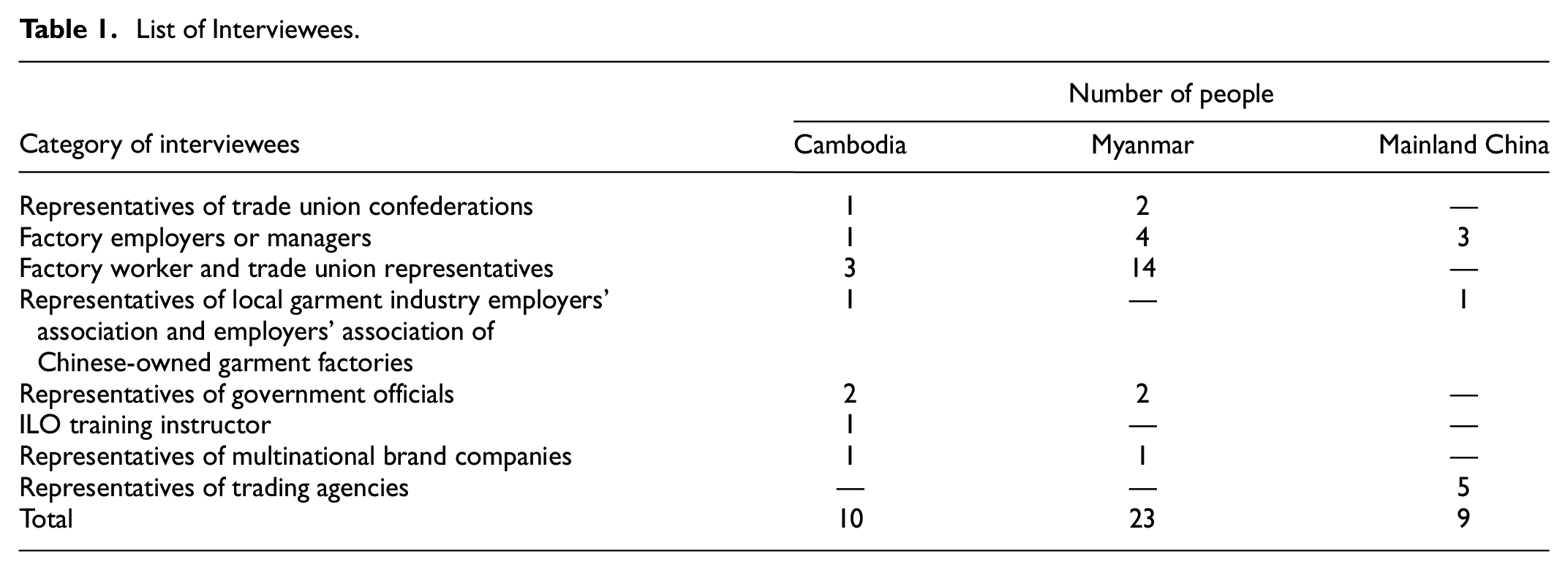
The data for this study were mainly obtained from interviews, field observations, and documents. Data were collected in three stages. In the first stage, the corresponding author traveled to Phnom Penh, Cambodia, Yangon, Myanmar, and Nay Pyi Taw in August and December 2019 to conduct field observations, during which the author interviewed representatives through local alumni connections and a snowball sampling approach, interviewing 25 respondents. In the second stage, from China, we conducted telephone interviews with employee representatives from several Chinese clothing trade companies based in Cambodia and Myanmar, all of which were done with the help of alumni connections, in August 2020. In the third stage, a Myanmar ER professor helped us collect interview data from eight workers and four supervisors of six Chinese-owned garment factories in Myanmar between October and December of 2022. The 42 interviewees were selected from among the Cambodian and Myanmar garment sector stakeholders, which involved 26 Chinese garment factories in the two countries. Interviewees included representatives of Cambodian and Myanmar trade union confederations, employers, managers, trade union and worker representatives from Chinese garment factories, representatives of local garment sector employers’ association and employers’ association of Chinese garment factories, Cambodian and Myanmar government officials, a senior ILO training instructor, and representatives of MNCs and trading agencies (see details in Table 1).
List of Interviewees.
The author, focusing on the theme of labor relations practices in Chinese enterprises, posed questions to the interviewees, covering four main areas. First, the author inquired about the basic situation of labor unions at the company and national levels in safeguarding workers’ labor rights, including the overview of labor unions, how they advocate for rights, challenges they face in the advocacy process, how they resolve labor disputes, and their connections with international labor unions and civil society organizations. Second, the author asked questions related to company operations and labor relations to employers, managers, and chamber of commerce representatives. These questions covered topics such as the reasons for Chinese companies investing abroad, difficulties encountered during operations, attitudes towards local workers and unions, relationships with multinational brand company clients and local governments, compliance with labor laws, and customer demands regarding working conditions. Next, the author inquired about issues related to code of conduct governance from representatives of multinational clothing brand companies and procurement intermediaries. These questions encompassed an overview of code of conduct governance, perspectives on and handling of supplier violations, and connections with other stakeholders. Finally, the author asked labor inspection department and arbitration committee representatives about labor inspection and judicial matters. The interviews were recorded by the corresponding author with the permission of the interviewees.
For observations, the corresponding author visited some factories, the offices of various civil society organizations, the labor dispute arbitration council, and trade union confederations. Additionally, the author witnessed a strike in a Chinese apparel factory, all of which aided in understanding the context and details. This study also reviewed the academic literature on ER of Chinese overseas firms as well as research reports issued by the ILO and NGOs on the Cambodian and Myanmar garment sector (see details in Table 2). Data from different sources can ensure the triangulation of data to enhance the construct validity of case studies.
Document Data List.

Note. CSO stands for civil society organizations; MSI stands for multi-stakeholder initiatives.
After collecting data, we analyzed it using the thematic qualitative text analysis method, a proven and tested method used in multiple research projects (e.g., Kuckartz, 2014; Miles & Humberman, 1994). The qualitative data was processed using Nvivo 11 software. In the first stage, important data was highlighted and memos were composed. In the second stage, main topical categories were developed based on research questions and the data was coded using these categories. In the third stage, passages assigned to each main category were compiled and sub-categories were created. All authors discussed and determined the sub-categories. In the fourth stage, the first and corresponding author coded all the data using the category system and established relationships between sub-categories and categories. Finally, the results were presented and discussed among the authors.
Case Analysis
Code-of-Conduct Effect or Country-of-Origin Effect?
Code-of-conduct effect and compliance to labor standards by Chinese overseas factories working in the global garment supply chain
All export-oriented Chinese-owned garment factories in Cambodia and approximately 30% of Chinese-owned garment factories in Myanmar are suppliers of lead firms in the global apparel supply chain (Tanaka, 2019), so their compliance to labor standards is subject to monitoring by lead firms. When lead firms show interest in purchasing from a Chinese garment factory, they usually require compliance with the code of conduct. They then conduct a labor-standards audit of the factory ER practices. After having passed the initial audit, the factory officially becomes a supplier of the lead firm. During the supply relationship, lead firms conduct routine follow-up monitoring of the supplier’s labor standards (Salmivaara, 2018). However, not all lead firms emphasize strict compliance with labor standards for Chinese suppliers. The level of importance placed on supplier compliance to labor standards varies among the lead firms. Some prominent lead firms implement more direct and rigorous monitoring of their suppliers’ adherence to labor standards. For example, the US apparel brand Gap has compliance teams in Cambodia and Myanmar to monitor compliance with labor standards in Chinese-owned factories (ILO, 2018, 2019; Oka, 2010, 2016). However, most other lead firms have a more distant relationship with their Chinese suppliers and use trading agencies to monitor their suppliers’ compliance with labor standards (Oka, 2010).
For the first research question, the analysis indicates that, for Chinese-owned garment factories based in Cambodian and Myanmar and that supply lead firms in the global garment supply chain, the code of conduct imposed by the lead firm is the main factor influencing the behavior and outcomes of compliance to labor standards (details see Table 3). Meanwhile, lead firms cooperate with the ILO in the process and receives its full support. In contrast, the country-of-origin effect does not significantly affect compliance with labor standards. Qualitative data from Cambodia and Myanmar (i.e., the results of interviews with all three types of actors) support this finding (Table 4).
Qualitative Data Coding Example Table.

Source. Compiled from this article.
Note. Reference point represents the number of times a specific code appears in the data.
Comparison of Code of Conduct Governance in Cambodia and Myanmar.

First, in terms of the interviews with employers and employer association representatives, the analysis shows that multinational brand companies actively develop and implement codes of conduct. The code of conduct of the lead firms significantly affects the degree of compliance with labor standards in Chinese-owned garment factories. A Chinese garment factory can only receive orders from the lead firms once it passes the code-of-conduct audit. For order fulfillment, the factory must be inspected by the lead firm. Conscious of the results of routine inspections by the lead firms, Chinese garment factories in Cambodia and Myanmar tend to comply with the codes of conduct, which prompts them to adhere to labor standards. The content of interviews with the owner of Factory F, a Cambodian Chinese-owned garment factory, supports this finding. Mrs. QF, the owner of Factory F, was sent to Cambodia by a garment company based in Dongguan city, China, to run the Cambodian branch—Factory F. The headquarters in Dongguan and the subsidiary in Hong Kong are responsible for receiving orders from garment production from European and American garment brand companies. After receiving the orders, the headquarters assign them to Cambodian Factory F. Mrs. QF stated the following: Lead firms, they are brand companies, and usually visit factories to check labour standards, unless these factories are in China. Lead firm always visit Cambodian factories to check labour standards. The customers come to the Cambodian factory to audit, and the audit process involves checking many aspects. The factory audit process is long and takes 1–2 years, so factories are compliant. To get orders from multiple customers, we need to comply with the codes of conduct of the multiple customers to follow the requirements of the different customers. After obtaining the order, customers regularly come to the factory to inspect.
The executive interviewed in Myanmar S Garment Co. expresses a similar opinion. Myanmar S Garment Co. is a subsidiary of S Corp in Jiangsu province, China, and primarily produces knitted garments and supplies for well-known European and American department stores and clothing brands such as Marks & Spencer in the UK and H&M in Sweden. S Corp is a state-owned garment enterprise and has long been receiving orders from lead firms in Europe and America. Due to factors such as the rising cost of labor and other production factors in China, S Corp moved its knitwear garments production to Myanmar. The interviewed executive of the Myanmar S garment factory said the following: We accept orders from several European and American customers, and each customer comes to audit the factory before placing an order, and if we do not pass the audit, we do not get the order. We improve and strictly comply with the requirements regarding workers’ working conditions and working hours as stipulated in the codes of conduct.
Second, based on interviews with workers and trade union representatives, the lead firms have stronger economic power than the suppliers. The competition between suppliers is strong, resulting in a buyer’s market. Violations of codes of conduct translate into a lack of orders. This puts great pressure on factories to improve their compliance with labor standards.
Three Cambodian garment workers who were interviewed agreed that the working conditions in the factory were generally good and said: Our work pressure is manageable, we don’t usually work overtime, occasionally we need to work overtime until 6 pm. At the same time, we get along relatively well with our supervisor. Although labour disputes sometime arise in the factory, the factory usually complies with the arbitration council’s awards on labour dispute. For this reason, we are not willing to change jobs.
Two Myanmar garment workers who were interviewed felt that the working conditions in the factory had improved to a greater extent and said that “workers are generally aware of labor laws because they learn about them through multiple sources. Also, compliance with labor laws in factories is not bad, workers are paid for overtime work. In general, working conditions in factories have improved.”
Cambodian and Myanmar trade unions recognize the economic power of the lead firms and often take advantage of the emphasis on supplier compliance to labor standards by well-known lead firms to protect worker rights. This frequently results in Chinese garment factories compromising, which has led to improvements in the compliance to labor standards by Chinese garment factories in Cambodia and Myanmar. A representative of the Cambodian Labor Confederation, the only independent union confederation at the national level, said the following: Last year, we settled two labour disputes in the garment sector, which could not be solved through the employer and the government. Our authority is greatly limited due to the complex trade union formation and strike process mandated by the Trade Union Law enacted by the government in 2016, as well as restricting the ability of independent trade unions to represent collective labour disputes. So we occasionally need to resort to lead firms to resolve labour disputes. These lead firms are large, well-known brands that are leaders in the global garment supply chain, such as Adidas, Nike, and Zara. We noticed that the lead firms have more power over the Chinese garment employers in Cambodia. If the employer does not follow the lead firms’s codes of conduct, the brand firms can stop the orders. When we inform brand firms about labour disputes, they take immediate action.
Third, interviews with representatives of lead firms and trading agencies indicate that their routine monitoring action places real pressure on the Chinese garment suppliers in Cambodia and Myanmar. Whenever lead firms and trading agencies find suppliers violating the code of conduct, they ask suppliers to make immediate corrections and severely penalize suppliers if major violations persist. Lead firms use these two approaches of routine monitoring and penalties to stop violations by Chinese suppliers. Thus Chinese-owned garment factories are obliged to improve compliance with labor standards. The representative of the trading agencies stated that “if our inspectors find any violations of the customer’s codes of conduct by the Chinese garment suppliers in Cambodia and Myanmar, they ask them to rectify the situation. We ensure that they meet the factory inspection requirements of our customers.” Similar views were voiced by the representatives of the lead firms: We value the labour standards of our Cambodian suppliers. Carters has a code of conduct that includes labour standards. If a Cambodian Chinese-owned garment supplier violates our code, first, we will warn them; second, our corporate social responsibility team will take care of the supplier’s compliance issues. If a supplier has a serious violation problem, we will immediately terminate business relations with them, so our Chinese suppliers have a high compliance rate.
This shows that lead firms in the global garment supply chain actively implement the codes of conduct. In addition, in leveraging the code of conduct to influence ER practices of Chinese garment suppliers, lead firms have initiated a series of collaborations with the ILO to further influence labor-standards compliance behavior in suppliers. For example, Adidas—one of the representatives of lead firms in the global garment supply chain—has partnered with the ILO to establish a social dialogue platform with the assistance of the Myanmar garment manufacturers association (ITUC, 2015). In Cambodia, brand companies have also partnered with the ILO to improve labor standards in the garment industry through the BFC program (Arnold & Shih, 2010). This finding different from Locke et al.’s (2007) study on Nike’s global supplier network and also deviate from Bartley’s (2015) findings on the Indonesian garment industry. Through a longitudinal analysis of global supplier compliance rating reports, Locke et al. (2007) discovered that supplier compliance ratings did not show significant improvement over the years. Bartley (2015) conducted a survey of over 600 companies in the Indonesian clothing, footwear, and electronics industries, revealing that the implementation of a code of conduct is unrelated to whether companies provide minimum wages or increase wage levels.
Country-of-Origin Effect and Compliance to Labor Standards for Chinese Factories Not in the Global Garment Supply Chain
Approximately 70% of Chinese-owned garment firms in Myanmar are not in the global supply chain. ER practices of Chinese garment factories that are not subject to a lead firm’s code of conduct exhibit the characteristics of employer unilateralism, with situations in which the employer unilaterally determines the terms of employment and the trade union has no bargaining role. The parent country ER model thus significantly influences compliance with labor standards. The qualitative data collected in Myanmar (i.e., the interviews with trade unions) could be interpreted to support this finding.
In an interview, the general secretary of the Myanmar trade union confederation (MICS) stated the following: Some of Myanmar’s small- and medium-sized Chinese-owned garment factories have seen illegal behavior such as employers unilaterally changing the terms of collective contracts, deducting employees’ social security funds and not remitting them to the government’s social security foundation required by law, and unilaterally dismissing workers who participate in union activities.
Although the working conditions in these factories are poor, the working hours are extremely long, and the workers are often not treated fairly, many workers still choose to work in these garment factories, mainly because of the higher pay. Several workers interviewed stated the following: In the period before the factory delivers to the customer, we are required to work quite long hours and under great pressure. In addition to working 14 hours a day, 6 days a week continuously, there are 2 to 3 days per month when we have to work overnight. The factory has high order volume, almost 1 to 2 orders per month, so the high work intensity is constant. In addition to long working hours and high work pressure, we also experience unfair treatment in the factory. Although the working conditions in the factory are poor, we still choose to come to work in the garment factory because of the higher income.
Employers in Myanmar’s Chinese-owned garment factories also use “Chinese style” incentives to keep workers working long hours at high intensity, such as piece-rate pay and material rewards. The worker representative interviewed stated: Employers will reward workers who exceed their goals. For example, a sewing worker has a goal of completing 30 garments in a day, and if that worker completes more than 30 garments, then the employer will reward that worker. In addition to paying us overtime wages, our employer sometimes gives us apples to compensate us for working overtime. Apples are very expensive in Myanmar, one apple is worth about 1500 kyats, while our overtime hourly wage is only 1200 kyats.
This research finding is highly consistent with existing research findings on ER practices in overseas Chinese-owned enterprises. Zhu et al. (2014) observes a significant alignment between the ER management philosophies of foreign subsidiaries and their Chinese parent companies, where managers typically embrace practices that are against unionization and cooperative labor-management relations. Scholars such as Andrijasevic et al. (2020) have found that the employment practices at Foxconn’s Czech plant share some similarities with those at Foxconn’s Chinese factories, including flexible labor arrangements, lower wage levels, dormitory management, and limited union representation.
The Contextual Effect of Host-Country Public Regulation
For the second research question, the analysis shows that compliance with labor standards by Chinese-owned garment factories in Cambodia and Myanmar is affected not only by the codes of conduct of lead firms in the global garment supply chain but also by public regulations in the host country. In Cambodia, public regulations exert a stronger influence on compliance with labor standards than in Myanmar. In addition, public regulations interact with codes of conduct to affect compliance with labor standards. In contrast, in Myanmar, the interaction of public regulation and codes of conduct has less impact on compliance with labor standards due to weaker public regulation.
Analysis of Cambodia
The Cambodian labor law framework was formed in the 1990s and developed further in later years. In 1993, The Cambodian government enacted the Constitution and then, with the support of the ILO, gradually ratified many core ILO labor conventions after 1999, including Convention 87, 98 and 100. The Constitution and the Labor Law of Cambodia grant workers and employers the right to form and join organizations, strike and lockout, and clearly define the procedures for registering organizations, signing labor contracts and collective bargaining, demonstrating ILO’s active role.
The Cambodian garment industry has a high unionization rate of 58% (BFC, 2013) with multiple trade unions in many factories, due to the freedom of association granted by labor laws. When workers’ legal rights are violated, trade unions defend their rights through negotiations with employers (based on interviews with representatives of trading companies and employers) and have achieved labor-management cooperation at the workplace level. The minimum wage is determined through industry-wide tripartite negotiations (Brignall, 2014; Salmivaara, 2018). Based on the theory of varieties of capitalism, the ER of the Cambodian garment industry exhibit the characteristics of ER in coordinated market economies, meaning coordination between firms and other actors (such as trade unions, employers’ associations and government) in the economy tends to rely on non-market means such as negotiation (P. Hall & Soskice, 2001).
Cambodia has a strong public regulation system. Labor laws lay the foundation for protecting workers’ fundamental labor rights, and the Cambodian government has strong labor-enforcement capabilities. Therefore, public regulation strongly encourages compliance to labor standards by Chinese garment factories and can interact with codes of conduct to further encourage compliance by Chinese garment factories. Qualitative data from Cambodia, namely, interviews with two types of actors and evidence from the NGO reports, support this finding.
Interviews with government officials and NGO reports indicate that the Cambodian government strictly enforces the law by conducting routine and unannounced inspections of Chinese garment factories and imposing fines on violators. In 2013, the Cambodian government established a labor inspection team to monitor compliance with labor standards in garment factories nationwide. According to a report released by Human Rights Watch (2015), the Cambodian labor inspection team conducted 1,686 inspections in the garment sector in 2014 and fined 25 companies for violations. In an interview, the labor ministry official said: “we have a labor inspection team of over 60 labor inspectors who routinely inspect compliance to labor standards of over 1,000 garment factories nationwide.”
In addition to routine inspections, the Cambodian government also conducts complaint-driven inspections of garment companies. Officials from the department of labor inspection interviewed stated the following: Workers and unions have channels to write and call us to complain about poor working conditions at their factories. Their complaints revolve around the payment of minimum wage, overtime, forced labour, discrimination, and labour-contract-related issues. When we receive a worker’s complaint, we deal with it immediately, sending one or two officers to the factory within a day at the earliest to solve the problem.
Second, based on interviews of employers and representatives of employer organizations, Chinese garment companies in Cambodia feel pressure to comply with the host law. Due to the stringent labor enforcement by the Cambodian government, they are motivated to comply with labor laws and regulations. A manager of a Chinese-owned apparel factory said: The government will inform us of the inspection date and the documents to be prepared in advance. Accordingly, we prepare the documents to be inspected, such as the labour certificate, before the inspection. As for other aspects of preparation, there is nothing more to prepare because we usually obey the labour law strictly.
Representatives of the association of Cambodian garment employers view government labor inspections as a key mechanism promoting compliance with labor standards in Chinese apparel factories: “we believe that an important factor in promoting compliance with labor standards in Chinese-owned garment factories is government labor inspections; the labor inspectors give high priority if they find a high number of violations in the factories.”
Three Cambodian garment workers who were interviewed concurred that the Cambodian government has a strong capacity to enforce labor law: Once a strike occurs in a factory, government officials will come to the factory to deal with it. Government officials will handle the strike as required by labour law, and they are neither on the side of the workers nor on the side of the employers. In addition, the arbitration council is both efficient and fair. The arbitration council usually makes a decision on a labour dispute within half a month, and the factories normally execute the arbitration awards.
Analysis of Myanmar
In an effort to end the international economic sanctions against Myanmar, the government undertook labor legislative reforms in 2011, enacting the Labor Organization Law in 2011 and the Settlement of Labor Dispute Law in 2012. During the drafting of these two laws, the Myanmar government actively sought technical support from the ILO. For example, the ILO Myanmar office provided detailed recommendations to the government on Convention No. 87, Freedom of Association and Protection of the Right to Organize and other core conventions (Henry, 2015). This was followed by the Labor Organization Law, which grant workers and employers the right to form and join organizations of their choice, engage in collective bargaining and gave workers and employers the right to strike and lockout (Gillan & Thein, 2016). Thus, the ILO played a positive role in Myanmar’s labor legislation.
After enacting the Labor Organization Law and the Settlement of Labor Dispute Law in 2011 and 2012, trade unions began to emerge in Myanmar garment industry. However, the unionization rate is low at 3% in 2021 (based on an interview with the MICS deputy secretary general). Collective bargaining on workers’ wages and benefits usually takes place at the workplace level, and trade union often resort to radical means such as protests and strikes when labor and management cannot reach an agreement. For example, between 2012 and 2014, 447 protests and strikes were launched by trade unions in Myanmar’s garment sector to demand better working conditions, and almost all strikes were not conducted according to legal processes (ITUC, 2015). This indicates adversarial labor-management relations at the workplace level, and based on the varieties of capitalism theory, ER in Myanmar garment sector display characteristics of ER in liberal market economies, where coordination between firms and other actors in the economy (such as trade unions and government) tend to rely on market mechanisms such as contracts (P. Hall & Soskice, 2001).
Public regulation in Myanmar is weak, although its labor laws provide a foundation for protecting workers’ fundamental labor rights. For Chinese-owned factories subject to codes of conduct, the interaction between public regulations and codes of conduct for compliance with labor standards is also weaker than in Cambodia due to the government’s weak enforcement capacity. In contrast, Chinese garment factories not obliged to follow a lead firm’s code of conduct often ignore labor laws, and their compliance with labor standards is more strongly affected by the country-of-origin effect. The interview data for both types of actors support this conclusion.
An interview of representatives of employers and employer organizations indicates that the Myanmar government has insufficient capacity to regulate illegal trade union strikes. In addition, the mechanism for settling labor disputes is inefficient. The secretary-general of the Myanmar Chinese garment employer’s association and a manager of a Chinese apparel factory said the following in an interview: “the Ministry of labor often ignores illegal union strikes in Chinese-owned garment factories. The government will not intervene unless a criminal incident occurs during a strike.”
Conversely, the weak labor regulations by the Myanmar government permits to some extent violations of the codes of conduct by some Chinese garment factories. One executive of a Chinese garment factory stated the following in an interview: We cannot meet some customer requirements related to the trade union, for example providing paid leave and permission for union representatives to enter and leave the plant freely at any time. If these demands are met, we will not be able to survive.
Second, based on interviews of workers and trade union representatives, we find that employment practices are significantly affected in Myanmar by the country-of-origin effect in Chinese-owned garment factories not subject to a code of conduct of a lead firm. Given the lack of labor inspections by the Myanmar government, Chinese garment factories indulge in frequent violations of labor laws. The violations involve frequent excessive working hours, managers refusing to allow associative freedom and collective bargaining, and an absence of social security. Similar finding on wages and overtime were found in a survey conducted by ALR of workers in factories that are owned by Korean owned garment companies in Myanmar (ALR, 2016). A worker in the Chinese-owned garment factory said the following in an interview: We work 10 to 14 hours a day during the week, with normal working hours from 7 am to 7 pm and overtime hours from 7 pm to 9 pm, six days a week. We occasionally must meet deadlines and work overnight two to three days per month.
One interviewed worker in a Chinese-owned garment factory said the work is extremely intense: “all workers work very hard because the supervisor will keep pushing us to speed up our work, which causes us to not be able to stop at all.” The general secretary of MICS, one of the trade union confederations in Myanmar, said the following in an interview: In some small and medium-sized Chinese garment factories in Myanmar, employers unilaterally changed the terms of collective contracts, deducted workers’ social security funds and did not pay them to the government, and unilaterally dismissed workers who participated in union activities.
A worker in a Chinese-owned garment factory said: “I and several other workers tried to form a union in the factory but ended up being sued by our employer and sentenced to jail for it.” The strength of public regulation in the host country is thus an important contextual factor. For Chinese overseas factories in the global garment supply chain, the interaction between the code-of-conduct effect and public regulation produces significantly stronger compliance with labor standards when public regulation is strong, such as in Cambodia. In contrast, the opposite is true in countries with weaker public regulation, such as Myanmar. In contrast, the country-of-origin effect largely determines the compliance to labor standards of Chinese garment factories that are not in the global garment supply chain and that operate in countries with weak public regulation.
Discussion and Conclusion
The theoretical framework of ER for the overseas subsidiaries of MNCs has evolved from the country-of-origin effect (Bae et al., 1998; Ngo et al., 1998) to the host-country effect (Ferner, 1997; Marginson & Meardi, 2006). However, given the changes in the business environment of the last decades, particularly with the formation of global supply chains and the emergence of codes of conduct imposed by lead firms, it is significant to review the analytical framework of the country-of-origin effect to see how it affects the ER practices of the overseas subsidiaries of MNCs. This article responds to the need for reconstruction of this theoretical framework and also to Cooke et al.’s (2019) call to analyze the factors that determine the employment practices of overseas Chinese companies from a perspective of the global supply chain. The results of the case study of Cambodia and Myanmar provide empirical evidence that codes of conduct are a determining factor in the ER practices of Chinese overseas garment firms.
The first finding is that the Chinese garment factories in the global garment supply chain comply with the codes of conduct imposed by the lead firms no matter based in Cambodia and Myanmar. This finding differs from existing research findings based on developed countries. To receive orders from lead firms, these Chinese garment factories must comply with these codes of conduct, which shows the market power are the primary influence on factory ER practices, with institutional forces in the host country playing a secondary position. After passing an initial audit, these factories are offered orders and are subject to follow-up inspections by the lead firms; passing these inspections is required to continue to receive orders from the lead firms. In addition to routine inspections by the lead firms, workers have a complaint mechanism, which has led Chinese garment employers to be proactive in complying with labor standards in the production process. Compliance with labor standards helps protect workers’ rights. In leveraging codes of conduct to influence ER practices of Chinese-owned garment suppliers, lead firms have also initiated a series of collaborations with ILO to further impact suppliers’ labor-standards compliance behavior. This behavior indicates that lead firms are actively implementing the code of conduct, which aligns with the views of Eyvazpour et al. (2021), who suggest that lead firms require suppliers to maintain ethical behavior in order to uphold a positive image.
Theories evolve with practice, and the country-of-origin effect and host-country effect, as well as contingent effects, do not consider the specifics of the global supply chain in explaining the ER of overseas subsidiaries of MNCs. However, since this theoretical framework emerged, a global supply chain has developed in the electronics and garment industries, and in both supply chains, codes of conduct developed by lead firms have influenced the ER of MNCs. In recognizing the dominant position of lead firms in the global garment supply chain, ILO has partnered with lead firms to advance core labor standards. The effect of codes of conduct that emerges in the theoretical framework corresponds to the new context of global supply chains. Therefore, we conclude that whether the code-of-conduct effect or the country-of-origin effect dictates compliance to labor standards by Chinese-owned garment factories based in Cambodian and Myanmar depends on whether these firms are subject to codes of conduct. The compliance with labor standards by Chinese-owned firms in the global garment supply chain is significantly affected by the lead firms’ codes of conduct. For Chinese factories not in the global garment supply chain, their compliance with labor standards is significantly affected by the country-of-origin effect. Based on the above discussion, we propose:
Proposition 1a: The compliance of labor standards in overseas Chinese clothing companies will be influenced by codes of conduct or country-of-origin effects, depending on whether they are subject to codes of conduct.
Proposition 1b: Overseas Chinese companies operating in the global apparel supply chain will be significantly influenced by codes of conduct in their labor standards compliance behavior.
Proposition 1c: Overseas Chinese companies that are not part of the global apparel supply chain will be significantly influenced by country-of-origin effects in their labor standards compliance behavior.
However, when studying the ER of Chinese overseas firms, we cannot ignore how the host-country effect influences compliance to labor standards. The host-country effect is a concrete manifestation of state power in Cambodia and Myanmar. The literature highlights the role played by the host-country effect in shaping ER of overseas subsidiaries of MNCs. Ferner’s (1997) study of European multinationals shows that the ER of these companies are grounded on the characteristics of the host-country ER model, such as the Anglo-American model, the German model, or the Japanese model, which influence the ER of overseas affiliates of European companies. In contrast with host-country institutional factors, the study by Meardi et al. (2013) shows the importance of sector by finding that MNCs in the highly internationalized automotive industry do not transfer employee direct participation practices to their Czech subsidiaries, while MNCs in the financial industry, which are at a low level of internationalization, transfer complex direct employee participation practices. These studies show that the host-country effect and the sector effect are determinant factors for the ER of overseas subsidiaries of MNCs. Andrijasevic et al. (2020) studied the ER practices of overseas subsidiaries of Chinese companies and found that the institutional environment of the host country affects the practices of overseas subsidiaries.
The case study results in this article indicate public regulation in Cambodia significantly affects the compliance of Chinese garment factories with local labor standards. On the other hand, the codes of conduct imposed by lead firms in the global garment supply chain also contributes to this compliance. A reasonable explanation for this scenario is the practice of BFC, it has increased the public regulatory capacity of the Cambodian government and thus put pressure on Chinese garment factories to comply with labor standards. From this, we find that the Chinese garment factories subject to the code of conduct have made significant progress in their compliance with labor standards under public regulatory control in Cambodia. Interesting results emerge from the Myanmar case study. Public regulation plays a minor role in improving labor standards compliance. Even if public regulation plays a role, it is because lead firms require Chinese-owned garment factories to comply with local labor laws. However, the 70% of Chinese apparel companies that are not subject to a code of conduct are not obliged to comply with labor standards because of the weak labor regulatory climate in Myanmar. This leads to a second important conclusion: the regulatory environment in the host country plays a pivotal role. For Chinese garment factories in Myanmar not bound by a code of conduct, the influence on their labor standards compliance is lessened by the combination of public regulation and the country-of-origin effect. In contrast, public regulation carries more weight in Cambodia for factories adhering to a code of conduct, resulting in a more pronounced impact on labor standards compliance. Conversely, in Myanmar, where public regulation is less stringent, codes of conduct exert a weaker influence on labor standards compliance. Based on the above discussion, we propose:
Proposition 2: The influence of codes of conduct on the labor standards compliance behavior of overseas Chinese clothing companies will be affected by the intensity of public regulation. In countries with strong public regulation, the impact of codes of conduct on labor standards compliance behavior will be stronger. Conversely, in countries with weak public regulation, the influence of codes of conduct on labor standards compliance behavior will be weaker.
This paper makes three contributions to this field of research. First, it provides empirical evidence of how compliance to labor standards of Cambodian-Myanmar Chinese garment factories in the global garment supply chain is influenced by the codes of conduct developed and implemented by lead firms. It indicates that buyer power intervenes in the ER practices from the perspective of globalization. This paper also responds to the current trend of ER theory development, which emphasizes the need to address the challenges posed by globalization (Kochan et al., 2016). Global supply chains are a concrete manifestation of globalization, and the global garment supply chain in particular is a worthy research subject. Second, this study finds that the country-of-origin effect is activated under some conditions. That is, Chinese overseas factories comply with labor standards only when they are suppliers for lead firms in the global supply chain. The third contribution of this study is the finding that the strength of public regulation in the host country is an important contextual factor. Some countries, such as Cambodia, combine comprehensive labor laws with strong labor regulation systems. In contrast, other countries, such as Myanmar, have comprehensive labor laws but weak labor regulations. The interplay between public regulation and the code-of-conduct effect or country-of-origin effect produces different incentives for companies to comply with the labor standards. Although this article presents a new case study that compares Chinese firms in two Southeast Asian countries and focuses on a typically global garment supply chain, it remains limited by an inherent problem of case studies, namely, that data is acquired from only two countries and one sector. Future research is needed to investigate the garment industry in other countries, such as Bangladesh and Vietnam. In addition, such studies should focus on more industries whose lead firms have codes of conduct, such as the global electronics supply chain.
Supplemental Material
sj-docx-1-sgo-10.1177_21582440241300863 – Supplemental material for Country-of-Origin or Host-Country Effects? Code-of-Conduct Effect and Labor-Standards Compliance in Chinese Overseas Garment Factories: The Cases of Cambodia and Myanmar
Supplemental material, sj-docx-1-sgo-10.1177_21582440241300863 for Country-of-Origin or Host-Country Effects? Code-of-Conduct Effect and Labor-Standards Compliance in Chinese Overseas Garment Factories: The Cases of Cambodia and Myanmar by Xiaoli Hu, Min Li, Yan Huang and Hailong Jia in SAGE Open
Footnotes
Acknowledgements
Xiaoli Hu and Min Li contributed to the work equally and should be regarded as co-first authors.
Declaration of Conflicting Interests
The author(s) declared no potential conflicts of interest with respect to the research, authorship, and/or publication of this article.
Funding
The author(s) disclosed receipt of the following financial support for the research, authorship, and/or publication of this article: This research is funded by Major projects of the Chinese National Social Science Foundation (Grant Number: 21BGL027).
Ethical Approval
An ethics statement is not applicable.

Data Availability Statement
Data sharing not applicable to this article as no datasets were generated or analyzed during the current study.
Supplemental Material
Supplemental material for this article is available online.
References
Supplementary Material
Please find the following supplemental material available below.
For Open Access articles published under a Creative Commons License, all supplemental material carries the same license as the article it is associated with.
For non-Open Access articles published, all supplemental material carries a non-exclusive license, and permission requests for re-use of supplemental material or any part of supplemental material shall be sent directly to the copyright owner as specified in the copyright notice associated with the article.
