




Abstract
This article is inspired by the considerable popularity of subtitled translations of YouTube videos in Mandarin on Bilibili, one of the largest online video streaming sites in China. Drawing on Bourdieu’s field theory reframed for digital media, this article uses Youzimu, a YouTube-focused fan subtitling channel on Bilibili, as a case study to explore how Youzimu fosters a self-mediating network for translating YouTube videos into Mandarin, and the extent to which fan translators reproduce the original YouTube videos through their autonomous endeavors. The results indicate that Youzimu’s self-mediated network is predicated upon the ongoing exchange of diverse forms of capital, affording fan translators within the platform a degree of productive autonomy in their translation efforts. Nevertheless, the channel’s adherence to regulatory frameworks governing online streaming and the unofficially sanctioned status of YouTube within China imply a heteronomous principle of hierarchy within the fan subtitling ecosystem.
Plain language summary
This article talks about how popular subtitled translations of YouTube videos in Mandarin are on Bilibili, a popular Chinese video streaming site. It looks at a specific channel called Youzimu that focuses on translating YouTube videos. The article uses a theory by Bourdieu, adapted for digital media, to study how Youzimu creates a network for translating videos and whether these fan translators reproduce the original videos or add their own ideas. The findings show that Youzimu’s network is based on fans exchanging different kinds of capital, giving them some freedom to translate. However, due to the rules about online streaming and YouTube being banned in mainland China, Youzimu operates within certain limits set by authorities, affecting how independent they can be.
Keywords
Introduction
As a global phenomenon, the rise of streaming media has effectively undermined previous linear flow patterns of media distribution and consumption (D. Wang, 2022). During the lockdown and self-quarantine period of Covid-19 pandemic, online streaming sites have facilitated the access to essential recourse for people to seek everyday news or public health information. Creative means of knowledge or entertainment transfer are practiced by both professional and amateur sectors who utilize digital platforms to communicate with a large and geographically distant population (T. K. Lee & Wang, 2022). This surge has contributed to reconfiguring our understandings of the traditional mediasphere and have further complicated the dynamics between various relationships including professional and amateur, producer and consumer, center, and periphery. In a mediasphere where the state plays a dominant role in supervising the entire media industry, international online platforms including video streaming sites YouTube, Netflix, and Apple TV are not available in China’s mainland. This unique media landscape enables domestic streaming sites to gain a long-term significant position in generating a specialized online field of video streaming.
In order to get access to the global media trend, Chinese netizens are involved in a process of self-importing and self-translating the videos from foreign video streaming sites (Li, 2015; Guo & Evans, 2020; Kung, 2016; D. Wang & Zhang, 2017). One of such examples are fan translation channels built on Bilibili (or known as “B site” by Chinese netizens), who translate enormous YouTube videos to domestic Chinese netizens through post subtitling. Considering its deep-ingrained orientation toward animation, comic and games (ACG) culture and the affordance of free access, Bilibili significantly differs from other major video streaming sites like Youku, iQiYi, and Mango TV in China in terms of its focus on facilitating user-generated content (UGC) and user participation (Yang, 2020). Unlike official-produced media, the building of platform’s exclusive “uploaders” and the creation of danmu interface (i.e., live comments that run across the screen as the video plays) have become signatures of Bilibili. Featured on pseudo-synchronicity and virtual liveness of danmu (Johnson, 2013), viewers are given extensive agency to participate in the scene and interact with other fans on Bilibili wherever possible. As Yin and Fung (2017) note, once a danmu resonates with other viewers, a discussion may well be created in a moment. As a result, Bilibili functions more like a social media platform that encourages the construction of social ties and features a unique field that user participation weighs more than streaming itself.
Rather than demonstrating a top-down administration strategy in video streaming, Bilibili’s own emphasis on usership is the core characteristic of its policies in regulating its members (Yin & Fung, 2017). Its focus on user-generated videos, danmu, and fan channels are all important values in Bilibili’s bottom-up strategy to potentially change the hierarchies between dominating sector (official-produced video streaming) and dominated sector (user-generated video streaming). Whilst no cultural practice operates fully outside the field of power (Bourdieu, 1990), it is crucial to note that the current study does not regard Bilibili as a thriving practice that transcends the dominant media portal in China. Through a case study on Youzimu, one of the largest YouTube-focused fan subtitling (i.e., fansubbing) channels on Bilibili, this article focuses on the social-digital dynamics of fansubbing, particularly exploring two research questions: (1) How does Youzimu channel foster a self-mediating network for translating English YouTube videos into Mandarin? (2) To what extent do fan translators in Youzimu reproduce the original YouTube videos through their supposedly autonomous activities? In order to answer the above questions, this paper applies Bourdieu’s field theory as refined in a digital context, to analyze the role and dynamic activities of fan translators on a YouTube-focused translation channel on Bilibili.
Literature Review
The Rise of Video Streaming Sites in China
The convergence of media and technologies has changed the traditional production and delivery mode of China’s television industry. New technologies of the Internet are less geographically constrained and provide audiences with greater access ever than before, varying from cable TV to digital TV, from smart TV to online streaming TV (Keane & Zhao, 2016). The rise of Chinese online streaming companies, as G. Zhang and Hjorth (2019, p. 808) argue, is “emergent, volatile and heavily influenced by various global actors” rather than instantly settled as “an enclosed area of Chinese characteristics.” They work as an assemblage of fragmentary international networks, regional influences from neighboring countries such as Japan and Korea, domestic media histories and user habit. In about 2005, Chinese online video streaming sites modeled after YouTube began to appear, where Youku, Tudou, and 56 were primarily held platforms that received crucial backing from foreign venture capital firms including Sequoia Capital and IDG Capital Partners (Zhao, 2016), nurturing enormous new genres that predominantly focus on UGC and rapidly transcending official-sanctioned TV due to their broadcast medium and content.
Digital platforms have transformed the viewing experience of youth demographic and are becoming inextricably linked to multiplatform viewing interfaces. The penetration of economic, political and cultural sectors has internalized many actors in to the platform ecosystem and gradually transformed in to a hybrid form “platform society” (Van Dijck et al., 2018), constructing a “connected viewing” model where social media and other user interactions begin to merge (Zhao, 2019, p. 110). W. Y. Wang and Lobato (2019) underline that video streaming platforms in Chinese model are far more than just a digital platform as understood in English. The term “platform,” or ping tai [
Online Fan Translation Communities
Early in 2009, translation scholars Perrino (2009) and O’Hagan (2009) emphasize the increasingly important role that amateur translators play in voluntarily rendering media to massive online users who somehow do not have permissions to the original source. Flew and Cunningham (2010, p. 53) describe people who create UGC as “both re-mediators and direct producers of new media content engage in new forms of large-scale participation in the digital media spaces.” Apart from transferring language, amateur videos are also used as a speech act that facilitates the engagement of public with a chance to break national and linguistic boundaries. As Pérez-González (2010, p. 335) suggests, amateur translators in audiovisual field have become more involved in a broader movement of “cultural resistance against global capitalist structures and institutions” through “interventionist modes of mediation.” Thanks to the highly interactive and participatory technologies, like-minded amateurs are able to socialize and construct online networks at the same time of completing a translation task (Diaz-Cintas & Muñoz Sánchez, 2006; Lu & Lu, 2021a; Massidda, 2015; D. Wang, 2017; Wongseree, 2020; W.Zhang & Mao, 2013). The Internet start-up company, ViKi, provides a pioneer example of fansubbing network that re-animates concepts of global variety. Aiming to dismantle the “national and linguistic hierarchies” that “dominate contemporary media and professional audiovisual translation,” Viki has internationalized global discourse and enabled more minority language pairs’ materials to be translated and available on their streaming platform (Dwyer, 2012, p. 217). Together with the increasing language pairs, the translated genres in fansubbing range from animations to TV soap operas, films to daily vlogs (S. Lee, 2021).
The tight import quota on official sanctioned portal and the robust cyber system, known as “The Great Firewall of China,” have mushroomed the construction of Chinese online fansubbing communities. As Li (2015, p. 9) notes, a Chinese fansubbing network is based on a “mutual dialectic” between technological infrastructure and social actions, where it is built inside the community through a codified hierarchical system in which individuals are advanced by substantial contributions, expertise, various engagement in QQ (i.e., a Chinese social media platform managed by Tencent company, providing various online services such as instant message chatting, blogging, game, and payment) and online forum. By utilizing the right occasions to “strike and divert resources to its own method of circulation,” Chinese online fansubbing communities have internalized neoliberalism through their “enormous capacity to absorb and redistribute images from multiple global sites” (Davis & Yeh, 2017, para. 17). Utilizing a decade’s worth of experiences within Chinese fansubbing communities, fan translators are regarded as grassroot martial heroes who gather to form an alliance against dysfunctional laws and powerful organizations through acts of chivalry (Li, 2013). The non-professional translation communities they construct not only dismantles linguistic barriers for fans and viewers, but suggest the potential connection between user-generated translation efforts and a deeper insight into how the world perceives China through grassroots expressions of opinions, particularly during the pandemic period where physical interaction is restricted (Ding et al., 2021). Domain-knowledge and creative strategies at both linguistic and typographical level are often deemed as advantages which make their production outperforms the work of professional sectors (Lu & Lu, 2021b). Rather than restricted by the orthodox standards, fansubbing appears to show a technology-facilitated activism with the potential to “liberate ordinary citizens from authoritarian and commercial imperatives” (D. Wang & Zhang, 2017, p. 301).
Rethinking Bourdieu’s Field Approach to UGC Platforms
This article adopts Bourdieu’s field theory, reframed for analysis within the digital media landscape, to investigate the activities and dynamics of fan translators operating within a YouTube-centric channel on Bilibili. In essence, a field is defined as “a network, or a configuration, of objective relations between positions” with its own fundamental rules, norms and structure (Bourdieu & Wacquant, 1992, p. 97). Within any given field, internal autonomous forces and external heteronomous forces, stemming from broader power structures, shape its dynamics. The social dynamics of a field is centered on the constant competitions where agents, who, “constantly work to differentiate themselves from their closest rivals” (Bourdieu & Wacquant, 1992, p. 100), struggle for certain social positions or distinctions. Bourdieu (1986) defines four principal dimensions of capital in position-taking: economic capital (e.g., money or property rights), cultural capital (e.g., knowledge, skills, language), social capital (e.g., social connections or networks), and symbolic capital (e.g., honor, status and recognition). The convertibility between different dimensions of capital is a basis for maintaining the reproduction of capital to generate distinctions.
Bourdieu’s analytical concepts were originally crafted to explore the dynamic activities in offline world, with relatively less attention devoted to practices mediated by technology and online social interactions. Scholars such as Di Stefano (2016) and Herzig (2016) acknowledge the ambiguity of classic Bourdieusian concepts in the study of digital media and online communication, and advocate for methodological approaches that integrate the examination of online activities with an understanding of both social actions and the unique affordances of digital platforms. Following Bourdieu’s argument about power relations, Levina and Arriaga (2014) propose a concept of online field, which provides a theoretical foundation for studying the social-digital dynamics of online UGC platforms. According to Levina and Arriaga (2014, p. 477), an online field is defined as “a social space engaging agents in producing, evaluating, and consuming content online that is held together by a shared interest and a set of power relations among agents sharing this interest.” Agents differentiate themselves online by accumulating recognition or “attention capital” (Levina and Arriaga, 2014, p. 477) generated through various streaming contributions by participants. As Levina and Arriaga (2014) note, attention capital may refer to Bourdieu’s symbolic capital on UGC platform, which implies the social crediting of online user’s earned attention and status.
Drawing on Bourdieu’s field theory as reframed by Levina and Arriage for UGC platforms, this article argues that subtitling YouTube videos on Bilibili has generated a specialized field, holding like-minded participants together with a shared interest and purpose in YouTube translation. Searching for “YouTube” on Bilibili yields thousands of videos and fan channels. Agents in this field tend to pursue distinctions through translating YouTube videos for rising to a higher position. For fan translators, distinction and acknowledgment are accumulated through the translation of valuable YouTube content and the subsequent elevation of their channels’ visibility. On Bilibili, such recognition accumulates mainly based on the attention received along five dimensions: the number of subscribers, likes, viewings, comments and danmu. Enhanced ratings and reviews from viewers contribute to the popularity of translated videos, thereby augmenting the status and acknowledgment of the channels. Viewers, in turn, wield their cultural capital, manifested through their tastes and knowledge, to evaluate translated videos and confer status upon fan translators. On Bilibili, viewers are granted extensive agency to participate in rating and interacting with their peers through utilizing platform’s user-friendly affordances. They can demonstrate their appreciation by subscribing to a channel or providing ratings to the videos they consume. On the other hand, viewers’ contributions determine their own ranking, ranging from level 0 to level 6, prominently displayed alongside their online pseudonyms. They are thus motivated to voice their opinions and initiate discussions with peers in order to gain a higher level. As a result, viewers with higher-level status often gain more attention capital, as their comments are often regarded as more valuable and are shown above others’ in the comment zone.
Platform designers represent another significant cohort of actors wielding greater agency within this field. According to the terms of service (see here) on its website, Bilibili is operated, designed, and managed by the Shanghai Kuanyu Limited, a Chinese technology and Internet company that provides online streaming services. They possess considerable authority in designing visible status markers (e.g., viewer level status, channel rating system) as well as tracking ratings and views of videos in order to convert them into streaming traffic. Over time, the Bilibili platform has evolved distinctive mechanisms for accumulating recognition and status through the collective engagements of diverse groups of actors.
It is useful, then, to consider such fan translation streaming platform as a “field” in which there is constant competition for various sorts of “capital.” Fan translators are fully aware that active and positive ratings from viewers sustain their online status; they seek to accumulate attention capital within the field by contributing content (i.e., translating YouTube videos) that viewers may deem valuable. Viewers then differentiate among themselves by gaining attention capital through various rating activities as they evaluate the translated content. They vote on its value, which often exerts great influence on fan translators. The development of socially technical systems by the platform designers is also essential to enable capital competitiveness. They determine how attention capital is allocated within the field by manipulating which viewers are targeted with which fan translators’ content, and which videos are promoted or demoted. Therefore, it is the differentiation among and positions of fan translators, viewers and platform designers that shape the dynamics of action in this field of fansubbing. This process of capital accumulation underscores the viability of analyzing a fan-focused channel dedicated to translating YouTube videos on Bilibili through the lens of Bourdieu’s field theory as reframed for UGC platforms.
Methodology
Researching Youzimu Channel
As previously indicated, Bilibili stands apart from other Chinese media streaming services owing to the extent to which it encourages UGC and user engagement (Yang, 2020). According to Bilibili’s 2022 Annual Business Q4 Report published on its Investor Home, the platform received 93 million daily active users, and the average day time spent on the platform reached 96 min, with 3.9 billion average daily video views. Among millions of uploaders and channels, Youzimu was selected for the purpose of this study based on its tag and metadata (i.e., YouTube translation and fan community) that the producers used to define their content theme and the popularity. By the date of this study, Youzimu received over 11,680,000 likes, 12,700,000,000 views, and 3,639,000 subscribers. Such relevance on fan translation and its high popularity implies that the channel has been effective and successful in attracting a large number of viewers interested in the translation of YouTube videos and their media practice is worth investigating. Youzimu channel includes four major sections that can be identified as follows:
1. Youzimu Life and News—translation of life vlogs, news, celebrity interviews, and entertainment shows.
2. Youzimu Science—translation of science videos, DIY guides, and digital evaluation on IT devices.
3. Youzimu Fun—translation of short funny and spoof videos.
4. Youzimu Movie and Music—translation of movie and TV trailers, European and American pop music MV, and music awards ceremonies.
Until the end of my study on 31 December 2021, 10,720 videos that fit different sections have been posted and the channel continues to update one or two new videos daily. As the number of videos in Youzimu is substantial, for the purpose of this study, only videos uploaded during my research (between 1 March 2021 and 31 December 2021) were observed for analysis. On 1 March 2021, I registered myself as a Bilibili member after passing an entry quiz and began to conduct a 10-month observation on Youzimu channel. Endowed with various platform-specific affordances, I decided to participate in the channel’s actual translation process to investigate Youzimu’s internal productive mechanism. The recruitment information for new translators is published at the bottom of each video on the Youzimu channel, including two QQ account numbers (one for scripting and translation training group; one for timing and editing training group). The group that new participants join may depend on their preferences and areas of expertise. On 10 April 2021, I sought to join the scripting and translation training group using my expertise in subtitling. However, when I sent my request to the QQ account administrator, the top message in QQ showed that the group was over-crowded, and new members would need to wait for a test—not yet scheduled—to join the official QQ group. I then sent my request to the timing and editing group, which elicited a similar response.
I then found a “A Must-read Handbook for New Members” in the QQ group documents for the scripting and translation training group, which described the entire recruitment process and provided detailed instructions in translating for Youzimu. According to the “A Must-read Handbook for New Members,” new participants can find a series of files in the group documents to complete their first phase of “self-training.” The training includes listening to and translating a short 3-minute science video named The Science of Bacon, following the translation guidelines found among a range of files that had been uploaded to the QQ group documents: “Tutorials for Youzimu Beginners,” “Instructions for Timing,” “The Subtitling Guidelines,” “Training Process and Evaluation Rules in Youzimu,” and a zipped package of film resources that can be used for practice. I chose to spend a week on this self-training as instructed and then acted as a trainee translator in the QQ group to observe the channel’s website.
As the aforementioned documents are all publicly available, and they already contained valuable information in relation to Youzimu’s internal productive mechanism and translation guideline, I stored them in Evernote, a note-taking and document archiving tool. During the observation period, I also used Evernote to capture screenshots, video links and my own observational notes and comments of the channel’s website. My observational notes primarily consisted of personal thoughts and impressions as a trainee translator in Youzimu, which proved to be a useful tool in identifying the underlying patterns of dynamic activities in naturally occurring settings and later make sense of the research questions for the study.
To analyze the observational notes, a coding-based method was used to extract core meanings and consistencies from the qualitative materials. This involved converting raw notes into specific categories and themes that addressed the two research questions. As Kozinets (2010) mentions, coding enables researchers to turn the collected and various downloaded textual and graphical screen captures into a finished research representation. For the purpose of this study, two steps of coding approaches, namely deductive approach and inductive approach, were used (see Figure 1). Deductive approach, as Berg (2001) indicates, refer to the coding where the research has already generated a series of predetermined themes based on the theoretical framework applied; inductive approach, on the other hand, involves the process that categories and themes arise after careful examination of the raw data. As Figure 1 shows, the first-level coding used deductive approach by suggesting two major themes (i.e., capital accumulation and conversion in Youzimu, productive autonomy in Youzimu) with four sub-themes (i.e., cultural/symbolic capital, social capital, autonomous production and heteronomous production) based on a Bourdieusian field theory as explained in previous section. As Miles and Huberman (1994, p. 9) suggests, the analytic arrangements in sequence for the coding involves coding, noting, abstracting and comparing, checking and refining, generalizing and theorizing. Following these steps, in the second-level of inductive coding, I then read the data carefully and used my colored pen to find sub-patterns, highlight relevant excerpts, and inserted them into the wider categories as illustrated in the first-level coding.

Two levels of coding map (first-level coding in purple, second level coding in pink).
Results and Discussions
Youzimu’s Competition for Capital in Building Fansubbing Networks
Youzimu and Cultural Capital
Translating YouTube in Youzimu is recognized as a field with its own norms and values, and as having various resources of cultural capital that may involve knowledge, taste, competence and symbolic power, permitting social actors to comprehend “cultural traditions and internalized codes” (Bourdieu, 1986). One of the most renowned aspects of Youzimu is its presence of cultural capital through building its own subtitling norms and identity. Although the transplantation of new online forms (e.g., fansubbing-style subtitles) has been considered a dynamic practice that may have the potential to move toward the professional end of the spectrum (Zhao, 2019), current officially sanctioned Chinese TV or film’s subtitles still serves only a referential purpose, and feature a stable “one-size-fits-all” solution employing a mono color and neutral pattern (Lu & Lu, 2021b). By contrast, as shown in Figure 2, Youzimu prominently features a bright blue and Nyala font for main subtitles, and a bright yellow and Nyala font consistently for inserted explanations, maximizing the fan translators’ interventionist and subjective stance.

Subtitle interface in Youzimu.
Such subtitle norms not only indicate the fan translator’s cultural competence in deconstructing the objectivity and invisibility as in officials’, but also allows for a multimodal enhancement and construction of visual attention for Youzimu. According to The Subtitling Guidelines in Youzimu, a prominent blue and Nyala interface should also be clearly applied at the opening and closing scenes of the video, aligning the subtitling font and color with the overall esthetics of the list of translators and contributors’ names. As noted in viewers’ responses, fan translators have successfully made use of such cultural convention to receive more attention and retain their loyal viewership by enabling viewers to recognize their work at the first glance of the subtitle. Exemplary responses from viewers include “
Fan translators may dynamically and esthetically position subtitles in order to establish an emotional relationship between translators and viewers, which further stimulates viewers to contribute more ratings. As Pérez-González (2013, p. 10) notes, fan translators prefer to “manipulate media texts and reform conventional representations of reality through transformative subtitling to effect aesthetic change.” As shown in Figure 3, two lines of blue subtitles with a shocked-face emoji are displayed obliquely near the speaker, transgressing the usual subtitling convention to create a comic and emotive effect that the speaker is speaking in a surprised, angry way. The subtitles are coherently integrated into the multimodal ensemble, and function as a textual insert blending with the visual surroundings to enhance an emotional viewing experience. This video received exceptionally high ratings from viewers—over 142,000 viewings, 9,380 likes and 874 danmu. Viewers expressed their emotional resonance with the speaker in comments, such as “

An example of dynamic and esthetic position for subtitles in Youzimu.
In addition to creating visual norms in subtitles to compete for attention, fan translators also cater to viewers’ cultural tastes by re-translating the video cover and title with the aim of striking a chord with them. This practice, while seemingly innocuous, embodies a subtle but profound manipulation of how fan translators wield their linguistic and cultural competencies to not only compete for visibility but also to assert dominance within the cultural field. As shown in Tutorials for Youzimu Beginners, a rule that “the title does not need to be a faithful translation of the original but should be as attractive as possible while still summarizing the main content of the video” confirms that the original video titles in Youzimu have often been replaced by a distinct interpretation with the purpose of gaining more attention. Figure 4 displays an example of a YouTube video dealing with the declining birth rate in Japan. The original title was, “Is Japan a dying country?” and the cover depicts an elderly Japanese woman sitting surrounded by life-sized dolls. Comparatively, fan translators modified the title into a rather sophisticated Chinese version: “

The original YouTube version.
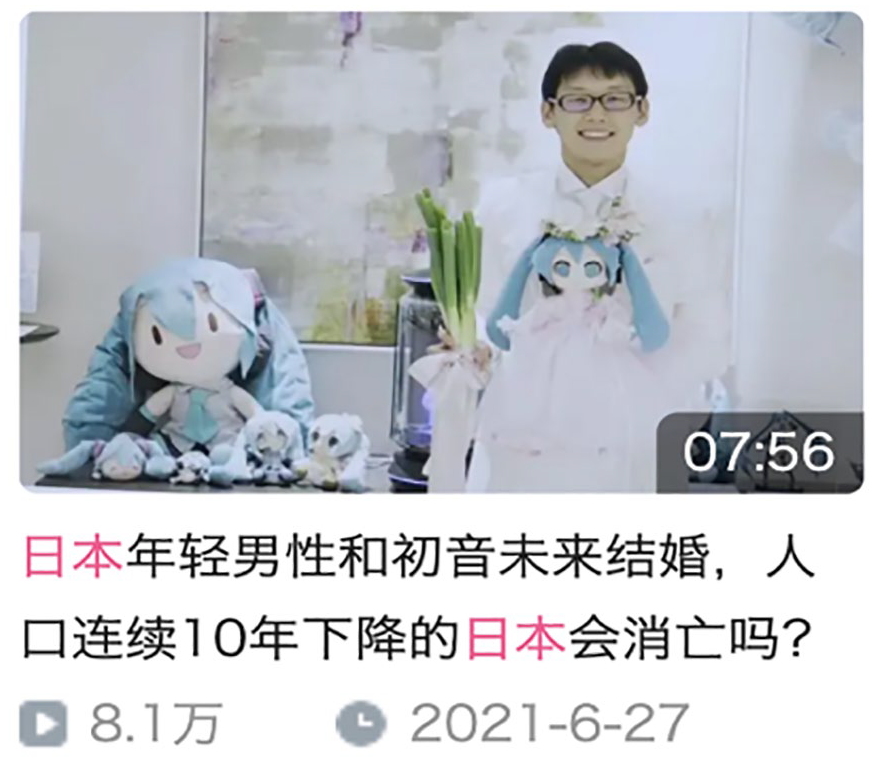
The fan translated version.
In Youzimu’s version, the title and cover references to anime idol Hatsune Miku reflect the translators’ efforts to cater to the cultural ACG tastes of their viewers on Bilibili, indicating fan translators’ intention to gain attention capital through adopting an unfaithful transfer that may better meet the platform viewer’s adoration and preference for anime. Such linguistic and visual metamorphosis manifest the subtle assertion of cultural authority as noted by Bourdieu, as fan translators not only reinterpret but also recontextualize the original narrative, reshaping it according to their own cultural expertise. This act of reinterpretation, although appearing to cater to the preferences of viewers, ultimately sustains a structure of “taste and cultural validation,” in which the fan translator assumes the roles of both intermediary and judge in determining meaning within the cultural domain.
Such catering to taste also manifests at a national level. As illustrated in Figures 6 and 7, fan translators have changed the original YouTube cover into a hilarious version of Donald Trump drinking a large bottle of disinfectant. A creative cover was used to cater to the national viewer tastes in relation to a popular news that the US President Donald Trump questioned if Covid-19 could be treated by injecting disinfectants into humans. In the context of anti-epidemic measures in China, where zero tolerance and rigorous elimination still continue, Trump’s statement caused great shock and disbelief, prompting many Chinese netizens to use ironic and funny pictures to satirize Trump’s claim. Following the trend, fan translators created a cover of Trump drinking disinfectant to comply with the national viewers’ tastes, successfully attracting more viewers’ attention and gaining more positive ratings. As noted in danmu and comments, many viewers stated that they “liked” the video or left a comment because of the cover: “

The original YouTube version.

The fan translated version.
In this light, Youzimu’s use of cultural conventions in the form of subtitling and cover norms can be viewed as a potentially usable stake for conversion into attention capital on Bilibili. Although these cultural strategies may deviate from the principle of faithful translation by departing from the original authorial intent, fan translators utilize the original text as a root and exercise their autonomy to re-create and adapt its content to the taste of viewers. This approach has not only enhanced the channel’s identity and recognition but also facilitated more evaluations and ratings from viewers, ultimately driving increased streaming traffic for the video. The higher the ratings Youzimu gets, the higher the status and reputation they receive. As Levina and Arriaga (2014) argue, ratings are symbolic and highly visual representations of the level of attention capital in any UCG platform. Youzimu is thus motivated to continue constructing their channel-specific cultural conventions to set themselves apart from their competitors and convert them into a symbolic form of distinction.
Youzimu and Social Capital
Social capital is the “aggregate of the actual or potential resources” that are linked to a long-term network and relationships accrued from individuals’ engagement in group activities (Bourdieu, 1986, p. 21). In Youzimu, social capital is built by constructing “a community of knowledge” through synchronous danmu or asynchronous commenting, which fosters loyal viewership and increases the channel’s stickiness. As Jenkins (2008) notes, a community of knowledge revolves around the sharing of knowledge and building of intellectual interests, where participants collaborate to reproduce new knowledge, often in areas where traditional expertise does not suffice. In Youzimu, it was found that fan translators may upload YouTube videos partially or fully untranslated in order to encourage diverse interactions by engaging viewers in translation activities. Once videos of this type are uploaded, they are followed by a top message in the comment zone such as “
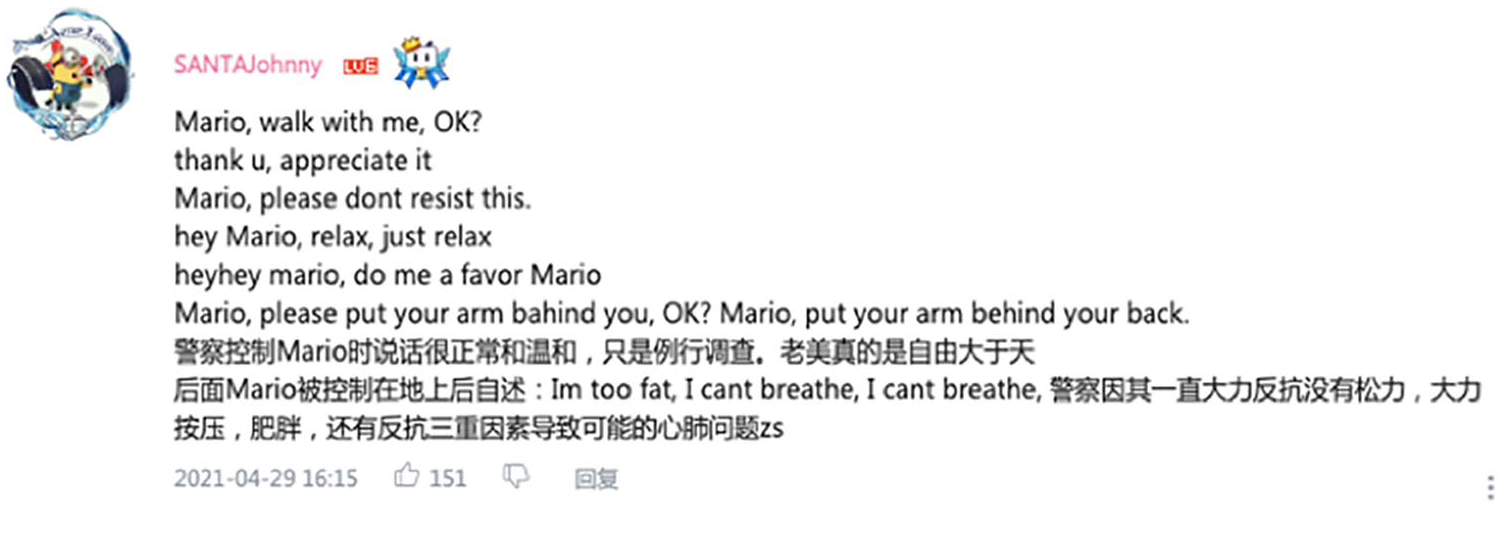
An example of viewer’s translation in the comment zone.
In addition to providing volunteer translation for the video, viewers were also motivated and engaged in expressing their opinions on the translation quality or suggesting alternative translation solutions through danmu or comments for Youzimu. As viewers are ranked according to level status markers such as the number of likes and replies, a public translation discussion sphere is created by the active and sometimes heated engagement among viewers. Figure 9 illustrates an example of one viewer’s suggestion on Youzimu’s translation of the term “pandemic.”
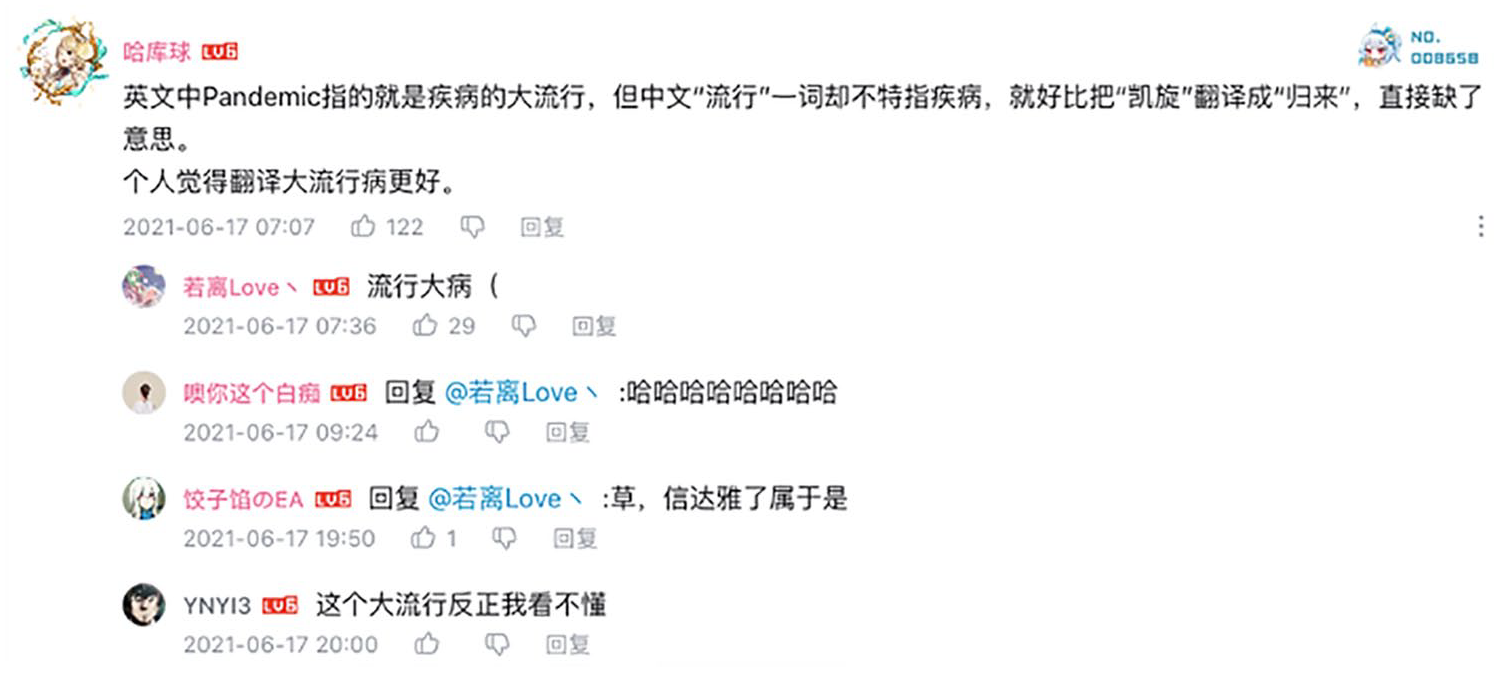
An example of viewer’s suggestion for Youzimu’s translation.
The viewer suggested that “pandemic” should not be literally translated as “
Technological affordances that emphasize the communicative and interpersonal components of media consumption, such as the comment function on video-streaming sites, have aided in the emergence of cyberspace as “a crucial site of participatory communication regarding translation” (Kang, 2015, p. 456, as cited in S. Lee, 2021). Through building a knowledge community, Youzimu seems to encourage viewers’ intelligence in translation, and to boost higher ratings through more rounds of discussions and replies. For viewers, they are endowed with considerable agency in bringing together their knowledge and reactions, which not only contributes to the elaboration and assessment of information delivered, but also contributes to drawing them into a sticky relationship in which they feel a sense of “responsibility” in judging and monitoring the translation quality for Youzimu. Such mutuality in the relationship is key to securing social capital for Youzimu, as the accumulation of social capital built on a knowledge community does not actually lie in the possession and amount of knowledge, which is static, but in the dynamic and durable process of reaffirming the group’s social ties through constantly acquiring and reproducing knowledge. It is apparent that, instead of constructing a mere “show-and-tell” streaming platform, Youzimu has embraced a community of knowledge through Bilibili’s technological affordances such as danmu and commenting, continuously and flexibly inviting viewers to participate in the discussion, negotiation and development of translation. Such interactivity not only enables viewers to convert their cultural capital (i.e., linguistic capacities in English) into attention (i.e., higher status level) through positive contributions, but also assures a lasting participatory community that can ultimately cultivate the channel’s own stable community of subscribers and generate higher signs of recognition.
Youzimu’s Self-Mediating Production on Bilibili
The above analysis shows that Youzimu has developed its own appropriate practices and become a “field” in its own right with internal norms and conventions for differential capital accumulation. Nevertheless, Bourdieu (1990) defines any cultural field as having autonomous and heteronomous poles. At the former pole, as in translating YouTube on Bilibili, the field generates an autonomous sector in which fan translators are rich with cultural capital and subtitling purely for the love of genres that are often unavailable within the mainstream and nationally regulated media framework. At the latter pole, the field generates a heteronomous sector that fan translators are interpenetrated by the institutional power and producing subtitled products that help promote discourse and ideologies favored by the dominant class. In order to delve further into the extent to which Youzimu enjoys productive autonomy in translating officially uncensored YouTube videos, the next step is to map out the production mechanism of the channel.
Based on A Must-read Handbook for New Members and Training Process and Evaluation Rules in Youzimu, the process, from obtaining a raw YouTube video to its final release, generally follows three stages. The first stage is primarily concerned with recruiting new translators, where candidates need to complete a self-training before starting their “official” subtitling project. The entire recruitment process, including all training and examination policies and guidelines, are set entirely by the community leaders and administrators of Youzimu, to some extent indicating the channel’s high degree of authority in creating its own norms and management. The second stage involves moderation, where a moderator acts as liaison between the community leader and the translators, assigning, and delivering subtitle segments to individuals. The third and most crucial stage involves various aspects of subtitling: scripting, timing, translating, revising, editing, and encoding.
According to The Subtitling Guidelines, scripting requires high level of English listening skills and is often undertaken in a traditional way, that is, scripters listen to a downloaded YouTube video word by word and typewrite the original sentences into a Word or text document. As noted in The Subtitling Guidelines, whenever a member is assigned a subtitling project, they are required to submit it to the moderator within 72 hr, with tasks marked “urgent” to be completed as soon as possible (e.g., a 3-min video marked “urgent” is normally completed within 3 hr). High efficiency indicates that fan translators are attempting to get higher streaming attention by being the first to publish content. As noted in a rule set by the Bilibili platform designer, only one copy is allowed to exist on the site, and priority will always be given to videos that had been submitted earlier. Having assimilated various advantages of established industrial production, such subtitling workflow in Youzimu seems to imply high efficiency and a “semi-professional model” (Rong, 2015) with clear division of labor. Compared with official Chinese subtitling studios in which the translation process may include pre- and post-review by the National Radio and Television Administration (NRTA; Chen, 2014), a subtitling project of a YouTube video in Youzimu seems to take as little as several hours from source reception to final distribution, and the absence of two NRTA reviews allows Youzimu to have its own patterns of reception, production, and distribution of YouTube videos, mediating and carrying out an autonomous surrogate demand-supply streaming system on Bilibili. The absence of formal media supervision over the subtitling production suggests that Youzimu puts forward an alternative mode of video importation that is radically different from the state-sanctioned production with quota and control.
The act of translating officially uncensored content on Youzimu exposes the channel to a delicate balancing act between the desire to translate and the pressures of state intervention. Although state monitoring may not be present during the production process, Internet censorship still exerts its influence in other stages of streaming on Bilibili. As W. Y. Wang and Lobato (2019) note, the Chinese Internet does not consider media technologies to be outside the political realm of the state; rather, media and communication have always been conceptualized as part of the state’s political apparatus. Early in July 2018, Bilibili was called on to discuss its censorship strategies in response to posting enormous quantities of unauthorized content from foreign websites including YouTube (Wu, 2020). From then on, Bilibili agreed to partner with The People’s Daily, China’s largest official newspaper of the Central Committee of the Communist Party of China, to strictly supervise its content under a series of macro-level policies that promote the “socialist material civilization and spiritual civilization” of netizen’s lives (He, 2018, p. 132).
Bilibili’s terms of service clearly outlines a list of licenses that vary from an “Information Network Communicated Audiovisual Program” to a “Shanghai Public Security License.” They are directly linked to an authority-controlled administration of China that are ultimately regulated by NRTA, which has the dominant power in supervising all media content published online. Since the list of licenses clearly illustrates both national and local authorities’ role in regulating the video content and presentation, Bilibili has issued a set of streaming rules that specifically targets at the video uploaders under the section, “Creation Ecology and Treaty to Bilibili Uploaders” (hereafter “the Treaty”) shown in Figure 10. The rules in the Treaty consist of eleven categories and are based on conventions approved by the Cyberspace Administration of China (CAC) regarding online content, user interactions, and platform management. As explained in the Treaty, it stipulates that channel uploaders on Bilibili must strictly adhere to its conventions in order to prevent the banning of channels or content. As can be observed, Bilibili is still in its heteronomous position subject to the state’s governance even if it has been developing its own regulatory production and mechanisms on content and user behavior. Such combination of self-regulation and government regulation, as Cusumano et al. (2021) argue, may result in better outcomes in the digital era than invasive government intervention alone.

A screenshot of The Treaty.
Due to the highly participatory affordances on Bilibili, the supervision of the Treaty also extends to the comment and danmu zone, where, as regulated, the video uploader has the responsibility to participate in self-supervising their videos and viewers’ responses. “Bilibili Discipline Committee [Bilibili
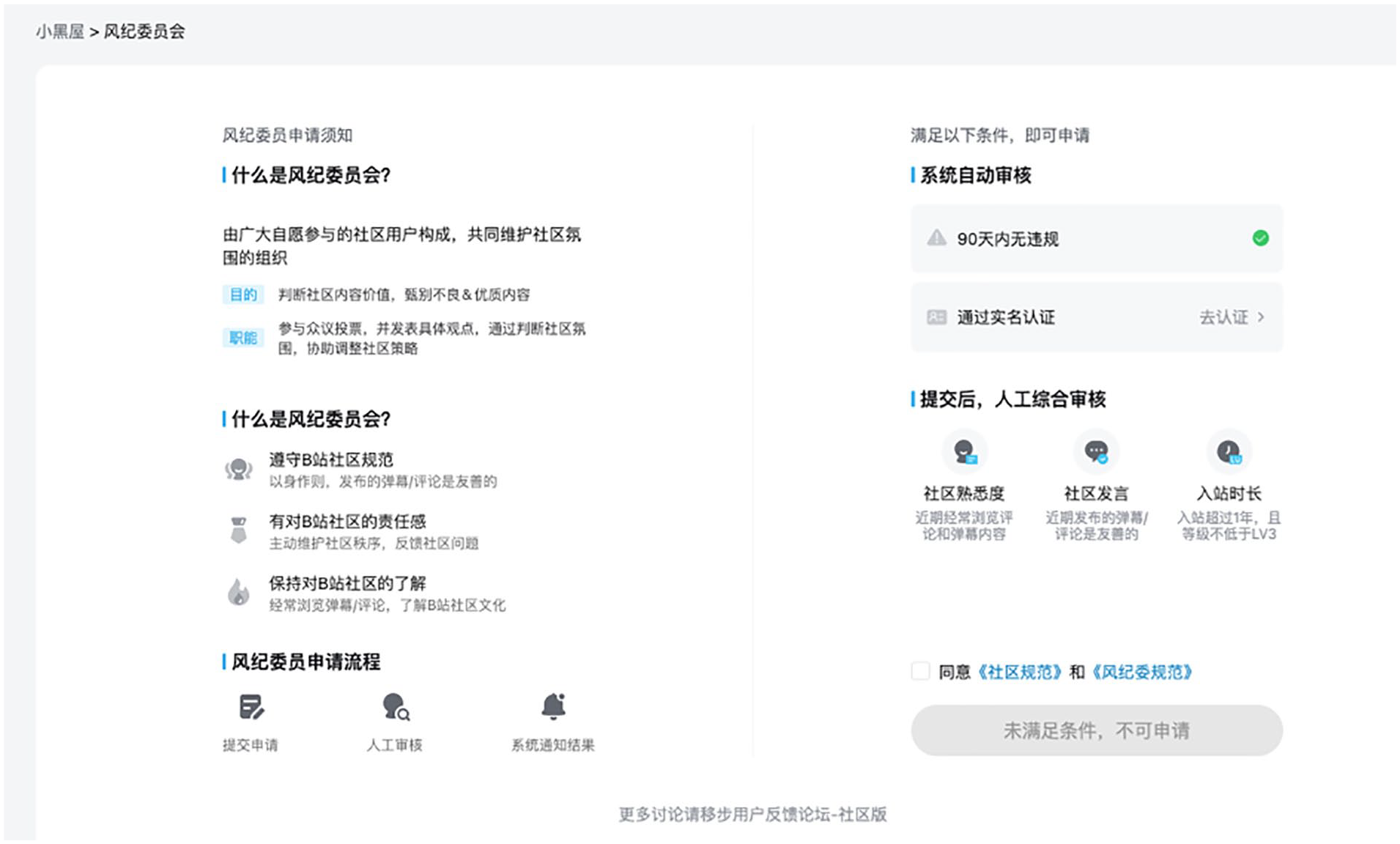
A screenshot of Bilibili Discipline Committee’s homepage.
However, as D. Wang and Zhang (2017) note, no specific and precise definitions regarding each individual element are understood in China’s media censorship; it varies from case to case and is more contextual, personalized, and continually negotiable. Competent players in a field may negotiate or reinterpret rules by maintaining the appearance of the rule or its supposed outcome, as opposed to cultural dopes who adhere to conventions (Reckwitz, 2002). At this point, in order to encourage YouTube content against living uncritically in support of the dominant discourse, Youzimu has shown a tendency to conduct self-censoring either explicitly or implicitly. For instance, in Youzimu’s source material selection, fan translators may self-assess the level of sensitivity of the original YouTube content and avoid translating YouTube channels deemed to be anti-China. As observed in the Youzimu Life and News section, a long-established video series translated from Daily Dose, an American YouTuber who typically showcases a wide variety of intriguing and compelling current affairs footage, suddenly stopped updating on 28 December 2021. Viewers expressed their love for the video series and questioned why the translation had ceased. Youzimu then posted an announcement to clarify that the translation for Daily Dose would be suspended due to its author’s political stance toward the Uyghur population in China. In replies to the announcement, some viewers agreed with Youzimu’s decision, mentioning that Daily Dose had several anti-China remarks either on his YouTube channel or Twitter, while other viewers said there was no need to completely dismiss a channel because of its different political views. Although viewers’ reactions varied, Youzimu did not continue translating from Daily Dose, given the risk of breaching the Treaty. As noted in a viewer’s danmu, “
The self-censorship strategies employed by fan translators on Youzimu are not limited to the selection of source material. They have also developed “hidden transcripts”—a series of linguistic substitution strategies such as puns, homophones, euphemism, neologisms, acronyms, and pictography—to skirt around restrictions and evade the Internet censors. For example, when translating language that may deem vulgar in a sex education video series under the Youzimu Science section, fan translators used pictographic characters “
Conclusion
This article explores the role and social-digital dynamics of YouTube-focused fansubbing channel on Bilibili through analyzing how Youzimu fosters a self-mediating network of importing YouTube videos into Mandarin language and the extent to which fan translators reproduce the original YouTube videos. The result shows that in order to move up the hierarchy and foster a long-term mechanism of governance, fansubbing channels on Bilibili are centered on the ongoing conversions of cultural capital (e.g., creating subtitle and cover norms) and social capital (e.g., building a knowledge community) into attention capital (i.e., increasing channel’s visibility and status). Fan translators on Bilibili have relative autonomy in subtitling YouTube videos based on their self-managed production flow that covers self-training, recruiting, moderating, and translating. Nevertheless, the authority-controlled licenses to the unofficially censored YouTube content and the self-supervision strategies of discipline committee and “hidden” translation scripts indicate the online streaming’s compliance to the governance authority.
The heuristic value of adopting a Bourdieusian field theory to study fansubbing channels is that it offers a fresh perspective from which to understand how Youzimu on Bilibili is built through the interaction of various power struggles in the media ecosystem and various positions and roles in the production of translation. Fansubbing practice in Youzimu does not conform to a typical translation model, as it blurs the boundaries between various social dichotomies, such as producers and consumers, professionals and amateurs, the individual and the collaborative. One of the most important aspects of Bourdieu’s approach is that it acknowledges that social fields are characterized by constant struggles coming from opposite tensions aimed at transforming or preserving the forces and positions that agents hold within a given field. Meanwhile, given that fan translators on Bilibili closely interact with digital media and their activities are inseparable from non-human factors such as technological infrastructure and platform algorithm, this study brings new insights into how a Bourdieusian field theory can be adapted for a new digitalized UGC context through incorporating Levina and Arriaga’s online field approach, particularly exploring how various forms of capital are converted into attention and how networked technologies are used by fan translators to achieve distinction and visibility.
Understanding the motivations and behaviors of users on platforms like Bilibili offers valuable insights into evolving trends in digital media consumption. This knowledge can benefit content creators, marketers, and platform developers seeking to adapt their strategies to effectively engage with global audiences and tailor content to meet their preferences and expectations. Limitations for the current study lie in its focus on a singular fan translation channel on Bilibili and its lack of more interactive data collection methods such as conducting in-depth interviews with community members. For future studies, fansubbing channels for other unavailable foreign video streaming platforms (e.g., Netflix, HBO, Hulu) could be analyzed. This could help develop further nuance and shed light on whether the popularity of fan translation is leading to a new streaming relationship between center and periphery sectors by breaking the official importation quota in a Chinese streaming ecosystem.
Footnotes
Declaration of Conflicting Interests
The author declared no potential conflicts of interest with respect to the research, authorship, and/or publication of this article.
Funding
The author received no financial support for the research, authorship, and/or publication of this article.
An Ethics Statement
This article does not contain any studies with human participants performed by any of the authors.

Data Availability Statement
Data sharing not applicable to this article as no datasets were generated or analyzed during the current study