




Abstract
Research indicates that the adverse effects on post-secondary students from the COVID-19 pandemic are unprecedented on a global scale. Specifically, there is limited research that focuses on international students’ mental wellness, resilience, and well-being experiences during the COVID-19 pandemic. This study qualitatively explores the resilience and mental wellness experiences of international university students at a mid-size, research-intensive, public university in British Columbia, Canada. Nine international students, between the ages of 18 and 30, participated in narrative-style interviews. Data were analyzed by using thematic analysis and applying a resilience lens framework. The findings highlight students’ mental wellness challenges and the key factors that were instrumental for supporting their mental wellness and enacting their resilience. These findings help to mitigate the negative impacts that can result from studying during a pandemic and offers recommendations for universities on how to support international students’ overall wellbeing, particularly during significant disruption and isolation.
Plain Language Summary
The purpose of this qualitative study was to focus on international students’ mental health, resilience, and well-being experiences during the COVID-19 pandemic. Nine international students participated in virtual interviews. Thematic analysis and applying a resilience lens framework were used to analyze the data. The findings highlight students’ mental health challenges and the key factors that supported their mental health and resilience. This study provides recommendations for universities on how to support international students’ psychological well-being, particularly during significant disruption and isolation.
Keywords
Introduction
The COVID-19 pandemic has disrupted the mental wellness of populations globally. The imposition of unfamiliar public health measures, restrictions on personal liberties, economic losses and strains, contradicting communication from governance, and the detachment of social connectivity have contributed to and exacerbated mental wellness concerns (Pfefferbaum & North, 2020). These subsequent biopsychosocial ramifications have manifested global, collective trauma; specifically, these impacts and challenges experienced by international students cannot be understated (Pfefferbaum & North, 2020).
Statistics Canada (2010) defines international students as those who have come to Canada specifically to pursue their education. The pandemic transformed this criterion, as many international students either remained at home or returned home between 2020 and 2021 to study online at Canadian and other universities.
This study examines the mental wellness and resilience of nine international students enrolled at a Canadian university during the COVID-19 pandemic. Seven of the students remained in their home countries during the pandemic, and two students returned to their home countries during the pandemic.
Research shows that domestic students experienced upheaval and mental wellness challenges as a result of the pandemic (Salta et al., 2022). However, international students faced additional and intensified challenges during this time, including difficulties with time zones and internet connections, lack of culturally sensitive support from instructors, stress, depression, and isolation from the target university. The students in this study demonstrated resilience in the face of various mental wellness challenges. Arguably, there are increasing risks of further pandemics; universities can use this research to foster international students’ wellbeing during future experiences of social isolation from universities and the associated mental wellness challenges (Global Health, Infectious Disease, 2022). Additionally, this research sheds light on tailored support universities can provide around travel, financial assistance, time zone negotiations, course delivery, and counseling. The findings are also relevant to the overall wellbeing of international students, whether a pandemic is occurring or not.
International students, attending higher education institutions, have had distinctive and exacerbated mental health experiences (Cohen et al., 2020; Dennis, 2020). Existing research shows that globally the detrimental effects on post-secondary students as a consequence of the pandemic is unparalleled (Hamza et al., 2021). During the pandemic, some of the most pressing concerns experienced by international students include maintaining their health, managing their visa status, adequate financial support, concerns regarding the health of their families and communities, and their own educational trajectories and career pathways (Chirikov & Soria, 2020; Cohen et al., 2020). Existing research reinforces the crucial importance of close social connections, both locally and back home, to support international students’ mental health (Humphrey & Forbes-Mewett, 2021).
In higher education, international students represent a vulnerable population, even without the complexities and implications of a pandemic (Sherry et al., 2010). Research focused on international student experience prior to the pandemic has focused primarily on foreign students’ vulnerability (Forbes-Mewett & Nyland, 2008; Sherry et al., 2010). Typically, international students face three major hurdles: new learning environments, the rapid adjustment of responsibility, and hesitancy to carry out help seeking behaviors (Forbes-Mewett & Sawyer, 2016). Research prior to the pandemic identifies significant symptoms of loneliness, affecting vast numbers of international students, particularly during the first stages in their adopted country (Forbes-Mewett & Sawyer, 2016). Sociological research notes that cultural values and norms related to the absence of friendship groups, coupling and social connections create further loneliness and can exacerbate feelings of isolation (Hofstede et al., 2010). Cultural factors and norms indeed make up a degree of expectation when it comes to seeking or accessing social engagement and support. Thus, a worldwide upheaval, such as the COVID-19 pandemic, brings about an additional set of difficulties (Chen et al., 2020; Demuyakor, 2020; Dennis, 2020; Hope, 2020).
International students experience university differently from domestic students. Even during times of relative stability, they face challenges that domestic students do not. The pandemic has both amplified those challenges and added new ones. There is limited research that concentrates on international students’ mental wellness, resilience, and well-being experiences during a pandemic (Hamza et al., 2021). Our study, therefore, addresses this gap and by doing so, qualitatively explores the mental wellness and resilience experiences of international university students during the COVID-19 pandemic.
For the purpose of this study “international students” are delineated as students who are not citizens in the country their degree granting institution is located; students who engage in all or a portion of their tertiary education in a location other than their own and move to that country for the purpose of studying (OECD, 2022). Pertaining to the participants in this study, these are “non-Canadian students who do not have ‘permanent resident’ status and have had to obtain the authorization of the Canadian government to enter Canada with the intention of pursuing an education” (Statistics Canada, 2012).
As referenced by the Roberts et al. (2022) companion study, we anticipate our research can “… empower and encourage space for further unique and diverse voices to learn from” (p. 3). The importance of highlighting and acknowledging those diverse voices and experiences cannot be overstated. They are essential to addressing on-going systemic inequities in our higher education environments, especially during a pandemic. The pandemic has had global impacts and ramifications, however, what has become clear is that our experiences have varied and those with marginalized identities have had unique experiences (Bowleg, 2020).
Embedded within this study are the concepts of mental wellness and resilience. We conceptualize mental wellness as a state of well-being that enables people to contend with the challenges of life, and to actualize their abilities; it is a fundamental element of “health and wellness that underpins our individual and collective abilities to make decisions, build relationships and shape the world we live in” (WHO, 2022). Mental health and wellness are a human right, and therefore essential to overall biopsychosocial development (WHO, 2022). Further, we define resilience as a dynamic developmental process comprising of positive emotional shifts and regulation and the ability to overcome trauma (Masten, 2007).
This study complements and extends from a previous study, which explored the mental health experiences and resilience of a heterogeneous group of undergraduate students from diverse communities during the COVID-19 pandemic (Roberts et al., 2022). The participant group included students “who identify as LGBTQ2SIA+, international students, students from both rural areas and urban settings, and students with disabilities” (Roberts et al., 2022). The findings presented in Roberts et al. (2022) study specifically highlighted the diversity, marginality, and adversity of the participants. It is important to note that while the methodology and underpinning framework mirrors Roberts et al. (2022) study, our secondary study explicitly explores the mental wellness and resilience experiences of international university students. A purposeful sample of nine international students, between the ages of 19 and 30, at a university in British Columbia, Canada, participated in this study. Narrative interviews were conducted via Zoom. Thematic analysis was employed from a resilience lens framework.
The rationale for this study was twofold: to explore the mental wellness implications and resilience experiences of the COVID-19 pandemic for international students; and to illuminate how the university is responsible for those experiences and what the university’s obligations are to students as a result of those experiences. Capturing international students’ mental wellness and resilience experiences in times of a pandemic is vital for understanding and mitigating the impacts of mental wellness challenges and enacting key protective factors to support overall wellbeing. anticipate that the findings from our study will better inform university faculty and administrators on supports and approaches that allow international students to thrive in an academic environment.
Guiding Theoretical Framework
A guiding theoretical underpinning in this study, is the exploration and importance of resilience; thus, the recovery and mental wellness to return to learning activities, and how resilience theory can frame and represent international student experiences implicated by the pandemic (Schwartz et al., 2021). As such, the second phase of thematic analysis employed a resilience lens (Masten, 2007; Sapienza & Masten, 2011).
Masten et al. (2008) argue that “resilience involves a system of positively adapting during the time of or after a significant disturbance”; resilience is the result of multiple, interacting processes. It is further argued that everyone can have the capacity to develop resilience as it can be enacted through cultivating skill sets as well as strengthening protective factors and decreasing the magnitude of risk factors (Masten, 2008).
Resilience theory offers a useful framework for understanding behavior and mental wellness of students during the pandemic, and specifically protective factors, as well as mediating the impact of risks. Aligned to the focus of this study, and specifically the resilience, recovery, and mental wellness to return to learning activities, existing research identifies “school attendance and school connectedness” as key protective factors for students, which can offset poor physical and mental health outcomes (Bond et al., 2007).
Exploring diverse fields of study with the use of resilience theory is an effective lens (Masten, 2008). For instance, assessing student trauma, the role educational institutions play in student’s recovery from traumatic events, and the reopening of schools representing normalization and recovery (Masten et al., 2008). Adopting a resilience lens as a framework within study enabled an exploration and understanding of the mental wellness challenges and protective factors used to promote positive developmental outcomes and mediate the impact of risk.
Methods
The rationale for this this study was to explore international students’ experiences of mental wellness, resilience, and recovery to return to learning activities during the COVID-19 pandemic, as well as the university’s responsibilities in mitigating student’s mental health impacts and supporting their wellbeing. Thus, our overarching research questions were: (1) What are the mental wellness impacts of the COVID-19 pandemic and the unique experiences of international students? (2) What are the implications and responsibilities for the university?
The overall study stance is informed by interpretive phenomenology while the analysis draws on thematic analysis and a resilience framework. Interpretive phenomenology guided the design of the interviews and engaging in the interviews with participants. Interpretive phenomenology allowed the researchers to gain a comprehensive understanding of international students’ experiences of studying during a time of social isolation and their experiences of mental health and resiliency (Lopez & Willis, 2004). For the data analysis stage, however, thematic analysis (Bogdan & Biklen, 2003; Braun & Clarke, 2006) and a resilience lens framework (Masten, 2007) were applied.
Ethical Considerations
The Research Ethics Board reviewed our application in accordance with university policies and the national research ethics policy the Tri-Council Policy statement: Ethical Conduct for Research Involving Humans (TCPS2). The Health Research Authority at the research institution approved our study. All participants provided written informed consent prior to enrolment in the study.
We received funding for this research through an internal research grant focused on health and wellness research. Data protection procedures were practiced in accordance with research policy and procedures outlined in the Canadian Tri council Policy Statement on the Ethical Conduct for Research Involving Humans. Zoom recordings of interviews were saved in password-protected files, and pseudonyms were applied to replace participant names in the verbatim transcriptions and the saved word files. Two researchers had access to the data set. Informed consent was granted from all participants prior to the interview, and on-going consent was obtained during the review of the transcripts and the review of the data themes. Since interpretive phenomenology focuses on the subjective experience of individuals revealing and making sense of their own stories, researcher reflexivity is important. We reflected carefully on the questions we asked participants as well as our assumptions, personal beliefs, and any potential power-over dynamics that might have influenced the way the research was conducted.
Recruitment and Participants
This study was conducted with international students who were enrolled in either undergraduate or graduate studies at the university. Participants’ ages ranged from 18 to 30 years. The students were recruited using a brief promotional advertisement that outlined the purpose and intent of study, participant criteria, and a link to a brief screening survey. The advertisement was posted on a student portal website and distributed through a listserv organized and maintained by the campus unit with primary responsibilities for international students, the International Student Centre. No compensation was offered to the participants. Interested students filled out the brief screening survey that was created in Survey Monkey. Fourteen students filled out the survey; however, nine were accepted based on the inclusion criteria. The five that were not included did not meet the age requirement of the study, which focused on emerging adults (18–30).
The nine participants were contacted through email to set up a 60 to 90-min virtual Zoom interview. Participants signed a consent form and verbal consent as also asked at the time of interviews and at the time of transcript review. To ensure participant safety, participants were also offered resources to support them if the interview brought forward emotions. Counseling through the university’s student services was listed and recommended, including a 24/7 counseling service called “Support Connect.”
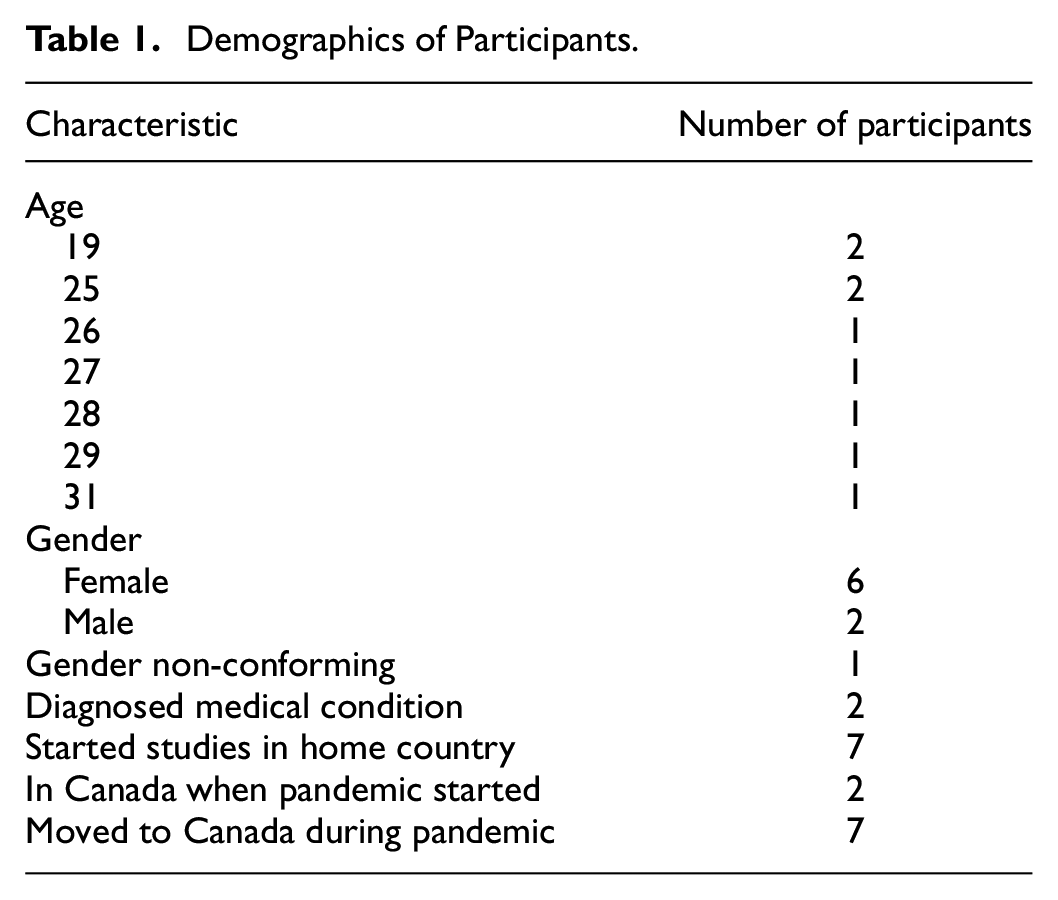
Following the interview, participants were sent verbatim transcripts of their interview to review and verify the content. They were asked three questions as part of the transcript review: (1) does this transcript provide an accurate reflection of the interview? (2) Are there any corrections you would like to make? (3) Given your review of the transcript is there anything else you would like to add through email or a follow up interview? All nine participants responded verifying their interview transcription, and four participants offered further insights and data via email. In addition, during the analysis stage, the meta themes were shared with all nine participants, and they were asked if the themes resonated with them. All participants endorsed the themes. The additional steps involved verifying participant data to ensure credibility. An overview of participant demographic is outlined in Table 1.
Demographics of Participants.
Interviews
Narrative interviews were carried out online via Zoom with participants who were either in their home countries at the time of the interview or located in the city of their university. The format of these interviews aligned with interpretative phenomenological methodology and thus encouraged participants to provide detailed accounts of their experiences during the pandemic and the meaning they attributed to them (Lopez & Willis, 2004). Our questions were designed to elicit more than descriptions of participant experiences but also concrete examples and to create space for participants to conceptualize the meaning of those examples. This ultimately allowed participants to organize, tell, and retell their understandings of experiences of isolation as stories (van Manen, 1990).
As the companion study conducted by Roberts et al. (2022) expressed, there are gaps in the existing research on the impacts of student studying during a time of social isolation. Questions for this study were thus created to address the gaps and to capture the unique experiences of international students (Appendix A). Participants were asked open-ended questions derived from our overarching question: “tell me about your experiences with social isolation during the COVID-19 pandemic and how your university supported you through this experience?” For participants who ended up going home during the pandemic, specific follow-up questions were asked about their decision to return home. Others who stayed home at the start of their study and had not yet relocated were also probed about their decision stay home.
Analysis
Data analysis occurred in two steps. The first step involved thematic analysis to draw out meta-themes and corresponding sub-themes (Braun & Clarke, 2006). The second step then involved applying the resilience framework to the generated themes (Masten, 2007). This second step emphasized and solidified the protective factors that supported participants’ mental wellness and enacted their resilience.
Using Bogdan and Biklen’s (2003) guidance for thematic analysis and development of codes, our initial approach was to get some distance from the data in order to allow biases and assumptions to emerge and address them through a field journal. After this reflection time, we read and re-read interview transcripts in order to become familiar with the data, taking care to look for words, phrases, concepts, patterns, ways of thinking and actions taken. To confirm the validity of the aforementioned themes, the principal investigator reviewed the transcripts, and the data collected from them. The findings were then discussed between the researchers until themes were agreed upon.
Findings
Overarching Structure of the Experience
The international student experiences we documented were distinctively different from the experiences of domestic students that Roberts et al. (2022) documented in their companion study. These variations seemed to be based on geographical location. Certain regions of the world were disproportionately affected by COVID-19 and several of the students we interviewed were impacted by the pandemic more directly. Several mentioned that friends and family had contracted COVID-19 and some were severe cases requiring hospitalization and intensive care. Some participants also suffered the loss of close loved ones. As a result, the themes that emerged from this study varied considerably from the companion study (Roberts et al., 2022), which looked predominantly at the experiences of domestic students ages 18 to 30.
Of the nine participants in our study, seven undergraduates stayed in their home country rather than relocate to Canada. All had received their acceptances in the spring of 2020 and had admission start dates of September 2020. At this point, the pandemic and recommendations for social distancing had been in place since March of the same year. In addition, universities globally were still in a state of online learning and most host countries like Canada were not allowing international students’ access yet. The graduate students in this study were at least 1 year into their programs at the time of this research. At the time of data gathering, in the spring of 2021, the two graduate students had returned home for the January to April 2021 term.
The findings from this study offer insights into the mental wellness challenges international students faced while studying during the COVID-19 pandemic. This study sheds light on the fundamental factors that were instrumental for supporting their mental wellness and enacting their resilience amidst a complex and unprecedented time. The themes articulated below are: (1) Responsive and positive connections; (2) Mental wellness impacts and challenges; (3) Exercising self-efficacy and achievement motivation; (4) Seeking reassurance and acting as a resource; (5) The meaning of university supports to international students; and (6) The teaching and learning environments: Building and maintaining connections.
Responsive and Positive Connections
All nine participants spoke of their appreciation for instructors who possessed soft skills: instructors who were responsive and demonstrated support and empathy. Several students highlighted that there were many emotional, physical, and logistical challenges while studying during COVID-19, and instructors who offered support in concrete ways made a difference. Amit shared,
My instructor was always helpful. He used to arrange special office hours. He always used to say, ‘if you have any kind of doubt or question – if you are facing any kind of problem, email me. I’m there for you.’ (Amit, age 19, India)
Jiven noticed instructors making adjustments to course materials and course delivery to better support student needs. He explained,
The instructor was understanding; he started recording the lectures, and he shifted them into one lecture. (Jiven, age 19, India)
When instructors were responsive and intentional about forging positive connections with their students, those students felt supported and less stressed. Suong shared,
They’ve been so sweet, supportive, and friendly. They make me feel welcomed, able to express myself and confident to do the work. (Suong, age 29, China)
On the other hand, when instructors lacked empathy, failed to consider the diverse needs of their learners, or were uncommunicative, students struggled. For example, Lucia shared,
Living in [name of home country], my internet connection sometimes is unstable. When I was doing my final essay, [they] cut off my internet cables. The professor was not understanding. It made me feel bad, even though I was trying very hard to complete the essay. I think it’s important [that] they be empathetic with this. (Lucia, age 25, Brazil)
When there was a lack of response from instructors, two participants described an increase in negative thinking. Faiza shared,
I wish instructors could put themselves inside the head of an international student, before they sent the communication. I felt like I had to prove that I wasn’t lying about my situation. In my opinion here, [name of university], the culture is you are a liar until you [are] proven wrong. I felt I was constantly defending myself so that [name of instructor] would believe me. (Faiza, age 30, Jordan)
Mental Wellness Impacts and Challenges
Participants spoke of the physical and mental wellness toll the pandemic had on them, in addition to the disruption it caused on their personal, family, and social contexts. Lucia shared,
I was waking up at midnight my time to take my graduate course. We were expected to participate as part of the mark. It was hard to stay engaged, as I was tired all the time; I think I lived with headaches all the time. (Lucia, age 25, Brazil)
Others mentioned physical pains from not having a suitable space to study at home where ergonomic desks and chairs were not available. Jing mentioned,
… I had to study from home using the kitchen table. The table was too high for me. I could feel my shoulders were getting tight and my arms sore from typing. (Jing, age 27, China)
All participants discussed the emotional and psychological impacts, including feelings of depression, anxiety, nightmares, and for one participant, suicidal thoughts.
Exercising Self-efficacy and Achievement Motivation
Participants also shared the coping strategies the employed in order to mitigate the challenges they were facing and contribute to their mental wellness. Almost all examples were student- or self-initiated. Chi-Chi, Jing, Jiven, and Rafaela talked about walking, hiking, and meditating as successful strategies for self-care. Jiven used an alternative and new means of maintaining his exercise:
The gyms were all closed in [name of home country] because of COVID. I knew I needed to exercise so I started to use apps on sites like Adidas and Nike. They offered regular exercise programs you could do at home. It made a difference for me, and I enjoyed them. (Jiven, age 19, India)
Students like Amit, Sana, and Suong, reached out to the Global Community, a service within the International Centre for Students geared toward offering social and personal support to students. Suong commented,
I reached out to the university and my TA mentioned the Global Community. I was put in a group with other international students in time zones like mine and we meet once a week to share, talk, and offer support. This helped my mental wellness. (Suong, age 29, Vietnam)
Two participants mentioned finding self-help courses online that promoted their mental wellness. Sana stated,
I didn’t think I would ever use a self-help course. There were good ideas offered, things I would have known to do when I am in a better state of mind but forgot about doing. (Sana, age 28, Pakistan).
When it came to accessing counseling services at their home institutions, two participants who were located in the global north spoke positively about the services. However, neither was aware these services were available to them until much later in their terms, and only found out about the service through word of mouth rather than directly from the institution. However, students from the global south referenced their reluctance to use the service. Their primary reason for not accessing a counselor through the institution was directly related to concerns about the counselors’ limited knowledge and/or lack of understanding of their cultural backgrounds. Faiza shared her experience of using the counseling services, which resulted in unintentional harm inflicted by the counselor:
They don’t understand the depths of our trauma because they come from this culture. The university needs to hire someone with an international experience, not simply a Canadian (western, privileged) experience. It was re-traumatizing for me. I thought it was only me but talking to other international students, we had the same experience with Counselling services. One of my friends from Iran and the other from India, they both told me they almost committed suicide after the second session because of something the counsellor said. The counsellors don’t realize when they are reinforcing something, they have good intentions but the wrong tools.
From these shared challenges with the institutions counseling services, Faiza mentioned that she and her friends created their own support group: a success precisely because of the similarity of their lived experiences.
Jiven also expressed the importance of having a counselor from his cultural background, and in particular the need for relatedness and shared experience with a counselor. He explained,
[Name of country] is a whole different country, and the people are different, the culture is different. I think it applies to all the countries that you cannot talk to someone easily if that person is not from your land. (Jive, age 19, India)
Seeking Reassurance and Acting as a Resource
The data we collected also suggested that international students wanted and needed clarity from the institution on COVID protocols. While two participants understood COVID was a time of uncertainty and believed the university did their best, for seven of the participants this was not the case. These participants felt there was a lack of communication and transparency around decision-making processes and inconsistences in the information shared. Chi-Chi shared,
Our teachers were confused like us. I remember leaving class, laughing, and talking with my classmates, and then on the weekend hearing the university is shutting down. (Chi-Chi, age 25, China)
Sana echoed Chi-Chi, stating,
The amount of uncertainty was incomprehensible. My teacher and she had limited advice. I got worried when she didn’t know. (Sana, age 28, Pakistan)
Two students mentioned becoming resources for other international students. As issues and information changed overtime, information for international students seemed hard to find or clarify. Suong stated,
When I got settled in, other international students asked me many questions like “how did you find your place? Do you know that with COVID, I need to be vaccinated before entering Canada?” It was very troubling international students had figure this out on their own, which I think that the university should tell us about. (Suong, age 29, China)
The Meaning of University Supports to International Students
Students expressed that because of their unique needs, in particular the high cost of tuition, they felt burdensome and invisible within the institution. Dealing simultaneously with a health and an economic crisis, international students were discouraged by the university’s inflexibility of paying fees and accessing scholarships. They saw this inflexibility as contradicting the spirit of care and support that the university appeared to emphasize elsewhere through their emails and website content. Jiven talked about his challenges at home, while trying to study. He shared,
When my tuition fees were due, I was also dealing with my dad’s and grandfather’s hospitalization. In [name of home country] your health is not insured by the government. I had to find money for the hospital fees plus tuition fees. I asked the university for financial help … but there was no help available. (Jiven, age 19, India)
The financial burden to relocate to campus once the decision was made that the university would return to face-to-face in September of 2021 was particularly hard on some students. At this point, the cost of flights had significantly increased. Additionally, there was the requirement that students coming to campus would need to pay for accommodations off campus for the mandatory 14-day quarantine. Rafaela commented,
The unexpected expense of having to live in a hotel for 14 days after we get to Canada – we couldn’t move directly into the apartment we had leased. (Rafaela, age 26, USA)
Some students mentioned that financial help from the university, even scholarships that are grade driven, would have been appreciated. Jiven pointed out,
Most of the scholarship programs that could have helped me were only available to [domestic] citizens. From the view of an international student, these scholarships would be so helpful. (Jiven, age 19, India)
The Teaching and Learning Environments: Building and Maintaining Connections
All students in this study recognized the importance of making connections with other students especially for their mental health and wellness. Even if their program may not have provided the connections they were seeking through the teaching and learning environments, many used social media to find out about ways to socialize and connect with peers. Lucia mentioned the value of the more informal ways to build connections with her peers. She stated,
We set up a WhatsApp group among the international students in my program, so we can chat. They share many interesting things in that group, so I don’t feel lonely. (Lucia, age 25, Brazil)
Although Jiven found that the university made efforts to set up online communities, he also spoke about his strategies to form online groups for support and connection. He took an active role in using multiple means to build a community of support. He explained,
The university’s Instagram page was a good place to start with posts from international students. I also created a WhatsApp group so that all [ethnicity of students] can be at one place and connect. (Jiven, age 19, India)
Although all participants spoke about their desire to connect socially and learn with their peers, some mentioned the challenge of connecting due to cultural factors. Amit felt reassured and pointed out the value of connecting with students who were in his program and in the same time zone and country.
I tried to connect with people, but due to cultural differences, this often proved to be difficult. Fortunately, there were some international students who had a similar ethic background, and who were with me and in the same program. We started interacting over Zoom calls. (Amit, age 19, India).
In terms of teaching and learning, students realized the challenges with online learning and creating peer-based supports. Several felt their instructors did their best to create some sense of community in their courses while also noting the limitations of the available technology. Many participants also commented that their instructors seemed overwhelmed with ensuring that the course content was well delivered, and the creation of the learning community was secondary or an afterthought. Rafaela, who was enrolled in a cohort-based program, shared,
We had lost the chance to connect as a cohort. There was no attempt to recreate that in any way because of COVID. I’ve lost a part of my education that I’m never going to get back. (Rafaela, age 26, USA)
Students who had to work in groups felt particularly challenged and frustrated. They talked about having to form their own groups by reaching out to their peers and going to great lengths to find group members only to find that domestic peers were not interested in working with them, thus adding to feelings of exclusion. Lucia said,
I approached two people to make a team then I wouldn’t hear back. I tried others but they told me they already had a team. I started to become stressed and panicked about getting behind. The university could have helped more here, especially at the start, until you get to know others. (Lucia, age 25, Brazil)
Two of the international students who were stuck in the city of their university mentioned how devastating the loneliness felt. They weren’t able to get home and were living on their own. Faiza described her experience,
When COVID hit, I was in my first year of my graduate program, so I just started to build relationships. Everything shut down on campus; I was cut off from all the places I know and the only sources of connections. (Faiza, age 30, Jordan)
Faiza also offered a powerful statement about the importance of familiarity with physical spaces, noting that in the absence of that connection, loneliness is exacerbated:
Our memories are related to spaces and places that do not exist here. So, when the pandemic happened, there’s a certain loneliness of being in a space that does not relate to you. (Faiza, age 30, Jordan)
Discussion
This study has explored the resiliency and mental wellness experiences of a diverse sample of international students studying during the pandemic. The findings offer distinct insights that are unique to international students. Five protective factors were identified, which were instrumental in supporting participants’ mental wellness and enacting their resilience during the pandemic: (1) responsive and positive connections with instructors; (2) building self-supports and seeking community support; (3) seeking clarity; (4) the meaning of university supports; (5) connections that are built and maintained through responsive learning environments.
During the pandemic, international students faced unique challenges including managing their visa status and travel restrictions, attending classes despite time zone differences, connecting to their learning community, and navigating concerns for the health of their families (Chirikov & Soria, 2020; Dennis, 2020; Hope, 2020). Pertaining to the participants in this study, challenges and stressors included death of parent and grandparent, contracting COVID, unexpected caregiving responsibilities, increased microaggressions and racism, anxieties about finances (rent and student fees), uncertainty around visa status, inability to find work, and feeling especially vulnerable in achieving their learning and personal goals.
Although participants prioritized their wellness and self-care, and thus attempted to access mental health supports via the university, it is apparent there is a lack of culturally aware and relevant supports for international students. Mental health counselors who specialize in working with international students should be aware of the unique experiences that affect their safety, mental health, and relationships so that they can develop strategies to support them (Chirikov & Soria, 2020).
For participants in this study, making connections through their programs was the most significant, unmet desire, and expectation. Students noted the lack of effort by the university to create relevant online communities, particularly for those in a different time zone, leaving the students to forge and maintain those connections themselves with difficulty and without external support. New arrivals felt a lack of belonging and an inability to integrate, which greatly impacted their mental wellness and academic motivation and performance.
International students in Canada pay higher rates of tuition and overall student fees because their enrolment is not subsidized by tax dollars. They also face unique challenges that include learning the academic expectations of their new university and, for many, learning and submitting work in a language that is not their first (Wu et al., 2015). They also have higher rates of depression, isolation, homesickness, and discrimination for racial and ethnic identities (Girmay & Singh, 2019).
Participants in this study expressed that the lack of institutional response to the unique challenges they faced as international students studying during the pandemic made them feel invisible. Although the university continued to email stating support is available for students, the students in our study noted that they were often denied what they called “real” support and left asking, what does “support” mean? While dealing with a health crisis, international students acutely felt the pressures of an economic crisis and saw the inflexibility of the university’s policy on paying fees and accessing scholarship funds as contradicting the spirit of care and support the university portrayed in official emails to their students. Faculty and staff working with these students should be mindful of this subpopulation and offer accommodations or asynchronous alternatives, where possible (Chirikov & Soria, 2020).
It is important to underscore that international students are not a homogenous group and, therefore, policies to support them should not be developed according to a one-size-fits-all strategy. We encourage international student support offices to develop individualized services, resources, and support systems for international students based upon their unique cultural and national backgrounds (Chirikov & Soria, 2020).
Recommendations for Schools
In addition to asking questions related to student experience of studying during the pandemic, participants were also asked if they had any recommendations for their university. Consistent themes emerged. The list below highlights the recommendations offered by all nine participants. Participants also reviewed this summary list during a post-interview validation process. We hope that the findings from this study along with the recommendations will drive the development of comprehensive supports for students, especially as it relates to their mental wellness. Many of these proposals support the recommendations listed in the companion study, Roberts et al. (2022).
(1) Establish a transparent and multi-modal flow of information from the university to students and provide more information on and assistance regarding international student travel, student visas, and accommodations.
(2) Create timely and ongoing communication between instructors and students and improve the structure of course delivery and assignment deadlines to take into consideration varying time zones and the challenges for team-based projects.
(3) Create virtual communities by building and maintaining on-going social support for students; ensure that mental health tools and resources are accessible to all students (domestic and international) and thus consider cultural differences and the unique needs of international students.
(4) Create grants and bursaries to support international students who are impacted financially during the pandemic.
Strengths and Limitations
This research contributes to a limited area of research, international students’ mental wellness, resilience, and well-being experiences in times of a pandemic. A further strength is the phenomenological approach adopted in this study, which emphasizes the agency of its participants; international students often feel and are precarious within this system.
In terms of limitations, it must be noted that this study comprised of a small sample size and thus does not offer generalizable findings. In future studies if the sample size was increased the data could establish greater reliability, validity and generalizability. Further, this study was carried out virtually over Zoom, which diluted the interpersonal experience between researcher and participant. Thus, if research in the future conducts in-person interviews, this can enhance researcher-participant engagement and contribute to the richness and authenticity of the data, particularly within qualitative research.
Education institutions and mental health professionals are invested in the returning of students following the COVID-19 pandemic (Schwartz et al., 2021). There is therefore an imperative need for future research to gain data on both the resilience and mental wellness challenges of students within the context of the pandemic (Schwartz et al., 2021). This will contribute to the provisions of ethical and accurate protocols for all students, including those with culturally diverse learning needs.
Conclusion
This study presents the distinct experiences of international students studying during a pandemic, and specifically focuses on their mental wellness, resilience and recovery to learning activities. In doing so, this study offers recommendations for universities on how to support international students’ overall wellbeing. These findings are fundamental for understanding and mitigating the negative impacts that can result from studying during a time of social isolation. International students have a distinctively unique experience from domestic students and often face many challenges, even during times of relative stability. We anticipate that the findings from our study will better inform university faculty and administrators on supports and approaches that allow international students to not only survive but also thrive in their academic experiences.
Footnotes
Appendix A
Interview Questions:
This is a narrative study to look at the experiences that UVic students have had studying during social isolation and COVID 19 pandemic and how your university has supported you through this experience? How could they improve? Or what recommendations you have for them? And please feel free to tell me what your story is of studying during this time. You can start at any point in your experience. I will ask some clarifying questions or maybe some prompts for you, but really, it’s an opportunity for you to tell your story as you want to tell it, and there’ll be a chance at the end for you to add. I can check in with you about your story the way you want to express it, and then you can certainly ask me questions before we get started.
Declaration of Conflicting Interests
The author(s) declared no potential conflicts of interest with respect to the research, authorship, and/or publication of this article.
Funding
The author(s) received no financial support for the research, authorship, and/or publication of this article.

Data Availability Statement
The data that support the findings in this study are available upon request. The authors confirm that the data supporting the findings of this study are available within the article and its supplementary materials.