



Abstract
The utilization of online information can be used as a measure of public concern and interest. It can be explored to institute, inform, and innovate mental health promotion and strategies in addressing the ever-increasing prevalence of anxiety disorders across the globe. As such, this infodemiological study described and analyzed the public utilization of online information for anxiety disorders using relative search volumes (RSV), top and rising related queries and topics from Google Trends, and Wikipedia page views. After describing the data, autoregressive integrated mean averaging (ARIMA) models were employed to predict future RSVs and page views. Results show that RSVs for anxiety disorders have increased over the years and will further increase in succeeding years, while the use of Wikipedia information for anxiety disorders is declining. Top and rising search-related queries and topics primarily revolved around anxiety disorder concepts, management, manifestations, types, etiology, diagnostics, social consequences, and related mental disorders. Based on the search volumes, public utilization of online information about anxiety disorders has increased and will further increase in the coming years. They can be explained by the rising rates of anxiety disorder and the higher internet access across the globe. As such, the Internet is a promising medium for mental health promotion, prevention, and intervention strategies. Moreover, trustworthy and reliable online information about anxiety disorders is ever-crucial in this age of information and disinformation.
Plain Language Summary
The findings indicate that online public interest in anxiety disorders has increased over the years and will further increase in succeeding years. It also revealed a decreasing usage of Wikipedia information for anxiety disorders. This increasing usage of online information may be explained by the rising rates of anxiety disorder and the higher internet access across the globe. These findings support previous notions that the Internet is a promising medium for mental health promotion, prevention, and intervention strategies and approaches for anxiety disorders. Based on these findings, mental health advocates and policymakers can collaborate to promote reliable and trustworthy online information among their stakeholders. Likewise, they can help ensure that their websites and other online public platforms (i.e., government websites) have sufficient information to address public concerns regarding anxiety disorder. This study revealed that these concerns might include anxiety disorder concepts, management, manifestations, types, etiology, diagnostics, social consequences, and other related mental disorders. Various languages can also be used in disseminating online information regarding anxiety to reach a wider audience and stakeholders. In addition, further studies are recommended to understand and address public concerns regarding anxiety disorder. Therefore, mental health professionals, advocates, program managers, and institutions may incorporate the aforementioned public concerns regarding anxiety disorders in their websites and online programs to better respond to public needs.
Keywords
Introduction
Anxiety disorders are characterized by “excessive fear and worry and related behavioral disturbances,” resulting in significant distress or impairment in functioning (World Health Organizations, n.d.). As of 2019, they constituted some of the most common mental disorder in the world (Yang et al., 2021). Global incidence rates of newly diagnosed anxiety disorders have shown an approximate 50% increase between 1990 and 2019, from 31.13 million to 45.82 million (Yang et al., 2021). Concurrently, the accumulated number of patients with anxiety disorders worldwide increased by around 50%, from 194.92 million in 1990 to 301.39 million in 2019 (Yang et al., 2021). The advent of the COVID-19 pandemic further exacerbated the incidence of anxiety disorders, with an additional 76.2 million cases being documented (COVID-19 Mental Disorders Collaborators, 2021). Therefore, the imperative of establishing and diversifying effective mental health promotion and strategies in response to the escalating burden of anxiety disorders, particularly within the context of post-pandemic societal rehabilitation, was underscored (COVID-19 Mental Disorders Collaborators, 2021; Yang et al., 2021).
Generally, the increasing prevalence of anxiety disorders has prompted a growing call for the diversification of mental health promotion and intervention approaches. Recent years have witnessed the leveraging of expanding internet accessibility across populations to this effect. Consequently, the incorporation of internet-based health interventions and promotions has gained prominence within this domain (Dworschak et al., 2022; Orsolini et al., 2021). Therefore, against the backdrop of rising incidence rates, it becomes imperative to scrutinize the trajectory of online concerns and interest pertaining to anxiety disorders. Hence, the present study embarks on an exploration of online interest in anxiety disorders, seeking to discern evolving patterns in public interest, concerns, and information utilization over the years.
Internet-Based Strategies for Anxiety Disorders
The rapid proliferation of internet access and digitization in recent decades has fostered a global surge in online engagement, inclusive of the domain of mental health promotion and intervention strategies targeting diverse populations (Dworschak et al., 2022; Orsolini et al., 2021). For instance, a review by Dworschak et al. (2022) found preliminary evidence supporting the effectiveness of internet-based interventions for anxiety in older adults. Similarly, Kauer et al. (2014) found that online mental health services may benefit the help-seeking process. Yap et al. (2018) found that online parenting intervention in Australia may reduce parenting behaviors that correlate with adolescents’ risk for anxiety. Bolinski et al. (2018) found that Internet-based prevention could be a promising, cost-effective measure to tackle the burden of anxiety among undergraduate students in Europe. Internet-delivered cognitive behavioral therapy (ICBT) is an effective intervention that can overcome barriers and provide convenient access to mental healthcare (McCall et al., 2021; Sharrock et al., 2021). Another review by Orsolini et al. (2021) found that Telemental Health services may offer an efficacious, practical, convenient, and cost-effective approach to overcoming barriers encountered in mental healthcare delivery for anxiety problems among the young.
Collectively, the preponderance of previous research attests to the increasing trend in internet utilization for mental health promotion and the management of anxiety disorders among populations. This proclivity toward online mental health information assimilation is partially attributed to the enhanced accessibility and anonymity engendered by digital platforms (Naslund et al., 2020). Thus, a more nuanced inquiry into the utilization of online mental health information is germane to the development, dissemination, and innovation of mental health strategies that can respond better to the ever-increasing prevalence of anxiety disorders across the globe.
Infodemiological Research for Anxiety Disorders
Recent years have borne witness to transformative strides in data analytics and big data, propelling the exploration of online information as a resource for health policy formulation. This emerging field of innovation has been termed “Infodemiology” or information epidemiology. Infodemiology, as defined by Eysenbach (2009), is a subfield of epidemiology that focuses on the study of the distribution of information on the Internet with the primary objective of informing public health and public policy. By scrutinizing patterns of internet utilization and search behaviors, Infodemiology can provide and determine changes regarding disease epidemiology, health research, public knowledge, and health-seeking behaviors among populations (Mavragani & Ochoa, 2019; Mondia et al., 2022; Nuti et al., 2014). Therefore, the present study utilized an infodemiological research design to explore and understand the utilization of online information for anxiety disorders.
Among the tools of infodemiological research, Google Trends is one of the most commonly utilized and popular tools for understanding changes in online public perception, interests, expectations, and information utilization. It is an open online tool that can provide real-time and archived information about Google queries (Mavragani & Ochoa, 2019). Its inherent advantage stems from the presentation of users’ actual preferences in an anonymous milieu, enabling the forecasting of sensitive diseases and topics, including highly stigmatized health concerns like HIV and mental disorders (Mavragani & Ochoa, 2019). Its wide use can be attributed to the Google search engines’ predominant market share (about 90%) among all search engines across the globe (Alibudbud & Cleofas, 2023; Arora et al., 2019; Mavragani & Ochoa, 2019; Statista, 2022). As a result, Google Trends has been previously utilized to explore online interest and behavior for different health conditions, including ADHD, COVID-19, epilepsy, HIV, mental health and substance use disorders among populations and regions (Alibudbud, 2022; Alibudbud & Cleofas, 2023; Knipe et al., 2020; Mavragani & Ochoa, 2019; Moalong et al., 2021; Nuti et al., 2014; Zhao et al., 2022). Therefore, with a predominant market share among search engines globally, the present study utilized Google Trends to explore and understand the changes in the utilization of online health information for anxiety disorders.
To further broaden the understanding of online information utilization, Google Trends can be complemented with Wikipedia page views (Guedes-Santos et al., 2021; Mondia et al., 2022). Wikipedia is a collaboratively edited online encyclopedia (Heilman & West, 2015). It offers free content in 300 languages, including those about various health conditions (Guedes-Santos et al., 2021; Mondia et al., 2022). It can be utilized as complementary data for Google Trends since Wikipedia is one of the world’s most-visited public domains. Evidence suggests that the health content of Wikipedia receives more web traffic than those of institutional and popular health websites (i.e., National Institutes of Health, WebMD, Mayo Clinic, National Health Service, World Health Organization, UpToDate; Heilman & West, 2015). The combination of Wikipedia and Google Trends data has been used to explore various health and social phenomena, including nature conservation and brain tumors (Guedes-Santos et al., 2021; Mondia et al., 2022). Therefore, in alignment to these studies, the present study combined the analysis of Google Trends data and Wikipedia page views to provide a more comprehensive understanding of the utilization of online information for anxiety disorders.
Objectives
In light of the increasing rates of anxiety disorder and the potential of the internet to ameliorate mental health conditions, this study endeavors to elucidate the changes of online information usage for anxiety disorders. To this end, several interrelated objectives underscore this inquiry:
Firstly, the present study seeks to delineate regional variations in online discourse concerning anxiety disorders through a ranking of countries based on Google search volumes. This endeavor is instrumental in identifying the nations that harbor the greatest interest in this subject matter.
Secondly, the present study described the worldwide Google Trends search volumes and Wikipedia page views for anxiety disorders. This descriptive endeavor unearths temporal changes in online interest patterns encompassing anxiety disorders.
Thirdly, the present study forecasted future trends in worldwide Google Trends search volumes and Wikipedia page views. This predictive analysis offers glimpses into the forthcoming digital landscape and, concurrently, serves as evidence for refining online anxiety disorder information dissemination.
Fourthly, the present study explored other online public concerns about anxiety disorders using the related topics and queries from Google Trends. These supplementary insights furnish valuable information for augmenting websites disseminating mental health promotions and information on anxiety disorders. Furthermore, these queries shed light on the linguistic preferences underpinning information searches related to anxiety disorders, thus facilitating the adoption of inclusive language strategies.
Overall, the findings of the present study provide actionable insights to inform, enhance, and innovate mental health promotion and interventions within the digital sphere, with the overarching aim of addressing the burden posed by the increasing prevalence of anxiety disorders on a global scale.
Methods
This infodemiological study was conducted to elucidate the global usage of online information related to anxiety disorders. To this end, data were extracted from Google Trends and Wikimedia Pageview. The rationale for choosing these sources rested on their substantial market penetration and extensive readership. The data gathered were relative search volumes (RSV), top and rising related queries and topics from Google Trends, and Wikipedia page views. Following the methodological framework for infodemiological studies espoused by Mavragani and Ochoa (2019), key parameters including the selected keyword, geography, time frame, and search categories were specified. The present study does not necessitate local ethical approval since the data is from a publicly available domain and does not involve human participants.
Data and Measures
RSV is the frequency or volume of searches normalized against the highest search volume in the specified period and location. Google Trends automatically determines the RSVs for a selected keyword by anonymizing users, categorizing their search queries, and aggregating them into topics (Alibudbud & Cleofas, 2023; Google, n.d.). After, every individual data point is divided by the total searches within the specified geographical area and timeframe. This approach enables a comparison of relative popularity (Mavragani & Ochoa, 2019). Without this normalization process, places with the highest search volumes would consistently claim the top ranks on Google Trends (Mavragani & Ochoa, 2019). The resulting numbers from this process are then scaled from 0 to 100, where 0 represents the lowest search volume, and 100 represents the largest search volume in the studied period and specified geography (Alibudbud & Cleofas, 2023; Google, n.d.). This process allows Google Trends to display interest in a topic from across the globe, down to the city level. The earliest data from its database is from 2004 (Mavragani & Ochoa, 2019). For this study, monthly RSVs were gathered to explore the changes in online information utilization for anxiety disorders.
Aside from RSVs, Google Trends also provides the top and rising search-related topics and queries over the study period. Queries denote the specific terms employed in searches pertaining to the entered keyword, while topics represent a group of terms that share the same concept in any language (Mavragani & Ochoa, 2019). Top search-related topics and queries are the topics and terms most frequently searched for by users concerning the keyword of interest using Google in the specified period and geography. Rising related topics and queries are the terms that users searched for with the keyword of interest, which had the highest growth in volume in the specified period. These topics and queries can be used to determine other public concerns related to the keyword, which in the present study pertains to anxiety disorders over time (Alibudbud & Cleofas, 2023; Google, n.d.; Moalong et al., 2021). This study used top and rising search-related topics and queries to evaluate changes in other concerns related to anxiety disorders over the study period.
The present study complemented RSVs with Wikipedia page views. Previous studies have utilized page views to understand social and health-related trends, including environmental conservation and tumors (Guedes-Santos et al., 2021; Mondia et al., 2022). In this regard, the Wikimedia Statistics data page can provide information about different Wikipedia pages, such as the number of views per month or day. The earliest data is from July 2015 (Mondia et al., 2022). This study used page views to measure the public utilization of Wikipedia information for anxiety disorders.
Data Collection and Analysis
The keyword “Anxiety disorder (Mental Disorder)” was entered in the Explore feature of Google Trends to collect all related web searches for anxiety disorders (available at: http://www.google.com/trends, accessed on 9 November 2022). This mental disorder topic keyword was selected since topic keywords can aggregate all the terms and queries that share the same concept in different languages (Mavragani & Ochoa, 2019). Therefore, the present study utilized the keyword “Anxiety disorder (Mental Disorder)” to gather the terms and queries for anxiety disorders utilized in the Google search engine in different languages. After, its Region filter was set to “Worldwide” to gather all the searches globally. Then, its Time Range filter was adjusted from January 2004 to October 2022. This period was selected since collecting the data after several days may improve the data reliability of Google Trends (Rovetta, 2021). Likewise, this study period allowed the collection of the earliest available data from Google Trends (Mavragani & Ochoa, 2019). After gathering 226 RSVs, data about the top and rising search-related queries and topics were collected using the same Filter settings.
Wikipedia page views were collected from the Wikimedia pageviews page by entering “Anxiety Disorder” in the Pages feature (available at: https://pageviews.wmcloud.org, accessed on 0 November 2022). Afterward, the data type was changed to monthly, while the Dates feature was set from July 2015 to October 2022. These settings enabled the present study to collect the earliest available data about page views (Mondia et al., 2022). The Agent feature was also set to “User” to limit the gathered data to people who viewed the page and avoid web crawler-related searches. A total of 88 monthly Wikipedia page views were collected.
After gathering all the RSVs and page views, the Google Trends’ country ranking, RSVs, and Wikipedia page views were described. Then, the top and rising search-related queries and topics concerning anxiety disorder by the users of the Google search engine available in Google Trends were descriptively compared. Subsequently, autoregressive integrated mean averaging (ARIMA) was conducted to predict future page views and RSVs. The present study followed the ARIMA methodology suggested by Schaffer et al. (2021). By doing so, RSVs and pageviews were transformed using differencing to address non-stationarity, seasonality, and changes in variance over time. After, the fit of the ARIMA models was noted using R Squares and Ljung-Box tests. The models predicted and determined RSVs and page views until December 2025. The present study limited the predicted values to this period since future improvements in internet penetration may influence search engine usage and volumes (Arora et al., 2019; Mavragani & Ochoa, 2019).
Results
Ranking of Countries Based on Search Volumes for Anxiety Disorder
A total of 55 countries were ranked by Google Trends based on their search volumes for anxiety disorder (see Table 1). Countries not listed have low RSVs to be ranked. The highest-ranked country is the Philippines, followed by the United States, Ireland, Australia, and the United Kingdom. On the other hand, the lowest-ranked country is France, followed by Italy, Ukraine, Spain, and Iran. The ranking indicates that Asian and Western countries are among those with the lowest and highest utilization of online anxiety disorder-related information across the globe.
Ranking of Countries Based on Search Volumes for Anxiety Disorder.

Google Trends RSVs and Wikipedia Page Views for Anxiety Disorder From 2004 to 2022
Figure 1 shows an increasing trend of RSVs for anxiety disorder. In particular, the search volumes almost doubled between 2004 and 2022, starting at 48 and ending at 91 in October 2022. Conversely, Figure 2 shows a decreasing trend in Wikipedia page views about anxiety disorder. They began at 68,156 in 2015 and ended at 28,419, indicating that page views about anxiety disorders decreased by more than half by October 2022. These findings suggest the public has increasingly utilized Google for anxiety disorder information over the years, while the use of Wikipedia information has decreased.

Graph depicting the worldwide search volumes for anxiety disorder from 2004 to 2022 and their predicted values until 2025.
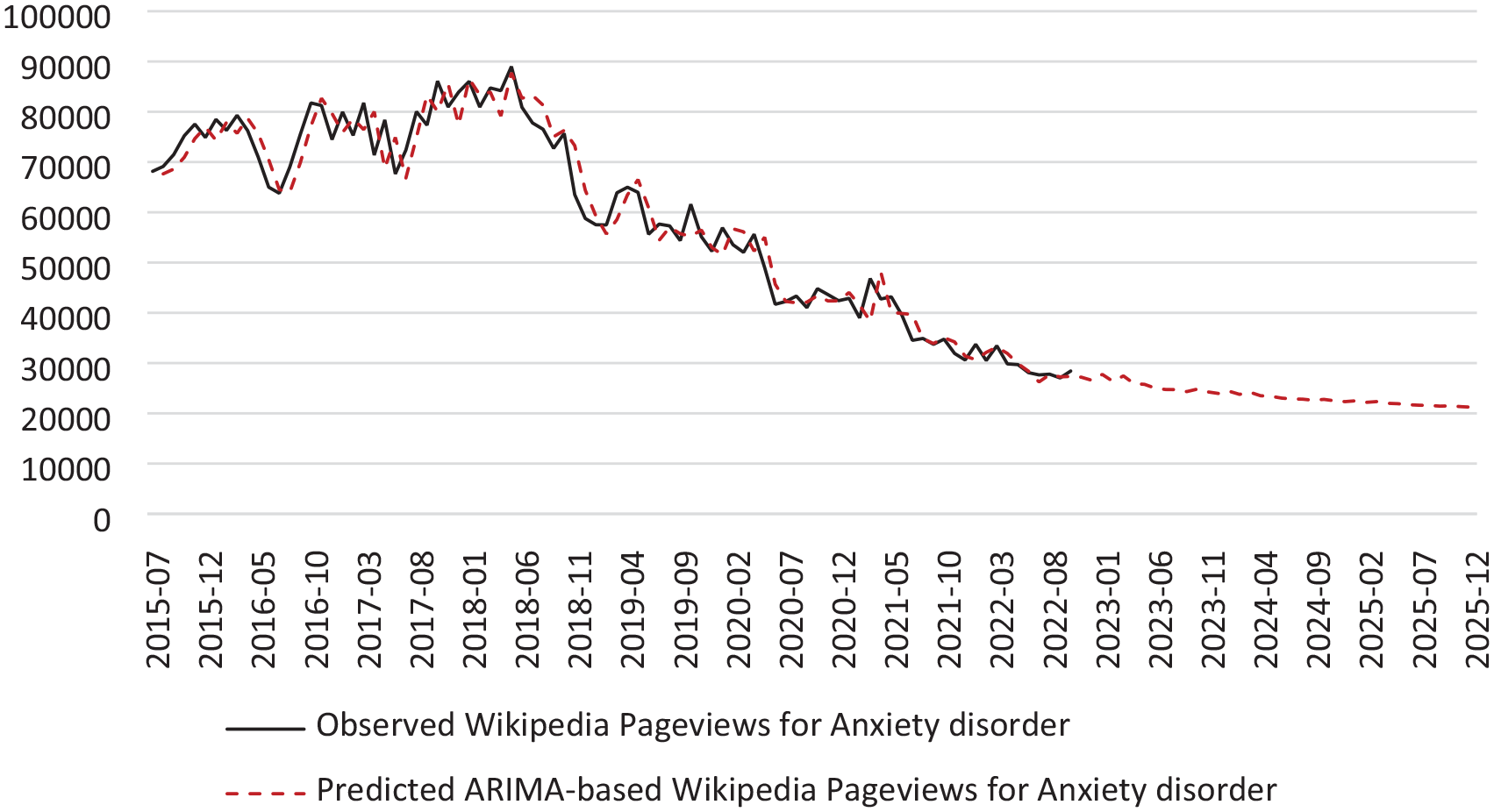
Graph depicting the worldwide Wikipedia page views for anxiety disorder from 2004 to 2022 and their predicted values until 2025.
Forecasting Google Trends RSVs and Wikipedia Page Views for Anxiety Disorder From 2022 to 2025
ARIMA models were utilized in the present study to predict future RSVs and Wikipedia page views for anxiety disorder. Table 2 shows the models’ R squares were .972 and .956 for RSVs and Wikipedia page views for anxiety disorder, respectively. Likewise, their Ljung box tests showed a p-value of > .05. These values indicate that the null hypotheses that the models do not predict future RSVs and page views are rejected. Thus, both models adequately predict the future RSVs and Wikipedia page views from 2022 to 2025.
ARIMA Model Fit.

Figure 1 shows that RSVs for anxiety disorder will increase between 2022 and 2025, from 91 in October 2022 to 102.35 in December 2025. On the contrary, Figure 2 shows that the monthly page views on Wikipedia for anxiety disorder will further decrease between 2022 and 2025, from 28,419 in October 2022 to 21223.29 in December 2025. These findings indicate that the public may increasingly utilize online anxiety disorder-related information on Google in the succeeding years. In contrast, the public’s use of the Wikipedia page about anxiety disorder will further decrease.
Top and Rising Search-Related Topics for Anxiety Disorder From 2004 to 2022
The top search-related topics about anxiety disorder are shown in Table 3. They primarily revolved around anxiety disorder-related concepts (i.e., Anxiety, Disease), management including medications (i.e., Pharmaceutical drug, Anxiolytic), manifestations (i.e., Medical sign), types (i.e., Generalized anxiety disorder), etiology (i.e., Cause), and other related mental disorders (i.e., Major depressive disorder). Depressive disorders were the most searched for among the related mental disorders.
Top and Rising Search-Related Topics and Queries for Anxiety Disorder From 2004 to 2022.

Table 2 also shows that most rising topics were similar to the top topics. However, it was notable that searches increased by >5,000% for other related mental disorders, social consequences, and drugs not found at the top, such as “High-functioning autism,”“Impairment of well-being,”“Pregabalin,” and “Medical cannabis.” Likewise, searches for anxiety disorder-related diagnostics also increased by >5,000%, such as “ICD-10-CM.”
These findings indicate that the public utilized online information using Google to understand anxiety disorder concepts, management, manifestations, types, etiology, and other related mental disorders over the years. Moreover, there was also rising public interest in other mental disorders, medications, social consequences, and diagnostics related to anxiety disorders.
Top and Rising Search-Related Queries for Anxiety Disorder From 2004 to 2022
Table 3 shows the top search-related queries of online users concerning anxiety disorder. They were mainly about anxiety disorder concepts (i.e., anxiety, anxiety disorder), management (i.e., anxiety medication), manifestations (i.e., anxiety symptoms), diagnostics (i.e., anxiety test), etiology (i.e., anxiety causes), and other related mental disorders (i.e., depression). Aside from English, some of the queries were also in Japanese (i.e.,  ) and German (i.e., angststörung).
Table 2 also shows that all the rising search-related queries for anxiety disorder increased by more than 5,000% over the study period. They were mainly similar to the top queries. Although, there was a notable increase in searches about anxiety disorder-related diagnostics and medications such as “anxiety icd 10,”“propranolol for anxiety,” and “hydroxyzine for anxiety.” Aside from English, several other languages were also used in the queries, such as Croatian (i.e., anksioznost), French (i.e., phobie), German (i.e., anxiety deutsch), Malay (i.e., gangguan kecemasan), Russian (i.e.,  ), and Turkish (anksiyete bozukluğu nedir). There were also queries about the translation of Anxiety in other languages aside from English, such as Hindi (i.e., anxiety meaning in hindi).
These findings suggest that the public utilized online information to search for anxiety disorder-related concepts, management, manifestations, diagnostics, etiology, and other related mental disorders over the years. In addition, it also shows recent concerns regarding anxiety disorder-related diagnostics and medications. Moreover, the languages used in the top and rising related queries are consistent with the countries ranked by Google Trends.
Discussion
The findings of the present study underscore a significant trajectory in online user behavior regarding anxiety disorders. The analysis of Google search volumes revealed a discernible upward trajectory that is projected to persist into subsequent years. By contrast, the employment of Wikipedia as an information source for anxiety disorders exhibited a downward trend during the study period, a trend that is anticipated to continue. This duality in the utilization of online resources suggests a shift in user preferences toward platforms other than Wikipedia for comprehending anxiety disorders in recent years. These increasing search volumes reflect rising online interest in anxiety disorder information. The underlying impetus to this increasing trend can be explained by the rising rates of anxiety disorders and internet access across the globe (COVID-19 Mental Disorders Collaborators, 2021; Dworschak et al., 2022; Orsolini et al., 2021; Yang et al., 2021).
The increasing rates of anxiety disorders may result in an increased need to understand anxiety disorders. Furthermore, the expanding internet accessibility across the globe has rendered online information a readily accessible, available, and highly anonymized medium for populations to advance their understanding of anxiety disorders (Dworschak et al., 2022; Naslund et al., 2020; Orsolini et al., 2021). Thus, the present study’s findings indicate that the ongoing digitization and expanding internet access offer mental health professionals and advocates a powerful tool to amplify the reach of their endeavors in mental health promotion and information dissemination concerning anxiety disorders (Dworschak et al., 2022; Naslund et al., 2020; Orsolini et al., 2021).
Moreover, in accordance with the observations of Orsolini et al. (2021), online services may offer an efficacious, practical, convenient, and cost-effective approach to transcend barriers in the delivery of mental healthcare. In this context, the present study supports the proposition that online initiatives geared toward mental health promotion and information dissemination can be strengthened and expanded, leveraging the increasing online proclivities that are anticipated to further increase in the years to come. However, in tandem with these opportunities, there is an attendant imperative to navigate the landscape of disinformation, misinformation, and fake news about health conditions (Bacsu et al., 2022; Brashier & Schacter, 2020). Therefore, mental health professionals, advocates, program managers, and institutions must ensure and advance reliable and trustworthy websites are highly searchable, up-to-date, accessible, and available for public consumption, bolstering the assurance of quality and veracity of anxiety disorder information in the digital ecosystem.
The present study’s findings also revealed the public’s focal concerns regarding anxiety disorders that can be included in online materials for mental health promotion and information dissemination. These concerns encompass anxiety disorder concepts, management, manifestations, types, etiology, and other related mental disorders. The most pressing concerns in recent years may consist of the rising search-related topics and queries, such as other mental disorders, diagnostics medications, social consequences, and diagnostics related to anxiety disorders. Therefore, mental health professionals, advocates, program managers, and institutions can integrate these multifaceted concerns into existing digital platforms for mental health education and promotion programs to engender a more responsive response to the exigencies of the public.
In addition, the public also utilized various languages as query terms in their search for anxiety disorder-related information, underscored in the top and rising search-related queries. Moreover, there were also regional variations in the top and lowest-ranked countries in Google Trends. Similar to other infodemiological studies of health-related phenomena (Alibudbud & Cleofas, 2023; Moalong et al., 2021), this utilization of multiple languages and regional variations in ranking indicates that different languages can be employed in online anxiety disorder-related information. Consequently, by diversifying the linguistic dimensions of their online resources, mental health professionals, advocates, program managers, and institutions can amplify the efficacy and inclusivity of their outreach, engaging with an expansive demographic.
Nonetheless, further research may be necessary to understand the regional variations in online search volumes and public interest regarding anxiety disorder. Thus, future research can explore search volumes for anxiety within and between countries to understand regional variations. Moreover, as seen from the related queries and topics, further analysis of search volumes for other related mental disorders and medications can also be done to explore their relations with anxiety disorders.
Limitations
To our knowledge, this is the first study that explored the global utilization of online information for anxiety disorders using infodemiological tools using Google Trends and Wikipedia page views. However, its findings must be considered in light of the inherent methodological limitations in infodemiological research. First, the data only reflects the online interests and concerns of users of Wikipedia and Google. Despite Google’s major global search engine market share, further research can be done among countries with low Google market share (i.e., China) using data from their popular search engines (Alibudbud, 2022; Alibudbud & Cleofas, 2023; Statista, 2022). Likewise, the results of the present study may not reflect the sentiments and concerns of people with limited internet access. Therefore, traditional measures, such as surveys, can be conducted in areas with limited internet access.
Second, since the present study utilized a single keyword, “Anxiety disorder (Mental Disorder),” to aggregate all related searches for anxiety disorders, further research may explore the different keywords for the different signs and symptoms of anxiety disorders to understand better the changes in the online public interest about the different signs and symptoms of anxiety disorders over time.
Third, while previous studies have highlighted the correlation between Google searches and surveillance data, further studies are needed to ascertain and explore the changes in the rates of anxiety disorders (Nuti et al., 2014). Thus, the interpretation of the present study is limited to the utilization of online information using Google and Wikipedia. As such, national, regional, and global prevalence rates can be better understood through research focused on epidemiological data (i.e., see COVID-19 Mental Disorders Collaborators, 2021; Yang et al., 2021)
Lastly, search volumes and page views are surrogate measures for public interest and concerns. Hence, a more comprehensive understanding of the utilization of online information for anxiety disorder may require other research designs, data, and measures (i.e., surveys). Lastly, regional variations in online information utilization were limited to countries ranked in Google Trends. Therefore, to further understand variations in online anxiety disorder information utilization, researchers can explore the search volumes for anxiety disorders within and among countries and regions.
Conclusion
Overall, the findings indicate that online public interest in anxiety disorders has increased over the years and will further increase in succeeding years. It also revealed a decreasing usage of Wikipedia information for anxiety disorders. This increasing usage of online information may be explained by the rising rates of anxiety disorder and the higher internet access across the globe. These findings support previous notions that the Internet is a promising medium for mental health promotion, prevention, and intervention strategies and approaches for anxiety disorders.
Based on these findings, mental health advocates and policymakers can collaborate to promote reliable and trustworthy online information among their stakeholders. Likewise, they can help ensure that their websites and other online public platforms (i.e., government websites) have sufficient information to address public concerns regarding anxiety disorder. This study revealed that these concerns might include anxiety disorder concepts, management, manifestations, types, etiology, diagnostics, social consequences, and other related mental disorders. Various languages can also be used in disseminating online information regarding anxiety to reach a wider audience and stakeholders. In addition, further studies are recommended to understand and address public concerns regarding anxiety disorder. Therefore, mental health professionals, advocates, program managers, and institutions may incorporate the aforementioned public concerns regarding anxiety disorders in their websites and online programs to better respond to public needs.
Overall, in this age of information, misinformation, and disinformation, this study reveals that trustworthy and reliable online information about anxiety disorder is ever-crucial and must be available, searchable, and easily understandable for public consumption.
Footnotes
Acknowledgements
None.
Author’s Contribution
RA had substantial contributions to the design, drafting, revision, acquisition, interpretation, and final approval of the data and work.
Declaration of Conflicting Interests
The author declared no potential conflicts of interest with respect to the research, authorship, and/or publication of this article.
Funding
The author received no financial support for the research, authorship, and/or publication of this article.
Ethics Approval and Consent to Participate
Informed consent and ethical approval is not necessary for this study. There was no human participant involved and the data is available in the public domain.
