




Abstract
This study aims to analyze accessibility for people with disabilities in general elections during the COVID-19 pandemic. The case study for this research was conducted in the East Karawang District, Karawang Regency because the region has a relatively high number of voters with disabilities. The study’s findings indicate the following: (1) a lack of maximum socialization of people with disabilities; (2) inadequate provision of assistive devices and ease of access at polling stations; and (3) very few people with disabilities participated in regional head elections in East Karawang District, Karawang Regency. (4) Inconsistency and a lack of synergy among general election organizers in providing accessibility to people with disabilities.
Plain language summary
This study examines general election disability accessibility during the COVID-19 epidemic. This study was undertaken in East Karawang District, Karawang Regency, where there are many disabled voters. Research shows: (1) inadequate availability of assistive devices and ease of access at polling locations; (2) low disability participation in regional head elections in East Karawang District, Karawang Regency; and (3) General election organizers’ inability to collaborate on disability accessibility.
Introduction
This article analyzes the accessibility of general elections for people with disabilities during the COVID-19 pandemic. The general election held in 2020 was a simultaneous general election to elect regional heads in Indonesia (Aminah, 2020). On the other hand, the 2020 regional head election differs from the previous general election because this general election was held during the COVID-19 pandemic (Fauzi et al., 2021).
General elections are a means of realizing people’s sovereignty in the context of administering a democratic state (Amanda Gelgel et al., 2020). General elections are a form of political participation carried out by all citizens to participate directly in the government (Yahya, 2021). In general elections, citizen participation is vital, especially in a democratic country using a general election system that involves public participation in government affairs (Sandi et al., 2020).
Citizen participation in Indonesian general elections refers to an Indonesian citizen meeting the voting requirements. Political participation in democratic countries is the right of every citizen, including people with disabilities, to vote in general elections (elections). Anyone who has long-term physical, intellectual, mental, and sensory limitations in interacting with the environment may face obstacles and difficulties in fully and effectively participating with other citizens who have equal rights. This principle manifests as inclusive citizenship, a fair realization of all the rights of people with disabilities as citizens, regardless of their identity. Aside from citizenship, one prerequisite for aspirational and democratic elections is that they are inclusive.
The principle of inclusivity refers to the inclusion of other parties in a process, in this case, election participation at all stages. Inclusive elections are elections in which every citizen has the most incredible opportunity. The owner must also meet applicable conditions and be guaranteed the right to vote. Barriers to realizing these rights based on religion, ethnicity, race, gender, age, persons with disabilities, regional conditions, socioeconomic status, etc. must be removed. Elections are always open to all voters, including those with disabilities, during implementation. Thus, the participation of voters with disabilities in the realization of elections is critical to guaranteeing that they receive equal legal treatment in conducting elections.
General elections are usually held directly by visiting election venues that have been provided (Sancino et al., 2021). Direct general elections aim to avoid fraud; however, the COVID-19 pandemic has become a challenge for general election organizers (Annisa et al., 2020). General elections cannot be held directly because the COVID-19 pandemic has restricted human mobility (Perera et al., 2020). This restriction was implemented to minimize the spread of the COVID-19 pandemic in Indonesia.
In Indonesia, the general elections in 2020 coincided with the COVID-19 pandemic (Pettinicchio et al., 2021). The increasing number of COVID-19 cases become a challenge for holding general elections in Indonesia (Fauzi et al., 2021). However, the general election held in 2020 was a regional head election held simultaneously for the first time (Fort, 2022). Simultaneous local elections are part of political reform to address the demand for efficiency and effectiveness in implementing elections. Consequently, there are only two forms of elections in Indonesia: the national election for the legislature and the president/deputy president, and local elections to elect the governor/deputy governor, the regent/deputy regent, and the mayor/deputy mayor. This election was held simultaneously in Indonesia in the general election contest for the president/vice president and regional heads in all regions of Indonesia.
The simultaneous regional head elections in 2020 are regulated under Law No. 6, 2020, concerning the Stipulation of Regulation instead of Law (Peraturan Pengganti Undang-Undang-PERPPU) No. 2 of 2020, concerning the Third Amendment of Law No. 1 of 2015, concerning the Stipulation of PERPPU 1 of 2014 concerning the election of governors, regents, and mayors. The regulation is also the response of the Indonesian state to the dangers of the COVID-19 pandemic (Waltz, 2021).
Implementing regional head elections during the COVID-19 pandemic requires extraordinary policies and measures at both the central and regional levels (Syafei et al., 2020). This ensures that regional head elections continue to be held in a democratic and high-quality manner and maintains domestic political stability (Gil de Zúñiga & Diehl, 2019). Implementation challenges during the COVID-19 pandemic were carried out simultaneously for the first time. The obligation of all citizens to vote in general elections is another hurdle in implementing the 2020 Regional Head Election (Lundmark et al., 2020).
One of the crucial aspects of local election implementation is the participation of residents who have met the requirements to be voters, including those with disabilities. People with disabilities experience physical, intellectual, mental, and sensory limitations for a long time; thus, they find it difficult to interact with their surroundings. The success of holding elections cannot be separated from the political participation of people with disabilities. They consider people with disabilities a strategic segment in the life of Indonesian democracy. However, even though the rights of people with disabilities have been ratified through Law Number 19 of 2011, concerning the Ratification of the Convention on the Rights of Persons with Disabilities, in democratic practice, people with disabilities often face several problems exercising their political rights. Accessibility for people with disabilities was not correctly fulfilled in the previous general elections. During the COVID-19 pandemic, it became a challenge for organizers to provide adequate accessibility for people with disabilities.
Figure 1 presents the world disability in 2022 and Indonesia with a 31% disability level is placed 11th. Official government data corroborates the high number of people with disabilities. The proportion of Indonesians living with disabilities ranges from 4% to 5%, compared with the global average of 15%. The high number of people with disabilities in Indonesia is a challenge for the government to provide proper accessibility under regulations and human rights principles globally. In a democracy, people with disabilities require access to health, education, and accessibility. Of course, participation in politics is integral to fulfilling the rights of people with disabilities.

World disabilities data.
This study focuses on the accessibility of democracy for people with disabilities in the general election for regional heads in West Java Province, specifically in East Karawang District, Karawang Regency, in 2020. The East Karawang District was chosen as a case study because it is an area in West Java Province with a voter list for people with disabilities in the 2020 local election (Sandi et al., 2020). People with disabilities have mental and physical limitations; however, they can participate by voting in general elections (A. A. Johnson & Powell, 2020). People with Disabilities have the same rights and opportunities as ordinary citizens to participate in an election that aims to elect their representatives and elect the leaders they want, either at the central level through elections or at the regional level through regional head elections (Ntale & Ngoma, 2021). The number of people with disabilities in the Karawang Regency is presented in Figure 2.

List of voters with disabilities in Karawang Regency in 2020.
Figure 2 presents the 2020 voter registration list for people with disabilities in Karawang Regency. This demonstrates that Karawang Regency has a sizable number of disabled voters, emphasizing the critical necessity of accessibility for disabled voters during general elections. Problems with accessibility are factors that affect people with disabilities rather than allowing them to vote optimally (Evans & Reher, 2020). This research is critical considering these circumstances, particularly during the COVID-19 pandemic, which has prompted academics to examine the accessibility that people with disabilities had during the 2020 regional head elections. This study analyzes how accessible the general elections were for people with disabilities during the COVID-19 pandemic, focusing on pre-election access and election-day accessibility, to provide a comparison and evaluation of the extent to which general elections adhere to accessibility standards that general election organizers must consider.
Literature Review
Democracy and General Election
The significance of the general election must be defined against the backdrop of the democratic system (Tormos-Aponte & Latner, 2020). The two have a close relationship, beginning with the government of, by, and for the people (Afsahi et al., 2020). This interpretation states that power is in the hands of the people and that they must act on their behalf. As a result, elections are used to elevate people’s status as the country’s supreme (Parry et al., 2020). Elections are a strong tradition that is universally used in democratic regimes worldwide. General elections are a tool offered to people to exercise their sovereignty because of democracy’s significant influence worldwide (Syafei et al., 2020). General elections are critical for exercising power because they provide legitimacy to rulers.
Elections are one of the pillars of democracy today, serving as emblems and yardsticks for institutions (McDonald et al., 2022). In other words, general elections are the process by which voters’ ballots are converted into seats won by candidates (Pionke & Manson, 2018). General elections serve as a vehicle for voters to express their will through elected officials, and people vote in general elections to select trustworthy candidates for legislative and executive positions (E. James et al., 2018). This may be the case in many instances, but there are certainly untrustworthy people who are elected as well. However, it is not certain that people’s chosen and trusted winners will be able to fulfill their positions fairly and wisely. As there were several cases of fraud in general elections to maintain the status quo of government positions, all means were used to win the election. Thus, general elections are a sign that people carry out their duties freely and independently when choosing the desired leader. However, it cannot be denied that general elections are prone to fraud to maintain the status quo of the existing regime in government positions.
In general, in the House of Representative (Dewan Perwakilan Rakyat-DPR) and Regional People’s Representative Assembly (Dewan Perwakilan Rakyat Daerah-DPRD), people vote for those who will represent them in parliamentary seats through direct elections to carry out legislative, supervisory, and financial tasks (T. S. James & Alihodzic, 2020). Meanwhile, people elect their representatives to the executive branch of the government, including the president and regional chiefs, in general elections (T. S. James, 2021). These two authorities are essentially people’s representatives who carry out their separate functions because of their direct legitimacy from the people via public elections (Haridison et al., 2021). The location of the two institutions in the state administration cycle is critical because it allows them to set the tone and objectives for both the short and long term. Thus, to attain true democratic results, general elections must be conducted based on genuinely free and fair standards (Syafei et al., 2020).
Disabilities and Accessibility
“Individuals with impairments” is a popular term for those who are unable to perform specific tasks (people with different abilities; Ulum, 2019). The term “people with disabilities” is defined as having long-term physical, intellectual, mental, and sensory disabilities that create challenges and problems in interacting entirely and effectively with other citizens with equal rights (Kramer et al., 2022). Equal rights are intended to provide citizens the same rights and opportunities to choose their leaders, and individuals identified with disabilities have the right to vote in general elections (Evans & Reher, 2020).
Accessibility is critical in general elections because it is a fundamental right that the state must provide to people with disabilities (Trevisan, 2022; Zhang et al., 2020). Accessibility enables individuals with disabilities to achieve equality of opportunity in all spheres of life and work (Annisa et al., 2020). Accessibility refers to the ease with which people with disabilities can participate in all facets of life and livelihoods (Fort, 2022). Accessibility promotes equal opportunities for people with disabilities in all spheres of life and work (McDonald et al., 2022). The provision of accessibility is meant to facilitate the realization of equal opportunities for people with disabilities in all aspects of life and to foster an environment that is more conducive to their ability to live in society (Fletes-Romo et al., 2020). Elections with accessibility for individuals with disabilities cannot be construed solely as an election that is technically accessible during the general election but also as the outcome of the general election, which has a direct or indirect effect on people with disabilities (Mutiarasari & Herawati, 2020; Yulyana et al., 2021) (Figure 3).

Research analysis model.
Methods
This study employed a qualitative and descriptive research approach to examine accessibility for people with disabilities during the simultaneous regional head elections in the Karawang Regency during the COVID-19 pandemic. Qualitative research is used to elicit knowledge about a subject (Dodgson, 2019). Qualitative research aims to identify facts based on continuing social settings or situations, carrying out processes, and uncovering problems by adjusting to real-world conditions and circumstances to observe, explain, and account for all actions that occur (Castleberry & Nolen, 2018).
This study was conducted in the Karawang Regency, with a focus on the East Karawang sub-district. This region was chosen for the case study because the disability situation in East Karawang District is more complicated than in other locations. The study uses both primary and secondary data sources. Interviews and observations in East Karawang District served as the primary data sources. Secondary data sources included indexed national and international periodicals, official government papers, and documents on research variables.
Purposive sampling was used to identify informants in this investigation. Specific aims guide the selection of informants, and the chosen informants must meet the needs and characteristics of the study target. The study interviewed five individuals who served as organizers of regional head elections in the Karawang Regency and seven individuals with disabilities. This study was limited to people with disabilities, where voting restrictions are enforced for voters who meet the requirements, including being over the age of 17. The next stage involves data validation via triangulation techniques. This technique confirms the data collected by comparing it to previously collected data (Braun et al., 2021). Additionally, this study employs data reduction, data visualization, and conclusion drawing/verification (J. L. Johnson et al., 2020).
Result and Discussion
Regional Governor’s Election During the COVID-19 Pandemic
General elections during the COVID-19 pandemic in the 2020 Regional Head Election are a logical outcome for a democratic society, as they are a safe method of preserving domestic political stability (Marisa et al., 2020). Democracies are a secure method for retaining control over the rule of law (Tormos-Aponte & Latner, 2020). In 2020, Indonesia held concurrent regional-head elections. Simultaneous Regional Head Elections imply that regional head elections are held directly by citizens of the local administrative area who meet the conditions and are held concurrently in all regions of Indonesia (Syafei et al., 2020).
Regional heads are elected concurrently with deputy regional leaders, including the province’s governor and deputy governor, the district’s regent and deputy regent, and the city’s mayor and deputy mayor (Lavazza & Farina, 2020). Indonesia has 270 regions that will host the 2020 local elections (Syafei et al., 2020). This local election is the fourth batch of simultaneous local elections held for regional leaders following the December 2015 election (Aminah et al., 2020). Implementing the regional head election during the COVID-19 pandemic necessitated additional planning to implement extraordinary measures based on previously established rules. According to this policy, regional head elections are conducted during a pandemic while adhering to strict health regulations (Marisa et al., 2020; Yulyana et al., 2021). The role and status of regional heads are critical for synergizing and collaborating with the central government to expedite the response to COVID-19 and the recovery process following the pandemic (Haridison et al., 2021). Regional head elections were held to ensure a fair democratic process.
Simultaneous regional head elections continue to be conducted according to applicable health regulations and norms (Marisa et al., 2020). Numerous attempts have been made to protect voters’ rights and preserve the health and safety of voters and election organizers. Organizers have also encountered numerous challenges in staging elections during the COVID-19 pandemic. The evaluation of regional head elections in Karawang Regency in 2020 specifically observed that (Aminah, 2020; Fauzi et al., 2021): (1) Health protocols were implemented effectively as cases of COVID-19 infection continued to be reported; (2) community involvement in general elections had decreased, possibly due to the COVID-19 pandemic, resulting in people failing to exercise their right to vote properly; (3) while organizers’ efforts to implement health protocols were not optimal, it can have a significant impact on voter awareness; (4) accessibility for disabled persons had not been maximized; and (5) there were issues with insufficient and mixed ballots, establishing what constitutes legal and invalid voting requirements, determining how to exercise voting rights, exercising voting rights, and election organizers abusing ballot papers.
Accessibility for People with Disabilities in the Regional Governor’s Election
In the previous section, the author described and evaluated the regional head elections conducted during the COVID-19 pandemic in the Karawang Regency. This section focuses on the accessibility of the regional head elections in the Karawang Regency for people with disabilities. In the evaluation of regional head elections in the Karawang Regency, it was stated that accessibility for people with disabilities had not been optimally implemented. Therefore, the authors conducted an in-depth analysis based on the conditions before the election (pre-election), including facilities accessible before and during the voting on election day (election day; Yulyana et al., 2021).
Among the principles guiding the implementation of election accessibility is respect for the dignity of people with disabilities and respect for their freedom of expression (Trevisan, 2022). The provision of integrated facilities, infrastructure, and services by election administrators for people with disabilities includes the required alternative measures and equal ability to obtain, use, and utilize the facilities, infrastructure, and services provided to others (Sancino et al., 2021). The analysis of this research is based on the study results and an analysis of the facts found.
Pre-Election Stage
People with disabilities experience long-term physical, intellectual, mental, and/or sensory limitations (Amanda Gelgel et al., 2020). These limitations include equal rights when interacting with the environment, which can cause obstacles and difficulties in participating fully and effectively with other citizens. Several of these political rights are outlined in Article 13 letters a, f, g, and h of Law No. 8 of 2016, which states that individuals with disabilities have the right to vote and be elected to public office, as well as to actively participate in the electoral system. Generally, at all stages and/or parts of its implementation, they should obtain access to facilities and infrastructure for holding general elections, elections for governors, regents, or mayors, elections for village heads or other posts, and should be able to obtain political education (Fletes-Romo et al., 2020). Therefore, people with disabilities must be aware of the stages of general elections, assistive devices for disabled voters, voting simulations, candidates, socialization, campaigns, and election days (Braun et al., 2021; Hofmann et al., 2020; Lavazza & Farina, 2020).
Based on General Election Commission Regulation Number 10 of 2018 concerning socialization, voter education, and community participation in organizing general elections, the targets in the implementation of socialization include the socialization and education of disabled voters, beginners, and female voters. Based on this, the General Election Commission of Karawang Regency facilitated the “Education of Disability Voters, Beginner Voters and Women in the 2020 Election.”
Overall, because of time constraints, the process of socializing the Karawang District election was minimally implemented during the pandemic. According to Mr. Saiful, a member of the public relations commission for regional elections interviewed on December 16, 2020, the Karawang Regency carried out socialization for people with disabilities, which was limited to being carried out only once, through representatives of people with disabilities.
Even though socialization is very important for people with disabilities because of their various limitations, they still need it.
The interviews were conducted with a representative of the Indonesian Association of Persons with Disabilities community, Dini, as a person with physical disabilities. Dini’s body keeps getting smaller, and her back loosens. Dini stated that she had never been to a polling place because she had never known how to vote. Moreover, Dini felt embarrassed to leave the house because of her physical condition. Socialization is an integral part of the general election process (Parry et al., 2020). In an early case study, a member of the Indonesian Association of Persons with Disabilities (PPDI) community revealed the importance of socialization in general elections. In addition, social awareness needs to increase so that the community does not look down on people with disabilities. This is because people with disabilities have the same rights as normal human beings.
Socialization is conducted to provide the understanding and information needed during general elections. With socialization, voters are informed and can adapt to the policies or programs implemented by the organizers.
According to Virendrakumar et al., socialization is a process that teaches individuals how to live and adapt to their group’s way of thinking to play a part and function within their group (Landman & Splendore, 2020; van Hees et al., 2019). Meanwhile, voters’ socialization is carried out to facilitate their selection of regional heads and compliance with health protocols.
Before the regional head election, socialization activities were conducted once for people with disabilities. On the other hand, this socialization was carried out only by inviting representatives of people with disabilities. Organizers’ socialization could have been carried out optimally. Of course, it would not be effective if it was conducted only once, even if only the invited representatives were present. It is impossible to increase the participation of people with disabilities in voting during election days.
Socialization activities at the time of the election of the President, DPR, DPD, and DPRD can only be done once because this is related to the funding provided by the KPU RI. The local election is the purpose of KPUD while the presidential election is a national purpose.
The socialization activities carried out by the KPUD are based on the budget provided by the central KPU. Based on the available budget, the activities carried out are very limited and will be far from effective in reaching all achievement targets.
“This activity is carried out on the budget in the revised APBN, which only budgets 3–5 activities according to the established stage mechanism.” And for people with disabilities, we only invite representatives of people with disabilities through PPDI, we realize this will not be effective, reaching all people with disabilities in Karawang Regency. (Saiful, Karawang Regional General Election Commission [KPUD—Komisi Pemilihan Umum Daerah Karawang], 2020)
Local election organizers in the Karawang Regency have not maximized the socialization of people with disabilities (Sandi et al., 2020). This is because the budget for socialization is limited; therefore, socialization is performed only once. On the other hand, organizers of the general election in Karawang Regency could have synergized better with other socialization agents. Socialization can be performed in various ways and can involve all societal elements. Several socialization agents can help, such as families, schools, peers, mass media, and the workplace (Evans & Reher, 2020). Some of these agents can assist in the socialization process to achieve the goals and targets of socialization.
Several agents can assist in socialization activities, but not all have been touched by general election organizers (Kurniawan et al., 2021). The organizers only carry out socialization based on the size of the budget provided. Socialization should be carried out in cooperation through various events held by the village government (Amanda Gelgel et al., 2020). This will have a more direct impact if the invitees are representatives from families of people with disabilities. They easily communicate with people with disabilities who are members of their families about the information obtained during socialization.
Stages of Voting
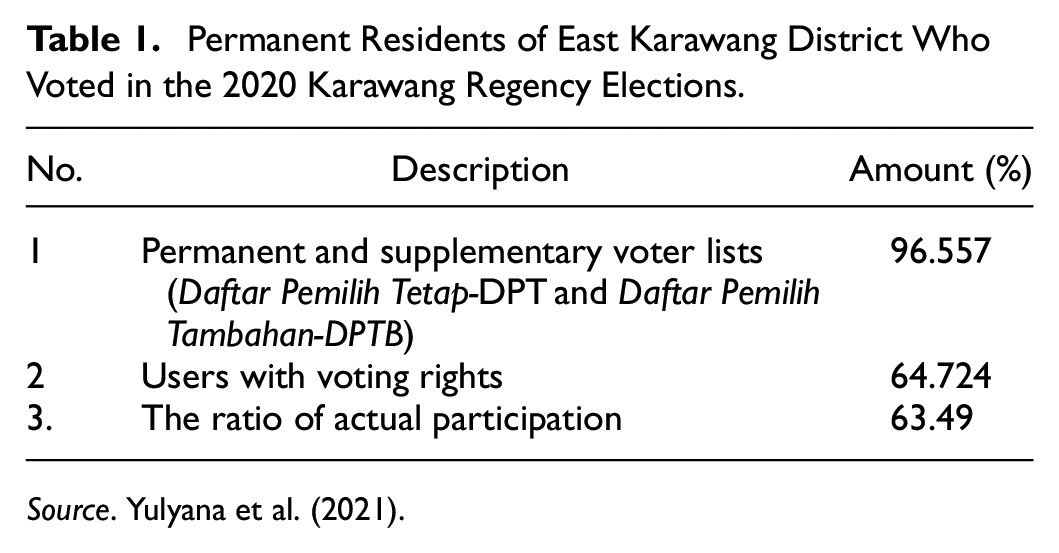
The election consists of several stages prepared by the election organizers. After the pre-election stage is carried out with various activities, the selection stage follows next: Under the schedule for holding elections, voting was to be held on December 9, 2020. The data obtained from the recapitulation results indicate the number of permanent voters listed in the East Karawang District and is presented in Table 1 below.
Permanent Residents of East Karawang District Who Voted in the 2020 Karawang Regency Elections.
Source. Yulyana et al. (2021).
With 96,557 registered voters, DPT, and DPTB in Karawang Regency and 64,724 voting rights users, the percentage of participation in regional head elections in East Karawang District remains low at 63.49% (Yulyana et al., 2021). On the other hand, the participation of people with disabilities in the 2020 regional head election in the Karawang District was relatively low. Figure 4 illustrates this phenomenon.
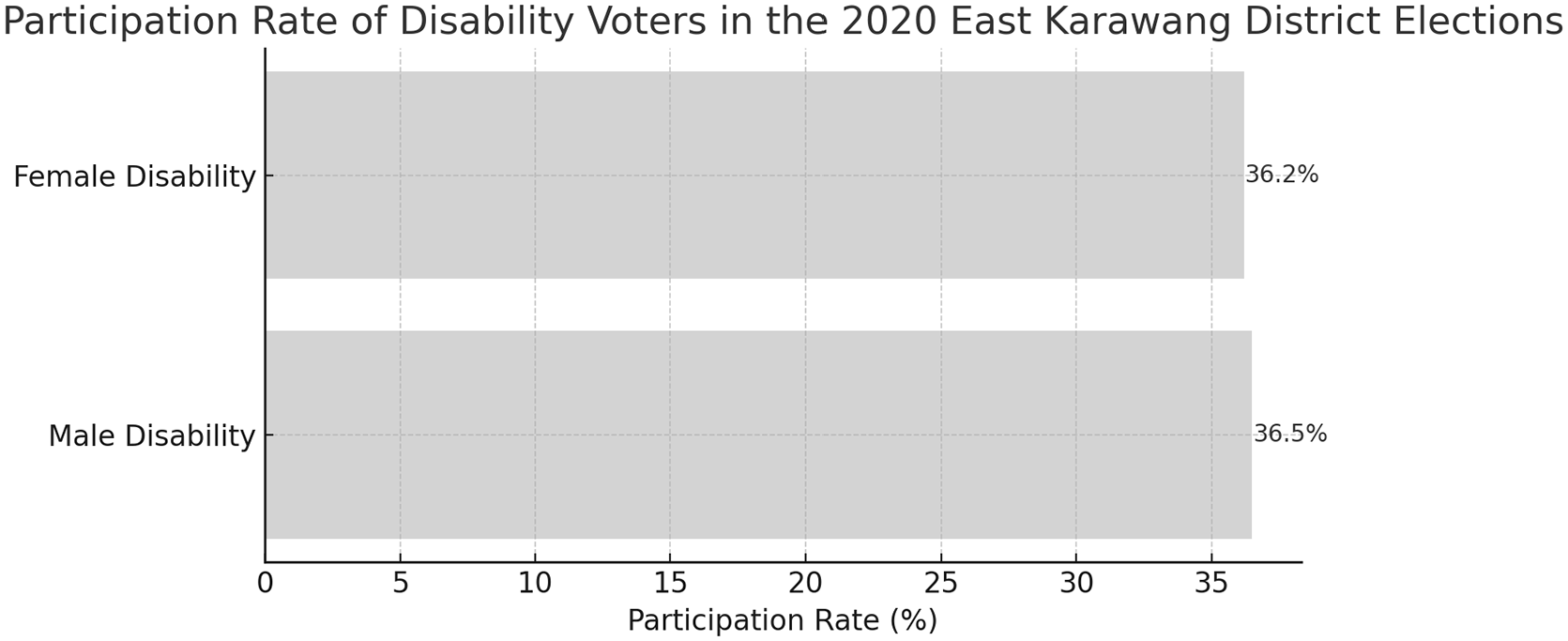
Participation rate of disability voters in the 2020 East Karawang District elections.
The percentage of people with disabilities was 36.34% in the East Karawang District. A total of 1,439 voters with disabilities in the Karawang Regency are included in the DPT and DPTB (Yulyana et al., 2021). Male voters who exercised their voting rights constitute only 36.52% of the total voters registered on the DPT, totaling 772 individuals (Yulyana et al., 2021). Meanwhile, 241 women with disabilities used their right to vote, constituting only 36.13% of the 667 voters registered on the DPT.
This was because there was a decline in participation compared to the previous general election. This decline could be attributed to various factors. However, it is obvious from the stages preceding the election that there was very little socialization for those with disabilities, and that occurred only once (T. S. James, 2021; Nwachukwu, 2021). This may be one reason why many people with disabilities did not use their right to vote in the 2020 regional head elections in the Karawang Regency. As election campaign messages and methods do not reach people with disabilities, they may feel uncared for or even excluded from the Democratic Party.
Meanwhile, East Karawang District lacks accessibility in the form of assistive gadgets and voting booths, which are inaccessible to people with impairments. The East Karawang District’s provision of access to regional head elections is insufficient and does not fulfill the criteria for accessible facilities for individuals with disabilities. Additionally, special police to help voters with disabilities were not supplied, even though people with disabilities require assistance officers and supportive devices during election time (Hofmann et al., 2020; Lavazza & Farina, 2020; Marisa et al., 2020). Therefore, individuals with impairments can exercise their rights as citizens to vote in general elections with acceptable accessibility. However, this has not yet been exploited by the organizers of the Karawang Regency general election. Numerous factors contribute to accessibility issues for people with impairments during general elections. This is because understanding the fulfillment of disabled people’s rights is still very basic in the community. Accessibility barriers and a lack of societal empathy toward disabled people have stigmatized disabled individuals (Zhang et al., 2020). Consequently, people with impairments voted at a low rate in general elections.
Conclusion
Based on the research and findings, it is concluded that the implementation of election accessibility in the East Karawang District is inefficient. Because election organizers did not reach out to people with disabilities in the East Karawang District during the pre-election period, many disabled voters faced challenges in exercising their right to vote on election days. This is because people with disabilities do not receive appropriate information about regional elections or their possible leaders. This is also attributed to the need for more socialization, particularly given the campaign’s brief duration and the climatic conditions during the COVID-19 pandemic.
Access to facilities such as polling stations and voting booths is insufficient for people with disabilities, as is the availability of assistive devices, which are often nonexistent. Additionally, the absence of specially trained police to assist voters with disabilities in polling places creates barriers for disabled voters. In East Karawang District, a lack of optimum socialization and election accessibility for individuals with disabilities has resulted in groups of voters with disabilities being unwilling to visit polling places, resulting in low levels of political engagement for persons with disabilities.
Footnotes
Declaration of Conflicting Interests
The author(s) declared no potential conflicts of interest with respect to the research, authorship, and/or publication of this article.
Funding
The author(s) received no financial support for the research, authorship, and/or publication of this article.

Data Availability Statement
Data supporting the findings of this study, “Election Accessibility during the COVID-19 Pandemic. Democracy’s Responsibility to Persons with Disabilities: Democracy’s Responsibility to People with Disabilities,” is not publicly available due to privacy and confidentiality requirements associated with participants and the sensitive nature of voter data. However, certain parts of the data, including anonymized summary statistics and relevant descriptive information, are available from the corresponding author, Eka Yulyana, upon reasonable request. Data access requests will be considered on an individual basis and require permission from relevant authorities and ethics review to ensure compliance with privacy regulations.