




Abstract
This study seeks to interrogate prospective configurations of public life through science fiction films, particularly by addressing the effects of technological advances and changes on society. In the study’s methodology, 27 films were assessed using the sociological film analysis method. In these films, an analysis was conducted on thematic elements, encompassing aspects such as the physical environment, socio-cultural structures, public life, technological infrastructure, and dynamics of human relationships. As a result, a codex of thematic codes was meticulously crafted. The main findings indicate that the films contain scenarios that discuss the boundaries of public space and reflect future social structures. The emphasis appears to be on how and to what extent technology is used. This research presents novel ideas and a platform for discussion for urban planning, architecture, social sciences, and film studies. The originality of this study lies in its analysis of cinematographic content from a sociological standpoint, providing an in-depth perspective on the future of public life and adding a new dimension to the existing body of knowledge on the subject.
Plain Language Summary
This study explores what public life might look like in the future through the lens of science fiction movies, with a focus on how technological advancements and societal changes affect us. In our research, we analyzed 27 films using a method that examines films from a sociological perspective. We looked at themes in these movies, including the physical environment, social and cultural structures, public life, technological infrastructure, and the dynamics of human relationships. From this analysis, we created a detailed set of thematic categories. The main findings show that these films present scenarios discussing the limits of public spaces and envision future social formations. A key aspect highlighted is the extent and manner in which technology is utilized. This research offers new insights and a basis for discussion in the fields of urban planning, architecture, social sciences, and film studies. What makes this study unique is its approach to analyzing movie content from a sociological viewpoint, providing a deep look into the future of public life and adding a new dimension to our understanding of the topic.
Keywords
Introduction
Throughout history, the evolution of everyday life in public spaces has constantly changed, influenced by economic, political, and social events. Global events such as wars, epidemics, and ideological conflicts have also affected public spaces, and these areas have continued to reshape themselves with a dynamic and changing structure (Eren & Aktuğlu Aktan, 2023). Beyond being a fascinating topic, the future of public life is an important matter that writers, artists, and intellectuals often discuss to comprehend how societies are evolving and where humanity is headed. In literature, Wells’ (1895/2017) The Time Machine, Huxley’s (1932/2021) Brave New World, Orwell’s (1949/2019) 1984, Bradbury’s (1953/2021) Fahrenheit 451; in the visual arts, the works of Jean-Michel Basquiat; in cinema, Blade Runner (1982), Metropolis (1927), Minority Report (2002); and numerous television series such as Black Mirror (2011–), Westworld (2016–), Revolution (2012–2014) offer deep questions on the future of public life. However, it appears that these comprehensive studies have not yet been examined holistically in the literature, and their implications for the future of society and public life have not beenadequately explored.
The rationale underpinning this research is predicated on the observation that discourses surrounding the future of society and urban environments have not been sufficiently addressed. This oversight necessitates the establishment of a discussion platform informed by social science perspectives. The impact of creating a discursive environment in which to consider the future, particularly by evaluating issues prevalent in genres such as science fiction and dystopia via a social scientific perspective, has not been fully highlighted in the existing literature in this domain. To bridge this lacuna, this study provides a critical evaluation of probable prospective scenarios of public life, using cinema’s predictive and reflective capacities in terms of social transformations. This study primarily seeks to make a substantial and novel contribution to the scholarly discourse on the future of public life.
A thorough evaluation of cinema films has been undertaken in this study, notably due to their extensive and varied production processes and their interplay with other literary forms, coupled with rigorous screenplay development. This research initially compiled a collection of 40 films from various periods in cinema history, focusing on themes such as urban life, societal evolution, the role of technology, and visions of the future. From this group, 27 movies that provided the most profound insights into the future of urban living and public spaces were then meticulously chosen for an in-depth sociological film analysis. They were chosen for their visually striking representations and powerful portrayals of predictions regarding urban and everyday life’s future.
The analyses employ a range of theoretical frameworks from film theory, including postmodern, Marxist, technology, and socio-cultural studies, to shed light on the complex relationship between films and societal structures and processes, thereby offering prognostications about the future of public life.
This study aims to explore potential future aspects of public life through these film analyses, interpret their meanings from a social science perspective, and create a platform for discussion on future urban planning, design, and social organization. The guiding research questions are: “What does the future hold for public life?” and “How can film analysis aid in comprehending future shifts in society and public life?” This art form, reflecting the social, political, and cultural factors of modern society, has the potential to articulate, ignite discussions, and enhance questioning and awareness about the hopes and concerns of individuals and society regarding the future.
The physical and social environment, cultural and economic structure, public life, technological infrastructure, behavioral patterns, human relations, public spaces, and behaviors were examined to depict the future of public space and life. While the world is grappling with crises and unexpected events, discussions, particularly within the framework of social sciences, must be developed. In this regard, the discovery of works of art and ideas based on extensive research into the future of society and the world is critical in shaping our future.
Public Life, Urban Spaces, and Cinema Films
“Long live public space, its ambiguities, and its contradictions.” (Zukin, 2022, p. 908) Public life is in constant flux, and its broadest definition should be thought of as everything that happens between buildings, the interaction between life and space (Gehl & Svarre, 2013). Madanipour (2003, p. 5) underscores that public spaces serve as communication channels connecting different parts of the city and catering to people’s daily necessities (Moughtin, 2003, p. 193), reflecting the complexity of urban society. The dynamic structure of public life can be seen in Lefebvre’s (1991) theory of the social production of space. Lefebvre states that space is not only a physical entity but also a structure shaped by social relations and power dynamics and affects these relations. This viewpoint stresses that public spaces go beyond physical locations in urban life and are a product of social, economic, and political processes. Habermas’s (1962) discussion of the role and evolution of the public sphere in modern societies reveals how this sphere plays a central role in social interactions and democratic processes. Additionally, De Certeau (1984) concerns how daily life practices are intertwined with space, thus illuminating the usage and meaning of public spaces in everyday life. Layton and Latham (2022) emphasize that public life and social infrastructure are in a constantly altering and evolving structure, and state that these areas need constant development and improvement to enhance service to society. Concerning the prompt transformation brought about by the information age, Gökgür (2017) states that immediate developments in communication, transportation and information technologies also influence urban usage areas and social life. Furthermore, public life is dynamically influenced by critical junctures and abrupt events, such as wars, epidemics, and economic policies, which profoundly impact daily life (Eren & Aktuğlu Aktan, 2022). Regarding the post-COVID19 period, which has recently occurred and triggered the acceleration in these technologies, Fuchs (2021, pp. 27–32) states that communication networks such as the internet and mobile phone networks have begun to be used at maximum capacity and that the coronavirus crisis has moved away from globalization and localized everyday life.
The prompt shift in public life also affects the political meaning of public life. In this respect, Sennett (2002, pp. 3, 6) states that most citizens in public life consider a spirit of submission, a formal obligation, in their dealings with the state. However, public life is much broader than political matters. Sennett (2002, p. 37) declares that in a society with a fortified public life, there must be intimacy between the stage and the street; moreover, there can be something comparable in the experiences of the crowds in these two environments. Arendt (1998, pp. 57, 64, 65) that the shared world is a common place where everyone meets, but the people’s positions here are different and cannot overlap. She emphasizes that everyone sees and hears from a different position and discusses the meaning of public life in this context.
This diversity and dynamism are also pivotal in the realms of art and science. For instance, Picasso’s (1937) “Guernica” and Dickens’s (2014) “Great Expectations” illustrate the reciprocal relationship between social events and artistic creations. Similarly, More’s (2006) “Utopia” and Orwell’s (2021) notable works like “1984” and “Animal Farm” have played a significant role in advocating for freedom and democracy through their social and political critiques.
In addition to literary works, media, particularly cinema movies, possess the power to reflect and critique social issues, as evidenced by a wide array of studies. For instance, Tudor’s (2014)“Image and Influence: Studies in the Sociology of Film” underscores cinema’s interaction with social structures and processes and its significance in sociological research. Similarly, “Visual Meaning: A Social Semiotic Approach” edited by Jewitt and Oyama (2011) and “Cinema and the City” by Shiel and Fitzmaurice (2001) delve into cinema’s impact on urban sociology and visual interpretation.
These works underline the influence of media, especially film and television, on social consciousness and change. Authors such as Harvey (1997) and Gold and Ward (2005) explore cinema’s handling of postmodern representations of time and space and its depiction of metropolitan life. Contemporary researchers like Greenwood (2023) and Salmenniemi and Ylöstalo (2023) argue that utopias and dystopias challenge traditional notions of labor and social production, asserting that tangible productive labor is crucial in shaping everyday utopias.
Furthermore, Kellner (2003) and Bergesen (2016) emphasize the importance of analyzing media culture’s reflection and influence on social structures, advocating for a detailed examination of films’ visual and narrative aspects, along with their societal impacts. Dowd et al. (2023) highlight the need for a sociological lens to comprehend how films represent gender roles, cultural norms, power dynamics, inequality, and ideological themes and the effects of these themes on society. These studies collectively demonstrate that films are not merely entertainment but are potent vehicles for social and political critique, capable of influencing societal mindsets and cultural transformations.
This perspective, as highlighted by these authors, suggests that cinema movies are more than mere storytelling tools; they actively participate in shaping social reality and spatial perception. This interaction provides valuable insights into how cinema movie is intricately interwoven with social structures and processes, underscoring its pivotal role in sociological studies. Several theoretical frameworks that deeply examine the relationship between cinema and society stand out in the literature in this context. In particular, postmodern film theory examines the boundaries between reality and representation and how films construct these perceptions. By analyzing elements of films such as hyperreality, intertextuality, and pastiche, it tries to reveal how reality is reproduced by the media (Baudrillard, 1994; Lyotard, 1984). For example, Gilliam’s “Brazil” (1985) reflects the absurdity of a society of bureaucracy and surveillance, while Spielberg’s “Ready Player One” (2018) explores the concepts of virtual reality and identity.
Concerning social structure, Marxist film theory also discusses the ideological apparatus of capitalist society and how class struggles operate and property representations. Marxist theorists can also examine how films represent class consciousness and reveal social inequalities (Jameson, 1992). For example, while Lang’s film “Metropolis” (1927) dramatizes class division and the mechanization of capitalist society, Bong’s “Snow Piercer” (2013) addresses class struggle and inequality through the metaphor of a train.
Theories of technology and society examine the effects of technology on social structures and human behavior. These theories explore the influences of technology on society and how society shapes technology, as well as the potential effects of technology on human experience and identity (Castells, 1996; Feenberg, 1991). For example, while Scott’s “Blade Runner” (1982) questions the ethical boundaries between artificial intelligence and humanity, Jonze’s “Her” (2013) deals with the emotional dimension of human-technology relations.
Cultural studies and theories examine films in the context of social ideologies, ethnic identities, and national identities. This approach considers how films, as cultural texts, reflect and question social values, beliefs, and ideologies. Cultural theorists, such as Hall (1997) and Turner (1990), emphasize how films can either reinforce or challenge cultural hegemony and represent various cultural identities. A pertinent example is Proyas’s “Dark City” (1998), which raises profound questions about memory and identity.
While these theories help us better understand the impact of cinema on the social fabric, they allow us to explore social, cultural, and ideological contexts through film in more depth.
As a result, these theories, which facilitate a comprehensive examination of films from a social perspective, aid in our understanding of the intricate relationships between cinema movies and society. Films, serving as mirrors to social transformations, technological advancements, and cultural dynamics, become an essential tool in sociological research. By analyzing the mentioned films within these theoretical frameworks, this study reveals how cinema interacts with social structures and processes and the implications of this interaction on society. These analyses demonstrate that cinema transcends mere entertainment; it is a potent social agent actively shaping societal norms, values, and expectations.
Studies of urban planning, architecture, and film also touch on this reciprocal relationship. Temel and Polatoğlu (2023, p. 50) discuss the flaneur approach to reading the city through cinema films; they claim the way images come together through montage in films offers a space reading experience similar to Le Corbusier’s Promenade architecture and Cullen’s serial view scheme. Kellner (2003, p. 152) emphasizes that he uses and represents the experiences and emotions of his audience when writing popular media texts. It highlights the importance of carefully studying and evaluating media culture texts because they have potent and distinctive effects. Bateman and Wildfeuer (2017, pp. 1–3) interpret the analysis of films as texts and emphasize that Dyer opposes the idea of film text analysis and defines analysis as a skill done by watching and listening to movies. They argue that direct text analysis tries to explain the effects it offers to the audience by extracting it from the visual and auditory elements. Field (2005) explains the intricacies of writing a screenplay, mentions the extensive research in the scripts and the issues such as harmonizing with the scene, and states that the screenplay is a paramount work of art.
Film criticism often debates between analyzing just the script or the film holistically. While the script is undoubtedly important, it is crucial to consider the entire film, including audiovisual sensations and the script. Scholars in cinema, society, and urban studies advocate a more holistic approach. Pratt and San Juan (2014) examine the historical connection between urban space and film, highlighting how cinema and art contribute to critical modernization and social change discussions. They argue that cinema serves as a vehicle for creating a new urban public space that fosters understanding and facilitates change, encouraging viewers to engage critically. AlSayyad (2006) presents the urban history of modernity and postmodernity through the lens of cinema, highlighting the strong and deep-rooted relationship between film and the city. He contends that films offer unique experiences and influence how we perceive and navigate the world.
Methodology
This research employs sociological film analysis to delve into cinema’s interplay with social structures, cultural norms, and technological advancements, focusing on discussing the future of public life. Sociological film analysis provides a critical lens for examining the reciprocal influences between film and society. Utilizing this approach, we can thoroughly examine how films engage with various social issues, including gender roles, power dynamics, economic structures, and ideological themes.
The selection of films for this research was guided by specific criteria to address the research questions effectively. These criteria included the films’ ability to depict social structures and future scenarios, their engagement with cultural and economic structures, and their reflection of technological infrastructure and futuristic visions. These factors were crucial in determining each film’s sociological relevance and suitability for analysis. The movies under investigation span a range of genres, such as science fiction, dystopia, utopia, futuristic, and post-apocalyptic, all capable of representing various aspects of public life and envisaging potential futures. The films were meticulously chosen to encompass themes like the physical and social environment, cultural shifts, and technological progress. This diverse selection offers a comprehensive perspective on the future of public life, facilitating a detailed exploration of their connections with film theories.
The chosen science fiction films are examined using categories designed to address how films interact with social structures and procedures on multiple levels. To facilitate a methodical analysis of the films’ messages and content, categories were created (Table 1).
Selected Movies and General Information.

The data analysis procedure employed the thematic coding technique. This method, a qualitative research approach, involves analyzing and categorizing movie content thematically. Thematic coding was developed to systematically identify, classify, and analyse the social meaning and significance of key film themes and motifs.
Given that the article concentrates on the future of public and urban life, the scenarios and scopes of the films are emphasized, yet the films are analyzed holistically. The films’ subjects and primary concepts were identified in the first analysis. Following that, the titles to be used during sociological film analysis were identified through the literature review. Codes were opted for the films’ themes, events, and characters. The physical structure and environmental factors of a future life are investigated under the title of the physical environment. Since the society and life of the future are being researched, the social milieu and cultural and economic structure are also included in our analyses.
Parallel to the research question of this article, it was necessary to examine public life, public space, developments in society, human relations, and behavior. Topics covered in sociological film analysis: Physical environment, social environment, cultural and economic structure, public life, technological infrastructure, behavioral settings, human relations, public space/community space, behavior in public space, main message, and presented future.
The films were compared using the coding technique during the analysis. Each title discussed in this technique is assigned a letter. Subsequent studies were carried out under these categories, and the data were widely classified without restriction. This classification is listed numerically. In other words, the titles examined are listed alphabetically from A to K, and the labels under each title are listed numerically. For example, in the comparison table, the first item for “A. Physical Environment group” was a “dystopic city,” coded as A1. The first table, created as a guideline, was applied for comparison in the subsequent table. In this table, movies and titles were overlapped, and all codes that should be in the combinations were established. Afterwards, the initial data for the analysis were created by verifying it. The most discussed and differentiated subjects were determined during the comparison. Tables 2 and 3 indicate the guidelines and comparison tables used in film analysis (Figure 1).
Code Guide for Sociological Film Analysis, Determined From Examinations of the Films.

Codes in the Films.


The methods of the study.
Sociological Film Analysis and Main Findings
Do you believe it is possible to discover clues to a future life by examining yesterday and today while trapped in a time capsule? Through the sociological analysis of 27 films, clues about the future are sought. References to other influential works have been discovered from time to time, such as George Orwell’s 1984.
This study glances into urban life, public life, and human life. People can live their days with the assistance of technology, sometimes with difficulty, sometimes alone in the world, and sometimes forced to leave.
Table 2 displays the coding guide created during the sociological film analysis. All movie reviews are made easier to understand and comparable through these tables. Table 3 indicates the codes in the movies.
The evaluation of the films together and mutually determined which codes were mentioned under which title in which film. Furthermore, when all films were evaluated together, the frequencies of the codes were examined using Phyton.
Findings according to the titles:
A. Physical Environments
It was discovered that different atmospheres and locations were used in the films examined. While some films deal directly with the future of a city, others prefer virtual or designed environments. The depiction of these diverse atmospheres indicates the potential variety of future urban spaces and living conditions. In particular, representations of dystopian cities offer insights into how technological advancements and societal shifts might shape urban landscapes
The films’ analysis results were examined, and coding was done according to their scope. Tables 2 and 3 present the data determined under the title of the physical environment. Following a comparison and examination of each film, the following tags were determined (respectively):

B. Societal Environment
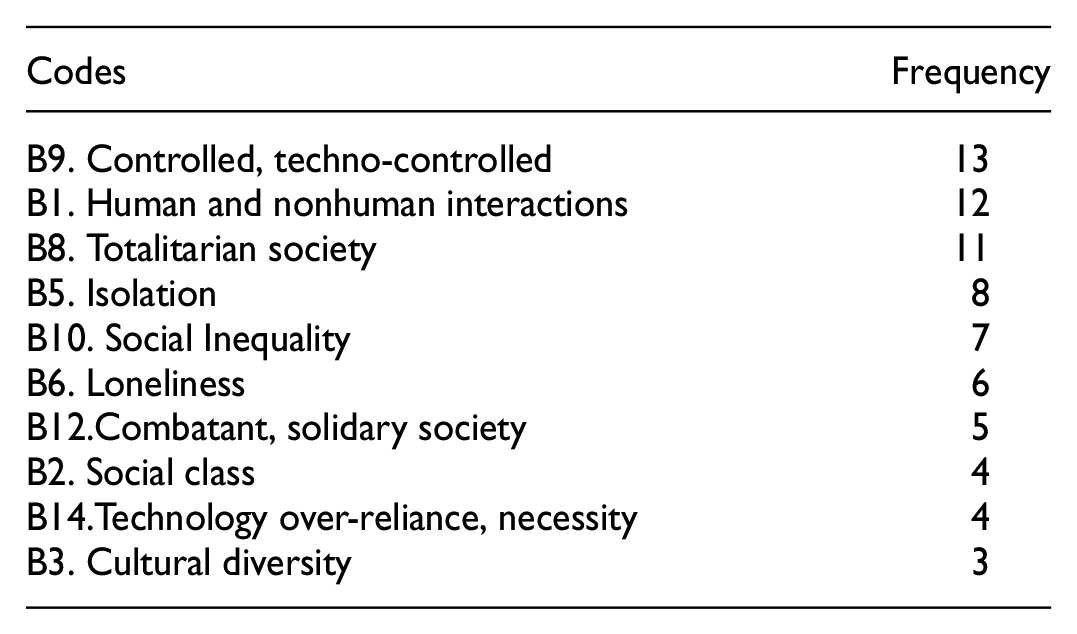
The recurring theme of technology-controlled societies in the films provides significant insight into the potential shaping of future social structures. The frequent portrayal of interactions between humans and non-humans suggests an evolving structure where technology’s impact on social relations intensifies. Moreover, some films highlight the challenges to social life arising from the regression or stagnation of technological advancements.
The analysis revealed that the most frequently identified themes were control, technology-dominated societies, and interactions between humans and non-humans. These findings highlight possible scenarios in future societies where an over-reliance on technology in governance could prevail. Furthermore, the portrayal of human nature and the various applications of technology often surfaces as subjects that provoke considerable thought. The most frequently detected codes are as follows:
C. Cultural and Economic Structure
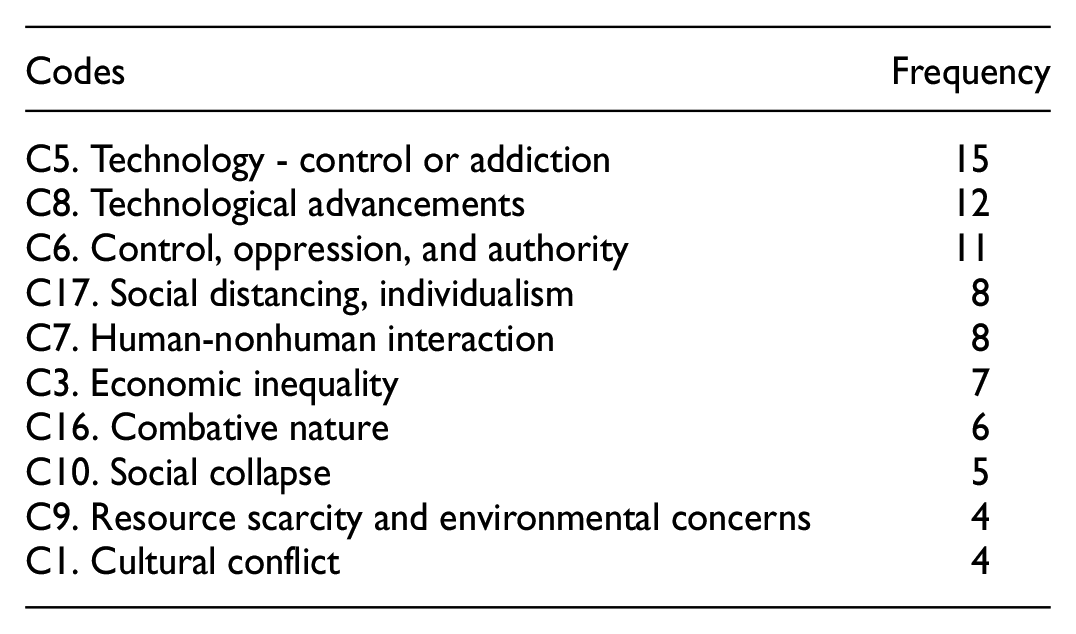
Cultural diversity, economic inequalities and technology use cases were found to be effective in our examination of cultural and economic structure. In our examination of cultural and economic structures, cultural diversity, economic inequalities, and the application of technology were identified as influential factors. The recurrent themes of technology control and addiction underscore the critical view future societies may hold toward technology. These themes present various scenarios on how future societies might address these challenges. Moreover, the potential of technology to foster control and addiction introduces new avenues for debate concerning ethical and social issues.
The most common tags because of the analysis are:
D. Public Life
Regular portrayals of environments under surveillance, control, and subject to management pressure echo societal concerns regarding the erosion of freedom and individual autonomy. While highlighting the potential adverse effects of technology on human interactions, especially in terms of limiting social relations, it is also evident that technology can be harnessed to foster solidarity in public life. It was investigated whether there were facts that could affect public life together, and all the films were compared, and the most repetitive ones were determined:

E. Technological Infrastructure
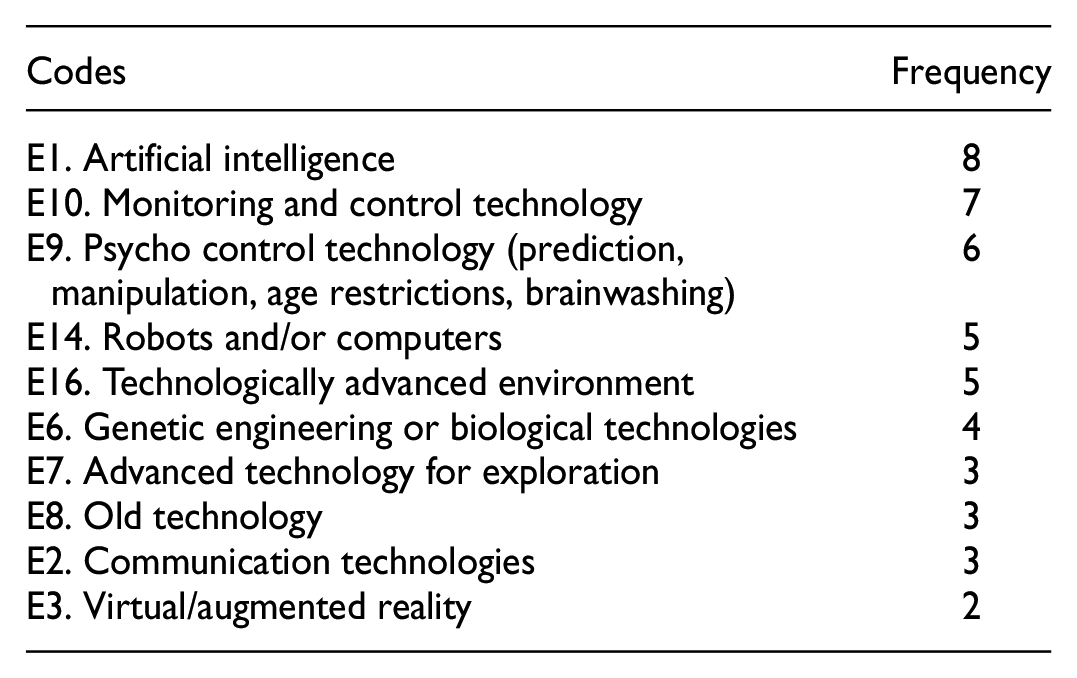
Regular portrayals of environments that are under surveillance, controlled, and subject to management pressure mirror societal worries about the erosion of freedom and individual autonomy. The depiction of constrained social relations highlights the potential adverse effects of technology on interpersonal interactions. Additionally, there are noted cases where technology plays a role in enhancing social unity. The most recurring codes for technology infrastructure:
F. Behavioral Settings
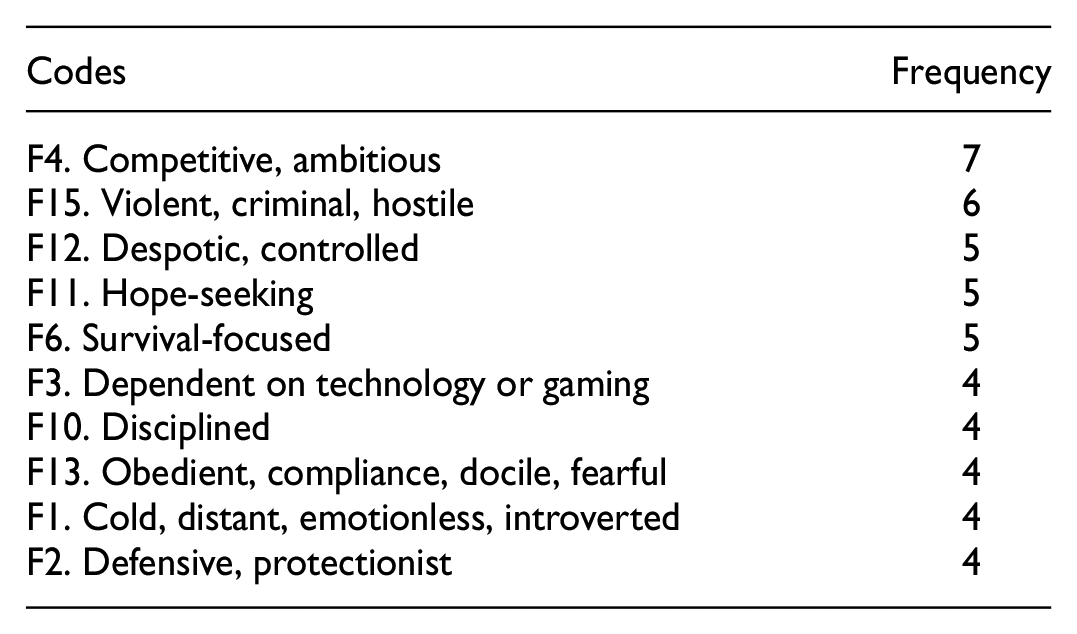
In examining behavioral patterns, the characters’ behaviors in the movie were evaluated as adjectives. The portrayal of characters as competitive and aspirational suggests that future societies may tend toward increased individualism and a focus on triumph. Furthermore, the depiction of aggressive and contentious behavior serves as a warning of potential sociable order descent in the future.
The most repetitive adjectives in movies are:
G. Human Relationships
The most commonly recurring themes in human relations were constrained and regulated relationships, interpersonal mistrust, and competition. This pattern reflects concerns about the erosion of genuine human connections in the face of technological advancements and social transformations. The most repeated ones in human relations are, respectively:

H. Public Spaces/Community Spaces
Some films depict public spaces in a more confined setting. This limited depiction of public spaces suggests a future shift in how societies interact with these areas. This portrayal raises intriguing concerns regarding the role of technology in transforming interpersonal interactions. The most common codes are:

I. Behavior in Public Space
These films frequently depict chaos, violence, and fear in public areas. These recurring elements represent a variety of themes, ranging from the emergence of collective unity, accommodation, and resistance to the growth of individual space and feelings of loneliness and isolation. The following are the most common behaviors, in order:

J. Main Message
The films under consideration introduce various themes, ideas, and potential future scenarios to the audience. In certain instances, the films explore the theme of a city approaching extinction due to the harmful consequences of technology. Some movies also touch on class discrimination, social inequality, and the darker side of human nature.
The following are the most frequently repeated:

K. Presented Future
The futures portrayed in the films under consideration are defined by different scenarios. Dystopian, chaotic, and hostile futures can depict a challenging world characterized by despair and fear. Technology-centered, isolated, and dystopian futures can represent a world in which technology or artificial intelligence has taken over human life. Future social issues are reflected through class discrimination and inequality, which also reveal the dark side of humans.
A potential future under authoritarian rule, limited by crime rates and demographics, is also emerging. These scenarios also offer a promising future for humanity. Nevertheless, optimistic movies highlight the importance of valuing something only after losing it.

Each of the analyzed films was reviewed under codes, followed by assigning a letter code to each title and a numerical code to the concept(s) that differed in each title. After the review, it was observed that certain tags were frequently used. After a comprehensive evaluation of all the codes, the most common ones are as follows:

Discussion
This study employs a sociological film analysis to investigate the future of public life, revealing various aspects under thematic categories by investigating the effects of films and technology on public life, as well as cultural and social dynamics. Movies like Fritz Lang’s “Metropolis” and Denis Villeneuve’s “Blade Runner 2049” illustrate the effects of technology on humans, while “Blade Runner 2049” and “The Matrix” delve into the hyperreality of postmodernism and the blurring lines between reality and fiction. These analyses, informed by the theories of Marcuse, Foucault, and Baudrillard, substantiate the influence of technology on public life with tangible examples. Furthermore, films such as “Metropolis” and “Elysium” echo Marx’s critique of capitalism, addressing class struggles and economic disparities.
When examined in the light of works such as Marcuse’s (1964, 2022) “One-Dimensional Man” and Foucault’s (1977) “The Birth of Prison,” the films support these theoretical frameworks with concrete examples. Films such as “Blade Runner 2049” and “Alphaville” present critical insights into the impact of technology on humans and the shaping of human experiences by authoritarian structures. From a Marxist perspective, “Metropolis” and “Elysium” reveal class struggles and economic inequalities. These films reflect Marx’s criticisms of capitalism and deal with the gaps and power relations among different social classes.
Regarding technology theories, “Minority Report” and “Her” probe the effects of technology on social structures and human relationships. Theories like Castells’ network society concept elucidate the influence of technological connections and interactions on social dynamics, as depicted in these films. Additionally, Baudrillard’s (1994) concept of “Simulacra and Simulation” illuminates the blurred lines between reality and fiction in films such as “The Matrix” and “Minority Report,” offering a framework to question individual freedom and perception of existence. These films encapsulate the concepts of control and surveillance as discussed in Foucault’s (1992)“The Birth of the Prison.” Furthermore, films like “Snow Piercer” and “Elysium” address the evolution of social and economic structures, the disparity between social classes, and environmental issues, providing a multifaceted exploration of these themes.
Regarding cultural theories, Snowpiercer and Gattaca delve into the aspects of cultural diversity and the construction of identity. These films parallel Hall’s theories of cultural identity, revealing how cultural norms and values change and affect social dynamics. Films such as Children of Men and Brazil evoke the dystopian society models in Orwell’s 1984, emphasizing the loss of individuality and state oppression. Additionally, films such as Gattaca and Minority Report invite us to think about the social consequences of technology while discussing the positive and negative effects of technological advances on society. The common theme of these films is an in-depth questioning of how technology, economy, and culture can shape the future of public life and how these changes can affect the lives of individuals.
The films examined display that social change and transformation are an ongoing reality. The beneficial and detrimental impacts of technological progress on public life are frequently discussed. The films examine in-depth intercultural interaction, identity formation, and societal relations. Furthermore, obstacles in this formation process and frequent class or genre conflicts, are mentioned.
In some of these films, it is predicted that future societies will coexist, and technology will become more prevalent. For instance, in “Blade Runner 2049,” humans and artificial intelligence interact in a world where technology is extensively utilized. In “Alphaville,” on the other hand, people live without emotion and are under strict authority. Similarly, in “Metropolis,” while examining the relationship between humans and machines, it is seen how technology has become a part of everyday life and how industrialization has affected the social order. “Brazil” discusses the loss of individuality and state oppression. “Children of Men” also describes the collapse of society and fertility issues. On the one hand, the oppressive management attitude in some films is associated with Orwell’s 1984. Although some groups in the films eventually seek their rights, they may not be able to raise their voices internally for a while, perhaps until they realize this. However, in some films, the messages of seeking hope or realizing the value of a thing once losing it and rising with that awareness are also conveyed. Moreover, while all of this goes on, technology continues to take the lead, which is beneficial. Sometimes digital technology may be a necessity for survival, as in Finch, and even as in Creator, artificial intelligence can become a new group in conflict, while on the other hand, it can turn into a group that can maintain good relations with people.
The analysis explores how seemingly positive activities can have negative consequences for society. It mentions “Gattaca,” depicting a future in which genetic engineering improves people’s immune systems and allows them to live longer lives, but at the expense of creating a competitive and conflicted society. The text also states how technological advancements depicted in films such as “Minority Report” have a mixed impact on everyday life. For example, the film’s preventive crime prevention system is viewed positively for combating crime, yet it also restricts personal freedoms, which is viewed negatively. The text emphasizes how technological advancements can have positive and negative societal consequences, creating a sense of solidarity and struggle.
The analysis has found that in films, the future of public life is often depicted as a world where technology plays an increasingly important role, but control and stress are prevalent. Using technology to rebuild society can lead to a cold and distant life without freedom. However, there is a growing sense of solidarity among people who want to reclaim their rights. It is also highlighted that technology can be used positively to benefit humanity and the environment, but the potential for abuse should not be overlooked. It is important to remember that these film depictions are products of imagination and may not accurately represent the real world. Nevertheless, films provide us with a glimpse into potential futures.
Considering what happens when movies are released:
For instance, Fritz Lang’s Metropolis (1927) preached class conflicts caused by the industrial age and the impact of technology on humans, shedding light on the societal concerns of the time. In contrast, Ridley Scott’s Blade Runner (1982) reflects the 1980s’ great interest and concerns in technology, focusing on the ethical dimensions of artificial intelligence and the concepts of human identity. These films reflected the social and cultural dynamics of their period and served as a way of expressing the concerns, hopes, and thoughts of the society of that period. Stanley Kubrick’s 2001: A Space Odyssey (1968) was released in the late 1960s at the height of the space race and raised humankind’s complex relationship with technology, the mysteries of the universe, and philosophical questions about human origins. This film shaped the public imagination by reflecting the time’s high hopes and fears about science and technology. The Matrix was released in the late 1990s, at a time when the internet and digital technology were becoming increasingly significant in everyday life. By covering topics such as virtual reality, artificial intelligence and human freedom, the film has stimulated public debates about the effects of technology on human life. Each of these films reflected the social and cultural dynamics of the period in which they were released and served as a way of expressing the concerns, yearnings, and thoughts of the society of that period. This perspective underscores the films’ significance, not only in terms of their artistic merit but also for their profound influence on social and cultural history.
Physical Environment
The films analyzed often depict a future physical environment with an urban and technological atmosphere. Some feature a degraded environment due to natural resource depletion and environmental problems. Common elements in these films include tall buildings, densely populated areas, and technological effects. In others, the physical environment is portrayed as abandoned, gloomy, secluded, and primitive. While films such as Blade Runner 2049 and Metropolis depict a future dominated by tall buildings, densely populated areas, and technological influences, they also underline the depletion of natural resources and environmental problems. Additionally, this situation can be related to Lefebvre’s (2020) Right to the City approach, emphasizing the effects of urban space on social relations.
Social Situation
Generally, social structures and classes shift, power dynamics shift and a significant future is foreseen. Authoritarian control of society, inequality, and social discrimination are typical dystopian themes. Some films draw attention to the increasing isolation, alienation, and loneliness caused by technology. Snowpiercer and Elysium reveal the social tensions and conflicts brought on by increasing class divisions and social injustices.
Economic and Cultural Structure
In general, cultural values and norms change, and new value systems emerge in tandem with social problems. Films frequently depict a “cultural mess” or a future in which cultural homogeneity has been lost. Some films depict a world where income inequality and class distinctions become more pronounced. It is also clear that technology and science are used to gain power. Films such as Gattaca and Minority Report emphasize the use of technology and science as tools to gain power.
Public Life
Films indicate how people’s behavior in public places has evolved. Some films portray public life as dystopian, with society under authoritarian control and personal freedoms restricted. Other films depict public life as more independent, free, and innovative due to technological advancements. In some films, public spaces are diminished, and the focus is on private life. Films portraying public lives with flourishing authority and social oppression can give a dystopian impression, like George Orwell’s 1984 novel. Furthermore, the society attempting to maintain control echoes Foucault’s (1992) themes and demonstrates how surveillance and control mechanisms shape the public sphere.
The Technological Infrastructure
Artificial intelligence, robots, and virtual reality technologies have become integrated into people’s daily lives. The films emphasize that advanced technology substantially influences public life and human interactions. Despite its advantages, some films also highlight instances of technology abuse and people’s uncontrolled dependence on technology. Films such as “The Matrix” and “Her” serve as samples showcasing the profound impact of advanced technologies, particularly artificial intelligence and virtual reality, on the dynamics of public life. This resonance with Castells’ (1996) “Network Society” theory underscores the pivotal role of technology in reshaping the landscape of social interactions. Additionally, certain cinematic narratives delve into scenarios of post-disaster extinction. In juxtaposition to the portrayal of a technologically facilitated society, these films unveil various facets of human nature, manifesting in the relentless struggle for survival.
Behavior Settings
Dystopian movies depict the control and alteration of individual behavior due to security concerns and constant surveillance. Some movies address the changes in behavior patterns, such as technological addictions and the rise of virtual relationships. Themes of obedience, compliance, rebellion, and resistance are highlighted, as are behaviors such as technology addiction and alienation. Stereotypical traits like selfishness, arrogance, and individuality are prevalent in films that deal intensively with social inequality, while feelings of solidarity, resistance, and rebellion are dominant. Movies such as “A Clockwork Orange” (Kubrick, 1971) and “The Island” (Bay, 2005) depict the control and modification of individual behavior.
Human Relationships
In many, the physical and emotional bonds between people are seen to diminish or change as technology advances. Several films portray a future where individuals are isolated and their connections are weakened, while others stress the importance of social solidarity. In certain films, attention is drawn to distrust and competition among people; in others, the lost values are later realized or attempted to be regained. Movies like “Her” and “Wall-E” show how physical and emotional connections between people change as technology advances. This is consistent with Bauman’s (2000) concept of “Liquid Modernity,” highlighting the superficial and transient relationships of modern societies.
Public Spaces/Community Spaces
Generally, the dwindling public spaces and the increasing significance of private life are noteworthy. Films such as “Ready Player One” (Spielberg, 2018) and “Finch” (Sapochnik, 2021) show the transformation of virtual environments into centers of social interaction and the decline of real-life interactions. Public spaces serve as sites for social resistance and protests in some films. Some envision a future where social solidarity and collective activities gain prominence.
Public Behavior
Films reveal how behavior in public spaces has changed. Some films depict individuals exhibiting anxious, apprehensive, or hostile behavior within public spaces. Some depictions show a future where people unite and collaborate toward shared objectives, preserving social order. Several films acknowledge the decreased interaction of technology-dependent and alienated individuals in public spaces. Films like “I Am Legend” and “Children of Men” highlight people’s proclivity to maintain social order and band together for common goals.
What’s the Future Like?
The films under consideration highlight both the advantages and disadvantages of technological advancements for society, offering diverse perspectives on how the future might pan out. These scenarios underline Beck’s (1992) theory of “Risk Society,” highlighting the risks faced by modern societies and the challenges brought by technology. While the films explore possible aspects of future public life, they make us think about what effects these scenarios might have in the real world. For example, some works encourage society to think about unexpected crises and their consequences, such as the “Revolution” series, which presents a dystopian scenario that begins with a power outage. “Children of Men” addresses the challenges and social dynamics of a post-apocalyptic world, raising significant questions about future social structures.
Conclusion
This study comprehensively discussed the contributions of cinema works to the future of public life and the sociological analysis of these works. The various aspects that films present about the future of public life portray the challenges and opportunities that society may face in the future. These evaluations additionally provide fresh concepts that can be utilized in the social sciences, architecture, urban planning, and film studies. Since the films’ treatment of various social issues and the messages they contain, it has been possible to comprehend the diversity and complexities of public life. The social and cultural changes that people go through as an outcome of technology are a recurring theme in the films. These changes may result in the development of novel behaviors in social life.
Films raise important sociological and philosophical questions about the future by reflecting on social changes and technological advances and their potential consequence on the future lifestyles of individuals and societies. This research advances knowledge in the field by providing new and inspiring perspectives on future urban and social structures.
Most of the films reviewed addressed the destruction or collapse of public life. This situation triggered significant changes in people’s interactions with others. These shifts have impacted people’s social status and power dynamics in films, or such an order has been formed. People’s social lives have been significantly influenced by the advancement of technological infrastructure. Artificial intelligence and other technological innovations have increased people’s interactions with one another and the rest of the globe. However, technological advancements have resulted in inequality, individualization, isolation, and deterioration of power balances and control with technology, as depicted in some films.
The films concentrate on the changes in people’s social lives and the unchanging aspects of human nature. The primary outcome is determined by how technology is applied. Technological advancements may render it easier for people to interact with others and collaborate for common goals. Another conclusion that could be drawn from these films is that people interact and indicate solidarity with one another in social situations.
The analysis of films revealed that public life is constantly changing. Moreover, societies seek various remedies for the challenges that they face. Themes like technological advancements, cultural interaction, political participation, and social justice were recognized as crucial elements influencing public life. The films regarded and the review method could be the constraints in this analysis. The films examined in this study span a wide range, and the examined features of each are detailed. Recognizing social dynamics and making predictions through films is critical to creating a more just, equal, and sustainable public life. Nonetheless, the objective here is to investigate the future and create an environment through plausible scenarios, not to build and predict the future. In this topic, Hochfelder (2020) encourages readers to consider how future cities should be thought of, rather than what they could look like, by highlighting the complexity and dynamism of cities rather than providing precise guidelines or designs for thinking about them. To grasp his ideas and forecasts about the cities of the future, he draws on fictional and visual sources, including books, movies, and artistic creations. Mulgan (2023) discussed the significance of further probability studies as well. He pointed out that social scientists should be involved in future research because the world is currently experiencing several crises and that analyzing potential future scenarios will create a possibility field full of rich, complex, and feasible ideas. He said that during this trying time, individuals need to be guided and assisted.
Limitations of this study include the diversity of films analyzed and the subjective nature of sociological film analysis. Subsequent research endeavors may assess these results from an expanded viewpoint, incorporating films from diverse cultural backgrounds. Additionally, in-depth studies focusing on the social impacts of technology can help us better understand the ethical and social dimensions of technological developments. Ultimately, research examining the potential effects of the dystopian and utopian scenarios presented in these films on real-world policies and social structures can make significant contributions to the urban and social structures of the future.
Ultimately, this study emphasizes that the sociological analysis of cinematic content adds a new dimension to our current understanding, providing a broad perspective on the prospects of public life. The various depictions of future public life in films are expected to play a pivotal role in intellectual engagement in the real world, generating novel perspectives for discourse on the upcoming urban and societal frameworks. This study is intended to spark further scholarly inquiries into the future of public life and to stimulate subsequent dialogues on the subject.
Footnotes
Author Note
The preliminary study of this article was presented as a summary paper at ICCAUA 2023 and was further developed thereafter.
Declaration of Conflicting Interests
The author(s) declared no potential conflicts of interest with respect to the research, authorship, and/or publication of this article.
Funding
The author(s) received no financial support for the research, authorship, and/or publication of this article.
Ethics Statement
In this study, there are no human or animal experiments or studies.

Data Availability Statement
Data sharing not applicable to this article as no datasets were generated or analyzed during the current study.