




Abstract
This study explores the determinants of career choices among Emirati students, engaging 550 students from selected universities in the United Arab Emirates (UAE). Employing a phenomenological approach, the research utilized a survey questionnaire to understand the impact of various factors such as parental influence, educational institutions, university programs, and socio-economic elements on the career decisions of undergraduate Emirati students. Out of 550 targeted participants, 400 completed surveys were analyzed using Statistical Package for the Social Sciences (SPSS) version 22. The findings reveal a predominant influence of parents, followed by significant roles of schools and socio-economic factors, in shaping career choices. University programs, while less directly influential, play a nuanced role, often aligning with students’ interests and parental expectations rather than directly dictating career paths. The study acknowledges its limitations, including its focus on a specific demographic within the UAE and the potential for response bias. Future research is suggested to examine the longitudinal effects of these factors on career development and to explore the impact of emerging economic trends. Additionally, comparative studies with students from other regions could provide a broader understanding of these dynamics.
Plain language summary
This study surveyed 550 Emirati university students to understand how parental influence, education, and socio-economic status affect their career choices. Analyzing 400 responses using SPSS revealed parents’ predominant influence, with education and socio-economic factors also important. University programs play a subtler role, suggesting further research on these dynamics.
Keywords
Introduction
Several empirical studies have focused a significant portion of their attention on students’ choices for their careers, specifically paying specific attention to students residing in the United Arab Emirates (UAE). The decision of what career path to pursue is frequently impacted by a plethora of internal and external circumstances for the student (Ausman et al., 2013; Nuseir & El Refae, 2022; Rababah, 2016). Notably, the choice of area, the function of academic institutions, the influence of social variables, and the personal aspirations and motivations of the students all play an essential role in the process. According to Nuseir and El Refae’s (2022) research, the decision to pursue higher education in one of the UAE’s many local universities has been linked to implementing various educational methods. This is further supported by the study of university image formation among potential higher education students, particularly in the case of overseas branch campuses (Wilkins & Huisman, 2015). Furthermore, Ahmad and Hussain (2017) highlighted the factors that influence student destination choice for higher education, highlighting the role of universities in influencing career choices.
Specific fields of study, such as accounting, medicine, nursing, teaching, dentistry, optometry, and entrepreneurship, have received individual attention in the context of the UAE (Abdulrahman et al., 2016; Ashour, 2016; Osuagwu et al., 2014; Rababah, 2016; Rashid, Ghotane, et al., 2013; Sharif et al., 2016; Wu et al., 2015). The students’ reasons for choosing these jobs are multifaceted, with some being driven by social issues, employability, societal demands, and personal curiosity (Khalid & Ahmad, 2021; Levaillant et al., 2020; Patterson et al., 2021; Subu et al., 2022). Gender concerns are also of the utmost importance when deciding on a professional path, and several studies have shed light on the significant role that women play in the labor sector in the UAE. AlDhaheri et al. (2017) and Baroudi and David (2020) offered empirical evidence on the career choices of females in the private sector and the role of universities in cultivating female leadership qualities. Similarly, research has revealed a gender gap in science, technology, engineering, and math (STEM) sector, highlighting the importance of increasing the number of women working in these industries (Patterson et al., 2021).
Ashour (2016) and F. Jabeen et al. (2017) studied entrepreneurship as a career option. Their findings highlighted significant role of schools in fostering entrepreneurial attitudes and providing the practical skills necessary for founding and managing successful enterprises. On the other hand, both Jawabri (2017) and Mannaa and Abou-Shouk (2020) emphasize the significance of internships and other forms of practical work experience and their impact on students’ future career possibilities. They discovered that internships played a significant role in giving students exposure to various industries, influencing their future goals, and easing students’ transition from academic to professional life. In a nutshell, a tangled web of factors, including personal drive, societal expectations, academic influences, employability prospects, and internship experiences, all play a part in determining the career paths that UAE students choose to pursue after graduation. It is of the utmost importance to offer guidance to students as they make decisions about their professional futures and to make sure that the educational institutions in the UAE are adaptable to the ever-changing requirements of the labor force.
There is a limited understanding of the role played by parents or guardians, teachers or schools, university programs, social and economic factors, and university programs among undergraduate Emirati students, despite numerous studies examining the factors influencing career choices among students in the UAE. The work already published has mainly concentrated on particular industries or fields, giving an unclear picture of how these elements function in many situations and career pathways. Understudied is the influence of parents or guardians on undergraduate Emirati students’ career choices. Parental influence, a significant factor in a family-oriented country like UAE, is generally unstudied, while other aspects like personal motivation and social expectations have been (Nuseir & El Refae, 2022; Rababah, 2016). More studies on how teachers and learning settings affect students’ career choices need to be included. In their study of professional motivations for teachers, Sharif et al. (2016) stated that a deeper comprehension of how school-level variables affect students’ career choices is required. Much research has yet to be done on how university programs affect career decisions. The direct impact of program offerings and curriculum design on profession choices has yet to be discovered, despite studies on university marketing techniques (Nuseir & El Refae, 2022) and the development of higher education institutions’ public perceptions (Wilkins & Huisman, 2015) being available in the universities.
The above literature provides an overview of career choice factors, but there appears to be a research gap in understanding how teachers and educational institutions affect undergraduate Emirati students’ career choices. Blotnicky et al. (2018) and Sheldon et al. (2020) examine how personal interests affect career choices, but they do not isolate teachers or schools. Regional studies like those by Abdulrahman et al. (2016) and AlDhaheri et al. (2017) focus on career choices rather than teachers and educational institutions. Thus, studying the effects of teachers and educational institutions on Emirati students’ career choices is a promising research topic. This gap emphasizes the need to investigate whether these educational influences shape career trajectories, addressing the research objectives. Finally, the study designs the research questions in order to ensure career guidance policies and practices for undergraduate Emirati students:
Do the teachers or schools influence the career decisions of undergraduate Emirati students?
Does the role of a teacher and an institution have a distinct influence on students’ career choices?
Review of Literature and Conceptual Model
Holland’s Theory of Career Choices
In the study of career choices among undergraduate Emirati students, Holland’s Theory of Career Choices (Holland, 1959) provides a framework for understanding the interplay between personal traits and environmental influences. This theory, which posits that career choices are expressions of one’s personality, is supported by findings from Blotnicky et al. (2018) and Kemboi et al. (2016), who emphasize the significant role of external factors like parental guidance and the home environment in shaping career interests and choices. Complementing this, the Expectancy Theory by Mitchell and Beach (1976) focuses on how individuals form expectations and how these influence behavior. This theory is particularly relevant in understanding the impact of teachers and educational institutions, as highlighted in the research by Theresa (2015) and Blotnicky et al. (2018), in shaping students’ career expectations. Furthermore, the extension of the Expectancy Theory by Baliyan and Baliyan (2016) to include social and economic factors such as job opportunities and income levels, as explored in studies by Hartmann et al. (2021) and Morgan et al. (2015), underscores the influence of these factors in career decision-making. Lastly, the significance of university programs in shaping career preferences is evidenced in the research by Wang and Wanberg (2017) and Kumara et al. (2019), aligning with the emphasis on the role of educational pathways. This integrated approach, combining Holland’s Theory and the Expectancy Theory with empirical evidence, provides a comprehensive understanding of the multifaceted factors influencing career choices among Emirati students.
UAE Education System and Students’ Career Choices
Holland’s Theory of Career Choices, supported by a range of scholarly studies, posits that individuals are drawn to careers that match their interests and personality types. This concept, highlighted in research like that of Blotnicky et al. (2018) and Sheldon et al. (2020), suggests a strong alignment between personal characteristics and occupational environments. The theory supports the idea that career choices reflect an individual’s identity, as explored by Su et al. (2015), where people seek environments that allow them to express their attitudes and values. Understanding one’s personal inclinations, as emphasized in studies by Wang and Wanberg (2017) and Hartmann et al. (2021), can lead to more satisfying and suitable career decisions. Holland’s framework, therefore, underscores the importance of self-awareness in the career selection process, advocating for choices that resonate with one’s inherent traits and preferences, a concept also reflected in the works of Kumara et al. (2019) and Morgan et al. (2015).
The UAE is a young, emerging and innovative country established in 1971. The country is a federation of seven emirates, namely Abu Dhabi, Ajman, Dubai, Fujairah, Sharjah, Ras al Khaimah, and Umm Al Quwain. Ras Al Khaimah is the northernmost Emirate of the UAE, known for its Arabian Gulf beaches and mountains. Education in the UAE has been steadily growing and advancing to compete with some of the top-performing countries. Ridge et al. (2015) indicate that the development of the education system has been a key priority of the government of the UAE since its establishment. There is a concern that only a few Emiratis consider private sector jobs in the UAE; they primarily focus on public sector jobs or setting up their own businesses. In order to overcome this structural division in the labor market, the UAE government launched the Emiratisation (Tawteen) campaign, which mandates the inclusion of Emiratis in the job sector, particularly in the private sector (The Official Portal of the UAE Government, 2024). However, it is still being determined if young Emiratis are interested in venturing into different sectors and professions. This research, therefore, is motivated to understand the career choices of young Emiratis. As the study focuses on Emirati students’ career choices, it is necessary to understand the ethnographic construct of these students. The cultural and social context in which these students develop their professional ambition must be addressed.
Bandura’s (1989) Social Cognitive Theory serves as a conceptual basis for this study as scholars such as Lent and Lopez (2002) argued that social persuasion affects an individual’s career choice. This is a typical case in the Arab and UAE culture, where parental influence on young people’s course and career choices is prominent. David (2017) indicated strong parental influences on young people’s career choices in the UAE. Self-efficacy Theory does offer a sound basis for career assessment, according to Betz (2000), as an individual’s decision regarding career path and interest is strongly linked to their self-efficacy.
Sen’s Capability Approach Theory (Wells, 2012) also offers necessary insights for career development and career counselling in individuals, according to Egdell and Robertson (2021). Higher education in the UAE has expanded in recent years with a wide range of courses available in the higher education in the country. According to Commission for Academic Accreditation (CAA, 2024), there are 75 licensed higher education institutions and 885 accredited programs in the UAE, including 492 bachelor, 204 master’s, and 16 doctoral programs.
Most Emirati students could continue their tertiary education within the UAE because there are many course choices available in the higher education market in the UAE, as it has expanded rapidly in recent years with privatization and the operation of foreign universities. However, there are only so many choices in other established higher education markets. There are many scholarship opportunities for Emirati students to study abroad and many self-fund to study abroad. In addition, the scope of the local job market is limited to a few sectors, which may only support a narrow range of career choices for students. David (2017) argues that most university courses are related to the four dominant sectors and job markets in the UAE: oil and gas, construction, retail market, and tourism. He observed that there is a significant interest in engineering and business courses among young students in the UAE. Sadler et al. (2012) found both stability and volatility of STEM career interest among high school students. They, in particular, found that the students’ choice of physics had higher stability in their career path compared to other science subjects within the samples they studied. They also found lower retention among female students in STEM careers than male students.
In addition, Hwa (2003) found significant relationships between students’ course choices and their gender and socio-economic background. Oon and Subramaniam (2013) indicated that students who chose science subjects did not show greater intention in science-related careers. Some studies suggest that parents, educators, industry, and peer influences are predominant in students’ course and career choices. David (2017) found that parents and educators are key influencing factors in the higher education course choices of female students in the UAE, while parents and peers are influencing factors for male students. It is, therefore, important to further investigate UAE students’ career choices. In recent years, the UAE, particularly Dubai, has hosted the largest career fair and events given the EXPO 2020. Careers UAE is one of those events that showcases career fairs with excellent connectivity to local and global job opportunities. Another important question to be addressed in research is whether students are prepared to face fast-changing job markets and whether schools and universities prepare students to deal with these changes.
Parents/Guardians and Students’ Career Choices
In vocational psychology and career development, there has been much interest in the study of parents’ or guardians’ influence on career choices. The enormous influence that parents have on their students’ career choices has been noted in numerous studies, but little is known about how this influence manifests itself among Emirati students (Nuseir & El Refae, 2022; Rababah, 2016). When Nuseir and El Refae (2022) looked at the variables affecting students’ decisions to enroll in UAE universities, they discovered that familial influence was a significant predictor of career choice. They did not, however, go into detail about how this influence affects particular career trajectories. Parental influence played a significant role, according to Rababah (2016), which examined why students at a UAE institution chose accounting as their major. This effect was incredibly potent in cases where one or both parents had accounting training.
In addition, Ausman et al. (2013) identified parental guidance as a significant factor in examining the social determinants influencing career choice in a UAE medical school. According to a related study by Abdulrahman et al. (2016), parental influence significantly impacts Emirati students’ decision to specialize in medicine. Both studies indicate that parental influence may be especially strong in professions like medicine, where career pathways are typically prestigious or linked to high social standing. The influence of parents is also shown in more general studies such as that by AlDhaheri et al. (2017) which analyzed the job choices of women working in the UAE private sector. It was discovered that parents’ opinions regarding particular professions significantly impacted their daughters’ career choices. Similarly, Ashour (2016) investigated the appeal of social and corporate entrepreneurship among university students in the UAE and found that those with entrepreneurial parents were more inclined to view this as a viable career path.
In contrast, Jawabri (2017) examined the internship experiences of business students in the UAE and hypothesized that these students had more fulfilling internship experiences and higher career prospects when they depended more on their experiences and less on their parents. This suggests that, although parents play a significant role, personal experiences also play a significant part in determining career pathways. Based on evidence in literature, the study offers a research hypothesis:
H1. Role of parents or guardians significantly affects career choices of undergraduate Emirati students.
Teachers/Schools and Students’ Career Choices
It is well recognized that teachers and schools play a significant socialization role in students’ career choices. According to several research studies (Serhan & Almeqdadi, 2021; Sharif et al., 2016), instructors’ attitudes, pedagogical strategies, and school surroundings may impact students’ career goals, choices, and preparation. Despite the widespread agreement on this subject, more is needed about how teachers and institutions of higher learning influence undergraduate Emirati students’ career decisions. The choice of teaching as a vocation among foreign instructors in the UAE was examined by Sharif et al. (2016). According to their findings, teachers’ influence was a significant factor in a student’s decision to pursue a profession in education. One of the main motivating factors for pursuing a profession in education was teachers’ standing as role models. Nevertheless, this study did not examine career choice in general but the teaching field.
In order to determine middle school kids’ interest in STEM fields in the UAE, Serhan and Almeqdadi (2021) conducted a study. They concluded children’s opinions of and aspirations for careers were greatly influenced by the inclusion of STEM education in the school curriculum. It is yet unknown, though, how this STEM-focused strategy affects undergraduate students’ choice of careers. Wilkins and Huisman (2015) offered a distinct viewpoint by examining how a university’s reputation impacts prospective students’ decisions. Their findings highlighted the part played by educators in fostering a positive perception of universities, which in turn influenced students’ decisions. Their study did not, however, look at how this image affected career choices.
The gender disparity in STEM disciplines in the UAE was cited in the research by Patterson et al. (2021) as evidence of a more indirect impact of education. According to their meta-analysis, teachers’ lack of support and the absence of female role models in STEM disciplines may discourage female students from pursuing STEM-related occupations. The study by Kemp and McLoughlin (2022) also looked into millennials’ career aspirations in the UAE. They discovered school-based career counselling services significantly shaped students’ vocational preparedness and adaptability. However, because most of their research concentrated on the millennial age, it is still being determined whether or not the results apply to other cohorts. Based on the evidence in literature, the study offers a research hypothesis:
H2. Role of teachers or schools significantly affects career choices of undergraduate Emirati students.
University Programs and Students’ Career Choices
Across a wide range of academic disciplines, the impact of university programs on students’ career choices is extensively established. Previous studies provide insight into several influential elements, including, but not limited to, economics, nursing, law, social sciences, pharmacy, and university life. Nguyen et al. (2023) examined the economic aspects influencing students’ professional decisions after the COVID-19 epidemic. They found that students’ career choices were influenced by their awareness and appraisal of the economic environment, backed by the knowledge they acquired from their university programs. This study underscored the crucial function of economics programs. Sakamoto (2022) considered the career options of nursing students and centered on their Research, Advocacy and Practice-related (RAP) experiences. The study discovered that these encounters had a substantial impact on their career decisions, indicating that the exposure and experience offered by nursing programs significantly impacted their choice to work in the field of ageing.
In addition, Karlsson and Noela (2022) focused on the factors influencing Swedish students’ decisions not to pursue careers in accounting. They discovered that how students perceived a profession was greatly influenced by how they were exposed to it throughout university courses. Boutcher et al. (2023) re-evaluated the influence of debt on law students’ career choices from a legal perspective. The study discovered a significant link between students’ subsequent job decisions and the financial burden of attending law school, indicating that the cost of attending university programs discourages students from following particular career routes. University students’ career choices were subjected to a multivariate discriminant analysis by Park et al. (2022) based on vocational flexibility, social support, the relevance of their academic majors, and their pleasure with university life. They concluded that these variables considerably impacted students’ job choices, suggesting that how institutions tackle these issues can influence students’ career choices.
An investigation by Suhi et al. (2022) on social science students revealed several vital influences on students’ career decisions, including interest in the subject matter, job market demand, and academic success. According to the survey (Suhi et al., 2022), social science program content and perceived applicability significantly impact people’s job decisions. The job preferences and factors influencing profession choice among undergraduate pharmacy students were investigated by Arbab et al. (2022). The importance of the pharmacy curriculum, student exposure to various pharmacy industries, and perceptions of job availability was stressed in their findings as factors influencing students’ career decisions. Howe et al. (2022), focusing on women graduates, discovered that departmental ideals and support were crucial in shaping their career decisions. This study emphasizes how university culture and departmental support networks impact students’ career decisions.
Yang and Chang (2023) predicted college students’ career choices using institutional data and social media communications. Their data-driven methodology revealed that students’ academic program experiences and the visibility and portrayal of numerous jobs on social media considerably impact their decision to pursue a particular vocation. Based on the evidence in literature, the study offers a research hypothesis:
H3. University programs significantly affect career choices of undergraduate Emirati students.
Social and Economic Factors and Students’ Career Choices
The influence of social and economic factors on students’ career choices is pervasive, multifaceted, and well-documented across various contexts and fields of study. The selected references illustrate a comprehensive range of impacting elements, from academic debts and gender competitiveness to entrepreneurial intent and social support. Nguyen et al. (2023) explored the impact of economic factors on students’ career choices in the post-COVID-19 period, focusing on economics majors. Their study identified a significant influence of the post-pandemic economic situation on students’ career choices, highlighting how economic shifts can shape career trajectories. Boutcher et al. (2023) tackled the role of economic burdens on law students’ career decisions, specifically academic debts. Their research found that the high costs associated with law school can substantially influence students’ career paths, often pushing them towards higher-paying jobs to manage their financial liabilities. Tetteh et al. (2022) utilized the social cognitive career theory to understand students’ choice of auditing in Ghana. They found that self-efficacy, outcome expectations, and social support significantly influenced the decision to pursue auditing, demonstrating the importance of social factors in career decision-making processes.
In addition, Ozaralli and Rivenburgh (2016) investigated entrepreneurial intention, a critical aspect of career choice, in the United States of America (USA) and Turkey. They found that social norms, perceived behavioral control, and attitude toward the behavior were significant predictors of entrepreneurial intent, highlighting the power of social influences on career decisions. Buser et al. (2017) explored the role of gender and competitiveness in study choices in high school, with implications for career paths. They found that gender differences in competitiveness could significantly impact educational choices, potentially influencing subsequent career choices. This research provides valuable insights into the social factors shaping career trajectories. Park et al. (2022) examined several factors in university students’ career decisions, including social support. They found that support networks, both within and outside the university setting, profoundly affected career decisions, demonstrating the essential role of social connections in career choices.
On the other hand, Suhi et al. (2022) and Arbab et al. (2022) found that subject matter interest and perceived job market demand played a significant role in students’ career decisions, indicating that economic factors such as job availability can powerfully influence career paths. Howe et al. (2022) focused on the role of departmental values and support, finding that these social factors could significantly impact women graduates’ career choices’. The research underscores the importance of social factors within the academic environment. Yang and Chang (2023) provided a unique perspective using institutional data and social media messages to predict students’ career choices. Their findings suggest that social media, a critical facet of contemporary social environments, can significantly impact students’ career decisions. Based on the evidence in literature, the study offers a research hypothesis:
H4. Social and economic factors significantly affect career choices of undergraduate Emirati students.
Finally, based on the research hypotheses, the study develops the conceptual model (Figure 1). This helps develop conceptual and contextual understanding, reach theoretical grounding, and review similar previous literature that would help situate the current study.

Conceptual model.
Research Methodology
Research Method
This research is quantitative in nature and used a survey questionnaire to undertake a phenomenological study. This method helps measure teachers’ and institutions’ influence on students’ career choices, following studies by Abdulrahman et al. (2016) and AlDhaheri et al. (2017), which used quantitative methods to study career choices (Hair, 2009). It is phenomenological as it explores the phenomenon of career choice of Emirati students. It is a survey, focusing on Emirati school-leaving students in the UAE. Phenomenological research helps to gain an in-depth understanding of the meaning of people’s everyday experiences. For Creswell (2013), a phenomenological study helps to describe the common meaning of several individuals’ lived experience of a concept or a phenomenon. According to Sidky (1995), a holistic understanding of the circumstances of the people studied through empirical fieldwork can help with a scientific generalization about human behaviors and the operation of social and cultural systems. A survey of students’ career choices was administered among the Emirati students. This helps develop conceptual and contextual understanding, reach conceptual grounding, and review similar previous literature that would help situate the current study. This study applied a quantitative research design by administering a survey questionnaire. Quantitative data was gathered using a career choice survey questionnaire, which was developed by exploring various career choice questionnaires. The questionnaire was circulated to all Emirati students in their final year of graduation. The results of the quantitative data were analyzed using descriptive and inferential analysis. According to Vygotsky (1980), Knowledge is constructed based on personal experiences and influenced by the environment. Required research ethical standards were followed in the research. The particulars of all the participating individuals and institutions in the study were kept confidential. Necessary approval and consent were taken prior to the conduct of the study.
Data Collection Procedure
The choice of the research location was followed by the challenging choice of selecting the students who would make up the study’s representative sample. It is obvious that picking one student group over the other required a more focused study goal. Since the subject area of the present study is related to the choices of career of Emiratis, only Emiratis in university were selected for the present study. However, further screening was required at this stage to ensure the participation in the present study because of the time constraints and teaching duties imposed on them. The sampling method used for the study was a convenience-based sampling method because it makes it relatively easier to reach the prospective respondents of the study. The total population was unknown; therefore, the study used a convenience sampling technique. A total of 550 students were proposed to be included in the study with a 10% margin of error, as described by Saunders et al. (2007). However, the study obtained 400 valid and fully answered survey questionnaires. The remaining 150 survey questionnaires were incomplete and not fully answered so they were removed from the study.
The participation was entirely voluntary, and no remuneration was given for taking part in the study. The students and career counsellors were required to sign a letter of consent to participate in the study, which was based in a university in the UAE. The survey was carried out by reaching all the study participants via email and inviting them to participate in the study, selecting a sample of 550 participants to fill in questionnaires. The 550 participants chosen were representative of the UAE population. The Emirati students were provided a link and answered a survey that was to take 15 min to complete. Career counsellors were contacted via email, phone call and WhatsApp groups and invited to participate. There was a concern that there might be a low risk involved with the data collection for the students, which is that they might feel emotionally distressed or uncomfortable recalling past experiences that they might have had, especially if those were negative ones.
For the career counsellors, some might feel uncomfortable sharing their personal opinions about the topic. To avoid any potential harm or negative consequences, participants were requested to sign a consent form prior to responding to the survey. The consent form included instructions explaining the rights of the participants in the study such as that they could withdraw from the study at any time, that information would be confidential, information would only be used to conduct this study, and that it was anonymous.
Measurement Instruments
The study used different measurement scales as only items regarding career choices have been adapted from the studies of AlDhaheri et al. (2017), Kemboi et al. (2016), and Sheldon et al. (2020). In the study of factors influencing students’ career choices, AlDhaheri et al. (2017) used a scale to measure the influence of parents or guardians. A sample item for this scale is, “My parents’ expectations shape my career decisions,” allowing students to rate the extent of this influence. Similarly, Kemboi et al. (2016) have investigated the role of teachers or schools with items like, “The guidance I receive from my teachers is pivotal in making career choices” to capture the educational environment’s impact. For university programs, a potential item adapted from Sheldon et al. (2020) could include, “The reputation of university programs plays a crucial role in my selection of a career path,” which would assess the perceived importance of higher education offerings. Lastly, the scale for social and economic factors features items such as “Current job market trends heavily influence my choice of profession” to evaluate broader contextual influences. Each of these scales was carefully designed to ensure reliability and validity, often through a process of piloting and refinement. The responses to these items were then used to test hypotheses (H1–H4) regarding the relationship between each set of factors and students’ career choices, employing statistical methods to analyze the collected data.
Educational psychology relies on the psychometric properties of scales like your model to ensure research accuracy and reliability. AlDhaheri et al. (2017), Kemboi et al. (2016), and Sheldon et al. (2020) likely reported scale reliability and validity. An acceptable Cronbach’s alpha coefficient is above .7, indicating scale reliability across time and items. AlDhaheri et al. (2017) have shown the parents’ influence scale’s high internal consistency with a Cronbach’s alpha of .85. Kemboi et al. (2016) have validated their teachers’ influence scale through factor analysis, ensuring that the items logically represent teacher influence. Sheldon et al. (2020) have shown that their university program scale accurately predicted students’ enrollment in various academic programs to prove its predictive validity. These psychometric properties are essential to verify that the scales are measuring what they are supposed to and that the study’s findings reflect the constructs of interest. Other survey questions related to parents/guardians, teachers/schools, university programs and social and economic factors were made with the help of two subject specialists from universities and one English language professor. The face and content validity of the survey questions were approved and obtained.
Data Analysis
The data was analyzed using the Statistical Package for the Social Sciences (SPSS) version 22. First, variables were measured on a Likert scale and encoded into numbers ranging from 1 to 5 where 1 = “Strongly Disagree,”2 = “Disagree,”3 = “Neutral,”4 = “Agree,”5 = “Strongly Agree.” Reliability tests were performed to ensure internal consistency in the items of each construct which were the parents’/guardians’ influence on the career choices of their students, the teachers’ and schools’ influence, and the university programs and career choice. Second, to determine the effect of parents, teachers, university programs and social and economic factors on career choice subscale scores, the researchers compute unweighted means of the items that load on each factor. After that, correlation analysis (Pearson Correlation Coefficient) was computed to examine the association between the different factors and students’ career choices. Finally, the study conducted regression analysis to test the effect of parents/guardians, teachers/school, university programs and social and economic factors on students’ career choices.
Results
Demographic Statistics
Table 1 presents a detailed demographic breakdown of the sample population under consideration. The data incorporates a variety of demographic attributes such as gender, age, marital status, Emirati origin, and career choice, albeit the career choice column does not provide specific data. Regarding gender distribution, the sample is heavily skewed towards females, who comprise 77.3% (309 individuals) of the total participants. Males, in contrast, comprise only 22.8% (91 individuals) of the sample. When the age breakdown is considered, most participants fall into the “Below 20” and “20–25” categories, constituting 36.3% (145 individuals) and 54.3% (217 individuals) of the sample respectively. The “26–30” age group represents 6.8% (27 individuals) of the population, while “31 and Above” forms a small portion of the sample at 2.8% (11 individuals). In the marital status category, most of the participants are single (91%, 364 individuals). A small proportion is married (6.3%, 25 individuals), while divorced individuals and those who prefer not to disclose their marital status make up 0.8% (3 individuals) and 2.0% (8 individuals) of the sample respectively. For Emirati origin, the participants are distributed across different regions. Dubai is represented most (30.5%, 122 individuals), followed by Sharjah (24.5%, 98 individuals) and Ajman (24.3%, 97 individuals). Abu Dhabi is represented by 15% (60 individuals) of the sample. Ras Al-Khaimah, Umm Al-Quwain, and Fujairah account for 3.3% (13 individuals), 2.3% (9 individuals), and 0.3% (1 individual) respectively. Regarding the question of Emirati origin, the majority of the participants identify as Emirati (72.8%, 291 individuals), while 27.3% (109 individuals) do not. In conclusion, the table provides an interesting demographic snapshot of the sample, demonstrating a notable overrepresentation of females, younger age groups, single individuals, and individuals identifying as Emirati.
Demographic Statistics.
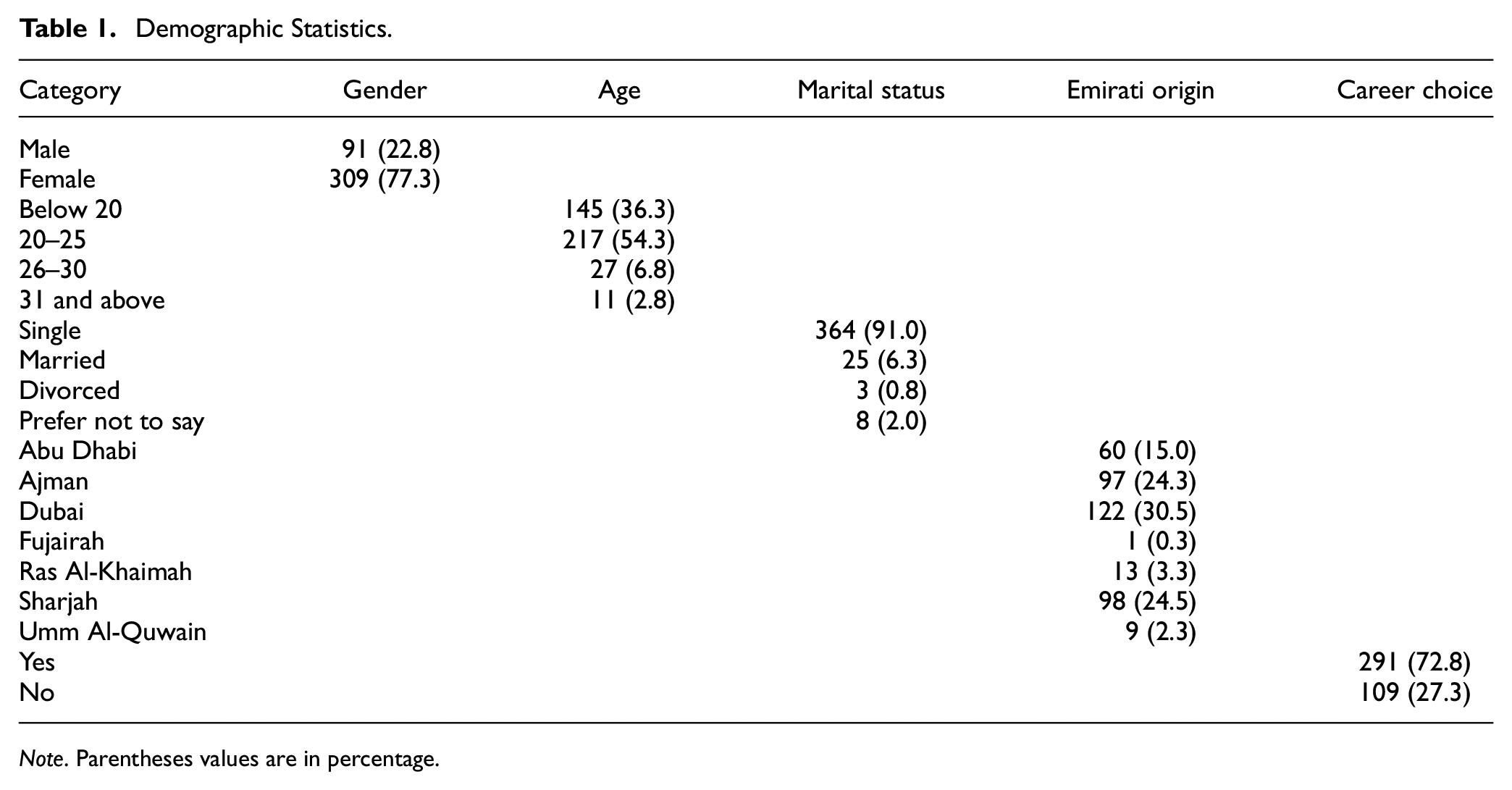
Note. Parentheses values are in percentage.
Descriptive Statistics
Table 2 presents the means and standard deviations of various variables grouped under different categories potentially influencing a student’s career choices. These categories include parents or guardians, teachers or schools, university programs, social and economic factors, and media influence. For “Parents or Guardians,” the average influence rating, or mean, is 3.0921 with a standard deviation of 0.92941. This suggests that parents or guardians influence students’ career choices, with a relatively moderate response variability. Similarly, “Teachers or School” also show a moderate average influence on students’ career choices, with a mean value of 3.2150 and a standard deviation of 0.87050. This indicates a moderate level of influence from teachers or schools, with slightly lower variability than that of parents or guardians.
Descriptive Statistics.

Among all categories, “University Programs” yields the highest mean value of 3.8835, with a standard deviation of 0.76994. This suggests that university programs strongly influence students’ career choices, and the relatively smaller standard deviation shows a less dispersed response, indicating a more consistent agreement among participants about this influence. Several variables are considered in the “Social and Economic Factors” category. The influence of “Peers” on career choices has a mean rating of 3.26 with a standard deviation of 1.208, implying a moderate level of influence with relatively high variability. “Financial Rewards” and “Job Opportunities” both have higher mean values (3.47 and 3.89 respectively) and lower standard deviations (1.165 and 0.915 respectively) compared to “Peers,” indicating a stronger and more consistent influence on career choices. “Self-determined career” tops this category with a mean rating of 3.96 and a standard deviation of 0.994, suggesting it has the strongest influence on career choices amongst social and economic factors, with a slightly higher variability than “Job Opportunities.”
Lastly, “Media Influence” has a mean rating of 3.17 with a standard deviation of 0.69866. This suggests a moderate level of influence, with the lowest variability among all the categories. Finally, university programs and self-determined career choices strongly influence students’ career decisions, with moderate influence from parents, teachers or schools, and media. Social and economic factors, including peers, financial rewards, and job opportunities, also play significant roles.
The descriptive statistics in Table 2 indicate that university programs have the highest mean score (3.8835) among the factors influencing career choices, suggesting their significant impact. In contrast, parents or guardians have the lowest mean score (3.0921). Overall, the average influence of all factors on career choices is moderately high, with a mean of 3.5769.
Correlation Coefficient
Table 3 represents a correlation matrix that provides information on the strength and direction of relationships between different factors influencing students’ career choices. Here, all correlations are positive, suggesting that as one factor increases in its level of influence, the other factor tends to increase as well. The influence of “Teachers” is strongly correlated with the influence of “Parents” (r = .741**), indicating a strong relationship between these two factors. This means that when the influence of parents on career choice is high, the influence of teachers is also likely to be high, and vice versa. The correlation between “University Programs” and “Job Opportunities” is moderate (r = .483**), suggesting that students who perceive a strong influence from university programs on their career choices also perceive a significant influence from job opportunities.
Correlation Coefficients.

Note. **p < 0.01 indicates statistical significance.
The correlation between “Peers” and “Financial Reward” is also high (r = .568**), implying a strong association between these two factors. This suggests that students who highly regard peer influence value financial rewards when making career choices. Among all the pairs, “Job Opportunities” and “Financial Rewards” present the highest correlation (r = .613**), indicating a very strong relationship between these two factors. This suggests that students who place importance on job opportunities when choosing careers also place a high value on financial rewards. The influence of a “Self-determined Career” has a positive but comparatively weaker correlation with all other factors, with the highest being with “University Programs” (r = .437**). This might suggest that students who strongly consider self-determined careers also consider the influence of their university programs.
In addition, “Media Influence” shows moderate to strong correlations with all factors, the highest being with “Peers” (r = .515**). This suggests that students heavily influenced by media also pay attention to peer opinions when making career decisions. The row “Overall” indicates the correlations of each factor with the overall effect of all factors on career choice. “Job Opportunities” has the highest correlation (r = .784**), suggesting it might be the most influential factor on career choices among those considered. In conclusion, all factors are interrelated to varying degrees. Job opportunities, financial rewards, and parental and peer influences are highly interrelated, suggesting that these factors may collectively shape students’ career choices.
Table 3 reveals strong positive correlations between various factors influencing career choices, with the highest correlation between financial reward and job opportunities (.613**). Overall, all factors demonstrate significant correlations with each other, indicating their interconnectedness in impacting career decision-making.
Regression Analysis (Hypotheses Testing)
Table 4 provides the results of a regression analysis that supports the hypothesis H1: The role of parents or guardians significantly affects the career choices of undergraduate Emirati students. The unstandardized coefficients (β value = 1.288) suggest that for every unit increase in the role of parents or guardians, there is a corresponding increase of 1.288 units in students’ career choices, assuming all other factors remain constant. This indicates a strong positive relationship between the role of parents or guardians and students’ career choices.
Regression Effect (Model 1)

indicates that the R value represents the simple correlation between the model predictor (Parents/Guardians) and the dependent variable (Students’ career choice).
The standardized coefficient (β value = 0.706) further substantiates this by showing that a standard deviation increase in the role of parents or guardians leads to approximately a 0.706 standard deviation increase in students’ career choices. This demonstrates that parents or guardians substantially influence students’ career choices when the variables are standardized. The t-value (19.912) and the corresponding significance level (Sig. = .000) further confirm the statistical significance of this relationship. The t-value indicates how many standard deviations the coefficient estimate is away from 0. The large t-value coupled with a significance level of .000, less than .05, provides strong evidence to reject the null hypothesis in favor of H1. The R2 value (.499) suggests that about 49.9% of the variation in students’ career choices can be accounted for by the role of parents or guardians, a sizable proportion demonstrating the significant influence parents or guardians have on their children’s career choices.
Table 5 presents the results of the regression analysis that pertains to the hypothesis H2: The role of teachers or schools significantly affects the career choices of undergraduate Emirati students. The unstandardized coefficient (β value = 0.714) shows that for every unit increase in the role of teachers or school, there is a corresponding increase of 0.714 units in students’ career choices, holding all other factors constant. This clearly demonstrates a strong positive relationship between the influence of teachers/school and the students’ career choices.
Regression Effect (Model 2).

indicates that the R value represents the simple correlation between the model predictor (Teachers/School) and the dependent variable (Students’ career choice).
The standardized coefficient (β value = 0.831) further supports this. It shows that a standard deviation increase in the role of teachers or schools results in approximately a 0.831 standard deviation increase in students’ career choices. This signifies that teachers or schools substantially influence students’ career choices when the variables are measured on a standard scale. The t-value (29.824) and the corresponding significance level (Sig. = .000) both attest to the statistical significance of this relationship. The high t-value means the coefficient is far from 0 regarding standard errors, indicating a significant effect. The significance level of .000, less than .05, strongly backs rejecting the null hypothesis in favor of H2.
The R2 value (.691) suggests that about 69.1% of the variation in students’ career choices can be explained by the role of teachers or schools. This is a considerable portion, further evidencing the significant influence that teachers or schools have on students’ career decisions.
Table 6 presents the regression analysis results pertaining to hypothesis H3: University programs significantly affect the career choices of undergraduate Emirati students. The unstandardized coefficient (β value = 1.455) indicates that for every unit increase in university programs, there is an associated increase of 1.455 units in students’ career choices, given that all other factors are constant. This represents a positive relationship between the influence of university programs and students’ career choices. The standardized coefficient (β value = 0.407) further emphasizes this. It shows that an increase in the standard deviation of the university programs leads to about a 0.407 standard deviation increase in students’ career choices. This means university programs significantly influence students’ career choices when the variables are measured on a standard scale.
Regression Effect (Model 3).

indicates that the R value represents the simple correlation between the model predictor (University Programs) and the dependent variable (Students’ career choice).
The t-value (8.896) and its associated significance level (Sig. = .000) both suggest the statistical significance of this relationship. The high t-value indicates that the coefficient is not close to 0 regarding standard errors, showing a significant effect. The significance level of .000, less than .05, further confirms the rejection of the null hypothesis in favor of H3.
However, the R2 value (.166) suggests that only about 16.6% of the variation in students’ career choices can be explained by university programs. This is a small portion compared to the results from previous models, suggesting that while university programs significantly influence students’ career choices, other factors outside of this model may have a more significant effect.
Table 7 presents the results of the regression analysis relating to hypothesis H4: Social and economic factors significantly affect the career choices of undergraduate Emirati students. The unstandardized coefficient (β value = 0.408) suggests that for every unit increase in social and economic factors, there is an associated increase of 0.408 units in students’ career choices, assuming all other factors remain constant. This shows a positive relationship between the influence of social and economic factors and the students’ career choices. The standardized coefficient (β value = 0.619) emphasizes this positive relationship. It demonstrates that an increase in the standard deviation of social and economic factors results in approximately a 0.619 standard deviation increase in students’ career choices. This suggests that social and economic factors substantially influence students’ career choices when the variables are assessed on a standard scale.
Regression Effect (Model 4).

indicates that the R value represents the simple correlation between the model predictor (Social and Economic Factors) and the dependent variable (Students’ career choice).
The t-value (15.712) and its associated significance level (Sig. = .026) provide evidence of this relationship’s statistical significance. The high t-value implies that the observed coefficient significantly differs from 0, indicating a significant effect. The significance level of .026, less than .05, further supports rejecting the null hypothesis favoring H4. The R2 value (.383) shows that around 38.3% of the variation in students’ career choices can be explained by social and economic factors. Although this is not as large as some other factors in previous models, it is still a considerable proportion. It suggests that social and economic factors play a significant role in shaping students’ career choices.
Discussion
The study has been conducted by using a phenomenology research approach to conduct a survey questionnaire among the Emirati students. The results of the current study are consistent with previous research in that they show a strong impact of social and economic factors, university curricula, teachers and schools, and parents/guardians on students’ career decisions. For example, Blotnicky et al. (2018) and Sheldon et al. (2020) stress the significance of individual interests and the learning environment in forming career goals, which aligns with the findings regarding the critical roles played by parents/guardians and teachers/schools. Studies like those by Abdulrahman et al. (2016) and AlDhaheri et al. (2017), which emphasize the influence of familial and educational influences on career decisions among students in the UAE, further support this correlation. The study’s findings, which highlight the critical role that university programs play in career development, are in line with those of Wang and Wanberg (2017) and Hartmann et al. (2021), who also emphasize the significance of educational pathways. This implies that the design and content of university curricula play a critical role in influencing students’ career decisions. This idea is supported by research conducted in a broader setting by Kemp and McLoughlin (2022) and Cevik et al. (2021), who look at the impact of educational experiences on career preferences.
Finally, the research’s findings about the influence of social and economic factors are consistent with the findings of Ashour (2016) and Al-Waqfi et al. (2023), who discuss how more significant societal and economic contexts impact career decisions. This link emphasizes the importance of considering the external environment—such as cultural norms and economic opportunities—when attempting to understand how people make career decisions. This is also supported by studies like those of Rashid, Manoharan, et al. (2013) and Wu et al. (2015), which examine how social factors affect healthcare professionals’ career decisions. Overall, the findings add to the body of knowledge by demonstrating the complexity of career decision-making and the interaction of social, educational, and personal factors, especially for UAE undergraduate students, in determining career paths.
Managerial Implications
The findings underscore several critical considerations for universities aiming to guide students towards making more informed career choices. First, in understanding that personal interest plays a vital role in students’ career choices, universities should aim to develop various programs and courses that cater to diverse interests. Providing ample opportunities for students to explore their interests could enhance their engagement and success in their chosen career paths. Universities could also foster an environment encouraging students to uncover and pursue their interests through interest-based clubs, internships, or guest lectures from professionals in various fields.
Second, in recognition of parents’ significant influence on their children’s career choices, universities could take a proactive role in engaging parents in the educational and career guidance process. This could be achieved through initiatives such as parent-teacher meetings, seminars or webinars on future job markets and showcasing the breadth of career opportunities offered by different fields of study.
Third, the impact of university programs on career choice indicates that universities play an inherent role in shaping students’ career trajectories. As such, it becomes essential for them to ensure that their programs are up-to-date, relevant, and capable of equipping students with the skills required by the job market. The curriculum should be frequently updated to reflect industry trends, and courses should provide practical skills alongside conceptual knowledge. Furthermore, career counselling and guidance services should be robust, providing students with a clear understanding of what to expect from different career paths.
Lastly, in light of the powerful influence of social and economic factors on career choices, universities should strive to equip students with a well-rounded understanding of the job market and economic landscape. Providing data on job market trends, hosting career fairs, offering workshops on job searching and employability skills, and establishing strong ties with industry partners for internships and job placements, can all be ways to enhance students’ preparedness for their future careers. Finally, universities play a critical role in shaping students’ career choices. They should prioritize creating a supportive and informative environment to guide students in their journey towards their professional futures.
Limitations and Future Directions
While this study provides important insights into factors influencing students’ career choices, it does have its limitations. First, the sample was limited to students in one geographical area, potentially limiting the generalizability of the findings. Different regions may have unique socio-cultural and economic factors that influence students’ career choices differently. Future research should include a more diverse sample that represents various geographical regions. Second, this study relied on self-report data, which various biases, such as social desirability or recall bias, influence. Future studies might consider using mixed-methods or longitudinal design to gather a more comprehensive, objective, and dynamic understanding of career choices.
Third, while the researchers examined key factors such as personal interest, parental influence, university programs, and socio-economic factors, other factors not considered in this study could also influence career choice. These include personal values, peer influence, personality traits, or career exposure. Future research could explore glass ceiling factors to better understand the career choices. Finally, this study looked at career choice as a one-time decision. However, career choice is often an evolving process, with individuals potentially shifting their career paths multiple times. Thus, future research should consider investigating the dynamics of career choice changes over time.
In addition, the study’s limitations include a potential bias due to self-reported data, which may need to reflect all influencing factors on career choices accurately. The focus on undergraduate Emirati students limits the generalizability of findings to other cultural or educational contexts. Additionally, the study’s cross-sectional nature restricts the ability to establish causal relationships. Lastly, the study does not account for the examined factors’ potential interplay or overlapping influence, which could provide a more nuanced understanding of career choices. A limitation of the research is the reliance on formative variables for constructing the “career choice” model, which may not capture the full complexity of career decision-making processes. This approach assumes a linear relationship among variables, potentially overlooking nuanced interactions and the multidimensional nature of career choices.
In terms of future directions, the researchers recommend longitudinal studies that track students from when they enter university to several years after graduation. This would provide insights into how career choices evolve and the long-term impact of the influencing factors identified in this study. It would also be beneficial to explore interventions or strategies universities could implement to support students in their career choice process effectively. Additionally, research exploring how these factors interact, for example, how parental influence might shape personal interests or how socio-economic factors might impact perceptions of university programs, could provide a more nuanced understanding of career decision-making.
Conclusion
The study’s conclusions effectively address the stated objectives and hypotheses by offering insightful information about the factors influencing undergraduate Emirati students’ career choices. The significant relationship between parental and guardian influence and students’ career choices indicates that parents and guardians undoubtedly significantly influence students’ career decisions. Similarly, schools and teachers also have a big influence, indicating that the learning environment plays a big part in determining students’ career paths. Additionally, the significance of university programs is emphasized, highlighting the impact of extracurricular and curriculum offerings on forming career preferences. The study also shows that social and economic factors are important to consider because they significantly impact students’ career decisions and reflect more significant societal and economic trends.
This study’s conclusion highlights the complexity of career decision-making processes among Emirati undergraduate students. It draws attention to how complex career decisions are influenced by various social, cultural, and educational factors. The results imply that a comprehensive strategy that considers the interactions between parental guidance, educational experiences, university curricula, and the larger socio-economic background is required to assist students in making informed career decisions. In addition to adding to the body of knowledge by offering particular insights into the Emirati context, this study has significant ramifications for educators, career counsellors, and legislators, creating interventions and plans to help students make well-informed career decisions.
Footnotes
Declaration of Conflicting Interests
The author(s) declared no potential conflicts of interest with respect to the research, authorship, and/or publication of this article.
Funding
The author(s) disclosed receipt of the following financial support for the research, authorship, and/or publication of this article: This research was made possible by the generous grant provided by Zayed University. Activity code number: Emirati Research Grant R 21102.

Data Availability Statement
The datasets generated and analyzed during the current study are publicly available and can be obtained from the corresponding author upon request.