




Abstract
With the advent of online communities, firms have invested heavily in creating their brand communities as a value co-creation platform to engage with their customers. However, customer interactions in online brand communities may not always be beneficial for firms. Drawing on conservation of resources theory, we explore how interaction failure as a manifestation of value co-destruction leads to negative customer outcomes in online brand communities. The results of an offline scenario-based experiment and an online survey suggest that interaction failure causes negative customer behaviors through two resource-based mediators: perceived usefulness and perceived fairness. Furthermore, we find that different types of interaction failures lead to different degrees of value co-destruction. Specifically, firm-oriented interaction failure leads to more negative customer behaviors than customer-oriented and peer-oriented interaction failures. Our study provides both theoretical and practical implications for value co-creation in online brand communities.
Keywords
Introduction
The customer–brand interaction space has undergone a significant transformation with the shift from traditional offline channels to online channels. This shift has made online brand communities as an important space for customer engagement (Akrout & Nagy, 2018). These communities serve as specialized online forums where individuals with shared preferences for specific brands can engage in numerous interactions, offering ample opportunities for value co-creation for customers and firms (Hanson et al., 2019). Specifically, customers can interact with both the brand and their peers to share experiences, access information about the brand and its products, and expand their social networks (Fan et al., 2022; Luo et al., 2016). As the interactions occurring in online brand communities can stimulate positive brand memory in customers’ minds (Alsharif, Salleh, Abdullah, et al., 2023; Alsharif et al., 2022), firms can strategically leverage these communities to advertise, collect first-hand feedbacks, and obtain creative ideas from a vast customer base (Essamri et al., 2019). However, the abundance of interactions within brand communities can sometimes thwart the intended goals of value co-creation, potentially leading to value co-destruction.
Value co-destruction is defined as a process within service system where interactions among actors lead to a decrease in the well-being of at least one party (Plé & Cáceres, 2010). This concept explains how collaborative efforts between actors can produce reduced, unsatisfactory, or negatively perceived value outcomes (Järvi et al., 2020). Recent studies have examined value co-destruction in various offline sectors, including tourism and hospitality (Järvi et al., 2020; Sthapit et al., 2023), healthcare (Keeling et al., 2021), banking (Kaabachi et al., 2024), and the event industry (Intason et al., 2021; Kim et al., 2020), suggesting that value co-destruction causes dissatisfaction, discontinuance, and negative word-of-mouth among customers. However, the phenomenon of value co-destruction and its consequences remains largely underexplored within online brand communities, even though some researchers have discussed value co-creation between firms and customers in the virtual space (Akrout & Nagy, 2018; Essamri et al., 2019; Luo et al., 2016). This study posits that value co-destruction in online brand communities arises from “interaction failure.” Customers may experience various types of interaction failures caused by the firm, themselves, or their peers, such as social loafing, knowledge hiding, communication overload, interpersonal distrust, inappropriate behavior, and conflict (Lv et al., 2021). Such failed interactions prevent customers from improving their well-being, despite the fact that they invest abundant personal resources (i.e., time, effort, emotions, knowledge, and creativity) to participate in online brand communities in hopes of increasing their well-being (Smith, 2013; Wang et al., 2020). Understanding customers’ behavioral responses to these interaction failures is critical to the overall well-being of brand community members and warrants further investigation.
To address the above research gaps, this study draws on conservation of resources theory to examine the impact of interaction failure in online brand communities on customer behaviors. According to this theory, customers subjectively experience a loss of resources when they perceive value gain is less than their investment (Hobfoll, 1989; Smith, 2013). To restore their resources, customers may resort to negative behaviors as coping strategies, such as negative word-of-mouth, switching, and counterproductive behaviors within online brand communities (Halbesleben et al., 2014). Specifically, we consider perceived usefulness and perceived fairness as two critical resources that customers perceive as lost during failed interactions, and test whether these two resources constitute the underlying mechanisms in the relationship between interaction failure and negative customer behaviors. In addition, we examine the impact of different types of interaction failures on negative customer behaviors as an extension of previous studies that have primarily focused on dyadic firm-customer interactions (Akrout & Nagy, 2018; Essamri et al., 2019; Hanson et al., 2019).
Our paper is organized as follows. Section “Literature Review” reviews the relevant literature. In Section “Hypothesis Development,” we develop our hypotheses to elaborate on the relationships between the core constructs based on conservation of resources theory. Section “Empirical Overview” presents our two empirical studies: an offline scenario-based experiment and an online experience-based survey. In Section “Discussion,” we summarize and discuss our findings. Finally, we conclude in Section “Conclusions” with the theoretical contributions and practical implications of our study.
Literature Review
Online Brand Communities and Value Co-creation
Brand communities consist of consumers who share similar preferences for a particular brand, in which these brand enthusiasts come together to deepen their knowledge of the brand, engage in community activities, and develop relationships with both the firm and other customers (Hanson et al., 2019; Liao et al., 2020). Interactions in online brand communities have the potential to create value for both customers and firms (Hanson et al., 2019). Specifically, customers can derive functional value, such as information seeking and problem solving, and emotional value, such as enjoyable experiences and social network development (Li & Chen, 2022). Meanwhile, firms can cultivate brand value by promoting their new products, fostering customer identification with the brand, and encouraging customer creativity for product innovation (Essamri et al., 2019).
The literature has highlighted the importance of online brand communities as valuable platforms for value co-creation (Veloutsou & Liao, 2023). Value is co-created through collaborative interactions among various actors in the communities, including firms, customers, and other stakeholders, which involves rich resources (Vargo & Lusch, 2008). Research has examined the positive aspects of co-creation in online brand communities, such as their role in enhancing brand identification (Li & Chen, 2022), brand commitment (Huangfu et al., 2022; Wang et al., 2020), and encouraging customer citizenship behaviors (Guan et al., 2022; Yang et al., 2023).
Value Co-destruction
Interactions within online brand communities do not always result in value co-creation and instead can sometimes lead to value co-destruction, given the complexities and challenges inherent in multi-actor interactions (Frau et al., 2018; Liao et al., 2020). Value co-destruction represents a negative outcome of value co-creation, characterized by an imbalance in the integration of resources within the service system or a decline in the welfare of at least one party (Plé & Cáceres, 2010). This decline in welfare encompasses both material aspects, such as financial losses, and psychological aspects, such as feelings of anger, sadness, and anxiety (Järvi et al., 2018). In essence, value co-destruction reflects a failed interaction process, in which interactions between customers and firms result in unsatisfactory and negatively perceived value outcomes (Akrout & Nagy, 2018; Essamri et al., 2019; Luo et al., 2016). Such failures may result from various factors, such as abuse of resources by the service system (Plé & Cáceres, 2010), inadequate information sharing, communication problems (Vafeas et al., 2016), information asymmetry, mistrust, errors, misconduct, incompetence, blame, and unclear expectations (Järvi et al., 2018).
Research has mainly examined value co-destruction in offline contexts, such as hotel services (Järvi et al., 2020; Sthapit et al., 2023), the medical industry (Keeling et al., 2021), the banking industry (Kaabachi et al., 2024), sharing businesses (Buhalis et al., 2020), and the event industry (Intason et al., 2021; Kim et al., 2020). In contrast, research on this phenomenon in online contexts, such as online brand communities, remains limited. Recently, some researchers have begun to investigate value co-destruction in online contexts, and discussed its specific downstream consequences, such as customer anger, feelings of betrayal (Grégoire et al., 2009), and decreased brand community commitment (Zhang et al., 2018). However, scholars have not yet systematically considered the different behavioral aspects and the diversity of key actors in value co-destruction. As mentioned above, different actors such as firms, customers, and fellow customers interact with each other in online brand communities (Frau et al., 2018). In this sense, value co-destruction involving different actors can be systematically classified into distinct types of interaction failures with different downstream consequences for customers. Therefore, further research is needed to explore the impact of different types of interaction failures on customers’ behavioral responses in online brand communities.
Hypothesis Development
Conservation of Resources Theory
Conservation of resources theory posits that individuals have a tendency to maintain, preserve, and acquire valuable personal resources (Hobfoll, 1989). The theory further suggests that individuals prioritize resource losses over resource gains because the effects of resource losses are more easily felt and last longer (Hobfoll, 1989). As a result, individuals who experience a loss of resources may feel tension and stress and thus take action to avoid further losses. The threat of resource depletion can trigger irrational, or even aggressive behaviors as a self-protection mechanism (Halbesleben et al., 2014).
We develop our hypotheses based on conservation of resources theory because our research question is consistent with the tenets of this theory. Specifically, conservation of resources theory views a resource loss event as the source of stress for an individual that affects their subsequent responses (Halbesleben et al., 2014; Hobfoll, 1989). Our study focuses on interaction failures in online communities as a specific form of value co-destruction. Customers typically participate in community interactions to gain benefits, such as absorbing high-quality information and knowledge, enriching their experience, expanding their social network, and gaining recognition (Fan et al., 2022; Luo et al., 2016). However, failed interactions do not provide the above benefits. Instead, they result in reduced welfare. In this case, customers in online communities may perceive their interaction failure as the source of their loss of resources and become more sensitive to this loss, leading to negative psychological and behavioral responses. In this sense, using conservation of resources theory as a theoretical lens to examine the impact of value co-destruction on consumers’ subsequent reactions is logically appropriate.
The Relationship Between Interaction Failure and Negative Customer Behaviors
As suggested, value co-destruction in online communities primarily manifests in failed interactions between different members (i.e., customers, firms, and other customers). Interaction failures include, but are not limited to, inadequate information sharing, communication problems (Vafeas et al., 2016), information asymmetry, mistrust, mistakes, misbehavior, incompetence, blame, and lack of clear expectations (Järvi et al., 2018), which inevitably lead to a decline in customer well-being. According to the conservation of resources theory, customers tend to view failed interactions as a loss of resources and therefore engage in negative behaviors to avoid further losses and protect themselves.
Studies have shown that negative customer behaviors in an online community mainly include negative word-of-mouth, switching, and counterproductive behaviors (Laud et al., 2019; Smith, 2013). As a typical complaint behavior, “negative word-of-mouth” refers to customers telling others about their or others’ unpleasant consumption experiences with a product in the hope of discouraging them from consuming the product (Donthu et al., 2021). “Switching” in a brand community is defined as community members leaving their current community for another community (Laud et al., 2019; Smith, 2013). “Counterproductive behavior” refers to customer actions that can potentially harm the interests of other community members, or even the entire community (Laud et al., 2019; Smith, 2013). Marketing scholars have demonstrated that when customers feel victimized and hurt in their interactions with a brand, they may take vindictive action as a means to alleviate their anger and restore the peace of mind (Grégoire & Fisher, 2008; Grégoire et al., 2009). Based on these findings, we argue that customers who experience interaction failures and resource losses tend to engage in negative behaviors in response to the stressful situation.
Furthermore, we analyze different types of interaction failures by comparing their effects on negative customer behaviors. Focusing on the three entities in online brand communities-the firm, the customer, and other customers-that cause interaction failures, we examine firm-oriented interaction failure, customer-oriented interaction failure, and peer-oriented interaction failure. Because the firm is the hub that connects a customer and his or her peers, customers generally expect the firm to do a good job in maintaining the brand community, such as organizing activities, providing valuable information, and solving customer problems (Akrout & Nagy, 2018; Luo et al., 2016). When the firm fails to take the lead in co-creating value for the community, customers may perceive the failed interaction as a violation of the psychological contract between the firm and them, leading to feelings of betrayal and distrust (Grégoire et al., 2009). This breach of trust reinforces feelings of resource loss, as customers may feel more personally harmed by failures caused by the firm than by failures caused by themselves or other customers (Grégoire & Fisher, 2008). As a result, customers are more likely to engage in negative behaviors. Therefore, we propose the following hypothesis:
H1. Interaction failures affect negative customer behaviors in online brand communities. Specifically, firm-oriented interaction failure has a stronger effect on negative customer behaviors than customer-oriented and peer-oriented interaction failures.
Mechanisms of Interaction Failure on Negative Customer Behaviors
Based on conservation of resources theory, we propose that two types of resource losses explain the effect of interaction failure on negative customer behaviors. First, interaction failure in brand communities reduces customers’ perceived usefulness. Davis (1989) first proposed the concept of perceived usefulness in the context of information systems, which refers to “the degree to which a person believes that using a particular system would enhance his or her job performance” (p. 320). By definition, usefulness typically encompasses the practical resources that individuals can acquire and exploit effectively. In the context of our research, the perceived usefulness of a customer who participates in the value co-creation of the brand community and interacts with other customers or firms implies the acquisition of more knowledge, problem solving, enrichment of experiences, and mental satisfaction (Hanson et al., 2019; Liao et al., 2020; Raïes et al., 2015). However, a failed interaction prevents customers from obtaining these benefits. For instance, late or no responses (Robertson et al., 2014), disputes between members (Pinnington & Scanlon, 2009), and misinformation (Järvi et al., 2018) derived from interactions undermine customers’ perceived usefulness, which are common in brand communities.
Meanwhile, customers joining the brand community for co-creation need to invest personal resources, such as time, effort, emotions, knowledge, and even creativity (Hanson et al., 2019; Smith, 2013). Social exchange theory posits that people give something in interpersonal interaction and expect to be rewarded accordingly (Cropanzano & Mitchell, 2005). In light of this, we consider that customers’ co-creation activities in brand communities are inherently a process of resource exchange, in which they expect mutual reciprocity. When an interaction goes smoothly, they perceive that the rewards exceed or at least equal their input and thus the interaction is considered fair. When an interaction fails, they perceive that the rewards are less than their input and thus the interaction is considered unfair. Perceived fairness is defined as the extent to which customers consider the treatment they receive to be acceptable and equitable (Grégoire & Fisher, 2008). Perceived fairness can be reflected by procedural fairness, interactive fairness, and distributive fairness (Tax et al., 1998). “Procedural fairness” refers to the perceived fairness of the process by which an allocation decision is made (Tax et al., 1998). “Interactive fairness” refers to the perceived fairness of interpersonal treatment by the other party (Tax et al., 1998). “Distributive fairness” refers to the perceived fairness of the resources received by an individual (Tax et al., 1998). Within online brand communities, procedural fairness mainly reflects the transparent and consistent procedures of various activities occurring in the virtual space; interactive fairness reflects mutual respect and equal treatment among community members; and distributive fairness reflects customer satisfaction with the overall value obtained through community interactions (Adjei et al., 2016). Researchers have suggested that perceived fairness can be conceptualized as a category of personal resources that contribute to individuals’ physical and psychological well-being (Campbell et al., 2013; Halbesleben et al., 2014). We argue that interaction failure reduces customers’ perceived fairness. First, a failed interaction in brand communities may disrupt customers’ smooth experience and erode a sense of control, thereby reducing perceived procedural fairness. Second, extensive interactions among community members foster emotional support and help customers develop their social network. However, failed interactions, marked by disrespect, neglect, and indifference, can result in perceived loss in interactive fairness. Finally, due to failed interactions, customers cannot obtain the return they expect, and their ultimate well-being is impaired, leading to a decline in perceived distributive fairness.
Studies have demonstrated that a decrease in the perceived usefulness of online communities may result in negative consequences from its members, such as poor brand impression (Smith, 2013), dissatisfaction with the community (Yi & Baumgartner, 2004), and negative word-of-mouth (Lv et al., 2021). Robertson et al. (2014) found that when customers fail to receive effective solutions from an online community, they are likely to switch to other communities for help. Similarly, scholars in the fields of marketing and organizational behaviors have widely suggested that perceived fairness can have a significant and positive impact on individual citizenship behaviors (Guan et al., 2022; Skarlicki & Latham, 1996), whereas damage to perceived fairness may have deleterious consequences on community members. For instance, Grégoire et al. (2009) found that customers who feel unfairly treated by a brand usually experience betrayal, and thus avoid the brand, and in some cases, they may even have a desire for revenge. Based on the above discussion and related findings, we propose the following hypotheses:
H2. Perceived usefulness mediates the relationship between interaction failure and negative customer behaviors.
H3. Perceived fairness mediates the relationship between interaction failure and negative customer behaviors.
Figure 1 shows our theoretical model.

The theoretical model.
Empirical Overview
We test our hypotheses using a scenario-based lab experiment and an online survey. Study 1 was the scenario experiment aiming to examine how different types of interaction failures affect negative customer behaviors and the underlying mediators, which confirmed the causality at first. To enhance the external validity of the results, we additionally conducted Study 2 - an online survey that recruited customers to report their real experiences on online brand communities.
Study 1
Method
Materials
Study 1 was a scenario-based experiment entitled “Your unpleasant experience on an online brand community,” describing the failed interaction that a customer confronted on a fictional online brand community. Participants were required to imagine themselves as the customer in the scenario to suffer an interaction failure.
Manipulation of Failure Type
The interaction failure type was manipulated through text description. For firm-oriented interaction failure, the description referred to “Suppose you bought a bicycle from the official website of brand X and joined its online community. After joining, the firm initiated some activities and sent you a lot of information and notices, which really annoyed you. Meanwhile, you found that there is a lack of rules in the community; it fails to set strict requirements for members to join and interact. Additionally, the firm itself even sends some unrelated advertisements or website links.”
For customer-oriented interaction failure, the description referred to “Suppose you bought a bicycle from the official website of brand X and joined its online community. After joining, you saw some interesting topics several times and try to discuss them with members of the community, but often could not have pleasant conversations due to your winning heart and impatience. Sometimes, you had to spend a lot of time and energy arguing with other members, and eventually put them into your blacklists.”
For peer-oriented interaction failure, the description referred to “Suppose you bought a bicycle from the official website of brand X and joined its online community. After joining, you often logged into this community to answer other customers’ help-seeking posts in the Q&A section. However, you found that most of these peers did not contribute as much as you did to the community. They just asked for help but did not actively engage in providing answers. Sometimes you could not even get any reply when you needed support from others.”
Before the formal experiment, we used a pretest to confirm this manipulation. Sixty undergraduates (Mage = 21.13, SD = 3.10) were randomly assigned to one of the three scenarios, and then answered some questions. We used three items to test the manipulation: “The failed interaction in the scenario that I just read was caused by the firm/myself as the customer character/other customers in the brand community,” with the scale ranging from 1 (definitely no) to 7 (definitely yes). We also measured the severity and the reality of the failure with two items. A one-way ANOVA analysis was performed using SPSS 26.0, the result revealed that the firm-oriented failure was perceived as more related to the firm than the other two conditions (Mfirm = 5.65 vs. Mcustomer = 3.70 vs. Mpeer = 3.75, F(2, 58) = 12.89, p < .001), the customer-oriented failure was perceived as more related to the customer himself/herself than the other two conditions (Mcustomer = 5.70 vs. Mpeer = 4.50 vs. Mfirm = 3.80, F(2, 58) = 120.64, p < .001), and the peer-oriented failure was perceived as more related to other members than the other two conditions (Mpeer = 5.75 vs. Mfirm = 3.70 vs. Mcustomer = 4.25, F(2, 58) = 34.73, p < .001). There were no differences between three conditions on the perceived severity of the failure and the reality of the failure (ps > .50). Next, we used the manipulations for our formal experiment.
Design and Participants
For the formal experiment, a total of 126 participants from a university in southern China were invited to an offline lab experiment and received a small gift as compensation. We used G*Power 3.1 software to calculate statistical power and thus determined this sample size (Faul et al., 2009). These 126 participants signed a written consent form before participating in the experiment. We finally got 119 participants (52.10% female; Mage = 21.92, SD = 1.99) retained for further analysis, because seven participants failed to pass the attention test. Three groups (total sample size of 119) reached a power of .96 when the significance level of .5 and an effect size (f) of .25, which is above the standard of .80.
Procedures and Measurement
For the formal experiment, participants were required to sit in individual booths to complete the experiment using the lab computers. Participants were first asked to read the interaction failure stimuli and imagine themselves as the character in the scenario (as in the pretest). Next, participants completed measures of their negative behavioral intentions, perceived usefulness, and perceived fairness. All measures were adapted from mature scales. Negative customer behaviors referred to negative word-of-mouth, switching, and counterproductive behaviors, with items adapted from Inman (2007) and Yi and Baumgartner (2004) (Cronbach’s α = .94). Perceived usefulness was adapted from Davis (1989) and Zhou et al. (2014) (Cronbach’s α = .88). Perceived fairness was measured with items adapted from Greenberg (1993) and Mohammad et al. (2019) (Cronbach’s α = .79). Participants were then asked to identify the exact type of failure from the following: firm-, customer-, and peer-oriented interaction failure. Severity and reality of the failure scenario were also measured. All constructs were measured on a 7-point scale (1 = strongly disagree, 7 = strongly agree; see Appendix 1). We opted for the 7-point Likert scale to strike a balance between sensitivity and simplicity, as a 5-point scale may lack the granularity needed to capture nuanced responses, while a 9-point scale may introduce unnecessary complexity, potentially leading to respondent fatigue or confusion (Simms et al., 2019). Finally, participants reported demographic information.
Results
Manipulation Check
The one-way ANOVA test reveal that the manipulation of interaction failure type was successful. Specifically, firm-oriented failure was perceived as more related to the firm than the other two conditions (Mfirm = 5.57, SD = 0.56 vs. Mcustomer = 3.74, SD = 0.44 vs. Mpeer = 3.57, SD = 0.78, F(2, 107) = 32.54, p < .001), customer-oriented failure was perceived as more related to the customers themselves than the other two conditions (Mcustomer = 5.83, SD = 0.38 vs. Mpeer = 4.39, SD = 1.10 vs. Mfirm = 4.17, SD = 1.30, F(2, 107) = 31.89, p < .001), and peer-oriented failure was perceived as more related to other members than the other two conditions (Mpeer = 5.42, SD = 1.06 vs. Mcustomer = 3.60, SD = 0.68 vs. Mfirm = 4.76, SD = 1.20, F(2, 107) = 36.68, p < .001).
Main Effect
The one-way ANOVA test with interaction failure type as the independent variable, and negative customer behaviors as the dependent variable was performed. The results are presented in Table 1. The effect of interaction failure on negative customer behaviors was significant (F(2,106) = 9.809, p < .001). Specifically, firm-oriented interaction failure caused more negative behavior intention (Mfirm = 5.688, SD = 0.403) than customer-oriented (Mcustomer = 5.444, SD = 0.555; p < .001) and peer-oriented interaction failures (Mpeer = 5.194, SD = 0.444; p < .001). The difference between customer- and peer-oriented interaction failures was also significant (p < .001). Therefore, H1 was supported.
Main Effects of Study 1.

Mediation Effect
The mediating hypothesis was tested using the SPSS PROCESS macro (PROCESS Model 4 with 5,000 bootstrap samples; Hayes, 2012). Type of interaction failure was set as the independent variable, perceived usefulness and perceived fairness as parallel mediators, and negative customer behaviors as the dependent variable. Gender, age, education level, and the average monthly income were included as control variables.
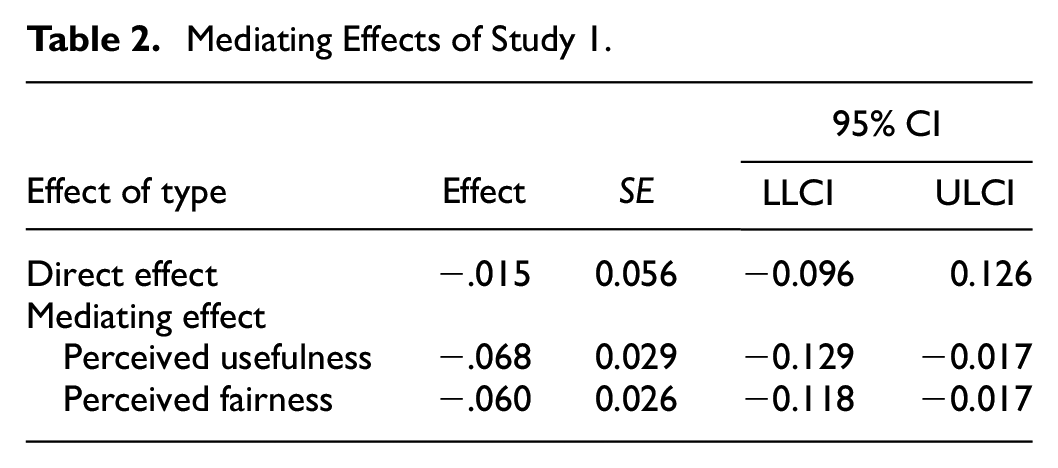
The results showed that perceived usefulness and perceived fairness mediated the effect of interaction failure on negative customer behaviors (perceived usefulness: β = −.068, SE = 0.029, 95% CI = [−0.129, −0.017], not including 0; perceived fairness: β = −.060, SE = 0.026, 95% CI = [−0.118, −0.017], not including 0). Therefore, hypotheses H2 and H3 were supported. Furthermore, the direct effect was insignificant after controlling two mediators (β = −.015, SE = 0.056, 95% CI = [−0.096, 0.126], including 0), indicating that perceived usefulness and perceived fairness fully mediated the main effect (Table 2).
Mediating Effects of Study 1.
Study 1 Discussions
In summary, Study 1 shows that interaction failure triggers negative customer behaviors, and customers’ perceived usefulness and perceived fairness of the online brand community play the mediating roles. Furthermore, different types of interaction failures have significantly different effects on negative customer behaviors. To improve the external validity of these results, we conducted Study 2, an online survey that recruited a more generalized sample.
Study 2
Method
Participants and Design
Study 2 was an online survey. The questionnaires were distributed and collected on Credamo.com, one of the largest research platforms in China. Participants were required to sign an electronic informed consent form before answering the online questionnaire. Initially, we explained the definition of online brand community as “the virtual space where customers with similar preferences for a specific brand gather to deepen their knowledge of the brand, engage in community activities, and develop relationships with both the firm and fellow customers” (Hanson et al., 2019; Raïes et al., 2015). To ensure understanding, we listed popular online brand communities of mobile phones in China as examples, including web.vip.miui.com, club.huawei.com, oppo.cn, and bbs.vivo.com.cn. Next, we further explained that extensive interactions exist between customers and firms/brands, between customers and their peers in online brand communities, but these interactions can sometimes fail, manifesting as insufficient or excessive communication, mistrust, inappropriate behaviors, and conflicts. Following the above illustration, three filter questions were used to screen participants: (1) Have you participated in any online brand communities of mobile phones? (2) Have you experienced any interaction failures in online brand communities? and (3) What is the name of an online brand community that you have joined? Participants who answered yes to questions 1 and 2 and also wrote down a realistic community name for question 3 were considered for further participation. The data collection platform Credamo.com initially recruited 257 participants to answer the screening questions. Out of these, 200 participants answered “yes” to the first two questions, and 183 participants provided a real community name for the third question. These 183 participants were then invited for the formal survey. The formal survey included an attention check question, and 33 participants who failed the check or selected all items with the same number were excluded. As a result, 150 valid questionnaires were finally obtained, resulting in an effective response rate of 58.4%. Among the participants, 46.0% were female; 56.0% were not more than 26 years old; 74% had a college or bachelor degree or above; 35.3% had an income of over 8,000 RMB per month; 39.3% visited the community more than once a week; 44.4% joined the online brand community for 6 months to 1 year.
Survey Procedure and Measures
The formal survey consisted of four parts: (1) First, participants were asked to recall and write down an interaction failure event they experienced in online brand communities. (2) Next, we measured their negative customer behaviors with the scale. (3) Then, we further measured their perceived usefulness and perceived fairness of the online brand community. (4) Finally, participants were asked to identify the type of interaction failure they experienced from the options of firm-, customer, and peer-oriented interaction failure. In order to facilitate their recognition of the interaction failure, we also provided precise explanations of the characteristics of each type of failure, as follows: “Interaction in the online brand community can be customer-firm interaction or customer-customer interaction. Treat yourself as a target customer, and other community customers as your peers. Now please recall the failed interaction you mentioned and find out who is primarily responsible. If you think that the failure is mainly caused by the firm, please select the firm-oriented interaction failure; if the failure is mainly caused by other customers, please select the peer-oriented interaction failure; if the failure is mainly caused by yourself, please select the customer-oriented interaction failure. Now, please select the specific type for your experience of failure.” To ensure validity, we invited two experts in online brand communities based on the academic definition to verify that the types of failed interactions reported by participants matched their self-selected types. This validation was done in several rounds. In the first round, the experts reviewed separately. Then, one of our authors compared the results of these two experts. If there was a discrepancy, the two experts were invited back to discuss the case until they reached an agreement.
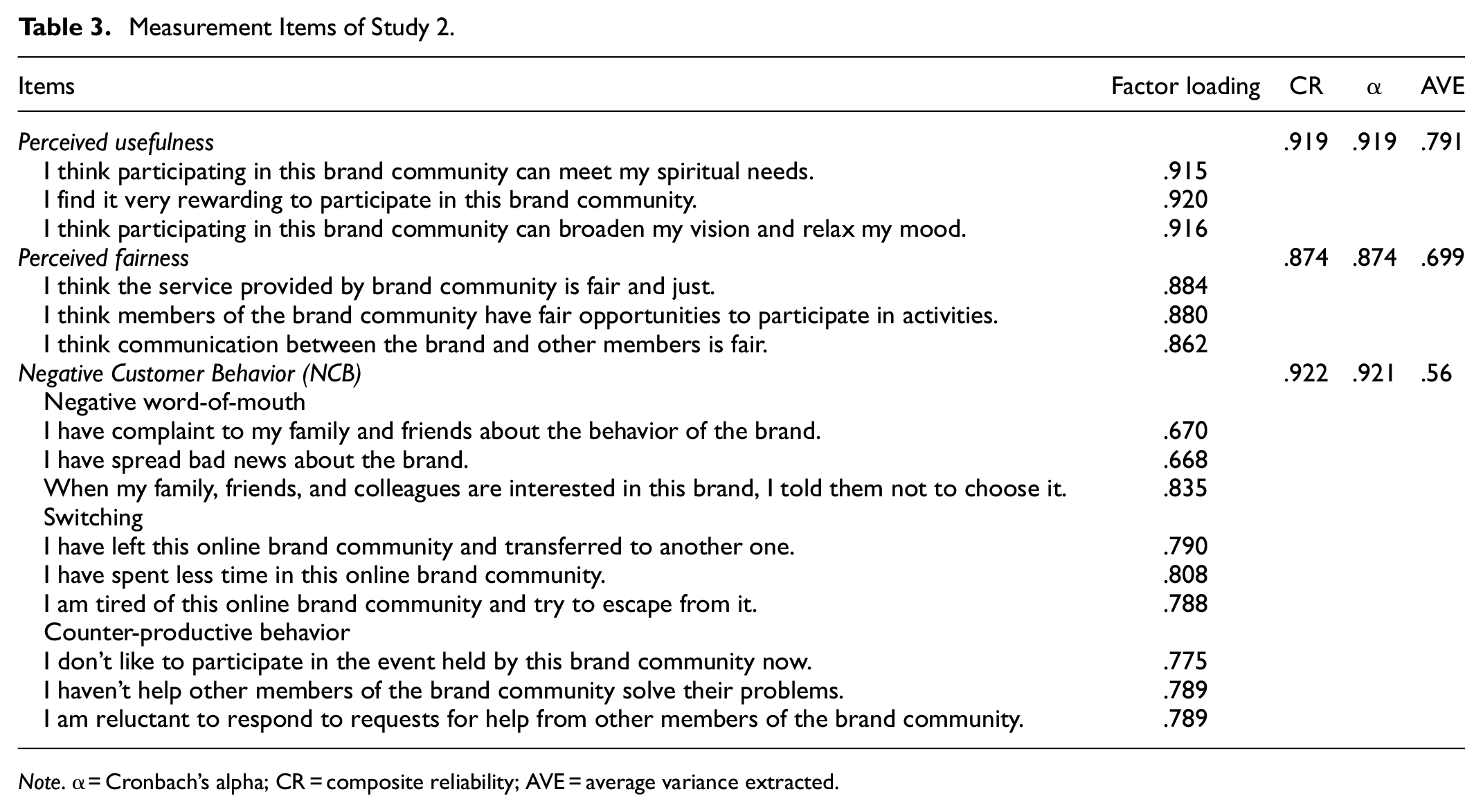
All measures were almost the same as in Study 1, with only a few minor adjustments to fit our context. The items were measured on a 7-point Likert scale (1 = strongly disagree, 7 = strongly agree; Table 3) to strike a balance between sensitivity and simplicity for better response.
Measurement Items of Study 2.
Note. α = Cronbach’s alpha; CR = composite reliability; AVE = average variance extracted.
Data Analysis and Results
Measurement Model
Using SPSS 26.0 and AMOS 26.0, we calculated the measures. The results show as in Table 3 that standardized factor loadings of all items were greater than .7, and the composite reliability (CR) values and Cronbach’s αs of all variables were greater than .8, indicating good internal reliability (Fornell & Larcker, 1981). AVE values of all constructs were above .5, indicating good convergent validity (Fornell & Larcker, 1981). The AVE square root for each construct was greater than their correlation between other constructs (Table 4), indicating a good discriminant validity (Fornell & Larcker, 1981). These results indicated that our model was valid and reliable.
Construct Correlations and Discriminant Validity.

Note. Numbers on the diagonal line represent the square root of the AVE value of each construct, other numbers represent the correlation coefficients between constructs. USE = perceived usefulness; FAI = perceived fairness; NEG = negative customer behavior;
p < .05. **p < .01.
Main Effect
A one-way ANOVA was performed with type of interaction failure as the independent variable, and negative customer behaviors as the dependent variable. The results are presented in Table 5. The effect of failure type on negative customer behaviors was significant (F(2,147) = 3.185, p < .05). Specifically, firm-oriented interaction failure (Mfirm = 4.11, SD = 1.37) led to more negative behaviors than customer- (Mcustomer = 3.83, SD = 1.24; p < .05) and peer-oriented interaction failures (Mpeer = 3.45, SD = 1.27; p < .05), while the difference between customer- and peer-oriented interaction failure was not significant (p > .05).
Main Effects of Study 2.

Mediation Effect
We then examined the mediating effects using SPSS PROCESS macro (PROCESS Model 4 with 5,000 bootstrap samples; Hayes, 2012). Three types of interaction failures were set as the independent variable, perceived usefulness and perceived fairness as parallel mediators, and negative customer behaviors as the dependent variable. Gender, age, educational level, and the average monthly income were included as control variables. The results showed that perceived usefulness and perceived fairness mediated the effect of interaction failure on negative customer behaviors (perceived usefulness: β = −.0969, SE = 0.0448, 95% CI = [−0.1936, −0.0208], not including 0; perceived fairness: β = −.2277, SE = 0.0636, 95% CI = [−0.3658, −0.1183], not including 0). Therefore, all hypotheses were supported again. Furthermore, the direct effect was not significant after controlling two mediators (β = −.001, SE = 0.1268, 95% CI = [−0.2516, 0.2496], including 0), indicating that perceived usefulness and perceived fairness fully mediated the effect of interaction failure on negative customer behaviors (see Table 6).
Mediating Effects of Study 2.

Study 2 Discussions
Study 2 utilized an online survey to collect real customer experiences and responses to test our hypotheses. The results reaffirm that interaction failures within online brand communities lead to negative customer behaviors. This relationship is mediated by customers’ perceived usefulness and perceived fairness. Furthermore, our findings suggest that firm-oriented interaction failure has a greater impact on negative customer behaviors compared to customer- and peer-oriented interaction failures.
Discussion
This research explores value co-destruction in online brand communities and its downstream impacts on customers. . Based on the different actors in online brand communities, we identify three types of different failed interactions. Specifically, value co-destructed interaction may be caused by the firm or the brand which we refer to firm-oriented interaction failure, may be caused by the customer himself/herself which we refer to customer-oriented interaction failure, or may be caused by other fellow customers in the community which we refer to peer-oriented interaction failure. Building on Conservation of resources theory, we consider interaction failure in online brand community as a source of resource loss leads to customers’ negative behaviors, including negative word-of-mouth, switching behaviors, and counterproductive behaviors. Customers engaging in these negative behaviors is actually a form of protecting themselves from further resources loss according to the tenet of Conservation of resources theory. As for the specific resource that customers perceive to be lost during co-destruction process, we focus on perceived usefulness and perceived fairness. Perceived usefulness derives from the point that customers tend to evaluate their value from participating in the community. When customers fail to reap value in the community, they reduce their usefulness evaluation. Perceived fairness derives from the point that customer also tend to compare their gotten value with prior investment. When customers contributed to the community but have not gained equivalent returns, their perceived fairness would be reduced. Perceived usefulness and perceived fairness are two fundamental resources that customers are concerned about but being lost, and therefore they endeavor to respond with negative behaviors.
We conducted two studies to test our hypotheses. Study 1 was a scenario-based experiment in the offline lab that used undergraduates as the participants. The results of Study 1 supported our hypotheses, revealing that interaction failures increased customer negative behaviors, and the impacts of different failure types showed the differences. Specifically, firm-oriented interaction failure had stronger impact on negative behaviors than customer-oriented and peer-oriented interaction failures. We also demonstrated the mediating effects of perceived usefulness and perceived fairness. To improve the robustness and external validity of results of Study 1, we additionally conducted an online survey of Study 2, which recruited customers who had real experiences of interaction failure in online brand communities. The results of 150 valid samples reconfirmed our predictions.
Conclusions
Theoretical and Managerial Implications
Theoretical Implications
Encouraging interactions in online brand communities is essential for value co-creation, but can also lead to value co-destruction. Our research focuses on the value co-destruction—namely interaction failures in online brand communities—and contributes to the literature in three ways. First, unlike previous research that has primarily discussed value co-creation in online firm–customer interactions (Akrout & Nagy, 2018; Essamri et al., 2019; Luo et al., 2016), our study systematically examines the underexplored topic of value co-destruction and its consequences in the virtual space. The results reveal that interaction failure leads to negative customer behaviors, such as negative word-of-mouth, switching, and counterproductive behaviors, which adds to the literature on value co-destruction in online brand communities.
Second, this study focuses on the different actors in online brand communities and classifies failed interactions into three types based on the party responsible for the failure. Most previous studies have focused on dyadic firm–customers interactions, ignoring the role of fellow customers as key members of these communities (Akrout & Nagy, 2018; Essamri et al., 2019; Hanson et al., 2019). In contrast, we compare the effect of different types of failures and find that firm-oriented interaction failure has a stronger impact on negative customer behaviors than customer-oriented and peer-oriented interaction failures. In doing so, our research contributes to the literature on both value co-destruction and interactions in online brand communities.
Third, we creatively use conservation of resources theory to provide an overview of the value co-destruction process in online brand communities. Studies examining value co-destruction and its outcomes lack a systematic method to fully understand this phenomenon (Laud et al., 2019). Following Smith (2013), we consider interaction failure in online brand communities as a source of resource loss. This research further proposes that customers’ perceived usefulness and perceived fairness are critical resources affected by such failure, causing them to engage in negative behaviors as a self-protection mechanism. The empirical results of our lab experiment and online survey demonstrate that these two critical resources are parallel mediators in explaining the relationship between interaction failure and negative customer behaviors. In this sense, our study offers a systematic framework for understanding how value is co-destroyed in online brand communities.
Managerial Implications
Our study has several managerial implications for managers of online brand communities. First, firms should empower their customers by delegating more authority in online brand communities and encouraging interactions among community members. According to our findings, when interaction failure is attributed to the firm, customers tend to respond more negatively than in other types of failures. Empowering customers to initiate activities and participate in event planning could foster a sense of responsibility, mitigating potential negative outcomes (Dunn et al., 2021).
Second, enhancing customers’ perceived usefulness and perceived fairness is crucial for effective management of customer–brand relationships. Firms could leverage tools such as artificial intelligence chatbots to quickly respond to customer queries and provide personalized information to meet functional needs. Additionally, introducing incentive policies, such as bonus points, could enhance perceived fairness. For inactive customers, timely reminders and recognition of peer contributions could spark reciprocity and encourage future engagement (Liao et al., 2020).
Third, cultivating a supportive climate in online brand communities can help mitigate failed interactions. Providing social support in emotional and informational dimensions could strengthen customers’ identification with the community. Strategies such as incorporating gamification into interactions and creating a positive atmosphere through sensory stimuli could enhance group cohesion and foster prosocial behaviors, ultimately reducing the negative impact of failed interactions (Guan et al., 2022; Lv et al., 2021; Yang et al., 2023).
Limitations and Future Research
This research has several limitations. First, the study focused on the negative impact of failed interactions in online brand communities on customer behaviors; however, we did not propose related approaches to intervene in or address the issue. Future research could explore potential measures to mitigate such failures. Second, we did not consider between-individual differences in consumers’ initial attitudes toward the brand. For example, consumers with high brand commitment may react more strongly to failed interactions than regular customers, due to stronger feelings of betrayal (Grégoire et al., 2009). Therefore, future studies are encouraged to examine whether brand commitment moderates the effect of interaction failure on customer behaviors. Third, we examined three types of interaction failures based on the party responsible for value co-destruction. Future research could explore additional classification methods based on other dimensions, such as severity and urgency. Fourth, our findings were tested using traditional experimental and survey methods. Therefore, future research could use neuroscientific tools and methods to measure customers’ brain and body activity responses, to more accurately capture their direct and first-hand reactions to interaction failures in online brand communities (Alsharif, Salleh, Alrawad, et al., 2023; Alsharif et al., 2022).
Footnotes
Appendix
Measurement Items of Study 1.

| Variable | Measurement items | |
|---|---|---|
| Perceived usefulness | I think participating in this brand community can meet my spiritual needs. | |
| I find it very rewarding to participate in this brand community. | ||
| I think participating in this brand community can broaden my vision and relax my mood. | ||
| I think participating in this brand community can enrich my life. | ||
| Perceived fairness | I think the service provided by brand community is fair and just. | |
| I think members of the brand community have fair opportunities and rights to participate in activities. | ||
| I think communication between the brand and other members is fair. | ||
| I feel that members are fairly given the information and explanation they deserve before, during, and after they receive the service of this brand community. | ||
| Negative customer behavior | Negative word-of-mouth) | I will complain to my family and friends about the behavior of the brand. |
| I will spread bad news about the brand. | ||
| When my family, friends, and colleagues are interested in this brand, I will tell them not to choose this brand. | ||
| When my family, friends, and colleagues are interested in related products, I will tell them not to choose this brand. | ||
| Switching | I have thought about leaving this brand and looking for another brand. | |
| I want to leave this brand community. | ||
| I thought I was tired of the brand community and wanted to escape from it. | ||
| I feel that I am no longer fit to be in this brand community. | ||
| Counter-productive behavior | I don’t think I would like to participate in the event held by this brand community. | |
| I felt less inclined to help other members of the brand community solve their problems. | ||
| I found myself reluctant to respond to requests for help from other members of the brand community. | ||
| Compared to the past, I think I am less willing to stay in this brand community for too long. | ||
Declaration of Conflicting Interests
The author(s) declared no potential conflicts of interest with respect to the research, authorship, and/or publication of this article.
Funding
The author(s) disclosed receipt of the following financial support for the research, authorship, and/or publication of this article: This work is supported by (1) The Ministry of Education of Humanities and Social Science Project (No. 23YJA630072), (2) The National Natural Science Foundation of Sichuan Province (No. 2023NSFSC1043), (3) Research Center of the Construction of the Chengdu-Chongqing Twin-Hub Mega-Region (No. CYSC24B005), (4) The Undergraduate Research and Learning Program of Southwestern University of Finance and Economics, and (5) the Soft Science Research Program of Zhejiang Province, People's Republic of China (Project No. 2024C35067).
Informed Consent
All the human participants gave the written informed consent prior to the enrollment.

Data Availability Statement
Data sharing not applicable to this article as no datasets were generated or analyzed during the current study.