




Abstract
As a common experience-based emotion, awe can easily arise within consumers who are immersed in an online brand community. On the basis of the awe prototype theory, this paper developed a research model involving community management authority, professionalism of opinion leaders, participation time, awe, and customer engagement at the organizational and individual levels of an online brand community. The study then targeted a mobile online brand community, obtaining 409 valid data points using a questionnaire survey platform (wjx.cn). The data were analyzed using a structural equation model, revealing that the management authority and the professionalism of opinion leaders positively affect community members’ awe, and this awe positively affects community engagement behaviors. Community members’ participation time negatively moderates the influence of management authority on awe; namely, longer participation time weakens such influence. In addition, community members’ participation time lowers the effect of opinion leaders’ professionalism on their awe, though not significantly. This research advances the study of online communities while also providing practical insights to managers and opinion leaders.
Keywords
Introduction
An online brand community refers to an assembly of individuals representing a group of interest-sharing and help-seeking brand admirers who influence one another under the guidance of an established community system and management norms (Muniz & O’Guinn, 2001). A brand community represents a series of relationships between brand loyalists, reflecting a perceived connection between customers as well as between customers and brands. Online brand communities have evolved into a powerful marketing tool for companies to connect with customers and to interpret the customer relationship network built by companies (Zhao et al., 2016). Meanwhile, community members often express emotional information, including joy, excitement, sadness, worry, surprise, shock, and admiration. Researchers have asserted that emotional information is a key factor affecting customer’s decision-making behaviors and a driving force to promote interaction between community members and further influence customers’ preference for products (Chintagunta et al., 2010; Chmiel et al., 2011; Jing et al., 2013; Zhao et al., 2019). For example, emotional information can serve as an economic forecast indicator, given its substantial correlation to the volatility of the stock index. It can also be a key factor for predicting the success of a movie, as it reflects the preferences of consumers in the online community (Bollen et al., 2011; Chintagunta et al., 2010).
Research has identified the awe expressed by online community members (Büssing et al., 2014). Zhou (2016) found that up to 36% of the consumption experience on Twitter, such as experiencing the work of a 3D printer, is accompanied by awe. In this study, we searched “awe” as a keyword in the Huafans Club (cn.club.vmall.com), a platform for fans of Huawei mobile phones, identifying 127 posts in which customers expressed awe, whereas 2,642 posts were found in the Oppo community (oppo.cn) using a keyword search for “awe.”
Awe is a common emotion in online brand communities, but insufficient attention has been paid to the expression of awe in the online brand community experience in theoretical research. For example, what factors in an online brand community can trigger customers’ sense of awe and whether such awe affects community performance, such as improving community members’ engagement. To fill this gap, investigating a mobile phone online brand community from the theoretical perspective of the awe prototype theory (Keltner & Haidt, 2003), this research studied awe in the online brand community based on the community’s management authority and characteristics of professionalism, in addition to customer engagement arising from specific brand community preferences.
First, brand communities essentially represent a series of structural relationships among brand admirers (Muniz & O’Guinn, 2001). Customers usually interact positively with managers or other members of the brand community. According to the awe prototype theory proposed by Keltner and Haidt (2003), the management authority of community managers can easily evoke a sense of awe (Ye et al., 2018). If non-authority members have extensive sociality and are deemed important by others, they can also arouse community members’ awe (Keltner & Haidt, 2003). In online brand communities, the community’s opinion leaders have extensive sociality and are considered very important to others (Demiray & Burnaz, 2019; Zhao et al., 2016). Therefore, management authority and opinion leaders are assumed to be two key factors that trigger awe.
Second, customer engagement refers to the level of customers’ physical, cognitive, and emotional presence in their relationship with an online brand community (Lima et al., 2019). Researchers generally regard customer engagement as a strategic element of establishing and maintaining an online brand community that is an extremely important indicator to reflect the operation status of an online brand community (Meirani, 2019). Research demonstrates that evoking the feeling of awe is conducive to the stability of the social structure, the unity and identification of groups, and the positive word of mouth of brands or products (S. Guo et al., 2018).Therefore, the awe that is triggered through interaction with an online brand community should also affect the stability of the community and improve engagement among community members.
The present research broadens past studies regarding the relationship of customer emotion with community performance through the study of awe, enhancing the study of customer emotion and community theory with very important implications for brand community management. Additionally, this research on the impact of awe on brand communities adds insights to considerations of the emotional management of community members, maintenance of relationship stability between customers and brands or enterprises, and the enrichment of community activities.
Literature Review and Hypotheses Development
Customer Emotions in Online Brand Communities
Customer emotion refers to the psychological state produced from a customer’s subjective feelings about whether the product or service meets their needs when purchasing, using products or experiencing services. After joining the community, customers with active brand loyalty interact with other customers, share information about products and brands, and establish a common bond that generates positive emotions such as happiness, joy, enthusiasm, delight, activeness, and excitement (Jing et al., 2013). Ponce and Cordelier (2015) analyzed the interactive content of online community members, finding that community members often expressed emotional information, such as happiness, excitement, sadness, anxiety, surprise, and anger. Lee et al. (2014) found that community members express negative emotions when sharing innovative ideas, such as fear, anger, shame, sadness, and frustration.
Brand communities are gatherings of consumers that share the same brand identity and are co-created through their consuming connotations, habits, and behaviors (Kozinets, 2002; Muniz & O’Guinn, 2001). Customers in a brand community express emotions that affect community behaviors. After consumers join the community, other customers’ expressed emotions have a positive impact on post-purchase satisfaction, friendship among customers, participation in community enthusiasm, brand loyalty, positive brand evaluation, WOA, willingness to purchase (WTP), reducing loneliness, and value creation (Jing et al., 2013; Niedermeier et al., 2019; Ponce & Cordelier, 2015; Snyder & Newman, 2019; Zhao et al., 2019). In the Facebook community, emotions expressed by members may be transmitted through post content and affect the emotions of other members, and this emotional transmission can be used to predict the emotional expressions of other members of the community within a few days (Ponce & Cordelier, 2015). In a textual content study of member support, discussion, and contributions, Lee et al. (2014) concluded that frustration, setbacks, sadness, and shame exert a stronger impact than do fear and anger. Niedermeier et al. (2019) found that consumers with higher community engagement are happier and present a positive reputation for the brand community and strong purchase intentions. Zhao et al. (2019) found that customers who feel more support from the community perceive things more optimistically and are more willing to co-create value with other community members.
Awe
Awe is an essential emotion that is produced by experiences of art, nature, and religion and is a deep concern of researchers in religion, philosophy, psychology, and sociology. The concept consists of surprise, doubt, admiration, and obedience that arise from individuals when they face perceived grand experiences or things that are beyond usual cognition (Keltner & Haidt, 2003; Piff et al., 2015; Ye et al., 2018). Although researchers of emotions have long been interested in the concept of awe, empirical research began following Keltner and Haidt’s (2003) proposal of the awe prototype theory.
The awe prototype theory identifies three types and two basic characteristics of the triggers of awe (Keltner & Haidt, 2003). The three types are social triggers (such as legends, religions, and myths), cognitive triggers (such as human knowledge and great theories), and tangible triggers (such as artworks, landscapes, and wonderful music that can be directly observed or felt). The two basic characteristics are perceived vastness and the need for accommodation. Perceived vastness refers to the things perceived being beyond usual cognitive categories and dimensions, and the need for accommodation refers to individuals’ feelings of cognitive dissonance, as they cannot assimilate the current experience into the existing cognitive schema. The researchers that followed expanded the theory to six characteristics of time distortion, self-minification, connectivity, vastness perception, body perception, and the need for accommodation (Yaden et al., 2019) and four characteristics of time extension, accommodation, esthetics, and vastness (S. Guo et al., 2018).
Research has shown that product experience, exciting speeches, powerful people (Schurtz et al., 2012), and provoking and sophisticated music (Pilgrim et al., 2017) can induce individuals’ awe, and awe has a positive influence on attachment, prosocial behaviors, ecological and environmental responsibility behaviors, life satisfaction level, word of mouth, WTP, and diversified needs (S. Guo et al., 2018; Pilgrim et al., 2017; Qi et al., 2018; Rudd et al., 2012; Untea, 2020; Van Cappellen & Saroglou, 2012; Y. Yang et al., 2018).
Factors Affecting Awe in Online Brand Communities
Social triggers, cognitive triggers, and tangible triggers can evoke the feeling of vastness in individuals, simultaneously stimulating the need for accommodation, which leads to the experience of awe (Qi et al., 2018). Therefore, perceived vastness and the need for accommodation can be adapted to assess whether stimuli arouse people’s awe (Keltner & Haidt, 2003). First, when the stimulus is considered vast, relative to the reference, the individual may experience awe. The vastness may refer to space, time, quantity, subtlety, ability, or even human experience (Keltner & Haidt, 2003; Shiota et al., 2007). Second, awe’s trigger features the need for accommodation. People recognize the world by experience or schema, while the experience of vastness challenges or suppresses existing cognitive models, and people are unable to assimilate the awe-inspiring experience into the existing cognitive schema. This leads to alteration in former psychological representations eliciting the need for accommodation (Bonner & Friedman, 2011; He et al., 2016; Jiang et al., 2014).
Online brand communities are virtual organizations, similar to small social organizations in which members act in specific social roles and interact with other community members to generate awareness of a company’s brand and products. McAlexander et al. (2002) proposed that brands, products, customers, and managers constitute a brand community, and as community members, customers are aware of the community management of the operators and interact with other members, which alters their perceptions of corporate products and brands. Keltner and Haidt’s (2003) awe prototype theory asserts that individuals or organizations with power can easily deliver a sense of awe, whereas individuals with sociality and importance, even without power, can also generate awe. Sociality reflects the degree of being understood by others and is a manifestation of the perception of vastness. Importance embodies the degree of influence on others and is a manifestation of the need for accommodation (Keltner & Haidt, 2003). From the perspective of awe derived from power, the community supervisor’s management authority will arouse community members’ experience of awe, whereas the sociality and importance of individuals without power, and the professionalism of the online brand community’s opinion leaders, will trigger community members’ awe.
Management Authority
In online brand communities, awe is essentially a social signal that conveys the status of people in the social hierarchy. According to the Oxford English Dictionary, the word awe comes from Old English and Ancient Norse and expresses the fear and horror of a person facing sacred or incomprehensible things, consistent with the fear and horror of individuals facing power. However, when the constant use of awe is experienced, the fear factor of awe becomes intertwined with reverence, piety, and respect. In the Eastern cultures, the concept of awe strongly resembles that of the English language, which also expresses a person’s fear and panic, mixing admiration and surprise as an emotion in the face of authority, solemnity, or sacred occurrences. On the basis of this semantic analysis, awe is an emotion that individuals experience when they face the authority of power. When Keltner and Haidt (2003) proposed the awe prototype theory, they also believed that awe could be derived from low-status individuals’ perceptions of high-ranking others, resulting in individuals’ tendency to follow powerful authorities’ interests and goals.
The role of authority in society is one of the factors of awe (Ye et al., 2018). The authority of the online brand community management is based on the convincing prestige of spiritual appeal, influence, and cohesion, which influences and alters the thoughts and actions of community members through the power endowed by the online community’s organization (Yuan, 2010). In fact, the management authority of online brand communities refers to the organic integration of the management power and personal prestige of community supervisors (Zhang, 2005). Community management power can influence and alter the thoughts and behaviors of community members, and personal prestige is the basis for connecting and convincing community members (Wang, 2019). Management authority carries two meanings. First, management authority represents the status and power of supervisors in the community. It is a symbol of power, similar to supernatural power, which is vast and beyond community members’ understanding. Ye et al. (2018) confirmed that management authority derives from organizational, economic, and/or cultural resources possessed by managers. Therefore, management authority makes community members perceive vastness. Second, individual authority is marked by the obedience of community members and indicates members’ need for accommodation. In fact, the management authority is invisible and intangible but exists objectively. In an online community, it is represented by community members’ obedience to community supervisors (Wang, 2019; Zhang, 2005).
In summary, authority connotes vastness and the need for accommodation, which are key features of the experience of awe. In the face of management authority, community members feel the vastness of the community, which generates the need for accommodation. Their reaction to the community is subject to awe, which should be strong. Some studies have also confirmed that the perception of authority induces individuals’ experience of awe. For instance, J. L. Guo et al.’s (2018) study of the emotions evoked in Red tourism found that the tourists unconsciously felt a strong sense of awe in the face of the authoritative characteristics of Red actors. Thus, we believe that the management authority will induce strong awe in members of an online brand community.
Professionalism of Opinion Leaders
People with authority and power are awe-inspiring, whereas, in some cases, those without authority can also make others feel awe. Keltner and Haidt (2003) argued that non-powerful individuals could also evoke awe when they satisfy two conditions: sociality and importance. For example, people feel greatness (vastness) for skills-oriented sports stars and chess masters, without fright or fear, and will take the initiative to approach (accommodate) the awe-inspiring figure for whom awe is easily generated.
The concept of opinion leaders refers to the members of an online brand community network who often disseminate information and exert influence on others. The highly professional opinion leaders in an online brand community are more social and prominent than those without power. In their brand community model, McAlexander et al. (2002) proposed that active consumers are the core group of a brand community. They act as a communication channel between an enterprise and other consumers in a brand community and lead opinions for brand expansion or product advertising. Core consumers are often active in community activities or group discussions, with more connections, broader social relationships, and higher social status in the community (Demiray & Burnaz, 2019). These findings illustrate the higher sociality of core consumers (i.e., opinion leaders) in online brand communities.
Furthermore, online brand community opinion leaders invest more time, energy, and resources than do ordinary community members in learning about and understanding products and services (Li & Xiong, 2017). In this way, they possess more knowledge of products and/or brand information and product usage techniques with stronger professionalism, indicating a more robust ability to solve product-related problems (Huang et al., 2014). They can offer professional-level knowledge and service while not being service personnel, which can have a far-reaching impact on other community members’ behaviors. Community members will seek contact with those displaying high professionalism who possess relevant product information to solve challenges of product use (Zhao et al., 2016). Therefore, the professionalism of opinion leaders makes them indispensable in the brand community.
On the basis of the above, opinion leaders in an online brand community are at the core of interactions and are well known among their members, with high social status. In addition, opinion leaders with advanced product knowledge and higher importance can significantly affect other community members’ behaviors in a demonstrative manner. Therefore, we hold that the professionalism of opinion leaders will trigger strong awe in community members.
Community Participation Time
Adaptation theorists have demonstrated that although events can aggravate or relieve positive or negative emotions, people usually return to their original emotional state following an emotionally altering experience (Ritter et al., 2016) through hedonic adaptation. This refers to the process wherein people become psychologically accustomed to positive or negative stimuli, and the emotional effects are diminished over time. Hedonic adaptation is ubiquitous and has been shown to be provoked for consumers by food, visual, and auditory stimuli (Y. Yang et al., 2016). Therefore, consumers affected by hedonic adaptation, even if generating extreme excitement or sadness, will eventually return to their initial state of emotions over time. Consumers have demonstrated extraordinary adaptation in the case of positive emotions in particular (Yu & Jing, 2016).
In line with the hedonic adaptation theory, hedonic adaptation will be generated among customers who are repeatedly stimulated by the same object, which will eventually diminish their emotional response to the stimuli and weaken the emotional intensity that is evoked. Awe is a positive emotion that involves some negative valences (Ye & Zhou, 2019; Ye et al., 2018). Members’ experience of awe from an online community is also subject to emotional adaptation over time, which weakens the community’s influence on awe. Therefore, we assume that a longer amount of time customers participate in a community will weaken the impact of the community on the experience of awe. This implies that longer customer experience in a community will weaken the stimulation of awe by the community authority and professionalism.
Customer Engagement
Customer engagement refers to companies’ interaction in the process of building close relationships with customers and presents a measurement for creating, building, and improving customer relationships (Lima et al., 2019) as well as a critically important indicator of business performance. Customer engagement is a process of interactive experience, specifically a certain interactive experience and collaboration between customers, brands, and other community members (Algesheimer et al., 2005). A higher level of customer engagement in an online brand community indicates closer relations between community members and the brand community and customers’ increased willingness to associate themselves with a brand or community (Xue, 2011). Therefore, customer involvement in an online brand community reflects the level of connectivity between customers and the community. Awe is an emotion that promotes collective interests and can significantly change customers’ self-concept through a smaller perception of self and a reduction in self-importance (Keltner & Haidt, 2003; Septianto et al., 2020). Awe can lead to the feeling that personal goals are less important than vaster things, self and self-interest are attended to less than things larger than self, and individuals can easily shift their focus from their own interests to entities that are larger than themselves.
As a typically positive emotion, awe can greatly promote happier and more satisfying behaviors and improve connectivity with others or objects (Shiota et al., 2007), which is conducive to maintaining the stability of social hierarchy and the unity and identification of groups (S. Guo et al., 2018). Some studies have demonstrated that awe can enhance connectivity among people and between people and objects so that people can easily become involved in an organization. For example, awe can drive people to welcome novel information or new experiences, which may blur the psychological boundaries between self and others, improve the connectivity between the self and others, produce stronger prosocial tendencies, and increase willingness to donate money (Piff et al., 2015; Ye & Zhou, 2019). Some other research has indicated that consumers with a strong sense of awe often feel that they are very small, which reduces the boundaries between self and other objects, leading to higher acceptance of other organisms and objects in nature and more ecological behaviors, environmental responsibility behaviors, and positive WOA (J. L. Guo et al., 2018; Qi et al., 2018; Y. Yang et al., 2018).
To summarize, awe can improve the connectivity among people and between people and things, and it can strengthen willingness to engage. Meirani (2019) demonstrated that when consumers were in awe of the Honda motorcycle brand, they tended to present a positive impression of the brand and a stronger willingness to be actively involved in the brand. Bashir and Ali (2016) found that when customers share the same awe regarding a brand and company, they are likely to induce basic social needs, actively create a fan community, and establish relationships with long-term involvement. Therefore, it can be further inferred that customers who experience awe in a brand community will increase their connectivity and willingness to interact with the brand and other community members and to learn, share, advocate, co-develop, and socialize within the brand community. To this end, we argue that community members’ awe has a positive impact on engagement in online brand communities.
The research model was obtained in reference to previous theoretical models, as shown in Figure 1.

Research model.
Materials and Methods
Sampling and Data Collection
This study was conducted consistent with the standards specified by the Academic Office of the East China University of Technology, is free of unethical behaviors, and did not require ethics approval according to applicable institutional and national guidelines and regulations because it did not involve human clinical trials or animal experiments.
The Questionnaire Star survey platform (https://www.wjx.cn/) paid sample service was used for the questionnaire survey. Questionnaire Star is China’s largest survey platform, with more than 1 million daily participants from diversified career and income backgrounds. Survey respondents, who had used the mobile phone brand BBS, were selected mainly on the basis of three considerations. First, the mobile phone is a high-tech product, and thus, it is easy to perceive the professional knowledge of customers. Second, many researchers have used the mobile phone brand BBS as a research object, and the research conclusions are of good reliability and validity. Finally, in China, mobile phones have become a necessity for life, and nearly every individual uses a mobile phone, ensuring a large research sample.
A sample special request service of the Questionnaire Star was purchased to ensure data quality. To eliminate participants of non-community experience, this was explained at the beginning of the questionnaire to ensure that they had mobile community experience prior to completing the questionnaire. In addition, considering that some respondents may ignore the instructions at the beginning of the questionnaire, two questions regarding whether a respondent had community experience were designed. The first question was, “Have you joined the mobile phone brand BBS”? If the respondent chose “No,” the survey ended there. The second question was, “Which brand BBS did you join”? The answers included Huafans Club, Vivofans home, Oppo community, Xiaomi community, Apple community, BBS of other mobile phones, and non-mobile phone BBS. If the respondent chose the “non-mobile phone BBS,” the survey was also terminated. Data collection lasted for 2 weeks, and a total of 457 users completed the questionnaire, of which 37 individuals had never experienced the BBS mobile phone brand and did not satisfy the requirement of the research sample; thus, they were removed from the study. Considering the number of questions, 130 seconds was required to complete all questions according to the normal reading speed. If the answer time did not reach 130 seconds, it could be deduced that the questionnaire had not been read carefully, rendering the answer quality poor and should be removed. In the remaining 420 questionnaires, 11 questionnaires did not reach 130 seconds and were removed. The remaining 409 valid questionnaires comprised the research sample.
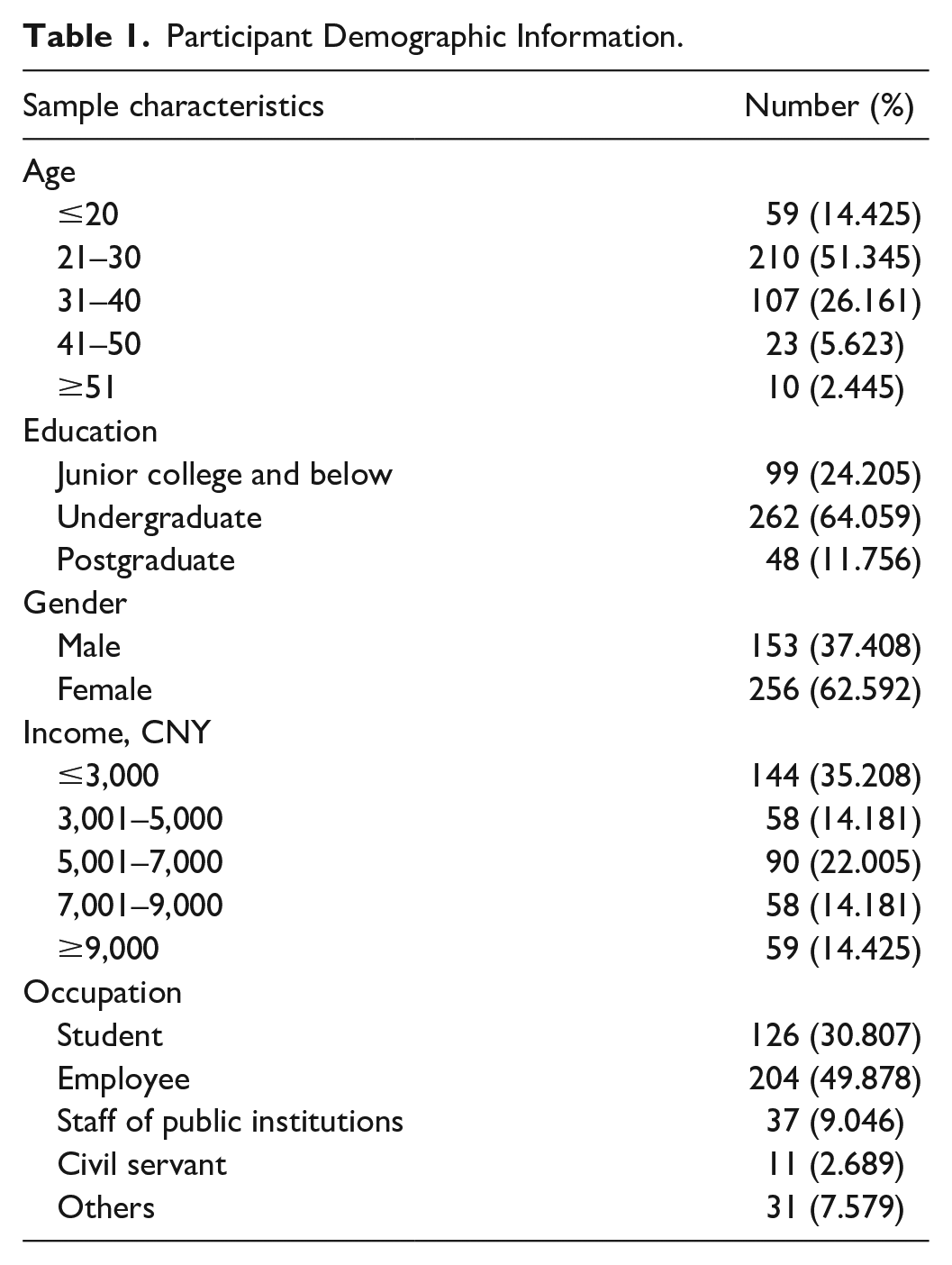
Table 1 presents the statistical results of the sample demographic characteristics. Among the 409 participants, individuals ranging from 21 to 30 years of age account for 51.345%, followed by those aged 31 to 40, a proportion of 26.161%. The proportion of participants with incomes of 3,000 CNY (1 CNY = 0.1399 USD) and below is 35.208%. More than half of the participants hold a bachelor’s degree, accounting for 64.09%. Nearly half of the participants are employees, accounting for 49.878%. The number of females in the sample is larger than that of males, namely, 62.592% and 37.408%, respectively.
Participant Demographic Information.
Measures
The key variables include management authority, professionalism of opinion leaders, awe, customer engagement, and participation time. In addition to the participation time, a 7-point Likert scale was used in the measurement of other variables. The management authority is the autonomy, decision-making power, and influence of the actual controller of the online brand community employed by BBS.
Management authority
In line with the research content, management authority was divided into system authority and manager authority, including disciplinary, decision-making, and prestige authority of managers (Sun, 2016; C. Yang & He, 2019). Regarding this point, we reference the scale of management authority, including five items, one of which was, “Every member should abide by the management system of the BBS brand.”
Professionalism
The professionalism of opinion leaders refers to Huang et al.’s (2014) measurement scale, including four items, one of which was, “Compared with professionals, active customers in the community have more knowledge of products and services.”
Awe
S. Guo et al.’s (2018) measurement scale was used to measure consumers’ experience of awe for the product or brand. The test item descriptions were modified to adapt to the online brand community situation, including six items, one of which was, “The BBS brand leads people into a new era.”
Customer engagement
Niedermeier et al.’s (2019) measurement scale was used to assess customer engagement, including seven items, one of which was, “I always publish posts, comments, photos, videos, and links about the BBS brand.”
Participation time
Regarding the measurement of community participation time, the respondents were directly asked when they joined the community, including four options: <1, 1 to 2, 2 to 4, and >4 years.
Data Analysis
PLS-SEM technology was used for data analyses and research hypothesis verification. PLS-SEM is widely used in marketing literature because of its capability for testing relationships among various predictive variables. PLS applies least squares regression and can be adapted to assess the relationships between multiple variables simultaneously more accurately than multiple regression, LISREL, and covariance-based methods. In addition, it is more convenient for PLS to introduce moderating variables in the research model (Kumar & Nayak, 2018).
The data analysis software SPSS 20 and SmartPLS 3.0 were used. The basic descriptive statistics and Cronbach’s α analysis were performed with SPSS 20, and the reliability and validity analysis, path coefficient test, and adjustment effect test were performed with SmartPLS3.0.
Results
Reliability and Validity
An exploratory factor analysis (EFA) was performed using the maximum variance method, extracting four common factors. The load of two common factors on one item of management authority is greater than 0.5; the load of two common factors on two items of awe is greater than 0.5; only one load of the common factor of remaining items is greater than 0.5; and the figure for the remaining three is smaller than 0.5 (see Table 2). If a load of all common factors of the item is smaller than 0.5 or the load of two or more than two common factors is greater than 0.5, this indicates that the factor characteristics of the item are not obvious (Zhao et al., 2019). Therefore, the three items that do not satisfy the factor characteristics were eliminated, obtaining a relatively stable scale of 19 items.
EFA Results.

SmartPLS3.0 software was used to explore the intrinsic relationship between test items and variables, mainly calculating the normalized factor load of each test item and reflecting the close relationships between the test item index and each variable. The results indicated that the variables are of good reliability (see Table 3). The value of Cronbach’s α of the four variables is between .793 and .886, which is >.7, indicating good reliability (Zhao et al., 2019). The normalized load of the corresponding latent variable of the test item is between 0.617 and 0.833, which is greater than 0.5, satisfying the requirements (Zhao et al., 2019). The internal consistency of variables was then assessed through combined reliability (CR). The CR values of the four variables are between .794 and .884, greater than .7, indicating good internal consistency of the four variables (Hair et al., 2012).
Reliability and Validity.

Following this, the convergence and discrimination of each variable were tested, and the average variance extraction (AVE) was used to indicate the convergent validity of the item, which should be more than .5 in general (Zhao et al., 2019). The values of the four variables are between .794 and .884, supporting the effectiveness of the measurement. Table 4 also indicates shows that the AVE square roots (diagonal data) of all variables are greater than their correlation coefficients, indicating good validity of the four variables.
Matrix of Correlation Coefficients and AVE Square Roots.
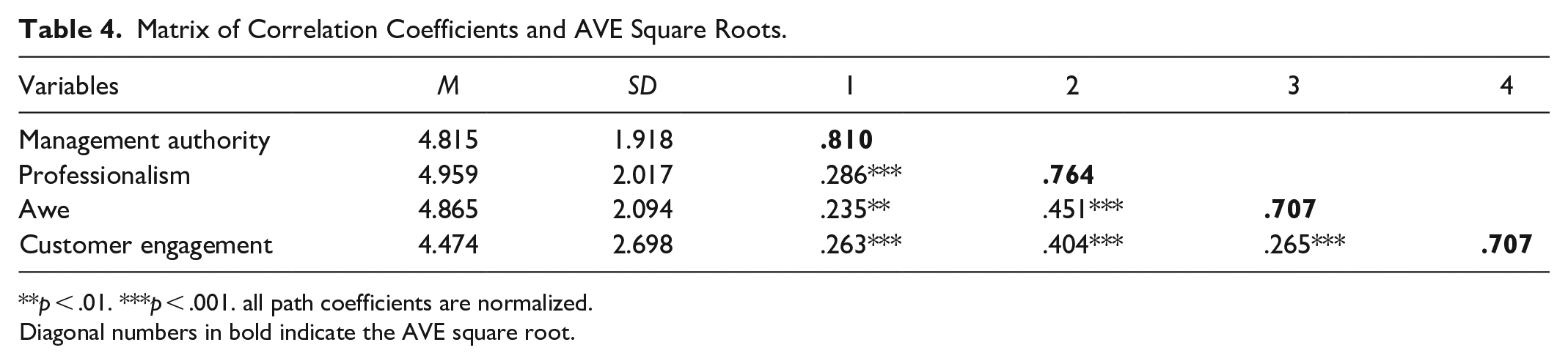
p < .01. ***p < .001. all path coefficients are normalized.
Diagonal numbers in bold indicate the AVE square root.
Common Method Deviation Test
A variation issue of using the same method is likely to occur in the data obtained from the questionnaire. To ensure that the data analysis results were not subject to this problem, the Harman single factor test method was used to perform the common method deviation test on the survey data. The unrotated factor analysis is performed on all test items of management authority, professionalism, awe, and customer engagement. The results indicate that the interpretation rate of the first-factor variance is 27.478%, which is lower than the 50%; thus, no serious common method deviation is apparent (Li & Xiong, 2017).
Tests of Hypotheses
The proposed research hypotheses were tested using two models, as shown in Table 5. In the first model, the direct influence of each variable is analyzed on the basis of the research hypotheses. In the second model, community participation time is introduced as a moderating variable, and the impact of participation time on management authority and the professionalism of opinion leaders on community members’ awe are analyzed.
Hypothesis Verification Results.
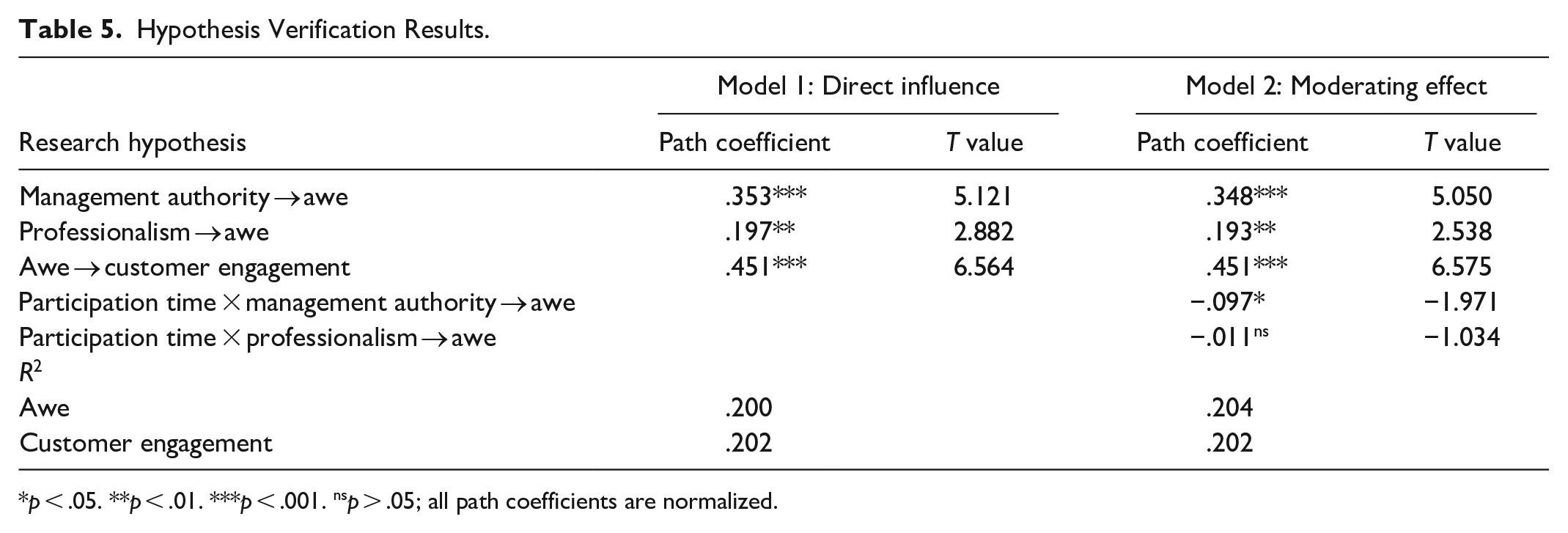
p < .05. **p < .01. ***p < .001. nsp > .05; all path coefficients are normalized.
An important test index in the hypotheses test is R2, which reflects the explanatory power of the evaluation model for endogenous variables. In the field of customer behavior research, if R2 is higher than .2, it indicates that the evaluation model can strongly explain endogenous variables (Hair et al., 2012). In Table 5, the hypothesis test results show that the R2 values of awe in Model 1 and Model 2 are .200 and .204, respectively, and the R2 values of customer engagement are both .202, all of which reach the desired level.
In Model 1, management authority has a significant impact on community members’ awe; the influence path coefficient β = .353, p < .05, verifying Hypothesis 1. Professionalism has a significant impact on community members’ awe; the influence path coefficient β = .193, p < .05, verifying Hypothesis 2. Awe significantly affects customer engagement; the influence path coefficient β = . 451, p < .05, verifying Hypothesis 4.
Model 2 demonstrates that participation time can significantly reverse moderate the impact of management authority on customers’ awe. The influence path coefficient of the interaction between participation time and management authority on customers’ awe β = −.097, p < .05, verifying Hypothesis 3a. Participation time can reverse moderate the impact of management professionalism on customers’ awe; the influence path coefficient β = −.011, not significant, and p > .05, based on which Hypothesis 3b is not verified.
Discussion
Emotion is a fundamental motivator of individuals’ actions. For community members in an online brand community, emotion is a key influencing factor that drives engagement in community interaction and community decision-making. Awe is a commonly experienced human emotion, and consumers’ experience of awe when facing enterprises’ products, services, and brands will affect their consumption decisions (S. Guo et al., 2018). Similarly, customers’ engagement in online brand communities is likely to induce various emotions (Jing et al., 2013). Awe is one of these emotions. To clarify the influence of awe on online brand communities, help community managers accurately understand customers’ emotions, and improve customer satisfaction, we propose a theoretical model based on the interdisciplinary awe prototype theory. Targeting a mobile phone online brand community, we analyze the influencing factors of awe and their impact on customer engagement. The research results provide some inspiration and contributions to the research and practice of online brand communities.
The results indicate that the management authority of online brand communities and the professionalism of opinion leaders positively affect community members’ experience of awe. This awe is conducive to enhancing community members’ engagement behavior, whereas community members’ participation time will reverse moderate the impact of management authority on awe. The longer community members’ participation time, the weaker the impact of the management authority of online brand communities on the experience of awe. Community members’ participation time also has a reverse moderating effect, though not significantly, on the impact of the professionalism of opinion leaders on community members’ experience of awe. The main reason may be that community members’ perception of the professionalism of opinion leaders cannot remain consistent in the long term. When new products and technologies are introduced in an enterprise, the professionalism of opinion leaders will fluctuate. According to the theory of hedonistic adaptation, such changes will make it more difficult to adapt to emotions and maintain the emotions at a certain level for a long time (Y. Yang et al., 2016). Therefore, the awe induced by the professionalism of opinion leaders can be maintained at a significant level for a long time, compromising the negative effect of participation time on the impact of the opinion leaders’ professionalism on community members’ experience of awe.
These conclusions offer certain theoretical contributions. (1) Regarding awe, researchers should pay more attention to the effect of great art, nature, and religious experiences on awe. Awe often appears in people’s daily lives as a commonly experienced emotion. For example, individuals’ experiences of awe may be induced with regard to the experience of brand or product consumption (S. Guo et al., 2018). We verify customers’ experiences in an online brand community can also induce awe, which broadens the research on the sources of inducing awe. (2) We also argue that community members’ awe will be affected by the amount of participation time in the community. The longer community members’ participation time, the weaker the intensity of awe induced by online brand communities, according to the theory of hedonistic adaptation, identifying the boundary conditions for research on the experience of awe. (3) This research imparts novel knowledge on online brand communities. Previous research on the elements of brand communities has focused on community members’ interaction characteristics, network characteristics of communities, and community atmosphere and analyzed the impact of these characteristics on community members. This study explored specific community elements at the organizational and individual levels of brand communities that influence customers’ experience of awe, investigating the impact of the management authority of online brand communities and the professionalism of opinion leaders on the awe of customers, proposing a new set of potentially influential community characteristics, to deepen researchers’ understanding of online brand communities. (4) Customers’ online brand community engagement includes many concepts, such as trust, satisfaction, commitment, emotional attachment, empowerment, consumer value, and loyalty (Brodie et al., 2013). We propose that awe is also a key element of customers’ integration into the community, enriching the research on customer engagement.
One of the motivations for enterprises to allocate expenditure of funds, time, and effort in building online brand communities is to affect customers’ consumption decisions and enhance their satisfaction and loyalty to the brand through connectivity. This requires enterprises to improve customers’ engagement within the online brand community. The research conclusions should inform and inspire online brand community managers to enhance community engagement by influencing community members’ experience of awe. (1) Online brand community managers can formulate community rules and regulations communicating clear rewards and disciplinary actions, such as information release systems and content management systems, to expand equal, transparent, fair, and rigid rules and regulations to all community members. Online brand community managers must promptly exercise the powers given by the community and reprimand community members who violate the rules, so that community members recognize the authority of rules and regulations and managers of online brand communities. Managers should also give community members a clear understanding of community rules and exhibit relevant community rules and regulations in more conspicuous places. (2) Active community members should be managed and supported. Active community members often arise in brand communities as the opinion leaders of the community. Community managers can recruit them, offering information, support, and training on brands and products to improve their professionalism and allow their partial function as community managers. For example, active community members can resolve customers’ questions and complaints in a timely manner. (3) Community managers must understand the effect of community members’ participation time. Particularly when welcoming new members, community managers should promptly and clearly share rules and regulations of the community, and active community members should also pay attention to their needs and challenges in a timely manner, so that they immediately recognize the authority of the managers and the professionalism of active community members.
Although this research was conducted in strict accordance with rigorous scientific principles, there remain some shortcomings and limitations. (1) The research on the experience of awe in an online community was performed on the basis of Keltner and Haidt’s (2003) awe prototype theory and described community members’ experience of awe from the perspectives of vastness and the need for accommodation. Additional research on community members’ experience of awe beyond these two characteristics should be further pursued. (2) We do not comprehensively analyze the community factors that induce community members’ experience of awe but only involve the management authority at the community organization level and the professionalism at the individual level, without examining the impact of enterprise brands or products on the community members’ experience of awe. (3) The research object was to investigate the online brand community of a mobile phone enterprise, which has high-tech products. There are many existing online brand communities with low technical requirements. In this sense, we do not provide a specific answer to the question of whether the type of online brand community affects community members’ awe and moderates the impact of community management authority and professionalism of opinion leaders on the experience of awe.
Conclusion
This research examined the triggers and consequences of awe in an online brand community, enriching the literature on community-induced emotion. Our research findings demonstrate that the management authority and professionalism of opinion leaders positively affect community members’ experience of awe, and this awe positively affects community engagement behaviors. Furthermore, community members’ participation time moderates the influence of management authority on the experience of awe; namely, longer participation time weakens this influence. The outcomes of this study offer insights for community managers to maintain and develop communities. We expect that the findings will encourage scholars to explore additional potential triggers and consequences of awe in online brand communities as well as other social emotions in future studies.
Footnotes
Acknowledgements
Jianbin Zhao is responsible for designing the study, carrying it out, analyzing results, and writing manuscript. Zheng Li is in charge of designing the study and carrying it out. Guobao Xiong job is to write the manuscript.
Declaration of Conflicting Interests
The author(s) declared no potential conflicts of interest with respect to the research, authorship, and/or publication of this article.
Ethical Approval
This study, the questionnaire was approved by the Academic Office of East China University of Technology. There is no unethical behavior in the study process, and an ethical approval was not required for our study as per applicable institutional and national guidelines and regulations, because our study does not involve human clinical trials or animal experiments. We entrust the Questionnaire Star to collect data ( ), all participants are from China and need to have a mobile phone experience. Prior to a formal investigation, we inform them that this survey is voluntary and will not involve personal privacy and will not have any impact on personal psychology or behavior. We received 457 questionnaires at the first round of data collection and found that all participants completed questionnaires according to our requirements. This showed that 457 participants agreed to join in our survey.
Funding
The author(s) disclosed receipt of the following financial support for the research, authorship, and/or publication of this article: This paper is supported by the National Natural Science Foundation of China (No. 71962001) and Research Center of Resource and Environment Economics (NO. 21JDGL02).