




Abstract
Workplace bureaucracies impact many areas of an employee’s working life. High levels of perceived bureaucracy can diminish employees’ job motivation, satisfaction, and performance. During the COVID-19 pandemic, infection containment measures contributed significantly to the ‘great resignation’ via the lack of self-efficacy from perceived bureaucracy. This study surveyed 240 full-time employees between late 2021 and early 2022 across organizations in both private and public sectors in Singapore using the Work Extrinsic Intrinsic Motivation scale, the Workplace Bureaucracy questionnaire, and the General Self-Efficacy scale alongside demographic data collection. Results showed that salary range, education levels, self-efficacy and job motivation were negatively associated with perceived workplace bureaucracies but not gender, age, and length of employment. The study’s findings provide insight into the effect of increased perceived bureaucracy during the COVID-19 pandemic on employee experience that would be relevant to the workplace environment even in regular times as a possible intervention point for better employee experience.
Plain Language Summary
Workplace bureaucracies impact many areas of an employee’s working life. High levels of perceived bureaucracy can diminish employees’ job motivation, satisfaction, and performance. During the COVID-19 pandemic, infection containment measures contributed significantly to the ‘great resignation’ via the lack of self-efficacy from perceived bureaucracy. This study surveyed 240 full-time employees between late 2021 to early 2022 across organizations in both private and public sectors of Singapore. Results showed that salary range, education levels, self-efficacy and job motivation were negatively associated with perceived workplace bureaucracies but not gender, age, and length of employment. The study’s findings provide insight into the effect of increased perceived bureaucracy during the COVID-19 pandemic on employee experience that would be relevant to the workplace environment even in regular times
Keywords
Introduction
An employee’s work environment is the sum of relationships between an organization’s employees and infrastructure conditions that affect an employee’s work life. Apart from productivity (Alwi & Shaiq, 2019), organizational environments can positively or negatively impact employee behaviours (Eldor, 2017), morale (Lambersky, 2016; McHugh, 2001), motivation (Lam & Lambermont-Ford, 2010; Y. Zhang et al., 2019) and engagement (Collini et al., 2015; Keulemans & Van de Walle, 2020). Bureaucratic organizations (Abun, 2021; Keulemans, 2021; Langer et al., 2019) where routine operations adhere to strict rules and procedures (Hodson et al., 2006), were reported to have increased employee performance (Abun, 2021), while other studies showed decreased employee satisfaction (Langer et al., 2019), productivity (Feeney & DeHart-Davis, 2009) and job motivation (Lam & Lambermont-Ford, 2010).
Since Weber’s bureaucratic theory (Weber & Andreski, 1983) aims to maximize employee efficiency by discouraging creativity, collaboration, flexibility and risk-taking within a strict hierarchy of authority, it was criticized for being too rigid (Piore, 2002), with the relationships being highly impersonal and serving only the purpose of meeting work-related goals. On the other hand, the neoclassic theory, utilizing more of the human relations approach (Bartell, 1976) and the antithesis of Weber’s bureaucratic theory, rewards innovation and encourages risk-taking (Cangemi et al., 2008). In the neoclassic theory, managers should trust employees and work collaboratively with them (Rocha & Miles, 2009), allowing such organizations to have improved employee performance, motivation (X. Yang et al., 2022) and satisfaction (Daley, 1986).
While bureaucratic work organizations were previously reported to be slow and laborious (Mengistu & Vogel, 2003), defeating the primary purpose of maximizing productivity, street-level bureaucrats (front liners of government policies) were recently reported to have increased confidence within such environments (Keulemans, 2021). Bureaucratic work environments reportedly strengthened work engagement and leadership (Arfat et al., 2017) since strict rules were usually applied equally to all employees. Perceived fairness contributes to a positive organizational culture that promotes better satisfaction and productivity while reducing workplace bullying. (Hodson et al., 2006)
Through attempts to harmonize Weber’s and the neoclassic theories, the contingency theory (Wadongo & Abdel-Kader, 2014) posits that no appropriate organizational design is a ‘one-size-fits-all’. Instead, adaption to the specific situation and employee needs is necessary. Thus, much remains to be investigated within the dichotomy between humanistic and bureaucratic work environments. While there were reports that Filipino college employees’ work performance and self-efficacy increased in humanistic work environments (Abun, 2021), bureaucratic organizations did not negatively impact self-efficacy. Both humanistic and bureaucratic work environments improved employee work performance, revealing bureaucracy as a double-edged sword where the positive impact on employees (Arfat et al., 2017; Hodson et al., 2006; Keulemans, 2021) can be contradicted by causing lowered satisfaction (Gautam, 2020; Langer et al., 2019), decreased motivation (Abun, 2021; Prendergast, 2007), increased burnout (Gunderman & Lynch, 2018) and reduced innovation (Langer et al., 2019). Since bureaucratic work environments tend to be coercive and highly formal, freedom, autonomy, and flexibility (Adler & Borys, 1996) were generally restricted by excessive or overly rigid red tapes (Kaufmann et al., 2018) to impact decision-making (Bozeman & Pandey, 2004) and innovation (Moon & Bretschneiber, 2002) to slow-down employee productivity negatively (Ciccone & Papaioannou, 2007). Such a situation can lead to emotional frustration and anger (Hattke et al., 2020).
Further comparing public sector employees in three work environments: routine bureaucratic work, centralized bureaucratic work, and entrepreneurial work environments, the high routine and centralized work environments of coercive bureaucratic work environments negatively impacted employee job satisfaction (Langer et al., 2019), whereas the entrepreneurial work environment encouraged risk-taking and innovation, positively contributed to employee job satisfaction.
Gender was reportedly a factor in perceiving workplace stress (Gyllensten & Palmer, 2005; Hitlan et al., 2006) and satisfaction (Mason, 1995), with many women feeling greater pressure at work and infringements on their personal time (Gardiner & Tiggemann, 1999). Lim and Teo (1996) found that women in Singapore reported greater stress from the organization’s structure and climate, and other studies reported women to be paid less than men (Lee, 1998; Takenoshita, 2020). Together, such factors can diminish job satisfaction (Sloane & Williams, 2000) aggravated by inequality (Blithe & Elliott, 2020) and poor treatment by superiors (Acker & Feuerverger, 1996). With differences in working preferences where women preferred collaborative working styles while men preferred independence (Peterson, 2004), bureaucracy can affect the sexes differently. Thus, while women may perceive fewer workplace bureaucracies (DeHart-Davis, 2009) than men, women generally prefer humanistic or entrepreneurial work environments over bureaucratic environments. Since there were generally no significant differences between gender perceptions of red tape, the representative bureaucracy theory (Turesky & Warner, 2020), where an organization considers the needs and differences of the respective sexes, may show the outcome of different perceptions.
According to the self-determination theory (Van Lange et al., 2012), people are naturally motivated to grow and adapt based on three innate needs: autonomy, competence, and connection. This theory can underpin employee-organization fit (Gagné & Deci, 2005) and guide intervention strategies. Research on the relationship between workplace bureaucracies across the domains of motivation found that pressure in highly bureaucratic organizations tends to demotivate employees (Sloane & Williams, 2000). Nonetheless, there were also contradicting findings where intrinsic motivation could arise from the satisfaction of overcoming challenges in their jobs, allowing bureaucratic organizations to provide higher intrinsic motivation (Kim, 2018; Scott & Pandey, 2005). Thus, highly intrinsically motivated individuals may tolerate the controlling nature of bureaucratic work environments (Scott & Pandey, 2005), given the relationship between red tape and public service motivation. This phenomenon was also found in managers with greater public-service motivation, higher intrinsic motivation, and a lowered perception of workplace bureaucracies. However, upon crossing a threshold, diminished intrinsic motivation (Adler & Borys, 1996; Feeney & DeHart-Davis, 2009) can result from the high formalization and lack of autonomy (Lam & Lambermont-Ford, 2010).
Where adopted work strategies aim for harmony with an employee’s values and needs, how workplace bureaucracies impact integrated regulation remained enigmatic. The goal setting in bureaucratic work organizations following one technique or format to align with the general rule-following in bureaucratic work organizations may not align with personal needs, compromising the integrated regulation (Wriston, 1980). Nonetheless, there are findings that suggest the impact to be limited (Wise, 2004).
Identified regulation, which involved recognizing and appreciating work-related behaviour, was positively associated with work performance (J. Zhang et al., 2016). With introjected regulation regulated internally by pressures in receiving reward or avoiding punishment, external regulation surrounds reward. Since the reward systems in bureaucratic work organizations generally adopt a more position-related and performance-based approach (Frenkel et al., 1998), the sufficiency felt by those at the top of the hierarchy may contradict the perception of employees lower in the hierarchy. Notably, obedience to rule-following and authoritarian disciplines is desired (Butterfield et al., 2005) within punishment-centred bureaucratic organizations. This is often seen in the more bureaucratic government sectors with greater fear of rule-breaking (Jung et al., 2020). On the contrary, enabling bureaucratic work environments fosters trust to reduce the fear of punishment (Adler & Borys, 1996; Hoy & Sweetland, 2000).
Self-efficacy reduces anxiety and coping with stressful events (De Clercq et al., 2018) and is directly tied to the quality of the work-life (Mensah & Asamani, 2013) and performance (Stajkovic & Luthans, 1998). While there was no clear relationship between self-efficacy and bureaucracy (Abun, 2021), rule-following identity (common in bureaucratic organizations) increased general self-efficacy (Keulemans, 2021). However, high formalization and centralization diminished self-efficacy (Mustafa et al., 2019), with red tape lowering self-efficacy due to emotional exhaustion in employees (Baker et al., 2007; Y. Yang et al., 2019) and the lack of flexibility and stifling of creativity and innovation (Jaussi et al., 2007). Nonetheless, longer-serving employees in the company, who were highly educated and better paid, and those of older age may perceive less red tape (Feeney, 2012) given that salary and education level were positively correlated with job satisfaction (Langer et al., 2019).
Job motivation can mediate self-efficacy in the workplace, which in turn can mediate person-organization fit and job satisfaction (Y. Peng & Mao, 2015). A greater sense of belonging can improve job satisfaction due to greater self-efficacy, and the sense of belonging can affect perceived bureaucracy. Generally, red tapes reduce the importance of workplace belonging (Reeves, 2015), making it important to design work where task delegation, social characteristics, and physical characteristics help mediate self-efficacy and job satisfaction (Bargsted et al., 2019). This is especially so when considering that environments with more opportunities to socialize at work and trust in task delegation would increase self-efficacy and job satisfaction.
To better investigate the above relationships, the COVID-19 pandemic provided a unique opportunity to kickstart the ‘Great Resignation’, coined by Anthony Klotz (Cohen, 2021; Kaplan, 2021) to describe the resignation en masse due to job dissatisfaction and safety concerns for investigation. Studies have investigated this phenomenon cross-sectionally from the ethnic, cultural and generational factors (Kuzior et al., 2022), as well as psychological distress (Ksinan Jiskrova, 2022) and toxic work cultures (Sull et al., 2022). However, to our knowledge, the increased bureaucracy during the pandemic has not yet been investigated during this extreme period.
This study thus aims to investigate the relationship between bureaucracies and self-efficacy, mainly because bureaucracy affects an organization's underlying social and task characteristics (Bargsted et al., 2019). Given the stated gaps in the literature regarding the impact of bureaucracy on self-efficacy, understanding the relationship and uncovering any possible mediation would allow future development of interventions to improve the employee experience that is desired in having better productivity. Considering that intrinsic motivation partially mediated self-efficacy and work performance relationship (Çetin & Aşkun, 2018), we specifically aimed to investigate if there would be any relationship between bureaucracies and self-efficacy via job motivation, which is used here in place of job satisfaction given its inclusion of workplace performance.
Hypothesis Development and Aims
The direct predictive relationship that perceived bureaucracy has on self-efficacy across various sectors (including public and private sectors), considering gender, length of service, salary range, age and education level, was investigated. The impact of perceived bureaucracy on job motivation (as per the self-determination theory) was investigated as performed in Langer’s study to measure perceived bureaucracy across the same three constructs. Since many findings show a positive relationship between job motivation and self-efficacy (Na-Nan et al., 2019), job motivation was also explored to determine how it can contribute to the predictive relationship as a mediator and confounding variable between perceived bureaucracy and self-efficacy.
Through the Workplace Bureaucracy Questionnaire (WBQ), perceived bureaucracy was measured across both public and private sectors alongside gender (hypothesis 1), salary range, education level (hypothesis 2a), and both the length of service and age (hypothesis 2b). The impact of perceived bureaucracy on job motivation, intrinsic motivation, and regulation (introjected, identified, and external) and amotivation was also investigated in hypothesis 3a. Noting that bureaucracy led to decreased job motivation that diminished self-efficacy, the impact of bureaucracy on self-efficacy via job motivation (Figure 1) was also studied (hypothesis 4).

Conceptual model of hypothesis 4.
Materials and Methods
Ethical Considerations
Ethics approval (H8589) was obtained from James Cook University as a low-risk study. The information sheet and informed consent were presented online to the participants, informing them of the potential risks and their rights to withdraw without prejudice.
Participants
Under a medium-sized effect (α = .05, 1-β = 0.95, effect size = 0.15, number of predictors = 19), G*Power a-priori analysis predicted the minimum number of participants needed to be 219.
To buffer for dropouts and missing data, two hundred and forty participants were recruited from Nov 2021 to April 2022 via convenience and network sampling on the authors’ social media platforms (Facebook, Twitter, and LinkedIn). The online study was open to anyone above 18 years old and in full-time employment (regardless of industry), gender, nationality, or other demographic factors. Eleven entries had missing data and were discarded upon data analysis and cleaning. The remaining 229 responses were analysed for this study.
Procedure
This cross-sectional study was administered online via the Qualtrics® platform and PsychVey (Liew et al., 2020; Nguyen et al., 2015). Upon consent, participants answered a demographics form adapted from previous studies (Cheok et al., 2020; S. K. Gan et al., 2003; Yew et al., 2015) concerning their age, gender, highest education qualification level, salary range, occupation anonymously. The education levels were based on the Singapore education system. Questions on organization nature and length of service were added (see Supplemental materials), followed by the Work Extrinsic Intrinsic Motivation Scale (WEIMS), the Workplace Bureaucracy Questionnaire (WBQ) and the General Self-Efficacy Scale (GSES), respectively. The questionnaire ended with a thank you note.
Measures
Job-Motivation
The Work Extrinsic Intrinsic Motivation Scale (WEIMS) by Tremblay et al. (Tremblay et al., 2009) was based on the self-determination theory (Van Lange et al., 2012) to measure the various work motivation dimensions in organizational settings. The WEIMS is an 18-item Likert-scale questionnaire where 1-‘Does Not Correspond at all’, 4-‘Corresponds Moderately’, 7-‘Corresponds Exactly’. The WEIMS measured six constructs (3 items each): intrinsic motivation (items 4, 8 and 15), integrated regulation (items 5, 10 and 18), identified regulation (items 1,7 and 14), introjected regulation (items 6, 11, and 13), external regulation (items 2, 9 and 16) and amotivation (items 3,12 and 17). The formula for calculating the total score on the WEIMS is W-SDI = (+3 × Average of Intrinsic Motivation)+(+2 × Average of Integrated Regulation)+(+1 × Average of Identified Regulation)+(− 1 × Average of Introjected Rejection)+(−2 × Average of External Regulation) +(−3 × Average of amotivation). Positive scores reflected self-determination, whereas higher scores reflected the extent of self-determination. The average score of the construct was calculated to measure the relationship between WBQ and these six constructs.
The WEIMS showed good internal consistency in the initial administration, with the Cronbach values ranging from 0.64 to 0.83, within the recommended value of at least 0.75 (Akram et al., 2018). The Cronbach alpha score was deemed adequate since each construct had only three items. Subsequent administration showed the WEIMS to have good predictive validity with work engagement, organizational commitment (Colaco & Loi, 2019), job performance (Tremblay et al., 2009) and ‘workaholism’ (Gupta, 2014). Reliability analysis on the final sample size showed a Cronbach’s alpha for the 18-item test to be .87, indicating good internal consistency.
Perceived Workplace Bureaucracies
The Workplace Bureaucracy Questionnaire (WBQ) was adapted from Langer et al. (2019) to investigate the relationship between job satisfaction and the bureaucratic and entrepreneurial work environments. It measured the nature of the work environment: routine bureaucratic work, centralized bureaucratic work, and entrepreneurial work environments. The original questionnaire was an 11-item Likert-scale inventory where 1= ‘Strongly Disagree’, 3= ‘Neither Agree nor Disagree’, and 5= ‘Strongly Agree’. In the present study, the item ‘Employees in this organization are resistant to change related to technology’ was excluded due to its irrelevance to this study. Some items in the entrepreneurial work environment (initially reverse-coded items) were reversed for ease of calculation. The WBQ measures routines, centralization, and entrepreneurship, with the maximum attainable score on the WBQ being 50, where a higher score indicates a more bureaucratic work environment.
This study examined the mean scores on the three constructs: routine bureaucratic (maximum score of 15), centralized bureaucratic (maximum score of 15), and entrepreneurial work environment (maximum score of 20). The items on the entrepreneurial work environment were reverse coded; thus, higher scores indicated lower entrepreneurship. In the initial administration, the latent constructs achieved good internal consistency (α = .746). The Cronbach alpha in this study for the 10-item questionnaire was .94, higher than the Cronbach alpha value in the initial administration, indicating very good internal consistency.
Employee Self-Efficacy
The General Self-Efficacy Scale (GSES) by Schwarzer and Jerusalem (Schwarzer & Jerusalem, 1995) measured employee self-efficacy and is a 10-item 4-point Likert-scale inventory where 1= ‘Not at all True’, 2 = ‘Hardly True’, 3 = ‘Moderately True’, 4= ‘Exactly True’. The scores range from 10 to 40, with higher scores indicating greater self-efficacy. The internal consistency of the original test ranged from 0.76 to 0.90, indicative of excellent internal consistency. The GSES had good test-retest reliability in several studies (Lazić et al., 2021) and highly correlated with work satisfaction (J. Peng et al., 2021), burnout (J. Peng et al., 2021), and coping with a stressful event (Luszczynska et al., 2005). In this study, the GSES had a Cronbach alpha of .95.
All data analyses were performed using IBM SPSS Statistics version 22. Descriptive statistics were performed from exploratory analyses. Hypotheses were tested using correlational analysis and hierarchical regression.
Results
Assumption Testing
Inspection of the skewness, kurtosis and Shapiro-Wilk statistics indicated that the assumption of normality was not met for the distribution for WBQ. Upon examination of the stem-and-leaf plots, the WBQ displayed a negative skew. Thus, Kruskal-Wallis was used to analyse WBQ.
Descriptive Statistics
Participants’ demographics exploratory analyses are summarized in Table 1. The list of ‘other’ organization natures is shown in Supplemental materials. Most of the participants were from the education and healthcare sectors. The mean distribution between WBQ scores and organization is also reported in Table 1.
Sociodemographic and Organizational Characteristics of Participants.

Note. Total sample size, N = 229.
National ITE Certificate (NITEC) and ‘Higher NITEC’ are vocational training certifications. General Certificate of Education (GCE) ‘O’ and ‘A’ Levels are adapted from the United Kingdom education system and equivalents of the United States’ high school diplomas. The ‘O’ Levels are typically taken at 16 years of age, and the ‘A’ Levels at 18. More information can be found at https://en.wikipedia.org/wiki/Education_in_Singapore.
The results for the subscales of the WBQ and WEIMS are shown in Table 2. For WBQ, the non-entrepreneurial environment had the highest score, while the routine bureaucratic subscale had the lowest score. For the WEIMS scores, external regulation was the highest while amotivation was the lowest. Gender differences in WBQ, job motivation and self-efficacy are shown in Table 3. The total WBQ score in various industries and scores of WBQ, WEIMS and GSES are shown in Figures 2 and 3, respectively.
Summary of Raw Scores: Mean and Standard Deviation of WBQ and WEIMS.

Summary of Raw Scores: Mean and Standard Deviation Differences Between the Gender.


Mean distribution of Total WBQ across organization natures.

Summary of raw scores of WBQ, job motivation (WEIMS) and self-efficacy (GSES).
χ2– analysis showed no significant differences between the WEIMS (p = .148) and GSES (p = .406) scores across the various industry sectors.
Hypothesis Testing
The first two assumptions of the Kruskal-Wallis One-Way ANOVA were assumed to be met. Independence was assumed met because the participants only answered the survey once and had no influence on other entries. As the WBQ adopts a scale measurement, the symmetry of the distribution of difference scores and the similar distribution among gender was met.
Since the Kruskal-Wallis analysis showed no significant differences between females (M = 29.43 + 10.77) and males (M = 29.50 + 9.77) with regards to WBQ scores (χ2 = 3.74, p = .83, df = 2), hypothesis 1 was rejected.
Spearman’s rho analysis for ordinal education level and salary range indicated a moderate negative relationship between WBQ scores and highest education level, rs = −0.37, p < .001, and salary range, rs = −0.31, p < .001. Thus, hypothesis 2a was accepted.
Linearity and homoscedasticity testing permitted Pearson’s correlational analysis on the length of service (2b) and age (2c). The bivariate Pearson’s product-moment correlation coefficient (r) with WBQ showed a non-significant, weak, and negative relationship between WBQ and age, r (227) = −.046, p = .488, as well as with WBQ and length of service, r (227) = −.03, p = .648, thus rejecting hypothesis 2b.
With all assumptions of the test met, hypothesis 3 was tested with the bivariate Pearson’s product-moment correlation coefficient (r) for the constructs of job motivation and WBQ (Table 4). A strong negative relationship was found for WBQ and WEIMS at r (223) = −0.66, p < .01.
Pearson Correlation (r) and Sample Size (N) between WBQ and WEIMS Constructs.

Note.**p < .01.
Table 4 shows a strong negative relationship between WBQ and intrinsic motivation, integrated regulation, and identified regulation. A moderate negative relationship was found between WBQ and both introjected and external regulations. Thus, hypothesis 3a was accepted. A moderate positive association between amotivation and WBQ was found, and hypothesis 3b was also accepted.
(1) Perceived workplace bureaucracies would have to significantly predict self-efficacy whilst there is a mediation effect (path c);
(2) Perceived workplace bureaucracies would have to significantly predict the mediator, job motivation (path a);
(3) Job motivation would significantly predict self-efficacy (path b);
(4) The association between perceived workplace bureaucracies and self-efficacy becomes non-significant (path c’) or reduced in size when the mediator is controlled for;
The indirect effect of perceived workplace bureaucracies through job motivation is more significant than zero. Mediation analysis was conducted using the PROCESS macro Model 4 (Hayes, 2018) with 5,000 Bootstrap resamples. Age, gender, length of service, education level and salary range have been included in this model as covariates. For this analysis, the gender data excluded the three non-binary participants, which were statistically insignificant and would not affect the power of the study.
From Figure 4, WBQ scores negatively predicted WEIMS, B = −0.490, β = −.580, t = −10.97, p < .001. The covariates’ salary range was the only positive significant predictor of job motivation, B = 1.37, β = .248, t = 3.24, p < .001. The other covariates of age (B = −0.090, β = −.113, t = −1.01, p = .186), gender (B = −1.30, β = −.078, t = −1.55, p = .123), education level (B = 0.293, β = .073, t = 1.33, p = .186) and length of service (B = −0.054, β = −.055, t = −0.557, p = .578), were not statistically significant predictors of job motivation.

Statistical diagram of hypothesis 4.
WBQ scores significantly predicted reported self-efficacy in a negative relationship, B = −0.275, β = −.480, t = −7.46, p < .001. The mediator job motivation was also seen to predict self-efficacy positively, B = 0.209, β = .309, t = 4.62, p < .001. The covariates salary range predicted self-efficacy negatively (B = −0.684, β = −.183, t = −2.40, p < .05) while education level predicted self-efficacy positively (B = 0.339, β = .124, t = 2.33, p < .05). The other covariates of age (B = 0.064, β = .119, t = 1.09, p = .278), gender (B = −0.589, β = −.052, t = −1.06, p = .290) and length of service (B = −0.032, β = −.047, t = −0.490, p = .625), were not significant predictors of GSES.
The indirect effect of perceived workplace bureaucracies (WBQ) on self-efficacy (GSES) via job motivation (WEIMS) did not include zero, B = −0.102, β = .179, 95% [CI] [−0.1564, −0.0540]. Mediation has occurred since the indirect effect of perceived workplace bureaucracies via job motivation is greater than 0. Perceived workplace bureaucracy was thereby found to significantly predict self-efficacy (B = −0.377, β = .659 t = −12.26, p < .001). However, after controlling for job motivation alongside other covariates, the direct effect of perceived workplace bureaucracies on reported self-efficacy decreased in effect size (B = −0.275, β = −.480, t = −7.46, p < .001), indicative of partial mediation.
With the significant indirect effect (IE), self-efficacy would diminish if perceived workplace bureaucracy increased because of decreased job motivation.
This mediation of job motivation on the relationship between perceived workplace bureaucracy and self-efficacy thus permits the acceptance of hypothesis 4.
To investigate the change in R2, a stepwise hierarchical multiple regression was performed. After controlling for job motivation, gender, age, salary range, education level and length of service, WBQ scores predicted GSES scores that were, in turn, correlated with coping with stress (De Clercq et al., 2018). Since previous findings showed that women experienced more workplace stress than men (Hitlan et al., 2006), gender was investigated in predicting self-efficacy using one-way ANOVA with the assumption of meeting normality and homogeneity of variance requirements. The ANOVA results showed that self-efficacy did not vary between the gender in our sample population, F (2,223) = 1.41, p = .25.
To determine whether WBQ could predict GSES scores after controlling for WEIMS, gender, age, salary range, highest education level and length of service, a stepwise hierarchical multiple regression was performed after stem-and-leaf plots and boxplots showed that self-efficacy was normally distributed. Seven outliers occurred in the self-efficacy scores from participants who rated all items as ‘Not at all True (1)’ or ‘Hardly True (2)’. While this could be due to participants merely getting through the survey without serious responses or having extreme opinions, the outliers were retained since no univariate outliers’ Z scores were beyond −3.29 to 3.29. The normal probability plots of standard residuals and scatterplots of standard residuals against standardized predicted values indicated that the assumption of normality, homoscedasticity and linearity were not violated. The Mahalanobis distance did not exceed the critical x2 for df = 5, α = .001 of 20.52 for cases in the data, indicating no multivariate outliers. All predictors’ tolerances and VIFs were acceptable, showing that multicollinearity would not interfere with the results.
In the hierarchical multiple regression, age, salary range, and length of service were non-significant predictors. Job motivation accounted for 35.9% of the variance in self-efficacy, R2 = 0.36, F(1, 219) = 122.91, p < .01 in step 1, while education level accounted for an additional 1.4% of the variance in self-efficacy in step 2, ΔR2 = 0.014, ΔF (1, 218) =4.76, p = .30. In step 3, WBQ accounted for an additional 12.2% of the variance in GSES, ΔR2 = 0.122, ΔF (1, 217) =52.57, p < .01. In combination, the three predictor variables explained 49.5% of the variance in GSES, adjusted R2 = 0.49, F (3, 217) = 71.03, p < .01. Unstandardized (B) and standardized (β) regression coefficients and squared semi-partial (sr2) correlations for each predictor on each step of the hierarchical multiple regression analysis are reported in Table 5.
Unstandardized (B) and Standardized (β) Regression Coefficients and Squared Semi-Partial (sr2) Correlations for Each Predictor on Each Step of the Hierarchical Multiple Regression Predicting the GSES scores in Employees.
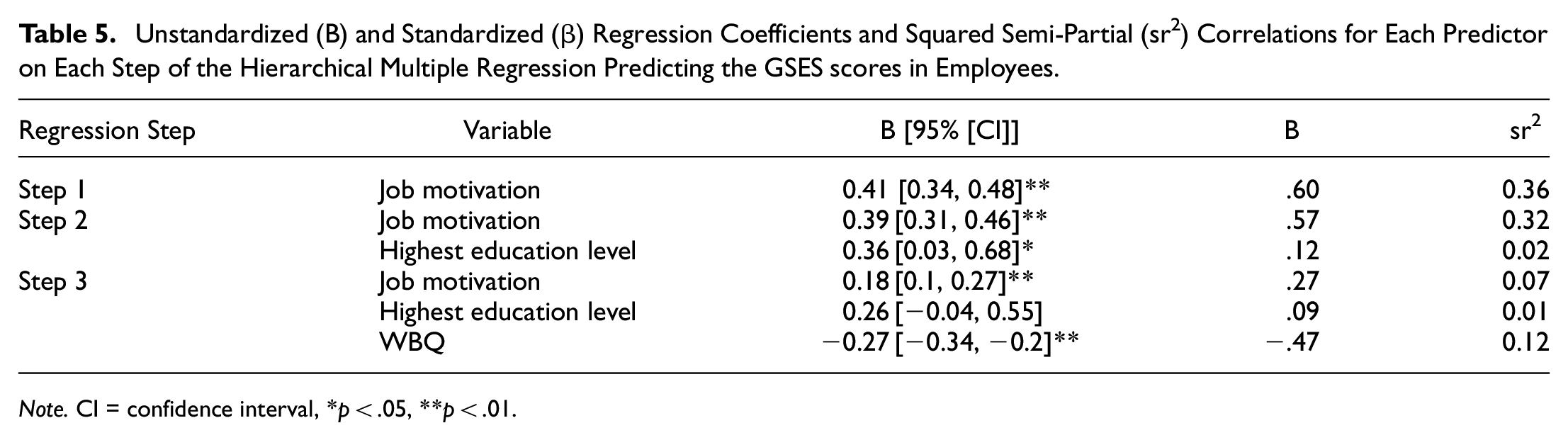
Note. CI = confidence interval, *p < .05, **p < .01.
As shown in Table 5, the only significant predictors of self-efficacy in the final regression model were job motivation (sr2 = 0.07) and WBQ (sr2 = 0.12). Therefore, WEIMS positively predicted GSES scores. In contrast, WBQ negatively predicted GSES, thus accepting hypothesis 4.
As an extension investigating the effect of the subscales in WBQ, we found routine bureaucratic environments (r = −.644, p < .001) to have a negative correlation with WEIMS than centralized bureaucratic (r = −.538, p < .001) and entrepreneurial work environments (r = −.572, p < .001). On GSES, the routine bureaucratic (r = .679, p < .001) and centralized bureaucratic (r = .767, p < .001) environments showed a positive correlation, but the entrepreneurial work environment (r = −.628, p < .001) was negatively correlated (see Supplemental materials).
Discussion
In this study, we investigate the relationship between perceived workplace bureaucracy, self-efficacy and job motivation across various industry sectors and the effects of gender, length of service, salary range, age, and education level on this relationship.
The first hypothesis that women may experience higher workplace bureaucracies was rejected because of the lack of significant differences in the WBQ scores of both self-reported gender. While this contradicted a previous finding (Lim & Teo, 1996) that Singaporean women experienced greater stress in an organization structure, the study was performed over 26 years ago. However, the findings were consistent with a more recent study (Ng et al., 2018) that found no significant differences in perceived stress by gender. One possible reason for this lack of difference could be that the participants accurately distinguished perceived bureaucracy from perceived stress, that bureaucracy was perceived similarly between the sexes as previously reported (DeHart-Davis, 2009), and that there may be good gender equality in the workplaces of our participants. However, it may also reflect the predominance of coercive bureaucratic work environments imposed regardless of gender.
The accepted second hypothesis 2a was that the education level and salary ranges would negatively correlate with WBQ, where the findings could be explained by Langer et al. (2019). Given the external demand for rewards to increase an individual’s extrinsic motivation, a higher salary likely leads to better job satisfaction and motivation. Higher salaries were often given to employees with higher education levels or advanced knowledge associated with higher job positions to yield better treatment and assistance in the workplace, which can lower perceived bureaucracies. Our findings here also concurred with (Feeney, 2012) that higher education and better salaries (Feng & Straughan, 2016; Tan et al., 2006) mitigated the unwanted effects of perceived bureaucracy.
While hypothesis 2a was accepted, hypothesis 2b, which studied the negative impact of age and length of service on WBQ, was rejected without significant associations. Our results did not agree with Feeney (2012) that the idea that older employees and those who had served in the organization longer perceived less red tape. Here, we initially assumed that age correlated with seniority and experience to translate to greater authority for delegation or respect from colleagues, thus negatively impacting perceived bureaucracy. The same underlying assumption also underpinned the length of service, leading to reduced perceived bureaucracy. Nonetheless, we did not find such significant relationships in our study population, reflecting that the younger workforce, possibly possessing higher education certifications, were placed in higher positions or that the organizations did not value experience and age seniority (and its associated familiarity with work processes) as much as education certifications alone. Another possible explanation was that habituation and getting used to bureaucracy did not occur since those older or having served longer did not have lower WBQ scores. It should also be noted that the recruitment method via social media and electronic methods may have created a bias towards the more IT-savvy younger employees, which may affect the perceived bureaucracy given that a lot of workplace bureaucracy may be contributed by digitalization in workplaces.
The third hypothesis investigating the negative relationship of intrinsic motivation, integrated regulation, introjected regulation, identified and external regulation on WBQ (hypothesis 3a) was accepted. Our findings agreed with the previous studies (Adler & Borys, 1996; Feeney & DeHart-Davis, 2009; Rasul & Rogger, 2018) that the likely reasons would be due to the high formalization in bureaucratic work organizations. Within routine bureaucratic structures, employees at the lower end of the hierarchy would feel more significant restrictions on their autonomy and be deprived of their innate needs. Nonetheless, this can also reflect the passing down of bureaucratic processes in the hierarchy, thereby mitigating the influence of already reduced rewards compared to those in higher positions in the organization hierarchy.
Consistent with previous findings (Wise, 2004) where bureaucracy impacted one’s values, needs, and internal and external rewards, amotivation was expectedly negatively associated with WBQ scores in our study. Among our participants, a bureaucratic organization's structure (high routines, high centralization, low entrepreneurship) most likely did not align with employee’s values or goals, as suggested by Wriston (Wriston, 1980).
The negative relations between WBQ and integrated regulation may reflect the participants being employed in bureaucratic organizations or that their autonomy was overly restricted (possibly amplified by the COVID-19 measures experienced during the period of the survey), leading to decreased flexibility in goal setting during the enforcement of general rule-following during the pandemic. In high routine or centralized work environments, participants would be pressured to avoid punishment or receive rewards (internally or externally), as previously reported (Jung et al., 2020; J. Zhang et al., 2016). Such effects would likely be amplified during the COVID-19 pandemic, with varying infection control measures melted out with notable general compliance (Badenes-Plá, 2022). With rewards and low punishment increasing identified regulation, introjected regulation and external regulation, the reward systems in bureaucratic work organizations were often more position-related and performance-based (Frenkel et al., 1998); thus, the negative relationship between these variables and WBQ implied that the reward system was deemed insufficient for the employees in our study.
Looking at the direct effects of WBQ on reported self-efficacy, we could draw a few conclusions from hypothesis 4 on how WBQ would negatively predict self-efficacy. Contrary to Keulemans’ study (2021), our findings agreed with Morris and Farrell (Morris & Farrell, 2007) in that the controlling nature of a bureaucratic environment decreased self-efficacy. This was reflected in the WBQ scores of our participants, where the measured employees’ perceptions of the environment routines, centralization, and entrepreneurship were reported. The perceived red tape (in a more extreme manner during the COVID-19 pandemic) could be coercive, leading to diminished self-efficacy from emotional exhaustion (Y. Yang et al., 2019). With the centralized bureaucratic work environment based on reporting to a hierarchy of leaders, the fear of rule-breaking (Jung et al., 2020) and decreasing employee creativity and innovation (Jaussi et al., 2007) could explain our findings. Since perceived anxiety and stress were previously found to translate to physiological parameters (Gan et al., 2016), the well-being of the employees may be negatively impacted in the long run.
Routine bureaucratic environments were more negatively correlated (r = −.66) to work motivation than centralized and entrepreneurial work environments in our population (−0.538 and −0.572, respectively), suggesting that routine bureaucratic environments were the least helpful for motivating employees. However, for self-efficacy, it was interesting to note that the centralized followed by routine bureaucratic environments were positively correlated with self-efficacy. In contrast, the entrepreneurial work environment was negatively correlated. This finding suggested that our surveyed population may require structures set in place to attain specific outcomes, a finding in agreement with (Keulemans, 2021), rather than in a loose framework in entrepreneurial environments.
We found job motivation to mediate the relationship between workplace bureaucracy and reported self-efficacy partially in the accepted hypothesis 4. This was interesting given that, to our knowledge, no studies have directly investigated the role of workplace bureaucracy on both job motivation and self-efficacy. Our findings agreed to an extent with a previous study (Y. Peng & Mao, 2015) that job motivation acted as a mediator in the self-efficacy and person-organization fit relationship, whereby person-organization fit increased self-efficacy because of motivation at how motivated they are by their jobs. In a highly bureaucratic organization, the hierarchical structure segregates employees by power, making it difficult to establish a sense of belonging for the person-organization fit. This, in turn, can negatively affect their job motivation and self-efficacy. To mitigate such negative effects, Bargsted et al. (2019) highlighted the importance of task delegation, work design and socialization as mediators in the relationship between self-efficacy and job motivation.
While most of the previous studies on bureaucracy focussed on street-level bureaucrats or one group of employees from the same organization, our study utilized a more varied sampling of private and public sector participants from various industries. Since the overall bureaucracy levels perceived between the various industries were not statistically significantly different, we conclude that the participants across the sectors felt high levels of perceived bureaucracy. As the study was conducted over the COVID-19 pandemic period when restriction measures were in place, the WBQ scores of the various industry sectors could be confounded by pandemic measures directly and indirectly. The influence of the pandemic measures was likely to be extreme. It provided us with a rare opportunity to investigate the effects of extreme perceived bureaucracy and how it affected the various parameters of job motivation, self-efficacy, motivation, and the various types of regulation. It should be noted that industries with innately high levels of perceived bureaucracy, such as those in regulation or about the safety of products, were found to be not significantly different from the rest, thereby suggesting increased perceived bureaucracy across the sectors during our study period in the pandemic.
The findings here show job motivation to mitigate against perceived bureaucracy, which was most negatively correlated in the routine bureaucratic environment. Similarly, to improve motivation, reducing perceived routine bureaucracy towards centralized can be an intervention without significantly diminishing self-efficacy. This can improve intrinsic motivation, integrated, introjected, identified, and external regulations. Reducing perceived bureaucracy by cutting red tape and restrictions could be an alternative solution to increasing rewards/salaries influenced by many confounding variables, including the economy and the limitations of constantly raising rewards. While the ideal solution would be to align better the personal values and goals of employees with those of the organization, this may not always be possible. Considering our other study on improving general mental well-being as a pull factor for the organization despite the bureaucracy, good perceived social support (Gan et al., 2023), especially within the organization, maybe an added potential mitigation approach.
The findings showed that routine, centralization, and entrepreneurship environments affected self-efficacy, with entrepreneurship somewhat diminishing self-efficacy compared to the other two environments. The WBQ scores suggest that the organization structures of our participants were mainly routine, centralization and non-entrepreneurial, perhaps requiring a shift towards more centralization than routine. Nonetheless, our sampling here was one-sided in only investigating the employees’ perspective without including the organization/ higher management perspective. Irrespectively, the perceived bureaucracy and its effects may underlie the ‘great resignation’ due to lowered job motivation during the COVID-19 pandemic, especially given the low rewards and high punishments.
Limitations and Future Work
Perceived increased bureaucracy during the pandemic may not be reflective of the organization in itself but of the control measures. This may have spurned the motivation to seek ‘meaningful work’ that underlaid the ‘great resignation’ (Cech & Hiltner, 2022), especially when considering the psychological distress during the pandemic (Çetin & Aşkun, 2018). This needs to be further investigated separately, perhaps by a comparison with normalized periods. Nonetheless, the pandemic also provided a unique period to examine the effects of perceived extreme bureaucracy. This was especially so since any passed-on restrictions from the pandemic measures to the employees via the organization were generally of low rewards and severe punishment that would not increase in the regulation (identified, introjected and external). There was also a lack of rewards during the pandemic, given that not getting infected would not be perceived as a reward in most cases and subject to personal intervention due to how deadly the virus was. Since we found the perceived bureaucracy across the various sectors to lack significant differences, it may also be worth investigating whether such an observation holds even in non-pandemic times and comparisons with entrepreneurial environments.
Conclusion
In conclusion, we did not find age and length of service to affect perceived bureaucracy and job motivation. Higher education levels and higher salaries were protective factors against the negative effects of perceived bureaucracy on self-efficacy and job motivation across the private and public sectors of the various industries of our study sample. Since the study here was carried out during the COVID-19 pandemic, it may have provided an understanding of the underlying contributing factors of bureaucracy towards the ‘great resignation’ during extreme times. In mitigating such effects, we found job motivation and rewards to be potential interventions for keeping employees in highly bureaucratic organizations.
Supplemental Material
sj-docx-1-sgo-10.1177_21582440241293505 – Supplemental material for The Relationship Between Perceived Workplace Bureaucracies, Self-Efficacy and Job Motivation Over the COVID-19 Pandemic
Supplemental material, sj-docx-1-sgo-10.1177_21582440241293505 for The Relationship Between Perceived Workplace Bureaucracies, Self-Efficacy and Job Motivation Over the COVID-19 Pandemic by Janisha Kaur Kang, Peng-De Jiao, Jian-Hua Tay and Samuel Ken-En Gan in SAGE Open
Footnotes
Acknowledgements
NA.
Author Contributions
Conceptualization, JKK. and SKEG.; methodology, JKK and SKEG. validation, JPD and JHT.; formal analysis, JKK, JPD, and JHT.; investigation, JKK.; resources, SKEG.; data curation, JKK.; writing—original draft preparation, JKK, SKEG.; writing—review and editing, JPD, SKEG.; visualization, JHT; supervision, SKEG.; project administration, JKK and SKEG.; funding acquisition, JKK. All authors have read and agreed to the published version of the manuscript.
Declaration of Conflicting Interests
The author(s) declared no potential conflicts of interest with respect to the research, authorship, and/or publication of this article.
Funding
The author(s) disclosed receipt of the following financial support for the research, authorship, and/or publication of this article: The publication costs were provided by the Wenzhou Science and Technology Bureau, Key Lab Program, Wenzhou Municipal Key Laboratory for Applied Biomedical and Biopharmaceutical Informatics, Wenke Jiji [2021] No.4 to Wenzhou-Kean University.
Ethical Considerations
Ethics approval (H8589) was obtained from James Cook University as a low-risk study. The information sheet and informed consent were presented online to the participants, informing them of the potential risks and their rights to withdraw at any time without prejudice.
Institutional Review Board Statement
The study was conducted by the Declaration of Helsinki and approved by the Institutional Review Board (or Ethics Committee) of James Cook University as a low-risk study.
Informed Consent Statement
Informed consent was obtained from all subjects involved in the study.

Data Availability Statement
Data is available upon reasonable request made to the corresponding author.
Supplemental Material
Supplemental material for this article is available online.
References
Supplementary Material
Please find the following supplemental material available below.
For Open Access articles published under a Creative Commons License, all supplemental material carries the same license as the article it is associated with.
For non-Open Access articles published, all supplemental material carries a non-exclusive license, and permission requests for re-use of supplemental material or any part of supplemental material shall be sent directly to the copyright owner as specified in the copyright notice associated with the article.
