




Abstract
Throughout the COVID 19 pandemic, young people have experienced numerous changes in their routine. This has affected their health and well-being in all dimensions as well as academic life, including their career planning and decision-making process. We explored the role of social support in the relationship between career self-efficacy and psychological distress in young people. High school students (N = 451) from different regions of Kosovo completed a series of validated measures online. The results showed the impact of the pandemic on career planning and decision-making processes and the negative correlation of career self-efficacy with psychological stress. Furthermore, the mediating roles of family, school, and peer support were observed. These findings provide valuable data for mental health and career professionals toward career guidance and counseling. Further theoretical and practical implications and future research directions have been discussed.
Plain Language Summary
The purpose: Throughout the COVID 19 pandemic, young people have experienced numerous changes in their routine. This has affected their health and well-being in all dimensions as well as academic life, including their career planning and decision-making process. We explored the role of social support in the relationship between career self-efficacy and psychological distress in young people. Methods: High school students (N = 451) from different regions of Kosovo completed a series of validated measures online. Conclusions: The results showed the impact of the pandemic on career planning and decision-making processes and the negative correlation of career self-efficacy with psychological stress. Furthermore, the mediating roles of family, school, and peer support were observed. Implications: These findings provide valuable data for mental health and career professionals toward career guidance and counseling. Further theoretical and practical implications and future research directions have been discussed. Limitations: The sampling was a limitation. The questionnaires were distributed online by school psychologists. Therefore, students who did not have school psychologists may have been excluded from the opportunity to participate.
Introduction
The role of social support in the lives of young people during the Covid-19 pandemic has been seen to be crucial. Studies have shown that young people who have received support from family and school, have been less predisposed to exhibit negative symptoms or mental health deterioration, although they have experienced the challenges and changes caused by Covid 19 (Layman et al., 2023). Social support includes care and attention from parents, caregivers, actors within the school, as well as peers for young people when they are bored, to do things with them and to talk, especially in a specific challenging area (Layman et al., 2023). With the interruption of learning in schools, the challenges of adapting to online learning and the limitation of social interactions, young people have shown a higher level of psychological distress (Arënliu & Bërxulli, 2020), and on the other hand, they have also reported difficulties in career planning (Jemini-Gashi & Kadriu, 2022). The current study will explore how social support can affect the relationship between career self-efficacy and psychological distress in the specific context.
The transmission of COVID-19 has caused psychological concerns among citizens. Preventive measures undertaken have caused fundamental changes in everyone’s routine, which has also affected education via changes in the educational process (National Center for Immunization and Respiratory Diseases, 2020). In March 2020, the Government of Kosovo announced preventive measures to combat COVID-19, similar to other countries globally. These measures affected people’s functioning and changed life in general, including the educational system where the teaching process moved from in-person to distance learning. In Kosovo, although the Ministry of Education, Science, Technology and Innovation together with the Municipal Directorate for Education made preparations for online learning, learning and adapting to these new ways was a challenge in itself for the students, teachers, and parents (Ministry of Education, Science, Technology and Innovation, 2020; Hyseni-Duraku & Hoxha, 2021).
These changes influenced young people, including the process of their career planning and decision-making. Young people also reported difficulties in their career planning along with worry regarding their personal and family health and the educational process and their performance. According to Jemini-Gashi and Kadriu (2022), young Kosovar people were faced with many challenges in their career orientation, planning, and decision-making. Although they could have support from their family, they lacked support from their school and peers throughout the pandemic. These findings highlighted the youth’s need for support regarding career orientation (Jemini-Gashi & Kadriu, 2022). Based on these findings and those of other studies in the country regarding the psychological distress among young people due to the COVID-19 pandemic (Arënliu & Bëxulli, 2020; Hyseni-Duraku & Hoxha, 2021), the need for a study that would analyze whether psychological distress was also connected with the career decision-making process was evident. Since social support plays an important role in career planning and decision-making, both globally and in Kosovo, the current study aimed to include and understand whether support from family, school, and peers affected the relationship of psychological distress with career self-efficacy. Hence, we aimed to identify the support systems and clarify support programs that could be offered to young people for career decision-making, especially where they may experience psychological distress. The levels of psychological distress of young people in Kosovo and its impact on their academic life need to be understood (Arënliu & Bërxulli, 2020). Furthermore, there are no studies on this variable in relation to career self-efficacy. Hence, the findings of this study will be of importance to and helpful for both, career counseling professionals and those in mental health-related professions.
Data on the combinations of variables are limited. However, the mediating role of social support was significant among other important career decision-making factors in non-pandemic conditions (Jemini-Gashi et al., 2019; Nota et al., 2007). Furthermore, career self-efficacy was considered a crucial factor for the career decision-making process. With the importance of each of the factors, lack of data from previous studies, and combination of the variables, this study will be a valuable basis for policy makers and designers of support programs with the aim of supporting students, teachers, career counselors, and parents for the right career guidance of young people.
Role of Social Support in Career Self-Efficacy and Psychological Distress
The idea that social support is necessary for and has a positive impact on well-being is not novel (P. Williams et al., 2004). Contrary to its popularity as a research topic, social support has a multi-faceted nature and remains a complex concept both regarding conceptualization and measurement (Hupcey, 1998). It can be described regarding its social integration—or active participation in social activities and being part of various networks—and functional components, including transactions between people regarding favors and emotional support (Piferi & Lawler, 2006).
Within the SCCT model, social support and barriers comprised the contextual elements of the triadic model. Therefore, they could exert influence on other parts of the system (self-efficacy) and be modified by the same systems (Lent et al., 2003). In support of the SCCT model, several studies reported positive relationships between variables of social support career decision-making and career self-efficacy (Chan, 2020; Rogers et al., 2008).
During an individual’s youth, parents and friends were reportedly the most outstanding sources of social support (Levitt et al., 2005). Despite a decrease in quality of parent–child relationships during adolescence, where bonds with peers became more central (De Goede et al., 2009), positive relationships with parents had a positive impact on measures of self-competence (Cauce, 1986) self-esteem (Vondra & Garbarino, 1988), overall general well-being (Greenberg et al., 1983), and an optimistic outlook on career development (Kenny et al., 2003) among adults in general, which included those in the family who served as role models for both career and academic accomplishments (Kenny et al., 2003). Regarding career development, increasing literature in the field of vocational development has emphasized the role of child–parent relationships on youths’ career development (Ginevra et al., 2015). As for the means of support provided by parents regarding career development, Keller and Whiston (2008) indicated two types: (1) general support, which included praise and encouragement and (2) constructive, pragmatic support, with the first one proven to be a stronger predictor of career self-efficacy (Keller & Whiston, 2008).
Adolescents who perceive their parents as supportive were more likely to have higher expectations for themselves regarding their future, further elaborate academic plans (McWhirter et al., 1998), and greater career self-efficacy (Garcia et al., 2011) as well as an increase in professional improvement (Hui & Lent, 2018; Metheny & McWhirter, 2013). Additionally, studies demonstrated that the process of deciding about one’s career could be positively affected when an individual perceive increased levels of parental support (Kracke, 1997). Keller and Whiston (2008) noted that the abilities necessary for career self-efficacy were strongly influenced by adolescents’ perceptions of parental support and career-related actions since these accounted for most of the variance in adolescents’ career self-efficacy.
Many researchers have stated that teachers had the power to affect their students’ attitudes, progress, cooperation, efforts, and decision-making, among others (Reddy, 2006; Rivkin et al., 2005). The effect that schools—and specifically teacher support—could have on students was expected considering that one’s educational process mostly took place in a school setting, during which a student felt supported in their academic and social matters. This was constantly associated with higher student engagement and achievement (Kenny & Medvide, 2013). For career development, teachers have many ways to facilitate career planning, such as being attentive to their students’ needs, setting expectations, providing guidance as well as ensuring that the school is seen as an accepting environment (Kenny et al., 2010). Despite these action, teachers’ influence on career decision-making was seen as inferior by adolescents compared to both parental and peer influence (Paa & McWhirter, 2000). Consistent with the previous statement, a study reported that parental influence occurred in 45.33% of the students who felt that their parents had great impact on their career decision making. In contrast, only 20% reported that their teachers played a significant role in this process (Abe & Chikoko, 2020). This may partially be a result of the immense curricular demands, increasing number of students in the classroom, and transition from middle school to high school, where students no longer rely on receiving support from a single source, such as a primary teacher (Fredriksen & Rhodes, 2004), who frequently lack strategies to increase their students’ knowledge and support them in their choices regarding their future (Eriksson et al., 2018). Nevertheless and contrary to the fact that the impact of teacher support on career self-efficacy among students was overshadowed in vocational psychology research—a positive correlation existed between perceived support from teacher and career self-efficacy, vocational outcome expectations, and career commitment (McWhirter et al., 1998; Metheny et al., 2008).
Support from peers was a crucial part of social support and could be defined as support received by individuals “who are in a similar situation and come together to advocate for each other through local groups” (Juang et al., 2016; O’Hagan et al., 2010). This type of support was more powerful compared to any other type of support typically provided by an adult due to the absence of a hierarchical organization, which could facilitate communication, collaboration, and mutual support (Kram & Lynn, 1985). Interaction with peers via exchange of knowledge and ideas and the mutual provision of academic and social support could result in the expansion of career opportunities, improved networks, and skill development (Jones et al., 2012). In addition, peer emotional support was associated with positive academic and social results (Patrick et al., 2007).
Within career development, data on the relevance of peer support in career development are rather scarce and ambiguous, with adolescents perceiving their peers as a support system as well as potential barriers (Kenny & Medvide, 2013). Despite this division, findings reported that peer support, associated with career self-efficacy (Hirano et al., 2021), was a predictive factor of career self-efficacy, which indicated the important role of peers in boosting confidence in implementation career-related tasks (Patel et al., 2008). In line with these studies, a study conducted with over 100 9th graders indicated that the significant variance in vocational self-efficacy could be attributed to peer and sibling support (Ali et al., 2005).
In addition to its role in career self-efficacy, social support was considered a protective factor between stressful events and negative feelings. Individuals who perceived support from family and friends reported better psychological well-being (Field & Schuldberg, 2011). Perceived social support indicated higher quality of life and lower stress, while individuals who perceived lower social support indicated higher stress and lower quality of life (Saltzman et al., 2020). Therefore, good quality and social interactions were associated with lower psychological distress. Thus, the perception of social support was a powerful predictor of psychological well-being and reduced levels of psychological distress (Çivitci, 2015; Galatzer-Levy et al., 2012).
Being forced to quarantine and isolate during the COVID-19 pandemic reduced physical social interaction and increased psychological distress, which indicated multiple impacts in every dimension of life. Gradually, individuals begun to use alternative methods to maintain social contacts, which influenced the reduction of psychological distress (Brooks et al., 2020). Furthermore, social support was shown to be a mediating factor in the relationship between stress against COVID-19 and mental health (Noh & Park, 2022). The role of social support was also seen as a mediating factor in a study on career decision-making status, which contributed to the relationship between self-efficacy and career indecision (Jemini-Gashi et al., 2019).
Career Self-Efficacy and Social Cognitive Career Theory
The term “self-efficacy” refers to an individual’s beliefs regarding their abilities to organize and continue a set of actions necessary for the achievement of a desired performance (Bandura, 1986). It is considered a central concept in the social cognitive theory and consists of a person’s confidence in their abilities, knowledge, and capabilities in various career-related situations (Bandura, 1997). Based on this theory, self-efficacy is rooted in a triadic, dynamic model consisting of personal, environmental, and behavioral elements (Bandura, 1977, 1997), where individuals are both the agents and subjects within such a system—a process commonly referred to as reciprocal determinism (Azzi et al., 2014). Consequently, how one perceives their self-efficacy predetermines their way of thinking, choice of environment and activity, emotional reactions, and amount of exhaustion when faced with hurdles (Lent et al., 1994).
Regarding the sources of self-efficacy, four sources of information shape and guide its development: (1) successful performance of a certain behavior, (2) learning through modeling others’ behaviors, (3) persuasion, which include encouragement and support from significant others, and (4) low levels of emotional activation related to the behavior (Bandura, 1997). Such beliefs are pervasive and may affect all our activities, which include specific fields, such as science (Britner & Pajares, 2006) or career development (Betz & Luzzo, 1996). Although self-concept and self-esteem have been recognized as highly important and related to vocational behavior (Leong & Barak, 2001), self-efficacy was initially adapted in a component of career development by Hackett and Betz (1981) in their study on women’s career development. Later, joint with outcome expectations and personal goals, it became a building component of career development within the integrative and comprehensive career model by Lent et al. (1994).
While the concept of self-efficacy and its sources according to the Social Cognitive Career Theory (SCCT) adhered to Bandura’s definition and acknowledged the elaborated sources of development, the newly added element of outcome expectations dealt with the imagined aftermath of behavior and included both self-directed and external reinforcements. Conversely, goals could be defined as the decision and volition to participate in a particular activity or impact a future outcome (Lent et al., 2002). The SCCT embraced Bandura’s bidirectional model of causality entirely, where these three elements and the elements of personal attributes comprised internal affective, physical characteristics, and cognitive states, element of overt behavior, and external environmental factors continuously affected one another in a sophisticated manner (Bandura, 1986).
In the career development context, career self-efficacy (Restubog et al., 2010) could be conceptualized as students’ beliefs regarding their ability to successfully engage in an academic program that could lead to a distinct career. Furthermore, it could influence the decisions they made regarding the selection of an academic program (Ginevra et al., 2015) and on other career-related behavior, such as career salience, decision process, and indecision (Luzzo, 1993; Taylor & Betz, 1983; T. W. Williams & Betz, 1994). Individuals with higher career self-efficacy were likely to be able to overcome such career obstacles (Cheng et al., 2016). This study will investigate how career self-efficacy is affected by the pandemic and its interaction with social support.
Psychological Distress and Process of Career Decision Making
Initiating and maintaining healthy, productive behaviors is a complicated process that consists of different stages dependent on the variables that exceed personal constructs of self-efficacy and intentions, such as psychological distress, an overlooked construct (McKenzie & Harris, 2013). Psychological distress has been elaborated by different theoretical perspectives in medical, psychodynamic, and cognitive models (Karasz et al., 2003). Nonetheless, the concept remains vague. Furthermore, different authors include different criteria and produce numerous combinations of symptoms and states from behavioral issues, personality traits, anxiety, and depression.
An inclusive conceptualization can define psychological distress as an emotional suffering state mainly characterized by a lack of enthusiasm, symptoms of anxiety (Drapeau et al., 2012), trouble sleeping, increased vulnerability to emotions, and a feeling of hopelessness regarding the future (Decker, 1997; Burnette & Mui, 1997). These commonly co-occur with somatic complaints (Arvidsdotter et al., 2016) likely to differ in different cultures (Kleinman, 1991). Conversely, making career choices often translates to stressful situations for an individual, including conflicting emotions (Lustig et al., 2012), where choosing one career over another may impact them differently and each prospective decision can have various effects (Reardon et al., 2009). As previously mentioned in Bandura’s model, self-efficacy had a disproportional relation with emotional arousal, which applied to the career context and implied that individuals could be more successful in career development if they experienced less emotional arousal or successfully managed their emotions—a state opposite to psychological distress (Bandura, 1997; Sampson et al., 1998).
Evidence regarding the involvement of psychological distress in career decision difficulties was shown in a study that revealed that many college students with difficulties during the career decision-making process, who pursued career counseling services, reported significant levels of psychological distress (Rochlen et al., 2004). In addition to the typical challenges that high school students might encounter during their decision-making regarding choosing a career, the current COVID-19 pandemic has not made things easier. Psychological distress, anxiety, and depression were reported to be higher in the general population during the pandemic (C. Wang et al., 2020). Although high school students were not primarily at risk for contracting COVID-19, multiple stressors, such as their academic future, overload of schoolwork through new forms of learning, reduction of interpersonal interactions, and limitations of social events, present during this developmental stage made them more vulnerable to mental health issues (Beiter et al., 2015). Similar results were reported among senior high school students in Greece, with increased distress leading to depression and anxiety during the COVID-19 pandemic (Giannopoulou et al., 2021). These reports were in line with findings of studies conducted in Kosovo.
A study conducted in the early stages of the COVID-19 pandemic, which measured psychological distress in the student population, found that 49.4% of the participants experienced varying degrees of psychological distress. Furthermore, 11.4% experienced severe psychological distress (Arënliu & Bërxulli, 2020). Similarly, regarding the measures of anxiety and perceived stress among university students, Hyseni-Duraku and Hoxha (2021) reported that 74.4, 23.1, and 2.6% of the participants experienced mild, moderate, and severe anxiety, respectively. Meanwhile, the percentages of those who felt highly stressed were rather high, and over 90% reported high and moderate levels of perceived stress. The finding that the effects of COVID-19 were universal and experienced by different ages and groups of students was also supported by Hyseni-Duraku and Hoxha’s (2021) qualitative study, which found that during the pandemic, gifted high schoolers in Kosovo had experienced changes, such as sleep disturbances, boredom, loneliness, sadness, anger, and helplessness. All these challenges faced by young people during the Covid-19 pandemic, make understanding the role of social support even more critical. The current study will explore the connections between psychological distress and career self-efficacy in the context of social support.
Previous studies revealed the importance of self-efficacy in the career decision-making process, together with the importance of social support as mediating factors. However, there is no data on these factors during a worrying situation, such as the COVID-19 pandemic, in the Kosovar context. Considering previous studies on the above variables and their relationships, this study aimed to understand the career decision-making process and the impact of the COVID-19 pandemic on Kosovar youth. Furthermore, we aimed to analyze the relationship between psychological distress and career self-efficacy, also the relationship between career self-efficacy and social support, which included family, school, and peer support. Moreover, we examined the role of social support on the relationship between career self-efficacy and psychological distress to understand whether parental, teacher, and peer support acted as mediating factors. Further, we aimed to discover the support systems for young people, during the process of career planning and decision-making, in case of an interaction of these processes with psychological distress, such as the COVID-19 pandemic. Understanding support systems would provide us with a valuable basis for the implementation of support programs for young people’s career decision-making, especially during potential stressful situations that could lead to psychological distress. Therefore, the main research questions were:
Q1) What was the status of young people regarding career planning and decision-making during the COVID-19 pandemic?; Q2) What was the relationship between career self-efficacy and psychological distress among Kosovar youth?; Q3) What was the relationship of career self-efficacy and social support?; and Q4) What was the role of family, school, and peer support in the relationship between self-efficacy and psychological distress among youth? On the basis of the general purpose and specific objectives, the hypotheses were:
H1: There would be a significant positive relationship between career self-efficacy and family support; H2: There would be a significant positive relationship between career self-efficacy and support from school; H3: There would be a significant positive relationship between career self-efficacy and peer support; H4: There would be a significant negative relationship between career self-efficacy and psychological distress; H5: Parental support would play a mediating role in the relationship between psychological distress and career self-efficacy; H6: School support would play a mediating role in the relationship between psychological distress and career self-efficacy; and H7: Peer support would play a mediating role in the relationship between psychological distress and career self-efficacy.
Methods
Study Design
This study had a correlational and cross-sectional design regarding the time dimension. The correlational design consists in studying the relationship between two or more variables without any intervention, which helps to identify the relationships between the variables of this study. In the cross-sectional design, data for a given sample are collected at a single point in time. This design allowed the examination of relationships between variables in the study in question at a given point in time. (Howitt & Cramer, 2011). A cross-sectional design had numerous advantages compared to other more detailed designs, such as lower cost, required a short time period for implementation, and was overall well suited when the main purpose of the study was to explore assumptions regarding relationships among the measured variables (Toon et al., 2021).
Participants
High school students and graduates (N = 451) from different regions of Kosovo voluntarily completed online questionnaires. Most participants were aged 18 years (62.3%), while 37.7% were aged 17 years. The mean age of the participants is approximately 17.613 years and the age range for this group of participants is 1 year, indicating that the ages in the group span a range of 1 year, from 17 to 18 years. Regarding sex, 76.7% were female and 23.3% were male, while as per place of residence, 55 and 45% were from urban and rural areas, respectively.
Sampling Method
This study used a non-probability sampling method, more precisely criterion sampling, which involved searching for cases or individuals that met a specific criterion (Given, 2008). The inclusion criterion was a student who currently attended the 12th grade or had completed high school in the last year and had not entered university yet. Although this sampling method was far from ideal, we argued that due to the lack of other possibilities owing to the COVID-19 pandemic and limited resources for a representative sample, the data collected would provide us with relevant information regarding Kosovar youth. Online questionnaires with a detailed description of the study and its purpose were sent to school psychologists who worked in high schools. Subsequently, they shared it with the students via their school platforms. Additionally, it was posted on online local platforms that were accessible to young people as well as through social media in Kosovo.
This non-probability sampling method was chosen in this study due to the unique circumstances presented by the COVID-19 pandemic and limited resources. With the impossibility of obtaining a representative sample through other sampling methods, this method enabled the collection of data efficiently from a specific group (12th graders or recent high school graduates) who were still likely to provide relevant knowledge in the focus of the study, despite the limitations.
Measurements
Standardized instruments were used to assess family, school and peer support, psychological distress, and career self-efficacy. Questions regarding demographic data and the COVID-19 pandemic were also presented.
Demographic Questions
Demographic characteristics, such as age, sex, and place of residence, were obtained. Career decision-making status was measured based on whether they had decided on their profession/career, and the answer had two options, “Yes” or “No” (Jemini-Gashi, 2014).
Questions on the COVID-19 Pandemic
The level and manner of influence of the COVID-19 pandemic during career decision-making was assessed via two questions designed by the researchers. The first question was: how much do you think the pandemic has influenced your career decision-making process?, and the answer was rated on a 5-point Likert-type scale that ranged from 1 (not at all) to 5 (completely). The second question was: in what way has the pandemic affected your career decision-making process? and participants had to click one or more alternatives, depending on the impact of the pandemic on their career process. The answer options were: a. The situation created by COVID-19 has not had any impact on the career decision-making process; b. Due to the concern about the situation, I have not been able to get the best out of school subjects during this period; c. Worrying about the situation, I have not been able to make a career plan; d. Due to concern about the situation, I could not decide earlier about my future profession; e. As a result of this situation, I have changed the profession I was thinking about and now I will pursue a completely different profession.
Social Support
The questionnaire regarding social support from all actors, such as parents/families, education establishments and teachers, and peers, was designed originally by an author in their previous research (Jemini-Gashi, 2014). The first three questions assessed the following aspects of parental support: the extent to which (a) their parents approved of their career choices, (b) they discussed their career plans with their parents, and (c) their parents had gathered information regarding their chosen career. The next three questions were on an aspect of school support, namely teacher support, and measured the extent to which students discussed their career plans with their teachers and were encouraged and provided information regarding professions. The last two questions assessed the extent to which participants were supported by their friends and had conversation and exchanged information regarding career plans and choices. Answers were rated on a 5-point Likert-type scale that ranged from 1 (strongly disagree) to 5 (strongly agree). Cronbach alpha (α) value was 0.923 and regarding validity, the coefficient r varied between .666 to .887, p = .000 (Jemini-Gashi, 2014). Answers were rated on a 5-point Likert-type scale to provide participants with an opportunity to express their thoughts from negative to positive, thus, the higher the score, the higher the perceived social support.
Career Self-Efficacy
The Career Self-Efficacy Scale, which comprised of 25 items, was used (Betz et al., 1996). The questionnaire measured confidence in one’s ability to gather educational and professional information required for both decision-making regarding career decision-making and planning. It assessed a person’s confidence in their abilities, knowledge and capabilities in various career-related situations. This scale included questions related to career planning, goal setting, problem solving, and career decision making. Essentially, it measured a person’s belief in their competence in career-related activities and can be used to understand their confidence and motivation to pursue and succeed in their chosen career. Answers were rated on a 5-point Likert-type scale to provide participants with an opportunity to express their thoughts from negative to positive. The Albanian version of the questionnaire obtained a Cronbach’s alpha coefficient of 0.743, whereas, the coefficient r for validity varied between .666 to .887, p = .000 (Jemini-Gashi, 2014).
Psychological Distress
Psychological distress was assessed using the Kessler Psychological Distress Scale (Kessler et al., 2003). This self-report scale contained 10 items on global concern, relating to various aspects of an individual’s mental health and emotional state over a period of time, often the last 30 days. Responses were rated according to their severity, such as from “none of the time” to “all of the time,” where the highest scores indicated a higher level of psychological distress. The scale’s internal stability in the Albanian language was α = .923 and a strong validity in our study, as it accounted for a substantial 60% of the variance, highlighting its powerful ability to accurately measure and capture the psychological distress levels of study participants (Arënliu et al., 2021).
Data Analysis
Data was collected via Google Form, from which an Excel file was generated following the submission of responses by the entire sample. This was later transferred to a SPSS file. Data analysis included both descriptive and inferential statistics, with the first type being mainly used to convey information regarding data distribution as well as frequency, while the latter enabled the researcher to explore relationships between variables (Guetterman, 2019). Data from the Shapiro-Wilk test showed normal data distribution. Hence, Pearson’s coefficients were used to analyze the strength and direction of linear relationship of career self-efficacy with psychological distress, parental support, support from schools, and support from peers. Furthermore, the mediating role of social support in the relationship between psychological distress and career self-efficacy was analyzed through PROCESS Macro (Hayes, 2018). Data was analyzed using SPSS software.
Ethical Considerations
All data in the study, questionnaires, time required for administration, and issue of confidentiality as part of ethical considerations were described in a special section before the questionnaire was completed. Participation was anonymous. For students under 18 years, approval to participate was provided by parents or guardians via email. Hence, students who declared they were under 18 years could not proceed without a confirmation from their parents sent via e-mail. The questionnaire took approximately 25 minutes to complete.
Results
The study sample consists of (n = 451) highschoolers and graduates from seven various regions of Kosovo who voluntarily completed online questionnaires. With regard to their age, most of them were 18 years old (62.3%), while the remaining 37.7% were 17 years old. The mean age of the participants is approximately 17.613 years. As for the gender, 76.7% were female and 23.3% were male, meanwhile as per place of residence, 55 and 45% were from urban and rural areas, respectively. Regarding career decision-making status, 63.9% reported that they had decided on their future profession, while 36.1% had not decided although they were at the end of their secondary education.
In relation to Psychological Distress the majority of the sample (73.3%) stated intermediate to high levels of psychological distress, while only 26.1% declared low levels of Psychological Distress. On the other hand, we see more equally distributed results when speaking about career self- efficacy, where the sample was almost equally divided in three levels (low, intermediate, and high) self-efficacy, the mean scoring being M = 31.2 and a standard deviation of SD = 11.7.
As for Social Support the results showed that most young people reported average and high levels of social support as a whole, with only 21.1% of the sample reporting low levels of social support. Mean score for social support (total) was M = 22.5 while the standard deviation was 12.7. Further analyzing the data regarding the distribution of scores from different sources of support such as parents, school and peers, reveal a different trend, in comparison to social support as a whole. The distribution of scores for parental support is the most similar to that of social support as a whole, with almost 50% of the sample reporting intermediate levels of parental support and only 10.1% of the sample reporting low levels of parental support with a mean score of M = 6.8 and a standard deviation of 3.5. Contrary to parental support, a larger percentage of the participants (33.3%) reported low levels of support from school, following (31.9%) who reported intermediate levels of support from school and lastly the remaining 34.4% reported high levels of support by school. Support from peers shows yet another trend where 50.6% reported high levels of social support from peers, with a mean score of M = 6.5 and a standard deviation of SD = 3.1. A more detailed description of these variables is presented in Table 1.
Descriptive Statistics and Magnitude for Variables: Psychological Distress, Social Support, and Career Self-Efficacy.

Note. n = 451. M = mean; SD = standard deviation.
Descriptive data showed the perceived impact that the COVID-19 pandemic had on young people’s career planning and decision-making. When enquired regarding their perceptions of how their career decision-making was affected, 20.6, 29.7, and 21.5% reported a low, medium, and high impact, respectively. Furthermore, 4.69% reported that the COVID-19 pandemic had completely affected their process of career decision-making. Meanwhile, 23.5% reported that this situation had not influenced their career decision-making.
Participants were also asked how the pandemic had affected their career decision-making process. Thirty nine percent of the participants reported that the situation did not have any impact on their career decision-making process. However, most young people reported an impact. Regarding concern for the situation, 41.2% reported that they could not get the best out of school subjects during this period, 23.9% reported that they could not career plan, 17.1% reported that they could not decide earlier regarding their future profession, and 12.2% reported they had changed their profession.
Sources of information on favorite occupations varied among young people. Of these, 52.3% reported that they were informed by their family, 38.6% by the school, 16.2% by their peers, and 26.4% by the media. Furthermore, 70.7% said that they had researched their professions and characteristics. Regarding the areas in which young people required help with choosing a profession, 41.2% reported that they required support for self-esteem to better understand their personality, skills, values, and interests. The need for information on professions, employment opportunities in Kosovo, support in all areas were reported by 29.5, 33.3, and 37.3% of the participants, respectively.
Table 2 displays the correlations between the study variables (psychological distress, career self-efficacy and social support). A negative correlation was observed between psychological distress and career self-efficacy (r = −.264, p < .001) meanwhile career self-efficacy was positively correlated with social support (r = .259, p < .001). Furthermore, career self- efficacy was positively correlated with specific domains of social support, with the highest correlation being that with parental support (r = .279, p < .001), followed by peer support (r = .217, p < .001) and school support (r = .206, p < .001). Thus, the findings supported the first three hypotheses, which assumed a positive relationship between career self-efficacy and social support. Psychological distress was moderately and significantly negatively correlated with career self-efficacy, which indicated that young people with higher levels of psychological distress scored lower on career self-efficacy as such, it supported the fourth hypothesis, on the negative relationship between these variables. In contrast, career self-efficacy was moderately positively correlated with social support, which indicated that young people with higher levels of social support, which included parental, school, and peer support, reported higher levels of career self-efficacy.
Correlations (Pearson) for the Association of Psychological Distress, Career Self-Efficacy and Social Support (School/Teacher Support, Peer Support, and Parental Support).

Note. n = 451. SD = standard deviation; M = mean.
p < .01.
Based on these findings, parental support played a mediating role in the association between career self-efficacy and psychological distress. This supported hypothesis 5 (Figure 1).
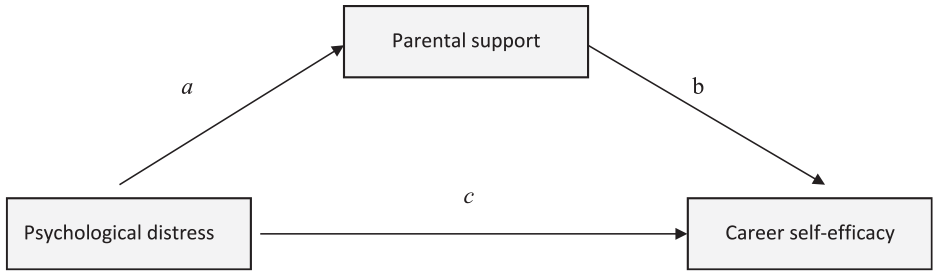
Simple mediation using the mediating effect of parental support on the relationship between psychological distress and career elf-efficacy.
Data from the mediation analysis performed via PROCESS Macro showed total (−1.32, SE = −0.11, t = −11.37, p < .001), direct (−1.11, SE = 0.12, t = −9.95, p < .001), and indirect (−1.09, Bootse = 0.043, bootLLCI = −0.147, and bootULCI = −0.18) effects. The number of bootstrap samples for percentile bootstrap confidence intervals was 5,000, and heteroscedasticity-consistent standard error and covariance matrix estimators were used (Hayes, 2012). These findings showed that the total, direct, and indirect effects were significant. This confirmed the partial mediating effect of parental support on the relationship between psychological distress and career self-efficacy. This supported hypothesis 5 (Figure 1).
School support also had a mediating role in the association between psychological distress and career self-efficacy. Hypothesis 6 stands validated by these results (Figure 2).

Simple mediation using the mediating effect of school support on the relationship between psychological distress and career self-efficacy.
PROCESS macro was used to perform a mediation analysis, and the results showed total (−1.20, SE = −0.10, t = −11.35, p ≤ .001), direct (−1.10, SE = 0.09, t = −9.90, p < .001), and indirect (−1.10, Bootse = 0.038, bootLLCI = −0.14, bootULCI = −0.18) effects. Heteroscedasticity-consistent standard error and covariance matrix estimators were used, with a 5,000-bootstrap sample for percentile bootstrap confidence intervals, adapted from Hayes (2012). Given the above-mentioned findings, the partial mediation of the relationship between psychological distress and career self-efficacy was established. Furthermore, school support played a role in this mediation, as shown in Figure 2.
Regarding to the mediating role of peer support on the relationship between psychological distress and career self-efficacy, the results are displayed in Figure 3. A mediation analysis was conducted via PROCESS macro, and showed total (−1.23, SE = −0.09, t = −11.36, p < 001), direct (−1.10, SE = 0.09, t = −9.94, p < .001), and indirect (−1.10, Bootse = 0.05, bootLLCI = −0.14, bootULCI = −0.19) effects. For this analysis, 5,000 bootstrap samples for percentile bootstrap confidence intervals as well as heteroscedasticity-consistent standard error and covariance matrix estimators were used (Hayes, 2012). The total, direct, and indirect effects were significant. Thus, a partial mediating role of peer support on the association between psychological distress and career self-efficacy was confirmed. These results are consistent with the predictions of hypothesis 7.

Simple mediation using the mediating effect of peer support on the relationship between psychological distress and career self-efficacy.
To summarize, results for psychological distress and social support were generally high while career self-efficacy was almost evenly distributed among the sample. The COVID-19 pandemic influenced career planning for many participants, causing concerns about school subjects, career planning, and profession changes. Sources of information included family, school, peers, and media. Correlations revealed negative associations between psychological distress and career self-efficacy, as well as positive associations between career self-efficacy and social support. Parental, school, and peer support played mediating roles.
In conclusion, the study investigated the mediating role of social support on the relationship between psychological distress and career self-efficacy among Kosovar students. The findings supported various hypotheses and highlighted the importance of support systems in career development The ensuing discussion will offer a detailed explanation of the findings and their implications.
Discussion
This study aimed to examine the association between psychological distress and career self-efficacy and the function of social support in this relationship. We aimed to understand whether parental, school, and peer support played a mediating role in the association among psychological distress and career self-efficacy during the COVID-19 pandemic.
The COVID-19 pandemic period affected the process of career decision-making among high school students. It initially made the planning process more difficult and slower, prevented them from making the best of their school experience, and even led them to change their career plans and decisions. Although similar data were lacking for the high school population, comparable findings were true for the student population, which suggested that the severity of the impact of COVID-19 was a weighty factor linked to career preference (X.-l. Wang et al., 2022). Additional studies that examined the relationships between COVID-19 and career decision-making mostly stressed on the gravity of the impact that COVID-19 had on the process, regardless of the sample (Mares et al., 2021).
Despite the fact that during data collection most participants were nearly completing their upper secondary education, their current status of career decision-making was concerning, and 36.9% had not yet decided on a future career. These percentages did not correspond to the previous results of research conducted before COVID-19, where the highest percentage of career indecision was 21% (Jemini-Gashi et al., 2019). This study revealed an impact of COVID-19 on most young people regarding both career planning and decision-making.
Regarding psychological distress, our results were in accordance with those of previous studies in Kosovo (Arënliu & Bërxulli, 2020; Hyseni-Duraku & Hoxha, 2021). A significant proportion of young people reported moderate and high psychological distress. Since the beginning of the pandemic, all actions aimed at preventing its transmission, which included implementing isolation, banning the educational process in educational institutions, transitioning to online education, and banning social activities, among others, changed the daily routine of young people. Hence, young people reported health concerns and ongoing academic challenges that affected their mental health (Hyseni-Duraku & Hoxha, 2021).
Data from the descriptive analyses showed medium and high levels of family support for the majority of young people, which was also seen in previous studies, where parents, despite concerns regarding the health and progress of the pandemic and challenges to children’s academics, prominently and consistently tried to provide support (Hyseni-Duraku & Hoxha, 2021). Support from schools and teachers was similar, and a higher percentage of young people reported a low level of support. Based on previous studies, teachers also reported concerns regarding the learning process and opportunities for distance learning. The low level of technological knowledge and skills, lack of access to platforms, and home isolation were reported as challenges affected the quality of the teaching process, both in Kosovo and other countries worldwide (Hyseni-Duraku & Hoxha, 2021; United Nations Educational, Scientific and Cultural Organization [UNESCO], 2020). Relating to these challenges, it can easily be concluded that our findings were similar to those of Mares et al. (2021) that the career decision-making process was guided by information and hindered by the COVID-19 pandemic among Kosovar high school students. In contrast, most young people received medium and high levels of peer support, which may be related to the communication through technology that they emphasized and may have continued.
Regarding career self-efficacy, lower levels of self-efficacy were found in our study compared with those from a previous study (Jemini-Gashi, 2014). Moreover, although to a lesser extent, the level of family, school, and peers support was lower than the results of previous studies (Jemini-Gashi, 2014; Jemini-Gashi et al., 2019). These data also reflected the influence of the COVID-19 pandemic on the lives and functioning of young people in Kosovo (Hyseni-Duraku & Hoxha, 2021).
The results showed a negative correlation between career self-efficacy and psychological distress. The results of the mediation analysis via PROCESS Macro (Hayes, 2012) highlighted that Kosovar young people, who reported high levels of psychological distress, manifested lower levels of self-efficacy for careers—a correlation that faded when they received social support (Rochlen et al., 2004). Data also revealed that support from family, schools, and peers had a mediating role between the two factors. Thus, the importance of career self-efficacy among young people was confirmed. Furthermore, our results showed significant total, direct, and indirect effects, which corroborated the partial mediating effect of family support in the relationship between psychological distress and career self-efficacy. School and teacher support also played a mediating role. The results showed a significant total, direct, and indirect effect in the association between psychological stress and career self-efficacy. For the correlation among career self-efficacy and psychological distress, total direct and indirect effects also emerged for peer support. Hence, career self-efficacy was significantly correlated with social support. Young people with the highest levels of family, school and teacher, and peer support reported higher levels of confidence in their abilities to cope with their careers. These results were in line with those of previous studies, both in the local and international context (Hirano et al., 2021; Hui & Lent, 2018; Jemini-Gashi, 2014; Levitt et al., 2005; McWhirter et al., 1998; Metheny & McWhirter, 2013; Metheny et al., 2008). Moreover, the findings also supported the social cognitive theory, which emphasized the combination and interaction of factors in the personal, contextual and cognitive aspect throughout the course of career decision-making (Lent et al., 2000).
Our findings generally indicated a serious state of psychological distress, which hampered the process of career decision-making among young Kosovars during the COVID-19 pandemic. These findings were consistent with those of other studies conducted with similar populations, which reported that due to COVID-19, 17% doubted their career choices and felt exhausted and fearful. In addition, 18% had reflected and started to think of changing their future profession (Panina et al., 2020). Career self-efficacy—an important construct for career planning and decision-making—became a more challenging task for young people as it was associated with psychological distress, which was in accordance with previous findings. This suggested that COVID-19 contributed to change in the mindset and lowered career self-efficacy (Yang et al., 2022).
Conversely, the confirmation of the mediating role of social support in this association provides a valuable basis for support programs targeting young people in their process of career decision-making.
Limitations, Implications, and Future Directions
The current study provides information on the career decision-making process among young people, association between psychological distress and career self-efficacy, and effect of social support in this relationship. However, the sampling was a limitation. The questionnaires were distributed online by school psychologists. Therefore, students from the schools lacking school psychologists may have been excluded from the opportunity to participate. It was worth stressing that all participants voluntarily responded to the questionnaires and no suggestions nor requests were made by the school psychologists. Although efforts were made to consistently distribute the link through social media, not all students had an equal chance of participating. Additionally, due to COVID-19, the manner of data collection was online. Hence, participants had no means of asking questions or clarifying anything related to administration or any questions. Since psychological distress emerged as a common issue among youth, it was recommended that further studies should include other important career development factors, such as career maturity, outcome expectations, and goals, to determine whether these related aspects were also affected by psychological distress amid the COVID-19 pandemic. Considering that differing rates of psychological distress were linked to one’s personality, further studies are warranted. Despite these limitations, the findings of our study offer valuable information, which can guide local experts provision of webinars and open online lectures for youth, parents, teachers, and school psychologists. These activities aimed to emphasize the role of parents, teachers, and school psychologists in the career decision-making process among young people and propose suggestions on the means of support from each system as well as a rationale behind why it works.
Moreover, our findings can be used to tailor specific sustainable programs for parents and families regarding forms of support for their children, namely emotional support, support in the process of self-assessment, support in providing information for self-knowledge, knowledge of the world of professions, and ways of their harmonization, among others. Awareness programs can also include emphasizing the role of peers as well as the ways in which they can support each other. Furthermore, this can be communicated to the parents as well, to increase their awareness of positive peer contribution, who often see the involvement of other peers as questionable or having a negative influence. School support can have many dimensions. Thus, its assistance in the career decision-making process or enhancing career self-efficacy can be done via different channels, starting from how the curriculum can facilitate or enable this process, to one-on-one student teachers interactions, to extracurricular activities, such as job shadowing and career days. The purpose of schools is to facilitate the transition from lower middle to upper secondary school, to a higher education level, and finally the labor market. This can be achieved through the shaping of general knowledge and skills as well as the orientation and selection of activities and subjects in an individual’s areas of interest and skills (Gysbers & Henderson, 2005). Furthermore, by being in contact with students and parents, teachers, and other professionals, they’re aware and well informed regarding the students’ development, things they are interested in, their skills, and knowledge they have acquired during their school years. Teachers play a special role through teaching practices, provide teaching content aimed at information and professional orientation, as well as through the organization of free activities and extracurricular activities with students. Furthermore, they can support students in their careers in the right way.
Curriculum support and career counseling should be included from the earliest stages of education to prepare young people for proper and timely career planning. This affects the productivity of school institutions when faced with career options. Studies showed that students who had early career plans or visions were more likely to stay in school and be more involved in their education (Eurydice [European Education and Culture Executive Agency], 2017). Support programs should also be designed with additional concrete guidance on how school psychologists can help young people. School psychologists and career counselors should assess the development of children and young people, their interests, physical and psychological abilities, and other personal and environmental factors to develop or guide their career guidance plans. Hence, they can make a complete assessment of the students and their suitability for certain areas. Furthermore, they can support students in their preparation for the next level of education, whether it be upper secondary or higher education. This type of support can be more sustainable if their roles, together with detailed specifications, are integrated on a legal basis at the national level. Policymakers can contribute to drafting documentation to regulate career orientation and other relevant components, and extend it to all involved parties supporting students regarding their mental health and career orientation.
In addition to the practical implications, our findings may also enrich the literature on career, especially from theoretical perspective that explain the process of career decision-making as influenced by career self-efficacy and social support. In addition, the effect of psychological distress on these respective issues among youth also add to the body of knowledge, while parallelly enriching our knowledge on how crisis situations affect career decision making. Data from this study emphasize the value and usefulness of social support in reducing the impact of psychological distress on career self-efficacy. Additionally, the position and role of these variables can also provide important insights for mental health professionals and career professionals toward career guidance and counseling.
Footnotes
Declaration of Conflicting Interests
The author(s) declared no potential conflicts of interest with respect to the research, authorship, and/or publication of this article.
Funding
The author(s) received no financial support for the research, authorship, and/or publication of this article.

Data Availability Statement
The datasets generated and/or analysed in the current study are available from the corresponding author upon reasonable request.