




Abstract
Various terms describe Information and Communications Technology (ICT) use in healthcare, including Health Informatics (HI). HI use in healthcare is expected to positively impact healthcare through healthcare cost reduction and improve healthcare accessibility and decision-making. However, the effective application and use of technology in healthcare requires appropriate HI competencies. This research explored what constitutes health informatics education programs to improve health professionals’ competencies. This review was conducted according to the PRISMA-ScR guidelines. Twenty articles made the final inclusion from a total of 577. The articles were extracted from seven databases, namely, Academic Search Complete, Elsevier (SCOPUS), Science Direct, SAGE, MEDLINE, ERIC, and Springer. The research found HI education-related content in various healthcare education programs, including medicine, dentistry, pharmacy, nursing, physiotherapy, occupational therapy, and dietetics. There were instances where HI was applied in interprofessional education, with other allied health professions such as psychology, radiology, and HI programs. Furthermore, profession-specific content such as nursing and medical informatics was identified. The content in computer literacy and Electronic Health Records seems applicable across multiple disciplines. However, HI curricula found for healthcare professions were insufficient for a distinguishable benchmark for HI education in academic disciplines of the healthcare professions.
Introduction
Information and communication technology (ICT) is integrated into most human activities and social undertakings (Mpofu & Nicolaides, 2019). The most common terms used in the application of ICT in healthcare are eHealth and Health Informatics (HI) and they are subject to various definitions. EHealth can be simply defined as the use of ICT appliances and services that aid in disease “prevention, diagnosis, treatment, monitoring and management” (Otto et al., 2018, p. 535). Subsequently, HI is considered a scientific domain concerned with the management, communication, and effective use of biomedical-related information and knowledge for informed decision-making and solutions in healthcare (Aziz, 2015). Therefore, HI competencies are acknowledged as capabilities, comprising computing skills and information or data manipulation proficiencies that are sufficient for the effective execution of informatics undertakings (Khezri & Abdekhoda, 2019). HI competencies are essential in deriving value from information systems for a positive impact on clinical outcomes and organizational effectiveness. Hence the need to make HI competencies an essential element of health professions’ capabilities (Khezri & Abdekhoda, 2019).
The growing use of ICT-related systems in healthcare is a recognition that they have a positive impact on healthcare (Kuek & Hakkennes, 2019) and these systems are considered another means of improving healthcare accessibility, effectiveness, and delivery costs (Li et al., 2019). The inadvertent impact of the COVID-19 pandemic affected the health fraternity on a grand scale (Elhadi et al., 2021). The value of ICT innovations was crucial to the work of various health professionals, including epidemiologists, public health experts, biostatisticians, healthcare practitioners and policymakers, with resources for planning, resource mobilization, decision-making, and service delivery among others (Mantas, 2020).
A modern-day healthcare professional needs to be trained and equipped with ICT knowledge to gain an all-inclusive understanding of health processes, comprising clinical and non-clinical applications (Ashrafi et al., 2014). There is a rationale that the development and acceptance of HI systems require the involvement and engagement of well-informed participants and users of these systems (Bhebe et al., 2015). Concerning the healthcare setting, Elhadi et al. (2021) state that competencies and a positive attitude toward ICT are essential for HI use in healthcare practices by healthcare professionals. Therefore, ICT competencies in healthcare settings can lead to the use of HI for improved healthcare systems, processes, delivery, and healthcare outcomes (Jabareen et al., 2020).
The need for ICT-related competencies compels the inclusion of Health Informatics (HI) content in the healthcare professions’ training (Khezri & Abdekhoda, 2019; Li et al., 2019). Globally, higher education institutions are generally responsible for the training and continuous development of healthcare professionals (Chatterji et al., 2017; Rooney et al., 2015). Therefore, the opportune period for healthcare professionals to acquire applicable competencies is most logical at institutions of higher learning (Rooney et al., 2015).
The inclusion of HI content in the health professions academic curriculum at an undergraduate level is subject to various challenges. On average, most undergraduate health professions academic programs lack HI content, with some programs neglecting ICT content (Li et al., 2019). This is partly attributed to the understanding that the required knowledge to develop HI competencies through academia has not yet been sufficiently determined (Chatterji et al., 2017) and that most lecturing staff are not yet fully equipped to teach the subject (Cummings et al., 2017). Furthermore, ICT-related education in healthcare professional programs is impeded considerably by clinical education’s substantial focus on professional practice skills and limitations on non-clinical facets of healthcare (Cummings et al., 2017).
There are studies relating to programs that discuss HI or eHealth competencies and competencies of health professionals in academia. However, it seems there is limited consensus on the approach and composites of these programs. This review intended to explore what constitutes health informatics education in health professions programs to improve health informatics competencies. Specifically, this review identifies and describes the content of health informatics-related modules or programs in healthcare professions academic programs and explores learning and teaching practices used in those educational programs to enhance HI competencies. The study intends to contribute evidence that will help improve the health informatics competencies of healthcare professionals, which will further improve digitization and technology acceptance in healthcare settings.
Method
A scoping review methodology was implemented to collate and analyze the available research (Pham et al., 2014) on the HI programs or modules for developing health professionals’ HI competencies. The scoping review was conducted according to the Preferred Reporting Items for Systematic Reviews and Meta-analysis for Scoping Reviews (PRISMA-ScR) guidelines, as proposed by Tricco et al. (2018).

Flow chart.
The inclusion criteria considered were studies that are primary research, publications between 2011 and 2023, and peer-reviewed studies focused on the keywords: education/academic and/or curriculum and/or program, health profession/professional, and undergraduate, was applied. A total of 577 articles were
Based on the abstract screening, 511 articles were excluded because they fell outside the inclusion criteria. The excluded articles lacked undergraduate curriculum content (n = 193), had no curriculum engagement at all (n = 146), had incorrect population samples (addressing postgraduate, continuous development programs, intervention programs for professionals and non-healthcare related professions; n = 158), or were reports and reviews (secondary research articles; n = 14). A total of 66 abstracts were considered for full-text review. However, seven of the studies could not be accessed through the databases, with the help of a librarian, and no response at the time of writing from the authors. Therefore, a total of 59 studies made the full-text article screening phase. The 59 articles remaining were charted and then thoroughly analyzed. A total number of 39 articles were rejected because 23 articles did not address curriculum-specific content, 9 articles were focused on postgraduate curriculum content with no undergraduate level content, 1 article evaluated a Continuous Professional Development program (CPD) course rather than an undergraduate course, 2 articles with inconclusive results, 2 articles were reports of ongoing evaluations and they had no comprehensive results yet and 2 articles were discussing programs for allied health professionals only. Therefore, a total of 20 articles met the inclusion and eligibility criteria and were included in the review.
Data Analysis
All articles that met the final eligibility criteria were extracted and analyzed using a thematic analysis method to synthesize the findings (Snilstveita et al., 2012). Thematic analysis is considered a flexible and basic analytic approach to qualitative articles, but it still provides a systematic and rigorous approach to research, capable of producing superior, thorough and intricate explanations of data (Braun & Clarke, 2006). The prescribed steps are the following.
Results
The study aimed to explore what constitutes health informatics education in the health professions programs to improve health informatics competencies. The first part of the results highlights the characteristics of the articles that made the final selection. Then the second part engages the findings from the articles that met the inclusion criteria.
Demographics
A total number of 20 articles were included in the review. The articles were from 11 different countries with the most prevalent being the United States of America (USA) (n = 8) and Australia (n = 3) while the rest of the countries accounted for one article each. Most of the articles retrieved were from developed countries (n = 15), though this is comprehensively skewed by the USA and Australian articles as illustrated in Table 1 below which has a list of the final included articles.
Final Inclusion List.

Programs With Health Informatics
The articles that made the final inclusion list are comprised of various healthcare disciplines. In the Discipline column of Table 1 below, a total of ten healthcare and allied healthcare professions were identified from the included articles, with the most articles being focused on the Nursing, Medicine and Pharmacy disciplines and the rest of the professions only represented at least once. The Nursing discipline is the most represented (n = 7). It is also notable that the most prevalent programs are advanced in the integration of HI in their disciplines of practice and education. Furthermore, the most prominent disciplines also appear in articles that discuss HI in interprofessional/interdisciplinary collaborations. The interprofessional/interdisciplinary partnerships comprise of healthcare professions and allied health professions, such as psychology as well (Titzer et al., 2015).
Findings
Overall, four themes were identified from the data drawn from the articles. The programs’ content theme covers HI content identified in the reviewed articles. The systems in practice comprised codes identifying systems used in health professional practices that have been integrated into educational practices. Then the teaching methods theme is made up of learning and teaching approaches, assessments and programs’ duration codes that relate to the curriculum of delivery.
Programs’ Content
The program content theme portrays HI-related content that is covered in academic settings and expected outcomes. The programs’ content theme consists of the course content, innovation and learning outcomes codes and discusses content in education that is aimed at developing HI competencies. The identified content and expected learning outcomes are condensed in Table 2.
Content and Outcomes.
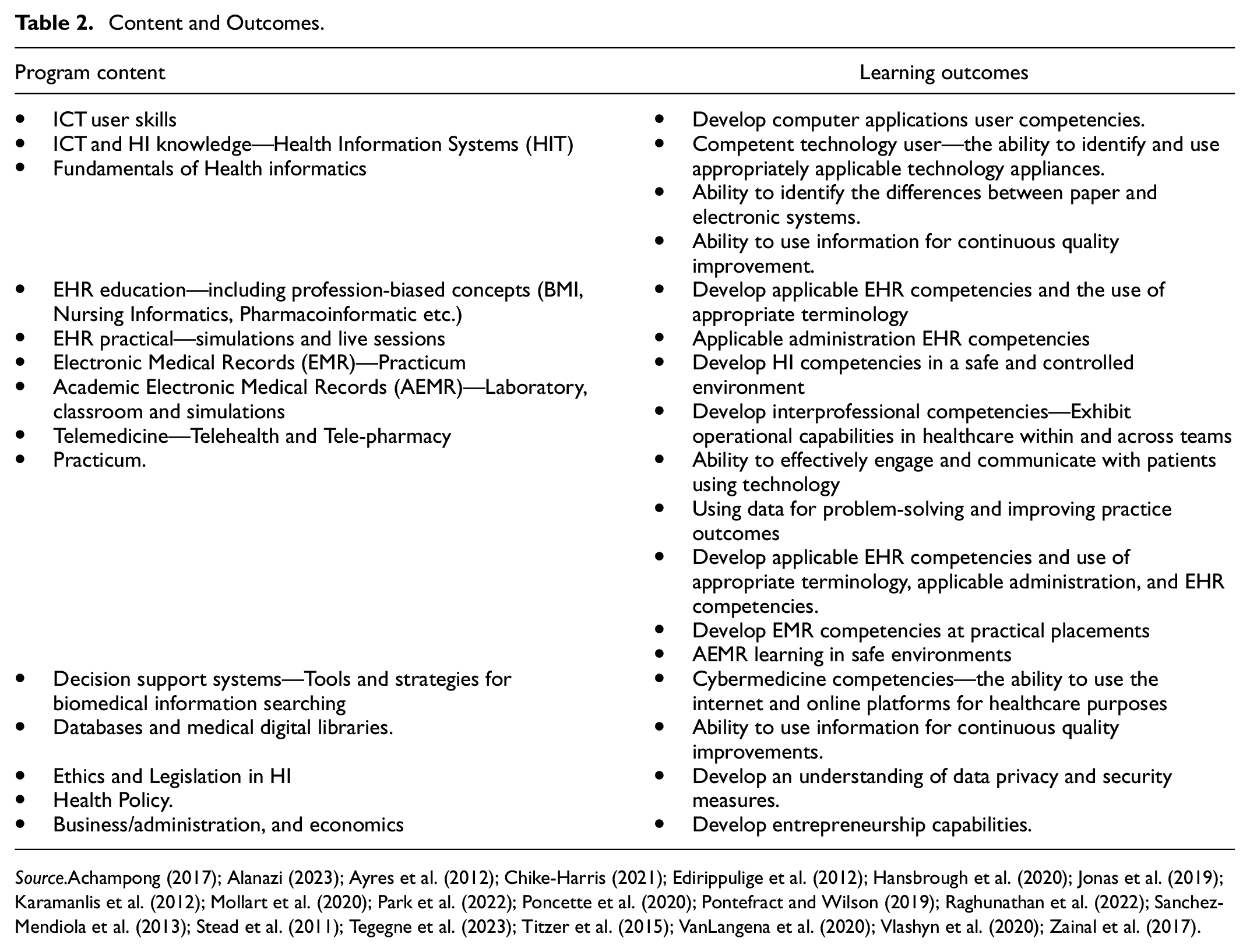
Source. Achampong (2017); Alanazi (2023); Ayres et al. (2012); Chike-Harris (2021); Edirippulige et al. (2012); Hansbrough et al. (2020); Jonas et al. (2019); Karamanlis et al. (2012); Mollart et al. (2020); Park et al. (2022); Poncette et al. (2020); Pontefract and Wilson (2019); Raghunathan et al. (2022); Sanchez-Mendiola et al. (2013); Stead et al. (2011); Tegegne et al. (2023); Titzer et al. (2015); VanLangena et al. (2020); Vlashyn et al. (2020); Zainal et al. (2017).
Basic computer skills and knowledge of health information systems can be considered as the foundation for developing HI competencies. Achampong (2017) states that “Students should be introduced to basic computer literacy with expected competencies in the Microsoft Office Suite, emails, Internet, and information literacy.” Findings from Alanazi (2023) an interprofessional (with multiple professions) article recommends, “an introduction to health information and information technology, clinical applications and health information systems, health data quality and analytics, and a module on leadership and management in health informatics” for the courses in IPE courses in HI, which is the most comprehensive of all studies.
The articles on the healthcare professions where HI is more distinguished, such as medicine and nursing seemed to mention the ICT skills passively with more sophisticated competencies taking precedence. Knowledge of health information technology is also highly recommended, with expectations that students or professionals should be able to understand the terminology and applications of ICT in healthcare, which is part of an interprofessional HI article by Alanazi (2023). Titzer et al. (2015) highlight that students need to acquire “… knowledge and skills related to informatics competencies, communication, data access, documentation, patient education resources, patient monitoring, application in clinical practice, and the role of the clinician in system design.”
The most prominent curriculum content was the content related to EHR developing competencies that cover the ability to use information technology to support medically related activities, engage with patients and healthcare staff, support problem-solving and decision-making and administration in healthcare settings. There is, however, a strong case for courses that are profession-biased to meet specific discipline requirements that can be noted in the use of profession-defining terms, such as Pharmacoinformatic, Nursing Informatics and Medical Informatics. A case in point is point pharmacists who have specific tasks as noted by Zainal et al. (2017) “In practice, pharmacists have access to evidence-based data, thereby helping to screen for preventable adverse drug interactions and drug-related problems.”
The Interprofessional competencies are essential in HI learning and practice. The courses that included an interprofessional education considered the relevance of the ability to effectively communicate, engage and contribute within and across multi-professional healthcare teams (Alanazi, 2023; Jonas et al., 2019; Titzer et al., 2015). Titzer et al. (2015) state, “The IPE activity also provided students with an opportunity to develop a patient-centred care plan within a controlled and safe environment as an interprofessional care team.” Communication was considered an important attribute that even extends beyond the engagement with professional teams. The article by Jonas et al. (2019) that focused on telemedicine emphasizes the importance of communication to ensure that patients are comfortable with devices used outside the common in-person consultations. There are practical and experiential learning and teaching practices such as simulations that provide a safe learning environment that allows room for errors (Titzer et al., 2015) and practicums that provide practical experiential learning from professionals (Edirippulige et al., 2012).
There are less mentioned competencies borrowed from business disciplines that include administration, finance and economics. The article by Alanazi (2023) also includes leadership and management in HI. These are noted in disciplines that have significantly integrated HI into most of their operational activities such as medicine, nursing and pharmacy. Zainal et al. (2017) highlight that “More than 50% of respondents felt that the skills and knowledge of supply chain management were moderately required for BPharm” and Achampong (2017) notes that “Nurses should be able to use administrative applications to document and review relevant patient data, critically analyse patient data, and use information management technology for patient education” and Poncette et al. (2020) suggests “…basic economic knowledge and health economic aspects such as financing and resource optimization” for medicine students.
Systems in Practice
The Systems in Practice theme covers codes that comprise HI concepts and systems applied in healthcare practices that have been applied in education practices. The codes comprised medical informatics, electronic health records (EHR), administrative systems, eHealth and other respective related systems and concepts. These HI concepts and systems that are becoming more prominent in healthcare practices are also being integrated into educational settings. This research identified the following, in Table 3, from the articles.
Systems and Concepts.

Source. Achampong (2017); Alanazi (2023); Ayres et al. (2012); Chike-Harris (2021); Edirippulige et al. (2012); Hansbrough et al. (2020); Jonas et al. (2019); Karamanlis et al. (2012); Mollart et al. (2020); Park et al. (2022); Poncette et al. (2020); Pontefract and Wilson (2019); Raghunathan et al. (2022); Sanchez-Mendiola et al. (2013); Stead et al. (2011); Tegegne et al. (2023); Titzer et al. (2015); VanLangena et al. (2020); Vlashyn et al. (2020); Zainal et al. (2017).
The HI concepts have been integrated into various professional fields of practice that have incited terms that include Nursing informatics and Medical Informatics. These terms tend to be named after the profession such as Pharmacy’s Pharmacoinformatic, which is defined as “the scientific field that utilizes a systemic approach to process and utilize medication-related data and information, including its acquisition, storage, analysis, and dissemination in the delivery of optimal medication-related patient care and health outcomes.” (Zainal et al., 2017). These terms and relatable subject content are found in respective curriculum-specific disciplines. There are however two articles that discuss comprehensive course content addressing HI competencies. The suggestions for a Nursing Informatics course include “Nursing information system-related concepts, Definition and components of healthcare information systems, Electronic Medical Records, Clinical decision support systems, Mobile technology and health management, Medical information standards, Personal information protection and ethics, Understanding of big data, IT in nursing research, and Practical use of the latest ICT” (Park et al., 2022, p. 349). Then the interprofessional education course recommendations include “an introduction to health information and information technology, clinical applications and health information systems, health data quality and analytics, and a module on leadership and management in health informatics” (Alanazi, 2023, p. 1180).
Telemedicine is also prevalent in multiple disciplines. Telemedicine is also differentiated in its application as noted in a consultative use, Teleconsultation and in a more comprehensive health approach, Telehealth. Furthermore, it is also adapted to professional practice-specific terms such as Tele-pharmacy, as discussed by Tegegne et al. (2023) who state that, “Tele-pharmacy is a subset of telemedicine in which pharmacies use telecommunication technology to provide patient care.”
The most prevalent systems identified from the articles are Electronic Health Records, which were identified across various healthcare disciplines (EHR; n = 5). This suggests that EHRs are the fundamental systems of healthcare practice. Some of the mentioned systems are extensions of EHR such as “electronic medical records (EMRs) for tasks such as medication reconciliation, computerized physician order entry (CPOE), e-prescribing, and clinical decision support”, (Vlashyn et al., 2020). This further denotes the variety of systems and their functionality, for example, the EHR systems can be shared across organizations and the EMR tends to be limited to internal use only (Hearta et al., 2017). There are also stand-alone systems such as the Patient Health Records (PHR) of which the data can be captured by the patients or individuals, laboratories, diagnostics and healthcare professionals, but the “data may or may not be included in the health provider’s electronic health record (EHR)” (Karamanlis et al., 2012). So, it is noteworthy that the EHR with its complimentary and subsidiary content appears in various curriculum programs, comprising of theory or practical or both.
Teaching Methods
This theme discusses the codes addressing learning and teaching approaches, assessments and durations of the courses encountered to facilitate learning. There is common recognition of a general digital competence associated with easy access to technology (Poncette et al., 2020). The computer and the internet are increasingly becoming integral parts of teaching and learning, as (Sanchez-Mendiola et al., 2013) noted: “Today, a considerable amount of teaching and learning of pharmacy students is associated with the use of computers and the Internet.” (Zainal et al., 2017). Thereby they underline that ICT skills are becoming fundamental for teaching and learning.
Learning and Teaching Approaches
Most of the articles suggested blended teaching approaches as evident in Sanchez-Mendiola et al. (2013) who state that “Balanced and dynamic use of blended learning, using face-to-face and online activities as dictated by educational goals and practical constraints.” This indicates the validity of traditional classroom/lecture-hall lectures and the use of ICT platforms, in HI education. Edirippulige et al. (2012) support technology use in teaching and learning activities, as acknowledged in their discussion that “Evidence shows the potential of e-learning to facilitate better access, better learning outcomes, and cost savings in medical and health education.”
It is highly recommended that educators need to be proficient in HI trends to prepare students for workplace environments. One such example is the use of academic electronic health records (AEHR), with the suggestion “that interprofessional collaboration through the use of an AEHR increased the students’ ability to gain experience with informatics’ competency, including data entry, analysis, and application” (Titzer et al., 2015). This is supported by other researchers, including Edirippulige et al. (2012) and Jonas et al. (2019), that link practice experience and education, which is supposed to ease the apprehension regarding technology through familiarity. There is a consideration for more complex informatics competencies training, such as EMR, in safe environments (simulated) where students highlighted technology confidence limitations due to basic training and limited access to systems at clinical placements (Mollart et al., 2020).
At least four articles, by Edirippulige et al. (2012), Poncette et al. (2020), Titzer et al. (2015), and Alanazi (2023) discuss interdisciplinary/interprofessional collaborative approaches in HI education. The collaborations are within a faculty for an interprofessional education approach (Alanazi, 2023; Edirippulige et al., 2012), across different faculties for multidisciplinary collaboration (Alanazi, 2023; Poncette et al., 2020; Titzer et al., 2015), and with other institutions and industry stakeholders (Edirippulige et al., 2012) to leverage on different strengths and resources. It is evident in Poncette et al. (2020), who states that “Digital literacy respondents emphasized that training with digital technologies from various perspectives, such as engineering, law, data protection, and ethics as well as statistical knowledge in the context of evidence-based medicine, should be part of the curriculum.” Furthermore, Edirippulige et al. (2012) highlight that “In some cases, traditional experiential learning methods such as a work-based practicum may be better suited to provide such skills and competencies,” which further strengthens the case for collaboration with industry stakeholders.
Assessments
Assessments are done to determine the knowledge gained during the period of learning (Amua-Sekyi, 2016). Most articles did not discuss assessments, but they are an essential component of education for continuous improvements in learning and teaching (Amua-Sekyi, 2016). However, there is mention of both formative and summative assessments that are highlighted by Sanchez-Mendiola et al. (2013), “There were two partial exams in each course that included two components: a multiple-choice question test with 70 items aimed at the application and problem-solving levels; and a practical hands-on test in the computer lab that explored competencies such as using Medline effectively, appraising the elements of a telemedicine consultation, among other things. …, and at the end, the students took a final summative test.” Other forms of assessment include problem-solving, as mentioned by Poncette et al. (2020), “During the course of the whole module, each student group invented and eventually pitched a new product for a specific problem in health care.”Alanazi (2023) suggests the inclusion of a HI-related research project at the end of the course for students to prove their understanding of the subject content.
Programs’ Duration
There were no consistent module or course durations due to different content composites which also determined credit hours. Notably, some articles focused on specific course content, instead of a complete course or module with no mention of duration. The complete course with the least duration was a three-week elective module, with 60 teaching hours. The intermediate long course duration was 3 hr per week over a semester of 14 weeks long (Poncette et al., 2020). The longest course consisted of two courses or modules offered across two consecutive academic year levels (Sanchez-Mendiola et al., 2013).
Summary
Briefly, the results highlight different HI concepts that have been integrated into the healthcare professions education programs. Figure 2 above highlights the concepts that are increasingly applied in most disciplines in the inner oval and the outer ovals show the additional content for more HI content for accomplished disciplines represented in more ovals. The fundamental concepts are computer literacy and EHR, which seem to be standard in almost all healthcare programs and professions, including dietetics.

Programs composite chart.
The disciplines that are considerably mature in HI content have integrated more HI concepts and therefore have more prevalent research, such as medicine, pharmacy and nursing, to the point that there is profession-specific content, such as nursing informatics and medical informatics. The interdisciplinary/interprofessional programs seem to focus on telehealth and related content, alongside other healthcare-allied professions.
The curriculum content seems to be comprised of HI theories, practical and with some including practicums. The methods of lecturing comprise traditional lectures and more modern concepts that leverage technology such as blended and hybrid teaching and learning practices, where they are applied. The programs’ durations are inconsistent as all the programs found were of different lengths. There is mention of various stakeholders that can play a crucial role in the strengthening of the HI curriculum in healthcare programs, with institutions and regulatory/professional bodies as fundamental stakeholders.
Discussion
This review aimed to explore what constitutes health informatics education in health professions programs to improve health informatics competencies. With the increased use of Health Information Technologies (HIT), healthcare professionals rely on technology for communication, data collection and arrangement, and decision-making. Hence, the need to integrate digitization concepts at the academic level (Herbert & Connors, 2016; Poncette et al., 2020; Alanazi, 2023). This research acknowledges that there is growth in the use of health informatics applications in healthcare and they have become a prominent feature in practice areas of medicine, dentistry, nursing, pharmacy, occupational therapy, and physiotherapy (Borycki et al., 2010; Hübner et al., 2018; Poncette et al., 2020; Pontefract & Wilson, 2019; Tegegne et al., 2023). The impact of HI extends to other allied health professions that include radiology, psychology and the administrative aspects of healthcare. The allied health professions’ portfolio has increased to include more health informatics-related professions (Alanazi, 2023; Titzer et al., 2015). Hence, there is a need to integrate HI content into respective academic programs to develop relevant practice competencies in healthcare (Cummings et al., 2017).
The research acknowledges that computer skills are fundamental and essential for HI competencies (Achampong, 2017; Edirippulige et al., 2012; Pontefract & Wilson, 2019; Titzer et al., 2015). However, computer skills on their own are inadequate for HI competencies, especially if they are not linked to profession-focused competencies (Alanazi, 2023; Cummings et al., 2017; Jonas et al., 2019). The most prevalent competencies seem to be those related to Electronic Health Records (EHR) which are prevalent across multiple healthcare disciplines (Achampong, 2017; Poncette et al., 2020; Pontefract & Wilson, 2019). There was mention of information ethics, data security and privacy, which are essential components of Information protection (Breil et al., 2018). The competencies that enable proficiencies in EHR and related applications and systems that aid in data storage and retrieval, protection and manipulation for decision support are considered essential.
There is also an argument for training in profession-specific HI-related content to meet profession-specific requirements (Mantas, 2020). This suggests the dynamism of HI competencies as noted in profession-specific terms such as Medical Informatics (Breil et al., 2018), Nursing Informatics (Achampong, 2017), nutrition informatics (Molinar et al., 2017), Pharmacoinformatics (Zainal et al., 2017) and Tele-pharmacy (Tegegne et al., 2023) that requires targeted content for specific professions. Park et al. (2022) discuss the most comprehensive nursing informatics module integrated into an undergraduate Nursing course, which can be exemplary or a guideline for the nursing discipline worldwide. This highlights the feasibility of profession-specific content, which enables streamlining content to meet profession-specific competencies. However, it is noteworthy that there are some healthcare professions with limited HI research, such as dietetics and nutrition, where basic computer skills are considered sufficient for novice HI users and that might suggest an ICT low-maturity level in those professions.
There is also consideration for interprofessional and multidisciplinary training to improve collaborative efforts in healthcare practices (Titzer et al., 2015). The interprofessional aspect of healthcare has become a fundamental and prominent feature in the health agenda, including in international policy and healthcare practice toward sustainable, effective, and safe healthcare services (Moran et al., 2015). Some of the HI modules or content found in the articles engaged in interprofessional and multidisciplinary approaches in learning and teaching practice, spanning health, social, business, and natural sciences for healthcare purposes. This is supported by Alanazi’s (2023) article that provides a more comprehensive Interprofessional education approach for HI competencies for healthcare professionals, which covers topics in introduction, clinical applications, data analysis, business intelligence and leadership and management in health informatics. It has become a common practice for the healthcare professions to engage in interprofessional practice and education (D’Amour & Oandasan, 2005). This extends to recognition of the multidisciplinary aspect, partly strengthened by the growth of HI in healthcare that spans multiple disciplines including medical sciences, healthcare, social and behavioral sciences, information technology and computer sciences (Miah et al., 2019). The learning and teaching approach of HI that encompasses various disciplines and professions supports the case for an interdisciplinary and interprofessional curriculum for more patient-oriented healthcare practices (Titzer et al., 2015) and for medical research grounded on the applicable and relevant facets of all disciplines and professions needed (Stead et al., 2011).
Regarding teaching methods, some of the articles assessed highlighted various teaching and assessment methods. There was a traditional lecture approach in a classroom environment, practical, assessments, hands-on learning experiences or practicums and more modern approaches such as simulations. The conventional classroom lecturers are still essential for theoretical understanding of the HI subject and the hands-on practical aspect builds confidence in technology use (Poncette et al., 2020). Other articles suggested practicums or hands-on experiential training during educational clinical practices in healthcare institutions so that students can gain valuable experience from professionals in practice (Chike-Harris, 2021; Hansbrough et al., 2020; Mollart et al., 2020). There is also a credible argument for the inclusion of computers and computerized practice systems such as EHR and AEMR that simulate existing systems for improved training toward real-world applicable competencies for practice (Karamanlis et al., 2012; Raghunathan et al., 2022; VanLangena et al., 2020). Simulations are considerably common in healthcare training because they provide a learning space where errors can be made safely (Shachak et al., 2019) and improve the students’ confidence in practice (Raghunathan et al., 2022). The learning and teaching practices discussed in the articles are based on the traditional formative and summative formats with modern approaches of blended learning, as discussed by Sanchez-Mendiola et al. (2013) and Chike-Harris (2021). Most of the formative content is aimed at developing competencies in HI theoretic knowledge, practical skills and confidence in HI. The summative content was comprised of exams and projects that are meant to gauge students’ comprehension of the concepts learnt.
Limitations
This research cannot be considered exhaustive because it considered peer-reviewed articles from only seven databases: Academic Search Complete, Elsevier (SCOPUS), Science Direct, SAGE, MEDLINE, ERIC, and Springer. The databases we selected were based on a Google Scholar search for articles that contained the keywords. It acknowledges that there are some databases with content that could make meaningful contributions. However, this review is not meant to be conclusive, but rather to establish gaps in healthcare professions education concerning the content that develops competencies in health informatics, through scientific-based evidence. The study did not consider reports and non-reviewed articles to ensure that the selected articles are of high-quality evidence that has been reviewed.
Recommendations
The research focusing on the health professions curriculum and healthcare policies regarding HI is fairly limited considering the general growth of ICT technologies in healthcare. Extensive original research around the subject will empower vested stakeholders to make informed decisions and possibly lead to improved healthcare systems and HI adoption in health and healthcare settings.
It is noteworthy that HI use and its inclusion in curricula in healthcare education is subject to regulation acknowledgement and amendment. The regulatory organizations are responsible for governing the professional practice and licensing of healthcare professionals and establishing that their conduct meets the required professional practice standards (VanLangena et al., 2020). The regulatory organizations need to consider the transformation and the continuous evolvement of the practice and training of healthcare professionals in line with the modern-day demands, more specifically the fourth industrial revolution in this regard.
Conclusion
This study attempted to understand what constitutes HI education that develops the HI competencies of health professionals. Though there is recognition and inclusion of HI content in the education of the health professions, there is no distinct fixed curriculum yet. However, there is a notable consensus to include applications used in practice to complement basic computer skills that students are taught or already possess to develop HI competencies. The teaching and learning aspects still draw from traditional teaching methods of lectures, and assignments that include group work and assessments. There is however, a growing emphasis on the inclusion of practical components, which include simulations and practicums with HI attributes to develop and strengthen competencies. Furthermore, there is consideration for interdisciplinary and interprofessional collaborations to leverage multiple knowledge areas for a more comprehensive approach to HI education for more comprehensive competencies. Health professionals are expected to possess HI competencies that encompass clinical and non-clinical competencies for more holistic healthcare services.
Footnotes
Declaration of Conflicting Interests
The author(s) declared no potential conflicts of interest with respect to the research, authorship, and/or publication of this article.
Funding
The author(s) received no financial support for the research, authorship, and/or publication of this article.

Data Availability Statement
Data sharing is not applicable to this article as no datasets were generated or analyzed during the current study.