




Abstract
In the context of globalization and liberalization, the international migration of health workers has gained prominence due to increased cross-border mobility. This migration trend, impacting healthcare systems, has intensified recently, driven by factors like the COVID-19 pandemic and demand in high-income countries. The present study was designed to give an overview on research trends and patterns of scholarly production on this topic. Relevant documents published in Scopus from 1950 to 2022 were extracted and analyzed using bibliometric methods. The search string extracted 708 articles. The Human Resources for Health journal ranked first while the University of Sydney was the leading institution. Authors from the US contributed the most (25.8%), followed by the UK, Canada, and Australia. At the regional level, countries in the WHO South-Eastern Asian region and WHO Eastern Mediterranean region contributed the least. Cross-country research collaboration was limited. The research hotspots that attracted the attention of scholars were nurse and physician migration, policy implications, and impact on developing countries. Emerging research topics were the impact of COVID-19 on migration and identification of push-pull factors. Most frequently mentioned push factors driving health worker migration included economic disparities, unfavorable work conditions, and security concerns. Conversely, the main pull factors encompassed prospects of advanced training, better quality of life, and enhanced practice environments. Future research should focus on global policies and push-pull factors to restore the balance in the ratio of health workforce between high and low- and middle-income countries.
Plain Language Summary
Cross-border migration of healthcare workers, influenced by globalization and liberalization, has become a significant concern. The migration impacts healthcare systems, particularly in low-resource regions. COVID-19 has further exacerbated the issue, with high-income countries seeking healthcare workers, worsening the shortage in 55 nations. While migration’s push-pull factors drive professionals from low- to high-income countries, it creates imbalances and “brain drain.” This migration’s complex consequences span economic, educational, and societal aspects, leading to healthcare inequalities. Addressing this challenge necessitates a holistic strategy to safeguard source countries and their societies. The study employs bibliometrics to unveil research trends, uncovering core topics like nurse and physician migration, health policy, and workforce retention. Emerging themes include COVID-19’s impact and migration motivations. Push factors encompass economic constraints, unfavorable conditions, and limited growth opportunities, while pull factors include advanced training, better living standards, and enhanced resources in destination countries.
Background
Globalization and liberalization made the phenomenon of cross-border migration and interactions across nations relatively easy and common (Stalker, 2000; Wickramage et al., 2018). Cross-border migration has particularly impacted the healthcare sector, where the international migration of health workers has emerged as a crucial concern over the past few decades. The dynamic interplay of factors that drive this migration, the subsequent impact on source and destination countries, and the resulting challenges for healthcare systems have garnered significant attention from researchers worldwide. Recently, the World Health Organization’s (WHO) 2023 report on “Health Workforce Support and Safeguards” underscores the potent influence of the COVID-19 pandemic on this issue. The pandemic’s dual effects, encompassing adverse health, economic, and social consequences, coupled with heightened demand for healthcare workers in high-income countries, have likely accentuated the outward migration of healthcare professionals from regions already grappling with low health workforce densities. A staggering 55 countries now find themselves below the global median in terms of doctor, nurse, and midwife density per capita (World Health Organization, 2023). In a similar vein, the report “Recent Trends in International Migration of Doctors, Nurses and Medical Students,” published on July 25, 2019, adds a pertinent layer of insight to this complex phenomenon (Lafortune et al., 2019). This report delves into the contemporary trends in the international migration of doctors and nurses within the OECD countries. A marked increase in the number of doctors and nurses in various OECD nations, attributed significantly to foreign-born and foreign-trained healthcare professionals, is documented over the past decade. Noteworthy findings from this report reveal that certain countries, such as Israel, Norway, Sweden, and the United States, exhibit a growing prevalence of foreign-trained doctors who obtained their initial medical degrees abroad before returning to their native countries. Most studies indicate that the direction of migratory flows is from low- and middle-income countries (LMIC) to high-income countries (Clemens & Pettersson, 2008; Kirigia et al., 2006). The migration of health workers caused the maldistribution of the health workforce and created a serious shortage in the health workforce in certain countries and world regions. The success of any healthcare system in any country depends on the availability of an adequate health workforce (Carr-Hill & Currie, 2013; Nguyen et al., 2016).
The WHO considers the shortage of health workers as a threat and challenge for the next decade (World Health Organization, 2020). The WHO predicts a shortage of approximately 15 million health workers by 2030, mostly in LMIC countries (World Health Organization, 2022). The problem is worsened by the recruitment policies of rich countries that led to the migration of health workers (Aluttis et al., 2014; Trines, 2018). Despite that many LMICs tried to implement retention strategies to limit the migration of health workers, the problem remains (Humphries et al., 2017; van de Klundert et al., 2018). Factors influencing migration were described in the context of a push-pull model, which describes factors that drive people to migrate and factors that attract people to another country (Kline, 2003). Migration patterns of health workers attracted the attention of researchers in both rich and poor countries because it affects both the source and destination countries (Davda et al., 2021; Oleribe & de la Fuente, 2022; Shaffer et al., 2020). The migration of health workers causes a serious deficit, called brain drain, in the proportion of health workers in source countries. The phenomenon of brain drain (Mullan, 2005) hinders development and growth in source countries, negatively affects their national health security, and prolongs their dependency on foreign aid.
The migration of health workers from source countries triggers a complex web of far-reaching social consequences that transcend the boundaries of healthcare. These implications underscore the intricate interplay between health worker migration and the broader societal fabric of these nations. As health professionals seek opportunities abroad, several significant outcomes become apparent. Economically, the departure of these workers results in a loss of investment in education and training, aggravating human resource shortages across various sectors and impeding overall economic growth (Asongu, 2014). The repercussions are not confined to the healthcare domain; the absence of educators and trainers disrupts healthcare education, hindering the training of future generations of health professionals and impairing the ability to meet growing healthcare demands (Afzal et al., 2012; Dimaya et al., 2012). At a community level, the departure of local health workers disrupts the close relationships they often develop within their communities, eroding trust in healthcare services and diminishing the social cohesion these professionals foster (Stilwell et al., 2004). Health inequalities deepen, particularly in underserved areas, perpetuating existing disparities. Moreover, the diminished presence of health workers weakens their collective political influence, hampering advocacy for improved health policies and reforms. The consequent erosion of trust in public institutions stems from witnessing the exodus of those responsible for public health and well-being, potentially fostering broader skepticism towards governance (Asongu, 2014). This “brain drain” doesn’t just affect healthcare—it ripples through various sectors, impacting education, research, technology, and other vital fields (Dohlman et al., 2019; Ebeye & Lee, 2023; Ifanti et al., 2014; Kollar & Buyx, 2013; Misau et al., 2010). Additionally, the weakened health system burdens social services, as families and communities grapple with heightened healthcare costs and the responsibility of caring for the sick, potentially exacerbating poverty. Overall, health worker migration presents a multifaceted challenge that requires comprehensive strategies to address its intricate social consequences and safeguard the holistic well-being of source countries and their societies.
In this context, our study aims to provide a panoramic view of research patterns and research hotspots within scholarly production concerning health worker migration published from 1950 to 2022. The primary motivation for this research stems from the dearth of comprehensive analyses examining the nuanced evolution and development of research pertaining to the international migration of health workers. While numerous studies have delved into specific facets of this phenomenon, no comprehensive overview encapsulating the entirety of research trends has been hitherto reported. To address this gap, we employ bibliometrics, a methodology frequently used to unveil and interpret complex trends within vast corpora of scientific literature, to shed light on certain aspects of research trends and patterns on migration of health workers. Furthermore, we employ mapping techniques to identify key research topics in the field. This research draws inspiration from various studies, including the examination of trust in health systems during the COVID-19 treatment (Antinyan et al., 2021; Pascucci, 2021)
Method
Database for Literature Retrieval
To conduct a comprehensive analysis and mapping of the international migration of health workers, pertinent literature was meticulously retrieved through the Scopus database. The utilization of Scopus as the exclusive platform for this research landscape analysis was strategically based on several compelling reasons and advantages such as wide coverage, large number of indexed journals, inclusiveness of PubMed journals, interdisciplinary scope, simplicity of single source in bibliometric analysis, in-depth metrics, and time saving.
Inclusion and Exclusion Criteria
To ensure both relevance and analytical focus, stringent inclusion and exclusion criteria were implemented. Inclusions involved studies published from 1950 to 2022, centered on health worker migration, and classified as peer-reviewed research articles. Exclusions comprised dissertations, conference abstracts, book chapters, editorials, notes, letters, and studies unrelated to health worker migration. No language restriction was imposed on the articles retrieved for analysis.
Search Strategy
The search strategy consisted of six steps (Table 1). The search strategy used Boolean operators “AND,”“OR,” and “AND NOT.” Since the number of the initially retrieved dataset was not large, the lead author asked two volunteering colleagues to review the titles and abstracts of a large sample of the retrieved publications. The review process found certain number of irrelevant publications that were excluded.
Search Strategy Used to Extract Journal Publications on the Migration of Health Workers (1950–2022).

Validation
To validate extracted data’s reliability and validity, title searches were conducted to eliminate false-positive outcomes. Additionally, retrieved articles were cross-referenced against highly cited articles from Google Scholar, reaffirming the analysis’s comprehensiveness.
Analysis and Mapping
The research landscape analysis and mapping of scientific literature on health worker migration were executed employing VOSviewer, a prominent software tool for mapping scholarly domains (van Eck & Waltman, 2010). Metadata extracted from Scopus, encompassing publication details, were imported into VOSviewer to facilitate the analysis and mapping of frequently occurring author keywords and terms.
Identification of Research Topics
Identifying the most impactful or emerging research topics followed a systematic process harnessing Scopus data. Article attribute (titles, abstracts, author keywords, publication years, and citation counts) were exported to Excel. The resultant list underwent meticulous scrutiny and sorting based on citation counts to identify the top cited articles. These highly cited articles were subsequently integrated into VOSviewer for in-depth analysis, utilizing its visualization capabilities to uncover potential research topics. The visual representation, with node size and connection line thickness as indicators, unveiled patterns, clusters, and associations within these articles’ research themes. Such visual insights illuminated prevalent and significant research avenues within the visualized articles. The same procedure was applied to identify the most recently published articles and the emerging research topics in these articles.
Results
Research Volume, Growth, and Key Contributors
The number of documents published from 1950 to 2022 on migration of health workers was 708. The publications were mainly within the subject areas of “Medicine” (n = 432, 61.0%), “Social Sciences” (n = 189, 26.7%) and “Nursing” (n = 140, 19.8%). There is an overlap among the three subject areas and that is why the total percentages of the three subject areas exceeded 100. The growth pattern of scholarly production on the topic can be divided into three phases (Figure 1). In the first phase (1950–2002), there was a low and fluctuating annual number of publications with a small peak in the mid-1970s. In the second phase (2003–2007) there was a steep growth that peaked in 2007 (n = 45). In the third phase (2008–2022), there was a steady state fluctuation in the growth of scholarly production.

Annual growth of publications on international migration of health workers (1950–2022).
The retrieved publications were disseminated through 347 journals. Table 2 shows the top 10 active journals. The Human Resources for Health journal ranked first (n = 40, 5.6%), followed by International Nursing Review journal (n = 22, 3.1%), and Social Science and Medicine journal (n = 20, 2.8%). Citation analysis indicated that documents published in the Health Services Research journal (n = 64.3 citation per document) received the highest number of citations, followed by those published in the Bulletin of the World Health Organization (n = 56.1). The University of Sydney (Australia) ranked first (n = 18, 2.5%), followed by the University of Toronto (n = 13, 1.8%), and the University of Washington (n = 12, 1.7%; Table 3).
Top 10 Active Journals in Publishing Documents on the Migration of Health Workers (1950–2022).

Top 10 Institutions in Publishing Documents on the Migration of Health Workers (1950–2022).

Publications on the topic originated from 87 different countries. Table 4 shows the top 10 active countries. The US ranked first (n = 183, 25.8), followed by the UK (n = 90, 12.7%), Canada (n = 70, 9.9%), and Australia (n = 46, 6.5%). Countries in the WHO African region contributed to 60 (8.5%) of publications, those in the WHO Eastern Mediterranean region contributed to 36 (5.1%) publications, those in the Eastern Asian region contributed to 27 (3.8%), and those in the WHO Western Pacific region contributed to 74 (10.5%) publications. Countries in the WHO region of the Americas and the European region contributed the most with 279 (39.4%) and 241 (34.0%) publications, respectively. The total number of publications from different WHO regions exceeded 100% because of the presence of a certain number of publications among authors in different regions. Mapping international research collaboration of active countries was shown in Figure 2. The map shows that the US, the UK, Canada, and Australia have collaborative connections with most countries. The US has the largest node size, followed by the UK. Therefore, the US contributed most to co-authorship and was the country with the largest network of international research cooperation. Countries in the center of the map have the highest number of collaborative ties, while countries at the periphery of the map, such as Lebanon, Iran, Uganda, and Japan, have the least number of collaborative ties.
Top 10 Countries in Publishing Documents on the Migration of Health Workers (1950–2022).

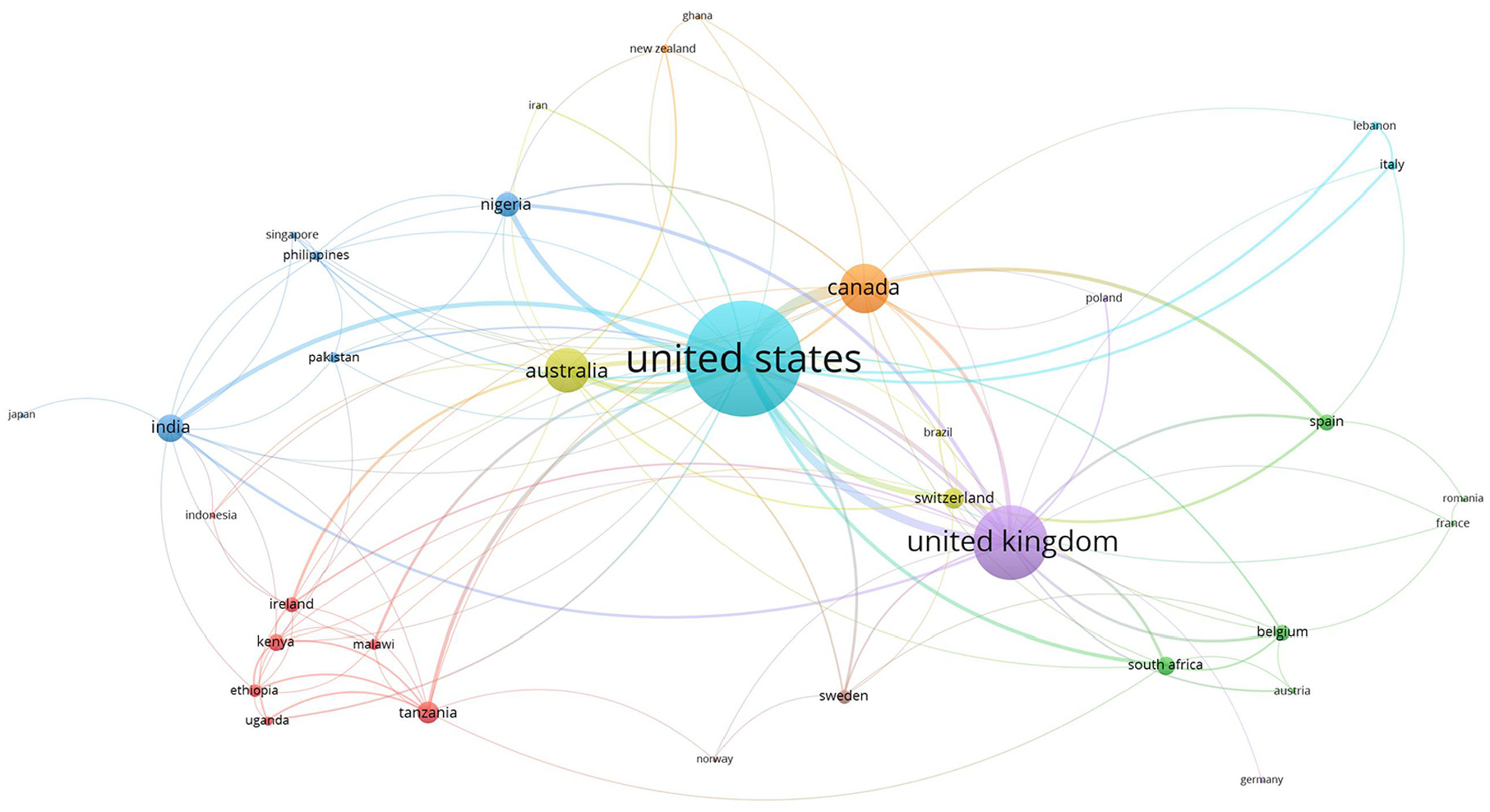
Network visualization map of international research collaboration. Nod size is proportional to the number of collaborative research publications. The US had the largest number of publications with international authors. Countries in the periphery of the map had the least collaborative ties.
The retrieved publications had 1,912 authors, an average of 2.7 authors per document. The majority of the publications were single-authored (n = 282, 39.8%), followed by two-authored publications (n = 134, 18.9%), and three-authored publications (n = 108, 15.3%). The remaining publications (n = 184, 26.0%) were multi-authored with at least four authors.
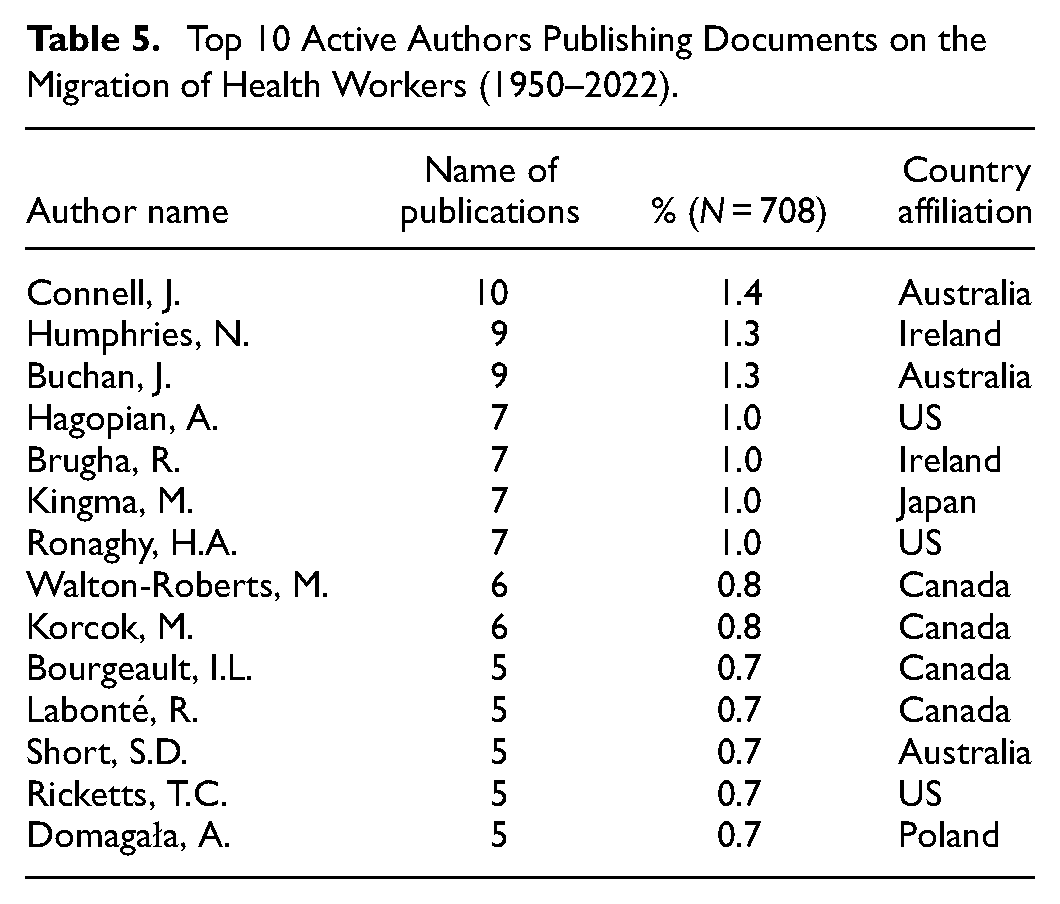
The core authors, with a minimum contribution of five documents, were mainly from Canada and the US (Table 5). Connell, J. ranked first with 10 (1.4%) publications, followed by Buchan, J. (n = 9, 1.3%) and Humphries, N. (n = 9, 1.3%).
Top 10 Active Authors Publishing Documents on the Migration of Health Workers (1950–2022).
Most Investigated Topics (Research Hotspots)
To identify the most frequently investigated topics (research hotspots), author keywords present in the retrieved literature were mapped and analyzed. The map of most frequent author keywords included 67 keywords (Figure 3). Each node in the map represents a keyword and the size of the node reflects the number of occurrences in the retrieved literature. The connection between nodes is a measure of relatedness and termed total link strength (TLS). Higher TLS value suggests stronger relatedness between the terms. Based on the map analysis, here are the most important and common research hotspots in the retrieved:
Nurse migration: Keywords related to this topic include nurse migration, nurses, nursing workforce, nursing shortage, internationally educated nurses, migrant nurses, push and pull factors, job satisfaction, retention, education, training, Philippines, India.
Physician migration: Keywords related to this hotspot include: physician migration, physicians, doctors, international medical graduates, medical education, motivation, ethics, health professionals, and Sub-Saharan Africa.
Health workforce mobility: Keywords related to this hotspot include: migration, health workers, health workforce, brain drain, emigration, international migration, human resources for health, workforce, mobility, globalization, Philippines, and Sub-Saharan Africa.
Health policy and globalization: Keywords related to this hotspot include: health policy, globalization, international recruitment, policy, health worker migration, health care systems, global health, developing countries, Philippines, Sub-Saharan Africa, and India.
Nursing workforce shortages: Keywords related to this hotspot include: nursing shortage, nursing workforce, nurses, developing countries, workforce, health policy, Philippines, and Sub-Saharan Africa.
Human capital and job satisfaction: Keywords related to this hotspot include: human capital, job satisfaction, motivation, career development, health professionals, retention, nurses, physicians, Philippines, and Sub-Saharan Africa.
International recruitment and retention: Keywords related to this hotspot include: international recruitment, retention, migration, workforce, health policy, recruitment, United States, Australia, Canada, Philippines, and Sub-Saharan Africa.
Impact on developing countries: Keywords related to this hotspot include: developing countries, brain drain, human resources for health, health policy, impact, migration, workforce, Philippines, and Sub-Saharan Africa.

Network visualization map of author keywords co-occurrences. Only author keywords with a minimum occurrence of five times were included. The map included 64 author keywords distributed into seven clusters with different colors.
The Most Impactful and Visible Research Topics
The number of citations received by a certain article reflects its scientific impact and visibility. To identify the most impactful and visible research topics in the field of migration of health workers, the top 50 cited articles were analyzed and the most impactful research topics were deduced. Based on the analytical mapping of the top 50 cited articles, here are the most impactful research topics:
Health worker migration and workforce imbalances: This research topic explores the phenomenon of health worker migration, its causes, consequences, and policy responses, focusing on the imbalances it creates in healthcare systems (Castro-Palaganas et al., 2017; Forcier et al., 2004; Frehywot et al., 2010).
Nurse migration and shortages: This topic examines international nurse migration, its impact on workforce shortages, and associated challenges in both source and recipient countries (Li et al., 2014; Ross et al., 2005; Tregunno et al., 2009).
Physician migration and brain drain: Description: This research topic focuses on the migration of physicians, brain drain implications for both source and destination countries, and associated workforce dynamics (Brown & Connell, 2004; Mullan, 2005; Sherr et al., 2012).
Global health and healthcare disparities: This topic addresses the global health implications of health worker migration, particularly how the movement of healthcare professionals affects healthcare disparities (Connell et al., 2007; Linda et al., 2004; Mejia, 1978).
Policy and ethical considerations: This research topic explores the policy responses, ethical considerations, and potential solutions related to health worker migration and its impact on healthcare systems (Buchan & Sochalski, 2004; Burnham et al., 2009; Stilwell et al., 2003).
Human resources for health and retention: This topic focuses on human resources for health, including strategies for retaining healthcare professionals in their home countries and mitigating the brain drain (Kuehn, 2007; Labonté et al., 2015; Tankwanchi et al., 2013).
Migration patterns and source countries: This research topic investigates migration patterns of healthcare professionals from specific source countries, along with the factors contributing to their migration decisions (Astor et al., 2005; Percot, 2006; Tankwanchi et al., 2013).
Migration strategies and transition experiences: This topic explores the experiences of internationally educated healthcare professionals during their migration and transition to a new healthcare environment (Newton et al., 2012; Robinson & Carey, 2000; Tregunno et al., 2009).
Emerging Research Topics
The emerging research topics in the retrieved literature were identified based on the content analysis of the recently published 50 articles. The following were the most emerging topics addressed in the recently published articles in the field:
COVID-19 pandemic and health worker migration: This research topic investigates the influence of the COVID-19 pandemic on health worker migration, retention, and workforce dynamics (Murataj et al., 2022).
Migration impact on healthcare systems and policies: This research topic explores the impact of health worker migration on healthcare systems, policies, and the challenges faced by countries dealing with emigration (Davda et al., 2021).
Migration motivation and push-pull factors: This research topic examines the motivations, factors, and considerations influencing healthcare professionals’ migration decisions (Kostrzewa et al., 2022).
Push-Pull Factors
To identify the push-pull factors, the top 100 cited articles were mapped and analyzed to identify the most frequently encountered push-pull factors. The following were the mostly frequently encountered push factors: (1) Economic factors such as low salaries, limited job opportunities, and lack of benefits in the home country that push healthcare professionals to seek better financial prospects abroad (Dovlo, 2007). (2) Unfavorable working conditions, including inadequate facilities, high workload, lack of resources, and challenging practice environments that lead healthcare professionals to consider migration (Kingma, 2007). (3) Feelings of underappreciation and lack of recognition for healthcare professionals’ contributions in their home countries, which can contribute to their decision to seek opportunities abroad (Hagopian et al., 2004). (4) Limited opportunities for career growth, promotion, and professional advancement in the home country, leading healthcare professionals to seek better prospects abroad (Castro-Palaganas et al., 2017). (5) Political turmoil, social unrest, and lack of security in the home country that prompt healthcare professionals to seek stability and safety abroad (Burnham et al., 2009). (6) Attractive career advancement prospects, access to advanced medical technologies, and opportunities for professional development that motivate healthcare professionals to migrate (Astor et al., 2005). (7) The promise of higher salaries, better benefits, and improved quality of life in destination countries that incentivizes healthcare professionals to move (Lorenzo et al., 2007). The pull factors were: (1) Access to advanced training, specialization, and professional growth opportunities in destination countries that attract healthcare professionals seeking to enhance their skills (Brown & Connell, 2004). (2) A desire for improved living standards, better quality of life, and access to better social services for healthcare professionals and their families (Lorenzo et al., 2007; Marcus et al., 2014). (3) Availability of advanced medical technology, modern facilities, and better resources in destination countries that attract healthcare professionals seeking to practice with the latest tools (Mullan, 2006; Sheikh et al., 2012). (4) Improved educational prospects and access to quality education for healthcare professionals’ children in destination countries (Lorenzo et al., 2007). (5) Improved practice environment, including supportive management, adequate resources, and better working conditions in destination countries that attract healthcare professionals (García-Pérez et al., 2007).
Discussion
The objective of this study was to provide an encompassing overview of the growth patterns and key themes in scholarly research related to the international migration of health workers. As globalization and liberalization facilitate cross-border mobility, the movement of health workers has gained prominence. The study’s significance lies in its contribution to understanding the evolving trends, key contributors, and key research themes associated with health worker migration. By identifying research hotspots and exploring the factors influencing migration, this analysis offers insights crucial for addressing the maldistribution of health workers, healthcare system disparities, and global health security threats. This study’s novelty stems from its comprehensive analysis of the evolution, development, and research trends within the field of health worker migration. While previous research has addressed specific aspects of the migration phenomenon, this study fills a critical gap by presenting a holistic view of the knowledge structure and growth patterns. By employing bibliometric analysis, the study not only quantifies scholarly output but also identifies key research themes and their interrelationships. Furthermore, the incorporation of advanced metrics such as keyword mapping offers a multidimensional understanding of international research networking and research hotspots, contributing to the field’s advancement.
Analysis of research activity in the field revealed a marked upsurge in publications between 2003 and 2007, driven by a confluence of influential factors. Firstly, the pursuit of Millennium Development Goal 5, centered on improving maternal health, underscored the indispensable role of skilled health professionals, particularly in regions grappling with low healthcare ratios (Green, 2006; Morley et al., 2017; Reis Tda et al., 2015). As governments earnestly endeavored to realize these goals, attention naturally turned to identifying barriers, including health worker migration, impeding MDG attainment (Beltman et al., 2010; Fotso & Fogarty, 2015; Wyss, 2004). Secondly, the recruitment strategies adopted by OCED countries to bridge healthcare shortages ignited discussions on human rights and ethical dimensions, triggering an intellectual exploration of the implications tied to enlisting skilled personnel from LMICs (Eckenwiler et al., 2012; Klingler et al., 2018; Stokes & Iskander, 2021; World Health Organization, 2010). A third driving force was the endorsement of a resolution during the Fifty-seventh World Health Assembly in 2004 (World Health Organization, 2004), which galvanized health policy makers and researchers to delve into the migration of health workers. Furthermore, the early 2000s witnessed a slew of scientific reports and articles sounding the alarm about the looming shortages of nurses and healthcare personnel (Akl et al., 2007; Hussey, 2007; Ulrich, 2003). The fifth catalyst emerged from the World Health Organization’s vocal concerns and advocacy regarding healthcare workforce shortages and the imperative to shape migration policies in the past two decades (World Health Organization, 2003). Notably, the WHO Code of Practice, initiated in 2004 and adopted in May 2010, materialized through collaborative efforts among national and international organizations (Taylor & Dhillon, 2011). These factors, while providing insights into the surge of publications from 2003 to 2007, also acknowledge that hidden influences, such as regional conflicts in the Middle East and Africa, democratic deficits, security issues, and disease outbreaks, likely amplified the waves of migration and thus catalyzed research engagement in this domain.
The distribution of active countries serves as a stark reminder of the existing imbalance in research engagement between affluent destination nations and low- to middle-income source countries. Notably, scholarly contributions heavily favor WHO regions encompassing the Americas and Europe, while regions like Africa and the Eastern Mediterranean, disproportionately impacted by health worker migration, exhibit limited involvement in research endeavors. This glaring disparity underscores an imperative for more comprehensive global research collaboration, aimed at addressing the distinct challenges faced by source countries. It is crucial that international research initiatives expand their scope beyond destination nations to encompass the viewpoints and experiences of source countries, thereby fostering a holistic strategy for effectively addressing health worker migration. The cohort of active countries within this domain encompasses both South Africa and India, which are considered source countries for migration of health workers. South Africa had contributed approximately 23,400 health workers to five nations—specifically, the US, the UK, Canada, Australia, and New Zealand (Chen et al., 2011; Dumont & Meyer, 2003; Siyam et al., 2014). Remarkably, South Africa has enacted various policies and initiatives that have contributed to a reduction in its healthcare workforce shortage (Labonté et al., 2015). Similarly, the case of India is compelling, with an estimated 69,000 Indian-trained physicians reported to have been working in the US, the UK, Australia, and Canada in 2017 (Walton-Roberts & Rajan, 2020). Notably, India also serves as a significant source of nurses for the US, the UK, Canada, Australia, and the Arab Gulf nations. Ireland played a dual role as both a source and destination nation. Ireland’s financial crisis in 2008/2009 triggered a wave of physician migration to countries like Australia, driven by the desire to escape unemployment and recession (Humphries et al., 2019, 2015). Australia emerged as an attractive destination due to shared language and aligned recruitment policies (Humphries et al., 2017). Australia’s facilitative measures, including streamlined visa processing and equivalency assessment of medical qualifications, have bolstered its appeal as a host country for migrating healthcare professionals (Hawthorne, 2013). Several reasons could be cited for the leading role of the US, the UK, Canada, and Australia in research activity in the field of migration of health workers. These four countries are considered the main destination countries for migrating health workers due to higher wages, advance and stable health system, better training and educational opportunities, and relatively easy migration policies for highly skilled health workers. In addition, the large number of scholars, academic institutions, and research funding in these countries make research output from these countries relatively high.
The push-pull factors influencing health worker migration encompass a range of economic, professional, and environmental considerations. Economic incentives, poor working conditions, and lack of career advancement emerge as notable push factors. Simultaneously, attractive career opportunities, better living standards, and access to advanced technology serve as pull factors. As the global context evolves, the emergence of topics related to the COVID-19 pandemic, migration’s impact on healthcare systems and policies, and motivations behind migration underscores the dynamism of health worker migration research. These emerging topics reflect the evolving challenges and opportunities presented by contemporary global health crises and shifting migration dynamics.
Research Gaps and Policy Implications
Despite the extensive research landscape analysis presented here, some gaps persist in the literature. The underrepresentation of research from source countries highlights the need for targeted efforts to engage researchers and institutions in these regions. Bridging this gap is crucial to ensure comprehensive understanding and effective policy formulation. Additionally, while push-pull factors have been extensively explored, a deeper analysis of socio-cultural, political, and ethical dimensions could enrich the understanding of health worker migration motivations. The study’s findings emphasize the urgency of coordinated policy interventions at both source and destination countries. Implementing retention strategies, improving working conditions, and fostering international collaboration are pivotal steps in mitigating the adverse effects of health worker migration.
Limitations
To the author’s knowledge, no prior research has delved into the investigation of research patterns concerning health worker migration, making this aspect a notable forte of the present study. Moreover, the study’s search methodology demonstrated a high degree of comprehensiveness, with meticulous screening ensuring the exclusion of irrelevant documents from the collected pool. This rigorous approach significantly bolsters the reliability of the ensuing outcomes. Nevertheless, it’s important to acknowledge that, akin to other studies within the bibliometrics realm, the present investigation hinges on the analysis of a defined corpus of literature sourced from particular databases. Consequently, the analysis is not an exhaustive examination of all published literature but rather an assessment conducted exclusively on literature drawn from specific databases.
Conclusions
In conclusion, this study sheds light on the evolving research landscape surrounding the international migration of health workers. By identifying growth patterns, research hotspots, and factors influencing migration, the study contributes to a comprehensive understanding of this complex phenomenon. The unprecedented growth during 2003 to 2007 highlights the increasing research interest and collaborative efforts to address health worker migration’s implications. The study underscores the importance of equitable international collaboration, incorporating source countries’ perspectives, and devising evidence-based policies to retain health workers and ensure equitable access to healthcare globally. To achieve Sustainable Development Goal 3 and establish good health and well-being, the global community must prioritize the development of research agendas, foster cross-border collaboration, and formulate policies that address the multifaceted challenges of health worker migration.
Footnotes
Acknowledgements
The author would like to thank Drs Adham Abu Taha and Saed Zyoud for helping and validating the research strategy.
Abbreviation
WHO: World Health Organization
Author’s Contributions
W.S. started the idea, designed the methodology; did the data analysis, graphics, and data interpretation; wrote and submitted the manuscript. This was a single-authored manuscript.
Declaration of Conflicting Interests
The author declared no potential conflicts of interest with respect to the research, authorship, and/or publication of this article.
Funding
The author received no financial support for the research, authorship, and/or publication of this article.

Data Availability Statement
Data sharing not applicable to this article as no datasets were generated or analyzed during the current study.