




Abstract
Chinese social psychology developed vigorously, and its scientific achievement showed explosive growth from 2000 to 2015. Based on typical Chinese social psychology articles published between 2006 and 2015, the development trend of this discipline was investigated in this article by means of citation analysis. There were 61,284 references in 1,982 typical Chinese social psychology essays, which were retrieved from the database of China National Knowledge Infrastructure (CNKI), Web of Science (WoS) and general literature database. The results were as follows: (a) The primary types of journal citation in the discipline of Chinese social psychology were English journals rather than Chinese journals; (b) The research hotspot of social psychology in China, as reflected by the top cited authors, involved both indigenous psychology and social psychology of culture; (c) The literature obsolescence rate of Chinese citations was declining and much lower than before; (d) Collaborations increased in Chinese social psychology articles, but remained significantly lower than collaborations in English articles.
Plain Language Summary
Based on typical Chinese social psychology articles published between 2006 and 2015, the development trend of this discipline was investigated in this article by means of citation analysis.The results were as follows: (a) The primary types of journal citation in the discipline of Chinese social psychology were English journals rather than Chinese journals; (b) The research hotspot of social psychology in China, as reflected by the top cited authors, involved both indigenous psychology and social psychology of culture; (c) The literature obsolescence rate of Chinese citations was declining and much lower than before; (d) Collaborations increased in Chinese social psychology articles, but remained significantly lower than collaborations in English articles.
Keywords
Introduction
It has been approximately 40 years since the reconstruction of social psychology in China in 1982. From 1949 to 1979, the development of Chinese social psychology had been at a standstill for historical reasons. It was in 1982 when social psychology was officially listed as a discipline to be strengthened in the “Major Tasks for Economic and Social Development in the 6th Five-Year Plan of P.R.C,” which indicated that Chinese social psychology had entered a time of rebuilding and recovery. In the same year, Chinese Association of Social Psychology (CASP) was founded in Beijing. At the beginning of this discipline’s development, it imitated Western psychology indiscriminately and was divorced from the actual social life in China (Du & Yue, 2004). With the development of the economy and society, Chinese social psychology made great progress during the period of “the 7th Five-Year Plan,”“the 8th Five-Year Plan,” and “the 9th Five-Year Plan” for Economic and Social Development of P.R.C. (Li et al., 2010). Gradually, the primary research fields have been formed, which then guided social problems in China, such as social justice and corruption, subjective well-being, social interaction, interpersonal concordance, moral psychology, and the changes in values (Wang et al., 2012). However, compared with the sharp rise of the “neural revolution” and “applied revolution” in China, Chinese social psychology is still at a disadvantage, which is not in line with the international development trend of the psychology discipline in which research in social psychology now has the highest citation rate (Yu, 2017). Thus, Chinese social psychology remains a developing branch of science, which will inevitably encounter obstacles.
This study employed bibliometric methods to investigate the characteristics of citations in studies of Chinese social psychology and the evolution of this discipline from 2006 to 2015. Bibliometric study is a statistical analysis of written publications, such as books or articles. This method is frequently used in the field of library and information science, including scientometrics. For instance, it was used for quantitative analysis of academic literature or evaluation of budgetary expenditures. Over the past decade, bibliometric tools have emerged as effective means for filtering, accrediting, and assessing scholarly information (Blakeman, 2018; Eom, 2009; Feller, 2005; Moed, 2009; Piotrowski, 2013; Richardson & McLeod, 2009; Wolfram, 2003).
Citation analysis is a commonly used bibliometric method based on constructing the citation graph, a network or graph representation of the citations listed in a series of documents. It has become an important tool for evaluating various aspects of scientific disciplines (Garfield, 1972; Garfield et al., 1978) and is widely used to explore the impact of a specific journal or research project or to track the model of knowledge distribution in a research field (Du et al., 2020; Frosch et al., 2010; Oermann et al., 2008). In addition, citation analysis has also been used to identify the most important scholars in the field of psychology (Griggs & Proctor, 2002), and it can identify well-organized and steady structural laws from a chaotic and dynamic literature collection (Xu, 1994).
Bibliometric analyses in psychology have been adopted by Chinese scholars since Guan et al. (1985) used bibliometrics to analyze articles published in Acta Psychologica Sinica from 1956 to 1984. Subsequently, other scholars have conducted studies on internationalization and indigenization from the perspective of disciplinary development. Specifically, internationalization involves the analysis of a branch of a discipline or a specific research field based on Science Citation Index (SCI)/Social Sciences Citation Index (SSCI). For instance, J. Wang and Zuo (2005) explored the trends of personality and social psychology reflected in Journal of Personality and Social Psychology while Jiang and Geng (2012) conducted analyses on a specific research field (i.e., implicit self-esteem). On the other hand, indigenization studies aim to reveal the integral or partial developmental direction of Chinese psychology based on the Chinese Social Sciences Citation Index (CSSCI). For example, Cheng (2001) analyzed the citation frequency, impact factors, cooperative situation, and citation types of a Chinese journal Journal of Psychological Science and found that original studies conducted by Chinese researchers were increasing. Similarly, a study done by Geng and Zhai (2008) analyzed the overall implications of Chinese psychology and found that although still in its infancy, Chinese psychology was in line with international standards and developing quickly.
Wang & Yue (2006) applied bibliometric methods to summarize the development history of Chinese social psychology for the first time, but he did not conduct a citation analysis. The team of Li was the first one to systematically analyze the characteristics of Chinese social psychology using the method of citation analysis. By analyzing citations listed in typical Chinese social psychology articles published in various journals from 2001 to 2005, they distinguished between tactical-typed and strategic-typed social psychologists and considered “internationalization” and “sinicization” as two legs of the development of Chinese social psychology (Li et al., 2014; Qi et al., 2013).
During the past decade, research fields in Chinese social psychology have increased rapidly and research scopes have largely expanded. This paper aims to conduct an updated analysis in which we selected typical Chinese social psychology articles published from 2006 to 2015 as the original data for citation analysis in pursuit of two main objectives: (1) provide the latest discipline academic information and the latest development trends for scholars who pay attention to the development of Chinese social psychology; (2) identify the most important and influential psychological scholars, academic journals, and cooperative situations in the discipline of Chinese social psychology. Based on the information provided in this paper, we hope that research collaboration could be strengthened in some aspects of social psychology through the efforts of social psychologists in China and other countries.
Method
Citation databases were retrieved on peer-reviewed articles published from 2006 to 2015 in scientific journals (to avoid counting citations repeatedly, subscript-cited references were not contained in the database). Citation databases consist of five parts, as shown in Table 1: (1) Chinese Social Psychological Review (volume 2–9; N = 96); (2) Research in Social Psychology (vol. 65–104 [N = 362]) including volume 92, volume 96, volume 100 and volume 104 were excluded because they are four collections of abstract with no articles ; (3) The top 10 most highly cited Chinese journals, which were ranked by Li et al. (2014; N = 1,519); (4) The top 51 most highly cited authors (not including Confucius) whose articles were published in other journals, which were ranked by Li et al. (2014; N = 166); (5) Considering that many Chinese social psychologists have published a wealth of articles in journals outside the mainland of China, this study also retrieved and added articles published by Chinese social psychologists in a Taiwan journal (i.e., Indigenous Psychological Research in Chinese Societies, N = 68) and 14 English journals (N = 229) that have been the highly cited journals in 2001 to 2005 (Li et al., 2014). The Web of science (WoS) was used to search articles and their citations in these 14 highly cited English journals. The search terms and the search strategy exercised by the advanced search function in the WoS were as follows: (a) publication name, such as “Asian journal of social psychology” (b) refined by publication years from 2006 to 2015 (c) countries/regions: Peoples Republic of China or Taiwan region. If the correspondence of the first author or corresponding author was not from the mainland of China, the article was not included.
Article Sources of Citations.

Note. CHN = China; TPE = Chinese Taipei; E = English Journal.
An annual published collected papers.
Papers written by the highly cited authors who were listed in Li et al. (2014), which were published in journals not listed in Table 1.
The filtering process included: the filters were experts in social psychology (the experts who have engaged in social psychology research and teaching), several graduate students in basic psychology, and the auxiliary filtering tools were CNKI web search for the latest research topics and “Social Psychology,”“Personality Psychology,” and “General Psychology” professional textbooks involved in the theme, after several repeated confirmation and comparison forming the final database (See, Figure 1).
Database formation and data analysis flow chart.
The filtering principles were as follows: The principles of filtering the typical social psychology articles were based on five standards of analyzing academic papers in the discipline of social psychology, which were presented in the book The Origin and Trend of Chinese Social Psychology by E. J. Wang (2008). In addition, other obvious branches of articles in psychology were filtered out, such as clinical psychology, industrial and organizational psychology, and child developmental psychology. Moreover, articles of independent subjects that belong to the branches of applied social psychology were also filtered out, such as business social psychology (consumer behavior psychology) and industrial social psychology (organizational behavior). Finally, a total of 1,982 typical Chinese social psychology articles were included in the database (Table 1).
Based on the above data, this paper pay more attention to the citation characteristics as follows: (1) Languages and Types of Citations, (2) Evolution of Citation Numbers in Different Languages, (3) Citing Half-Life and Price Index of Citation, these two indicators reflect the speed of reference aging or obsolescence, which also directly responds to the speed of disciplinary development, because if the literature is aging faster means that new literature, new theories, new studies are emerging to replace the relatively old literature; (4) Collaborative Rate and Collaborative Level can be a more directed response to the collaborative situation of the paper, generally speaking, the authors of theoretical articles are less, but the mainstream of psychology is mostly empirical research, so an appropriate increase in authors indicates the level of collaborative research, which in essence can promote the level of research and the level of the paper, such as cross-cultural research, cross-regional data collection, etc. Of course, not the more authors the better, according to the specific research area and the need to appropriately increase and the number of authors should be increased and decreased according to the specific research area and needs. (5) Highly Cited Authors (ethnic Chinese and Western) are the authors whose research is actively selected and preferred by Chinese researchers in the field of social psychology and cited extensively. The top Chinese and Western authors’ research interests are mainly in cross-cultural studies, local cultural studies, and social psychological studies, etc. (6) The Chinese and English Highly Cited Journals are more indicative of the preference of Chinese social psychology researchers for certain journals in the process of researching and writing papers during 2006 to 2015, which may also reflect the recognition of the quality of research in certain journals.
The working definition of the citing half-life is the time during which one-half of all the currently active articles were published (Burton & Kebler, 1960; Ladwig & Sommese, 2005; Tian, 1995). Thus, “one-half of all the active literature of a subject field was published not more than this time, T1/2, ago” (Burton & Kebler, 1960). The citing half-life is specified as Equation 1 (Zhang, 2014):

where HL is the half-life; A = the order of the year whose cumulative percentage is closest to 50%, counting backward from 2015 (2015 = year 0); B = the cumulative percentage in year A; and C = the cumulative percentage in year A + 1.
Price, in his classic article, defines the so-called “Price index” as “the proportion of the references that are in the last five years of literature” (Chi, 2019; Franssen & Wouters, 2019; Price, 1970). The Price index is formulated as Equation 2 (Egghe, 1997):
For d = 1, 2, 3, … we define the Price index

According to Price (1970), the exact index d = 5 here.
To describe the cooperation situation and tendency, the time 2006 to 2015 was separated into two parts: 2006 to 2010 and 2011 to 2015 (See Tables 2 and 3). Scientific cooperation is commonly measured by two attributes: “collaborative rate” and “collaborative level” (Levitt & Thelwall, 2009; Zhao & Wei, 2019). These two indicators of both Chinese and English citations were calculated. The word “collaborative” is utilized to denote an article that has more than one author. The collaborative rate is formulated as Equation 3 (B. Wang, 1992):

where, C = collaborative ratio; Nm = number of multiple-authored research papers; and Ns = number of single-authored research papers. In addition, the definition of “collaborative level” is the average number of coauthors per article, which is formulated as Equation 4 (Qiu, 2007; Wen & Li, 2011).

where CL = collaborative level; Na = the total number of authors; and Nt = total number of articles. It is important to emphasize that this essay has only counted the explicitly listed authors per citation. The authors, who are commonly omitted and marked as “et al.” when there are large number of authors in an article, are not counted. Therefore, the results for the collaborative level are a little lower than the actual collaborative level. As illustrated in Tables 2 and 3, both the collaborative rate and the collaborative level are much higher in English citations than Chinese citations.
Collaborative Rates of Chinese and English Citations in Two Different Periods (2006–2010 vs. 2011–2015).

Collaborative Level of Chinese and English Citations in Two Different Periods (2006–2010 vs. 2011–2015).

In Little Science, Big Science (1963), Derek de Solla Price points out that “the total number of scientists goes up as the square, more or less, of the number of good ones” (Allison et al., 1976). Referring to the definition of “the Price Law,” half of the scientific papers are contributed by the square root of the total number of scientific authors (Liu, 2004; Price, 1963; Qiu, 2000). The equation is as follows:

where n = the maximum cumulative number of cited frequencies (Li et al., 2014; Zong, 2016). In the current study, n = 773 (i.e., total cited frequencies of Chiu, C.Y.). The m-value here is about 21. Twenty-one cited time, which is selected as the criterion to distinguish the highly cited authors from the other authors.
Results
Article Sources of Citation
The sources of the selected papers are listed in Table 1. There are 27 article sources ranked depending to the number of articles per source. Our analysis mainly focuses on the number of citations (i.e., publications, either articles or books, that are cited by these 1,982 selected papers) listed in the 1,982 selected papers. The total citation number is 61,284 and the average number of citations is 30.92. The number of citations listed in Chinese articles or books (domestic publications hereafter when referring to this citation source of the selected papers) and the number of citations listed in English articles or books (international publications hereafter when referring to this citation source of the selected papers) are 49,391 (80.6% of the total citations) and 11,893 (19.4% of the total citations), respectively.
Languages and Types of Citations
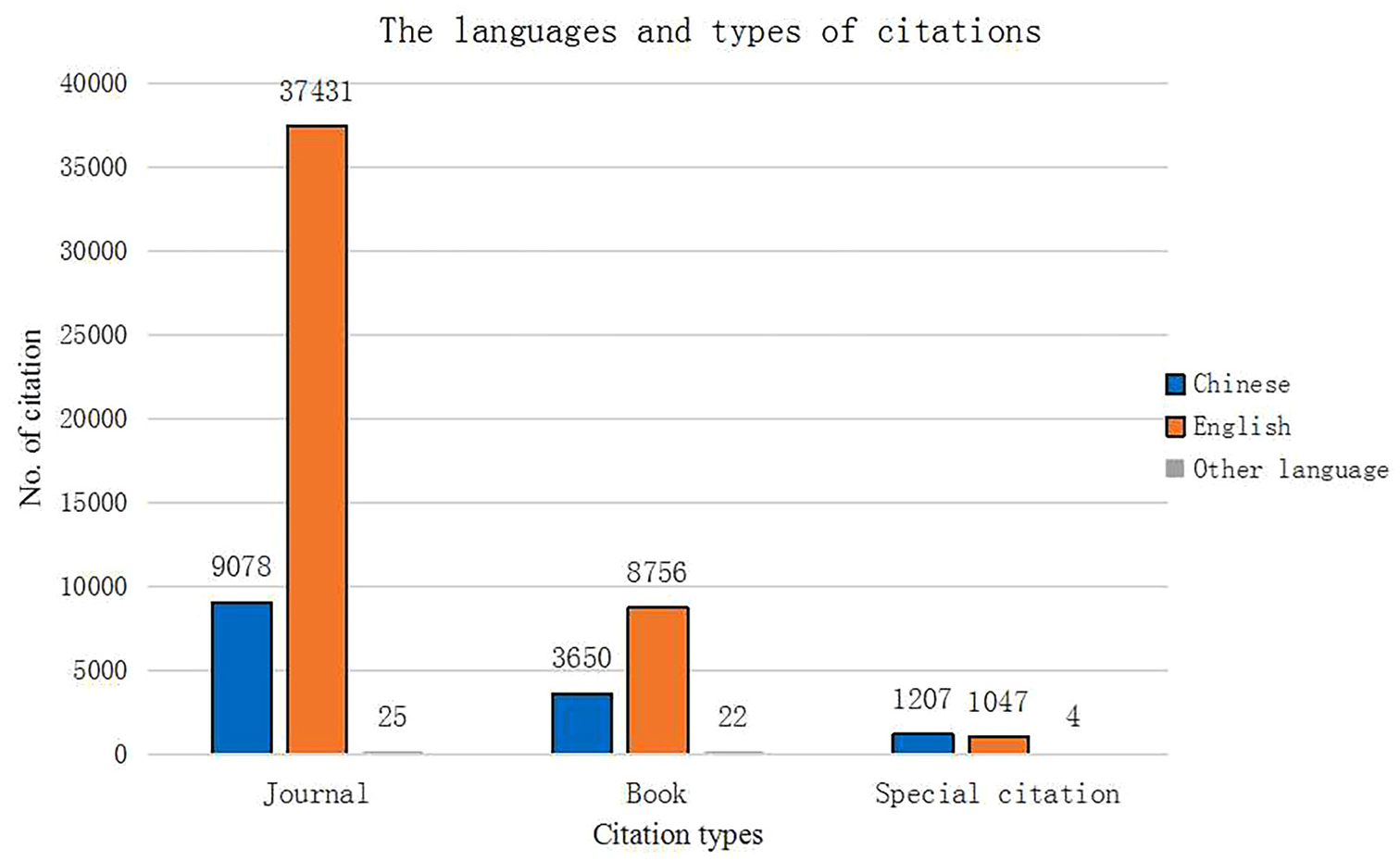
Figure 2 shows the languages and the types of these citations. English is the predominant language, with approximately 77.16% of the citations written in English, 22.76% written in Chinese, and 0.08% written in Japanese, French, and Spanish. According to Z. X. Li et al.’s (2014) classification principles, citations are divided into three types: Journal, Book, and Special Document (including academic dissertation, conference article, unpublished dissertation, and online resources). As expected, the most common citation type is Journal, which contributes roughly to 75.93% of the total citations. Book (20.28%) contributes to the second largest number of citations, followed by Special document, which contributes to 3.68%.

The languages and types of citations.
Evolution of Citation Numbers in Different Languages
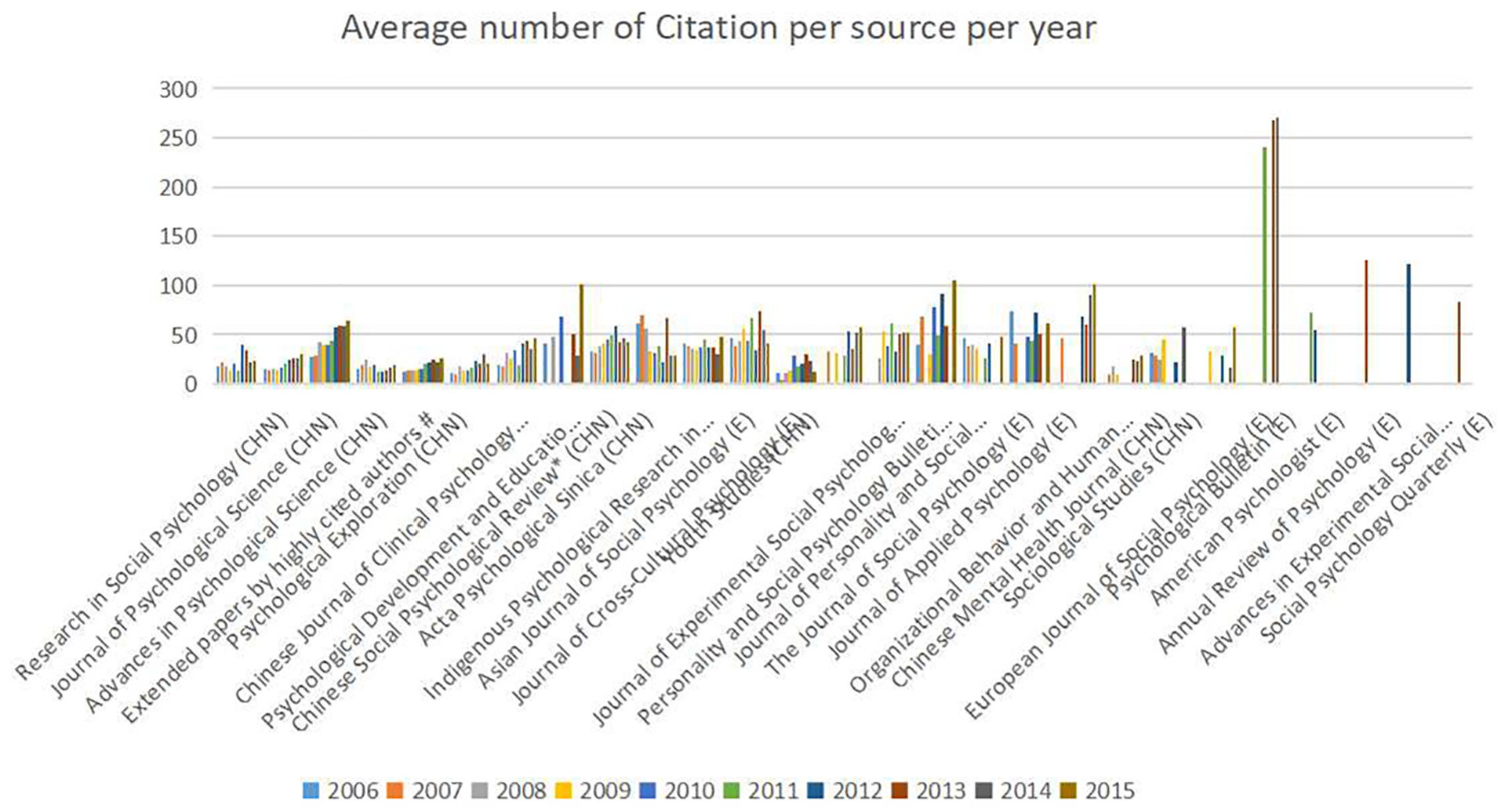
Figure 3 displays the evolution of citation numbers in different periods. All citations are separated into Chinese and English, without considering other languages due to their small counts. The results of comparative analyses between English and Chinese citations listed in domestic and international publications are shown in Figure 3. Bedsides, considering the number of articles in different categories in Figure 3 and the year, the number of citations can be misleading. Therefore, in this paper, we add the indicators of average number of citations per source per year are shown in Figure 4.
The evolution tendency of citations.

Average number of citation per source per year.
It is clearly that the number of Chinese citations is consistently less than that of English citations in this discipline. Especially, there are very rare Chinese citations in international publications, suggesting that papers published in Chinese journals have rarely been cited in English articles. English citations in domestic publications are increasing very fast, meaning that papers published in English journals have been extensively cited by Chinese articles. This contrast shows an extreme asymmetry, suggesting that Chinese scholars are paying more and more attention to English journals but researchers (no matter where they are from) pay no attention to Chinese studies when publishing in English journals, partly due to the barrier of language or the problems of research integrity in China (Zeng & Resnik, 2010). A rather positive news is that Chinese citations in domestic publications are also increasing, suggesting that Chinese scholars are also paying more attention to Chinese journals.
Citing Half-life and Price Index of Citations
Table 4 shows the citing half-life and Price Index, which are two important measures of the rate of literature obsolescence. These two indicators for Chinese and English citations were calculated in the current study. The calculated half-life results for Chinese and English citations are 9.48 years and 13.37 years, respectively. Besides, comparative analyses of half-life between different languages of citations in both domestic publications and international publications are shown in Table 4.
Half-life and Price Index of Chinese and English Citation.

The Price indexes of Chinese and English citations are 13.37% and 8.45% respectively, from 2006 to 2015 in the discipline of Chinese social psychology. Comparative analyses of Price index between different languages of citations in both domestic publications and international publications are also shown in Table 4.
Collaborative Rate and Collaborative Level
Highly Cited Authors
Tables 5 and 6 show the specified names of the highly cited authors in Chinese and English, respectively. One hundred sixty highly cited ethnic Chinese authors are listed in Table 5 and ranked by the cited frequency. Highly cited western authors are listed in Table 6 (because of the word limit we just present the highly cited authors whose citations are more than 50 times).
Highly Cited Authors: Ethnic Chinese (160).

Note. Authors who have the same number of citations are ranked by the first letter of their name.
p < .05. **p < .01. ***p < .001.
The author who was also the highly cited author in 2001 to 2005 (Li et al., 2014).
Highly Cited Authors: Western (Only Top 149).

Note. Authors who have the same number of citations are ranked by the first letter of their name.
There are 759 highly cited western authors totally. Due to page limitations, top 149 highly cited authors who have been cited more than 50 times are presented here. If you are interested in the rest of authors, please contact us.
Author who was also the highly cited author in 2001 to 2005 (Li et al., 2014).
p < .05. **p < .01. ***p < .001.
Chinese and English Highly Cited Journals
According to the method of Garfield (1972), journal titles in Chinese and English are described below and ranked by the cumulative cited frequencies. Table 7 displays the top 10 most frequently cited Chinese journals, which accounts for nearly 50% of all cited numbers of Chinese journals. Journal of Psychological Science is the most frequently cited journal, accounting for 10.89% of citing frequency. Acta Psychologica Sinica comes next, constituting 9.60%. The journal Advances in Psychological Science contributes 9.22%. Similarly, Table 8 lists the top 38 most frequently cited English journals, which accounts for 50.12% of all cited numbers of English journals.
Top 10 Most Highly Cited Journals in Chinese.

Including 65 cited times of Journal of Southwest China Normal University: Philosophy & Social Sciences Edition.
Journal of Southwest University: Social Sciences Edition is one of the source journals in CSSCI.
Including 10 cited times of Newsletters of Psychological Sciences.
Including 43 cited times of Journal of Development in Psychology.
p < .05. **p < .01. ***p < .001.
Source journal of CSSCI (According to the source journals of CSSCI in 2014–2015).
These are also the highly cited journals during 2001 to 2005 (Li et al., 2014).
Top 38 Most Highly Cited Journals in English.

p < .05. **p < .01. ***p < .001.
Including 73 cited times of Journal of Abnormal and Social Psychology.
These are also the highly cited journals during 2001 to 2005 (Li et al., 2014).
Discussion
Although the average citation number per article from 2006 to 2015 (30.92) is higher than that during 2001 to 2005 (13.13, Li et al., 2014), it is far less than the average citation number of the Journal of Personality and Social Psychology from 1990 to 2000 (approximately 50, J. Wang & Zuo, 2005). The result suggests that Chinese social psychology develops more rapidly than before but further development is still needed.
The total number of English citations is 3.39 time than that of Chinese citations, which indicates that English journals have received more attention than Chinese journals from 2006 to 2015. The percentage of English citations accounting for the total citations is 77.2%, which is higher than the foreign reference rate in the overall discipline of Chinese psychology (51.74%, Zhang, 2014). On one hand, this phenomenon demonstrates that scholars in the field of Chinese social psychology are capable of absorbing and applying English literature. On the other hand, it suggests that some Chinese scholars may have got used to living under the theories of social psychology from Europe and America. They seem able to explain the research results only with these theories and are indifferent to the theories emerging in their own ranks (Zuo, 2003). Besides, language barriers in Chinese or issues of integrity in Chinese research can also reduce the likelihood that Chinese literature will be cited. Therefore, to keep moving forward, China needs to continue to take effective action to promote research integrity. Some of the challenges China faces include additional policy development, promoting education in responsible conduct of research, protecting whistle-blowers, and cultivating an ethical research environment (Zeng & Resnik, 2010). The proportion of other languages is extremely low, which indicates that the global minority countries are mainly an importer of psychological knowledge from the global majority countries whereas its own capacity to produce psychological knowledge is still low (Moghaddam, 1987). Although Chinese social psychology is not as disadvantaged as it was 40 years ago, the state of being colonized by Western academic hegemony has not fundamentally changed. People must turn to their own reality and maxims, from which they can derive their own “scientific” results (Moscovici, 1972). Some Chinese scholars also advocated that psychological research should apply to the real social problems in China (Sun et al., 2014).
Journals have remained the principal sources of citations in Chinese social psychology from 2006 to 2015. At the beginning of the 19th century, journals became the fundamental pillars of new disciplines, including psychology (Daniel & Louttit, 1953; Osier & Wozniak, 1984). Journals not only express the state of a science at a given moment but also reveal the problems that concern authors, the most prolific and dynamic research groups, and the most influential studies (Quinones-Vidal et al., 2004). The number of journal articles accounts for 75.93% of the total citations from 2006 to 2015. Journal articles account for 79.16% of the total English citations, which is higher than the standard of journals’ contribution to scientific research activity of the world (65%–70%, Li et al., 2007). The contribution rate of journal articles for Chinese citations is 65.09%, which is within the range of the standard.
The distribution characteristics of the citation year are showed in the “half-life” and the “Price index,” which indicate the obsolescence of citation. The more quickly a discipline grows, the more rapid obsolescence takes place. A longer half-life means fewer time-sensitive quotations. The half-life of Chinese citations in Chinese social psychology is 9.48 years, which is shorter than 12.79 years for English citations from 2006 to 2015 but longer than the mean citation half-life in the overall discipline of Chinese psychology in 2012 (7.36 years, Zhang, 2014). The Price index of Chinese citations is 13.37%, which is higher than the index of English citations (8.45%) from 2006 to 2015. However, it is noticeably lower than the Price index of Chinese citations from 2001 to 2005 (54.2%, Li et al., 2014). In sum, the rate of Chinese social psychology literature obsolescence is quicker than that of English literature but slower than the average level for Chinese psychology. It shows that Chinese social psychology is a relatively fast-growing branch of Chinese psychology at present.
The degree of collaboration in journals is positively related to its impact (Du et al., 2012). The collaborative rate and the collaborative level are two important indicators that reflect the cooperative situation in citations. As illustrated in Tables 2 and 3, although the collaborative rate and the collaborative level increased from 2006 to 2015 for Chinese citations, they are still much lower than those for English citations, which illustrates the need for social psychologists in China to increase collaborative research. There are three types of collaboration: local, domestic, and international (Bordons et al., 1996; Levitt & Thelwall, 2009). From the domestic perspective, to promote the research quality of Chinese social psychology, Li et al. (2014) suggested that academic dialogue between teams of different academic orientations, collaboration between “psychologists” and “sociologists,” and interaction between Chinese Psychological Society (CPS) and Chinese Association of Social Psychology (CASP) should be strengthened. Moreover, international collaboration is an essential way to improve the impact of research, such as the money research by Zhou et al. (2009). Many governments are promoting increased international collaboration with the belief that this will result in reduced costs and higher-impact research (Katz & Hicks, 1997; Levitt & Thelwall, 2009).
Tables 5 and 6 lists the names of highly cited authors and the cited numbers. First, the theoretical citation counts of Chinese source database and English source database were calculated for each highly cited author, and the citation differences of each highly cited author in Chinese source database and English source database were compared by chi-square test, and the preference of highly cited authors in Chinese source database and English source database of Chinese social psychology was compared based on the difference between the actual and theoretical citation counts, such as in the whole cited literature, the difference in citations of Chiu, C.Y. in Chinese sources is smaller than the difference in citations of English sources (D < I), indicating that Chiu, C.Y.’s research is more popular in English source journals than in Chinese source journals from 2006 to 2015 in the field of Chinese social psychology. Then, he can be considered as an “International Favorite Scholar (IFS)” in Chinese social psychology. In addition, Hong, Y.Y., Peng, K.P., and Leung, K., etc. And so forth, they can also be classified as “Domestic Favorite Scholars (DFS),” such as Yang, C.F., Huang, X.T., Wang, D., and Huang, K.K., etc. and “International-Domestic Favorite Scholar (I-DFS)” such as Yang, K.S., Zhang, J.X., and Zhu, Y., etc. Similarly, among the western highly cited authors, Bond, M.H., Markus, H.R., Kitayama, S., etc. can be called IFS; Greenwald, A.G., Fiske, S.T., and Tajfel, H. are called DFS. Banaji, M.R., Hogg, M.A., and Higgins, E.T. are “I-DFS.”
Bedsides, Most Chinese highly cited authors in Table 5 are from psychological institutions, faculty or research centers. On the contrary, the minority of authors are from institutions of sociology, such as Fei, Zhou, and Fang. This phenomenon implies that psychologists played a leading role in the discipline of Chinese social psychology from 2006 to 2015, which is the same as the period of 2001 to 2005 (Li et al., 2014). The top 10 most highly cited Chinese authors are all in the field of indigenous psychology and social psychology of culture. Similarity, Table 6 shows Western highly cited authors. Diener, E. is ranked first, which is consistent with the statistical ranking of Li et al in 2001 to 2005 (Li et al., 2014). Greenwald is also ranked in the top 10 Western highly cited authors, partly due to Cai’s (2003) introduction of the Implicit Association Test (IAT) into the discipline of Chinese social psychology. In addition, almost all the top 10 most highly cited Western authors are studying in the field of cultural and social psychology and social psychology across cultures (e.g., Bond, M.H., Markus, H.R., Kitayama, S). It suggests that the psychological research orientation in indigenous and social cultural are more popular in Chinese social psychology.
The number of English highly cited journals is 38, which is 3.8 times more than that of Chinese journals, which also illustrates researchers’ constant attempts to understand, trace, and review the work of European and American scholars in Chinese social psychology (Fang, 2008). The Journal of Personality and Social Psychology is the flagship publication of American social psychology, and its 4,931 citations are approximately 4 times more than that of the second most cited journal, Personality of Social Psychological Bulletin, and are nearly 5 times more than that of the most cited Chinese journal (Journal of Psychological Science). The quality indicator takes into account the average cited numbers per citation in every journal. The highest quality journal in English is Psychological Review, with an average cited number of 3.56, which is higher than that of the highest quality journal in Chinese journals, Indigenous Psychological Research in Chinese Societies (2.87). It is important to emphasize that the journal Indigenous Psychological Research in Chinese Societies mainly publish papers that adopt indigenous opinions and strategies. In other words, this journal emphasizes unique Chinese theories and cultural phenomena. In terms of the quality indicators, indigenous research means that blind imitation of foreign theories is inadvisable. It is essential to cite localization theories that are in accordance with Chinese culture and to construct new theories that are based on the characteristics of Chinese society in the present. As we know from the history of social psychology research, almost all research topics are based on a certain social reality and have been developed, such as the study of racial discrimination, which is typically based on American social problems and has gradually developed a series of huge research fields. In summary, the development of Chinese social psychology remains restricted by Western studies, but the orientation of indigenous and social cultural psychology is a bright road that may deeply influence the structure of Chinese social psychology in the next several years.
Overall, from the results of citation analysis, it can be found that Chinese social psychology in general shows improved research quality, rapid development, formation of research trends and hotspots, and maintaining an open attitude during 2006 to 2015 compared to 40 years ago, as reflected in (1) a higher increase in the number of citations and an increase in the depth of research questions (2) far more citations in English than in Chinese, indicating an openness to international research (3) journal citation rate meets the standard; (4) citation timeliness is better than English citations and the timeliness of the whole Chinese psychology, indicating faster development than the average level of domestic psychology; (5) preference for articles by domestic, sociocultural and cross-cultural psychology-oriented researchers, indicating that domestic researchers research initiatives form a socio-cultural psychology trend. (6) There is an increase in the degree of author collaboration.
Of course, the above-mentioned development features also have places that need reflection, such as far more citations in English than in Chinese, and having an international perspective to study the latest research is a sign of openness, but there may also be negative effects of overly following international trends to seek international identity while ignoring domestic research results based on Chinese social reality, or even devaluing domestic research. In addition, while collaborative research can improve the efficiency of research, scientific research should not be reduced to a factory production line operation, but should be more innovative. In conclusion, the development of Chinese social psychology should be based on the social reality of China, with an international perspective, to continuously improve the level of research and eventually produce research results that are identified both domestically and internationally.
Limitations and Prospects
From the perspective of citation analysis, this study attempts to thoroughly clarify the developmental characteristics, research hotspots, and trends of Chinese social psychology from 2006 to 2015 to lay the foundation for future research. For domestic colleagues interested in Chinese social psychology research, this paper can provide general trends and hot spots in the discipline, specifically, when publishing papers, they should consider further increasing the number of citations, incorporating international research results while deeply drawing on existing domestic research results, focusing on the specific reality of Chinese social and cultural psychology, and increasing high-quality international collaborations. For international colleagues, Chinese social psychology deserves to be an important part of the international psychology field, because after all, it involves the psychology of more than 1.4 billion people, and ignoring Chinese social psychology means that the international psychological research community is indeed an important part of it. Moreover, Chinese social psychology, shaped by history and culture, has both similarities and differences with the findings of international social psychology research, and is more complete only when it focuses on the Chinese social psychology. Therefore, with the rapid development of Chinese social psychology, international colleagues are more likely to produce world-class research results only if they collaborate with the Chinese social psychology community and focus on Chinese social psychology and culture. At the same time, for international social psychology colleagues who are interested in Chinese society and culture, the analysis of the general development trend in this paper provides opportunities for further in-depth understanding and participation in the development of Chinese social psychology, such as seeking partners and finding research topics. Bedsides, Other characteristics and phenomena of Chinese social psychology researchers in conducting social psychology research deserve further study, such as the tendency to cite Chinese and English references, the preference for certain research topics and the preference for certain famous researchers, etc.
In addition to the above prospects, the limitations of this paper are: (1) the citation analysis can only analyze the general and approximate trends of social psychology in China, lacking the discussion of specific research topics; (2) this paper only counts the development of 2006 to 2015 based on the research from 2001 to 2005, not all the data; (3) the ranking of highly cited authors may cause controversy among some scholars, but the ranking does not represent the level of academic level and contribution, but only indicates the popularity of the research and the relative level of citations.
Footnotes
Declaration of Conflicting Interests
The author(s) declared no potential conflicts of interest with respect to the research, authorship, and/or publication of this article.
Funding
The author(s) disclosed receipt of the following financial support for the research, authorship, and/or publication of this article: This research was supported by grants named the Study on the Breakthrough and Construction of the Core Theory of Chinese Indigenous Psychology from the Major Project of National Social Science Foundation (13&ZD073)

Data Availability Statement
Data sharing not applicable to this article as no datasets were generated or analyzed during the current study.