




Abstract
This study aims to ensure the accountability of the technology acceptance model in the domain of over-the-top (OTT) service. As antecedents of usefulness, content diversity, content uniqueness, content recommendation, and ease of use were employed. The determinants of ease of use include easy registration and navigability. Additionally, this work examines the moderating effect of content diversity on the relationship between usefulness and intention to use. This study used Amazon Mechanical Turk to collect the data. The number of observations is 398. The results showed that content diversity, content recommendation, and ease of use significantly affected usefulness. Moreover, easy registration and navigability significantly affected ease of use. Attitude is also positively influenced by usefulness. Attitude and usefulness are positively associated with intention to use. Furthermore, this study revealed a significant moderating effect of accountability on information overload.
Plain language summary
This study aims to ensure the accountability of the technology acceptance model in the domain of over-the-top (OTT) service.
Introduction
The over-the-top (OTT) service market has grown, with many brands competing in the market. For instance, US Screen (2022) reported that the global revenue of OTT services in 2020 was approximately $106 billion, and the market size is forecast to reach approximately $210 billion by 2026. Mordor Intelligence (2024) also reported that the US market size of OTT is approximately 56 billion dollars. Additionally, the market is very competitive because of competition from multiple brands, such as Netflix, Prime Video, Disney+, and Apple TV (Mordor Intelligence, 2022). In this situation, increasing market share is critical to achieving business sustainability. A starting point for becoming more competitive might be to understand the market. Therefore, it is worthwhile to understand the behavior of users of OTT services. Thus, this research explores the characteristics of user behavior in the OTT service domain.
The technology acceptance model (TAM) is the theoretical underpinning of this work. TAM addresses the relationship between usefulness, ease of use, attitude, and intention to use by examining the use behavior of a particular technology or system (Granić & Marangunić, 2019; Jung et al., 2021; Moon et al., 2022a). The TAM has been widely used to scrutinize user behavior in various technologies (Al-Emran et al., 2018; Granić & Marangunić, 2019; Holden & Karsh, 2010; Marangunić & Granić, 2015). Such fertile works suggest that the TAM has explanatory power for user behavior in the area of technology. Although the OTT market has increased, scholars have rarely performed research to verify the TAM by employing OTT users. Moreover, this research identifies the antecedents of the main TAM attributes: usefulness and ease of use. The extant literature has alluded to content variety and uniqueness as central elements of competitiveness (Chen, 2019; W. S. Lee et al., 2023; Saha, 2021; Yousaf et al., 2021). Moreover, scholars have claimed that too much content in OTT services might become a burden, and a solution is to use recommendation systems to enhance the service experience (Gacanin & Wagner, 2019; Shin et al., 2021, 2022). Therefore, this research adopts content diversity, uniqueness, and recommendations as the antecedents of usefulness. In addition, previous studies have shown that platform services such as OTT and food delivery apps can be easily perceived through simple enrollment and a basic search for desired content (Kimiagari & Malafe, 2021; W. S. Lee et al., 2023; Pal & Vanijja, 2020; Zhao et al., 2022). This implies that easy registration and navigability could become determinants of ease of use in OTT services. Furthermore, this research investigated the moderating effect of content diversity on the relationship between usefulness and intention to use. Silva (2021) found that choice overload in the domain of OTT service is associated with negative consumer reactions such as confusion, pain, and wasting time. Even though information overload is likely to become a critical issue in the domain of OTT services, few studies have explored the effect of such overload. To streamline such a void, this work explores the moderating impact of content diversity.
In sum, this research explores the effect of content diversity, uniqueness, and recommendation on usefulness, as well as the impact of easy registration and navigability on ease of use. The abovementioned efforts shed light on the literature by examining TAM-related elements, which may be the academic contribution of this research. Next, this work theoretically contributes to the literature by elucidating the relationships among content diversity, usefulness, and intention to use by testing the moderating impact of content diversity. This work clarifies the literature on the TAM and information overload together in the area of OTT service. Additionally, this research has managerial implications in the OTT service area for better resource allocation.
Review of the Literature and Hypothesis Development
Technology Acceptance Model (TAM)
The TAM has been used by many scholars to scrutinize user behavior for certain technologies, related to the association between usefulness, ease of use, attitude, and intention to use from the perspective of technology users (Holden & Karsh, 2010; Marangunić & Granić, 2015). According to the TAM, user attitudes toward certain technologies are developed by utility and ease of control (Al-Emran et al., 2018; Granić & Marangunić, 2019; Marangunić & Granić, 2015). In The TAM, ease of use refers to the simplicity of handling certain technology, and usefulness is gained through using technology (Al-Emran et al., 2018; Granić & Marangunić, 2019). Moreover, researchers have shown that attitude is a long-term assessment of a target, and intention to use is defined as how individuals are willing to adopt certain technologies (Marangunić & Granić, 2015; Yuen et al., 2021). Additionally, the TAM contends that usefulness and attitude are essential attributes that account for the intention to use technology (Abdullah & Ward, 2016; Kamal et al., 2020). In fact, numerous studies have demonstrated the accountability of the TAM in various domains. For instance, Granić and Marangunić (2019) and Han and Sa (2022) tested the explanatory power of the TAM in the context of education. Kamal et al. (2020) employed the TAM as a theoretical foundation for examining technology in the medical service area. Alfadda and Mahdi (2021) selected the TAM as the theoretical background to investigate the characteristics of Zoom technology users. Yuen et al. (2021) and Moon et al. (2022a) also used TAM to examine user behavior in the case of autonomous vehicle adoption and sharing mobility services, respectively. Scholars have also explored the accountability of TAM in the domain of fast food kiosks (Moon et al., 2022b) and shared accommodation platform services (Jung et al., 2021). Hence, it can be inferred that the TAM has been widely examined in various fields to determine user behavior.
Antecedents of Usefulness and Ease of Use
Sadana and Sharma (2021) reported that OTT’s competitive advantage is created by content. Shon et al. (2021) asserted that more content (e.g., drama, movie, and documentary) has been created due to OTT services because consumers have a desire to consume both diverse and unique content. Chen (2019) also argued that drama and movies are the main content in OTT services, and OTTs’ competitive advantages are determined by both the quantity and quality of content. Yousaf et al. (2021) also documented that content quality is a critical element for consumer decision-making. Saha (2021) and Sundaravel and Elangovan (2020) claimed that content production housing plays a significant role in producing new content, resulting in increasing program variety and developing content uniqueness. Namely, content diversity and uniqueness are likely to be linked to the quantity and quality of content on OTT platforms, respectively. Additionally, content diversity and uniqueness are likely to determine how consumers evaluate the utility of a program. In fact, Chen (2019), Gupta and Singharia (2021), and Yousaf et al. (2021) considered that consumers attain utility through content diversity and uniqueness. Thus, it can be inferred that consumers perceive usefulness from both content diversity and uniqueness. Another area of this research is content recommendation, which is related to customization. Because OTT services provide much content, users are likely to suffer from choice overload (Gacanin & Wagner, 2019; Shin et al., 2022). To minimize this problem, OTT service has a content recommendation function that analyzes the program-watching habits of users (Chan-Olmsted, 2019; Shin et al., 2022). Through recommendation services, the user experience can be enhanced as users not only acquire new information from the system but also reduce the time and effort spent on content searching (Y. W. Lee et al., 2020; E. A. Park, 2019; Shin et al., 2022). Thus, it is possible to increase the utility of OTT services by reducing user effort. Hence, this research proposes the following research hypotheses:
H1: Content diversity is positively associated with usefulness.
H2: Content uniqueness is positively associated with usefulness.
H3: Content recommendation is positively associated with usefulness.
The next domain of this research is the antecedents for ease of use. Prior research has shown that difficulties in the registration process frustrate users of certain technologies because it becomes an entry barrier for beginners (Portz et al., 2019; Vanduhe et al., 2020). It can be inferred that an easy registration process creates the perception of ease of use from the user’s perspective. Ooi and Tan (2016) claimed that an easy registration process in mobile banking systems is essential for improving the user experience. W. S. Lee et al. (2023) revealed a positive association between easy registration and ease of use by scrutinizing food delivery app users. Alfadda and Mahdi (2021) also contended that the easy registration process of Zoom results in a better perception of users because it leads users to appraise a technology as easy to use. Another area for ease of use is navigability. Navigability refers to the ease of searching for content in a system (Kimiagari & Malafe, 2021; Moon et al., 2022b; Pal & Vanijja, 2020). Gance-Cleveland et al. (2019) argued that navigability plays a significant role in improving the technological experience because navigability enables users to find desired content more easily. Moon et al. (2022a) additionally revealed that navigability is crucial for establishing a higher level of ease of use in the case of fast-food kiosk systems using the TAM as a theoretical underpinning. Additionally, Zhao et al. (2022) found that ease of use is positively influenced by the navigability of websites. Therefore, the following research hypotheses are proposed:
H4: Easy registration is positively associated with ease of use.
H5: Navigability is positively associated with ease of use.
Relationships Between Usefulness, Ease of Use, Attitude, and Intention to Use
The extant literature argues that ease of use has a positive effect on usefulness and attitude because learning a new technology requires time and effort (Han & Sa, 2022; Moon et al., 2022b). Abdullah and Ward (2016) found that ease of use is positively associated with usefulness and attitude in the area of e-learning services. Similarly, Jung et al. (2021) showed the positive impact of ease of use on usefulness by inspecting Air B&B service users, and Moon et al. (2022a) disclosed the positive influence of ease of use on both the attitudes and usefulness of Uber taxi application services. Scholars have also found that usefulness positively affects both attitude and the intention to use because of improved productivity from technologies, which results in building positive user perceptions of the technology (Alfadda & Mahdi, 2021; Kamal et al., 2020; Oyman et al., 2022). Specifically, Alfadda and Mahdi (2021) revealed the positive impact of usefulness on both attitude and intention to use by exploring Zoom service users using the TAM as a theoretical foundation. Moon et al. (2022b) employed fast food kiosk users and demonstrated that the usefulness of fast food kiosks has a positive effect on both attitudes and intentions to use them. In addition, previous studies have shown that attitude is a prerequisite for establishing the intention to use technology in the case of technology user behaviors, claiming that a better attitude is a precondition for greater use of technology (Hu et al., 2019; Jung et al., 2021; Moon et al., 2022a). Indeed, scholars have noted a positive effect of attitude on the intention to use in various domains, including banking services (Hu et al., 2019), virtual reality (Fussell & Truong, 2022), and augmented reality (Oyman et al., 2022). Based on the literature review, we propose the following research hypotheses:
H6: Ease of use is positively associated with usefulness.
H7: Usefulness is positively associated with attitude.
H8: Ease of use is positively associated with attitude.
H9: Usefulness is positively associated with intention to use.
H10: Attitude is positively associated with intention to use.
Choice Overload Effect
Previous studies have claimed that choice overload results in negative user evaluations because users spend significant time and effort (Chernev et al., 2015; Reed et al., 2011; Scheibehenne et al., 2010). Scholars have also found that choice overload is an inefficient resource allocation for businesses because individuals’ information processing capability is constrained (Misuraca et al., 2019; Thai & Yuksel, 2017). Additionally, the extant literature has shown that choice overload causes consumers to process information due to limited mental energy, which results in irrational consumption and regret because human mental capabilities are limited in processing information (Buturak & Evren, 2017; J. Y. Park & Jang, 2013; Sthapit, 2018). Specifically, Zeike et al. (2019) and Pronk and Denissen (2020) examined online system user behavior and found that the choice overload effect is essential in online services. Additionally, prior studies have argued that reducing choice overload is a key strategy for improving consumers’ appraisal (Guo & Li, 2022; Sharma & Nair, 2023). Indeed, Silva (2021) reported that information overload is a problem in content streaming services because consumers need energy and time for filtering. By reviewing the literature, it can be inferred that providing too much information in OTT services is likely to be a drawback because the perception of choice overload is related to undesirable outcomes such as regret and exhaustion. Therefore, users who perceive too much diverse content are likely to make negative evaluations. Regarding the literature review, this research proposes the following research hypothesis:
H11: Content diversity exerts a significant moderating effect on the relationship between utility and intention to use.
Method
Research Model and Data Collection
Figure 1 shows the research model. The determinants of usefulness are content diversity, uniqueness, and recommendation, and ease of use. Additionally, ease of use is influenced by easy registration and navigability. Attitude is affected by ease of use and usefulness, and intention to use is impacted by attitude and usefulness. All directions are positive.

Research model.
Amazon Mechanical Turk was used to collect the data. Scholars commonly employ Amazon Mechanical Turk for data collection, and many studies have demonstrated statistical significance using data from Amazon Mechanical Turk (Bahja & Hancer, 2021; Casidy et al., 2018; K. H. Lee & Hyun, 2018; Moon et al., 2022a); thus, this work used Amazon Mechanical Turk for data collection. Mordor Intelligence (2024) also reported that the market size of OTT in 2024 was approximately 56 billion USD, suggesting that the US could be a key market for OTT services; thus, this work recruited data from the US population. Because Amazon Mechanical Turk is a US-based platform, it could be a more suitable instrument for accessing US samples. The data were collected between January 10th, 2023 and January 12th, 2023. At the beginning of the survey, we asked survey participants whether they had experience with OTT services to collect information based on respondents’ vivid experiences. Survey responses without OTT experience were eliminated from the data analysis. There were 413 initial observations, 19 of which were deleted based on responses. Thus, the number of valid observations was 394. Additionally, this research provided an agreement to the survey participants and explained the purpose of the survey, which was to investigate the perception of OTT services from the consumer perspective.
Item Measurement
Table 1 provides a description of the measurements. All variables other than attitude are measured by a 5-point Likert scale (1 = strongly disagree, 5 = strongly agree). The following four items composed most of the constructs: content diversity, content uniqueness, content recommendation, easy registration, navigability, usefulness, and intention to use. The ease of use construct has three items, and attitude has six items. Items related to content diversity, uniqueness, and recommendation were derived from consulting consumer behavior research experts in the academic field. Moreover, prior studies referenced most items, which were modified to make them suitable for this work. The definition of content diversity is how users perceive the variety of OTT programs. Content uniqueness is an appraisal of an OTT program’s specialty from the user’s perspective. Content recommendation is the perception of how well the recommendation function in the OTT system works. Easy registration is defined as how simple it is for users to register for OTT services and find what they want by navigating an OTT service. Next, ease of use is how users handle an OTT service without difficulties (Kamal et al., 2020; Moon et al., 2022a); usefulness is an appraisal of consumer utility from an OTT service (Alfadda & Mahdi, 2021; Jung et al., 2021). Attitude denotes users’ consistent predisposition toward OTT (Abdullah & Ward, 2016; Alfadda & Mahdi, 2021; Kamal et al., 2020). Finally, intention to use is the degree to which users intend to subscribe to an OTT service (Han & Sa, 2022; Moon et al., 2022b).
Measurement Items.

Data Analysis
This work conducted frequency analysis to obtain the demographic information of the respondents. Confirmatory factor analysis was used to check convergent validity. Scholars have found that the convergent validity of measurement is confirmed by multiple criteria (loading >0.5, average value extracted (AVE) >0.5, and construct reliability (CR) >0.7) (Fornell & Larcker, 1981; Hoyle, 1995; Hair et al., 2010). Next, this work computed the mean values for each construct. The correlation matrix was used to inspect the relationships among the constructs. A structural equation model was also selected for hypothesis testing. Multiple indices, such as Q (CMIN/degrees of freedom) <4, the goodness-of-fit index (GFI), the normed fit index (NFI), the relative fit index (RFI), the incremental fit index (IFI), the Tucker–Lewis index (TLI), the comparative fit index (CFI) >0.8, and the root mean square error of approximation (RMSEA) <0.1, ensured the assessment of statistical significance for confirmatory factor analysis and structural equation modeling (Fornell & Larcker, 1981; Hair et al., 2010). Furthermore, this work used the Hayes process macro model 1 to test the moderating effect of content diversity on the relationship between usefulness and the intention to use OTT. Then, the median was computed to implement the median and scrutinize the moderating effect of content diversity (Hair et al., 2010).
Results
Demographic Information
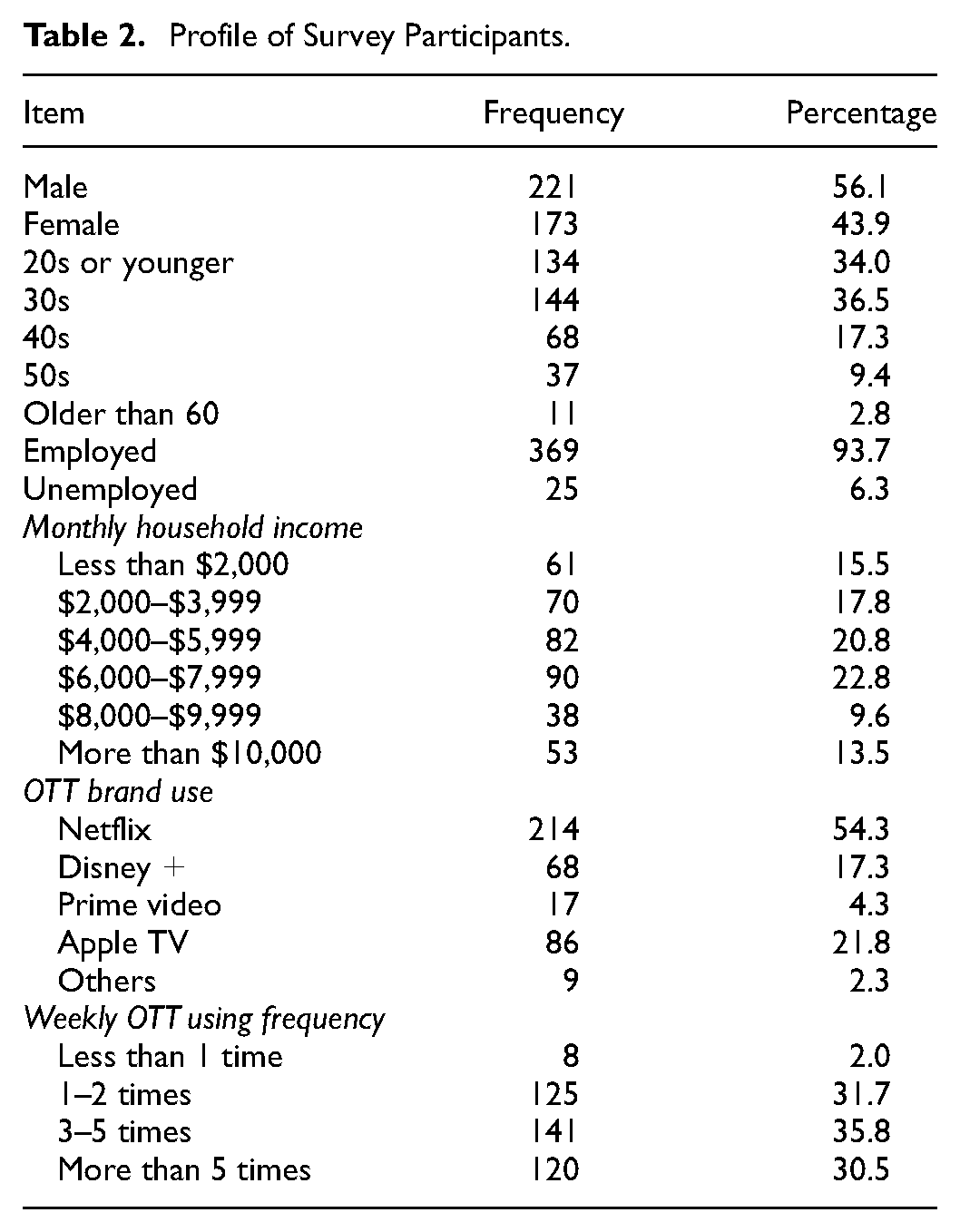
Table 2 shows the demographic information. There were 221 and 173 males and females, respectively. Table 2 presents the information on age (20s or younger: 134; 30s: 144; 40s: 68; 50s: 31; older than 60: 11) and monthly household income (less than $2,000: 61; $2,000–3,999: 70’ $4,000–5,999: 70; $6,000–7,999: 82; $8,000–9,999: 90; $2,000–4,000: 38; more than $10,000: 53). Regarding OTT brand use, Netflix is subscribed to by 54.3%, and Disney+ is subscribed to by 68%. The weekly OTT use frequency information is presented in Table 2.
Profile of Survey Participants.
Results of the Confirmatory Factor Analysis and Correlation Matrix
Table 3 shows the means and standard deviations of the variables (content diversity (mean = 4.22, SD = 0.64), content uniqueness (mean = 4.18, SD = 0.63), content recommendation (mean = 4.14, SD = 0.65), easy registration (mean = 4.18, SD = 0.70), navigability (mean = 4.22, SD = 0.65), ease of use (mean = 4.41, SD = 0.57), usefulness (mean = 4.22, SD = 0.60), attitude (mean = 4.35, SD = 0.57), and intention to use (mean = 4.33, SD = 0.62)). All factor loadings, construct reliability (CR), and AVE values met the criteria for validity. Moreover, the goodness of fit indices indicate that the model is statistically acceptable.
Confirmatory Factor Analysis Results and Descriptive Statistics.

Note. AVE = denotes average variance extracted; CR = denotes construct reliability, and SD = denotes standard deviation. χ2 = 1,476.223, df = 593, Q(χ2/df) = 2.489, RMR = 0.027, GFI = 0.811, NFI = 0.842, RFI = 0.823, IFI = 0.899, TLI = 0.886, CFI = 0.899, RMSEA = 0.062.
Table 4 is the correlation matrix. Most of the diagonal values are greater than the correlation coefficients. The results suggest that the discriminant validity appeared to be defensible. Moreover, intention to use positively correlated with content diversity (r = .689, p < .05), content uniqueness (r = .619, p < .05), content recommendation (r = .634, p < .05), easy registration (r = .671, p < .05), navigability (r = .646, p < .05), ease of use (r = .725, p < .05), usefulness (r = .714, p < .05), and attitude (r = .738, p < .05). Attitude was also positively correlated with content diversity (r = .653, p < .05), content uniqueness (r = .607, p < .05), content recommendation (r = .662, p < .05), easy registration (r = .716, p < .05), navigability (r = .718, p < .05), ease of use (r = .656, p < .05), and usefulness (r = .676, p < .05).
Correlation Matrix.

Note. Diagonal is the square root of the AVE.
p < .05.
Results of Hypothesis Testing
Table 5 shows the results of the structural equation model. Usefulness is positively affected by content diversity (β = 0.261, p < .05), content recommendation (β = 0.245, p < .05), and ease of use (β = 0.682, p < .05). Ease of use was also positively impacted by easy registration (β = 0.542, p < .05) and navigability (β = 0.292, p < .05). Additionally, attitude was positively influenced by usefulness (β = 1.227, p < .05). Finally, both usefulness (β = 0.635, p < .05) and attitude (β = 0.335, p < .05) positively affected intention to use. In sum, eight out of 10 hypotheses are supported.
Results of Hypotheses Testing Using the Structural Equation Model.

Note. χ2 = 1,401.654, df = 507, Q(χ2/df) = 2.765, RMR = 0.030, GFI = 0.806, NFI = 0.836, RFI = 0.818, IFI = 0.888, TLI = 0.876, CFI = 0.888, RMSEA = 0.067.
p < .05.
Table 6 shows the results of the Hayes process macro model 1 for testing the moderating effect. The model was statistically significant according to the F value (p < .05). The results also indicated that the usefulness × content diversity variable had a negative impact on intention to use. The coefficients of usefulness on intention to use in cases of content diversity are 3.55, 4.25, and 5.00, which are 0.4900 (p < .05), 0.4487 (p < .05), and 0.4045 (p < .05), respectively. The moderating effect is statistically significant according to the F values (p < .05).
Results of Hypotheses Testing Using Hayes Process Macro Model 1.
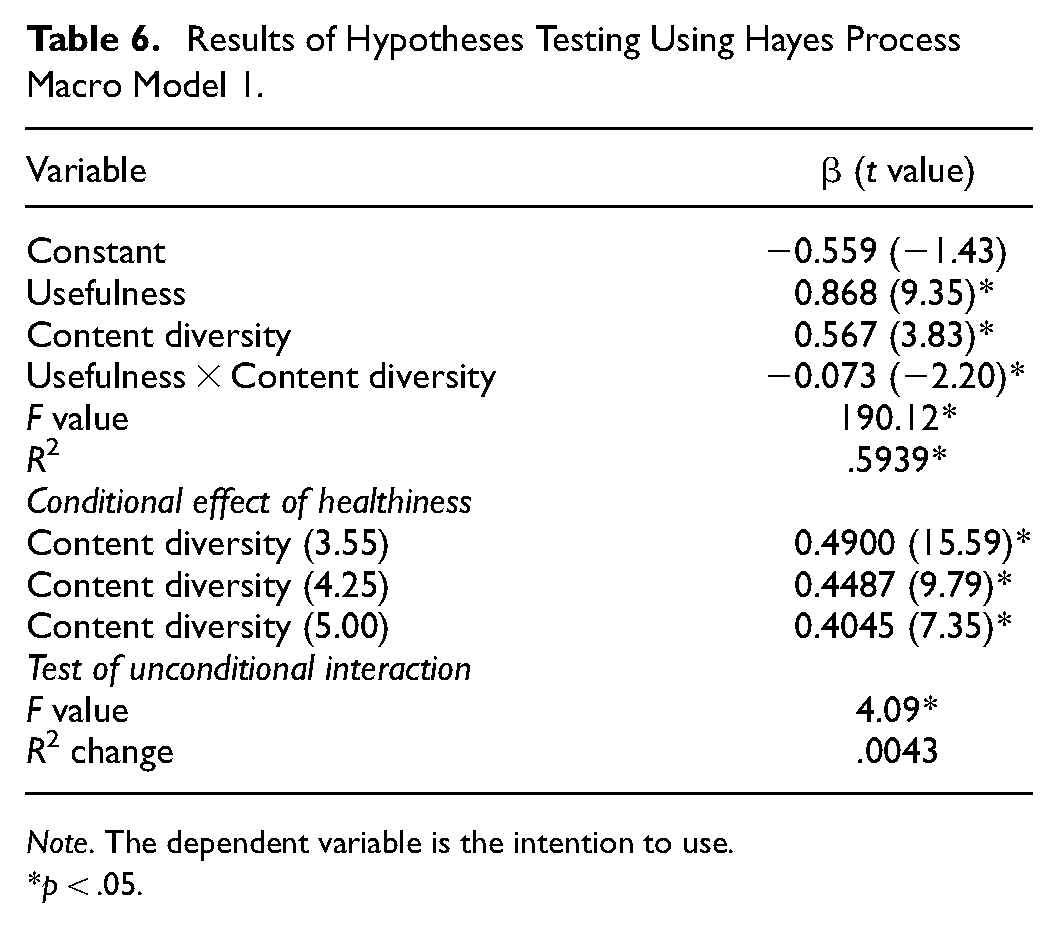
Note. The dependent variable is the intention to use.
p < .05.
Table 7 and Figure 2 show the results of the median split analysis. The results showed that the mean values of low usefulness with low content diversity and low usefulness with high content diversity were 3.74 and 4.37, respectively. Additionally, the mean value of the high usefulness and high content diversity group is 4.70, while the mean value of the high usefulness and low content diversity group is 4.42.
Results of the Median Split.

Note. Median usefulness = 4.25; median content diversity = 4.25.
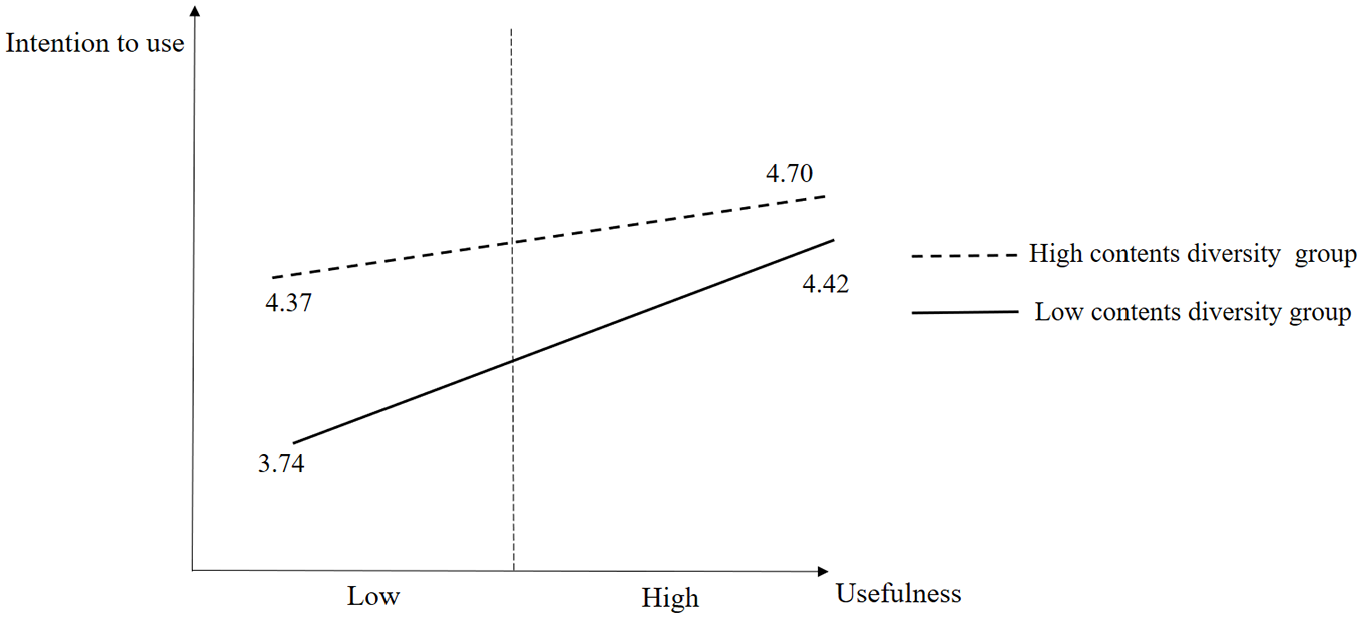
Results of testing the moderating effect using the median split.
Discussion
This study explored the behaviors of OTT service users. The TAM was the main theoretical approach. This research first scrutinized the determinants of ease of use and usefulness. Regarding the mean values of the variables, ease of use recorded the highest value, implying that users have few difficulties handling the OTT system. As determinants of usefulness, content diversity and content recommendation appear to be significant attributes. This indicates that OTT users were interested in various content and recommendation functions, which resulted in enhanced utility of OTT services from the user perspective. The magnitude of the effect of content diversity on usefulness is greater than that of content recommendation. This means that program diversity has a stronger effect on OTT users’ ability to attain utility using the service. Additionally, the results revealed that ease of use is positively related to the usefulness of OTT services. Ease of use has the strongest effect of the four attributes, given the argument that the complexity necessary to control such a system might add to the learning costs. However, content uniqueness was not significant in accounting for usefulness. This is because the unique content offered by OTT services is less likely to suit consumer tastes.
The results revealed that easy registration and navigability exerted a positive effect on ease of use. This suggests that OTT users perceived ease of use in controlling the system through easy registration and program searching processes. Considering magnitude, easy registration exerted a stronger impact on ease of use than did navigability, indicating that the entry barrier is more essential for an OTT service. With respect to the antecedents of intention to use, a positive attitude and a higher level of usefulness led OTT users to have a greater level of intention to use. While the results revealed the positive impact of usefulness on attitude, ease of use did not appear to be significant in determining attitude. The results differed from those of prior studies, which revealed a significant and positive association between ease of use and attitude (Hu et al., 2019; Jung et al., 2021; Moon et al., 2022b). Furthermore, this work revealed that content diversity exerted a significant moderating effect on the relationship between usefulness and intention to use. Specifically, groups perceiving a lower level of content diversity (from 3.74 to 4.42) showed a stronger effect of usefulness on intention to use than did groups with a higher level of content diversity (from 4.34 to 4.70). These findings contrast with those of the extant literature because content diversity has been considered sufficient in the extant literature (Saha, 2021; Sundaravel & Elangovan, 2020). However, this research demonstrates that content diversity is likely to cause undesirable outcomes for consumers in the domain of OTT services.
Conclusion
Theoretical and Practical Implications
This research contributes to the literature by identifying the antecedents of usefulness and ease of use of OTT services within the TAM. Namely, content diversity and content recommendation appeared to be critical determinants of usefulness, while ease of use was significantly affected by easy registration and navigability. This research contributes to the literature by demonstrating the explanatory power of the TAM in the area of OTT services. Thus, this research contributes to the literature by expanding the applicability of the TAM to the case of OTT users. Moreover, this work contributes to the literature by ensuring the association between usefulness, ease of use, attitude, and intention to use (Fussell & Truong, 2022; Moon et al., 2022a; Oyman et al., 2022). That is, the results of this research externally validated the outcomes of prior studies by employing the case of OTT service. Additionally, this work contributes to the literature by demonstrating the impact of choice overload in the domain of OTT. The extant literature indicates that excessive information provision is likely to become a weakness of OTT (Silva, 2021). Considering this argument, this research investigated whether content diversity significantly affects OTT user behaviors, and the results demonstrated the significant moderating effect of content diversity. This finding suggests there is an information overload problem with OTT services, which weakens the impact of usefulness on the intention to use OTT. Thus, this work clarifies the literature by finding a significant moderating impact of content diversity on the relationship between usefulness and intention to use. In other words, this work is valuable because it demonstrates that content diversity is not always beneficial from the perspective of consumers. Furthermore, this research clarifies the literature by demonstrating the explanatory power of linking the TAM with information overload in the domain of OTT by showing that the extant literature insufficiently considers both notions to account for user behavior.
This study has managerial implications. First, OTT service providers might focus on offering more varied content for users. This might be accomplished by producing more original content and establishing a friendly relationship with their content providers. Additionally, OTT service managers might invest more in content recommendation systems such as artificial intelligence and big data analysis. Such efforts might lead users to perceive the OTT system as more useful. Moreover, OTT users need to allocate resources to provide an easier system by simplifying the registration process and organizing content for better navigability, which might help consumers attain more utility from an easier system, resulting in positive attitudes and higher membership in the service. Next, OTT service managers must also budget more to determine how they can provide greater utility to consumers, which might be accomplished by researching consumers’ needs more. Additionally, OTT service managers might perform marketing to build better consumer attitudes. Additionally, making registration and building systems easier might improve the perception of both ease of use and usefulness, respectively, as well as be a more efficient use of resources. This could be achieved by ESG marketing and reasonable and diverse price option offerings for subscriptions. Additionally, OTT managers might also be able to consider the efficiency of the provision of OTT content because too much information may cause information overload. Therefore, strengthening and encouraging content recommendation functions through artificial engineering might be a key domain for business resource utilization.
Future Research Suggestions
This research is not without limitations. This study focused only on the linear relationships between variables. Future research could explore more complex psychological mechanisms of OTT users by examining either mediating or moderating variables. Additionally, future studies could consider a more diverse theoretical framework to inspect the characteristics of OTT users. Such an effort might allow researchers to better determine OTT user behaviors. This research focused only on the TAM to determine OTT user behavior. Researchers might be able to develop more diverse theoretical frameworks for future research. Such efforts might become an avenue for better understanding OTT users.
Footnotes
Declaration of Conflicting Interests
The author(s) declared no potential conflicts of interest with respect to the research, authorship, and/or publication of this article.
Funding
The author(s) received no financial support for the research, authorship, and/or publication of this article.

Data Availability Statement
Data sharing not applicable to this article as no datasets were generated or analyzed during the current study.