




Abstract
Self-monitoring—the ability to detect and correct errors during speech production plays an important role in second language production. Despite its importance, it has received little attention within English as a Foreign Language (EFL) contexts, particularly with regard to self-monitoring foci, speed, and its association with pausing behavior. This study aims to contribute to this area by investigating self-monitoring foci, speed, and the relationship between self-repair and pausing behavior within an EFL context. Sixty six EFL learners were recruited to perform picture-based description tasks. The research employed repeated measures and correlation analysis to address the research questions. The findings revealed that EFL learners frequently made more grammatical repairs compared to other repair types. Grammatical repair also took significantly longer to process than other repair types, implying that Grammatical repair might be challenging for EFL learners. Furthermore, the findings revealed a weak negative correlation between the frequency of Grammatical repair and pauses between clauses, suggesting that between-clause pauses in EFL speech might be associated with self-monitoring process. These insights shed light on the psycholinguistic aspects of self-monitoring in EFL contexts, carrying significant implications for research and theory.
Introduction
Self-repair is an important manifestation of L2 self-monitoring which entails checking internal and external speech against the existing linguistic system (Kormos, 2006). Self-repairs occur when speakers recognize an error or inappropriateness in their speech (Levelt, 1983). As a result, the speech flow is interrupted, and a correction is made to rectify the mistake (Levelt, 1983). To understand the psycholinguistic processes of self-monitoring, various theories have been proposed (see Postma, 2000, for review of self-monitoring theories), Among these, Levelt’s (1983) Perceptual Loop Theory (PLT) stands out as the most viable and extensively researched model in the field of psycholinguistics.
According to the PLT (Levelt, 1983, 1989), the comprehension system is employed to monitor both one’s own speech and that of others. This theory assumes that there are three loops that convey information to a central monitor: the conceptual loop, the inner loop, and the auditory loop. The conceptual loop assesses the suitability of messages within a specific context. The inner loop checks the speech plan before production, while the auditory loop checks speech after articulation. Within this framework, two types of repairs are identified: covert and overt repair (Levelt, 1983, 1989). Covert repair occurs at a prearticulatory level and is manifested through disfluencies such as hesitations, repetitions, and pauses. Overt repair occurs after articulation and encompasses various types, including D-repair (different-information repair), A-repair (appropriateness repair), and E-repair (error repair) (see Table 1). Empirical studies have supported Levelt’s PLT, validating its applicability in L1 speech production (Blackmer & Mitton, 1991; Broos et al., 2019; Hartsuiker et al., 2008; Levelt, 1999; Levelt et al., 1999; Oomen & Postma, 2001; Seyfeddinipur et al., 2008).
Repair Classification According to Levelt (1983, 1989).

As L2 speech processing is different in terms of slower processing, a higher likelihood of errors, and less automaticity compared to L1 processing (Broos et al., 2019; Kormos, 2006), researchers have attempted to validate the PLT in L2 contexts. Existing research evidence suggests that the implication of self-monitoring may differ for learners in a foreign language setting (Bardovi-Harliq & Dörnyei, 1998; Kormos, 2000b), particularly in contexts involving form-focused teaching (Kormos, 2000b). There is still a need to explore how self-monitoring foci, speed, and their relationship with pausing behavior manifest in an EFL context.
Literature Review
Self-Repair Types
Levelt’s (1983, 1989), speech model includes the conceptualizer, formulator, articulator, and monitor. The conceptualizer is the first stage of speech processing involves the generation of the preverbal message which includes the conceptual content of the message. Issues at this stage may result in the production of D-repair and A-repair (see Table 1). The second stage of speech production is the Formulator stage which is concerned with transforming the preverbal message into linguistic forms through assigning appropriate lexis, syntactic structure, and phonological aspects to the message. Error-repair (E-repair) can occur during this stage (see Table 1). The third component of speech production is the articulator which finally, executes speech, while the monitor revises speech both before and after articulation.
Kormos (1998) introduced the category of Grammatical-repair within the broader E-repair category, which differs from Levelt’s (1983) syntactic-repair. Specifically, syntactic-repair focuses on correcting the syntactic structure of utterances, while grammatical-repair encompasses corrections of both syntactic structures and grammatical errors, such as inflectional morphologies (e.g., tenses), auxiliaries (e.g., is, are), and prepositions that exhibit syntactic connections (e.g., “on” in “decided on”). In fact, the inclusion of a grammatical-repair category is valuable in the analysis of L2 speech since L2 speakers, unlike L1 speakers, may more frequently produce this type of repair due to their limited linguistic competence. Levelt’s (1983, 1989) taxonomy of self-repairs not only provides valuable insights into the nature of self-repairs but also serves as a valuable tool for categorizing and understanding the different types of repairs based on their alignment with specific speech stages.
Self-Monitoring Speed
Based on the principles of the Perceptual Loop Theory PLT (Levelt, 1983, 1989), the process of making repairs consists of three phases: monitoring or error-detection (the first phase), editing (the second phase), and making repair (the third phase). In the first phase (monitoring or error-detection), speakers produce an erroneous or inappropriate utterance, leading to a pause in the flow of speech (Levelt, 1989). The erroneous or inappropriate utterance is commonly referred to as the original utterance or the reparandum (Levelt, 1983, 1989). This interval represents the time required for error detection in one’s speech (Levelt, 1989). According to the PLT framework, speakers interrupt their utterances immediately upon detecting an error or inappropriateness, adhering to the Main Interruption Rule, which is particularly relevant in cases of E-repair involving erroneous information (Levelt, 1989). However, A-repair is an exception to this rule, as it does not involve any error. Consequently, speakers may interrupt their speech after completing the utterance (Levelt, 1989). Debate exists within the literature concerning this rule, with researchers arguing that this phase serves not only for error detection but also for planning the repair (e.g., Blackmer & Mitton, 1991; Broos et al., 2019; Oomen & Postma, 2001). Previous L1 studies have identified certain characteristics of this phase, indicating that it can be prolonged due to conceptual difficulties (see Broos et al., 2019; Hartsuiker et al., 2008). Nevertheless, it remains unclear whether this observation holds true for EFL learners, especially those with limited linguistic knowledge.
The second phase involves the production of silent and/or filled pauses preceding the production of the repair and is commonly referred to as the editing phase. According to the PLT (1983), this phase is optional in the structure of repairs, meaning that some repairs may not include this interval of filled or silent pauses. The primary function of this phase is to maintain the floor while planning the repair and to provide a signal or notification to listeners that a problem exists in the speech (Levelt, 1989). This phase is employed for re-planning, as pausing frees up processing components to prepare the correction for the erroneous utterance (Levelt, 1989). Research indicates that L1 speakers employ more editing terms in E-repair compared to A-repair (Levelt, 1989). The use of fewer editing terms in A-repair is attributed to the distinct nature of this type of repairs, as they are not primarily focused on correcting real errors but rather on adding further specifications to the speech (Levelt, 1983). However, Blackmer and Mitton (1991) proposed that re-planning might begin earlier during the first phase rather than being exclusively confined to the second phase. Research suggests that there are instances when speakers interrupt their speech only after the repair is prepared, aiming to keep the duration of pauses to a minimum level (Seyfeddinipur et al., 2008).
The third phase is executing the repair which involves the actual production of the repair and is also known as the “repair proper” (Levelt, 1983). It is assumed that in order to carry out the repair, the speaker needs to have access to the structural properties of the original utterance (Levelt, 1983). By utilizing the structural properties of the erroneous or original utterance, the speech fluency improves (Levelt, 1983). However, despite speaker’s efforts to correct the erroneous utterance, many repairs may not be entirely correct (Levelt, 1983). In short, while the three phases of various repair types have been thoroughly investigated in L1 speech, further research is essential to explore and validate these phases in EFL contexts.
Perceptual Loop Theory Premises
According to the PLT (Levelt, 1983), self-monitoring, drawing on cognitive resources, is sensitive to contextual factors. Given that L2 processing largely consumes cognitive resources (Kormos, 2006), self-monitoring is expected to be affected by different contextual factors such as task type, task condition, and type of instruction. Task types and conditions have been explored in several studies to understand their impact on learners’ self-monitoring processes. Various L2 studies have investigated the impact of task characteristics or task conditions on L2 self-monitoring (e.g., Albarqi & Tavakoli, 2023; Ahmadian et al., 2012; Ahmadian & Tavakoli, 2011). It has been shown that types of self-repair are affected by task structure and task condition, with less demanding tasks potentially leading to more accurate oral performance (Foster & Skehan, 1996; Garcia-Prone & Tavakoli, 2022; Kuiken & Vedder 2007), as the availability of attentional resources can allow learners to focus more on form and make more effective use of monitoring processes (see Kormos, 1999; Wang, 2014). Furthermore, the findings of Ahmadian et al.’s (2012) study revealed that participants, engaged in structured picture-based narratives, focused on correcting grammatical or lexical errors in their speech. It has been assumed that this task type directed learners’ attentional resources to the formulation and articulation stages rather than conceptualization (Ahmadian et al., 2012).
Self-monitoring foci may also be shaped by the methods used in teaching the target language. It has been argued that EFL learners in settings with a strong emphasis on explicit grammar instruction exhibit distinctive patterns in allocating attentional resources and making decisions about error corrections, differing from learners in second language environments or those instructed using communicative methods (Kormos, 2006). In Kormos’ (2000b) data, the similar rate of correction for both grammatical and lexical errors was attributed to the mixed type of instruction that the learners received, combining both form-focused and communicative approaches. Bardovi-Harliq and Dörnyei’s (1998) findings seem to support Kormos’s (2000b) assumption, as they indicated that grammatical errors were more important for speakers in a foreign language setting compared to those in a naturalistic environment. This implies that formal language instruction in the EFL context is likely to encourage learners to prioritize the correction of their grammatical errors. However, examining the impact of instruction on self-monitoring foci has rarely been conducted in EFL contexts.
Another premise of the PLT (Levelt, 1983) suggests that different self-repair types represent post-articulatory editing, where the speaker identifies and corrects the error after articulating the speech, known as overt repair. Another form is covert repair, occurring before articulating the utterance and making an error, suggesting that the speaker is monitoring or repairing their speech covertly prior to articulation, known as pre-articulatory editing. This type of repair often manifests through disfluencies such as hesitations, repetitions, and pauses. That is, when speakers anticipate an error, they produce pauses or repetition to buy time for correcting the error before articulation. In an L2 context, Williams and Korko (2019) investigated the relationship between L2 pause behavior (silent and filled pauses) and self-repair in lower intermediate and advanced groups. They focused on false starts and corrections, corresponding to Levelt’s classification of A-repair and E-repair, respectively. The study revealed that the lower intermediate group produced more silent pauses during error-corrections compared to the advanced group. However, they did not examine the relationship between different types of self-repair and the location of pauses. In other study, Albarqi and Tavakoli, 2023 (2023) delved into the self-monitoring behavior of L2 learners. Their findings indicated that the group with higher proficiency demonstrated greater accuracy and error correction rates while displaying fewer disfluency features. However, despite these results, they contested the notion proposed by Levelt (1983) that disfluencies are used as corrective measures in response to anticipated errors. Their study revealed that the increased frequency of disfluencies among the lower proficiency learners was not directly linked to their ability to anticipate and correct errors. The researchers highlighted the need for further research to examine the relationship between self-repair and pauses within L2 speech. In short, for a comprehensive understanding of self-monitoring in an EFL setting, researchers should investigate the foci and speed of self-monitoring, as well as the relationship between pauses and self-repair within an EFL context.
Research Questions
The primary objective of this study was to explore the foci and speed of self-monitoring in an EFL context, along with exploring the relationship between self-repair types and pausing behavior. Here are the research questions addressed in the study:
Methods
Design
The study employed a within-subject design, where each participant engaged in describing two different picture-based narrative tasks. The variables investigated in this study included various measures of self-repair and pauses.
Participants
The data were collected from 66 female undergraduate students who were native Arabic speakers. Their ages ranged from 18 to 23 years. All participants were pursuing an English major at a state university in Saudi Arabia and were enrolled in L2 English courses focused on linguistics and literature. The participants had received formal English instruction for approximately 8 to 9 years, both at school and university. Before participating in the study, learners underwent an institutionally developed grammar placement test, which resulted in their placement at levels equivalent to A2 and B1 of the Common European Framework of Reference for languages (CEFR). Prior to their involvement in the study, all participants provided formal consent, indicating their willingness to contribute to the research. To assess the participants’ oral proficiency for the study, an Elicited Imitation Test (EIT) was conducted (see Wu & Ortega, 2013). The EIT consisted of 19 sentences with an increasing number of syllables, spoken by a native speaker of English (Table 2).
Descriptive Statistics of Elicited Imitation Test.

The decision to employ an EIT in this study was prompted by previous research emphasizing the need for a reliable and valid assessment of L2 spoken proficiency when examining speech production (Tremblay, 2011). EIT, validated in multiple prior studies (e.g., Erlam, 2006; Gaillard & Tremblay, 2016; Isbell & Son, 2022; Wu & Ortega, 2013), has been shown to elicit speech samples resembling those produced spontaneously in natural language contexts (Baten & Cornillie, 2019; Erlam, 2006), making it suitable for assessing L2 processing and production. As part of a larger project, a previous study investigated the impact of proficiency on self-repair. The findings from the study revealed no statistically significant effects of proficiency levels on either the types of self-repair or their temporal phases (see Authors, 2023).
Materials and Procedures
The study employed two narrative tasks to elicit oral performance from EFL learners. The rationale for employing picture-based narrative task is that it is believed to encourage attention to both meaning and linguistic form (Skehan, 2009). This aspect is particularly crucial in self-repair studies, as previous research has indicated that the commonly used network description task tends to draw learners’ attention primarily towards lexical elements, potentially neglecting other foci of self-monitoring (Authors, 2023; Declerck & Kormos, 2012). The participants were asked to describe two picture prompts, explain how characters feel in each picture and why they may feel in that way (see Appendix 1).
Coding
Measures of Self-Repairs and Their Temporal Phases
According to Levelt (1983, 1989), three phases of repair exist: monitoring or error-detection, editing, and repair phases. These three phases of self-repair were operationalized by Kormos (2000a) as follows: the Error-to-cut-off phase (first phase), the Cut-off-to-repair phase (second phase), and the repair production phase (third phase). The frequency of self-repair instances was calculated per 60 s in the speech sample. Research on the temporal phases of self-repair has been relatively limited within the context of L2 studies. Previous research has employed various measurements for these phases, with some studies, like Levelt (1983), quantifying them by counting the number of syllables, while others, such as Kormos (2000a), measured the durations of these phases in seconds.
In the present study, the temporal phases of repair were assessed in seconds using PRAAT (Boersmal & Weenink, 2008), as depicted in Figure 1. The coding procedures outlined by Levelt (1983) were employed to analyze these phases of repair. To assess interrater reliability, 10% of the data was coded by an expert rater, yielding a high consistency rate of 92% among raters. This led to the conclusion that a satisfactory level of interrater reliability was reached.
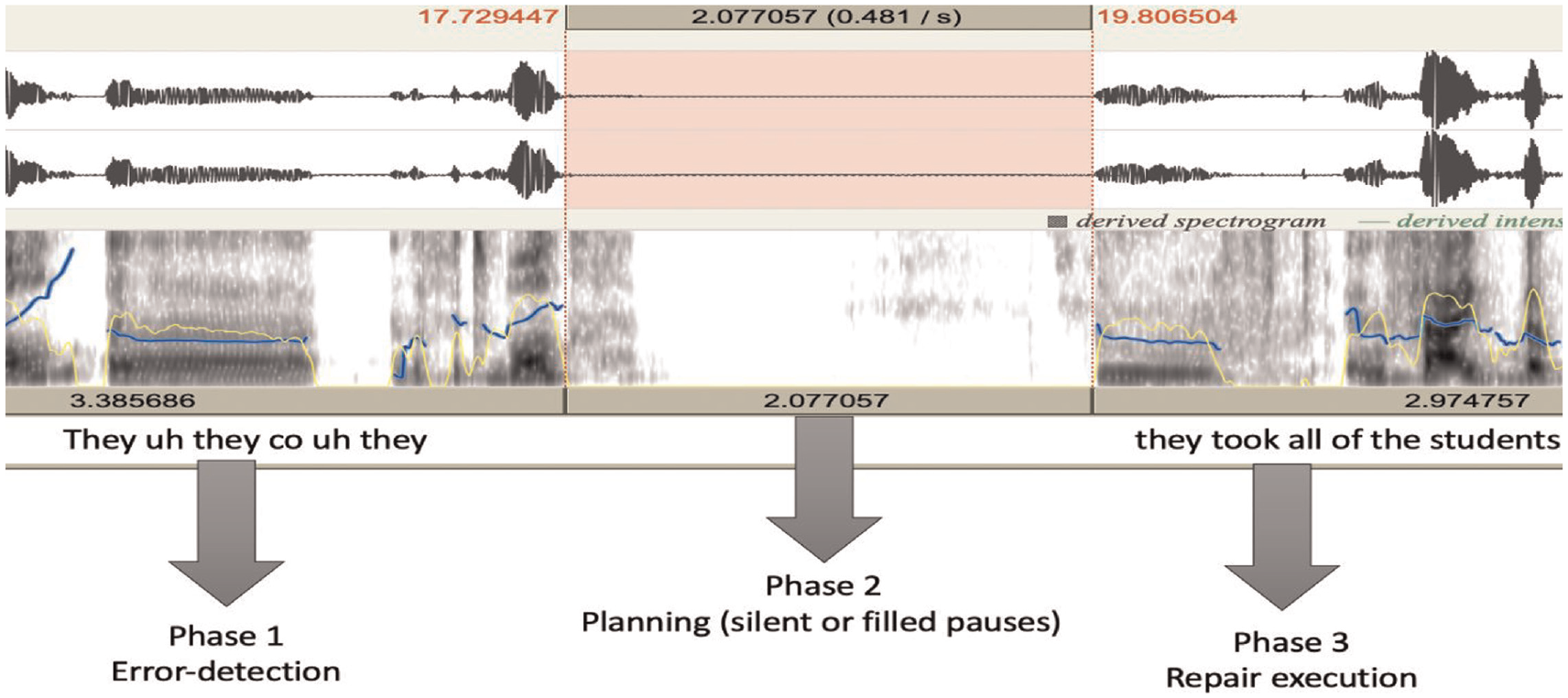
Measuring temporal phases of repair in seconds.
Error-To-Cut-Off (Phase 1)
The duration of the first phase of repair was measured in seconds, starting from the onset of the erroneous or inappropriate word or phrase to the moment of interruption. Any hesitation or repetition occurring within this phase was calculated as part of this phase.
Cut-Off-To-Repair (Phase 2)
During this phase, speakers encounter periods of silent and/or filled pauses before commencing the repair process. The duration of this phase, measured in seconds, encompasses the time from when speech flow stops to when speech resumes. It is worth noting that certain repairs may not entail this interval. This phase serves the dual purpose of maintaining the floor while planning the repair and signaling to the listener that there is a processing difficulty (Levelt, 1983). In cases where both filled and silent pauses were present in this phase, their combined duration was calculated as a single unit.
Repair (Phase 3)
This phase is referred to as “the correct version of what was wrong before” (Levelt, 1983, p. 44). In the repair phase, speakers execute corrections to erroneous or inappropriate utterances. Speakers may retrace their utterances without providing a real correction. The duration of this phase is measured in seconds, starting from the end of interruption to the end of the repair.
Measures of Pauses
Pause measures include filled pauses, and silent pauses occurring within and between clauses. To ensure accuracy in calculating silent pauses, a reliable threshold of 0.25 s was adopted in line with Kormos and Dénes’s proposal (2004). In L2 studies, silent pauses are categorized based on their locations (see Lambert et al., 2017; Skehan et al., 2016; Tavakoli, 2011). Specifically, two types of silent pauses are identified: those occurring within clauses and those between clauses (Lambert et al., 2017; Skehan et al., 2016; Tavakoli, 2011). This study examined the frequency and duration of silent pauses within and between clauses (see Table 3).
Measures and Definitions of Pauses.

Results
The data analysis in this study employed one-way repeated measures ANOVA to address the first two research questions, while Pearson Product-moment Correlations Coefficient was conducted to answer the third research question. Table 4 presents the descriptive statistics for different repair types (A-repair, D-repair, Lexical repair, Phonological repair, Grammatical repair), and Table 5 for the temporal phases of repairs.
Descriptive Statistics of Frequency of Repair Types.

Descriptive Statistics of Duration of Repair Phases in Seconds.

Repeated Measures Analysis of Variance
Repeated measures ANOVA was conducted to examine the differences among types of repairs (A-repair, D-repair, Lexical-repair, Phonological-repair, Grammatical-repair), and their temporal phases measured in seconds. These measures were submitted to repeated measures ANOVA as within subject-variables. By examining the variations in these measures, the study seeks to gain a deeper understanding of the underlying speech processes involved in self-monitoring behavior of EFL learners.
Repeated measures within-subject analysis indicated that there were significant differences among different types of repairs and their temporal phases. Wilks’ Lambda = .34, F(16, 116) = 9.44, p < .000, partial eta squared = .57. This suggests that there are substantial variations in both the types of repairs and their temporal phases in EFL oral production.
Bonferroni adjustment was applied for the pairwise comparisons. In this case, the significance level was adjusted to .0125 (.05 divided by 4) (See Tables 6–9). By implementing Bonferroni correction, the analysis becomes more stringent.
Repeated Measures ANOVA: Pairwise Comparison Among Self-Repairs.

Note. N = 66; *Corrected alpha level of p < .0125; L-repair = Lexical-repair; Ph-repair = Phonolological-repair; G-repair = Grammatical-repair.
Repeated Measures ANOVA: Pairwise Comparison Among Self-Repairs on Phase 1.

Note. N = 66; *Corrected alpha level of p < .0125; L-repair = Lexical-repair; Ph-repair = Phonolological-repair; G-repair = Grammatical-repair.
Repeated Measures ANOVA: Pairwise Comparison Among Self-Repairs on Phase 2.
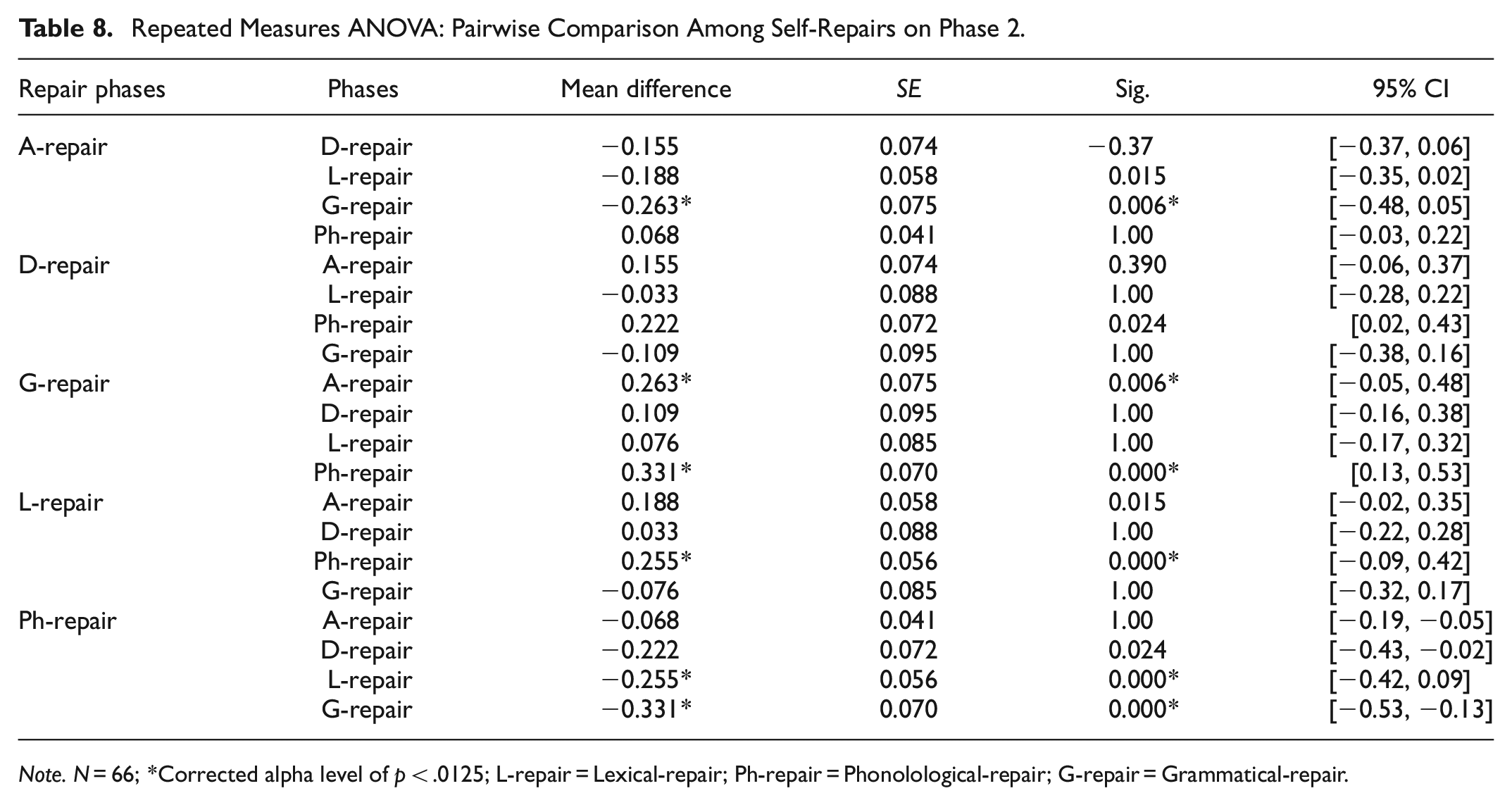
Note. N = 66; *Corrected alpha level of p < .0125; L-repair = Lexical-repair; Ph-repair = Phonolological-repair; G-repair = Grammatical-repair.
Repeated Measures ANOVA: Pairwise Comparison Among Self-Repairs on Phase 3.

Note. N = 66; *Corrected alpha level of p < .0125; L-repair = Lexical-repair; Ph-repair = Phonolological-repair; G-repair = Grammatical-repair.
Figure 2 illustrates that Grammatical repair was the most frequently occurring repair type. However, Table 6 revealed that it is significantly more prevalent than both Phonological repair and D-repair in EFL speech. This suggests that EFL learners tend to engage in more Grammatical repairs compared to repairs related to phonological aspects of their utterances, and repairs that associated with replacing inappropriate messages in their speech (See the Literature Review section for further details about D-repair). The higher frequency of Grammatical repair in the context of the study indicates that EFL learners are more likely to focus on correcting and adjusting their grammar or syntax during speech production.

Means of frequency of repair types.
Regarding the data on the phases of repair production, Figure 3 illustrates that Grammatical repair involves the slowest processing of the three phases of repair, compared to other repair types. In the first phase of repair, Table 7 demonstrated that EFL learners were able to quickly halt their speech when making phonological errors. That is, they were able to detect Phonological errors more quickly compared to other types of repairs, except for Lexical repair as demonstrated in Figure 3. This suggests that self-monitoring likely has a heightened sensitivity and ability to quickly detect phonological errors in EFL speech.

Means of temporal phases of repair.
It is also shown that EFL learners were considerably slower in detecting Grammatical errors in their speech as compared to both Lexical and phonological repair. This might indicate that grammatical errors may be more challenging for EFL learners to recognize and address promptly during the processing and production of their speech. Regarding the second phase of repair, Table 8 revealed that, among the E-repairs (Grammatical-repair, Lexical-repair), Phonological repair had the shortest duration in this phase. In other words, EFL learners required the least amount of time to plan Phonological repair compared to other E-repair types. On the other hand, Grammatical repair took considerably longer time during this phase compared to A-repair and Phonological repair (see Figure 3). This finding suggests that EFL learners may face greater difficulties in planning Grammatical repair compared to planning Phonological repairs or A-repairs. It implies that EFL learners may encounter more challenges when it comes to identifying and correcting grammatical errors in their speech. Further elaboration and discussion on this point can be found in the Discussion section.
Similarly, the analysis of the third phase of repair revealed that among the different types of repair, Phonological-repair stood out as having the shortest duration in this phase as can be seen in Table 9. This indicates that EFL learners were able to execute Phonological-repair relatively quickly compared to other types of repair.
In summary, the findings of the current study indicate that Grammatical-repair occurs more frequently compared to both Phonological-repair and D-repair. This suggests that EFL learners tend to prioritize grammatical repairs over repairs related to phonological aspects of their speech, as well as repairs associated with replacing inappropriate messages in their utterances.
Additionally, an interesting observation was made regarding the time intervals involved in Phonological-repair. Phonological errors were detected in the shortest interval as compared to other types of repair (except for Lexical-repair). Furthermore, Phonological-repair was planned and executed in the shortest duration which suggests that EFL self-monitoring may be particularly sensitive to phonological features, which might be easier to detect, plan, and execute. The finding also showed that EFL learners may face greater difficulties in identifying and planning Grammatical repair compared to certain types of repairs. The tendency to prioritize grammatical repairs in EFL speech, and the rapidity in detecting, planning, and executing Phonological repair suggest a nuanced relationship between certain linguistic aspects and the self-monitoring mechanisms utilized by EFL learners.
Pearson Product-Moment Correlation Analysis
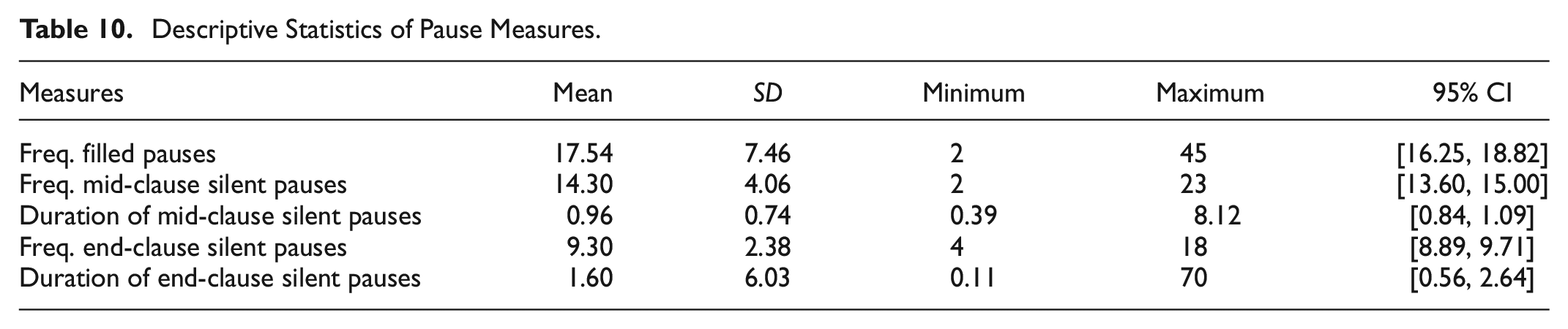
Pearson product-moment correlations were conducted to examine the relationships between the frequency of self-repair and pausing behavior. Prior to this analysis, preliminary assessments were carried out to ensure that the assumptions of normality, linearity, and homoscedasticity were not violated. The interpretation of the correlation analysis followed Plonsky & Oswald’s (2014) field-specific benchmarks: r = .25 indicated a small effect size, .40 indicated a medium effect size, and .60 indicated a large effect size. Table 4 presents a summary of the descriptive statistics related to EFL learners’ self-repair, while Table 10 contains the descriptive statistics for pauses.
Descriptive Statistics of Pause Measures.
In Table 11, the analysis reveals a significant negative correlation between the frequency of between-clause pauses and the frequency of grammatical repairs, r = −.26, n = 66, p < .002. Despite the small effect size, this finding suggests an interesting relationship between these two variables. Notably, as the frequency of end clause pauses increases, the frequency of grammatical repairs decreases. While the current study does not specifically investigate the relationship among pauses, it is noteworthy that the frequency of pauses within clause boundaries showed a negative correlation with pauses between clauses, r = −.23, n = 66, p < .009. This suggests that these two types of pauses may have distinct functions in EFL speech. Further discussion on this topic can be found in the upcoming section.
Pearson Product-Moment Correlations: The Relationships Between L2 Self-Repair and Pausing Behavior.

Note. Freq = frequency; mid-clause = within clause pauses; end-clause = pauses between clauses.
Correlation is significant at the .05. **Correlation is significant at the .01.
Discussion
The primary objective of the present study was to examine the foci and speed of self-monitoring in an EFL context. It also aimed to investigate the relationship between self-repair and pausing behavior in EFL speech. The oral data were coded in terms of frequency and duration of repair types and pauses per minute. Repeated measures analysis of variances (ANOVA) was employed to address the first two research questions and correlation analysis was conducted to answer the third research question. This section will provide discussion of the findings in relation to previous research and relevant theoretical frameworks.
Self-Monitoring Foci
The first research question examined the monitoring foci in EFL speech. The results indicated a higher frequency of Grammatical-repair compared to other types of repairs, specifically Phonological-repair and D-repair. This indicates that EFL learners tend to prioritize the correction and adjustment of grammatical errors during speech production. The monitoring process, as proposed by Levelt (1983), serves two purposes: inspecting messages for intention/meaning and linguistic deviancy. A-repair and D-repair reflect the former, while E-repair relates to the latter. This finding implies that EFL learners may emphasize correcting linguistic deviancy, particularly addressing grammatical errors, within their speech. Two possible explanations for this result can be considered. First, the inherent controlled nature of self-monitoring makes it sensitive to contextual factors (Levelt, 1989) such as task type. This controlled nature of self-monitoring involves cognitive resources that are both limited (Skehan, 1998) and selective (Schmidt, 2001). In this study, the use of picture-based narrative prompts, as opposed to network description tasks used in previous studies (e.g., Levelt, 1989; Declerck & Kormos, 2012), might direct learners’ attentional resources to the formulation stage, resulting in the production of Grammatical-repair. In Ahmadian et al.’s (2012) study, EFL participants engaged in structured picture-based narratives were primarily focused on rectifying both grammatical and lexical errors in their speech. Variations in these results might be attributed to other factors, including differences in the teaching methods employed in both contexts.
The second factor that may affect self-monitoring foci in this study is the type of instruction used for the target language. EFL speakers in settings with a strong emphasis on explicit grammar instruction exhibit distinctive patterns in allocating attentional resources and making decisions about error corrections, differing from learners in second language environments or those instructed using communicative methods (Kormos, 2006). In Kormos’s (2000b) findings, learners demonstrated balanced attention to both Grammatical and Lexical repairs. This monitoring focus was explained in terms of the mixed teaching methods which involved both form-focused and communicative activities (Kormos, 2000b). Form-focused instruction in the EFL context of the study is likely to prompt learners to prioritize correcting their grammatical errors. In conclusion, the examination of monitoring foci in EFL speech revealed a pronounced emphasis on Grammatical-repair, suggesting a prioritization of correcting grammatical errors during speech production.
Self-Monitoring Speed
The second research question aimed to examine the speed of self-monitoring across different repair types. The findings showed that EFL learners were considerably slower in detecting grammatical errors in their speech as compared to both lexical and phonological errors. Grammatical repair also required a significantly longer time during the planning phase (editing phase) compared to A-repair and Phonological repair. According to Levelt’s (1983) PLT, speech monitoring relies on the comprehension system as the inner and outer loops are based on the speech comprehension system. All information from these loops is directed to a central monitor that assesses whether a problem has occurred. The extended duration of error-detection and editing phases of Grammatical-repair suggests that there may be comprehension difficulties encountered in detecting errors and replanning Grammatical repairs. EFL learners may have inadequate linguistic knowledge, thus they need long time to check their utterance for grammatical errors and to replan the repair. This result supports the notion that achieving grammatical accuracy in L2 production is a demanding task that necessitates a profound comprehension of the target language’s grammar (Ellis, 2006). A delay in detecting grammatical errors and replanning repair could thus be attributed to inadequate linguistic knowledge among EFL learners, which may extend the processing of grammatical repair.
Phonological errors, on the other hand, were detected in the shortest duration among the other types of repairs, with the exception of Lexical-repair. The quick detection of Phonological-repair is indicative of error-detection phase, where speakers identify errors and interrupt their speech to initiate a repair. This rapid response to phonological errors reflects the immediate recognition of deviations from the intended linguistic form. The finding is similar to previous studies (Blackmer & Mitton, 1991; Van Hest, 1996; Verhoeven, 1989), which suggest that phonological detection time was the shortest among other repairs. This finding could be explained in terms of Levelt’s (1983) model, where the correction route for phonological errors is assumed to be the shortest because the information needed for phonological encoding becomes available first in speech perception (Van Hest, 1996), making the detection of phonological errors faster than syntactic and semantic errors. Another reason for this, according to Verhoeven (1989), is that a phonological form can be immediately interrupted, while determining semantic or syntactic inappropriateness/incorrectness requires completion of a larger portion of the utterance. In the current findings, there is no significant difference between Phonological repair and Lexical repair in this phase, possibly due to limited vocabulary knowledge of EFL learners who may work with limited number of familiar words. Consequently, when they realize an error, they can quickly halt their speech to make a correction.
Regarding the editing phase (second phase), the Phonological repair demonstrated the shortest time duration among repair types, with the exception of A-repair. The rapid replanning of Phonological repair can be attributed to the fact that they do not entail major restructuring of the utterance; rather, they can be addressed by simply retrieving the correct phonological forms of the lexical elements from memory. Interestingly, the results revealed no significant differences between Phonological repair and A-repair in this phase, indicating a quick replanning process for A-repair in the current data. It has been observed that, during A-repair processing, “L2 speakers only need to make minor changes in the informational content of the preverbal plan” (Kormos, 2000a, p. 159). The short editing phase in A-repair can be attributed to its unique nature, which is not mainly geared towards correcting actual errors but on adding additional specifications to the speech (Levelt, 1983). However, Blackmer and Mitton (1991) proposed that re-planning might commence earlier, not exclusively restricted to the second phase. This assumption aligns with Seyfeddinipur et al. (2008) who observed that speakers interrupt themselves not when they detect the problem but when they are ready to produce the repair. In short, the minor adjustments to informational content in A-repair, as well as to linguistic form in Phonological repair, likely necessitate the shortest duration for replanning among other repair types in EFL speech.
The length of the third phase (Repair) is also the shortest in Phonological repair. This interval is used for producing the actual correction, implying that the repair has already been replanned in the preceding phase. Given that Phonological repair involves minor adjustments to linguistic structure, the execution of this phase is the shortest among other types of repairs. Similarly, in Grammatical repair, this phase is short and comparable to Phonological repair. It is important to note that the second phase is prolonged in Grammatical repair, providing speakers with an opportunity to replan and process the repair, while the final phase is exclusively used for executing the repair. In short, the differences observed in the temporal phases of repairs provide valuable insights into the self-monitoring mechanisms employed by EFL learners during speech production. The findings also highlight the challenges associated with achieving grammatical accuracy in EFL speech.
The Relationships Between Self-Repair and Pausing Behavior
The third research question explored the relationship between self-repair and pausing behavior in EFL speech. Initially, it is important to highlight a significant negative correlation between pausing within clauses and between clauses in the present data. While the correlation is weak, it implies distinct functions for these two types of pauses in EFL speech (see Kahng, 2024). Some researchers (e.g., Huensch, 2023; Kormos, 2006; Skehan et al., 2016; Tavakoli, 2011) propose that within clause pauses may indicate formulation difficulties due to limited lexicon of L2 learners, while pauses between clauses are associated with planning and monitoring (Kobayashi, 2023). Thus, when L2 learners pause between clauses, they might be engaged in higher-level cognitive processes, such as monitoring and planning their speech before proceeding to the next utterance.
The findings reveal a significant negative correlation between the frequency of Grammatical-repair and pausing between clauses, suggesting an interesting relationship. As pauses between clauses increase, the frequency of grammatical repairs may decrease. This implies that L2 learners might strategically use pauses between clauses, possibly for planning and monitoring their utterances for potential grammatical errors. If they detect errors during this planning phase, they might revise their speech on-the-fly, minimizing need for grammatical repairs later on. This assumption aligns with earlier research indicating that L2 learners tend to concentrate more on grammatical rather than conceptual aspects when they pause at the end of a clause (Fukuta & Tamura, 2017). In essence, these pauses seem to serve as moments for learners to review and consider the structure and accuracy of the sentences they are constructing in the target language. Nonetheless, it is important to acknowledge that the interpretation presented here is only tentative and relies on a weak correlation. Therefore, these results should be approached with caution. Further research would be needed to draw more concrete conclusions about the implications of this correlation.
Conclusion
The present study aimed to investigate self-monitoring foci, speed, and the association with pausing behavior within an EFL context. The research findings underscored Grammatical repair as the predominant aspect of EFL speech, being the most frequent, requiring the longest duration for detection and replanning, and showing a negative association with pauses between clauses.
An explanation for these findings could be attributed to the importance of grammar in EFL classrooms. The focus on accurate grammar within L2 setting has been assumed to arise from the recognized significance of grammatical proficiency in language learning and production (DeKeyser, 2010; Kormos, 2000a; Krashen, 1981). These findings align with the assumption that the teaching method may influence the importance L2 learners place on linguistic accuracy (Kormos, 2000b). Given the prevalent use of form-focused instruction in English teaching within the study’s context, EFL learners may tend to prioritize grammatical accuracy. Exposure to form-focused instruction can lead learners to “believe that grammatical accuracy is very important for successful communication, and grammatical errors should be regarded as serious flaws in one’s performance” (Kormos, 2000b, p. 372). Thus, EFL learners’ endeavors to showcase their command of the target form may indicate the influence of instructional method on self-monitoring tendencies within the study’s context. As such, EFL teachers may need to consider making use of both form-focused and communicative instructions to enhance different aspects of EFL speech.
The delay experienced by EFL learners in processing Grammatical-repair can be ascribed to potential gaps in their linguistic knowledge. This delay might be beneficial for EFL learners as it can direct learners’ attention to specific linguistic forms they may struggle with due to incomplete linguistic knowledge. It has been assumed that self-monitoring can direct learners’ attention to gaps in their knowledge of the target language, thereby trigerring further learning processes (see Izumi, 2003; Kormos, 1999, 2006; Swain, 1985). Future research should incorporate retrospective interviews to explore whether the delay in processing Grammatical repair draws EFL learners’ attention toward recognizing gaps in their knowledge of the target language, to assess the extent to which this recognition contributes to the learning process. Similarly, there is a need for future research to examine the particular challenges faced by EFL learners in self-monitoring and the strategies they employ to overcome these challenges. The current finding holds practical implication, suggesting that the delay observed in processing grammatical repairs can serve as a beneficial self-monitoring mechanism for EFL learners. Consequently, it is advisable for EFL teachers to provide students with ample time during speaking activities, enabling them to identify areas of linguistic challenge, and work to correct the errors in their speech.
The current findings also revealed a significant negative correlation between the frequency of Grammatical-repair and pausing between clauses. This finding implies that pausing between clauses is not merely a hesitancy marker but a strategic tool used by L2 learners to monitor linguistic accuracy. It is important to approach the interpretation of this finding cautiously, given the weak correlation observed. Future research should consider employing retrospective interviews to investigate the potential role of distinct types of pauses and their connection to self-repair. In terms of practical implications, EFL teachers should guide learners in understanding the purposeful nature of pausing and encourage them to utilize pauses effectively during speaking tasks (for further details on enhancing fluency, see Tavakoli & Wright, 2020). By integrating awareness of pausing strategies into language instruction, teachers can empower learners to enhance their self-monitoring practices and fluent speech production.
To conclude, the findings should be approached with caution as this study has some limitations that need to be acknowledged. Firstly, the sample size was relatively small, which may limit the generalizability of the findings to a broader population of EFL learners. Including a broader demographic and cultural range in future research would not only improve the study’s external validity but also its relevance to diverse EFL learning contexts. Secondly, this study utilized only one type of task, namely picture-based narrative prompts. Using a variety of tasks and contexts may have provided a more comprehensive picture of self-repair behaviors in different situations.
Footnotes
Appendix
Declaration of Conflicting Interests
The author declared no potential conflicts of interest with respect to the research, authorship, and/or publication of this article.
Funding
The author disclosed receipt of the following financial support for the research, authorship, and/or publication of this article: The researcher would like to acknowledge Deanship of Scientific Research, Taif University for funding this work.
A Statement Concerning Research Involving Human Participants
This study involved research with human participants and adhered to ethical standards and guidelines set forth by Taif University. The ethical procedure was reviewed and approved by the School Ethics Committee
A Statement of Informed Consent
Informed consent was obtained from all participants involved in this research study. Participants signed a consent form and an information sheet which had a description of the study. Each participant was given a copy of the signed consent form and another copy was kept with the researcher. The researcher told the participants that their privacy and confidentiality will be protected and that they are free to withdraw from the study at any time.

Data Availability Statement
Data sharing not applicable to this article as no datasets were generated or analyzed during the current study.