




Abstract
Cooperative learning and differentiated instruction have recently attracted a lot of attention as they are considered by educators and teachers to play significant roles in motivating learners and promoting interactive learning. The present study aims to examine English teachers’ views about the effectiveness of the practice of cooperative learning and differentiated instruction in enhancing students’ learning in English language classes. A sequential mixed method was used to collect the necessary data to answer the research questions. A questionnaire was first sent to 200 English language teachers, and then the researchers conducted focus group interviews with eight teachers. The findings of the study reveal that English language teachers consider cooperative learning as a valuable instructional procedure for promoting learners’ engagement, classroom social interaction, cultural appreciation, and differentiated instruction. The present study’s findings may have implications at all levels, such as teacher training, academic administration, curriculum designing, and decision making. Applications of those findings may attract the attention of others beyond the English classes. In addition, the findings may provide valuable guidance for researchers and educators to carry out large scale studies on the practice of cooperative learning and differentiated instruction in English language classes within the present study’s context and beyond.
Introduction
Cooperative learning and differentiated instruction have recently drawn the attention of more educators and teachers due to their key roles in creating an interactive learning environment. The purpose of the study is to explore teachers’ perceptions about the benefits of structured cooperative strategies in teaching English as a second language (ESL) in creating an engaging learning environment that helps learners acquire ESL within a frame that is socially, culturally, and academically enriching. The study also intends to investigate ways with which cooperative learning (CL) strategies give room for effective differentiated instruction that fosters student-centered learning and teachers’ facilitation of second language acquisition especially when we consider the local context of the United Arab Emirates (UAE) as a country that is embarking on ambitious national agendas and global educational initiatives, such as 21st century learning (Cavanaugh, Hargis, Munns, & Kamali, 2012).
Since the evolution of the UAE as an independent country in 1972, there has been emphasis by its rulers and governing bodies to build well-educated citizens who can cope with the requirements of today’s life and the global community. Within the UAE context in particular and the Arab context in general, the teacher is considered to be a central figure in the classroom (Abdulghani, 2003). This particular factor explains to a great extent the dominance of the teacher-centered education in most schools in the UAE. Hence, one of the educational practices that was advocated by different scholars in the UAE was the development of a learning environment that can promote interaction, collaboration, and critical thinking as pivotal premises to achieve educational excellence in the country (Abdulghani, 2003; Al Allaq, 2016). Building on the aforementioned issues and with reference to the UAE National Agenda for instance, it can be clearly discerned that the UAE today has rapidly become a state of constant and dire search for current trends in teaching and learning to assist in promoting the national learning outcomes. Thus, there is an immediate need for exploring and implementing appropriate procedures to assist the enhancement of the whole process of education (Gunn, 2013). These objectives might be accomplished by creating a more interactive and student-centered learning environment. Also, they may be achieved though the practice of CL and differentiated instruction to respond to students’ multiple needs to achieve their goals (Ismail & Al Allaq, 2018). Accordingly, new instructional methods and practices are needed to be implemented to replace the existing ones (Al Subaihi, 2012). In addition, in foreign and/or second language teaching and learning environments, a number of elements may represent real barriers for any kinds of effective English language learning to occur, such as students’ noncompliance, indifference, unwillingness to work together collaboratively, anxiety, and disappointment. In this regard, Krashen (1981) asserted that if the students’ “Affective Filter” or anxiety is very high, then they will find difficulty in processing the “comprehensible Input” that is considered by Krashen as a prerequisite for learning to take place. To assist students in reducing the amount of their anxiety and to learn better, it is very important to plan and create an interactive and CL environment. Therefore, the main focus of the present study is to investigate teachers’ perceptions about the practice of CL and differentiation in UAE’s private schools.
Another fundamental factor that gives rationale to the exploration of CL to enhance language proficiency is the national initiative of the Ministry of Education to eliminate the foundation year program in tertiary education by raising the standards of language teaching and students’ performance in the four English skills (Ministry of Education Strategy 2010-2020). Moreover, the Ministry of Education has adopted the “Student Competency Framework” (SCF) in differentiated instruction as a pivotal base to accurately determine students’ language proficiency level and to work on improving it regardless of the student’s grade level (Bourini, 2015).
Significance of the Study
When it comes to the UAE context, there is a national consensus on the need to refine the educational system and embrace collaboration and active learning as a catalyst for constructing and gaining knowledge. Hence, educators and researchers in the UAE have made several recommendations that document the dire necessity to make changes in the teaching method by introducing CL. The UAE’s aim has been to establish a prominently effective educational context for its people and residents in the continuously evolving and changing knowledge-based type of economy that cannot be actualized without the interplay between several factors, such as critical thinking, reasoning, problem solving, and cooperative leaning (Alkhateeb & Jumaa, 2002). Based on that, the study will add a body of knowledge that would contribute to the strategies that can consolidate such national and global initiatives that the UAE has embarked on and is keen on actualizing and facilitating.
Conceptual Background of Cooperative Learning
Several definitions attempt to clarify the meaning of CL. Olsen and Kagan (1992) contended that CL is a group learning activity that is set, so that learning depends on the exchange of information between students when they are working together within a context of individual accountability and motivation to enhance mutual learning. This definition illuminates the principles of communication, interaction, individual accountability, and above all cooperation. Other definitions illustrate and highlight the shared goal that learners usually have in a CL classroom. According to Ormord (2011), CL is an “approach to instruction in which students work with a small group of peers to achieve a common goal and help one another learn” (p. 443). Not only do students work together in this context, but they also enrich and complement each other’s learning in a way that enhances social awareness, communication skills, and language learning competence.
Different studies emphasize the role of CL in fostering students’ motivation and refining teaching and learning (Ara & Akter, 2013; Azizinezhad, Hashemi, & Darvishi, 2013; Goodman, 2016; Thanh, 2013; Zhou, 2012). Thus, the theoretical framework along with the related studies present substantial evidence that sheds light on the plethora of constructive academic, social, cultural, and pedagogical outcomes of applying systematic CL in the English classroom.
Theoretical Framework of Cooperative Learning
Vygotsky (1983) highlighted the sequential relationship between CL and independent learning by indicating that what children can do together today, they can do unaided tomorrow. This statement summarizes how collaborative effort may forge an independent learning experience, yet it is essential to indicate that the learning autonomy does not necessarily mean that the future of CL is the formation of isolated learners. In fact, this autonomy signifies the rich interaction between learners in a way that reflects the uniqueness of thought and distinctiveness of character and in turn encourages further cooperation in the future with the wider world. Furthermore, Vygotsky (1978) gave interaction a more valuable role that is catering to differentiated instruction by providing opportunities for children to interact under an adult supervision with more capable peers. In a very interesting account of describing the interactive nature of learning and teaching and the context within which they pave the way for more advanced learning to take place and evolve, Dunn and Lantolf (1998) captured the role of learning and teaching within the Vygotsky’s view of ZPD (zone of proximal development) as a guiding blaze that draws in development and maturity of learning. This interpretation fleshes out the role that interaction can play in maximizing the learning experience for children as they interact with their peers through a systematic frame of communication and collaboration. This in turn lends itself to another notion that Vygotsky advocated when he contended that development that springs from interaction, collaboration, and emulation is the sources of consciousness that a child develops.
When we preview theories that underlie CL, such as the sociocultural views, we can see that they evidently elucidate the social, behavioral, and cognitive premises. Within this view, the social construction of reality presumes that comprehending and making meaning are usually constructed not in isolation within an individual but they are eventually developed through interaction and cooperation with other people. It contends that language is the essential medium through which communication takes place (Leeds-Hurwitz, 2009). Accordingly, learners should take part in the community and the society in which they exist and of which they make a significant part. Students may work cooperatively to reason, solve problems, reach conclusions, and construct knowledge. With this premise in mind, we can say that CL draws on the sense of social awareness that schools should promote and help learners acquire the language and reflect on their learning experience. This view along with multifarious other views may provide the base upon which CL can be built and developed.
Cooperative Learning and Differentiation
Students can be distinctly skilled in an area but not that skilled in another. As Kagan and Kagan (2009) asserted, learners’ preference and learning readiness may closely pertain to different kinds of intelligences, such as linguistic, mathematical, spatial, musical/rhythmic, bodily/kinesthetic, naturalist, interpersonal/social, and intrapersonal/ introspective. When students’ individual differences and preferences are accommodated and effectively met, tailoring instruction becomes more accessible for teachers to better attend to and address their learners’ needs. With the theory of multiple intelligences, structured CL can become an increasingly enriching method to differentiate instruction and provide a variety of paths for students to lead. As various CL structures accommodate the needs of students who excel in a varied range of intelligences (Gibbons-Lester, 2016; Kagan & Kagan, 2009), constructing CL activities that appeal to different learners’ preferences has become a feasible strategy for many teachers, including English teachers.
Speaking of different learners’ preferences and styles, we cannot tackle differentiation without discussing the emotions that accompany ESL learners in an ESL class. ESL learners often feel weighed down by peer pressure, competition, and self-consciousness (Cassady, 2010). For this reason, differentiated instruction unfolds various facets of emotions. To diminish the negative sentiments that might arise within a differentiated classroom, we need to embrace CL as it provides a friendly environment that facilitates differentiation and transforms it into a frame of collaboration, confidence, support, and friendliness. As CL rests on principles of social interaction and promotes social and cultural awareness, one anticipated outcome of CL is the enhancement of the self-confidence and lowered anxiety. In a CL class, learners interact within a context that is collaborative, sociable, pleasant, engaging, and interdependent. In other words, there is a growing familiarity that sprouts as cooperative activities combine individuals and put them within contexts in which they share ideas, outcomes, strategies, and thinking skills. As a result, learners gradually become less stressed out and more at ease. When they start to gain confidence, they combat anxiety and stress-related issues; when they praise one another after a group activity, they foster positive reinforcement; and when they enjoy working collaboratively and feel safe, they sense that the learning environment is anxiety-free, welcoming, and friendly.
Although some critics of CL often depict it as an environment that does not further high achievers’ skills, a meta-analysis of a total of 12 different studies about CL reflects that this method has a constructive impact on gifted and talented and also advanced learners (Neber, Finsterwarld, & Urban, 2001). Also, in support of the notion of “CL facilitating differentiation” is Vygotsky’s ZPD and his assertion that CL fosters children’s intellectual evolvement in the range between what students can achieve autonomously and what they can accomplish collaboratively whether in the presence of a teacher or with the collaboration and coaching of a higher achieving student (Johnson, Johnson, & Holubec, 1994; Vygotsky, 1978). According to Slavin (1995), CL allows learners to interact with and coach each other; thus, they can mutually benefit one another, and this is specifically why Vygotsky (1978) recommended that teachers lessen the times when students work in isolation.
Brain-Based Learning Through Cooperative Interaction and the Role of Compassion
The more we ponder over the capability of the human brain, the more we feel amazed at the myriad intricate processes that take place in this miraculous engine of thought. Therefore, discussing the idea of brain-based learning is a relevant and pivotal point that integrally supports CL and its link to differentiation. This principle outlines the way the mind can flower and respond when it is intrigued and when the critical thinking is stirred (Fogarty, 2009). Before Fogarty, Piaget (2005) asserted that processes of higher order thinking can be achievable primarily through interaction. Fogarty also advocated cooperation in the application of differentiation when he alleged that critical thinking can be ignited when teachers forge opportunities for students to interact. In contrast, when the brain is stifled and when its activity is restricted, then the brain is “starved for input” as Jensen (1995) contended. In Jensen’s view, the context of a daily classroom environment should resemble the outside world and society in the sense that students need to interact, negotiate, and solve problem to learn and to achieve targeted goals.
A compassion-rich environment contributes to students’ success, acceptance of challenge, and stability of emotions (Park, Long, Choe, & Schallert, 2018). Thus, compassion plays a role in creating a safe and responsive learning environment that builds trust, interaction, cooperation, and positivity, which are all elements that greatly contribute to promote a rich learning environment. When it comes to the psychological aspect of learning, it was found that individuals who can express their compassion healthily and spontaneously can constructively grow and can provide help and assistance to others (Kenny, 2016).
Cooperative Learning and Its Role in Enhancing Self-Esteem and Motivation
Research studies reported results in favor of CL environments. Students were found to be more enthusiastic and learn better when they work together. In a study by Hanze and Berger (2007) in Kassel, Germany, the researchers used a quasiexperimental method to compare the puzzle instructional procedure of collaborative learning with direct instruction on a sample of 137 Grade 12 students. The results reflected that students with low achievements benefited more from collaborative learning than from the traditional direct instruction due to the enhanced competence those students experienced.
Within the Iranian context, Goreyshi, Kargar, Noohi, and Ajilchi (2013) examined the effect of CL on students’ emotional intelligence and self-esteem. They investigated the psychological impact of two instructional procedures of collaborative learning and mastery teaching in a grade-skipping context of 25 middle school students. The results indicated a remarkable boost in emotional intelligence and self-esteem. Similarly, within the Chinese context, Zhou (2012) carried out a survey and empirical research in an ordinary class of students who are not majoring in English for 15 weeks. The results stressed the effect of CL in fostering students’ motivation.
Integrating CL and differentiated instruction within a specific context may promote students’ motivation and result in a better learning. Flaherty and Hackler (2010) conducted a study in two schools in a Midwestern state in the United States to explore the impact of collaborative learning on learners’ motivation. In this study, they employed differentiation and intervention strategies of CL. Postintervention data showed that students exhibited more class participation and more involvement in the learning process in addition to an improved attitude toward learning. The results also indicated that the combination of CL and differentiated instruction enhanced the intrinsic motivation in most students.
Other benefits of CL such as motivation and communicative competence were cited in a study by Azizinezhad et al. (2013). The study was carried out in Tuyserkan, Iran. The study combined CL, second language learning, and English as second language instructional approach to enhance effective learning experiences. The results showed both enhanced motivation and communication competence toward learning English as a second language.
Supporting Krashen’s theory of the “Affective Filter Hypothesis,” Yan-hong (2013) conducted a study that investigated Chinese first year students’ foreign language learning anxiety. He instructed two classes differently; one was instructed using CL, and the other one using a traditional teaching method. The study examined the participants’ foreign language learning anxiety through a classical instrument, the FLCAS (Foreign Language Classroom Anxiety Scale). After the analysis and comparison of the first and second FLCAS, the researcher asserted that CL has a paramount impact on lowering learners’ anxiety of second or foreign language learning.
The Role of Cooperative Learning in Fostering Social Skills, Cultural Understanding, and Communicative Competence
The influence of CL on learners’ achievements in English language, social skills, and learning attitude was highlighted in different studies conducted in various regions. For instance, within the Chinese context, Huang (2007) used a pretest–posttest on 43 students of Grade 6 in a primary school to explore the effect of CL on students’ social skills and achievements. The study reported results reflecting the learners’ improvement in social skills and achievements in English. In another context, Li and Campbell (2008) in New Zealand conducted interviews with 22 Asian students to explore the cultural benefits of CL. The results indicated that Asian students valued cooperative discussions as these discussions helped them interact with students from various backgrounds, improve their language skills, foster their cultural comprehension, and strengthen their friendship bonds. The design and purpose of the present study were based on those elements highlighted in the literature to be investigated in more depths within a different context.
Within the Malaysian context, Othman, Asshaari, Bahaludin, Tawil, and Ismail (2012) examined students’ perceptions of the benefits of CL. The results revealed that students showed more interest in collaborative work and exhibited enhanced social and interpersonal skills and fostered positive behavior. Another study conducted within the Yemeni context reported improvement in oral communication skills and a sense of belonging and involvement in the classroom (Zuheer, 2008). The study also reported that the safe learning environment contributed to students’ development in oral communication.
The UAE has one of the globally highest rates of cultural diversity with more than 202 different nationalities. This diversity contributes to the projected business, economic, and educational initiatives and is thought to be a very essential factor in the success of business in the UAE (Menon Vadakepat, 2013). Al-Shamsi (2009) found that multiculturalism is an aspect that integrally affects the UAE’s societal construction and is greatly enhanced by education and the overall inclination toward tolerance, humanitarian projects, collaboration, and interaction. Accordingly, considering the fact that the UAE is rapidly becoming a cosmopolitan country with an amalgam of ethnic and cultural groups, interwoven with the local populations, further focus should be placed on the role of CL in creating an atmosphere in which students of different races and cultures can cooperatively learn, tactfully interact, and critically think. In this regard, Slavin and Oickle (1981) brought to light how CL methods positively contribute to students’ achievement and race relations in addition to other outcomes. Thus, the present study was designed in the light of those ideas and other similar concepts in the literature such as cultural responsiveness, tolerance, and cultural interaction.
Cooperative Learning and Its Role in Enhancing Students’ Achievements and Language Proficiency
Students’ achievements and language proficiency received great attention in the literature as several studies were conducted in these areas. Marzban and Alinejad (2014), for example, conducted a study in Iran to investigate CL effects on reading proficiency through a pretest, posttest, and a standardized proficiency test. The results showed a remarkable enhancement of students’ reading proficiency. Within the same context, Motaei (2014) reported similar results in favor of the use of CL. Similarly, Khoury’s (2012) results highlighted the advantages of using CL in improving students’ performance. However, all these studies reported results relevant to only some elements of CL, whereas the present study dealt with a number of elements relevant to CL in addition to the topic of differentiation.
Other studies were conducted within the Gulf context to examine the relationships between CL and other variables such as students’ achievements, motivation, and so on. In a study conducted in Saudi Arabia, Alharbi (2008) investigated the role of CL in enhancing students’ reading comprehension and motivation. The results demonstrated that there was no significant difference between the experimental and the controlled group in the level of motivation toward reading. However, significant differences between the two groups were reported in the reading performance and in the learners’ attitude toward CL. Within the UAE context, Abdulghani (2003) conducted a study to explore the impact of using CL on students’ achievements and critical thinking. The study reported no significant differences between the two methods of teaching on achievements and critical thinking in Arabic language. In a recent study, Al Rasbi’s (2014) results showed that CL played a role in improving students’ learning. All these studies reported results about the impact of CL on certain variables such as students’ achievements, reading skills, critical thinking, motivation, but the issue of differentiation was not part of the design of any them. This clear gap in the literature highlights the needs to conduct more studies that include the impact of CL on other variables such as differentiation which is part of the design of the present study that attempted to answer the research questions discussed below.
To sum up, CL is regarded as a highly desirable form of active learning due to its role in reducing isolation and peer competition and the way it fosters academic achievements and interpersonal relationships. Research whether former or recent contributed to the consolidation of the benefits of CL as a catalyst for academic, as well as social improvement through a context of shared targets and welcoming learning environment (Slavin, 1996). Apart from the above, CL provides a sense of accomplishment to students when they contribute to their peers’ learning within teams, which in turn enhances their cognitive activity and their attitude toward learning (Gillies, 2004; Johnson et al., 1994; Jordan & Le Metais, 1997). In a recent Australian study that examined CL within a blended leaning frame, Bower, Kenney, Dalgarno, and Kennedy (2013) reported that the positive impact of virtual CL increased communication, collaboration, and interaction despite the technical issues and constrains. Another recent study conducted by Munir, Baroutian, Young, and Carter (2018) fleshed out the various advantages of CL for both learners and teachers in terms of deepening the learning experience, strengthening critical thinking skills, improving social and interactional skills even after graduating from school, creating opportunities for reflective learning, and exploit opportunities for peer assessment. As can be seen, there is a plethora of studies that depict the role of CL in engineering a setting where knowledge is shared and learned in an organized manner and within a context of interaction, learning stimulation, and peer cooperation (Shimazoe & Aldrich, 2010).
Research Questions
This study sought to address the following research questions:
Method
Research Method and Setting
The selection of the methodology was informed by the research questions and the theoretical framework in which the study was grounded. The study employed a sequential mixed method to collect the necessary data to answer the research questions. A questionnaire was first conducted with 200 English teachers and followed by a focus group interview with eight volunteered teachers: “This combination of quantitative and qualitative approaches provides a better understanding of research problems than either approach alone” (Creswell & Clark, 2011, p. 5). Hence, the use of both quantitative and qualitative methods is very crucial for this study as it might not be efficient to answer the research questions using only one approach. In addition, Tashakkori & Teddlie (2011) contended that the choice of using a mixed method depends on the nature of the research questions that need to be sufficiently answered through exploiting more than one method. In the same vein, Rowan and Huston (1997) asserted that it is paramount to have a complementary fit between the research question and the research approach as this shows the researchers’ thorough understanding of the nature of the study and how to bring it to light and investigate it effectively.
Due to the multistaged data collection, the researchers used a three-phase sequential method (Creswell, 2003; Tashakkori & Teddlie, 2011). The first stage involved the collection of the quantitative data by administering the questionnaire. This stage gave rise to points that lacked depth and clarity, such as the way CL fosters the cultural and social awareness. Based on the researchers’ experience in the field of education in the UAE, the cultural aspect can have an array of interpretations and shades of meaning that a survey is not sufficient to contain and unfold. In addition, the discussion of differentiation has several layers and contexts that require more in-depth exploration of experience and information. Therefore, in the second stage, a focus group interview was conducted with teachers who had more experience in the field of the application and coaching in CL in English to explore more details about various items of the survey. Subsequently, the third stage of the study was the synthesis and the detailed analysis of both sets of data.
In this regard, exploiting quantitative and qualitative methods can provide a set of data sources that are complementary and enriching whether the method used is simultaneous or sequential (Palinkas et al., 2011). Accordingly, 200 teachers from different private schools that implement CL in one of the UAE cities participated in the study. The two principal instruments consisted of a questionnaire and focus group interviews. The questionnaire was administered in a number of private schools within the researchers’ reach. With regard to the qualitative data drawn from the interviews, the researchers were keen on obtaining firsthand information on authentic experiences in CL. Therefore, the researchers interviewed eight English teachers in one of the participated schools that implements the international American curriculum and has been systematically applying Kagan Structures as a structured CL approach for more than 6 years. The school is the first school in the UAE to be regarded as a Kagan model school.
Participants
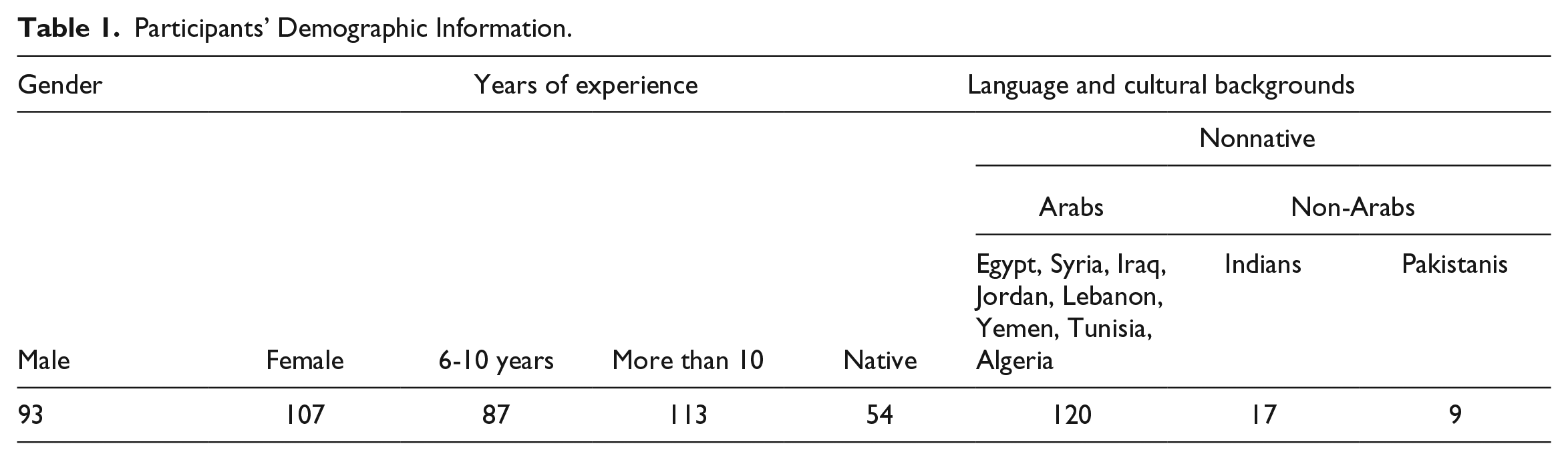
The participants of this study were 200 English teachers from a number of different private schools that implement CL in one of the major cities in the UAE. The 200 participants of this study came from different cultural and language backgrounds representing and/or reflecting the multicultural/multilingual context of the UAE (see Table 1). Despite the diverse cultural and language background, all the teachers were experienced and proficient English teachers and did not face any difficulty in accessing the contents of the questionnaire. Speaking in detail of the participants’ backgrounds, the majority of them were male and female English teachers who were Arabic native speakers (n = 106). The Arab teachers are from different countries, such as Jordan, Tunisia, Algeria, Iraq, Lebanon, Yemen, Syria, and Egypt. The rest of the participants were divided into native speakers (n = 54); nonnative, non-Arabic speakers (n =46); Indians (n =17); and Pakistanis (n = 6). The teachers had different teaching experiences; 87 of the teachers had a teaching experience between 6 and 10 years, whereas the rest had a teaching experience of more than 10 years. In addition, the teachers had experiences in different schools and contexts whether inside or outside the UAE. The female teachers were slightly more than half of the total participants (n = 107). Only eight teachers from different cultural backgrounds participate in the interview (see Table 2). Those interviewed teachers included native speakers (n = 2); nonnative, non-Arabic speakers (n = 2); and nonnative, Arabic speakers (n = 4). Based on the stages and time spent with the participants, it can be said that the chosen sample comprised a group of articulate and highly experienced teachers.
Participants’ Demographic Information.
Demographic Information of the Interview Sample.

Sampling
To gain insight into the perspectives of teachers on CL as a method that is not commonly used in most of UAE’s schools, the researchers ensured the selection of schools whose teachers adopt CL and have firsthand experience and expertise in it. The researchers visited the Department of Education and Knowledge (ADEK) headquarters to obtain data about the schools that are following the British and American systems in the city where the study was conducted. After excluding the schools that follow the Ministry of Education curriculum, the researcher made field visits to the respective schools to find more information about the extent of experience, knowledge, and familiarity the teachers in those schools have about CL. Based on the field visits and the meetings with the schools’ leaders, the researchers chose the schools that regularly apply CL strategies to be the sample with which the questionnaire would be administered. Subsequently, the focus group interview was conducted with volunteered teachers (n = 20) from whom eight were sampled purposefully based on vast experience and coaching contributions in the field of CL in general and Kagan Structures in particular. The sample was also chosen due to the suitability of the school in which Kagan Structures are actively applied, systematically evaluated, and annually updated and reinforced. Based on the foregoing explanation of the various stages of choosing the sample, the researchers used purposive sampling as the context and the focal point spirals around CL. In this respect, Gay, Mills, and Airasian (2011) contended that the researcher’s choice of purposive sampling indicates that the researcher has a clear and a concise set of criteria that need to be met; hence, the need for precision as well as clarity justifies the choice of purposive sampling.
Linking this study to the foregoing discussion on purposive sampling, the researchers resorted to purposive sampling when they realized that it is more effective for the research focus which is CL. To obtain authentic and credible feedback from teachers on CL, the researchers should be confident that the participants can relate to the experience authentically and can report findings credibly. As asserted by Tongco (2007), purposive sampling is a technique that is nonrandom and that is used by the researcher who already has in mind the people who can provide beneficial information based on their experience or their knowledge. In addition, Tongco (2007) maintained that when the method of purposive sampling is used efficiently, it can be more effective than random sampling in certain contexts and conditions as the randomly selected sample might not be able to provide insight into the experience being investigated if they do not have expertise to base their feedback on.
Research Instruments
The first instrument was a 5-point Likert-type scale questionnaire. Taking into account the fact that the study was focusing on a specific aspect of cultural responsiveness, differentiation, and engagements, the researchers did not find a suitable, established, and published questionnaire that could serve the purpose of the study and the different premises it underlies. Therefore, the questionnaire was developed and designed by the researchers to measure teachers’ perceptions of various structured cooperative-learning strategies and to measure to what extent these strategies can help students gain academic, social, and emotional benefits. The researchers gleaned the foci of the questionnaire from the study context and purpose, the nature of the study, and the research questions. The stages of creating the questionnaire involved multiple meetings, writings of statements, consulting CL coaches in the process of elimination and inclusion of points, and then meeting with university-experienced educators to finalize the statements and to ensure the meaningful relevance of the questionnaire’s items to the research questions. The rudimentary stage of writing the statements was informed by the researchers’ objective of the research study and the spheres of thought the research questions revolve around. In this regard, multiple meetings took place between the researchers to reflect on each set of the proposed statements to discern the extent to which they are integrally related to the focal point of the research questions and objectives. After several sessions of discussion and revision, the researchers finalized the questionnaire by carefully selecting the statements and paying particular attention to how the questionnaire categories were arranged and structured in line with the research questions of the study.
For the purpose of establishing the validity of the questionnaire, the researchers asked six university educators to look at the questionnaire and check its relevance to the purpose and design of the study. They were also given instruction to look at the clarity of the questionnaire, the type of statements, the structure of sentences, the choice of words, the layout, how strongly the statements are tied to the research questions and/or purposes, and so on. All the referees’ comments were collected and taken into consideration when the questionnaire was revised. The final draft of the questionnaire included two sections. The first part included the demographic information, whereas the second part included 20 items relevant to the two research questions. The Cronbach’s alpha was used to calculate the reliability of the questionnaire. The value of this calculation was found to be 0.93 which is considered to be a good value for judging a questionnaire reliability.
The second instrument was a focus group interview. The questionnaire’s data provided the researchers with insightful points to consider and gave rise to the relevant and the carefully chosen questions of the interviews. The initial step of choosing the questions actually began during and after the completion of the questionnaire administration as the collection of the quantitative data brought to the researchers’ attention the dire need to unveil some points that seemed obscure and not sufficiently brought to light in the questionnaire, such as personalized learning, engagement, learning ownership, different types of differentiation, and most importantly the cultural dimension that the study stirred and involved. With this in mind, the researchers decided to form the interview questions by revisiting the questionnaire statements and response. Coming up with focal questions, and relating each question to the research questions and the different variables that underpin the study, the researchers ensured the relatedness, the meaningfulness, and the concision of the interview questions.
To encourage effective answers, the researchers created questions that encourage informative responses and can subsequently be thematically categorized, coded, and transcribed. The researchers also made sure that the interview questions are brief and simple (Kvale, 2008) and that the word choices make sense to the interviewees, so that the researchers would get the desired responses (Merriam, 1998). Then, the questions were given to the same educators who helped in validating and improving the questionnaire. Similarly, the interview questions were reviewed and redesigned in the light of the referees’ comments and feedback. The interview questions featured three central areas that revolve around the two research questions. The first research question investigated teachers’ views about how CL can create an engaging learning atmosphere that fosters students’ learning and social and cultural awareness in the UAE’s ESL context. The second question explored how teachers perceive their practice of differentiation in UAE’s ESL classes.
Data Collection
The researchers distributed and collected 200 questionnaires from English teachers in private schools in one of the cities in the UAE. To facilitate the distribution of the hardcopy questionnaires in a timely manner, the researchers appointed three research assistants to help in distributing and collecting the questionnaires from schools, especially the remote ones. After the collection of all the questionnaire scripts, focus group interviews were conducted in one of the larger schools where one of the researchers was teaching at the time of conducting the study. Eight English teachers participated in the interview. Those teachers were divided into two groups, and they were interviewed by the researchers. Each of the two sessions of the interview lasted for more than 40 min.
The face-to-face focus group interviews were conducted using English language as all the interviewed teachers possess a very high command of the language. The collection of qualitative data from the focus group interviews involved the processes of organizing the interviews, and annotating and coding them. The next stage featured studying and comparing themes and/or recurrent patterns across multifarious types of data to determine their relationships with the questionnaire findings. The following stage involved the broadening of the findings by relating them to the research problem statement, the research questions, as well as the purpose of the study.
Data Analysis
The quantitative data were analyzed using the SPSS version 21 to attain descriptive statistics, namely, the median for all items due to the fact that “the median is more resistant against extreme scores” (Yu & An, 2016), and they also allow the researcher to clearly differentiate between random variations and structured and organized changes (Moura & van Eeten, 2015). Robson and Reed (1999) also suggested to utilize the median instead of the mean due to the easiness of obtaining it in comparison to the mean, the quickness of getting it, and the less fluctuation that it has in presenting the data (Milner, 1986; Turhanoğlu & Beyazova, 2003). All the analyzed results were organized into tables to facilitate the process of interpretations and/or discussions of all the important findings.
The qualitative data collected from the focus group were first tabulated to make it easier to look at the whole data at the same time. Then, a framework was developed to organize and classify the data into patterns/themes to serve the goals and/or research questions of the study (Denzin & Lincoln, 1994). The researchers utilized Kvale and Brinkmann’s (2013) guidelines of meaningfully steering the interviews to allow for additional themes to be categorized and ideas to be crystalized and used the highlighting facility in Microsoft Word to categorize different concepts and themes and then annotate them. The visual representation that the computer technology provides facilitates the process of analysis as it made the detection of redundancy easier to find and weed out and gave room for faster elimination and/or combining ideas. Emphasizing the computer technology in fostering and easing data analysis, Merriam (1998) maintained that technology has brought forth various media that are commonly used in data analysis, whether in individual or collaborative research studies. In the analysis of the qualitative data, the researchers followed Patton’s (2002) model of qualitative content analysis that rests on the premise of making sense of and interpreting the emerging data by relating it to the research questions, finding a balance between interpretation and description in the sense of making them two complementary factors that add depth and meaning and elucidate contexts and details (pp. 503-504).
As the researchers were transcribing and coding the notes, additional themes began to crystalize and emerge. Hence, they were added and other ones were omitted or added to similar themes. In the light of a qualitative data analysis procedure recommended by Patton (2002), the researcher carefully examined the details and specifics of the data to trace key patterns and/or themes and their interrelationships. This special qualitative data analysis technique was used to ensure that the available recurrent themes/patterns are consistent with the research questions and the purpose of the study. At a later stage, the recurrent themes/patterns obtained from the qualitative data were employed to support the discussion of the results gained from the 5-point Likert-type scale questionnaire (Creswell, 2003; Creswell & Creswell, 2017).
Ethical Considerations
The researchers follow a strict ethical procedure in conducting this study. First, they designed and used a written consent form to make sure that teachers are aware of their voluntary participation in the study. Second, teachers were informed that they may choose either to participate in the study or not. Third, the purpose of study and its procedures were communicated clearly to the participants, and they were informed that they can withdraw from the study at any point. They were also assured that all the given information will be kept confidential and their names and identity would not be released during the reporting and discussion of results. Finally, they were also assured that the information collected from them will only be used to serve the purpose of the study and would not be shared with a third party.
Results and Discussions
Cooperative Learning as a Means for Learning Engagement
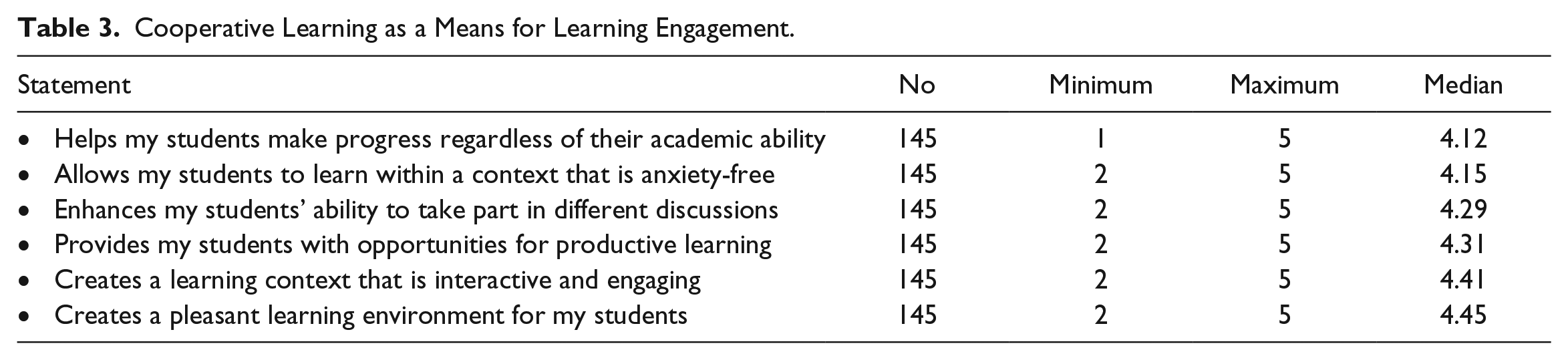
Question 1 emphasizes the way CL involves students in active participation and communication. With reference to the first set of analyzed data from the questionnaires, Table 3 and Figure 1 demonstrate that the concept of “enhancing engagement” is recognized and appreciated by teachers. This confirms the interactive atmosphere that CL creates for ESL learners as discussed by Zhang (2010). It also brings to light the vibrancy of the learning environment in which CL is applied as it provides room for exchange of ideas, discussion of thoughts, planning shared targets, and working collaboratively to achieve these targets. Thus, the median score shows that CL enables students to learn and improve in a learning environment that respects their varied levels and needs and caters to their emotional safety and well-being. In fact, the engagement component is by far more prominent as a direct benefit of CL than learning achievements or learning improvement.
Cooperative Learning as a Means for Learning Engagement.
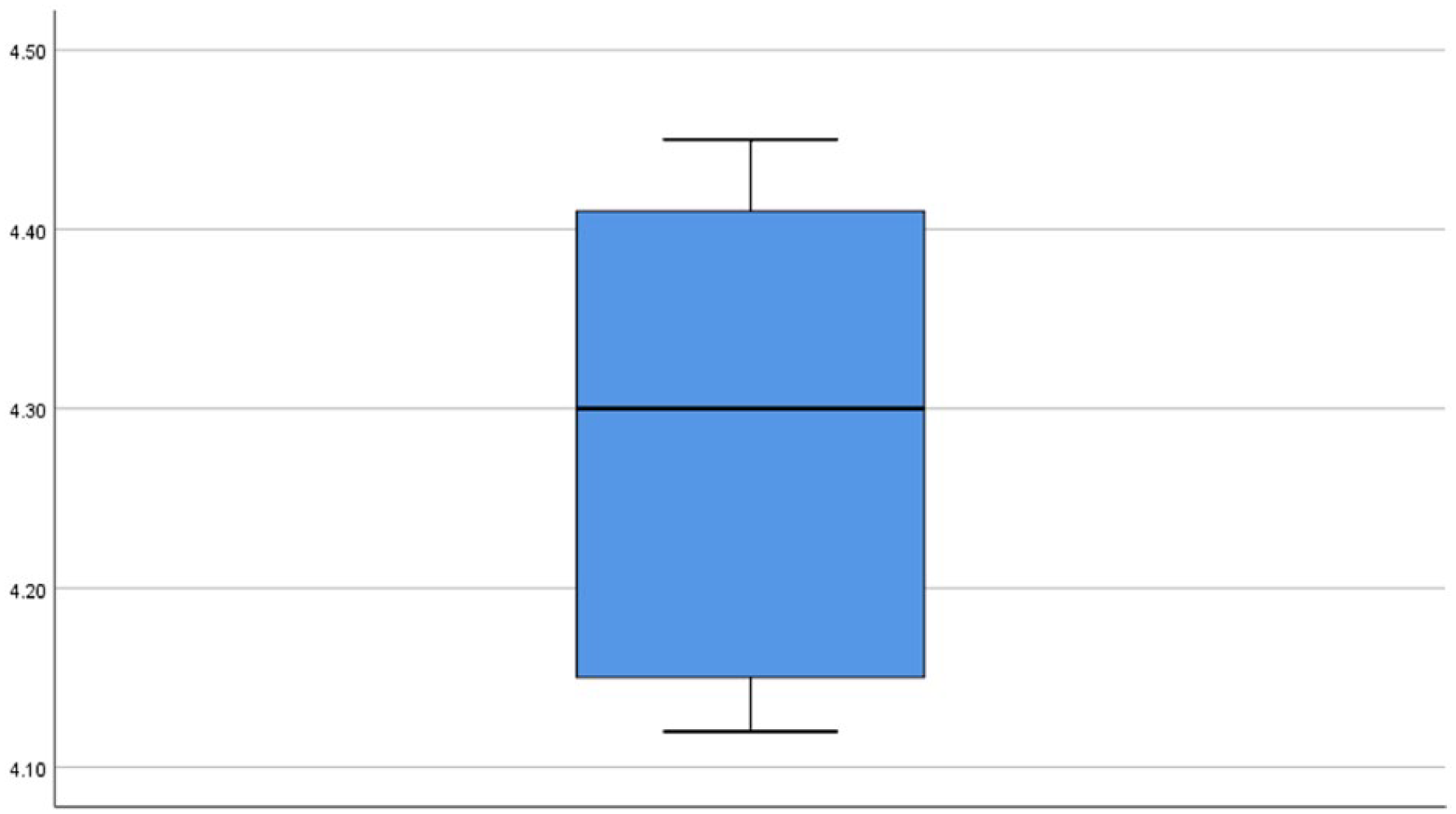
The spread of data of “cooperative learning as a means for learning engagement.”
Generally, results from the interviews support the results obtained from the questionnaire, especially when it comes to students’ engagement. Teachers extensively explained how interesting and engaging the learning process becomes when CL is implemented constructively. A teacher indicates that “students feel engaged and motivated as they interact with their peers in a CL classroom.” Other teachers also discussed the interactive environment that CL creates, emphasizing the involvement and the sense of responsibility that CL creates in students’ learning. Considering the fact that focus is on the ESL learning, it is easy to detect that this method of instruction supports second language acquisition theories that shed light on the interactive strategies that prompt language learning and provide a spontaneous context within which it can be practiced interactively. In the literature, CL environment was referred to as a context of collaboration, interdependence, communication, and interaction. Johnson et al. (1994) found that CL constructively affects learning motivation, relationships, and psychological health. In support of the above is the following extract from the responses of a teacher: When students engage in cooperative learning activities, they need to discuss ideas, share responses, and peer assess each other; such skills are important for students in the future of their academic and professional journeys because the skills of interaction, negotiation, and peer assessment are higher order skills that prepare students better for their university and career path.
Other teachers also asserted the feeling of engagement that students are charged with as they work within their groups. In this respect, a teacher attributed the feeling of engagement to the shared goals and the sense of achievement: The engagement might be stirred by the target that combines them all to work towards; it might also be the sense of accomplishment they get from working on a task. The increased feeling of involvement that they get from the group activity can be seen and felt by any observer that contemplates the learning that take place in the classroom.
Stressing the concept of engagement is a remark shared by a “Kagan Structures Coach” on her observation of the students’ interaction during a systematic CL session. She stated that “You can clearly see the positive energy in the air; students apply the cooperative learning strategy within an environment of positive interaction, discussion, and noticeable engagement.” This is certainly an essential part of the success of the CL strategy. In the light of this statement, involvement and vibrancy of learning is a direct outcome of well-structured CL in which students are cared for and guided to perform CL strategies in a systematic way. This in turn leads to the development of language acquisition because when interaction is an integral part of learning, then language learning occurs spontaneously and in a less stressful way because the CL experience provides a low affective filter. In this regard, several research studies asserted that CL is a procedure that provides a safe learning environment and improves learning (Kagan & Kagan, 2009; Oxford & Ehrman, 1993; Slavin, 1995).
A number of studies reported that CL increases learning engagement and motivation (Ara & Akter, 2013; Azizinezhad et al., 2013; Goodman, 2016; Thanh, 2013; Zhou, 2012). These studies emphasized the role of CL in encouraging the learners to be more engaged and more motivated. In short, the discussed results show that implementing CL in an ESL classroom helps students feel responsible for their own learning, as it encourages them to exert more effort into their tasks and projects. Based on the above reference to the questionnaire results and the interview responses linked to Research Question 1, the results clearly show that teachers support the fact that CL creates a constructive environment for all learners.
Additional studies confirm the engagement element in CL. They asserted the effectiveness of CL in creating engagement and student-centered classes (Fernandez-Rio, 2015; Purzer, 2011; Slavin, 1987, 1991). The interactive atmosphere creates engagement and enhances social skills (Clapper, 2015). Thus, CL is primarily linked to success factors for students (Groccia, 2014; Purzer, 2011). It is important to indicate that one of the sources of the feeling of engagement is the intrinsic motivation that is created from the sense of giving and contribution. The engagement factors also arise from the feeling of collective responsibility that stems from CL and the sense of ownership of learning (Ning & Hornby, 2014).
Cooperative Learning as an Enhancing Factor for Social and Cultural Understanding
The questionnaire results show that teachers consider CL a mode of instruction that fosters students’ social and cultural awareness and enhances interpersonal skills through the opportunities that it provides learners for mingling with students from different cultures, the interaction that takes place in various contexts and structures, and the skills of sharing knowledge, ideas in addition to the room for peer coaching that these strategies can accommodate and foster. Table 4 and Figure 2 demonstrate that the highest median score is pertinent to the questionnaire item “helps my students become more sociable individuals.” This clearly supports the focal point of the second research question that mainly emphasizes social and cultural understanding. Evidence from the interviews demonstrates that teachers strongly believe in the CL role in enhancing students’ social skills. Nevertheless, they consider its role in creating cultural responsiveness relatively minor when compared with its role in enhancing the social factor.
Cooperative Learning as an Enhancing Factor for Social and Cultural Understanding.


The spread of data of “cooperative learning as an enhancing factor for social and cultural understanding.”
The interview responses support the results obtained from the questionnaire as all the teachers extensively discussed the role that CL plays in strengthening students’ social skills and cultural responsiveness. A teacher stated that “mixed-ability groups of students that belong to different cultural backgrounds combine their effort to achieve common goals. Accordingly, solid social bonds will be cultivated.” This teacher passionately discussed the cultural responsiveness that results from CL; she shed light on how students who work in a context of different cultural backgrounds learn to show acceptance and tolerance toward each other. They work in togetherness to achieve tasks and projects, which helps them to enhance social and cultural awareness. Another teacher added with noticeable conviction and enthusiasm that CL does instill cultural and social tolerance and understanding that make up a base for their future academic and professional and even personal lives: Based on my teaching experience, I think our school’s decision to apply CL as an integral part of its instruction has positively impacted our students’ cultural and social responsiveness and understanding. Some students used to prefer mingling only with students from the same cultural background. Now we can see students from various nationalities and academic competence interacting positively together to plan, work on and reflect upon a collaborative project. I sincerely feel that many of our students started to develop better manners in terms of praising each other after every activity and in term of taking turn in cooperative learning structures and even in coaching and supporting their team members during collaborative activities.
As can be discerned from the quote of the first teacher above, cultural and social awareness are shown as essential outcomes of CL. Despite the emphasis that the questionnaires and the interviews placed on the social factor in comparison with the cultural factor, the focus group discussion unveiled some insightful and culturally enriching details about the relevance of CL to the UAE unique culture. A teacher reported the role that CL strategies play in consolidating the values of cooperation that already exist in the UAE society and how it enhances the acceptance and the harmony that is created with other cultures in the classroom: The fact that most students in the class are locals from the Emirati society makes cooperative learning an important opportunity to show respect, cooperation, and tolerance towards other nationalities in the classroom since this is an initiative that the whole country is advocating and embracing. It is relevant to the cultural diversity in the UAE.
In addition to the above description of the cultural benefit that students can get from CL, another teacher used an attractive simile to capture the cultural advantages of applying CL: When the CL strategies are applied properly and effectively, it is almost like looking at the UAE society at a glance: a group of culturally varied individuals interacting together to achieve similar goals in a context of respect, learning, and interaction.
Emphasizing this point is a quote by the UAE Minister of State of Tolerance, Lubna Al Qasimi: “Tolerance, mutual respect and cooperation are key values of the UAE—a nation keenly interested in building humankind, creating harmony among different segments of society” (Salama, 2016). This supports the fact that CL should be embraced in educational systems to pave the way for the students to deal and interact with the outside world with its myriad scenarios, challenges, and opportunities.
Other previous studies on CL (Huang, 2007; Khoury, 2012; Othman et al., 2012; Zuheer, 2008) documented outcomes of social benefits and enhanced communication skills. In stressing the role of CL on enhancing cultural responsiveness, Li and Campbell (2008) conducted a study in New Zealand and presented findings that stress the cultural factor in an ESL classroom.
CL classes create a social context in which different opinions are accommodated. A friendly relationship starts to flower among the CL participants as they mix, discuss notions, exchange ideas, and work toward group targets. They come from different genders, races, styles, and abilities (Basak & Yildiz, 2014; Sadeghi, 2012). This in turn creates a feeling of compassion among learners. When we consider the element of compassion in Item 4 in Table 4, we can see that the responses confirm the notions raised by Park et al. (2018) and Kenny (2016) on how compassion facilitates interaction, learning, and character development and how it builds bridges of helpfulness, collaboration, acceptance, and positive interdependence within CL contexts.
All in all, the results of the interview and the questionnaires along with results of previous studies stress the social interaction and cultural understanding that teachers attribute to CL in ESL classrooms. This supports the theoretical background of CL manifested in the sociocultural theories, the social constructionism, and the communicative competence theory. This is especially meaningful when we consider the overall social awareness and tactfulness that result from the ongoing orderly interaction that is facilitated by CL. All students regardless of their cultural backgrounds, levels, differences, and interests become more responsive and more sociable when they authentically interact and when they collaboratively perform cooperative projects, tasks, and activities.
The Role of Cooperative Learning in Facilitating Differentiated Instruction
Question 2 explores how CL facilitates teachers’ differentiated instruction. Table 5 and Figure 3 demonstrate that all the median scores are more than four. The statement that received the highest median score was “enables me to become a facilitator of learning rather than a giver of knowledge.” However, the statement that received the lowest median score was “can positively challenge my above-level students.” All responses stress that CL enriches differentiation.
The Role of Cooperative Learning in Facilitating Differentiated Instruction.


The spread of data of “the role of cooperative learning in facilitating differentiated instruction.”
The interview results in this regard are consistent with those gleaned from the questionnaire. Teachers asserted that CL provides opportunities for different students’ groups of various levels. For example, a teacher explained that high achievers can scaffold the emerging students’ learning through CL. She also contended that low achievers’ exposure to higher order questions will eventually enable them to learn how to answer such questions. In regard to emphasizing the notions of differentiation, a teacher pointed out that CL helps students work in collaboration to accomplish projects and tasks, which strengthens their self-confidence and their learning outcomes. Other teachers argued strongly for the fact that CL facilitates differentiation. Still other teachers reported that CL helps learners enhance their self-esteem.
In CL structures, students are given activities that are pitched to their levels. Hence, students feel at ease in responding to the activities and they don’t hesitate to openly share answers with their peers. Forming heterogeneous groups allows students to support each other within a non-threatening learning environment.
Another intriguing point shared by another teacher about the benefits of CL revolves around the idea of CL as a means of peer scaffolding: Within the context of cooperative learning, differentiation is served in both ways for challenging high achievers and supporting emerging learners. When CL is applied, high achievers feel that they are rich contributors to learning, and emerging learners feel that they can be supported by their peers to make progress and overcome difficulties.
Both the study of Mehdizadeh, Nojabaee, and Asgari (2013) and Yan-hong (2013) supported this notion. Both studies asserted that CL diminishes the foreign language learning anxiety in ESL classrooms. In this regards, Kagan and Kagan (2009) explained that different structures meet different learners’ needs and styles. ESL students often struggle with issues relevant to self-confidence due to their performance anxiety and fear of failure (Cassady, 2010). Differentiation and CL context may eliminate students’ affective filter and fosters their self-confidence (Goreyshi et al., 2013; Hanze & Berger, 2007). Thus, those two elements may motivate learners to get involved in other tasks and projects. In line with this result is the study of Flaherty and Hackler (2010) which reported that students showed active involvement, motivation, and a positive attitude toward learning. The results also confirm that combining CL with differentiated instruction can strengthen students’ intrinsic motivation.
The interaction contributes to students’ self-confidence and their interpersonal skills without compromising their learning and achievements (Mitakidou & Tamoutseli, 2011). Students also feel that they are working within a friendly, welcoming, and safe environment which eradicates feelings of worry and anxiety (Han, 2015). This can greatly support students’ learning and their motivation to achieve better and perform in a more interactive and successful way.
In support of the above point, a teacher stated a remark that can serve both as a point that supports the cultural benefits and differentiation in terms of how CL contains the embarrassment that sometimes young Emirati boys may feel when they are asked to share answers individually with the whole class: It is part of the cultural upbringing of some Emirati boys to maintain a state of self-confidence and positive pride in what they can reflect they know or can do. Thus, when those boys are put in a situation where their errors might be exposed to others openly, they lock themselves in their shells and refrain from participation. In this case cooperative learning comes in handy to absorb the feeling of self-consciousness and replaces it with openness and willingness to interact.
In summary, the accumulated results from the questionnaire, the interviews, former studies, and the literature review indicated that ESL teachers consider CL as a constructive context for the application of differentiation as it helps reduce the amount of anxiety that students usually feel. In addition, it fosters peer scaffolding and cooperation, and it also allows learners make progress regardless of their learning level, language proficiency, and style. This is in line with the UAE key educational priorities, cultural values, and national initiatives which all place high emphasis on collaboration, critical thinking, interaction, cultural responsiveness, and being effective and enriching global citizens. Thus, the UAE is eager to adopt an educational approach that has the capability to embrace, advocate, and instill the foregoing values in the current and the upcoming generations of learners.
Conclusion and Recommendations
This study aimed at investigating English teachers’ views on how CL can create an engaging and intriguing learning environment for students, fosters students’ social and cultural responsiveness, and facilitates teachers’ differentiated instruction. This research study was conducted using a combination of quantitative and qualitative designs in which both quantitative as well as qualitative data were collected. The participants were English teachers from private schools in one of the cities in the UAE. The study employed two instruments to collect the necessary data. A questionnaire was sent to teachers of ESL in private schools, and semistructured interviews were conducted with volunteered English teachers. The findings of this study demonstrate that English teachers view the structured application of CL as an effective teaching strategy that may contribute to students’ learning engagement, social awareness, cultural responsiveness, and learning needs in general.
The results of this study may have applications at all levels for different concerned groups, such as teachers, academic administrators, advisors, curriculum designers, and decision makers. To promote the practice of CL and differentiation, we recommend regular and systematic professional development sessions for teachers. It is also very important to make sure that the CL environment is motivating and safe to encourage students to interact collaboratively. The results of this study may provide hints and/or guidance for future research to conduct more in-depth investigation of the issues of CL and differentiation. Future studies may look at issues such as students’ achievements, the role of curriculum, students’ attitudes, the culture of CL classrooms, and so on.
Footnotes
Declaration of Conflicting Interests
The author(s) declared no potential conflicts of interest with respect to the research, authorship, and/or publication of this article.
Funding
The author(s) received no financial support for the research, authorship, and/or publication of this article.
