




Abstract
This study examines the intersectionality between professional identities and race/ethnicity among Latina/o school leaders. Stemming from a larger study at the National Latina/o Leadership Project, we examine the contributions of Latina/o school administrators in the state of Texas in relation to their leadership in K-12 schools. Two hundred twenty-six respondents inform this study. Descriptive and content analyses of data revealed that the intersectionality of race and class as influencing the work of school administrators and described how, among major influences, their own schooling experiences had an impact in the development of their professional identities.
Keywords
The new century brought to light social justice issues related to the improvement of schools in America (Bogotch, Beachum, Blount, Brooks, & English, 2008; Horsford, 2009; Jean-Marie, Normore, & Brooks, 2009; Murakami & Hernandez, 2013; Theoharis, 2009). Beyond high expectations for academic performance, scholars indicated the importance of considering school leaders to be prepared to foster the development of “a multicultural, multiethnic, multi-religious, and multinational society” (Jean-Marie et al., 2009, p. 2). Within their preparation, there is a pressing responsibility to prepare leaders who can create participatory venues conducive to equitable opportunities for students—as well as teachers, families, and colleagues in education.
Important considerations for school leaders include their preparation and experiences growing up as a student themselves. Narratives showing an intersection between being a student and later becoming a school leader are particularly poignant. Horsford (2009), for example, examined the effects of segregation and desegregation from an African American who later became a school superintendent. Of relevance here is the pipeline from student to professional. It is important to not only advocate for social justice among students but also guarantee the preparation of these students in a possible path to serve in education professions as teachers, counselors, and school administrators.
In this study of Latina/o leaders, we developed an examination of the intersectionality between the professional identity and race/ethnicity. Stemming from a larger study at the National Latina/o Leadership Project, we examine the contributions of Latina/o school administrators in the state of Texas in relation to their leadership in K-12 schools. The knowledge acquired during formative years informs how school leaders can capitalize their experiences and use it to inform the development of a professional identity.
Purpose of the Study
The purpose of this study is to examine the experiences of Latina/o school administrators in Texas. In consideration is the principals’ intersectionality between professional identity and race. Scribner and Crow (2012) indicated the importance of professional identity in research on school leaders as it relates to their role beyond the development of technical skills. Professional identity relates to the multiple identities that shape leaders, and the nature of their leadership in relation to the populations they serve. The essence of professional identity relates to the evolving nature of school leaders’ ontology, and how it informs their professional role.
The state of Texas serves 5,000,000 children in K-12 schools. The Texas Education Agency reported that in 2014, 52% of students were Hispanic, 29% were White, and 13% were African American (Texas Education Agency, 2016). Data from the National Latina/o Leadership Project survey include 215 Latina/o school administrators and observed their schooling experiences and how their background and race impact their work as school leaders. Questions considered for this study included the following: (a) Describe your schooling experiences. (b) Has your racial/ethnic background create barriers in your work as a school administrator? (c) Has your racial/ethnic background been a benefit in your work as an administrator? Findings in this study show that the school administrators’ schooling experiences, successes, and barriers contributed to shape their professional role and the development of a professional identity.
Rationale
In 2006, the founder and president of the National Hispanic Institute, Ernesto Nieto (2006) indicated a need to organize Latinas/os in America to “influence thinking, alter the social trajectories and directions of collective bodies of Latinos, and cause significant shifts in the social perspectives, beliefs, and outlooks of either various subsectors or the entirety of the Latino community” (p. 84). At the time, he defined this need as a Latina/o leadership crisis. He highlighted the importance of developing a community that (a) can recognize the ongoing collective capacity and effectiveness in enacting community-focused change and (b) can determine ways of creating a critical mass for addressing internal conflicts, and included considerations of Latina/o upbringing in the development of an individual and national identity.
Indeed, even though Latinas/os can be defined based on cultural and collective values, there are internal differences among the several groups that compose the Hispanic community. The National Center for Education Statistics (NCES) differentiated Hispanics as Cuban, Mexican, Puerto Rican, South or Central American, or other Spanish-speaking backgrounds, regardless of race (Murakami, Valle, & Mendez-Morse, 2013). Each country’s background generates variability in personal values and purpose. Such variability of Latinas/os also influences their development of a professional identity, which will vary due to language-base similarities, but varied roots. Unifying this diversity is a call for the development of a Latina/o national voice and identity according to Nieto (2007) and Trueba (1999).
Trueba (1999) advocated for the development of a Latina/o cultural identity, stating that leaders should have “specific qualities of vision, biculturalism, multiple identities, the ability to code-switch and a profound commitment to democratic ideals of fair participation in the political and economic arenas for all Americans” (p. 25). Nieto (2007) believed that Latinas/os have the potential to develop community equity by
. . . attracting involvement via initiatives that heighten the bar of expectations in the quality of life people prefer to live, engaging parents in pursuing new forms of socializing and educating their children beyond what public education is able to provide, and creating the environments that broaden and sustain the structures needed to significantly increase participation across all sectors of Latino community life. (p. 86)
This social responsibility is echoed across the diverse groups that compose Latinas/os in America, which comprised 54 million in 2013 or 17% of the total U.S. population (Stepler & Brown, 2015).
Latina/o Leadership Literature
Scholars exploring Latina/o leadership like Bordas (2015) affirm that Latina/os possess leadership traits conducive to addressing the aforementioned crisis indicated by Nieto (2006). Bordas contends that Latinas/os come from a We-orientation, or people-centered culture. In schools in need of improved performance, a leader who can build a cohesive culture can positively impact a campus culture. She reminds us that Latinas/os grow up contributing to their families and communities since an early age, developing values such as cooperation, reciprocity, and generosity.
Social and civic engagement is particularly important in fostering school change. When promoting social justice for diverse groups in schools is perceived as an important aspect in improving schools (Anderson, 2009; Bogotch et al., 2008; Jean-Marie et al., 2009; Theoharis, 2009), culture-centered leadership can be considered of particular significance. Bordas (2015) indicated five fundamental principles Latinas/os carry, significant in building a culture-centered leadership. These are as follows: (a) An intergenerational spirit, related to how Latinas/os have maintained sight of the generational responsibility to work together toward a common good; (b) the Latina/o leader as one among equals, nurturing shared governance and rotating responsibilities to cultivate leadership in others and strengthening a We culture; (c) Juntos: a collective community stewardship toward short-term and long-term vision to remain focused on a step-by-step process that counts on every small and large contribution; (d) Sí, se puede (Yes we can!) which relates to exercising social activism and coalition building, fostering a sense of culture and community, advocating and participating in issues of community concern; and finally (e) Gozar la vida—with quintessential leadership that promotes the celebration of life through community celebrations, oral traditions, and storytelling that integrates history and cultural traditions. Similarly, Yosso (2005) has also identified six elements of cultural wealth that can impact the practice of school leaders. In this model, Yosso (2005) argued that students of color bring with them six forms of cultural capital that can be used to improve the outcomes. These capitals include aspiration, language, familial support, social skills, navigational, and resistance capital. It would not be uncommon to think that Latino school leaders have been able to bring these cultural wealth elements into their own leadership practice.
Despite these potential qualities, Latina/o school administrators are not necessarily largely represented nationally. The 2013 NCES condition of education report shows that from 89,000 school administrators working in U.S. public schools, only 7% are Latinas/os, when compared with 80% White and 10% African Americans school administrators (Bitterman, Goldring, & Gray, 2013). One of the considerations in this study is whether a racial/ethnic background creates barriers in the attainment of educational leadership positions. If the path to becoming a school administrator requires a teaching background, the same report accounts for only 8% of Hispanic teachers represented nationwide. In states like Texas, where the racial diversity of students shows that 52% of students are Latina/o, the number of school administrators who could foster a specific culture-centered leadership for the improvement of students seems conspicuously sparse. In 2012, 1,742 Latina/o school administrators were identified in the state of Texas, which may represent 2% of the overall total considering the aforementioned NCES report. One of the barriers for the small representation of Latinas/os in school leadership positions may relate to continuing systems of oppression.
Intersectionality of Race and Identity
The diverse Latino population is the fastest growing in the United States, has a burgeoning political and economic impact on the country, but still faces homogeneous categorization. Oboler (1995) outlined that Hispanic and Latino labels are in fact abstractions of reality, and their usage may inevitably single out socially constructed attributes. That is, by accepting these labels, individuals may be subject to limitations related to race, gender, class, or language. Labels are connected to attributes which may then be considered common to the group and can be used to create assumptions for the individuals in the group (Oboler, 1995). Lisa Garcia Bedolla (2005) argued that to understand the contradictions and dilemmas that arise from Latino contact with reality, “An analysis of the Latino experience in the United States must be situated at the intersection of power, collective identity(ies), and place” (p. 4). The analysis of intersectionality of race and identity for Latinos, especially Latina/o educators, is critical as spaces of political power within the spheres of education continue to situate Latino identity in marginalized contexts.
The Institute for Social, Behavioral, and Economic Research (ISBER) out of the University of California Santa Barbara with the Center for New Racial Studies (n.d.) posits as follows:
“Intersectionality” is the name that is now given to the complex of reciprocal attachments and sometimes polarizing conflicts that confront both individuals and movements as they seek to “navigate” among the raced, gendered, and class-based dimensions of social and political life. Both as individuals seeking to make a socially just and fulfilling “everyday life,” and as collectivities seeking to “make history” through political action and social movements, we struggle with the unstable connections between race, gender, and class (para. 1).
Both Latina/o students and educational professionals may still be discriminated and treated as marginal to those expected to represent educational success (Holvino, 2008; Viruell-Fuentes, Miranda, & Abdulrahim, 2012). Analyzing immigration and health, Viruell-Fuentes et al. (2012) recognized that “becoming American involves contending with ideologies that render them racial ‘minorities’ and the stigmatized meanings that the racialized society ascribes to their specific group” (p. 2101). Holvino (2008) argued that work and scholarship at the intersections of race, class, and gender are still underdeveloped. This sentiment extends to a generalized perception of people of color as racialized “others” reproducing inequality within an ethnoracial hierarchy (Collins, 1998, 2000; Viruell-Fuentes, 2007, 2011). Collins (2000) further defined how an intersectionality of race, ethnicity, class, and other social categories limits people of color’s access to successful positions in society. By recognizing that Black women’s experiences were also shaped by race and class (Collins, 1998, 2000), she showed that intersectionality further evidences a system of oppression mutually constituted to work together to produce inequality (Collins, 2000; Crenshaw, 1989). Although intersectionality has impacted feminist theory and critical race theory, a conceptual framework exploring intersectionality as impacting the professional identity and opportunities for Latina/o school administrators is warranted.
When discussing ways that intersectionality works, it is important to consider that forms of oppression do not operate independently. Many forms of discrimination are intertwined with others and intersect within the various areas of race, ethnic, socioeconomic, and even religious identities. This concept of intersectionality was first defined academically in the 1980s (Crenshaw, 1989), but it has been subject to discourse since the early 1900s when women’s rights and feminism began gaining traction.
It may be easy to consider a specific form of racial oppression or discrimination as operating in a vacuum. For example, when considering the victimization of gay youth, many leaders and administrators may simply see them as lesbian, gay, bisexual, and transgender (LGBT) youth and ignore their membership in other minorities. However, personal identity is fluid and multifaceted, and developing this sense of identity is a complex and varied process. Similarly, a student’s experience is not accurately described simply as being gay and as being a religious minority—these experiences intersect, intertwine, and influence each other. As such, when categorizing school leaders by minority membership only, one runs the risk of stereotyping and reductionist attitudes toward understanding their work and life. At the intersection of race and other professional identities, for example, an individual may attribute their experiences to a single category (gender), to a different category (race), or to many categories at once (language, gender, and race), which, in turn, shapes their perception of the experience.
Conceptual Framework
The conceptual framework of intersectionality is the lens employed to examine Latina/o school administrators in this study. Dill and Zambrana (2009) defined intersectionality as a critical lens to interrogate race, ethnicity, class, ability, age, nation, sexuality, and gender within structures of inequality. Collins further contextualized intersectionality within a system that politically constructs these categories within a hierarchy of social organization, which defines the experiences of people of color, which, in her study, explored the lives of Black females. Holvino (2008) stated the relationship between women and men of color is “the area in which feminists of colour have made fewer inroads . . . because intergroup ethnic/racial conflict creates the need for little-questioned solidarity in order to survive” (Hurtado, 1996, p. 381). In this study, we explore intersectionality as influencing the professional identity of school administrators.
Professional identity relates to the evolving nature of defining an individual’s professional role. Beijaard, Meijer, and Verloop (2004) asserted that professional identity “is not a fixed attribute of a person, but a relational phenomenon” (p. 108). In educational leadership, Scribner and Crow (2012) explored the professional identity of school leaders as an important investigation of personal and professional values beyond the achievement of technical skills. When exploring the development of a professional identity, Gee (2001) reflected that “one cannot have an identity of any sort without some interpretive system” (p. 107). DeRue and Ashford (2010) further argued that a leader identity is both an internal cognition and a socially constructed cognition that build on the interplay between leader and follower. Considering the effect of intersectionality among Latina/o school administrators, it is important to explore how Latinas/os interpreted their experiences to build their professional identity.
In states like Texas, where the context of traditionally underserved students limits the opportunity for success, the pipeline from student to educational professional can be examined to explore the negotiation of one’s identity in relation to oppressive systems and societal participation. Scholars indeed asserted that identity involves an understanding of self, and it is influenced by their social context and experiences (Gee, 2001; Stets & Burke, 2000). Mpungose (2010) adopted a humanistic perspective to examine leadership and concluded that school administrators created their own provisional selves, building professional identities from their own experiences and professional knowledge. Mpungose (2010) further explained that provisional selves relates to temporary solutions school administrators may use to close a gap between their current capacities, and ideas they may hold about attitudes and behaviors that may be expected in their roles. In fact, Helena and Abrahao (2002) contended that in education, it is hard to separate the personal from the professional, especially when considering the leadership role, which may directly relate with values and ideals in a position that can be very demanding in its commitment to human relations. The examination of intersectionality among Latina/o school administrators and their personal and professional identity illuminates a critical and political examination of “behaviors, attitudes, and values prevalent within American society” (Lopez-Class, Gonzales Castro, & Ramirez, 2011, p. 1558). One final note regarding labels and the designation of ethnic identity as it relates to this study. Without a doubt, the United States is experiencing unprecedented demographic changes as it relates to Spanish-speaking individuals; however, sometimes it is unclear on the label that should be used to describe this rising population. The researchers of this study have agreed to use the term Latino, which is short for latinoamericano. We use “Latino” because it was created within the Latino community, connotes common values but leaves room for individual differences and does not strip people of their historical identity.
Method
This study recruited 231 participants via email invitations, which described the study as a Texas-wide survey of Latina/o superintendents, principals, and assistant principals. Developed as a state-specific project in the National Latino Leadership Project (NLLP), its purpose is to further identify characteristics about leadership style and career paths. The NLLP represents a 10-year collaboration among Latina/o scholars from universities across the country.
The initial NLLP project began through discussion around common leadership questions and evolved into a large-scale study of Latina/o school leaders. In 2007, a group of scholars conducted the first national survey of Latina/o school administrators and presented the findings of this first every national survey at various national conventions and international research conferences in subsequent years. NLLP investigated the representation of Latina/o assistant school administrators in the United States, including their challenges and aspirations. Some of the following questions composed the initial survey: (a) What are the demographics of Latina/o assistant school administrators? (b) Where do Latina/o assistant school administrators work? (c) What types of challenges do Latina/o assistant school administrators face? and (d) What are likely future aspirations of Latina/o assistant school administrators? The initial study evidenced Latinas/o leaders’ willingness to serve in highly diverse high-need communities where their impact would be meaningful in promoting student improvement (Murakami, Hernandez, Mendez-Morse, & Byrne-Jimenez, 2016).
Context of the Study and Instrumentation
Texas was selected for the statewide study because it is one of the largest states in the United States employing a high number of Latina/o school leaders. The state is also home to the faster growing Latino population. Based on the feedback received from the first study from participants in 2007, survey questions were changed and survey section questions were reduced in numbers. The initial survey was first modeled after the School and Staffing Survey (SASS) that was last given in 2011-2012. However, NLLP survey, unlike the SASS survey, included questions related to gender, race, leadership style, barriers, and successes to effective leadership. Although this study specifically looks at professional identity and the intersectionality of race, the larger survey was divided into three broad categories: school demographics, career path, and leadership identity (Murakami et al., 2016). These three categories were further subdivided into 10 sections:
School context: general school information, school performance, responsibilities
Career path: professional development, leadership style/practice, experience/training, successes/challenges
Leadership identity: gender/ethnicity, barriers, personal background.
Participants’ email addresses were obtained from the state of Texas education records, which tracks school administrators demographic data. Participants were expected to take 10 min to complete the survey which included both short essay response and Likert-type scale formats (Murakami et al., 2016). The survey instrument was distributed during the spring of 2015. The instrument was distributed again during the following summer and fall. A reminder email was sent out every 3 to 5 days to prompt the participants to take the survey. In all, the survey was available for approximately 3 weeks. This study reflects the responses of 226 school administrators in the state, 57% were female and 43% male, with ages ranging between 33 and 68. Eighty-seven respondents were U.S. born.
Variables considered as influencing the professional identity of Latina/o school leaders included schooling, barriers due to racial/ethnic background, challenges as school administrators, and benefits of race/ethnicity within their work. Short essay questions in this study included the following: (a) Describe your own schooling experiences. (b) To what extent has your racial/ethnic background created barriers in your work as an administrator? (c) What are the biggest challenges you face in your work as a school administrator? (d) What are the biggest successes you face in your work as a school administrators? and (e) To what extent has your racial/ethnic background been a benefit in your work as an administrator? Race and ethnicity were terms included in the questions and offered as interchangeable (grouped). They were left to be defined by the participants due to the high intersectionality variation in backgrounds and cultures among Hispanics.
Data Analysis
Each question was analyzed separately informed by the conceptual framework and includes all qualitative responses, considering confirming and disconfirming data. Ethical considerations included the anonymity of individual responses and masked geographical location. Descriptive and content analyses were the approaches employed for this study. A descriptive analysis was used to summarize the data, portraying important characteristics and features of the data provided by the participants (Coladarci, Cobb, Minium, & Clarke, 2011). Content analysis was used to add to the descriptive approach by coding of the data and an interpretation of qualitative responses for each survey question (Downe-Wamboldt, 1992; Mayring, 2000). The content analysis was conducted by examining similar words used by participants. In addition, the short essay questions were coded and grouped into themes based on the content of each answer. At the end, the researchers were able to identify the main patterns found in the short answers. An inductive process was used for the content analysis, considering related studies based on variables considered. In other words, the researchers were committed to allowing the data to speak for itself and to place it within the conceptual framework. Below, the findings are discussed.
Findings
The findings reveal the intersectionality of race and class as influencing the work of school administrators, who described their schooling experiences as leading to the development of their professional identities. To provide contextual information in relation to the respondents, we first include demographic data to inform the responses. Also included are rates of responses to the questions, followed by answers to open-ended sections provided for each of the questions, which included reflections on their experiences growing up in schools; the extent their racial/ethnic background created barriers in their work as an administrator; and challenges in their leadership.
Demographical Characteristics
This study included 216 participants, of which 91 were males and 125 females. Fifty-eight percent of participants self-identified as Hispanic. Others self-identified as Mexican (20%) and Latina/o (7%). The participants ranged from 28 to 73 years of age (M = 47.45, SD = 9.04). Less than 1% (N = 2) identified as Puerto Rican, and 9% of the participants identified as “Other.” Eighty-six percent of participants were U.S. born. Ten percent were born in Mexico and 3% selected “Other.” Of the U.S. born participants, 88% (N = 162) were born in Texas.
In terms of languages spoken, 90% of participants reported fluency in Spanish beyond English proficiency. As educators, these participants spoke Spanish mainly with students and their families. Sixty-one percent of the participants reported that their racial or ethnic background positively impacted their work as an administrator: Sixty-six percent of the participants indicated that their racial or ethnic background has helped them connect with students (with 14% responding as “neutral”). Also, 76% of the participants reported that their ethnicity did not present a barrier in their work as administrators, selecting “rarely” or “never” when asked whether ethnicity created barriers or problems in their work as administrators.
The school administrators indicated their highest level of education. Twenty percent of participants reported to have a doctorate degree, 63% had master’s degrees, 16% declared having an education specialist certification, and 2% indicated a bachelor’s degree as their highest degree. From the sample, the majority of participants (81%) were serving as school administrators and 10% were serving in the superintendency role.
The participants shared information about their formal preparation. Besides principals and superintendents, seven participants indicated they were assistant principals, and 11 indicated they served in other administrative positions. Eighty-three participants acquired their principal or superintendent certification at a public university, whereas 10% attended private institutions. Few participants declared earning their degrees from an online university (n = 4) or a liberal arts college (n = 1). As undergraduates, 27% of participants (n = 57) indicated they began their education at a community college. The majority of participants (75%) indicated that they were “well prepared” or “very well prepared” when they began their current position.
The school administrators reported that on average, their experiences as students in school were very positive. Seventy-six percent responded that their experiences ranged from “positive” to “very positive.” Overwhelmingly, participants also cited the role of mentors in choosing administrative work. Seventy-nine percent of school leaders indicated that mentorship played a significant role in their development of leadership skills and style. The school leaders indicated that their leadership style was “democratic” or “delegative” and only 16 participants indicated a very autocratic leadership style. In addition, 81% indicated that a mentor was important in attaining the position they currently hold; 74% indicated that they currently serve as a mentor or role model to another aspiring professional. Forty-two percent of salaries among school administrators ranged from US$70,000 to US$90,000 a year, with 34% reporting earnings of US$90,000 to US$110,000 a year. Only 21 participants indicated they were earning more than US$110,000. Salaries for males and females did not differ.
Early Schooling Experiences
Participants were asked how they would describe their school experiences. We considered the focus on early school experiences as affecting not only individuals in schools but also their health (i.e., Cummins, 1986; Kumanyika & Grier, 2006). Latinos and African American students are more commonly the focus of interventions. Hardships threatening their academic success often are related with language and poverty. However, it is important to consider Cummins’s (1986) observation that while interventions are often implemented with positive intent, these have not necessarily proved to alter the relationships between educators and students of color, nor the relationship between schools and communities of color. In our intent to learn about those Latina/o students who presented an interest in becoming teachers and administrators, we inquired whether Latinas/os who became teachers and subsequently school administrators were students who did not necessarily experience difficult relationships in schools. Indeed, very fewer school administrators communicated their experiences in school as negative. However, this was not always the case. Surprisingly, 6% of the participants communicated that their experiences in school were negative. On the flipside, only 37% of school administrators expressed their experiences as very positive. Many expressed that their experience in school presented a gamut of both positive and negative aspects (see Figure 1).

Latina/o school administrators’ schooling experiences.
Many of the participants contributed with open-ended positive responses. These responses showed the influential role of teachers. Respondents who added comments to negative experiences sections of the Likert-type scale instrument (i.e., Figure 1, Options 1, 2, or 3) shared memories of the following interactions with teachers:
Based on the responses, categorized under negative experiences in school, it is clear that many of these experiences were related to the leader’s racial identity, including the intersectionality of language and ethnicity. For example, when participants use words such as “discriminated” and “had donkey ears put on my head,” this can have traumatic results for children. Other leaders who wrote about negative experiences reflected on their treatment for speaking their native language and being Hispanic, pointing again to the intersectionality of race and language. Two of the leaders wrote about the physical punishment for speaking Spanish.
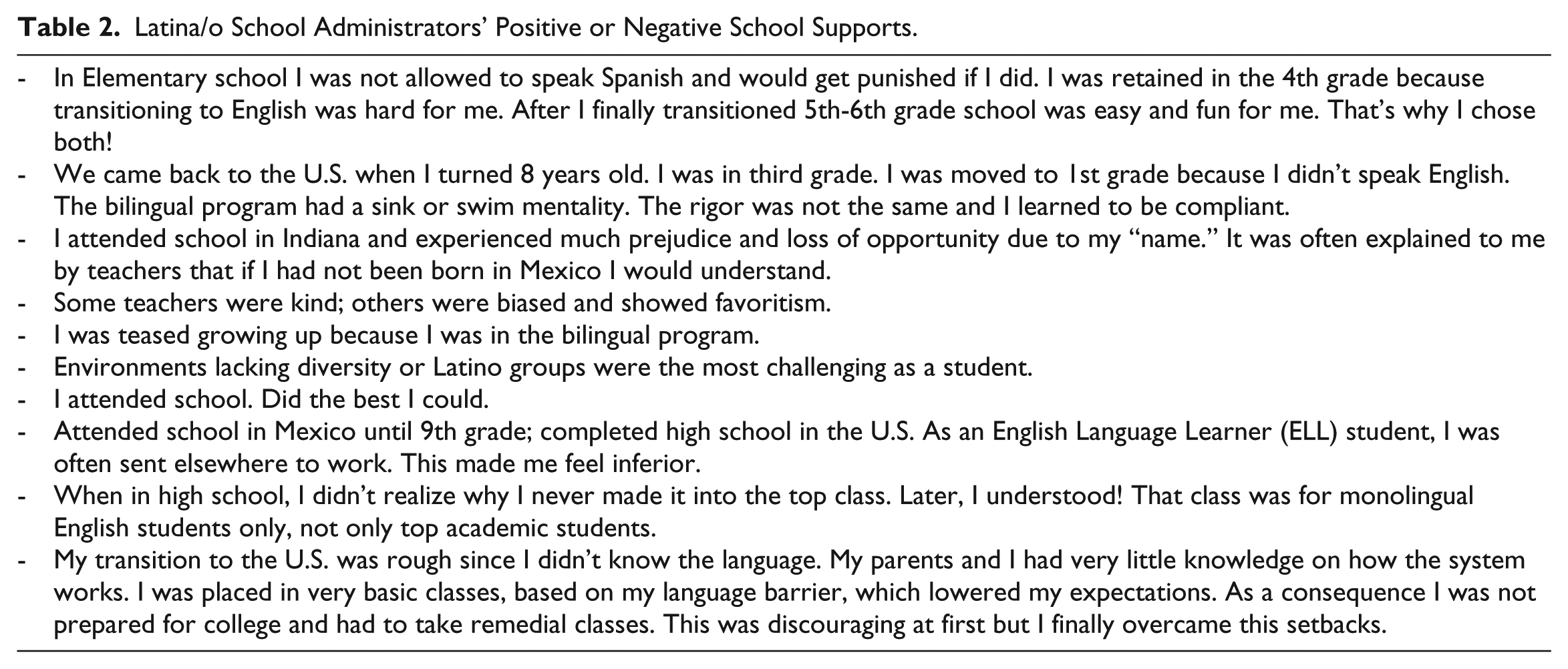
Among responses indicating school experiences were both positive and negative (survey responses with a Likert-type response 4), the influence of teachers is evidenced. Open-ended responses included the following:
These leaders express that while they had both positive and negative experiences in school, most of their negative experiences centered on issues related to language, Spanish names, and being isolated from other students. As they reflected in the survey, they also experienced lower expectations from teachers and questions about their cognitive abilities based on language skills only. Despite these negative experiences, the Latina/o school leaders persevered and made the best of their experiences.
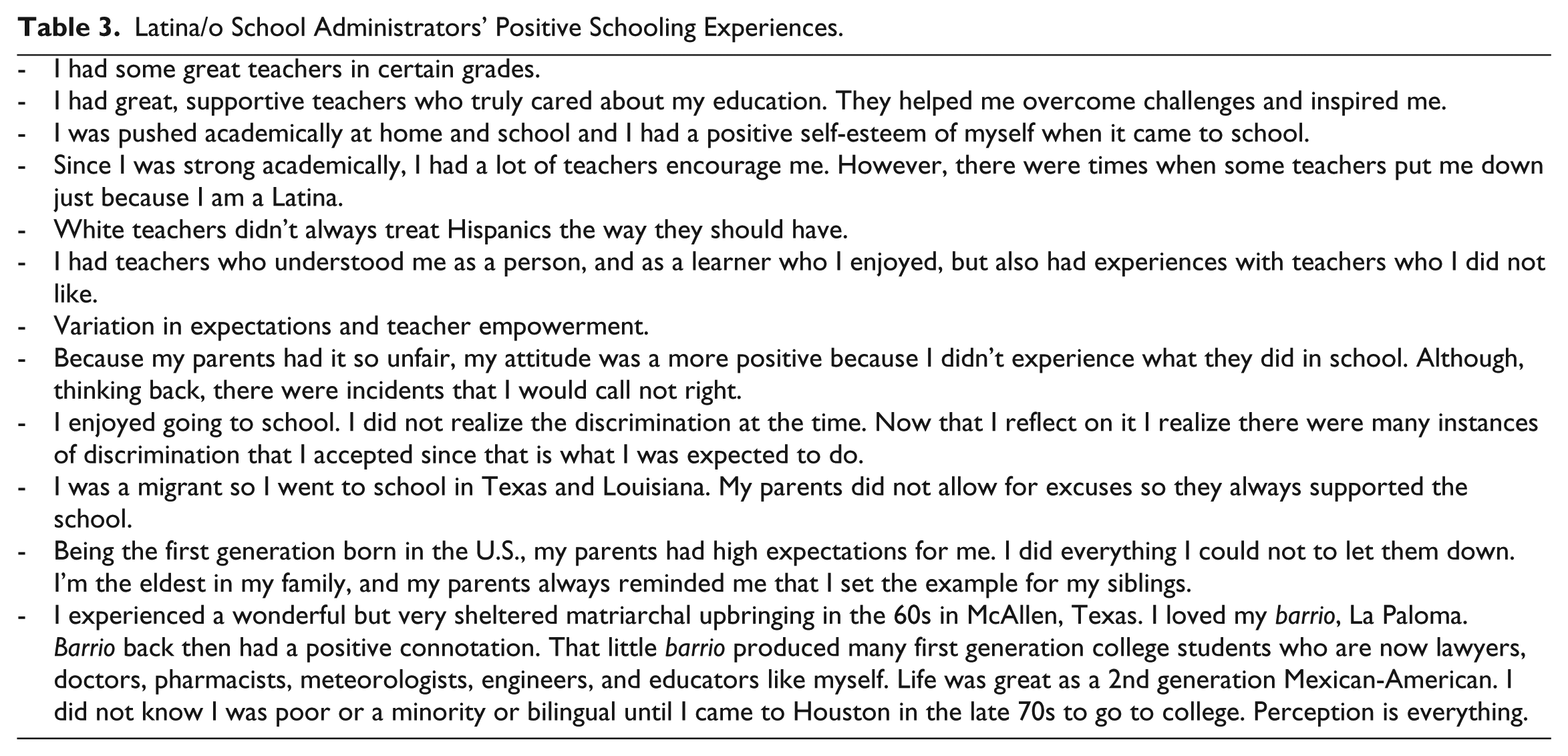
School administrators who responded having positive experiences, similarly relate those experiences as being influenced by teachers and the importance of being validated in their efforts. Interestingly, not all open-ended responses were only positive as follows:
All responses analyzed indicate the strong influence of adults in determining these school administrators schooling experiences, with strong intersectionality between negative experiences and race, and negative experiences and language. Furthermore, it was clear that the participants in the study could recognize the teachers who cared about and for them. Looking back at their schooling experiences and acknowledging both the good and the bad, these Latina/o school leaders knew which teachers empathized with them and could understand their experiences. Even though respondents are between 33 and 68 years old, it was hard as a research group to understand how corporate punishment was used to encourage learning.
When race is the focus of building individual identity, we critically considered the racial composition of teacher/student associations and intersections in these responses considering the likelihood that these students were served by a teacher demographic that accounts for 65% White teachers and 22% Hispanic in the state of Texas (Bitterman, Goldring, and Gray, 2013). The influence of White teachers and dominant racial ideologies are evidenced in the responses, aligning with Picower (2009) and others who call for the importance of examining these critical intersections. Important to consider is Bernal, Knight, Ocampo, Garza, and Cota’s (1993) observation that Latina/o students are aware that schools are “social, cultural, and political contexts” (p. 135) early in their schooling experiences. In relation to students’ perceived interventions, the responses showed that in some instances, even when interventions were in place, neither students nor parents were fully informed about them. These responses confirm Cummins’s (1986) point about the importance of the need to improve not only interventions but also the relationships between educators and students.
Latina/o School Administrators’ Negative Schooling Experiences.

Latina/o School Administrators’ Positive or Negative School Supports.
Latina/o School Administrators’ Positive Schooling Experiences.
Latinas/o School Administrators Connecting With Students of Color
Following on their intersectionality considerations in the development of a professional identity, we asked school administrators to reflect on the extent of their racial/ethnic background as contributing in connecting with the experiences of students of color (Figure 2). The rationale behind the connections of Latinas/os and students of color relates to observations made by Ferdman and Gallegos (2001), who argue that individual identity develops in the context of a group, or intergroup realities. This means that there is diversity not only in America but also within groups, such as Latinas/os. As we can find Mexican families who are indigenous to colonized states like Texas, as well as immigrant families from Mexico, we also acknowledgee other backgrounds such as Puerto Ricans, Cubans, South Americans, and others, as families and children served by Latinas/os. The heterogeneity is often ignored, where “glossing over identifictions based on national origin can be problematic” (Ferdman & Gallegos, 2001, p. 35). Hence, the importance to reveal whether Latinas/os would be prone to articulate if they identified with the experiences with students of color. Not surprisingly, their responses varied.

Latina/o school administrators’ race/ethnicity background as contributing to understanding the experiences of students of color.
Seventy-eight participants recognized an intersection between their racial background and the experiences of students of color (Likert-type responses 4-7). There was a representative response from participants who did not perceive their racial background as associated with students of color in their schools. Their identity has been explored by Ferdman and Gallegos (2001), who assert that some Latinas/os may carry an undifferentiated orientation, where they see people of color as “just people.” The authors explain that some Latinas/os may accept the dominant norms of the U.S. society and perceive to view people distinct from their racial or ethnic identity. Ferdman and Gallegos (2001) suggested that these Latinos may take a “color blind” perspective when considering their own racial identity. Moreover, these authors assert that when these particular Latinos encounter barriers, they attribute them to behavior rather than to race, racism, or their Latinoness. Studies in educational leadership may explain this behavior when recognizing race may compromise their own profession. For school administrators of color, they have to be very careful when recognizing their skills because the intent is not to further dismiss instances of discrimination but to address inequalities. Nonetheless, those who responded not perceiving a connection between their own upbringing and potential connections with students of color added comments as shown in Table 4.
Latina/o School Administrators Who Do Not Perceive Race/Ethnicity Background as Significant to the Experiences of Students of Color.

Those indicating their racial background as contributing to an understanding the experiences of students of color added comments as shown in Table 5.
Latina/o School Administrators Who Perceive Race/Ethnicity Background as Significant to the Experiences of Students of Color.

The implications of race in the development of a school leader’s professional identity are indeed complex as demonstrated by the responses. Language and kinship were seen as benefits. There seems to be more to be learned about a connection between Latina/o administrators and students. For example, Ferdman and Gallegos (2001) questioned what factors lead to each orientation. In consideration is that much still needs to be explored about “What is the role of variables [in developing an identity] such as external stressors, perceived threats from others to oneself, or to one’s group, relationships with other people, language use, and ability, phenotype, and family composition?” (p. 54).
Latinas/o School Administrators Capitalizing on Race/Ethnicity
Considering the school administrators’ experiences in schools, the NLLP survey sought to examine the participants’ preparation as a school administrator. For the most part, a large majority of participants responded they felt prepared for the position. Seventy-five percent of those surveyed indicated they felt well or very well prepared for their first administrative job. Within their preparedness, we asked a question that would include race/ethnicity in their preparation, which bring together their experiences. We asked how the Latina/o school administrators perceived their race and ethnicity background as benefiting their work. In a previous NLLP national study, school administrators were divided between those who perceived race/ethnicity as a barrier and those who did not. In studying Latina/o adminstrators in Texas, we found a similar pattern where respondents were divided about their race/ethnicity as benefiting their work. Murakami et al. (2016) found similar concerns about those indicating a void between their race/ethnicity background and their position. Respondents in the Texas study were divided in recognizing how their racial/ethnic background been a benefit in their work as administrators. This question provoked a larger range of both likert-type and open-ended responses, as it connects upbringing experiences and the development of a professional identity (Figure 3):
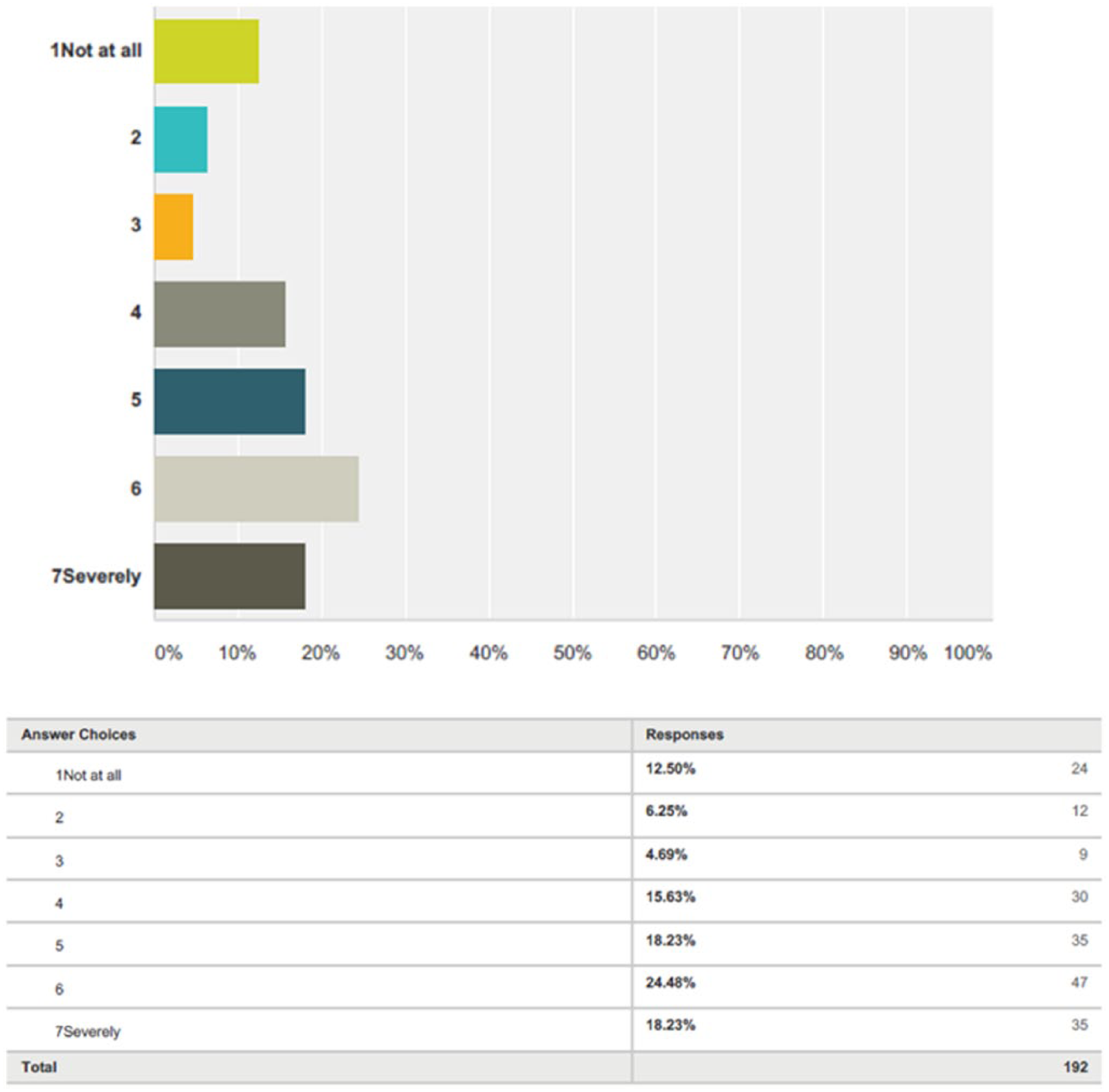
Latina/os race and ethnicity background as benefiting the work of school administrators.
When school administrators were asked whether their race/ethnicity background benefited the work of school administrators, more than 12% of respondents indicated that race/ethnicity did not benefit them as professionals. Those responding not at all (Likert-type option 1) did not add open-ended comments. Eleven percent of participants responding that race/ethnicity was not necessarily benefiting their work (Likert-type options 2 and 3) added the following open-ended comments:
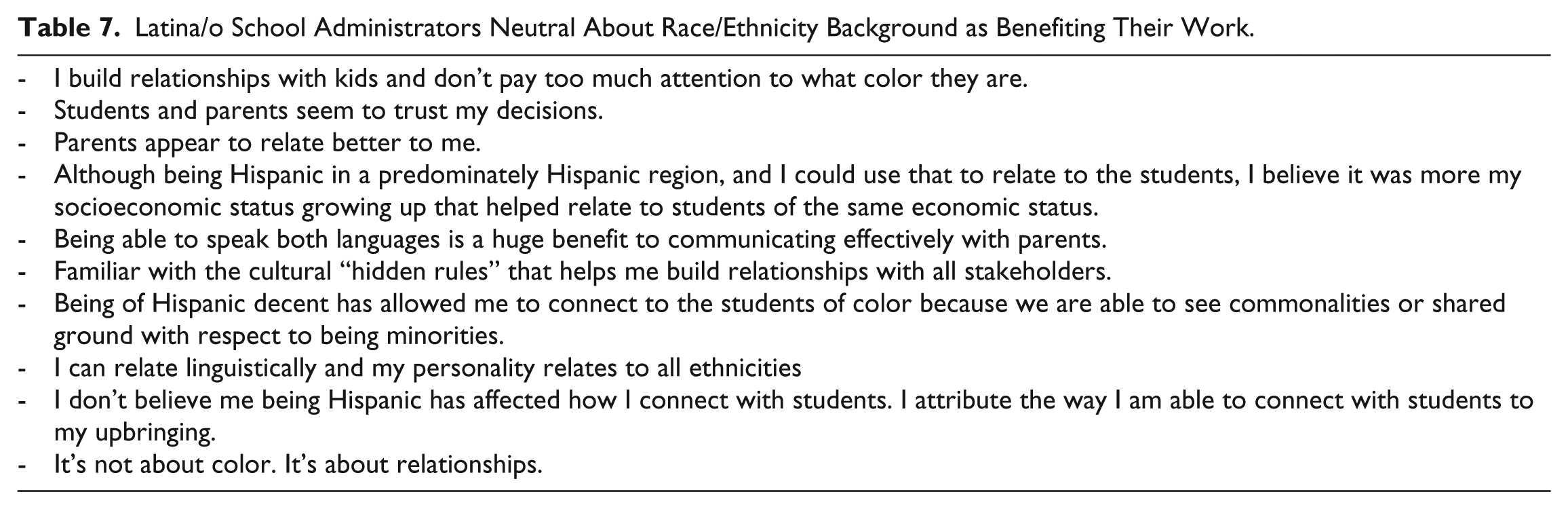
Fifteen percent of participants were neutral in perceiving if race/ethnicity benefited their work. It is clear that some of the leaders that completed the survey are not aware of how their own racial and ethnic identity impacts their work as school leaders. Their open-ended comments included the following:
More than 60% of respondents perceived race/ethnicity as benefiting to some degree (Likert-type options 5, 6, and 7). These school administrators added an overwhelming number of comments when compared with other options in this question. In their open-ended responses, Latina/o school administrators suggest a strong connection between their race/ethnicity and their professional identity as school administrators especially based on (a) common upbringing, (b) common language and culture, and (c) being a role model.
Common upbringing
The respondents recognized that students and parents felt connected to them due to their racial/ethnic background. They included comments such as follows:
Common language and culture
Latina/o school administrators demonstrated that language and culture were assets they brought to parents and students. Comments as detailed in Table 9 included the following:
Latina/o School Administrators Who Perceive Race/Ethnicity Background as Not Benefiting Their Work.

Latina/o School Administrators Neutral About Race/Ethnicity Background as Benefiting Their Work.
Latina/o School Administrators’ Connections With Common Race/Ethnicity Upbringing.

Latina/o School Administrators’ Connections With Common Language and Culture.

In the last two sections, it is clear that the leaders’ lived experiences have provided them with the ability to comprehend and recognize the diverse backgrounds of their students. This is noted as some leaders express the idea that they can see themselves in the lives of their students. Their capacity to see themselves in the eyes of their students connects these Latino school leaders with their students on a much profound level, which is beyond the conventional principal–student connection.
Latina/o school administrator as a role model
An important asset benefiting students, teachers, and parents related to the Latina/o school administrator as a role model (Table 10). Respondents perceived they could positively influence multiple stakeholders. Their comments included the following:
Latina/o School Administrators’ as Role Models.

The question of how race and ethnicity background benefit the work of school administrators received an extraordinary number of open-ended comments. The participants felt more comfortable in responding to this question as opposed to the question about connecting with students of color. The school administrators confirmed many of the Latina/o capitals listed by Yosso (2005), including the importance of a common upbringing, common language, and culture. The awareness of being a role model for both students and adults was an indication that these administrators were critical in their roles and intentional in their investments to improve the experiences of those in schools. These leaders also ultilized their own experiences with discrimination to develop high levels of empathy for their diverse students. Although still holding their students to high expectation, these Latino school leaders understood that parents saw them as an advocate for their chilren because of their racial and ethnic backgrounds.
Discussion
The lessons provided by the findings in this research reveal that much is still to be explored about the impact of Latina/o school administrators. Their responses were rich in evidencing common early schooling experiences. These experiences were not often devoid of racism and discrimination. Despite these hardships, these individuals opted to have a career in education. It was important to remind ourselves of the low number of Latinas/os in administrative positions in the United States. Therefore, we recognize how this study could not include questions that could jeopardize their work.
Nonetheless, they were candid in recognizing how race and ethnicity affect their work. When race is the focus of building an individual’s professional identity, we also critically considered the racial composition of teacher/student associations and intersections in these responses. We especially considered the likelihood that these administrators, when children, were served by a teacher demographic that is less White, but still accounts for 65% White teachers and 22% Hispanic in the state of Texas (NCES, 2013).
The influence of White teachers and dominant racial ideologies are evidenced in the responses, aligning with Picower (2009) and others who call for the importance of examining these critical intersections. Important to consider is Bernal et al.’s (1993) observation that Latina/o students are aware that schools are “social, cultural, and political contexts” (p. 135) early in their schooling experiences. In relation to students’ perceived interventions, the responses showed that in some instances, even when interventions were in place, neither students nor parents were fully informed about them. These responses confirm Cummins’s (1986) point about the importance of the need to improve not only interventions but also the relationships between educators and students. We wondered whether teachers dealing with issues of discrimination among Latinas/os would consider that these children might want to have a job as a teacher and eventually become a school administrator in the future.
We hope this study can be further developed to include the preparation of teachers for delivering intervention programs that promote the success of Latinas/os and students of color. With the help of school adminisrators who once experienced these programs and interventions, ways to improve the experiences of Latinas/os in schools could be further explored. In addition, the positive influence of Latina/o leaders as role models of color merits exploration, especially because some of these school administrators sorely missed someone to whom they could trust when growing up. Similarly, an environment where school administrators do not feel threatened in their intent to support others to succeed as Latina/o teachers and school leaders is needed. To improve schools, mentoring future educators to positively impact their schools may be key to reducing racial and ethnic discrimination at all levels of the education pipeline, including professionals in education.
Footnotes
Declaration of Conflicting Interests
The author(s) declared no potential conflicts of interest with respect to the research, authorship, and/or publication of this article.
Funding
The author(s) received no financial support for the research, authorship, and/or publication of this article.
