




Abstract
The purpose of this study is to investigate the dual mediation role of creativity and academic coping in network efficiency and academic performance, using Folkman and Lazarus’s transactional model of stress. Data were obtained from 39 students taking business administration at a Korean university. Social network analysis was performed to check the ego network of students. The double mediation model was applied to analyze the path from network efficiency to academic performance. The results showed that network efficiency, in relation to the structural hole in social network parameters, was double mediated by creativity and academic coping, which had a positive effect on academic performance. However, the effect of double mediation through avoidance was insignificant. Based on the research results, the theoretical and practical implications for the dual mediation effect of creativity and academic coping were presented.
Introduction
The social capital concept of social capital relates to the provision of trust, cooperation, and collective action based on human relations within the community (Jacobs, 1961). Tsai and Ghoshal (1998) divided social capital into three dimensions and identified social interaction as a structural dimension, trust as a relational dimension, and shared goal as a cognitive dimension of social capital. Social interaction as a social capital promotes knowledge exchange and reinforces participants’ learning and creativity in the network (Nahapiet & Ghoshal, 1998). In the same vein, social capital is an important facilitator that inspires creativity and is considered a significant new knowledge source (Perry-Smith & Shalley, 2003). Moreover, creativity can be boosted when a creative individual exists within a network in which interpersonal relationships are formed (Simonton, 1984). The creative process is a social interrelationship involving actors, activities, and resources beyond a single organization’s scope (Perry-Smith, 2006). These previous studies highlight an essential research task to confirm the relationship between social network parameters and individual creativity (Jen, 2014). In addition, classes were forced to go online due to the isolation caused by COVID-19 (Ng et al., 2022). It has also been shown that these online learning activities can reduce creativity while limiting interactions between students compared with face-to-face activities (Usher et al., 2021). That shows the importance of the school’s cooperative environment in cultivating students’ creativity. In particular, social capital is emerging as a potential protector for organizations facing problems caused by COVID-19 (Al-Omoush et al., 2022). Thus, it could be essential to examine whether the network among students within the social capital provided by the school can improve students’ creativity and academic performance. In addition, it could be essential to check whether these harmonious and healthy relationships between students enhance students’ creativity (Luo et al., 2022) while also serving as a related resource to effectively cope with stress from academic activities (Castro Torres et al., 2022). However, studies on social connection and creativity have been mainly based on organizational literacy, and everyday settings are insufficient (McKay et al., 2017). In addition, previous studies have mainly been conducted on the relationship between network centrality (Ahuja et al., 2003), strength of ties (Perry-Smith, 2006), and network position (Tsai, 2001) and creativity. In other words, in terms of research on network structure and creativity, studies on network efficiency and creativity dealing with the possibility of exchange of various nonoverlapping information derived from the concept of a structural hole are limited.
Therefore, this study examined the effect of network efficiency, which encompasses non-redundancy of relationships, on creativity in relation to the structural hole of university students in natural settings. In addition, it examined if students’ creativity level affects academic coping and students’ academic achievement. This was based on the research findings that show creative thinkers adapt well to the school environment and have little difficulty dealing with academic stress (Carson et al., 1994). The main questions of the study are:
Can the network efficiency of students’ ego-network affect an individual’s creativity?
Can an individual’s creativity affect the student’s academic coping?
Can personal relationships affect students’ creativity and ability to cope with academic stress?
Accordingly, two mediator analyses were performed to confirm the chain of major research factors.
Theoretical Background
Network Efficiency and Creativity
Social capital is a relationship based on trust, cooperation, and collective action formed over time for the continued survival and functioning of city neighborhoods (Jacobs, 1961). When social capital creates individual creativity, the structure of possible networks is organized into two perspectives. First, a closed and socially boned network in which the network’s density and degree of centrality enable knowledge sharing (Coleman, 1988). Second, a structure in which actors can bridge distant and unconnected contracts in the form of a brokered network (Fleming et al., 2007). Burt (1992) proposed the concept of a structural hole as an advantage of brokerage opportunities, arguing that the structural hole reinforces an individual’s unduplicated and wide-range access to information. As a result, individuals gain the advantage of access and control a variety of information (Burt, 2000). A structural hole can be measured by network efficiency in relation to non-redundant access to resources and information (Zaheer & Soda, 2009). Within an efficiently maintained network, non-overlapping information is delivered (Hargadon & Sutton, 1997), and available knowledge can be transferred as new knowledge (Kratzer et al., 2010). Since overlapping connections with the same network contacts can be seen as an inefficient network, network efficiency is measured as the ratio of the non-redundant relationship among the ties that the ego network is connected to in its neighborhood (Burt, 1992).
In the modern business environment where competition is fierce, employees’ creativity is a major factor in strengthening an organization’s competitiveness and performance (Hahn et al., 2015). According to Amabile (1988), creativity is a novel and useful concept and a one-dimensional construct (Amabile, 1988). However, it has been empirically confirmed as a multidimensional concept (George, 2007). Creativity is multifaceted but its many features have not been fully explored yet (George, 2007). In other words, it is necessary to confirm that creativity has characteristics that deviate from the existing order (Mainemelis, 2010); there is no need to limit creativity to antecedents when solving endogeneity problems (Soda & Bizzi, 2012). Initially, it was assumed that the cognitive and motivational processes can explain the difference in creativity between individuals (Perry-Smith, 2006), but it was gradually revealed that creativity is influenced by the environmental variables individuals face (Hahn et al., 2015). Although cognitive limitations and prejudices still limit creativity, social networks can be an important resource for creativity and knowledge (Zhou et al., 2009). Therefore, creativity is more than simple individual characteristics and a factor that is exogenously affected by the network in which an individual is located, such as an organization or group (Soda & Bizzi, 2012). Creativity can vary depending on the degree of interpersonal relationship an individual has in the network (Simonton, 1984). Since creativity is affected by social influences resulting from the interaction between groups (Perry-Smith, 2006), the social process becomes a prime factor in inducing creativity (Kratzer et al., 2010). Therefore, it is necessary to consider the network effect assuming a social context or social structure on creativity (Soda & Bizzi, 2012). Social capital, embodied as a social relationship within the network (Nahapiet & Ghoshal, 1998), is linked to various organizational dynamics and outcomes, including creativity (Liu, 2013). Previous studies have investigated concepts that relate to social ties as the variable that affects individual creativity within social networks (Fleming et al., 2007; Perry-Smith, 2006). Organizational research has found that over time, peers perceived as creative by other employees moved to a more central position in the network as their surrounding peers tried to keep themselves closer to their creative peers (Koseoglu et al., 2023). Differences in creativity among individuals may occur due to tie strength or diversity of connections (Baer, 2010). It was also found that weak ties at an optimal level can increase creativity (Zhou et al., 2009). Through research on the R&D team, employee structural holes were mediated by diversified knowledge and positively influenced employee creativity (Tang et al., 2017). In this vein, from this study’s point of view, the structural hole concept as a social network parameter may increase diverse connections and non-redundant information, improving creativity as a result. As students perceive their relatedness through self-appraisal, classmates, who are social partners, can be motivational resources for achieving personal goals, increasing engagement with academic situations, and aiding academic stress-coping behavior in stressful situations (E. Skinner et al., 2013). This study wants to place creativity between the social relationship and academic coping that affects a student’s academic outcome. The specific causal relationship between the mentioned variables is discussed below.
First, if the network’s diversity increases, each individual’s creative ability will increase because they are better able to evaluate potential alternative solutions to problems with their connection (Jen, 2014). A diverse perspective reinforces creation-relevant skills because it promotes a different and unusual approach to the conventional one (Perry-Smith & Shalley, 2003). If each individual has a diverse background of knowledge, the individual’s creative ability will be sufficiently affected by the access to this diverse knowledge (Rodan & Galunic, 2004).
Second, access to broader knowledge is possible due to non-redundant information, which promotes creativity (Perry-Smith & Shalley, 2003). Increasing diversity can maximize information richness (Kurtzberg, 2005), and when knowledge sharing is supported, new and unique thinking can be produced (Wang & Noe, 2010). On the contrary, a dense network with few structural holes inhibits creative thinking through the creation of a dominant logic and strong norms (Mom et al., 2009). Also, dense networks can limit high-level exploration and exploitation by requiring an individual to invest the time and effort needed in communication between existing network members (Hansen et al., 2001). Eventually, as interactivity and interconnection in a dense network increase, information and resources are bound to become redundant (Jen, 2014). In conclusion, diversifying ideas collected through various networks and information can increase creativity. Therefore, this study made the following hypothesis:
H1: Network efficiency is positively related to creativity.
Creativity and Academic Coping
According to Folkman and Lazarus (1984), coping is basically a cognitive and behavioral change to manage perceived stress. It encompasses “conscious volitional efforts to regulate emotion, cognition, behavior, physiology, and the environment in response to stressful events or circumstances” (Compas et al., 2001, p. 89). Coping is a dynamic process that responds to changing demands and appraisals of circumstances (Moos & Holahan, 2003).
The coping appraisal goes through three steps. The first step is to determine whether the situation at hand has an effect on our well-being, is positive for our life goals, and the condition is stressful enough to require coping strategies. The situation will become a challenge if you can pursue profit or benefit even in a stressful situation, but the opposite is a threat (N. Skinner & Brewer, 2002). The second step is to determine the resources that can address this situation. The more significant the discrepancy between resources and coping strategies, the more stress that can be experienced (Carver & Scheier, 1999). The third and final step is the coping response step (Folkman & Lazarus, 1985). From this study’s point of view, creativity is related to evaluating resources for coping with the second stage.
Coping resources protect individuals from stress and influence the coping process. Coping resources are divided into personal and environmental resources (Folkman & Lazarus, 1984). Folkman and Lazarus explicitly identified creativity as a coping resource. However, since studies on the relationship between creativity and mental health have been consistently confirmed through causal relationships between creativity characteristics, creative behavior, and personal psychology, creativity cannot be said to be utterly unrelated to the stress-coping process (Nicol & Long, 1996). Therefore, it can be inferred that creativity can form a causal relationship with coping as a coping resource. As a classification of resources for coping with stress, personal resources include individual traits, skill, and cognition styles, while environmental resources include social support (Folkman & Lazarus, 1984; Pierce et al., 1996). In terms of social support, the relationship between students in the classroom is related to a teacher, learner, social skills, communicative competences, cooperation skills, and team work formed between learners at the same level are the basis of social coping strategies within the school (Sakk, 2013). Peer relationship, which is a social factor that influences students’ response to a crisis that occurs in school, is related to adaptation to stressful situations (DuBois et al., 1992). Indeed, students use social support as an approach to coping (Väisänen et al., 2018). Therefore, it is necessary to infer the creativity created by the use of the network’s social relationship as a coping resource. Just as personal relationships and situational parameters affect the coping style (Saadu & Adesokan, 2013), antecedent conditions that affect creativity include personality, cognitive style, and social background (Woodman & Schoenfeldt, 1989). Therefore, as hypothesized by this study, creativity induced by social relationship resources, like a secondary by-product, can become a coping resource. For example, working class families showed lower problem-solving ability than middle-class families, according to studies into problem-solving ability of social classes. The difference seems to be the lower community count within low-income family members, which undermines the development of creativity (Straus, 1968). Interpreting Straus’s study results from the perspective of this present study, the insufficient relational resource within working class families lacks coping resources called creativity and consequently affected the working-class member’s problem-solving ability. Also, creativity triggers can be related to personal coping resources. For example, divergent thinking, which has a positive relationship with creativity (Orkibi & Ram-Vlasov, 2019), is related to the problem-solving skills described by Lazarus and Folkman as a personal coping resource (Nicol & Long, 1996).
Coping refers to an individual’s cognitive, emotional, and behavioral effort to control, reduce, and endure the situation that caused the problem (Folkman & Lazarus, 1985). In general, an approach coping strategy refers to cognitive or behavioral effort to reduce or manage stress, whereas avoidance coping strategies refer to avoiding thinking about stress and its consequences (Moos, 1993). According to Syed and Seiffge-Krenke (2015), approach coping strategies are more adaptive than avoidance coping strategies.
The relationship between creativity and approach coping strategies is expected to be positive, whereas that between creativity and avoidance coping strategies is expected to be negative. Previous studies have shown that approach-based psychopathologies have a positive relationship with creativity, and avoidance-based psychopathologies negatively affect creativity (Baas et al., 2016).
There are different reasons for the correlation between creativity and coping style (approach vs. avoidance). First, there is a difference between creativity, approach context, and avoidance context. The positive relationship between creativity and the approach context exists because the approach context tries to adapt to risks and maintains an explorative processing style. On the contrary, the relationship with the avoidance context is expected to be negative because it maintains a risk aversion or vigilant processing style (Friedman & Förster, 2002).
Second, the degree to which creativity is used as a coping resource is different. Approach motivation has a positive relationship with creativity because it pursues flexible and associative information processing through challenging appraisal. Avoidance motivation seeks an inflexible processing style through threat appraisal. Even though avoidance motivation does not make it impossible to be creative, it makes using creativity more difficult (Icekson et al., 2014). Above all, it is an optimal resource to lead adaptive coping to students’ daily academic challenges and adversities (Putwain et al., 2012). Creativity is a typical optimal coping resource that helps individuals have more joyful emotions, passions, and optimism (Rasulzada & Dackert, 2009). It also affects people’s well-being positively (Csikszentmihalyi, 1999).
Third, specific coping styles that correspond to approach and avoidance coping strategies have a negative relationship between them, so the relationship with creativity will reflect this. Though there is a paucity of research on creativity and coping styles, the results from available studies show that there is a positive relationship between creativity and approach-based coping strategies.
Everyday creativity is related to an individual’s coping ability (Flach, 1990; Richards, 1990), especially the relationship between creativity and problem-solving ability (Blissett & McGrath, 1996; Isaksen et al., 2010). Although problem-solving may not always be an effective coping strategy, it helps with successfully adapting to individual situations (Carson & Runco, 1999). Creative thinking also reduces stress and depression (Le et al., 2015), highlighting a relationship between creativity and coping with stress. Specifically, a look at the cognition dimension of creativity shows creative thinkers can tolerate ambiguity (Dowd, 1989). They can incorporate and synthesize contradictory ideas with flexibility, which helps them cope with stressful situations (Carson et al., 1994). Creativity enables simultaneous divergent thinking, showing the ability and flexibility to generate ideas from different, detailed, and original concepts that evoke unique ideas (Orkibi & Ram-Vlasov, 2019). In fact, in school research, divergent thinking affects stress-coping ability (Carson et al., 1994). As a result, creativity enables adaptive future thinking in the face of stressful situations (Forgeard & Elstein, 2014). It is associated with psychological characteristics such as high-level ego autonomy, which helps individuals respond to life’s stressors in a positive way (Cropley, 1990). In this way, creativity enables positive and pro-active coping (Corry et al., 2013).
The relationship between avoidance coping and creativity can be inferred through the different results from using avoidance coping and approach coping mechanisms. Approach coping and avoidance coping have a negative relationship, and students who do not make active attempts will use more avoidance coping strategies (Hsieh et al., 2012). Students with academically good performance use more approach coping strategies, such as problem-solving strategies, and less avoidance coping strategies like alternative rewards or cognitive avoidance (Gustems-Carnicer et al., 2019). Creative problem-solving is an approach coping strategy that highlights a negative relationship with distancing and escape-avoidance tendencies (Carson & Runco, 1999). Taken together, it can be inferred that creativity has a positive relationship with approach coping strategies and a negative relationship with avoidance coping strategies. Accordingly, the following hypotheses were formulated:
H2-1: Creativity is positively related to approach coping.
H2-2: Creativity is negatively related to avoidance coping.
Academic Coping and Academic Performance
Coping is a critical element in academic success (Struthers et al., 2000). Approach coping strategies refer to active attempts made to solve a problem. It involves setting a problem-solving goal, developing a skill to master the problem, or finding a variety of solutions through processes like brainstorming. Avoidance coping is a cognitive or behavioral attempt to escape or disengage from a stressful situation (Hsieh et al., 2012). If considering this concept of coping, it is possible to infer whether the coping result will be successful.
The traditional stress coping model is divided into problem-focused coping and emotion-focused coping. In some cases, it is difficult to distinguish between which category of the two a coping response falls (Abella & Heslin, 1989). Therefore, stress coping can be broadly explained by dividing into active (problem-focused) or avoidant strategies (Abella & Heslin, 1989). In the context of this study, active coping or problem-focused coping is an approach coping strategy, while emotional focused coping is an avoidance coping strategy. Basically, active coping is adaptive coping, while avoidance coping is maladaptive coping (Sagone & Elvira De Caroli, 2014). Coping style depends on the nature of the stress. Problem-focused coping is possible in a controlled environment, but avoidance coping may occur in an uncontrollable environment (Folkman & Lazarus, 1984). In academic situations, problem-focused coping predicts higher grades, while avoidant coping predicts lower grades (MacCann et al., 2012). Avoidance coping is usually an appropriate coping strategy in stressful situations in the absence of attempts to change the situation. However, on the long run, task-oriented attempts are more efficient strategies (Kausar, 2010). As a result, academic performance due to coping method will be different. This is due to various below-discussed reasons.
First, the stress evaluation process causes the result from the different from the overall coping strategy. Stress can be experienced as a challenge or threat (Baum et al., 1981). For example, when a school event is regarded as challenging, harder academic work is obtained with an active coping response; if threatening, students avoid or drop out of the school event with negative coping responses (Shields, 2001). More specifically, in the case of academically high-risk students lacking necessary knowledge, they did not challenge college learning. They deal using avoidance coping, resulting in being academically behind their peers. This coping strategy is not useful for student adaptation (Pizzolato, 2004). Students suffering from post-traumatic stress prefer to avoid and disengage (denial, social withdrawal, and self-destructive behaviors) when faced with stressful academic situations (Read et al., 2014). As a result, they usually end up with poor academic results. Therefore, a way for students to adjust better and increase school success is to respond effectively to academic challenges and demands (Vizoso et al., 2018).
Second, depending on the coping strategy, effort put in and academic results can be different. The way students cope with academic stress determines how much effort they invest in it (Sullivan, 2010). Active coping strategies for academic stressors experienced in the university environment predict positive academic achievement when grade points are identified (Sennett et al., 2003). In contrast, avoidant coping strategies encompass cognitive or behavioral efforts to avoid the stressful situation. Because of this, avoidance coping impairs students’ academic achievement due to poor academic engagement and adjustment difficulties (Boyraz et al., 2019). According to DeBerard et al. (2004), a university freshman study showed that escape coping strategies have a negative relationship with cumulative GPA. Students who used this coping style usually end up with low GPAs.
Third, the different coping strategies triggered different learning strategies. Students who use approach coping strategies are problem-oriented and analytical when preparing for exams, taking on actual challenges, reflecting on class material and personal examples, and use elaborative cognitive learning strategies (Appelhans & Schmeck, 2002). In academic environment, proactive coping (Aspinwall & Taylor, 1997) means students actively plan, carry out learning plans, and monitor challenging learning plans for academic materials (E. Skinner et al., 2013). However, avoidance coping includes a cognitive avoidance strategy (Gustems-Carnicer et al., 2019). Cognitive avoidance negatively affects academic plans by causing students to disengage from schoolwork due to the intense stress (Neveu et al., 2012). Students may resort to alternative reward strategies, like alcohol or drug intake, to avoid dealing with the stressful situation (Tavolacci et al., 2013). However, students seeking help or attempting to solve problems using approach coping strategies achieve high academic performance (Gustems-Carnicer et al., 2019).
Fourth, the results are affected by the characteristics of students who use the coping strategies. Students who use approach coping have a high interest in academic work, high personal responsibility for academic behavior, endeavor to solve tasks, and, above all, high self-efficacy (Appelhans & Schmeck, 2002). However, students who use avoidance coping simply memorize textbooks and notes when preparing for exams (Appelhans & Schmeck, 2002). According to a university freshmen study, active coping is pursued in a positive mood or with high optimism, and, as a result, has a positive effect on overall college life adjustment, including college grades. On the contrary, adopting avoidance coping strategies negatively affects college life (Aspinwall & Taylor, 1992). Based on the above, academic performance results for approach and avoidance coping strategies may be different. Accordingly, this study proposed the following hypotheses:
H3-1: Approach coping is positively related to academic performance.
H3-2: Avoidance coping is negatively related to academic performance.
Serial Multiple Mediator Hypothesis
All causal relationships are hypothesized based on the theoretical background of the path. What sets this study apart from other studies is that it hypothesizes serial mediation based on connected hypotheses. The linkage of research parameters is based on Folkman and Lazarus’s (1984) transactional model of stress. An individual carries out two appraisals when faced by a stressful encounter that can affect their academic performance. The first appraisal is to ascertain if the task/examination is a personal goal. The second appraisal is a self-evaluation of the individual’s ability to cope with the stressful situation. This process becomes the evaluation stage for the resource called network efficiency as social capital within this present research model.
H4-1: Network efficiency is sequentially associated with creativity and approach coping, which is related to increased academic performance.
H4-2: Network efficiency is sequentially associated with creativity and avoidance coping, which is related to decreased academic performance.
Method
Participants and Procedure
This study was devised to identify a dual mediation model that affects academic performance through network efficiency using creativity (M1) and academic coping (M2). A survey was conducted on 39 consenting students participated (Mage = 25, SD = 1.277; Nmale = 29, Nfemale = 10) taking business administration classes at a Korean university.
First, a class list was gathered. The list was made up of five names given by each participant of classmates they share knowledge and solve assignments with. This was to ascertain the students’ classroom ego network in the class. Thereafter, the participants were given instructions on how to indicate the behavior or attitude they usually take when solving the tasks presented in the curriculum. This was to measure creativity. Academic coping style was measured with questions like “Think about a time when you received a low grade on an important exam, significantly lower than what you usually get.” This was adapted from Sullivan (2010). Finally, participants provided answers their demographic information (age, gender, etc.).
Survey Measures
Network Efficiency
Network efficiency is calculated by dividing the effective size by the number of direct contacts in an ego network (S. Borgatti et al., 2002). Effective size is the ego’s degree (the number of alter egos) minus the average degree of alters within the ego network, which means they are redundant (S. P. Borgatti et al., 2018). High efficiency occurs when the ratio of the connection between the ego and alters without duplicates in the network is high. To measure the students’ network efficiency, they were instructed to mention, in order of importance, up to five students who attended selected class and with whom they shared useful knowledge for assignments. By running UCINET 6 for Windows, I checked the participating students’ ego network and network efficiency.
Creativity
Creativity was measured using five items adapted from Zhang and Bartol (2010). The respondents were asked the degree to which they think of themselves based on items on a seven-point scale (1 = not at all characteristics; 7 = very characteristic). The questions included “Suggest new ways to achieve goals or objectives.” and “Come up with new and practical ideas to improve performance.”
Academic Coping Style
Academic coping style was tested using a scale adapted from Sullivan (2010). Following Sullivan’s method, the students were reminded of a specific academic stressor and asked to “Think about a time when you received a low grade on an important exam, significantly lower than what you usually get.” This guide encouraged students to respond by maximizing the usual way they cope with students’ academic stress (Hsieh et al., 2012). Fifteen approach coping items and 11 avoidance coping items were used. The approach items included “Creating a specific plan of action for solving the problem,” and “Doing nothing about the problem” as an avoidance coping question. These items used were on seven-point Likert scale (1 = strongly disagree, 7 = strongly agree).
Academic Performance
Academic performance was calculated based on 100 points accumulated from scores assigned to intermediate exams, final exams, team project, and attendance for one semester in the class selected for the survey.
Reliability and Validity of Measurements
Excluding network efficiency and academic performance, all multiple response questions measured by self-reporting survey questions were investigated for internal consistency and validity. The Cronbach’s alpha coefficients for the constructs ranged from .836 to .913. These results indicate adequate internal consistency for the majority of the measures. In terms of content validity, the measurements were validated by applying items used in previous research. To determine validity, factor analysis was performed on the construct measures, using principal component analysis as the extraction method. Three factors emerged with eigenvalues greater than 1, and these accounted for 74.42% of the total variance. To ensure construct validity, the factor loading results for each factor are required to exceed 0.7 (Hair et al., 2010; Nunnally & Bernstein, 1994). Here, the factor loading values ranged from 0.730 to 0.873, which is higher than the recommended level.
Results
To examine whether network efficiency predicts academic performance through creativity and academic coping, this research used a three-path sequential multiple mediational model based on traditional ordinary least-squares regression. In this model, the indirect effect is composed of two mediators placed in a chain, reflecting the theoretical assumption that network efficiency leads to creativity and that academic coping is a reaction strategy that is linked to academic performance. To compute all the regression equations, this research used a specialized SPSS macro called PROCESS model 6 (Hayes, 2017), which computes the regression coefficients for all indirect effects and uses a bootstrapping procedure to compute bias-corrected confidence intervals (CIs) around the point estimates of each indirect effect in the model.
The research model first computed the total effect (path c) by regressing the academic performance on network efficiency. Second, to compute the indirect and direct effects, three regression equations were used: (i) regressing creativity (mediator 1) on network efficiency; (ii) regressing academic coping (mediator 2) on creativity and network efficiency; and (iii) regressing academic performance on academic coping, creativity, and network efficiency. A generic form of this model is depicted in Figure 1.

The three-path sequential mediation model linking network efficiency to academic performance through creativity and academic coping.
Preliminary Results
First, all the main study variables were tested for non-normality. All the measures of skewness (0.295–0.849) and kurtosis (−0.561–2.129) were under the cutoff line of satisfaction. Second, Mahalanobis distance was used to check for multivariate outliers with the main study variables, and no participant was removed due to being a multivariate outlier, resulting in a final analytic sample of 39. Finally, to decide which, if any, demographic and control variables to include in the model testing, the study examined the bivariate correlations study variables with demographic characteristics (for age and gender). There were correlations based on demographic, control, and study variables. Therefore, age and gender were included as covariates in all the subsequent analyses. The means, standard deviations, and bivariate correlations for the study variables for the final analytic sample are shown in Table 1. All study variables are intercorrelated in predicted directions, except the relationship between avoidance coping and academic performance.
Sums, Standard Deviations (SDs), Inter-correlations and Scale Reliabilities b for the Study Variables.

aGender: 0 = “male”, 1 = “female.”
The values in parentheses on the diagonal are Cronbach’s alphas (Creativity = 2, Approach coping = 3, Avoidance coping = 4).
p < .001. *p < .05.
Mediation Models
This hypothesis was modeled and tested by setting direct paths from network efficiency to creativity, academic coping, and academic performance, as well as a serial mediation pathway through creativity and academic coping to academic performance (see Figure 1) while statistically controlling for gender and age (not depicted in Figure 1). In the first model, this research tested the following predicted sequential model: network efficiency → creativity (mediator 1) → academic approaching coping (mediator 2) → academic performance. The regression coefficients of all four regression equations for this mediational model are presented in Table 2 and Figure 2. Table 2 presents the bootstrapping-based point estimates and standard errors (SEs) of each indirect effect and its associated 95% CIs. As can be seen in Figure 2, network efficiency is positively associated with creativity (ba1 = 1.089, SE = 0.567, p = .063). Considering the correlations discussed above, the effect of network efficiency on creativity was predicted to support the hypothesis, but the causal relationship between the two variables weakened as the covariate was inserted. Strictly, H1 may be rejected in the sense of significance, but since this study is an analysis aimed at double-mediated analysis, H1 was adopted at an acceptable level in which the indirect effect is not rejected. Next, creativity is positively associated with approach coping (ba3 = 0.336, SE = 0.097, p = .001), thereby supporting H2-1. In addition, approach coping is positively related with academic performance (bb2 = 20.398, SE = 6.751, p = .005), thereby supporting H3-1. Most pertinent to H4-1 is the estimate of the indirect effect through both mediators. The indirect effect through both mediators was significant—a1a3b2 = 7.454, 95% CI [0.400, 25.766]—thereby supporting H4-1 (see Table 3). This suggests that a serial multiple mediation has indeed taken place. The effect of network efficiency on academic performance was also insignificant in the total effect model (bc = 9.370, SE = 14.026, p = .508), and even when all variables were considered (bc’= 16.555, SE = 13.529, p = .230). Therefore, network efficiency did not independently affect academic performance within the model. In conclusion, H4-1 was supported, and these results show that network efficiency affects academic performance through creativity and approach coping, as hypothesized in this study. In addition, there was no direct effect on network efficiency → academic performance within each model.
Multiple Regression Coefficients, Standard Errors (SEs), t Values and p Values for All Regression Equations Testing a Mediational Model With Approach Coping as the Mediator.

All coefficients are unstandardized.
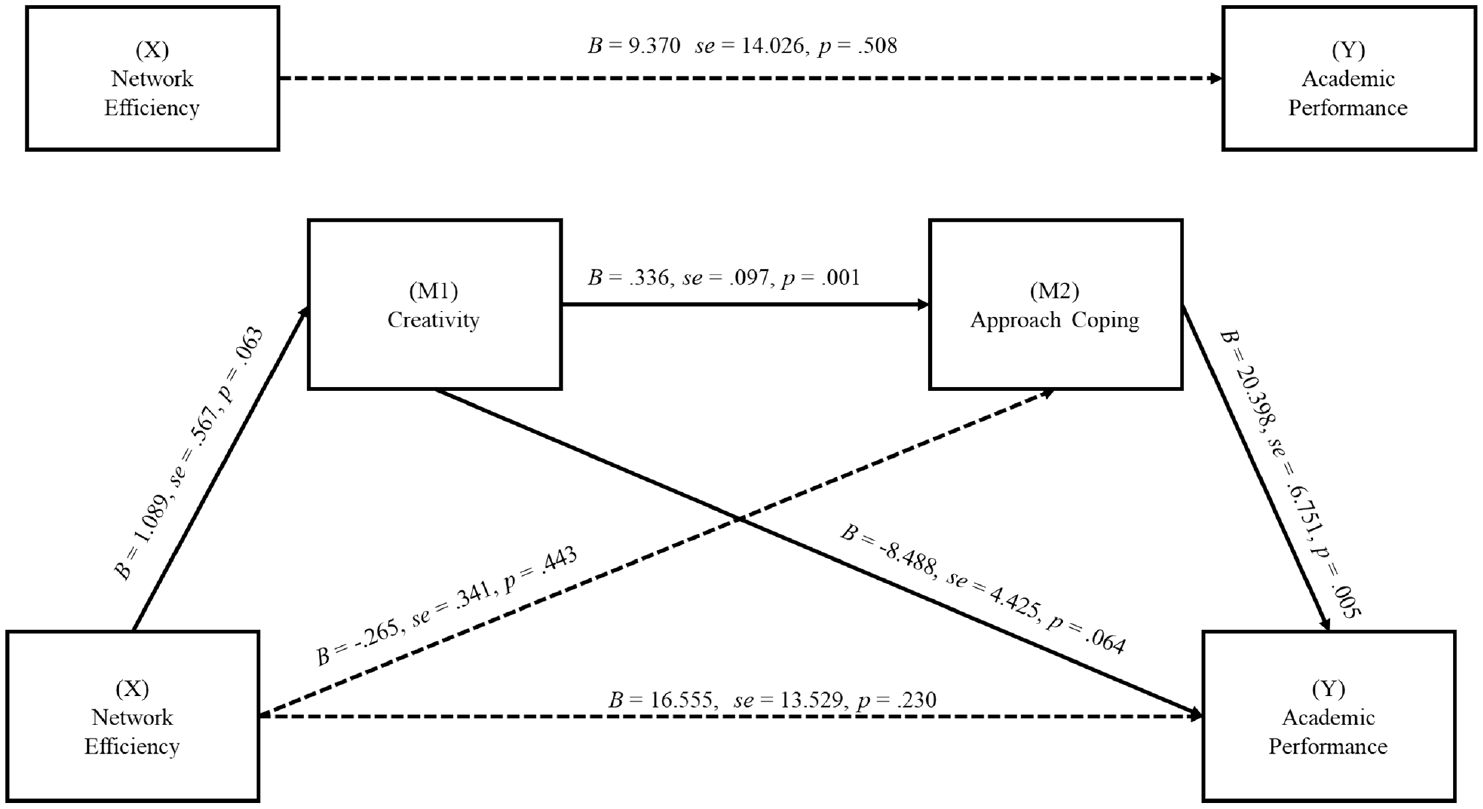
Unstandardized path coefficients for serial multiple mediation through creativity-approach coping.
Bootstrapping Point Estimates and 95% Confidence Intervals (CIs) for All Indirect Effects With Approach Coping as the Mediator (CIs that Do Not Include Zero Indicate That the Point Estimate Is Significantly Different Than Zero).

Note. SE = standard error; BCa = bias corrected and accelerated; CI = confidence intervals.
In the second model, this research tested the following predicted sequential model: network efficiency → creativity (mediator 1) → academic avoidance coping (mediator 2) → academic performance. The regression coefficients of all four regression equations for this mediational model are presented in Table 4 and Figure 3. Table 4 presents the bootstrapping-based point estimates and standard errors (SEs) of each indirect effect and its associated 95% CIs. As can be seen in Figure 3, network efficiency is positively associated with creativity (ba1 = 1.089, SE = 0.567, p = .063). This path is the same as a result in the model parameterized approach coping. Next, creativity is negatively associated with avoidance coping. However, the path is insignificant (ba3 = −0.266, SE = 0.145, p = .075), therefore H2-2 was rejected. In addition, the avoidance coping is negatively related with academic performance. However, the path is insignificant (bb2 = −5.199, SE = 4.989, p = .305), therefore H3-2 was rejected. Finally, the statistical significance of H4-2, the mediating effect of the two mediators, was verified. The results showed that the indirect effect through both mediators was insignificant—a1a3b2 = 1.508, 95% CI [−1.363, 7.098]—so H4-2 was rejected (see Table 5). This suggests that a serial multiple mediation did not take place, and showed that contrary to this study’s hypothesis, network efficiency does not affect academic performance through creativity and avoidance coping.
Multiple Regression Coefficients, Standard Errors (SEs), t Values and p Values for All Regression Equations Testing a Mediational Model With Avoidance Coping as the Mediator.
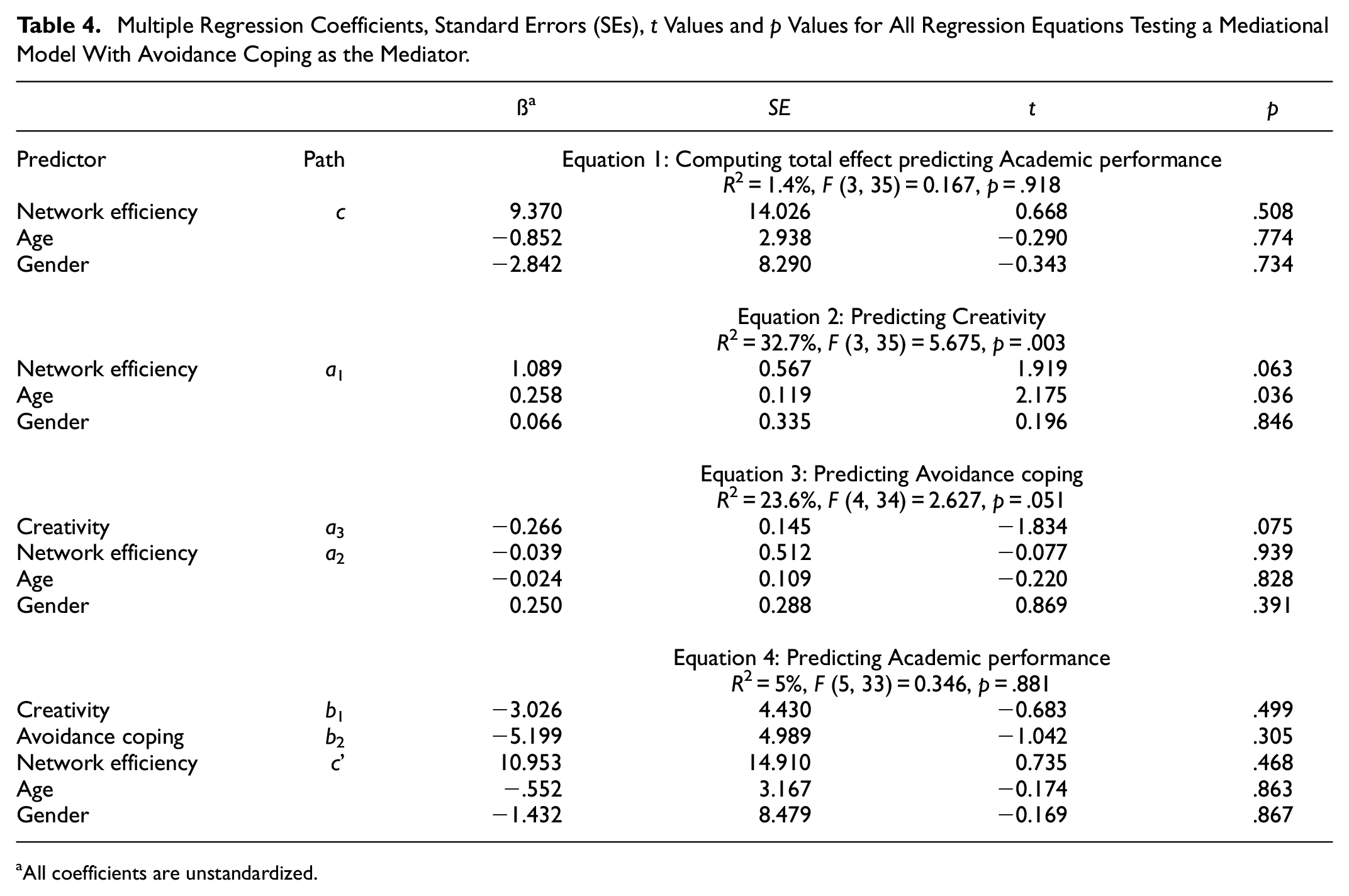
aAll coefficients are unstandardized.

Unstandardized path coefficients for serial multiple mediation through creativity-avoidance coping.
Bootstrapping Point Estimates and 95% Confidence Intervals (CIs) for All Indirect Effects With Avoidance Coping as the Mediator (CIs That Do Not Include Zero Indicate That the Point Estimate Is Significantly Different Than Zero).

Note. SE = standard error; BCa = bias corrected and accelerated; CI = confidence intervals.
Discussion
Based on the study’s main questions, the effects of the dual mediation of creativity and coping style that affect academic performance from network efficiency are discussed below.
First, network efficiency has a positive relationship with creativity. As predicted by the hypothesis, creativity has a positive relationship with approach coping and a negative relationship with avoidance coping. In the last causal relationship, approach coping has a positive relationship with academic performance, while avoidance coping has no relationship with academic performance. As a result, the dual intermediary path that affects academic performance through creativity and approach coping in network efficiency was significant.
However, the double-mediation pathway that influences academic performance across creativity and avoidance coping was insignificant. It was confirmed that the main reason for rejecting the double meditation was that the relationship between avoidance coping and academic performance was negative and statistically insignificant.
The coping strategies may show unclear natures concerning academic performance (Alimoglu et al., 2011). Rather than a specific coping strategy being more adaptive or maladaptive, active coping can be more closely related to improved outcomes than avoidance coping (Schiller et al., 2018). According to previous studies, avoidance coping may have a positive relationship with academic grade (Edwards & Trimble, 1992) and avoidance coping may be independent of academic achievement (MacCann et al., 2012). It is assumed that the students in the study could have used both coping strategies at once and separately. For example, there may be cases of avoidance coping among high performers. There could be students who do not use avoidance coping among the low performers. As a result, the result was mixed; the correlation and causal relationship between avoidance coping and academic performance was insignificant.
Theoretical Implications
This study has many theoretical implications.
First, this study confirmed that the potential causal relationships ranging from students’ networks, creativity, and coping to academic performance in more detail through statistical mediation analysis. Folkman and Lazarus’s (1984) transactional model of stress showed that creativity created through network efficiency can be a positive coping resource that positively affects approach coping and academic performance in a chain.
Second, implementing the structural hole concept showed that individuals in the network can access deviant knowledge, filter redundant information (Burt, 1997), and consequently improve creativity. In addition to social network parameters such as network centrality (Ahuja et al., 2003), tie of strength (Perry-Smith, 2006), and network position (Tsai, 2001), the positive relationship between network efficiency and creativity in relation to the structural hole concept was hypothesized and proved.
Third, it was found that creativity had the opposite correlation according to the coping style (approach vs. avoidance) in this study. Previous studies for the 1960s found that creativity can increase academic performance (Cicirelli, 1965). It was also found that creativity affects test performance and grade (Hansenne & Legrand, 2012; Naderi et al., 2009; Powers & Kaufman, 2004). The results of this study showed that, as creativity is related to positive behavior and emotion (Stephenson & Rosen, 2015), rather than just creativity directly affecting academic performance, academic performance can be improved by more relevant approach coping behavior. The study results were also obtained by measuring the student’s GPA, not a self-reported performance that runs the risk of common method bias and social desirability.
Managerial Implications
This study’s results give evidence that students’ creativity can be improved through the school’s social process. Therefore, to support students when solving academic tasks through creativity in schools or organizations, it is necessary to prepare a complex academic support plan that connects the preceding factors of individual characteristics and the way to activate creativity in the social process with existing education. In this process, social network analysis can be a very effective tool for studying student interactions (Kratzer et al., 2010). For example, students can solve problems based on their knowledge and experience and persuade classmates in the problem-based learning (PBL) class. In the PBL environment, students may face the limit of their cognitive capacity (McLean et al., 2006). What can be introduced as a coping resource in this process is the creativity creation process based on the social process. Previous studies have also demonstrated that group PBL can effectively stimulate creative thinking (Chan, 2013), and studies involving social network analysis have confirmed that active and reciprocal interactions between groups, tutors, and individual students can predict group performance within PBL (Zeng et al., 2021).
Therefore, if students’ social relationships can be analyzed in detail and incorporated into the curriculum, students’ academic coping ability can change. In the PBL situation, the PBL satisfaction may vary according to students’ coping style, and in the case of emotional coping and avoidance coping, satisfaction will be negative (Alimoglu et al., 2011). Therefore, it is important to induce students who pursue this coping style to participate thoughtfully in particularly appropriate social relationships. In particular, the present study highlights the importance of ensuring diversity in the network structure among students to foster creativity. An important factor to consider is promoting a supportive social environment to discourage discrimination among students due to the social categorization process linked to diversity. This discriminatory environment can ultimately prevent students from networking and hinder collaborative behavior to foster creativity (Sung & Choi, 2019).
Also, this study’s results prove once again that approach coping improves academic performance. When designing a school curriculum, school authorities and faculty should consider the usefulness of seeking social support among approach coping styles (Väisänen et al., 2018) and strive to create a class environment in which students can directly help each other, rather than seeing social support as a dysfunctional style (Seiffge-Krenke, 2013). For example, as shown in the results of recent organizational research, creativity is influenced by knowledge-sharing behavior among coworkers depending on the setting of the coworking space (Rese et al., 2020), and students’ and teachers’ creativity can be nurtured in the sociotechnical network within a virtual world (Gadille et al., 2021), indicating the possibility that various settings within schools can promote students’ creativity.
Limitations and Future Research
First, it is necessary to secure a social relationship that allows a clearer view of the mediating process between coping and academic performance, which is the relationship between network efficiency and creativity. The survey targeted small students who took specific classes within the school. For this present study, it is necessary to check the ego network and network efficiency of the students within the class, and at the same time to measure the level of creativity, the academic coping style applied by these students, and their academic performance. To gather those data, the students had to be aware of all the students in the class and knew each other well. At the same time, the researcher should be able to measure the students’ creative level and academic coping style directly by the survey and obtain the students’ final grades, with the consent of students based on the trust and successful agreement to the purpose of research. As a result, since various levels of personal information must be processed, there is a limitation that cannot artificially increase the number of survey target groups. For the above reasons, especially in ego network research based on field research among social network studies, research can be performed with a relatively small number of participants (e.g., Hogan et al., 2023; Wellman & Wortley, 1990) and this study also has a relatively small sample size. In this vein, network research investigates relatively small organizations for practical reasons (Mehra et al., 1998); also, if the class atmosphere was excessively competitive, the information exchange environment would be distorted in class (Perry-Smith, 2006). Therefore, there may be limitations in that this study is a measure by students within one class (Hsieh et al., 2012). As a result, the significance of the path toward creativity from network efficiency could be small. To fundamentally solve this problem, it is clear that studies applying the same method need to be repeated in the future. Therefore, this study can be considered as a pilot study for follow-up studies. Because all students in the class have similar academic backgrounds in the same major, the similarity factor increases, lowering the possibility of diversity and affecting the relationship between network efficiency and creativity (Tang & Naumann, 2016). Therefore, in the subsequent study, first of all, it is necessary to diversify the participants’ academic backgrounds and examine their influence on creativity. To this end, it is required to examine how the dual mediation of creativity and coping influences academic performance by network efficiency while securing the diversity of various participants and expanding the network size of participating organizations. A recent study indicates that open networks and diverse content play a crucial role in boosting creativity, but their effectiveness is heightened when the network structure is dynamic rather than stable (Soda et al., 2021). Hence, monitoring the shifts in relationship diversity within the network structure over time is crucial to understanding the dynamic impact on the connection between creativity and academic achievement.
Second, based on the information from the structural hole in the network structure, it was possible to confirm the facilitators of creativity. But it will be an oversimplified concluded that creativity is affected only by the structure property. Also, it is necessary to recognize that an individual’s environment within the network can be affected by the degree of ego network collaboration. Therefore, there is a need to introduce a personal difference variable that makes the difference between individuals. Creativity can be influenced by a complementary fit between the network and the adaptive cognitive style (Carnabuci & Diószegi, 2015) and an individual’s collaborative attitude (Soda et al., 2019) as well as the individual’s position which influences creativity in the network as the environmental social as this study found. Further studies must incorporate proactive personality (Gao et al., 2020) and attachment needs (Suldo et al., 2008), as they impact cognitive functioning and creative self-efficacy (Orkibi & Ram-Vlasov, 2019), which in turn influence stress management through creativity. In particular, it was confirmed that students’ self-efficacy mediates the positive impact of post-traumatic growth resulting from the stressful experience of the COVID-19 pandemic on their creativity (Zeng et al., 2021). This particular field has not been studied extensively, but it is imperative to analyze an individual’s motivation and aptitude for learning and developing skills, as these play a vital role in promoting creativity. When conducting research in the field of education, it is crucial to examine personal mastery (Fateh et al., 2023), autonomous motivation (Fateh et al., 2021), and achievement motivation (Gao et al., 2020) as essential factors. Meanwhile, students’ academic engagement should also be considered. Academic engagement is a “positive, fulfilling, work-related state mind” for academic challenges, determining students’ affective and cognitive state (Schaufeli et al., 2002). Those are variables that can influence students’ coping styles and the outcome. Therefore, it is necessary to examine the correlation and causal relationship between network structure, creativity, and individual cognitive style by introducing personal difference variables in future studies.
Third, rather than determining the final outcome variable as academic performance, it is necessary to examine the coping results using wellbeing-related variables such as satisfaction with academic life. MacCann et al. (2012) posit that even avoidance coping strategies can act as effective means of coping in an uncontrollable or aversive situation. Therefore, it is necessary to define coping more broadly and examine the effect on academic adaptation through the double mediation of network efficiency.
Fourth, new studies have revealed that structural holes, which are linked to network effectiveness, can result in knowledge being hidden and may impede creativity (Xia & Li, 2023). That is a phenomenon that occurs when non-redundancy, or network efficiency, is high. At the same time, the strength of ties is weakened, resulting in insufficient holistic knowledge exchange (Flipo et al., 2023). In other words, knowledge hiding has occurred in R&D organizations with high network efficiency, which has hindered creativity. The degree of trust in knowledge exchange within a network has a significant impact on creativity, which contrasts with the positive effect of network diversity on creativity in this research. Hence, it is essential to explore the connection between network-related variables and creativity by gaining a better understanding of how this connection mediates or moderates with other variables that shape the network’s features.
Lastly, due to the ongoing pandemic, many classes have undergone a transition to online formats (Ng et al., 2022), leading to the question of whether creativity can still be cultivated in this changed educational environment. As per previous findings in organizational research, utilizing enterprise social networking in a relational manner can mitigate employee stress and foster creativity (Ding et al., 2019). Thus, it is imperative in upcoming educational research to verify the effects of this digital platform on students’ academic stress and creativity.
Conclusion
The main contribution of this study is that it confirmed that network efficiency, as a form of social capital within the network formed by students at school, can affect academic performance through individual creativity and academic coping. The significance of student networks in promoting creativity in schools has been highlighted in recent studies. Furthermore, this study confirmed that creativity can positively impact academic performance by serving as a coping mechanism for stress. The findings of this study provide insight into the connection between network structure and creativity. It is crucial to conduct additional studies to explore the correlation between students’ relationships and their creativity and academic performance in diverse school settings.
Footnotes
Declaration of Conflicting Interests
The author(s) declared no potential conflicts of interest with respect to the research, authorship, and/or publication of this article.
Funding
The author(s) received no financial support for the research, authorship, and/or publication of this article.

Data Availability Statement
The data that support the findings of this study are available from the corresponding author upon reasonable request.