




Abstract
The aim of this research was to clarify the concept of advance care planning (ACP) for patients undergoing high-risk surgery. The Walker & Avant’s approach to concept analysis was used. ACP for the patient who received a high-risk surgery was defined as follows: patients who are aware of the risks of surgery are initiated voluntarily with the need to participate in anticipatory decision-making. To do this, patients define their life-prolonging treatment, provided that appropriate treatment is guaranteed, and prepare for end-of-life care decisions through discussions involving healthcare providers and surrogate decision-makers. It is a continuous, patient-centered decision that allows the patient’s treatment goals to transition over time. The goal of the ACP is to focus on quality of life and care rather than determining end-of-life care. The development of this concept contributes to an assessment of the value of ACP support, which can lead to improved approaches to help patients recover in a short period.
Plain Language Summary
Many patients undergoing high-risk surgery receive critical care after surgery, yet there is a risk of the patient taking a sudden turn for the worse. Patients can opt to preplan their treatment preferences in preparation for potential complications or adverse outcomes. The aim of this research was to clarify the concept of advance care planning (ACP) for patients undergoing high-risk surgery. The method of Walker & Avant's approach to concept analysis was used. The reviewed literature was sourced from PubMed, EMBASE, Ichushi Web, and CiNii databases as well as guidelines and books. Five attributes of this concept were extracted: promise of proper treatment, the definition of life-prolonging treatment, customization of life-saving care, expression of treatment inclinations and discretion, and continuous plan revision and transition. In addition, two antecedents were extracted: recognition of expected risks and the need for anticipatory decision-making. The three conclusions were: respect for autonomy, satisfaction with the decision-making process, and improvement in the quality of care. ACP is characterized by anticipatory decision-making about the risks faced by patients. In addition, in the event of a sudden turn for the worse, necessary life-saving treatment is guaranteed, and the patient has informed about wishes for treatment as well as anxieties and fears that help a medical professional or surrogate decision-maker to select life-prolonging treatment in the event of a complication. The goal of the ACP is to focus on quality of life and care rather than determining end-of-life care. The development of this concept contributes to an assessment of the value of ACP support, which can lead to improved approaches to help patients recover in a short period.
Keywords
Introduction
Advances in medical treatment increase the opportunity for elderly patients with a low physical or mental reserve and patients with complicated co-morbidities to undergo an operation. Many patients in both the minimally invasive and the high-risk surgery groups are admitted to the intensive care unit (ICU) postoperatively. Successful surgery often improves patient survival (Onwochei et al., 2020) and quality of life (Ni et al., 2022). However, if complications develop, the length of an ICU stay may be prolonged, with severe deterioration in physical and cognitive functions (Cutuli et al., 2018). Surgery is prerequisite for recovery, yet there is a risk of severe or sudden complications, especially for patients requiring critical care after surgery, as they are at greater risk. When patient deterioration brings critical care to its limit, patients may be forced to choose to continue treatment, withhold further treatment, or discontinue it. However, many patients undergoing critical care have difficulty making decisions due to sedative use and impaired consciousness. In situations where the patient is unable to make a decision, surrogate decision-making commences based on the patient’s intention as presumed by surrogates such as the patient’s family and/or medical personnel. Healthcare providers undergo moral distress in making surrogate decisions for patients when selecting a treatment course, and conflicts have been noted (Flannery et al., 2017). By contrast, advance care planning (ACP), involves informing the patient about decisions that might need to be made, preparing for those decisions ahead of time, and then letting surrogates know about the patient’s treatment preferences. It provides a solution to the surrogate’s decision-making conundrum, especially for end-stage, older, and chronically ill patients (Houben et al., 2014; McMahan et al., 2021). In the process of continuing treatment, the importance of ACP and decision support is to prepare for a sudden turn for the worse (Blackwood et al, 2018; Yamamoto et al., 2022a, 2022b).
However, it has been pointed out that patients and their families need to be prudent in their support due to the anxiety of undergoing high-risk surgery (Gigon et al, 2015a, 2015b; Yamamoto et al., 2021). Therefore, ACP for patients undergoing critical care following high-risk surgery is an initial phase that should be taken very seriously (Yamamoto et al., 2022a, 2022b). For many, the goal of the ACP was only to focus on a “good death,” and has not been perceived as a concept for “living” or quality of life. Clarifying the concept of ACP for patients undergoing aggressive treatment such as surgery could enable support that emphasizes patient autonomy in all situations.
Objectives
The aim of this research was to clarify the concept of ACP in patients undergoing high-risk surgery.
Methods
Document Selection
The databases used to retrieve relevant literature were PubMed, EMBASE, Ichushi-WEB, and CiNii. Both English and Japanese language research articles were included. The leading search terms were “advance care planning,”“advance directive,”“living will,”“critical care,”“intensive care unit,”“surgery,” and “periodic.”“Critical care” and “intensive care units” were included in the search because many patients who undergo high-risk surgery are admitted to the ICU after surgery (Additional File1).
Research literature was selected that discussed the impact of ACP support on patients and families. Literature that only described medical personnel and systems was excluded. The year of publication was not limited, and duplication and minutes were eliminated. To clarify the concept of ACP, the search also excluded literature that presumed patients who underwent high-risk surgery and needed critical care would stop receiving surgical therapy or critical care. The literature search process was performed in two steps. First, primary screening was performed to confirm the title and abstract content; then, the full text was carefully read to identify the appropriate literature. Consequently, 46 studies from five fields (nursing, midwifery, medicine, bioethics, and behavioral economics) were collected. In addition, two related books and six references, including guidelines (Figure 1), were selected by a manual search. The research articles were selected in January 2021.

Flow diagram of study selection and inclusion process.
Concept Analysis
This study used Walker & Avant’s (Walker & Avant, 2019) concept analysis approach to clarify concepts. This method is reputed to help redefine ambiguous concepts in theory. The definition of ACP is ambiguous, as the meaning and context of language usage differs by country and specialty. The conceptual analysis steps are as follows: (a) Select a concept. (b) Determine the aims or purpose of analysis. (c) Identify all uses of the concept that one discovers. (d) Determine the defining attributes. (e) Identify a model case. (f) Identify borderline, contrary cases. (g) Identify antecedents and consequences. (h) Define empirical referents. To increase the reliability and validity of this concept analysis, researchers familiar with this concept analysis approached supervised this study.
Findings
Definitions and Use of Concepts
Frequently cited definitions include those provided by Sudore et al. (2017) and the European Society for Palliative Medicine (Rietjens et al., 2017). These definitions refer to people of all ages and health statuses. The purpose of ACP is to ensure that the healthcare provided in the event of future severe illness is consistent with a person’s values and goals. Evaluation of ACP includes care and processes, behaviors, and quality of care consistent with the patient’s goals (Sudore et al., 2018).
Common elements of ACP covered by the UK, Canadian, Japanese and USA governments are that: (a) patients should select the treatment decisions in advance as well as appoint surrogates such as medical providers and family members; (b) ACP should be completed before a decline in the patient’s decision-making capacity and (c) it should demonstrate the process (American Medical Association, n.d.; Canadian Hospice Palliative Care Association, n.d.; Ministry of Health Labor Welfare, 2018a, 2018b; National Health Service, 2008). However, differences in ACP vary by nation. One difference is the designation and requirements of a surrogate decision-maker. For example, in the UK, Korea, and Japan, the designation of a representative is not mandatory and is either presented as an option or it is recommended (Ministry of Health Labor Welfare, 2018a, 2018b; National Health Service, 2008; Ohama & Fukui, 2019). On the other hand, in Taiwan and the US, it is mandatory to designate a representative at the state level. Requirements also differ regarding age restrictions and kinship. Another difference of the definition of ACP regards the discussion process (Canadian Hospice Palliative Care Association, n.d.; Ministry of Health Labor Welfare, 2018a, 2018b) and whether it explicitly includes decision-making through the discussion process (American Medical Association, n.d.; National Health Service, 2008). The third difference is whether or not there are legal restrictions. While some countries, such as the UK, the USA, and Canada, have laws related to advance directives, Japan has no laws related to advance directives but tends to. Hold guidelines as more binding compared to other countries (Ministry of Health Labor Welfare, 2018a, 2018b). The definition of ACP is influenced by culture, law, and other factors, has been revised in each country, and is continually undergoing revision.
Furthermore, the use and understanding of ACPs vary among different disciplines, specialists, and medical providers. Nursing, medicine, bioethics, and behavioral economics say that the ACP’s process includes end-of-life care and death. For example, in behavioral economics, end-of-life care decisions are thought to be driven by patient loss aversion and provider bias toward better patient care (Halpern, 2018). It has been suggested that appropriate support may be available, particularly for patients who require complex decision-making with many treatment options, such as those receiving postoperative critical care (Halpern, 2018).
On the other hand, midwifery does not base discussions on the premise of death. Instead, midwives will help women consider and prepare for various possible changes and circumstances that may arise, such as pregnancy, childbirth, childcare, and family and partner relationships during childbearing age (Yamashita, 2017). This strategy of life planning makes it easy to imagine “living” in your preferred way in such circumstances. Therefore, ACPs in ICUs are still under development; moreover, there are few reports regarding support methods or evaluations in ICUs. In conclusion, ACP is an ambiguous concept, and there is no clear definition of ACP for patients undergoing high-risk surgery.
Defining Attributes
For initiating ACP for patients undergoing high-risk surgery, the physician’s appropriate medical judgment must be used to estimate the likelihood of survival and to ensure that the necessary life-saving treatment is provided (Table 1). Unfortunately, it is difficult for patients and surrogate decision-makers to have genuine discussions with medical providers when patients are concerned that discussing an ACP will limit the best treatment for their lives. Also, depending on what complications could potentially occur in the postoperative course, there are various treatment options to choose from, so the decision is often complicated.
Attributes of Advance Care Planning for Patients Undergoing High-Risk Surgery.
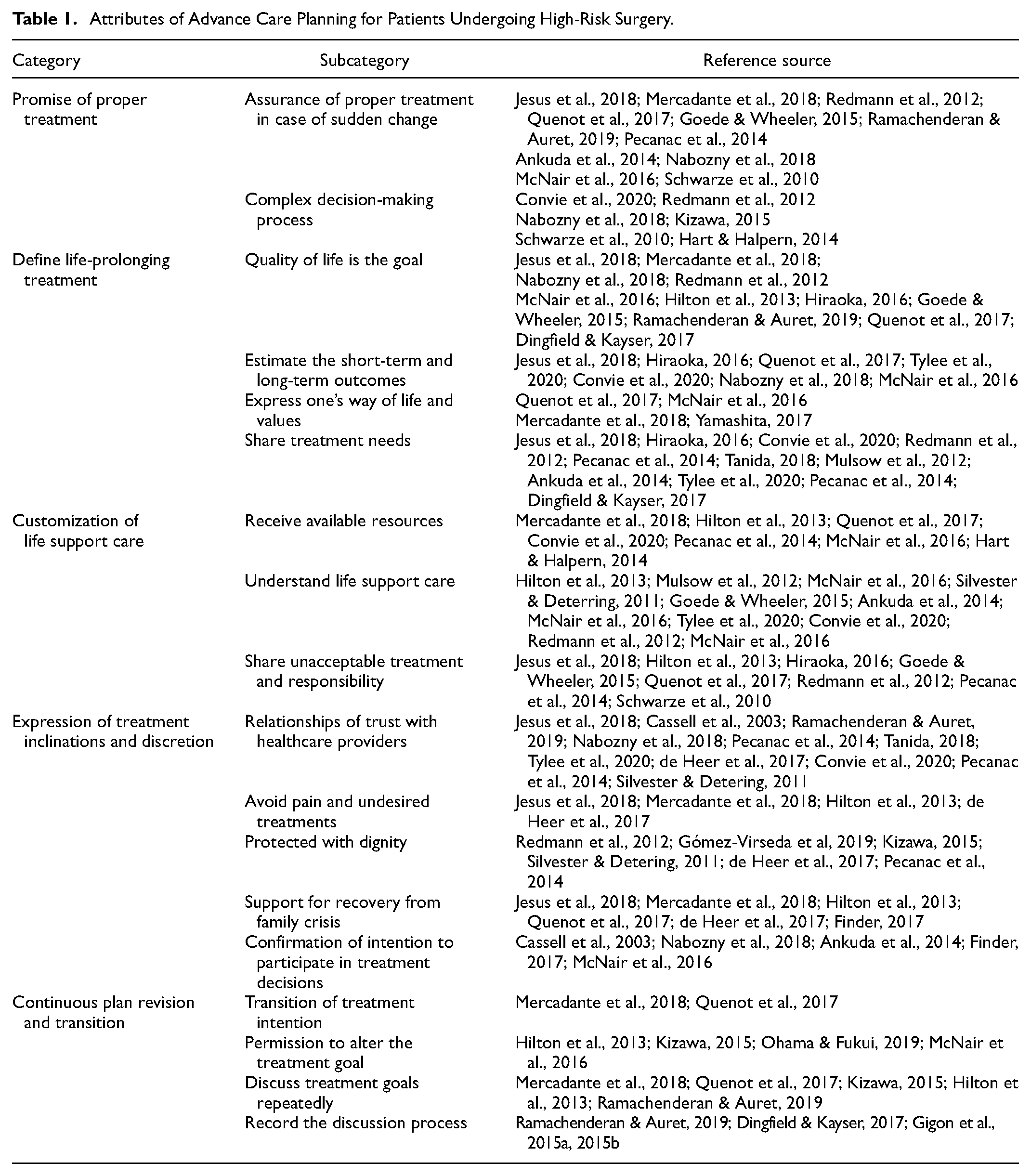
In addition, the patient can define when the treatment should involve “life-prolonging treatment,” which involves more than just keeping patients alive with surgery. Advancing an ACP by obtaining information from the physician about the prognosis of physical and cognitive function that may occur after surgery, recalling the best and worst of one’s quality of life, and focusing on what kind of quality of life is the goal of treatment is characteristic of planning for preoperative patients. Having a long-term life after treatment that can be experienced comfortably is usually emphasized. In addition to sharing their hopes and options with medical providers and their families, the ability to freely express feelings of anxiety and fears, including their future after surgery, is an essential factor in discussing ACP before surgery.
On the other hand, patients undergoing high-risk surgery often require a ventilator after surgery, and other features include the use of life support devices. Therefore, understanding that surgery and life support are combined is also required.
In some cases, an extension in the duration of life support is presumed. After understanding this premise, the patient should discuss treatments that are unacceptable to him or her with the doctor. Moreover, the patient’s reassurance can come from collaborating in the discussion process and sharing the responsibility for the patient’s wishes that lead to decisions. Patients should discuss and share their treatment preferences and needs with medical providers and surrogate decision-makers before surgery. Through these discussions, patients reduce their concerns about treatment, trust medical providers to hope for life, protect their dignity, and reiterate their intention to receive treatment. Patients also understand the anxiety and worry that their family members feel when they undergo treatment. Although the selection of a surrogate decision-maker is an essential process in ACP, it is necessary to share the role of the surrogate decision-maker rather than expect the right surrogate decision. Patients do not always have to take the initiative in making all these complex and challenging decisions. It is important to tolerate the willingness to leave decisions to healthcare providers and surrogate decision-makers. This process requires a relationship of trust between the patient, surrogate decision-maker, and healthcare provider. In addition, treatment may change after surgery depending on the patient’s condition. Post-treatment outcomes and experiences can also influence a patient’s treatment goals and preferences. Therefore, it is necessary to reconfirm the patient’s intention to receive a specific treatment. As patients repeatedly discuss their treatment preferences and needs with medical providers and surrogate decision-makers, treatment goals may change, and plans must be continually reviewed.
Case Study
Model Case
Mr. A was a man in his 60s who was diagnosed with a thoracic aortic aneurysm and required surgery for replacement. After the operation, he was to be admitted to the ICU. The doctor explained that there was a high possibility of the postoperative complication of paraplegia and cerebral infarction. If these complications occurred, he discussed with doctor and the surrogate decision-maker how his life would change after treatment, including whether the worst-case scenario could be tolerated. Through discussions among the three parties, Mr. A said, “When paraplegia occurs, being alive is my greatest value, and even when using a wheelchair, I want to be able to do what I want to do.” They also shared their intention that if the patient became unconscious then based on the hope of treatment they would trust the attending physician and entrust their life to him/her, and if the attending physician judged that the possibility of saving the patient’s life was low and that recovery of consciousness was difficult, they would talk to the surrogate decision-maker and consider halting treatment. The physician recorded the process and decision reached during a discussion between the patient and the patient’s surrogate decision-maker in the medical record so that the wishes of Mr. A were carried over to other departments, such as outpatient facilities, wards, and ICUs. After the operation, the patient developed pneumonia and was temporarily placed on a ventilator, and a medical practitioner and a surrogate decision-maker selected a treatment based on Mr. A’s prior intention. This was the result of the physician's medical judgment of the patient's condition and judgment that the life-saving rate was high. After the patient was successfully extubated and transferred to the ICU ward, the patient’s wishes were verified by the medical records.
Borderline Case
Mr. B was a man in his 60s who needed an aortic valve replacement. The patient was scheduled to be admitted to the ICU with a respirator after the operation. Mr. B had a history of diabetes and renal failure and was told by his doctor that he was at risk of developing cerebral infarction and infection. In some cases, permanent dialysis may be required after treatment. Mr. B was prepared to undergo high-risk treatment and told his surrogate decision-maker, “I do not want life-prolonging treatment in life-threatening situations.” The hope was not conveyed to the doctor before the operation. After the operation was completed successfully, Mr. B’s recovering was complicated by pneumonia, he lost his decision-making capacity and required reintubation. At this time, the surrogate decision-maker informed the doctor that before the operation, Mr. B had expressed his intention not to provide life-prolonging treatment. The doctor explained that this treatment was not a life-prolonging treatment, but Mr. B and his surrogate decision-maker did not discuss what kind of treatment the patient considered to be life-prolonging treatment. Thus, the surrogate decision-maker was worried about whether to proceed with the treatment. The doctor persuaded the surrogate to agree with reintubation followed by long-term ventilator management; the extubation was successfully carried out, and the patient was discharged from the hospital. During the outpatient consultation, Mr. B discussed with the doctor and surrogate decision-maker more precisely about his wish for the doctor to “not provide life-prolonging treatment.”
Contrary Case
Mr. C was a man in his 60s who was diagnosed with esophageal cancer requiring surgery. After the operation, the patient was scheduled to be admitted to the ICU with a ventilator. Because Mr. C seemed to have a high level of anxiety about the operation, the doctor took care not to increase his mental burden and informed him about the risks of complications but did not discuss the details of resuscitation. Mr. C lives alone, and his daughter who lives at a far distance was designated as the surrogate decision-maker, although she had never talked to him about life crises. Mr. C developed septic shock from the wound infection after surgery. Multiple organ failure progressed, and extracorporeal membrane oxygenation was required in addition to the respirator. The patient’s condition rapidly deteriorated, and the surrogate decision-maker was forced to make a surrogate decision about life support in a short period and thus felt stressed. Finally, Mr. C was released from the life support system and transferred from the ICU to the ward. After overcoming a sudden change, the medical practitioner and surrogate decision-maker thought that there was no need to talk again about Mr. C’s intention to receive treatment in the event of a sudden change; after that, Mr. C left the hospital without any discussion.
Antecedents and Consequences
The antecedent’s requirements listed two elements (Table 2). For a patient to consider ACP, it is necessary to recognize the expected risks of surgery. This risk includes anesthesia and surgical complications as well as the possibility of rapid deterioration during treatment the lack of time for contemplation in decision-making and the difficulty of predicting the prognosis. The assumption is that the patient is aware of the risk, needs to prepare for the worst that may occur after treatment, and needs anticipatory decision-making.
Antecedents of Advance Care Planning for Patients Undergoing High-Risk Surgery.

Three consequences were identified: respect for autonomy, satisfaction with the decision-making process, and improvement of the quality of care (Table 3). For patients undergoing high-risk surgery, consideration of ACP before surgery ensures that when a patient loses his or her decision-making capacity, it is handed over to a surrogate decision-making process based on the patient’s desired treatment. This protects the patient’s dignity and maintains the patient’s quality of care and patient-centered care during and after treatment. In addition, when making a surrogate decision, patients share their wishes for treatment and values in advance, thus reducing the burden involved in decision-making. This process also requires quality communication with medical providers and surrogate decision-makers, including patients, and improves trusting relationships with medical providers. Thus, satisfaction in treatment and decision-making processes is increased, and improvement in the quality of care can be expected.
Consequences of Advance Care Planning for Patients Undergoing High-Risk Surgery

Theoretical Definition
As a result of the concept analysis, ACP for the patient who received a high-risk surgery was defined as follows: Patients who are aware of the risks of surgery are initiated voluntarily with the need to participate in anticipatory decision-making. To do this, patients define their life-prolonging treatment, provided that appropriate treatment is guaranteed, and prepare for end-of-life care decisions through discussions involving healthcare providers and surrogate decision-makers. It is a continuous, patient-centered decision that allows the patient’s treatment goals to transition over time. A conceptual diagram was shown in Figure 2.

Concept model of advance care planning of patients undergoing high-risk surgery.
Discussion
The purpose of ACP is to enhance the overall quality of end-of-life medical care outcomes. However, when applied to patients undergoing high-risk treatments, there is potential for the treatment goals to become obscured. Clarifying the application of the ACP concept to patients receiving high-risk treatments significantly contributes to visualizing patient support within this realm, thus underscoring its paramount importance. In addition, medical professionals can provide support according to the patient's health level and stage of treatment, and are expected to contribute to patient-centered care.
Patients undergoing high-risk surgery have both risky recovery and potential ingravescence outcomes. Usually, surgery is premised on the recovery of health and an improvement of quality of life. Therefore, the common goal of the patient, surrogate decision-maker, and medical provider is a successful operation and return to society. However, there is a risk that undergoing high-risk surgery will lead to a worsening physical condition and a life-threatening situation. On the other hand, it can be seen as an opportunity for advanced care planning. Patients are aware of the potential for complications from anesthesia and surgery, and if there is a sudden change, they can decide their current wishes for life-prolonging treatment before surgery. Although high-risk surgery has anxiety-generating factors for patients and their families, understanding negative information about the postoperative course enables patients to wish to participate in anticipatory decision-making regarding emergency treatment. Some patients understand the need to be prepared for life-threatening situations (Andreu et al., 2018; Yamamoto et al., 2021). Endotracheal intubation with surgery or anesthesia and mechanical ventilation is inevitable. In the unlikely event of complications following surgery, patients are not prevented from receiving life-saving treatment and ICU life support. However, if life support becomes difficult during a life-saving treatment, the intention to provide end-of-life care must be considered. The patient’s values determine their perspective of what kind of physical condition changes from a life-saving treatment to an ineffective treatment. As a medical practitioner, it is essential to make an appropriate medical judgment based on the patient’s condition and to provide necessary medical care; however, the patient’s autonomy must be factored in as an equally essential component for medical judgment (Jonsen, 2006). Therefore, it is necessary for patients to determine their way of life. By following these processes, whatever the recovery pattern may be, the patient’s autonomy in treatment will be respected, and the satisfaction of patients and their families will increase accordingly.
The difference between the concepts of ACP for terminal cancer patients versus that for elderly patients is that for the elderly it does not necessarily involve end-of-life decision-making. It is characterized by being prepared for the risk of a rapid decline in the patient’s condition, rather than focusing only on the end-of-life that will inevitably come one day. Support for ACP at the time of surgery or discharge from the hospital may reduce the needs of patients and making it more difficult to initiate the conversation (Yamamoto et al., 2022c). The primary goal of ACP before surgery is not necessarily to document the patient’s wishes for treatment for DNAR but to provide a basis for discussion and support in making treatment decisions based on their needs. Because, in cases where patients require surrogate decision-making, pre-documented information such as post-surgery wishes, activities of daily living, quality of life, etc., can offer crucial insights. While it remains to be seen how patients can recognize both the merits and demerits of surgical therapy and how they can be assisted in making more informed decisions, the discussions about ACP and DNAR can assist in the process. Therefore, before a risky treatment, it is necessary to be aware of the need for treatment, enhancement of communication, and creation of relationships so that patients can freely communicate their concerns to medical professionals.
Suggestions for Nursing Care to Support Patients
First, nurses need to understand that the concept of ACP is complex, and medical professionals do not always understand its complexity. Therefore, it is necessary for the nurse to make an effort to build a relationship of trust. This is accomplished by communicating with the patient and the surrogate decision-maker and accurately supporting the patient so they can fully express their hopes in such a way that they can live without regret until their final days. An important part of the communications involves discussing the possibility of death which can be stressful for many patients. The nurse can initiate conversation about dying—even indirectly with a story or sharing their own experience about a relative. It may also be helpful for nurses to realize that the two values of respecting patient autonomy for responsibility and the desire to save patients are often at odds. When patients undergo surgery and require critical care, it is difficult to draw a clear line between life-prolonging treatment and conventional treatment. The patient’s desire to not receive life-prolonging treatment should not detract from the right of the patient to believe in the possibility of recovery as much as the possibility of undergoing surgery or becoming ill after surgery. At the same time, it is essential to promote the shared responsibility and stress of considering end-of-life care and making shared decisions between the medical provider and surrogate decision-maker.
Second, as advocates and communicators, nurses are in an excellent position to begin explaining what informed consent means for treatment options (Faison, 2018). When the patient has decision-making ability, the informed consent enables the patient to receive his or her desired medical treatment (Herath et al., 2023). However, because of the high possibility of impaired decision-making and the high uncertainty of treatment during the perioperative period, it is worthwhile to clarify the patient’s intention to receive treatment in advance. Also, it is not easy for patients to anticipate the future and make anticipatory decisions about possible end-of-life treatments. Timely provision of information and communication in an equal relationship is important, as is the development of a trusting relationship to facilitate such a discussion (Krebs & Hoang, 2023; Parker & Mortimore, 2023). Patients who understand what informed consent means are in a better position to enter into an equal relationship with the physician.
Finally, as advocates, nurses can encourage ACP support so that it is not a one-way communication by the medical provider, and is not used as a tool to protect institutions and medical providers. Continued support and enhanced research are needed to ensure that patient autonomy is respected and that if the patient suddenly changes his or her wishes, effort will be made to alleviate the distress of the surrogate decision-maker. This may be an important yet difficult aim. However, it could be an important concept for patients with a low success rate or who wish to challenge difficult treatments.
Limitations
In this study, the concept was examined from a wide range of literature, and it is difficult to say whether sufficient clarification of the concept was possible, because most of the research in this field has been made for the elderly patients and patients in the terminal stage. In addition, many articles discussed problems regarding surgeons, ICUs, or the need for patient support from the viewpoint of the medical personnel. However, few studies demonstrated the need or effectiveness of ACP support from the perspective of patients and surrogate decision-makers. This suggests that ACP is an evolving concept for patients undergoing high-risk surgery.
Conclusion
The ACP concept for patients undergoing high-risk surgery identified three attributes: the need to ensure critical care, the definition of life-prolonging care for the patient, and customization of life-prolonging care. ACP before surgery can help patients realize the benefits of discussing a plan to live life without regrets and to have frank discussions with the surrogate decision-maker and healthcare provider. The primary goals of ACP before surgery are to not only document the patient’s wishes for treatment including DNAR but also to establish a basis for discussion and support for treatment decisions based on the patient’s needs.
Additional file1 Search Strategies
A. PuBMed
#1. Intensive Care Unit/ AND/ Advance Care Planning/ AND/ (Perioperative Period/ OR/ Perioperative). ti.ab
#2. Intensive Care Unit/ AND/ ((Advance Directives ) OR (Advance Directives)). ti.ab.
#3. Intensive Care Unit/ AND Living Will. ti.ab.
#4. Intensive Care Unit / AND ((Advance Directives) OR (Advance Directives))/ AND / (Perioperative period OR Perioperative). ti.ab.
#5. Intensive Care Unit/ OR/ Living Will AND (Perioperative Period) OR Perioperative))ti.ab.
#6. Intensive Care Unit/ AND / Advance Care Planning AND (Perioperative Period) OR (Perioperative)) .ti.ab.
#7. Search: ((intensive care unit) OR (critical care)) OR (criticall illness)
“intensive care units”[MeSH Terms] OR (“intensive”[All Fields] AND “care”[All Fields] AND “units”[All Fields]) OR “intensive care units”[All Fields] OR (“intensive”[All Fields] AND “care”[All Fields] AND “unit”[All Fields]) OR “intensive care unit”[All Fields] OR (“critical care”[MeSH Terms] OR (“critical”[All Fields] AND “care”[All Fields]) OR “critical care”[All Fields]) OR (“criticall”[All Fields] AND (“illness”[All Fields] OR “illness s”[All Fields] OR “illnesses”[All Fields]))
#8. “advance care planning”[MeSH Terms] OR (“advance”[All Fields] AND “care”[All Fields] AND “planning”[All Fields]) OR “advance care planning”[All Fields] OR (“advance directives”[MeSH Terms] OR (“advance”[All Fields] AND “directives”[All Fields]) OR “advance directives”[All Fields] OR (“advance”[All Fields] AND “directive”[All Fields]) OR “advance directive”[All Fields]) OR (“living wills”[MeSH Terms] OR (“living”[All Fields] AND “wills”[All Fields]) OR “living wills”[All Fields] OR (“living”[All Fields] AND “will”[All Fields]) OR “living will”[All Fields])
#9. “surgery”[MeSH Subheading] OR “surgery”[All Fields] OR “surgical procedures, operative”[MeSH Terms] OR (“surgical”[All Fields] AND “procedures”[All Fields] AND “operative”[All Fields]) OR “operative surgical procedures”[All Fields] OR “general surgery”[MeSH Terms] OR (“general”[All Fields] AND “surgery”[All Fields]) OR “general surgery”[All Fields] OR “surgery s”[All Fields] OR “surgerys”[All Fields] OR “surgeries”[All Fields] OR (“perioperative”[All Fields] OR “perioperatively”[All Fields]) OR (“perioperative period”[MeSH Terms] OR (“perioperative”[All Fields] AND “period”[All Fields]) OR “perioperative period”[All Fields])
#10 #7 AND #8
#11 #7#AND #9
B. EMBASE_PICO Search
Population: Intensive care unit/ OR / Perioperative/ OR / Surgery .ti.ab
Intervention: advance care planning/ OR advance directives/ OR / living will. ti.ab.
C. Ichu-shi web (Japanease)
1.
2. 2
3.
4. 1 AND 2
5. 1 AND 3
D. CiNii (Japanease)
1.
2.
3.
4.
Footnotes
Acknowledgements
The authors would like to acknowledge the assistance of Dr. Sarah E. Porter of Oregon Health & Science University in editing the manuscript.
Authors’ Contributions
Kanako Yamamoto performed research design, data collection, the analysis and interpretation of results, and manuscript preparation. Miho Suzuki contributed to the research idea and designed, analyzed, and interpreted the results; advised the whole research process; and helped prepare the manuscript. All authors read and approved the final manuscript.
Declaration of Conflicting Interests
The author(s) declared no potential conflicts of interest with respect to the research, authorship, and/or publication of this article.
Funding
The author(s) disclosed receipt of the following financial support for the research, authorship, and/or publication of this article: This work was supported by JSPS KAKENHI (Grant-in-Aid for Young Scientists) Grant Numbers JP19K19613 and JP22K17456.

Data Availability Statement
Data sharing is not applicable to this article as no new data were created or analyzed in this study.