



Abstract
Resilience is a city’s continual ability to resist, adapt, change, and prepare for shocks and pressures, whether of environmental, social, institutional, or economic origin, in order to preserve city operations and improve responsiveness to future shocks. The goal of this research was to see how well each aspect of resilience governance (economic, social, environmental, and institutional) predicted acceptance of climate change policy (ACCP) in a Taiwan sample. A total of 1,089 employees from the Environmental Protection Agency (EPA) from six special municipalities were included in the study (Taipei, New Taipei, Taoyuan, Taichung, Tainan, Kaohsiung). The analysis discovered that for all six cities, the economic dimension of resilience governance was significantly negatively correlated with the ACCP, while the social and institutional dimensions of resilience governance were significantly positively correlated with the ACCP. Furthermore, the institutional dimension of resilience governance was the only characteristic of resilience governance that consistently predicted EPA staffers’ ACCP across six Taiwanese special municipalities.
Keywords
Introduction
It is frequently stated that, in addition to political and economic systems, a mix of governance indicators is required for cities to achieve environmental sustainability and, ultimately, resilient governance success (Figueiredo et al., 2018). Uncertainty and the ability to adjust to unforeseen developments are implied by the idea of resilience (Ahern, 2013). The governance sophistication of metropolitan regions must be addressed in evaluating their resilience.
Current findings have shown that resilience governance (RG), in addition to urban resilience (Leichenko, 2011; Meerow & Newell, 2019), and sustainable resilience (Fiksel, 2003), offers various insights to the forecasting of sustainability (Alexander, 2013). However, although Ahern (2013) claims that resilience is a developing concept that may be viewed as the fourth dimension of sustainability, Meerow and Newell (2019) claim that the terms sustainability and resilience are interchangeable. RG provides understanding of the complicated socio-ecological systems and their sustainable governance (Folke, 2006; Pickett et al., 2013), particularly in relation to climate change (Leichenko, 2011; Pierce et al., 2011; Solecki et al., 2011; Zimmerman & Faris, 2011).
Furthermore, a number of studies have looked into how the characteristics of RG connect to policy results (Brown et al., 2018), including urban climate resilience (Ibarrarán et al., 2010; S. Tyler & Moench, 2012), city management (ARUP and The Rockefeller Foundation, 2015), community (C. F. Cheng & Cheng, 2018; Cutter et al., 2014), and disaster risk reduction (Alexander, 2013). Although aspects of RG have been studied in many areas of public policy and management, most notably in urban planning, the relationship between RG’s dimensions and ACCP has received far less attention, particularly in Asian countries. Furthermore, no research is done in the Taiwan sample.
In the face of climate change, metropolitan city resilience governance has shifted radically in emerging nations (Filho, 2020). Regrettably, many cities pay little attention to resilience governance and climate change policy acceptability, and may even disregard governance challenges (Leichenko, 2011; Pierce et al., 2011; Solecki et al., 2011; Zimmerman & Faris, 2011). Furthermore, no study has looked at the sample from Taiwan’s environmental protection administration. This study aims to add to the development of climate change policy acceptance and resilience governance in public management and local government. Public policy, socio-ecological, and urban planning scholars have long recognized the importance of resilience governance (Folke, 2006; Meerow et al., 2016; Meerow & Newell, 2019; Pickett et al., 2013) and have defined resilience governance to include various dimensions (Figueiredo et al., 2018; Gharai et al., 2018). Nonetheless, current studies on resilience governance and acceptance of climate change policy in municipalities have received little attention, prompting researchers to ask for further works that relate resilience governance to significant policy practices and frameworks (Leichenko, 2011; Pierce et al., 2011; Solecki et al., 2011; Zimmerman & Faris, 2011). As a result, the goal of this research is to see whether aspects of resilient governance anticipate acceptance of climate change policy (ACCP) among the six environmental protection administrations of six special municipalities in Taiwan.
Resilience Governance and Acceptance of Climate Change Policy
Holling (1973, p. 14) characterized resilience as a system’s ability to survive and adapt to change and disruption while maintaining the same connections among populations and state variables. According to his research, ecological resilience is favored for unstable systems that can rebound to a more stable state (Holling, 1996, p. 33). Holling’s ecological resilience, on the other hand, is interpreted by Gunderson (2000, p. 427) describes a system as having several domains of attraction or stable states, with the shape of the domain of attraction being engineering resilience. In addition, additional scholars have proposed 21 different definitions of resilience. Each of these definitions involves a stress or shock being applied to a system, but each places an emphasis on its own unique problem or circumstance (Norris et al., 2008).
The Brundtland report provided the first definition of sustainability: sustainable development is development that satisfies present demands without jeopardizing the capacity of future generations to satisfy their own needs (Keeble, 1988). The Sustainable Development Goals (SDGs) of the United Nations have also offered a route to bringing sustainability to human and environmental systems. Goal 1 specifically states that it aims to increase the resilience of the poor and those who are most at risk, and decrease their exposure and susceptibility to extreme weather events connected to climate change and other economic, social, and environmental shocks and disasters (United Nations Framework Convention on Climate Change [UNFCCC], 2015).
Climate change is projected to bring regular extreme weather events such as heavy rainfall, drought periods, and storms as a result of rising global temperatures and sea levels. This will constitute a risk not just to communities and cities but also to the people who live in them (IPCC, 2014). As a result, more research to date has focused on separating the governance mechanisms needed to build RG. This school of thought spread to psychology, geography, sociology, and urban planning (Alexander, 2013). Holling (1973) emphasized the resilience of ecological systems to change and their ability to absorb change without undergoing significant change. As a result, Biggs et al. (2015) identified seven core aspects as crucial: diversity and redundancy, connectedness, slow variables and feedbacks, complex adaptive systems thinking, learning, participation, and polycentric governance.
More than half of the world’s population now resides in urban regions, and city populations are expanding at an alarming rate all across the globe (United Nations Human Settlements Programme, 2022). The massive population density, the concentration of economic activity in cities, the dense built-up environments, and the high concentration of infrastructural networks all contribute to the increased susceptibility of cities to natural catastrophes and other sorts of threats (Monstadt & Schmidt, 2019). As a result, risks, dangers, and possible threats could readily spread and cascade. When an ecological system is vulnerable to a violent outburst and is not equipped to handle or adjust to it, it may suffer negative effects. The competence of individuals, institutions, organizations, and systems to handle, manage, and overcome unpleasant events in the short- to medium-term by employing adequacy and effectiveness, values, beliefs, resources, and opportunities is known as coping capacity (IPCC, 2018).
Holling (1996, p. 33), on the other hand, considers resistance to be a result of engineering robustness. Furthermore, some studies (Carpenter et al., 2001) go even farther, stating that resistance is a result of persistence. The “amount of external pressure needed to bring about a given amount of disturbance to the system” is known as resistance (Carpenter et al., 2001, p. 766). As a result, resilience is a systems construct, as is the social-ecological system. It may be a complex adaptive system in and of itself, as it is an interconnected and interdependent entity (Alexander, 2013, p. 2712). According to the OECD, resilience is defined as a capability that entails specific actions in response to specific occurrences (shocks, stresses, hazards, and disasters) and situations (OECD, 2014d).
While other investigations do not specifically list climate change as an objective, some do (e.g., Cutter et al., 2010; Mach et al., 2016; The Rockefeller Foundation, 2014; UNISDR, 2017; Welle & Birkmann, 2015). The set does not represent a generally accepted set of indications on how to evaluate resilience governance, even though those indicators or dimensions are most frequently used. Additionally, towns have unique roles in the global fight against climate change. Due to the reality of climate change, cities are required to honor a changing, fluid state. For instance, the ARUP and The Rockefeller Foundation’s (2015) framework lists the following four areas as the first hierarchical level: “Economy & society,”“Infrastructure & ecosystems,”“Leadership & strategy,” and “Health & wellbeing.” Each dimension is further divided into three sub-dimensions, each of which is measured and quantified using a number of indicators. To determine the indicators that have been commented upon in the research literature, Cutter (2016) examined how frequently specific indicators are utilized by various investigations. The 19 particular indicators that make up the academic foundation of resilience measures are as follows: household median income; educational success/equality; availability to medical treatment (number of doctors); number of local groups; number of religious organizations/followers; plans for mitigation (percentage of population covered), number of mitigation efforts, or amount of mitigation funding (per capita); community assistance; community programs; prior recovery experience; past experience and lessons learned; danger level; numerous sorts of buildings (government, power, bridges, and emergency management); community sense of kinship; accessibility to urban areas Refuges, escape routes, and impenetrable surfaces
Resilience is a city’s ongoing capacity to resist, adapt, transform, and prepare for environmental, social, institutional, and economic shocks and challenges in order to retain its operations and enhance its response to future crises (Figueiredo et al., 2018). Resilience is indeed multifaceted, including a number of interrelated elements and circumstances. The four aspects of resilience governance are economic, social, environmental, and institutional (Figueiredo et al., 2018). The economic dimension of RG refers generally to industry diversification and room for innovation (Andreoni & Duriavig, 2013; Ernstson et al., 2010; Giannakis & Papadas, 2021; Röhn et al., 2015). The social dimension ensures that society is inclusive and cohesive, that citizens’ connections are engaged, and that individuals have access to resources (Grafakos et al., 2016; OECD, 2014a, 2014c; Walker & Salt, 2006). The environmental dimension pertains to whether or not metropolitan expansion is sustainable, if appropriate and dependable infrastructure is supplied, and if sufficient natural resources are accessible (Godschalk, 2003; The Rockefeller Foundation, 2014; Walker & Salt, 2006). Finally, the institutional dimension necessitates strong leadership and a protracted vision, as well as enough public resources, coordination with some other levels of governance, and an open and participatory government (Ernstson et al., 2010; Figueiredo et al., 2018; OECD, 2014d; Suárez et al., 2016).
To implement the Kyoto Protocol Agreement, many countries were required to implement relevant statutory policies to demonstrate their commitment to reducing global warming (Jordan et al., 2018). The Greenhouse Gas Reduction Bill (Draft) in Taiwan was reviewed in 2008. Taiwan’s Legislative Yuan enacted the Greenhouse Gas Emission Reduction and Management Act in 2015. One of the most pressing topics on the political agenda these days is policymaking connected to climate change mitigation. As a result, approval of the climate change policy by employees of the Environmental Protection Agency (EPA) is crucial.
Acceptance of climate change policy (ACCP) is defined in this study as individuals’ perceived agreements collected as a consequence of their job experiences. It’s comparable to the idea of “acceptance of political choices” (Leung et al., 2007). Fair processes express respect on the part of the decision maker for individuals affected by his or her choice, which, in within-group decision making, makes people feel like they are complete members of the group that utilizes the procedures, according to Leung et al. (2007). As a result, there is a relationship between fair processes and decision acceptability, a crucial and necessary variable for measuring procedural justice impacts (T. R. Tyler & Blader, 2000). Therefore, we examined whether public employees in EPA acceptance of climate change policy is affected by how municipalities treat the dimensions of RG. Based on literature reviews, a theoretical framework is proposed (See Figure 1).

Theoretical framework.
Methodology
According to the Taiwan Climate Change Projection Information and Adaptation Knowledge Platform (TCCIP), the number of days with temperatures above 36°C in Taiwan’s plains could increase from less than 1 day per year in 2021 to 48.1 days in 2100 if the global warming trend is not kept below 1.5°C. If the global temperature rise is maintained below 1.5°C, there would be 6.6 days per year with such temperatures. The number of summer days may increase from 80 to 210 by the end of the century, while the number of winter days would decrease from 70 to 0 (CAN English News 08/10/2021).
The government of Taiwan has vowed to expand the use of renewable energy to 20% by 2025. In accordance with the 2015 Taiwan Greenhouse Gas Reduction and Management Act, the administration vowed to reduce carbon emissions by 20% by 2030 and by 50% by 2050, compared to 2005 levels. According to the RSPRC, this would not be sufficient to maintain global temperatures between 1.5°C and 2°C. The Taiwanese government has made investments in the wind turbine business, and in 2019, Taiwan has the eighth largest offshore wind market in the world (Gao et al., 2021). However, Taiwan is situated in a subtropical region, therefore it receives an abundance of rainfall. Most of the country’s precipitation happens during abrupt typhoons, but its water infrastructure absorbs very little of it. Taiwan obtains 2.6 times more precipitation than the global average, but the United Nations nevertheless classifies it as a region with inadequate water resources (Lee et al., 2018).
The difficulty is how to provide and handle the context-specificity and changing patterns of risk in the current study (Figueiredo et al., 2018). Such obstacles pertain not just to the adoption of impact assessment indicators, but also to institutional and political issues. Importantly, there is no set of climate resilience indicators for Taiwanese municipalities, as global measures cannot be applied directly to the Taiwanese context. Given this context, the study’s approach identifies measurable characteristics of resilient governance.
There is a need to strengthen RG for urban areas in light of the impact of climate change. Resilience is a multi-dimensional and intricate capacity. A metropolitan metropolis should adapt, evolve, and shift to a better, stronger condition, according to climate change science (Jordan et al., 2018). However, policy objectives for multiple stakeholders in Taiwan who are affected by the EPA are likely to differ. Employees of six special municipalities’ EPAs were chosen for examination since they perform an important role in the formulation of climate change policy and have received relatively little attention in prior resilience and climate change studies.
Sample
The objective of this paper was to see how well each dimension of RG predicted the ACCP in a Taiwanese demography. The sample was chosen using a random sampling process. Using this survey strategy is a great way to get information from a variety of sources. The director of human resources issued an introductory note reminding staff of the study’s goal and soliciting assistance. A package of surveys was distributed, along with a bulk reply envelope with the author’s university address, with the help of the director of human resources and his employees. This method ensures that the questionnaire was given to a sample of participants.
Six special municipalities occur in Taiwan: five special municipalities and Taoyuan County, which has been a special municipality since December 2014. The present research is a cross-strategy using a large-scale questionnaire survey in Taiwan (N = 1,089) because of the EPA’s character as an environmental preventive agency. The questionnaire was distributed to each EPA in six towns in the form of 300 copies between 8/1/2019 and 7/31/2020. As a result of the random sampling technique, the sample included 1,089 personnel from the EPAs of six special municipalities; using the commonly used standard of 3% sampling error and a 95% confidence level, a sample of 1,067 units was actually needed (O'Sulivan & Rassel, 1989), and the response rate was around 60.5%. Participants were selected from the EPAs of six different special municipalities: Taipei City (n1 = 216), New Taipei City (n2 = 203), Taoyuan City (n3 = 169), Taichung City (n4 = 187), Tainan City (n5 = 168), and Kaohsiung City (n6 =146). No between-group difference was found (χ2 (3, N = 6) = 4.89, n. s.). Participants were approached by their direct reports. Survey questions were given in the form of booklets with a cover letter promising confidentiality and informed consent. During a concurrent test validation project, data was collected. All respondents received a letter before testing that included a brief description of the study’s goal (i.e., test validation) as well as a research statement guaranteeing the confidentiality of their individual findings. Subjects completed, a brief demographic form that requested background knowledge, immediately following the assessment.
Measures
To measure the aspects of RG for ACCP, the resilience governance (RG) scale was used. There were 14 elements on this scale (K. T. Cheng & Hebenton, 2008; Figueiredo et al., 2018). “Industries are diverse to generate growth. Society is inclusive and cohesive. Infrastructure is adequate and reliable. “Collaboration with other levels of government takes place.” A 5-point Likert scale was used to capture the replies of the respondents (1 = entirely disagree, 5 = fully agree). Higher scores indicated a higher level of RGs, implying that subjects exhibit more RGs for ACCP.
The 3-item acceptance of climate change policy (ACCP) scale was revised by Leung et al. (2007). Sample items included, “To what extent do you intend to respect the regulation of climate change policy? To what extent do you accept the regulation of climate change policy? To what extent do you not respect the regulation of climate change policy? (R)” The ACCP scale was designed to assess the level of acceptability as experienced by individuals who worked for an EPA. A 5-point Likert scale was used to capture the replies of the respondents (1 = entirely disagree, 5 = fully agree). Higher expectations indicated higher scores, suggesting that respondents had higher expectations of ACCP.
Results
Because our evidence was cross-sectional, we ran numerous extra common source variance (CMV) analyses. Widman’s test was performed by contrasting the path coefficients of the measurement model with and without a common latent factor (CLF; Widaman, 1985). Our findings revealed that the CLF accounted for 4.4% of the variation in our analysis, which is less than the 25% cut-off point (Widaman, 1985). Nonetheless, the differences in fit statistics were minor (RMSEA = 0.002, CFI = .002, SRMR = .01, NFI = .002) and far below .05 standards (Bagozzi and Yi, 1988). As a result, CMV is unlikely to be a problem in the research design. Furthermore, we generated additional statistics to test the measures’ convergent and divergent validity. The factor-level composite reliability ratings exceeded .70, indicating convergent dependability. All of the average variance extracted (AVE) values were above .50, indicating convergent validity. Within the analysis, there was no inter-factor connection outlined above .4. The factor correlations’ confidence intervals did not cross one, indicating facet level discriminant validity. The AVEs’ square roots were greater than their inter-construct correlations, indicating model level discriminant validity (Anderson & Gerbing, 1988). Finally, Harman’s single factor test revealed five distinct factors with Eigenvalues greater than one (P. M. Podsakoff et al., 2003).
For sample demographics, the mean age of the whole participants (n = 1,089) were 38.57 years old (SD = 8.10). Gender ratio was: male (47.25%) versus female (55.75%). Mean job tenures were 15.59 years (SD = 7.64). Marital statuses were stratified as the single (42.00%), married (50.90%) and others (7.10%). Educational levels were stratified as the high schools (9.73%), graduate (40.77%) and postgraduate (49.50%). As no statistically significant variations in demographic data among six municipalities were found, the six municipalities were subsequently amalgamated for an additional statistical study.
According to the findings, the economic dimension (M = 18.42, SD = 5.89), the social dimension (M = 26.56, SD = 5.76) and the environmental dimension (M = 27.13, SD = 4.53) were less frequently used dimensions in Taipei City (see Table 1), whereas the institution dimension (M = 31.19, SD = 4.84) was a more frequently used dimension in New Taipei City (see Table 2). Also, in Taoyuan and Taichung cities, their findings revealed that the social dimension, economic dimension, and environmental dimension were less frequently-used dimensions sequentially, whereas the institution dimension was a more frequently-used dimension (see Tables 3 and 4). However, in Tainan city (see Table 5), the findings revealed that the economic dimension (M = 18.63, SD = 4.70), the environmental dimension (M = 23.21, SD = 4.22), and the social dimension (M = 28.04, SD = 4.30) were less frequently-used dimensions sequentially, whereas institution dimension (M = 30.35, SD = 4.44) was a more frequently-used dimension. The results for Kaohsiung City are quite different (see Table 6); we discovered that the environmental dimension (M = 32.30, SD = 5.42) was more frequently used than the social dimension (M = 24.60, SD = 4.14), the economic dimension (M = 25.50, SD = 4.24), and the institutional dimension (M = 32.02, SD = 5.37) sequentially. New These values are frequency variances but not in absolute terms.
The Intercorrelations Between RGs and ACCP in the EPA of Taipei City (n = 216).
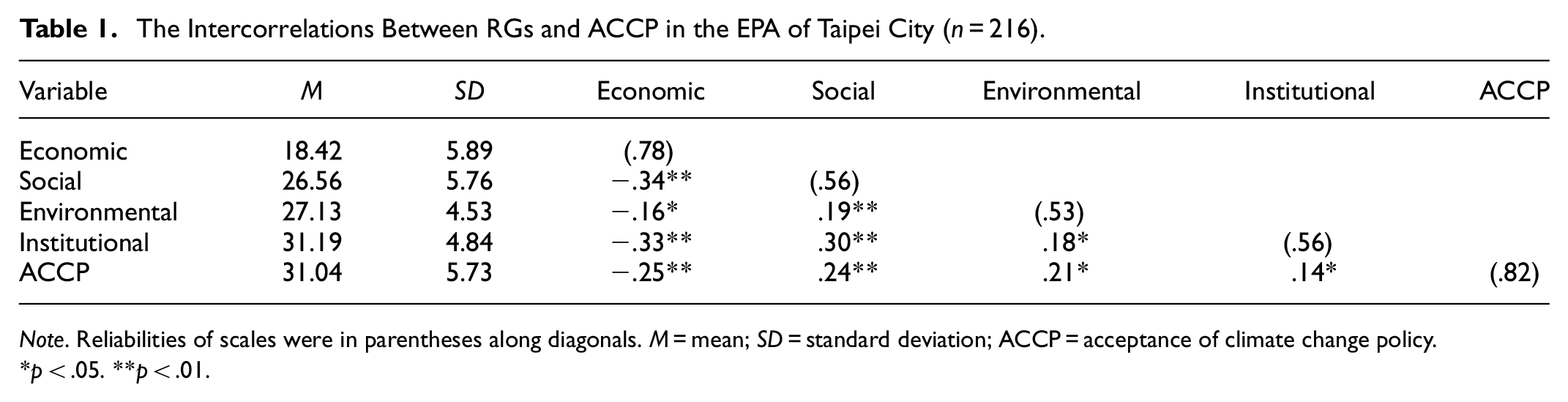
Note. Reliabilities of scales were in parentheses along diagonals. M = mean; SD = standard deviation; ACCP = acceptance of climate change policy.
p < .05. **p < .01.
The Intercorrelations Between RGs and ACCP in the EPA of New Taipei city’s EPA (n = 203).

Note. Reliabilities of scales were in parentheses along diagonals. M = mean; SD = standard deviation; ACCP = acceptance of climate change policy.
p < .05. **p < .01.
The Intercorrelations Between RGs and ACCP in the EPA of Taoyuan City’s EPA (n = 169).

Note. Reliabilities of scales were in parentheses along diagonals. M = mean; SD = standard deviation; ACCP = acceptance of climate change policy.
p < .05. **p < .01.
The Intercorrelations Between RGs and ACCP in the EPA of Taichung City’s EPA (n = 187).

Note. Reliabilities of scales were in parentheses along diagonals. M = mean; SD = standard deviation; ACCP = acceptance of climate change policy.
p < .05. **p < .01.
The Intercorrelations Between RGs and ACCP in the EPA of Tainan City’s EPA (n = 168).

Note. Reliabilities of scales were in parentheses along diagonals. M = mean; SD = standard deviation; ACCP = acceptance of climate change policy.
p < .05. **p < .01.
The Intercorrelations Between RGs and ACCP in the EPA of Kaohsiung City’s EPA (n = 146).

Note. Reliabilities of scales were in parentheses along diagonals. M = mean; SD = standard deviation; ACCP = acceptance of climate change policy.
p < .05. **p < .01.
The correlations between the characteristics of RG and the acceptance of climate change policy (ACCP) in each EPA of six municipalities are described in Tables 1 to 6. For EPAs in six municipalities, the findings demonstrate that the economic dimension of RG had considerably negative correlations with ACCP, whereas the social and institutional dimensions were significantly positively linked to ACCP.
To evaluate the analysis of the possible impact of each RG dimension on ACCP, we used multiple regression analyses. The models were compelled to include the economic, social, environmental, and institutional dimensions, in that order. Table 7 shows that, with the exception of the EPA in Taichung City, the institutional dimension was the only component that substantially predicted ACCP across five EPAs in six municipalities. Taipei City, New Taipei City, Taoyuan City, Tainan City, and Kaohsiung City had standardized values of .21, .26, .40, .30, and .39, accordingly (all p < .01). It should go without saying that the institutional dimension of RG was the only one that could identify ACCP across municipalities. The EPA establishes informed policies to provide substantive outcomes for resilience governance, which is an important institutional component. Indeed, institutional resilience refers to a metropolitan city’s and its whole socio-ecological and socio-technical network’s ability to continue or swiftly return to normal functioning in the face of a crisis. Resilient institutions are those that survive and thrive, such that if the system’s power to react to present or future changes is limited, it can be swiftly modified thanks to its resilience governance (Meerow & Newell, 2019).
Results of Multiple Regression Analysis for All Six Municipalities With ACCP as Dependent Variable and the Dimensions of RG as Predictors.

Note. RG = resilience governance; ACCP = acceptance of climate change policy.
p < .05. **p < .01.
Resilience institutions may be characterized by the ability or capability to handle disruption and risk, adapt to changes, and strengthen and sustain the metropolitan city’s intrinsic effective governance. Furthermore, the institutional dimension of RG is viewed more as a capability or flow than a result (Ernstson et al., 2010; Figueiredo et al., 2018; OECD, 2014d; Suárez et al., 2016). RG’s institutional dimensions may also promote open, transparent, and participatory policymaking as well as successful policy execution. EPA, in particular, is a climate change policy watchdog on the front lines of successful public service delivery and data and information exchange. Municipal regulatory competence and capacity building are essential for robust, effective, and adaptable institutions (OECD, 2014b).
In four EPAs of six municipalities, the social dimension of RG was an important predictor: Taipei City (β = .17, p < .05), New Taipei City (β = .10, p < .05), Taoyuan City (β = .16, p < .01), and Tainan City (β = .16, p < .05), but not Taichung City or Kaohsiung City (see Table 7). Furthermore, in four EPAs from six cities, the social dimension was a strong predictor of ACCP. As a result, the present research was in line with past results (Grafakos et al., 2016; OECD, 2014a, 2014c; Walker & Salt, 2006). Municipalities that are resilient can respond to shocks by implementing a cohesive and integrated set of structural adjustments and strategies (OECD, 2014d). Social inclusion, as well as access to employment and education, can enable the community to deal with change more effectively (Figueiredo et al., 2018). As a result, the present research was in line with past results (Grafakos et al., 2016; OECD, 2014a, 2014c; Walker & Salt, 2006).
Nevertheless, among all the EPAs of six municipalities, the environmental dimension of RG was the only component that was inversely associated (although not substantially) with ACCP. The findings did not match our expectations for variations across the EPAs of six municipalities. Furthermore, in the responding to environmental deterioration, resource exploitation, and the possible ramifications of climate change and natural disasters, resilience is critical (OECD, 2014d). However, the present investigation contradicts previous research that concluded that the environmental dimension is important for understanding how climate change would affect indigenous residents and taking action to protect human well-being and community capital (Godschalk, 2003; The Rockefeller Foundation, 2014; Walker & Salt, 2006). It may be contended that without an environmental dimension to RG, there is no assurance that climate change policymaking can actually deliver crucial disaster relief and rehabilitation services like communication, transportation, water, and sanitation.
Discussion
Our research aims to analyze whether aspects of resilient governance anticipate acceptance of climate change policy (ACCP) among the six environmental protection administrations of six special municipalities in Taiwan. Specifically, at five EPAs of municipalities, the findings revealed that the institutional dimension was the only robust governance that significantly influenced ACCP, except for Taichung City. As a result, the importance of RG in terms of cooperation, bargaining, and collective policymaking is rooted in the collaborative connections and interactions between municipalities, organizations, and civil society. “Interlinkages of parallel policies and regimes within a horizontally and vertically segmented governance system,” as Biermann (2004, p. 12) suggested, might occasionally be the basis of “divergent policies in global environmental governance.” The World Meteorological Organization and the United Nations Environment Program convening a conference that inevitably results in findings that merge into the Intergovernmental Panel on Climate Change, which led to the Kyoto Protocol’s better development a decade later, was the accelerant in the situation of the Kyoto Protocol (Chasek et al., 2000). As a result, the current study is in line with previous investigations (Figueiredo et al., 2018; Gharai et al., 2018; OECD, 2014c). Nonetheless, while evaluating RG and ACCP in the cities of Kaohsiung and Taichung, one must anticipate competing objectives and adverse correlations. For instance, the provision of infrastructure and environmental factors have competing objectives. The principle of resilience governance involves competing objectives that must be carefully balanced. It is not a limitation of the notion that it is unidimensional but rather a strength, as it can facilitate a transparent policy process and evidence-based policymaking regarding conflict climate issues.
On the other hand, it has been shown that the pre-existing institutional arrangements in Taichung City do not promote particular resilience capacities to the same extent as they do in other places. It is possible to make the case that the current institutional frameworks do not provide sufficient support for either the enhancement of adaptive capacities or recovery capacities, which is especially relevant when considering the interconnection of the infrastructure systems. The results of this research make it very evident that local governments cannot shoulder all of the responsibility for institutionalizing governance for resilience on their own. The current research implies that municipalities need to be perceived as being integrated into the complex territorialities of infrastructure systems and the multi-layered institutional arrangements that are involved in maintaining these systems. While some academics argue that municipalities are becoming more and more crucial in their coordinating, networking, monitoring, and regulating functions (K. T. Cheng & Cheng, 2016; Dahlberg et al., 2015), this research revealed that municipalities need to be regarded as being embedded In addition to this, it necessitates carefully considering the manner in which responsibilities, authorities, and political legitimacy are dispersed across various levels of governance in order to preferentially determine which actors should take over regulating and coordinating functions in order to improve governance for resilience.
The institutions, organizations, and decisionmaking procedures that run a city or community are included in the institutional component of RG. Governments, organized civil society, and business organizations are all involved in the risk governance framework. Knowledge sharing, capacity building, learning procedures, and participatory pathways are all examples of capacity. To adapt to and recover from shocks, institutions must have the capacity to do so (see OECD, 2014c). Ultimately, RG necessitates not just the effective coordination of individual interests but also the inevitability of making decisions that may favor some actors over others. Because the institutional dimension of RG is so crucial (Filho, 2020), the EPA makes reasoned judgments to maintain substantive openness and transparency; otherwise, a huge and hazardous gap between regulators and regulatees exists (K. T. Cheng, 2016). If everyone agrees on the RG, it will bind interest groups and civil society to a defined objective, ideally without misunderstandings. Municipalities should do more to make sure that information on regulations is easily available to members of the public interested in participating in a specific climate change policy process. The institutions’ climate change policies must satisfy public interest purposes, but they must do so in a transparent and reasonable way to guarantee policymaking stability and consistency. As a result, it may be claimed that effective RG in the climate change policy framework may assist regulatory authorities like the EPA in developing optimal policy decisions, while training and information will raise their understanding and readiness to do so (UNISDR, 2012). In the context of climate change resilience governance, Taiwanese municipalities must prioritize expanding knowledge, collaboration, training, trust, consciousness, sympathy, community, and network development. Without these soft competencies, climate resilience governance cannot be managed.
Crucial to climate resilience is the social dimension (e.g., community assistance, networks, a sense of belonging), which is never well explored due to a shortage of data on such soft components (Feldmeyer et al., 2019; Schaefer et al., 2020; Sorg et al., 2018). The findings also revealed that the social dimension of RG appears to be positively and significantly related to ACCP, and that this capacity is argued as part of “wealth, technology, education, information skills, infrastructure, access to resources, stability, and managerial capabilities” (O'Brien et al., 2004, pp. 304–305). This is in line with previous research (Grafakos et al., 2016; OECD, 2014a, 2014c; Walker & Salt, 2006; Wilson, 2014). The prevalence and effect of cross-scale linkages, information flow, and the placement of a system in the adaptive change cycle, for instance, are three fundamental elements of resilience theory, according to Redman and Kinzig (2003). Hence, according to the findings, safeguarding people and their emotional, physical, and economic well-being (social capital) should be prioritized in the development of climate change policies. Some contextual factors increase the susceptibility of Taiwanese municipal societies to the effects of climate change. In addition, the adverse consequences of climate change, such as severe air pollution, rising food costs, and water wars, substantially destabilize political structures, hence escalating societal conflicts.
As a result, the RG for municipalities should make reasonable efforts to accommodate and promote public participation, as well as include complete and coherent regulations regarding the distribution and dividing line of obligations, powers, and roles and responsibilities among the regulatory authority, municipalities, and all other policy stakeholders. Therefore, in the event of a difficult circumstance, people will coordinate themselves and construct structures in order to conquer obstacles, thereby developing their resilience. As a result, it should not come as a surprise that communities also demonstrate resilient governance, or even especially by them, given that social features are essential for the development of a sustainable society. It’s possible that the social dimension is linked to other RG aspects and that the social dimension is more likely to play a prominent role in helping cities adjust to changing circumstances. Furthermore, the municipality’s customs and the people that reside here are the fabric that will ensure its survival. That implies we’ll have a leader in charge of managing our social and natural resources, which will define the destiny of towns. This level of detail is necessary for municipalities to advance their ACCP.
The findings greatly enhance our understanding of the causation between RG and ACCP among EPA employees, but should be considered in light of some limitations. We initially tested our hypothesis with a restricted sample of employees from the EPA. The cross-sectional approach of the current study does not establish a definitive cause-and-effect relationship. Data acquired exclusively from EPA employees in Taiwan may raise doubts about the applicability of the current results to different contexts. The dependent variable RG may be affected by common method bias due to its self-reported nature (N. P. Podsakoff et al., 2014). Future research could focus on creating more detailed survey instruments or gathering data from other sources to objectively examine RG’s dimensional changes among EPA employees (P. M. Podsakoff et al., 2003). Secondly, we recognize that RG represent aspects that may be affected by many individual and organizational circumstances. Our data does not account for the time-dependent effects of RG. Further efforts could be made to investigate how individual, group, organizational, or environmental factors may independently or collectively influence aspects of RG. The present empirical findings are derived from Taiwans EPA. Thus, we should interpret our observations carefully, as the EPA and its employees may have varying backgrounds and aspects of RG compared to those in private organizations or public sectors in other countries. Replicating the study with data from various situations would be beneficial to determine if the results are consistent across different public sectors and countries. Expanding the sample of employees might enhance the generalizability of the empirical results beyond our country-specific findings. Future studies will require a longitudinal study design to address the statistical problems raised by this methodology. It is an issue for future research whether additional variables can provide distinct contributions to explaining ACCP beyond the influence of RG. Future research should analyze the RG concepts in detail and investigate its sub-dimensional relationship. This is crucial because aggregated indexes could obscure unique variations and impacts. Future research should expand upon the original RG elements and contents identified in Western countries.
Conclusion
The findings lead to a more effective knowledge of RG and climate change development policies, as well as the organizational structures required for resilience governance. In terms of policy implications, the findings can help practitioners identify more effective delivery modes for resilience and climate change policymaking. The present study'’s findings show that the four dimensions of RG have significant relationships with ACCP and that the RGs are a useful foundation for investigating the attitudinal cause of ACCP. Beyond the effects of RG, whether additional factors can contribute specifically to the understanding of ACCP remains a matter for further investigation. Future study should expand on the concept of resilience as a process and the impact of cross-scalar barriers in a multi-level institutional framework. Finally, future research should attempt to comprehend the governance mechanisms that may justify resilience governance’s ties to policy acceptance for climate change.
Footnotes
Declaration of Conflicting Interests
The author(s) declared no potential conflicts of interest with respect to the research, authorship, and/or publication of this article.
Funding
The author(s) received no financial support for the research, authorship, and/or publication of this article.

Data Availability Statement
The data that support the findings of this article are available from the corresponding author upon reasonable request after the article being published. The dataset was newly collected and never being used for publication.