




Abstract
Women are exposed to various challenges, especially when engaged in men’s work. This study described the condition of women as they turned challenges into opportunities in agritourism through women’s empowerment. It was anchored on the theoretical foundations of organizational resilience and women in the tourism framework. The study addressed the key question of how women in agritourism sites of Central Luzon turned the challenges they experienced into opportunities through women empowerment. The research gap bridged by the study involved analyzing the conversion process of challenges into opportunities by validating the presence of different aspects of empowerment in agritourism operations. Qualitative data were gathered through semi-structured interviews among empowered women leaders in agritourism enterprises. Data were analyzed and presented through thematic outcome-pair matching to verify propositions from related literature and studies. Results showed a complete match with the conversion of challenges into opportunities through empowerment in terms of political, economic, and socio-cultural aspects, but a partial match was observed in terms of the physical aspect of empowerment. The study revealed that women in agritourism converted their challenges into opportunities that benefit them as women who excelled in male-dominated industries. Practical implications were observed as agritourism served as a platform for improving the quality of life of women in Central Luzon. The research also contributed to widening the importance of women’s empowerment as a mechanism rather than an end goal in attaining the opportunities offered for women leaders in the agritourism industry.
Plain language summary
This study described the condition of women as they turned challenges into opportunities in agritourism through women’s empowerment. It was anchored on the theoretical foundations of organizational resilience and women in the tourism framework. The study addressed the key question of how women in agritourism sites of Central Luzon did, Philippines turned the challenges they experienced into opportunities through women empowerment. The research gap bridged by the study involved analyzing the conversion process of challenges into opportunities by validating the presence of different aspects of empowerment in agritourism operations. Qualitative data were gathered through semi-structured interviews among empowered women leaders in agritourism enterprises. Data were analyzed and presented through thematic outcome-pair matching to verify propositions from related literature and studies. Results showed a complete match with the conversion of challenges into opportunities through empowerment in terms of political, economic, and socio-cultural aspects, but a partial match only was observed in terms of the physical aspect of empowerment. Practical implications were observed as agritourism served as a platform for improving the quality of life of women in Central Luzon. The research also contributed to widening the importance of women’s empowerment as a mechanism rather than an end goal in attaining the opportunities offered for women leaders in the agritourism industry.
Introduction
Agritourism or more commonly known as farm tourism in the Philippines, can be defined as “any agricultural or fishing-based enterprise or activity that involves bringing visitors and tourists to farm regions for production, educational, and recreational objectives; may also offer a location for accessible outdoor enjoyment and family trips” (Republic Act No. 10816). Additionally, this definition is aligned with the U.N.W.T.O. definition of agritourism, which is defined as visiting an agricultural site or working farm for enjoyment, education, or active engagement in the farm’s activities (U.N.W.T.O, 2020a, 2020b).
As the Philippines optimized the benefits of agritourism, sustainability problems emerged (Aguila, 2019; Bueno et al., 2016). Concerns about the sustainability framework hamper the longevity of agritourism development in the country (Busby & Rendle, 2000; Lago, 2017). The study of Recio et al. (2014) initially pointed out how agritourism affected the three main aspects of sustainable development: the environment, the economy, and the local community. One critical aspect is the proper and complete integration of the local community into the development for the sustainability of the program (Bueno et al., 2016; Karabati et al., 2009; Lago, 2017; Mazlan & Juraimi, 2014). Ingavale (2015), Mazlan and Juraimi (2014), and Zunic (2011) focused on the involvement of the local indigenous groups or ethnic tribes as critical for agritourism. Among these groups, one growing segment that has not been given adequate attention is the involvement of women in the management of agritourism operations (Savage & Barbieri, 2020; Tiraieyari, 2012).
The involvement of women in agritourism was explored by Wright and Annes (2014). A. E. Savage et al. (2022) focused on personal and social attributes affecting the role and experiences of women in agritourism, while Halim et al. (2020) discussed the economic benefits that agritourism has contributed to the life of women in agritourism. Sathiyabama and Velmurugan (2019) identified challenges related to discrimination and unequal opportunities faced by women who decided to enter a male-dominated form of tourism, such as agritourism. With the positive and negative impacts of agritourism on women, Annes and Wright (2015)and Gil-Arroyo et al. (2019) explained the role of women’s empowerment toward attaining positive impacts and minimizing the challenges.
This study tackled the involvement of women in agritourism development on selected sites of Central Luzon, Philippines. Agriculture and its underlying modifications or peculiarities were often linked to male responsibilities (Brezuleanu et al., 2019; Phelan & Sharpley, 2012). This can be attributed to the physical work that the agricultural activities require for its operations. Linking to tourism in general, unfair treatment in the involvement of women has been presented as a socio-cultural issue that should be addressed properly as part of sustainable development (Bhatta & Ohe, 2020; Ramchurjee, 2011). Its significance can also be seen in the integration of women and their role as part of the gender equality goal of the United Nations 2030 Agenda (U.N. Women Report, 2019; U.N.W.T.O, 2020a, 2020b). According to Raspor et al. (2020), the success of the specific form of the tourism industry depends on how individuals involved in tourism identify the changes and challenges they hurdle and succeed in the situation they are given. Women entrepreneurs hurdled various challenges, such as financial and economic problems, discrimination, and strategic or competitive problems (Mukit et al., 2020). Considering the importance of women’s empowerment, there was a need to analyze its value in converting the challenges and disadvantages faced by women into opportunities in agritourism. This was addressed by this study that treated women’s empowerment as an instrument in aiding the conversion of lived challenges of agritourism leaders into opportunities.
Central Luzon, which was known for both natural and cultural tourist attractions, is recognized as the Agricultural Center of the Philippines, being the Rice Granary of the Country. The Department of Tourism (2017) launched and recognized eight agritourism sites within the region that includes Caffe La Tea, Chanos Chanos, National Food Authority Grounds, Milka Krem Plant, P.M.P. Paradise Farm, Philrice Research Institute, Puno Ice Cream Plant, and Science City Tour. The recorded number of agritourists in the region by the Tourism Office showed an average of 8% to 10% per year starting in 2016 (Yamagishi et al., 2024). With this increasing number of agritourism sites and agritourists, the region was the appropriate setting for this research. Currently, agritourism in Central Luzon has been observed to be in the involvement stage of the tourist area life cycle where the benefits in the quality of life of residents start to emerge coming from the engagement of the locals in tourism activities (Uysal et al., 2011). The specification of these benefits varies across different destinations based on the extent of participation and the nature of tourism activity developed in the destination, which in this case is agritourism, which is also reflective of the main source of livelihood of the locals (Zhong et al., 2008). The future of farm tourism in the Philippines exhibited complex dynamics where local engagement becomes transformative because of the benefits of tourism development in the country (Yamagishi et al., 2024). However, there is still a need to describe the transformation of residents’ quality of life, especially from the lens of resilience and empowerment (Hsiao & Tuan, 2023).
This study explored the value of women empowerment among agritourism sites in Central Luzon. In general, it worked to validate a framework for women’s empowerment as a tool for managing women’s lived experiences by converting the challenges they faced into opportunities. Specifically, it presented women managers’ challenges and how they turned these difficulties into opportunities through women empowerment. This research addresses the knowledge gap because there still needs to be more on how women who experience challenges in a male-dominated industry, such as agritourism, thrive on converting these challenges into opportunities. Based on the propositions of Ingavale (2015), Mazlan and Juraimi (2014), and Ramchurjee (2011), women in tourism are empowered, which allows them to hurdle various challenges. However, it is important to analyze if the process of hurdling leads to the conversion of these challenges into opportunities, which is the main theme of this study.
Literature Review
Agritourism in the Philippines
Agritourism was first practiced in the Philippines in the 1990s when the Department of Tourism and UNDP joined forces to create the Philippine Tourism Master Plan, which was built on the principles of sustainable development and made use of agricultural and rural areas for environmental preservation (SEARCH, 2018; Spire, 2013). From the Asian context, Hsiao and Tuan (2023) explained that agritourism in the region is characterized by the recreational farm operators’ dynamic capabilities to maneuver several economic and social adversities. The future of agritourism in the Philippines is characterized by complex dynamics in which local participation becomes transformational due to the advantages of tourist development in the nation (Yamagishi et al., 2024). However, So (2016) identified that one of the new tourism segments emerging in the region was farm tourism. Claravall (2017) mentioned that farm tours were also considered special-interest activities, especially in Central Luzon. Despite the growth of this tourism niche, there still needs to be more studies that explore its social impact (Uysal et al., 2011). There is still a need to define the transformation of residents’ quality of life, particularly via the perspective of resilience and empowerment, to describe the unique phenomenon of agritourism in the Philippines (Hsiao & Tuan, 2023).
Women’s Empowerment in Agritourism
Annes and Wright (2015)and Gil-Arroyo et al. (2019) discussed the significance of women’s empowerment in achieving good outcomes and reducing difficulties in agritourism. Ateljevic (2010) emphasized the significance of women empowerment in assisting women in reaping the advantages of tourist activities in terms of physical, political, economic, and socio-cultural dimensions in tourism. The study of Khairabadi et al. (2020) discussed how agritourism contributes to developing social services and creating value for economic prosperity and social capacities. After reviewing the literature, women empowerment and agritourism engagement were examined independently (Aghazamani et al., 2020; Annes & Wright, 2015). Agritourism and other industries in the farming landscape are connected to patriarchal ideologies that lead to the marginalization of women and the limitation of their roles (Saugeres, 2002). Nevertheless, there is an evident growth in women’s involvement among micro and small-scale agritourism sites (Tugade, 2020). Despite the challenges for women in this field, it is interesting to describe the factors that made them thrive in agritourism (Azima & Mundler, 2022). In this view, women’s empowerment was not the ultimate result of an action but rather the means to a goal. Moreover, women empowerment in tourism has been explored by various scholars but treated as a latent variable in a quantitative study (Abou-Shouk et al., 2021; Elshaer et al., 2021; Khan et al., 2022). Considering that women faced phenomenological challenges in agritourism, a qualitative study of their lived experiences may be necessary. This research addresses the gap in the value of empowerment as an instrument for individual resilience and transformation from a qualitative perspective.
Organizational and Individual Resilience
According to Annes and Wright (2015) a person can convert problems into opportunities through empowerment. Women involved in agritourism faced various challenges because of social isolation (Annes & Wright, 2015). Hence, it is interesting to analyze women empowerment based on its role and significance in the progression of a business that is commonly contextualized under masculine and patriarchal ideologies (Bhatta & Ohe, 2020; Ramchurjee, 2011). de Vries and Hamilton (2021) explained that individual and organizational resilience are important attributes of managers and the company when faced with adversities. With the study, the resilience theory of Denyer (2017) can be used to demonstrate how women empowerment assisted female agritourism leaders in turning problems into opportunities. According to Raspor et al. (2020), the success of a certain type of tourist sector is determined by how persons working in tourism recognize changes and obstacles and succeed in the scenario they are given. Women entrepreneurs face various barriers, including financial and economic difficulties, discrimination, and strategic or competitive issues (Mukit et al., 2020). This study fills a gap in the literature by utilizing women’s empowerment to address challenges toward excellence in the agritourism business by transforming their experienced challenges into opportunities through empowerment.
Methods
This study was anchored on several grounded theories and concepts. The organizational resilience theory explains that when a person encounters risky and challenging conditions in their workplace, they learn the skills needed to respond appropriately and transform their scenario into a pervasive situation and adaptive innovation (Denyer, 2017). It was relevant to the research because it described women’s difficulties in agritourism and how they overcame them to seize possibilities. The women empowerment framework utilized for the study was the women in tourism framework by Ateljevic (2010). This report emphasized the outcomes of the U.N.W.T.O. Report for Gender Equality and Development and promoted the Fifth Sustainable Development Goal to “achieve gender equality and empower all women and girls” (U.N.W.T.O. 2030 Sustainable Agenda). It is relevant for the study because it served as the source of propositions on the value of different aspects of empowerment to women in the tourism industry.
As part of Figure 1, Women empowerment is operationally defined as developing women’s physical, political, economic, and socio-cultural aspects that help them thrive in the tourism industry (U.N.W.T.O, 2020a, 2020b). Meanwhile, challenges in agritourism are operationally defined as the difficulties and challenges experienced by women entrepreneurs and managers involved in agritourism, while opportunities in agritourism represent the benefits seized by women with their engagement in the field (Annes & Wright, 2015). The conversion of challenges into opportunities was based on the resilience framework of Denyer (2017), while the women empowerment framework that was instrumental in converting the challenges into opportunities was patterned after the tourism and women empowerment framework by Ateljevic (2010). Women empowerment was segmented into physical, political, economic, and socio-cultural forms of empowerment as measured by the different factors identified in the U.N.W.T.O. report of Ateljevic (2010). The proposal for physical women’s empowerment emphasized how the participation of women in accurate geological mapping, resource exploitation, environmental protection, and urban or rural development changed women’s obstacles into possibilities (Brezuleanu et al., 2008). The argument for political women’s empowerment outlined how women’s difficulties may be turned into opportunities by their active participation in the formulation of laws, policies, and decision-making processes (Mazlan & Juraimi, 2014). According to Ingavale’s (2015) argument for economic women’s empowerment, employment, microcredit, and the use of technology all contributed to helping women turn their obstacles into possibilities. Finally, Ramchurjee’s (2011) proposal for socio-cultural women’s empowerment said that women’s specialization in health, religion, education, and skills equality was crucial in helping them turn obstacles into opportunities.

Operational framework.
The main participants of the study were selected through a purposive sampling technique. This approach was selected because the insights of female agritourism leaders who expressed direct knowledge and experience in women empowerment should be qualified, as their lived experiences were critical in validating the framework. Twelve research informants were interviewed using a semi-structured set of questions based on the guidelines of Carlsen and Glenton (2011)and Ochieng et al. (2018), reaching the point of data saturation. A small number of participants can be justified in a qualitative study if there is information power (Malterud et al., 2016). Women managers and entrepreneurs possessed information power because of their lived experiences from the start-up to the growth of agritourism operations. A phenomenological approach was used as the research design because the lived experiences of women agritourism leaders were used as the primary data for determining the conversion process from challenges into opportunities and the role of women empowerment in facilitating this conversion process.
The research-gathering technique implemented was a semi-structured interview with the empowered women based on questions validated by social science and tourism management experts. The guidelines recommended by Carlsen and Glenton (2011) were adopted following the steps of literature content analysis (pooling of related literature and studies), theoretical review (establishment of propositions), and conduct of semi-structured interviews (probing of lived experiences). The outcome-pattern matching was adopted as the data analysis technique because propositions formulated from the theoretical review were tested to formulate the framework supporting the instrumental value of women’s empowerment in converting the challenges into opportunities. Themes extracted from data gathering were paired through the previously identified assumptions to determine full, partial, or zero matching. Direct relationship means a complete match or literal replication of the propositions on the operational framework. An inverse relationship means a partial match or partial replication of the proposition in this research. Zero association means no match or no replication of a particular proposition.
Results and Discussion
The qualitative study was conducted through semi-structured interviews. The research questions were answered, and propositions were tested by describing and evaluating the convergence of the results of pattern matching of modal responses of twelve female agritourism leaders. The matching of the themes involved pairing challenges and opportunities in the first level to determine how challenges can be converted into opportunities, followed by pairing opportunities and women’s empowerment to describe the instrumental value of women’s empowerment in seizing the advantages.
Proposition 1: Women Who Experienced Challenges in Agritourism Can Turn These Factors Into Opportunities Through Physical Women Empowerment in Agritourism
Women in agritourism indicated how they started as amateurs in terms of mapping farming or agricultural land, and as they opened their sites to agritourists, they managed to learn the importance of mapping the whole agricultural land that will be open for agritourism. Suppliers of agricultural resources used within the farms expanded over time, starting from a few groups where bargaining is challenging into a more convenient supply chain. They also learned how farming is bounded by environmental protection measures which opened their concept of the value of sustainability. Land conversion became added knowledge as the women in agritourism took the opportunity to know the mechanics. The infrastructure concerns, such as the type of buildings, units, and equipment suitable for the land, were also resolved during agritourism operations.
As seen in Table 1, The women in agritourism felt challenged by male resource and site planning expertise. However, these did not prohibit the women in agritourism from mastering the craft and taking formal and informal learning activities to know how agritourism operates. Based on the study of Aghazamani and Hunt (2017) and Barbieri and Mshenga (2008), agricultural knowledge should be an added requirement to ensure that the women in agritourism could be more assertive in performing their functions in the agritourism sites. Regarding timeline planning, the women still consulted with male experts and engineers for more routine operations. Kunjuraman and Hussin (2016) and Widiastini et al. (2019) explained that women might be empowered in terms of esthetic design concerns but with technical land design and mapping, consulting a male perspective is deemed to be more comfortable and convenient for women in agritourism.
Pattern Matching with Proposition 1.

Women accepted that no matter how they learned the value of engineering and structural concerns in agricultural land planning, they deemed consulting with male site planners and engineers more practical. Though some agritourism employees managed to learn the field of land use mapping and planning, most women in agritourism noted that male expertise could make their jobs easier and on-point. Engineering tasks such as plow design and water source channels involved men colleagues and did not involve women in agritourism purely. Nevertheless, the women explicitly stated that their participation in site planning became essential as they suggested maintenance and resource management measures.
Relating this to the tourism and women empowerment framework by Ateljevic (2010), the study’s findings showed a complete match with the conversion of challenges and opportunities. This means that women agritourism leaders were encouraged by the doubts they faced from their colleagues. This was proven by the response of Participant 2, who said:
“Male compatriots in agritourism doubted our skills which is why I showed them the things I learned in terms of structural planning and land conversion (P2).”
Nevertheless, some participants believed that their physical limitations could never be neglected, so the assignment of the specific function for women is critical. As much as women wanted to contribute in terms of structural expertise and site planning involvement, the specialization of males was highly favored in the agritourism industry. The findings of Mishra (2014) discussed that the level of women’s empowerment could not be optimized because there were functions designed for a specific gender. Despite the training attended by women agritourism leaders in Central Luzon, they believed landowners were still looking for male experts. Aghazamani and Hunt (2017) explained that the dependence on male experts for these specific functions of agritourism delimits the opportunities given to women agritourism leaders. Women took advantage of opportunities based on the specific functions deemed appropriate by other organizational stakeholders, but there were also some opportunities for the roles that other stakeholders still depended on male experts. As stated by Participant 10:
“I obtained expertise in agritourism through several training and development programs, but no matter what I do, our bosses are still looking for male engineers and male actuaries. There could be discrimination there, but at least they still assigned us other tasks and responsibilities (P10).”
P2: Women Who Experienced Challenges in Agritourism Can Turn These Factors Into Opportunities Through Political Empowerment in Agritourism
Women in agritourism narrated how they only served as audience and mere participants during the introduction of agritourism in Nueva Ecija. This challenge was hurdled by the women in agritourism when they started speaking out more during meetings and taking up leadership positions and affiliations. Women entrepreneurs turned their influence to a greater level when they contributed their expertise in terms of their business acumen as they developed practical models for turning their farms into agritourism sites. Another wonderful theme is the united notion of women in agritourism about policies that protect their interest in a previously male-dominated farming industry in the province.
As presented in Table 2, Women in agritourism felt accepted among agritourism-related organizations. After their voice and suggestions were heard, male members of the organizations treated them fairly. They were even given equal rights regarding nomination and candidacy for organization positions, and their gender did not become an issue within the group. Their management expertise and acumen allowed them to hold consultative positions. Managing an agritourism destination empowered them and raised their influence within the community as the other members recognized how the women in agritourism contributed to the progress of the community.
Pattern Matching with Proposition 2.
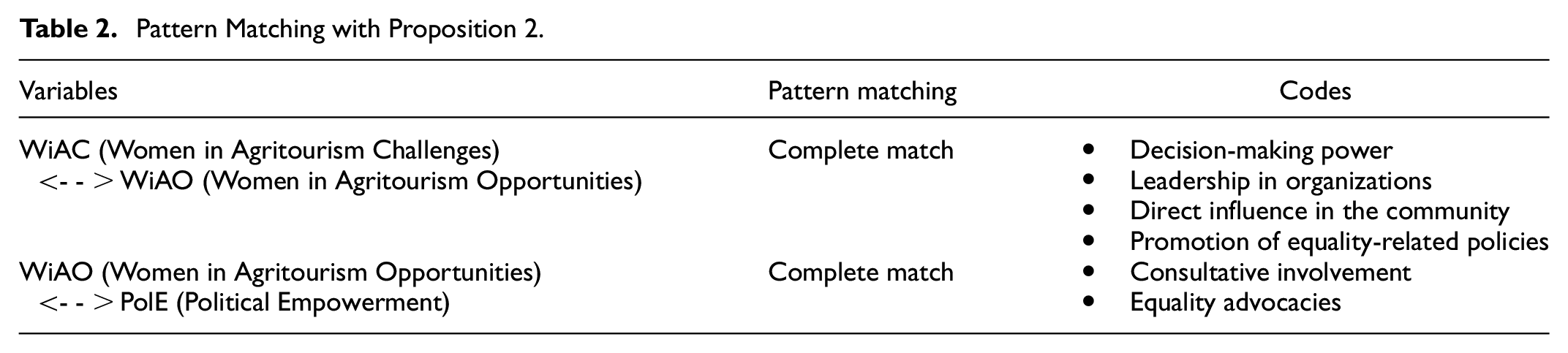
The women in agritourism experienced mere participation before and during the introductory phase in Nueva Ecija. However, as the previous male members of farming associations and organizations recognized how a perspective of women could contribute to the success of their organizational objectives, their roles became more significant. Sundström et al. (2017) and Irawan and Nara (2020) explained that political empowerment was rooted when women stepped forward and made their expertise and competencies recognized. In the case of agritourism, their business acumen and management skills helped them become more valuable as their perspective led to more effective marketing strategies for agritourism resources and experiences. Mazlan and Juraimi (2014) and Alexander et al. (2016) supported these findings by explaining how women can take their leadership positions as platforms for carrying their advocacies. The women in agritourism in Nueva Ecija took the chance to ensure that gender sensitivity and equality programs were in place in agritourism operations within the province.
The Women in Tourism framework by Ateljevic (2010) proposed that women can now be given leadership positions and responsibilities in the tourism industry. This was also reflected in agritourism in Central Luzon, as justified by women leaders who served as research participants in the study. A complete match was observed in the key themes under the challenges and opportunities faced by women in agritourism with other forms of tourism, indicating that women may initially be doubted to handle leadership positions because of the strength of personality of male subordinates. As theorized by Freund and Hernandez-Maskivker (2021), the glass ceiling in the tourism industry still exists among women managers, but there were already several measures that have been adopted to turn the womanhood of a manager into an opportunity. The insights of Participant 1 supported this:
“Being a woman did not become a big hurdle to me because I used it to my advantage. I proved to my male colleagues that my sense of responsibility and firm decision-making goes beyond my gender, which is how I got their trust and confidence to lead them (P1).”
Women empowerment was found to be instrumental based on the complete match of themes for opportunities and women empowerment in the study results. Linking this to the theory of gender roles and leadership by Kawakami et al. (2000), women empowerment eliminates the restrictions to women in attaining leadership roles and positions. The women agritourism leaders in Central Luzon stated that women empowerment helped them to become confident in their leadership approach. The “mother syndrome” was effective because male subordinates perceived the leadership approach of women as caring and full of concern. As these women occupied leadership roles and achieved women empowerment, the top management acknowledged the approach of women agritourism leaders in getting the trust of all male or female subordinates. Participant 6 expressed that:
“It helped that I was given a leadership position because I had the opportunity to create strategies and decisions which benefited the whole organization. My colleagues felt that the “mother knows best” idea is also in play (P6).”
P3: Women Who Experienced Challenges in Agri-Tourism Can Turn These Factors Into Opportunities Through Involvement in Agri-Tourism, Further Leading to Economic Empowerment
Agritourism operations have employed several women in the community who still need to finish their bachelor’s degrees. The rank-and-file employees of agritourism sites are composed of homemakers who are fond of gardening, and because of agritourism, they managed to become more productive because they were employed as receptionists and even farmers. Wide opportunities opened among the women members of the community as women entrepreneurs gave them a chance to apply their expertise in the field and in managing the garden with economic benefits and incentives. Capitalization has been a common challenge during the start-up phases, but the women in agritourism turned this into an opportunity to look for networks and collaborate regarding agritourism inputs such as seeds and fertilizers.
As discussed in Table 3, During the collaboration of women in agritourism in consolidating their input orders, they thought of establishing and mobilizing a cooperative among their group, which could be an institutional initiative for availing trade and volume discounts. The established cooperative has also been an outlet for financial and economic concerns about maintaining insurance, micro-credit, and savings in emergencies. These women expressed that they reached financial independence because of the stability within their respective agritourism sites and the mobilization of their agritourism cooperative. The women in agritourism also promoted fair trade by ensuring that the other community members would also experience economic benefits from the agritourism operations.
Pattern Matching with Proposition 3.
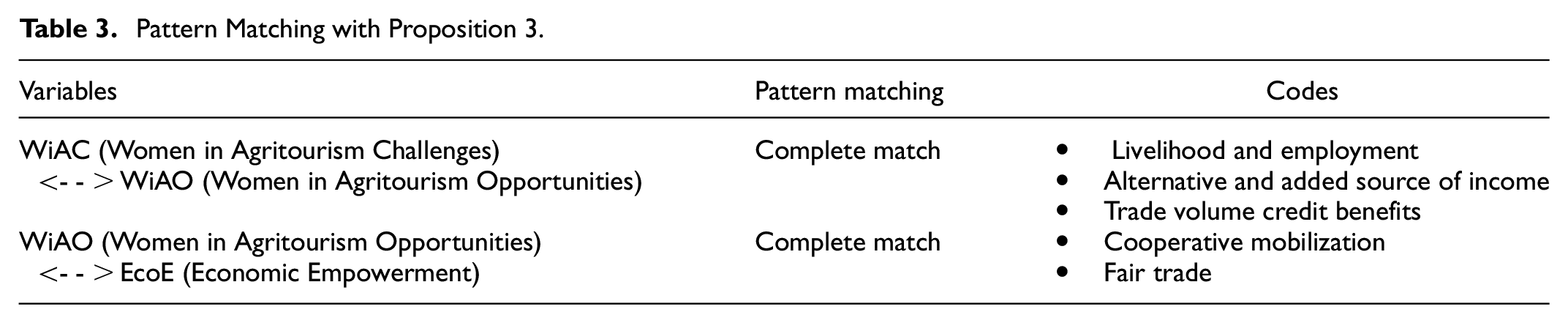
Like any business, capitalization is one of the initial economic challenges that entrepreneurs should hurdle. The women in agritourism applied conservative financial and economic planning optimized by collaboration and consolidation, making them qualified for trade and volume discounts. Their practical approach to financial and economic consideration of business led to direct economic benefits and opportunities such as employment, livelihood, and added source of income (Nutsugbodo & Adjei Mensah, 2020; Pavanello et al., 2015). With the joint mobilization among agritourism owners and managers, the women members took advantage of volume discounts and economic incentives. Agritourism served as a valuable platform for improving their quality of life which paved the way to their financial independence, as realized by the studies of Thanikaivel and Priya (2018) and Murugan (2019).
Ateljevic (2010) proposed the role of women’s economic empowerment in the tourism industry, which showed a complete match in the lived experiences of the women agritourism leaders in Central Luzon. In the challenges into opportunities pairing, a complete match was observed because women leaders experienced problems related to economic resource scarcity, but this served as their motivation to look for alternatives and attain other sources of benefits. Pereznieto and Taylor (2014) discussed that womanhood helped attain economic opportunities because women were generally found to be resourceful and persistent in getting support for their projects and programs. As seen from the lived experiences of women agritourism leaders, they are used to limited resources, which fueled them to avail of discounted rates and establish cooperatives where the scarcity of resources can be addressed. Research Participant 9 expressed that:
“We, women, can build strong connections. For example, we established a women’s agritourism cooperative to avail of discounted rates and lower lump sum prices for agricultural products (P9).”
Women empowerment was critical in seizing the opportunities in agritourism, as seen in the complete match of opportunities and women empowerment in agritourism. Gil-Arroyo et al. (2019) discussed how empowered women proposed alternative strategies to fill up inadequacies for resources needed by their respective organizations. Women agritourism leaders elaborated on the importance of their connections and business acumen in strengthening capitalization and trade commercialization. As Ingavale (2015) explained, empowerment helps women attain a better economic condition because they become wiser in managing their finances and commercial transactions. Women leaders mastered agritourism suppliers who can offer them better deals and manage credit terms to make their financial condition more liquid. These are all possible because women leaders were given more significant roles in the administrative side of agritourism operations. This was supported by the statement of Participant 5, who said:
“I know how to budget our finances because it is the same way I managed our household budget. To ensure stable financial condition, I optimized the networks we built in our cooperative to avail of more affordable purchases (P5)."
P4: Women Who Experienced Challenges in Agritourism Can Turn These Factors Into Opportunities Through Socio-Cultural Empowerment
The women in agritourism started with knowing only the basics and simple know-how in farming, but the common notion and stereotype as domestic partners were hurdled by taking and participating in effective enhancement programs conducted during farming and agricultural festivals within their areas. Their social and networking strength helped improve the productivity of their respective agritourism operations. Women managers and owners also realized that they must go out to the common notion of a domestic wife only by ensuring they project an image of a strong and independent woman whenever they face their clients and employees. They maintained their sensitivity in managing their employees but had to be steadfast in implementing their tactics and policies.
As projected in Table 4, Women in agritourism ensured that their gender would not be disadvantaged in setting up operations commonly paired with male proprietors. The cultural value of being a woman in a male-dominated industry helped them to climb the social hierarchy and build useful networks in the community. The leadership roles given to women in agritourism empowered them to integrate the value of family culture within their respective operations. Hospitality to their guests became easier because women leaders trained their employees to be more service-oriented and treat each guest and visitor as a family member.
Pattern Matching with Proposition 4.

The socio-cultural influence of gender did not remain a challenge among women in agritourism sites in Central Luzon. They learned to stand up and realize personal development by ensuring they enhanced their skills with male-related tasks and competencies in farming. Instead of giving up, their resilience to learn the craft of farming allowed the women in agritourism to set more productive strategies within their operations. Managing an agritourism site improved the reputation of women within the community, which validated the findings of the research conducted by Batool and Syeda (2019) and Woldemichael Delango (2019) Their enterprises’ management style and culture were polished with women’s values, primarily on family orientation and service culture. Hasin et al. (2018) and Irawan and Nara (2020) discussed that a woman’s approach to managing an agritourism destination allowed the interplay of women’s core values of care and sympathy, which can actually work more effectively in terms of maintaining the family ambiance within the organization.
The conversion of women agritourism leaders’ lived challenges and opportunities showed a complete match with the related literature. According to Batool and Syeda (2019), agritourism allowed women to break the domestic wife stigma because, in their agritourism roles, they were treated by their colleagues not only as the group’s mothers but also as site managers. This was also reflected among the agritourism leaders in Central Luzon because they served as the person that bound the whole team and set clear directions and missions for the organization. They ensured that every member of the agritourism site was heard and given attention, but they also showed authority as an agritourism leader (Hasin et al., 2018). Based on the experience of Participant 2:
"They treated me as the mother here because I know how to interact with them, and they felt how much I care for them. (Nevertheless) during the time of work, they listened to my decisions which is why managing them becomes easier (P2)”.
The role of socio-cultural women empowerment, as discussed by Ateljevic (2010), emphasized the importance of connection and linkages of women toward their colleagues in making the operations of the tourism site successful. This was implied in the agritourism sites of Central Luzon because women leaders took advantage of the respect given to them by their other colleagues. The “mother treatment” was significant because as women took an empowered role, their influence on their other colleagues became more evident. Supporting the insights of Ramchurjee (2011), women empowerment is instrumental in shaping the independent women figure of a leader in tourism operations. The male staff of the agritourism sites greatly respected women leaders because they knew how to handle their team with care and authority. The approach of women agritourism leaders followed a family culture integrated into the operations. Participant 3 supported this by saying:
"I had no difficulty connecting with my staff because I treat them too as my sons and daughters, and because I have this managerial position, I become more confident in implementing my programs because I know they will listen to me (P3).”
Theoretical Contributions
The findings from the lived experiences of women leaders in agritourism sites of Central Luzon showed great alignment with the existing body of knowledge in tourism and women empowerment. Despite considering agritourism as a male-dominated form of tourism, women started to make a stand as they took leadership positions and empowered roles because they converted the challenges into opportunities. This study has expanded the theory of women’s empowerment because the results showed that women’s empowerment is not the end goal but rather the means toward taking advantage of opportunities offered for women leaders. Since the findings revealed that physical empowerment was found to be partially matched only its influence on the opportunities of women in agritourism, the holistic theoretical framework of empowerment has to indicate a provision for additional factors that should be considered, such as the stereotypes and prejudices in the physical capabilities and expertise of women in agritourism.
Practical Implications
Women’s empowerment was instrumental in optimizing the values generated by women in agritourism. Women turned the initial challenges they faced in setting up or entering the agritourism industry, but they managed to overcome them by turning them into opportunities. Women in agritourism can sustain their resilience and focus on how their gender can benefit them by improving the quality of service through the integration of family orientation and service culture, optimizing economic benefits through joint mobilization, and living their equality advocacies by stepping up on leadership positions and responsibilities. Agritourism enterprises should ensure that their operations allow the value of care and justice within their team by giving women equal opportunities in terms of physical, political, economic, and socio-cultural decisions because these women were found to be creative in using their gender to attain greater value for the organization. Meanwhile, as physical empowerment was observed not to reach a complete match, government agencies and related organizations may introduce programs that boost the confidence of women to facilitate physical tasks and activities such as structural and site planning so that they can perform the underlying tasks without taking it as a disadvantage relative to their male counterparts. Specific suggestions include partnerships with male agritourism owners and entrepreneurs to balance the tasks that women cannot do. Allowiempower to take charge of decision-making while the men take the physical tasks empowers both genders through agritourism. This would also open opportunities for both genders to excel in the field.
Conclusion
The research realized significant themes in terms of challenges and hurdles faced by women in agritourism which they turned into opportunities. These opportunities empowered them regarding physical, political, economic, and socio-cultural aspects of their lives. Political, economic, and socio-cultural empowerment were realized from a full match of analytical generalization as agritourism served as a platform that involved women in influential and leadership roles, provided them with financial independence and economic incentives as well as permitted them to improve their reputation, and integrated their core values of family and service orientation within their respective operations. Meanwhile, physical empowerment is rated at partial match only because women in agritourism still perceived that the contribution of their male counterparts will be more practical in designing the system of agritourism within their respective operations. This study made it clear that women in agritourism are resilient as a complete match was observed across physical, political, economic, and socio-cultural implications, which were converted into opportunities by employees, managers, and owners of agritourism enterprises. The critical theme that emerged from this study is that women took advantage of their identity as women and covert these challenges into opportunities. Thus, this study concluded that women in agritourism are strong and resilient to treat the challenges they face in their operations as opportunities for growth once empowerment materializes.
Limitations of the Research
This research applied a qualitative approach through focus-group discussion and subsequent semi-structured interviews. The application of the themes through the development of a model which can frame future quantitative research can enhance the value of the findings. As the research is only limited to a certain province in the Philippines, conducting succeeding research on a cross-sectional magnitude may also improve the generalization value for the topic. Other antecedents besides gender may also be analyzed as part of validation analysis on the resulting themes for empowerment’s physical, political, economic, and socio-cultural aspects.
Footnotes
Declaration of Conflicting Interests
The author(s) declared no potential conflicts of interest with respect to the research, authorship, and/or publication of this article.
Funding
The author(s) disclosed receipt of the following financial support for the research, authorship, and/or publication of this article: Thank you for the support of the National University, Manila, Philippines for funding this research project that aims to contribute to the farm tourism development in the Philippines.

Data Availability Statement
Data sharing not applicable to this article as no datasets were generated or analyzed during the current study.