




Abstract
Prior research on online language learning is extensive but mainly focused on higher education setting. However, secondary school learners’ distance learning experiences and psychological profile have been largely neglected due to the fact that teenagers are rarely involved in distance learning. This situation has changed with schools moving their classrooms online in a time of crisis during COVID-19. To address this issue, this study adopts a mixed-methods research design to investigate Chinese EFL (English-as-a-foreign-language) learners’ virtual experience in distance English learning, based on theories of positive psychology and technology acceptance model (TAM). Participants were 323 students from junior high schools and 398 students from senior high schools in China. Data were collected by both questionnaires and interviews. Quantitative results from independent samples t-tests and structural equation modeling (SEM) indicate that, first, junior high school students reported a significantly more positive perception than senior sample in all six measured constructs. Second, the predictive effects of social presence and flow on technology acceptance were broadly confirmed in both groups. Qualitative analysis reveals that learners had complex and multifaceted perceptions, highlighting the two-sided nature of distance English learning: technology can be both facilitating and challenging. This study aims at exploring the factors influencing learners’ acceptance of online English learning, providing ideas for optimizing the online learning environment, and maximizing the benefits and potential of online English learning.
Introduction
The merging of modern information technology with classroom teaching has brought about substantial transformations in the methods of teaching and learning. Before the outbreak of COVID-19, the common online educational delivery modes were either the adjunct mode, in which activities were only supplementary to a course, or the blended one, in which online activities were an important part of a course (Harasim, 2000). However, the outbreak of the pandemic has presented significant obstacles for regular school education, leading to the implementation of “Emergency Remote Teaching,” which is “a temporary shift” of teaching to a fully online delivery mode under crisis circumstances (Hodges et al., 2020). It is reported that the pandemic “delivered an unprecedented shock to education systems globally, with school closures affecting 1.6 billion children” (The World Bank et al., 2021, p.5) and forced global physical closure of schools by moving to online platforms (Adedoyin & Soykan, 2020).
In China, schools of almost all levels took active measures to temporarily replace the traditional face-to-face delivery mode with a fully online one. For a majority of elementary and secondary school students, they were instructed to take the form of “synchronous online learning” in an effort to maintain learning in a time of crisis (Zhou et al., 2022). This round of online learning is unprecedented for several reasons.
Firstly, it is being implemented on a large scale across various levels of education. As indicated by the Ministry of Education (Y. Wu, 2020), about 1.18 billion students from 1,453 higher institutions had been involved in online learning provided by 952 thousand teachers up to April 3rd during the epidemic. In addition, online learning was adopted by 200 million primary and middle school students. Secondly, online learning during the epidemic had incorporated a combination of flexible instructor-led teaching and self-regulated learning. The complete transition to online learning allows teachers to fully utilize their roles, which significantly impacts student engagement (Shernoff, 2010; Skinner & Pitzer, 2012). Meanwhile, learning also depends on students’ self-regulation and autonomy (Liaw et al., 2007), as students have to control their thoughts, motivations, and learning behaviors so as to attain their learning goals (Pintrich, 1995; Zimmerman, 1989, 1998, 2000). Thirdly, it combines both synchronous and asynchronous learning methods. During synchronous online learning, instructors and students are expected to be present online simultaneously to engage in interactive teaching activities. Conversely, in asynchronous online learning mode, teachers and students have the flexibility to access the online platform at different times. Students can learn at their own pace even without the direct presence of instructors (Horton, 2006). Synchronous activities are conducted via video-conferencing or chats supported by online learning apps or platforms such as WeChat, QQ, DingTalk, and Tencent Meeting. Through those classified as asynchronous such as video lectures and automatically graded online assignments, discussion forums, or e-mails (Stöhr et al., 2020), students are provided with the opportunity to seek assistance from teachers whenever they feel uncertain or perplexed.
Online English learning is believed to have numerous advantages compared to traditional face-to-face classroom teaching, such as saving time (Harasim, 2000), ease of use, flexibility in terms of location and time (Engelbrecht, 2005), access to rich multimedia learning materials (Stöhr et al., 2020), saving money on commuting (N. Chen et al., 2005). It is suggested that online learning is potentially as effective as traditional face-to-face learning (Nguyen, 2015). Despite the acknowledged advantages of online learning (Harasim, 2000; Stöhr et al., 2020), distance learning still brings many challenges, such as the absence of a learning atmosphere, a lack of a sense of community, and a lack of engagement in online learning (Z. Guo et al., 2016), causing the common confirmation-discontinuance phenomenon.
Learners’ acceptance of online learning has been empirically researched within a variety of theoretical frameworks in previous studies, including the theory of reasoned action (TRA; Fishbein & Ajzen, 1975), the technology acceptance model (TAM; Davis, 1989), and the unified theory of acceptance and use of technology (UTAUT; Venkatesh et al., 2003). However, most previous studies adopted a single model or theory, which has been considered inadequate to explain technology acceptance (Cheung & Vogel, 2013).
Since the “positive turn” in language learning, the focus of psychology has shifted from identifying weaknesses and dysfunctions to the building of well-being (Seligman & Csikszentmihalyi, 2000). Its aim is to improve the well-being and achievements in language learning. The perspective of positive psychology has attracted much attention, especially during the epidemic when external pressures may lead to some psychological problems and numerous studies have been conducted under this umbrella term (Dewaele & MacIntyre, 2014; Teimouri, 2018). In spite of the growing attention paid to emotions in language learning, there are still some understudied topics, such as flow at the subjective level and social presence at the contextual or interpersonal level.
To bridge these gaps, this study integrates the understudied flow and social presence (SP) under the umbrella of positive psychology into technology acceptance model (TAM; Davis, 1989). With the largest population of English learners in the world, China provides a precious context for the study on this global language (Wei & Su, 2012). In addition, ERT (Emergency Remote Teaching) is unprecedented in its vast scale and scope, with approximately 200 million primary and middle school students learning English courses online, according to the statistics presented by the Ministry of Education of the People’s Republic of China (Y. Wu, 2020).
Prior to the implementation of this new teaching modality, Chinese university students had already become accustomed to online teaching and learning through the widespread use of Massive Open Online Courses (MOOCs). However, online learning is still a relatively new phenomenon for Chinese high school students. Additionally, research on the adoption and reception of online learning has primarily focused on college students aged 18 to 21 within the context of higher education. Furthermore, studies exploring the attitudes of high school junior (aged 12–16) and senior (aged 14–18) students toward online learning remain scarce. Thus, exploring the perspectives of Chinese high school junior and senior students can be enriching and enlightening. This study aims to address the following three questions:
Literature Review and Research Hypotheses
Technology-Mediated Language Learning
Technology-mediated language learning refers to the integration of certain technologies or tools into language learning. Among the researched technology or tools, some were designed to enhance different aspects of language learning, while others aimed at improving overall language learning experience. A number of studies on technology-mediated language learning reported positive attitudes and considerable satisfaction regarding technology use (Tanrıkulu, 2020). The frequently discussed psychological aspects concerning the effectiveness of technology-mediated language learning are learning motivation and engagement, which greatly influence learners’ attitudes toward both language learning and technology use in that context.
Concerning students’ motivation in language learning, Macaro et al. (2012) and Golonka et al. (2014) contended that when it comes to the educational advantages of computer-assisted language learning (CALL), there is likely more evidence for its facilitating role in learner motivation than for its impact on enhancing language learning. The effectiveness of technology use in elevating learner motivation in language learning has been repeatedly demonstrated through various technological elements, such as game-based vocabulary learning (Li, 2021) and mobile-assisted language learning (Seibert Hanson & Brown, 2020), as well as in different delivery modes like blended learning (R. Zhang, 2020).
Quite a few studies have reported language learners’ enhanced engagement in technology-mediated language learning. For instance, Bikowski and Casal (2018) noted high expectations for the customized interactive digital textbook and high level of engagement during the learning process among participants. Moreover, technology mediation helps promote interaction among students and teachers. Most of the students were willing to interact with their teacher on We Chat (Q. Xu et al., 2017) due to the social and affective benefits offered by technology-mediated language learning, including a low-anxiety environment that encourages more interaction among teachers and students (Jabbari & Eslami, 2019). Recently, similar effectiveness of technology use in teaching Chinese characters was reported by Y. Xu et al. (2021).
However, in spite of the perceived effectiveness of the spaced-repetition flash card application (Anki), participants in Seibert Hanson and Brown (2020) were reluctant to use the app and showed low enjoyment. Students were somewhat aware of how distractive technology can be for their language learning (Murray et al., 2020). Additionally, some concerns were expressed regarding the use of technology in language learning. According to Q. Xu et al. (2017), students felt uncomfortable talking directly to the smartphone, which they deemed impersonal and unemotional.
Technology Acceptance Model (TAM)
The technology acceptance model (TAM; Davis, 1989, 1993) explains the mechanism of how information system (IS) users adopt and use a specific technology based on the causal relationships between external variables (e.g., systems design features), perceived usefulness (PU), perceived ease of use (PEU), attitude toward using, behavioral intention to use (BI), and actual use behavior.
The causal relationships among the constructs in TAM have been empirically corroborated in numerous studies on user acceptance of online learning ( Zhou et al., 2021; Al-Adwan, 2020; Joo et al., 2018; Yang & Wang, 2019; Zhai et al., 2018). However, these causal relationships among the original variables are not universally significant. Regarding perceived ease of use as an antecedent of attitude, Tarhini, Hassouna et al. (2015) did not indicate a significant relationship in Lebanon, while Shroff et al. (2011) did in Hong Kong. Regarding the impact of perceived ease of use on BI, in contrast to Mohammadi (2015), Fathali and Okada (2018) demonstrated a direct influence when examining Japanese EFL learners’ intention to use learning technologies for technology-enhanced out-of-class language learning (OCLL). Considering the mixed findings concerning the path relationships, it is necessary to examine TAM among different samples in various educational contexts. Meanwhile, it is acknowledged that the original TAM is insufficient to understand user acceptance and some new components should be integrated into this model in order to enhance its explanatory power for technology acceptance (Yang & Wang, 2019).
Thus, the research hypotheses based on the original TAM are:
Flow
Originating from the field of psychology, the flow theory, first proposed by Csikszentmihalyi (1975), refers to the optimal psychological state when people are fully engaged in an activity. This concept of the optimal state has been extensively applied to the study of computer-mediated learning in various contexts. Technology-mediated online learning has the potential to contribute to flow experience in the learning process (Shernoff et al., 2003). Research has shown that flow in learning is an important facilitator of learning outcomes, conceptual understanding (Pascarella et al., 2010) and satisfaction (Ho & Kuo, 2010).
Prior research demonstrated that flow experience influences end-users’ acceptance of a system (Lee, 2010). The more they are immersed, the more useful they consider a certain technology. Empirically, Agarwal and Karahanna (2000) proved a significant relationship between cognitive absorption (similar to flow) and PU. Additionally, flow experience affects the end-user’s attitude toward the technology use. The more they are engaged, the more positive attitude they will hold toward technology use. Alhamami (2018) suggested that students who experience flow are much more willing to continue using the technology under discussion. Lee (2010) demonstrated that concentration (similar to flow) is one of the predictors of users’ continuance intention to use e-learning systems. Consistently, Liao (2006) revealed a positive relationship between students’ flow experience and their intention to participate in a distance learning course.
The flow theory provides a motivational perspective for technology acceptance. From this perspective, people are both intrinsically and extrinsically motivated to use an information technology (Davis et al., 1992). Intrinsically, motivated learning is more effective, as echoed by Chan and Ahern (1999), who found that intrinsic reasons not only encourage students to learn more but also lead to more positive learning outcomes. In our model, flow experience is considered as an intrinsic motivation while perceived usefulness is treated as an extrinsic motivation.
Therefore, the following hypotheses are posited:
Social Presence
Social presence (SP) was first introduced by Short et al. (1976) as “the degree of salience of the other person in the interaction and the consequent salience of the interpersonal relationship.” In this study, it refers to English learners’ subjective feelings of being connected with the instructor or fellow students, and thereby creating a sense of belonging to a learning community. It is one of the significant psychological perspectives in employing computer-mediated communication (CMC) for language learning (Yamada, 2009). Investigating learners’ sense of presence is important in online learning contexts where students and the teacher are physically separated (Sung & Mayer, 2012).
Prior studies have shown that SP is positively related to learners’ flow experience (Zhao et al., 2020), interactions between instructors and students (Sung & Mayer, 2012), learners’ feelings of connectedness to the learning community (X. Liu et al., 2007), and satisfaction (Richardson & Swan, 2003). SP can reduce the psychological distance among learners (Joo et al., 2011), making them less likely to feel isolated and lonely, which was capable of reducing the likelihood of dropping out of their online courses (X. Liu et al., 2007). However, some studies indicated contradictory findings. Wise et al. (2004) did not support a positive relationship between SP and learners’ engagement. Thus, it remains to be investigated whether learners with a high level of SP are more likely to become engaged in their online learning.
In addition, Okazaki and Renda Dos Santos (2012) revealed that Brazilian faculty members’ perceptions of social interactions directly influence their intentions to continue using the e-learning system. Therefore, we hypothesize that:
Proposed Research Model
Grounded in TAM model and relevant literature, the research model (Figure 1) is proposed for the present study, aiming to explore high school junior and senior students’ social presence, flow and technological acceptance in distance English learning. Based on the above literature review, research hypotheses are developed to integrate social presence (SP) and flow(FLOW) into technology acceptance model (TAM), and therefore intended to offer empirical evidence on the factors influencing students’ attitude and behavior intention in the context of online learning. The research model is displayed as follows:

Proposed research model.
Materials and Methods
Context and Participants
This study employed a random sampling technique. All the participants took part in this study voluntarily. A total of 721 respondents (323 high school junior and 398 high school senior students) from different provinces in China voluntarily participated in this study and all of them had been involved in online English learning during COVID-19. Before they were surveyed, they had studied English for at least 3 years. Therefore, their responses to the questionnaire are invaluable for examining the technology acceptance of the rapidly expanding online English learning mode. The demographic information and online English learning experience of the participants are presented in Table 1.
Background of Participants.

After eliminating incomplete questionnaires, 649 valid samples were retained, consisting of 309 junior students and 340 senior students, respectively accounting for 47.6% and 52.4% of the total sample. Overall, 95.8% of the respondents reported at least 2 weeks of English learning experience in ERT when they were surveyed. Among the 309 high school junior participants, 54% were male while 46% were female. Most of the respondents were aged between 13 and 15 years (87.1%); 4.2% were aged 16 or older; 8.7% were younger than 13. Among 340 senior high school participants, 48.2% were male and 51.8% were female. Most of the respondents were aged between 16 and 18 years (79.7%).
Instruments
The questionnaire was composed of three parts with 24 items. Four items are included in Part One to collect demographic information of respondents, such as gender, age, grade, and school. Part Two focuses on respondents’ experiences of ERT. The two items in this part are “What e-learning platforms are you using?” and “How long have you used it/them since the epidemic outbreak?” Part Three covers six constructs (SP, flow, PEU, PU, attitude, and BI) and includes 18 items with 3 items per construct. Items from Part Three were adapted from valid and reliable questionnaires in prior studies. Items measuring SP and flow were adapted from Zhao et al. (2020). Items measuring PEU, PU, attitude, and BI were adapted from S. H. Liu et al. (2009). A five-point Likert scale was used in the questionnaire ranging from 1 which means “strongly disagree” to 5 which means “strongly agree.” The adapted questionnaire is presented in Appendix A1.
Interviews were conducted with six high school students who have responded to the self-report questionnaire, aiming to elicit deeper insights into the factors influencing students’ intention to adopt online English learning. Interviews were carried out in Chinese dialects or Mandarin, considering the English profieciency of the participants. For some rural participants, speaking in their dialects was more comfortable for them and allowed them to express their ideas freely. Participants were interviewed for approximately 15 minutes. All the six interviews were audio-recorded and later transcribed to provide qualitative data for further analysis.
For the qualitative data, the audio recordings of the six interviews were first transcribed, and then thematic analysis was used to analyze the transcriptions. The participants’ answers to the open-ended questions were also thematically analyzed about the challenges the respondents faced during online English learning or their perceptions of it. The interviews themselves were semi-structured, using several broad initial prompts (see Appendix A2). The interview protocols were developed to gain more insight into high school students’ acceptance of online English learning during COVID-19, with the validity ensured by an EFL professor who is an expert in qualitative research.
Data Collection and Analysis
We collected data through surveys and interviews. The self-report questionnaire was distributed via http://www.wjx.cn/, one of the largest online questionnaire survey-distribution and collection platforms in China. The voluntary respondents of self-report questionnaire were informed of the anonymous nature of the data collection process. Subsequently, interviews were conducted among six participants (three high school junior students and three high school senior students) aiming to elicit deeper insights into factors influencing teenagers’ intent to adopt ERT. The interviews themselves were semi-structured, utilizing several broad initial prompts.
For data analysis, we employed both quantitative and qualitative methods. For the quantitative data, SPSS 22.0 was used to compute the mean values and standard deviations of all six constructs and an independent samples t-test was conducted. Meanwhile, with the help of the statistical software SmartPLS 2.0, structural equation modeling (SEM)-partial least squares (PLS) was employed to assess the measurement model for evaluating the reliability and validity of the six variables, as well as the structural model for exploring the significant relationships among them. Compared to the covariance-based SEM, variance-based SEM (PLS) focuses on prediction and is more suitable for theory development or model complexity with more than six constructs (Ringle et al., 2012). For the qualitative data, the audio recordings of the six interviews were first transcribed, and then content analysis was used to analyze the transcriptions.
Results
Descriptive Statistics and Group Comparison (Research Question 1)
Table 2 shows the SPSS analysis results of the means and standard deviations of each of the six constructs, as well as the group comparison of the six averages between teenagers in junior high schools and those in senior high schools. Each construct is assigned a value from 1 to 5, with 3 as the midpoint. The mean values for the six constructs in the junior and senior samples range from 3.634 to 4.141 and from 3.074 to 3.635 respectively. Meanwhile, the independent samples t-test revealed statistically significant group differences between teenagers in junior high schools and those in senior high schools concerning their responses to all six constructs. In these six constructs, junior high school students showed a significantly more positive attitude toward online English learning. The possible reasons behind these age-related differences are further explored in the discussion section.
Descriptive Statistics and Group Comparison.

p < .001 (two-tailed test).
Influencing Factors in the Measurement Model (Research Question 2)
The measurement model was assessed in terms of reliability and validity. Table 3 shows an overall good individual item reliability, with all the factor loadings in the latent variables exceeding 0.7, according to Chin (1998). Additionally, all the values of the two reliability indicators – composite reliability (CR) and Cronbach’s alpha (CA) – exceeded the acceptable value of 0.7 respectively, as recommended by Werts et al. (1974) and Cronbach (1951), demonstrating satisfactory internal consistency for all variables. Moreover, the measurement model met the convergent validity criteria recommended by Fornell and Larcker (1981), with all the average variance extracted (AVE) values higher than 0.50. Finally, discriminant validity was also adequate, as all the six square roots of the average variance extracted (AVE) were greater than correlations coefficients between the construct and any other construct (Fornell & Larcker, 1981; Tables 4 and 5).
Reliability and Convergent Validity.

Note. Jr = high school junior students; Sr = high school senior students.
AVE and Inter-Construct Correlations (Junior).

Note. The diagonal elements in bold are the square roots of the AVEs and the off-diagonal ones are correlation values.
AVE and inter-construct correlations (Senior).

Note. The diagonal elements in bold are the square roots of the AVEs and the off-diagonal ones are correlation values.
Figure 2 is the summary of the structural model analysis and Table 6 shows the path coefficients, t-values and p-values among latent variables, and the results of hypotheses tests. Both junior sample and senior sample showed significance at p < .05 in 9 of the 11 examined paths (H1, H3, H4, H5, H6, H7, H8, H9, H11) while significance at p < .05 was not consistent in 2 paths: the link between PEU and ATTI (H2) and the link between SP and PU (H10). The ease of use perceived by high school junior students did not significantly influence their attitude toward ERT (H2 rejected in junior sample). For the senior sample, SP did not have a significant effect on their perceived usefulness of ERT (H10 rejected in the senior sample).
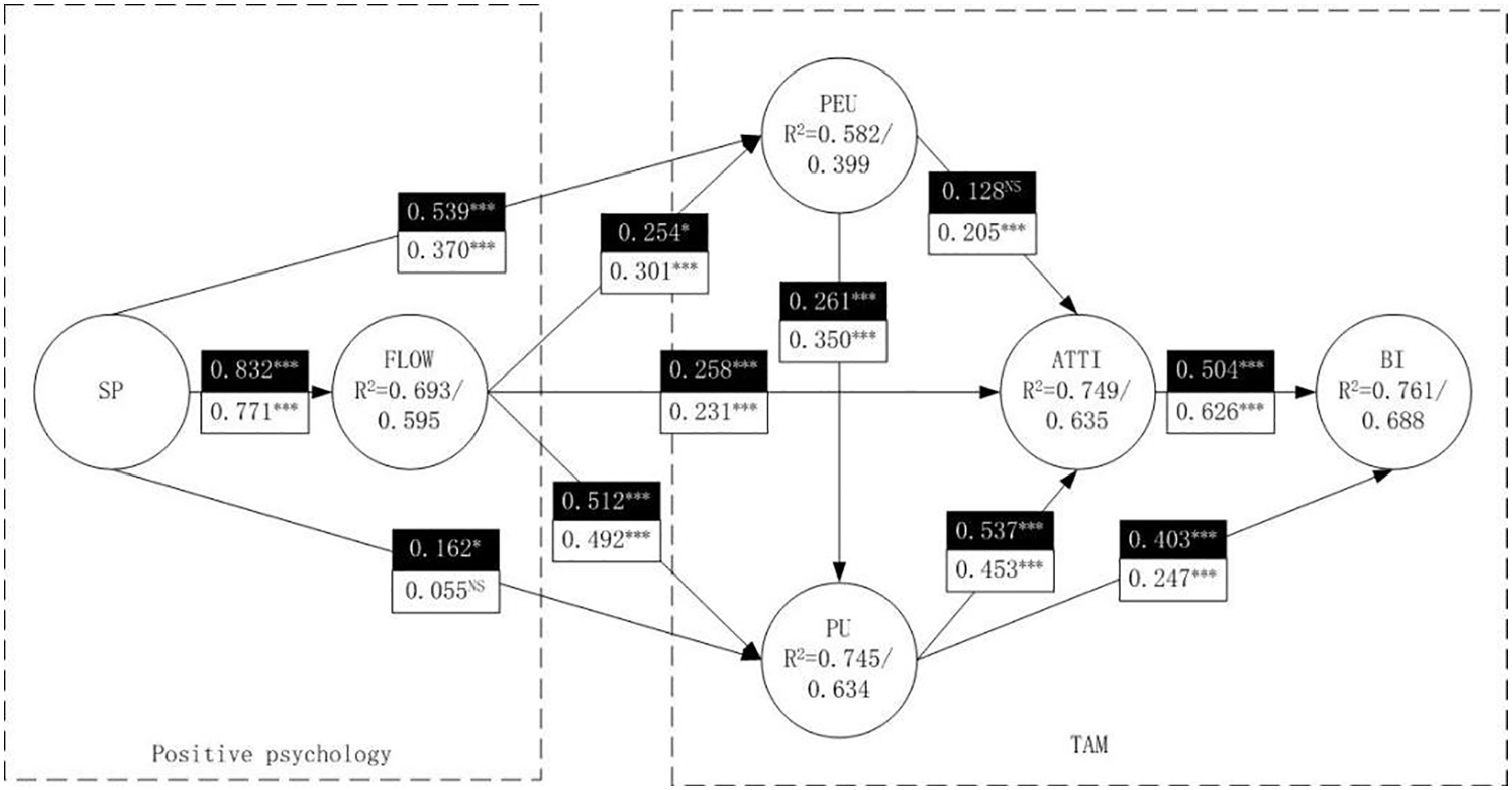
Measurement model results.
Summary of Hypotheses Tests.

p < .001. **p < .01. *p < .05. NS > .05.
For junior sample, the behavioral intention to continue ERT was jointly predicted by ATTI (β = .504, p < .001), and PU (β = .403, p < .001) and the two variables explained 76.1% of the variance of BI. In turn, 74.9% of the variance of ATTI was explained by PU (β = .537, p < .001) and FLOW (β = .258, p < .001). PU was collectively determined by SP (β = .162, p < .05), FLOW (β = .512, p < .001), and PEU (β = .261, p < .001) and the three variables accounted for 74.5% of the variance of PU. 58.2% of the variance of PEU was accounted for by FLOW (β = .254, p < .05) and SP (β = .539, p < .001). SP (β = .832, p < .001) predicted 69.3% of the variance of FLOW.
In terms of senior sample, the behavioral intention to continue ERT was jointly predicted by ATTI (β = .626, p < .001), and PU (β = .247, p < .001) and the two variables together explained 68.8% of the variance of BI. In turn, 63.5% of the variance of ATTI was explained by PU (β = .453, p < .001), FLOW (β = .231, p < .001), and PEU (β = .205, p < .001). PU was collectively determined by FLOW (β = .492, p < .001) and PEU (β = .350, p < .001) and the two variables together accounted for 63.4% of the variance in PU. 39.9% of the variance of PEU was accounted for by FLOW(β = .301, p < .001) and SP (β = .370, p < .001). SP (β = .771, p < .001) predicted 59.5% of the variance of FLOW.
Since the proposed model explained 76.1% and 68.8% of the total variance of BI respectively for the junior sample and the senior sample, and both values were higher than the coefficient of determination of the original TAM, it demonstrated good predictability and explanatory power for teenagers’ acceptance of ERT. Notably, the R-square values of BI of the junior sample were higher than those of the senior sample, indicating that this research model had better predictability and explanatory power for high school junior students’ acceptance of ERT compared to that for high school senior students.
Qualitative Analysis of the Themes From Interview (Research Question 3)
The semi-structured interviews and responses to the open-ended questions in the questionnaire were thematically analyzed to explore individual and contextual factors that influence high school students’ psychological status and acceptance of online English learning. Interviews were conducted with three high school junior students (J1, J2, and J3) and three high school senior students (S1, S2, and S3). Four main themes were identified: students’ flow experience, social presence, attitudes and technological acceptance, and continuous intention to learn English online.
The first main theme focuses on high school students’ flow experience in online English learning as well as the reasons for being or not being able to concentrate. When a person is in a flow experience, he or she fully engages in the activity, and this concentration can be used to measure flow experience (S. H. Liu et al., 2009). Table 7 presents interviewees’ opinions related to the first main theme. Regarding their concentration on learning, all six interviewees suggested mixed experiences and provided various reasons for their attention or distraction. The ability to concentrate was mainly related to three factors. The first factor is the teachers’ monitoring. For instance, J2 commented that “I was hardly distracted from learning because our teacher is hot-tempered and too responsible.” The second key factor is whether the teacher can offer appropriate and interesting teaching methods. For instance, J1 thought she can focus possibly due to the efficient and appropriate teaching methods. One senior student expressed his interest in certain learning content, such as some extracurricular knowledge (S3). The third important factor reported is whether students had the discipline to learn. J3 reflected: “Learning English online did not affect my attention. It was impossible for me to wander because of my strong self-regulation.” As for the reasons why these high school students could not focus on the English lessons, distractions of other entertainment apps were the primary annoyances, followed by unstable network connections.
Main Theme 1: Flow Experience.

Second, the main theme of social presence is identified through students’ perceived interaction with the teacher and classmates, as shown in Table 8. Interviewees were generally unwilling to interact with their teachers. Nevertheless, one of the interviewees (J1) showed a strong willingness to interact with the teacher when she was able to answer the questions posed by her English teacher. Notably, one interviewee (J2) reported reduced anxiety when interacting with her teacher during online English learning although she was definitely unwilling to actively interact with her teacher. However, the majority of interviewees tended to avoid interacting with their teacher due to some apprehensions, such as feeling anxious or embarrassed when they are unable to answer questions, fearing they might bother their teacher when he or she is offline, and facing technical problems which discouraged them from actively interacting with their teacher. For instance, students expressed reluctance to engage with their teacher because of feelings of shyness, as S2 reported: “I prefer interacting with my classmates because I would be shy when interacting with my teacher and maybe my teacher would be strict with me.” Additionally, it was quite frustrating for these high school students to turn on the microphone when they wanted to speak, and some of them were not so accustomed to speaking this way.
Main Theme 2: Social Presence.

On the other hand, interaction with classmates was preferred. One of the reported reasons for such a tendency was the pooling ideas in the process of interacting with each other. One student (S1) commented: “I prefer interacting with my classmates because my classmates can solve my problems. It is enough.” The close relationship among classmates also helped a lot in facilitating interaction among them. Nevertheless, interaction with classmates was not without any hindrance. Some reported obstacles included “classmates not responding timely” or “feeling embarrassed because chat messages would be visible to everyone”.
The third main theme that emerged is students’ attitudes and technological acceptance of distance English learning (Table 9). This theme includes language skills, self-regulation, attention, teachers’ monitoring, pedagogical instruction, learning resources, learning content, and homework checking. All six interviewees expressed mixed opinions on the helpfulness of online English learning. Notably, only two interviewees (J2 and S1) agreed on the usefulness of this English learning mode in improving their listening skills, as the interviewee (J2) stated, “It is more relaxing to do listening exercises. At school, I was very nervous when listening because I was always under the impression that I did poorly in listening.” Half of six interviewees reported improvement in self-regulation while the other half did not. In particular, half of the interviewees (J1, J3, and S1) expressed that they had less attention during online English courses.
Main Theme 3: Attitudes and Technological Acceptance.

The fourth main theme concerns high school students’ intention to continue online English learning. Table 10 lists the reasons why the interviewees were willing or not willing to continue online English learning. Regarding the intention to continue online English learning, two out of six favored continuing and three opposed it, and only one balanced the advantages and disadvantages.
Main Theme 4: Continuous Intention.

Discussion
High School Junior Students’ More Positive Perceptions of Distance English Learning Than High School Senior Students’
The findings of the present study showed that most teenagers, both in senior high schools and junior high schools, responded positively to the six measured dimensions, indicating that regardless of their grades, teenagers generally had satisfactory distance English learning experiences in accordance with the generally positive feedback on online learning in previous studies (Tanrıkulu, 2020; Tarhini, Hone, & Liu, 2015; Tsai, 2020). However, the mean score of behavioral intention was the lowest among the six dimensions, which indicated potential room for improvement. As reported by Alhamami (2018), regardless of acknowledged advantages, EFL learners preferred face-to-face language learning to online language learning.
Noticeably, significant differences were found between high school junior and senior students in their survey responses. Compared with senior students, junior students responded more positively. This difference is not surprising as senior high school students attached more importance to the efficiency of teaching methods because of higher pressure from both the school and their parents. Senior high school students tend to generally welcome test-oriented curricula and teacher-centered pedagogical methods geared to high-stakes tests such as English Academic Proficiency Test and gaokao (i.e., the National College Entrance Examination in China), which might be attributed to several reasons. The first is the potential feelings of isolation or disconnection brought about by the lack of social cues in the virtual online learning environment (Waugh & Su-Searle, 2014), which causes low engagement in learning. The second reason is the loss of personal instructor guidance and attention (e.g., eye contact) from instructors in traditional face-to-face classrooms. Students in the online learning environment are forced to self-regulate and navigate difficult topics during learning. Considering the fact that senior high school students encountered larger academic pressure, compared to junior students, they are expected to feel more anxious when engaged in online learning.
However, more influential factors have been identified in the interviews, together with academic pressure, contribute to the significantly different perceptions between high school junior and senior students. Three of the senior high school participants indicated in the interviews they were not so satisfied with distance English learning in that sometimes it was hard to focus because of the distractions, unstable network connections, and unskilled use of learning platforms by their teachers and themselves. Similar complaints regarding poor network access were reported by Sun et al. (2020). In discussing potential challenges, Adedoyin and Soykan (2020) also expressed their concerns regarding unstable network access and uneven digital competence of both students and teachers. In addition, the lack of learning atmosphere or inability to feel the presence of others (i.e., social absence, the antonym for social presence) is another reason why they rated negatively. The importance of social presence for learners’ acceptance of online learning has been demonstrated in previous studies, such as Okazaki and Renda Dos Santos (2012). The aforementioned problems or challenges hampered the efficiency of English learning to such extent that it discouraged senior high school students from continuing.
The Affecting Factors of High School Students’ Behavior Intention for Future Online English Learning
The present study demonstrates that TAM is a useful theoretical framework with significant explanatory power for understanding the students’ acceptance of technology mediating in online language learning in the ERT context, aligning with the existing studies (Fathali & Okada, 2018; Mohammadi, 2015). The four significant paths in the original TAM (PEU to PU, perceived usefulness to attitude, perceived usefulness to BI, and attitude to BI) have been consistently supported in the existing literature (Lee, 2010; B. Wu & Zhang, 2014).
However, mixed results were found in the causal process between perceived ease of use and attitude among teenagers. For those in senior high schools, perceived ease of use played a minor role in predicting attitude compared with PU, which is consistent with findings from Lee’s (2010) study in the context of continuing education. Whereas for those in junior high schools, no significant relationship was found between perceived ease of use and their attitude toward ERT. A possible explanation is that, for high school senior students who were under higher academic pressure, time was a scarce resource. Having less attention to spare for overcoming technical inconvenience, they were more sensitive to the ease of use of technology. On the other hand, for junior students who were believed to be “digital natives” growing with the technology (Padilla-Meléndez et al., 2013), the design of online learning platforms is never too confusing to operate.
Another major predictor of teenagers’ perceived ease of use is social presence, which aligns with Zhao et al.’s (2020) finding for university students in MOOC learning. Higher social presence can create similar learning atmosphere to that in a face-to-face classroom, helping teenagers overcome the psychological unfamiliarity caused by physical distance (Joo et al., 2011).
However, there is a relatively weak effect of social presence on perceived usefulness with a discrepancy between junior and senior groups. For junior sample, SP predicts the least of perceived usefulness, while for senior sample, SP does not predict PU. It is suggested that senior high school students, compared to their younger counterparts in junior high school, were more self-governed to benefit from distance learning where they are isolated from their teachers and peers.
Another interesting finding is that the usefulness of ERT, perceived by Chinese high school junior students, largely depends on whether they can concentrate. M. Guo (2009) offered a reasonable explanation for our finding in the context of online learning, as he found the positive relationship between learning self-control and attention stability. Unlike senior students, the self-control of high school junior students in China tends to be influenced by external factors, with the distractions being the most significant. Different from face-to-face teaching, the easy access to the Internet in ERT presents greater external distractions for junior students, which greatly affects their learning self-control, flow and, in turn, their perceived usefulness.
Meanwhile, flow is found to be the strongest predictor of perceived usefulness for both junior and senior samples. In other words, the usefulness perceived by Chinese high school students largely depends on how fully they can engage in online language learning. This finding coincides with the results from Agarwal and Karahanna (2000), which provided evidence of the significant relationship between cognitive absorption (similar to flow) and PU in university learners. However, our study targets a different age group, that is, teenage EFL learners aged 12 to 18, in the context of distance language learning.
Technology as a Double-Edged Sword to be Both Facilitating and Challenging
In our interview, we found that favorable factors of distance learning often come with corresponding negative ones. On the one hand, our interviews identified students’ reluctance to talk with their teacher or chat with peers because the voice or chat messages can be heard or seen by all other classmates during online class. And some learners complained about the reduced learning atmosphere in the absence of classmates. On the other hand, some stated that the reduced social presence made them feel relaxed and alleviated their anxiety and shyness.
With regard to participants’ flow experience, three students reported they were able to concentrate on learning due to their own self-regulation and teachers’ rigorous discipline, which reveals the nature of distance learning – a combination of instruct-led and self-regulated learning. However, there were also complaints about distraction from other entertainment apps, which indicates the distractive nature of learning technology reported in Alhamami (2018) and Murray et al. (2020).
Whereas quantitative data shows a generally positive attitude toward online English learning, qualitative data reveals many challenges that students are confronted with. Secondary students were challenged in the following five ways: technical aspects (e.g., unstable network connections and inexact registration of students’ attendances), language learning process or content (e.g., less concentration), interaction with the teacher (e.g., the unclear voice of the teacher, the teacher’s unfamiliarity with online instructional tools, inability to ask the teacher for immediate help, and no encouragement or monitoring from the teacher), interaction with classmates (e.g., sense of isolation from classmates and a reduced learning atmosphere in the absence of classmates) and physical health (e.g., sore eyes). What stands out is that interviewees repeatedly reported unstable network connections, which caused distraction from learning. This problem is one of the most reported reasons for distraction problems. Distance learning posed a high demand on network access and stability (Adedoyin & Soykan, 2020).
The qualitative analysis illustrates students’ ambivalence toward online English learning, indicating that technology can serve as both a facilitator and a challenge.
Implications and Further Study
Generally speaking, it has been an unaddressed but important question whether the technology for EFL would be similarly perceived by high school juniors and seniors. By establishing a cross-age theoretical model, the empirical evidence gained in this study not only increases the generalizability of flow theory, social presence theory, and TAM model but also allows illuminating comparisons and contrasts between the two age samples to be made. This study also provides practical implications for educational decision-makers and teachers. Here are some practical implications from the perspectives of network operators, educational decision-makers, English teachers, and students themselves.
First of all, considering the unstable network and slow network speed, network operators should keep innovating information technology to provide users with a more pleasant online experience and provide students with reliable infrastructure for online English learning.
Secondly, educational decision-makers should adjust the timetable according to the curriculum standard and the psychological and physical states of students. In addition, when choosing an online learning platform, educational decision-makers should take into account the characteristics of English courses and those of students, rather than blindly copying the online learning platform used by college students. If possible, learning management systems (LMS) should be chosen to supervise students and help students in self-regulation.
Thirdly, teachers should improve in three aspects: professional training, interaction, and lesson preparation. In order to prevent students from being negatively impacted by teachers’ unfamiliarity with online teaching tools, teachers should keep abreast of the latest developments, master modern information technology, and take the initiative to learn how to use online teaching tools. On the one hand, as a facilitator of learning, teachers should give full play to students’ initiative and promote students to actively participate in English learning activities, as well as encourage students to communicate with their classmates in order to shorten the psychological distance between students. On the other hand, as a helper in learning, teachers should also closely monitor the states of students and offer timely help and encouragement to students. Regarding lesson preparation, teachers should make full use of the rich learning resources on the Internet and choose interesting teaching content that aligns with the course objectives and students’ characteristics, so as to stimulate students’ interest in learning, enthusiasm, and concentration.
Fourthly, students should learn to employ strategies to regulate their own English learning, especially in the online environment where the external distractions are significant.
The limitations of this study might be addressed in future studies. Firstly, this study explored users’ behavioral intention to adopt distance learning only through self-reported data and interviews. Future studies might consider integrating additional measures, such as system log data, longitudinal experiments, where researchers are able to observe and obtain real-time data. Secondly, this study explored the technology acceptance of students. Future research could shift to include the perspectives of teachers.
Conclusion
This study constructs a more functionally comprehensive model by integrating the TAM model with new variables from the domain of positive psychology, namely social presence and flow. The study has enriched the existing literature in terms of the age of participants (teenagers in junior and senior high schools) and disciplines (EFL). Moreover, our study targets a different age group, specifically teenage EFL learners aged 12 to 18, to examine the possible differences between high school junior and senior students’ distance learning experiences.
The structural model analysis broadly validates the predictive effects of positive psychology on teenage learners’ acceptance of distance English learning. Qualitative analysis of students’ ambivalence toward online English learning indicates that technology can be both a facilitator and an impediment.
To conclude, through investigating teenagers’ learning experiences during emergency remote teaching, this study sheds new light on the innovation of post-COVID-19 distance teaching and learning in secondary education, preparing countries around the world, particularly developing countries that share similar economic, political, and cultural backgrounds, for any possible crisis circumstances in the future.
Footnotes
Appendix A1
Items and Constructs.

| Constructs | Items | Source |
|---|---|---|
| Social presence | SP1: I felt comfortable interacting with teachers and my classmates in the e-learning platform. SP2: I felt that my point of view was acknowledged by my classmates in the e-learning environment. SP3: I felt comfortable participating in discussions through the e-learning platform. |
Zhao et al. (2020) |
| Flow | FLOW1: I become absorbed in my studies when I learn English online. FLOW2: I feel curious when I study through the e-learning platform. FLOW3: My imagination is aroused when I study using the e-learning platform. |
|
| Perceived ease of use | PEU1: It is easy for me to remember how to carry out tasks using e-learning platform. PEU2: I believe that it is easy to get the e-learning platform to do what I want it to do. PEU3: Overall, I believe that the e-learning platform is easy to use. |
S. H. Liu et al. (2009) |
| Perceived usefulness | PU1: Using the e-learning platform improves my English performance. PU2: Using the e-learning platform enhances my effectiveness as regards English schoolwork. PU3: Overall, I find that using the streaming e-learning platform is useful in my English schoolwork. |
|
| Attitude | ATTITUDE1: I like using the e-learning platform to learn English. ATTITUDE2: The e-learning platform is fun to use. ATTITUDE3: The e-learning platform provides an attractive studying environment. |
|
| Behavioral intention | BI1: I intend to completely switch over to the e-learning platform to learn English. BI2: I intend to increase my use of the e-learning platform to learn English in the future. BI3: Assuming that I have access to the e-learning system, I intend to use it. |
Appendix A2 Broad Initial Prompts for Interviews
Acknowledgements
We would like to express our sincere thanks to the students who voluntarily participated in our questionnaires and interviews. Meanwhile, we are grateful to Mr. Panrui Huang for his assistance with the revisions of the early versions of the paper. Furthermore, we appreciate the five anonymous reviewers for their valuable comments.
Declaration of Conflicting Interests
The author(s) declared no potential conflicts of interest with respect to the research, authorship, and/or publication of this article.
Funding
The author(s) disclosed receipt of the following financial support for the research, authorship, and/or publication of this article: This research was funded by Education Department of Hunan Province (No. HNJG-20230158).
Ethical Approval
Approval was obtained from the ethical review board of Hunan University.
Informed Consent
The authors posted an online questionnaire for this study and all the partcipants voluntarily and anonymously filled in the questionnaire.

Data Availability
The datasets generated during and/or analyzed during the current study are available from the corresponding author upon reasonable request.