




Abstract
For ages, individuals have relied on trust assessment skills to evaluate spoken words and accompanying body language social signals (BLSS) in friendships. This interactive process seeks to avoid harmful associations and unreliable information. However, with widespread social media use, assessment of BLSS is difficult, and users commonly report harm from defective estimations of interactions. This study evaluates how individuals adjust their trust assessment skills for close social media friendships, given the importance they place on BLSS in its role as a moderator. The research utilizes PLS-SEM, ANOVA, and cluster analysis to evaluate 247 U.S. online survey participants aged 18 to 67. The study adapts Mayer et al.’s trust model using social learning and cognitive dissonance theories. The independent variables, ability, benevolence, and integrity, strongly predict the dependent trust belief. In line with cognitive dissonance theory, BLSS has a negative and significant moderating effect on ability. BLSS reflects a small effect and widely insignificant moderating relationship with benevolence; analysis shows that a moderating relationship should not apply to benevolence. Counter to the hypothesized direction, BLSS produced a positive moderating effect on integrity, which was insignificant by a narrow margin. The analysis explains the basis for the positive relationship. Lastly, statistical analysis reveals an age-based shift in the relevancy of BLSS; younger users place less importance on BLSS, whereas older users place more importance on BLSS. This position for younger users aligns with their exposure and acclimation to social environments with widespread mobile communication and social media use since childhood.
Plain language summary
Keywords
Introduction
Face-to-face communication has been instrumental in forming close associations between individuals in interpersonal relationships for many years before social media (SM). More specifically, close friendships are the focus of this study within these interpersonal relationships. In face-to-face interactions, to develop close new friendships and maintain existing friendships, individuals rely on trust assessment skills to evaluate spoken words and accompanying BLSS (Ackerman, 1991; Pease & Pease, 2008). BLSS involves intuitive, instinctive body movements and speaking dynamics carried out naturally, without notable directed or focused effort, when engaged with other individuals (Pentland, 2008). Assessment of BLSS through face-to-face interactions is an essential foundational part of human communication and understanding; one can even see its evidence in infants’ responses (Goldsmith, 1993; Pease & Pease, 2008).
Conversely, friendships formed or maintained using SM connections challenge ages of deeply embedded trust assessment skills for BLSS. This study seeks to answer how individuals adjust their trust assessment skills and what aspects they use with close social media friendships to avoid harm, given the importance they place on BLSS in its role as a moderator. Accordingly, similar to this study’s topic, research on virtual communication during the COVID-19 pandemic noted issues users experienced trying to assess nonverbal behaviors and complex cues outside of face-to-face interaction (Bailenson, 2021). Nevertheless, trust assessment skills remain relevant. Drawing on Mayer et al.’s (1995) definition of trust, the current research frames trust as the inclination of an individual to be subject to the actions and advice that another provides willingly with a sincere interest. Accordingly, trust belief in the present study entails an individual believing they can follow their inclination to be subject to another’s actions and advice. In this study and as defined in the survey, the individuals are close friends where the individual feels the relationship is meaningful and reliable enough to communicate on personal matters of interest and concern. These friend-type relationships go beyond those confined to discussions about business and job-related issues.
Friends also include family members, as used in the phrase “my mother, father, brother, sister is my best friend.” The study assesses the nature of trust assessment and BLSS between individuals in SM interpersonal friendships and considers differing assessments across social generations. The current research focuses on trust assessment due to its principle role as an antecedent to trust-related dependent variables given the behavior intention studied. These dependent variables include purchase, usage, affiliation, transaction, and basic reliance behavior intentions (Kim et al., 2009; Lu et al., 2016; Pavlou & Gefen, 2005; Robert et al., 2009; Stolle, 1998; Wu & Tsang, 2008). Thus, trust assessment is fundamental, and once correctly measured, it is suitable for studying various behaviors related to SM. This study also distinguishes trust assessment in organizations from trust assessment between individuals in personal settings outside organizations. Organizational settings can influence trust assessment through company structures and policies/procedures, which are not equivalent in personal settings (Jensen & Meckling, 1976; Mayer et al., 1995).
Nevertheless, SM friendships require correct trust assessment due to the vast information they can share over ubiquitous social platforms. YouTube, which maintains 81% use by U.S. adults, and Facebook, 69%, are two platforms (Auxier & Anderson, 2021). The issue is that an individual’s defective estimation of another’s trustworthiness can lead to behavior outcomes that negatively impact their safety, privacy, societal, or economic wellbeing (Proudfoot et al., 2018; Waldman, 2016). Aitchison and Meckled-Garcia (2021) explain that adverse outcomes often arise directly from actions of one’s SM friends where trustworthiness was defectively estimated.
Prevailing research commonly views SM and trust belief in individuals in light of organizational influences and visual, voice, and data qualities (Daft & Lengel, 1986; Shareef et al., 2020; Short et al., 1976). These attributes underscore frequently used social presence and media richness theories in online organizational, group, and general trust studies. This study posits that social learning theory can provide more insight into attributes that can improve the process for individuals assessing other individuals in close personable SM interactions. Mayer et al.’s (1995) trust model is selected for the framework since its ability, benevolence, and integrity variables can be best adapted to assess knowledgeable, sincere, and emotional personal aspects for close interactions using social learning theory (Hardin, 2002). Improving estimations is essential due to decreased access to BLSS in SM interactions. Thus, the study applies the cognitive dissonance theory to assess the impact of decreased BLSS in its moderator role.
This research also frames changes in measures across impacted social generations of Boomers, Generation X, Millennials, and iGen members to improve overall analysis. However, going forward, Boomers and Generation X are combined due to all of their members being age 40 and over at the time of this study. The resulting research questions are:
RQ1: What particular trust attributes measure trust assessment between close social media friends?
RQ2: How does the importance individuals place on body language social signals relate to their trust assessment of close social media friends?
RQ3: How do Boomers-Generation X, Millennials, and iGen social generations differ in the importance they place on body language social signals?
Answers to the above research questions address individual-level constructs which affect entity-level areas of interest. Close SM friends influence e-commerce and other business decisions (The Nielsen Company, 2015; Turcotte et al., 2015). Thereby, the individual-level constructs have a nexus with organizational-level constructs and entities. The current study increases understanding of the core basics of close online trust assessment in light of the vast and varied amounts of shared information. Lastly, this study is a marker of changes in BLSS importance across social generations in assessing trust in SM friends.
Literature Review
Leading Theories for Assessing Others Through Online Media
Social presence (Short et al., 1976) and media richness (Daft & Lengel, 1986) are leading theories for explaining how individuals assess others “in general” through communication technologies like Facebook and YouTube (Lin et al., 2014; Lu et al., 2016). Social presence theory (Short et al., 1976), as framed by Gunawardena (1995), is the extent an individual perceives another as a real person through personable interaction across SM platforms. Perceptions include visual, vocal, and textual communication that researchers find can support trust (Lu et al., 2016). Researchers used social presence in e-commerce and website studies to explain consumers’ trust in sellers’ websites and interactions with other buyers (Hassanein et al., 2009; Lu et al., 2016). The other principal theory, media richness, resembles the social presence theory. Media richness entails a timely exchange of information that can confer body language, tone of voice, and clear messaging (Daft & Lengel, 1986). In recent media richness theory studies, trust helped explain participant engagement in online communities (Shareef et al., 2020; Shiue et al., 2010).
As applied, media richness assessed general group interactions where members could number in the thousands and include strangers. Prior research includes the contribution of body language in interactions and the assessment of individuals on SM platforms at group and organizational levels. The researchers examined generalized trust assessment in processes, groups, entities, or people widespread (Glanville & Paxton, 2007; Newton & Zmerli, 2011). General trust addresses the basic human nature of the average individual one interacts with and is not necessarily a friend (Yamagishi & Yamagishi, 1994). For example, one might generally trust those who follow them the most online.
General trust is not at the heartfelt level of interpersonal or particular trust that uses specific, close, and emotional aspects in the assessment (Glanville & Paxton, 2007; Newton & Zmerli, 2011). Hence, previous social presence and media richness studies did not drill down to evaluate trust assessment by one individual of another for interpersonal or particular trust in close friends and family.
Two Major Psychological Foundations of Trust Formation
In SM, two principal perspectives that can explain the foundation for trust are psychological predisposition and social learning (Glanville & Paxton, 2007). With psychological predisposition, individuals can have an inborn characteristic for a tendency to trust (L. C. Becker, 1996; Couch & Jones, 1997), or individuals can be conditioned early in childhood toward a tendency to trust, which continues into adulthood (Ainsworth et al., 2015; Bowlby, 1982). However, the focus is not particular trust (Glanville & Paxton, 2007). This psychological disposition perspective addresses findings of Uslaner (2004) and Jennings and Zeitner (2003), which showed a lack of support connecting trust and Internet use. Overall, Uslaner (2004) found that general Internet use in and of itself does not establish or diminish trust. Uslaner’s (2004) study encompasses a significant limitation in light of the current study that assesses the beliefs and perceptions exercised through and obtained by SM tools versus focusing on just the Internet as a tool. Like Uslaner (2004), Jennings and Zeitner (2003) found no significant impact on social trust from Internet use in their study of civic engagement. However, Uslaner’s (2004) and Jennings and Zeitner’s (2003) research centered on generalized trust and general Internet use. Some general use included email, chat rooms, virtual conferences, and bulletin boards. However, the essential demarcation is that the views of Uslaner (2004) and Jennings and Zeitner (2003) centered on generalized trust under psychological disposition, whereas the current research focuses on particular trust to uncover perceptions, nuances, and personal emotional aspects in assessing close friend relationships (Glanville & Paxton, 2007).
With the social learning perspective, individuals assess and learn from their experiences to develop indicators that estimate others’ trustworthiness (Hardin, 2002). The social learning process is significant since much of what individuals learn derives from communication with others (Rotter & Rotter, 1967). This communication with others involves an assessment of trust since communication is usually not accompanied by evidentiary material (Rotter & Rotter, 1967). Nevertheless, successful outcomes from reliance on individuals build upon each other (Bandura, 1971) to create an individual’s trust assessment criteria (Hardin, 2002; Rotter & Rotter, 1967). Most importantly, Bandura (1971) explained that when environmental circumstances change, individuals assess and adapt new socially learned techniques that support continued success, as in trust assessment through SM in the present research. The social learning perspective’s applicability to individual factors provides a basis for the current study and the use of Mayer et al.’s (1995) trust model discussed in the next section.
Trust Model Research
A social learning perspective explains how individuals form interpersonal factors to assess trust in others to aid in developing and maintaining SM friendships. For the current research, Mayer et al.’s (1995) trust model of organizational trust aligns with the social learning perspective by using interpersonal level factors. Mayer et al. developed a model to assess trust by one individual of another as a basis for working together in an organization to complete joint goals. Mayer et al. identified ability, benevolence, and integrity as independent constructs that explain a large portion of belief in an individual team member’s trustworthiness. Researchers generally hold that assessment of trustworthiness precedes one’s trust belief in the entity as represented in the current research (Mayer et al., 1995; McKnight et al., 2002). Moreover, Mayer et al.’s trust model positioned trust belief as an endogenous construct, leading to subsequent trust actions and dependent outcomes. The present research focuses on trust belief and therefore draws on that portion of Mayer et al.’s trust model, where ability, benevolence, and integrity assess trustworthiness to predict trust belief. This approach is similar to other information systems studies on consumer trust in e-commerce and individuals’ trust in organizational team members (Moody et al., 2017; Robert et al., 2009). Foundationally, Mayer et al. proposed that the independent variables presented three unique perspectives based on perceptions for assessing trustworthiness in another person. These perceptions are akin to an individual’s social assessments under a social learning perspective and provide the current study’s approach. However, as previously discussed, since Mayer et al. used measures to assess trust, subject to organizational influences and controls, this study adapted and developed measurement items subject to SM platform use.
Body Language Social Signals (BLSS)
Concerning friendship communications, before SM platforms, the primary forms were face-to-face, telecommunication, and written text, with face-to-face being the most effective (Daft & Lengel, 1986). A primary reason for the high value of face-to-face communication is the ability to confer BLSS along with the words (Pease & Pease, 2008). In conversations, words mainly confer information, while BLSS expresses underlying attitudes and emotions (Pease & Pease, 2008). The current research defines BLSS following Pentland (2008), where BLSS involves unconscious speech attributes and body movements that signal behaviors between individuals engaged in face-to-face communications. Communication theory research highlights BLSS’s importance, where studies show that BLSS contributes an average of 60% to message understanding (Mortensen, 2017; Pease & Pease, 2008). BLSS is such a core component of face-to-face communication, researchers view it as partly inborn, with continued development from childhood (Goldsmith, 1993).
Cognitive Dissonance and BLSS
Given the high use of SM platforms in friendships against the established history of BLSS’ importance in face-to-face communication, the current research considers a cognitive dissonance presence. Festinger (1962) established that cognitive dissonance occurs when there is a conflict between an individual’s belief and performance of related behavior. The individual would seek to resolve the conflict or dissonance so the belief and behavior would be consistent (Festinger, 1962). There are three fundamental ways for an individual to resolve the conflict and bring about consistency (Festinger, 1962). First, a person may minimize the importance of their dissonant belief to the point that it no longer matters. Next, an individual may identify enough consistent/consonant beliefs to overshadow the dissonant belief’s impact. Lastly, a person may eliminate the dissonant belief or the behavior in conflict, which may be the most difficult of the three options (Festinger, 1962). The current research considers the first two options, not the third, eliminating SM activities. For the first option, one may resolve that BLSS is no longer as important. In the second option, one may reason that the benefit and use of SM platforms far outweigh the decreased ability to assess BLSS fully.
Positioning Social Media Platforms Within Social Generations
The previous discussions of BLSS and trust assessment of others span social history. The social generations in the present study range for those born from 1955 to 2002 and include general ranges that may overlap for Boomers 1946 to 1964; Generation X 1965 to 1980; Millennials 1981 to 1996; and iGens 1995 to 2012 (Dimock, 2019; Twenge, 2017). With the advent of email in 1993 (Kramer, 2020), iGen members were the first to experience internet-based communication followed by SM, from childhood to adulthood. Most importantly, research shows iGen members were most impacted by the technology changes since, in their adolescent years, they began valuing and spending less time in face-to-face communication (Twenge, 2017; Twenge et al., 2019). BLSS for iGen members should differ from earlier generations that matured before SM availability.
Research Model and Hypotheses
This study develops scale items to measure trust in interpersonal SM friendships (see Appendix B), which goes beyond the assessment of business associates involved with organizational and entity goals. The process also develops BLSS as a moderator (see Figure 1). Moreover, the syntax of scale items addresses and applies to various combinations of interactions, whether solely online or face-to-face and online. In addition, the model recognizes that individuals may have face-to-face communication and trust assessment outside of SM that function adequately. However, considering the volume and velocity of information that close friends commonly share via SM beyond face-to-face interactions (Turcotte et al., 2015), the current model accounts for the proper assessment of trust belief in that SM environment.

Proposed social media friend trust model.
Trust Belief
Trust belief results from an individual’s assessment of another according to aspects of the three antecedents. If an individual believes the other is trustworthy as a close friend, they believe they can engage, share personal concerns, and rely on the other’s advice. The current research also holds that trust belief can diminish; thus, individuals must assess and maintain existing friendships in light of the three antecedents.
Ability
Communication shared via SM platforms can cover a wide range of topics. Consequently, communication is more valuable for friendships when useful and of interest (Katz & Lazarsfeld, 1966; McPherson et al., 2001). In organizations, individuals assess others’ ability as it applies to specific organizational goals (Mayer et al., 1995). In friendships, individuals assess ability based on topics of interest and general awareness of the friend (Whiting & Williams, 2013). Furthermore, it is whether the individual believes the friend has the overall skill, experience, and propensity for sharing advice (Mayer et al., 1995). Trust will increase if an individual believes their friend has the relevant overall ability. Thus, this research hypothesizes that:
Benevolence
Research shows that emotional and interactive support exists on SM platforms (Whiting & Williams, 2013). Thus, individuals assess the benevolence of their SM friends. Friends demonstrate benevolence when they express their concern, goodwill, and willingness to help (Mayer et al., 1995; Robert et al., 2009). Most importantly, the friend will seek to manage a connection with the individual and extend support without a desire for material gain (Mayer et al., 1995). Trust will increase if an individual believes their SM friend has a benevolent spirit toward them. Hence, this study hypothesizes that:
Integrity
Individuals use SM platforms to exchange volumes of information and expend significant social engagement. In these areas, integrity would undoubtedly matter. The individual assesses their friend’s integrity by evaluating whether they stick to principles that the individual finds acceptable (Mayer et al., 1995). Therefore, this research hypothesizes that:
BLSS
Individuals have relied on BLSS for its importance when interacting with friends face-to-face. The current research posits that individuals who value the importance of BLSS will experience some level of dissonance in their trust assessment of SM friends due to the reduced level of BLSS in using SM platforms. Thus, this research hypothesizes that:
Methodology
Survey Administration and Participants
The cross-sectional study utilized U.S. online panel participants of Zoho Corporation—Survey (Cook & Gonzales, 2016; Niculescu et al., 2012) collected in 2020. The questionnaire addressed adults aged 18 to 67 using Zoho’s web-based application. Prequalification criteria selected respondents who actively use SM monthly or more frequently to communicate with close friends and family. The process also asked respondents to identify sites used. A review of the responses for quality and validity resulted in a sample size of 247. The review checked for missing data, straight-lined/patterned responses, outliers, and those that failed the reverse-scored validation item. Based on statistical power analysis of the research model, where the maximum number of indicators for a construct is six, the final sample size is sufficient for this study’s PLS-SEM analysis (Marcoulides & Saunders, 2006; Wong, 2013).
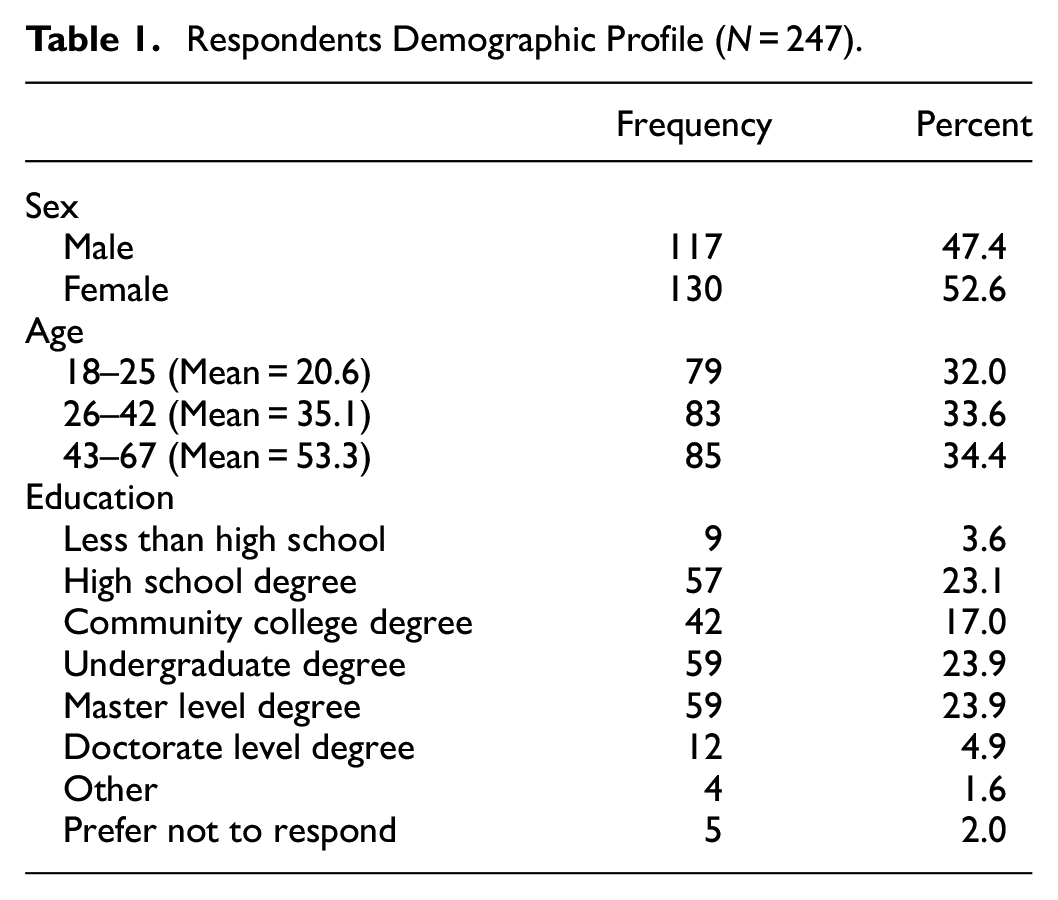
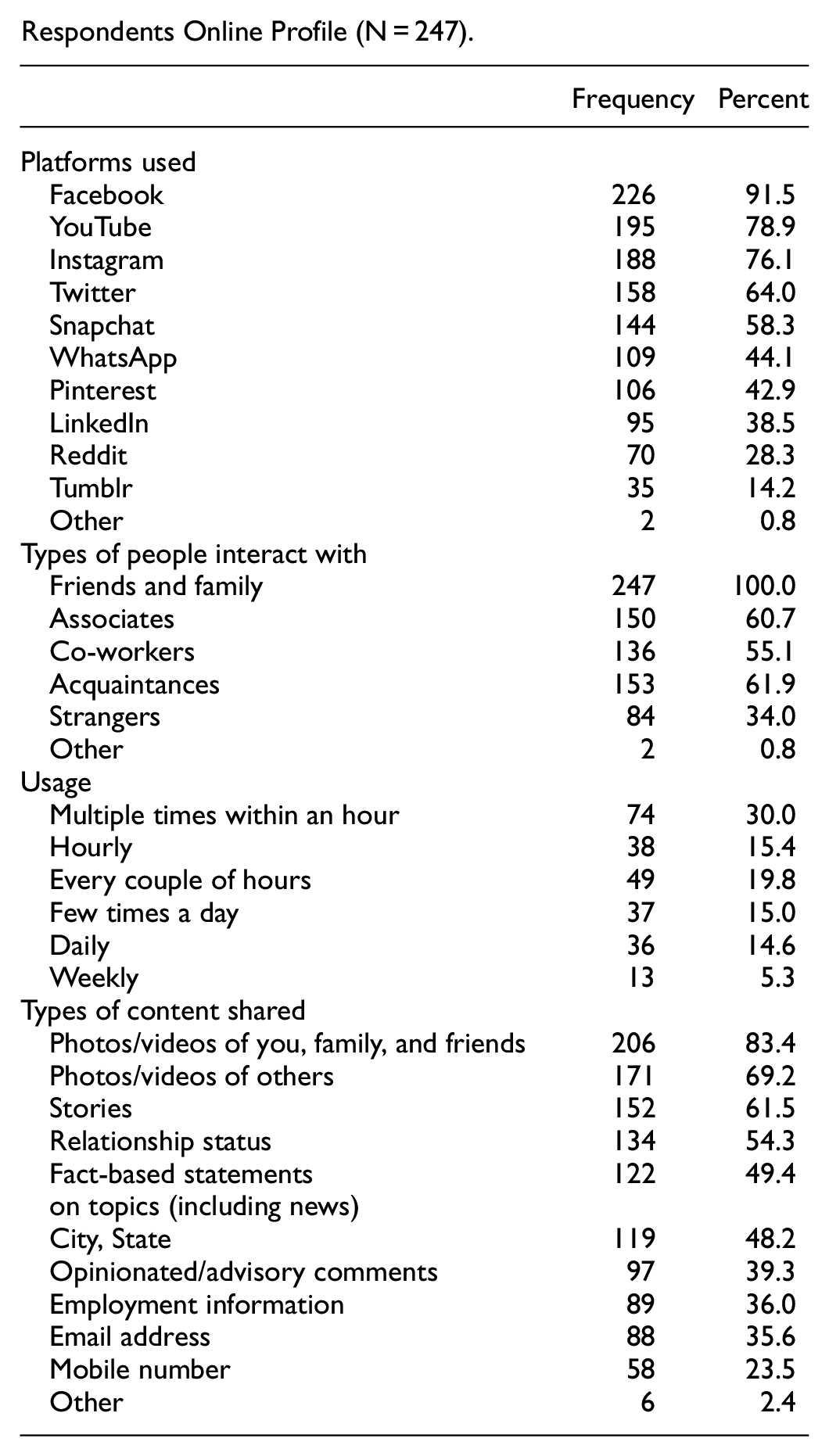
Table 1 presents respondents’ demographics, where male (47.4%) and female (52.6%) percentages align with those of similar studies (Cheung & To, 2017; Shiue et al., 2010). The three age groups in Table 1 are based on the time of the current study and the year 1995, the beginning of the iGen generation. In group 18 to 25, those born in 1995 would be age 25 at the time of the current study. For group 43 to 67, those age 43 would have been 18 in 1995. Group 26 to 42 derives from the other two age groups. The average age of respondents is 36.7. Finally, 69.7% of respondents hold a college-level degree. Appendix A shows respondents’ online activity profiles, where 45.4% of participants use platforms at least hourly.
Respondents Demographic Profile (N = 247).
Measurement Development
Methods used Mayer and Davis (1999) corporate model to develop the original item measures. Modification of Mayer and Davis (1999) items to assess interpersonal relationships involved adapting ability, benevolence, and integrity items using research of Jones and Shah (2016), Robert et al. (2009), and Warner-Søderholm et al. (2018). The process defined six items each for ability, benevolence, and integrity (see Appendix B). Mayer and Davis (1999) scale included items such as “top management has specialized capabilities that can increase our performance” and “top management has a strong sense of justice.” Wording was modified to assess individuals’ assessment of others for close interpersonal interactions using SM. Likewise, the current study modified trust belief measures using findings of Lewicki et al. (1998) and Robert et al. (2009). The process defined six items (see Appendix B). The scale development process formed BLSS from activity, consistency, influence, and mimicry social signal definitions established by Arena et al. (2010) and Pentland (2008) (see Table 2). Efforts defined four measurement items for BLSS (see Appendix B). The reliability and validity procedures followed those of Moore and Benbasat (1991) to develop modified scales. Development efforts included re-evaluating measurement items for clearness in capturing their related construct for assessing interpersonal friendships. Procedures continued with field and pilot tests.
BLSS Measurement Items.

Note. Social Signals and Definitions sourced from Arena et al. (2010) and Pentland (2008). Ss = Social Signal. Items Ss1 to Ss 4 developed in the study.
Three academic scholars first reviewed BLSS measures for quality, validity, and agreement with the theoretical framework. Development efforts clarified wording to improve adaptation to social media and interpersonal friendships. Next, instructions and all items went through three rounds of field tests with knowledgeable SM users. The individuals provided feedback on readability, understanding, and length. Following the field tests, an initial pilot test and second pilot of 42 respondents used subjects obtained through the Zoho paneling process planned for the full study. Methods used PLS confirmatory composite analysis (PLS-CCA) to assess PLS-SEM measures, as J. F. Hair et al. (2020) recommended. Loading values, Adjusted R-Square, Cronbach’s alpha, composite reliability (CR), average variance extracted (AVE), and discriminant validity measures were satisfied to support using the measurement instrument for the full study. Appendix B contains the refined measurement items used in the full study.
Three procedures and statistical assessments addressed common method bias (Podsakoff et al., 2012). First, the process included randomizing and administering survey questions within two groups: (a) main model measures and (b) moderator measures due to their unique and logical context (Kline et al., 2000; Podsakoff et al., 2003). Each respondent received randomized questions within the two groups which provided a counterbalancing effect to reduce order biases (Podsakoff et al., 2003). Next, using nine-point scales required respondents to use a less common measurement interval, although nine-point scales maintain equivalent reliability with more common seven-point scales (Preston & Colman, 2000). The anchoring labels also differed for independent and dependent measures (strongly disagree/strongly agree) versus the moderator measures (very unimportant/very important) (Podsakoff et al., 2012). Lastly, the survey instrument included a reverse-scored measurement item (Kline et al., 2000).
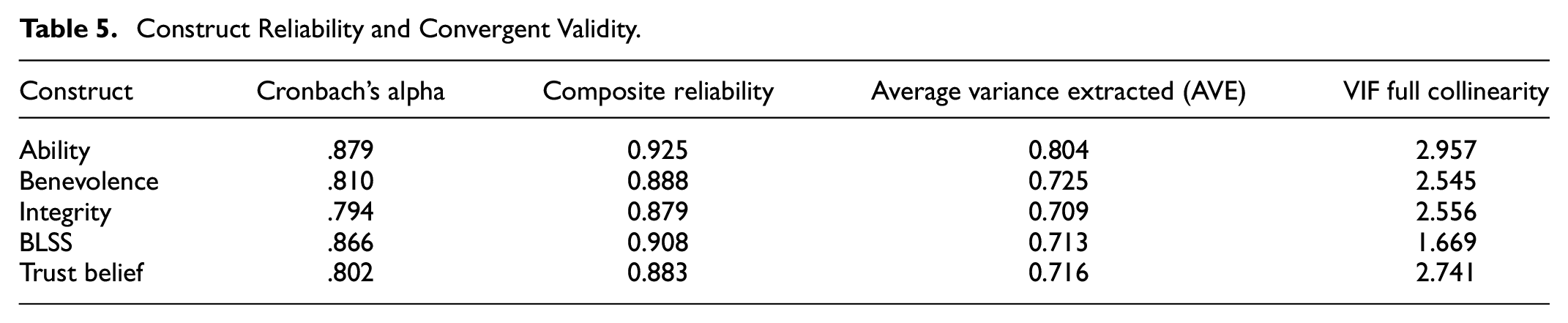
Following procedural steps, the Harman one-factor test assessed factors for unacceptable common method bias (CMB) (Babin et al., 2016; Steinbart et al., 2013). CMB occurs when the survey design and how it is administered creates common response biases across respondents (Kock, 2015). The assessment produced an acceptable Harman one-factor variance percentage of 48.4%, just under the 50% threshold. To reconfirm CMB levels, a full collinearity variance inflation factor (VIF) test assessed measures as suggested by Kock (2015) and as used in other IS studies (Goh & Yang, 2021; Saunders et al., 2017). Kock (2015) determined that VIFs equal to or below 3.3 indicate that factors are free from CMB. Resulting VIF test values in Table 5 are less than 3.3. Accordingly, the measurement development process and the procedural steps provided the basis for controlling CMB and relying on the survey. The finding of controlled CMB is most important since ability, benevolence, integrity, and trust belief scale items underwent significant modifications in the process of being adapted from Mayer and Davis (1999) corporate model. In addition, the survey used new scale items developed for BLSS.
Data Analysis
This study used partial least squares structural equation modeling (PLS-SEM) for data analysis instead of covariance-based modeling (CB-SEM) since the primary research focus is improving the prediction of the dependent construct, trust belief, and extending theory (J. F. Hair et al., 2019; J. F. Hair & Sarstedt, 2021). In the current study, the extant and tested social learning theory is extended with its application to Mayer and Davis (1999) corporate model. In comparison, CB-SEM’s focus is theory testing and confirmation (Matthews et al., 2018). PLS-SEM operates by explaining total variance in constructs’ measurement items based on their prediction of the endogenous construct (J. Hair et al., 2009). PLS-SEM uses bootstrapping to test model significance’s (J.-M. Becker et al., 2023). To perform the test, multiple subsamples are randomly selected, with replacement, from the existing data set to conduct path analysis (J.-M. Becker et al., 2023). Large subsample sizes from 1,000 to 10,000 are generated to ensure reliability, but with higher numbers recommended (J.-M. Becker et al., 2023). The current study selected 5,000 bootstrap subsamples versus 10,000 due to better system performance, similar to observations of other researchers (Banjanovic & Osborne, 2016; Ringle et al., 2015).
Measurement Model Assessment
Measurement model assessment followed PLS-CCA guidelines (J. F. Hair et al., 2020) as compared to exploratory factor analysis (EFA) and confirmatory factor analysis (CFA) procedures (J. F. Hair et al., 2020; Henseler et al., 2014). The current study is also not exploratory making EFA unsuitable (J. Hair et al., 2009; J. F. Hair et al., 2020). Moreover, CFA is not used since PLS-SEM uses the total variance for estimating models, while CFA uses common variance in its assessment, as with CB-SEM (J. F. Hair et al., 2020; Matthews et al., 2018). PLS-CCA is a methodological process that captures the confirmation, explanation, and predictive aspects of PLS-SEM during the evaluation of its measurement model (J. F. Hair et al., 2020).
Table 3 lists the steps and criteria to assess the current study’s reflective model. For Step 1, PLS-SEM indicator loadings derive importance by revealing indicators that properly predict endogenous variables through the independent variable and their input for path coefficients, which support indicator reliability (J. F. Hair et al., 2011, 2012). Relatedly, acceptable indicator reliability in Step 2 depicts items that have practical significance in the model’s structure (J. Hair et al., 2009). The 50% threshold derived by squaring indicator loadings expresses the importance of the indicator and shows that it explains at least 50% of the variance in the variable. Composite reliability under Step 3 examines the internal consistency of constructs’ measurement items (J. Hair et al., 2009; J. F. Hair et al., 2021). Constructs meeting the threshold signify that items are properly intercorrelated and determine the same construct (J. Hair et al., 2009; J. F. Hair et al., 2021). Step 4 uses average variance extract (AVE) to assess how well measurement items converge on the construct and share in explaining more extracted variance than error variance (J. Hair et al., 2009). Successful discriminant validity for Step 5 indicates that a construct uniquely differs from other constructs in the structural model and therefore measures some other aspect (J. Hair et al., 2009). Step 5 uses the heterotrait-monotrait ratio of correlations (HTMT) to assess discriminant validity due to its high level of sensitivity for detecting a lack of discriminant validity (Henseler et al., 2015). Nomological validity in Step 6 means constructs within a network should behave as logically expected according to established principles and suggested theory (J. F. Hair et al., 2020). The network for nomological validity consists of constructs within the structural model and other related constructs not included in the structural model (J. Hair et al., 2009). Assessment involves evaluating if correlations of model constructs behave as expected with one or more logically related constructs from the network (J. F. Hair et al., 2020). Predictive validity for Step 7 tests how well current construct scores predict or correlate with the values of subsequently collected criterion variables as with a longitudinal study (J. F. Hair et al., 2020). In a longitudinal study, data would first measure respondents’ position on ability, benevolence, integrity, and BLSS. At a later period, data would assess the same respondents for their trust belief. Correlated construct values, assuming significance, would support predictive validity (J. F. Hair et al., 2020). However, due to time and cost, the current study used cross-sectional data; therefore, procedures did not utilize predictive validity assessment of the measurement model (Step 7).
PLS Confirmatory Composite Analysis Steps for Reflective Measurement Models.

Note. Adapted from J. F. Hair et al. (2020).
For Step 1, all items have loadings of at least 0.708. Ability ranged from 0.869 to 0.914; benevolence, 0.816 to 0.886; integrity, 0.813 to 0.889; BLSS, 0.803 to 0.876, and trust belief, 0.765 to 0.882. All items have t-statistics beyond 1.96 significance to meet requirements (see Table 4). Similarly, indicator reliability is satisfied with all items sharing more than 50% extracted variance with associated constructs for Step 2. Cronbach’s alpha ranged from .794 to .879 and composite reliability from .879 to .925 (Step 3) to exceed the .70 threshold to satisfy reliability of constructs (see Table 5). Additionally, AVE measured from 0.709 to 0.804 to exceed the 0.50 criterion for all constructs to meet convergent validity requirements in Step 4. Table 6 shows that all HTMT values that range from 0.640 to 0.894 are less than the 0.90 threshold indicating proper discriminant validity for constructs. Likewise, in the HTMT inference test at 95%, no upper limits of the confidence intervals contained 1.0, which indicates proper discriminant validity (Henseler et al., 2015). In addition, Table 7 shows all constructs satisfied the Fornell-Larcker criterion (Fornell & Larcker, 1981). Lastly, for Step 6, all construct and item correlations were positive and significant, as suggested by theory (see Table 7). The current research notes that in direct relationships with constructs, BLSS maintains positive correlations; however, relationships change according to theory in a moderating role.
Indicator Loadings and Significance.

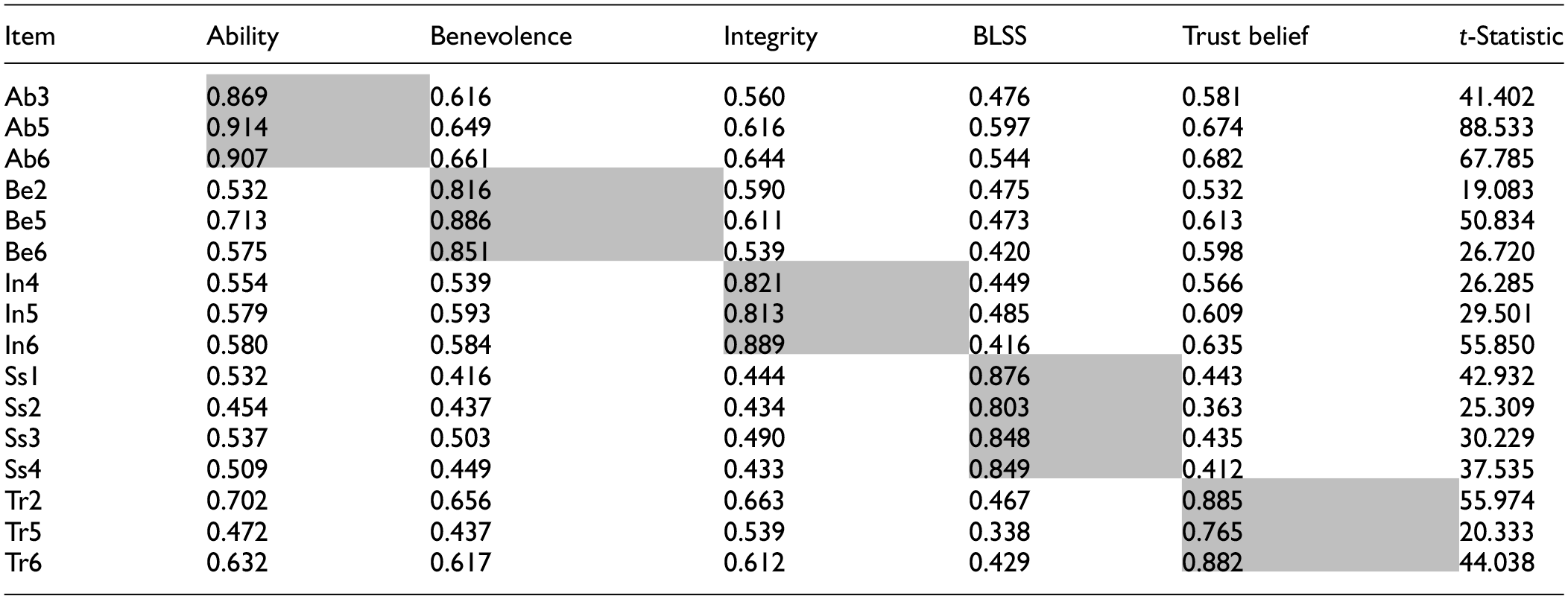
Note. Highlighted factors identify items properly loaded on related construct.
Construct Reliability and Convergent Validity.
HTMT Discriminant Validity.

Fornell-Larcker Diagonal/Correlated Scores Off-diagonal.
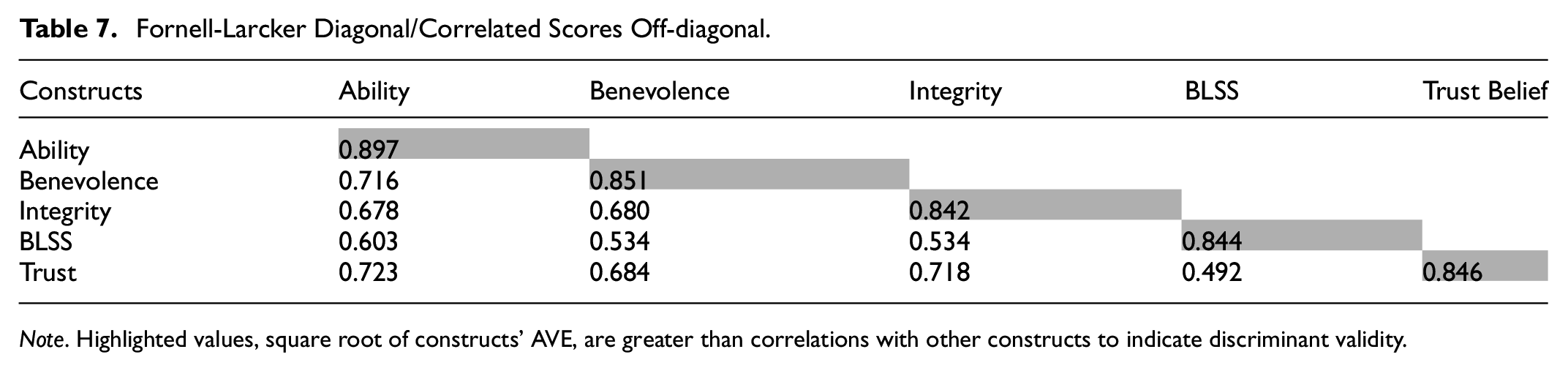

Note. Highlighted values, square root of constructs’ AVE, are greater than correlations with other constructs to indicate discriminant validity.
Cluster Analysis Statistics
After satisfying the measurement model’s assessment, hierarchical cluster analysis, with Ward’s method, measured the characteristics of constructs in relation to the moderator. The selected Ward’s method is proficient in presenting clear solutions for cluster groups (J. Hair et al., 2009). It has the advantage of seeking to create clusters with approximately the same number of respondents (J. Hair et al., 2009). In other words, the Ward’s method tends to produce meaningful cluster sample sizes for analyzing and drawing inferences as in the current study. However, the Ward’s method is susceptible to distortion by outliers (J. Hair et al., 2009). The results of the measurement model assessment signify that the 247 observations in this study reflect reliability, validity, and a good distribution where outliers would not be problematic. Cluster analysis provided a statistical basis for classifying participants based on their responses. This statistical classification process provided robustness over a judgmental process, which could have incorporated unintentional biases. Cluster analysis also provided a foundation for assessing differences between the three social generations. Given the current study’s theoretical objectives, the four items of the BLSS moderator formed the basis for developing the clusters.
The resulting agglomeration schedule identified the number of clusters (see Appendix C). The change in coefficient values indicates the increase in heterogeneity within clusters; a large increase in the trend suggests a stopping point (J. Hair et al., 2009). Agglomeration schedules usually identify a significant increase moving to two clusters, suggesting a stopping point (J. Hair et al., 2009). However, unless in line with research objectives, two clusters are not as meaningful (J. Hair et al., 2009). The agglomeration schedule reflects a large 44.17% change when moving to a three-cluster solution. Accordingly, a three-cluster solution was selected. Three clusters also align with this study’s research focus on how individuals adjust their trust assessment skills in light of BLSS, which would be a form of low, medium, or high for parsimony. However, this study recognizes that cluster analysis may have identified a different number of groups if statistically justified.
Construct mean values were calculated based on the three-cluster solution. An analysis of variance (ANOVA) with the three-cluster solution as the independent variable (factor) and the five construct means as dependent variables determined the robustness of the clusters, with significant differences for the groups (see Appendix D). Evaluations of BLSS mean distributions provided a descriptive basis for relabeling cluster formations (see Table 8). The BLSS-Important and BLSS-Very Important cluster groups show that the BLSS construct means are higher than the other four constructs. Conversely, for the BLSS-Mildly Important cluster group, the BLSS mean is lower than the other four constructs.
Cluster Means by Construct.

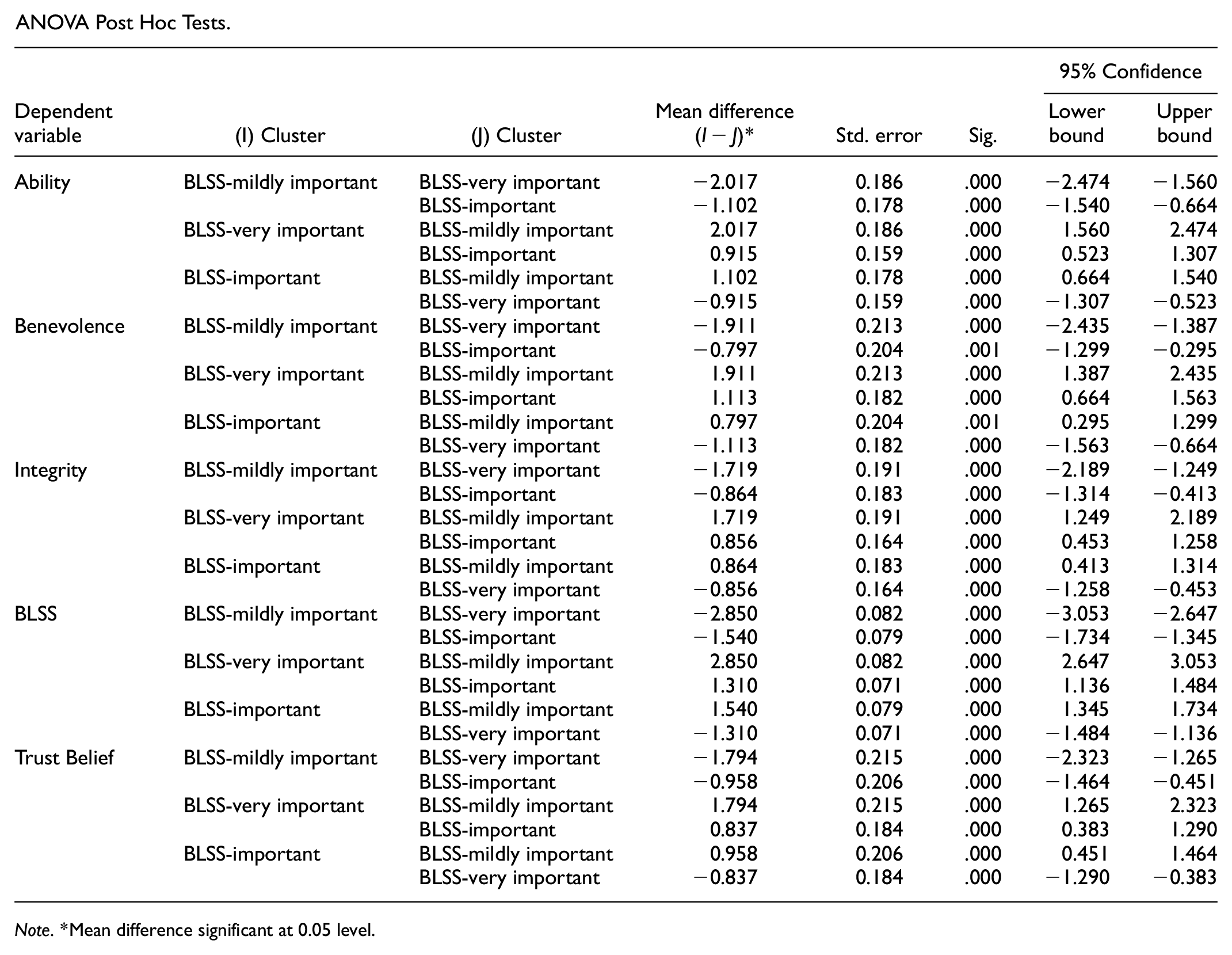
Post hoc analysis used the Scheffe method to assess significance across all constructs and levels (see Appendix E). Scheffe served as the method since it is the most conservative in Type 1 error (J. Hair et al., 2009). Post hoc tests revealed that all levels demonstrated significance. Table 9 presents the assessment of social generations across clusters. The analysis used a bimodal approach for parsimony by viewing BLSS-Important and Very Important collectively against BLSS-Mildly Important results. Overall, Boomers-Gen X expresses the highest percentage among the three social generations, 81.2%, for considering BLSS as either Important or Very Important, leaving 18.8% considering BLSS Mildly-Important. In contrast, iGen members valued BLSS-Mildly Important the highest amongst the three generations at 29.1%.
BLSS Importance by Social Generations.

Analysis of Structural Model
Procedures used one PLS-SEM model to test main effects (H1–H3) (see Figure 2). A second model incorporated the moderating effects of BLSS (H4a–H4c) (see Figure 3).

PLS-SEM analysis of main effects model.

PLS-SEM Analysis of Moderating Effects Model.
In the main effects model (Figure 2), all three variables were significant at the 0.05 level and had a positive effect on Trust Belief, explaining 63.5% of the variance. Adjusted R2 was 63.0%. Integrity had the strongest effect to support H3 (β = .349, t = 5.097, p = .000). Ability was second strongest with support for H1 (β = .340, t = 4.254, p = .000). Lastly, benevolence supported H2 but with the lowest effect (β = .202, t = 2.857, p = .004) (See Table 10).
Summary of Findings.

Measures are not significant by a narrow margin.
p < .05.
In testing the moderating effects of BLSS in Figure 3, moderation settings in SmartPLS 4 used standardized indicator data to calculate product terms and standardized report outputs (J.-M. Becker et al., 2018; Ringle et al., 2022). SmartPLS-SEM algorithms are typically generated with standardized scores since standardization helps interpret and compare variables’ relative influence (J.-M. Becker et al., 2018; J. Hair et al., 2009). In the current study, analysis shows the effect on the three independent variables for a plus or minus movement of one standard deviation in the moderator. However, the principal point is that SmartPLS 4 uses the two-stage approach to model the influence of the moderator, and standardized variable scores from step one are used in step two interaction calculations, given the standardization used in SmartPLS-SEM algorithms (Ringle et al., 2022). Most importantly, researchers found that the two-stage approach performs very well in estimating PLS-SEM moderating effects compared to the two common approaches, product-indicator and orthogonalization (J.-M. Becker et al., 2018) suggested by Henseler and Chin (2010). The performance is due to the ability to reduce bias in reporting interactions and path analysis with the two-stage approach (J.-M. Becker et al., 2018). However, the two-stage approach is subject to collinearity (J.-M. Becker et al., 2018); the current study sought to develop well-defined variables with strong discriminant validity to mitigate a collinearity problem.
Overall, moderating effects increased R2 from 63.5% in the main model to 65.1% in the moderating effects model, which also had an adjusted R2 of 64.1%. Specifically, moderating effect, BLSS × Ability, was negative and significant (β = −.183, t = 2.780, p = .005) to support H4a. In contrast, the moderating effect, BLSS × Benevolence, was positive with a small coefficient and was widely insignificant (β = .032, t = 0.486, p = .627) without support for H4b. Similarly, the moderating effect, BLSS × Integrity, was positive and insignificant without support for H4c, although its measurements just missed significance criteria (β = .125, t = 1.947, p = .052) (see Appendix F).
Figure 4 displays the negative interaction effect of BLSS on the relationship between ability and trust belief. From the chart’s left side, the middle line reflects the increase in trust belief at the standardized beta rate of 0.325 as ability increases and BLSS interacts at average levels. The top line from the left reflects higher levels of BLSS importance at +1 SD and the −0.183 interaction effect on ability-trust belief. The slope reflects an increase at a much lower rate of 0.142 (0.325–0.183). The bottom line from the left depicts lower levels of BLSS importance at −1 SD and the −0.183 interaction effect on ability-trust belief. The slope reflects an increase at a steeper rate of 0.508 (0.325 + 0.183). The predicted movements of ability-trust belief slope lines are consistent with theory in their support of H4a.

Moderating effect on ability.
Discussion and Implications
The current research demonstrates that ability, benevolence, and integrity measures developed for this study significantly and successfully assess trustworthiness and predict an individual’s trust belief in a close SM friend. Extant literature principally addresses general trust between individuals and group members, organizational entities, applications, and processes. Conversely, this research beneficially assesses another level of trust belief for close SM friends based on particular trust. The focus is on SM friends, especially since many individuals indicate that they confide in close SM friends and use their input in making important decisions (Pan et al., 2018; Turcotte et al., 2015). The interdisciplinary nature of the current research likewise supplies findings that apply across disciplines. It reveals social and psychological dynamics for how trustworthiness assessment behaviors have changed for close friend interactions in the current ubiquitous SM environment. Findings are also applicable to IS and technology uses. Most importantly, the current research addresses and explains the impact of new SM trust assessment skills on BLSS, which historically was highly valued. The influential strength of ability, benevolence, and integrity indicate an effect on BLSS’s moderation efforts since chart slopes depict notable interactions, but two interactions were not significant. Only BLSS × Ability was significant, BLSS × Integrity was slightly insignificant but had a positive effect instead of negative, and BLSS × Benevolence was not significant by a large margin. Moreover, analysis reveals a trend or shift in the importance of BLSS based on age. iGen’s younger SM users place less importance on BLSS, whereas older users place more importance on BLSS.
As the clear significant moderating relationship, BLSS × Ability involves a mixed power distribution between respondents and friends. Friends possess, control, and develop abilities to express or imply to online respondents. In some situations, a friend’s abilities can be subject to verification and recognition by a third party that the respondent could utilize. In the SM arena, information can be subject to large volumes and types that exchange at high speeds. In such cases, the respondent would often need to exercise their power to rely on their assessment of their friend’s ability. As an illustration, one can view ability as producing tangible or intangible output. In either case, the respondent usually would want to assess the output and inquire online with the friend. BLSS’ importance and the lack of thorough BLSS in ability’s assessment play a role during this output and inquiry process. As a result, BLSS × Ability reflects a negative moderating influence where ability’s assessment decreases as the importance of BLSS increases, and the respondent cannot evaluate BLSS thoroughly.
On the other hand, benevolence primarily projects attributes centered on the actions of friends, not the respondent. Most importantly, online friends can use a wide range of functionality to carry out and express benevolence. For example, these include e-commerce, e-transfers, eCards, emojis, and other forms of electronic messaging. The considerable measure of no significance and small effect for BLSS × Benevolence indicates that online functionality mitigates the lack of BLSS, and the dissonant element is unnecessary. Thus, the theoretical design should reflect the removal of the BLSS moderating relationship with benevolence.
In a further discussion of moderation efforts, the positive but slightly insignificant BLSS × Integrity interaction signifies that enough consistent items exist in integrity’s assessment to neutralize the presence of BLSS dissonance under cognitive dissonance theory. The interaction can then have room to reflect a positive versus a negative effect for BLSS. BLSS items reflect observations and interpretations made directly by respondents concerning the BLSS of friends they engage with personally. The structure of these observations and interpretations follows social learning theory, where respondents would draw on the context of their experiences to make successful BLSS assessments. The current research holds that experiences gained from BLSS assessment opportunities precede those for online integrity assessments and set a basis before online integrity assessments.
Consequently, in an online environment, integrity assessment advances observations and interpretations of the respondent concerning their friends. Accordingly, for areas that do not involve violation of law, ethics, which underlie integrity, can vary by person and require thoughtful assessment. Respondents again work through social learning theory, relying on their experiences to properly assess their friends’ integrity. The nature of respondent actions for BLSS and integrity could explain why BLSS positively moderates integrity. Respondents who utilize their assessment skills when taking specific positions on BLSS will likewise exhibit similar efforts and skills with integrity assessment in a positive relationship.
Theoretical Discussion
Social learning theory supports using Mayer et al.’s trust model as a basis. To enhance the understanding of SM relationships against the importance of face-to-face interaction, BLSS served as a moderator based on cognitive dissonance theory. Both the main and moderating effects models produced coefficients of determination that explained sizable portions of trust belief. Path coefficients for ability and integrity were the two strongest in the moderating effects model. Ability and integrity appear as principal factors supporting assessment information and influence. In comparison, benevolence plays a lesser role and seems closely aligned with extending emotional support. Model results underscore that many individuals have adapted to using and accepting SM platforms. While some struggle with trust assessment of close friends on SM, others strongly and significantly rely on independent variables in this study. Festinger (1962) explained individuals’ actions of resolving dissonance by relying on enough consistent beneficial behaviors (i.e., the independent variables) to override the dissonant issue, BLSS, in this study.
Moreover, the independent variables in the current study fulfill two roles. They address cognitive dissonance, and they depict aspects of social learning theory. Regarding resolving cognitive dissonance, the strong t-values of the independent variables indicate that respondents have identified enough consistent techniques (i.e., measurement items) to assess trustworthiness and minimize the impact of decreased ability to assess BLSS. Examining the measurement items reveals new socially learned and adapted techniques that respondents found successful in assessing the trustworthiness of SM friends. For example, in one item under integrity assessment, respondents would search online content of their friends to match it to what they know their friends express otherwise. Each measurement item encompasses specific wording to frame an SM aspect to execute new socially learned assessment skills.
The analysis explains the robustness of the overall BLSS moderating effects model with its 2.5% R2 increase over the main effects model. Moreover, the high t-values reflect the strength of this study’s independent variables. T-values express the amount of explanatory power a variable contributes to explaining the dependent variable and thereby indicate available room for variables with additional explanatory power (Freed et al., 2014; J. Hair et al., 2009). Concerning explanatory power, BLSS × Ability produced a significant negative moderating influence, whereas BLSS × Integrity generated a positive moderating influence as indicated by its chart (see Appendix F) but was slightly insignificant. The removal of BLSS × Benevolence, based on findings, should release enough power (t-value), thereby allowing BLSS × Integrity to pick up more explanatory power and reflect significance. However, the hypothesized direction should be positive under social learning theory. Overall, the interactions depict social learning and cognitive dissonance theories. For example, respondents reflect that they minimized or eliminated BLSS dissonant beliefs in relation to benevolence (e.g., BLSS × Benevolence large insignificance and small coefficient) and that socially learned assessment skills to support benevolence overshadows reduced BLSS. However, BLSS demonstrates a presence in social generations. The values for iGen members reflect that they are the first generation to go from birth to maturity in an internet-based environment and, subsequently, an SM environment. Their BLSS results underscore their conditioning to recognize, accept, and adapt assessments of others using technology-based versus face-to-face interactions.
Thus, their level of BLSS importance is lowest. Conversely, BLSS results for Millennials and Boomers-Gen X indicate conditioning for utilizing face-to-face interactions; therefore, their level of BLSS importance is highest. This trend proposes that as iGen members age and subsequent generations follow, the importance of BLSS could continue to diminish as social interactions and assessment indicators continue the shift to technology and online platforms.
Practical Discussion
Findings from the current study also have insight for SM platform providers and other organizations involved in SM use by individuals. Since many individuals trust close SM friends and rely on their input when making important decisions, organizations have a stakeholder interest in these trusting friendships. At the individual level, content from this research would also benefit those who provide personalized guidance to those struggling with SM, friendships, and trust.
Organizations should develop or enhance initiatives recognizing the impact of adverse/positive decisions stemming from trusting-social-media-friendships. Initiatives should augment the assessment of abilities, benevolence, and integrity in interpersonal SM friendships. At the forefront, many individuals have difficulty assessing others virtually via visual or other SM connections. Organizations can provide validated survey items from this research to their platform members to enlighten them. Members can complete an online self-assessment questionnaire to improve their awareness of assessment skills. The self-assessment is to help them understand how they form trust belief in those they consider close SM friends they can rely upon and discuss matters of a personal nature. This approach is similar to that of AT&T, where they led the development of an online questionnaire to help parents and caregivers determine their child’s readiness for a cell phone and media use (Mask, 2022). The AT&T online tool also provides links to knowledgeable resources (Mask, 2022). From this study, an organization would also include BLSS issues but specify how their platform compensates for decreased BLSS with consistent functionality that enhances their assessment experiences and objectives.
From a marketing perspective, findings encourage companies to incorporate more push-type information sharing. Currently, SM platforms, in essence, use pull-type information sharing, where an individual sends out an online request for information or a recommendation and waits for a response (How do i ask a question on Quora?, 2021; How do i ask friends for recommendations on Facebook?, 2023). The current research noted the sizeable influence of friends on each other across SM platforms regarding social matters, e-commerce, and other business decisions. Hence, the present study views information from trustworthy friends as having a force multiplier effect. Using a push-type approach, friends can proactively identify areas/categories on their profile where they feel comfortable and knowledgeable about sharing insight. SM platforms can provide structure using a drop-down list of areas/categories. Examples of items include countries in terms of travel, contractors, food cuisines, physical fitness, appliances, careers, and professional certifications. Individuals would query items/topics listed for their friends as a basis for inquiring.
For older social generations, in particular, BLSS survey items will increase their self-awareness concerning BLSS’ level of importance with their use of SM. Organizations would then provide simple vignettes, FAQs, and other resources to increase their proficiency with the platform’s functionality to compensate for decreased BLSS. For example, organizational tools would present and walk through different rating assumptions for items of BLSS and the independent variables, then explain the expected trust belief outcome. Trust belief would tie to behavior intentions like purchasing a product/service, entering a social affiliation, or executing other financial transactions. Organizational efforts should consistently seek to improve individuals’ perceived ability, benevolence, and integrity levels of their SM friends.
Also, this study’s content, specifically the survey instrument, can assist those providing guidance and counseling to others with trust issues and interpersonal SM friendships. The survey instrument would be able to target areas that require discussion and attention. Most importantly, research findings provide a basis for understanding trust belief and the interpersonal SM interactions of concern.
Finally, organizational strategies should consider profiles of iGen members that tend to place less importance on BLSS. This profile of iGen members, active SM users, indicates their increased preference for assessing others’ attributes using SM platforms. One area of applicability is employment-recruiting efforts. For example, organizations can allow all recruits to conduct or submit initial interpersonal communication via SM platforms before face-to-face interaction. This study notes that the coronavirus pandemic of 2020 drove the adoption of many SM initiatives for employment and education-related activities. However, the current research does recommend counterbalancing efforts for the lower importance younger users apply to BLSS. Since even with younger users’ high comfort with SM interactions, skill in face-to-face interactions is still valuable. The current research recommends that educators review pedagogy for opportunities to incorporate and develop face-to-face interaction skills. Educators should consider role-play and simulation activities that stress personal communication and interaction. These activities could be introduced and started at age 11 since researchers find that children begin understanding social conventions, reasoning, and logic at that age for application to the learning activities (Miller et al., 2000). These recommendations should better equip iGen and younger users overall as SM continues its ubiquitous trend.
Limitations and Future Research
The approach to the research topic limited the study to close interpersonal friendships. However, SM platforms typically allow users to apply the friend label to various individuals, including associates and acquaintances. The study sought to control for this broad category of friends with screening questions and instructions to participants. In addition, the current research recognizes that BLSS factors considered important by U.S. respondents could differ from those considered important in other cultures and countries. In future studies, the notable BLSS differences across social generations also provide an opportunity for additional research on drivers and influences.
Similarly, BLSS moderating influences suggest an area for further research. Research should study ability, benevolence, and integrity and consider the influence of BLSS on ability and integrity only. In addition, studies could include BLSS where nomological validity suggests the influence of BLSS. Some areas include online education, virtual communication, video streaming, in-person interactions, and situations that switch between face-to-face and virtual communication. In those studies where independent variables do not generate and explain a sizable portion of the total variance, BLSS could be a factor that produces significant influence. Most importantly, whether BLSS is significant or not, the results would provide meaningful insight into the independent variables and nature of the phenomenon. In addition to BLSS influences, opportunities might adopt this study’s trust measures to assess levels of interpersonal online interactions by type, such as all online or various percentages of online interaction.
Conclusion
This study approached trust belief between SM friends from social learning and cognitive dissonance perspectives. The scope framed friends as being close, where discussions could include topics of a personal nature. The social learning perspective supported using Mayer et al.’s (1995) trust model as a basis, but scale items were developed and adapted for SM interpersonal interactions with friends. The resulting ability, benevolence, and integrity measures adapted for this study strongly and significantly predicted trust belief to support their three hypotheses. The strength and significance of the independent variables indicate that respondents adapted new consistent behaviors to offset and compensate for the reduction of BLSS in their assessment process. Cognitive dissonance theory supports and explains the use of new behaviors to address dissonant beliefs. The methodology also tested and developed a new BLSS construct as a moderator. Moderating influences expanded understanding of changing behaviors in an active, wide-ranging SM environment. Analysis revealed cognitive dissonance around BLSS due to the distinction between BLSS in face-to-face communication and decreased BLSS in SM interactions. BLSS produced a significant and negative influence on the relationship with ability due to the reduced capability to use BLSS to assess a friend’s ability. Findings suggested that benevolence has developed to a point with numerous online opportunities to infer and assess benevolent behaviors, so BLSS is widely insignificant and, thus, should not be considered a moderating factor. However, BLSS’ moderating influence on integrity reflected a positive interaction, although it missed being significant by a slight margin. Removing the unnecessary moderating influence on benevolence in future research should allow the moderating influence on integrity room to reflect significance.
Moreover, additional analysis identified BLSS differences by social generation. Younger iGen users view BLSS as less important than Millennials, and Millennials find BLSS less important than Boomer-Gen-X users. This trend portrays the possibility that BLSS will continue to decrease in importance with succeeding generations. Educators should consider modifications in pedagogy to counterbalance this trend and enhance interpersonal interaction skills with BLSS. Companies are also encouraged to incorporate tools to help users enhance their understanding and assessment skills of ability, benevolence, and integrity attributes. This study utilized social learning and cognitive dissonance theories with Mayer et al.’s trust model to reveal and increase understanding of the adaptive behavioral changes of individuals as they build or maintain close, trusting friendships in a ubiquitous SM climate.
Footnotes
Appendix A
Respondents Online Profile (N = 247).
| Frequency | Percent | |
|---|---|---|
| Platforms used | ||
| 226 | 91.5 | |
| YouTube | 195 | 78.9 |
| 188 | 76.1 | |
| 158 | 64.0 | |
| Snapchat | 144 | 58.3 |
| 109 | 44.1 | |
| 106 | 42.9 | |
| 95 | 38.5 | |
| 70 | 28.3 | |
| Tumblr | 35 | 14.2 |
| Other | 2 | 0.8 |
| Types of people interact with | ||
| Friends and family | 247 | 100.0 |
| Associates | 150 | 60.7 |
| Co-workers | 136 | 55.1 |
| Acquaintances | 153 | 61.9 |
| Strangers | 84 | 34.0 |
| Other | 2 | 0.8 |
| Usage | ||
| Multiple times within an hour | 74 | 30.0 |
| Hourly | 38 | 15.4 |
| Every couple of hours | 49 | 19.8 |
| Few times a day | 37 | 15.0 |
| Daily | 36 | 14.6 |
| Weekly | 13 | 5.3 |
| Types of content shared | ||
| Photos/videos of you, family, and friends | 206 | 83.4 |
| Photos/videos of others | 171 | 69.2 |
| Stories | 152 | 61.5 |
| Relationship status | 134 | 54.3 |
| Fact-based statements on topics (including news) | 122 | 49.4 |
| City, State | 119 | 48.2 |
| Opinionated/advisory comments | 97 | 39.3 |
| Employment information | 89 | 36.0 |
| Email address | 88 | 35.6 |
| Mobile number | 58 | 23.5 |
| Other | 6 | 2.4 |
Appendix B
Survey Items Used in Study

| Ab1. My social media friends are successful.* |
| Ab2. My social media friends are very competent.* |
| Ab3. My social media friends have specific skills I appreciate. |
| Ab4. My social media friends are very knowledgeable.* |
| Ab5. My social media friends are very skillful. |
| Ab6. My social media friends have excellent abilities. |
| Be1. My social media friends care about my well-being.* |
| Be2. My social media friends express concern for problems I may have. |
| Be3. My social media friends are considerate of things that mean a lot to me.* |
| Be4. My social media friends are very kind in their well-doing for me.* |
| Be5. When I share concerns, my social media friends seek to help. |
| Be6. My social media friends will go out of their way to help me. |
| In1. My social media friends strive to keep their word.* |
| In2. I would characterize my social media friends as valuing honesty.* |
| In3. My social media friends are truthful.* |
| In4. Ethical principles guide my social media friends. |
| In5. The online activities of my social media friends are consistent with what they say. |
| In6. My friends are ethical when they communicate on social media. |
| Tr1. I value my social media friendships.* |
| Tr2. I believe in my social media friendships. |
| Tr3. I am committed to my social media friendships.* |
| Tr4. I believe my social media friends are trustworthy.* |
| Tr5. I cannot trust my social media friends. (Reverse scored) |
| Tr6. I have faith in my social media friends. |
| Next section asks about things important to you in face-to-face conversations with friends over your lifetime. |
| Ss1. Friends demonstrate an active interest in your conversations. |
| Ss2. When speaking with you, friends stay on topic. |
| Ss3. Friends physically position themselves in a welcoming manner. |
| Ss4. In conversations, friends use a tone of voice that matches your emotional level. |
Note. Ab = Ability, Be = Benevolence, In = Integrity, Tr = Trust Belief, Ss = BLSS.
Deleted for model fit.
Appendix C
Extract of Agglomeration Schedule.

| Stage | Clusters combined | Coefficients | Number of clusters after combining | Coefficient difference to next cluster | Percentage increase in heterogeneity to next stage | |
|---|---|---|---|---|---|---|
| Cluster 1 | Cluster 2 | |||||
| 1 | 67 | 247 | 0.000 | 246 | 0.000 | 0 |
| 2 | 162 | 246 | 0.000 | 245 | 0.000 | 0 |
| 3 | 223 | 243 | 0.000 | 244 | 0.000 | 0 |
| | | | | | | | | | | | | | |
| | | | | | | | | | | | | | |
| 242 | 4 | 13 | 616.096 | 5 | 58.878 | 9.56 |
| 243 | 2 | 5 | 674.974 | 4 | 84.163 | 12.47 |
| 244 | 4 | 11 | 759.138 |
|
|
|
| 245 | 2 | 4 | 1094.485 | 2 | 800.988 | 73.18 |
| 246 | 1 | 2 | 1895.474 | 1 | n/a | n/a |
Note. Large percentage change of 44.17 indicating selection of three-cluster solution.
Appendix D
ANOVA Cluster Significance.

| Construct variable | Comparisons | Sum of squares | df | Mean square | F | Sig. |
|---|---|---|---|---|---|---|
| Ability | Between groups | 140.099 | 2 | 70.049 | 59.307 | .000 |
| Within groups | 288.195 | 244 | 1.181 | |||
| Total | 428.294 | 246 | ||||
| Benevolence | Between groups | 131.948 | 2 | 65.974 | 42.500 | .000 |
| Within groups | 378.771 | 244 | 1.552 | |||
| Total | 510.719 | 246 | ||||
| Integrity | Between groups | 102.829 | 2 | 51.414 | 41.171 | .000 |
| Within groups | 304.710 | 244 | 1.249 | |||
| Total | 407.538 | 246 | ||||
| BLSS | Between groups | 279.903 | 2 | 139.952 | 600.602 | .000 |
| Within groups | 56.857 | 244 | 0.233 | |||
| Total | 336.760 | 246 | ||||
| Trust belief | Between groups | 111.097 | 2 | 55.549 | 35.114 | .000 |
| Within groups | 385.995 | 244 | 1.582 | |||
| Total | 497.092 | 246 |
Note. Significance at.05 Level.
Appendix E
ANOVA Post Hoc Tests.
| 95% Confidence | |||||||
|---|---|---|---|---|---|---|---|
| Dependent variable | (I) Cluster | (J) Cluster | Mean difference (I − J)* | Std. error | Sig. | Lower bound | Upper bound |
| Ability | BLSS-mildly important | BLSS-very important | −2.017 | 0.186 | .000 | −2.474 | −1.560 |
| BLSS-important | −1.102 | 0.178 | .000 | −1.540 | −0.664 | ||
| BLSS-very important | BLSS-mildly important | 2.017 | 0.186 | .000 | 1.560 | 2.474 | |
| BLSS-important | 0.915 | 0.159 | .000 | 0.523 | 1.307 | ||
| BLSS-important | BLSS-mildly important | 1.102 | 0.178 | .000 | 0.664 | 1.540 | |
| BLSS-very important | −0.915 | 0.159 | .000 | −1.307 | −0.523 | ||
| Benevolence | BLSS-mildly important | BLSS-very important | −1.911 | 0.213 | .000 | −2.435 | −1.387 |
| BLSS-important | −0.797 | 0.204 | .001 | −1.299 | −0.295 | ||
| BLSS-very important | BLSS-mildly important | 1.911 | 0.213 | .000 | 1.387 | 2.435 | |
| BLSS-important | 1.113 | 0.182 | .000 | 0.664 | 1.563 | ||
| BLSS-important | BLSS-mildly important | 0.797 | 0.204 | .001 | 0.295 | 1.299 | |
| BLSS-very important | −1.113 | 0.182 | .000 | −1.563 | −0.664 | ||
| Integrity | BLSS-mildly important | BLSS-very important | −1.719 | 0.191 | .000 | −2.189 | −1.249 |
| BLSS-important | −0.864 | 0.183 | .000 | −1.314 | −0.413 | ||
| BLSS-very important | BLSS-mildly important | 1.719 | 0.191 | .000 | 1.249 | 2.189 | |
| BLSS-important | 0.856 | 0.164 | .000 | 0.453 | 1.258 | ||
| BLSS-important | BLSS-mildly important | 0.864 | 0.183 | .000 | 0.413 | 1.314 | |
| BLSS-very important | −0.856 | 0.164 | .000 | −1.258 | −0.453 | ||
| BLSS | BLSS-mildly important | BLSS-very important | −2.850 | 0.082 | .000 | −3.053 | −2.647 |
| BLSS-important | −1.540 | 0.079 | .000 | −1.734 | −1.345 | ||
| BLSS-very important | BLSS-mildly important | 2.850 | 0.082 | .000 | 2.647 | 3.053 | |
| BLSS-important | 1.310 | 0.071 | .000 | 1.136 | 1.484 | ||
| BLSS-important | BLSS-mildly important | 1.540 | 0.079 | .000 | 1.345 | 1.734 | |
| BLSS-very important | −1.310 | 0.071 | .000 | −1.484 | −1.136 | ||
| Trust Belief | BLSS-mildly important | BLSS-very important | −1.794 | 0.215 | .000 | −2.323 | −1.265 |
| BLSS-important | −0.958 | 0.206 | .000 | −1.464 | −0.451 | ||
| BLSS-very important | BLSS-mildly important | 1.794 | 0.215 | .000 | 1.265 | 2.323 | |
| BLSS-important | 0.837 | 0.184 | .000 | 0.383 | 1.290 | ||
| BLSS-important | BLSS-mildly important | 0.958 | 0.206 | .000 | 0.451 | 1.464 | |
| BLSS-very important | −0.837 | 0.184 | .000 | −1.290 | −0.383 | ||
Note. *Mean difference significant at 0.05 level.
Appendix A6
Declaration of Conflicting Interests
The author declared no potential conflicts of interest with respect to the research, authorship, and/or publication of this article.
Funding
The author disclosed receipt of the following financial support for the research, authorship, and/or publication of this article: This research was supported by funding from the author’s university.
Ethical Approval and Informed Consent
This research project has been reviewed & approved by the Texas A&M University-Kingsville Institutional Review Board for the protection of human subjects. For questions, complaints, or concerns about the research, you may contact the office of Research and Graduate Studies by phone at 361-593-2677, or by email at

Data Availability Statement
The data that support the findings of this study are available from the author, upon reasonable request.