



Abstract
The aim of the current research was to explore the relationship between supply chain integration and supply chain responsiveness in the electronics manufacturing industry in Guangdong, China. The research model conceptualized supply chain integration (comprising business process integration, system integration, and activity integration) as a key resource impacting the capability of firms to respond efficiently to changing consumer demands and market conditions. This research utilized the questionnaire to gathered data from 420 supply chain management professionals from electronics manufacturers in China. The gathered data was analyzed using PLS-SEM, which allowed us to examine the relationships between supply chain responsiveness, business process integration, activity integration and systems integration. The results obtained were interpreted and discussed in the context of previous literature and theories. The study findings reveal a positive correlation between the three aspects of supply chain integration and supply chain responsiveness. Respondents agreed that business process integration (mean = 4.822, standard deviation = 1.825), system integration (mean = 4.965, standard deviation = 1.809), and activity integration (mean = 5.243, standard deviation = 1.792) were essential determinants in developing supply chain responsiveness. This indicates that a higher level of integration in these areas can significantly enhance a firm’s ability to respond quickly and effectively to changes in the market. These findings are consistent with prior research, suggesting that these forms of integration are critical for supply chain performance. In the context of the electronics manufacturing industry in China, this research further validates the importance of these variables. Business process integration is first investigated as the determinant of supply chain responsiveness, especially in the electronics manufacturing companies of China. This study is, to the best of the authors’ knowledge, one of the first to investigate the link between business process integration and supply chain responsiveness. Meanwhile, it is also seen as the new test of examining the influence of system and activity integration on supply chain responsiveness in the current business environment. The truth from the data analysis illustrated that even in the new business environment, both integration constructs (system integration and system integration) could affect the supply chain’s responsiveness. The study’s results provide valuable insights for practitioners and policy-makers in the electronics manufacturing industry. By focusing on enhancing business process integration, system integration, and activity integration, firms can increase their responsiveness to the dynamic market environment, thus improving overall performance.
Plain Language Summary
Purpose—The aim of the current research was to explore the relationship between supply chain integration and supply chain responsiveness in the electronics manufacturing industry in China. The research model conceptualized supply chain integration (comprising business process integration, system integration, and activity integration) as a key resource impacting the capability of firms to respond efficiently to changing consumer demands and market conditions. Methodology—This research utilized the questionnaire to gathered data from 420 supply chain management professionals from electronics manufacturers in China. The gathered data was analyzed using PLS-SEM, which allowed us to examine the relationships between supply chain responsiveness, business process integration, activity integration and systems integration. Findings—The study findings reveal a positive correlation between the three aspects of supply chain integration and supply chain responsiveness. This indicates that a higher level of integration in these areas can significantly enhance a firm’s ability to respond quickly and effectively to changes in the market. Originality/value- This study is, to the best of the authors’ knowledge, one of the first to investigate the link between business process integration and supply chain responsiveness. Meanwhile, it is also seen as the new test of examining the influence of system and activity integration on supply chain responsiveness in the current business environment. The study’s results provide valuable insights for practitioners and policy-makers in the electronics manufacturing industry. Limitation—It is essential to acknowledge the limitations of this research, particularly regarding the generalizability of our findings.
Keywords
Introduction
Over several years, the supply chain responsiveness (SCR) concept as a linchpin for long-term profitability and competitiveness (Wong et al., 2021) has received considerable attention and became one of the essential supply chain management (SCM) features (Z. Chen et al., 2020). Coupled with the quick response and agility abilities, SCR became indispensable as a response to the ever-growing global market demands for business competitiveness (Samad et al., 2021). Research on SCR has become more critical than ever, especially when responding quickly to business uncertainties. Reimagination of supply chain responsiveness practices is valuable given the pace of progress in supply chains today, coupled with the need for supply chain management to help face significant societal challenges, including sustainability and geopolitical challenges (Thompson & Anderson, 2021). To cope with the rapidly changing business environment caused by highly unexpected events, companies and their supply chain members must develop a rapid response strategy to maintain performance and achieve competitive advantages. Existing literature identifies such capabilities as a firm’s strategic capability (S.C.s) and dynamic capability (D.C.) (Hernández-Linares et al., 2021)
A responsive supply chain is essential in the Chinese electronics manufacturing market due to the intense competition and rapidly changing market conditions (Mukherjee et al., 2022). China is a significant player in the global electronics industry, with many of the world’s largest electronics manufacturers based in the country. As a result, manufacturers operating in China must adapt quickly to meet any changes in demand, supply, and other factors to remain competitive (Borazon et al., 2022). Nevertheless, as the geopolitical rift between the U.S. and China intensifies, global companies are looking for a replacement for manufacturing in China in Asia, which would cause more challenges and uncertainty to many electronics manufacturing companies in China (Tukamuhabwa et al., 2023). Hence It is necessary to explore key determinants to boost supply chain responsiveness in new business environments so that electronics manufacturing companies can survive in the competitive market.
One of these criteria is the ability to integrate. As the business environment changes rapidly and commercial uncertainty persists, this is widely recognized as the vital aspect that keeps a company competitive and helps it survive (Calantone et al., 2002). The history of business is littered with graveyards of businesses that were destroyed due to the lack of integration and the failure to adapt to their changing business environment (Chandy & Tellis, 2000). Golgeci and Ponomarov (2013) agree that integrating supply chains is critical to a company’s success. The integration of organizations has been a priority for contemporary organizations (Golgeci & Ponomarov, 2013).
The core rationale for proposing integration as the driver of SCR lies in its capability to enable companies to renew and reconfigure their business process, systems, and activities and thus preserve the value of their resource base in times of increasing environmental dynamics and this is precisely where supply chain responsiveness’s central theme resides (Bicocchi et al., 2019). By exploring critical dimensions of the supply chain as an enabler of supply chain responsiveness, this study will address Thilmany et al.’s (2021) argument on how to meet responsiveness through integration and expand the supply chain responsiveness’s enablers body of literature.
Given that integration, as a resource, expands organizations’ performance, the mechanism of supply chain responsiveness in boosting responsiveness and integration-led performance in the electronics manufacturing supply chain is lacking. This research sheds new light on the indirect influence of supply chain integration factors business process integration, activity integration, system integration) on responsiveness based on surveys of Chinese electronics manufacturing companies (Ali, Jiang et al., 2022; Ali, Naseem et al., 2022).
To ensure that electronics manufacturing companies to reach better gains, they are obliged to support integration and develop responsiveness with their supply chain members (Ramos et al., 2023). Managers embrace supply chain responsiveness due to their effectiveness in capitalizing on gains (Z. Xu et al., 2020).
Notwithstanding the preliminary investigation of available research into the relationship between supply chain integration and supply chain responsiveness, two aspects remain under-researched. Firstly, existing research has separately investigated the impact of integration (Omar et al., 2019; Panahifar et al., 2018; Parwez, 2015) on responsiveness but generally from the dimensions of supplier integration and consumer integration. There is little by way of literature indicating that business process integration can directly affect supply chain responsiveness. Secondly, the previous studies concluded that inter-firm system integration and activity integration enable the supply chain to respond to customer needs and market changes quickly and successfully but have not been explored in the electronics manufacturing industry (Borazon et al., 2022; H. Chen et al., 2009; Kim & Cavusgil, 2009; Melnyk et al., 2014).
Meanwhile, with the changing business environment and new technology utilization, very few pieces of new research have been published and quantitatively analyzed in recent years, especially in the Chinese electronics manufacturing industry (Shapiro, 2019). Hence, investigating the association between business process integration, activity integration, system integration, and supply chain responsiveness remains to be studied more extensively.
This study will explore three research questions based on these statements.
RQ1: What is the impact of business process integration on supply chain responsiveness?
RQ2: What is the influence of system integration on supply chain responsiveness?
RQ3: What is the influence of activity integration on supply chain responsiveness?
Hence, from the RBV theory and DCV theory perspective, this study’s objectives are to meet questions by empirically assessing and theoretically analyzing the relationship between business process integration, activity integration, system integration, and supply chain responsiveness.
The contributions consist of two points. Firstly, researchers analyze the association between business process integration, activity integration, system integration, and supply chain responsiveness theoretically and empirically. Our results show the satisfactory validity and reliability of the research model and measurement instruments, suggesting that these could be employed in future studies to further validate and generalize these findings. The AVE values of all constructs exceed the minimum necessary value of 0.50, implying high convergent validity. Furthermore, all Cronbach’s alpha, composite reliability, and indicator reliability values were greater than .70, demonstrating excellent internal consistency. Discriminant validity was also established, as shown by the HTMT values below the cut-off of .85. The results prove that three key determinants of supply chain integration (business process integration, system integration, and activity integration) are positively associated with supply chain responsiveness. Secondly, the study’s results provide valuable insights for practitioners and policy-makers in the electronics manufacturing industry. By focusing on enhancing business process integration, system integration, and activity integration, firms can increase their responsiveness to the dynamic market environment, thus improving overall performance.
Below are the remaining sections. Section 2 reports the theoretical background of supply chain integration (business process integration, activity integration, system integration) and supply chain responsiveness with the research hypothesis. Then, section 3 designs the research methodology. This study used a deductive approach, which involves moving from the general theories of RBV and DCV to more specific implications that will be tested with the data. This approach is associated with scientific investigation and is appropriate for this research. The quantitative method with a questionnaire survey to examine the relationship between supply chain integration and supply chain responsiveness in Chinese electronics manufacturing companies. Afterward, section 4 and section 5 describe the results and discussion. Section 6 and the last section discuss the conclusions, limitations, and future research direction.
Literature Review
Supply Chain Integration
Supply chain management (SCM) has grown in prominence due to increased global rivalry and value-seeking efforts from manufacturing companies (Z. Chen et al., 2020). Companies work strategically with their supply chain members to create efficient and effective flows of products and services, as well as to manage internal and cross-organizational operations. Supply chain integration refers to integrating activity, system, information, finances, and decision-making to maximize customer value (Wong et al., 2021). Collaboration with supply chain partners and aligning incentive and reward systems can reduce company costs by minimizing non-value-added activities and inefficient resource use. Supply chain management processes require understanding how supply chain players integrate and work together. Sharing information, resources, and risks, communicating proactively, developing supply chain procedures, and coordinating planning and decision-making inside and across the supply chain are all part of the integration process. (Birkel & Müller, 2021). Whereas stakeholders in a connected supply chain must cooperate to gain the competitive advantage in business (Fernando & Wulansari, 2021). However, current literature focuses more on the other dimensions of supply chain integration (supplier integration, customer integration), and sharing of systems, activity integration, and integration of business processes appear to be the fundamental challenges for in-depth research (M. Beheshti et al., 2014).
Business Process Integration
Business process integration (BPI) was defined by Nakano (2019) as the reduction of effort or strengthening of the connection between organizational functions in the business process (Nakano, 2019). BPI has become increasingly important in today’s corporate environment. It enables manufacturers to optimize their processes, improve efficiency, enhance the end-user experience, better understand and evaluate business processes, reduce overhead costs, and streamline functionality (Andrei, 2019). The current business environment has necessitated a shift in competition for companies, from competing with each other to competing with supply chains. This approach has made business process integration crucial, particularly in the Chinese electronics manufacturing industry (Hallikas et al., 2019; Hazen & Byrd, 2012; Wiengarten et al., 2013).
System Integration
Integrating numerous systems into a supply chain to guarantee smooth coordination and collaboration among all players is referred to as system integration (S.I.) (Y. Yu et al., 2021). Supply chain integration has evolved as a crucial distinguishing feature for organizations in today’s intensely competitive business climate, assisting them in improving customer happiness, lowering expenditures, and increasing overall efficiency (Yachoulti & Houssaini, 2018). The study conducted by Y. Yu et al. (2021) revealed that it is a critical element of supply chain management (SCM) for achieving efficiency, agility, and responsiveness (Y. Yu et al., 2021). Therefore, to achieve successful system integration, it is crucial to thoroughly comprehend different components in the supply chain involved in the integration, their interdependencies, and the technologies that can be used to integrate them (Lee et al., 2022). Implementing system integration (S.I.) is crucial for firms striving for supply chain excellence. It provides numerous benefits, such as improved supply chain visibility, increased stakeholder collaboration, enhanced agility and flexibility, and reduced lead times and inventory costs (Lee et al., 2022). With the right strategies, tools, and technology, organizations can integrate their supply chain systems to achieve seamless coordination, cooperation, and performance across the whole supply chain, as highlighted by Alam et al. (2021) and Ghobakhloo et al. (2011). (Alam et al., 2021; Ghobakhloo et al., 2011).
Activity Integration
According to W. Yu et al. (2019), activity integration (A.I.) refers to the extent to which a corporation combines its stakeholders’ strategic channel activities, such as scheduling and forecasting (W. Yu et al., 2019). Some scholars have highlighted the importance of activity integration (A.I.) in achieving supply chain efficiency and performance, identifying three key aspects: vertical integration, horizontal integration, and inter-firm integration (Adams et al., 2014; Jin et al., 2013; Kim & Cavusgil, 2009; F. Li et al., 2021). Vertical integration involves integrating activities within a single company, from suppliers to customers, which requires coordination among functional areas such as purchasing, manufacturing, and transportation (Pollák et al., 2021; Yeniyurt et al., 2019). Horizontal integration refers to combining activities across multiple facilities or warehouses. In contrast, inter-firm integration involves merging activities across multiple enterprises at various supply chain levels, requiring collaboration and coordination among suppliers, manufacturers, distributors, and consumers (Kim & Cavusgil, 2009; W. Yu et al., 2019). Activity integration offers several benefits for supply chains, including improved productivity, lower costs, increased customer satisfaction, and greater flexibility. It enables companies to respond quickly to changing market conditions, customer demand, and supply chain disruptions, enhancing overall performance (Yeniyurt et al., 2019).
Supply Chain Responsiveness
Many companies widely acknowledge the importance of supply chain responsiveness (SCR). The constant and sometimes sudden changes that firms face internally and externally require efficient and quick responses from their supply chains (Sundram et al., 2018). The highly networked marketplace brought on by globalization presents both a challenge and a competitive advantage for firms (Tiwari et al., 2013; W. Yu et al., 2018, 2019). Supply chain response is critical, which refers to how quickly a supply chain reacts and implements new strategies and programs to support an organization’s overall strategy and market changes (Ali et al., 2019). Additionally, responding promptly to evolving market demands is considered an integral part of supply chain responsiveness (SCR) (Katiyar et al., 2018).
Resource-Based View Theory (RBV) and Dynamic Capability View (DCV)Theory
The resource-based view theory (RBV) suggests that firms can attain a competitive advantage by organizing and deploying unique, valued, scarce, and immobile resources, which can be physical or intangible (Barney, 1991). Excellent performance is achieved by companies that possess abundant resources, generate competitive advantages, and have the ability to translate them into difficult-to-replicate capabilities, resulting in commanding specialized competencies (Barney, 1991; McIvor, 2009; Menguc et al., 2014; Puspita et al., 2020). RBV theory has recently gained significant attention in operating and managing the supply chain. Researchers have utilized this theory to identify the critical capabilities for supply chain integration contributing to responsiveness (Duclos et al., 2003; Jaimes, 2019; Liu et al., 2019). The RBV theory offers a holistic approach to understanding a firm’s competitive advantage by considering tangible and intangible assets relevant to supply chain integration and responsiveness, where activities and relationships are complex and challenging to measure and manage. Therefore, the resource-based view theory is a natural fit for conceptualizing supply chain responsiveness based on its factors in the current context (Asamoah et al., 2021; Jaimes, 2019; F. Wu et al., 2006).
Teece et al. (1997) presented the idea of a dynamic capability view (DCV) as a complement to a resource-based approach to improve comprehension of how firms companies can deploy their resources to establish a competitive advantage in rapidly changing contexts (RBV) (Teece et al., 1997). A company working in encountering uncertainties and the dynamic environment in the supply chain is required to build the capacity to deal with those uncertainties, according to the DCV logic (Teece, 2007). The DCV theory is the RBV theory’s extension and guides this paper’s study. Dynamic capabilities would be strategically relevant to a firm as it tries to respond to dynamically changing environments. Thus, DCV theory can be viewed as a way to relate resources and change capabilities to corporate sustainability and performance. The main objective of this study is to uncover different resources (supply chain management factors) that will enable companies to boost supply chain responsiveness and supply chain innovation capabilities.
The Relationship Between Business Process Integration and Supply Chain Responsiveness
Organizations often integrate business processes to cope with the uncertainty of their business environments. While there has been limited direct empirical research on the impacts of business process integration on supply chain responsiveness, various studies have looked at the effects of process integration on responsiveness (Irfan et al., 2020; Lu et al., 2019). A study by H. Chen et al. (2009) showed that process integration is a dynamic skill that significantly impacts supply chain agility. Participants in the survey stated that such process integration is necessary for organizations to design appropriate reactions to change (Nabila et al., 2022). Business process integration is characterized by its ability to share real-time information and combine multiple systems to streamline operations. Effective information sharing is at the heart of supply chain integration and critical to any business process integration strategy. Studies have found that sharing information and integrating processes among supply chain partners can positively impact customer response (Zhang et al., 2020) and enhance organizational responsiveness (Nabila et al., 2022; Nightingale et al., 2018). Making informed decisions can be made faster and easier when all parties have access to the most recent information (Ali, Jiang et al., 2022). Business process integration can improve demand forecasting and planning. Sales, marketing, and production teams can quickly respond to changes in customer demand patterns when they are synchronized through integrated systems. Consequently, accurate production and timely delivery are ensured (Nabila et al., 2022).
In addition, Spillan et al. (2018) extended a framework proposed by Christopher et al. (2004), maintaining that the unified logistics strategy, process integration, and customer service effectiveness result in higher competitive performance with capabilities. These capabilities provide awareness of opportunities and problems in the supply chain and the surrounding environment, which is necessary for developing responsiveness capacity. It also ensures that crucial operations are coordinated and that the buyer-supplier connection is strengthened (Bai et al., 2023). Process integration improves responsiveness by enhancing ordinal qualities such as flexibility. Responsive and agile organizations are interconnected with their supply chain partners (Qian et al., 2017). Inventory planning, demand forecasting, logistics integration, and customer service are just a few of the operations covered by process integration. Spillan et al. (2018) insisted that a unified logistics strategy, process coordination, and customer service effectiveness results in higher competitive performance. Process integration has become a vital success element and a source of competitive advantage for enterprises as they transition from a product-oriented to a process-oriented mindset (Irfan et al., 2020). According to Lu et al. (2019), managers should make more muscular, more confident, and informed judgments about where to direct their resources by upgrading the current business processes to increase supply chain responsiveness in the Chinese electronics manufacturing industry.
The utilization of BPI has been implemented in various Chinese sectors, including electronics manufacturing (Lu et al., 2019). Eliminating uncertainty and ambiguity is crucial for achieving responsiveness, and business performance indicators are critical for providing the necessary information to achieve this goal (Nabila et al., 2022). Chinese electronics producers are well-known for their ability to mass-produce goods at a low cost. (Nightingale et al., 2018). However, they face increasing pressure to improve their supply chain responsiveness to reduce inventory costs, meet changing customer demands, and shorten lead times (Spillan et al., 2018). This reactive approach can be materialized by integrating different business processes, such as procurement and production, to respond more quickly to customers’ needs (Lu et al., 2019). By integrating these critical processes, Chinese electronics manufacturing companies can ensure that raw materials and components are readily available when needed. This reduces the risk of production delays due to shortages and helps meet changing customer demands more effectively. From this discussion, the following hypothesis can be derived.
Chinese electronics manufacturing companies should also discover more about the antecedents influencing supply chain responsiveness. Supply chains are complex networks of organizations and procedures that must work together to achieve common goals. Business process integration focuses on streamlining and optimizing business processes within a single organization. While business process integration is essential, Chinese electronics manufacturing companies must also ensure that their technology systems are integrated across the supply chain to facilitate communication, collaboration, and data sharing. This is important because business process integration alone may not be enough to optimize supply chain responsiveness fully. In contrast, system integration focuses on integrating the technology systems different organizations use within the supply chain (Nabila et al., 2022). By combining the technology systems used by other organizations within the supply chain, companies can improve communication, collaboration, and data sharing. Whether this will impact the supply chain’s responsiveness is worth an in-depth study (Y. Yu et al., 2021).
The Relationship Between System Integration and Supply Chain Responsiveness
To quickly adapt to changes in customer demand or supply disruptions, businesses need to reorganize their supply chain resources in response to the environment, as per the findings of W. Yu et al. (2019). They suggested that supply chain integration facilitated the processing and joint interpretation of supply chain information, reducing uncertainty and ambiguity and establishing agreed meanings and goals, laying the foundation for supply chain responsiveness. The research indicated the possible relationship between supply chain integration and supply chain responsiveness. System integration was one of the types of supply chain integration and referred to associated technologically-based collaborative actions. It encompassed information networks, systems, and technologies, which rely heavily upon technology investment (Huo et al., 2013) and represented the “hard” side of supply chain integration (Y. Yu et al., 2021). A study revealed by Giannakis et al. (2020) that internal supply chain responsiveness can be enhanced by technological investment. A global survey published after the COVID-19 epidemic demonstrated how crucial disruptive technologies were for improving the response of supply chains in times of crisis (L. D. Xu, 2020; Yin et al., 2020).
The above point of view is consistent with Kim et al. (2006), who justify that a company can improve interfirm coordination and information exchange activities through closer systems integration. More importantly, they verify that interfirm coordination and information exchange also can affect the partnerships’ responsiveness. It also can reflect the potential indirect relationship between system integration and responsiveness. The study also emphasized that advanced technology impacts corporate responsiveness (Y. Yu et al., 2021).
Companies can integrate their supply chain management (SCM) system to efficiently communicate and coordinate with different parts of the supply chain to improve supply chain responsiveness. This integration streamlines operations and improves efficiency, reducing lead times and creating a more remarkable ability to respond to customer demands (Gonul Kochan et al., 2018; Helo & Hao, 2017). According to L. D. Xu (2020), system integration enables companies to offer new products and services to customers promptly, helping them respond swiftly, effectively, and efficiently (L. D. Xu, 2020; Yin et al., 2020). Various technologies, such as electronic mail, video conferencing, and computer-to-computer connections like intranets, the internet, and extranets, support cross-functional and cross-organizational workgroups, allowing designers to work on more designs and products within a shorter period and respond quickly to market needs (Qian et al., 2017). In addition, collaborative initiatives with partners can also improve responsiveness. A collaborative attitude among supply chain partners can lead to better long-term strategies, forecasts, and operations (W. Yu et al., 2019). Companies can quickly understand consumers’ demands and provide higher services by sharing information and collaborating. Interfirm systems integration is vital to promptly responding to customer requests and market changes. The supply chain will be able to respond successfully to customer requests and market alterations promptly due to interfirm systems Integration. An inadequate level of system integration is also likely to result in a supply chain that is not sufficiently responsive to modifications in the marketplace (L. D. Xu, 2020). The following hypothesis may be derived from the preceding discussion.
When the Chinese electronics manufacturing company has integrated their systems (H2) to communicate and share data with its suppliers, it still experiences delays in the supply chain due to inefficient processes or bottlenecks in the competitive business environment. For instance, even if the suppliers can produce and ship the raw materials quickly, customs clearance or transportation delays due to poor logistics could slow down the entire supply chain (Nabila et al., 2022). Therefore, to improve the supply chain responsiveness of China’s manufacturing industry, it is necessary to consider business process integration and system integration and explore more antecedents.
The Relationship Between Activity Integration and Supply Chain Responsiveness
Supply chain integration has been an extensively explored issue over the past 20 years as supply chain operations grow increasingly scattered among consumers, suppliers, and service providers (Leuschner et al., 2013). A rapid and efficient reaction through the supply chain is required for success in today’s market. Integration between supply chain partners has been identified as a critical factor in the literature that leads to such a response. Thus, activity integration between supply chain partners has become critical because it enables the supply chain to promptly respond to customer needs and market changes (Kim & Cavusgil, 2009). This research looks at supply chain responsiveness at the supply chain partnership (buyer and seller) level rather than the individual business level.
W. Yu et al. (2019) proposed that the extent to which a company coordinates strategic channel activities, such as planning and forecasting, with its supply chain partners is known as Activity Integration. Coordination is increasingly crucial in today’s supply chains, where products are constantly being developed, imitated, and rendered obsolete. With the shift of global industrial centers to Asia and the growth of global markets, supply chains must be responsive and flexible to adapt to changing situations and environments (Anupam, 2015). Scholars have claimed that integration is necessary for achieving supply chain reactivity (Kim & Cavusgil, 2009; Yoo et al., 2019; W. Yu et al., 2019). Integrating activities will enable supply chain members to successfully and effectively respond to alterations in customer requirements in real time (Yachoulti & Houssaini, 2018). When different activities in a supply chain are well integrated, there is better communication and collaboration between them. This can help to reduce information asymmetry, minimize delays, and improve the overall efficiency of the supply chain. Meanwhile, integrating activities can also improve visibility into the supply chain (Silvestro & Lustrato, 2014). This allows for better tracking of inventory levels, production schedules, and delivery times, which in turn can assist companies to respond more quickly to changes from customers and then organizations can better meet customer expectations and enhance customer satisfaction (W. Yu et al., 2019).
According to the above viewpoint, activity integration is hypothesized to influence supply chain innovation. In other words, A low degree of integration of activities among enterprises may lead to a slow supply chain response to market changes. It can be stated that there is an association between activity integration and supply chain responsiveness. Therefore, the next hypothesis of this study can be tested as follows:
Chinese electronics manufacturing companies have recognized the importance of integrating all activities across the supply chain to avoid bottlenecks and inefficiencies that can slow down the supply chain, even if they have combined their systems (H2) and business process integration (H1). By implementing activity integration (H3), these companies can achieve a more coordinated and effective supply chain that can better meet customer demand and achieve optimal supply chain performance, according to comprehending the antecedent of supply chain responsiveness (Cai & Li, 2018). The next part is necessary to explore the relationship between supply chain responsiveness and innovation because these two factors are critical for the success and competitiveness of modern businesses (Asree et al., 2018). Understanding the relationship between supply chain responsiveness and innovation can also help companies identify potential areas for improvement and develop strategies for optimizing their supply chain and innovation processes.
Research Model
The primary aim of the current research was to investigate the relationship between supply chain integration and supply chain responsiveness. By exploring the factors of supply chain responsiveness, this research pursues to establish a research model for understanding the role of supply chain integration in enhancing responsiveness. Specifically, the study conceptualizes supply chain integration (business process integration, system integration, activity integration) as a resource that influences the capabilities of companies to respond effectively to meet changeable consumer demands and market conditions.
The research model has been refined and improved through careful conceptualization. The theoretical framework comprises integrated business processes, integrated systems, and integrated activities, with supply chain responsiveness as the primary dependent variable. Drawing on the underpinning theories of RBV (Barney, 1991) and DCV, the independent variables (business process integration, system integration, activity integration) affect the dependent variable (

Research framework.
Research Method
Study Design
Current research will focus on the primary data collection, measurement, analysis, and concern on objectively describing the “what” of the research object. This research objectively represents supply chain innovation, responsiveness, corporate performance, and corporate sustainability. However, the research cannot be used as the basis of causality. Therefore, the hypothesis is followed up with descriptive research (Shields & Tajalli, 2006). and explore the impact of key supply chain integration determinants on supply chain responsiveness. This research seeks to provide suggestions for corporate development and fill the theoretical and practical gaps. Afterward, the researcher will collect primary data from the questionnaire survey to generate quantitative data. Quantitative research is principally associated with experimental and survey research strategies, usually conducted through questionnaires (Saunders et al., 2018).
Measurements of the Variables
The study included four variables: business process integration, system integration, activity integration, and supply chain responsiveness. Business process integration was measured using six items from the questionnaires developed by Asif Salam (2011), while system integration was measured using items developed by Kim et al. (2006). Activity integration was measured using items introduced by Kim and Cavusgil (2009), and the level of supply chain responsiveness was measured using question items developed in previous studies (Asif Salam, 2011; Kim et al., 2006; Kim & Cavusgil, 2009; Thatte et al., 2013).
Measurement of Business Process Integration
The researcher used the framework offered by Asif Salam (2011), who chose demand management, customer relationship management, and new product creation as the basis of business operations in the current study. Those choices are reasonable because they represent the sequence of all services a company can provide to its customers, beginning with identifying and developing key customers, managing the flow of raw materials required to meet customer demand (demand management), and quickly introducing and launching new products into the market (product development).
Based on the above considerations, six items from Asif Salam (2011) may also be reasonable to measure the BPI in this study. Table 1 depicts the scale items from earlier research that capture these features.
A Summary of How BPI is Operationalized.

Measurement of System Integration
The research employing measurements from Kim et al. (2006) is more relevant for this study, especially the supply chain communication systems, which is very crucial in supply chain management. Whereas most electronics industrial companies need more information service from the providers when using this type of equipment or materials to support their business and by an effective supply chain communication system (Ding & Fan, 2022; Kim & Cavusgil, 2009). Therefore, system integration is a critical measurement in the current study. The relevant items about system integration had good reliability with a Cronbach Alpha value of more than.78 (Table 2).
A Summary of How System Integration is Operationalized.

Measurement of Activity Integration
The study utilized six items from Kim and Cavusgil (2009) and Rajaguru and Matanda (2009), which may also be reasonable to measure activity integration in this study. Three things of the extent to which supply chain partners engage in collaborative planning and forecasting were captured since those express activity integration usually operationalized in a supply chain integration context. Table 3 depicts the scale items from earlier research that capture these features.
A Summary of How Activity Integration is Operationalized.

Data Collection Procedure
About 500 survey questionnaires were sent to the management staff in the region of Guangdong, including top managers, supervisors, and industry experts in the electronics manufacturing industry. These questionnaires used a 7-point Likert scale (Shashi et al., 2019). The response rate of 84% based on the questionnaire survey is relatively high compared to previous studies on Chinese electronics manufacturing industry that utilized questionnaire surveys (Shashi et al., 2019). After collecting 420 usable questionnaires from 125 electronics manufacturing companies, with each company participated by 2 to 3 managers. Furthermore, this study used multiple respondents, so the researchers proceeded to analyze the data. The survey was conducted among professional knowledge and experienced individuals in supply chain management who have worked for leading electronics manufacturing companies in Guangdong, China. The target participants for the study were middle and senior managers, with 94.3% and 87.9% of the workforce, respectively, who had held their current positions for more than 5 years. The educational backgrounds of the respondents ranged from degree holders (53%) to diploma holders (31.8%). Table 1 ensures the validity and reliability of the questionnaire survey; the Cronbach alpha was above .6 for all the question items included in the survey. Meanwhile, the Smart-PLS tested the kurtosis and skewness of the data, and the outcomes are shown in Table 3. In this study, the skewness of all observed variables is less than 2, and the kurtosis is less than 7, so the data analysis of the observed variables can be considered to be normally distributed.
Data Analysis
The reflective measurement model was evaluated using SPSS software and the PLS-SEM method. Descriptive analysis was conducted using SPSS, and according to Hair et al. (2019), the PLS-SEM method was employed to analyze the measurement and structural model (Hair et al., 2019). The study utilized the PLS-SEM method extensively to evaluate the measurement model and generate reliable outcomes (Hair et al., 2019). Convergent validity, composite reliability, and discriminant validity assessments, including cross-loadings, the Fornell-Larcker criteria, and the Heterotrait Monotrait test, were used to assess the measurement model (HTMT). The structural model was evaluated using PLS-SEM bootstrapping to assess the significance of the path coefficients (Kerja, 2017).
Findings
Descriptive Analysis
The descriptive analysis of the current research reflects a successful conclusion, with participants rating variables linked to the development of supply chain responsiveness in Chinese electronics manufacturing enterprises on a 7-point Likert scale (1 = strongly oppose to agree 7 = strongly). The most important determinant factors, as stated by respondents, were business process integration (mean = 4.822, standard deviation = 1.825), system integration (mean = 4.965, standard deviation = 1.809), and activity integration (mean = 5.243, standard deviation = 1.792), as shown in Table 1. The mean value of supply chain responsiveness was 5.108, with a standard deviation of 1.826, reflecting that participants agreed it was an essential results of this research. As shown in Table 4, results from this initial stage indicate that the eight constructions have a high degree of internal consistency. These findings are consistent with prior research in which they were used in supply chain management scenarios. For example, the internal consistencies were as follows: Activity integration (0.844), Systems Integration (0.828), and Supply chain responsiveness (0.790), which can reflect the reliability of the current study.
Means, Standard Deviations, C.R., AVE, and Cronbach’s Alphas.

Assessment of Measurement Model
The extracted average variance (AVE) is a common statistic for assessing concept-level convergent validity (Hair et al., 2019). The grand mean of the squared loadings of the construct-related indicators is used to calculate this criterion (such as the sum of the squared loadings divided by the number of indicators) (Kerja, 2017). Based on Table 1, the AVE values of BPI (0.664), SI (0.672), A.I. (0.619), and SCR (0.642) are all significantly higher than the minimum necessary value of 0.50. As a result, the reflective constructions’ measurements have a high degree of convergent validity. Meanwhile, all Cronbach’s alpha, composite reliability, and indicator reliability values in Table 1 were greater than .70, showing that all constructions had excellent levels of internal consistency (Hair et al., 2019). The heterotrait-monotrait ratio (HTMT), which analyzed the correlations of indicators across construct, was examined for discriminant validity (Henseler et al., 2015). Furthermore, Table 5 displays the results of the constructs activity integration (A.I.), business process integration (BPI), system integration (S.I.), and supply chain responsiveness (SCR) are well above the threshold of 0.70, reflecting sufficient reliability of the indicator. It shows good subject reliability, and the indicators can be retained. In order to show discriminant validity, HTMT values were below the cut-off of 0.85 (Clark & Watson, 1995; Kline, 2015). The bias-corrected 95% confidence intervals of the HTMT values did not include one for either of the HTMT values following the bootstrap method, supporting the discriminant validity of the measures. The outcomes, therefore, parallel those presented in Table 6, which clearly shows that all reflectively measured constructs have discriminant validity.
Factor Loadings and Cross-Loadings.

Note. (a) Loadings for items with bold values are greater than the suggested value of 0.70. A.I. = activity integration ; BPI = business process integration; SCR = supply chain responsiveness; S.I. = system integration.
Discriminant Validity (HTMT).

Structural Model
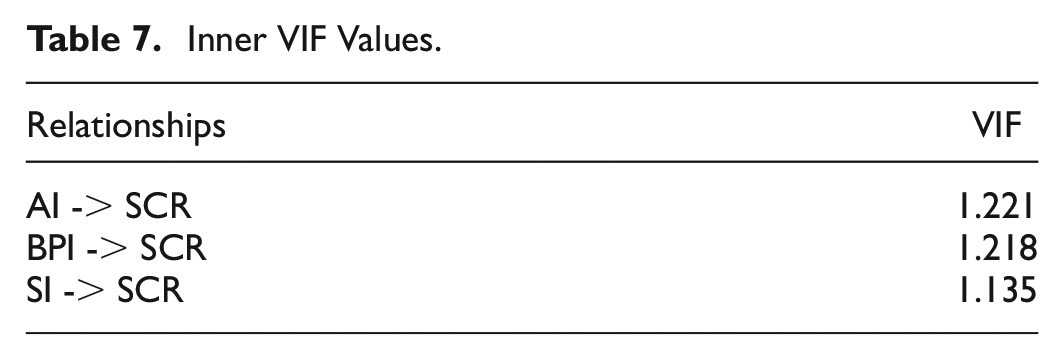
The collinearity of the structure model was investigated, and it was discovered that the VIF value of all variables was 1.135 to 1.221 as shown in Table 7, which is below the critical criterion of 3.3. Hence, there is no serious common method bias in this study. Using SmartPLS 3, the path model for construct analysis was created.
Inner VIF Values.
The results of this section provide information on the direct connections between the constructs of business process integration (BPI), system integration (S.I.), activity integration (A.I.), and supply chain responsiveness (SCR). A bootstrapping routine of 5,000 iterations was used for hypotheses testing in the model. Hair et al. (2019) found a correlation between bootstrapping sample size and t > 1.645 and t > 2.33. For hypotheses testing, path coefficients were calculated, and t-values for hypotheses were greater than the critical value (p < .01 for t > 2.33). In Figures 2 and 3, the direct path coefficient of the structural model is assessed using a two-procedure approach utilizing the PLS algorithm and bootstrapping. Table 8 demonstrates a significant and positive relationship between the constructs based on the testing results.

Path coefficient of the structural model (PLS algorithm).
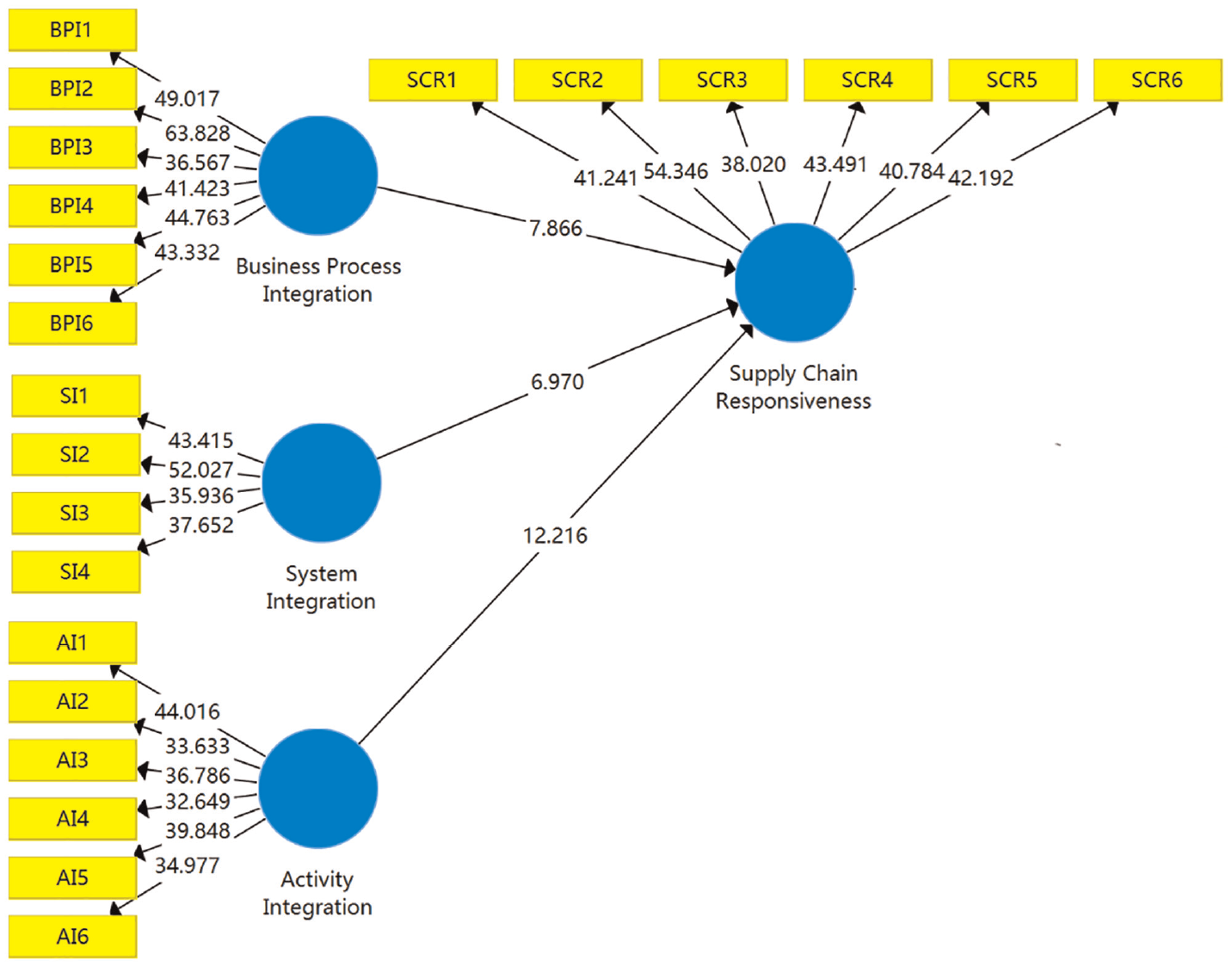
Path coefficient of the structural model (PLS bootstrapping).
Hypotheses Testing Results.

R 2 values range from 0 to 1, with higher values indicating better predictability. Establishing guidelines for optimal R2 values is difficult since they depend on the model’s complexity and the research discipline. In subjects such as consumer behavior and success driver research, R2 values of .20 are considered high (Kerja, 2017). In supply chain management, an R2 value of .20 is considered low. Due to supply chain management often involving complex systems with many variables and interactions, models with higher degrees of explanatory power are preferred. Nevertheless, while evaluating the R2 value, the specific context and objective of the study should also be considered (Hair et al., 2019).
Since this research concerns the Chinese electronics manufacturing supply chain responsiveness with key determinants, researchers anticipate significantly higher values, such as .5 or higher. Various scholars use different criteria to value R2. R2 values of .67, .33, or .19 for endogenous latent variables, according to Chin and Ringle’s criteria, can be classified as considerable, moderate, or weak (Hair et al., 2019). According to Table 8, each variable’s explanatory power to supply chain responsiveness (business process integration, activity integration, and system integration) is 0.549, and the result is significant. Based on the standard, the R2 value of all variables was greater than.33, suggesting a moderate-to-upper scenario. Hence, the interpretation is correct, as is the internal model (Table 9).
R2 Value.

By calculating the change in R2, the f2 effect size measures the relative impact of exogenous variables on endogenous variables. According to guidelines for calculating 2, values of 0.02, 0.15, and 0.35 represent the exogenous latent variable’s small, medium, and substantial effects. Effect size values below 0.02 denote the absence of an effect (Kerja, 2017). According to Table 10, the findings of this research demonstrate that the three main supply chain integration factors (A.I., BPI, and S.I.) all have medium effects, particularly in activity integration, which has the highest value of f2. This finding highlights the significance of activity integration in creating a supply chain responsive to Chinese electronics manufacturing companies.
f2 Value.

Researchers could also use the Stone-Geisser Q2 value as a measure of prediction accuracy in addition to gaging the size of the R2 values (Kerja, 2017). Q2 values greater than 0 imply the predictive usefulness of the model for a specific endogenous construct. However, values of 0 and lower suggest a lack of predictive relevance (Kerja, 2017). According to Hair et al. (2019), cross-validated redundancy prediction fully suits the PLS-SEM technique (Hair et al., 2019). To evaluate the predictive relevance of the model for each endogenous component, Table 11 displays the sum of squared observations (SSO), the sum of squared prediction errors (SSE), and the final value Q2 in the last column. All endogenous constructions have Q2 values that are significantly more than zero, as can be seen. In more detail, BPI (0.425) has the highest Q2 value, followed by SCR (0.420), A.I. (0.373), and SI (0.373). (0.360). These findings show how well the model predicts the endogenous latent variables.
Q2 values.

Discussion
The findings demonstrate that business process integration, activity integration, and system integration significantly influence improved supply chain responsiveness in the context of Chinese electronics manufacturing companies (B. Li & Li, 2017). Supply chain responsiveness is critically dependent on business process integration for Chinese electronics manufacturers. Business processes can be integrated to streamline operations and reduce production delays when a company integrates its business processes. Communication and coordination between departments within a manufacturing company, for instance, can reduce lead times and improve delivery performance by identifying and resolving issues more quickly. Integrating business processes can also improve information sharing between companies, enabling them to respond to demand changes more quickly. A short product life cycle and fluctuating demand are essential in the electronics manufacturing industry (Orji & Liu, 2020).
Meanwhile, Chinese electronics manufacturers need system integration to stay competitive and meet customer demands in a supply chain that must be responsive to customer demands. These companies can improve their supply chain responsiveness by linking different information systems and technologies, reducing lead times, and responding quickly to changing market conditions (Gupta et al., 2020). Furthermore, it has been shown that companies can improve their supply chain responsiveness by coordinating and integrating different activities within their organization, reducing lead times, and responding more rapidly to changing market conditions.
Findings of the Relationship Between Business Process Integration and Supply Chain Responsiveness
Business process integration and supply chain responsiveness significantly positively correlated, with a path coefficient of 0.306, according to the findings from the earlier part. It may demonstrate how effectively business process integration (BPI) is used and how that responsiveness is reflected in Chinese electronics manufacturing supply chains. Many Chinese electronics manufacturers have realized how crucial BPI is for enhancing the capacities of their supply chain partners (Institute, C. E. I. I. D. R, 2022). When a company’s various departments collaborate well and share information, it has integrated its business processes, which improves communication, streamlines workflows, and speeds up decision-making. That aligns with the opinions expressed by Wiengarten et al. (2019), who highlighted the significance of business process integration for creating new products through knowledge sharing and decision-making (Wiengarten et al., 2019). During the creation of a new product, for instance, a supply chain partner with knowledge of a particular technology or manufacturing procedure might offer direction and help (Nabila et al., 2022). This can help the business introduce new products to the market more rapidly and effectively, increasing its ability to adapt to shifting consumer demand and overcome the current crisis and turbulent times.
Findings of the Relationship Between System Integration and Supply Chain Responsiveness
According to recent research findings, system integration (S.I.) can promote information exchange and communication between supply chain partners, enhancing supply chain responsiveness (Li et al., 2018; Liu et al., 2019). Chinese electronics manufacturers may benefit from effective S.I. to enhance their forecasting and planning capabilities. This may result in shorter lead times, better supply chain responsiveness, and sound production alignment. According to a prior study, the firm will only remain competitive over the long run by connecting information systems with its key supply chain partners to enable more significant data and information exchange (Chygryn et al., 2020). To increase supply chain responsiveness, S.I. with appropriate technology that can support effective communication and coordination among Chinese electronics manufacturing supply chain members and the data analysis results are crucial.
Findings of the Relationship Between Activity Integration and Supply Chain Responsiveness
In light of the results from the previous part, the path coefficient is 0.435, reflecting that activity integration significantly impacts supply chain responsiveness. As a result, the level of activity integration demonstrates the company’s supply chain management capabilities (W. Yu et al., 2018). Integrating activities across different functions and departments allows Chinese electronics manufacturing companies to streamline their operations and reduce the time and resources required to move products through the supply chain. The above viewpoint is consistent with Kim and Cavusgil (2009), who demonstrated that activity integration constructs positively impact supply chain responsiveness (Kim & Cavusgil, 2009). The truth from the data analysis illustrated that even in the new business environment, both integration constructs could affect the supply chain’s responsiveness. More importantly, It enhances the influence of business process integration on Chinese electronics firms’ supply chain responsiveness. This is anticipated because the more connected the supply chain partners are, the more likely the entire supply chain will be able to swiftly and efficiently respond to external impediments. Partners collaborating closely on planning and forecasting may also learn from and complement each other, allowing them to respond rapidly to any uncertainty.
Theoretical Implication
This study aims to provide theoretical value to the measurement model by using RBV theory to explain the relationships among the constructs. The findings of this research fill a vacuum in the literature by hypothesizing a link between outcomes and variables. In line with the RBV theory expectation, the outcomes of this research support the proposition that business process integration, activity integration, and system integration are related to supply chain responsiveness. Empirical evidence would be needed to demonstrate that different types of integration improve supply chain responsiveness. This approach could inform practitioners and policymakers in making decisions regarding adopting and implementing integration strategies to improve supply chain responsiveness. Simultaneously, this study opens up a new line of inquiry into the determinants of supply chain management in Chinese electronics manufacturing firms.
Managerial Implication
This study provides managerial contributions. It guides electronics manufacturing managers involved in the supply chain to rethink effective ways for supply chain responsiveness using a resource-based approach. Additionally, this study provides managers with practical ways to identify critical factors for a more responsive supply chain (Jiang, 2021; A. Wu & Li, 2020). Moreover, during the study, Chinese electronics manufacturing firms were suggested to improve business process integration, system integration, and activity integration to improve supply chain responsiveness. There are many ways to accomplish this, including streamlining communication and collaboration between business units within the organization and external partners (such as consumers and suppliers), integrating different information systems to enhance real-time information sharing and decision-making, and reducing lead times and improving efficiency within the organization by optimizing processes and activities.
Conclusion
This study delved into the intricacies of supply chain responsiveness within Chinese electronics manufacturing companies, drawing upon the RBV theory and DCV theory to construct a comprehensive conceptual model. This research contributes to the literature on supply chain integration and responsiveness in the electronics manufacturing industry. It has demonstrated a significant positive relationship between the integration of business processes, systems, and activities and the ability of companies to respond to changes in market conditions and consumer demand. The significance of this research lies in its potential to revolutionize the way these companies operate, ultimately improving their ability to meet customer demands efficiently.
The relationship between supply chain responsiveness and business process integration is our primary claim, which is backed up by empirical evidence. Streamlining operations, reducing redundancies, and improving communication can significantly reduce reaction times to customer needs, shorten delivery times, and improve overall supply chain responsiveness for Chinese electronics manufacturers. From raw material suppliers to final product delivery, this integration fosters collaboration and coordination throughout the entire supply chain, resulting in win-win scenarios for all parties involved.
Furthermore, researchers underscore the direct relationship between system integration and supply chain responsiveness. Due to the inherent complexity and dynamism of the electronics manufacturing industry in China, system integration is regarded as particularly crucial. By integrating diverse systems and processes, companies can swiftly adapt to changes in demand and supply, ensuring agile responses to unforeseen supply chain disruptions. In an ever-evolving and fiercely competitive market, Chinese electronics manufacturers can gain an advantage by embracing cutting-edge technologies and best practices.
As researchers have demonstrated, activity integration is also pivotal in enhancing supply chain responsiveness. Effective activity integration, eliminating communication barriers, and facilitating information flow between departments enables quicker decision-making and fosters collaboration across departments. Thus, businesses can respond to fluctuations in demand more effectively and forecast better.
These findings are particularly relevant for the electronics manufacturing industry in China’s Guangdong region, where managers can use this knowledge to integrate their supply chains better and improve their responsiveness. While further research is needed to confirm and extend these findings, the present study provides a solid foundation for understanding the critical role of supply chain integration in enhancing responsiveness.
It is essential to acknowledge the limitations of this research, particularly regarding the generalizability of our findings. However, despite these limitations, this study contributes to the body of knowledge concerning Chinese electronics manufacturing. It provides practical insights that can aid industry practitioners in optimizing and deploying their resources more effectively for improved supply chain management.
In summary, the overarching purpose of establishing supply chain integration—business process integration, system integration, or activity integration—is to enhance supply chain responsiveness in Chinese electronics manufacturing companies. Researchers urge industry stakeholders to recognize the potential benefits of these integrative approaches and consider their adoption. The practice of supply chain management can thus evolve in response to a dynamic market.
Future Research Direction
Though this study contributes to the literature on supply chain responsiveness in the Chinese electronics manufacturing sector, there is always space for further research. Future research could focus on the following areas:
Cross-sectoral Analysis: Although this study concentrated on the Chinese electronics manufacturing industry, similar studies can be conducted in other sectors to compare and contrast the findings. This will help us understand whether the same principles apply to all industries or if there are sector-specific variations.
International Comparison: This research focused on Chinese electronics manufacturers. Further studies could investigate whether similar relationships exist between system integration, activity integration, business process integration, and supply chain responsiveness in electronics manufacturers in other countries or regions.
In-depth Case Studies: While this study provided a broad overview of the relationship between integration and supply chain responsiveness, in-depth case studies could provide more nuanced insights into how specific firms in the Chinese electronics manufacturing industry are achieving these benefits.
Impact of Emerging Technologies: This research should also consider the impact of emerging technologies like Artificial Intelligence (A.I.), the Internet of Things (IoT), and Blockchain on the integration and responsiveness of the supply chain in the electronics manufacturing industry.
Supply Chain Resilience: Future research could also explore the role of integration in enhancing supply chain resilience, especially in the face of disruptions such as the COVID-19 pandemic, highlighting the need for resilient supply chains.
Environmental Sustainability: As the global concern for the environment grows, it would be interesting to study how system, business processes, and activity integration can influence environmental sustainability in the supply chain.
Role of Government Policies: Future research could investigate the impact of government policies on supply chain integration and responsiveness, considering the government’s decisive role in Chinese businesses.
By investigating these areas, we could gain a deeper and richer understanding of supply chain responsiveness, which could help electronics manufacturers in China and beyond navigate the rapidly changing business environment more effectively.
Footnotes
Authorship Contributions
Fei Jiang: Conceptualization, Methodology, Validation, Investigation, Writing, Funding acquisition. Filzah Md Isa: Formal analysis, Software, Resources, Visualization, Funding acquisition. Sin-Pei Ng: Editing and Review, Data Curation, Formal analysis, Validation. Mariam Bhatti: Writing, Funding acquisition.
Author Note
This research was conducted while [Fei Jiang] was at [Guangxi International Business Vocational College]. They are now at [ School of Management and Marketing, Faculty of Business and Law, Taylor's University. Subang Jaya, 47500 Selangor, Malaysia] and may be contacted at [ 461425403@qq.com].
Declaration of Conflicting Interests
The author(s) declared no potential conflicts of interest with respect to the research, authorship, and/or publication of this article.
Funding
The author(s) disclosed receipt of the following financial support for the research, authorship, and/or publication of this article: This paper is the midterm research result of the 2022 Guangxi University Teachers Basic Research Ability Improvement Project’ Construction of multimodal transport smart logistics system based on the new western land-sea corridor under the influence of RCEP (code:2022KY1252); Special fund for science and technology innovation strategy of Guangdong Province in 2021 (special fund for climbing plan) (pdjh2021a0944).
Ethical Approval
No need ethical approval.
Informed Consent
Any participants (or their guardians if unable to give informed consent, or next of kin, if deceased) who may be identifiable through the manuscript (such as a case report), have been given an opportunity to review the final manuscript and have provided written consent to publish.

Data Availability Statement
Data sharing not applicable to this article as no datasets were generated or analyzed during the current study.