




Abstract
The mobility of skilled employees from developing to developed cities is a prominent phenomenon in China. However, little is known about whether and how micro factors (e.g., unfair treatment) in the workplace affect employees’ cross-city mobility. The aim of this study is thus to investigate the effect of employees’ perceived workplace unfairness on their intentions to withdraw from the city where they work, specifically, to shed light on the moderating role of urban identification in this effect. Through a survey of 453 skilled employees working in developing cities in northeast China, this study reveals that (a) both perceived distributive and procedural unfairness have a positive effect on employees’ urban dissatisfaction, which in turn reinforces their urban withdrawal intention; (b) urban identification can amplify the positive effect of perceived distributive/procedural unfairness on urban dissatisfaction; and (c) the positive joint effect of perceived distributive/procedural unfairness and urban identification on urban dissatisfaction can further carry over to urban withdrawal intentions. This study therefore sheds new lights on how employees’ workplace unfairness shapes their withdrawal intentions toward the city where they work and how their urban identification moderates this process, offering implications for how developing cities and firm managers can retain skilled employees.
Plain language summary
Numerous prior studies have argued that individuals’ urban identification (a sense of belonging and/or affective commitment to a city) helps them to accept the city’s imperfections and facilitates their intentions to stay. This implies that urban identification plays a buffering role in individuals’ reactions to a city’s imperfections. However, this study challenges the buffering role of urban identification with the argument: if employees experience unfairness in the workplace regarding distribution and procedures, and they attribute blame to the city, an increase in their intentions to leave the city may be witnessed. More importantly, urban identification will play a “love becomes hate” amplifying effect between the experience of workplace unfairness and the intentions to leave the city. Empirical analyses based on a survey of 453 employees from developing cities in northeastern China confirms the above arguments. The key implication is that for employees working in developing cities who experience unfairness in the workplace and attribute blame to the city where they work, fostering their urban identification does not buffer their intentions to leave the city, but may instead reinforce their willingness to leave. The main limitation of the very present study is that our findings are based on only one sample from developing cities in Northeast China.
Keywords
Introduction
With China’s urbanization, the cross-city mobility of skilled employees has become a prominent phenomenon (He & Qian, 2017; X. Wu, 2019). For example, from 2009 to 2018, 3.78 million skilled employees in northeast China moved to other cities, especially developed cities (e.g., Shenzhen) (cf. Lu, 2021). Given the crucial role of a skilled workforce in a city’s sustainable development, addressing cross-city mobility has become an important issue for city managers and firms in developing cities (He & Qian, 2017; Ma et al., 2020). Thus, it is important to understand the driving mechanisms behind skilled employees’ cross-city mobility.
Prior studies have offered fruitful findings regarding employees’ mobility across firms (Belal, 2023). They have demonstrated that employee mobility can be driven by individual-level (e.g., employee skills, Scoresby & Park, 2021; knowledge and experience, Ganco, 2013; personality traits, van Huizen & Alessie, 2019), firm-level (e.g., wage, Kacperczyk & Bachalandran, 2018; compensation dispersion, Carnahan et al., 2012), or institutional-level factors (e.g., enforcement of non-competition agreements, Johnson et al., 2020). Concerning employees’ cross-city mobility, some studies in the field of urban management (e.g., Lin & Zhu, 2022; Ma et al., 2020; X. Wu, 2019; Zhang et al., 2019) have revealed some macro causes, such as the agglomeration effects of central cities, regional economic levels, industrial structures, or livability differences. Previous research, however, has not explored whether and how micro-level factors (e.g., unfair treatment) in the workplace affect employees’ cross-city mobility (Belal, 2023).
Furthermore, the literature suggests two opposing, moderating roles of residents’ identification with a specific city (urban identification, an individual’s sense of belonging and affective commitment to a city, Mišič & Podnar, 2019; Rollero & De Piccoli, 2010; Tajfel & Turner, 2004) in their cross-city mobility, namely, “buffering” versus “amplifying.” The buffering stream (e.g., Hernández et al., 2007; Mišič & Podnar, 2019; Rollero & De Piccoli, 2010; W. Wu, 2004, F. Wu, 2012; Zenker & Petersen, 2014) argues that cultivating residents’ identification with a specific city could help to mitigate their withdrawal intention toward that city. The higher an individual’s identification with a city is, the stronger the individual’s sense of belonging and affective commitment to the city (Mišič & Podnar, 2019). Thus, enhancing individuals’ identification with a city may increase their intention to accept the city’s imperfections (e.g., lower income relative to developed cities), thereby strengthening their intention to stay and weakening their intention to leave the city (Cuba & Hummon, 1993; W. Wu, 2004, F. Wu, 2012; Zenker & Petersen, 2014). In contrast, the amplifying stream (e.g., Brockner et al., 1992; Irving & Coleman, 2003; Reilly, 1994) asserts that individuals who have strong identification with another party also have high expectations of that party. When strongly attached individuals experience unfair treatment from the other party, sharp contrasts with expectations will occur, resulting in their strong disappointment and negative responses (e.g., avoidance or revenge, Tripp et al., 2007) to the other party, amplified by their attachment. Previous research, however, has not yet determined which moderating role of urban identification is applicable in the case of skilled employees’ cross-city mobility.
To fill these gaps, this study integrates skilled employees’ perceived distributive and procedural unfairness in the workplace, urban identification, urban dissatisfaction, and urban withdrawal intention into a conceptual model to investigate the mechanism behind their cross-city mobility. Urban withdrawal intention refers to the extent to which an employee is willing to cut off his or her connections with the city in which he or she currently lives (Howard & Cordes, 2010; McCullough et al., 1998) and work in another city to change his or her work circumstances (Koslowsky, 2009; Pinto et al., 2017). Through a survey of 453 Chinese skilled employees, this study confirms that perceived distributive/procedural unfairness positively affects urban dissatisfaction and urban withdrawal intention. Hence, these results support the “amplifying,” moderating role of urban identification on the relationship among perceived distributive/procedural unfairness, urban dissatisfaction, and urban withdrawal intention. The findings also reveal that perceived distributive/procedural unfairness and urban identification have a positive joint effect on urban dissatisfaction, which in turn reinforces skilled employees’ urban withdrawal intention. This study, then, contributes to the employee mobility literature by verifying the positive effects of micro-level workplace unfairness on employees’ withdrawal intentions toward a city and the amplifying role of urban identification in these effects. Practically, our findings provide implications for managers of developing cities and their firms regarding skilled employee retention.
In the remainder of this paper, we introduce the literature review, elaborate our hypothesis development and methodology, and discuss our results. This paper ends with a conclusion.
Literature Review
Employee Mobility
At the micro level, prior studies in the field of organizational behavior have offered productive findings on employee mobility or turnover among firms. Employee mobility refers to the movement of employees from one company to another (Mawdsley & Somaya, 2016). First, extensive prior studies have demonstrated the impacts of individual-level factors. For example, Ganco (2013) and Scoresby and Park (2021) reveal the positive effects of employees’ skills, experience, and technological specialization on their mobility. Liu and Hu (2021) and Renneboog and Zhao (2020) have shown that employees’ social ties and relational capital positively affect their mobility. Additionally, individuals’ personality traits, such as being risk-tolerant (vs. risk-averse) (van Huizen & Alessie, 2019), open to migration (Huinink et al., 2014), or open to experience (Wille et al., 2010), play a positive role in their mobility decisions.
In addition to individual-level antecedents, firm-level factors, such as low wages (Campbell et al., 2012; Kacperczyk & Bachalandran, 2018), distribution unfairness (Joseph et al., 2015; Sørensen & Sharkey, 2014), and low opportunities for advancement (Kacperczyk & Bachalandran, 2018), are drivers of employees’ mobility. Furthermore, academics (e.g., Johnson et al., 2020; Starr et al., 2018) have demonstrated that institutional-level factors, such as the enforcement of noncompetition agreements, decrease employee mobility.
At the macro level, scholars in the field of urban management have documented some macro causes of employees’ cross-city mobility. For example, Ma et al. (2020) and Lin and Zhu (2022) argue that the agglomeration effects of central cities, industrial structures, and livability differences have a significant impact on employees’ cross-city mobility and that the agglomeration effects of central cities have the greatest impact. Zhang et al. (2019) have also revealed that regional economic level is a driver of employee cross-city mobility. Finally, Wu (2019) has highlighted the role of income inequality in employees’ cross-city mobility.
Workplace Unfairness and Employee Mobility
Individuals’ perceived workplace unfairness typically includes their perceptions of unfairness toward distributions (i.e., distributive unfairness) and procedures (i.e., procedural unfairness) at work (Howard & Cordes, 2010). When an individual perceives that his or her ratio of firm outcomes to firm inputs is lower than that of his or her colleagues in the focal firm (internal unfairness) or of employees in other firms with similar jobs (external unfairness), distributive unfairness occurs (Howard & Cordes, 2010). When an individual perceives that the processes or procedures of a firm that determine his or her outcomes are not fair, procedural unfairness occurs (Lind & Tyler, 1988). Another type of unfairness among persons, that is, interactional unfairness, has been proposed by Bies and Moag (1986). However, recent studies (e.g., Howard & Cordes, 2010) have shown that this can be classified as procedural unfairness.
Scholars have thus directly or indirectly demonstrated the positive effects of distribution unfairness on employees’ mobility. For example, Campbell et al. (2012) and Kacperczyk and Bachalandran (2018) report that perceptions of inadequate pay increase employees’ mobility. Sørensen and Sharkey (2014) and Joseph et al. (2015) directly show that distribution unfairness (perceived internal wage inequality) positively affects employee mobility. The positive effect of procedural unfairness on employee mobility has also been documented in other studies (Daileyl & Kirk, 1992; Howard & Cordes, 2010; Otaye & Wong, 2014).
Urban Identification
Urban identification involves an individual’s social identity development in relation to a city. Social identity theory (Tajfel & Turner, 2004) suggests that an individual’s self-concept includes not only individual identity but also social identity. Individual identity is developed on the basis of specific individual traits, while social (or collective) identity is developed on the basis of an individual’s membership in a group, such as a gender, racial/ethnic, or urban identity (Tajfel & Turner, 2004). As a residential member of a city, an individual may develop a sense of belonging and/or affective commitment to the city through daily interactions with the city (Hernández et al., 2007; Rollero & De Piccoli, 2010). This social identity development in relation to a city constitutes a person’s urban identification (Mišič & Podnar, 2019; Tajfel & Turner, 2004). Urban identification can be specifically defined as the degree to which a citizen defines himself/herself as the member of a city and the extent to which he or she experiences a sense of belonging or affective commitment to that city (Zenker & Petersen, 2014). The stronger a citizen’s urban identification is, the stronger his or her sense of belonging and/or affective commitment toward his or her city.
Concerning the moderating role of urban identification in employees’ mobility decisions, there are two rival explanations: “buffering” (love is blind) versus “amplifying” (love becomes hate). The former argues that highly urban-identified (vs. low urban-identified) individuals will experience weaker dissatisfaction and weakened mobility intention toward their city after encountering an unfair event (e.g., a distributive unfair treatment) therein. High-identified (vs. low-identified) individuals have a stronger sense of belonging and/or affective commitment toward the city (Mišič & Podnar, 2019). This “love” toward the city may enhance their intention to accept the imperfections of the city (e.g., lower income relative to other cities), strengthen their intention to stay and reduce their intention to withdraw from the city (Cuba & Hummon, 1993; W. Wu, 2004, F. Wu, 2012; Zenker & Petersen, 2014). In the literature on the “love-is-blind bias” (Murray & Holmes 1997), assimilation bias (i.e., in an uncertain condition, individuals tend to underweight or neglect messages that are inconsistent with their previously endorsed ones due to their strong identification with an object, cf. Grégoire & Fisher, 2006) and the buffering effect of commitment in individuals’ resistance to negative information persuasion (Ahluwalia, 2000) provide support for this explanation.
An alternate explanation contends that high (vs. low) urban identification will trigger individuals’ stronger dissatisfaction and withdrawal intentions from the city after experiencing an unfair event therein. High-identified (vs. low-identified) individuals’ intense “love” (i.e., strong sense of belonging and affective commitment) for a city might induce their higher expectations for the city (Brockner et al., 1992; Meyer & Maltin, 2010). When unfair events are encountered and accountability is attributed to the city, high-identified individuals will experience stronger contrasts with their expectations relative to low-identified individuals. This sharp contrast will reinforce or amplify high-identifiers’ dissatisfaction and intention to withdraw from the city, that is, love becomes hate. Indeed, some studies (e.g., Brockner et al., 1992; Irving & Coleman, 2003; Reilly, 1994) in the field of organizational behavior support the amplifying effect (love becomes hate) of organizational commitment on employees’ reactions to perceived unfairness or job stressors.
Research Gaps
Although prior studies have provided fruitful findings on employees’ mobility across firms and some have explored the causes of employees’ cross-city mobility, little is known about whether and how micro-level workplace factors affect employees’ cross-city mobility. In particular, researchers have suggested two opposing effects regarding the moderating role of employees’ commitment in their reactions to unfair or stressful treatment. However, we still do not know which moderating explanations (buffering vs. amplifying) of employees’ urban identification are applicable in employees’ cross-city mobility decisions. This study aims to fill these gaps.
Hypothesis Development
Perceived Workplace Unfairness, Urban Dissatisfaction and Urban Withdrawal Intention
This study follows the “accountability” and “counterfactual thinking” principles of fairness theory (Folger & Cropanzano, 1998) to demonstrate the relationships among employees’ perceived workplace unfairness, dissatisfaction with the city where they work (urban dissatisfaction) and intention to withdraw from that city (urban withdrawal intention).
Fairness theory (Folger & Cropanzano, 1998) asserts that when an individual perceives distributive or procedural unfairness in the workplace, he or she usually follows the principles of accountability and counterfactual thinking to infer causes of the unfair state. The accountability principle argues that for any unfair event or state, some party is to blame (Folger & Cropanzano, 2001). Applying this principle to an unfair state in the workplace, accountability can be determined based on the following three elements (Folger & Cropanzano, 1998): (a) the unfair state or event makes the employee perceive loss; (b) the employee believes that the responsible party (e.g., the employer) has volitional control (e.g., the employer had the option of providing fair treatment) over the unfair treatment; and (c) the employee perceives that the responsible party violated some norms (e.g., the employer should pay the employee fairly according to his or her contributions) or ethical standards (e.g., the employer should respect or highly value the employee) in the event or state.
When an employee perceives unfair treatment with regard to distribution or procedures in a firm and feels loss, he or she will further assess whether the employer has volitional control over the unfair event and whether the employer has violated norms or ethical standards. If the assessment affirms the employer’s volitional control and violations of norms or ethical standards, the employee will blame the employer, increasing his or her dissatisfaction with the employer (Daileyl & Kirk, 1992) and subsequent turnover intention (Hom & Kinick, 2001). If the assessment affirms that the employer did not have volitional control and did not violate norms or ethical standards, the employee will blame other parties, such as the city where he or she works. For instance, an employee may confirm that the reward or treatment he or she received was not worse than that of peers in other firms of the city but was significantly worse than that of his or her counterparts in other cities; in this case, the employee will blame the city. In fact, numerous skilled employees who work in developing cities (e.g., cities in northeast China) tend to blame the city after experiencing an unfair event (Lu, 2021; Ma et al., 2020; Yuan & Gao, 2022).
The counterfactual thinking principle refers to the contrast between “what is perceived to be” and “what might have been” (cf. McColl-Kennedy & Sparks, 2003). When an individual encounters a negative state or event, he or she uses counterfactual thinking to infer accountability (Folger & Cropanzano, 2001; Roese, 1997). Applying this principle to an employee’s unfair treatment in a firm, the employee may imagine possible alternative outcomes that vary from what he or she actually received, although the imagined outcomes are often counter to the facts. In that case, the employee thinks in a contrastive framework about how much payment might have been received or how well he or she might have been respected or valued if he or she were treated fairly by the firm or if he or she had worked in another firm or in another city (McColl-Kennedy & Sparks, 2003).
Following counterfactual thinking, an employee who perceives unfair treatment will infer the reason why the counterfactual outcome did not occur. Given the significant variance of average salary (National Bureau of Statistics of China, 2021) and socioeconomic inequalities (X. Wu, 2019) among different cities of China, employees who practice counterfactual thinking may ponder the following: “I could and should have earned more money (being treated with fair distribution) and received better treatment (being treated with fair procedures) if I had worked in another city.” This pondering about counterfactual outcomes (e.g., higher income, better procedures) will also lead the employee to blame the city (Tripp et al., 2007). If an employee attributes the cause of distribution and/or procedural unfairness in his or her workplace to the city, whether through accountability or counterfactual thinking, it will result in the employee’s dissatisfaction with the city (i.e., urban dissatisfaction) (Hom & Kinick, 2001). Indeed, prior studies (e.g., Lu, 2021; Ma et al., 2020; X. Wu, 2019; Yuan & Gao, 2022) in the Chinese context have argued that skilled employees who work in developing cities tend to attribute the cause of unfair distribution/procedural treatment to the city where they work. Thus, we hypothesize the following:
H1: Perceived distributive (H1a) and procedural (H1b) unfairness in the workplace will increase urban dissatisfaction.
An employee’s unfair experiences and dissatisfaction with a city will further shape his or her withdrawal intention toward the city (i.e., urban withdrawal intention) (Howard & Cordes, 2010; Tripp et al., 2007). Urban withdrawal intention refers to an employee’s desire to cut off his or her current connections with a city (Howard & Cordes, 2010; McCullough et al., 1998) and willingness to work in another city to change his or her work circumstances (Koslowsky, 2009; Pinto et al., 2017). Urban withdrawal is an immediate reaction to dissatisfaction with a specific city (Hom & Kinick, 2001). It should be noted that victims of unfairness can also choose revenge to restore fairness and reduce their dissatisfaction if the unfairness is caused by an individual or an organization (Tripp et al., 2007). However, if the unfairness is due to a city and the victim cannot restore fairness by retaliating against the city, the victim will perform withdrawal or avoidance reactions (Hom & Kinick, 2001; Tripp et al., 2007). Therefore, for employees who work in a developing city, if distributive and/or procedural unfairness leads to their urban dissatisfaction, it further reinforces their withdrawal intention toward the city. Formally, we propose the following hypotheses:
H2: Urban dissatisfaction is positively related to urban withdrawal intention.
H3: Urban dissatisfaction acts as a mediator between two forms of perceived unfairness (distributive, H3a; procedural, H3b) and urban withdrawal intention.
Moderating Effects of Urban Identification
Although there are two rival explanations, prior studies (e.g., Crossley, 2009; Grégoire & Fisher, 2006) further suggest that accountability regarding a negative event plays a critical role in determining the moderation direction of urban identification. If individuals consider that the city should be accountable for unfair rewards or procedures, that is, they believe that there was no significant unfair treatment among different firms in the city but obvious poorer treatment relative to firms of other cities, their urban identification may moderate their intention to withdraw by playing an amplifying role (i.e., love becomes hate) in the causal link among workplace unfairness, urban dissatisfaction, and urban withdrawal intention. However, if individuals believe that it is not the fault of the city, the moderation of urban identification may have a buffering effect in the link (i.e., love is blind).
In the case of unfair rewards and/or procedures for skilled employees, prior studies (e.g., Lu, 2021; Ma et al., 2020; Yuan & Gao, 2022) have revealed that skilled employees in China’s developing cities tend to blame the city. Thus, we expect that urban identification, as a moderator, will have an amplifying effect, that is, it will amplify the positive effect of perceived distribution/procedural unfairness on urban dissatisfaction and urban withdrawal intention. Indeed, although very limited, some research (Brockner et al., 1992; Irving & Coleman, 2003; Reilly, 1994) in the field of organizational behavior supports the amplifying role of prior commitment in employees’ reactions to unfair or stressful treatment. Thus, we propose the following:
H4: Urban identification will amplify the positive effect of perceived distributive unfairness on urban dissatisfaction (H4a) and urban withdrawal intention (H4b).
H5: Urban identification will amplify the positive effect of perceived procedural unfairness on urban dissatisfaction (H5a) and urban withdrawal intention (H5b).
It should be noted that H4b and H5b involve a moderated mediation approach (Hayes, 2013). Figure 1 describes the conceptual framework of the study.
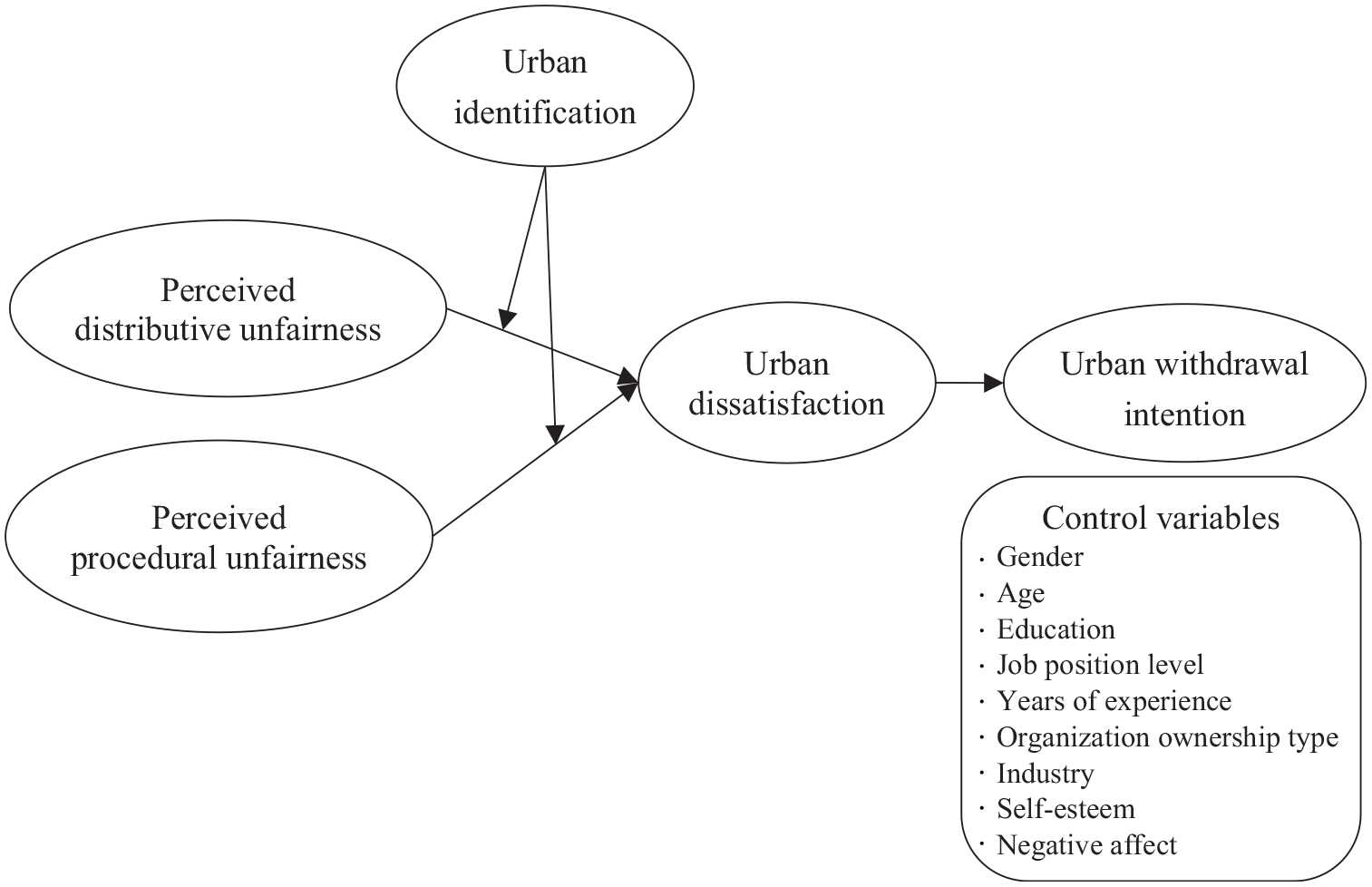
Conceptual framework.
Methodology
Sample
Given that the cross-city mobility of skilled employees in northeast China is prominent (Ma et al., 2020; You et al., 2021), this study collected a sample of these employees to test our hypotheses. Specifically, we collected subjects from the social network of MBA students at a comprehensive university in northeast China. After designing the questionnaire via the “wenjuan.com” survey platform, we first sent corresponding links to 58 MBA students (employees of firms or other organizations) who expressed explicit willingness to complete the questionnaire via the WeChat app. After they completed the task, each of them was asked to invite seven of their colleagues to complete the questionnaire by sending the survey link to them. We paid each valid response six RMB through the “red envelope function” of WeChat, and all subjects provided informed consent. Finally, we obtained 453 valid responses. The results of post hoc power analysis (via G*Power 3.1.9.7, Faul et al., 2007) show that the power (1−β error probability) is greater than .99 with a sample size of 453 (α = .01, ρ = .3), indicating that the sample size is sufficient. The participants’ demographic characteristics are presented in Table 1.
The Demographic Characteristics of the Sample.

Measures
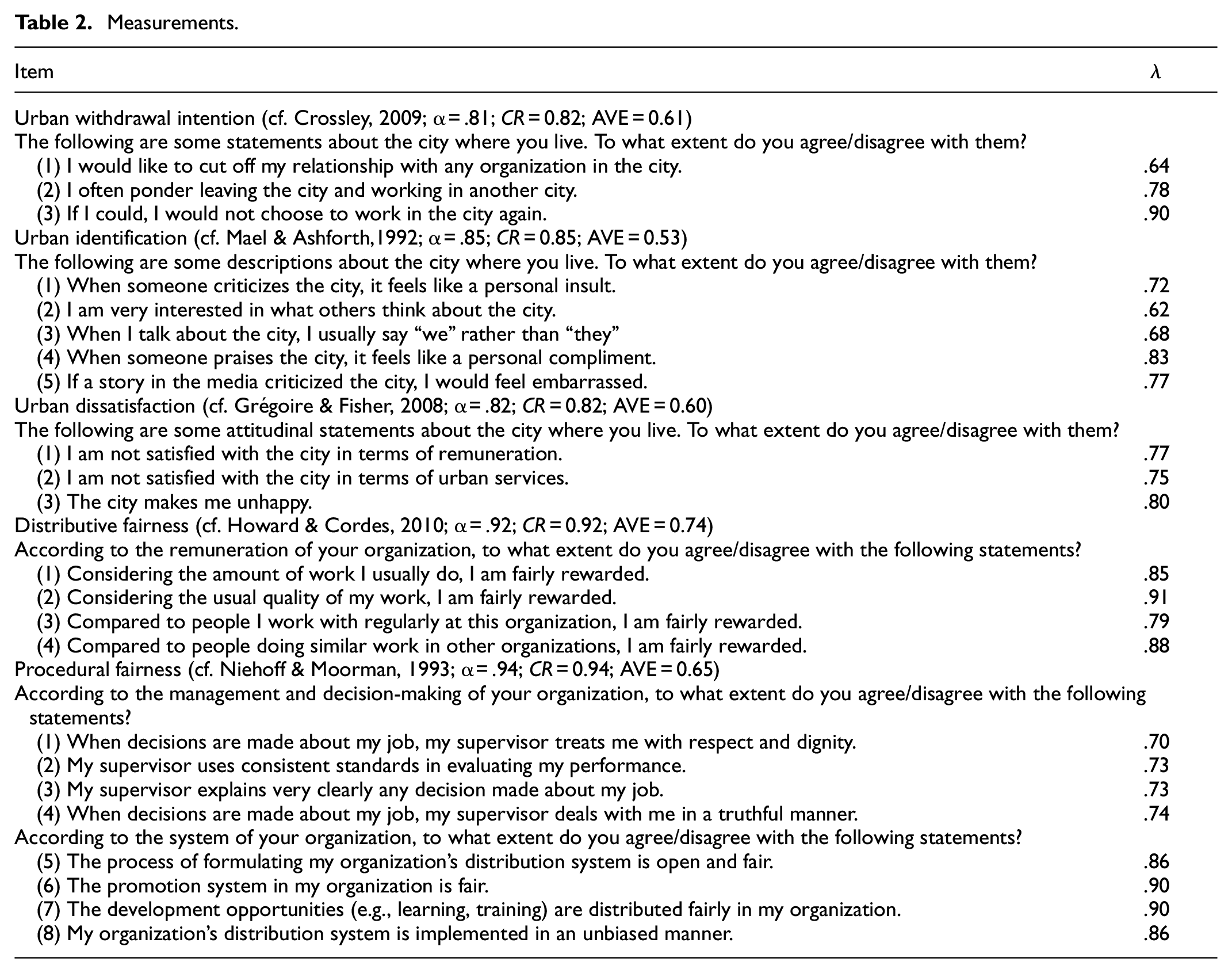
In the questionnaire, we first manipulated the subjects’ inputs by asking them, “Are you a helpful person?” (1 = yes, 0 = no). Cialdini (2016) asserts that this “presuasion” can significantly enhance subjects’ seriousness about the questionnaire. Of the 453 valid responses, 95.4% chose “yes.” Subsequently, scales adapted from prior studies were employed to measure the variables of this study. The specific items of the major variables are shown in Table 2. Participants responded to these items on a five-point scale (1 = strongly disagree to 5 = strongly agree).
Measurements.
Since self-esteem (an individual’s confidence in his or her self-worth or abilities, Rosenberg et al., 1995) and negative affect (Crawford & Henry, 2004) may confound the effects of perceived distributive/procedural unfairness on urban dissatisfaction and withdrawal intention, we included these two variables as control variables. For the self-esteem measurement, subjects responded on the following five items (1 = strongly disagree, 5 = strongly agree, Cronbach’s α = .86) of the Rosenberg self-esteem scale (Rosenberg, 1979): (a) I feel that I have a number of good qualities; (b) I am able to do things as well as most other people; (c) I feel that I’m a person of worth; (d) I certainly feel useless at times (R); (e) On the whole, I take a positive attitude toward myself. For negative affect, subjects were asked, “Please indicate to what extent you felt this way during the past week.” Then, five words describing negative affect (i.e., distressed, upset, nervous, scared, afraid; α = .84) along with another five words describing positive affect were randomly presented (Crawford & Henry, 2004). The subjects answered on a five-point scale (1 = very slightly or not at all, 2 = a little, 3 = moderately, 4 = quite a bit, and 5 = very much). Notably, translation and back-translation of all these items were conducted by the authors and an assistant professor who obtained his Ph.D. in England, following the procedure recommended by Brislin (1970). We carefully checked and corrected any discrepancies in the translations.
Given the high consistency (α and CR, see Table 2) of these constructs, we averaged the subjects’ scores on corresponding items to generate the variables. Moreover, since the measurement of perceived distributive and procedural fairness reflected the subjects’ perceptions of “fairness,” we reversed their scores on corresponding items to obtain their perceived distributive and procedural “unfairness.” Additionally, with reference to Belal’s (2023) review on employee mobility, the subjects’ gender, age, education, job position level, years of experience, organization ownership type, and industry were included in the questionnaire as control variables (Table 1 shows their specific options).
Finally, to reduce common-method bias, we told the respondents that this questionnaire consisted of four different parts. Specifically, after the introductory web page (the first page), we placed measurements of “urban withdrawal intention,”“urban identification,” and “urban dissatisfaction” on a separate follow-up page as Part 1 (the second page). Scales for “perceived distributive and procedural fairness” were placed on the third page as Part 2. Scales about “self-esteem” and “negative/positive affect” were placed on the fourth page as Part 3. Other control variables were placed on the final page as Part 4. After completing the tasks on one page, the subjects could not return to the previous page.
Statistical Procedure
IBM SPSS version 25.0, LISREL 8.7, and Process V3.5 based on SPSS developed by Hayes (2021) were employed to analyze the data. First, confirmatory factor analysis (CFA) based on LISREL 8.7 was conducted to examine the validity of all variables. The results in Table 2 show that the standardized factor loadings (λ) for all items were above .6. We therefore kept all the items. Second, both Cronbach’s α and composite reliability (CR) were calculated to test the internal consistency of the variables. Table 2 shows that the α and CR of all variables were above 0.8, implying high internal consistency. Third, the average variance extracted (AVE) was calculated to test the convergent validity. Table 2 indicates that the AVE of all variables was greater than the critical value of 0.5 (Hair et al., 2014). Fourth, we compared correlations among the variables and the square root of the AVE to examine the discriminant validity (Fornell & Larcker, 1981). Table 3 shows that all the correlations among constructs were less than the square roots of the AVE, thereby confirming the discriminant validity of the variables.
Means, Standard Deviations (SD), and Pearson Correlations of the Variables.
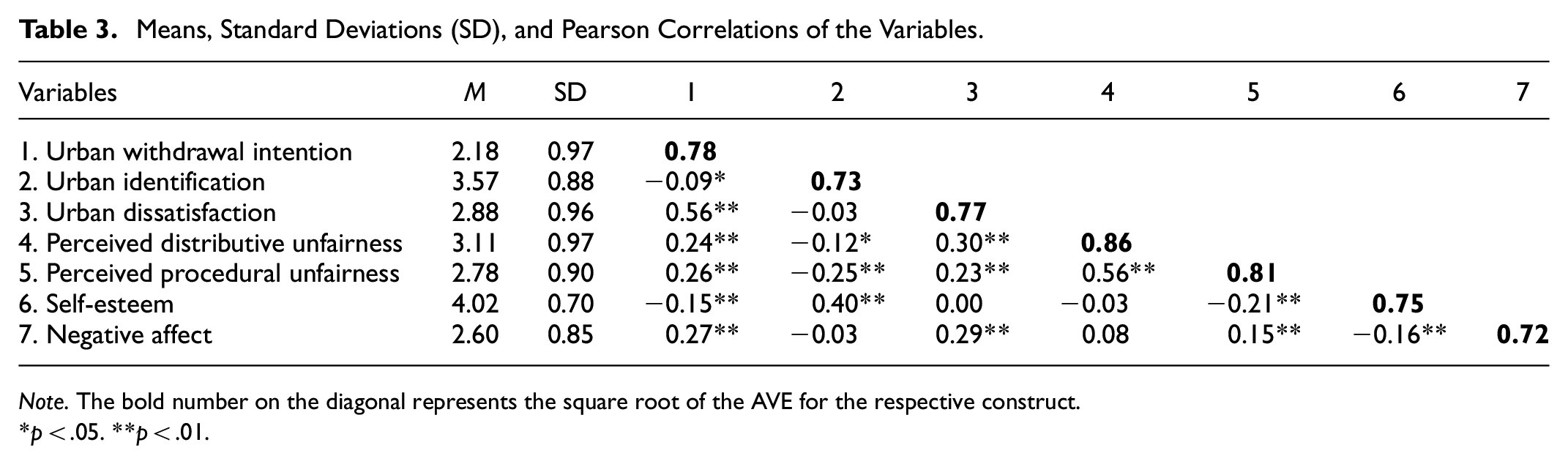
Note. The bold number on the diagonal represents the square root of the AVE for the respective construct.
p < .05. **p < .01.
Next, given the survey nature of the study, common-method bias (CMB) was examined (Podsakoff et al., 2003). CFAs indicated that the model fit indices of the seven-factor solution (χ2 = 2,096.87, df = 474, RMSEA = 0.087, NFI = 0.91, NNFI = 0.93, CFI = 0.94) were evidently better than those of the single-factor solution (χ2 = 9,737.31, df = 495, RMSEA = 0.203, NFI = 0.68, NNFI = 0.68, CFI = 0.70). These results suggest that CMB was not a problem in this study (Podsakoff et al., 2003). To test the hypotheses, multiple linear regression, a mediation model, and a moderated mediation model analysis method were used.
Results
Table 3 indicates that both perceived distributive (r = .30, p < .01) and procedural (r = .23, p < .01) unfairness are significantly positively related to urban dissatisfaction, which provides initial support for H1a and H1b. Perceived distributive (r = .24, p < .01) and procedural (r = .26, p < .01) unfairness also have a significant relationship with urban withdrawal intention. Urban dissatisfaction is positively related to urban withdrawal intention (r = .56, p < .01). Additionally, the moderator (urban identification) has only a weak relationship with perceived distributive (r = −.12, p < .05) and procedural (r = −.25, p < .01) unfairness and urban withdrawal intention (r = −.09, p < .05). The majority of the correlation coefficients are less than .5, indicating that there is no serious multicollinearity problem (Gujarati et al., 2012).
Next, we used multiple regression analysis to test H1 and H2. Before the regressions, we set two dummy variables for “organization ownership type” (state-owned or controlled, 1 = yes, 0 = no; privately owned or controlled, 1 = yes, 0 = no) and industry (manufacturing, 1 = yes, 0 = no; services, 1 = yes, 0 = no) as control variables. In support of H1a and H1b, the results of Models 6 and 7 in Table 4 indicate that after controlling for all the control variables, perceived distributive (β = .27, p < .001) and procedural (β = .20, p < .001) unfairness have a positive effect on urban dissatisfaction. As we hypothesized (H2), the results of Model 5 in Table 4 support the positive relationship between urban dissatisfaction and urban withdrawal intention (β = .54, p < .001).
The Standardized Regression Results Predicting Urban Dissatisfaction and Urban Withdrawal Intention.

p < .05. **p < .01. ***p < .001.
Subsequently, we first applied the three-step regression method of Baron and Kenny (1986) to test H3. The results of Models 1 and 6 in Table 4 provide support for the first two conditions of this method. Furthermore, Model 3 in Table 4 suggests that when adding the mediator (urban dissatisfaction) into the model, the mediator has a significantly positive effect (β = .52, p < .001) on DV (urban withdrawal intention), while the effect of IV (perceived distributive unfairness) on DV becomes nonsignificant (β = .08, p = .07). These results affirm H3a and indicate full mediation of urban dissatisfaction on the relationship between perceived distributive unfairness and urban withdrawal intention (Baron & Kenny, 1986). Similarly, the results of Models 2, 7, and 4 in Table 4 indicate a significant and partial mediation of urban dissatisfaction on the relationship between perceived procedural unfairness and urban withdrawal intention (Baron & Kenny, 1986), thus supporting H3b.
We also employed the mediation model (Model 4) recommended by Hayes (2013) to further test H3a and H3b. We specifically ran this model based on the software (Process v3.5, boot = 5,000) developed by Hayes (2021). The results showed that urban dissatisfaction mediated the relationship between perceived distributive unfairness and urban withdrawal intention (95% confidence interval, [CI] [0.10, 0.22], mean of indirect effect = 0.16). These results reaffirm H3a. A similar mediation analysis also revealed that urban dissatisfaction mediated the relationship between perceived procedural unfairness and urban withdrawal intention (95% CI [0.06, 0.18], mean of indirect effect = 0.12). These results reaffirm H3b.
To test H4a and H5a, we first conducted traditional multiple linear regression analyses. Before the analyses, all related latent variables were standardized (Cohen et al., 2013). The results of Models 8 and 9 in Table 4 provide support for H4a and H4b, respectively. When we regressed the DV (urban withdrawal intention) on the IV, the moderator (urban identification), the interaction term (IV × moderator), and the control variables, the coefficients of both interaction terms, “perceived distributive unfairness × urban identification” (Model 8, β = .14, p < .01) and “perceived procedural unfairness × urban identification” (Model 9, β = .12, p < .01), were significant. These results support the amplifying effect of the moderation of urban identification between perceived distributive/procedural unfairness and urban dissatisfaction.
We also employed the moderation model (Model 1) of Hayes (2013) and ran Process v3.5 (Hayes, 2021) to further test H4a and H5a. The results are shown in Figures 2 and 3.

Means for subjects’ urban dissatisfaction as a function of perceived distributive unfairness and urban identification.

Means for subjects’ urban dissatisfaction as a function of perceived procedural unfairness and urban identification.
Figure 2 indicates that the positive effect of perceived distributive unfairness on urban dissatisfaction was greater among subjects with high urban identification than among those with low urban identification. Figure 3 shows that urban identification played a similar moderating role between perceived procedural unfairness and urban dissatisfaction. These results reaffirm H4a and H5a, suggesting that highly urban-identified (vs. low urban-identified) employees report stronger urban dissatisfaction after experiencing unfair treatment in terms of workplace distributions and/or procedures.
Finally, given that H4b and H5b involve both the moderating role of urban identification and the mediating role of urban dissatisfaction, we employed the moderated mediation model (Model 7) of Hayes (2013) and ran the corresponding software to test H4b and H5b. The results show that the “index of moderated mediation” of urban identification and urban dissatisfaction on the relationship between perceived distributive unfairness and urban withdrawal intention was significant (95% CI [0.011, 0.133], mean value = 0.075), thus supporting H4b. The “index of moderated mediation” of urban identification and urban dissatisfaction on the relationship between perceived procedural unfairness and urban withdrawal intention was marginally significant (90% CI [0.006, 0.112], mean value = 0.061), providing support to H5b. These results confirm that subjects’ urban identification can amplify the positive effect of perceived distributive/procedural unfairness on their urban dissatisfaction, which in turn reinforces their urban withdrawal intention.
Discussion
This study focuses on whether and how employees’ workplace unfairness affects their withdrawal intention toward the city where they work. Prior studies in the field of organizational behavior have provided fruitful findings regarding employees’ mobility across firms, and some studies in the field of urban management have revealed certain macro drivers of employees’ cross-city mobility. However, few of these have explored the impacts of micro-level factors in the workplace on employees’ cross-city mobility. Concerning the moderating role of employees’ urban identification in their cross-city mobility decisions, the literature has provided two rival explanations: “buffering” (love is blind) and “amplifying” (love becomes hate). The former argues that individuals’ urban identification (one’s love or commitment to a specific city) plays a buffering role in the link among perceived distributive/procedural unfairness, urban dissatisfaction, and urban withdrawal intention, while the latter asserts that urban identification plays an amplifying role in this link. Prior studies, nevertheless, have neglected which moderating role of urban identification is applicable in employees’ cross-city mobility. These are the purposes of the current study.
Based on a survey of 453 skilled employees who worked in developing cities of northeast China, this study reveals that (a) both employees’ perceived distributive and procedural unfairness in the workplace can increase their urban dissatisfaction after controlling for the influence of gender, age, education, job position level, years of experience, organization ownership type, industry, self-esteem, and negative affect, and their urban dissatisfaction can further boost their urban withdrawal intention; (b) employees’ urban identification moderates the relationship between unfairness and dissatisfaction by playing an amplifying role in the causal chains between perceived distributive unfairness and urban dissatisfaction and between perceived procedural unfairness and urban dissatisfaction; and (c) perceived distributive/procedural unfairness and urban identification have a significant joint effect on employees’ urban dissatisfaction and their urban withdrawal intention (i.e., moderated mediation), indicating that high urban identification can amplify the positive effect of perceived distributive/procedural unfairness on urban identification, thereby increasing employees’ urban withdrawal intention.
Theoretical Contributions
First, this study contributes to the identification/commitment literature by verifying the “amplifying” effect of urban identification on the relationship among employees’ perceived workplace unfairness, urban dissatisfaction and urban withdrawal intention. This finding is contrary to the “buffering” logic, which argues that cultivating residents’ identification with a city could increase their intention to stay and reduce their intention to leave the city (e.g., Cuba & Hummon, 1993; Mišič & Podnar, 2019; F. Wu, 2012; Zenker & Petersen, 2014). However, this finding is consistent with the amplifying and moderating effect of organizational commitment on the relationship between unfair or stressful treatment and employees’ negative responses revealed in some prior studies (Brockner et al., 1992; Irving & Coleman, 2003; Reilly, 1994).
Moreover, this study confirmed the positive link between employees’ perceived workplace unfairness and their withdrawal intentions from the city in which they work. This finding complements prior studies (e.g., Lin & Zhu, 2022; Ma et al., 2020; X. Wu, 2019; Zhang et al., 2019), which have often adopted a macro perspective to explain the causes of skilled employees’ cross-city mobility. Our findings suggest that for employees who work in a developing city, their perceived distributive and procedural unfairness in their workplace can also lead to their dissatisfaction and withdrawal intention toward the city.
Practical Implications
Given the crucial role of skilled employees in a city’s (especially a developing city’s) development, our findings have practical implications for city and firm managers to retain skilled employees. The major implication is that the role of urban identification is not always positive. For employees who work in a developing city, if they attribute the accountability of unfair treatment in the workplace to the city, cultivating their identification (e.g., sense of belonging, affective commitment) toward the city may not buffer the boosting effect of perceived workplace unfairness on their dissatisfaction and withdrawal intention toward the city. In contrast, it may amplify the positive effect of perceived workplace unfairness on employees’ urban dissatisfaction and withdrawal intentions.
Thus, reducing skilled employees’ perception of distributive and procedural unfairness in the workplace should be the fundamental approach to mitigating their negative responses (dissatisfaction, withdrawal intentions) toward a developing city. Regarding distributive unfairness, given the objective income gap relative to developed cities and the fact that this gap cannot be filled in a short period, the managers of developing cities and firms can highlight the relatively low living costs to mitigate employees’ perception of distributive unfairness. Indeed, the cost of living (e.g., housing prices) in developing cities (e.g., Shenyang) of China is significantly lower than that in developed cities (e.g., Shenzhen). Adopting innovative strategies to increase a city’s economic development level in the long term is the fundamental way to decrease employees’ perception of distributive unfairness.
Concerning procedural unfairness, improving firms’ management qualities and enhancing participatory management (encouraging employees to engage in organizational decisions, Cheung & Wu, 2014) and thereby increasing the overall procedural fairness level of firms in a city could be an effective way to resolve skilled employees’ perception of procedural unfairness in a city.
Limitations and Future Directions
First, we have measured employees’ perceived distributive and procedural unfairness in their workplace following previous literature, but we have not directly measured the extent to which their unfairness perceptions are driven by comparisons of what may have been obtained in other cities. Future studies can therefore adopt this measurement to further examine our findings. Second, this study collected samples only from skilled employees from developing cities in northeast China to test our hypotheses. Future studies can collect samples from other developing cities of China or other cultures to test the external validity of our findings. Given the significant differences between China and Western societies in terms of employees’ social mobility and socioeconomic inequalities (X. Wu, 2019), it is particularly important to examine our findings in Western cultures. Finally, in the practical implications section, we have suggested that highlighting living costs could mitigate employees’ perceptions of distributive unfairness in developing cities. This suggestion also deserves further empirical investigation.
Conclusion
This study sheds light on whether and how micro-level workplace unfairness affects employees’ withdrawal intention toward a city, a question thus far neglected in the literature. Through a survey of 453 Chinese skilled employees, this study reveals that perceived distributive/procedural unfairness positively affects employees’ urban dissatisfaction and urban withdrawal intention. More importantly, the findings affirm the amplifying role of employees’ urban identification in the casual link among perceived distributive/procedural unfairness, urban dissatisfaction, and urban withdrawal intention. Hence, this study deepens the understanding of how micro-level workplace unfairness influences employees’ withdrawal intention toward the city where they work and how urban identification moderates this process. These findings also have novel implications for retaining skilled employees in developing cities.
Footnotes
Declaration of Conflicting Interests
The author(s) declared no potential conflicts of interest with respect to the research, authorship, and/or publication of this article.
Funding
The author(s) disclosed receipt of the following financial support for the research, authorship, and/or publication of this article: This study was supported by research grants from the Liaoning Province Economic and Social Development Research Project (Grant numbers 2024lslybkt-060).

Data Availability Statement
The data supporting the findings of this study are available from the corresponding author upon request.