




Abstract
Conceptual understanding is one of the most difficult issues in teaching physics. This study investigated the effect of adopting cooperative learning and Internet reciprocal teaching (IRT) on science, technology, engineering and mathematics (STEM) literacy (physics) in secondary school by comparing the cooperative method with the IRT strategy and traditional method. A quasi-experimental research method was adopted. The data were analyzed using SPSS software. Participants were 60 physics students from 12th-grade secondary schools. In this study, two intact classes were involved: the experimental group consisting of 30 students taught with the cooperative technique and the IRT strategy and the control group comprising 30 students taught with the traditional method. After adjusting for word problem-solving pre-test scores for STEM literacy (physics), the two-way MANCOVA results indicate that the cooperative method with the IRT strategy has a significant effect at p < .05 level. Results show that employing the cooperative method, specifically the IRT strategy, significantly impacts students’ attitudes toward learning STEM literacy, particularly in comprehending physics concepts and vocabulary for solving STEM-related word problems. This study holds relevance for policymakers, urging them to endorse the integration of the cooperative method with the IRT strategy within educational institutions. Furthermore, it underscores implications for teachers’ instructional approaches within the classroom setting. Overall, this study suggests that using cooperative learning alongside IRT can effectively enhance students’ STEM literacy (physics). By promoting collaboration, critical thinking and active engagement, this approach aids in preparing students for prospective careers in STEM fields and fosters a positive attitude toward learning STEM.
Keywords
Introduction
An effective and efficient educational approach achieves instructional goals using minimal time and resources. It necessitates strong communication between students and instructors to facilitate the instructional process effectively. Additionally, students must be highly motivated to meet the desired learning outcomes. Furthermore, fostering a positive learning environment is crucial for promoting healthy interaction among class participants (Dwiyogo & Radjah, 2019).
In physics education, various methods and strategies can be employed depending on the material being taught. One prevalent approach for fostering lasting learning is through laboratory methods, which encourage mental engagement and enable students to work either individually or collaboratively (Bao & Koenig, 2019). By using laboratory approaches, students learn to apply acquired knowledge rather than merely memorizing it. Students then gain a deeper understanding of concepts and their practical relevance in daily life and personal skills development, thereby fostering a positive attitude toward physics classes (Campos et al., 2020; Kamba et al., 2018).
The Palestinian education system, overseen by the Palestinian Ministry of Education and Higher Education (MoEHE), encompasses both formal and informal education and operates across the West Bank, including East Jerusalem and the Gaza Strip. It is structured into three primary levels: preschool education, basic education and secondary education. Preschool education, serving children aged 3 to 5, is optional. Basic education comprises primary school (grades 1–6) and preparatory school (grades 7–9). Secondary education encompasses grades 10 to 12 and culminates in the General Secondary Certificate Examination. Additionally, the Palestinian education system includes vocational and technical education and training (VET) programs designed to equip students with practical skills and knowledge relevant to various professions and trades (Naser-Najjab, 2020).
Besides the Palestinian Authority’s education system, the United Nations Relief and Works Agency for Palestine Refugees in the Near East (UNRWA) runs schools in the Palestinian territories. These schools cater to Palestinian refugee children and follow a distinct curriculum. Moreover, the Palestinian territories host several universities and colleges providing undergraduate and postgraduate programs. Renowned institutions include Birzeit University, An-Najah National University and the Islamic University of Gaza. Oversight of higher education institutions and the maintenance of their standards fall under the purview of the MoEHE (Naser-Najjab, 2020).
In higher education, the conventional instructional model often entails the lecturer delivering the learning material to the students until the end of the class session. Following this, the professor assigns tasks to the students. However, this approach tends to diminish student engagement in classroom. Students passively receive information as the instructor merely explains the topic without soliciting input from the students, leading to feelings of fatigue, distraction, and boredom among pupils (Lau & Lam, 2017).
Contrastingly, cooperative learning emerges as a teaching method that maximizes active classroom participation through pair work or small group discussions (Patel, 2018; Van Ryzin & Roseth, 2018). Within small groups comprising individuals with varying levels of ability, diverse learning activities are employed to enhance comprehension of the subject matter. Cooperative learning, as defined by Flakes (2018), involves systematic learning activities that hinge on information exchange among learners within groups, where each learner assumes responsibility for their own learning and is motivated to enhance the learning of others. In essence, cooperative learning encompasses both individual and group learning within small, heterogeneous teams. These learning activities aim to foster students’ collaboration and independence in grasping the materials, with students being trained to participate fully in these activities. Moreover, this learning strategy underscores the significance of individual involvement in shaping group outcomes throughout the learning process (Flakes, 2018).
Reciprocal teaching (RT) is a structured conversation style that employs eight strategies to assist proficient readers in comprehending text: anticipating, questioning, clarifying, summarizing, visualizing, calculating, connecting, and providing feedback (Meyer, 2014). When engaging in adult reading, such as perusing articles in newspapers, magazines, or online, individuals typically begin by reviewing graphics and skimming to grasp the article’s essence. Subsequently, they alternate between rereading to clarify ideas and terms and employing strategies like questioning or pondering unfamiliar concepts as they progress through the text. They summarize the material they have read thus far and anticipate what may transpire next. Proficient readers effortlessly navigate through these processes with each reading session (Oczkus, 2018).
RT is a method that enables both students and teachers to take on the role of the instructor, fostering dialog about a specific text (Mulbar et al., 2019). It proves effective in teaching students how to extract key concepts from texts whilst addressing vocabulary, generating thoughts and questions and summarizing information (Mafarja et al., 2023). Although applicable across various subjects, RT particularly excels with textbooks and nonfiction content (Patandean & Baharuddin, 2017).
Internet RT (IRT) represents an online adaptation of RT, a reading comprehension strategy involving dialog between teachers and students to cultivate and monitor comprehension skills. IRT utilizes online tools and resources to facilitate the four key strategies of RT: prediction, generating questions, clarifying, connecting, calculating, visualizing, summarizing, and providing feedback. Successfully employed in diverse educational contexts including language learning, content area instruction and special education, IRT offers flexibility, and can enhance student engagement and motivation. However, it presents potential challenges. Nevertheless, IRT emerges as a promising approach for fostering reading comprehension and online collaboration skills among students, particularly in remote or blended learning settings (Castek et al., 2015).
Online communication tools can be used to facilitate collaborative learning and discussion within IRT. Examples of such tools include discussion boards, chat rooms, video conferencing software, collaborative writing platforms, and social media networks. Discussion boards enable structured and asynchronous interaction, allowing students to post comments and respond to one another’s ideas. Chat rooms facilitate synchronous communication, whereas video conferencing software supports real-time collaboration. Collaborative writing tools permit simultaneous editing of shared documents and social media platforms foster online discussions and resource sharing. The selection of online communication tools for IRT hinges on the specific instructional context’s needs, goals and the digital literacy proficiencies of the students (Castek et al., 2015).
RT, a pedagogical strategy involving student groups collaboratively developing comprehension skills, relies on four primary skills: predicting, clarifying, questioning, and summarizing. This approach is adaptable to online environments, such as internet-based discussions. RT proves effective in enhancing reading comprehension skills and fostering positive attitudes toward science, technology, engineering and mathematics (STEM) literacy. Additionally, it serves to promote STEM literacy among students who may lack access to traditional STEM resources.
RT is a student-led instructional method, proven effective in both face-to-face and online learning environments. In traditional settings, RT typically involves small student groups engaging in collaborative reading and discussion of a text. Each student takes turns leading the group discussion, employing key skills such as predicting, clarifying, questioning, and summarizing to guide the conversation. In online settings, RT can be adapted to leverage digital resources and communication tools. For instance, students can utilize online discussion forums or video conferencing platforms to collaborate and exchange ideas about STEM-related texts. Additionally, digital resources like videos, simulations and interactive websites can augment students’ comprehension of STEM concepts (Zeng et al., 2020).
STEM literacy refers to the ability to understand and apply principles from science, technology, engineering, and mathematics across diverse contexts. Conversely, attitude refers to an individual’s overall mindset or disposition toward a specific subject or activity (Al Salami et al., 2017). Attitude is an important factor in STEM literacy, greatly influencing a person’s motivation and willingness to engage with STEM topics. A positive attitude toward STEM can foster greater interest and involvement in STEM-related activities, whereas a negative attitude may lead to disinterest and avoidance (Techakosit & Nilsook, 2018).
Much of the research on STEM literacy has centered around STEM student literacy (Cavalcanti, 2017; Hayford et al., 2015; Sutter, 2014). Studies have explored various factors concerning teachers, such as their beliefs and self-efficacy in teaching science within an integrated STEM framework (Mobley, 2015). However, a notable gap exists regarding research on teachers’ STEM competence. Achieving the educational objectives of STEM necessitates attention not only to students but also to teachers, who are pivotal in influencing student learning and achievement (Hattie, 2003).
This study aims to fill this gap by developing a research instrument. The primary research question guiding this study is: How can an instrument be formulated to assess STEM literacy? The findings from this research endeavor hold significance for STEM educational research, particularly where the STEM literacy levels of participants are under scrutiny. The developed instrument possesses versatility, allowing its application in various scenarios, such as evaluating the advancement of teachers’ or students’ STEM literacy within new STEM programs or curricula. Employing diverse research designs, the STEM Literacy Questionnaire facilitates the monitoring of progress, comparison of means within or across groups and identification of factors influencing STEM literacy. Thus, the questionnaire serves as a valuable tool for researchers seeking insights into situations and addressing research inquiries pertinent to STEM education (Huang et al., 2024).
The nature of each learner should be considered when selecting the educational topic. Additionally, the content chosen should align with students’ learning capacities and comprehension levels. Effective teaching aids are essential for capturing students’ attention and fostering their enthusiasm throughout the teaching and learning process. For promoting active inquiry and discovery, innovation should be guided by psychological principles. Students are more likely to engage in the learning process when they feel empowered and encouraged to think and express themselves freely (Lei, 2013).
STEM literacy presents a considerable challenge for students, particularly in Palestinian secondary schools, often resulting in disengagement from classroom learning activities. As a consequence, the acquired content tends to be fleeting, as students passively receive information from teachers without active participation. In light of this, collaborative techniques combined with reciprocal internet strategies are expected to positively impact students’ learning outcomes. These strategies aim to assess the level of STEM literacy and evaluate the effectiveness of IRT in addressing misconceptions of STEM concepts and other real-life challenges faced by students. The following research questions have been formulated:
RQ (1): What is the level of STEM literacy among 12th-grade students?
RQ (2): Is there any difference in the mean scores of attitudes toward learning STEM literacy between physics students in the experimental group, who engage in cooperative learning with IRT, and students in the control group who follow traditional teaching methods?
Method
Research Design
This study aims to assess the effectiveness of the cooperative Learning with IRT approach in enhancing physics students’ attitudes toward learning STEM Literacy, particularly in understanding physics concepts and broader STEM subjects. A quasi-experimental design was employed, involving two groups: an experimental group and a control group. The experimental group received the IRT method as an intervention, whereas traditional teaching methods were applied to the control group. Prior to the intervention, all groups underwent a pre-test, followed by a post-test administered after the intervention. Equal numbers of students were allocated to each group. Two teachers were selected and trained in IRT, utilizing a specifically designed training manual for this technique.
Sample
A total of 60 physics students from 12th-grade secondary schools participated in this study. Two intact classes were formed: the experimental group comprising 30 students and the control group comprising another 30 students. The comparability of the two groups was assessed through pre-tests utilizing the STEM Literacy scale. The experimental group received instruction through cooperative learning with IRT, whereas the control group adhered to the traditional method of instruction.
Instruments
The current study aims to enhance the attitude toward learning physics among selected Palestinian secondary students through collaborative learning with the IRT strategy. To achieve this goal, an attitude toward learning physics questionnaire was developed. The researcher adapted a STEM literacy questionnaire originally created by Chamrat et al. (2019), with some modifications tailored to the context of physics education. The STEM literacy questionnaire comprised five domains: STEM Concept, STEM Practice, STEM Application, STEM Attitude, and STEM-related Context, which were used to assess the physics students’ attitudes toward STEM literacy. The initial questionnaire encompassed concepts of STEM.
Permission was obtained from the authors to utilize the questionnaire, which consisted of 30 items rated on a five-point Likert scale ((1) Strongly disagree, (2) Disagree, (3) Neutral, (4) Agree, (5) Strongly agree)). The reliability and validity of the questionnaire were assessed. The validity coefficients ranged from 0.51 to 0.856, with recommended factor loadings exceeding 0.50 to ensure the instrument’s meaningfulness (Hair et al., 2010). Regarding reliability, the Cronbach’s alpha coefficient was .887, exceeding the threshold of .70 (Pallant, 2013).
Intervention
One of the fundamental subjects taught in high school is physics, often regarded as the most basic science, as it delves into the behavior and structure of objects (Poutot & Blandin, 2015). The process of learning physics inevitably encounters challenges, particularly in the form of learning difficulties, which are commonly experienced by physics students. These difficulties encompass struggles in comprehending the concepts presented in physics learning materials. The comprehension of a concept is termed as conception, whereas a misconception arises when there is a discrepancy between the understanding of a concept by an individual and the definition used by scientific experts (Liu & Fang, 2016; Samsudin et al., 2017).
Addressing students’ misconceptions proves challenging as these misconceptions tend to be deeply ingrained in their thinking and are not easily altered within a short timeframe. Recognizing and addressing students’ misconceptions is crucial in science education (Kirbulut & Geban, 2014). Particularly in the context of the heat topic, students often harbor misconceptions and struggle to grasp the true essence and practical application of heat concepts in STEM fields. To tackle this issue, researchers employed IRT to enhance students’ attitudes toward learning STEM literacy. The researchers used The Physics Classroom website as a platform for implementing the IRT approach. IRT, initially designed for teaching reading, can be adapted into preparatory, during and post-reading activities for both students and teachers, as outlined in Table 1.
Learning Objectives and the IRT Strategy Activities.

IRT: A Three-Phase Model of Online Reading Instruction
Phase 1: Teacher-Led Instruction
During this initial phase, students engage in teacher-led demonstrations aimed at enhancing their online research and comprehension skills. These demonstrations involve the teacher guiding group discussions, demonstrating online research techniques and verbalizing thought processes. Instruction predominantly occurs in a whole-group setting. The teacher closely monitors students’ progress and utilizes the TICA (Teacher Internet Comprehension to Adolescents) Basic Skills Phase 1 Checklist to evaluate when students are prepared to transition to the subsequent phase of the model (Castek et al., 2015). Once a majority of students demonstrate proficiency in these skills and strategies, it indicates readiness to advance from the teacher-led first phase to the collaborative second phase.
Phase 2: Collaborative Modeling of Online Research and Comprehension Strategies
Phase 2 marks a transition from teacher-led instruction to collaborative work in small groups, where students engage in problem-based learning activities aligned with curriculum standards to enhance their online reading comprehension skills. As students progress, the level of structure and support in instruction gradually diminishes. A key focus of this phase is fostering self-reliance among students as they collaborate in small groups, sharing strategies for online reading and learning with their peers and teachers (as illustrated in the IRT Demonstration Video). To monitor progress and determine readiness for the final phase, the TICA Phase 2 Checklist is used (Castek et al., 2015; Leu et al., 2015).
Phase 3: Enquiry
The final stage represents the culmination of small group or individual inquiry-based education. Scholars formulate their own inquiries or challenges to resolve. Moreover, students endeavor to effectively communicate their findings to their peers and eventually to other scholars in different classrooms through inquiry projects. Learners actively engage in comprehending how to question, locate, evaluate, integrate, and convey information via authentic online reading experiences, utilizing the tactics and skills acquired throughout the three stages. The assignments are structured to progressively increase in complexity across the phases as students acquire expertise and self-reliance (Castek et al., 2015).
Contexts for IRT Instruction
Instruction in Internet reading encompasses various contexts, progressing from simpler to more complex scenarios within the IRT framework.
A. Reading between two web pages (a homepage and one linked webpage: This series of lessons introduces website structures, demonstrating how the reading context changes with different navigational paths. Students learn to select hyperlinks aligned with their reading purpose through demonstrations, discussions and guided navigation.
B. Reading within multiple web pages bound to one website: This series familiarizes students with navigating multiple layers of hypertext. Through demonstrations, discussions and guided navigation, students learn to interpret linked information and evaluate website quality based on predefined criteria.
C. Reading within a search engine: This series introduces search engine usage, teaching students how to query, interpret search results and refine searches to locate specific information. Students develop skills to make informed choices about reading material and website navigation.
D. Reading the entire Web: This series guides students in selecting topics, querying electronic sources, locating relevant information, and synthesizing information from multiple sources. It offers diverse reading tasks and contexts, requiring the application of strategies learned in earlier stages.
E. Reading (and writing) Online Messages: This series explores comprehension strategies for interpreting various communication contexts, such as instant messages, emails, and blogs. Students learn to infer information unique to each context and construct clear messages appropriate for communication.
In this study, the researcher chose The Physics Classroom website (https://www.physicsclassroom.com/class/thermalP) to apply IRT with 12th-grade students, focusing on reading the heat lesson to enhance STEM literacy. The control group received traditional physics classroom instruction. Figure 1 illustrates the online physics classroom was modified from (Bauer & Chan, 2021; TPC and eLearning, 2023):

Physics Classroom website and heat topic lesson (TPC and eLearning, 2023).
Data Analysis
The findings have been presented in tabulated format. To evaluate STEM Literacy among 12th-grade students, mean, SD, normality, and homogeneity were assessed. Subsequently, a two-way multivariate analysis of covariance (MANCOVA) was employed to analyze the data, considering the influence of continuous covariates.
A two-way MANCOVA is justified when there are two independent variables and multiple dependent variables, with one or more continuous covariates. This statistical analysis allows for the examination of the impact of two independent variables on multiple dependent variables whilst controlling for the effects of continuous covariates (Pituch & Stevens, 2016).
The researchers opted for a two-way MANCOVA to provide a comprehensive understanding of the relationships among variables in a more complex experimental design. This approach enables the simultaneous examination of the effects of two independent variables on multiple outcomes, whilst considering the effects of covariates. By employing mean, SD, normality and homogeneity assessments, the robustness of the analysis was ensured. The choice of MANCOVA allowed for a thorough exploration of discrepancies across groups of independent variables, whilst considering covariate effects. This rigorous approach aimed to comprehensively evaluate STEM Literacy among 12th-grade students.
Results
Level of STEM Literacy Among 12th-Grade Students
The researchers focused on one main area: understanding students’ STEM literacy. STEM literacy analysis was conducted on a sample of 60 students. The data, gathered through the distribution of closed questions to the sample, were then averaged across the entire sample, resulting in a score per item. The analysis of STEM literacy among the 60 students prior to the intervention is detailed in Table 2.
Level of STEM Literacy Among 12th-Grade Students.

Table 2 presents descriptive statistics regarding the STEM literacy domains. The findings from Table 2 suggest that students perceived their level of STEM literacy domains to be moderately positive or average (Yusof et al., 2015), following the implementation of an IRT strategy with cooperative learning. This was evident in the responses provided by the students when addressing items related to STEM literacy domains (STEM Concept, STEM Practice, STEM Application, STEM Attitude and STEM-related Context). Despite this positive feedback, secondary students’ perception of their STEM literacy level remained positive (mean of overall STEM literacy = 3.47).
Differences in Attitude Towards Learning STEM Literacy Based on Physics Students’ Groups
The assumption of normality is crucial for most parametric tests. A test distribution with a mean of 0, a standard deviation of one, and an asymmetric bell-shaped curve is considered normally distributed. In this study, Skewness and Kurtosis tests were used to evaluate the normality assumption, with Skewness test values ideally falling between 2 and −2, and Kurtosis test values also falling within the same range (George & Mallery, 2016). The normality test for the STEM Literacy core domain is shown in Table 3.
Skewness and Kurtosis Tests for Normality Distribution for Groups in Attitude Toward Learning STEM Literacy.

Table 3 displays the skewness and kurtosis values for both tests (Skewness and Kurtosis Tests), alongside the average and standard deviation for each component. As all variables exhibited kurtosis values within the range of −2 to +2, which is deemed acceptable (George & Mallery, 2016), it suggests that the attitude toward learning physics scale demonstrated a normal distribution for both the control and experimental groups (George & Mallery, 2016). Additionally, the form of the histogram is significant in determining data normality. To ascertain whether the groups had identical variances under the assumption of homogeneity of variance, the researchers employed Levene’s test. A non-significant outcome of this test is required to meet the equality of variances assumption. The homogeneity of variances in attitude toward learning STEM literacy is illustrated in Table 4.
Levene Test of Homogeneity of Variances in Attitude Toward Learning Attitude Learning STEM Literacy.

The F-value was F(1, 58) = (.1), p = (.75) > (.05), indicating no substantial variance in attitude toward learning STEM Literacy between the control and experimental groups, as outlined in Table 4. The outcomes for attitude toward learning STEM Literacy domains were as follows: F(1, 58) = (.73), p = (.4) > (.05) for enjoying the STEM Concept domain, indicating no significant change between the control and experimental groups. Similarly, for the STEM Practice domain, the difference was F(1, 58) = (.69), p = (.41) > (.05), suggesting no significant difference. The STEM Application domain yielded F(1, 58) = (.4), p = (.53) > (.05), indicating no substantial variance. Additionally, STEM Attitude showed F(1, 58) = (.07), p = (.79) > (.05), suggesting no significant change between the groups.
Similarly, the F-value for STEM-related Context was F(1, 58) = (.09), p = (.76) > (.05), indicating no significant variance between the groups in this domain. Overall, there were no significant changes in learning attitude toward STEM Literacy between the experimental and control groups across the domains of STEM Concept, STEM Practice, STEM Application, STEM Attitude and STEM-related Context.
Before beginning the intervention, the findings about attitude toward learning STEM Literacy were homogeneous across the experimental and control groups. The researcher’s initial hypothesis aimed to identify differences between the RT technique and the traditional method in enhancing attitudes toward learning STEM Literacy among Palestinian 12th-grade students. Following the session, all study participants completed the STEM Literacy scale (experimental and control group). The average, standard deviation and significant value of the two-way MANCOVA were used to analyze the findings across the five domains of the STEM Literacy scale: STEM Concept, STEM Practice, STEM Application, STEM Attitude and STEM-related Context.
Table 5 compares the students’ scores in attitude toward learning STEM Literacy between the experimental group, which was taught physics using the IRT technique and cooperative learning, and the scores for the traditional method.
Comparison Mean Value Results for Attitude Toward Learning STEM Literacy.
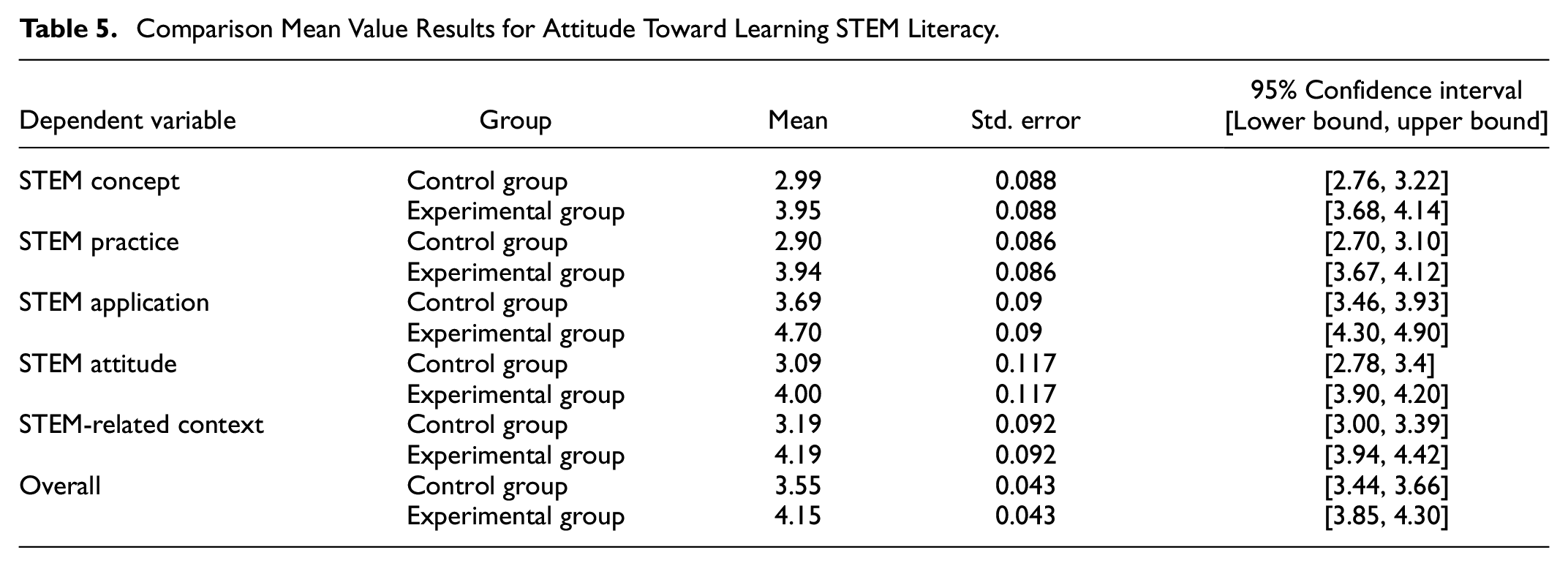
Table 5 displays the average and mean values of the control and experimental groups in attitude toward learning STEM literacy, encompassing instructions on STEM concepts, STEM Practice, STEM Application, STEM Attitude, and STEM-related Context. All attitudes toward learning STEM literacy domains showed improvement from pre-test to post-test, indicating the benefits derived from the IRT and cooperative learning process.
In the STEM Concept domain, the post-test mean for the IRT group was 3.95, compared with 2.99 for the traditional group. This difference in average values favors the IRT group, suggesting that this method enhances the STEM Concept domain of attitude toward learning STEM literacy more effectively than the traditional method.
Similarly, in the STEM Practice domain, the post-test mean for the IRT group was 3.94. On the other hand, the post-test mean for the traditional group was 2.90. Consequently, the average value difference between the IRT with cooperative learning and traditional method groups favors the RT group, indicating that RT enhances the STEM Practice domain of attitude toward learning STEM literacy more effectively for the IRT group compared with the traditional method.
In the STEM Application domain, the post-test average for the IRT group was 4.7, whereas for the traditional group, it was 3.69. Again, the average value difference between the IRT with cooperative learning and traditional method groups favors the IRT group, indicating that IRT improves the STEM Application domain of attitude toward learning STEM literacy more effectively for the IRT group compared with the traditional method.
The result of the STEM Attitude domain, the IRT group post-test mean was (4). On the other hand, the traditional group post-test means (3.09). Thus, the average value difference between the IRT and traditional method groups favors the IRT with the cooperative learning group and indicates that the IRT improves the STEM attitude domain of attitude toward learning STEM literacy of the traditional method of IRT group.
The post-test mean for the IRT with cooperative group in the STEM-related Context domain was 4.19, whereas for the traditional group, it was 3.19. Consequently, the average gain difference between the IRT and traditional method groups favors the IRT group, indicating that IRT improves the STEM-related Context domain of attitude toward learning STEM literacy more effectively for the IRT group compared with the traditional method. Similarly, in the overall attitude toward learning STEM literacy, the post-test mean for the IRT group was 4.15, compared with 3.55 for the traditional group. Thus, the average value difference between the IRT with cooperative learning and traditional method groups favors the IRT group, indicating that IRT enhances the overall attitude toward learning STEM literacy more effectively for the IRT with cooperative learning group compared with the traditional method.
The attitude toward learning STEM literacy data underwent analysis using two-way MANCOVA to examine the significant difference between the experimental and control groups’ averages, as well as the effect of RT on enhancing attitude toward learning STEM literacy among selected 12th-grade physics students in Palestine. The MANCOVA findings were interpreted using Wilks’ Lambda, chosen by the researchers for its resilience in accommodating minor assumptions breaches. Table 6 summarizes the findings.
Wilks’ Lambda Test of Control and Experimental Groups in Attitude Toward Learning STEM Literacy for Post-Test.

Table 6 shows the results of Wilks’ Lambda, comparing the control group (traditional method) and experimental group (IRT strategy with cooperative learning) in attitude toward learning STEM literacy after the intervention, using the Wilks’ Lambda test at a significance level of 0.05. The value for attitude toward learning STEM literacy was F(6, 53) = 15.42, p = .00 < .05, Partial η2 = .45, indicating a significant difference in the average of the experimental and control groups for attitude toward learning STEM literacy, favoring the experimental group, who were taught physics through IRT with cooperative learning. The Partial multivariate η2 (.45) suggests that approximately 45% of the total variance in attitude toward learning STEM literacy can be attributed to the independent variables (instructional methods such as IRT strategy with cooperative learning).
As the results were significant, the between-subjects effects or univariate tests for each dependent variable were necessary. These results are presented in Table 7 below.
Test Between- Subject Result for Attitude Toward Learning STEM Literacy.

For the STEM Concept, F(1, 58) = 11.50, p = .001 < .05, Partial η2 = .32, indicating a statistically significant difference between the average of the experimental and control groups for the STEM Concept result, in favor of the experimental group taught physics through IRT with cooperative learning.
For the STEM Practice domain, the statistical analysis yielded F(1, 58) = 4.44, p = .03 < .05, Partial η2 = .24, indicating a significant difference in the average of the experimental and control groups. This difference favored the experimental group taught physics using IRT with cooperative learning.
Similarly, for the STEM Application domain, the analysis resulted in F(1, 58) = 3.99, p = .04 < .05, Partial η2 = .21, suggesting a statistically significant difference between the average of the experimental and control groups. Once again, this difference favored the experimental group taught physics using IRT with cooperative learning.
Furthermore, for the STEM Attitude domain, the statistical analysis showed F(1, 58) = 4.36, p = .035 < .05, Partial η2 = .23, indicating a significant difference in the average of the experimental and control groups. This difference favored the experimental group taught physics using IRT with cooperative learning.
However, for the STEM-related Context, the analysis yielded F(1, 58) = 3.15, p = .07 > .05, Partial η2 = .02, indicating that there were no significant differences in the average of the experimental group taught physics using IRT with cooperative learning and the control group taught using the traditional method.
Finally, for the overall attitude toward learning STEM literacy, the analysis resulted in F(1, 58) = 11.83, p = .001 < .05, Partial η2 = .35, indicating a significant difference in the average of the experimental and control groups. Once again, this difference favored the experimental group taught physics using IRT with cooperative learning.
Discussion
A study on attitudes toward learning STEM literacy found that employing cooperative learning with the IRT strategy (experimental group) for teaching physics appears to be more effective than the traditional method (control group) in enhancing overall attitude toward learning STEM literacy and the core domains of STEM concept, STEM practice, STEM application, STEM attitude and STEM-related context among selected 12th-grade students in Palestine.
The IRT approach seems to facilitate relaxation, recall, focus, and absorption of knowledge whilst students are learning. Students who are open to new experiences and are aware of various learning possibilities may exhibit greater cognitive ability through problem-solving, whether through teacher-directed or student-directed techniques, thus improving their views about physics (Tseng et al., 2013). Furthermore, it has been shown that the control group’s negative views about physics were attributed to a lack of information, problem-solving abilities, self-confidence, incorrect application of formulas and failure to act like experts when addressing physics issues (Altakahyneh & Abumusa, 2020; Hudha et al., 2019; Sulasih et al., 2018).
However, the findings of this study suggest that IRT had a beneficial impact on the experimental group’s attitude toward studying STEM literacy, consistent with previous research (Ali, 2017; Mosley et al., 2016; Ojo, 2015). Regarding the overall study results, there is a significant difference in attitude toward learning STEM literacy between the experimental group, which is taught physics via IRT, and the control group, which receives conventional methods. Furthermore, there is a substantial change in attitude toward learning STEM literacy between pre-and post-tests for both the experimental and control groups, favoring the experimental group, which is taught physics through RT (both traditional method and IRT strategy).
In a STEM-related context, no substantial difference is noted between the control and experimental groups. However, significant differences were observed in STEM Concept, STEM Practice, STEM Application, STEM Attitude and overall attitude toward learning STEM literacy between the control and experimental group students, favoring the experimental group, who were taught physics using IRT with cooperative learning. The experimental group students were more active and interested in using IRT with other subjects, not only in sciences.
Students prefer an IRT strategy to learn physics because it helps them understand physics concepts specifically and STEM concepts in general, solve word problems and improve their attitude toward STEM literacy more than the traditional method. Mosley et al. (2016) investigated the impact of cooperative robotics learning methods on middle school students’ critical thinking and interest in STEM (Veloo et al., 2015). A critical thinking test was administered to assess ’students’ cognitive ability and STEM interest, revealing that robotic cooperative learning significantly enhances students’ critical thinking.
Similarly, Ali (2017) examined the effects of IRT on improving EFL secondary students’ new literacies of online research and comprehension and self-efficacy on the Internet. The findings showed a significant relationship between self-efficacy and reading comprehension. Additionally, readers’ self-efficacy was different from their proficiency levels. The study demonstrated that IRT has positive effects on improving students’ new literacies of online research and comprehension, as well as their self-efficacy on Internet use. On the contrary, Tseng and Yeh (2018) investigated how RT strategies could be used in conjunction with an annotation tool to enhance low-achieving students’ English reading comprehension in a virtual environment.
The results of reading comprehension tests revealed that students’ English reading comprehension improved after using RT strategies with annotation tools. The two most effective tactics were questioning and predicting, as they both encouraged successful collaborative reading. Owing to linguistic issues among low-achieving EFL students whilst summarizing and clarifying, these tactics were found to be more effective than summarizing and clarifying strategies. By creating a collaborative environment where students can discuss RT tactics at any moment, organizing and indexing reading content in multimodal ways and more, the annotations enhanced RT strategies and helped students review and revise their comprehension.
Huang and Yang (2015) examined the effects of two online reading interventions on the reading strategy, comprehension, motivational beliefs, and self-efficacy of 36 low-achieving students. The interventions compared were explicit instruction before reciprocal instruction (ET-RT) and direct instruction (DI). A 10-part online English reading program was developed based on the theoretical framework of the ET-RT model by Palincsar and colleagues. The study examined teacher modeling patterns in both groups and interactive dialog in the ET-RT group. ’Additionally, it explored students’ experiences and perceptions of the interventions.
The results indicated that the implementation of ET-RT significantly ’enhanced students’ reading comprehension, reading strategies and self-efficacy compared with DI. Survey triangulation revealed that ET-RT reduced ’students’ English learning anxiety and increased their reading interest. Learners from the ET-RT group demonstrated better mastery of reading strategies than those from the DI group. However, qualitative evaluation ’revealed moderate satisfaction in both groups, with most learners accepting the interventions. Excerpts from ET-RT learners underscored the importance and utility of explicit reading strategy instruction.
Although both ET-RT and DI were deemed valuable, the superior performance of ET-RT suggests a need for re-evaluation of the design and delivery of English reading instruction. Drawing from these findings, IRT combined with cooperative learning can foster a positive attitude toward learning and STEM literacy. This approach encourages active participation, collaboration, communication, problem-solving, and a deeper understanding of STEM concepts, all essential for success in STEM fields and beyond. Furthermore, the utilization of the IRT learning strategy involves leveraging online resources to facilitate better concept comprehension (Leu & Timbrell, 2014).
Research suggests that IRT not only enhances learning outcomes but also fosters creative thinking in group activities (Chen & Kong, 2016). Compared with conventional methods, IRT has been shown to improve learning outcomes (Nurfahrudianto et al., 2018).
Conclusion
Physics depends on higher cognitive skills rather than mere memorization. This study examines the metacognitive and cognitive efficacy of IRT. The findings suggest that collaborative learning through RT can improve the attitudes, motivation and enthusiasm of Palestinian 12th-grade students toward learning physics. This may be attributed to the eight-step approach of RT, which includes prediction, question generation, clarification, connection, calculation, visualization, summarization, and feedback.
Students positively perceived the IRT strategy, leading to increased classroom engagement, positive thinking, and improved clarity and precision in their responses. They also displayed greater self-direction and autonomy as learners, attributes beneficial for lifelong learning. Additionally, students had opportunities to enhance their communication skills, effectively expressing their opinions and ideas—essential abilities for navigating today’s complex world.
Cooperative learning with a RT strategy is an effective method for promoting positive attitudes toward learning physics among students. RT involves a group of students taking turns to act as teachers, leading discussions and explaining concepts to their peers. This method not only enhances students’ understanding of the subject matter but also fosters a sense of responsibility and ownership for their learning. Cooperative learning involves students working together in small groups to achieve a common goal.
Combining cooperative learning with a RT strategy fosters a sense of community and encourages students to support and learn from each other. Studies have demonstrated that this combination leads to active participation in the learning process and cultivates a positive attitude toward physics. Research indicates that students engaging in cooperative learning with RT exhibit significant improvements in their attitudes toward the subject. They express greater confidence in their ability to learn physics and increased motivation to pursue further studies.
Furthermore, they display heightened engagement and participation in classroom activities, resulting in enhanced overall academic performance. Utilizing cooperative learning with a RT strategy shows promise in promoting positive attitudes toward learning physics. This method encourages students to take an active role in their education and nurtures a classroom community, empowering students with the skills and confidence necessary for success in physics and beyond.
IRT in STEM learning environments offers students valuable opportunities to cultivate essential skills and attitudes crucial for success in STEM fields. Through collaborative discussions and using digital resources to enhance their comprehension of STEM concepts, students can gain a profound appreciation for the significance and applicability of STEM in their daily lives.
Implementing cooperative learning with the IRT strategy can positively influence students’ attitudes toward STEM literacy. Here are several specific ways this approach proves effective (Castek et al., 2015):
Active Participation: Cooperative learning with IRT encourages active engagement and participation in the learning process. Students are prompted to ask questions, share ideas, and collaborate with peers to comprehend STEM concepts. This fosters a greater sense of ownership over learning and cultivates a positive attitude toward STEM subjects.
Collaboration and Communication: Collaborative learning with IRT nurtures communication and teamwork, crucial skills in STEM fields. Students learn effective team collaboration, idea sharing, and constructive feedback provision. This fosters a sense of community in the classroom and fosters a positive learning attitude.
Problem-Solving Skills: Cooperative learning with IRT enhances problem-solving abilities by offering opportunities to apply knowledge and skills to real-world problems. Students are encouraged to think critically, creatively, evaluate evidence and devise solutions. This instills confidence and fosters a positive learning attitude.
STEM Literacy: Cooperative learning with IRT enhances STEM literacy by delving into STEM concepts deeply. Students recognize the relevance of STEM to their daily lives and learn to apply STEM concepts to real-world issues. Enhanced STEM literacy leads to a greater appreciation for STEM subjects and fosters a positive learning attitude.
Future Research
Cooperative learning with the IRT strategy emerges as an effective tool for fostering STEM literacy among students. Nonetheless, further research is imperative to enhance the understanding in this domain. Several avenues for future research can be delineated:
Long-term Impact: Investigate the enduring effects of employing cooperative learning with the IRT strategy on students’ STEM literacy. This may entail longitudinal studies tracking students’ STEM literacy development over multiple years to ascertain the sustainability of the benefits derived from the IRT strategy.
Comparative Analysis: Conduct comparative studies to juxtapose the efficacy of the IRT strategy against alternative teaching methodologies. Such research aims to discern the most efficacious approach for promoting STEM literacy among students.
Teacher Preparation: Explore the significance of teacher training in facilitating the proficient implementation of cooperative learning and the IRT strategy. This could entail the design and evaluation of teacher training initiatives specifically tailored to the IRT strategy and cooperative learning methodologies.
Diversity and Inclusion: Investigate the efficacy of cooperative learning with the IRT strategy across diverse student cohorts, encompassing individuals from varied cultural backgrounds, students with disabilities and those possessing differing levels of prior STEM knowledge. Such research endeavors to ascertain the inclusivity and effectiveness of the IRT strategy in catering to diverse student populations.
Footnotes
Acknowledgements
This research was supported by Universiti Tun Hussein Onn Malaysia Publisher’s office via publication fund (E15216).
Author Contributions
Nofouz Mafarja: The idea, data analysis, collecting data and findings, writing the final report.
Mimi Mohaffyza Mohamad: Literature review.
Hutkemri Zulnaidi: literature review, conceptual framework, and Editing.
Declaration of Conflicting Interests
The author(s) declared no potential conflicts of interest with respect to the research, authorship, and/or publication of this article.
Funding
The author(s) disclosed receipt of the following financial support for the research, authorship, and/or publication of this article: Universiti Tun Hussein Onn Malaysia through publication fund (E15216).

Availability of Data and Materials
The datasets used and/or analyzed during the current study are available from the corresponding author on reasonable request.