




Abstract
This research attempted to explore, based on the broaden–and–build theory of positive emotions, the relationships among high school teachers’ savoring and instructional design imagination, and to verify the mediating effects of resilience and inspiration through action on the aforementioned relationships. Data were collected from 497 high school teachers in Taiwan. PLS-SEM was used to validate the research hypotheses. The results show that: (a) Savoring positively influences instructional design imagination; (b) Resilience has a complementary mediation effect on the relationship between savoring and instructional design imagination; (c) Inspiration through action has a complementary mediation effect on the relationship between savoring and instructional design imagination. Accordingly, this study bears important theoretical and practical implications for the professional development of teachers’ instructional design imagination.
Introduction
As Artificial intelligence (AI) rapidly changes the workforce, the role of imagination cultivation in education has become increasingly important. Imagination makes it possible for people to transcend actual experience and embrace different possibilities to make whole a fragmented situation (Passmore, 1985). Greene (1995) noted that imagination can drive learners’ physical and mental development, lead individuals to actively participate in the world, and see the world from a new perspective. Both imagination and creativity belong to the higher order thinking ability of the mind (Carruthers, 2011). Nevertheless, the source of creativity often comes from abundant imagination. Creative competence has to do with being able to approach things, with curiosity and imagination, from different angles to form new concepts (Hwang & Kwon, 2019). Through the process of continuous imaginative inputs into thinking, people can transform the limitation of reality awareness into opening up new thinking spaces (Egan, 2005). That is why imagination is often considered the foundation for creative-thinking cultivation and the impetus for innovation (Finke, 1996; Policastro & Gardner, 1999).
Instructional design imagination is an important resource for teachers’ professional practice change, and professional development (Fleer et al., 2021). Teachers need to have abundant imaginations in order to identify the spiritual worlds of students and guide their adaptive developments (Montessori, 1917) in a timely manner to meet the needs of current and future settings. Egan (1992) stated that the instructional design imagination displayed by teachers was not only the image of the instructional design or the description of the known status quo but also the ability to conceive various teaching possibilities and concrete implementation methods. In the teaching field, teachers’ imagination can lead students to have the motive force of curiosity, interest, and inquisition about learning, can guide students to develop autonomous learning abilities, and can even help teachers to improve teaching efficiency. Thus, the instructional design imagination possesses a great research value (Decety & Grezes, 2006; Panjwani & Brown, 2019).
In the current study, the instructional design imagination of the teachers is defined as the teachers’ capability to employ imagination in situations while conducting instructional design when compiling course content, designing teaching processes, and selecting teaching methods. The imaginative capacity includes dimensions of initiating imagination, conceiving imagination, and transforming imagination, which are used to generate the structure, content, and implementation process of the instructional design, so as to help learners to achieve the learning objectives (Hsu, 2016). In other words, educators are moving from knowledge work to thought work (Van Osch & Avital, 2009). Imagination is not only the ability to recall or recognize activities of internal mental images (Folkmann, 2011), but also the ability of active and self-adjusting characteristics, which can guide the individual to engage in the important capabilities of creative thinking and expression (Liang et al., 2014). Fleer et al. (2021) verified the use of imagination as a resource for professional practice changes and professional developments by the teachers.
Past studies of imagination have mostly used students as the research objects, and there is still very little research about which psychological and environmental factors can stimulate teachers’ imagination (Hsu, 2016; Fleer et al., 2021; Mullet et al., 2016; Panjwani & Brown, 2019). Current literature shows that resilience is a key factor affecting teachers’ creative performance (Deng et al., 2020; Hallak et al., 2018). In addition, studies have confirmed that inspiration through action can affect imagination (Hsu et al., 2013; Hsu et al., 2014). Savoring is defined as the ability to direct one’s attention to positive experiences and change one’s thoughts and behaviors in order to augment and prolong positive emotions (Bryant et al., 2011; Bryant & Veroff, 2007). The enhancement of positive emotions may be achieved by reminiscing, enjoying the here and now, or looking forward to the good time ahead (Bryant & Veroff, 2007). Although studies on the effect of savoring on creativity stimulation have yielded some results (Lee et al., 2016; Lingke & Chang, 2019), the literature on how savoring affects teachers’ instructional design imagination through the perspective of positive psychology is lacking. This study explores the influence of high school teachers’ savoring on instructional design imagination and examines how resilience and inspiration through action mediate the relationship between savoring and instructional design imagination. Hence, this study primarily aimed to address the following questions: (a) How does high school teachers’ savoring influence their instructional design imagination?; (b) What roles do resilience and inspiration through action play in the relationship between savoring and instructional design imagination? According to our findings, we provide theoretical and practical implications.
Theoretical Background and Hypotheses Development
Active experience may contribute to triggering imagination, but little is known about the triggering pathway. Our study explores this issue based on the broaden–and–build theory of positive emotions (BABTOPE) developed by Fredrickson (2004). The theory has two important key propositions (viewpoints). One proposition is that positive emotions can broaden the momentary thought–action repertoire of a person, for example: contentment triggers the urge to savor and integrate. The second viewpoint involves the outcomes of these broadened mindset, resulting in positive emotions that encourage the discovery of new and ingenious ideas, actions, and interpersonal connections. Fredrickson pointed out that when an individual is faced with a challenge, positive emotions would help him/her to make a flexible, creative, and resilient response. There are four pathways to expand positive emotions: (a) broaden possibilities of thinking actions, (b) reverse negative emotions, (c) increase resilience, and (d) make lasting resources to improve wellbeing (Fredrickson, 2002). If such a virtuous cycle is advanced, it will further trigger more positive emotional experiences. Some studies have also confirmed the positive benefits of theoretical savoring (Cohn et al., 2009; Fredrickson et al., 2008; Smith & Hanni, 2019; Smith & Hollinger-Smith, 2015; Tugade & Fredrickson, 2004; Wright & Armstrong, 2016).
Savoring as a concet is valued in positive psychology. It refers to people’s ability to pay attention to, fully enjoy and extend positive experience and the processes based on this ability (Bryant & Veroff, 2007). It is also a person’s capability to attend to the positive experiences in their lives and change their thoughts and behaviors by enhancing and prolonging positive emotions (Bryant et al., 2011; Bryant & Veroff, 2007). People are actually able to savor more by purposely thinking and behaving in ways that strengthen their positive emotions, for example, making good memories, being grateful, or by refraining from focusing on the negative aspects of things that may spoil positive feelings (Smith & Hanni, 2019).
Vygotsky (2004) stated that life experiences stimulate the development of imagination, in which emotions are vital in imaginative activities. Therefore, the perceived control in the savoring experiences is also important (Bryant, 1989). As Dewey (1938) emphasized in the experiential learning theory, any experience is continuous, inheriting the past, regulating the future, and continuing constantly. Especially, when a learner needs to deal with the conflict between the pressure and the reason for an action, experiential learning occurs. Although creative experiences are largely uncertain and frequently unintentional, they may help us embrace the differences, especially differences of opinions, between ourselves and other people (Glăveanu & Beghetto, 2017). Accordingly, two focuses of this study are on how savoring stimulates and maintains imagination through the two pathways of inspiration through action and resilience.
Resilience plays an important role in an individual’s ability to spark the imagination. Resilience is considered to be important personal psychological capital. When an individual is in adversity, he/she can persevere and transcend the status quo to achieve success (Luthans & Youssef, 2007; Polirstok, 2017). Findings of previous studies have shown that teachers frequently faced different situational problems in the teaching process. When encountering difficulties in teaching, teachers with better resilience are able to promptly make adjustments to balance situational needs and behavioral responses; when confronted with many challenges and setbacks, they also recover quickly (Beaird et al., 2018; Masten, 2011; Zimmerman et al., 2013). Some research results have supported that by boosting positive feelings, the savoring of positive experiences stimulates greater resilience (Cohn et al., 2009; Fredrickson, 2001; Smith & Hollinger-Smith, 2015; Smith & Hanni, 2019; Tugade & Fredrickson, 2004), while other studies have confirmed that high resilience is a key factor affecting teachers’ creative performance (Deng et al., 2020; Hallak et al., 2018).
Inspiration through action is also very important in the process of sparking the imagination of individuals. To demonstrate the contextual character of inspiration through action, Liang (2013) and Hsu et al. (2013), through hands-on practices, enabled their participants to articulate their feelings about their metacognition-influenced imagination. Inspiration through action refers to the meta-cognition and the inspiration resulted from the individual’s hands-on learning and inspection of stage prototypes (Hsu et al., 2013; Hsu et al., 2014; Hsu, 2015). In this study, inspiration through action means that teachers employ the doing, thinking, and modifying process of implementing the instructional design—constantly ideate, evaluate, revise, and gain insights, to assist learners in achieving their learning goals. Past studies have confirmed that inspiration through action influenced the exertion of imagination (Hsu et al., 2013; Hsu et al., 2014). Individual imagination is usually quite implicit, which needs to be actively triggered by the individual and be verified by internal interactions with practical limitations. Pelaprat and Cole (2011) once cited Vygotsky’s research ideas to elaborate imagination as the cognitive operation of the individual thinking about the gap between the subject and the target object. Imagination can lead the individual to be drawn into situations of various present and unknown possibilities as well as build a bridge for the possibilities of the subject and the object. Moreover, imagination can guide the individual to dedicate internal resources to further generate actions to address gaps. Therefore, the teacher shall keep an open mind between new thoughts and thoughts in the instructional design process. Even if the teacher may not always agree to the new thoughts, they can enrich experience, helping the teacher to become highly adaptable and flexible in worldly relationships (including the ones between the self and the others; Glăveanu & Beghetto, 2021).
Summing up the aforementioned literature, Figure 1 presents the conceptual framework based on BABTOPE of this study. The following are derivations of hypotheses among variables in the conceptual framework.

Conceptual framework based on BABTOPE.
Influence of Savoring on Instructional Design Imagination
In positive psychology; savoring beliefs refer to people’s evaluation of their ability to enjoy experience. Fredrickson (2001) indicated that positive emotions could trigger innovative ideas of individuals to act. Amabile et al. (2005) pointed out that creativity arises from positive feeling and emotion. When the individual’s positive feeling is insufficient, it will affect creativity or imagination. On the other hand, when positive feeling is continuous, it will also affect creativity generation. Previous studies found that savoring of positive events can prolong pleasure time and positive benefits of reinforcing emotion (Bryant, 2003; Bryant & Veroff, 2007; Smith & Bryant, 2016; Smith & Hollinger-Smith, 2015; Smith & Hanni, 2019). Many studies have confirmed that individuals’ positive emotions can be increased by savoring—by remembering past, enjoying the present, or anticipating future happiness (Bryant & Veroff, 2007; Gentzler et al., 2013; Hurley & Kwon, 2013).
Imagination may be considered a prerequisite of creativity (Kaplan, 1972). Research has demonstrated that one might unexpectedly develop new ideas, extraordinary insights, and awareness of fresh images conducive to the enhancement of one’s creativity by concentrating on savoring (Bryant & Veroff, 2007). Currently, many studies have confirmed that savoring has a positive effect on creative performance (Chang et al., 2015; Lee et al., 2016). Hsu (2016) has empirically confirmed that teachers’ positive emotions can positively predict the instructional design imagination. Based on the conclusion of the previous literatures—savoring can produce positive emotions, and positive emotions can positively predict the instructional design imagination, this study puts forward the following research hypotheses.
H1: Savoring positively influences instructional design imagination.
The Mediating Role of Resilience in the Relationship of Savoring and Instructional Design Imagination
After the rise of positive psychology, research on resilience has become the focus of creativity research (Bickley-Green & Phillips, 2003; Graziano, 2004; Luthar, 2003; Metzl & Morrell, 2008; Meneely & Portillo, 2005). Resilience is an important helping force for the individual to bounce back from the bottom of adversity, and it includes two important factors: recovery and sustainability. The former has to do with being able to pull around from a stressful event or trauma; the latter concerns being able to persevere throughout life challenges (Zautra, 2009). For teachers, stress can lead to learning opportunities and professional growth so that they can fulfill the roles of teaching practitioners and meeting future challenges. Teacher resilience involves the teacher being adaptable to various situations: being able to recover from setbacks, making continuous adjustments, becoming better skilled in unfavorable situations, etc. Adversity serves to spur teachers to become more committed and to devise concrete methods of teaching in a timely manner (Castro et al., 2010; Chao et al., 2017).
Savoring has been assumed to be positively related to resilience. In addition to emphasizing amplifying and prolonging positive experiences and enhancing positive emotions, savoring also has an adaptive function in ignoring negative experiences. Savoring can also transform negative experience and the pain of life (Quoidbach et al., 2010). Past findings of savoring and resilience studies showed that savoring might enhance the conspicuousness of positive experiences and strengthen the memories of them (Smith & Hanni, 2019). In addition, savoring has been shown to promote the acknowledgement and enjoyment of positive experiences during difficult times, which possibly served to boost resilience by offsetting the adverse effects of bad feelings (Zautra et al., 2001). Savoring may also further the expansion of resources that allow people to be resilient in the face of challenges by making them experience positive emotions more intensely, more often, and for longer periods of time (Fredrickson, 2001; Tugade & Fredrickson, 2007). Positive emotions promote greater resilience (Cohn et al., 2009; Fredrickson, 2001; Smith & Hanni, 2019; Tugade & Fredrickson, 2004). Smith and Hanni (2019) confirmed that savoring expansion (amplification) was positively related to resilience.
Resilience has a positive influence on teachers’ instructional design imagination. Resilience has been verified to be closely related to cognitive functions such as intelligence quotient, problem-solving abilities, etc. (Dumont & Provost, 1999; Friborg et al., 2005; Smith & Carlson, 1997). Instructional design imagination is the high-level thinking ability that a teacher performs when facing the teaching situation. Imagination of initiating, conceiving, or transforming knowledge or experience in a specific field is the thinking skill enables a novice to gradually become an expert or an expert to continuously update, transform, and even create (Fogarty & McTighe, 1993; Zittoun & Cerchia, 2013). In implementing instructional design, the occurrence of difficulties and setbacks are inevitable. The teacher needs resilience to adjust and adapt to various situations and improve their capability to face unfavorable situations, in order to stay committed and promptly respond with appropriate actions and strategies (Castro et al., 2010; Chao et al., 2017; Shin, 2020). Some empirical studies with teachers as participants have confirmed the mediating effect of resilience on teachers’ personal traits (e.g., extraversion, agreeableness, and openness) and creative teaching (Deng et al., 2020; Hsiao, 2015). Based on the aforementioned literature review, the authors propose the following hypothesis.
H2: Resilience mediates the relationship between savoring & instructional design imagination.
The Mediating Role of Inspiration Through Action in the Relationship of Savoring and Instructional Design Imagination
Inspiration through action refers to meta-cognition and inspiration resulted from the individual’s hands-on operation and inspection of the stage prototype, which can affect imagination (Hsu et al., 2013; Hsu et al., 2014; Hsu, 2015). Based on Vygotsky’s research concept, Pelaprat and Cole (2011) explained the gap between the subject and the target object could be filled through imagination. Imagination guided the individual to think about various present and unknown possibilities and built a bridge for the possibilities of the subject and the object; imagination also led individuals to devote internal resources to further generate actions to solve the gap. Inspiration through action is similar to the reflective practical learning reconceptualized after exploring action leaning by You (2003). You (2003) believed that the key medium for learning is reflection in reflective practical learning because action without reflection was reckless and reflection without action was meaningless. According to the viewpoint of Schön (1983; 1987), “reflective practice” can be divided into reflection-in-action and reflection-on-action, and reflection is an important factor to promote teachers’ imagination of curriculum. Through the process of instructional design practice, teachers can gain insights while thinking by doing, finding inspiration, or self-examining and evaluating the original plan, which in turn triggers further imagination. Specifically, reflective practice leads to devoting the individual’s internal resources to further generate actions to solve the gap. Fredrick (2007) pointed out that people in the situation of inspiration through action were easier to overcome the bottleneck of creative thinking. Results of past empirical studies also confirmed that: (a) Inspiration through action is moderately correlated with imagination (Hsu, 2015), (b) Transforming imagination and conceiving imagination of teachers’ instructional design imagination can be predicted by inspiration through action variable (Hsu, 2016). Hence, it can be inferred that inspiration through action has a positive influence on instructional design imagination.
Savoring positively affects inspiration through action. It has to do with mindfulness of positive experiences and the awareness and control of positive feelings about such experiences (Smith & Hanni, 2019). Thoughts and actions that occur when savoring by being immersed in the positive experience are similar to the creative experience proposed by Glăveanu and Beghetto (2021), which has the characteristics of pluri-perspectives, nonlinearity, future-orientation and open-endedness. The common principles are that individuals are willing to deal with the unfamiliar, to tackle familiar things in unfamiliar ways, and to make the argument that it exists in all creative actions. These principles are similar to the display of creative personality, which is conducive to the progress of inspiration through action (Hsu et al., 2013). Past studies had also confirmed that inspiration through action was highly correlated with positive emotion (Hsu, 2016). Accordingly, the authors propose the following hypothesis.
H3: Inspiration through action mediates the relationship between savoring & instructional design imagination.
Method
Participants
This study chose high school teachers in Taiwan as participants, and selected 40 schools by stratified random sampling (19 schools in the North District; 10 schools in the Central District; 11 schools in the South District). There were 15 to 20 teachers from each school. Consent forms were included in the questionnaire and filled out by the teachers. We collected 497 valid samples. As shown in Table 1, there were 255 males and 242 females. As to years of teaching, “less than 10 years” accounted for 41%, while “11 to 20 years” accounted for 44%, and “more than 20 years” accounted for only 15%. As for the classification of “teaching subjects,”“general subjects,” and “technical subjects” account for about half each.
Information on Sample Background Variables (N = 497).

Measurement
The scales used in our investigation were adopted from relevant studies to ensure content validity (Bryant, 2003; Connor & Davidson, 2003; Hsu, 2016; Hsu et al., 2013; Hsu et al., 2014). During compilation, three experts were invited to review the content of our questionnaire and give qualitative opinions in order for us to revise it accordingly. The resultant questionnaire therefore offered measurements validated by the experts. All survey items except background variables used a Likert six-point scale to measure, ranging from “strongly disagree” (1) to “strongly agree” (6).
Savoring Belief
In assessing teachers’ savoring beliefs, the 12-item Savoring Belief Inventory (SBI) of Bryant (2003) was used. It contains three parts: ANT (anticipating), MOM (savoring the moment), and REM (reminiscing). Higher scores suggest stronger savoring beliefs.
Resilience
Resilience was assessed with the 25-item Connor-Davidson resilience scale (CD-RISC) developed by Connor and Davidson (2003). CD-RISC is made up of five subscales: personal competence, high standard, and tenacity (Factor 1); trust in one’s instincts, tolerance of negative affect, and strengthening effects of stress (Factor 2); positive acceptance of change and secure relationships (Factor 3); control (Factor 4) spiritual influences (Factor 5). The higher the score, the stronger the resilience.
Inspiration Through Action
This study adopted the inspiration through action scale developed by Hsu (2016). The scale consists of six questions. The higher the score, the stronger the understanding.
Instruction Design Imagination
We used the 29-item imaginative capability scale established by Hsu (2016) to measure teachers’ instructional design imagination. The scale includes three parts: the initiation of imagination, the conception of imagination and transformation of imagination. The higher the score, the stronger the instructional design imagination.
Data Analysis
Statistical analyses of the inner (structural) and outer (measurement) models were done using SmartPLS 3.3.2 software (Ringle et al., 2015). Convergent validity and discriminate validity were tested using confirmatory factor analysis (CFA). Path analysis (Hair et al., 2011) was performed on the data with 5,000 repeated samplings using PLS-SEM and Bootstrapping to test the significance of causality in path coefficients, predictive power (R2), the fit of SRMR (standardized root mean square residual) of the overall model and to validate research hypotheses. In the mediating effect testing, we first confirmed indirect effects and variance account for (VAF) of dimensions to test the existence of multiple mediating effects (Hair et al., 2017).
Results of Research
Descriptive Statistical Analysis
Table 2 lists descriptive statistics for each construct. Among them, the average distribution of teachers’ savoring, instructional design imagination, resilience and inspiration through action is between 4.65 and 4.97. Following the general guidelines for skewness and kurtosis, the construct distribution is generally considered normal.
Descriptive Statistics of the Research Constructs.
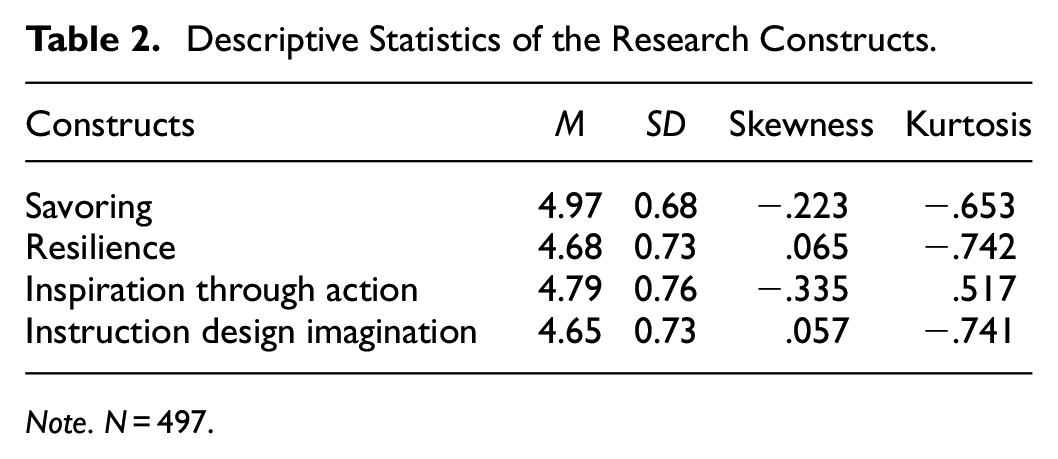
Note. N = 497.
Measurement Model: Reliability, Validity of the Scales
Indicator loadings, Cronbach’s alpha, composite reliability, and average variance extracted for each variable in this study are sorted, as shown in Table 3. All indicator loadings of each constructs in this study are more than 0.7, and the composite reliability (CR) value is also more than 0.7, indicating internal consistency. The average variance extracted (AVE) value of each constructs is more than 0.5, showing that each scale has convergent validity (Hair et al., 2017). The discriminant validity results are summarized, as shown in Table 4. Results of Fornell-Larcker criterion analysis show values of diagonal elements are all larger than values of the off-diagonal elements. Results of heterotrait-monotrait (HTMT) analysis exhibit that all HTMT values are less than 0.85 (Henseler et al., 2016), indicating that the scales in this study have good discriminant validity. In addition, the model fit for this study is .041 (SRMR < 0.08). The above analyses show that this study has good reliability and validity.
Indicator Loadings, Cronbach’s α, Composite Reliability, and Average Variance Extracted for Each Contracts.

Note. CR = Composite Reliability; AVE = Average Variance Extracted; Tenacity = reflects the notion of personal competence, high standards, and tenacity; instincts = corresponds to trust in one’s instincts, tolerance of negative affect, and strengthening effects of stress; secure relationships = relates to the positive acceptance of change, and secure relationships; control = was related to control; spiritual = to spiritual influences.
Discriminant Validity.

Note: Fornell-Larcker Criterion: Diagonal elements (bold) are the square root of the variance shared between the constructs and their measures (AVE). Off-diagonal elements are the correlations among constructs. ITA = inspiration through action; IMA = instruction design imagination.
Structural Model and Hypothesis Testing for the Mediation Effects
The procedure proposed by Hair et al. (2017) was adopted to test the mediating effect of resilience and inspiration through action on the influence of savoring (SAV) against teachers’ instructional design imagination (IMA). Table 5 displays the significance analysis of the direct and indirect effects. Savoring (SAV) positively affects teachers’ instructional design imagination (IMA), so H1 is supported. Regarding the indirect effect analysis, resilience and ITA factors have indirect effects on the relationship between SAV and IMA (both a1*b1 and a2*b2 are significant), with VAFs between 20 % and 80%. As a result, resilience and ITA have complementary mediation effects (Hair et al., 2017). H2 and H3 are therefore supported. Figure 2 presents path coefficients of the structural model analysis. In terms of model explanatory power, R2 of resilience is 41%, R2 of ITA is 33%, and R2 of IMA is 74.5%.
Significance Analysis of the Direct and Indirect Effects.

Note. SAV = savoring; ITA = inspiration through action; IMA = instruction design imagination. VAF = variance account for; VAF > 80%: Indirect-only mediation; 20% ≤ VAF ≤ 80%: complementary mediation; VAF < 20%: non Mediation (Hair et al., 2017).

Path coefficients of the structural model analysis.
Discussion
Resilience Mediates the Relationship Between Savoring and Instructional Design Imagination
The results of this study verify that resilience indeed mediates the relationship between savoring & instructional design imagination. Deng et al. (2020) stated that certain personality traits of the teachers such as openness, agreeableness, and extroversion may affect innovative teaching through the mediation of different constructs of resilience (e.g., problem cognition, emotional regulation, and empathy). Hsiao (2015) also found the indirect effects of extroversion, affinity, and openness on creative teaching through the mediation of resilience. People with the extroverted trait usually have higher savoring (Bryant, 2003). Consistent with the assumptions of BABTOPE, savoring indeed contributes to the expansion of resources that allow people to be resilient in the face of challenges by making them experience positive emotions more intensely, more often, and for longer periods of time (Fredrickson, 2001; Tugade & Fredrickson, 2007).
Anser et al. (2020) found the mediating effect of resilience between polychronicity and creativity. Varker and Devilly (2012) pointed out that employee resilience raises positive emotions commenced from their polychronic experiences toward creativity. Polychronicity allows employees to handle multiple schedules simultaneously. Thus, these endeavors make it possible for them to explore the newest way to perform their duties (Jang & George, 2012). For instance, Bryant and Veroff (2007) claimed that new images, ideas, and insights will be accidentally acquired while in the process of savoring the past, savoring the present, and savoring the future, which is in turn conducive to the improvement of people’s creativity.
Whereas the results of this study are similar to the above-mentioned creativity-related studies (Anser et al., 2020; Deng et al., 2020; Hsiao, 2015), this study further deduces and verifies the mediation model of improving instructional design imagination through savoring and resilience, implying that researchers and administrators who are engaged in teacher professional development may need to pay more attention to savoring skills’ enhancement and application of teachers and the mediating effect of resilience.
Inspiration Through Action Mediates the Relationship Between Savoring & Instructional Design Imagination
The results of the present study confirm that inspiration through action mediates the relationship between savoring & instructional design imagination. The study by Hsu et al. (2013) showed that inspiration through action affected both reproductive imagination and creative imagination through its influence on intrinsic motivation and confirmed that positive emotions could influence these two types of imaginations via inspiration through action and intrinsic motivation. Liang and Liang (2014) noted that positive emotions and inspiration through action had highly significant effects on imagination while positive emotions were significantly correlated with inspiration through action. Hsu (2016) found that: (a) Inspiration through action was moderately correlated to teachers’ instructional design imagination and was highly correlated with positive emotions, (b) Inspiration through action predicted three kinds of imaginations (reproductive, creative, and transforming imagination) mediated by intrinsic motivation and self-efficacy.
The results of this study are similar to those of the above-mentioned imagination related studies (Hsu, 2016; Hsu et al., 2013; Liang & Liang, 2014), but are different from those of Liang (2013). Liang (2013) found: Although some psychological and environmental factors did affect imagination through the mediating variable of inspiration through action, positive emotions had no effect on imagination and creative imagination, echoing the opinion that emotions had both positive and negative effects on people’s creativity (Batey et al., 2010). In particular, there are still very few studies on the influencing factors of prolonging savoring and expanding positive experiences on teachers’ instructional design imagination, and further research is warranted. Moreover, it also means that researchers and administrators who are engaged in teacher professional development may need to focus more attention on creating the environment of inspiration through action, including how to provide tangible resources to assist teachers and create a supportive organizational atmosphere.
Conclusions and Implications
Instructional design imagination is an important resource for teachers’ professional practice change and professional development. How to motivate and cultivate teachers’ instructional design imagination is very important. Based on the BABTOPE, this study collected empirical data on high school teachers in Taiwan to explore this issue. Our results confirm the significant positive effect of savoring on teachers’ instructional design imagination, and savoring affects teachers’ instructional design imagination through complementary mediation effects of resilience and inspiration through action.
These two mediators make specific contributions to both theory and practice of imagination cultivation. First, this study theoretically deduced the influence of savoring on teachers’ instructional design imagination, and then validated and expanded the theoretical argument of the BABTOPE (Fredrickson, 2004). Secondly, this study further searched out and then verified the two mediating variables of resilience and inspiration through action, so as to improve the explanatory power of teachers’ teaching imagination. In practice, this study suggests the importance of cultivating teachers’ savoring skills, resilience, and inspiration through action on teacher professional development. There are quite a few ways to practically promote teacher professional development, including coaching (Elek & Page, 2019), mentoring (Trevethan & Sandretto, 2017), co-teaching (Murphy et al., 2015), lesson studies (Vermunt et al., 2019), professional learning communities (Schaap & de Bruijn, 2018), etc.
Despite the rigorous attitude of this study, there are nevertheless limitations. First, we investigated high-school teachers’ instructional design imagination. It is worth noting that follow-up studies can further address whether the research results can be extended to teachers at other levels (e.g., elementary school or university). Second, the study samples were teachers in Taiwan; the findings may be limited in generalizing to teachers from other cultural backgrounds, for imagination must be understood as an important component of how individuals think and act in culture-mediated environments (Vygotsky, 2004). Lastly, the two mediators revealed by the results of the study had only partial mediating effects, implying that there were other mediators or moderators that had not been explored in this study. Future studies can build upon findings of this study and then combine with different discourse analysis and theoretical framework to explore possibilities of other variables, for example, environmental factor variables.
Footnotes
Declaration of Conflicting Interests
The author(s) declared no potential conflicts of interest with respect to the research, authorship, and/or publication of this article.
Funding
The author(s) disclosed receipt of the following financial support for the research, authorship, and/or publication of this article: This research was supported partly by the National Science and Technology Council of Taiwan under grants MOST 109-2511-H-018 -015 -MY3 and NSTC 112-2410-H-018-027-MY3.

Data Availability Statement
Data sharing not applicable to this article as no datasets were generated or analyzed during the current study.