



Abstract
This study selects provincial panel data from 2008 to 2019 and constructs a panel vector autoregressive (PVAR) model to explore the bidirectional interactive relationship between digital economy, consumption upgrading and domestic demand level through the Granger causality test, the analysis of impulse response function and variance decomposition. Firstly, the GMM estimation results show that there is a significant bidirectional interactive effect between digital economy and domestic demand level, and a significant bidirectional interactive effect between digital economy and consumption upgrading, while the interactive effect between consumption upgrading and domestic demand level is weak. Secondly, the analysis of impulse response function shows that domestic demand level can sustainably promote the development of digital economy, and the promotion effect of digital economy on domestic demand level is immediate. However, in the long run, digital economy has a gradually weakening hindering effect on domestic demand level. Digital economy and consumption upgrading show a “V-shaped” relationship. The shackles of mutual promotion between consumption structure and scale still exist. Thirdly, the analysis of variance decomposition shows that the mutual contribution rate of digital economy and domestic demand level is low, the mutual contribution rate of digital economy and consumption upgrading is high, and the mutual contribution rate of consumption upgrading and domestic demand level is low. The implications in this study can help drive digital economy development, promote consumption upgrading and raise domestic demand level.
Keywords
Introduction
The world is undergoing a century of unprecedented changes, and one of the main goals of all countries is to achieve a high level of development to improve people’s living standards. To achieve this goal, a strategy that emphasises growth through domestic demand becomes a panacea for development. In the past few years, China’s economic growth has experienced a significant structural reform (J. Yu et al., 2021) and is in a period of strategic opportunity for economic development. In response to the new circumstances of China’s economic development, such as the reconstruction of international trade regulations, China has proposed to “build the new development paradigm with domestic circulation being the mainstay and the two circulations reinforcing each other”. With the proposal of China’s strategy of expanding domestic demand, endogenous consumption has become the main driving force of current economic growth (Shu et al., 2023), which aims to empower and strengthen China's economic development by expanding domestic demand and reshape new advantages for economic growth. However, as China’s economic development enters a new normal, the momentum to raise domestic demand level is relatively insufficient, for which digital economy and consumption upgrading provide new ideas. It is important to stimulate consumption, boost investment and create employment (Han et al., 2022). Furthermore, consumption upgrading is essential for domestic distribution (J. Yu et al., 2021), which drives a vast domestic demand market. Therefore, clarifying the interactive relationship between digital economy, consumption upgrading and domestic demand level can not only ensure the healthy development of supply and demand relationship, but also help the high-quality economic development.
As far as existing studies are concerned, firstly, with regard to digital economy and consumption upgrading, some scholars have realised in recent years that digital economy has accelerated the transformation and upgrading of traditional industries, created new industries and business models (J. Zhang et al., 2022), changed residents’ consumption patterns and lifestyles (W. Chen & Yan, 2020; J. Zhang et al., 2022), and promoted consumption upgrading (Jiang, 2020; Song et al., 2022). Secondly, with regard to digital economy and domestic demand level, scholars have reached a consensus that digital economy is an important measure to stimulate domestic demand (Le et al., 2023). On the one hand, digital economy promotes the flow of factors and the transformation of production and lifestyles (Z. Li & Wang, 2022, B. Lin & Huang, 2023; Xu et al., 2022), on the other hand, digital economy improves the convenience of consumption and reduces transaction costs (Y. Chen, 2020), thus leveraging the domestic market. Thirdly, with regard to consumption upgrading and domestic demand level, some scholars believe that consumption upgrading will increase the demand for clothing consumption, household equipment and other consumption as well as other product and service consumption, thus boosting domestic demand (M. Hong & Lou, 2022; Shu et al., 2023).
Based on theoretical perspective, existing studies explore the unidirectional impact of digital economy and consumption upgrading on domestic demand level and the unidirectional impact of digital economy on consumption upgrading. No empirical analyses incorporate all of them into a framework to explore their bidirectional interactive relationship, and the theoretical connection between them is not yet clear. The panel vector autoregressive (PVAR) model does not need to conduct hypothesis research and set independent and dependent variables in advance, and can solve the problem of individual heterogeneity (Charfeddine & Kahia, 2019), reflect the changing trend of the relationship between variables, reveal the interaction between variables, and make up for the shortcomings of existing studies. Based on this, this study investigates the bidirectional interactive effect between digital economy, consumption upgrading and domestic demand level using PVAR model with 31 provinces, autonomous regions and municipalities in the Chinese mainland as research object, which provides a reference for promoting the development of digital economy, facilitating consumption upgrading and enhancing domestic demand level. This study aims to respond to three research questions (RQs) in the Chinese context. RQ1: In the short term, what is the interaction between digital economy, consumption upgrading and domestic demand level? RQ2: What is the effect and the impact trajectory of long term dynamic shocks between digital economy, consumption upgrading and domestic demand level? RQ3: What is the contribution rate of the interaction between digital economy, consumption upgrading and domestic demand level over a period of time?
The remaining sections are arranged as follows. Firstly, this study presents a review of relevant literatures. Then, this study states the research design and empirical analysis in the third and fourth sections. The final section includes conclusions, implications, theoretical contributions, limitations and future research.
Literature Review
Digital Economy and Consumption Upgrading
With the continuous improvement of modern digital technologies, such as 5G communication, artificial intelligence, big data and cloud computing, digital economy has become a powerful driving force for a new round of consumption upgrading (Song et al., 2022), and has a significant positive impact on consumption upgrading (Jiang, 2020). Digital economy has accelerated the transformation and upgrade of traditional industries and created emerging business models (J. Zhang et al., 2022), which change residents’ consumption patterns and lifestyles (W. Chen & Yan, 2020; J. Zhang et al., 2022), promote consumption upgrading. On the one hand, relying on Moore’s Law, the development of digital economy is conducive to incubating new consumption hotspots. By using digital technology, enterprises can continuously and dynamically monitor the demand pattern of the market to keep abreast of the market demand (S. Zhang et al., 2021), create a large scale and amazing potential of the global e-commerce market, meet consumers’ pursuit of high-quality products and services, and accelerate consumption upgrading. Moreover, the development of digital economy impacts traditional consumption patterns (L. J. Wang et al., 2023; J. Yu et al., 2021). With the gradual improvement of supporting industries, such as logistics, mobile payment and platforms in digital economy, traditional consumption patterns are reshaped. On the other hand, digital economy can create new consumption growth. According to Davidow’s Law, consumer demand is constantly changing in digital economy, and product and service renewal cycles are becoming increasingly fast, forcing enterprises to innovate to secure their original market share constantly. The innovation of the supply system can lead to a new wave of consumption upgrading, from basic survival consumption to high-end consumption to improve the life quality. Digital economy governed by Davidow’s Law is the driving force for enterprises’ innovation of digital products and services and consumption upgrading.
By reviewing relevant literatures, the relationship between digital economy and consumption upgrading has attracted some attention. Many scholars have discussed the unidirectional impact of digital economy on consumption upgrading from a theoretical perspective, but ignored the bidirectional interactive relationship between them. Therefore, exploring the bidirectional interactive relationship between digital economy and consumption upgrading is one of the goals of this study.
Digital Economy and Domestic Demand Level
The consumption plays an indispensable role in China’s economic growth. In order to overcome the most direct, prominent, and urgent institutional barriers that restrict the residents’ consumption and enhance the fundamental role of consumption in economic development (K. Yu & Guo, 2023), digital economy is required as a new opportunity to form a high-level dynamic balance with higher quality supply and more dynamic domestic demand. Digital economy is an important measure to boost domestic demand (M. Li et al., 2023). On the one hand, digital economy breaks the time and space barriers of production activities, accelerates the smooth flow of production factors such as capital and technology (B. Lin & Huang, 2023; Xu et al., 2022), promotes the transformation of production modes, lifestyles and business models (Z. Li & Pang, 2022). Digital economy can satisfy consumers from design, production, sales, and other stages, reduce ineffective marketing and resource redundancy, correct factor distortions, improve resource allocation efficiency and production efficiency (Xue et al., 2022), boost domestic demand. The change in payment methods and emergence of e-commerce platforms as a result of the development of digital economy has substantially facilitated the consumption (Y. He et al., 2022). According to the “Attention, Interest, Search, Action and Share” model of consumer behaviour analysis, digital economy development can quickly attract consumers’ attention and arouse their interest in buying through big data information analysis. And the online consumption model facilitates consumers to search for relevant information, increases the purchase rate, fully reflects the impact of digital economy on consumption behaviour. This makes digital economy become an important force for improving the supply system’s adaptability, modernising the supply chain, stimulating domestic consumption, and driving new consumption (Jiang, 2020). Simultaneously, in the digital era, the increased speed, scope and convenience of information transmission (Yang, 2023), and the reduction of information asymmetry have reinforced the demonstration effect of residents’ consumption, gradually expanding the scale and kinds of consumption, and the potential of consumption has been deeply dug by digital technology. On the other hand, based on the external economy of the network, digital economy has the Metcalfe Effect. This means that digital economy usually launches its services in a free mode and keeps expanding the scale of users, thereby increasing the value and reducing marginal costs. Digital economy can reduce market frictions, significantly reduce information search, production and transportation costs (Y. Chen, 2020), achieve convenience in consumption and reduce transaction costs, becoming an essential driver of higher domestic demand level.
By reviewing relevant literatures, it is found that scholars pay attention to the role of digital economy in stimulating consumption, and explore the unidirectional impact of digital economy on domestic demand level from a theoretical perspective. However, the existing studies lack the exploration of the interaction between them from an empirical perspective. Therefore, exploring the bidirectional interactive relationship between digital economy and domestic demand level is one of the issues to be solved in this study.
Consumption Upgrading and Domestic Demand Level
Upgrading consumption and expanding domestic demand are key tasks that need to be carried out urgently. Consumption upgrading represents optimising the consumption structure, and domestic demand level raising represents expanding the scale of consumption, both of which are important driving forces for achieving high-quality economic development in the context of the two circulations. Consumption upgrading and the expansion of domestic demand are endogenous drivers to effectively reduce dependence on international markets and reconfigure the economic development model. In addition, the Keynesian theory states that consumption demand determines the scale of social consumption and is closely related to the consumption propensity. Consumption upgrading is an important measure to change the inherent consumption propensity, promote consumption demand and raise domestic demand level. The expansion of domestic demand should prioritise the fundamental role of consumption (D. Yu & Zhang, 2015). Domestic demand is mainly influenced by insufficient consumption, and there is still a large potential space for consumption to drive China’s economic development (M. Hong & Lou, 2022). Nowadays, consumption upgrading has surpassed the field of individual life and become the basis for the national field to boost domestic demand, expand economic growth and stimulate production (Liu, Chen, & Liang, 2023; Liu, Li, & Hu, 2023). Industrial upgrading through consumption upgrading is a vital strategy to adhere to the policy of expanding domestic demand (Shen et al., 2022). M. He et al. (2023) noted that the expansion of domestic demand required response to the trend of consumption upgrading, including clothing consumption, family equipment consumption, other product and service consumption upgrading. Shu et al. (2023) noted that with the transformation and upgrading of the consumption structure and the continuous promotion of structural reforms on the supply side, the essential role of consumption in economic development would be more sustainable, which was important for the realisation of China’s strategy of expanding domestic demand.
By reviewing relevant literatures, it is found that scholars pay attention to the role of consumption upgrading in expanding domestic demand, and explore the unidirectional impact of consumption upgrading on domestic demand level from a theoretical perspective. However, there is a lack of research on the interaction between them from an empirical perspective. Therefore, exploring the bidirectional interactive relationship between consumption upgrading and domestic demand level from an empirical perspective can fill the existing research gap.
After reviewing the literatures, it can be found that there are a few studies on the relationship between digital economy, consumption upgrading and domestic demand level and it needs further exploration. In terms of research content, the existing literatures have focused more on the unidirectional impact of digital economy and consumption upgrading on domestic demand level and the unidirectional impact of digital economy on consumption upgrading. No studies incorporate the three variables into a framework and explore the bidirectional interactive relationship between them. Regarding research methodology, the existing literatures are all from a theoretical perspective, which lack an empirical method to examine the relationship between digital economy, consumption upgrading and domestic demand level. Thus, this study uses PVAR model to explore the bidirectional interactive relationship from an empirical perspective by considering the time lag of the interactive relationship between them to fill the research gap.
Research Design
Model Setting
The VAR model, a time series analysis method established by Sims (1980), overcomes the shortcomings of econometric models that artificially define whether variables are endogenous but still suffers from the shortcomings of limiting the amount and form of data. Holtz-Eakin et al. (1988) improved VAR model by proposing PVAR model. PVAR inherits the advantage of incorporating endogenous lagged variables into VAR model. The panel data can effectively solve the problem of individual heterogeneity. PVAR model has advantages of both panel data analysis and VAR model. Compared with traditional econometric models, it can better eliminate endogeneity among variables. Its main advantage is that all variables in the system are treated as endogenous variables according to the reality of interdependence (Zhao et al., 2023). Furthermore, individual and time effects are introduced (Belaid et al., 2021), effectively reflecting the trend of the relationship between the variables and truly exposing the interactive relationship between them. Therefore, this study uses PVAR model to investigate the bidirectional interactive effect between digital economy, consumption upgrading and domestic demand level, as shown in Equation (1).

Yit can be expressed as Equation (2).

Where Yit is a vector containing three variables, DE, CU and DDL. DE represents digital economy; CU represents consumption upgrading and DDL represents domestic demand level. i represents the sample, t represents the year, α0 represents the coefficient vector, αj represents the parameter matrix at lag order j, and p represents the lag order of the model. χi is the individual effect, reflecting individual heterogeneity, ηt is the time effect, reflecting the trend of the time change and μit represents the random error term.
Variable Measurements and Data Sources
Digital Economy
Digital economy involves many aspects, and its indicators should be selected to reflect digital economy development comprehensively. Based on the characteristics of digital economy development and the view of S. Yu et al. (2021), this study selects four dimensions of digital infrastructure, digital economy popularization, network information resources and digital economy commercialization and their corresponding 10 indicators to measure the level of digital economy development, as shown in Table 1. The relevant data can be obtained from the China Statistical Yearbook (2009–2020), the 21st to 41st Statistical Report on the Development of the Internet in China and the National Bureau of Statistics website.
Measurement Indicator System of Digital Economy.

Based on determining measurement indicator system, to objectively evaluate each indicator’s importance, this study chooses the entropy method to determine the weight of each indicator and calculates the comprehensive score to characterise the level of digital economy development.
Firstly, Equation (3) standardises the indicators.

Where xij represents the value of the jth indicator of sample i; Xij represents the value of the jth indicator of sample i after standardisation; min(xj) and max(xj) represent the minimum and maximum values of the jth indicator, respectively.
Secondly, based on determining the weight of the jth indicator of sample i through Equation (4), Equation (5) is used to calculate the entropy value of the jth indicator.


Thirdly, based on determining the utility value of the jth indicator through Equation (6), Equation (7) is used to calculate the weight of the jth indicator.

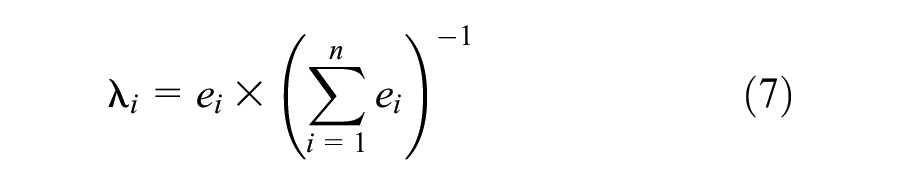
Finally, Equation (8) calculates the level of digital economy development for sample i in year t.

Consumption Upgrading
According to Maslow’s hierarchy of needs, as people’s standard of living improves, their needs develop from the lower level of physiological and safety to a higher level of esteem and self-actualisation, manifesting as consumption upgrading. Consumption upgrading is a complex economic and social process, which includes both the expansion of the quantity and the improvement of the quality of consumption. It is a process in which the long term upward trend in consumption quantity aligns with the transition of consumption quality from lower to higher levels (D. Chen & Guo, 2023). Following the views of some scholars (Jiao & Sun, 2020; P. Wang & Wang, 2018), this study chooses food consumption, residence consumption and transport and communications consumption, setting them with weights 1, 2, and 3, respectively, to calculate the degree of consumption upgrading using Equation (9).

In Equation (9), TCE represents total consumption expenditure, FC represents food consumption, RC represents residence consumption and TCC represents transportation and communications consumption. Relevant data can be obtained from the China Statistical Yearbook (2009–2020) and the National Bureau of Statistics website.
Domestic Demand Level
Domestic demand level refers to the final domestic demand, includes domestic consumption and investment demand. Yew Wah (2004) used consumption demand as a proxy variable for domestic demand level. However, using either consumption or investment demand to measure domestic demand level may lead to the error. Therefore, this study considers the connotation of domestic demand and refers to the existing literatures (W. Hong, 1989; Wong, 2008) to measure domestic demand level of a province by the sum of final consumption demand and investment demand. The data can be obtained from the China Statistical Yearbook (2009–2020) and the National Bureau of Statistics website.
Empirical Analysis
Descriptive Statistical Analysis
Table 2 shows the descriptive statistical results of the variables. The results show that digital economy development varies widely across provinces, with the maximum value of 0.717 and the minimum value of 0.024 between groups, which is a significant difference. Conversely, the degree of consumption upgrading is more balanced across provinces, with a difference of about 0.2 between the maximum and minimum values between groups, which is not a distinct difference. To eliminate heteroscedasticity, this study takes the logarithm of each province’s domestic demand level. This shows that the maximum value is 11.028, while the minimum value is only 7.267, indicating that there is some difference in domestic demand level across provinces.
Results of Descriptive Statistical Analysis.

According to the view of Jahanger et al. (2023), the correlation coefficients between the variables must be calculated to ensure the accuracy of the estimation results. The fitting coefficients are obtained by creating an auxiliary regression equation with one variable as dependent variable and the remaining variables as independent variables. This study calculates the variance inflation factor (VIF) to test the multicollinearity among the variables. Table 3 presents the results. The correlation coefficient between digital economy and domestic demand level is the largest at 0.449, while the correlation coefficients between the other variables are all less than 0.2. These results indicate no multicollinearity among digital economy, consumption upgrading and domestic demand level. Meanwhile, the auxiliary regression equation is established with digital economy, consumption upgrading and domestic demand level as the dependent variable, respectively; none of VIF values exceeds 1.25, further indicating no multicollinearity among digital economy, consumption upgrading and domestic demand level.
Variable Correlation Coefficients and VIF Test Results.

Variable Stability Test and Model Lag Order Determination
When using PVAR model, unit root test of the variables is required to avoid the occurrence of spurious regressions, which may impact the robustness of the test results. Referring to the view of Mishra (2020), this study conducts unit root test on the panel data using the LLC, IPS, Fisher ADF and Hadir tests simultaneously. Table 4 presents the results. The tests all reject the null hypothesis of the existence of unit root at the 1% significance level, indicating that digital economy, consumption upgrading and domestic demand level are all stationary series.
Unit Root Test Results.

Note.*, ** and *** denote significance at the 10%, 5%, and 1% levels, respectively.
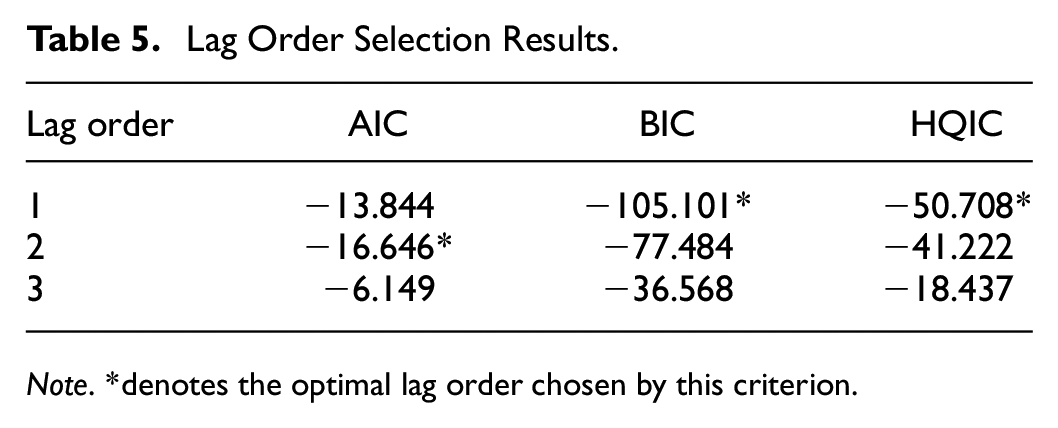
An appropriate lag order must be selected before PVAR model is built. The lag order affects the accuracy of the model test results. In this study, three information criteria of AIC, BIC and HQIC, are used to select the lag order. Table 5 presents the results. Generally, the optimal lag order corresponds to each criterion’s minimum value; however, when the three results are inconsistent, the BIC and HQIC standards tend to lean on streamlined models and are better than AIC standard (M. L. Wang et al., 2023). From Table 5, the optimal lag order is order 1, and PVAR (1) model is established, as shown in Equation (10).
Lag Order Selection Results.
Note. *denotes the optimal lag order chosen by this criterion.

PVAR Model Estimation
Based on the stability test results and the optimal lag order selection, this study uses Stata 15.1 software to conduct GMM estimation of PVAR model to explore the interactive relationship between digital economy, consumption upgrading and domestic demand level. Table 6 presents the results.
GMM Estimation Results of PVAR Model.

Note. c_GMM denotes estimated coefficient, and s_GMM denotes standard error.
, ** and *** denote significance at the 10%, 5%, and 1% levels, respectively.
Column (1) of Table 6 shows that when domestic demand level is the dependent variable, there is a significant negative effect of one-period lagged digital economy and a non-significant negative effect of one-period lagged consumption upgrading. This indicates that one-period lagged digital economy and consumption upgrading are ineffective in stimulating consumption expansion and leveraging domestic demand market. Column (2) of Table 6 shows that when consumption upgrading is the dependent variable, one-period lagged digital economy has a significant positive effect, and one-period lagged domestic demand level has a non-significant positive effect. This indicates that one-period lagged digital economy helps optimise consumption structure; however, one-period lagged domestic demand level does not facilitate consumption upgrading. Column (3) of Table 6 shows that when digital economy is the dependent variable, one-period lagged consumption upgrading has a significant negative effect and one-period lagged domestic demand level has a significant positive effect. This suggests that one-period lagged consumption upgrading fails to provide the impetus for the development of digital economy. However, the result suggests that one-period lagged domestic demand level can drive digital economy development.
Granger Causality Test
Before conducting the Granger causality test of PVAR model, the systematic stability is tested. Figure 1 presents the results.
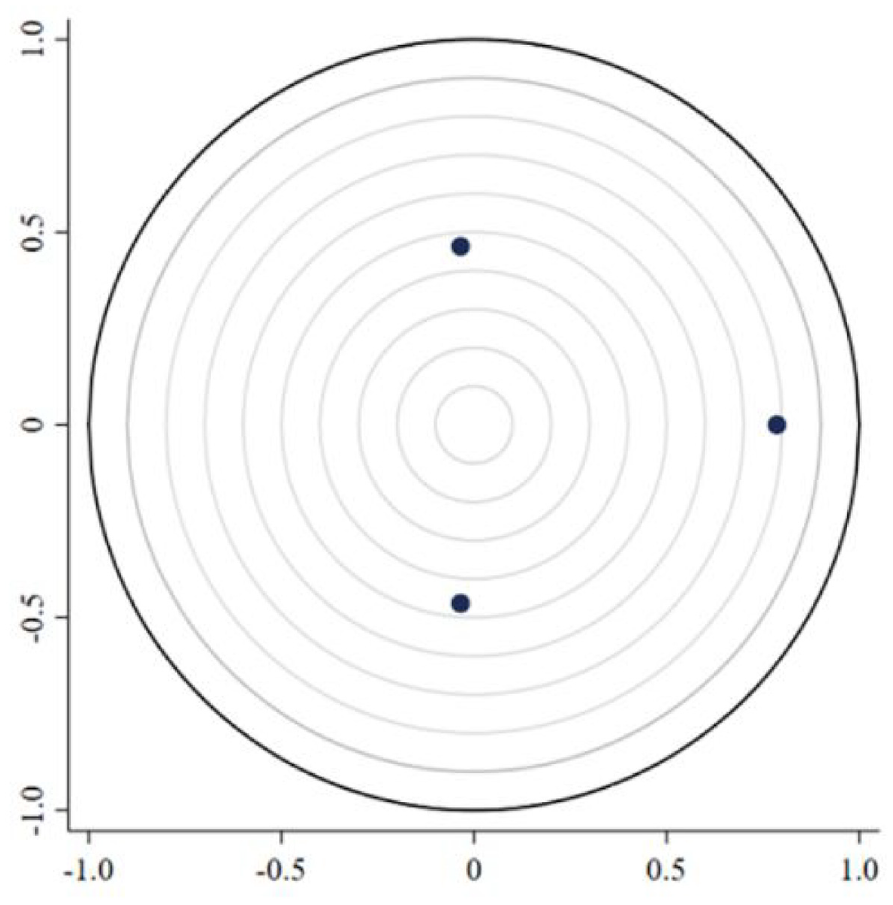
Stability identification diagram of PVAR model.
From Figure 1, it shows that the unit root of the accompanying matrix are all located inside the unit circle, indicating that PVAR model has strong stability and subsequent analysis is feasible. Therefore, this study conducts the Granger causality test for digital economy, consumption upgrading and domestic demand level. Table 7 presents the results.
Granger Causality Test Results.

Note.*,** and *** denote significance at the 10%, 5%, and 1% levels, respectively.
Table 7 shows a bidirectional Granger causality relationship between digital economy and consumption upgrading or domestic demand level, respectively, indicating a significant interactive relationship between digital economy and consumption upgrading or domestic demand level. There is no Granger causality between consumption upgrading and domestic demand level. The possible reasons for this are that, due to the interference of systemic factors, such as income disparity and structural imbalance, consumption inequality has been widened while residents’ consumption has been upgraded. The speed difference of consumption upgrading between different groups has highlighted consumption stratification, thus bringing “hidden poor population”. Thus, consumption upgrading cannot fully drive domestic demand level, indicating that consumption upgrading is not the Granger cause for domestic demand level. Simultaneously, consumers focus on consumption regarding the utility value of the product itself and tend to seek utility maximisation, and they are sensitive to price only (Genc & De Giovanni, 2021). Consumption upgrading is not easily achieved in the short term when domestic demand level raises. Therefore, domestic demand level is not the Granger cause for consumption upgrading.
Impulse Response Function
The impulse response function is useful for analysing the effect and impact trajectory of long term dynamic shocks between variables. Through impulse response function, it is possible to observe a variable’s response to another variable’s shock, that is, a standard deviation shock (Feng et al., 2020). This study conducts 500 Monte Carlo simulations to obtain the impulse response results for each variable in 10 periods and ensure the robustness of the analysis results, as shown in Figure 2.

Impulse response results.
From 1a, 2b, and 3c of Figure 2, digital economy, consumption upgrading and domestic demand level respond rapidly to internal shock. Domestic demand level responds positively to shock from itself, reaching the maximum in the 0 period and weakening over time. Consumption upgrading and digital economy behave similarly when faced with internal shock; a positive response reaches the maximum in the 0 period, then decreases. After a weak negative response from the 1st period to the 3rd period, they fluctuate around 0 and eventually converge to 0. Evidently, digital economy, consumption upgrading and domestic demand level show significant path-dependence.
From 1b of Figure 2, when domestic demand level is hit by consumption upgrading, a negative response is generated in the 0 period, followed by weakening the negative response and generating the positive response, which reaches the maximum in the 2nd period, and the positive response weakens and converges to 0. This indicates that the increase in domestic demand level boosted by consumption upgrading is a gradual and cumulative process. From the 0 period to the 2nd period, consumption upgrading will highlight the demonstration effect of the relative income hypothesis, that is, the imitation and comparison of consumption leads to the optimisation of the consumption structure at the expense of the scale of consumption, which negatively impacts domestic demand level. From the 2nd period to the 4th period, consumption upgrading that drives demand growth is accelerating as residents’ purchasing power increases. Consumers’ willingness to improve their life quality and social status becomes increasingly strong, and residents’ consumption evolves from the original simple quantitative growth to a parallel increase in both quantity and quality, which raises domestic demand level. From 1c of Figure 2, when domestic demand level is hit by digital economy, a positive response is generated in the 0 period, followed by weakening the positive response and generating the negative response, which reaches the minimum value in the 1st period. The negative response then weakens and converges to 0. This suggests that the positive effect of digital economy on domestic demand level is immediate. In the 0 period, digital economy expands the consumption market, particularly the development of potential consumption market of the “last mile”, which broadens the main consumer group, unleashes consumption potential, and facilitates a wider circulation of products and services, plays a significant role in enhancing domestic demand level. When the lag period is extended, digital economy continues to develop, reduces the external financing costs (Liu, Chen, & Liang, 2023), breaks the time and space constraints of international transaction and facilitates international consumption channel, makes cross-border delivery more feasible. Meanwhile, along with an obviously insufficient of effective supply of high-quality products and services, and a significant outflow of consumption demand for mid- to high-end products and emerging services, digital economy provides an opportunity to easily meet domestic demand for diversified products in the global market. This results in a flow of domestic consumption to international markets and a crowding-out effect on domestic demand.
From 2a of Figure 2, when consumption upgrading is hit by domestic demand level, there is no response in the 0 period, followed by a positive response that reaches the maximum in the 2nd period, then the positive response weakens and converges to 0. This suggests that domestic demand level gradually diminishes in promoting consumption upgrading. The raising of domestic demand level brings more substantial consumption power, promotes changes in residents’ consumption attitudes and nurtures demand for high-quality consumption, which can drive consumption upgrading. As can be seen from 2c of Figure 2, when consumption upgrading is hit by digital economy, it shows an inverted “V-shaped” response path, with a negative response in the 0 period, followed by a weakening negative response and subsequently generating the positive response, which reaches the maximum in the 1st period. Then, the positive response weakens, and after a weaker negative response from the 2nd period to the 4th period, the response fluctuates around 0 and eventually converges to 0. This indicates that consumption upgrading is lagged behind digital economy. In the 0 period, digital economy lowers the threshold of price experience, opens the door to the sinking market. This provides more attractive, low-priced products, leading to a transient contradiction between consumption upgrading and market sinking, and an expanding scale of consumption, which has a crowding-out effect on consumption upgrading. For example, Pinduoduo focuses on price-sensitive group, attracting consumption with low prices. However, over time, digital economy helps provide consumers with diversified, personalised and convenient products and services by relying on big data technology to analyse consumer behaviour. The consumption ecosphere allows the online sale of traditional products and services, facilitating consumers’ pursuit of high-quality products and services and achieving higher quality consumption of residents. From the 2nd period to the 4th period, consumption demand and decision are rationalised; however, sharing of consumption experiences increases (Kim et al., 2014), and the phenomenon of blind conformity of consumption decreases. Digital economy innovates marketing models through long term development and begins to offer more affordable products and services that cater to the consumption status, leading to a reduction in the prevalence of consumption upgrading.
From 3a of Figure 2, it shows that when digital economy is hit by domestic demand level, it does not respond in the 0 period, then generates a positive response and reaches the maximum in the 1st period, followed by weakening the positive response and converges to 0. Evidently, domestic demand level has a gradually diminishing promotion effect on digital economy. The rising domestic demand level brings a more dynamic consumption market, which attracts more information technologies and capital, provides better development conditions and opportunities for digital economy. Enterprises must introduce advanced information technologies to grasp the growing consumption demand more keenly, which enriches the core technological factors and promotes digital economy development. Moreover, enterprises use these information technologies in production, consumption, distribution and allocation to promote the development of digital economy industry. From 3b of Figure 2, digital economy shows a positive “V-shaped” response path when it is hit by consumption upgrading, with no response in the 0 period, followed by a negative response, reaching the minimum in the 1st period, then weakening the negative response and generating the positive response, reaching the maximum in the 3rd period. Eventually, the positive response fluctuates around 0 and eventually converges to 0. This indicates a lag in the contribution of consumption upgrading to digital economy. The possible reasons for the hindering effect of consumption upgrading on digital economy from the 0 period to the 2nd period are that, according to Davidoff’s law, digital economy can only build a complete consumption ecosphere and meet consumption demand by constantly eliminating outdated products and developing new products. Consumption upgrading brings about an improvement in consumption concept. Traditional digital products can no longer meet consumption demand, and technological innovation in digital economy is a long term improving process, which can not meet the upgraded consumption demand in the short term, making consumers unable to adapt digital economy. As offline consumption can meet consumer demand for timely experience and quick pick-up of high-quality products and services, consumers prefer offline consumption, which hinders digital economy development. From the 2nd period to the 4th period, consumption upgrading has a facilitating effect on digital economy. Digital economy has been able to meet the upgraded consumption demand through a longer development period. Consumption upgrading plays an essential role in supporting the development of digital economy. Consumption upgrading promotes the deep integration of digital economy with other industries and drives the digitalisation process of the life service market and consumers’ pursuit of high-quality, cross-provincial products and services. The consumption market requires efficient, convenient and wide-coverage consumption models, which stimulate digital economy to provide high-quality digital products and services and develop in the direction of meeting high-quality information consumption.
Variance Decomposition
The degree of a variable’s impact on another is specified by the variance decomposition, and the result shows in percentages (B. Lin & Okoye, 2023). The variance decomposition enables in-depth understanding of the interaction and changing trend of each variable in the current and future periods. This study conducts 500 Monte Carlo simulations to obtain variance decomposition results for 20 periods between digital economy, consumption upgrading and domestic demand level to deeply reflect the dynamic impact of each variable. For a more concise presentation of the variance contribution of each variable, only the results for the 10th and 20th periods are presented in this study, as shown in Table 8.
Variance Decomposition Results.

From Table 8, the results of the variance decomposition of digital economy, consumption upgrading and domestic demand level in the 10th and 20th periods are consistent, indicating that the influence between the variables is relatively stable. Digital economy, consumption upgrading and domestic demand level are much influenced by themselves, with the lowest contribution rate of 74.9%, which is consistent with the above analysis results, that is, digital economy, consumption upgrading and domestic demand level are all long term development processes with certain inertia, prominent path-dependent characteristics and have a strong self-reinforcing effect.
The contribution of digital economy to domestic demand level is 2.4%. In comparison, the contribution of domestic demand level to digital economy is only 0.7%, indicating that digital economy has a stronger explanation for domestic demand level. Domestic demand level has a weaker explanation for digital economy. The contribution of digital economy to consumption upgrading is 14.3%, and the contribution of consumption upgrading to digital economy is 24.4%. This indicates that digital economy and consumption upgrading are interdependent, and both have a strong explanatory power for the other. The contribution of consumption upgrading to domestic demand level is 0.9%, and the contribution of domestic demand level to consumption upgrading is 0.3%, indicating that consumption upgrading and domestic demand level weakly explain each other.
Conclusions and Implications
Conclusions
This study uses provincial panel data from 2008 to 2019 and constructs PVAR model to explore the bidirectional interactive relationship between digital economy, consumption upgrading and domestic demand level through the Granger causality test, the analysis of impulse response function and variance decomposition. The conclusions are as follows:
The GMM estimation results of PVAR model show that there is a significant bidirectional interactive effect between digital economy and domestic demand level, and there is a significant bidirectional interactive effect between digital economy and consumption upgrading, while the interactive effect between consumption upgrading and domestic demand level is weak. The shackles of mutual promotion between consumption structure and scale still exist. This significant bidirectional interactive relationship indicates that digital economy not only creates new consumer demand (Jiang, 2020), and boosts domestic demand, but also changes the old consumption structure (L. J. Wang et al., 2023), and promotes consumption upgrading, which echoes the existing studies. At the same time, it also shows that the expansion of consumption scale and the change of consumption structure are conducive to the development of digital economy. The weak interaction between consumption upgrading and domestic demand level indicates that the shackles of mutual promotion between consumption structure and scale still exist. The shackles may be caused by the fact that consumption upgrading amplifies the impact of systemic factors, such as income disparity and structural imbalance, and the consumption demand of the “hidden poor population” cannot expand with consumption upgrading. Additionally, even though domestic demand level are raising, consumers may, due to considerations of cost-effectiveness, choose not to adopt new products in the short term, which in turn prevents changes in consumption structure.
The analysis of impulse response function shows that the promotion effect of digital economy on domestic demand level is immediate. In the short term, digital economy breaks the consumption barrier, which echoes the existing study (Z. Li & Wang, 2022), but digital economy can have a diminishing hindering effect on domestic demand level in the long term. Domestic demand level facilitates digital economy but the effect diminishes gradually. Consumption upgrading has an inverted “V-shaped” response path when digital economy hits it, and the response path fluctuates. Digital economy has a positive “V-shaped” response path when it is hit by consumption upgrading, and the promotion effect of consumption upgrading on digital economy has a time lag. Consumption upgrading has the gradually weakening negative effect on domestic demand level, which changes to a positive effect with the extension of the lag period, indicating that the promotion effect of consumption upgrading on domestic demand level needs a certain period of accumulation, which reaches a consensus with existing study (Shen et al., 2022). Domestic demand level has a weak feedback effect on consumption upgrading, and its promotion effect on consumption upgrading in the short term gradually diminishes as time passes.
The analysis of variance decomposition shows that self-reinforcing effects of digital economy, consumption upgrading and domestic demand level are prominent. There is a certain inertia in the improvement of them, which can’t be achieved in the short term, but need long term accumulation and development. The mutual contribution rate of digital economy and domestic demand level is low. But the contribution rate of digital economy to domestic demand level is higher than that of domestic demand level to digital economy, indicating that digital economy has a stronger explanation for domestic demand level. The mutual contribution rate of digital economy and consumption upgrading is high, and they have strong mutual explanation. The mutual contribution of consumption upgrading and domestic demand level is low, and the mutual explanation between them is weak.
Implications
Based on the above findings, and considering the current situation of China’s digital economy, consumption upgrading and domestic demand level, this study proposes the following implications. (1) Relevant departments should promote digital economy and domestic demand level to develop in the same direction. Firstly, relevant departments should fully implement market access institutions for digital economy industry. They should provide supporting policies for the development of digital economy, attract more traditional industries to participate in the development, increase the popularity of digital economy, further open up potential consumption markets, quickly and accurately match supply and demand and avoid the outflow of consumption. Secondly, relevant departments should attract more capital investment by increasing domestic demand, tackle disruptive technologies in the digital domain, advocate information consumption and promote the accelerated maturation of digital economy domain. Meanwhile, standardizing consumption environment and facilitating consumption channels will drive digital economy to develop and innovate at a higher level, promoting a synchronous resonance between digital economy and domestic demand level. (2) Relevant departments should promote the integration development of digital economy and consumption upgrading. Firstly, relevant departments should guide online platforms, such as Zuoyebang, Jingdong, Taobao and TikTok, to meet the demand for high-quality learning, living and entertainment, improve the online consumption scene, advocate high-quality consumption, fully tap the consumption potential, provide consumers with high-quality online products and services and promote the upgrading of residents’ consumption concept. Secondly, relevant departments should create an open and healthy digital ecology through consumption upgrading, guide digital economy development towards meeting high-quality consumption demand, expand the scale of digital industrial development and accelerate the formation of industrial chains related to digital economy. Meanwhile, relevant departments should encourage enterprises to dig potential consumption hotspots through big data technology, generate timely product and service innovation, avoid a disconnect between digital economy and consumption upgrading, promote the integration development of both. (3) Relevant departments should remove the shackles of mutual promotion of consumption upgrading and domestic demand level. Firstly, relevant departments should vigorously develop new types of consumption, such as information and credit consumption, improve residents’ life quality, optimise their consumption structure and use new types of consumption as a breakthrough to raise domestic demand level. Secondly, relevant departments need to reasonably raise residents’ incomes and promote full coverage of basic medical and pension insurance to alleviate residents’ worries and expand the scale of consumption, thus laying the foundation for optimising the consumption structure. Finally, relevant departments should advocate healthy consumption concept, create a personalised and diversified consumption culture that pays more attention to practicality and prefers new products and experiences, resist blind conformity of consumption, avoid mutual constraints on the scale and structure of consumption, and break down obstacles to the synergistic development of consumption upgrading and domestic demand level.
Theoretical Contributions
Firstly, the study enriches the literatures about the relationship between digital economy, consumption upgrading and domestic demand level. Some scholars have explored the unidirectional impact of digital economy (Le et al., 2023) and consumption upgrading (M. He et al., 2023) on domestic demand level, as well as the unidirectional impact of digital economy on consumption upgrading (Jiang, 2020; Song et al., 2022), but there is a lack of analysis that incorporates them into a framework and explores their bidirectional interactive relationship. Based on China’s provincial panel data, this study explores the bidirectional interactive effect between digital economy, consumption upgrading and domestic demand level, which helps us understand the relationship between them.
Secondly, the study can provide empirical support for related literatures. The existing literatures are based on theoretical perspective and lack empirical method to investigate the relationship between digital economy, consumption upgrading and domestic demand level. Moreover, the development of digital economy, the upgrading of consumption and the expansion of domestic demand are all long term processes. There may be a time lag in the interaction between them, and existing studies have not considered this phenomenon. Different from previous studies based on theoretical perspective, this study uses PVAR model to explore the interactive relationship between digital economy, consumption upgrading and domestic demand level, effectively reflecting the changing trend of the relationship between them, and verifying the views of scholars on the relationship between digital economy, consumption upgrading and domestic demand level.
Limitations and Future Research
Limitations
This study empirically investigates the bidirectional interactive relationship between digital economy, consumption upgrading and domestic demand level; there are still limitations in the following three aspects. Firstly, this study uses a panel vector autoregressive model, and takes digital economy, consumption upgrading and domestic demand level as endogenous variables without considering the degree of coupling of them. Secondly, this study uses secondary data from 31 provinces, autonomous regions and municipalities in the Chinese mainland, lacks horizontal comparative analysis of different provinces. Finally, this study only investigates the interconnectedness between the three variables, has not considered the factors that affect digital economy, consumption upgrading, and domestic demand level.
Future Research
In response to the above limitations, future research can be conducted from the following aspects. Firstly, in the future, the coupling coordination model can be used to deeply explore the coordination relationship between digital economy, consumption upgrading, and domestic demand level. Secondly, in the future, typical provinces can be selected and comparative analysis can be conducted to deeply explore the bidirectional interactive relationship between digital economy, consumption upgrading, and domestic demand level, in order to propose more targeted implications. Finally, future research can be conducted by incorporating other variables that affect digital economy, consumption upgrading, and domestic demand level into a framework, which can enrich existing studies.
Footnotes
Acknowledgements
We were thankful for the suggestions and efforts from the reviewers and editors.
Declaration of Conflicting Interests
The author(s) declared no potential conflicts of interest with respect to the research, authorship, and/or publication of this article.
Funding
The author(s) disclosed receipt of the following financial support for the research, authorship, and/or publication of this article: This study was supported by the Research Project Supported by Shanxi Scholarship Council of China “Study on the influence mechanism and countermeasure of digital economy on the upgrading of equipment manufacturing industry in Shanxi Province” (Grant No. 2021-063).

Data Availability Statement
Data sharing was not applicable to this article as no datasets were generated or analyzed during the current study.