




Abstract
One of the critical concerns for the company to increase its competitiveness is how to better engage new employees, who play a significant role in driving the sustainable development of the enterprise. Based on the analysis of questionnaire data from 206 new employees in Zhejiang IT firms, the empirical results found that empowered leadership enhances new employees’ work engagement by enhancing their perception of insider status. Specifically speaking, empowered leadership significantly and positively influences new employees’ engagement, perceptions of insider status play a partially mediating role, and the association between perceptions of insider status and new hire engagement is positively moderated by trait-based promotion regulatory focus. The study provides theoretical support for empowering leadership as a proven method of organizational socialization.
Keywords
Introduction
Enterprises frequently need to sustain organizational vitality and innovation in the current market environment, which is defined by dynamic information flux and growing competitiveness, to obtain an advantage in the harsh market battle. Among them, the natural creative traits of new employees can bring heterogeneous or even subversive knowledge resources to the organization, which are indispensable for enterprises to continue innovation and maintain competitiveness. However, in reality, new employees often feel the deviation from reality and psychological expectations after entering the organization, leading to difficulties in assimilating both professionally and emotionally, and further develop the tendency to flee (Nifadkar et al., 2012). How to make new employees transform from “outsiders” to “insiders” in the organization quickly (Zhang et al., 2018), and forming a high level of work commitment is the key to testing the competitiveness of the organization. In order to retain the right employees and foster a sense of belonging and identity among new employees, an organization must adopt organizational socialization (Jones, 1986). This process can help new employees quickly integrate into the company culture and increase their work initiative.
Studies show that effective socialization strategies have a positive impact on new employees in multiple ways, such as enhanced psychological security, job satisfaction, task performance, and retention intentions (Wang, 2023). However, organizational socialization of new employees is a long process of continuous adjustment, due to this rationale, in order to expedite the integration of new employees into their respective organizations, various establishments have implemented socialization techniques such as formal norms (Chen, 2023), job training (Saks et al., 2006), and mentoring (Yu et al., 2015) to help new employees become “insiders” in the organization as soon as possible. But with the influx of many new generation employees into the workplace, the new employees’ group gradually shows distinctive characteristics such as a strong sense of autonomy, not blindly obeying authority, eagerness for social recognition and self-worth realization (Wu, 2007), etc. Traditional methods of organizational socialization are not well suitable enough to analyze these characteristics: the traditional approach generally requires new employees to follow plans and regulations, gradually get to know the organization and become “insiders,” but with the changing personality traits of the new generation of employees, this approach is no longer as effective as usual in stimulating organizational identity. We need to find more appropriate and effective ways to motivate the socialization process of the new employees by taking into account the characteristics of the current generation of employees, which is very important but has not been explored in depth in the current research.
Empowered leadership focuses on giving employees autonomy and stimulating intrinsic motivation (Wei et al., 2020), which is match with the characteristics of the current group of new employees with a strong sense of autonomy and the desire to achieve self-worth, and effectively meets the psychological needs of new employees and promotes them to become “insiders” to enhance their level of commitment to their work. Thus empowered leadership is a more targeted approach to socialization for new hires, but there is little research on empowering leadership as an organizational socialization method. And employees also exhibit different work behaviors due to differences in individual traits, and the moderating focus theory can be used to explain this difference, which means individuals respond differently to the same environmental stimuli due to their pursuit of different ideal self-states. Individuals with a promotion regulatory focus are involved in obtaining positive outcomes, are willing to learn new knowledge, dare to explore, and are more intrinsically motivated and conducive to work engagement; employees who have a prevention regulatory focus are involved in avoiding negative outcomes, tend to be conservative and secure, and may inhibit intrinsic motivation and work engagement levels (Higgins, 1997). Based on the above analysis, this paper proposes the mechanism of the influence of empowering leadership on new employees’ work engagement and discusses its boundary conditions, and conducts an empirical analysis by means of a questionnaire survey, which provides inspiration and reference for enterprises to accelerate the socialization process of new employees to improve their work engagement.
Theoretical Background and Research Hypothesis
Organizational socialization is a process of new employees transform from “outsiders” to “insiders” when they take part in a new organization (Bauer et al., 2007). If organizational socialization is successful, it will impact organizational citizenship behavior, role clarity, and work engagement of new employees positively (Chen, 2023; Ma, 2023; Nasr et al., 2019). Scholars have conducted numerous studies on the factors that influenced organizational socialization from the following three perspectives: organization, individual, and leadership. From the organizational perspective, factors of team atmosphere such as cooperative goal atmosphere and sense of organizational support (Chen & Tjosvold, 2008; Xu, 2017), and socialization strategies such as orientation training, institutionalization strategies, and mentor-ship (He & Huang, 2015; Yu et al., 2015; Zhao et al., 2008) have a favorable impact on socialization. From the individual perspective, proactive personality, active socialization behavior, and low ambiguity tolerance (Mao & Li, 2015; Song et al., 2019; Zhang et al., 2017) are conducive to socialization advancement. In recent years, as research has intensified, scholars have paid more and more attention to the psychological mechanisms of interpersonal relationship construction between new employees and relational people within the organization in the socialization process, emphasizing being identified with the organization at the psychological level (Zhang et al., 2018). Leaders are important internal relators who are in direct contact with new employees, and thus the influence of leadership style on organizational socialization is gradually attracting attention.
Empowering leadership is a kind of leadership that enhances the level of internal motivation by sharing power with employees (Tang et al., 2012) and improve employee job satisfaction and performance, creativity (Zhao et al., 2019), and knowledge sharing (Song et al., 2021; Xue et al., 2011; Zhang & Bartol, 2010), but few studies have examined whether empowering leadership has an impact on the organizational socialization of new employees. The behaviors of empowering leadership specifically include encouraging employees to participate in decision-making, giving employees autonomy at work, conveying confidence in performance, and emphasizing the meaning of work to employees (Song et al., 2021), which fits well with the current characteristics of the new employee group, who may have a strong sense of autonomy and desire to achieve self-worth, and can help them perceive themselves as “insiders” who are valued by the organization (Merton, 1972). Based on this, this paper introduces the important concept of perceptions of insider status as a mediating variable to study the mechanism of empowered leadership on new employees’ work engagement. Moreover, even when faced with the same leadership style, employees may exhibit different work behaviors due to individual trait differences (Ehrhart & Klein, 2001). Therefore, this paper further incorporates the trait-based moderating focus of new employees into the framework to discuss the boundary conditions under which empowered leadership works, and the research model is shown in Figure 1.
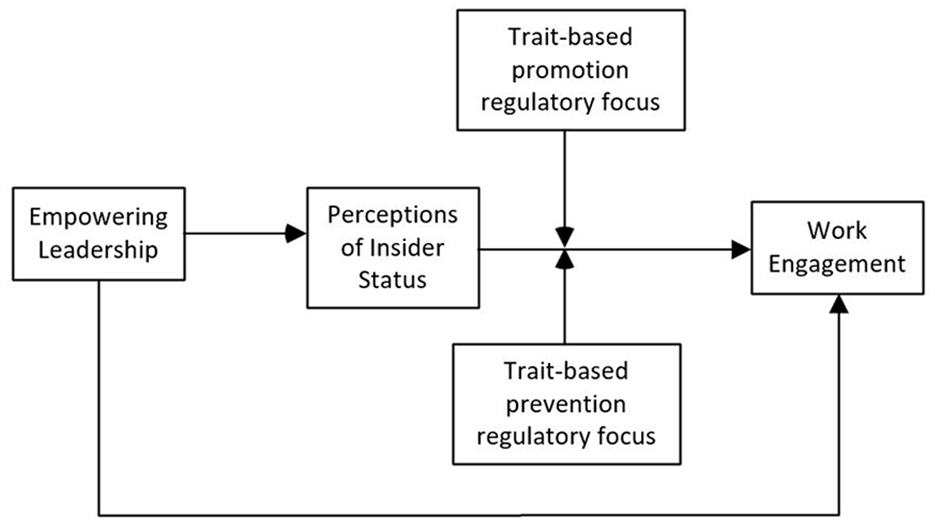
Research framework.
Empowering Leadership and New Employee Engagement
Self-determination theory suggests that the external environment promotes individual work behavior by satisfying autonomy, competence, and belonging, which are three basic psychological needs of individuals, to stimulate their internal motivation (Gagné et al., 2022). Empowering leadership also promotes new employees to develop higher levels of internal motivation by satisfying these three types of needs to achieve a state of full integration into the work role and free self-expression, or say, to show higher levels of work engagement (Hou et al., 2021). First, empowering leadership increases employee to take part in decision-making and gives them some autonomy, which makes new employees feel that they are in a free and flexible work environment on the one hand and satisfies their autonomy needs (Lin et al., 2022), and makes new employees realize that they are valued and supported by the organization on the other hand (Na-Nan et al., 2021) and satisfies their belonging needs; second, empowering leadership often conveys to employees the confidence in performance and the meaning of work, so that new employees feel the organization’s affirmation of their abilities (Li et al., 2011) and firmly believe that they are able to overcome challenges in the mission, which helps to satisfy their competency needs. In summary, this paper proposes the following hypothesis:
H1: Empowering leadership positively influences the work engagement of new employees.
The Mediating Role of Perceptions of Insider Status Between Empowering Leadership and Work Engagement
The perception of insider identity is an employee’s perception of their freedom in the organization and their acceptance as a member of the organization, or say, the extent to which the employee perceives itself as an organizational “insider” (Stamper & Masterson, 2002). We argue that empowering leadership enhances new employees’ work engagement by promoting their perception of insider status. On the one hand, empowering leadership increases employee to take part in decision-making and gives them autonomy in their work, providing them with opportunities to take responsibility and influence organizational processes and outcomes (Yin et al., 2012) so that they can feel that they get the trust and support from the organization, and on the other hand, empowering leadership often conveys confidence in performance and the meaning of work to new employees, so that they can perceive that the organization recognizes them and their importance to the organization (Wang et al., 2019), which helps new employees to perceive themselves as “insiders” in the organization. According to identity theory, when self-concept is stable, people will strive to achieve and maintain a positive social identity, and tend to choose activities that are consistent with their social identity and embrace organizations that identify with their social identity (Ashforth & Mael, 1989). Once new employees develop a high level of perceptions of insider status during socialization, they will tend to maintain behavioral performance consistent with their insiders’ identity, and will combine organizational interests with their interests (Zhang & Chen, 2013), then will carefully observe how other members of the collective approach their work with positive attitudes and behaviors (Rego et al., 2014), finally, they will be actively involved in the work with a sense of “ownership” and resulting in a high level of work engagement. In summary, the following hypotheses are proposed:
H2: perceptions of insider status mediates the relationship between empowering leadership and new employees’ work engagement.
Moderating Effect of Trait-Type Moderation Focus
Individuals try their best to achieve the set goals, and the process of response is self-regulation and the long-term stable self-regulatory tendency is called the regulatory focus (Geers et al., 2005). Trait-type regulatory focus is influenced by the individual’s long-term personality and early life socialization (Jason et al., 2021) and is not easily influenced by environmental changes, which is one of the most important psychological traits of individuals. Individuals have two different trait-type regulatory priorities, promotion and defensive types, and individuals with high promotion regulatory priorities tend to have stronger intrinsic motivation and will show it at work (Friedman & Förster, 2001), care about wishes and achievement and pursue their ideals. Therefore, when forming the self-concept of perceptions of insider status, such new employees have a greater sense of responsibility for the development of the organization, to challenge themselves actively and aggressively, and even if they encounter difficulties, they will be optimistic about finding solutions and showing higher work engagement. However, individuals with a highly prevention regulatory focus tend to show stronger external motivation at work (Friedman & Förster, 2001), tend to avoid challenges and maintain the current situation, and are more afraid of loss and punishment. For such new employees, becoming an “insider” of the organization means more pressure and responsibility, and the unknown risks and challenges tend to cause burnout and emotional exhaustion, which negatively affects the level of work engagement. In summary, the following hypotheses are proposed:
H3a: Promotion regulatory focus moderates the mediating role of perceptions of insider status between empowering leadership and work engagement of new employees positively, and the promotion regulatory focus is higher, the mediating role of perceptions of insider status is stronger.
H3b: Prevention regulatory focus moderates the mediating role of perceptions of insider status between empowering leadership and work engagement of new employees negatively, and the prevention regulatory focus is higher, the mediating role of perceptions of insider status is weaker.
Research Method
Measurement Measures
In this study, the variables were measured by using a seven-level Likert scale, with one to seven representing totally disagree to completely agree, drawing on well-established domestic and international scales and modified according to the actual situation and expert opinions, and all had good reliability. In particular, empowering leadership was measured by the 12-item scale developed by Song et al. (2021), which was divided into four dimensions with three items per dimension, including “The leader will help me understand the relevance of my goals to the company’s goals” and so on. Perceptions of insider status were measured by using a six-item unidimensional scale developed by Stamper et al. (Stamper & Masterson, 2002), including “I feel that my job is very important.” and so on. Work engagement was measured by using a short version of the nine-item scale developed by Schaufeli et al. (2006), involving three dimensions of energy, dedication, and focus, with three items per dimension, including “I am proud of the work I do.” and so on. The trait-based regulation focus was measured by using a scale which was adopted by Zhou et al. (2012) from Lockwood et al. (2002) (Friedman & Förster, 2001), in which the promotion regulatory focus was a four-item unidimensional scale, including “I think a lot about how to get good results,” and so on and the prevention regulatory focus was a three-item unidimensional scale, including “I always worry about not accomplishing my work goals.” and so on. In addition, in order to reduce the potential for alternative interpretations of model relationships, demographic characteristics such as age, gender, education level, years of working in the company, and years of working with leaders were included in the study model as control variables to ensure the accuracy of the statistical test results.
Data Collection
The questionnaire method was used for data collection in this study. Since the study population was new employees, the questionnaire survey was administered to employees with less than five years of employment in two IT companies in Zhejiang Province, China. Considering that empowering leadership is generally applicable to teams with high learning ability, a high degree of task complexity, collaboration, and innovation (Na-Nan et al., 2021), this study mainly selected new employees in R&D, operations, and artwork departments because When employees work in these departments in these departments require a more autonomous environment and continuous learning The work of employees in some departments requires a relatively more autonomous environment and continuous learning. Due to the high screening requirements of the study population, we used a full-sample survey of individuals who met the requirements for new hires in the two companies we selected to ensure that the data collected was more comprehensive and accurate. First, we identified and numbered the list of respondents eligible for this study through the HR department of the organization, and each number corresponded to a questionnaire link. Then, the specified questionnaire link was sent to the respondents through the HR department. Procedural and statistical controls were performed in this study to avoid homogeneous variance problems as much as possible (Zhou & Long, 2004). For procedural control, on the one hand, the anonymity of the questionnaire test was clarified to the respondents in the questionnaire preamble to reduce their guesswork about the purpose of the measurement, and on the other hand, the order effect of the items was balanced without compromising the logic of the scale by distributing the scales of each measured variable to the respondents in random order or reverse order. Statistical controls can be read in Section “Common Method Bias Test.”
Sample Structure
This survey was completed between June and September 2022, and a total of 310 questionnaires were distributed, and 263 were returned, with a questionnaire return rate of 84.8%. After eliminating the questionnaires with too short response time, too high repetition rate of answers, and the existence of obvious patterns, we also considered the three reverse questions and the corresponding positive questions with obvious logical errors in the scores of the insiders’ identity perception variables measured in them as invalid questionnaires according to the questionnaire question settings. After preliminary screening, 206 valid questionnaires were obtained, with a valid completion rate of 66%. Among all respondents, 47.6% were male and 52.4% were female; in terms of age, 68% were under 25 years old, 26.7% were from 26 to 30 years old, 2.9% were from 31 to 35 years old, and 2.4% were 36 years old and above; in terms of education, 68.4% were college, 28.7% were bachelor’s degree, and 2.9% were master’s degree and above; the average years of work is 2.03 years, and the average number of years working with leaders is 1.65 years.
Data Results and Analytical Results
Reliability Test and Correlation Analysis
In this study, the validation factor is analyzed by using AMOS 22.0 to test the convergent and discriminant validity among the variables. The credibility tests are shown in Table 1, and Cronbach’s α and combined reliability (CR) of all variables are higher than 0.7, which means good reliability. The factor loadings of the variable entries (sub-dimensions) were all greater than 0.6, and the average variance extracted (AVE) was greater than 0.5, this indicates that the convergence validity of the variables used in this paper is good, and at the same time, the validity analysis results of the questionnaire are reasonable.
Measurement Items and Scale Reliability.
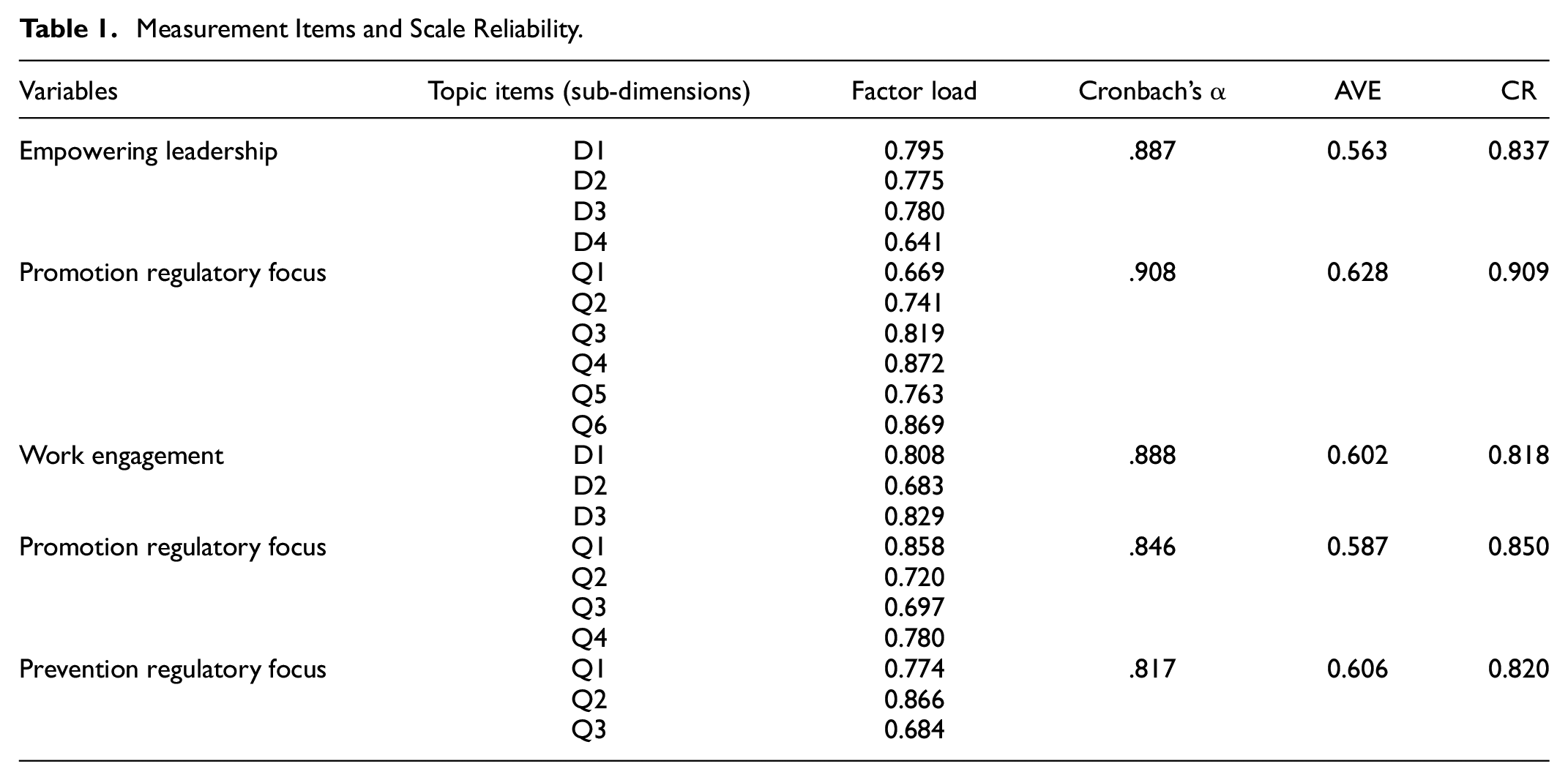
Meanwhile, the discriminant validity of the variables in this study has been confirmed. This is evident as the square root value of the average variance extracted (AVE) for each factor exceeds the maximum correlation coefficient value between that factor and other factors. The results of descriptive statistical analysis and correlation coefficients of the main variables in this study are shown in Table 2 below. The results show that there is a significant correlation between empowered leadership, perceptions of insider status, work engagement, promotion regulatory focus, and prevention regulatory focus, which provides preliminary statistical evidence to support the next step of analysis and hypothesis testing.
Means, Standard Deviations, Correlation Coefficients and Discriminant Validity of Each Variable.

Note. The numbers in diagonal brackets are the arithmetic square root of each factor AVE.
p < .05. **p < .01. ***p < .001 (same below).
Common Method Bias Test
Although this study controlled the common approach bias through procedural control methods such as anonymous questionnaires and sequential effects of balanced items [44], there may still be potential common approach bias because data on empowering leadership, perceptions of insider status, work engagement, promotion regulatory focus, and prevention regulatory focus are derived from subordinates’ self-reports. Therefore, the Harman one-way test was used in this study to assess whether common method bias would have an impact on the study. The results of the unrotated exploratory factor analysis showed that the first unrotated factor explained 26.04% of the overall variance, indicating that the effect of common method bias in this study was limited.
Hypothesis Testing
This study used employees’ age, education level and years of employment in a company as control variables and conducted multiple regression analysis by using SPSS22 software to test the proposed hypotheses in turn To test the hypotheses further, and the results of the analysis are shown in Table 3. First, testing whether the independent variable, empowering leadership has a significant positive effect on the dependent variable new employees’ work engagement. From model 3, it can be seen that empowering leadership has a significant positive effect on new employees’ work engagement with a correlation coefficient of β = .325 and a significance level of p < .001, so hypothesis H1 is verified. To test the mediating role of insider identity perceptions, we test whether the dependent variable, empowered leadership, has a significant positive effect on the mediating variable. From model 2, it can be seen that empowering leadership has a significant positive effect on perceptions of insider status with a correlation coefficient of β = .445 and a significance level of p < .001. Then in the third step, the independent variable, empowering leadership, and the mediating variable, perceptions of insider status, are simultaneously analyzed by using the regression equation. From model 4, the positive effect of perceptions of insider status on new employees’ work engagement is significant (β = .302, p < .001), but the positive effect of empowering leadership on new employees’ work engagement is weaker than before (β = .191 < .325, p < .01), which indicates that perceptions of insider status plays a partially mediating role between empowering leadership and new employees’ work engagement, so hypothesis H2 is verified. In addition, we tested the mediating effect by using the Bootstrap method with the PROCESS macro further, a plug-in in SPSS. The results show that the indirect effect of perceptions of insider status was 0.134 with a 95% confidence interval of [0.08, 0.21] (excluding 0), and the direct effect was 0.191 with a 95% confidence interval of [0.05, 0.33] (excluding 0), indicating that perceptions of insider status plays the role of some intermediaries between empowering leadership with new employees’ work engagement. Thus, hypotheses 1 and 2 are again validated.
Results of Multiple Regression Analysis.

p < .05. **p < .01. ***p < .001.
This paper tests the hypothesis of the moderating effect with a cascade regression analysis. The results of the regression analysis are shown in Table 3. From model 6, we find that the interaction term between the standardized perceptions of insider status and the facilitative regulation focus has a significant positive effect on new employees’ work engagement (β = .209, p < .001), that is, and the promotion regulatory focus has a significant moderating effect between perceptions of insider status and new employees’ work engagement. Based on the regression results, we plotted a simple slope plot as in Figure 2. From model 8, we find that the interaction term between the standardized perceptions of insider status and prevention regulatory focus has a non-significant effect on new employees’ work engagement (β = −.107, p > .05), that is, and the moderating effect of prevention regulatory focus between perceptions of insider status and new employees’ work engagement is not significant. The reason for this may be that new employees with a prevention regulatory focus tend to form normative commitments after forming a perception of insider status (Meyer et al., 2004), and their sense of responsibility to the organization weakens the negative impact of the pressure to be an “insider.”

Moderating effect of promotion regulatory focus.
Then, the paper continues to test the mediating effect of being moderated by the PROCESS plug-in, and the results are shown in Table 4, where the effect of empowering leadership on new employees’ work engagement through perceptions of insider status is significant (β = .192, confidence interval [0.103, 0.295]) when employees’ promotion regulatory focus at a high level (at one standard deviation above the mean); the effect of employees’ promotion at lower levels of regulatory focus (one standard deviation below the mean), the effect of empowering leadership on new employees’ work engagement through perceptions of insider status is not significant (confidence interval [−0.016, 0.120]). Afterward, the mediating effect of being moderated was judged by determining the index, which is 0.056 for perceptions of insider status with a confidence interval of [0.021, 0.104] and excluding 0. In summary, it is concluded that the promotion regulatory focus positively moderated the mediating effect of perceptions of insider status between empowering leadership and new employees’ work engagement. Therefore, hypothesis H3a is verified.
Tests of the Moderating Effect of the Facilitative Moderation Focus.

Although the results of regression show that the moderating effect of prevention regulatory focus was not significant, we examined the moderating effect of prevention regulatory focus as well, and the results are shown in Table 5. The effect of empowering leadership on new employees’ work engagement through perceptions of insider status was significant (β = .156, confidence interval [0.063, 0.272]) when the level of employees’ prevention regulatory focus was low; the effect of empowering leadership on new employees’ work engagement through perceptions of insider status was also significant (β = .077, the confidence interval was [0.017, 0.157]) when the level of employees’ prevention regulatory focus was high, and it is impossible to determine whether the moderating effect was significant. The index of perceptions of insider status was −0.026 with a confidence interval of [−0.062, 0.007], containing 0. In summary, it means that there is no moderating effect of prevention regulatory focus on the influence of empowering leadership on new employees’ work engagement through perceptions of insider status. Therefore, hypothesis 3b is not tested, that is, there is no significant effect of prevention regulatory focus of new employees on the relationship between perceptions of insider status and work engagement. The reason for this may be that new employees with a defensive regulatory focus are prone to develop normative commitment after forming a perception of insider status (Meyer et al., 2004), and a sense of responsibility to the organization undermines the negative effects of the pressures of being an “insider.”
Tests of the Moderating Effect of the Prevention Regulatory Focus.

Research Discussion and Implications
This study answers the question of how to give new employees a better chance to improve their work engagement, and explored the impact of empowering leadership on new employees’ work engagement in the current social context from the perspective of new employees’ organizational socialization, as well as the mediating role of perceptions of insider status and the moderating role of employee trait regulation focus. The study shows that empowering leadership has a significant positive impact on new employees’ work engagement, and perceptions of insider status partially mediate the positive impact of empowered leadership on new employees’ work engagement. New employees’ trait-based promotion regulatory focus moderated the positive effect between perceptions of insider status and new employees’ work engagement. This reveals the important role of leadership in the organizational socialization process of new employees, while insider identity perception as a mediating variable better explains the influencing process and mechanism, and employee moderating focus as a moderating variable explains its boundary conditions, which provides certain guidance and direction for both future research and corporate practice.
This paper has the following three specific innovations: first, the research object is the new generation of new employees, the new generation of new employees has a strong sense of autonomy, not blindly obey the authority of the characteristics, which requires organizations to use new methods to accelerate their socialization process, prospective attention to this group is of great significance; secondly, regarding the method of organizational socialization, the method of empowering leadership is innovatively proposed, which is not found before, and the article also explains in detail why empowering leadership is a more targeted socialization method for new employees both theoretically and practically; third, it reveals the impact of individualized differences in employees on this process, innovatively proposing the variable of moderating focus rather than the traditional study of demographic differences.
Theoretical Contributions
The theoretical contributions of this paper are in two main areas: first, it expands the theoretical study of organizational socialization methods to include perspective variables such as leadership characteristics, employee traits and employee psychological resources in a unified framework. This study finds that empowering leadership may be an effective organizational socialization method that has not received much attention and has a positive impact on the organizational socialization of new employees. As an important source of organizational vitality and innovation, the organizational socialization of new employees is conducive to better engagement in the workplace and has a significant impact on organizational competitiveness. Specifically, empowering leadership can increase the level of new employees’ work engagement by prompting them to develop perceptions of insider status better during the socialization process, while the trait-based promotion regulatory focus of new employees positively moderates the positive impact of perceptions of insider status on their work engagement. In a broader meaning, this also suggests that the organizational socialization of new employees is influenced by a combination of organizational strategies and individual traits.
Second, it enriches the theoretical study of empowering leadership by focusing on the impact on a special but important group and introducing an important resource of employee perceptions of insider status to connect the two. Existing research on the impact of empowering leadership on employees’ behavior is mostly focused on general employees, but new employees are very different from general employees in terms of psychology and actions. This study analyzes the group of new employees in particular and explores how empowering leadership plays a role in the organizational socialization process of new employees. In particular, as Chinese companies are influenced by Confucian culture, the power gap is generally large (Li et al., 2011), especially for new employees, and it is important for leaders who conduct empowering leadership to make new employees feel like insiders in the organization and then, inspire internal motivation. Therefore, including the variable of perceptions of insider status in the research framework is important to improve the mechanism of how empowering leadership affect Chinese companies.
Practical Implications
This study has important guiding implications for business management practices as the following. First, the study found that empowering leadership is a proven socialization method, so leaders can make new employees feel valued and recognized by the organization through appropriate empowering behaviors such as communicating their recognition in communication and supporting their participation in decision-making so that they can form a perception of insiders’ status and thus enhance their work engagement. Secondly, the study suggests that the impact of being an “insider” on work engagement is different for new employees with different trait-type regulation focus. At the same time, managers can promote a corporate culture and inclusive work environment that emphasizes aspirations and achievements to have a long-term impact on new employees and cultivate and strengthen their trait-based promotion regulatory focus. Overall, this study addresses the dilemma of new employees who often find it difficult to quickly integrate into the organization both professionally and emotionally, and helps organizations to better manage their new employees by empowering line leaders to accelerate and enhance their organizational socialization and improve work engagement.
Discussion
This paper has shortcomings for further improvement as the following and needs in-depth discussion. First, the data in this study were obtained from the self-reports of the subordinates, and although procedural controls were performed during the questionnaire design and data collection, and statistical controls were performed during the data analysis, this cross-sectional study still could not completely avoid the problem of homogeneous variance. Future research can be combined with other research methods to explore this research in depth to improve the reliability and accuracy of the research results, which is helpful for further generalization of the research results, and longitudinal research is also conducive to exploring the possible dynamic perspectives of this research topic. Secondly, the sample selection of this study is mainly from two IT companies in Zhejiang, China, although it ensures the internal validity of the research results to a certain extent, but may also lead to a decrease in external validity. Future studies can collect samples from multiple companies in different regions to expand sample data sources and sample sizes to further enhance the external validity of the findings. Third, the moderating effect of trait-based prevention regulatory focus between perceptions of insider status and new employee work engagement in this study has not been confirmed, and the specific reasons for this can be further explored in future studies. The study is also a good example of the role of environmental variables in the process of development of the economy. At the same time, there are external environmental characteristics that are not used in different regions, and expanding the geographic area of the study sample will also help to further clarify the role of more environmental variables on this process.
Footnotes
Declaration of Conflicting Interests
The author(s) declared no potential conflicts of interest with respect to the research, authorship, and/or publication of this article.
Funding
The author(s) received no financial support for the research, authorship, and/or publication of this article.

Data Availability Statement
Data sharing not applicable to this article as no datasets were generated or analyzed during the current study.