



Abstract
This research study reports on the in-service English as a Foreign Language teachers’ perceptions of and needs and expectations regarding EIL and EIL-informed pedagogy in Northern Cyprus, which is a multilingual and multicultural teaching-learning context. A mixed method research design was utilized by collecting data through a questionnaire and interviews. A total of 152 in-service EFL teachers responded to the questionnaire, and 23 of them participated in the interviews. The findings of the study indicated that although the teachers welcomed the inclusion of EIL-aware pedagogy, they were hesitant to implement it in their classrooms due to lack of EIL-bound materials and existence of native speaker bound tests. The analysis also showed that teachers are aware of the EIL and EIL-aware pedagogy to some extent, however they lack the practical experience and expertise in order to implement such an approach to their daily practices. The findings of the study are believed to help raise EFL teachers’ awareness on how to integrate an EIL-informed approach in not only the local context but also in other multilingual and multicultural teaching-learning contexts worldwide.
Plain language summary
This paper focused on the perceptions of English language teachers about English as an international language. In addition, their needs and expectations in relation to an in-service course on the topic were identified. To collect data, a questionnaire and interviews were used, and 152 teachers responded to the questionnaire; while 23 of them took part in the interviews. The results showed that teachers had positive perceptions toward EIL in general, but they were not willing to implement an EIL-aware pedagogy in their classes. One of the main reasons indicated for not implementing was a lack of resources and training. This study is believed to foster English teachers’ awareness and competencies regarding the implementing EIL-aware pedagogy in their classes. The study is expected to raise English language teachers’ awareness about these issues not only in local contexts but also in other multilingual and multicultural teaching-learning contexts worldwide.
Keywords
Introduction
In recent decades, there has been a paradigm shift in the emphasis of English language instruction as a result of globalization, from native speaker proficiency to the comprehensibility and intelligibility of English (Tajeddin et al., 2020). The growing trend of communication amongst non-native speakers of English from various cultural and linguistic backgrounds has led the English language and English language pedagogy research to redirect their focus on English as an international language. EIL communication that takes place in multicultural settings, in contrast to conventional perspectives of communication, recognizes the growing varieties of English, such as Asian Englishes, as legitimate forms of English (Jenkins, 2006; Matsuda, 2003). Despite the fact that many scholars and professionals around the world have acknowledged the English language as a common medium for intercultural communication, many others appear to be hesitant to deviate from the standard Englishes (i.e., American English or British English). It is critical to understand the English language’s fundamental function in cross-cultural communication and address the needs of language learners accordingly. In such multicultural contexts where pedagogical changes are required, the fundamental assumptions that underlie English language pedagogy must be re-examined from a sociolinguistic and sociocultural perspective, and traditional beliefs must be challenged (Seidlhofer, 2011). Many scholars have emphasized that EIL-informed pedagogy should be incorporated into English language teaching (ELT) pedagogy and teacher education programs in this regard (Galloway & Rose, 2015; Matsuda, 2017; McKay, 2002).
The rapid spread of the English language has led to an exponential growth in the varieties of English used today, which requires ELT professionals to adjust their methods of delivery, curricula, and mindsets. This prevalence of World Englishes (WEs) at the international level of communication, especially in expanding-circle countries, has significant implications for the ELT field. As Matsuda (2019) noted, the expansion and global spread of English require ELT practitioners to adjust their mindsets and daily practices accordingly. Considering the rapid developments, it is crucial to investigate stakeholders’ viewpoints, particularly those of teachers, regarding the diverse uses of English. To the same end, this research study aims to investigate EIL in the Northern Cyprus context by focusing on in-service EFL teachers’ perceptions, needs, and expectations regarding EIL and EIL-informed pedagogy.
Given the impact of English language teachers’ perceptions on their practices, it is critical to investigate their perceptions about: (1) the diversity of English; (2) EIL-informed pedagogy; (3) English ownership; and (4) communication strategies for multilingual and multicultural contexts. While there has been an increase in studies focusing on pre-service English language teachers’ perceptions on such issues (Bozoglan & Gok, 2017; Coskun, 2011; Lee et al., 2019; Ren et al., 2016; Rezaei et al., 2019; Shibata, 2009; Wang, 2015), there has been a dearth of attention paid to in-service English language teachers’ perceptions, especially those located in the expanding circle countries (Ahn, 2014; Bernaisch & Koch, 2016; Tajeddin et al., 2018, 2020).
The English language has been dominant internationally for some reasons, including globalization, migration, and modern media. Phillipson (1992) called the international dominance of the English language “linguistic imperialism” (p. 46). English is now a common language spoken by both native and non-native speakers. According to Crystal (2006), there are more non-native speakers of English than native speakers, which led to the emerging varieties of English. According to Clyne and Sharifian (2008), the difference between native and non-native speakers is fading due to the rapid growth of English. This viewpoint emphasizes the diversity of English language rather than relying on native speaker models.
Given the diversity exists in English today, many scholars in the field of ELT have frequently noted the evolving nature of English’s sociolinguistic and sociocultural landscape (Cook, 2002; Galloway & Rose, 2015; B. B. Kachru, 1976; B. Kachru, 1985; McKay, 2002; Pennycook, 2001; Seidlhofer, 2011; Widdowson, 1994). Specifically, several scholars seem to problematize and confront the conventional practices of ELT (native speakers’ models and norms, norm-bound materials, and tests) because there are new approaches and norms defined by non-native speakers of English. In particular, Matsuda (2002, 2012, 2017) mentioned that EIL-aware pedagogy should be integrated into ELT practitioners’ daily practice and teacher education programs. Along with these arguments, it is important to emphasize that there are several approaches to EIL-informed pedagogy and several terminologies that are associated with the EIL, such as Global Englishes, WEs, and English as a lingua franca.
Furthermore, Kirkpatrick (2008) pointed out that in addition to the native varieties of English, there are nativized varieties. “Nativized varieties are formed and influenced by the local culture and languages that are spoken beforehand.” He further emphasized that all varieties of English are “nativized” varieties because somehow, they have been influenced by the culture and languages spoken there. One of the implications of such a distinction for the field of ELT is that practitioners are required to choose between two alternatives. Practitioners can either choose to use an exonormative native speaker approach, which is based on native speaker norms, or adopt an endonormative nativized approach, which is influenced by the local cultures and languages.
Along with these terminological considerations, more practical issues such as materials development and testing and measurement need to be considered, and the perceptions of English teachers regarding such issues must be examined. Considering the fact that most of the dialogs and interactions in English all around the world take place between non-native speakers of English rather than native speakers of English, the materials that are used in the EFL classroom need to reflect this reality and prepare English language learners for this reality (Tomlinson, 2016). Previous research studies showed that most EFL courses fail to reflect this reality and address the needs of English language learners. For instance, Tomlinson and Masuhara (2013) found that most of the texts in six EFL courses represented standard versions of English. The results of their study also showed that most of the materials (texts, audio and video recordings, etc.) illustrated native speaker speech that did not help prepare learners for the real use of English in a global lingua franca context. They further noted that the involvement of non-native speaker speech in dialogs is very little, and it relies on native speaker models. Likewise, Burns and Hill (2013) explored the textbooks that are used in EFL courses and concluded that non-native speaker involvement was minimal and the focus of the activities or texts was not to explore the communication that takes place between different speakers of English. In line with these studies, Tomlinson (2016) suggests that such EFL courses need to be revisited and problematized to explain why they do not meet the needs of the majority of English language learners and he proposes ways to address the problem.
As far as testing and assessment in ELT are concerned, the long-established belief is bound to the native speaker norms which are constituted by the inner circle countries (i.e., UK, USA). In the past four decades, empirical studies have shown that most of the English speakers are located in the outer and expanding circle countries (Crystal, 2003; B. Kachru, 1985), and the varieties that are emerging in these countries are developing into systematic and stable norms for non-native varieties of English (Y. Kachru & Smith, 2008; P. Lowenberg, 2012). Of course, it is premature to assume that such non-native norms are valid and reliable in testing and assessment in ELT (Elder & Davies, 2006). Many scholars draw attention to the unprecedented growth of variation in English and the need to reflect this pluricentricity of English in ELT materials and tests (Canagarajah, 2006; Clyne & Sharifian, 2008; Elder & Davies, 2006). However, most of the English language materials and tests in use dominantly focus on inner-circle English, underrepresenting other varieties.
Perceptions of English Teachers About EIL
A body of research on English language teachers’ perceptions toward EIL has been reported recently (i.e., Ahn, 2014, 2015; Bayyurt et al., 2019; Bernaisch & Koch, 2016; Ceyhan-Bingöl & Özkan, 2019; Rahayu, 2020; Sadeghpour & Sharifian, 2017; Selvi, 2013; Tajeddin et al., 2020; Zacharias, 2014). Overall, most of the studies revealed that there is a strong consensus among English teachers such that they prefer standard American or British English across different educational contexts. In addition to that, English teachers identify the non-native varieties of English accents as deficits and classify them as incorrect, deficient, and not good. The dominance of native-speaker norms appears to have a significant effect on non-native speaking English teachers (NNESTs), and regarding this, N. C. Sifakis and Sougari (2010) found that NNESTs were bound to the native speaker model and preferred to sound like native speakers.
In another study conducted by Bernaisch and Koch (2016), the results showed that Standard English accents were preferred over other varieties of English. Although there were positive attitudes toward the accents of local varieties of English, standard British or American accents were more favorable. Tajeddin et al. (2018) investigated 125 NNESTs’ perceptions of native speakers’ linguistic and pragmatic norms. Despite acknowledging emerging varieties of English, they held favorable attitudes toward native speakers’ norms. In another study, Tajeddin et al. (2020) found that NNESTs recognized the emerging varieties of English throughout the world and appreciated these varieties as long as they are intelligible and comprehensible. However, there was a gap between their recognition of World Englishes and their classroom practices, which were strictly bound by native speaker norms. Bayyurt et al. (2019) explored in-service English teachers’ awareness of English as a Lingua Franca (ELF)-aware pedagogy in three different countries, namely, Turkey, Portugal, and Poland. The findings of the study showed that most of the English language teachers were aware of the significance of integrating ELF-aware pedagogy into their teaching contexts, but they were hesitant to implement such pedagogical practices in their teaching own contexts.
Despite the growing interest in research concerning the above-explained issues, the following two issues can be considered as research which are crucial to investigate: (1) The perceptions of in-service English language teachers have garnered scant research attention compared to the pre-service English language teachers’ perceptions; (2) To the best knowledge of the researcher, the perceptions of in-service English language teachers about EIL and EIL-informed pedagogy were not investigated in the local context (Northern Cyprus). However, in the past 10 years, teachers in the local context have been challenged to deal with students that are coming from various linguistic and cultural backgrounds due to the main reason of migration (Erden & Erden, 2019).
Research Aim and Questions
In order to address the above-mentioned contextual problems, there is an urgent need for investigation into EFL teachers’ beliefs, instructional practices, and their understanding and awareness of the concept of EIL and EIL-informed pedagogy. Thus, the current case study focuses on investigating in-service English language teachers’ (in Northern Cyprus) perceptions of EIL and EIL-informed pedagogy, as well as conducting a needs analysis to identify their needs and expectations, which will be basis for designing an in-service course to address these needs and expectations.
To this end, the following research questions were addressed:
What are the in-service English language teachers’ perceptions of EIL and EIL-informed pedagogy?
What would be the in-service English language teachers’ needs and expectations if an EIL workshop/seminar/course were offered to them?
Method
Research Design
In this research study, the convergent parallel design, which is a typology-based mixed method design, was used. In a convergent parallel design, the researcher collects and analyzes both qualitative and quantitative data in the same stage of the study and then combines the results of both strands into an overall interpretation (Creswell & Plano Clark, 2017). A questionnaire and a semi-structured interview were utilized in this study to collect data. This design allows the researcher to compile the distinct strengths and nonoverlapping weaknesses of both quantitative methods (i.e., generalization, large sample size, and trend) along with the qualitative methods (i.e., in-depth and detailed data, small sample size) in order to yield a better understanding of the results (Creswell & Plano Clark, 2017).
Participants and Research Context
The participants of this research study were the in-service EFL teachers who were teaching at public and private secondary and high schools as well as tertiary education institutions (i.e., university English-preparatory schools) in Northern Cyprus. A convenience sampling was adopted in this study and a total of 152 in-service teachers (122 females and 30 males) participated in the study. As displayed in Table 1, their ages ranged from 21 to 67 and their years of experience varied, ranging from 1 year to 38 years, with a mean of 17 year.
Demographic Information About the Participants.

Over the last 10 years, the research context has evolved from a homogeneous group of learners (Turkish Cypriot and Turkish students) to a multicultural and multilingual one. Due to socioeconomic and sociocultural reasons, many families around the world, especially from Arabic countries, moved to Northern Cyprus. The immense number of migrations to Northern Cyprus had a negative impact on secondary-high schools, and school administrators and teachers have regarded migration and its effects as one of the current problems in the education system (Erden & Erden, 2019). The increased number of immigrant children in schools, who do not speak Turkish, do not share the same cultural values, and do not participate in orientation activities causes problems for both these students and local students. In such contexts, particularly EFL teachers, play an important role in encouraging and increasing immigrant students’ active participation (Gözpınar, 2021).
Data Collection Instruments
In this research study, quantitative and qualitative methods of data collection that is, a questionnaire and an interview were adopted.
The Questionnaire
A questionnaire adapted from previous studies (Bayyurt et al., 2019; Ceyhan-Bingöl & Özkan, 2019; Tajeddin et al., 2020) was used to collect data on in-service teachers’ perceptions of EIL and EIL-aware pedagogy. The internal consistency scores of the instruments used in these studies were 0.73, 0.75, and 0.72, respectively. For the current study, the Cronbach’s alpha was .75. This questionnaire included both qualitative and quantitative data collection methods, and in addition to the 5-point Likert-scale question format, the participants were given the opportunity to express their perceptions, needs, and expectations in open-ended questions throughout the questionnaire. Overall, the questionnaire consisted of three major parts: “Biographical Data,”“Perceptions about English as an International Language,” and “Needs and Expectations.”
The first part of the questionnaire involves questions related to participants’ demographic information. The second part is composed of 36 statements that intend to gather data about EFL in-service teachers’ perceptions regarding EIL. In this part, there are statements (S) related to EIL and teaching EIL under six sub-headings;
(a) Perceptions of language and accent (S1–7)
(b) Perceptions of cultural awareness (S8–13)
(c) Perceptions of varieties of English (S14–21)
(d) Perceptions of Native English speaking teachers (NESTs) and NNESTs (S22–24)
(e) Perceptions of communication goals (S25–32)
(f) Perceptions of ownership of English (S33–36)
The last part of the questionnaire aims to elicit data regarding the participants’ needs/expectations about to be planned EIL workshop/seminar/course. Needs/expectations part is a needs analysis developed based on Macalister and Nation’s (2019) language curriculum design model in order to explore the needs, wants, and lacks of the participants.
Interviews
Semi-structured interviews consisting of eight questions on the in-service EFL teachers’ perceptions, needs, and expectations of EIL and EIL-informed pedagogy were conducted. In this respect, a total of 23 in-service teachers voluntarily participated in interviews. For the analysis, all interviews were audio recorded and then transcribed for further analysis. In the following sections, scripts from the interviews will be referred to as T1, T2, T3, and so on (T standing for teacher).
Data Collection Procedures
Prior to the process of data collection, the questionnaire was piloted. A total of 10 in-service teachers who had been given instructions regarding the aim of the questionnaire were kindly asked to evaluate the integrity of the questionnaire. Upon their feedback, minor wording changes were made for comprehensibility reasons. Once the questionnaire was ready, it was administered to a total of 152 in-service teachers. A consent form (approved by the ethics committee) informing participants about their participation in the study was given beforehand.
Then, the quantitative data was triangulated by employing semi-structured interviews. For the interviews, a total of 23 in-service teachers agreed to take part, which was also on a voluntary basis. Each interview, which was administered individually, took around 10 to 15 min. Prior to the interview sessions, the interviewees were informed about the purpose of the study and the terms of confidentiality. Then, each interview was held in a face-to-face format. Based on the interviewees’ responses, the researcher asked additional questions to elaborate more on the topics.
Data Analysis
Both quantitative and qualitative sets of data were collected and analyzed through corresponding analysis methods. For the analysis of quantitative sets of data, the Statistical Package for the Social Sciences (SPSS) was used. On the other hand, to transcribe the interviews the Otter software program was used. The analysis of the qualitative was conducted based on Braun and Clarke’s (2006) thematic analysis in order to identify, analyze, and report recurring themes (i.e., codes or patterns). The recurrent topics that emerged from the interviews were codified systematically. The analysis was conducted by comparing the teachers’ responses from the interviews. The themes were improved by reviewing and revising them, ensuring that they made sense in light of the coded extracts and the complete data set.
Ethical Issues
In terms of ethical considerations, the researchers applied to the Ministry of Education, their university’s ethics committee, and other universities for permission for data collection. Once all the institutions approved the application, the researchers visited all the secondary and high schools; during these visits, they informed the administration about the purpose of the study and, they were granted permission to collect data under the condition of the school principals’ and/or vice principals’ consultation (based on the Ministry of Education’s permission letter). Thus, the school principals and/or vice principals were first informed about the objectives of the study and the procedures for the data collection, including the questionnaires and semi-structured interviews.
Findings
The findings of the study are presented under two headings based on the research questions.
In-Service EFL Teachers’ Perceptions of EIL and EIL-Informed Pedagogy
The findings of the questionnaire are discussed based on the categories used in the questionnaire. Moreover, the main themes that emerged regarding the first research question are summarized in Table 2 below. Also, descriptive statistics of teachers’ perceptions regarding EIL are presented in Table 3.
Main Themes Emerged From Interviewees’ Responses to the First Research Question.

Descriptive Statistics of Teacher’s Perceptions of EIL.

LA = language and accent; CA = cultural awareness; VE = varieties of English; CG = communication goals; OE = ownership of English.
Teachers’ responses to language and accent related statements indicated that NNESTs, in general, preferred to have native-like proficiency and accent. For instance, 45% of the teachers agreed that NNESTs must have a British or American accent. Similarly, 86.8% of the teachers preferred to use standard British or American English. Additionally, the interview results showed that, although the teachers’ accepted non-native varieties as legitimate varieties of English, most of them preferred to sound like native speakers of the language. One of the teacher’s (T17) response reflected such a view: “I think it is hard to teach non-native varieties of English in the classroom, especially in terms of pronunciation. We should be following the principles of native speaker models. Maybe some degree of tolerance can be shown when it comes to international communication in order to prevent communication breakdowns.”
As far as cultural awareness is concerned, the results clearly showed that most of the teachers were positive about the influence of culture in language education. Over 75% of the teachers responded that in language education, both target and local cultures should be integrated. Also, over 60% of the teachers believed that a comparison that identifies the similarities and differences between target and local cultures is important. In addition to that, the findings showed that there was a strong agreement in favor of the inclusion of inner-circle culture-oriented materials in language teaching. For instance, 76.9% of the teachers’ responses showed that cultural aspects of the materials should be based on Britain and/or the USA. Overall, the findings of the interviews suggested that teachers recognized the importance of culture in language education, which is parallel to the questionnaire results. Moreover, 16 out of 23 teachers indicated that they were willing to integrate EIL in their classes but were not able to do so due to a lack of materials. In this vein, T14 describes the lack of ELF-aware materials in the interview as follows: “I believe that non-standard English is much easier for students in places like our university. Most of the students are non-native speakers, and the same is true of the teachers. But we don’t have the materials for that. The course books that we use are produced by inner-circle countries. For example, in terms of accent, all the listening scripts are spoken by a native speaker, especially a British or American speaker, not even from Canada or Australia.”
Teachers’ responses the statements about utilizing various non-native varieties of English while preserving the principles of intelligibility and comprehensibility were highly positive (77.7% agreement, item 14). A smaller proportion of teachers (34.2%) were unsure about introducing different uses of English-to-English language learners based on geographical regions, while a sizable proportion (51.4%) agreed with the statement. Although the legitimacy of non-standard varieties of English are widely accepted by the teachers (58.6% agreement), a significant number of them (61.2%) claims achieving native speaker norms to be the main goal. One of the themes that emerged from teachers’ responses is the importance of exposure. They firmly believed that learners would develop a positive attitude and an understanding of the diverse uses of English by getting exposed to all varieties of the language. Despite their acceptance of the importance of non-native varieties of English, most of the teachers were adherents of the native language. For instance, T7 stated: “The standard variety of English should be the reference point. However, we cannot ignore the reality that non-standard varieties of English are more common than the use of Standard English. As a result, we should, at the very least, introduce non-standard varieties of English in our classroom.”
A vast majority of the teachers (61.9%) perceived NESTs as being better at pronunciation than NNESTs, while 63.1% of them believed that NNESTs are better at spotting learners’ mistakes and errors that are rooted in their L1. Another theme that emerged from the qualitative results suggested that NNESTs are better at teaching the target language to non-native learners, since they were once learners of English themselves. In line with this idea, T22 posited:
“I think NNESTs are superior in the sense that I can tell what subjects are going to be difficult, because I was once a student who was learning English. I have experienced similar struggles. So, I know that if I teach this subject in this manner or provide these examples, they will learn more effectively.”
Teachers’ responses to statements related to communication goals showed that an intelligible accent (65.1% agreement) is quite important for successful communication between native and non-native speakers of English, whereas accurate grammar (47.3% agreement) seems to be less important for the teachers. Interestingly, 46.1% of the teachers were indecisive about whether international communication or native speaker language norms should be used between two non-native speakers, while 54.6% of them believed that NNESTs should use native speaker models to have successful communication. Such findings suggest that intelligibility is more important than accuracy. Regarding the grammatical accuracy, teachers’ opinions are contradictory. To exemplify, 47.3% of the teachers believed that accurate grammar was essential, while 27.6% thought it is not. The interview results revealed that teachers are mostly positive about the use of intelligible accents, even at the cost of grammatical accuracy. Even though the teachers’ responses reflected such ideas, a vast majority of them adhered to Standard English. One of the teachers (T2) stated that: “Knowing about non-native English varieties led me to be tolerant of the grammar, vocabulary, and pronunciation errors they made as long as the intelligibility was maintained. Due to the changing demographic background of the students, we need to make them aware of the non-standard uses of English. For classroom practices, standard English should be used.”
According to the findings, the majority of teachers believe that English belongs to all users of English. A high percentage (79.6%) of the teachers indicated their agreement with “the English language belonging to whoever uses it for communication.” Moreover, most of the teachers (73.7%) believed that native and non-native speakers of English are legitimate users of the language and should have the right to decide what norms to use in communication. Regarding this issue, T19 mentioned that: “English is the common language used by millions of users; therefore, it should no longer be considered the language of native speakers, but of non-native speakers as well.”
In general, teachers’ perceptions regarding EIL and EIL-aware pedagogy were positive as long as that the principles of intelligibility and comprehensibility were preserved. However, they were reluctant to integrate EIL-aware pedagogy into their practices. It seems that a lack of EIL-aware pedagogy and norm-bound tests are the main reason for their reluctance.
In-Service EFL Teachers’ Needs and Expectations of EIL and EIL-Informed Pedagogy
Descriptive statistics of needs and expectations are summarized in Table 4 below. In the needs analysis, the first part was about the aims and objectives of the in-service course. The teachers’ responses indicated an immense need for practical knowledge rather than theoretical knowledge. For example, a high percentage of teachers were undecided about introducing theoretical models and terminologies about EIL, ELF, and WEs, indicating that teachers were resistant to theoretically oriented components. On the other hand, 85.6% of the participants indicated a need for gaining understanding of how to develop materials for teaching EIL. Also, a vast majority of the teachers’ responses showed their willingness to develop awareness of the implications regarding the use of EIL in education (85.7% agreement, item 7). Interviewees’ responses, in general, indicated that the in-service course should aim to focus on the practical activities that facilitate awareness of EIL-friendly pedagogy. One of the interviewees (T23) stated that:
“The workshop should focus on the teaching and learning context and help teachers develop and adapt materials for EIL.”
Descriptive Statistics of Needs and Expectations.
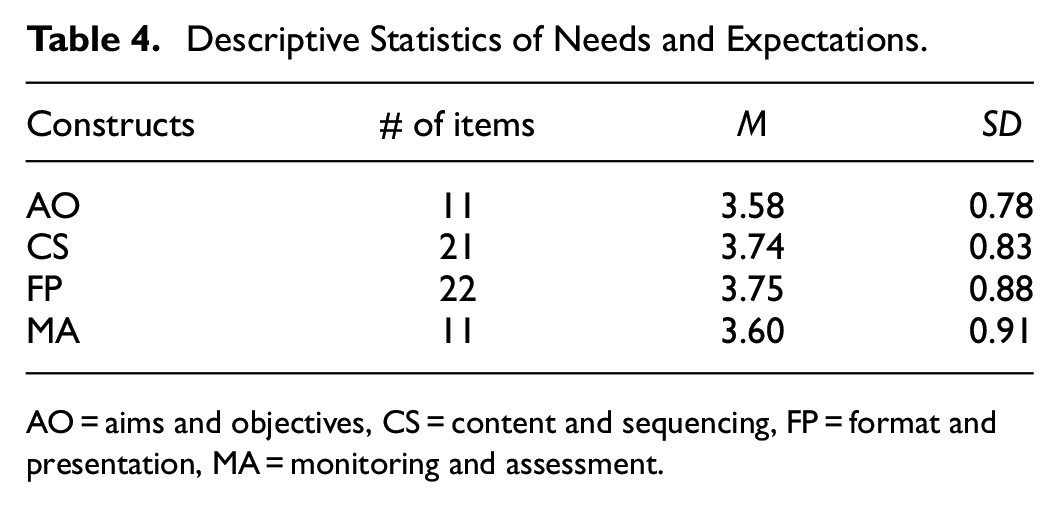
AO = aims and objectives, CS = content and sequencing, FP = format and presentation, MA = monitoring and assessment.
Regarding the content and sequencing part, the teachers seemed to believe that topics such as materials development and testing and assessment are more important than topics such as the historical development of the global expansion of the English language and ownership of language. To this end, the results showed that most of the participants wanted the workshop to focus on materials development and testing and assessment of EIL (84.9% agreed with item 8 and 79.6% agreed with item 9). Meanwhile, teachers’ responses regarding the inclusion of teaching the language skills and language areas in the workshop indicated a high percentage of agreement for all skills and components except for vocabulary; a vast majority of the teachers (48.7%) were not sure about giving more attention to the vocabulary in the workshop. In line with the questionnaire results, interview findings showed that teachers were concerned about the materials and testing of EIL-aware pedagogy. Regarding this (T19):
“I believed that EIL-aware pedagogy is important, especially in our context since the number of immigrant students is steadily increasing. However, I am highly concerned about how to implement such pedagogy and how to measure students’ performance in tests based on the principles of EIL-aware pedagogy.”
The next part was related to the format and presentation. Most of the teachers wanted the content to be presented in the form of real-life speech samples (i.e., audio scripts of non-native speakers), with 92.1% agreement, and in the form of tasks and activities, with 86.2% agreement, whereas a high percentage of teachers were indecisive about the inclusion of journal articles, with 32.9%, and the inclusion of transcripts of lessons, with 35.5%. As shown in Table 5, interview results indicated that teachers needed hands-on experience with EIL-aware pedagogy in terms of tasks and activities. In this vein, one of the interviewees (T9) said that:
“In this workshop, I would like to see what kind of tasks and activities I can use in my classroom to increase my students’ awareness of World Englishes.”
Main Themes Emerged From Interviewees’ Responses to the Second Research Question.

The participants’ responses in the monitoring and assessment part yielded interesting results. They were highly positive on the idea of receiving feedback about their performance, with 63.2% agreeing, whereas they were reluctant to have a formal assessment regarding their progress, with 30.3% not sure. A vast majority of teachers believed that the assessment should focus on practical skills in teaching EIL rather than theoretical knowledge (71.1% agreement).
As shown in Table 5, teachers’ perceptions about the workshop indicated that teacher training regarding practical issues was insufficient. Therefore, they preferred the in-service course to provide them with practical issues such as materials development, activities that facilitate awareness of non-native varieties of English, and so on. In this respect, one of the teachers (T5) stated that: “The content of the course should briefly introduce the theoretical parts of these concepts and then focus on the materials and activities that can be used in the classrooms, how to tackle problems they might face, and elaborate on what kind of problems they might face.”
In addition to that, teachers were concerned about the lack of practical issues in teacher education programs. Most of the teachers pointed out that teacher education programs should revisit their curricula regarding EIL-aware pedagogy since English language learners are constantly changing in today’s world.
Discussion
This study explored the perceptions, needs, and expectations of in-service EFL teachers in Cyprus context regarding EIL and EIL-aware pedagogy. Regarding the perceptions and instructional practices of the teachers, contrasting results were obtained. The results of the study showed that although teachers favored the idea of inclusion of EIL-aware pedagogy, they seem to be hesitant to integrate the EIL into their teaching practice as also reported in previous studies (Bayyurt et al., 2019; Tajeddin et al., 2020). The mismatch between what teachers believe about EIL, and the hesitancy of EIL-aware approach in their practices can be explained by the lack of materials and the existence of native-speaker bound tests. Such findings indicate that teachers recognize language use and language education as two separate strands which was also reported in earlier studies (Tajeddin et al., 2018, 2020). Language use involves the positive perceptions of teachers with regard to the intercultural competence, whereas the language education is strictly bound to the native speaker norms. Previous studies have also documented that the EIL-aware materials are close to non-existent, while inner circle-oriented materials are readily available for teachers to implement (Bayyurt et al., 2019).
Although the instructional practices of the teachers are beyond the scope of this study, the results showed a significant insight about the controversy of teachers’ beliefs and practices. In the present study, although teachers’ responses showed some awareness of non-native varieties of English, they were undecided on how to position the emerging varieties of English in their classes, and their use of English is generally reflecting native speaker norms. Comparable results are reported in the literature. For instance, Ceyhan-Bingöl & Özkan (2019) reported that EFL instructors preferred to use British and/or American English. In another study, Bernaisch and Koch (2016) reported that Standard English accents were preferred over other varieties of English. In this research study, the findings showed that teachers preferred their own local accent which validates their lingua-cultural identity whenever they are involved in a “language in use” On the other hand, they preferred the Standard English accents when they were involved in “language in education.” In parallel with the previous studies (i.e., Tajeddin et al., 2020), the findings suggested that teachers make use of their L1-influenced local accent in lingua franca contexts, however when it comes to teaching they seem to be heavily influenced by the native-speaker norms.
As evidenced by the findings, a vast majority of the teachers stressed the importance of cultural elements in language education. Previous research has also revealed that teachers value the importance of culture in language education, especially in multilingual and multicultural contexts, as well as the inclusion of cultural aspects of non-native speakers (Bayyurt et al., 2019; Ceyhan-Bingöl & Özkan, 2019). Such findings suggest that teachers support the idea of cultural diversity in their teaching practice, but a lack of EIL-aware materials restricts their ability to implement such an approach in their classrooms.
Teachers’ beliefs regarding the intelligibility and grammatical accuracy showed comparable results with previous studies (Bayyurt et al., 2019; Tajeddin et al., 2020). For instance, although the teachers seem to have positive attitudes toward intelligible accents, they were norm bound when it comes to teaching. It is found that intelligible accent is more important that grammatical accuracy for teachers especially in a lingua franca context. Yet, they were strictly bound to the native speaker models and intolerant for grammar mistakes in classrooms.
Concerning the perception of NNESTs and NESTs, the findings revealed that NNESTs are considered better at teaching compared to their NESTs counterparts. This finding is validated by Atamturk et al.’s (2018) findings which emphasized that NNESTs teachers are better at anticipating and helping learners’ mistakes stemming from their L1 due to the fact that they have undergone the same experience. Bingol and Ozkan (2019) found results that were comparable to those found in the present study. There is a clear tendency toward NESTs being better at pronunciation, while NNESTs are more favorable in terms of teaching grammar or language in general. Previous studies have shown that, especially in multicultural contexts, native speakerism is becoming less relevant due to the emerging varieties of English and the increased number of non-native speakers of English (Matsuda, 2017; Selvi, 2014, 2016).
Moreover, teachers’ perceptions about ownership of language evidently showed that both native and non-native speakers of English have the right to decide on the language norms of English. As reported in earlier studies (Lee et al., 2019; Tajeddin et al., 2020), non-native speakers of English are considered as legitimate users of English. Such findings are in line with the prominent EIL scholars’ assumptions (Matsuda, 2003; Ren, 2014; Widdowson, 2003). Similarly, in this study, teachers considered both native and non-native speakers of English as the legitimate owners of English.
Regarding the needs and expectations of the teachers in this study the findings indicated that practical oriented course would help teachers to put their theoretical knowledge into action. Although their perceptions regarding EIL-aware pedagogy are generally positive, they were unable to integrate such an approach in their daily practices. Such findings highlight the importance of hands-on experience, such as developing EIL-aware materials, designing lesson plans, etc. It has been previously reported that teachers are eager to implement EIL-aware pedagogy, but they seem hesitant to practice it in their local contexts. (Bayyurt et al., 2019; Kemaloğlu-Er & Bayyurt, 2018).
Conclusion
In this study, the findings indicated that teachers have positive attitudes toward EIL but are hesitant to integrate EIL-aware pedagogy into their teaching context. Such findings suggested that teachers’ beliefs and practices are contradictory. Some of the main reasons for this contradiction are found to be the lack of EIL-aware materials and existence of norm-bound tests. Furthermore, the results of the needs analysis showed that teachers expect the workshop to focus heavily on practical rather than theoretical matters. These findings have several implications for the field of ELT. For instance, the results found in this study can be generalized to other multilingual and multicultural contexts. Needs analysis can be utilized in other contexts to design an in-service course according to their needs and expectations. Also, teacher education programs should consider revising their curricula to better prepare prospective teachers of English toward EIL-aware pedagogy.
On account of these findings, more research needs to be conducted in order to understand how teachers conceptualize EIL and how they can implement EIL-aware pedagogy into their teaching context. Considering the rapidly changing world, it is of the utmost importance that the teachers become aware of the diverse uses of English today; then, they will be able to foster such awareness in their learners and encourage them to be competent and confident EIL-aware users of English.
Footnotes
Acknowledgements
This manuscript represents original research, and no part of the manuscript has been published nor is any part of it under consideration for publication elsewhere. Data collection in this study is carried out under the Eastern Mediterranean University’s Scientific Research and Publication Ethics Board (BAYEK)’ approval (reference number: ETK00-2021-0049).
Declaration of Conflicting Interests
The author(s) declared no potential conflicts of interest with respect to the research, authorship, and/or publication of this article.
Funding
The author(s) received no financial support for the research, authorship, and/or publication of this article.
Ethical Approval
All procedures in this study are carried out in accordance with the ethical standards of the institutional and/or national research committee.
Informed Consent
Informed consent was obtained from all individual participants included in this study.

Availability of Data and Materials
Data that support the findings of this study are available from the corresponding author upon reasonable request.