




Abstract
A novel coronavirus, SARS-CoV-2, has spread widely throughout the world. To reduce the spread of infection, children are prevented from going to school and have fewer opportunities for in-person communication. Such changes in the everyday lives of children might influence their socio-emotional behaviors; however, the whole picture of the possible impact was not well known. This study examined socio-emotional behaviors of Japanese children (aged 4–9) during the pandemic and compared the data to the data before the pandemic. Children’s socio-emotional behaviors in an everyday context was assessed using the parent-reported Strengths and Difficulties Questionnaire. The results indicated that during the pandemic, children were more prosocial and experienced more problems in their peer relationships, but no differences were found in emotional symptoms, conduct problems, hyperactivity between before and during the pandemic. The findings suggest that the COVID-19 pandemic has mixed impacts on children’s socio-emotional behaviors, implying that this topic should be considered in broader and fuller perspectives.
Plain language summary
The global spread of a new coronavirus, known as SARS-CoV-2, has dramatically changed the way we live. Among those most affected are children, who have had to adapt to not attending school and having limited face-to-face interactions with others. This shift in their daily lives could be affecting their social and emotional behaviors, but until now, the full extent of these impacts hasn’t been clear. This study focused on Japanese children between the ages of 4 and 9 to see how the pandemic has influenced their social and emotional development. By comparing parents’ observations from before and during the pandemic using a questionnaire, researchers were able to assess changes in the children’s behavior. The findings reveal a mixed picture. During the pandemic, children seemed to behave more kindly and helpfully toward others, yet they struggled more in forming and maintaining friendships. Interestingly, there were no significant changes in how often they showed emotional distress, behaved badly, or were hyperactive compared to before the pandemic. These results indicate that the COVID-19 pandemic has had varied effects on children’s social and emotional behaviors. This suggests that our understanding of these impacts needs to be viewed from a broader perspective, taking into account the different ways children are responding to the changes in their lives.
A novel coronavirus, severe acute respiratory syndrome coronavirus 2 (SARS-CoV-2), has now spread widely throughout the world. Due to the virus’ high transmission rate, relatively long incubation period, and increased mortality rate in people with certain conditions (e.g., older people), the World Health Organization (2020) has provided guidelines to help prevent the public from becoming infected with the virus. Common strategies include asking or ordering people to stay at home, avoid crowds or large gatherings, and practice social distancing. Consequently, people in several countries have been prevented from going to work or school including kindergarten and have fewer opportunities for in-person communication with others. Coronavirus disease 19 (COVID-19), the clinical course that is caused by SARS-CoV-2, appears to be relatively mild in children compared to other populations (Pathak et al., 2020; Wu & McGoogan, 2020), although infants were found to be at high risk of becoming severely or critically ill (Dong et al., 2020). Nevertheless, the effects of the societal changes implemented to decrease the likelihood of SARS-CoV-2 infection on children’s cognitive, social, and emotional behaviors are unknown. According to Bronfenbrenner (1979), child development is a function of the interaction among several systems that include culture, parental occupations, schooling, peer relationships, and parenting. Thus, changes in one system can directly or indirectly affect children’s development. In the case of COVID-19, the pandemic can affect parents’ work, and children’s schooling by both children and adults, which may in turn have significant effects on children’s cognitive, social, and emotional behaviors.
Previous studies have shown that children’s physical activities, sleep patterns, and eating habits have been negatively affected by the COVID-19 pandemic in several countries, such as China, the USA, and Spain (Jiao et al., 2020; López-Bueno et al., 2020; Meherali et al., 2021). Moreover, several studies have examined the effect of the COVID-19 pandemic on the mental health of children in those countries that have been severely affected, such as China, Italy, Spain, the UK, and the USA (Berasategi et al., 2020; Bignardi et al., 2021; Golberstein et al., 2020; Oosterhoff et al., 2020; Orgilés et al., 2020; Pisano et al., 2020; Sama et al., 2021; Xie et al., 2020; Yeasmin et al., 2020; Wright et al., 2021), and some studies have focused on children’s socio-emotional behaviors during the pandemic (Creswell et al., 2021; Orgilés et al., 2020). Indeed, research has reported that children experienced emotional and behavioral problems (e.g., difficulty concentrating) after the imposed national lockdown due to the pandemic outbreak in countries such as the UK (Creswell et al., 2021), where changes in socio-emotional problems were longitudinally related to the timing of the national lockdown. However, it is unclear whether children had socio-emotional behaviors problems during the pandemic in countries without a national lockdown. Therefore, the present study examined children’s socio-emotional behaviors during the pandemic in Japan, where a national lockdown was not introduced. In other words, we examined whether or not the children in less severely affected countries, which had not imposed a national lockdown, had mental health or socio-emotional problems.
In Japan, the first infected person infected with SARS-CoV-2 was identified in January 2020, and the number of infected people has since increased although the growth rate was lower than in many other countries (Worldometer, 2020). On the 27th February 2020, the government asked all elementally schools across the country to close until March 2020, and the vast majority of elementary schools complied (but nursery schools did not). School started to re-open at the beginning of April 2020, but the government declared a state of emergency covering seven prefectures including Tokyo and Osaka on the 7th April 2020. Thus, most of the schools in seven prefectures closed. Subsequently, the declaration to close schools was extended to all regions on the 16th April 2020, and most of the schools in all prefectures closed until the 6th May 2020. (Ministry of Education, Culture, Sports, Science and Technology, 2020).
It was unclear whether the Japanese children experienced socio-emotional problems during the pandemic. Thus, we assessed children’s socio-emotional behaviors (emotional symptoms, conduct problems, hyperactivity, peer problems, and prosocial behavior) using SDQ (Strengths and Difficulties Questionnaire) during the pandemic. We compared data of a sample during the pandemic to data of another sample before the pandemic. This was because we were not able to access to a sample before the pandemic when we collected data after the outbreak of the pandemic. Therefore, although our design was cross-sectional, we can evaluate whether children experienced more or less socio-emotional problems during the pandemic.
Moreover, changes in children’s social life may be related to their mental health. The closing of schools due to the pandemic affected children’s social lives, and such changes can affect children’s socio-emotional problems. Larsen et al. (2022) showed that home school experiences and missing friends are associated with children’s emotional, somatic/cognitive, and worry reactions. Thus, we hypothesized that children’s social life was a mediating factor between the pandemic and socio-emotional problems. Specifically, we predicted that children would experience difficulties in their social relationships (i.e., schooling, outdoor playing) during the pandemic compared to before the pandemic, which may lead to higher socio-emotional behavior problems during the pandemic compared to before the pandemic. Thus, we conducted mediation analyses, where the relationship between pandemic and socio-emotional behaviors can be mediated by social relationship. In terms of prosocial behavior, a previous study reported that experiencing a natural disaster (an 8.0 magnitude earthquake in China) affected children’s prosocial behaviors (Li et al., 2013). The researchers compared the prosocial behaviors of two groups: a group 6- and 9-year-old Chinese children who lived near the epicenter of the earthquake before the disaster and a second group of Chinese children matched by age and school of attendance after the earthquake. The results suggested that 6-year-old children became more selfish whereas 9-year-old children became more prosocial immediately after the disaster. The age differences may be due to the different empathic tendencies, where older children are more likely to engage in other-focused behaviors than young children, which lead to differences in prosocial behaviors (Decety, 2010). Although the COVID-19 pandemic may be different from the earthquake in several ways, for example, children may feel more anxiety about being infected by the virus, the results from the previous study suggest that experiencing an adversity can have differential effects by age on children’s prosocial behaviors. Based on the previous study, we expected children’s age to moderate the effect of the pandemic on prosocial behaviors. We recruit 4- to 9-year-old children and their parents to assess children’s socio-emotional problems.
Methods
For this study, we preregistered our hypotheses, method, primary analyses, and sample size (https://osf.io/c7p6b). We hypothesize that children and parents will experience changes in social life (schooling, playing and lessons outside), which may impair their socio-emotional skills after pandemic compared to before pandemic, and children’s age would moderate the pandemic effect in terms of prosocial behavior.
Participants
We conducted a cross-sectional study in which we administered an internet-based survey for parents during the pandemic and compared the obtained data to data from before the pandemic. We collected the data of children aged 0 to 9 years during the pandemic (N = 700), randomly selected from the population of a database owned by an internet research firm (Cross Marketing Inc. Tokyo, Japan) and the compared the data before (N = 700) the pandemic. Note that the data before pandemic was collected for a different project. Before the survey, we determined that we would collect the data of 700 children aged 0 to 9 years (35 boys and 35 girls in each age group) for before and the during pandemic respectively. Before the pandemic, a total of 1,215 participants completed the questionnaire, but 293 participants were excluded, of which 255 participants incorrectly answered trap questions and 38 participants inappropriately answered questions (e.g., participants who chose “1” in a series of questions). Out of the 922 participants, we used the first 70 participants in each age group (0–9 years of age). During the pandemic, 1,045 participants completed the questionnaire, but 152 participants were excluded, of which 81 participants incorrectly answered trap questions and 71 participants answered inappropriately. Out of the participants, we used the first 70 participants in each age group (0–9 years of age).
Although our sample included children aged 0 to 9 years, we collected SDQ data from children aged 4 to 9 in this study. Thus, SDQ was conducted on children aged 4 to 9 years before (N = 420) and after the pandemic (N = 420). The during-pandemic sample completed the survey between April 28 and 30 in 2020, when the declaration to close schools was extended to all regions and children now had less time to attend schools where they met their friends. We compared the results of the during-pandemic sample to the before-pandemic sample. No participants were the same between the two groups. The Before-pandemic sample completed the survey from September 26 to 30 in 2019. The sample characteristics are presented in Tables 1 and S1.
Descriptive Statistics.

Note. The Before-sample was different from During-sample.
Material and Procedure
The online questionnaire consisted of two parts. In the first part, parents were asked to complete background information about themselves and their children. In the second part, parents were given a questionnaire about their children’s socio-emotional behaviors and their social life. Participants took 15 min to complete. The questionnaire was exactly the same before and after the pandemic sample.
Background Information
In the first part, parents answered questions about their background. Background information included respondent (mother vs. father answered the questionnaire), parental age, parental education, family size, children’s age, children’s sex (boy = 1, girl = 2), and children’s sleep hours (when children get up and go to sleep). Parental education level was assigned a value from 1 to 5 (1 = less than high school, 2 = high school, 3 = some college, 4 = undergraduate degree, 5 = graduate level).
Socio-Emotional Behaviors
In the second part, parents answered questions about their children’s socio-emotional behaviors within the last week. Children’s socio-emotional behaviors in an everyday context was assessed using the Strengths and Difficulties Questionnaire (SDQ; Goodman, 1997; Matsuishi et al., 2008; Moriguchi et al., 2020). We used the Japanese version translated from the original English version, validated by Matsuishi et al. (2008) and Moriwaki and Kamio (2013), without any modifications. The SDQ is a screening measure of social, emotional, and behavioral functioning. The 25-item SDQ is divided into five subscales, namely, emotional symptoms, conduct problems, hyperactivity, peer problems, and prosocial behavior. Emotion symptoms include five items, such as “Often complains of headaches, stomach-aches or sickness.” Conduct problems include five items such as “Often fights with other children or bullies them.” Hyperactivity includes five items such as “Restless, overactive, cannot stay still for long.” Peer problems include five items, such as “Has at least one good friend.” Prosocial behavior includes five items such as “Shares readily with other children, for example, toys, treats, pencils.” The parents answered whether each item applied to a child on a three-point scale from 0 “not true” to 2 “certainly true.” Children were regarded as “high need” (also referred to as “abnormal,” which represents a substantial risk of clinically significant problems, Goodman et al., 1998) if their scores were more than five for emotional symptoms, conduct problems, peer problems, and seven for hyperactivity. For prosocial behavior, children were regarded as “high need” if their scores were less than four.
Social Life
To assess children’s social lives, questions were asked regarding children’s schooling, children’s outside play, and children’s lessons (e.g., music, dance). We asked the number of days of children’s schooling per week, and the average hours of outside play and lessons per day.
Analytic Plan
Analyses were conducted in R (version 3.6,1). After briefly describing the proportion of children who experienced socio-emotional problems, we conducted two analyses. First, we examined dependent variables that may be different before and during the pandemic. In our preregistration for the study, we planned to assess whether period and children’s age affected their social life and socio-emotional behaviors using a MANOVA. The analysis included period (Before-pandemic vs. During-pandemic) and age (4–9) as independent variables and durations of children’s schooling, children’s outside play and lessons, along with sub-scale scores for the SDQ as dependent variables. However, not all dependent variables were normally distributed, and we could not conduct the planned MANOVA. Instead, we conducted MANOVA within the framework of structural equation modeling (SEM). That is, we applied the MANOVA model to the data and simultaneously estimated the parameters corresponding to the main effects using maximum likelihood estimation with robust (Huber-White) standard errors and a scaled test statistic that is (asymptotically) equal to the Yuan-Bentler test statistic using the “lavaan” package (Rosseel, 2012).
Second, we conducted a planned SEM analysis to assess the relationships between period and SDQ sub-scale scores, which were mediated by parents’ and children’s social lives. As dependent variables, we chose the respective SDQ subscale scores which showed a significant main effect of period in the analyses above. Moreover, second, as mediation variables we chose variables for children’s social lives which showed a significant main effect of period in the analyses above. Moreover, as control variables, we used the background information, such as respondent, sleep hours, parental age, family size, parental education, and children’s sex. Each dependent variable was covaried with other variables, and covariance (correlation) was assumed between errors on the dependent variables in this analysis. Then, we evaluated the model with and without a direct path from the period to SDQ subscale scores based on fit indices. We used the RMSEA, CFI, GFI, AGFI, and AIC as model fit indices. For indices such as CFI, GFI, and AGFI, the closer they were to 1, the better was the fit; for RMSEA, the closer it was to 0, the better was the fit. Moreover, for AIC, a smaller value was better.
Ethical Considerations
The study was conducted in accordance with the principles of the Declaration of Helsinki and the procedure of the study was approved by local ethical committee. Written informed consent (including study purpose, methodology, risks, right to withdraw, duration of the experiment, handling of personal information, and voluntary nature of participation) was obtained from all participating parents prior to administering the survey.
Results
The descriptive data are reported in Table 1. We also reported the percentage of children categorized as “high need” (Table 2). Children’s age in months, parental age, sex ratio (ratio of boys to girls), and the number of family members, and parental education did not differ by period, Before-pandemic versus During-pandemic. Children’s sleeping time was significantly higher During-pandemic than Before-pandemic (t(838) = −3.453, p = .001, d = .24). Thus, Before-pandemic and During-pandemic samples were generally matched. We included demographic variables as control variables in our subsequent analyses.
Percentage of Children Who Categorized as “High Need.”

Note. “High need,” which is also referred as “abnormal,” represents substantial risk of clinically significant problems.
We assessed whether period and children’s age impacted children’s socio-emotional behaviors and social lives using MANOVA within the framework of SEM. Period was significantly associated with children’s peer problems (β = .264, p = .033) and prosocial behaviors (β = .514, p = .002) as well as durations of children’s schooling (β = −4.233, p < .001), children’s outside play (β = .185, p = .001), and children’s lessons (β = −.052, p = .032), but not with emotional symptoms (β = .081, p = .580), conduct problems (β = −.089, p = .467), and hyperactivity (β = .037, p = .813) (Positive values represent increases during the pandemic compared to before the pandemic). We also found a significant interaction between period and age in prosocial behavior (β = .080, p = .001). The effects of period were significant in 5- (β = 1.000, p = .009) and 7-year-old (β = .843, p = .036) children. Children’s prosocial behavior and peer problems are displayed as a function of age in Figure 1.
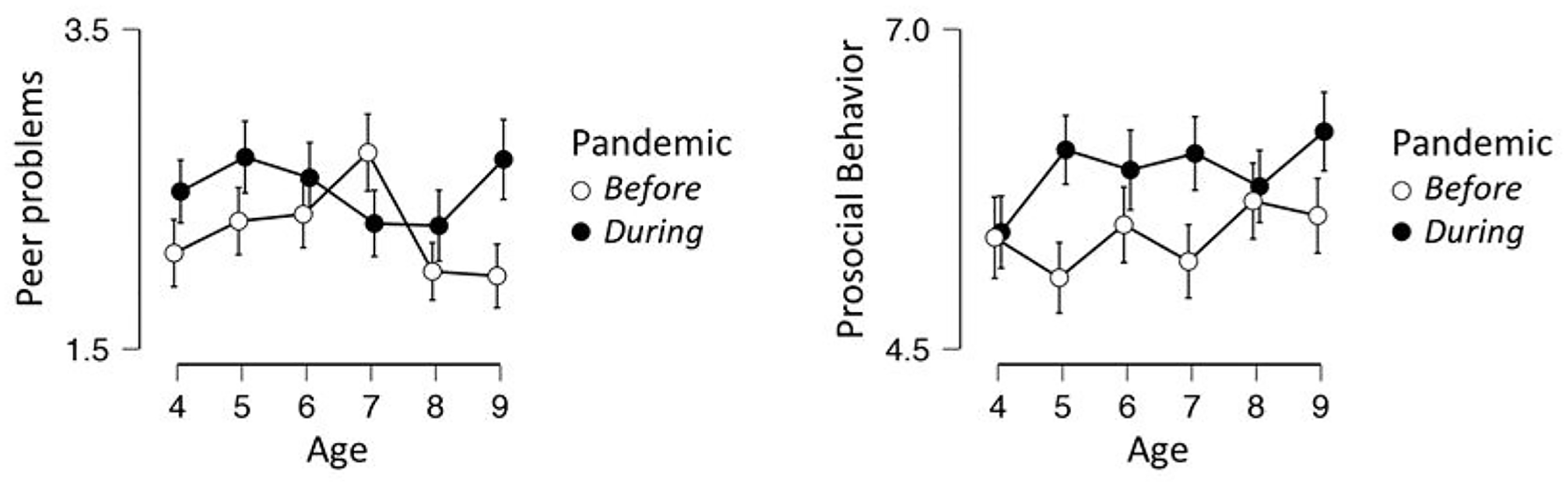
Children’s prosocial behavior and peer problems as a function of age.
Next, we conducted planned SEM analyses to assess whether the effects of period and children’s age on peer problems and prosocial behavior were mediated by differences in children’s social lives. Specifically, we used the peer problems and prosocial behaviors as the dependent variables. We also used durations of children’s schooling, children’s outside play, and children’s lessons as mediation variables and children’s background information as a control variable (Figure 2). We selected the model that included direct paths between period and peer problems and between interaction and prosocial behavior (χ2 = 62.304, RMSEA = .047, CFI = .966, GFI = 0.989, AGFI = 0.948, AIC = 12,508.818) because fit indices indicated that it provided a better fit to the data than a model without the direct path (χ2 = 80.494, RMSEA = .053, CFI = .952, GFI = 0.985, AGFI = 0.936, AIC = 12,524.260). In this model, period was positively (β = .491, p = .022) and negatively (β = −2.843, p < .001) associated with durations of outside play and schooling, respectively. Interaction between age and period negatively associated with schooling (β = −0.214, p < .001). In addition, the duration of play negatively associated with peer problems (β = −0.261, p = .001). However, schooling was not significantly associated with prosocial behavior (β = 0.113, p = .070).

Effects of pandemic (period), age and the interaction on children’s prosocial behavior and peer problems. We included sleeping time, as control variables. For visibility, the non-significant paths, error variances, and covariances were removed and reported in Table S2.
Finally, we evaluated the mediation effects of outside play on the relationship between period and peer problems using Sobel tests. The estimated mediation effect of duration of outside play was significant (β = −.051, p = .014 95% CI [−0.092, −0.010]). The estimated direct effect of period on peer problems was also statistically significant (β = .316, p = .011 95% CI [0.073, 0.558]).
Discussion
The results revealed that prosocial behavior and peer relationship differed between before and during the pandemic. In contrast, there were no significant differences in emotional symptoms, conduct problems, or hyperactivity between these two periods. Although there were no mediation effects on the relationship between period and prosocial behavior, we found an interaction effect between the pandemic and age in prosocial behavior. The results were partially consistent with our hypothesis that age may modulate the effect of the pandemic on prosocial behavior. Specifically, 4-year-old children scored equally before and during the pandemic, but older children showed more prosocial behavior during the pandemic compared to those before it.
One possible interpretation for the difference in prosocial behavior was that the parents were more likely to stay home with children during the pandemic compared to before the pandemic, and therefore they had more opportunities to observe prosocial behaviors. Children also showed more problems in their peer relationships during than before the pandemic. Thus, children’s need for social contact might be pronounced during the COVID-19 situation, and therefore children may engage in prosocial behaviors to keep the social contact with others. In terms of peer problems, our results suggest that children may have more peer problems during the pandemic compared to before. When they engaged in more outside play, such problems can be lowered. Although we found a mediation effect of outside play, we did not find mediation effects of schooling and lessons. One possible interpretation for the results was that both the direct effect between the pandemic and peer problem and indirect effect of schooling and lesion had negative effects on peer problem, but the direct effect was strong, by which we cannot find the negative indirect effect of schooling and lessons. On the other hand, outside play showed the positive effect on peer problem, which can work as a protection factor and we can find the effect. Nevertheless, we need to be careful about the interpretation of the results, because some items in peer problem (e.g., “tends to play alone”) could be increased during the pandemic compared to before pandemic unless children played with siblings as much as they used to play with peers, and the increased scores did not necessarily mean the children were having trouble with peers. Taken together, our results showed that children’s some of the socio-emotional behaviors partially differed before and during the pandemic.
Our results were inconsistent with those of previous studies on the mental health of children in other countries where a national lockdown was imposed, such as Italy, Spain, and the UK, and the children in these countries had severe mental health and socio-emotional problems during the pandemic (Creswell et al., 2021; Orgilés et al., 2020). This inconsistency may be because during the conduction of this study, in Japan the national lockdown was not introduced and behavioral restrictions were milder compared to other countries. Specifically, one difference between the countries with a national lockdown and Japan is that self-restrictions were imposed in Japan, and it was possible for the Japanese children to go out and meet other children.
The present study has theoretical implications for children’s mental health. Bronfenbrenner (1979) suggested that child development is a function of the interaction among several systems, such as schooling, peer relationships, and parenting. Our results showed the estimated mediation effect of the duration of outdoor play, indicating that the social changes caused by the COVID-19 pandemic may affect children’s play, which can impact their socio-emotional behaviors. Importantly, other systems, such as schooling or children’s lessons, may not have such effects.
Our results showed that children exhibited better and worse socio-emotional behaviors during the COVID-19 pandemic compared to before the pandemic. Although some studies have conducted a pre and post-assessment of the impact of the COVID-19 pandemic on children’s mental health, few studies have examined its impact on children’s socio-emotional behaviors. We assessed children’s behavior using an online questionnaire, most of the available research did not utilize the same method of assessment both before and during the pandemic, which results in the difficulty of not having a valid comparison group. It is possible that parents’ answers to the surveys can reflect differences in parents, not in children, and we need to be careful about the interpretations of the results. Nevertheless, we believe that web-based surveys may be one of the best methods for addressing the effects of the pandemic on child development.
Another limitation in this study was that we compared the different sample before and during the pandemic. We matched several background information that may affect socio-emotional behaviors across samples, but we need to conduct longitudinal research to examine how children change their behaviors across different time points. Relatedly, we cannot deny that our data may have some potential biases due to parental reports and time differences between the two surveys. We need to consider other data by using other methods time points. Moreover, it remains unclear whether the results from this population can be generalized to other populations, because the growth rate in the number of infected persons and deaths in Japan was lower than in other countries (Worldometer, 2020). Moreover, children’s social-emotional behaviors could be more severely impaired due to the pandemic, particularly if this difficult situation continues for a long period. Future research should address these issues.
Supplemental Material
sj-docx-1-sgo-10.1177_21582440241268800 – Supplemental material for Socio-Emotional Behaviors of Japanese Children during the COVID-19 Pandemic: A Cross-Sectional Study
Supplemental material, sj-docx-1-sgo-10.1177_21582440241268800 for Socio-Emotional Behaviors of Japanese Children during the COVID-19 Pandemic: A Cross-Sectional Study by Yusuke Moriguchi, Chifumi Sakata, Xianwei Meng and Naoya Todo in SAGE Open
Footnotes
Acknowledgements
We thank Chika Harada and Nobuhiro Mihune for helpful comments on an earlier version of the manuscript.
Declaration of Conflicting Interests
The author(s) declared no potential conflicts of interest with respect to the research, authorship, and/or publication of this article.
Funding
The author(s) received no financial support for the research, authorship, and/or publication of this article.

Supplemental Material
Supplemental material for this article is available online.
References
Supplementary Material
Please find the following supplemental material available below.
For Open Access articles published under a Creative Commons License, all supplemental material carries the same license as the article it is associated with.
For non-Open Access articles published, all supplemental material carries a non-exclusive license, and permission requests for re-use of supplemental material or any part of supplemental material shall be sent directly to the copyright owner as specified in the copyright notice associated with the article.
