




Abstract
The mental health problems caused by COVID-19 pandemic to every person and every group cannot be ignored, especially for college students, who are the main force of the society. Few studies explore the mechanism of action between college students’ epidemic stress perception and life satisfaction in China. The study aims to understand the association between the epidemic stress perception of COVID-19 on life satisfaction, and examines the effect of coping flexibility and perceived social support in China. We investigated 597 college students by questionnaire and found college students’ epidemic stress perception of COVID-19 was significantly negatively associated with life satisfaction; coping flexibility partially mediated the relationship between college students’ epidemic stress perception of COVID-19 and their life satisfaction; perceived social support moderated role in the first half of the mediating pathway. Practical strategies to improve college students’ life satisfaction were discussed in the paper.
Plain language summary
The mental health problems caused by COVID-19 pandemic to every person and every group cannot be ignored, especially for college students. We found the college students of higher epidemic stress perception would have lower level of life satisfaction. The coping flexibility worked in that relationship as well. And the perceived social support is a protective factor.
Keywords
Introduction
As a major global public health emergency, the COVID-19 pandemic has had a great impact on the normal functioning of China’s economy and society, adversely affecting people’s life safety, property security and psychological health, and invariably creating pressure on the public in many ways (English et al., 2022; Morgan et al., 2022; Terry et al., 2021; Ye et al., 2020). The World Health Organization (WHO) recently declares that the coronavirus disease is over as a global health emergency. However, since the end of 2019, COVID-19 has lasted for 3 years, and the negative impacts and mental health problems of people it caused cannot be ignored (Cullen et al., 2020; Hossain et al., 2020). A longitudinal study by Lu et al. (2022) determined the overall increasing trends in psychological symptoms, long-term predictors, trajectory categories, and evolutionary patterns of psychopathological networks among 18,804 participants who participated in at least two surveys after the onset of the epidemic, and found that multiple psychiatric problems were highly co-occurring across epidemic dynamics and showed multiple different patterns of co-occurrence with epidemic dynamics (Lu et al., 2022).
The mental health problems caused by COVID-19 pandemic to every person and every group cannot be ignored. Regardless of the changes in the epidemic prevention policy, the epidemic for more than 3 years has disrupted the normal rhythm of people’s work and study life, with factories shutting down, students suspending classes, universities closing and not being able to go out freely, cities strictly controlling, continuous nucleic acid testing or health codes popping up frequently, and new adaptation problems brought by the newly liberalized epidemic prevention policy, etc. These long-term inconveniences, anxiety, worries, depression and other kinds of mental health problems have plagued every person and every group (Wu & Liu, 2023; J. Yuan et al., 2023).
For the college student group, COVID-19 pandemic is a stressful life event that they commonly experience, and the mental health problems it brings are more prominent. On the one hand, the mental health problems of the new-age college student group itself are more prominent. According to the relevant data from the World Health Organization, about 1.2 million young people aged 15 to 24 in China suffer from depression, and college students account for as much as 23.8% of them (World Health Organization [WHO], 2021). On the other hand, the sudden outbreak of COVID-19 pandemic and the adjustment of its prevention policy have made the mental health problems faced by the college students more prominent. When the pressure brought by COVID-19 pandemic is not fully relieved and released, college students are under different degrees of psychological pressure, and are prone to negative emotions and psychological problems such as tension, anxiety, irritability, loneliness, helplessness and depression (Tang & Yang, 2023), which may lead to lower life satisfaction of college students, and then trigger suicidal ideation and problematic behaviors (Akın & Akın, 2016; Zhang et al., 2014). Thus, the status of college students’ life satisfaction under the influence of the epidemic and understand the mechanism of effect has become a key issue at present. This study aims to investigates the influence of college students’ perceived stress of epidemic on their life satisfaction and its influencing mechanism. Exploring the life satisfaction of college students under COVID-19 pandemic and its influencing factors can help to improve the establishment of spiritual-psychological coping platform and system in the emergency platform of public health emergencies such as epidemic, and provide some reference for the handling of subsequent major public health events in the world.
Epidemic Stress Perception of COVID-19 and Life Satisfaction
Epidemic stress perception of COVID-19 refers to individuals’ subjective feelings of internal and external stressful events under the COVID-19 epidemic, which can change people’s cognitive function and affect their emotional and physiological states (X. Li et al., 2019). The public has experienced multiple stressors during the COVID-19 pandemic. For example, in the early stages of the epidemic, the shortage of protective equipment such as masks made it difficult for the public to obtain epidemic prevention supplies and forced the public to face the rising prices of epidemic prevention necessities (C. Wang et al., 2020). The epidemic affected the functioning of the economy and society, resulting in a decline in income and other difficulties for most of the public (James et al., 2022; Jiang et al., 2022). Home quarantine measures have led to changes in public schedules, travel restrictions, and the need to work and study at home (Mousavi et al., 2020). College students may also face unique stressors such as closed campus management, online learning, cancellation of expected events (e.g., graduation ceremony), and anxiety about employment after graduation and financial stability (Lee, 2020), which seriously jeopardized college students’ mental health, mainly in the form of a significant increase in stress levels (Kang et al., 2020). Despite the current adjustment of China’s outbreak prevention and control strategy and the new stage of COVID-19 pandemic prevention and control, the mental stress and psychosocial problems caused by the outbreak still persist or are even greater.
Life satisfaction is a process of cognition and judgment, which refers to the overall subjective evaluation of an individual’s life quality and situation based on self-set standards. It belongs to the cognitive component of subjective well-being (Diener, 1996; Shin & Johnson, 1978), and it’s an important field of positive psychology research. Depression is a negative emotional state resulting from the inability to cope with stressful events (Naicker et al., 2013). Based on the two-factor model of mental health, life satisfaction and depression are positive and negative indicators of an individual’s mental health, respectively (Greenspoon & Saklofske, 2001; X. Wang & Zhang, 2011). Life satisfaction reflects the subjective well-being of individuals and the level of social development to a certain extent. Studies have shown that individuals with higher levels of life satisfaction have more positive inner experiences, better academic performance and lower levels of academic burnout (An & Zhang, 2016), experience a higher sense of meaning in life and a lower sense of boredom, and have more prosocial behavior and fewer emotional and behavioral problems (X. Wang et al., 2012). The factors influencing individual life satisfaction include parent-child and peer relationship, life experience, family environment, personality and cognitive factors (B. Yao et al., 2011), among which stressful life events are important environmental factors influencing individual life satisfaction (J. Ma & Wang, 2018; Peker & Cengiz, 2022).
According to the stress process theory, psychological stress is a continuous dynamic multi-factor process (Pearlin, 1989; Wallace et al., 2002), which involves the starting point, intermediate variables, stress response and end point of stress. The stressful life events have a direct or indirect impact on individual life satisfaction (Li et al., 2018; Liu et al., 2022; Ren et al., 2021; C. Wang et al., 2024). Individuals who experience high levels of stressful life events tend to have higher levels of anxiety, depression, tension, feelings of losing control and lower levels of mental health. The epidemic stress perception of COVID-19 is an important social-environmental factor that directly affects college students’ evaluation of life satisfaction. Therefore, we proposes Hypothesis 1: There is a negative relationship between college students’ epidemic stress perception of COVID-19 and their life satisfaction.
The Mediating Role of Coping Flexibility
Coping flexibility refers to the ability of individuals to flexibly choose coping strategies according to stressful situations (Zong et al., 2010). According to the stress coping theory proposed by Lazarus and Folkman (1984), coping is an individual’s continuous cognitive or behavioral effort to deal with and solve the conflicts between the environment and people’s internal needs. The perceived controllability of the individual to the stressful situation will affect the behavior of the individual to cope with, which can be divided into two categories. One is the problem-oriented coping strategy that focuses on problem solving when the individual perceives the situation to be controllable; the other is the emotion-oriented coping strategy that focuses on emotion regulation when the individual perceives the situation to be controllable (Lazarus & Folkman, 1984). Previous studies have shown that both problem-oriented coping strategy in controllable situations and emotion-oriented coping strategy in uncontrollable situations contribute to individuals’ positive adaptation in stressful situations (Thoits, 1995). In fact, individuals’ positive adaptation to stress is the result of their flexible choice of coping strategies and ways according to the nature of stress (Lei & Wei, 2017).
Perceived epidemic stress puts people in a distressed and anxious state, which in turn motivates them to engage in problem-solving activities to resolve it (Cho & Lee, 2006; X. Li & Lyu, 2021). Under the influence of different stressful situations, individuals may show inconsistent coping flexibility. For example, Gan et al. (2004) found that college students showed lower flexibility in coping with sudden stressful events such as SARS compared with stressful events in daily life, which may be due to the decline of college students’ cognitive ability of situational controllability under the influence of sudden stressful situations, resulting in reduced adaptability to coping strategies and situations (Gan et al., 2004). Therefore, college students’ cognitive ability of situational controllability may also be affected in the face of the sudden outbreak of COVID-19 pandemic, and their countermeasures may not match the situation. When the coping strategies selected by individuals can better match the situation, individuals have higher coping flexibility. Studies have shown that individuals with higher coping flexibility have lower levels of depression and anxiety and better mental health (Kato, 2015; Kendall & Terry, 2008), while better mental health predicted higher life satisfaction (Cowen, 1994). In addition, Cheng et al. (2014) found that coping flexibility could promote individuals’ positive psychological adaptation in stressful events and traumatic events (Cheng et al., 2014). Therefore, coping flexibility may be an important protective factor between college students’ epidemic stress perception of COVID-19 and life satisfaction. Hypothesis 2 is proposed in this study: Coping flexibility mediates the association between role college students’ epidemic stress perception of COVID-19 and life satisfaction.
The Moderating Role of Perceived Social Support
Perceived Social support refers to the subjective emotional experience that individuals perceive to be supported, respected and understood, which is an internal and stable psychological trait (W. Ma et al., 2022). According to the stress-buffering model, social support mainly provides help for individuals to cushion the negative effects of stressful events when they are facing them, such as promoting more adaptive stress assessment and better regulating stress response. It emphasizes the buffer role of social support and mental health (e.g., life satisfaction) and individual reaction (coping flexibility) (Cohen & Wills, 1985; Y. Wang, 2004).
According to this model, perceived social support may play a buffer role between college student’ epidemic stress perception of COVID-19 and their coping flexibility and life satisfaction, and protective factors (perceived social support) can reduce the impact of risk factors (epidemic stress perception of COVID-19) on positive psychological quality (D. Li & Li, 2017). When college students’ level of perceived social support is high, the decline rate of students’ coping flexibility and life satisfaction slowed down with the increase of epidemic stress perception of COVID-19. However, there have been studies with inconsistent conclusions on this model. For example, Breet et al. (2014) found that social support did not mitigate the relationship between stressful events and post-traumatic stress disorder or depression, despite the protective effect of social support, there are other factors that prevent social support from buffering the relationship (Breet et al., 2014).
In addition, stress coping is a complex psychological adjustment process, which is affected by personality, coping experience, social support and other factors (Lei & Wei, 2017). Previous studies have reported a significant positive correlation between social support and coping flexibility (Sang & Lu, 2006), and during the COVID-19 epidemic, higher perceived social support may enhance college students’ coping flexibility. Therefore, perceived social support may have a moderating effect on the relationship between epidemic stress perception of COVID-19 and life satisfaction, epidemic stress perception of COVID-19 and coping flexibility.
Thus, Hypothesis 3 is proposed: perceived social support moderates the first half and direct pathways of the impact of epidemic stress perception of COVID-19 on life satisfaction through coping flexibility.
The Current Study
Although the dozens studies pay attention to the impact of the epidemic on the mental and psychological conditions of different populations (Dragioti et al., 2022; Phiri et al., 2021; K. Yuan et al., 2022), a few studies analyze the influencing mechanism of the effects. And as one of the countries that has implemented the strictest and longest epidemic prevention policies, the relationship of Chinese college students’ stress perception in epidemic journals on their life satisfaction is worthy of in-depth exploration. Based on the stress process theory and stress-buffering model, this study proposed a moderated mediation model to explore the impact mechanism of college students’ epidemic stress perception of COVID-19 on life satisfaction, as shown in Figure 1. The analyze of the relationship among epidemic stress perception, life satisfaction, coping flexibility and perceived social support may provide sight for making policy for the potential future public health events and taking the influence into consideration.

Theoretical research model.
Methods
Procedure and Sample
Participants were college students chosen through nationwide convenience sampling on the Internet. We initial contacted the counsellors in colleges in three provinces in China to help deliver the questionnaire link to students, who were school public officials engaged in ideological and political education of college students, daily management of students, employment guidance, mental health and student party and league building in a Wechat group of counsellors in colleges. Then, five counsellors responded and were willing to deliver the questionnaire link to students. Afterwards, the college students filled out the questionnaire link on a voluntary basis. Cattell (1978) believed this ratio of sample size and the number of variables items should be in the range of three to six. To meet the criterion, the sample size should be more than 164 (with 10% invalid questionnaires in assumption) in the study. Finally, a total of 624 questionnaires in total were collected. The participants would get 2-3RMB award in WeChat after finish the questionnaire. After screening and eliminating the questionnaires with complete repeated answers and missing answers of more than one third items, the effective number of questionnaires was 597, with an effective rate of 95.7%. The demographic of participants was as follows (Table 1).
The Demographic of Participants.

Research Instruments
Epidemic Stress Perception of COVID-19
The Epidemic Stress Perception Questionnaire compiled by Wong et al. (2007) was used to measure the sources of stress perception by college students during the COVID-19 epidemic (Wong et al., 2007), by converting the SARS epidemic background into the COVID-19 epidemic background. There were 20 questions in the scale, such as “I think I could get COVID-19 virus at any time”. 1 to 6 scale was conducted (1 = completely disagree; 5 = completely agree). The average score of all the questions was used as the quantitative evaluation index of the epidemic stress perception of COVID-19 of the participants, the higher the score was, the more stress perception of the COVID-19 epidemic. In this study, the Cronbach’s α coefficient was 0.897. In this study, the Cronbach’s α coefficient of the scale was 0.897, and the fitting index of CFA was acceptable (χ2/df = 2.734, GFI = .938, AGFI = .901, RMSEA = .039), indicating that the scale had good reliability and validity.
Coping Flexibility
The Coping Flexibility Scale developed by Kato (2020) and the Chinese version translated by Gong et al. (2022) was used to measure the coping flexibility of college students (Gong et al., 2022; Kato, 2020). There were 12 questions in total, including three dimensions (abandon, re-coping and meta-coping), with four questions for each dimension, such as “I will stop using coping strategies that make the situation worse.” A 4-point scale was used, with 1 = “not consistent” and 4 = “very consistent.” The average score of all the questions was used as the quantitative evaluation index of coping flexibility. The higher the score, the higher the coping flexibility of the participants. In this study, the Cronbach’s α coefficient of the scale was 0.913. In this study, the Cronbach’s α coefficient of the scale was 0.913, representing a good reliability, and the goodness of fit (χ2/df = 2.537, GFI = .959, AGFI = .926, RMSEA = .065) demonstrated a good validity.
Perceived Social Support
Perceived Social Support Scale (PSSS) developed by Zimet et al. (1988) and the Chinese version translated by Xu et al. (2023) was adopted to measure the degree of support from family, friends and other people that the participant’s perceive (Dahlem et al., 1991; Xu et al., 2023). There were 12 questions in the scale, such as “when I need help, there is a special person around.” Seven points were used for scoring, ranging from “very disagree” to “very agree.” The average score of all items was calculated as the quantitative evaluation index of the participant’s understanding of social support. The higher the score, the higher the total degree of social support the participants perceived. In this study, Cronbach’s α coefficient was .947. In this study, the Cronbach’s α coefficient of the scale was .947, and the fitting index of CFA was good (χ2/df = 2.563, GFI = .982, AGFI = .946, RMSEA = .051), indicating that the scale had good reliability and validity.
Life Satisfaction
Life Satisfaction Scale compiled by Diener et al. (1985) and the Chinese version translated by C. Wang et al. (2024) was adopted (E. Diener et al., 1985; Tian et al., 2022). The scale had been proved to have high internal consistency and high time reliability, and was suitable for different age groups. There were five items, for example, “For the most part, my life is close to what I want it to be.” The questionnaire was scored on a seven-point scale, from 1 = “strongly disagree” to 7 = “strongly agree.” The average score of the five questions was calculated as the quantitative evaluation index of the participant’s life satisfaction. The higher the score, the more satisfied the participants were with their lives. In this study, the Cronbach’s α coefficient of the scale was .862. In this study, the Cronbach’s α coefficient of the scale was .803 representing a good reliability, and the goodness of fit (χ2/df = 1.047, GFI = .998, AGFI = .989, RMSEA = .011) demonstrated a good validity.
Data Analysis
The purpose of this study was to investigate the relationship between epidemic stress perception of COVID-19 and life satisfaction among college students and to examine the mechanisms of action between them, that is, the mediating role of coping flexibility and the moderating role of perceived social support. First, in terms of data collection, this study was obtained using a questionnaire method, that is, participants’ self-report, which is the most common and popular method for quantitative research (Young, 2015). Second, in statistics, a mediation model was an analysis that aimed to identify the mechanism of the observed relationship between the independent and dependent variables by including a third explanatory variable (called a mediating variable) and, in the presence of moderating variables added, a mediation model can also be tested (Aas & Melle, 2017; Edwards & Lambert, 2007). In addition, the sample size of this study was more than five times the number of questionnaire items, allowing for further data analysis (Wen et al., 2012). Therefore, this study adopted a mediating model to investigate the role of the mechanism between variables. Finally, for data processing, SPSS 26.0 was used to perform descriptive statistics, correlation analysis, and tests of mediating and moderating effects on the data. Model 4 in SPSS macro and Model 8 in the SPSS macro were applied in the study (Hayes, 2017), which was consistent with the theoretical model of this study was used to test the moderated mediation model under the condition of controlling the gender (X. Li & Wang, 2022), grade (X. Li & Wang, 2022), one-child status (Yang & Ma, 2022) and major (Yang & Ma, 2022) of the participants.
Result
Common Method Bias
The data for this study were collected through self-report measures completed by the participants. To control for common method bias, several steps were taken. Firstly, the participants were ensured anonymity during the test procedure. Additionally, the Harman single-factor test was conducted to assess the presence of common method bias. Exploratory factor analysis was performed on all items in the scale, extracting a common factor using the principal component method. The resulting factor loadings were examined, and partial correlations were calculated after removing the first common factor (Zhou & Long, 2004). The results showed that the variance interpretation rate of the first factor without rotation is 24.242%, which was less than 40%. Therefore, there was no significant common method bias in this study.
Descriptive Statistics and Correlation Analysis
The descriptive statistics of epidemic stress perception, coping flexibility, perceived social support and life satisfaction were presented in Table 2. Pearson correlation analysis was applied to examine their relationships (Table 2). The results showed that the epidemic stress perception of COVID-19 was negatively correlated with coping flexibility, perceived social support and life satisfaction; Coping flexibility was positively correlated with perceived social support and life satisfaction; Perceived social support was positively correlated with life satisfaction.
Descriptive Statistics and Related Analysis Results.

p < 0.01.
The Relationship Between Epidemic Stress Perception of COVID-19 and Life Satisfaction: A Moderated Mediation Model
First, Model 4 in SPSS macro (Model 4 is a simple mediation model) was used to standardize variables under the control of participants gender, grade, one-child status and major, and the mediating role of coping flexibility between epidemic stress perception of COVID-19 and life satisfaction was tested (Hayes, 2017). The results showed that the negative predictive effect of epidemic stress perception of COVID-19 on life satisfaction was significant (β = −.196, t = −4.839, p < .001), after adding the mediating variable coping flexibility, the negative direct predictive effect of epidemic stress perception of COVID-19 on life satisfaction was still significant (β = −.144, t = −3.692, p < .001). Epidemic stress perception of COVID-19 had a significant negative predictive effect on coping flexibility (β = −.164, t = −4.012, p < .001), while coping flexibility had a significant positive predictive effect on life satisfaction (β = .319, t = 8.276, p < .001). In addition, the total effect of epidemic stress perception of COVID-19 on life satisfaction was −.196; The direct effect was −.144, accounting for 73.47% of the total effect; The mediating effect of coping flexibility was −.052, accounting for 26.53% of the total effect; And the 95% confidence interval of Bootstrap did not contain 0 (see Table 3), which conformed to Hypothesis 1 and Hypothesis 2. Therefore, coping flexibility played a partial mediating role between epidemic stress perception of COVID-19 and life satisfaction, which indicated that epidemic stress perception of COVID-19 can not only directly affect life satisfaction, but also indirectly affect life satisfaction through the mediating role of coping flexibility.
Decomposition Table of Total Effect, Direct Effect and Mediating Effect.

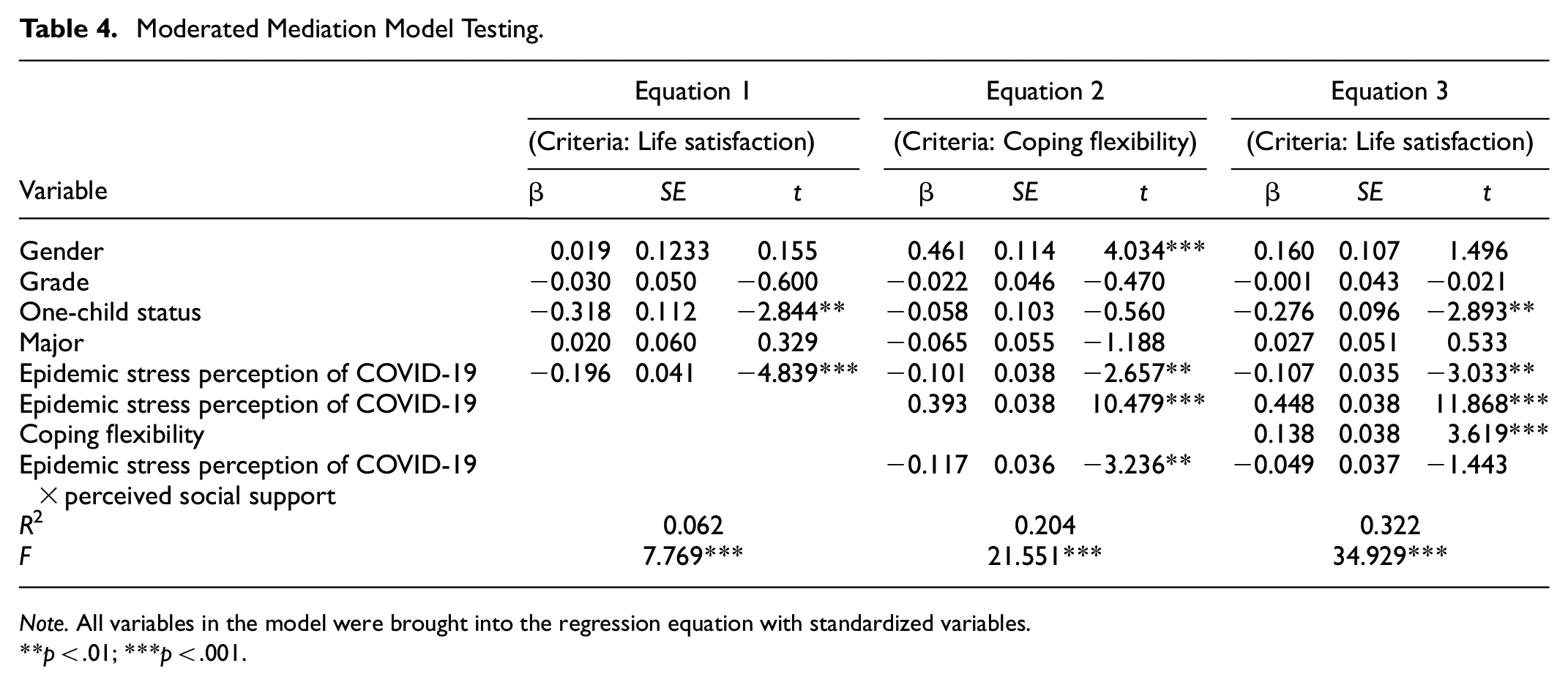
Second, Model 8 in the SPSS macro (Model 8 assumed that the first half of the mediation model and the direct path are moderated [Hayes, 2017], which was consistent with the theoretical model of this study) was used to test the moderated mediation model under the condition of controlling the gender, grade, one-child status and major of the participants. The theoretical model in this study needed to estimate the parameters of three regression equations (Wen & Ye, 2014). Equation (1) estimated the total effect of epidemic stress perception of COVID-19 on life satisfaction; Equation (2) estimated the predictive effect of epidemic stress perception of COVID-19 on coping flexibility; Equation (3) estimated the moderating effect of perceived social support on epidemic stress perception of COVID-19 and coping flexibility, epidemic stress perception of COVID-19 and life satisfaction. The results were shown in Table 4. In equation (1), epidemic stress perception of COVID-19 significantly negatively predicted life satisfaction (β = −.196, t = −4.839, p < .001); In equation (2), epidemic stress perception of COVID-19 significantly negatively predicted coping flexibility (β = −.101, t = −2.657, p < .01), and the interaction between epidemic stress perception of COVID-19 and perceived social support also significantly negatively predicted coping flexibility (β = −.117, t = −3.236, p < .01); In equation (3), epidemic stress perception of COVID-19 negatively predicted life satisfaction (β = −.107, t = −3.033, p < .01), but the interaction between epidemic stress perception of COVID-19 and perceived social support did not predict life satisfaction significantly (β = −.049, t = −1.443, p > .05). Therefore, the moderated mediation model was established in this study, and the moderating effect only occurred in the first half of the mediation effect, which indicated the impact of epidemic stress perception of COVID-19 on coping flexibility was moderated by perceived social support, which partially conformed to Hypothesis 3.
Moderated Mediation Model Testing.
Note. All variables in the model were brought into the regression equation with standardized variables.
p < .01; ***p < .001.
In order to reveal how perceived social support moderated the impact of epidemic stress perception of COVID-19 on flexibility, perceived social support was divided into high and low groups for simple slope analysis. The results were shown in Figure 2. When the level of perceived social support was high (+1), the impact of epidemic stress perception of COVID-19 on flexibility showed a significant downward trend (βsimple = −.217, t = −4.301, p < .001). When the level of perceived social support was low (−1), epidemic stress perception of COVID-19 had no significant predictive effect on coping flexibility (βsimple = .016, t = 0.298, p > .05). Therefore, perceived social support played a moderating role in the negative predictive effect of epidemic stress perception of COVID-19 on flexibility.
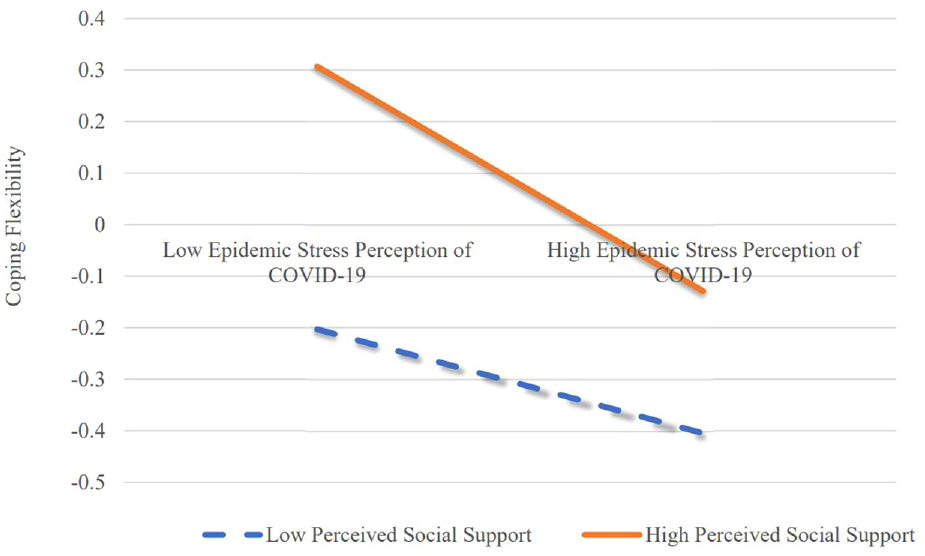
The moderating effect of perceived social support on the relationship between epidemic stress perception of COVID-19 and coping flexibility.
Discussion
The Influence of Epidemic Stress Perception of COVID-19 on Life Satisfaction
This study aimed to reveal the association of college students’ epidemic stress perception of COVID-19 on life satisfaction and its mechanism. This study found that college students’ epidemic stress perception of COVID-19 had a significant negative predictive effect on their life satisfaction, which was consistent with the results of previous studies (Bukhari et al., 2021; Hu et al., 2023; Zheng et al., 2019). The core of risk perception is the threat posed by uncertainties about the environment (Cho & Lee, 2006). In the face of the sudden outbreak of COVID-19 pandemic, due to its uncertainty and complexity, people are prone to psychological stress reactions such as anxiety, depression, hypochondria, panic, etc., and it will cause excessive loss of life satisfication and decrease of body resistance without timely intervention (Jin et al., 2021; Liu et al., 2021; Y. Wang & Luo, 2003). The media has given overwhelming coverage to the COVID-19 epidemic, making it difficult to distinguish the authenticity of the news. The excessive attention to the COVID-19 epidemic information and the perception of transmission risk as stressors have increased the risk of public anxiety, especially among young people and retired people who have limited scientific understanding of the epidemic (Chen et al., 2020). The stress mainly stems from the sense of threat and expectation of adverse results in the future (Peters & McEwen, 2015; Peters et al., 2017). College students are forced to face such problems as closed school management, home online learning, delayed and hindered employment process, reduced number of jobs, changes in examination and interview forms and so on (C. Li, 2020). Individuals predict future results through comprehensive judgments of risk information in the present environment. And for the students’ prediction is filled with uncertainties and stressful, the negative impact on college students’ mental health and low level of their life satisfaction .will develop (Peters & McEwen, 2015).
The Mediation Role of Coping Flexibility
The results of this study indicated that coping flexibility mediated the relationship between college students’ epidemic stress perception and their life satisfaction. That is sudden stress events will lead to a decrease in the cognitive ability of situational controllability of college students, a lower coping flexibility, and a higher sense of burden, thus reducing the life satisfaction of college students, which is consistent with previous studies (X. Li & Lyu, 2021; Lei & Wei, 2017). Lei and Wei (2017) found that coping flexibility played a partial mediating role between stress experience and happiness. The psychological resilience theory (Luthar et al., 2015) holds that individuals can successfully cope with stress and maintain mental health even in the face of adversity, because internal and external protective factors can alleviate the negative effects of stress on individuals. When dealing with such negative stressful events_(COVID-19 pandemic), if individuals adopt a negative cognitive attitude, unable to flexibly deal with and solve problems, and are more prone to depression, anxiety and other negative emotions, which leads to low life satisfaction of college students (Cho & Lee, 2006). Coping flexibility can be used as a protective factor at the individual level (Skapinakis, 2020), and the college students with coping flexibility can apply an active mechanism to select appropriate coping strategies to promote their positive adaptation, so as to reduce or offset the negative impact of epidemic stress perception of COVID-19 on life satisfaction.
The Moderation Role of Perceived Social Support
For the moderating role of perceived social support, this study found that the direct impact of epidemic stress perception of COVID-19 on life satisfaction was not positively buffered by perceived social support. It is consistent with the findings of Zaken et al. (2022), that perceived social support didn’t have a protective effect. It may resulted by the two reasons. Perceived social support may cushion the negative impact of certain stressful life events, but it will not provide an adequate buffer in the face of a long-term pandemic of related stressors such as restricted economic and social functioning, threats to personal finances and health due to the COVID-19 pandemic (Su-Hsin et al., 2022; Zaken et al., 2022). In addition, Rueger et al. (2016) pointed out that there was a significant buffering effect of social support for high-risk groups (e.g., poor groups), however, without comparing high-risk groups with non-risk groups, this buffering effect could not be detected. The subjects of this study are only college students, most of whom are facing the pressure of the epidemic and belong to the high-risk group. They are not compared with the non-risk group, which may be one of the reasons why the buffer effect of social support on the negative impact of epidemic stress perception of COVID-19 on life satisfaction is not significant in this study.
Besides, we found the first half of the path of epidemic stress perception of COVID-19 indirectly affecting life satisfaction through coping flexibility was moderated by perceived social support. That is, compared with students in the local social support group, students in the high social support group had a greater decline in the relationship between perceived stress and flexible coping. It’s inline with the previous findings that the perceived social support is a protective factor in the relationship between epidemic stress and coping flexibility (X. Li & Wang, 2022; Zaken & Walsh, 2021). For students with high perceived social support, they are empowered by promoting adaptive coping appraisals and coping behaviors (Lazarus & Folkmanm, 1984), and the relationship between perceived stress and flexible coping declined.
Research Implications
This study revealed the mechanism of the influence of epidemic stress perception of COVID-19 on college students’ life satisfaction in the context of COVID-19 epidemic, with theoretical and practical implications. Theoretically, this study added to empirical research on the stress buffer model and the stress perception assessment model, and it aids in understanding how college students’ perceptions of COVID-19 epidemic stress affected their level of life satisfaction either directly or indirectly.
On a more practical level, this study elucidated the process underlying the impact of epidemic stress perception caused by COVID-19 on life satisfaction and offered suggestions for raising it among college students. The detrimental effects of the COVID-19 pandemic on college students deserve our attention. College students continue to face the possibility of catching the virus and are still under some epidemic stress even though we are now in the post-epidemic era and there is no longer a concern with home isolation and limited activities. By providing psychological counseling and guidance, we can help college students perceive the COVID-19 epidemic less stressfully. We can also help them cope better with sudden stressful events, provide the right support to help them perceive the epidemic accurately, and concentrate on improving their coping flexibility to increase their level of life satisfaction.
Limitations and Further Research
There were still some limitations in this study. First, the study is a cross-sectional research and applied convenience sampling due, which is difficult to examine the causal relationship variables and has the limitation in generalization to the nationwide colleges. Future studies should expand the representative of sample and continue to use longitudinal research design to test this research model. Second, this study adopts the method of self-report of the subjects, and the collected data may be affected by the subjective factors. Future research may combine other disciplines and methods to collect data, such as using observation or behavioral evidence to assess the coping flexibility of the subjects. Thirdly, the link between COVID-19 epidemic stress perception, coping flexibility, perceived social support, and life satisfaction was the only topic covered in this study. But other elements have important roles in influencing students’ life satisfaction. Additionally, the potential mediating role of coping flexibility suggests that the impact of the independent variable on the dependent variable may not be solely mediated by this variable (Iacobucci, 2008). This implies that there could be other mediating variables that warrant investigation in future research. Therefore, future studies should consider incorporating other significant variables into the proposed model.
Conclusion
Findings showed in the study are college students’ epidemic stress perception of COVID-19 was significantly negatively associated with life satisfaction; coping flexibility partially mediated the relationship between college students’ epidemic stress perception of COVID-19 and their life satisfaction; perceived social support moderated role in the first half of the mediating pathway. For college students, reducing the negative influence of the pandemic by cultivating and improving their coping flexibility and enhance their perceived social support is conducive to improving their life satisfaction.
Footnotes
Author Contributions
WF, RX, and HC conceived the study, conducted the analysis, and took the lead on drafting the manuscript; WF and RX designed oversaw the data collection; HC and RX analyzed the data and wrote the draft manuscript. All authors read and approved the final manuscript.
Declaration of Conflicting Interests
The author(s) declared no potential conflicts of interest with respect to the research, authorship, and/or publication of this article.
Funding
The author(s) disclosed receipt of the following financial support for the research, authorship, and/or publication of this article: This research was funded by the Youth Project of Beijing Education Science 14th Five-Year Plan (BECA22129).
Ethical Approval
The studies involving human participants were reviewed and approved by the Ethics Committee of our University. Informed consent of participate in this study was provided.

Data Availability Statement
The datasets generated during and analysed during the current study are available from the corresponding author on reasonable request.