




Abstract
Virtual reality (VR) for Language learning has been shown effective in improving students’ communication skills. However very few studies reveal the communication strategies students used in communicating in a VR environment, especially in learning Chinese as a foreign or second language (CFL/CSL). In this pilot study, a prototype Virtual Experiential Language Learning Environment (VELLE) was used to provide immersive learning experiences in developing CFL students’ communication strategies. Productive Failure was employed as an instructional approach to support the learning design. The participants were six CFL students learning in an Australian university. The main data sources included audio recordings of the students’ communication in VR and interview data. The findings showed that participants’ use of various types of communication strategies was influenced by the VELLE and Productive Failure design. In particular, the use of L1 in the problem-solving phase enriched the participants’ learning opportunities and all participants used a lesser number of resource deficit-related strategies after the instruction. Second, Students reported enhanced engagement in language use in the VR context.
Keywords
Introduction
The development of the internet has evolved rapidly from Web 1.0, Web 2.0, and now into the era of Web 3.0. One of the key Web 3.0 technologies is 3D virtual worlds such as Second Life (SL), Active Worlds, and Cybertown, featuring human-like avatars, intelligent agents, and multimedia features (Bidarra & Cardoso, 2008). In the past two decades, 3D virtual worlds (3DVWs) have been widely adopted for language learning and have received increasing attention in research (Lin & Lan, 2015; Parmax, 2020). Despite the effectiveness of 3DVWs in language learning, there are some gaps and a need for further research. First, although research has shown that 3DVW led to considerable growth and skills in managing L2 communication (Canto et al., 2013; Milton et al., 2012; Mroz, 2014; Wigham & Chanier, 2013), the students’ choice of communication strategies remained unclear when used in maintaining and managing their L2 communication in a virtual reality (VR) environment. Second, researchers emphasized the need to incorporate instructional design principles in conceiving VR-based real-life tasks (Merchant et al., 2014; Parmax, 2020) to enhance students’ interaction and communication in the target language. Third, compared to the ample research available of English language learning in VR, how the learning of Chinese as a foreign or second language (CFL/CSL) could be supported by 3DVW, has been little researched. This paper addressed these gaps by conducting a study of CFL students’ use of communication strategies in a Virtual Experiential Language Learning Environment (VELLE) hosted by Second Life.
Literature Review
The Use of Virtual Reality in Second/Foreign Language Learning
Research has shown that the VR learning context improved leaners’ motivation to learn a foreign language (Henderson et al., 2012; Lan et al., 2019; Wang, Lan et al., 2020), reduced foreign language learning anxiety (Hammick & Lee, 2014; Melchor-Couto, 2017), and increased learners’ participation and interaction overall (Peterson, 2012; Swier, 2014; Tseng et al., 2013; Vuopala et al., 2016). A common finding was that VR facilitated the production of target language output (Peterson, 2012, 2016). In particular, a VR environment reduced students’ anxiety while communicating in a foreign language and was preferred by learners than the face-to-face context (Grant et al., 2013; Wang, Lan, et al., 2020).
Most studies on the use of SL in language learning focused on linguistic gains, learners’ perceptions, and the affordances of the virtual world, with few focusing on communication strategies (Park, 2018; Wang, Lan, et al., 2020). Reisoğlu et al. (2017) reviewed 167 studies of 3DVW in general education research and found that one major achievement was in enhanced communication skills. Similarly, some research revealed that learners’ L2 communication competence and the ability to manage communication have considerably improved after immersion in a 3DVW environment (Milton et al., 2012; Wigham & Chanier, 2013; Yamazaki, 2018). In addition, some research has revealed that SL could stimulate a strategic approach in communication via text chat (Liang, 2012; Peterson, 2010). However, it remained unclear how students used various strategies in managing their communication in the VR environment (Chen, 2016; Park, 2018). One study has a detailed analysis of the communication strategies based on Dörnyei and Scott’s (1997) taxonomy using aviation English in a VR-learning context (Park, 2018). Chen (2016) also found that confirmation checks, clarification requests and comprehension checks were frequently used by EFL learners through voice chat in SL. In short, a more nuanced understanding of students’ use of communication strategies in VR would appear to be needed.
A systematic review of language learning in the virtual world suggested that adopting 3DVWs showed a moderate degree of effectiveness in CFL/CSL learning (Reisoğlu et al., 2017). In addition, a more recent meta-analysis of experimental research on the effects of 3DVW in language learning showed that a majority of the research focused on English learning with relatively less research focused on Chinese language learning (Wang, Lan et al., 2020). Some research revealed the effectiveness of the SL environment on CSL vocabulary learning (Lan et al., 2019) and writing performance and motivation (Lan et al., 2019). In addition, CSL learners’ oral performance also improved after engaging with the task in SL (Lan et al., 2019). One key challenge that arose in CFL/CSL was the limited opportunities for learners to use the language for communication in an authentic context (Liddicoat & Scarino, 2009; Wang, Lan, et al., 2020). In one study of CFL learning in SL, students reported improvement in their linguistic knowledge and communication skills through engagement with SL (Grant & Huang, 2010). Given that Orton and Scrimgeour (2019) identify the need to improve Chinese language learners’ communication ability, the present study focused on a detailed investigation of the communication strategies used by CFL students learning in a VR environment. It is also highly recommended that the real-life task design in 3DVW is combined with instructional design principles to promote more authentic language production (Merchant et al., 2014; Parmax, 2020; Wigham et al., 2018).
Consequently, this paper used an innovative instruction design called Productive Failure (PF) to support students’ CFL learning. PF is an instructional approach proposed by Kapur (2008). In PF, students first work on solving complex, ill-structured problems without the provision of support structures. This mechanism can be a productive exercise in failure, providing opportunities for students to generate and explore the multiple representations and solution methods (RSMs) required to activate and differentiate their prior knowledge and experience (Kapur, 2008). The follow-up instruction affords opportunities for students to compare and contrast, organize and assemble, the student-generated solutions into canonical solutions (Kapur, 2016). The PF design framework will be further explained in the section related to the pedagogical design.
Research on Communication Strategies
Communication Strategies have been defined as a “conscious technique” (Dörnyei & Scott, 1997, p. 184), and as “conscious attempts” (Lafford, 2004, p. 204) used by speakers to deal with difficulties in communication (Burch, 2014; Dörnyei & Scott, 1997). Substantial research has been undertaken on the nature, classification and application of communication strategies in second language acquisition in the past 40 years (Matsuoka, 2013), but mostly in the area of learning English as a second or foreign language. Although the teaching of communication strategies has been controversial for almost 30 years, many researchers have argued that L2 learners would benefit from explicit instruction on strategies to cope with communication problems (Aljohani & Hanna, 2021; Dörnyei, 1995; Maleki, 2007). Although some adult L2 learners have already acquired communication strategies from their L1 communication experiences (Bialystok & Kellerman, 1987), their use of these strategies in the L1 context were found to be non-systematic and not well defined (Pavón Vázquez & Ramos Ordóñez, 2019). In addition, there were variations within the communication strategies regarding their teachability (Dörnyei, 1995, p. 61). For instance, some strategies (such as paraphrasing and appealing for help) include certain key words and structures that need to be taught explicitly. Therefore, it would be necessary to teach communication strategies to raise L2 learners’ awareness of such strategies, so they are willing to take a risk and use those strategies in their communication (Dörnyei, 1995).
Research revealed that learners’ use of communication strategies was closely related to their language proficiency (Hsieh, 2014; Nakatani, 2006). In addition, the context and the task also influenced learners’ choices of communication strategy (Chang & Liu, 2016; Jidong, 2011). The present paper contributed to the research of communication strategies in two respects. One area for more research was the use of communication strategies in a VR learning environment. Research found that students in a computer mediated L2 communication environment tended to develop a higher level of communication strategies than in the ordinary classroom setting (Dörnyei, 1995; Hung & Higgins, 2016). For instance, learners used more substitution, framing, and fillers in a computer-mediated communication context (Smith, 2003). Therefore, there was a call for research regarding the use of communication strategies in different instructional environments (Aljohani & Hanna, 2021; Fang et al., 2021), including the VR language learning environment. The VR environment can lessen learners’ foreign language anxiety (FLA) (Kruk, 2022; Thrasher, 2022; Xie et al., 2019). In particular, the avatars in VR were viewed as a “shield” for learners, which not only lowered their FLA but also enabled various types of interaction between the avatars and the VR environment (Wang, Lan, et al., 2020). In addition, VR can help students to generate more ideas compared to conventional classrooms during problem-solving activities, thus enhancing the effect of productive failure (Gong et al., 2022).
Another area for further research was the use of communication strategies between learners in an interactional context (Rosas Maldonado, 2016). In this light the current study analyzed the CFL learners’ use of communication strategies in an interactional design underpinned by Productive Failure (PF), which will be explained in the following sections.
There are various taxonomies of communication strategies (e.g., Bialystok, 1990; Dörnyei & Scott, 1997; Poulisse, 1993). In this paper we follow the four types of communication strategies (resource deficit, processing time pressure, own-performance problems, and other-performance problems) developed by Dörnyei and Scott (1997). This categorization was an extension based on the original direct, indirect, and interactional strategies. Resource deficit strategies refer to those used by learners to handle insufficient language resources and gaps in their knowledge, such strategies including message reduction, literary translation and code-switching. Processing time pressure strategies refer to those used by learners when they need more time to process and plan L2 speech, such strategies including the use of fillers and self-repetition. Own-performance problems strategies refer to those used when the learners realized what they said was incorrect, such strategies including self-repair, self-rephrasing, self-editing, and so on. Communication strategies related to other-performance problems usually include negotiation strategies when learners find incorrect or problematic language used in the interlocutor’s speech (Dörnyei & Scott, 1997). The present paper adopted this categorization because it aligned with the PF design, requiring students to engage in a problem-solving task before receiving the instruction. In this situation, a student would encounter problems of insufficient resources, time, and the incorrect or problematic use of language in their or their interlocutor’s speech. The aim was to identify their use of communication strategies in coping with these issues.
Communication Strategies in the Context of CFL
Although the literature of CFL highlighted the importance of using language for communication, most teaching practice still focused on grammatical structure and usage (Loke, 2002; McDonald, 2011), with little consideration given to how learners would use the language for communication (Zhang & Li, 2010). Researchers called for more research directed to enhancing the communication competency of CFL learners, reflected in their use of communication strategies through the provision of authentic communication opportunities and resources (Gong et al., 2020; Jidong, 2011). However, there has been limited research related to the communication strategies of CFL learners. Hsieh’s (2014) study investigated how cultural background and target language proficiency affected L2 Chinese learners’ choice of oral communication strategies and revealed that learners at lower proficiency levels tended to use more avoidance/reduction strategies. At the same time, there were a few studies focused on speaking strategies in the CFL context. For example, in the context of overseas exchange programs, the strategies most frequently used by CFL students were a compensation strategy and asking for repetition (Cáceres-Lorenzo, 2015). However, most of these studies used the Strategy Inventory for Language Learning (Oxford & Burry-Stock, 1995) and focused on language learning strategies rather than communication strategies. It is noteworthy that one prominent trend in current studies of communication strategies was its link to the use of technology (Matsuoka, 2013). This present study brought insights to the field of communication strategies in the CFL context and in the VR environment by exploring their relationship with the PF task design.
Pedagogical Design Framework: Productive Failure
In this study, an innovative instructional approach called Productive Failure (PF) was employed to support the learning design. PF proposed that students should engage in solving problems before receiving appropriate instruction, this practice being known as productive failure (Kapur, 2008). PF had two phases: a generation (problem-solving) phase and a consolidation (instruction) phase (Kapur & Bielaczyc, 2012). The problem-solving phase asked students to work on novel and complex problems with no scaffoldings. During this phase, students generated multiple representations and solutions based on their prior knowledge or experience, though most of them failed to solve the problems. The aim of this phase was to provide opportunities for students to activate their prior knowledge, grasp an awareness of their knowledge gap, and recognize the deep features of the targeted concepts. Students’ prior knowledge can be used as a resource to generate representations and solutions during the problem-solving phase (Kapur & Bielaczyc, 2012).
The problem-solving phase was followed by an instruction phase that provided opportunities for comparing student-generated solutions with canonical solutions imparted by the teacher’s instruction. The teacher also provided explanation and elaboration on the targeted concepts. After the instruction, students usually were asked to apply their learned knowledge to solve a novel and complex problem thus needing to organize and assemble their knowledge. This process is called knowledge assembly. The aim of this phase was to provide students with the opportunity to fill the knowledge gap, correct prior misunderstandings, learn the deep features of the targeted concepts, and assemble the relevant student-generated solutions into canonical solutions. Evidence from a range of PF studies has shown that compared to the traditional direct instruction approach, PF was more effective in helping students learn higher-order knowledge and promote knowledge transfer (e.g., Jacobson et al., 2017; Kapur, 2014).
The PF approach may seem to share some similarities with the Task-based Language Teaching (TBLT) method, a well-established method in the field of applied linguistics. The main similarity is to first present a novel and complex problem which might be in the form of a task, and students then generate multiple representations and solutions based on their own linguistic resources (Ellis, 2009, 2017; Kapur, 2008). The key difference between TBLT and PF is the sequence of instruction. In TBLT, there are various interpretations of the sequences and different practices involved in classroom implementation. Debates have centered on whether explicit instruction should be provided before the task or re-actively after task, as well as whether the timing of corrective feedback should be during the task or after the task (Ellis, 2017; Long, 2015). To date, there has been insufficient research about the effect of the delayed feedback in TBLT to draw effective conclusions (Ellis, 2017; Li, Ellis, et al., 2016).
However, PF has a clear structure that the instruction phase can only take place after the students’ problem-solving phase. In the instruction phase, the teacher needs to compare and contrast student-generated solutions with canonical solutions. The PF design was more effective in helping students to learn conceptual knowledge and problem-solving, as for example in mathematics (Kapur, 2014; Loibl & Rummel, 2014), and in biology (Cao, 2020; Jacobson et al., 2017). Only one study employed PF to learn English as a second language (Rahayu, 2021). The results showed that compared to direct instruction, the PF condition showed a higher post-test score in the written assessments of English syntax. The process data results further showed that students in the PF condition were found to apply more self-regulated strategies and cognitive strategies than students who received direct instruction. Overall, the results indicated the potential of PF in both the learning of procedural language knowledge and in promoting the use of learning strategies during the learning process. Given the focus of this paper was on communication strategies closely related to students’ metacognition and how they use strategies in handling problems in their communication (Dörnyei & Scott, 1997), we explored how the use of PF can impact students’ use of communication strategies. This has not been previously explored.
Research Questions
This paper aims to investigate two research questions:
What communication strategies were used by students in the VELLE learning environment?
How did the integrated design of Productive Failure influence the students’ use of communication strategies in learning Chinese as a foreign language?
Methodology
To explore the research questions, we adopted a case study approach with three pairs of CFL learners attending a university in Australia. The development of the VELLE and pilot study obtained ethics approval from the university where the first and second authors are affiliated.
Participants
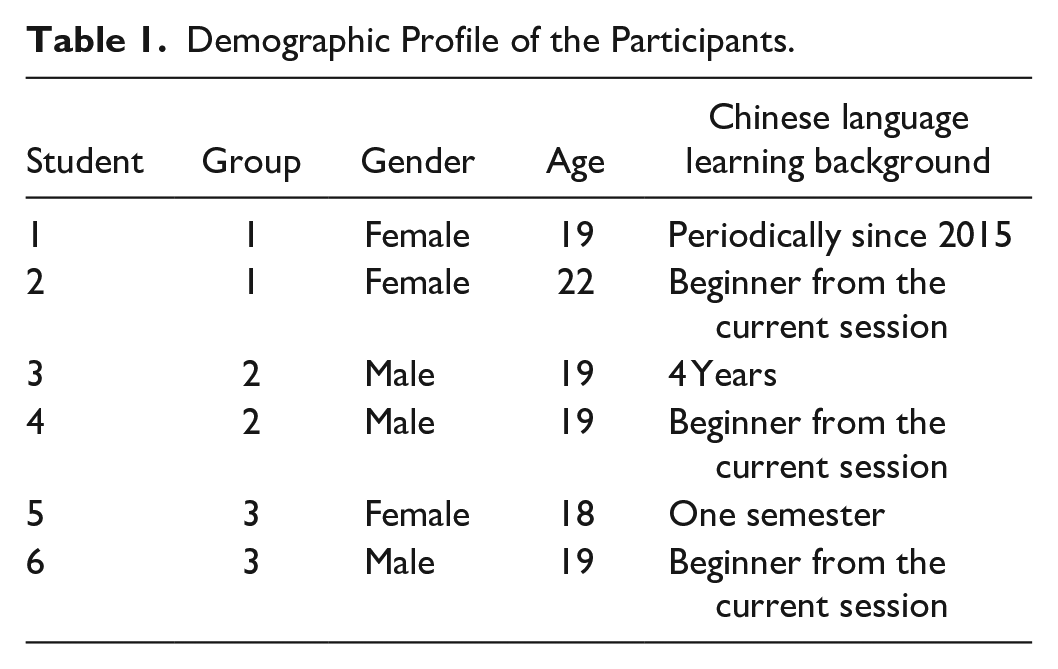
The participants were six first-year university students who enrolled in a beginner Chinese language unit. The unit is a six-credit point university course, timetabled in the second semester of the first year of study. The participants all gave voluntary consent to participate in this pilot study and were randomly grouped into three pairs. Each pair’s performance in the designed tasks was analyzed as a case. The students were aged from 18 to 21 years. Half of the participants had learned Chinese periodically before they enrolled in the Chinese language unit, while the other participants started learning Chinese in this unit. The data collection occurred at the end of the semester. The same teacher taught all sessions. The demographic profile of the participants is presented in Table 1. This study did not involve a pre-assessment to measure the students’ level of Chinese proficiency in the targeted concepts (i.e., ordering food and drinks) because of the potential for students to invent solutions during the pre-assessment to subsequently activate their prior knowledge, thus compromising the PF activities (Loibl & Rummel, 2014).
Demographic Profile of the Participants.
Learning Environment: Second Life
In this study, we used one well-developed SL site, called “Chinese Island” developed by Monash University (Second Life, n.d.), as the learning environment. This island provided a China Town with a range of scenarios such as Chinese restaurants, railway stations, tea shops and so on (see Figure 1). Students could explore the scenario using their own avatars and communicate with other players by sending messages or by using microphones.

The snapshot of China town.
The students conducted their learning activities in a Chinese restaurant. First, the students found a table in the restaurant. The researcher sent them the notecard which contained the detailed information about the first day’s tasks and the menus they should use to order drinks (see Figure 2). After reading the notecard, students conducted their conversation using microphones for recording purposes.

Students worked in pairs to start the conversation in a Chinese restaurant.
In this study PF was employed as the instructional approach. It was ensured that the use of the SL environment was compatible with the PF design principles. First, the SL environment provided students with an authentic environment to work on complex problems that admitted multiple representations and solutions. Second, when students conducted their conversation during the problem-solving phase, they were not allowed to access any scaffoldings related to the targeted vocabularies, grammars, or expressions in the SL environment, as they needed as far as possible to activate their prior knowledge to generate representations and solutions. Finally, the SL environment provided students with an immersive environment in which to conduct learning activities, causing students to be more engaged in solving the problems. All these steps were aligned with the PF design principles.
Learning Activities and Procedures
The learning activities involved 2-day sessions, following the same structure and components shown in Figure 3. The 2-day sessions were arranged to avoid overwhelming students with all the learning tasks in 1 day. On Days 1 and 2, students’ participation in VELLE and interviews were conducted via Zoom due to Covid restrictions. After completing the Day 2 session, students participated in focus group interviews in pairs by Zoom (each lasting around 15–20 minutes). The pairs remained the same throughout the 2-day sessions and focus group interviews.

Daily sessions of the study.
For each daily session, the teacher first sent greetings to the students by Zoom and asked them to enter the virtual China Town scenario in SL. When all students reached the virtual China Town, they were asked to go to the virtual Chinese restaurant and stay around a table. Next, the teacher sent students their first daily tasks and the related menu by sending a notecard in SL (see Figure 4). In the daily activities, students were asked to complete two tasks, with Task 1 as the problem-solving phase, followed by an instruction phase, and then Task 2 as the knowledge assembly phase (Figure 3). Each session lasted for around 50 to 60 minutes (Figure 3).

The notecard representing day 1, task 1, and the menu.
Problem-solving phase: Task 1
Regarding the problem structure, Task 1 required students to play a role as either a customer or waiter/waitress to order drinks on a hot summer day, involving a complex problem that admitted multiple representations and solutions. When the conversation finished, the students swapped roles to conduct the conversation again. As a result, the students conducted two rounds of conversation during Task 1. They worked on the first conversation task for about 15 to 20 minutes in total, which constituted the problem-solving phase. Students were encouraged to try their best to communicate with their partners. They were allowed to speak English. During the problem-solving process, no scaffolds were provided by SL or the teacher to help students learn how to solve the problem or inform them of the targeted vocabularies, grammars, or expressions.
Instruction phase
Once the conversations were finished, students commenced the instruction phase. During the instruction phase, the teacher gave a 20-minute lecture via Zoom on how to order drinks using Chinese. The teacher discussed student-generated solutions in terms of the incorrect use of vocabularies, grammar, and expressions. This was more specific targeted on the students’ needs. Based on PF’s principles we need to compare and contrast students’ generated solutions with the canonical solutions. The teacher also gave instructions about how to order drinks in a restaurant. During the instruction, students followed the teacher in repeating the correct vocabularies and expressions.
Knowledge assembly phase: Task 2
After the instruction phase, students worked on Task 2 to assemble their knowledge. Task 2 was similar to the first task, but this time the menu changed a little so that students could order different drinks. Similar to Task 1, students conducted two rounds of conversations in Task 2, swapping their roles as before.
On Day 1, students were asked to order drinks. Day 2 was the extension of Day 1 as students were required to not only order drinks but also to decide, (1) whether they would like to order a hot/normal/iced drink, and (2) whether the drink was with sugar or not. These tasks on each day are exemplified in Figure 5 for Pair 1. In addition to the daily tasks, a Teacher’s Guidebook was developed to detail the students’ tasks and the related vocabularies, grammar, and expressions.
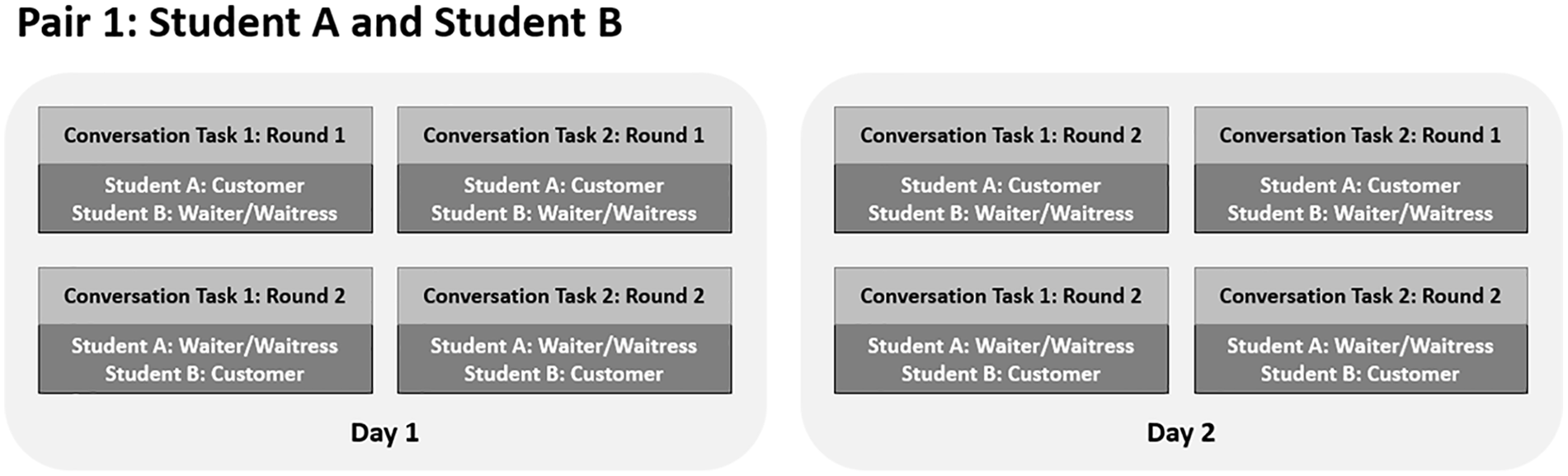
Each pair had eight rounds of conversation (pair 1 used as an example).
Data Sources and Analysis
Process data
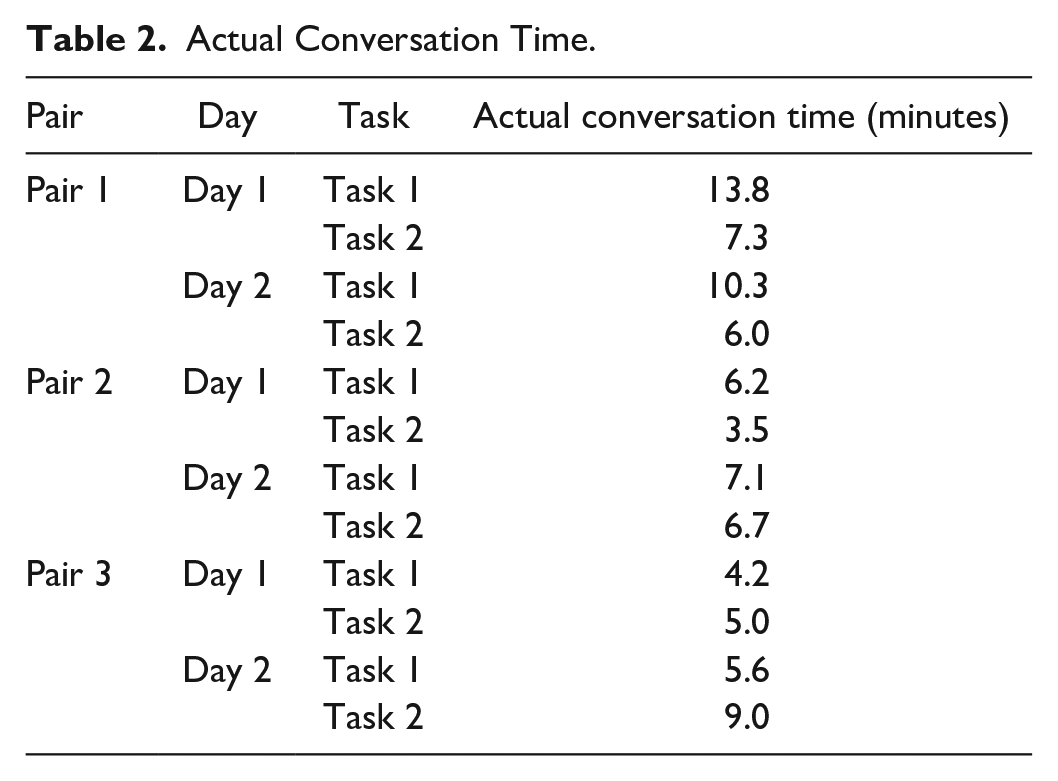
As described in section 4.3, at each daily session, two conversation tasks were completed by students in pairs. The process data recorded students’ behavior during the learning activities. Each pair had eight rounds of conversation as indicated in Figure 5. The actual conversation time is listed in Table 2 below. As each conversation time varied, the analysis calculated the means by dividing the number of communication strategies in each conversation by the actual time.
Actual Conversation Time.
For analysis of the communication strategies used, all 24 short conversations were transcribed and coded in accord with the coding scheme outlined in Supplemental Appendix A.
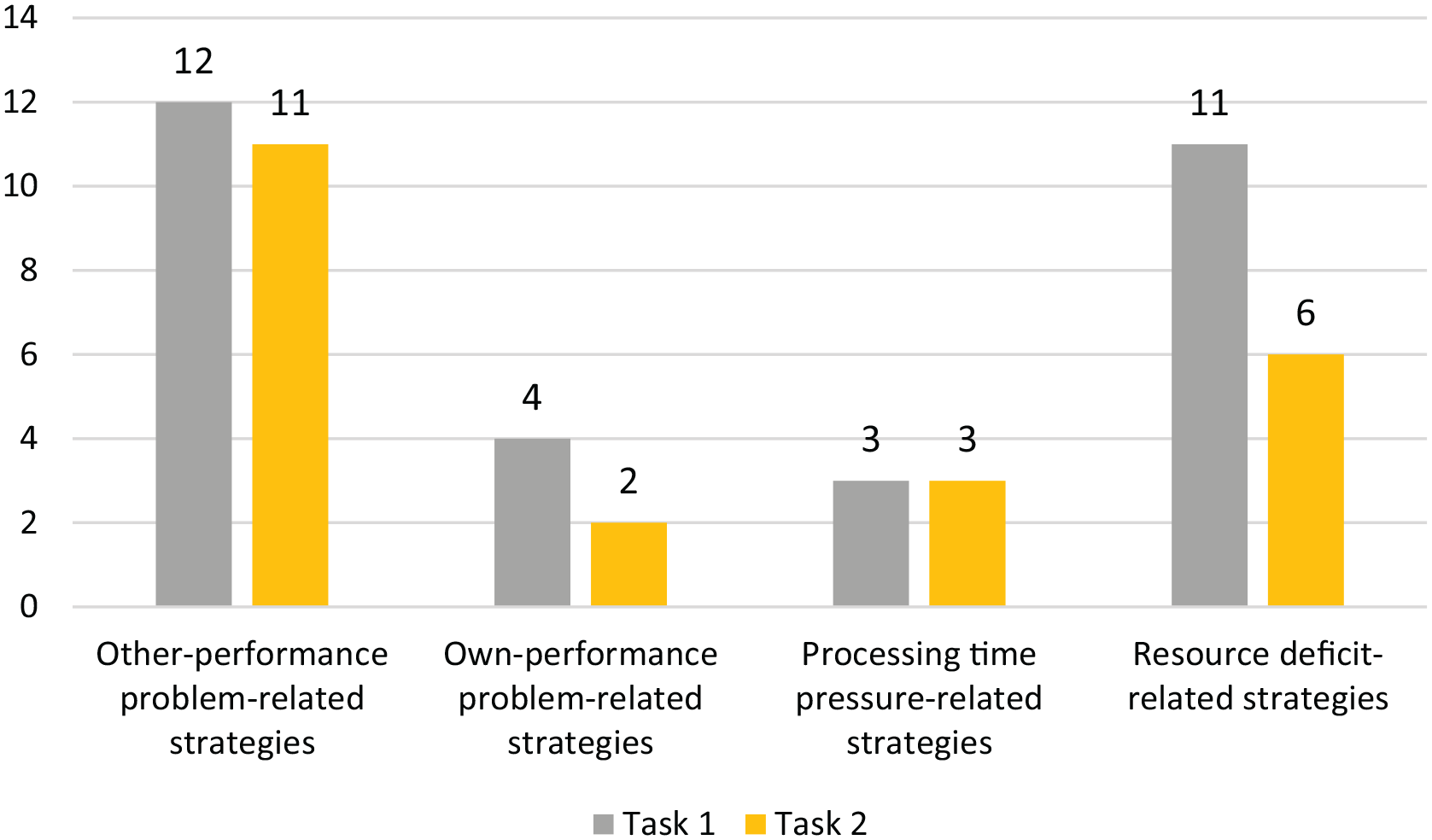
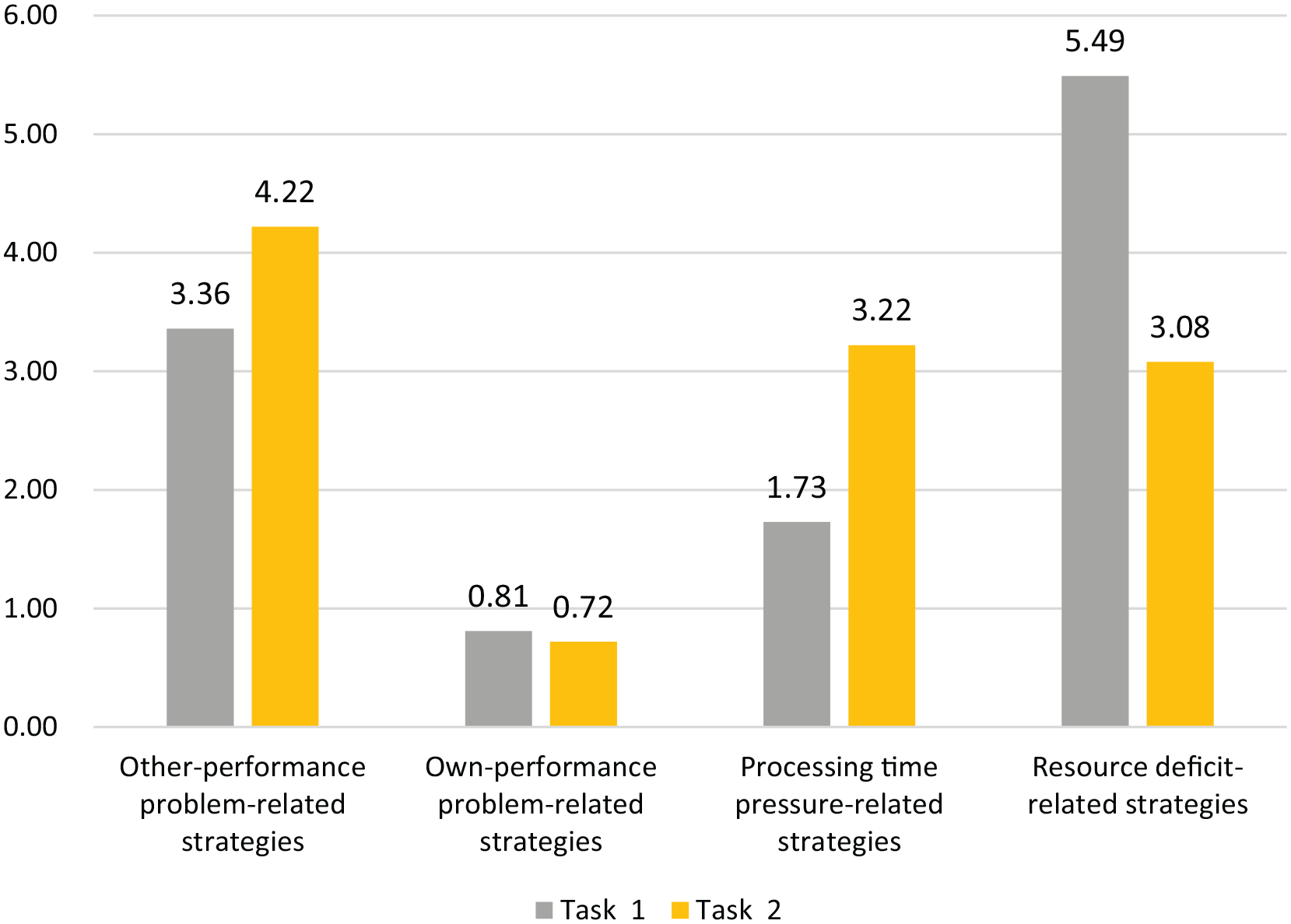
The coding was processed through four rounds of review by the first and third authors and reviewed by the second author to ensure inter-coder reliability. In the first round, the transcripts of the 24 short conversations were coded based on 33 communication strategies (Supplemental Appendix A, total 40 strategies with seven are subsets of three strategies), as adopted from Dörnyei and Scott (1997), representing a quite comprehensive taxonomy. An example of the coding scheme can be found in Table 3. The number of communication strategies was calculated and displayed in Table 4. One conversation could be coded into several types of communication strategies when multiple communication strategies were used. The second round of analysis categorized the number of communication strategies according to the four strategic types: other-performance problem-related, own-performance problem-related, processing-time pressure-related and resource deficit-related strategies (e.g., see Figure 6). As the elapsed time of each conversation varied, we calculated the means of communication strategies used by each pair in terms of the four categories to show the frequency of strategy use (e.g., see Figure 7). The third round of analysis calculated the frequency of occurrence of the coded communication strategies based on the actual time of each conversation. In addition, the number of strategy types and the frequency of occurrence of the strategies used in Tasks 1 and 2 were compared to see whether there was any change in terms of types and frequency of occurrence of strategies used. The last round of analysis focused on selecting informative quotations from the conversation transcriptions to be used as qualitative evidence of each type of communication strategy.
An Example of the Coding Scheme.

Note. Adapted from Dörnyei and Scott (1997).
Different Types and Numbers of Communication Strategies Used by Each Pair.
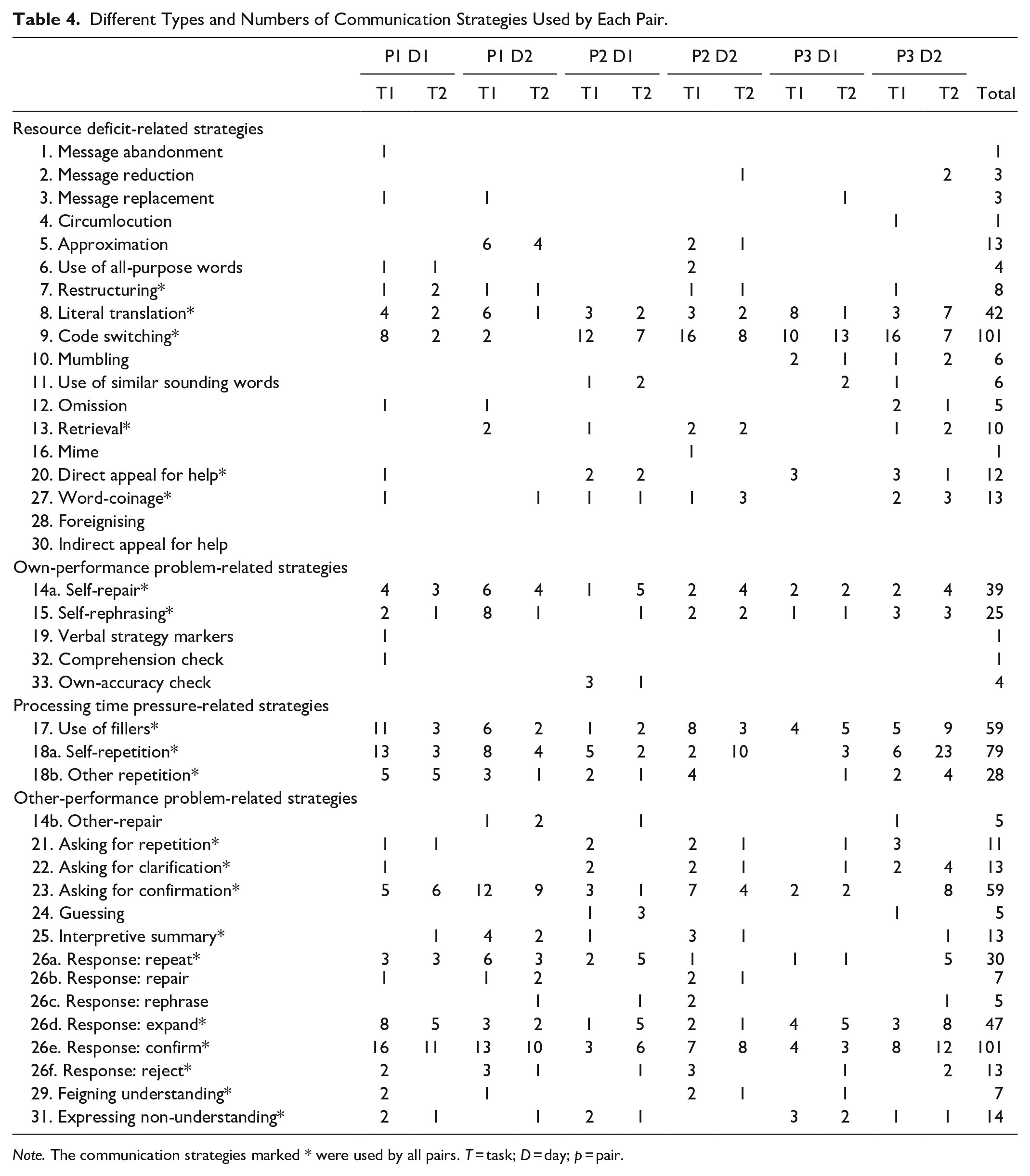
Note. The communication strategies marked * were used by all pairs. T = task; D = day; p = pair.

Numbers of communication strategies used by the three pairs.

Means of communication strategies: Pair 1.
Interview data
The interview focused on participants’ perceptions and feelings for the learning experience in VELLE and the influence of the PF design on their learning experience. The interviews were conducted using Zoom. The transcription of the interviews was analyzed based on the two themes aligned with the two research questions, their CFL learning experience in the VELLE context and the influence of PF design on their learning. As the analysis focused on the coding of communication strategies, the interview data was used as complementary and triangulating data.
Results
This section reports the results of the process data analysis.
Types of Communications Strategy Used by the Participants
Different types and frequencies of communications strategy (CS) used by each pair in the 2-day sessions are illustrated in Table 4:
The analysis showed that the top five CS accounted for half (50.2%) of the 38 strategies coded (two, #28/#30, being unscored). The predominant strategy types were categorized as resource-deficit related (28.8%) and processing time pressure-related (20.9%), plus other specific strategies such as response: confirm (12.7%), and asking for confirmation (7.4%). These strategies accounted for almost 70% (69.8%) of all the CSs.
To further explore the use of CS in each group over the PF design, Figure 6 illustrates the number of strategy types used by each pair in Task 1 and Task 2 after the instruction provided on each day.
As illustrated in Figure 6, Pair 1 used a lesser number of communication strategies in Task 2 than in Task 1. For Pair 2, the number of strategies used was the same for each task. Pair 3 used slightly more strategies in Task 2 than in Task 1. The specific types of strategies used by each pair were analyzed in the next section.
Patterns of Strategy Use in the PF Design
More specifically, the following charts in this section illustrate the number of CS in terms of other-performance problem-related, own-performance problem related, processing time pressure-related and resource deficit-related strategies used by a pair of students. Communication strategies used by each pair were exemplified with quotations from their conversation transcript.
Pair 1
As shown in Figure 7, other-performance problem-related strategies were more frequently used in Task 2. Meanwhile, own-performance problem-related, processing time pressure-related and resource deficit-related strategies were less frequently used in Task 2. As shown in Table 4, literal translation and code-switching were the resource deficit-related strategies predominantly used by Pair 1 for both tasks, with a significant decrease in Task 2. One reason could be that the students became more familiar with the related Chinese expressions and vocabulary in the direct instruction before Task 2, so there were less needs to use other strategies related to resource deficit. This explanation might also apply to the slight decrease in the use of own-performance problem-related strategies (see Figure 8). As shown in the example below, the structure of the first half of the sentence was a sign of a transfer from the English sentence structure. However, the student realized the error and made a self-initiated correction in the second half of the sentence.
[00:06:20] Speaker 1: 你想什么其它. . . 喝点什么?[You want what else. . . what else to drink?] [Day 1 Task 1]
Numbers of communication strategies: Pair 1.
As for processing time pressure-related strategies, use of fillers and self-repetition, such as 嗯(Eh) or 好 (Ok) had been used frequently in Task 1 as one way to cope with pauses and to gain time, but this was less often used in Task 2. For example:
[00:06:32] Speaker 1: 好,好。我想喝一杯咖啡。[Ok, ok. I want a cup of coffee.] [Task 1 Day 1]
Similarly, the frequency of other-performance problem-related strategies also fell away in Task 2. A possible reason for this may be that the two students were more familiar with each other. For example, two frequently used strategies were “asking for confirmation” and “response: confirm.” Pair 1 often used “好吗” [right?], “好不好” [Is it right?], to ask for confirmation during Task 1. The response was usually a simple word response, such as “好” [ok], “对” [right], “嗯” [Eh]. However, the expression became more content-related in Task 2, such as:
[00:00:14] Speaker 1: 你要一杯咖啡?你要咖啡,咖啡要热的,恒温的,还是冰的? [You want a cup of coffee? You want the coffee to be hot, normal temperature or ice?] [Task 2, Day 2]
This indicated an improvement in the content-related language use and the ability to vary expressions for the same strategy after the instruction. Another reason could be that Student 1 became more familiar with the content of the conversation, which led to the varied expressions.
Regarding the VELLE learning environment, although at the beginning it took some time for the students in Pair 1 to become familiar with the interface, they believed that this environment supported their communication. Student 1 compared the VELLE with her classroom learning experience: “In the classroom, it’s very much textbook-based learning, but the virtual reality is more conversational. So I can apply what I learned in the virtual reality to everyday life.” Student 2 highlighted that VELLE gave her a sense of “hands on” experience which was especially effective for learners with an attention problem because it is “engaging and directly lets someone take control of their learning experience.” However, they also expressed the need to have more engagement with the VELLE environment beyond the designed task of ordering drinks, such as walking around the restaurant and ordering other dishes.
Regarding the PF design, both students believed that the VELLE environment helped with their learning, “Because in the instruction, we picked up the points we need to improve. And in the second task, we did improve” (Student 1, Pair 1 Interview). This was evidenced in the analysis of their conversation above. In addition, Student 2 viewed the PF design as helpful for communication tasks as “it means you’ve got these conversations in your head from Task 1, and you know what the context of the word is and how you can use it [in Task 2].”
Pair 2
As shown in Figure 9, the use of other-performance problem-related strategies predominated and increased slightly in Task 2. Pair 2 had a low dependence upon own-performance problem-related strategies as well as processing time pressure-related strategies, with no differences observed between Tasks 1 and 2. By contrast, resource deficit-related strategies were the second most frequently used strategies, with a mild decrease in use from Task 1 after instruction (see Figure 10).

Numbers of communication strategies: Pair 2.

Means of communication strategies: Pair 2.
As illustrated in Table 4, among the resource deficit-related strategies, code-switching was the most frequently used strategy, though the usage was halved after instruction. For example,
[00:03:45] Speaker 1: 一共 [Total] . . . what’s the price of all these. . . [Day 1, Task 1]
We also found that in own-performance problem-related strategies, the use of self-repair tripled from Task 1 to Task 2. For example:
[00:03:14] Speaker 1: 我想 [I want] . . . no, no. 我不想奶茶[I don’t want milk tea]。 [Day 1 Task 2]
Reflecting a shift from reliance on fillers in Task 1, Pair 2’s use of self-repetition, another processing time pressure-related strategy, increased from Task 1 to Task 2, as follows:
[00:02:46] Speaker 2: 好的。 你想. . . 你想. . . 你想喝热的,冰的,还是常温的吗 [Ok. You want. . .you want. . .you want hot, iced or room temperature?]? [Day 2 Task 2]
Most of the self-repetition was due to students’ unfamiliarity with the new expressions and vocabulary covered in the instruction, and was a way of gaining more time to process the information.
Regarding other-performance problem-related strategies, asking for confirmation, such as 对吗?[Right?] was a common strategy used by Pair 2, and similar to Pair 1.
Another other-performance problem-related strategy that showed more obvious increase in Task 2 was “response: expand.” Although the frequency of use was not very high, there were some self-initiated uses of language. For example:
[00:00:26] Speaker 1: 一杯咖啡是十五元。[A cup of coffee is 15 yuan] [00:00:35] Speaker 2: 很便宜。[Very cheap.] . . . [00:01:57] Speaker 2: 一壶奶茶三十五块。[A pot of milk tea is 35 yuan] [00:02:07] Speaker 1: 不便宜。[Not cheap.] . . . [00:03:04] Speaker 2: 你想喝奶茶,还是绿茶?[You want to drink milk tea or green tea?] [00:03:14] Speaker 1: 我想. . . no, no. 我不想奶茶。No, sorry. 我不想一壶奶茶,我想一壶绿茶。[I want. . .no, no. I don’t want milk tea. No, sorry. I don’t want a pot of milk tea. I want a pot of green tea.] [00:03:36] Speaker 2: 好的。[Good.] [00:03:37] Speaker 1: 因为便宜,很便宜。[Because it is cheap. Very cheap.] [Day 1 Task 2]
As shown in the excerpts, Speaker 2 first expanded the response by commenting on the price 很便宜 [very cheap] [00:00:35], which was not in the task requirements, but was initiated by the speaker himself. Speaker 1 learned this word from his partner and started varying the use of this word in the following expanded responses, such as using negation form 不便宜 [not cheap], or adding a cause-effect connective, such as “因为便宜” [because it is cheap].
In the interview with Pair 2, they regarded the VELLE environment as motivational in their language learning as it put them “in the mood to speak Chinese.” As with Pair 1, they also believed that VELLE would be more engaging than the normal classroom environment especially for ADHD children. Similar to Pair 1, they would like to explore the VELLE more and have a more dramatic scenario embedded in the design, such as challenges found in computer games.
As for the PF design, Pair 2 highlighted that this design was effective for deep learning and building relevance, remarking: “I definitely love the tasks because it is like chucking us in the deep end and makes us think more and relate more to what we know and a more a realistic environment.” (Student A in Pair 2). Similarly, Student B also highlighted that: “Task 1 made us do it without any help at first and made us think in the first language. Then in the instruction, you corrected us and showed us the differences between English and Chinese. So that was good.” Both students in Pair 2 stressed the impact of the PF design as “very intellectual and intuitive” causing them to communicate with each other rather than repeating the expressions taught by the teacher: “it makes us think more” (Pair 2 interview).
Pair 3
As shown in Figure 12, for Pair 3 the means of other-performance problem-related strategies and resource deficit-related strategies predominated with the former increased from Task 1 to Task 2 (by 26%), whilst the latter decreased (by 56%) from Task 1 to Task 2. The means of own-performance problem-related strategies were little used and remained stable between tasks. At the same time, the numbers and means of processing time pressure-related strategies almost doubled from Task 1 to Task 2 (see Figures 11 and 12).

Numbers of communication strategies: Pair 3.
Means of communication strategies: Pair 3.
As shown in Table 4, among resource deficit-related strategies, both literal translation and code-switching decreased from Task 1 to Task 2. For example, the common literal translation that Pair 3 used most was the expression of the compound verb phrase “想要” [want to order]. Influenced by their first language English, they often only kept “想” [think] but omitted the verb “要” [want] because in English both words have the meaning “want.” For example:
[00:03:10] Speaker 1: . . .我想柠檬茶一杯。[I think lemon tea one cup][Task 1 Day 1]
This resulted in an ambiguous meaning. After the instructor corrected this usage in the direct instruction, Pair 3 made some corrections in Task 2, though they sometimes stumbled a little, as shown in the excerpt below.
Pair 3 often intentionally used an own-performance problem-related strategy, self-repair, to correct their speech, thus this strategy also increased accordingly in Task 2.
[00:07:04] Speaker 1: 好,谢谢。我想绿茶热。我想喝热的绿茶。 [Good, thank you. I think green tea. I want to drink hot green tea.]
Meanwhile, the use of another strategy under the same category, direct appeal for help, fell markedly from Task 1 to Task 2. Pair 3 used this strategy more in Task 1 when they didn’t know how to express the intended meaning in Chinese, which was often involved with code-switching, for example:
[00:00:29] Speaker 2: 不是咖啡。我要绿茶,还有,我想 “shang yi hu”. I am sorry. How do you say like, what do you recommend? [Not coffee. I want green tea. And, I want a pot.]
Two processing time pressure-related strategies, the use of fillers and self-repetition, increased significantly in Task 2. Pair 3 used these two strategies to gain more time in speech when using the new expression or vocabulary covered in the instruction. The most commonly used fillers were 是 [yeah] or 好[Ok].
There were several other-performance problem-related strategies which Pair 3 used more often in Task 2 than in Task 1, such as #23, asking for confirmation; #26a, response: repeat; #26d, response: expand: and #26e, response: confirm. For example, in Task 2, Day 2:
[00:02:20] Speaker 1: 谢谢。还是,你想红茶? 对不起。[Thanks. Again, you think red tea? Excuse me.] [00:02:32] Speaker 2: Yeah. 我想红茶。[Yeah. I think red tea.] . . . [00:02:37] Speaker 1: 壶?是,是。你想红茶加不加糖 吗?[Pot? Yes, yes. Do you want red tea without sugar?] [00:02:47] Speaker 2: 不加。[No]
As compared to Pairs 1 and 2, Pair 3 used more content-related words when asking for confirmation by providing choices, rather than simply asking: “好吗” [right?]. This could be interpreted as Pair 3 wanting to practice the new vocabulary or expressions in their conversation, as gleaned from the instruction provided. This was also reflected in the increased use of “26a, response: repeat” in Task 2. The student often repeated the expression/vocabulary used by their partner:
[00:05:07] Speaker 2: 我没有红茶。[I do not have red tea.] [00:05:11] Speaker 1: 没有红茶。是。[No red tea. Yes.]
Pair 3 also appeared more confident in expanding their responses by adding new expressions which were not included in the instruction or the questions:
[00:00:27] Speaker 1: 咖啡,不加糖。[Coffee, no sugar.] [00:00:31] Speaker 2: 好。我不喜欢糖。[Good. I don’t like sugar.]
Here is another example of using the “response: expand” strategy:
[00:02:52] Speaker 1: . . .一共是. . . 一共. . . 一共是七十五块。[Altogether. . . altogether. . .altogether are 75 yuan] [00:03:28] Speaker 2: 什么?太贵了。[What? Too expensive.]
The expanded response also brought more interaction between the two speakers. In the interview with Pair 3, their perceptions about the VELLE were similar to the other two pairs in that the visualization of the scene in VR made them feel more comfortable and authentic in speaking the language, as if “feeling you’re almost in there,” compared to facing a worksheet in a classroom. In addition, they related this VR environment to language use such as “the visualisation, the menu and characters . . . helps with my language . . . made me speak more fluently.”
It was highlighted that the PF design made the students “try out different ways of saying things that I probably wouldn’t usually think about,” which was in line with the purpose of the design to encourage learners to come up with multiple solutions to the task. In addition, they felt that the design enhanced their language choices for communication, “Even if I didn’t really know what it meant or I didn’t know how to say it. I still said it anyway.” This was reflected in the increased frequency of other-performance problem-related and processing time pressure-related strategies used in Task 2. In other words, the students tried to increase the chances or time available for applying the new vocabulary or expressions acquired during the instruction in their conversation, and this was reflected in the use of various expansions in their responses.
Discussion
The Type of Communication Strategies
Regarding Research Question 1, we discussed the use of the four types of communication strategies. Among the resource deficit-related strategies, code switching, and literal translation were the two most widely used strategies to cope with the participants’ limited linguistic resources. This was in line with the finding that learners with a lower level of L2 competence usually resorted to a higher number of communication strategies, especially “literal translation” and “code switching” (Jidong, 2011; Rosas Maldonado, 2016). In the VR environment, L2 learners also often resorted to their first language for communication (Liang, 2012). While the six participants did resort to message abandonment and reduction (four instances), this differed from other research findings that beginner learners tended to make greater use of message abandonment and reduction when facing communication problems (Hsieh, 2014; Rosas Maldonado, 2016).
At the same time, all three pairs extensively used self-repair and self-rephrasing to cope with own-performance-related problems This was also reflected in Pair 3’s interview comment about the problem-solving phase, “Even if I didn’t really know what it meant or I didn’t know how to say it. I still said it anyway.” To gain more time, all participants used self-repetition, fillers and other repetition, which coincides with the claim that learners used these strategies to remain involved in the conversation, keep fluency and gain some time for thinking (Dörnyei & Scott, 1997; Rosas Maldonado, 2016).
Regarding the communication problems related to other’s performance, all participants used response with confirmation, and in asking for confirmation. They also responded by expanding the answer or repeating the response. At the same time, some help-seeking strategies were adopted by participants, such as expressing non-understanding, asking for clarification, and asking for repetition. Among them, asking for confirmation was also found as frequently used strategy by the EFL learners in Chen’s (2016) study. These observations also indicated learners’ intention to keep the conversation flowing without breakdown (Hsieh, 2014). The findings confirmed that second language learners utilized a variety of communication strategies, especially communication strategies of deficit resources and other performance related problems in a virtual reality learning environment (Park, 2018). As shown in Table 4, there was a fairly wide spread of strategies used consistent with the different types of communication problems encountered. This differed from other research findings that indicated avoidance or reduction strategies were often used (Hsieh, 2014).
As for the VR environment, all participants regarded the VELLE as more engaging and relaxing than classroom learning, which was in line with the finding about VR by other research (e.g., Hammick & Lee, 2014; Melchor-Couto, 2017; Wang, Lan, et al., 2020). In addition, the participants believed that the immersive VR environment gave them more confidence to communicate in L2, which supported their use of language for communication. These findings confirmed other research about the effects of VR on learners (Caspar, 2021; Peterson, 2012; Swier, 2014; Tseng et al., 2013; Vuopala et al., 2016). In particular, the participants commented that the VR environment provided a near-to-real-life environment which better supported their communication in Chinese than the classroom setting. This was in line with other research that the VR environment not only alleviates learners’ anxiety but also enhanced their confidence in L2 communication (Ayedoun et al., 2019; Thrasher, 2022). The patterns of communication strategies influenced by the PF design will be discussed in the next section.
The PF Design and the Use of Communication Strategies
Regarding Research Question 2, we focused on how the PF design influenced the students’ use of CSs. In other words, whether and how students changed their use of CSs from the problem-solving phase (i.e., Task 1) to knowledge assembly (i.e., Task 2) following the instruction phase. There were three key findings to arise. First, all participants used a lesser number of resource deficit-related strategies in Task 2. Second, the use of L1 enriched the participants’ learning opportunities. Third, the participants used other-performance problem-related strategies more frequently in Task 2.
As to the first finding, we found that all three pairs used less strategic types and used them with lower frequency of the resource-deficit related strategies, from Task 1 to Task 2. For example, all groups markedly decreased their use of code switching and literal translation strategies, suggesting they were more experienced speaking the target language and effectively used the lexical resources provided during instruction. As a result, resource-deficit related strategies were used less often than otherwise. This finding is consistent with other CFL studies showing that when a learner’s L2 lexical knoweldge improved, they used L1-based strategies, most of which lie in resource-deficit related strategies (Hsieh, 2014; Jidong, 2011). This is also in line with other PF studies (e.g., Jacobson et al., 2017; Kapur, 2014) showing that students improved their learning of the targeted concepts after the instruction phase, which demonstrates the beneficial effect of PF.
Second, the findings also revealed that the use of L1 related strategies facilitated their communication in Task 1 and enriched the learning opportunities in the instruction phase. Only after identifying the errors in their use of literary translation in Task 1, we were able to provide more specific instruction targeting these errors, such as the compound verb phrase “想要” [want to order]. This was confirmed by Pair 2’s interview that:
“Task 1 made us do it without any help first and made us think in the first language. Then in the instruction, you corrected us and showed us the differences between English and Chinese.”
This finding was in line with the claim that the appropriate amount of L1 use had a positive impact on students’ learning if the pedagogical task was well designed and sequenced (Pavón Vázquez & Ramos Ordóñez, 2019; Tavares, 2015).
The third key finding was that the frequency of other-performance problem-related strategies increased from Task 1 to Task 2. This could be interpreted that students had more interaction with their paired partner after the instruction. For example, students in Pair 2 and Pair 3 increased their use of “response: confirm” strategy to confirm they understood the other’s meaning. Pairs 2 and 3 also increased their use of “response: expand.” This can be explained by students being more familiar with each other during the second communication process. In addition, this PF design gave them the opportunity to genuinely interact using more of the target language, and was reflected in their interview data that they had tried various ways to keep the conversation flowing. This finding confirmed that these interactional tasks enabled learners to use various communication strategies to initiate the topic, ask for help, correct and clarify each other’s responses (Aljohani & Hanna, 2021; Hung & Higgins, 2016; Rosas Maldonado, 2016). This finding was also in line with the claim that PF promoted L2 learners’ use of multiple language strategies (Rahayu, 2021). All three pairs commended the PF design as helpful for their language learning, like “in the instruction, we picked up the points we need to improve. And in the second task, we did improve.” (Pair 1 interview). At the same time, there were individual’s variations in their communication strategies use, especially in terms of own-performance problem-related strategies, as there were no generally consistent changes from Task 1 to Task 2 among the three pairs for this type of strategies.
This finding indicated that it was necessary to provide learners with a simulation and a more natural setting which would prompt the learners’ use of communication strategies in order to try to solve the encountered problem (Rosas Maldonado, 2016). The PF design not only provided a context for language use in Task 1, as confirmed by Pair 2 interview data, it also showed teachers the specific problems their students experienced in communication so that the follow-up instruction could be more specifically tailored to the students’ needs (Rosas Maldonado, 2016).
Conclusions, Implications, and Limitations
The findings from this small sample pilot study indicated that VELLE created a more comfortable, authentic and engaging learning experience for language learners’ in their communications. Although we did not compare the use of communication strategies in VELLE with those used in the classroom setting, the participants confirmed that they were more confident in communicating with each other. The analysis of the types of communication strategies showed that there were 22 commonly used strategies out of the 33 strategies listed in Dörnyei and Scott (1997). Among them, code-switching, self-repetition, use of fillers, response with confirmation, asking for confirmation, and expanded response were the most frequently used strategies. These findings contribute to the research related to the strategies that CFL learners used in maintaining and managing communications in the virtual reality environment. Regarding the challenge of the limited opportunities for learners to use the language for communication in an authentic context, VR provided a near authentic and engaging context for foreign and second language learning. Other affordances and features of VR could be used to support students’ language use and communication.
With the PF design, the common findings were that students used less resource-deficit related strategies and more other-performance problem-related strategies in Task 2, implying the improvement of their language skills and familiarity with the content after participating in the designed activities. In turn, they had more frequent interactions with each other. These findings indicated that PF design had the potential to effect students’ use of communication strategies and provided an option for incorporating instructional design in VR-based learning tasks, as suggested by researchers (Merchant et al., 2014; Parmax, 2020). In addition, all the participants confirmed the effectiveness of this PF design in activating their prior knowledge and creative use of language. The findings enriched the research on CFL/CSL learners’ use of communication strategies and the limited research on the relationship between the use of communication strategies and task design.
The findings presented in this paper may have three pedagogical implications for L2 communication strategies. First, none of these participants had an explicit knowledge of the communication strategies but used them based on their intuitive needs for communication. Therefore, it is necessary to embed both explicit and implicit teaching of CSs in language education, as suggested by other researchers (Maleki, 2007; Nakatani, 2005). In addition to the teacher’s presentations, the explicit teaching could include guided reflection on the use of specific communication strategies, instruction on how to identify and solve a communication problem, and directions on how to use a strategy including related key words and expressions (Chang & Liu, 2016; McNeil, 2016). At the same time, teachers could model the communication strategies as the implicit instruction (Aljohani & Hanna, 2021). The purpose is to raise their awareness of communication strategies, so they are willing to take risk and use these strategies in their L2 communication (Dörnyei, 1995). Second, in terms of the task design, other affordances of the VELLE should be fully utilized to encourage students’ interaction, such as allowing learners to explore the VELLE by themselves to have more self-initiated conversation and interaction with the VR environment. Third, PF design could be further applied in CFL teaching with the aim to enhance students’ active language learning.
As earlier mentioned, the limitations of this pilot study were the small sample size, and lack of comparison with the use of communication strategies in different settings. The third limitation was the lack of a pre-assessment of students’ language proficiency. This suggests some directions for future research. One is to compare students’ use of CSs in the VELLE and classroom settings. Another future research area is to explore how PF mechanisms are associated with other aspects of language learning in different learning phases with a longitudinal study. Last but not least is the cognitive engagement and learning emotions of CS in a VELLE context.
Supplemental Material
sj-docx-1-sgo-10.1177_21582440221141877 – Supplemental material for The Use of Communication Strategies by Second Language Learners of Chinese in a Virtual Reality Learning Environment
Supplemental material, sj-docx-1-sgo-10.1177_21582440221141877 for The Use of Communication Strategies by Second Language Learners of Chinese in a Virtual Reality Learning Environment by Hongzhi Yang, Linda Tsung and Lu Cao in SAGE Open
Footnotes
Acknowledgements
We appreciate the participants’ contribution to this study.
Declaration of Conflicting Interests
The author(s) declared no potential conflicts of interest with respect to the research, authorship, and/or publication of this article.
Funding
The author(s) disclosed receipt of the following financial support for the research, authorship, and/or publication of this article: This work was supported by the Faculty of Art and Social Science Faculty Research Support Schemes (FASS FRSS) Project, The University of Sydney and Peak Discipline Construction Project of Education at East China Normal University.
Ethics Statement
An ethics statement (including the committee approval number) for animal and human studies. This project has obtained ethics approval from the University of Sydney Project No. 2020/574.

Supplemental Material
Supplemental material for this article is available online.
References
Supplementary Material
Please find the following supplemental material available below.
For Open Access articles published under a Creative Commons License, all supplemental material carries the same license as the article it is associated with.
For non-Open Access articles published, all supplemental material carries a non-exclusive license, and permission requests for re-use of supplemental material or any part of supplemental material shall be sent directly to the copyright owner as specified in the copyright notice associated with the article.
