




Abstract
Low levels of female representation are found when it comes to technical roles within the South African performing arts industry despite improved numbers in the overall representation of females within the industry across different occupational categories. Employment in the core functions of the performing arts entities is therefore still predominantly male. The research aimed to explore the representation of women in a performing arts entity. The feminist, social dominance and patriarchy theories were used to conceptualize the research phenomena and interrogate the findings in this study. The research adopted a qualitative case study approach, using one-on-one in-depth interviews. The sample of participants included management and employees in the technical business unit, selected through convenience sampling and a complementary snowball sampling technique. Thematic analysis was used to analyse the data, which engendered themes and sub-themes, substantiated by verbatim quotes from the interviews. Although the research findings indicated an unequal representation of females in technical roles and their absence in management positions within the entity, female presence was found to enhance teamwork and diverse views, which consequently improved team performance. The study found that barriers to female representation include unequal gender representation, the nature of work, and the work-life balance. The study established policy recommendations for the industry, including flexible-hour strategies and childcare facilities, among others.
Plain Language Summary
Minimal female representation remains in technical roles within the South African performing arts industry although the overall representation of females within the industry throughout various occupational categories has improved. Employment in the core functions of the performing arts entities therefore remains predominantly male. This study sought to explore the representation of females in a performing arts entity. The feminist, social dominance and patriarchy theories helped conceptualise the key research aspects and analyse the findings in this study. The research followed a qualitative case study approach, through individual in-depth interviews. The sample of participants was comprised of management and general employees in the technical business unit. These participants were selected through convenience sampling and a complementary snowball sampling technique. Thematic analysis was used to analyse the data, resulting in themes and sub-themes which were then substantiated by verbatim quotes from the interviews. While the research findings suggested an unequal representation of females in technical roles and their absence in management positions within the entity, female presence was implied to enhance teamwork and diverse views, thereby improving team performance. The study revealed that unequal gender representation, the nature of work, and the work-life balance inhibited female representation. Some of the industry policy suggestions that emerged from the study as a way to improve female representation in technical roles within the performing arts entity were flexible-hour strategies and childcare facilities.
Introduction and Background
The South African performing arts industry, which is centred on theatre, and especially state-funded theatres, has been faced with the challenge of female underrepresentation. There were previously no specific qualification requirements for employment in the performing arts industry, particularly in South Africa (Yende, 2021). However, in more recent times, the sector began emphasising the importance of acquiring formal education within the field, ranging from national higher certificates and diplomas to master’s and doctoral degrees (Ebewo & Sirayi, 2018). Job fields within the sector include working as a performer, producer, director, lighting technician, playwright, opera singer, animator, comedian, and arts educator, among several others (Yende, 2021). State-funded theatre entities in South Africa previously did not appoint females in prominent positions. This may be ascribed to the fact that theatre was once viewed as a public and political space in which men would generally speak and protest apartheid, while those who were lucky enough to be appointed had limited control of the system (Hutchison, 2018). One of the less acknowledged facts around this has been the imbalance in the gender representation around the employment of females in theatrical performances (Plaatjie, 2020). Hutchison (2018) further argues that, whilst the transition to a democratic South Africa has seen females occupying positions of power, in parliament, for example, this has unfortunately been slow to reach the core of some businesses and assemblages of people on the ground.
The importance of this study can be appreciated considering the mandate of the public performing arts institutions (PAIs), which is to create and fortify South Africa’s culture and heritage (Department of Arts and Culture (DAC), Republic of South Africa (RSA), 2020). The 2019/2020 annual reports of four of the main state-funded performing arts institutions, the State Theatre, Pacofs, Artscape Theatre, and the Durban Playhouse, confirmed that they were Schedule 3A Public Entities and agencies of the Department of Sport, Arts and Culture, and were declared to be cultural institutions in terms of Section 3 of the Cultural Institutions Act, Act 119 of 1998, and that they were governed by the Public Finance Management Act, Act 1 of 1999 (Department of Arts and Culture (DAC), Republic of South Africa (RSA), 2020). Unlike the private performing arts institutions, which have the freedom to operate as both receiving and producing houses, public performing arts institutions are mainly receiving houses. The performing arts must surely surpass racial, social, economic, political, and all other possible differences if indeed it is to be a vehicle for building confidence and fellowship in the new South Africa (Blumer, 2020). Real change must also be visible in the demographics of the entities across all occupational levels, in all business units, including in technical roles. This study, which substantially expanded on our recent related research (Nkomo et al., 2023), specifically focussed on the representation of women in technical roles in a public/government supported PAI.
The following sections are outlined in this paper: the study’s underpinning theoretical framework; the research methodology; data collection and analysis procedures; strategies employed to ensure sound data; ethical considerations; findings emanating from the empirical research; discussion of the findings; study limitations and recommendations; and concluding remarks.
A Brief Literature Review
The Feminist Theory
Feminism, which advocates equal rights between males and females, originates centuries ago, particularly from the 18th and 19th centuries, as founded by the works of pioneering feminists, like Elizabeth Cady Stanton, Mary Wollstonecraft, Sojourner Truth, and John Steward Mill, who tackled critical aspects of female status in educational, economic, and political, spheres (Frazer, 2011). Wollstonecraft specifically emphasised the importance of female independence, citing how social domination and oppression prevented females from becoming independent while further arguing against docile, blind obedience and male domination and demanding female participation in civic life (Gibbels, 2020).
Influenced by feminist theory, feminist economists persisted in the 19th century, which prompted further impetus through the work of Treiman and Hartmann in 1981, who critiqued the causal processes underpinning gender inequality in the working environment (Kabeer, 2021). Feminist economists consider gender as the focal point of their activities, proffering integral and human understanding of the economy to a more considerable extent while evoking a further focus on the aspects of inclusion and exclusion (Agenjo-Calderón & Gálvez-Muñoz, 2019).
Literature and research corroborate that female underrepresentation, specifically in critical positions, is because of social norms that have stifled females from accessing power and similar privileges while primarily affording them to their male counterparts (Einarsdottir et al., 2018; Zinatsa & Saurombe, 2022a; Zinatsa & Saurombe, 2022b). Discriminatory practices were enforced in the workplace, fostering an environment unconducive for females to occupy critical positions with meaningful duties and advantages. Today’s workplace demographics, where fewer females exist in the first place and, once they do, are forced to occupy inferior positions, are unnatural but a consequence of man-based norms, beliefs, policies, and prejudiced practices towards females. Organisations, such as the PAI in this study, seeking future sustainability must introspect and learn from the feminist theory to ensure equal opportunities and representation within the workplace.
The Social Dominance Theory
The Social Dominance Theory (SDT) was developed in the 1990s by Jim Sidanius, Felecia Pratto, and Shana Levin, who argue that there are three systems of group-based hierarchies created by society : (a) an ageing system, in which adults have social power over children, (b) a gender system, where men have social, political, and military power in contrast to females, and (c) an arbitrary set system where one group dominates the other due to differences in nationality, ethnicity, class, religion, and so on (Soliman, 2022). The SDT believes strongly that group-based hierarchies of dominance are made stable due to the legalising of ideologies that help coordinate beliefs, actions, and institutional practices that maintain that hierarchy, which is detrimental for lower-power and lower-status groups (Vargas-Salfate et al., 2018). The SDT claims that those who benefit from a social-dominance orientation tend to strongly endorse ideologies, policies, and practices maintaining domination over others, in stark contrast with those who counter it (Islam, 2020).
The SDT explains the reason for fewer females in the workplace, even fewer in critical roles, and why they cannot grow in their careers, whilst males have access to positions of power and more lucrative remuneration packages (Saurombe & Zinatsa, 2023). In the entity explored in this study, males still dominated top management and occupied the key technical roles, thus embodying the dominant group, whilst females languished in lower-level roles, embodying subordinate groups. In general, male-dominated entities are characterised by a disproportionate and excessive advantages for males such as organisational positions, power, privileges, and these entities tend towards gender-based exploitation (Adisa et al., 2021). Guided by the above, this study explored the occupational levels of females in technical roles and the benefits they enjoyed compared to their male counterparts.
The Patriarchy Theory
Patriarchy is a term emanating from Latin, where the word pater means “father” and arch means “rule;” combined, they mean “the rule of the father,” as expounded by Dixit (2020). He indicates that the first person to use the term was Friedrich Engels (1820–1895), who used it to describe male dominance over females. Patriarchy has existed since the beginning of the Holocene; however, prior to this, in nomadic hunter-gatherer forms of sociality, the institution of patriarchy did not exist as a universal social phenomenon (Stanish, 2017). This means patriarchy was man made and given its destructive nature in society, it can similarly be resolved by man. Employers must be on the forefront as change agents to bring a society that is fair and just (Blanco-González et al., 2023).
A study of 250 females working in Malaysia found that patriarchy, organisational cultural factors, and family factors, had significant relationships with females’ progression (Moorthy et al., 2022). Carbajal (2018) similarly found that the patriarchal perspective influences the portrayal of leadership roles in society because many females do not assume senior positions due to gender inequality in the workplace, lack of support, companies’ preference for a leadership style based on masculine characteristics, and unnaturally forcing females to follow such styles. Employers must therefore continuously examine their culture and periodically affirm equal opportunities, equal rights, and equal treatment policies to change the status quo (Adisa et al., 2019).
The state of Qatar has proven that patriarchy can be gradually eradicated if there is willingness from the top to do so. As institutions of classic patriarchy erode in Qatar, the labour market has opened for females, who are entering in large numbers; this has strengthened the argument that females need to work in communities historically characterised by patriarchy (Salem & Yount, 2019).
Research Aim and Objectives
The research aimed to explore the representation of women in technical roles in a South African performing arts entity.
The objectives of this research were to:
Identify the gaps that existed around addressing female representation in technical roles in a South African performing arts entity.
Highlight the measures used to address the underrepresentation of women in technical roles in a South African performing arts entity.
Methodology
Research Philosophy
Research philosophies shape the process of the research and conduct of enquiry as based on research assumptions centred on the three levels of research philosophy, namely ontology, epistemology, and axiology (Saunders et al., 2016). We used a subjectivist ontology. In terms of this perspective, the social reality of participants was accommodated, and human intentions were utilised for explaining causal relationships among social phenomena (Smith, 2020).
Epistemologically, an interpretivist perspective was used, as we sought to understand the phenomenon of female representation in technical roles within a performing arts entity and to establish policy recommendations for the improvement of the same. We considered the participants’ perspective and their descriptions of events, beliefs, and behaviours (Al-Khanbashi, 2020). Discourse analysis was employed to interpret the participants’ perspectives while aligning them with existing contextual knowledge on the research topic.
We had to consider the axiological assumptions during the process of conducting this study to manage their own biases, intuitions and values. This was done by discussing before data collection, the sentiments that would possibly be evoked by participant responses to the interview questions, and reflecting on and discussing after data collection, how such and other arising sentiments influenced the interpretation of the data.
Research Design and Approach
Sampling and Participants
One of the key considerations when one makes a research decision will be determining whom to choose for a sample and the method that will be used to select the estimated sample to meet the objectives of the research (Oribhabor et al., 2019). The total number of employees at the South African PAI where the study took place was 88, of which 56 (64%) were male and 32 (36%) were female. At the time of the research, the number of technical staff was 31, of which 28 (90%) were male and 3 (10%) were female. In this study, dovetailing with the qualitative case study research approach adopted, data were collected primarily through convenience sampling, and a complementary snowball sampling technique. Access to the institution was gained through one of the authors who was an employee thereof at the time when the study was conducted. Since some of the participants were subordinate to this author, they were given the option to be interviewed by an alternative author to mitigate any possible dynamics of power that may have prevailed.
Initially, a research sample of between 10 and 12 was targeted as per guidelines from previous research which suggest that 6 to 12 individual interviews are sufficient for a qualitative study (Braun & Clarke, 2021b; Dworkin, 2012; Fugard & Potts, 2015; Guest et al., 2006). Fourteen participants were then secured, however, three of them withdrew due to unforeseen, schedule-related circumstances. While we were prepared to stop at 11 interviews, some of the participants referred other possibly interested candidates after going through the interview, which resulted in the addition of six more participants, hence the complementary snowball sample. Ultimately, a total of 17 participants was achieved. Besides the three participants who withdrew from the study, none refused to participate. No participation incentives were offered to the participants in this study.
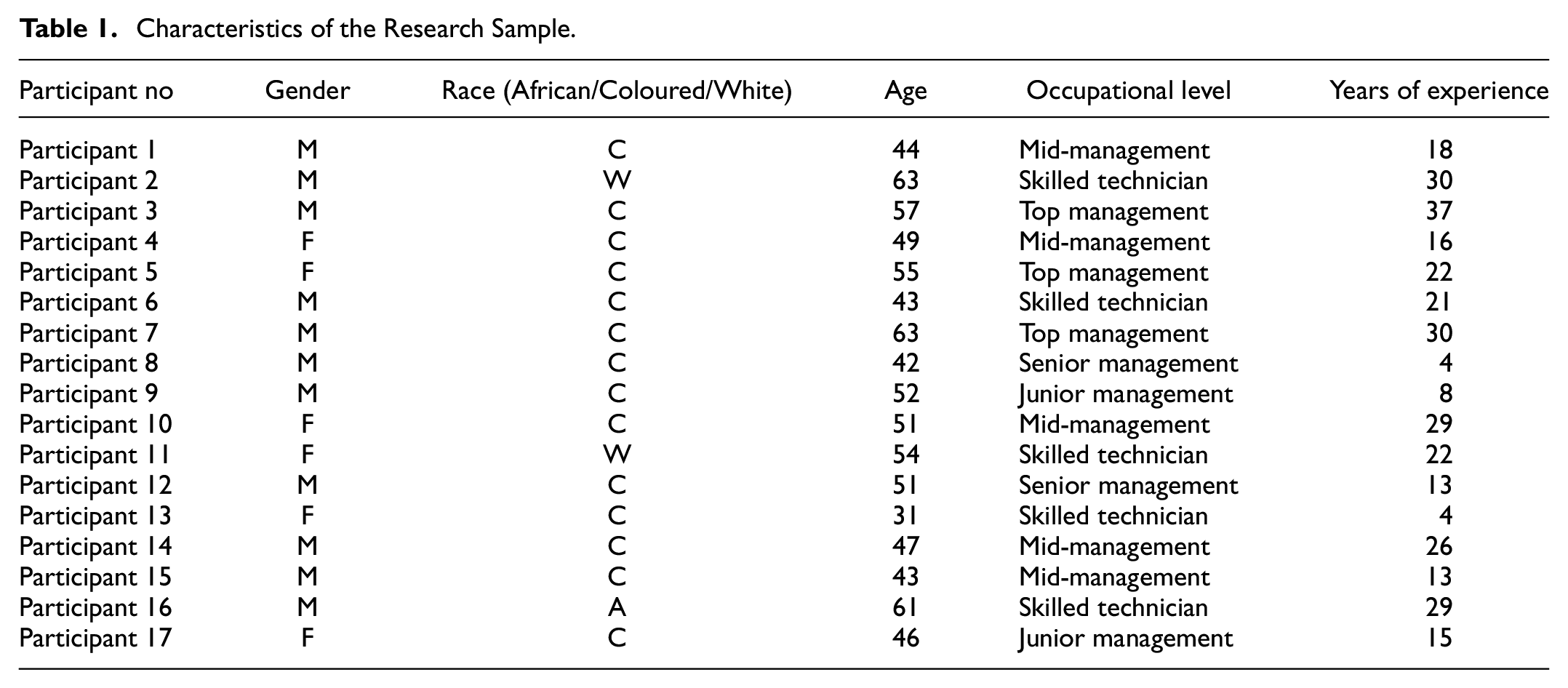
The management and employees within the operations department of the performing arts entity were interviewed. These participants formed part of the group of employees who were performing core functions in the business and management of the entity. Two of the participants were employees who used to work in the technical business unit but had moved to a different business unit within the same entity. Their holistic view was found to be useful around providing pertinent insights for this study. For the sake of the achievement of a balanced view in the project, the participants included male and female participants as well as line managers and general employees in the technical business unit. The chief executive officer, who was the vision holder of the entity, was also interviewed to garner an in-depth understanding of the strategic position of the entity around female representation and the challenges faced in this respect (Table 1).
Characteristics of the Research Sample.
Data Collection
We used a semi-structured interview guide to collect data. The interview guide was self-developed and based on the research questions and objectives as underpinned by the relevant extant literature. The initial intention in this research was to conduct face-to-face interviews. However, due to the COVID-19 pandemic and South African national lockdown regulations at the time of data collection, most of the interviews were conducted telephonically and on Microsoft Teams. Some interviews were conducted face-to-face. The interviews were of a one-on-one nature and were all conducted in English. A pilot interview—which turned out successfully—was initially conducted to ensure there were no issues with the interview guide. The pilot study ultimately formed part of the 17 interviews that were included in this study.
It is important to note that, while no new themes emerged beyond the seventh interview—which implied data saturation (Braun & Clarke, 2021b; Guest et al., 2006) —we continued up to the seventeenth interview since obtaining a sufficient breadth and depth of insights was considered more important, as well as to garner a well-represented sample, particularly regarding occupation levels. Time constraints prevented us from exceeding 17 interviews. A recording machine was used to record the interviews, and these were downloaded and stored on password-protected files on a cloud. The interviews conducted on Ms Teams were also recorded on the external audio recording device, as the ethical clearance provisions did not allow us to use any video recordings. Each interview lasted approximately 70 min on average. We made field notes during all the interviews. These notes mainly focussed on our feelings and thoughts towards participant responses and were subsequently used to discuss and reconcile our approaches to data analysis. This helped ensure and confirm the consistency of the data collection and analysis processes between us.
To uphold the confidentiality of participant responses, we ensured that no one else was privy to the interview conversation by advising participants to select a secure and preferably secluded location with little to no disruptions. For the face-to-face interviews, we utilised a pre-booked boardroom at their workplace, and for the telephonic and online interviews, we ensured that the participants were alone and without possible disturbance, before commencing with the formal conversation.
Data Analysis
We transcribed the recordings by repeatedly listening to them and typing verbatim the participants’ responses. Whilst this took considerable time to complete, it embodied an imperative first stage in the data analysis process, by allowing us to re-live the interview experience while simultaneously internalising key themes. Any of the participants who were interested in checking their interview transcripts were given the opportunity to do so, however, this was not made compulsory. Ultimately, only 8 of the 17 participants opted to go through their transcripts (which were printed and hand-delivered to them) and all of them were satisfied with the way their responses were captured. This process is known as member checking in research (Connelly, 2016). The file with transcribed participant responses was kept in a safe and locked area at the main author’s workplace.
We employed the six steps proposed by Braun and Clarke (2021a) to thematically analyse the data. We first familiarised themselves with the data by playing back the audio recordings and making additional notes. Initial codes were then formulated, after which we met to converse about the similarities in the codes identified and ensure their alignment with the research questions. We subsequently explored possible themes by reviewing and bundling the codes in terms of their commonalities. We then discussed the possible themes that had emerged. These themes were subsequently re-examined and regrouped. The themes were then named appropriately and linked to the research objectives. Finally, we produced a written report and supported the findings with verbatim quotes from the interview responses, as demonstrated in the findings section of this paper. To enhance the validity of the data analysis, we each conducted a separate thematic analysis using the Microsoft Word and Excel software, as well as printed transcripts on which colour coding was performed using highlighter pens. The independent data analyses were subsequently compared and merged into the identified themes and sub-themes in this study.
Whilst we used the deductive approach centred on designing the semi-structured interview guide (by using the challenges currently faced by the institution that was explored, and prevalent themes extrapolated from the literature), we applied the inductive approach when analysing data, where codes were allowed to emerge organically outside of the confinements of the study’s theoretical framework. Some of the questions asked were:
What is your perception on the importance of women representation in the workplace?
Over the span of your career, what improvements have you noted regarding women representation in your entity and technical business unit?
Are you aware of any gender equality policy adopted by your entity in alignment with the national legislation?
What is your perception of the challenges faced by women in technical roles within your entity?
How do you perceive the mindset your institution’s leadership, towards achieving the mandate of gender equality in technical roles in your entity and technical business unit?
What do you think are the disadvantages for an organisation that still has women underrepresentation in its staff compliment?
Where necessary, we further probed participants, to garner deeper insights into the research topic, based on the main questions in the interview guide as outlined above. The codes and their frequencies were recorded, and these were later grouped into the mentioned themes and sub-themes. While many of the insights that emerged were aligned with the theory delineated in the literature review, other sub-themes emerged outside of this, thus contributing to the significance and uniqueness of the study.
Strategies Employed to Ensure Rigor and Quality of the Data
To the greatest extent possible, the research was conducted in a non-biased, rigorous, thorough, and accurate manner (Hadi & José, 2016). In accordance with the advice of Mekonnen et al. (2018) when it comes to rigor and quality of data analysis, we ensured that participant numbers were allocated to participants to maintain confidentiality regarding their identity. For the sake of testing and verifying coding validity, transcripts were also coded separately through the process of triangulation (Connelly, 2016).
There are four strategies to consider when establishing trustworthiness, while these are intertwined and interdependent: credibility, transferability, dependability, and conformity (Lemon & Hayes, 2020). To work within the ambit of these, we ensured that data were transcribed immediately after the interviews, where recordings were listened to repeatedly to understand the concepts communicated by each of the participants (Mekonnen et al., 2018).
To demonstrate credibility, we verified research findings with some of the research participants (Kyngäs et al., 2020). Dependability was achieved through diligence in record-keeping throughout the research process, while ensuring the safekeeping of all data and records. Confirmability is also very important for the trustworthiness of research data. To uphold this principle, and in alignment with the advice by Haven et al. (2019), we used interview notes and recordings to maintain the accuracy of the data in addition to constantly reviewing, validating, and keeping a clear audit trail of the data. To ensure transferability, we described the participants as well as the research process, thereby enabling the reader to assess whether the findings are transferable (Cope, 2014).
Ethics and Authorisation
Abdulai and Owusu-Ansah’s (2014) ethical research principles were adopted in this study as subsequently delineated. A consent form was signed by each participant, and we assured the participants that the information would be treated with a high degree of confidentiality. The information was stored in a locked storeroom and downloaded recordings were stored in password-protected files on the cloud. The participants were informed that participation was voluntary, and should they not have felt comfortable during the interview process, they were free to opt out. We ensured that the participants were protected from both physical and emotional harm. The face-to-face interviews were conducted in a spacious room with appropriate ventilation, and social distancing and the wearing of masks were observed in accordance with COVID-19 protocols. We maintained a level of professionalism to ensure that participants were comfortable throughout the interview.
The participants were informed that they would be allowed to view the results of the research if they were willing to. The letter of consent with details regarding the research and the rights of participants was given to all the participants and they all consented. The data was presented accurately, truthfully, and honestly. No misrepresentation of the interviews was recorded, nor the interview transcripts or the quotes used to support the findings of the research. All sources used in the research were acknowledged, cited correctly, and referenced.
Ethical clearance was sought from and granted by the relevant Research Ethics Committee under the ethical clearance reference number: IPPM-2021-586(M). In conducting this research, we were considerate of both the values endorsed by the committee and those of the research participants in the study. We fully adhered to the university’s ethical clearance processes ensuring that the research was conducted ethically without harming the participants.
Findings
The findings of this study centred on the following: unequal gender representation, teamwork, the nature of work, and the work-life balance. Several codes emerged during the data analysis process engendering the sub-themes of this study, which were later grouped under main themes. Table 2 below depicts the overall main and sub-themes that emerged. Although this is not typically the focus in qualitative studies, we arranged the main themes in order of frequency, with theme one occurring the most frequently and theme four occurring the least frequently.
Main and Sub-Themes Emerging from the Study.

Research Objective One: Current Measures Used to Address Female Underrepresentation in the Technical Roles Within a Performing Arts Entity
Theme 2: Teamwork
There was also considerable reference to teamwork, which ranked third in frequency among the main themes. Three sub-themes emerged: diverse views, team mood (spirit), and work ethic.
Sub-Theme: Work Ethic
The participants, particularly the males, highlighted that the presence of team females in the team improved the team work ethic.
Females have this attention to detail, natural excellence, they come and all the relaxed mood we had as boys changed completely, everyone is working hard, you can’t [don’t want to] be outshined by a woman who has just come. (Participant 6, male, aged 41, experienced specialist, 21 years of work experience)
Another participant added: Men might take things out of your hand and think that you can’t do it. So, you have to work harder to prove that you can do it. (Participant 13, female, aged 31, skilled technician, 4 years of work experience)
Another aspect raised in the study was that females seemed to be quick in learning and expressing themselves, asking relevant questions where they needed clarity. This was good for the team as it opened them up to a culture of fruitful engagement and effective team communication: I think as males we kind of pride ourselves as you know, we think we’re expected to know all the answers. Whereas as a female technician, she wouldn’t be shy to ask the questions, why do we move this? Where does the information go to? You know they [females] want to be informed all the time as technicians and often they don’t complain but they engage openly and produce results. (Participant 14, male, aged 47, mid-management, 26 years of work experience)
Sub-Theme: Team Spirit/Mood
Female presence was indicated, mostly by male participants, to have a positive influence on the team spirit.
Where the female cannot lift heavy stuff, we males jump in to assist without saying, look you are paid the same money as I do for the same job, so lift the thing. It happens naturally that you find guys assisting where needed…this makes us a team and work for one another. (Participant 6, male, aged 43, experienced specialist, 21 years of work experience)
The participant added: Females in the team bring some new energy, they have the caring nature, they ask how you are doing, the nurturing side makes them see when you are not doing well and they will say, are you ok today? Boys don’t see that it’s just work, work, work. (Participant 6, male, aged 43, experienced specialist, 21 years of work experience)
Another participant noted that the presence of females brought warmth to the team, which was not only felt by the team but extended to other stakeholders who interacted directly with the team: Number one, there is a warmth when there are females present. I work closely with the technical team in our rural outreach programmes and in-house productions. With the presence of females you get warmth there [in the technical business unit]. (Participant 16, male, aged 61, skilled technician, 29 years of work experience)
There was, however, also the negative impact of few females in a male-dominated environment, as highlighted by the following participant: Just imagine spending the whole day and the talk is about my soccer team in Liverpool and Manchester and Chelsea and they’re [males] expressing their frustrations with other aspects of life blending it with male interests, soccer in this instance in their conversation. Where does a single female in the middle of these guys fit in…they are left out, it is not work-related conversation, but they are not part of the team at that moment. (Participant 2, male, aged 63, skilled technician, 30 years of work experience)
Another participant posited the following: OK, my position is that it is a male dominant environment [in the technical business unit]. We females feel isolated in that space. The culture, also, the jokes, the language that the males might use [uncomfortable male jokes and language]. Also, in the environment females could feel bullied and abused as well. (Participant 4, female, aged 49, mid-management, 16 years of work experience)
Another participant added: When I was a production manager, I could see resistance, there wasn’t a belief that a female can be a production manager, calling the shots in a production. You have to work with a team that doubts your ability and prove yourself worthy before there is confidence. This can kill your appetite for work and [cause you to] live a frustrated work-life. (Participant 16, female, aged 46, skilled technician, 15 years of work experience)
A balanced team was believed to make managing team conflicts easier. Some participants expressed their support for a balanced gender mix in improving teamwork: … for me, I’ve always felt that working with one sex can actually cause more competition than working with mixed male and females in one department…some of the less memorable times I have had in a theatre was working with an all-female group of people. It can be very competitive and maybe that’s mostly because the females fight for their space all the time…not all females, but certainly many females. (Participant 11, female, aged 54, skilled technician, 22 years of work experience)
In addition: In early days, males were not comfortable with the presence of females, you could feel it. As management, I had to deal with such…now you can see the difference. (Participant 3, male, aged 57, top management, 37 years of work experience)
Sub-Theme: Female Representation as a Source of Different Perspectives
Female presence was perceived to bring diverse views to the team, which was of value to the ultimate delivery of results by the team.
One of the participants said: I think it’s much better to have a balanced group of people. I feel that females bring something unique to the unit as well that males only may miss perhaps. (Participant 10, female, aged 51, mid-management, 29 years of work experience)
Also: I have witnessed more creativity and better solutions when the females started joining our teams. They certainly bring something new, which can only make the team stronger. (Participant 6, male, aged 43, experienced specialist, 21 years of work experience)
The sub-themes that emerged under the main theme teamwork each spoke to the contribution that females made in the technical business unit of the PAI. Their work ethic was acknowledged for being distinct from that of their male counterparts, which proved to be worth emulating in many aspects. According to the account of several male participants, the feminine touch which females added to the team also proved to lift team spirits in general, however, several females cited how competition among female team members often dampened team spirits which made many prefer working with males. Both male and female participants agreed that overall, females add a unique touch to their teams which otherwise would not be achieved among males only.
Research Objective Two: The Gaps That Exist in Addressing Female Representation in Technical Roles Within a Performing Arts Entity
Theme 1: Unequal Gender Representation
We adapted the theme of the unequal gender representation of females in roles and management in the technical business unit from our recent study (Nkomo et al., 2023), as we found it pertinent to the current research. Some participants attributed this theme to the history of South Africa and the history of stagecraft within the performing arts industry.
Sub-Theme: Fewer Females in Technical Roles and in Managerial Positions in the Technical Business Unit
The two sub-themes (fewer females in technical roles and fewer females in technical business unit managerial positions) were combined to avoid repetition of identical comments that could be read together. It was found that, whilst there was an acknowledgement that there had been improvement in the numbers of females in general, especially in support services, there were still fewer females in technical roles and management positions in the technical business unit, as substantiated by the following: As a former intern, I can say there have been efforts to bring a female into the space, but there are still fewer females in technical roles and management position in our business unit. Of around twenty-three (23) technical staff in our business unit, we are only three (3) females with one being in props, so the female that is at the centre of the daily technical work are two (2) out of the whole male component and all of us are junior. (Participant 13, female, aged 31, skilled technician, four years of work experience)
In addition: One of the things I had to do when I got appointed as the CEO, was to introduce the technical training internship, with a drive to bring more females to change the male dominating picture of our technical crew. (Participant 5, female, aged 55, top management, 22 years of work experience)
Furthermore: When I was a production manager, we were still very few females, and I was the only female in that level…. (Participant 17, female, aged 46, junior management, 15 years of work experience)
Sub-Theme: History of the Industry and Stagecraft
Most participants agreed that there was an underrepresentation of females in technical roles of the performing arts entity because of the history of the industry and stagecraft.
If we look in all spheres of either the public sector or the private sector, men have always occupied top positions and since we have moved into the new dispensation after 1994, a change, though slow, has been witnessed. The same has happened with our entity. (Participant 1, male, aged 44, mid-management, 18 years of work experience)
Another participant added: Technically, it [the industry] was predominantly men. My first show here was in 1984, I was on stage then, but I was always very much aware and very much involved with the technical people and there were only two females basically in the entire technical team, and in those days the technical department was large. I mean in both the sound department and lighting department. (Participant 2, male, aged 63, skilled technician, 30 years of work experience)
Further: Ever since I joined this entity some decades ago, there are fewer females in technical roles. There was a period when there were females in technical roles when theatres could produce and host at the same time….especially as stage managers, females were stage managers, but when the government changed the mandate of performing arts entities from producing houses to receiving houses, females left the entity and the opportunities for employment in smaller structures became fewer. (Participant 5, female, aged 55, top management, 22 years’ experience)
Sub-Theme: Legislation Supporting Female Representation
Some of the participants noted the influence of legislation on the changing demographics in the South African landscape which also had a direct influence on the industry.
We are guided by the employment equity act, which informs our employment equity policy. We have targets and report to the department of labour every year. (Participant 5, female, aged 55, top management, 22 years of work experience)
This was supported by another participant, who stated: Our EE [employment equity] targets are being monitored and I think we report annually to the department. Because there are penalties for not reporting, organisations take compliance with the equity act seriously and as an employer, we also report through Human Resources (HR). Leadership takes this process seriously and we are working to achieve our targets as well. (Participant 7, male, aged 63, top management, 30 years of work experience)
Sub-Theme: Male Attitudes Toward Females
If not monitored, male attitudes may adversely affect females within the technical business unit. Perceptions that certain jobs were not for females influenced some males’ engagement with females. This was ranked low in the study, but it was found to be a critical factor to consider for an entity seriously committing itself to equal female representation in its staff complement.
The issue of male attitudes was highlighted strongly by the following participant: When I was a production manager, I could see resistance, there wasn’t a belief that a female can be a production manager, calling the shots in a production. You have to work with a team that doubts your ability and prove yourself worthy before there is confidence. This can kill your appetite for work and [cause you to] live a frustrated work-life. (Participant 16, female, aged 46, junior management, 15 years of work experience)
Another participant said: There is a general tendency of people [males] in those roles and even people from within the organisations, when they see that a female has taken over a technical role, they often ask questions of whether she is able? Can she do that job? So, this is not a job for a female, that is the male view. (Participant 12, male, aged 51, senior management, 13 years of work experience)
Sub-Theme: Male Language Behind the Scenes
The technical side of the business had been dominated by males in the past. This had by default developed a male-dominant culture, expressed through the language behind the scenes and the male attitudes in the space.
Remember I have just said also that the place was mainly males only, we have our language, jokes, we tease each other, now a woman joins you in the space, you must all of a sudden behave, change your language, it’s a bit of a shock I think. (Participant 15, male, aged 43, mid-management, 26 years of work experience)
And: The culture, also, the jokes, the language that the males might use backstage…whilst we have policies against harassment and bullying, but also in the environment of one or two females with more males, they could be bullied as well. (Participant 4, female, aged 49, mid-management, 16 years of work experience)
The sub-themes that emerged under the main theme unequal gender representation revealed deeper insights into this theme. Firstly, the underrepresentation of females was not only evident in managerial positions but also in other roles within the technical business unit as a whole; this, however, was said to have improved in recent times. Participants acknowledged that the history of the industry and stagecraft certainly played a role in the existing unequal representation, as it was male dominated pre-independence and for some time thereafter. Now with the post-independence legislation amendments supporting the equal representation of females in various professions including the performing arts, more females are gradually finding their way into the sector, including in technical roles, despite prevalent but slowly fading attitudes of males often depicting doubt in females’ abilities to get the job done. Further, participants expressed that the language commonly used behind the scenes showed the past deep rooted male domination in the industry and specifically, the technical business unit. Both male and female participants agreed on the importance of phasing out such language as it creates an unwelcoming atmosphere which counteracts the agenda of achieving equal representation and incites possibilities of inappropriateness and harassment.
Theme 3: The Nature of Work
The nature of work also ranked higher in terms of affecting female representation in technical roles when compared to males. The sub-themes that emerged were the physical nature of the work as well as challenges around technology and innovation.
Sub-Theme: The Physical Nature of Work
Participants reflected on the physical nature of the technical roles in the industry: If you can, if you can just picture, each unit weighing in between 10 and 25 kilograms. These were cast iron heavy units made with tungsten bulbs and some of them had power sources or power batteries installed in the light. So, it was very much perceived as male dominant because of our physical abilities to lift heavier equipment, that is, in my opinion, and no disrespect to females. It was very long hours, 12-hour days where we used to do this labour intense lighting rigs [a structure that holds the lights for a stage in a theatre]. (Participant 14, male, aged 47, mid-management, 26 years of work experience)
It was noted that the physical nature of the job should not be an excuse for not giving females a fair opportunity in technical roles, as not all of them struggled to do physical work.
… for long, many years, I was the only female in my department, lifting the heavy instruments as males, so females can lift those instruments, if one has chosen and has passion on the technician role as a career, even when assistance comes, it mustn’t [be] because as a woman I am desperately unable to perform that function. If someone wanted to assist, I would not say no, but I never wanted to be viewed as not able in my role because I am a woman. (Participant 11, female, aged 54, skilled technician, 22 years of work experience)
Also: We go to the gym to build the areas that will strengthen us to lift the instruments and it’s better now, they are no longer as heavy as in the past. (Participant 13, female, 31 years old, 4 years of work experience, skilled technician)
And: … due to the physical nature of the technical roles, females tend to choose stage management instead of roles in lighting and sound which required a certain level of physical effort. (Participant 3, male, aged 57, top management, 37 years of work experience)
Sub-Theme: The Impact of Technology and Innovation
Participants stated that technology had brought innovation to the industry, while this had seen the introduction of small and lighter instruments which could be easily lifted by females.
With new innovation and modern technologies, speakers are getting smaller and lighter, so they can easily be lifted by any size bodied person. This is the beauty of modern technology and new innovations in our space. (Participant 15, male, aged 43, mid-management, 13 years of work experience)
And: We have invested in the upgrading of our equipment, this has an added advantage not only of the quality, but also of the user friendliness and in right shape and weight to be carried by females as well. (Participant 3, male, aged 57, top management, 37 years of work experience)
Another participant saw more benefits for females to be part of the technical team which outweighs their inability to lift heavy weights. Lifting and setting up instruments is not the only activity in this role, there is more to it which does not require physical efforts.
So yes, I’ve the pleasure of working with females on our stages and I can say that it adds a lot of value to the department… surprisingly, they [females] might not pick up as much kilos, but they definitely have a drive and with team work there is assistance from male counterparts even when the support is not requested. (Participant 14, male, aged 47 years, mid-management, 26 years of work experience)
Sub-Theme: Artistic Expression
Whilst there were many females working off stage as artists, they were supported technically mainly by males. This impeded the full artistic expression that might have occurred if the female artist was supported by female technicians, as suggested by the following participant: The show you watch is a product of days of rehearsals. You can imagine if the production as an example, will require artistic expressions where there is part of [a] female’s body revealed. On stage it might be fifteen (15) seconds, but that has been rehearsed several times over and over again. The woman will obviously feel uncomfortable with a male technician, but she has no choice. (Participant 13, female, aged 31 years, skilled technician, 4 years of experience)
Further: Some of the concepts expressed by female writers and artists in the productions may not be understood properly by a male technician, but a female technician will associate with that expression and give the best light design or sound support. Why? Because they are emotionally in touch and can relate to the concept… and you will notice that most of the people who come to the theatre are females. I know this because I am tracking data. (Participant 16, male, aged 61, skilled technician, 29 years of work experience)
Further insights were revealed by the sub-themes that emerged under the main theme the nature of work. All participants agreed that previously, the equipment associated with technical roles was easier for males to lift and handle in terms of strength, than females. However, technology and innovation have resulted in most equipment becoming smaller and less in weight, making it easier for females to handle with little to no difficulty. Also, participants agreed that since the performing arts is an expressive profession, the representation of females has become more imperative as artists and the industry are increasingly acknowledging that some artistic expression can only be encapsulated by females.
Theme 4: Work Life Balance
This was one of the themes highlighted by participants as a barrier to entry for females in the technical roles within the performing arts industry. The two sub-themes that emerged from this theme were long and odd working hours and the life stages of females.
Sub-Theme: Long and Odd Working Hours
The working hours of the employees are protected by the national legislation and the entity had all policies available to comply with the legislation through flexi-hours and time off instead of overtime worked. The participants were, however, of the common view that the time spent setting up for production to the actual performance took long hours. A long workday meant that one spent several hours away from one’s family.
… as an intern I realised and came to terms with the fact that when you sign up for this job, you will in many instances work long hours away from home. That is the nature of the business. You set up earlier before the show, ensure everything is spotlessly perfect, and you are there later in the evening during the production. (Participant 13, female, aged 31, skilled technician, 4 years of work experience)
Further: Our working hours may not be suitable for all perhaps. Our country is crime ridden, [and] whilst transport is provided, one thinks of their safety back home, the safety of their property, assets, their family, all that, during their absence. These are real issues you can’t ignore. (Participant 8, male, aged 42, senior management, 4 years of work experience)
Sub-Theme: The Life Stages of a Female
While this sub-theme occurred less frequently, it is still very important, because females are inherently biologically different to males, which influences females’ decisions regarding what profession to take, as highlighted by the following, mostly female participants: As a woman, I have planned my life and at a certain stage, I will have a family, be married and I will no longer have that desire to travel more. I will be a family person. My life stage as a woman will also decide whether I will still be here and if so, in what position. (Participant 13, female, aged 31, skilled technician, 4 years of work experience)
Another participant added: I had to leave the technical team as a production manager when I got married, I could not balance the demands of a marriage and technical work. Thank God I was employable in other sides of the business in the industry, and I am now back in the company in a different role. (Participant 17, female, aged 46, junior management, 15 years of work experience)
And: I have observed some females in this area who have resigned when they got married or had their first baby. Perhaps this is one of the reasons why we lose some of our female technicians to freelancing and other areas which allow them some family time. (Participant 3, male, aged 57, top management, 37 years of work experience)
Valuable insights were also uncovered by the sub-themes that emerged under the fourth and final main theme work life balance. Participants expressed their concern regarding the performing arts profession in terms of the limited work life balance it affords, particularly for those working in technical roles, as this facet of production is typically pivotal, thus requiring long and odd hours of work. This often contravenes the conventional, socially engineered role of females in the South African context of being primary caregivers and homemakers who cannot afford to be away from home for extended periods, over and above other complexities in the country such as a substantial crime rate, which make more precarious for a female to be traveling from work to home late at night. Thus, females in technical roles find themselves either delaying other life stages that may be important to them besides career, such as marriage and motherhood, or finding it challenging to balance both their career and personal lives (particularly for those who are married and/or have children).
Discussion
The research focused on female representation within the performing arts industry. The aim of the research was to investigate female representation in technical roles within a performing arts entity, and the accompanying objectives were firstly, to highlight measures used to address such female representation and secondly, to identify the gaps that existed around addressing the underrepresentation of females.
The first research objective was achieved by the teamwork theme, while the second objective was achieved by the unequal gender representation, the nature of work, and work life balance themes. The subsequent sub-sections entail a discussion of each of these themes in terms of the objectives.
Research Objective One: Current Measures Used to Address Female Underrepresentation in the Technical Roles Within a Performing Arts Entity
Globally, regardless of the amount of research on gender inequality in the workplace, progress towards gender parity in the workplace has stalled (Lau, 2021) and it seems South Africa is not exempt from this. Blanco-González et al. (2023) and Kobus-Olawale et al. (2021) found that the implementation of progressive legislation has not yielded satisfactory results, as women continue to face gender inequality in the workplace. In the entity where the study was conducted, there were still low levels of female representation, which is socially historical in South Africa and the industry. Interestingly, Buchholz (2023) outlined 14 countries that have achieved a different reality, where women have completely equal rights as men, namely Belgium, Canada, Denmark, France, Germany, Greece, Iceland, Ireland, Latvia, Luxembourg, Netherlands, Portugal, Spain and Sweden.
The efforts made by the explored entity to change its status included, firstly, attempts at complying with the Employment Equity Act (1998). Secondly, the entity introduced the technical training programme, an internship course that focused on training the youth in stagecraft for the entity and the industry. It was through this programme that the CEO of the entity demanded the intake of the participants in the programme to be 50% female and 50% male. Regardless of such efforts, the study findings showed that the progress was slow and there still were low levels of female representation in technical roles. We noted that while this confirmed that more needs to be done for meaningful progress to occur, teamwork was found to alleviate the challenges associated with the underrepresentation of females in the entity.
Teamwork
We believe that as a client centred institution, teamwork is important for this entity. Teamwork facilitates a healthy work experience, catalysing creativity, positive strategies, values, and enabling members to enjoy a higher level of emotional security as well as the ability to plan and make decisions with others positively (Sanyal & Hisam, 2018). This research found that teamwork is important in a work environment that encourages diversity and diverse perspectives. The research participants explained that the presence of females in a predominantly male environment brought forth different perspectives that added value to the overall output of the team. This somewhat contradicts the findings of another study which revealed that while gender-balanced teams reduced social loafing, it did not necessarily lead to higher performance (Takeda & Homberg, 2014). This research further found that female presence in the team brought new ideas and enhanced creativity, contrary to when the team was comprised of only males. We believe that since people are unique, they project different views of the world and the female view in the workplace can only be accessed when they are present, as supported by Ballard (2015).
The research also found that the presence of females in the workplace improved team spirit or mood. This was partly because of their caring nature and interest in finding out whether team members were well. We believe this is important in a team setup because teams spend most of their time together and care for one another is likely to improve employee wellness. Also, the caring attitude displayed by female technicians is supported by the ethics of care feminist approach which appreciates the feminine attributes of human beings such as caring for others and view these as value to society. The ethics of care feminist attributes are not a weakness but strength for in them caring becomes the most valued activity, fulfilling the entire obligation of society (Herring, 2019). We particularly noted how the caring nature of females in technical roles motivated the whole team, consequently creating a culture of care amongst the team. Alternatively, Ericsson and Bergström (2020) suggest that greater female representation tends to translate into increased toxicity within workplace teams.
This research also found that the presence of females in the team increased work ethic and professionalism to the ultimate benefit of the client. Perez (2019) emphasises the need for the strong foundation of an excellent and healthy workplace culture which encourages diversity because a diverse workforce creates a fertile environment for innovation and high performance, while moderating the dominant extremes, which when not monitored my lead to unethical conduct, damaging the image of the company. While we believe the PAI in this study is on the right track in terms of implementing current legislation supporting equal gender representation, it is also necessary for the institution to intentionally foster an environment that encourages team cohesion as the diversity of the staff complement in the technical business unit gradually increases. We further argue that this would lead to many benefits, such as positioning the institution as an employer of choice for females, as opposed to for males only as was conventionally the case.
Research Objective Two: The Gaps That Exist in Addressing Female Representation in Technical Roles Within a Performing Arts Entity
Unequal Gender Representation
In terms of the entity explored in this study, females were mostly clustered together in administrative and support functions and not technical and managerial positions. Globally, regardless of decades of progress, females remain underrepresented in the upper scales of earnings distribution (Bertrand, 2018). Espi et al. (2019) believe that females (especially black and coloured females) continue to be underrepresented in high-skilled and management positions. This study found that, whilst there was fair representation in the administrative support functions across all occupational levels in the entity, low levels of female representation occurred in technical roles and management positions in the technical business unit.
We believe that these discrepancies between males and females in the entity can be understood in terms of the SDT. Sidanius and Pratto (2001) established the theory based on the reality that human societies are structured in terms of group-based societal hierarchical systems, that is, social stratification, characterised by one or a small number of dominant and hegemonic people at the top while the rest act as several subordinate groups at the bottom. In the entity explored, the highly skilled technical jobs and managerial posts in the technical business unit, which were high paying, were mostly occupied by males, whereas junior positions which were low paying were occupied by females. A study of the McKinney’s Group found that, whilst representation of females in senior leadership positions had increased, they continued to be underrepresented at every level (Huang et al., 2019). We noticed how this resonates with the challenges faced by the entity in this study and believe that a greater sense of urgency must be placed – by both males and females in the industry – on the agenda of gender equality, to hasten the so far, steady but slow post-independence progress. We further posit that being more intentional about the gender equality agenda in the performing arts sector would help institutions become more compliant with the current legislation which emphasises this.
In a patriarchal setup, men’s exercise of power over females means that they are granted automatic privileges, whereas females only lay claims to necessities through fighting for them (Abraham, 2019). If organisations are to create a conducive environment within which all employees can thrive, they must overhaul their culture (Adisa et al., 2019). This resonates with the findings of this study.
As indicated by Adisa et al. (2019), a male-only environment also leads to the development of a male language that is typically not accommodating of females. This was indeed highlighted by participants in the entity. Attitudes of the male technician when reporting to females were also found to be important. If not addressed, we believe this could reinforce the archaic male-superiority mindset and undermine females’ abilities, as supported by Altay (2019).
The Nature of Work
Participants raised the matter of the impact of the nature of work on female representation in technical roles in this entity. This encompassed, firstly, the physical nature of work. Research by Solovieva et al. (2018) found that heavy physical work, kneeling or squatting, manual handling of heavy loads, moving at work, and so on, were associated with gender-specific jobs. In the United States, for example, scientific, technical, engineering, and mathematical occupations were found to be strongholds of gender segregation, creating gender stereotypes that we associate with people and jobs which, in turn, affect the labour demand and labour supply (Thébaud & Charles, 2018). The study participants felt that the physical demands of the technical roles discouraged females from joining the profession. Lifting sound and lighting equipment and setting up stages needed some level of physical ability. We believe this wrongfully strengthened the perception that the technical roles were suited for males and not females.
The participants also highlighted that technology and innovation had an impact on the nature of work. Due to technological advancement, sound and lighting equipment has been modified, and the best output could be achieved with lighter and less equipment. The new and lighter equipment required less physical strength and females could easily work with the modern equipment. Thus, we believe the technological change, which has led, for example, to the adoption of automation technologies, has already begun to transform the way work is done, as supported by Madgavkar et al. (2019), leaving no reasonable excuse for the exclusion of females from technical roles within the performing arts industry. Additionally, continued innovation in information and communication technologies have played a major role in the diversification and evolution of the workplace (Aroles et al., 2019). Dissentingly, Vyas-Doorgapersad (2018) noted that while technology can be used to promote the equal representation of females in previously male dominated professions, this does not negate the prevailing socially engineered and perpetuated phenomenon of gender inequality in the African context.
The participants also raised artistic expression as being a key aspect since the performing arts are hinged on it. We particularly believe enhancing the artistic expression of female producers and artists would require a female technician who related to the feelings and expressions of the female artists. Participants similarly suggested that productions by females are better when supported by female technicians, as opposed to male ones. This is a “nothing about us, without us” perspective, which denotes that a female technician will likely relate better to the female artistic expression, thereby giving the best technical effects sprouting from the depth of feelings that they can naturally connect with (Halliday et al., 2022). We further argue that this would lead to females being able to exercise their constitutional right to freedom of expression more accurately, through the performing arts, unlike was previously the case in conventional societies, as supported by the United Nations (2021).
Work-Life Balance
The employee perception of a healthy work-life balance and a sense of employee well-being has become important in organisations to ensure superior performance, especially in these highly competitive times (Poulose & Sudarsan, 2018). We therefore believe the work-life balance is important for employees and their organisations alike and was highlighted in this study as a barrier to female representation in the entity. This is due to the long and odd working hours that the technicians must maintain. Whilst this was part of their chosen career, we believe it became a barrier for those who wanted to be in a stable relationship or wanted to establish a stable family. We further argue that the life stages of a female play a major role in deciding whether to join the profession or, if they are already part of the profession, deciding whether to continue or leave. At a young age females might enjoy the profession, traveling and making a difference, however, when they have a family, their priorities change, and they become mothers and must take care of their children (Karabchuk et al., 2021). We therefore opine it is important to look for alternatives and new ways of work to attract and retain females in areas where they are still underrepresented. This should include practices that will allow for work-life balance and flexible work time (Ma, 2022), as also supported by the recent South African legislation which expanded the application scope of parental leave and social security benefits for employees with family (Malherbe, 2020).
Limitations and Recommendations
We encountered the following limitations while undertaking the study:
The study was conducted within strict timeframes; hence no time was available to go back to the participants and probe further where more interesting themes were emerging.
This research was conducted in the heat of the pandemic, making it very difficult to meet face-to-face with all participants, thus most of the interviews had to be conducted on Microsoft Teams and by means of telephone calls. This meant some of the facial expressions that one would have gained insight into were missed.
Some of the participants also experienced load shedding or unforeseen schedule changes, hence the interviews had to either be postponed or cancelled, while others also had connectivity problems. In such instances, where possible, follow-up meetings were scheduled face-to-face or telephonically again. This delayed the process and diluted the flow of the interview mood: however, the willingness of most of the participants to avail themselves again was highly appreciated.
The fact that one of us occupied a position in the top management of the entity may have caused some of the participants not to express their opinions freely, regardless of the assurance of the confidentiality and freedom to opt out if they were not comfortable. That positional power relationship might have impacted free expression for some participants: however, stringent adherence to and observance of methodological strategies to ensure rigor and curtail these challenges were employed, as described in the methodology section of this paper.
The research findings identified, amongst others, a lack of knowledge of stagecraft as a career option. This was partly because the arts education curriculum does not include stagecraft. Considering the findings of this research, we recommend the following from a policy perspective:
A curriculum review of arts education, from primary school to tertiary level, is recommended. This will ensure exposure for the youth to stagecraft, both males and females, and ensure an adequate supply of stage technicians where the industry can get the best-trained females and qualified technicians.
There is a need to influence the policy in departments of basic and higher education regarding stagecraft. The National Department of Basic Education has already added “robotics” and “coding” into their curriculum to cater for future fourth industrial revolution needs, but there is no zeal and national interest for stagecraft to be introduced to students at an elementary level.
It is recommended that leadership in the industry must influence the policy of both basic and higher education for their curriculum to cater for stagecraft.
Knowing that government approval processes are affected by bureaucratic red tape, whilst pushing for a policy review of the curriculum on arts education, it is recommended that the performing arts entities join hands and invest in the setting up of their accredited school of stagecraft and arts administration.
The research findings also highlighted work-life balance as one of the key concerns for female technicians. It is recommended that a policy on work from home and flexible hours be considered and implemented. The COVID-19 pandemic taught the industry that it is possible to work from home and use flexible hours and be productive (Shaw et al., 2020).
The entity has a beautiful, world-class building infrastructure and consideration must be made for the establishment of a child-care and aftercare service centre. If this is located within the building in the city centre, it can be made available to working parents in the neighbouring companies, which would be a source of third-stream income for the entity.
Policies on bullying and harassment must be developed as well to curb the hostile male culture. These will ensure the performing arts entities are serious about fighting the hostile environment. This can be strengthened by a toll-free unanimous number where any manifestation of bullying or harassment can be reported timeously.
We further recommend the following in terms of future similar studies that may be conducted:
This research was conducted within one entity in the performing arts industry, which may reduce generalisability. To influence policy and garner adequate funding to support the establishment of an arts academy by the performing arts entities, future research including all performing arts entities in South Africa on the same subject is highly recommended.
Performing arts entities, whilst having a national and international footprint when it comes to their productions, are all regionally located. A study across all entities, although they number only a few, would give a more credible picture of the extent of the problem and the recommendation would be representative of all, thus increasing the likelihood of buy-in from the relevant key national departments.
It is further recommended that a quantitative study with a larger sample be conducted. This would increase the ability to make comparisons and be of value to the academic field, the performing arts industry, and the national transformation agenda.
Conclusion
This study aimed to investigate female representation around the technical roles within a performing arts entity. The research employed a qualitative case study approach, using semi-structured interviews, and focusing on a mixed audience of the organisation. We achieved the research objectives and was satisfied that the research questions were answered to the satisfaction of the foci of the study. Whilst the study answered the research objectives and questions, we uncovered emergent themes which may be useful for policymakers and leaders within the organisation. Sentiments regarding the unequal representation of females in technical roles within the organisation prevailed among participants. The entity’s leadership can use these findings in line with new policies to be instrumental in bringing the desired transformational change in the demographics of the organisation as well as meeting the employment equity requirements. Another barrier that the study found was an elusive work-life balance due to live performances taking place on holidays, weekends, and evenings. Leaders and HR are therefore encouraged to employ measures in planning and implementation of flexible-hour policies.
Footnotes
Acknowledgements
The authors have no acknowledgements to make.
Author Contributions
This article was adapted from the master’s research of LN who primarily executed and wrote-up the study, while MDS was the study leader and provided supervision, conceptualization guidelines, methodological refinement and editorial inputs for the study, as well as the final compilation of this article.
Declaration of Conflicting Interests
The author(s) declared no potential conflicts of interest with respect to the research, authorship, and/or publication of this article.
Funding
The author(s) received no financial support for the research, authorship, and/or publication of this article.
Disclaimer
The views expressed in the submitted article are the authors’ own and not an official position of the authors’ affiliated institutions.

Data Availability Statement
The data that support the findings of this study are available on request from the corresponding author, within reasonable parameters. The data are not publicly available due to privacy or ethical restrictions.