




Abstract
This study provides a comprehensive exploration of factors impacting the online buying intentions of Generation Z consumers by studying perceived risk, perceived usefulness, perceived ease of use, perceived privacy and perceived security, customer trust, and trust toward sellers. Furthermore, the study augments the Technology Acceptance Model (TAM), which can assist in formulating marketing strategies for online marketers and companies to enrich their online shopping platforms and entice more Generation Z consumers. This study employed a quantitative research approach to explore how perceived risk, perceived usefulness and perceived ease of use, perceived privacy and perceived security, customer trust, and trust toward sellers impact online buying intentions among Generation Z consumers. The data were collected employing a 5-point Likert scale questionnaire and analyzed using the SmartPLS software. Generation Z consumers’ online buying intentions are directly impacted by perceived risk, perceived usefulness, perceived ease of use, perceived privacy and perceived security, customer trust, and trust toward sellers. Applying these factors, the TAM model augmented the theoretical understanding of the online buying intentions of Generation Z consumers in the Indian context. Companies and marketers can employ the study’s insights to develop targeted online marketing campaigns that cater to the manifold needs of Generation Z consumers. The study furnishes a theoretical perspective of the intricate interplay of factors impacting consumers’ online buying intentions. The study on Generation Z consumers’ online buying intentions had several limitations, including a small sample size, quantitative technique, and geographical context limited to India.
Introduction
In the late 1990s, consumers began to buy goods and services online, anticipating this modern buying mode to be groundbreaking for E-commerce businesses (Mastana, 2023). The readiness of consumers to buy goods or services from an E-commerce company has a substantial influence on their online buying intention (Naseri, 2021). Buying goods or services online correlates to consumers’ behavior, opinions, and perspectives (Dastane, 2020; P. Singh et al., 2022). Consumers acquainted with E-commerce and understand what is occurring, why, and what will occur next are more likely to visit an online shopping website to buy (Limna et al., 2023). With the advancement of E-commerce, online buying has evolved into the third most prevalent activity after email and web browsing (Hammouri et al., 2021; Jamali et al., 2014; Ngah et al., 2021). Consequently, buying goods and services via the Internet begins with the online buying intention of consumers (Close & Kukar-Kinney, 2010; Huseynov & Özkan Yıldırım, 2019; Meskaran et al., 2013). Consumer behavior in E-commerce platforms is widely studied, and many studies have considered consumer online buying behavior from different perspectives (Huseynov & Özkan Yıldırım, 2019; Ying et al., 2021). However, consumer behavior can be anticipated by online buying intention, and several factors can also play a key role (Hammouri et al., 2021). Therefore, studying online buying intention and the factors that drive it has become crucial in assessing consumer behavior and opinions (Alsoud & Bin Lebai Othman, 2018).
In today’s digital age, E-commerce has become vital to businesses’ success. To succeed in the online marketplace, companies must understand the factors that drive consumers’ intention to buy online (Pappas, 2016). Recent studies have shown that knowing consumer buying preferences can help businesses produce fascinating marketing strategies and advance their overall sales performance by understanding consumer buying intentions (Arruda Filho et al., 2020; Ke et al., 2016; Liang & Chen, 2009). Previous studies concentrated on the crucial link between different factors (such as perceived risk, customer trust, etc) and the online buying intentions of consumers from diverse generations and geographical contexts (Cyr et al., 2009; X. Zhang et al., 2020). A study by Yuan et al. (2021) discovered that consumers rely heavily on product information when purchasing online. Furthermore, website quality is another critical element in shaping the online buying intentions of consumers (Arruda Filho et al., 2020; Ke et al., 2016).
When it comes to online shopping, consumers perceive different risks, including financial, performance, social, and psychological risks (Han & Kim, 2017; Qalati et al., 2021). Perceived risk has negatively impacted online buying intentions (Hanjaya et al., 2019). These risks can significantly influence consumers’ decision-making process in online shopping, making it essential to investigate how consumers perceive and evaluate these risks to understand their buying intentions better (Arora et al., 2021; Ghali, 2022; Mofokeng, 2021). However, limited studies are available in the context of studying Generation Z consumers’ online buying intention in the Indian context, grounding their studies with any theoretical model. The group of people born between 1995 and 2010 and grown up with technology and social media is called Generation Z, or Gen Z, or digital natives for short (Cilliers, 2017). To bridge the gaps in the existing research, the following research questions (RQ) were formulated:
The primary aim of this research is to explore how perceived risk, perceived usefulness and perceived ease of use, perceived privacy and perceived security collectively impact customer trust. Moreover, the subsequent impact of customer trust toward sellers and trust toward sellers on the buying intentions of Generation Z consumers in online buying. This study makes several contributions to the body of knowledge. First, the study investigates how several factors impact the online buying intentions of Generation Z consumers. Second, the study extends the original Technology Acceptance Model (TAM) by exploring diverse factors impacting Generation Z consumers’ online buying intentions in the Indian context (Baum & Spann, 2014; Davis, 1989). Third, the study delivers actionable insights to assist E-Commerce and marketers in understanding the online buying intentions of Generation Z consumers. However, many studies have supported that TAM is a remarkable model to rationalize consumer adoption of digital information technology and explore online buying intentions (Hammouri et al., 2021; Limna et al., 2023; Wei et al., 2018).
The article is well-structured, offering a comprehensive overview of the study. The literature review in the next section provides a theoretical grounding and the stage for the hypotheses’ development. The following section provides a precise and concise outline of the methods utilized for this study. Afterwards, results and discussions are presented. Finally, the study’s conclusion is summarized, followed by implications, limitations, and future research.
Literature Review
Theoretical Grounding
This study extends the Technology Acceptance Model (TAM) to explore the influence of online buying intentions of Generation Z consumers in India. By exploring the influence of perceived risk, perceived usefulness and perceived ease of use, perceived privacy and perceived security, customer trust, and trust toward sellers, the study has attempted to offer insights to help businesses better understand this growing market. Furthermore, the TAM has been widely used to predict consumers’ acceptance of information technology, with perceived usefulness and perceived ease of use as its two key components (Davis, 1989). Prior findings suggest that perceived usefulness has a direct impact on online buying intentions, while perceived ease of use is linked to a consumer’s level of comfort with adopting new digital technology (Verma et al., 2021). However, as online buying continues to gain momentum in India, it is vital to understand the buying intentions of Generation Z consumers and the factors that influence them, as India is the youngest country on the planet, which might assist businesses in the long run.
Emerging economies like India and China will have the largest Generation Z consumer group in the next decade (Ling et al., 2023). Hence, there is a need to conduct more studies employing the TAM with distinctive factors to explore Generation Z consumers’ intent to buy online (Thangavel et al., 2021; Thomas & Monica, 2018; Tiwari & Joshi, 2020). This study attempts to fill this gap by using the TAM as the theoretical basis for the research framework, as it delivers valid grounds for anticipating consumers’ intentions toward online buying (Azhar et al., 2023; Nayak et al., 2022). The study provides a valuable foundation for companies and marketers striving to tap into this dynamic market and anticipate consumers’ intentions toward online buying. Figure 1 depicts the conceptual framework of the study.

Conceptual framework.
Perceived Risk
Perceived risk was a primary barrier to online buying (Malaquias & Hwang, 2016). The effect of perceived risk on customer trust in online buying has been the subject of several studies (Arruda Filho et al., 2020). Yousafzai et al. (2010) discovered that perceived risk might harm customer trust in online buying. The impact of perceived risk on customers’ trust might be complex and depends on various factors, such as financial risk, which shapes customer trust (Chiu & Ho, 2023; Lin & Chen, 2022). Furthermore, perceived risk was considered a consumer’s belief to stand out from adverse and unreliable outcomes in online buying, impacting their overall trust in online shopping (Pelaez et al., 2017; Ventre & Kolbe, 2020). Perceived quality was found to affect customer trust and loyalty positively (R. Zhang et al., 2023). Moreover, the level of risk consumers perceive when buying online might affect their level of trust (Marriott & Williams, 2018). The fear of buying false products or goods in bad condition was identified as the perceived risk impacting customer trust (Munikrishnan et al., 2023). Therefore, several researchers have supported that the perceived risks of online shopping negatively influence online buying intention (Nguyen Thi et al., 2022; Wai et al., 2019). Drawing from the literature reviewed earlier, the following hypothesis was formulated:
Hypothesis 1 (H1): Perceived risk significantly impacts customer trust in online buying.
Perceived Usefulness and Perceived Ease of Use
Perceived usefulness was a significant predictor of the online buying intention of consumers (Abdullah et al., 2016). However, when a consumer believes it is easy to buy goods and services online, it might increase trust and augment their online buying intention (Hamid et al., 2016; Nguyen Thi et al., 2022). Hajli et al. (2017) uncovered that perceived ease of use and usefulness thoroughly impact E-commerce trust. Several studies have demonstrated that perceived usefulness positively impacts consumers’ trust in online transactions (Gefen et al., 2003; Pavlou, 2003; Pavlou et al., 2006). For example, Pavlou and Fygenson (2006) discovered that perceived ease of use significantly predicted customer trust in online auctions. Similarly, Sohn and Kim (2020) noted that various situational factors and the level of social influence could influence consumers’ trust in buying over social commerce. Perceived ease of use of online websites has shown a substantial influence on online consumer buying intention as it might augment customer trust based on the overall experience (Shadkam et al., 2013; Wijerathne & Peter, 2023). The hypothesis presented below was formulated based on the literature reviewed earlier:
Hypothesis 2 (H2): Perceived usefulness and perceived ease of use significantly impact customer trust.
Perceived Privacy and Perceived Security
Perceived privacy and perceived security were the most significant factors influencing consumers’ trust in online shopping (Katta & Patro, 2017a). However, consumers’ perceptions of privacy were positively linked with their endorsement of the usefulness of online retail services (Hong et al., 2017). Several studies have demonstrated that consumers’ perception of online privacy was critical to their readiness to trust online shopping (Gong et al., 2023; Kim & Peterson, 2017; Liu & Tao, 2022; Ooi et al., 2021). For instance, the revelation of consumers’ private information on social networks has impacted their online buying intentions trust of users (Wang et al., 2019). However, Kim and Peterson (2017) found that consumers’ perception of privacy was crucial to their willingness to trust online shopping. Additionally, security and privacy in online buying over the seller’s website were found to significantly influence the intention of online consumers to buy continuously as it was linked with trust (T. S. Lee et al., 2016; Mohd Johan et al., 2022). Based on the initial literature review, the following hypothesis was proposed:
Hypothesis 3 (H3): Perceived privacy and Perceived security significantly impact customer trust.
Customer Trust and Trust Toward Sellers
Online shopping is growing rapidly, indicating an enormous scope for E-Commerce growth. Consumers, particularly Generation Z, used to buy goods and services online from sellers based on their level of trust (Tiwari & Joshi, 2020). The most substantial contributor to the customer’s intention to buy online was the trust in online sellers over perceived risks (Munikrishnan et al., 2023). Customer trust toward sellers’ websites was vital in influencing intention to buy online (Ngah et al., 2021). Website security privacy policies and service quality were the main contributing factors to trust toward sellers (T. S. Lee et al., 2016). Customer trust was poorly affected by the disclosure of consumers’ private information in social networks during online buying and further led to hampering their trust towards sellers (Wang et al., 2019). Consequently, augmenting the website security privacy policies and service quality is significant for E-commerce endurance and development as it has a positive impact on the level of customer satisfaction, which further shapes trust toward sellers (Chen & Chen, 2019). Based on the literature reviewed above, the below hypothesis was framed:
Hypothesis 4 (H4): Customer trust significantly impacts Trust toward sellers.
Trust Toward Sellers and Customer Intention
Trust in the seller has been defined as the consumer’s belief in the seller based on their service quality, overall behavior, and competency to serve consumers long-term (Chandrruangphen et al., 2022). Leeraphong and Sukrat (2018) found that an online seller’s reputation affects the online buying intentions of consumers, whereas M. K. O. Lee and Turban (2001) discovered a positive correlation between customer trust in sellers and online buying intentions. The mounting acceptance of online shopping has underscored the crucial role that customer trust plays in determining consumer attitudes and behaviors toward online shopping (Al-Debei et al., 2015). Furthermore, customer trust was discovered as a critical factor in determining intention to buy from online sellers (Arruda Filho et al., 2020; M. K. O. Lee & Turban, 2001; Nguyen Thi et al., 2022). For instance, when consumers were satisfied with online buying based on their previous shopping experiences, they were likelier to buy again from the online seller (Nguyen Thi et al., 2022). Consumers tend to buy online more if they perceive that the online seller is trustworthy (Wijerathne & Peter, 2023). It was found in several studies that customers believe that the goods and service quality of the online seller must meet their expectations to build trust toward sellers (Hou et al., 2019; Wongkitrungrueng & Assarut, 2020). Based on the literature reviewed above, the below hypothesis was formulated:
Hypothesis 5 (H5): Trust towards sellers significantly impacts customer intentions to buy online.
Methods
Young people born between 1997 and 2012 make up Generation Z, and their online buying intention is becoming increasingly crucial for businesses as they grow up in a digital age (Szymkowiak et al., 2021). They are known for their tech-savvy and connected nature, and their online buying behavior has become increasingly crucial for businesses to understand as they enter the workforce and gain purchasing power. Despite the popularity of online shopping, many consumers, including Generation Z, are hesitant to make purchases due to concerns about privacy, security, and ease of use. Businesses must address these concerns to build trust with Generation Z. In this study, we utilized a quantitative approach to investigate the connections between perceived risk, perceived usefulness and ease of use, perceived privacy and security, customer trust, trust toward sellers, and online buying intention among Generation Z consumers in India. India has been selected for the Generation Z study over other countries due to the distinctive leverages this generation of consumers has had while rising. As documented by Black et al. (2017), Indian Generation Z consumers have glimpsed substantial transitions in modern-day India through digital media and internet expansion (N. Singh et al., 2023). Likewise, the Indian population of Generation Z consumers is considered “digital natives” with heightened access to diverse digital platforms and social media, as stated by N. A. Singh (2014) and Singh et al. (2023).
With a total of 609 million people under 24, Indian Generation Z consumers constitute a substantial share of the world’s population and generate a prevailing consumer segment by not only their size and buying intention but also how they impact their parents’ buying intentions (Chaney et al., 2017; Turner, 2015). Therefore, investigating the buying intentions of Indian Generation Z consumers is vital in comprehending the distinctive leverages that have shaped their buying intentions, which cannot resemble those of Generation Z consumers residing in other countries (N. Singh et al., 2023; Srinivasan, 2012). Using a five-point Likert scale with responses ranging from strongly agree to disagree strongly, we designed and administered a questionnaire to collect data from B2C customers. We conducted statistical analysis to test the hypotheses.
Participants, Procedure, and Data Collection
The researcher sought diverse responses from respondents buying over the Internet with different gender (i.e., male and female), age (i.e., 11 to 14, 15 to 18, 19 to 22, and 23 to 26), marital status (i.e., married and unmarried), educational qualifications (i.e., no education, primary, secondary, higher secondary, and graduate and above), and annual income (i.e., no income, below INR 150,000, INR 150,001 to 300,000, INR 300,001 to INR 450,000, and above 450,000). Convenient sampling was utilized for data collection by sharing the questionnaire through offline and online means, as the goal was to get responses from respondents aged 11 to 26 years (i.e., born between 1990 and 2010).
Using the sample size determination technique (n = Z^2 × (p*q) / e^2, n = (1.96 × 1.96 × 0.5 × 0.5)/(0.05 × 0.05), n = 384 as minimum sample size. Here, n = Sample size, Z = normal curve value, p/q = proportion, and e = error), it was observed that sample size must be either 384 or more than that. Considering this, the questionnaire was shared online (using email, WhatsApp, and social media groups) and offline (through in-person interviews). More than 900 respondents were contacted using online and offline methods. Six hundred two filled out the survey form, and out of that, 555 responses were found valid. As the data was collected using the offline and online methods, it is important to check the consistency in the responses, which was studied using an independent sample t-test. The results of the test were insignificant, indicating that there are no significant differences in reactions collected using offline and online means.
Reliability and Validity
The constructs and scale items used in the questionnaire were adapted from existing literature in E-commerce (See Table 1). The constructs included perceived risk, perceived usefulness and perceived ease of use, perceived privacy and perceived security, customer trust, and trust toward sellers. Once the scale was adapted, experts refined it to enhance its clarity, question-wording, and validity. The questionnaire was pretested on 17 experienced online shoppers who provided feedback on the questions and statements. Based on their responses, several instrument items were removed, and the final questionnaire items were used to measure each construct.
Construct and Source.

Source: Author’s work.
Results
Demographic Analysis
The demographic details in Table 2 offer crucial insights into the target audience for this study. Based on the responses of 555 individuals, it is evident that a sizable proportion of the participants are males, representing 64.68% of the total count, while females constitute 35.32%. The data reveals that the largest group of respondents fall within the 19 to 22 age bracket, constituting 38.92% of the total count, followed by the 23 to 26 age group, accounting for 31.71%. Notably, the data indicates that a significant percentage of respondents are aged 15 to 18, accounting for 28.29% of the total count. This implies that online sellers must tailor their online marketing campaigns appropriately to cater to the diverse age range of participants. The data further indicates that most respondents are unmarried, accounting for 92.25% of the total count, while a mere 07.75% are married. This information is valuable in determining the messaging that best resonates with the target audience.
Demographic Profile of Respondents.

Source: Authors.
Regarding educational qualifications, the data reveals that a considerable proportion of respondents have completed higher secondary education, accounting for 30.45% of the total count, followed by secondary education, which constitutes 26.49%. Interestingly, 04.86% of the respondents have no formal education, while 19.46% have completed graduate-level education or higher. This information can be leveraged to determine the appropriate tone and language for the online marketing campaigns boosted over social media platforms. Finally, the data indicate that most respondents have no annual income, representing 69.91%. This information pointed out that these respondents depend on their parents, and hence, online sellers might consider tailoring the online marketing campaigns to target Generation Z as they play a key role in influencing their parents’ intentions to buy online and play a key role in online buying decisions.
Confirmatory Factor Analysis (CFA)
The following table exhibits the confirmatory factor analysis. As shown in Table 3, the scale’s reliability is established, as Cronbach’s alpha is more significant than .7. Convergent validity is also established as CR and AVE for all the constructs are more significant than 0.7 and 0.5, respectively.
Confirmatory Factor Analysis (CFA).

Source: Author’s work.
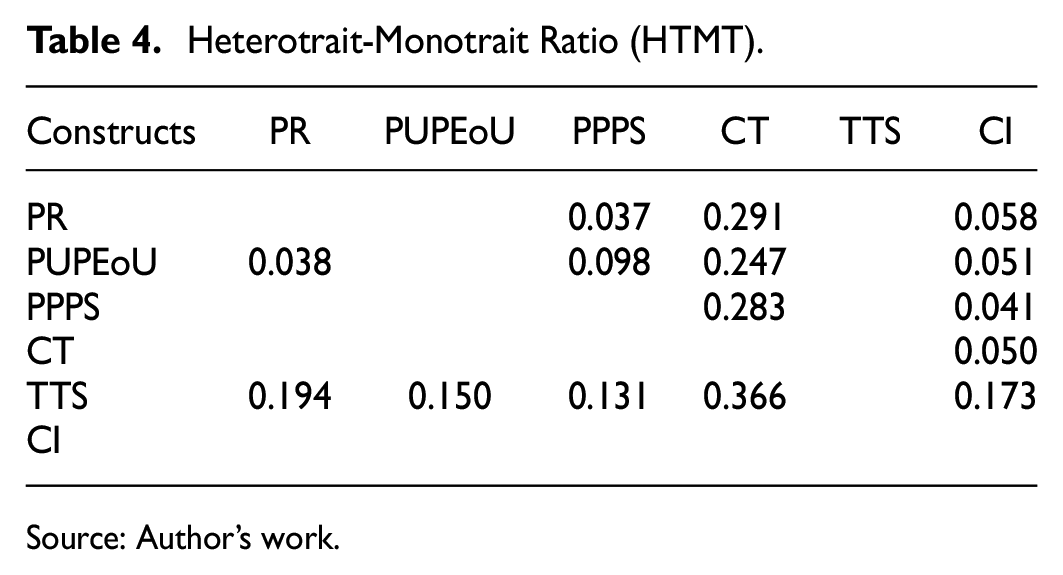
It is vital to establish discriminant validity, which is established using two methods. Since the analysis is run using SmartPLS, it is essential to check discriminant validity using the Heterotrait-Monotrait Ratio (HTMT). Table 4 exhibits the values for HTMT (Franke & Sarstedt, 2019). As all the values are less than the threshold limit of 0.85, as suggested in the literature, the condition for discriminant validity is established.
Heterotrait-Monotrait Ratio (HTMT).
Source: Author’s work.
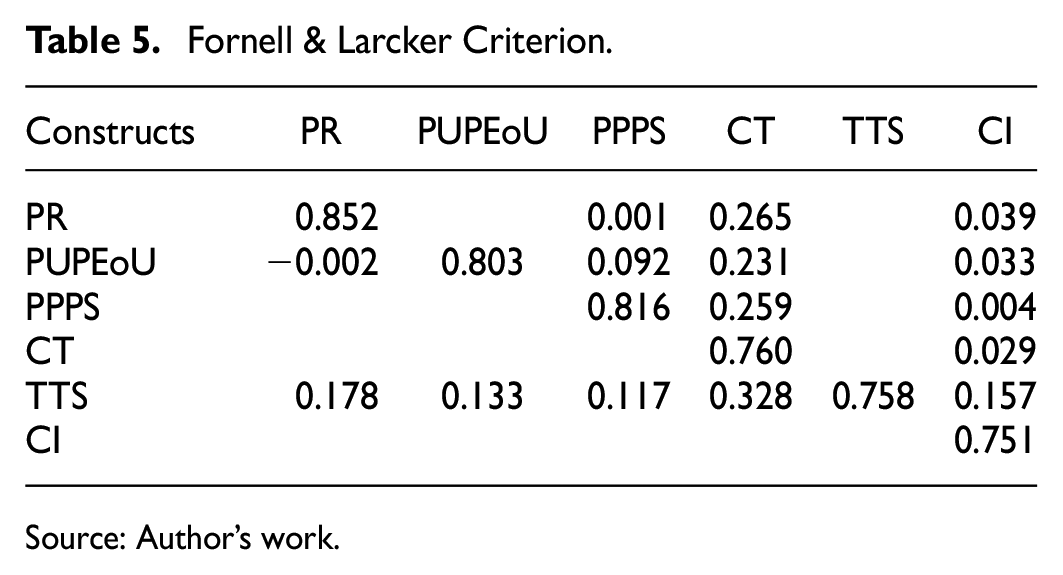
Discriminant validity is also established as the square root of AVE is greater than the inter-item correlation, as shown in Table 5.
Fornell & Larcker Criterion.
Source: Author’s work.
Both the methods, that is, HTMT and Fornell and Larcker Criterion, establish that the discriminant validity condition is satisfied (Fornell & Larcker, 1981). This explains that the scale is adequately reliable and exhibits validity.
Assessing Structural Relationship
Once the reliability and validity of the scale were established, the structural relationships were examined using the bootstrapping procedure with 10,000 sub-samples (Hair et al., 2019). Table 6 explains that all the hypotheses proposed were significant based on the p-values and the confidence interval of 95%.
Structural Relationship.

Source: Author’s work.
Table 7 summarizes the result of examining the structural relationships and the hypothesis.
Hypotheses Summary.

Source: Author’s work.
Examining Model Fit
Once structural relationships are examined, it is vital to assess the overall model fit. The general model fit was evaluated using Standardized Root Mean Square Residual (SRMR), squared Euclidean distance (d_ULS), and geodesic distance (d_G), as the model was tested using SmartPLS.
As suggested in the literature, the values of SRMR, d_ULS, and d_G should be lower than 95% or at least 99% of the confidence interval obtained using the Bollen-Stine bootstrapping procedure (Henseler et al., 2016). Table 8 explains that the model has achieved fit. The values of SRMR and d_ULS are fulfilling the criterion of being lower than 99% of the confidence interval, and the value of d_G is fulfilling the standard of being lower than 95%.
Model Fit Parameters.

Source: Author’s work.
Discussions
The research investigated the buying intentions of Generation Z consumers in India. Generation Z is known for its inclination toward seeking variety and embracing change. An analytical model based on the framed hypotheses has been designed and presented in Figure 2.

Analytical framework.
Using a bootstrapping procedure, Figure 2 exhibits the relationships with path coefficients and t-values. The research revealed several significant findings based on the acceptance of this study’s five stated research hypotheses. Firstly, the study found that perceived risks, such as financial, physical, time, operational, or psychological risks, impact Generation Z’s trust in online buying. These results align with previous studies showing that perceived risk impacts customer trust in online buying (Pappas, 2016; Ventre & Kolbe, 2020). According to a recent study by Ventre and Kolbe (2020), customer trust and perceived risk have an inverse relationship, and trust positively influences online buying intention. The possible key reason for this finding is Generation Z’s digital upbringing, heightened access to information over the Internet, and peer stimulus over social media platforms.
Moreover, this study uncovered that perceived usefulness and ease of use directly impact customer trust, which aligns with a previous study’s findings that perceived ease of use positively affects Generation Z’s trust in online buying. Furthermore, Generation Z consumers may prioritize convenience over the product’s usefulness due to their high trust in the online seller’s website (Moslehpour et al., 2018). These results highlight the importance for online sellers to consider the intricate interplay between perceived risk, perceived usefulness, customer trust, and perceived ease of use while devising marketing strategies targeted at Generation Z consumers. The possible key reason for this finding is that Generation Z’s trust in online buying is prompted by perceived ease of use and perceived usefulness, which is associated with their digital tech-savvy characteristics and desire for convenience. This can aid in establishing a robust foundation of trust with this demographic, which is vital for fostering brand loyalty and boosting sales. Therefore, future research must delve deeper into the factors influencing customer trust, particularly among younger generations, to help online sellers devise more effective marketing strategies.
Thirdly, previous research suggests that Generation Z’s perceived privacy and security concerns significantly impact their trust level in online shopping (Liu & Tao, 2022; Ooi et al., 2021; Wang et al., 2019). Gen Z customers with a favorable attitude toward online shopping are more likely to engage in positive actions, such as online purchases, despite privacy or security concerns. Moreover, this study revealed that perceived privacy and security protection play a significant role in intentions to buy online, and this finding is consistent with preceding literature on the online contribution where perceived privacy and security play an essential role in the online shopping intention of consumers (Alsoud & Bin Lebai Othman, 2018). However, additional research is necessary to understand the relationship between these factors and the level of trust individuals have when making online purchases, as Yang et al. (2015) noted. The possible key reason for this finding is that Generation Z is highly informed of perceived privacy and perceived security issues in the digital space as they have grown up in an age where online privacy breaches and violations are repeatedly observed. Fourthly, prior studies supported that customer trust will augment online buying intention among consumers by generating trust toward sellers, which aligns with the findings of this study (Nikbin et al., 2022). The possible key reason for this finding is that Generation Z’s digital upbringing, associated with their trust in online relationships with online sellers, leads to their inclination to buy online. Finally, the present study has also uncovered that trust in sellers directly relates to Generation Z’s online buying intentions (Chen & Chen, 2019; T. S. Lee et al., 2016). Generation Z consumers are loyal to the seller, and frequent online buying shows loyalty toward the seller. This aligns with previous research that found that consumers look for trust in online sellers before making an online purchase (Al-Debei et al., 2015; Arruda Filho et al., 2020; Gefen et al., 2003; Hou et al., 2019). Overall, the study reveals that Generation Z’s online buying intention is a function of trust, and consumers are looking for trust in sellers to buy online. The possible key reason for this finding is that Generation Z’s online buying intention relies on online reviews, ratings, comments, and peer influence due to their digital upbringing, resulting in access to vast information.
Conclusion
In today’s world, businesses have realized the importance of understanding the factors that drive or slow down the online buying intentions of consumers. This study aimed to extend the TAM model in India to explore the impact of perceived risk, perceived usefulness and ease of use, perceived privacy and perceived security, customer trust, and trust toward sellers on the online buying intentions of Generation Z consumers. The TAM model contributed well and facilitated augmenting the theoretical insights on online buying intentions of Generation Z consumers in the Indian context employing these factors. Ke et al. (2016) found that the rise of electronic commerce has made it crucial for businesses to comprehend these factors. An empirical study on Indian consumers’ online buying intention by X. Zhang and Yu (2020) highlighted the significance of perceived risk, customer trust, and perceived ease of use in shaping online consumers’ buying intentions. Although privacy and security concerns may not directly impact trust, it is still crucial for businesses and marketers to prioritize safeguarding their customers’ data and information. This can promote a favorable reputation for the business and foster customer loyalty (Arruda Filho et al., 2020; Flavian et al., 2005; Ventre & Kolbe, 2020). Additionally, cultivating customer trust should be a primary goal for businesses and marketers, which can lead to enhanced loyalty and repeat purchases (Jarvenpaa et al., 2000; Ngah et al., 2021; Tiwari & Joshi, 2020). The study discovered that perceived risk, customer trust toward sellers, perceived security, and perceived ease of use impact Generation Z consumers’ buying intentions, which is aligned with the findings of this study.
Although the study on Indian consumers’ online buying intentions had some limitations, it still provided valuable insights into the key factors that influence online consumers’ buying intentions. All five hypotheses were accepted, and the results of this study are substantial for businesses and marketers who aim to demystify the online buying intentions of consumers and further assist them in reducing perceived risk through augmented customer trust and perceived ease of use (Munikrishnan et al., 2023; Nguyen Thi et al., 2022; Sohn & Kim, 2020). By addressing these factors, businesses can build customer trust and credibility, increase sales, and foster customer loyalty (Chen & Chen, 2019; Gefen et al., 2003; T. S. Lee et al., 2016; Tiwari & Joshi, 2020). Online sellers might consider targeting Generation Z consumers by focusing on factors beyond these traditional factors to stimulate online buying intentions (Kimiagari & Malafe, 2021). The contributions of this research are significant, as it provides insights into the online buying intentions of Generation Z consumers, characterized as variety-seeking and change-loving (Hsu & Lu, 2007). Recent studies have shed light on the factors influencing the decision-making process of Generation Z consumers regarding online buying. Surprisingly, perceived risks are not a significant barrier to Generation Z customer’s trust in online retailers (Al-Debei et al., 2015; Arruda Filho et al., 2020; Hou et al., 2019). Additionally, perceived usefulness and ease of use directly impact the trust of Generation Z consumers in online buying.
Meanwhile, trust in sellers affects consumers’ online buying intentions ( Kimiagari & Malafe, 2021). These findings suggest that companies targeting Generation Z consumers need to focus on other factors beyond trust and perceived usefulness if they want to stimulate online buying intentions. However, perceived risk, customer trust, and other factors accelerate the buying intentions of Generation Z consumers in online buying (Chen & Chen, 2019; Gong et al., 2023; Liu & Tao, 2022; Ventre & Kolbe, 2020). Hence, businesses and marketers must acknowledge the impact of perceived risk, customer trust, and ease of use to succeed in online retail by demystifying the intention to buy online. Future research should delve into the role of other factors that may affect the online buying intentions of Generation Z, including personal characteristics and cultural differences, to assist businesses and marketers in surviving and sustaining profitably in the competitive marketing environment in the long run (Han & Kim, 2017; Munikrishnan et al., 2023; Nguyen Thi et al., 2022).
Implications of the Study
The study on Indian consumers’ online buying intentions has practical implications for online retailers seeking to improve their customers’ experiences and increase sales. The study emphasizes the significance of minimizing perceived risk, enhancing customer trust, and improving perceived ease of use in stimulating online consumers’ buying intentions. Online retailers can use these results to develop targeted marketing strategies that address customer concerns around data privacy and security, website usability, and brand reputation. Additionally, retailers can use the study’s insights to tailor their marketing efforts to specific customer segments based on their characteristics, social influence, and online buying intentions. The study’s results have significant theoretical implications, shedding light on the intricate interplay of aspects that impact consumers’ online buying intentions. By examining perceived risk, customer trust, perceived ease of use, and perceived security, the study lays the groundwork for further research into additional factors that can impact online buying, such as social influence, online reviews, and website design. The proposed future research questions provide a solid theoretical foundation for developing more accurate and comprehensive theoretical frameworks to explain how these factors influence the online buying intentions of Generation Z consumers.
Limitations and Future Research
While the study on Indian consumers’ online shopping behavior had limitations, it provided valuable insights into the factors driving online buying intentions. The sample size was moderately small, which could be considered a limitation, but this also allowed for a focused and in-depth analysis. Additionally, the study’s geographical scope was limited to Indian consumers, but this provided a unique perspective on a significant and growing market. While the study used a quantitative research approach, it still provided valuable insights into consumers’ intention to buy online. It is essential to recognize that any research has limitations, but the insights gained from this study are still highly relevant and helpful leading a route to future research. Looking into the future, several promising avenues for future research could significantly enhance our understanding of online consumer buying intentions, as shown in Table 9 by addressing the notable research questions presented in the table for future research. For instance, increasing the sample size and participant diversity could help us better generalize the results and gain a more comprehensive understanding of consumers’ experiences and perceptions. Additionally, qualitative research methods such as interviews or focus groups could provide deeper insights into consumers’ online buying intentions and preferences. To truly unlock the potential of online shopping, we need to delve deeper into the factors that stimulate and influence consumer behavior. By examining shopping motives in diverse geographical and industry settings, scholars and researchers can explore how different factors impact online buying intention in diverse research contexts such as social commerce, online review, live-streaming commerce, etc.
Future Research.

Source: Author’s work.
These research directions can help scholars and researchers understand online buying mechanisms and provide useful insights for businesses seeking to enhance customer trust, reduce perceived risk, and improve their sales. By examining these questions, scholars and researchers can better understand the factors that shape consumers’ online shopping behaviors in diverse geographical and industry settings and devise tactics to cultivate customer trust and enrich their experiences. Ultimately, this research can help businesses thrive in the competitive world of online shopping by meeting their customers’ needs and expectations.
Footnotes
Declaration of Conflicting Interests
The author declared no potential conflicts of interest with respect to the research, authorship, and/or publication of this article.
Funding
The author received no financial support for the research, authorship, and/or publication of this article.

Data Availability Statement
All data used to support the results of this study are included in this article.