




Abstract
There are currently 23 states in the United States that have laws considered as some form of school disturbance law. These do not include codes or laws specifying school discipline consequences such as suspension or expulsion. They vary widely in how broadly they can be applied and how broadly they define behaviors. Students are often not aware typical student misbehavior such as refusing to work, talking back, belching, or throwing paper airplanes could result in an arrest. These laws disproportionally impact students of color and students with disabilities. This article will review the breadth of these laws in the United States, their historical development and growth, and how the implementation of these laws disproportionally impacts students of color and students with disabilities. Suggestions for policy changes are included.
Many people first learned the existence of school disturbance laws thanks to a viral video in 2015. The video was of a Black teenage girl in Spring Valley, South Carolina, sitting at her desk with a school resource officer (SRO) standing next to her. The SRO attempted to pull her from the desk, she resisted, and the SRO ended up throwing the girl still in her desk toward the front of the room. The girl, along with a girl who recorded the incident, Niya Kenny, were arrested. Kenny was charged with “disturbing school” for recording the incident and encouraging others to do so.
Many questions were asked in the immediate aftermath of the Spring Valley incident; what precipitating behaviors had brought the SRO to the classroom, why was such force used, and why was the student who videoed the incident arrested? Soon after, the SRO was fired for his use of force and it was determined the first girl had been told multiple times to put away her cell phone to participate in class activities and when she did not, a school administrator was called who asked her to leave the classroom and when she would not, that administrator called the SRO (Coble, 2017; Gupta-Kagan, 2017; Ripley, 2016). However, that still left unanswered the question of why Kenny was arrested. The answer to that question was—because the law said she could be arrested. Kenny did not want to return to Spring Valley High School and her family filed a lawsuit, which determined the South Carolina school disturbance law endangered freedom of expression and due process due to being unconstitutionally vague (Smith, 2019).
The South Carolina legislature changed their school disturbance law in 2018 so it only applied to non-students who come onto school property. Two other states, New Hampshire and Texas, have school disturbance laws which apply only to non-students. But 20 other states across the United States have either school disturbance laws, or disturbance/disorderly conduct laws which can be applied to school settings, not specifically to non-students coming onto school property. These laws vary in how broad they are, behaviors specified, and, anecdotally, how often they are applied. There is no requirement to track or report students arrested for school disturbance violations, and there are concerns these laws are used disproportionately against students of color and students with disabilities (Coble, 2017; Fowler et al., 2016; Gupta-Kagan, 2017; McGinn, 2017; Ripley, 2016; Rivera-Calderón, 2019; Shaver & Decker, 2017). This policy review and discussion will examine how school disturbance laws in the United States developed and grew, some examples of the abuse of school disturbance laws, an examination of the constitutionality of especially vague school disturbance laws, and the impact of these laws on our marginalized students, especially students of color and students with disabilities, and conclude with some suggestions for future policy directions.
History and Growth of School Disturbance Laws
School disturbance laws are not a result of modern student misbehavior or school violence. The original school disturbance law was first passed in South Carolina in 1919 (Coble, 2017), but was focused on men who might attempt “flirting with students at the all-white women’s college,” (Ripley, 2016, para. 18). The law was entitled “Disturbing Schools Attended by Girls, or Women,” and referenced vague behaviors such as interfere, disturb, loiter, and acting in an obnoxious manner, without any further definition of what those behaviors might be (Coble, 2017). The law remained as originally written for 50 years, until the Civil Rights Era. Concerned with students who were protesting segregated public settings (not only schools), South Carolina legislators revised their existing school disturbance law so it no longer applied only to all-girls or women’s schools, but all schools (Coble, 2017). The growth of school disturbance laws spread widely across the United States after the Supreme Court decision in Tinker v. Des Moines (Ripley, 2016). Justice Hugo Black, in his dissent, stated:
One does not need to be a prophet or the son of a prophet to know that after the Court’s holding today some students in Iowa schools and indeed in all schools will be ready, able, and willing to defy their teachers on practically all orders. This is the more unfortunate for the schools since groups of students all over the land are already running loose, conducting break-ins, sit-ins, lie-ins, and smash-ins. Many of these student groups, as is all too familiar to all who read the newspapers and watch the television news programs, have already engaged in rioting, property seizures, and destruction. … This case, therefore, wholly without constitutional reasons in my judgment, subjects all the public schools in the country to the whims and caprices of their loudest-mouthed, but maybe not their brightest, students. (Tinker v. Des Moines Independent School District, 1969)
With that, states began passing new legislation aimed to squelch student unrest. At the time, even police departments in some states were concerned lawmakers were writing new laws that duplicated existing laws (Ripley, 2016). For example, some Maryland legislators were concerned, perhaps appropriately, the new law they were passing “could be applied to a kindergarten pupil throwing a temper tantrum,” (Ripley, 2016, para. 25).
Most of these laws went unused and unenforced until the 1990s. After several school shootings, most notably at Columbine High School in Colorado, there was a push for greater school security, discipline, and the development of what were called “zero-tolerance” policies in schools (Evans, 2015; Kim, 2012; McGinn, 2017; Nussbaum, 2018; Pigott et al., 2018; Rivera-Calderón, 2019; Wolf, 2018). Continued education legislation such as the No Child Left Behind Act (2001) punished “low-performing schools” causing school administrators to refer students to juvenile justice systems (Nance, 2014), as well as federal and state reporting mandates regarding weapons, controlled substances, theft, vandalism (Kim, 2012), or behaviors as vague as “violent disruptive incidents” (Nance, 2016, p. 935). Even though actual juvenile crime rates were dropping across the country, the numbers of police officers in schools rose dramatically, and continued to rise (Nance, 2016; Ripley, 2016).
However, with the growth of laws and mandates regarding disruptive behaviors in schools, there was not a corresponding requirement for data collection and research. Crews and Counts (1997) acknowledged in their historical recounting of school disturbance the limitations involved due to varying reporting procedures among school districts and juvenile courts and even varying definitions of disturbance or delinquency. An example of reporting difficulty was illustrated in a report by the American Civil Liberties Union (ACLU) in 2019 in which they found the Florida Department of Juvenile Corrections reported 7,341 school-related arrests in 2015 to 2016 while the state Department of Education reported 1,919 school-related arrests to the U.S. Department of Education (Mann et al., 2019). Even with that conflicting information, the ACLU noted Florida is one of the only states that collects detailed data on youth arrests. In conducting his review of the impact of policing on public education, Justice (2021) noted the complex societal systems involved in both education and juvenile justice and the massive scale of these systems nationwide make studying their relationship “both challenging and essential” (p. 4).
Those same limitations noted by Crews and Counts (1997) and by Justice (2021) hold true today and for this review. The purpose of this policy review and discussion is to examine the current status of school disturbance laws across the United States, review legal cases in which these laws have potentially been abused, and discuss how these laws may disproportionately impact students of color and students with disabilities.
Method
In order to gain an understanding of the current state of school disturbance laws, an initial review of the literature was done. Because “school disturbance laws” are a specific entity, the term needed to be searched in its entirety. Searching in part would yield a myriad of articles with the words school or disturbance, which would have no relation to the topic. When searching the databases EBSCO E-Journals, Education Source, ERIC, and PsychInfo for the complete term, there were zero returns. After removing the word “law” from the phrase, and searching all the same databases again, there were eight results, with only one being related to this topic (the Crews and Counts [1997] book). Because this is an examination of an educational legal policy, HeinOnline, a legal database was then searched, again using the full phrase. One result was found, and that was an applicable review of school disturbance laws from Rivera-Calderón (2019). The HeinOnline database was again searched removing the word “law” as the previous databases were, and that yielded 67 results. Of those, nine were legal reviews of school disturbance laws. The other 58 results were items such as reviews of the Crews and Counts (1997) book or legal findings or reviews that used the term “school disturbance” but were not about school disturbance laws specifically (for example, discussing disturbing school as in the Vietnam era protests litigated in Tinker v. Des Moines). From an examination of those legal reviews, I was able to determine the states which currently have school disturbance laws in place. I then used Google to conduct a web search and find the full legislation for each state.
Results
There are currently 23 states which have laws that can be interpreted as some form of school disturbance law. These do not include codes or laws specifying school discipline consequences such as suspension or expulsion; these are only laws with a criminal penalty. They vary widely in how broadly they can be applied and how broadly they define the behaviors. Figure 1 shows the states with school disturbance laws and how they vary.
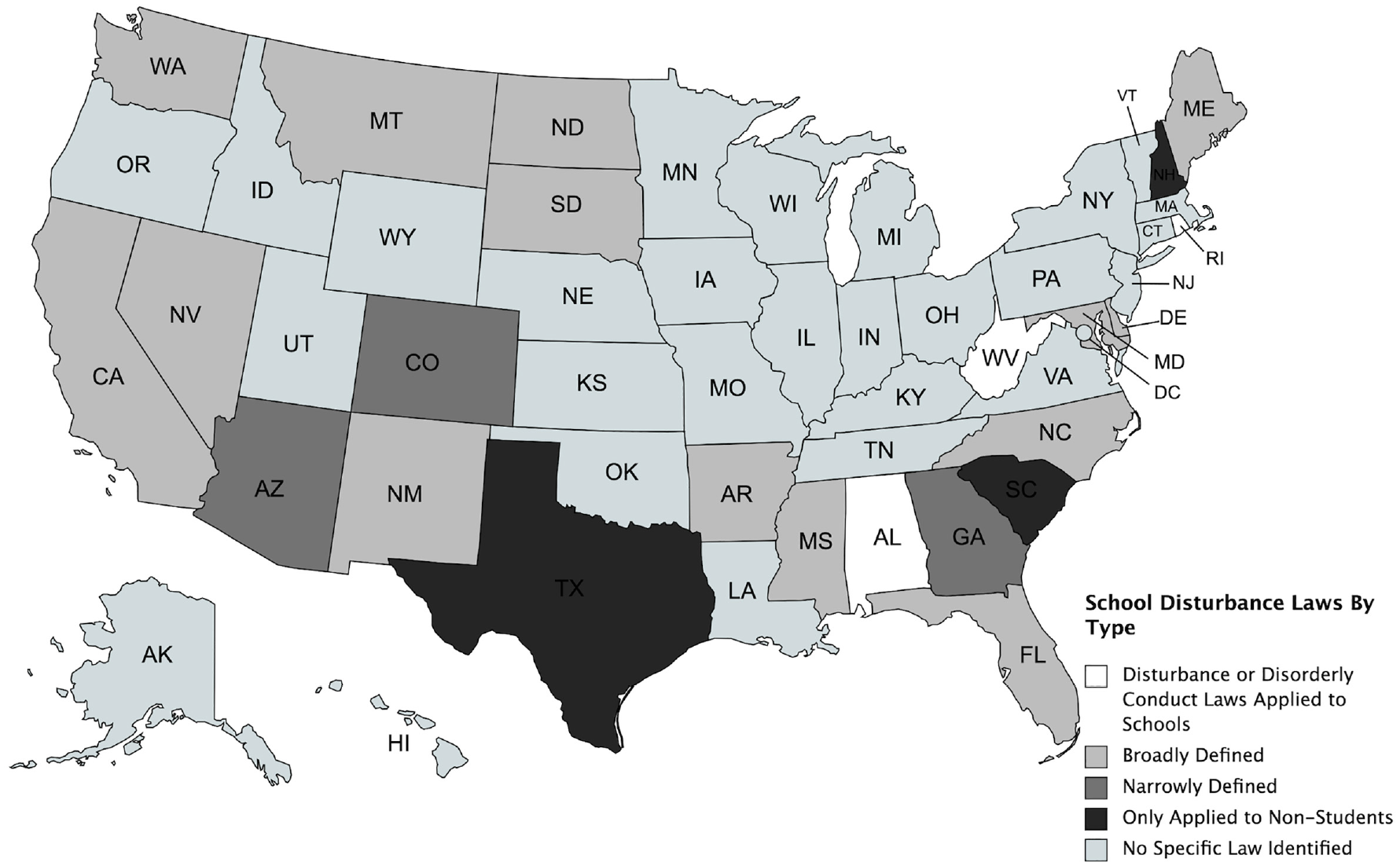
School disturbance laws by type.
In order to categorize these laws, the full text of these laws in these 23 states was printed out on separate sheets of paper. The author then grouped the laws, based on how similar the laws were in describing student behaviors, place in which behavior must occur, or potential penalties. She gave these category names. A graduate student then viewed the laws and was asked to place them in the named categories; the student matched 21 of the 23 states, resulting in 91% interrater reliability.
The most narrowly defined school disturbance laws are written to only apply to non-students, and these are in place in three states (New Hampshire, South Carolina, and Texas) (Table 1). The laws in both South Carolina and Texas were recently changed; South Carolina (S.C. Code § 16-17-420) after the Spring Valley incident (as previously mentioned). In Texas (TXEC §37.124), the law changed in 2013 after a state Supreme Court justice was invited to visit the courtroom of a juvenile court judge. The justice was shocked to see the number of children charged with minor school behaviors, such as spraying perfume in class or throwing paper airplanes (Ripley, 2016). He met with state legislators who agreed the law needed to be changed. After changing the school disruption law, the number of juveniles charged with a minor offense in Texas dropped 61%, approximately 40,000 arrests, and the number of arrests for violent crimes continued to drop (Ripley, 2016).
Narrow Application of School Disturbance Laws Applied Only to Non-Students.

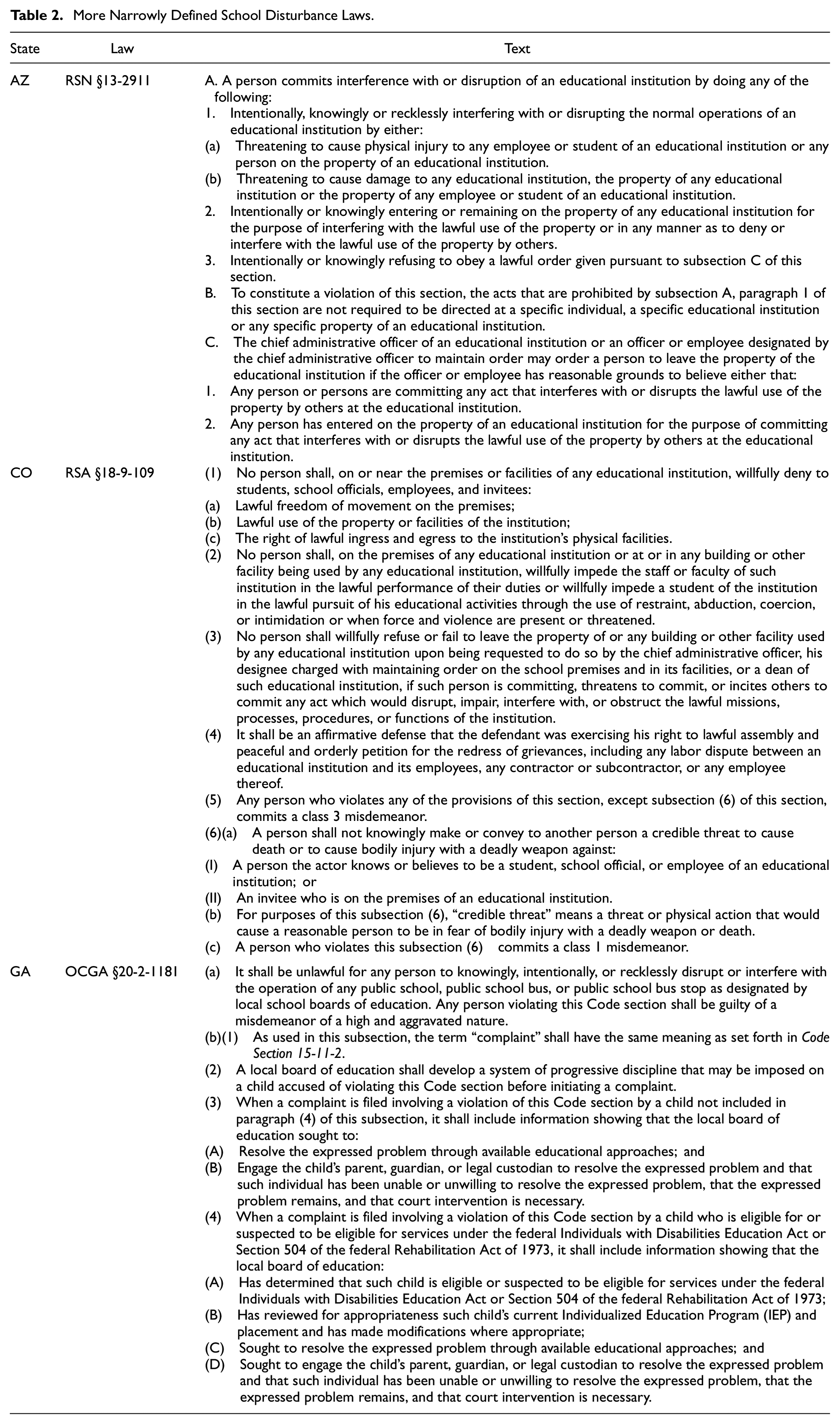
Other states have more detailed, defined school disturbance laws. Arizona (RSN §13-2911), Colorado (RSA §18-9-109), and Georgia (OCGA §20-2-1181) more specifically define the behaviors which entail school disturbance, and they are focused on use of weapons and violence. Georgia’s law specifically requires the school must engage parents and/or guardians in developing behavior plans to address problems and ensure all requirements of the Individuals with Disabilities Act and Section 504 of the Rehabilitation Act are being met (Table 2). However, that specificity does not necessarily mean the law is used less. When questioned by The Atlantic about arrests under their school disturbance law, all an Arizona juvenile court official could report was it was somewhere between zero and 5,375 arrests per year (Ripley, 2016).
More Narrowly Defined School Disturbance Laws.
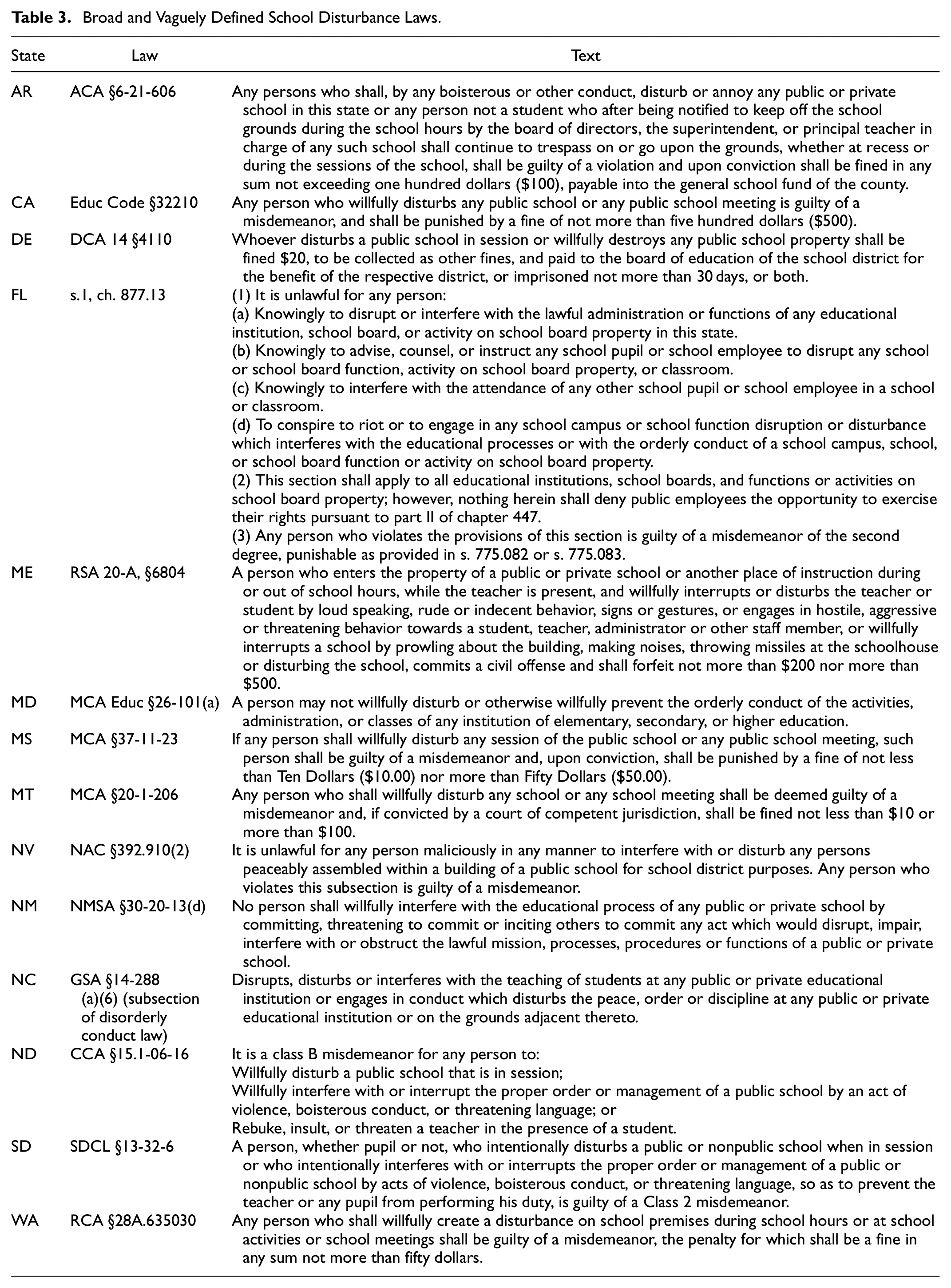
There are 14 states with broad and vague school disturbance laws. These vary in their description of behaviors, description of place (some are specific to school, some include school board meetings, some include after school activities), and potential resulting penalties (Table 3). Arkansas (ACA §6-21-606) makes illegal “boisterous” conduct, while Maine (RSA 20-A, §6804) has criminalized interrupting teachers by “loud speaking, rude or indecent behavior, signs or gestures.” States such as Mississippi (MCA §37-11-23), Montana (MCA §20-1-206), Nevada (NAC §392.910[2]), and North Carolina (GSA §14-288[a][6]) just have the vague description of willfully disrupting school, without any additional explanation of what that might be.
Broad and Vaguely Defined School Disturbance Laws.
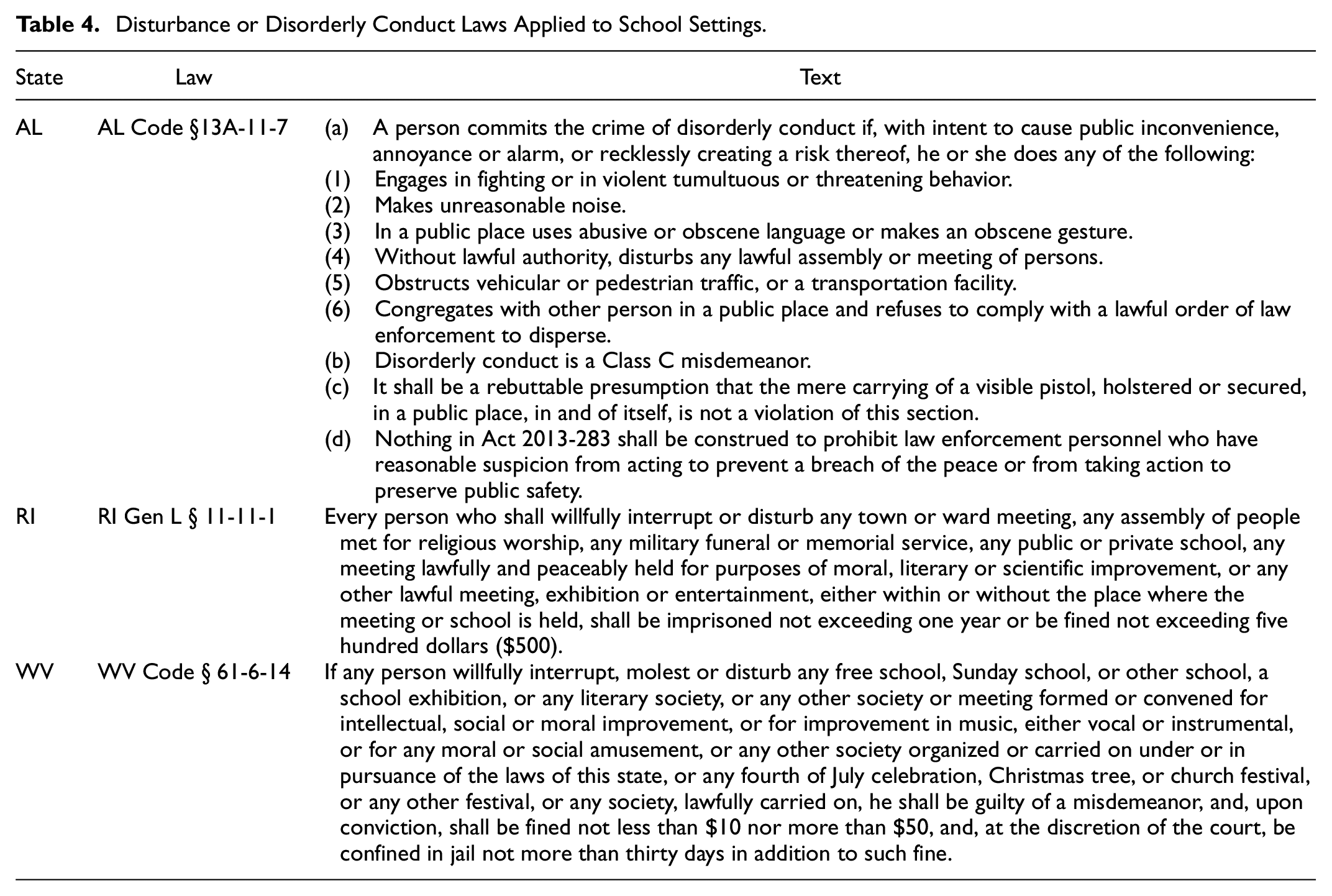
Finally, three states, Alabama (AL Code §13A-11-7), Rhode Island (RI Gen L § 11-11-1), and West Virginia (WV Code § 61-6-14), simply apply what would normally be disorderly conduct or public disturbance charges specifically to school settings (Table 4). In these laws, public disturbance is broadly described to apply to a number of settings, not exclusive to but also including schools.
Disturbance or Disorderly Conduct Laws Applied to School Settings.
The wide variety of school disturbance laws and wide differences in how police officers are utilized in schools have resulted in other viral incidents where student arrests have been captured on video (Shaver & Decker, 2017). There have also been legal challenges to arrests made under school disturbance laws (Soto, 2018) and suggestions on how further challenges could be made to arrests under these laws (McGinn, 2017; Wolf, 2018).
Discussion
While determining the current status of these laws may be as simple as looking up current statutes, determining how these laws are being enforced and the impact such enforcement may have on students is a much more complex issue. As noted previously, there is no peer-reviewed research published on school disturbance laws. There has been very limited work done by organizations, such as in Texas (Fowler et al., 2016) and one attempt at a nationwide study led by the National Council of Juvenile and Family Court Judges (NCJFCJ, 2015). Even with agreement to participate from 16 different sites nationwide, the NCJFCJ found data collection “a substantial challenge” (p. 26). Examining data on school discipline and juvenile justice has long been difficult. In reviewing zero tolerance policies, Hanson (2005) stated much of the information available came from local or national news media, often after the resolution of an “absurd” (p. 295) school discipline case. We are left to examine what little evidence we have, legal cases and news reports which indicate potential concerns regarding abuses of these laws and disproportionate application impacting students of color and students with disabilities.
Abuses of School Disturbance Laws
While the incident Niya Kenny recorded with her phone in Spring Valley became one of the most well-known abuses of a school disturbance law, it was not an isolated incident. That was not even the only time the arrest of a student accused of school disturbance was captured on video, and it was not the only school disturbance arrest challenged in court. As the Spring Valley incident occurred, a legal case stemming from an incident in New Mexico was already winding through the court system. In 2011, a 13-year-old boy was made to leave gym class because the teacher said he was making fake burps to cause his classmates to laugh, and he continued to do it while sitting in the hallway. The teacher then called the SRO, who walked the boy to the administrative office. At that point, he handcuffed the student, arrested him, and drove him to juvenile detention for disruption of school (Soto, 2018).
The mother of the boy sued the officer and the school for violation of her son’s constitutional right to be free from unreasonable search and seizure, stating the arrest demonstrated excessive use of force. The Tenth Circuit Court found in support of the officer, granting him qualified immunity, based on the officer’s belief he was supposed to arrest the student under his understanding of the school disturbance law. Current Supreme Court Justice Neil Gorsuch was then a member of the Tenth Circuit Court, and he dissented with the decision. He stated:
If a seventh grader starts trading fake burps for laughs in gym class, what’s a teacher to do? Order extra laps? Detention? A trip to the principal’s office? Maybe. But then again, maybe that’s too old school. Maybe today you call a police officer. And maybe today the officer decides that, instead of just escorting the now compliant thirteen year old to the principal’s office, an arrest would be a better idea. So out come the handcuffs and off goes the child to juvenile detention. My colleagues suggest the law permits exactly this option and they offer ninety-four pages explaining why they think that’s so. Respectfully, I remain unpersuaded. (A.M. v. Holmes, 2016, N. Gorscuch, dissenting).
Another incident that occurred prior to Spring Valley but was also captured on camera happened in Kentucky, but with much younger students, both children with emotional/behavioral disorders. In two separate cases, with an 8-year-old boy and a 9-year-old girl, the same SRO was shown to use handcuffs to restrain them, except he had to place their arms behind their backs and the handcuffs around their biceps because the children were so small (Shaver & Decker, 2017). In one case, the incident was recorded on video by school personnel for the purposes of showing the child’s mother how disruptive the child had been; instead, the mother saw her son handcuffed and saying, “Oh God. Ow, that hurts,” as the SRO tells him to “behave nicely” if he wants the cuffs removed (Black, 2017). Both families sued the officer, the police department, and the school district. Again, the officer was found to have qualified immunity because his department said they trained officers to use handcuffs on students; however, where this case differed from Holmes was the court found the police department and the school district liable because of the small size of the children versus the large size of the officer and the department should have recognized this was unnecessary use of force.
Courts are often left interpreting vague and broad school disruption laws, leading to disparities in application, even within the same state. In Maryland, where legislators had expressed concern upon passing their law that kindergarten tantrums could lead to arrest, a series of court cases have attempted to define school disruption, with no clear success. In re Nahif A (1998) case, the court held Nahif’s behavior of cursing, shouting, and failure to follow directions in a hallway while class was in session were offenses under the school disturbance law. Nahif argued the law was written specifically to address disruption and protests during the Vietnam War era and as he was a student in a special school for students with behavioral issues, the law did not apply to him; the court disagreed. The next time the Maryland courts were asked to interpret the school disturbance law was in 2003 when Jason W. had written on a wall in a school stairwell, “There is a bomb” in pencil, erasing the word, “bomb” when he saw a teacher approaching. Police were called and he was arrested for school disturbance, even though no action was taken to indicate police believed there was an actual bomb (Rivera-Calderón, 2019). While the court stated the word “disturb” could not be interpreted too broadly, they stated for the purposes of criminal charges, the disturbance needed to go beyond a minimal, routine disturbance, and be one that significantly interferes with activities at the school (In re Jason W, 2003). That became the standard Maryland courts would use to determine school disruption. However, even with that standard, courts in Maryland have made contradictory decisions regarding school disturbance, finding a classroom fight to be a school disturbance in one case, while another one was not; yelling, screaming, and cursing at staff after being directed to take off a hoodie was also not school disturbance, despite the fact that specific behavior was already found to be a disturbance in Nahif (Rivera-Calderón, 2019).
The hypothetical suggested by Maryland legislators of a kindergartener’s tantrum resulting in arrest (Ripley, 2016) became more than a possibility, it became reality in 2007 in Avon Park, Florida. Two police officers responded to the school where a student was said to be disrupting her class and posing a danger to other students. The student in question was a 6-year-old kindergarten girl, who the officers then handcuffed, arrested, fingerprinted, and took her mugshot. She was charged with one felony, battery of a school official, and two misdemeanors, including disruption of school function (Aldridge, 2018). An earlier Florida incident involved a 5-year-old girl who threw a tantrum after her teacher ended a math exercise with jellybeans (Nance, 2016). In that case, again officers handcuffed the child and placed her in a police car, but she was not transported anywhere; her mother arrived, and the officers released the child after the State’s Attorney told them a 5-year-old would not be prosecuted (Tobin, 2005). Another case in Florida, occurring prior to A.M. v. Holmes in New Mexico, found a student being arrested and charged with disrupting school due to “passing gas” intentionally and then shutting off some classmates’ computers (Associated Press, 2008).
Unconstitutionally Vague?
Much of the confusion around these laws likely stems from the vagueness inherent in the very term “school disturbance.” As educators, we should recognize the problem in the construction of these laws. The purpose of the laws from the beginning was to legislate and place criminal sanctions on student behavior. Yet the term “school disturbance” is a summary label, a broad description of a response class, not a precise description of specific behavior (Martin & Pear, 2019). Vague terms to describe behavior leads to confusion and disagreement about the behavior that is or is not occurring; that is why in education and the field of behavior analysis, professionals define behavior operationally (Alberto et al., 2021). An operational definition of behavior includes specific descriptions of behavior, which can be done functionally (describing behavior in terms of the results or outcomes of the behavior) or topographically (describing the physical movements encompassing the behavior), or both. Some of the more narrowly defined laws attempt defining behavior by specifying violence with a weapon, for example, but none include a fully operationalized definition of school disturbance.
Besides lack of functionality, the vagueness of the laws may also be unconstitutional. The Fourteenth Amendment of the Constitution ensures all individuals due process of law. In order to receive due process, a person must understand the law they are expected to follow so they can adequately shape and change their behavior. Statutes must be definite enough that a typical person will understand what behavior is being prohibited by the law; a statute can be determined to be “void-for-vagueness” if a typical person cannot determine the prohibited behavior (Rivera-Calderón, 2019, p. 9). The United States Supreme Court first outlined this concept of unconstitutional vagueness in 1999 in City of Chicago v. Morales (Smith, 2019). In Morales, the Supreme Court found a Chicago law against loitering violated individuals’ rights to due process as the interpretation of who was loitering and who was standing in a place with purpose was left to the interpretation of police officers. This decision set the precedent for unconstitutional vagueness (Smith, 2019).
At the time of the incident in Spring Valley, Niya Kenny’s mother filed a lawsuit against the school district. After South Carolina changed their school disturbance law, the lawsuit was dismissed, with the court determining it was moot since Kenny was no longer a student, and the law had been changed. Kenny filed the lawsuit again, along with another student who had been charged under the previous law, requesting their records be expunged and still contesting the constitutionality of the new law, stating it remains unconstitutionally vague. The defendants requested the case be dismissed, again stating Kenny did not have standing to file a case, and in 2020, the motion to dismiss was denied (Kenny v. Wilson, 2020). The Kenny case may be the one that will determine whether the wide variety of school disturbance laws across the country are unconstitutional or not.
Disproportionate Impact of Laws
As currently implemented, school disturbance laws may have a disproportionate impact on students of color and students with disabilities. In 2014 to 2015, prior to the change in the school disturbance law in South Carolina, Black students were four times more likely than White students to be charged under the law (Crain, 2021). Most of the students in the example cases in this article were students of color and many of them were also students with disabilities. In the 2013 to 2014 school year, while overall school enrollment in the United States was approximately 15% Black, approximately 33% of students arrested were Black (Turner, 2017). Black girls have been facing increasing levels of disproportionate punitive discipline in schools. While only comprising 16% of the female population in the United States, Black girls without a disability are more than half the female population in schools with more than one school suspension and have approximately 33% of all school-related arrests (Aldridge, 2018). Aldridge demonstrated in the time period where enforcement of school disturbance laws expanded, after the 1990s, Black girls became the fastest growing demographic group in the juvenile justice system, with the number of girls detained doubling from 1992 to 2002. The percentage dipped slightly afterward, but in 2008, still remained 75% higher than in 1992. Potential causes for this increase may be biases and stereotyped perceptions regarding Black females by the predominately White female educators; the idea Black women are more loud or aggressive, behaviors that would then be defined as disruptive (Aldridge, 2018; Kupchik & Alleyne, 2017). Morris (2016) demonstrated the behaviors of Black girls was described by teachers as “ghetto” (p. 10), or arrests or criminal summons for Black girls were justified by behavior descriptors such as “irate,”“disrespectful,” or “insubordinate” (p. 11). The U.S. Secretary of Education at the time of the Spring Valley incident acknowledged the role race may have played in the arrest of the girls in a public statement, which concluded with:
To do better, we also have to take a hard look at ourselves, and our history, and the implicit biases that we all carry. The ugly truth – the harsh reality – is that still today in 2015, some children are far more likely to face harsh discipline than others, simply because of their zip code or the color of their skin. That’s unacceptable and not a reality anybody should be willing to live with. (Duncan, 2015)
Students who are both Black and have a disability are especially more likely to face biases that may result in disproportionate reactions to behavior (Gowdey, 2015). Students with disabilities make up a disproportionate percentage of the population in juvenile correctional facilities; however, the research shows a wide range of possible prevalences, anywhere from 20% to 70% of the population, with some estimates as high as 85% (OSERS, 2017; Rutherford et al., 2002; Tulman & Weck, 2009). Even at 20%, the rate is higher than the population of students with disabilities in schools, which is generally estimated at approximately 8% to 12% of the school population. Data from the Office of Civil Rights in the U.S. Department of Education showed even though students with disabilities only comprised 12% of the school population, they represented 23% of the students arrested at school in the 2011 to 2012 school year (Shaver & Decker, 2017). The ACLU found when examining the intersectionality of race, disability, and gender, Black boys with disabilities faced the highest overall arrest rates; however, Black girls faced the highest disproportionality in arrest rates, experiencing arrest at a rate five time higher than White girls (Mann et al., 2019).
Students with disabilities may be at particular risk from school disturbance laws if they are in a school with a SRO. Research has shown the presence of a SRO does not predict more total arrests, but it does predict more arrests for non-violent behaviors such as disorderly conduct (Theriot, 2009). Research is limited on the specific topic of SROs and students with disabilities, but the few studies that have been done have shown most SROs have had little to no training on special education or disability issues (Shaver & Decker, 2017), and this lack of understanding and use of exclusionary disciplinary practices most impacts students with disabilities and students of color (Counts et al., 2018). Reporting on issues related to SROs in schools, the ACLU (Mann et al., 2019) noted students with disabilities were 2.9 times more likely to be arrested than their peers without disabilities. In 2014, in response to the report from the Office of Civil Rights, the U.S. Department of Justice’s Community Oriented Policing Services (COPS) program issued a bulletin advising SROs needed training on disability issues (Shaver & Decker, 2017).
Special educators who are aware of the provisions of the Individuals with Disabilities Act (IDEA) to implement behavior intervention plans and to take steps to determine if behaviors are manifestations of a child’s disability may be left confused as to how so many children with disabilities are arrested, seemingly with no consideration of their disabilities. The legal protections offered by IDEA (2004) for behavior appear to be contradictory; while outlining the steps for manifestation determination before changing student placement, IDEA then has a section titled, “Referral to and action by law enforcement and judicial authorities,” which reads:
Nothing in this subchapter shall be construed to prohibit an agency from reporting a crime committed by a child with a disability to appropriate authorities or to prevent State law enforcement and judicial authorities from exercising their responsibilities with regard to the application of Federal and State law to crimes committed by a child with a disability. [IDEA, §1415(k)(6)(A)]
An analysis completed by Ordover (2002) detailed how the clause, which was added to the legislation in the 1997 reauthorization, allows schools to defend against due process complaints for failure to provide a free and appropriate education to students with disabilities due to their behavior. Schools can call police to report disruptive behavior, even if the child has a disability, because that can be interpreted as a crime. It is disheartening to consider the very law that was designed to protect students with disabilities, particularly, as pointed out by the Supreme Court in Honig v. Doe (1988), “hard-to-handle disabled students” could actually be used to justify the criminalizing of those students’ behaviors.
Limitations
The main limitation to this review is the current lack of research and data on school disturbance laws. The laws have been analyzed from a legal standpoint in law reviews and there have been contemporary media stories written, but there have not been research studies conducted. As determined by the one report from the NCJFCJ (2015), this may be due to the difficulty in collecting data from the large variety of agencies needed (all school districts in a state, police departments, juvenile courts, etc.).
This current review is an initial study and limited by the lack of existing research on how school disturbance laws have historically been enforced and if they are still currently being enforced. As concerns continue to exist regarding disproportionate use of exclusionary forms of discipline in schools (Barrett et al., 2021; Owens & McLanahan, 2020; Welsh, 2022), this could be an area of further research that would benefit both students and educators.
Policy Implications
By turning on her camera in her classroom in 2015 in Spring Valley, South Carolina, Niya Kenny may have made a huge, lasting impact on how we address student misbehavior in schools. Niya wasn’t the first arrest for school disturbance; her story just received the most attention. Prior to Niya, we had the two youngsters in Kentucky arrested and cuffed at their biceps; we had the two primary grade girls in Florida who were handcuffed and detained, and the elementary boy who farted in class who might have made great friends with the boy in New Mexico who liked to belch. These actions had been happening for the better part of two decades, Niya Kenny just caught it on camera and shared it on social media.
Perhaps the actions of that day will trigger lasting change. South Carolina’s law has changed, but time will show if it makes a difference in the arrest rates of students, as it did in Texas. In order for meaningful change to occur, we first need a clearer picture of the arrests occurring in the other states, the states with the different laws, and the states with no laws at all. We need much better collection of data, collected and analyzed in a methodical way. The reporting from the ACLU demonstrates the data currently collected are often inaccurate (Mann et al., 2019); we need accurate data in order to determine trends in school-based arrests. Collecting these data would allow any potential policy changes to be made in a targeted manner. We especially need to be able to track the arrests to measure for disproportionate use by race, gender, and disability status. Our students with disabilities are particularly vulnerable to arrest. In a Statement of Interest written by the Department of Justice for the case in Kenton County, the DOJ wrote, “For children with disabilities, who may experience disproportionate contact with law enforcement in schools, such interactions can exacerbate the disability and the very behaviors that led to the SRO interaction” (Statement of Interest of the United States, 2017).
Next, it is time for a careful examination of the role of the SRO in schools. The line between education and criminal justice has become blurred and blended in our school hallways and classrooms. Bleakley and Bleakley (2018) outlined how the role of the SRO has evolved over the years and become a behavioral compliance role, especially in states with school disturbance laws. Administrators are unsure of what decisions they can and cannot make regarding student behavior and SROs are acting as untrained school counselors. Na and Gottfredson (2011) found 75% of school administrators were using SROs in a disciplinary role, directly contradicting the position statement from the National Association of School Resource Officers (2015), which stated SROs should not become involved in discipline procedures that normally would be under the purview of school administrators. If police are to remain in the nation’s school buildings, their role needs to be clearly delineated as do the laws they enforce.
Conclusion
A final recommendation is for lawmakers to review the laws currently in place used to detain and arrest students in school. Educators can contact their lawmakers to inform them about the existence of these laws and the potential for disproportionate application of them negatively impacting students of color and students with disabilities. It is time for an examination of the necessity of such laws when laws already exist for disrupting the peace and when schools have disciplinary measures they can use for school misbehavior. Educators need to re-take the reins of school discipline and behavior management.
Footnotes
Authors’ Contributions
Sole author is responsible for all contributions to this manuscript
Declaration of Conflicting Interests
The author(s) declared no potential conflicts of interest with respect to the research, authorship, and/or publication of this article.
Funding
The author(s) received no financial support for the research, authorship, and/or publication of this article.
Ethical Approval
This study was a review of law and policies that were publicly available. No human subjects were involved and no ethical approval/waiver was needed.

Data Availability Statement
All data were gained from publicly available sources