




Abstract
We describe and illustrate a new method of graphically diagramming disputants’ points of view called cognitive-affective mapping. The products of this method—cognitive-affective maps (CAMs)—represent an individual’s concepts and beliefs about a particular subject, such as another individual or group or an issue in dispute. Each of these concepts and beliefs has its own emotional value. The result is a detailed image of a disputant’s complex belief system that can assist in-depth analysis of the ideational sources of the dispute and thereby aid its resolution. We illustrate the method with representations of the beliefs of typical individuals involved in four contemporary disputes of markedly different type: a clash over German housing policy, disagreements between Israelis over the meaning of the Western Wall, contention surrounding exploitation of Canada’s bitumen resources, and the deep dispute between people advocating action on climate change and those skeptical about the reality of the problem.
Introduction: The Need for New Tools to Analyze Social Disputes
A social dispute is often easier to resolve if all parties, including any intermediaries, understand how the disputants see the dispute. Most approaches to conflict resolution indeed start with an effort to understand the essential features of the dispute in question. But different approaches to conflict resolution generate markedly different types of understanding. 1
Some approaches involve application of externally derived rules—such as laws, regulations, and accepted precedent or norms—to establish the relative merits of each side’s case, so as to guide a resolution judgment and its enforcement. These approaches, which include litigation, adjudication, and binding arbitration, generally use processes such as discovery and cross examination to determine whether relevant rules have been broken or how particular rules might be interpreted in particular cases (Butler, 2008). They produce an understanding of disputes that is analytical and legalistic, and they tend to focus on the disputants’ observable actions and statements rather than on their underlying interests, beliefs, and emotions.
Conventional approaches to direct negotiation often better clarify the differences—and the unrecognized compatibilities, if they exist—in the disputants’ interests (Raiffa, 1982; Watkins & Rosegrant, 2001). These practices, when effective, reveal previously unseen alternatives for action that could at least partially accommodate all disputants’ interests (Fisher & Ury, 1991). But the focus on disputants’ narrow interests in the context of the immediate dispute usually does not produce a rich understanding of the motives, values, and emotions that underlie these interests.
Mediation by a third party sometimes generates this rich understanding (Trujillo, Bowland, Myers, Richards, & Roy, 2008). It might, for instance, illuminate the disputants’ views of their own identities—of their groups’ respective histories, myths, aspirations, and criteria for membership. Such complex systems of beliefs are always laden with powerful emotions and are invariably critical elements of most intractable conflicts. Usually, though, mediation does not apply systematic methodologies to probe and represent these belief systems.
Finally, game theory reveals the structure of decision options and outcomes as perceived by the disputants; it represents this knowledge systematically, usually in the form of decision matrices that incorporate quantitative measures of the disputants’ preferences. Game theory can usefully complement conventional negotiation and mediation by revealing disputants’ strategic relationship—that is, each disputant’s perceived range of moves and countermoves in response to the other’s possible moves and countermoves. Knowledge of this relationship can aid conflict resolution. All the same, game theory tends to assume the strategic structure is given and constant; it generally does not reveal how this structure emerges from and is constituted by the disputants’ deeper beliefs, values, and emotions.
A significant need thus exists for methods that can systematically probe, reveal, and represent the deep ideational content of social disputes. In response to this need, we describe and illustrate here a new method of graphically diagramming disputants’ points of view called cognitive-affective mapping. The products of this method—cognitive-affective maps (CAMs)—represent an individual’s concepts and beliefs about a particular subject, such as another individual or group or an issue in dispute. Each of these concepts and beliefs has its own emotional value. The concepts are connected together into a network with links representing either emotional coherence or incoherence. 2 The result is a detailed image of a disputant’s complex belief system that can assist in-depth analysis of the ideational sources of the dispute and thereby aid its resolution.
Cognitive maps, including representations of beliefs as sets of connected concepts, are of course not new (see, for instance, Axelrod, 1976; Novak, 1998; Renshon, 2008; Sowa, 1999). The CAM method offers, however, some distinct advantages over previously developed methods, especially with respect to improving understanding of specific conflicts. In particular, it incorporates emotion directly into the representation of an individual’s beliefs. The method thus accords with recent scholarship that emphasizes the central and essential roles of emotion and emotional coherence in human perception, understanding, and decision making (Damasio, 1994; Heise, 2007; Loewenstein, Weber, Hsee, & Welch, 2001; Thagard, 2006; Vohs, Baumeister, & Loewenstein, 2007). 3 The old and still widely used distinction between “cold” and “hot” cognition is no longer serviceable. Especially in efforts to explain and understand conflict, emotion must be accorded a central role. 4
The CAM method is also simple to grasp and use. Scholars, disputants, and mediators can use it to improve their understanding of their own or other disputants’ perspectives. They may thereby identify key similarities in the disputants’ perspectives and unrecognized opportunities for compromise or reconciliation. Perhaps most importantly, by elucidating deep differences in disputants’ perspectives, the method opens up the possibility of “conceptual intervention,” whereby the disputants—through dialogue between themselves or with a mediator—change concepts and links in their understandings in a way that actively alters the terms of the debate and creates previously unavailable space for agreement. 5
Finally, CAMs provide a quickly understandable holistic appreciation for what might be called a belief system’s “topology”—that is, of its gross structure and of the relationships among its macro components. A textual narrative, such as those that accompany our illustrative CAMs in this article, is linear. It can at best describe a belief system through a string of consecutive statements about the system’s specific ideas, components, and internal relationships. CAMs, however, provide an immediate gestalt of the whole system and of the simultaneous interactions between, and relationships among, its parts. This kind of appreciation is very difficult to communicate in words.
In this article, we first describe cognitive-affective mapping and explain the simple procedures for its use. We then outline the underlying theory of emotional coherence. We follow by illustrating the method with representations of the beliefs of typical individuals involved in four contemporary disputes of markedly different type: a clash between German policy makers and the German public over housing policy, disagreements between Israelis over the nature and meaning of the Western Wall, contention surrounding exploitation of Canada’s bitumen resources, and the deep dispute in the West between people advocating action on climate change and those skeptical about the reality of the problem.
These illustrations show how CAMs can help people craft better public policies, find common ground when faced with ideologically divisive policy challenges, and perhaps even end violent conflicts. We conclude with some remarks on application of CAM methods to conflict resolution and research on conflict processes.
Cognitive-Affective Mapping: Overview
Researchers in psychology, computer science, and political science have used the method of cognitive maps—also known as conceptual graphs, concept maps, and mind maps—to visualize the conceptual structures that people use to represent important aspects of the world. Such maps, however, tend to neglect the emotional (affective) values attached to concepts and other representations such as goals, and therefore inadequately capture the underlying psychology of social conflicts.
Cognitive-affective mapping, in contrast, permits investigation of the emotional properties of conflicts ( Findlay &Thagard, in press; Thagard, 2010b, 2011, 2012a, 2012b, in press-a). The method acknowledges the importance of emotions in decision making and other kinds of inferences.
The CAM approach adopts the following conventions. Map elements are depicted by shapes:
Ovals represent emotionally positive elements.
Hexagons represent emotionally negative elements.
Rectangles represent elements that are neutral or carry both positive and negative aspects.
Ovals within hexagons represent ambivalence (often characterized by a psychological state of alternation between emotionally positive and negative responses).
The thickness of the lines in the shape represents the relative degree of the positive or negative value associated with it.
If color is available, ovals are green (go), hexagons are red (stop), rectangles are yellow, and combined ovals/hexagons are purple.
Lines depict relations between elements:
Solid lines represent relations between elements that are, taken together, emotionally coherent.
Dashed lines represent the relations between elements that are emotionally incoherent.
The thickness of the lines in the connection represents the degree of the coherent or incoherent relation.
For reasons of parsimony, our CAMs represent emotion very simply: emotional valence is either positive or negative, and the degree of valence varies along a one-dimensional continuum. 6 We are aware that at least two further dimensions are necessary to fully describe the emotional content of conceptual representations (see, for instance, Fontaine, Scherer, Roesch, & Ellsworth, 2007; Morgan & Heise, 1988; Osgood, 1962; Rogers, Schröder, & von Scheve, 2014; Scherer, Dan, & Flykt, 2006). Activity, which is sometimes called arousal or intensity, denotes the continuum from relaxed to aroused emotional responses. Potency, which is sometimes called control or dominance, refers to an agent’s perceived capacity to effectively deal with a given situation. Specific types of emotion such as love, contentment, pride, fear, or anger can be represented as points in the three-dimensional affective space constituted by valence, activity-arousal, and potency.
We acknowledge that a deep understanding of social disputes often requires a conception of emotion that goes beyond positive versus negative valence. But we argue that even our very simple one-dimensional representation of emotions can capture a great deal of a dispute’s emotional complexity and, therefore, of its essential character. If desired, specific emotional concepts such as hatred or fear can be introduced in the CAM like any other concept.
In any case, research has shown that the dimensions of affect are not fully independent. Both highly positive and highly negative concepts often invoke high activity-arousal (see, for example, Bradley, Codispoti, Cuthbert, & Lang, 2001; Schmidtke, Schröder, Jacobs, & Conrad, 2014). We may thus infer from a CAM with many thick-lined ovals and hexagons that the disputant experiences the conflict as emotionally arousing.
In CAMs, the concepts of coherence and incoherence have a specific meaning. Two CAM elements are emotionally coherent if liking one element makes an individual like the other element, or if disliking one element makes the individual dislike the other. 7 As a result, when two emotionally positive elements are linked, the relationship is always coherent; the same is true when two emotionally negative elements are linked. On the contrary, when a positive element is linked to a negative element, the relationship is usually incoherent. Neutral or ambivalent elements are generally linked to both positive and negative elements, although clusters of neutral elements are also possible. The links with positive and negative elements can be coherent or incoherent, and the overall set of relationships producing neutrality or ambivalence in a given element can often be quite complex.
Figure 1 illustrates these various conventions. A computer tool that facilitates drawing CAMs is available at http://cogsci.uwaterloo.ca/empathica.html. All CAMs below were produced using this tool, which is called EMPATHICA because it is intended to increase mutual understanding.

Conventions for cognitive-affective mapping.
We use the following five-step method to construct CAMs.
Identify the main concepts of the person being modeled (the subject) concerning the issue in question (such as a dispute).
Identify these concepts as emotionally positive, negative, neutral, or ambivalent and, accordingly, represent them by ovals, hexagons, rectangles, or ovals within hexagons, respectively.
Identify relations of coherence (solid lines) or incoherence (dashed lines) between concepts and the relative strength of these relations.
Arrange the concepts and their relations to minimize crossing links; doing so maximizes graph modularity (clustering closely related concepts) and helps identify highly connected concepts or “hubs.”
Finally, confirm the validity of the resulting map, by either
showing it to the subject to see if it accurately captures his or her understanding of the issue (because the method is easy to grasp, a subject can quickly understand and if necessary correct CAMs representing his or her viewpoint); showing it to other people familiar with the subject’s views on the issue in question; or assessing it against interview, survey, or other data that reveal the subject’s beliefs and emotional attitudes and that have not been used previously to develop the CAM.
Before starting, a person constructing a CAM must, of course, have an initial body of evidence from which inferences can be drawn about the subject’s beliefs and emotions. As we will illustrate with our case studies, this body of evidence might be, initially, no more than personal experience with the subject that allows the development of a provisional hypothesis about the subject’s beliefs. An empirically richer approach, which we also illustrate, relies on a detailed and carefully structured survey that asks the subject to report his or her emotional reactions to different aspects of a dispute.
Step 1 in our method assumes the person constructing the CAM has clear criteria for concept inclusion and exclusion. When identifying the “main concepts,” the person must judge which concepts most influence the subject’s inferences and behavior with respect to the dispute in question. Generally, the person constructing the CAM can best detect this influence by noting the relative frequency of concepts’ occurrences in the subject’s utterances.
Assuming the principle in Step 4 is followed—that is, assuming the concepts are arranged to minimize crossing links, thus maximizing modularity and identifying hubs—how the concepts are then spatially arranged in the graph is largely a matter of comprehensibility and aesthetics.
Emotional Coherence
CAMs are based on the theory of emotional coherence developed by Thagard (2000, 2006). This theory extends the view that inference is not the kind of serial process formal logic assumes but rather a parallel process of satisfying constraints to maximize coherence. It can be summarized in three principles:
Elements in a cognitive system have, in addition to acceptability, a positive or negative emotional valence. Depending on the nature of what a given element represents, its valence can indicate likability, desirability, or other positive or negative attitude.
Elements are linked to each other by positive or negative valence constraints. The links represent “coherence” when two elements influence each other toward having the same emotional valence and “incoherence” when the representations influence each other toward having opposite emotional valences.
The valence of an element is determined in parallel by the valences and acceptability of all the elements to which it is connected. The calculated valence is similar to the expected utility of an action, with degrees of acceptability analogous to probabilities and valences analogous to utilities.
This theory is implemented in a computational model called HOTCO for “hot coherence,” in which units (artificial neurons) have valences as well as activations. Positive emotional connections are implemented by mutual excitatory links between units, and negative emotional connections are implemented by mutual inhibitory links between units. The valence of a unit Uj is the sum of the results of multiplying, for all units Ui to which it is linked, the activation of Ui by the valence of Ui by the weight of the link between Ui and Uj.
CAMs can be converted into a HOTCO simulation of emotional coherence by the following method (EMPATHICA generates the required computer code):
Each CAM element becomes a HOTCO unit, capable of acquiring positive or negative valence.
Each CAM solid line (coherent link) between elements becomes an excitatory link between the corresponding units.
Each CAM dotted line (incoherent link) between elements becomes an inhibitory link between the corresponding units.
The major difference between the HOTCO simulations and the CAM method is that the latter only displays the results of a calculation of emotional coherence, whereas HOTCO actually carries out the computation. CAMs display the static result of the dynamic process of computing emotional coherence that HOTCO performs.
Case Studies
We now present four case studies to show how this method provides a deeper understanding of widely different types of dispute. These case studies concern housing policy in Germany, the Western Wall in Jerusalem, bitumen extraction in Canada, and climate change. For each case, we offer CAM representations of the beliefs and emotions of typical individuals on each side of the dispute.
By “typical” we mean average or representative. Any given individual participating in a dispute we analyze might not have the exact configuration of beliefs and emotions represented in either of our CAMs of that dispute. Our CAMs represent what we regard as the most common (and therefore most influential) shared elements of the belief systems of people participating on one side or other of the dispute.
We prepared each of the eight CAMs below (two CAMs for each of the four cases) using the five-step method described above. The CAMs for two cases, those on German housing policy and climate change, were largely derived from detailed survey data. The CAMs for the other two cases, the Western Wall and bitumen extraction, are hypotheses about the belief systems in question derived from the authors’ deep case knowledge.
The contrast between the two pairs of cases is instructive: a CAM can serve as both a research input—that is, a tool in the form of a hypothesis to guide scientific investigation of belief systems—and a research output—that is, an empirically grounded representation of belief systems that might aid, for instance, conflict resolution.
It is important that readers recognize, though, that in none of the four cases do we intend the maps to be definitive analyses of the cognitive states of the disputants. We offer each solely as an illustration of the method and of its possible utility as a research and dispute-resolution tool.
Housing in Germany
Germany is one of the most densely populated countries in the world. Most people want to live in suburban detached family homes. For decades, this widespread desire has fueled a conversion of farmland into suburban settlements, a trend now considered one of the country’s biggest impediments to sustainable development (Malburg-Graf, Jany, Lilienthal, & Ulmer, 2007; Schröder, Huck, & de Haan, 2011).
The German public, although generally well-informed about environmental issues like climate change, is largely ignorant of this problem. But experts are deeply concerned about the impact of this land consumption on groundwater, biodiversity, transportation, and the long-term financial well-being of local communities. So the German government has set a goal of reducing the amount of cropland consumed to extend existing settlements to a daily average of 30 ha by 2020, down from an average of 104 ha from 2005 to 2008.
Constitutional law provides private property owners and local communities a high degree of autonomy in decision making about land use; hence, the German federal government cannot simply set and enforce regulations to prevent further urban sprawl. Instead, under the national plan for sustainable development, it has tried to educate local policy makers and the public about the problem and to persuade them to embrace more sustainable ways of urban development involving, especially, centralization and inner-city densification.
However, land-use statistics indicate these efforts have not succeeded: There has not been the slightest indication of any reversal of land-use trends, and recent surveys indicate that hardly any government experts believe the 30-ha goal can be met by 2020, and even fewer believe further urban sprawl can be halted entirely (Schröder et al., 2011).
Based on a series of studies of experts, local policy makers, and a representative sample of Germans, Schröder et al. (2011) analyzed the problem in terms of a conflict between the government and the public. Schröder used the information from these studies to produce CAMs that illustrate the two disparate viewpoints. The government relies on expert knowledge to solve the problem, while the population’s behavior is driven by deep-seated beliefs and emotions about housing needs. The comparison shows why previous attempts at communication between the government and communities have had so little impact.
Figure 2 shows a CAM of a typical government expert; Figure 3 shows a CAM of a typical individual holding the contrasting popular perspective. The government CAM is based on Schröder’s interpretation of the relevant discourse. Having worked with government officials and other experts in several workshops related to the land-use problem, he is deeply familiar with this discourse. Schröder produced the popular CAM using survey data on the core concepts in people’s representation of the issue, the associations between these concepts, and the concepts’ emotional values. As described in more detail in Schröder et al. (2011), these data were generated with psychological methods such as word associations, triadic similarity tests, and the semantic differential (Burton & Nerlove, 1976; Osgood, Suci, & Tannenbaum, 1957).
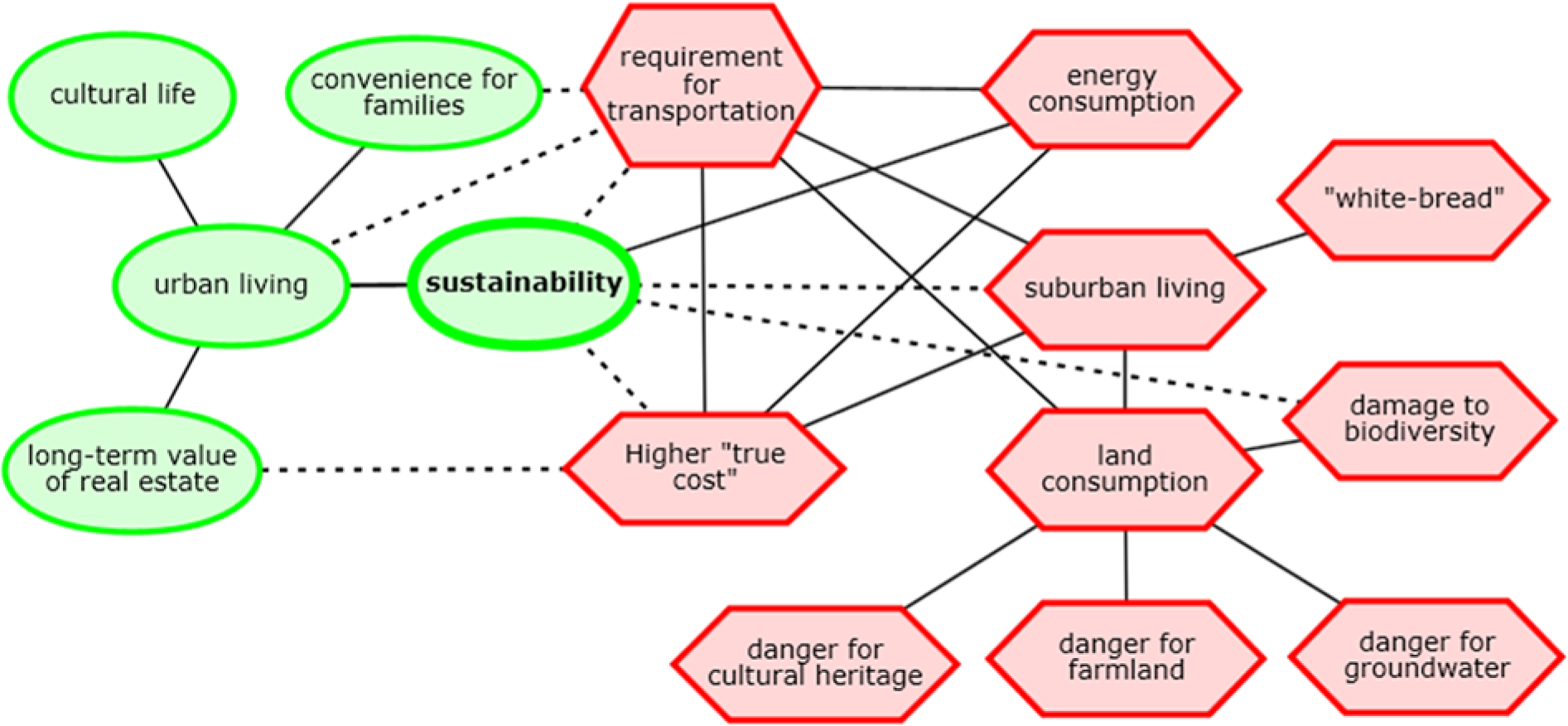
A government expert’s representation of housing in Germany.

A typical member of the German public’s representation of housing in Germany.
The concept of sustainability, with a highly positive emotional value, is central to the expert’s mental representation of land-use and housing patterns. As Figure 2 shows on the right-hand side, sustainability is incompatible with negatively perceived suburban living (hence, a hexagon), which is not only implicitly associated with a boring “white-bread” lifestyle, but is above all closely tied to land consumption and its devastating impacts on farmland, groundwater, and the like. As the connection with the concepts in the upper part of the CAM indicates, suburban settlement structures increase the need for transportation, with secondary effects on energy consumption (for instance, fuel for cars) and further land consumption (as additional farmland is converted to roads). Higher spending on fuel increases the cost of suburban living, creating important financial risks for the average household, while contradicting economic principles of sustainable development. The government has tried to persuade communities and future homeowners to choose more urban and centralized forms of living by focusing on economic and rational arguments such as the “true cost” of the suburban lifestyle, the inconvenience of transportation, and the long-term decline in value of real estate in economically unsustainable communities (see the concepts on the left of Figure 2).
The CAM in Figure 3 shows why the public has not been receptive to such rational and problem-centered communication strategies. Germans have a strong emotional preference for suburban forms of living, indicated by the cluster of positively evaluated concepts on the right-hand side of the CAM. In the mind of the typical German, suburban life is connected with the very positive notions of owning property, thriving, enjoying nature, having lots of space, and a sense of community. Suburban life is also closely linked to people’s desired perception of themselves (“myself as I really am”).
But, as symbolized by the superimposed hexagon and oval on the left-central part of Figure 3, Germans are ambivalent about the more urban forms of housing the government wishes to promote. On one hand, they have positive emotional associations between inner-city living and prosperity, cultural diversity, and family (interestingly, the positive association with family is equally strong for both types of housing). On the other hand, these positive feelings are overshadowed by the negative feelings associated with the high cost of urban living, urban noise, and greater environmental load (such as greater air pollution). The position of the concept of sustainability in the people’s CAM is somewhat ironic. Although sustainability is far less central than in the government expert’s CAM in Figure 2, members of the general public, in contrast to experts, implicitly assume sustainability to be more compatible with a suburban lifestyle, because they associate the city with greater environmental load and the detached family home with nature. People are aware of the piece of green they see when they look out of the window of their suburban house, but not of the green that used to be in the spot where their house was built.
Successful communication requires common ground (Clark, 1996), but, as the CAMs of the sustainable-housing debate in Germany indicate, such ground hardly exists between the minds of the government and the German people. For the latter, the detached family home in suburbia elicits very positive emotions stemming from a deep-rooted representation of the good life (Bourdieu, 2000). In contrast, the government has attempted to change behavioral patterns around housing by choosing communication strategies that either focus on problems associated with suburban living (evoking negative emotion) or on the rational calculation of costs and benefits of the suburban lifestyle (for the most part also evoking negative emotion).
These sharply contrasting mental representations explain why there has been virtually no success in resolving the social dispute between the German public and the German government over housing. We can learn from looking at Figure 3 that future efforts to tackle the problem of urban sprawl should take people’s housing desires—and the emotional associations of certain forms of housing—as starting points, instead of decrying suburban living as economically foolish and boring. Problems of noise and other environmental stresses in central urban areas must be addressed if dense inner-city living is to be emotionally appealing. City planners designing urban quarters should accommodate people’s deep-seated housing needs, and advertisers need to stress how the spot in the city they are selling is calm, green, and spacious, instead of stressing the risks posed by high fuel prices to suburban living.
Israeli Attitudes Toward the Western Wall
The previous example shows that CAMs can help identify profound disagreements that block progress toward key policy goals. CAMs can also be used to map the symbolic attachments implicit in ethnic, national, and religious identities. This section’s case study contrasts religious-nationalist attitudes toward the Temple Mount and Western Wall in Jerusalem with mainstream Jewish–Israeli attitudes.
The CAMs used in this case represent hypotheses drawn from Mock’s close reading of diverse textual sources, ranging from biblical and medieval mythic and religious texts to journalistic accounts, political propaganda, and statements by Israeli political and military elites covering the period from the rise of Zionist movement to the present (Mock, 2011). These sources vary widely in their origin, but all have been highlighted by Israeli religious or secular elites as expressions of the importance of the Temple Mount and Western Wall to the nation.
In 1983, for example, the Israeli Ministry of Defense published a book that assembles a collection of photographs, essays, and quotations about the Western Wall (Ben-Dov, Naor, & Aner, 1983). The book offers a particularly rich source of textual evidence that shows how the Israeli state wanted both insiders and outsiders to understand the site’s significance.
Of course the sentiments expressed in such a book, a mythic text, or a politician’s comment to the media may not reflect what goes on in anyone else’s mind. But such texts allow researchers to develop hypotheses about the connections between, and emotional weights of, concepts related to objects of symbolic significance as they are experienced by individuals embracing a certain ideology or group identity.
CAMs represent these hypotheses as networks of emotionally loaded concepts that activate in parallel. They thus allow researchers to incorporate into their hypotheses multiple simultaneous relationships between concepts, in turn allowing discernment of the networks’ emotional coherence. As we indicated above, representing such information in purely textual form is difficult if not impossible. The CAM method thus provides a deep understanding of the nuances of identity conflicts that may elude even the disputants themselves.
The Israeli–Palestinian conflict includes symbolic attachments of each party to the same contentious site: the Haram al-Sharif or Temple Mount precinct that includes the Al-Aqsa Mosque, the Dome of the Rock, and the Western Wall. Both insiders and outsiders often assume that this conflict is irreconcilable: Two groups claim sovereignty over the same location to which both attribute religious and national significance. But this assumption is grounded in an oversimplification that has, at times, caused the two sides to misunderstand each other’s intentions, leading them to violence and preventing them from developing creative solutions to the dispute.
The Haram al-Sharif is considered to be the location from which Mohammed undertook his “Night Journey” to heaven as described in the Qur’an (Sura 17), giving Jerusalem the status of the third holiest place in Islam after Mecca and Medina. The Haram has been under Muslim religious authority since the Crusades, through subsequent periods of Ottoman, British, and Jordanian rule. It continues to be under the authority of the Muslim Waqf (religious trust), which controls entry and determines rules of conduct, even since the annexation of the surrounding area of Jerusalem by Israel after the 1967 Six-Day war. Jews, however, consider the site to have been the location of the First and Second Temples, the ritual and political center of ancient Judea, and the only truly holy place in the otherwise iconoclastic Jewish religion. Prayer is still conducted by Jews in front of the Western Wall—the retaining wall of the complex, which contains original stones from the Second Temple period. After the Temple’s destruction (by the Romans in 70
The assumption, sensible on its face, that the Jewish national movement must ultimately assert sovereignty over the Jewish religion’s holiest place has been at the core of several misunderstandings, often to the point of violence. In the 1920s, efforts to introduce seemingly innocuous elements into Jewish worship at the Western Wall, such as candles, benches, and dividers to separate men and women as required by Jewish tradition, were vigorously opposed by Arab nationalist leaders. This led to a series of demonstrations and counter-demonstrations at the Western Wall and on the Haram, culminating in the riots of 1929, widely perceived as a decisive turning point that ended any hope of Arab–Jewish reconciliation under the British Mandate (Friedland & Hecht, 1991; Wasserstein, 2001). More recently, in 1996, the opening by Israeli authorities of a second entrance to a tunnel allowing tourists and worshippers access to excavations of the Western Wall sparked violent protests that left 80 Palestinians and 15 Israelis dead (Enderlin, 2003). In both cases, Palestinian violence was driven by the perception that any effort, however miniscule, to alter the status quo at the Western Wall was a precedent for more far-reaching Jewish claims over the Temple Mount itself.
However, in reality such a possessive and activist attitude toward the site is restricted to a subgroup within Israeli political culture that we will call “religious nationalist.” This group combines the principle of strict adherence to Jewish religious tradition with the active pursuit of claims of collective self-determination associated with the ideology of modern nationalism. As such, it has been at the forefront of the movement to expand Jewish settlements in the occupied West Bank under the organization Gush Emunim (Bloc of the Faithful). A smaller organization known as the Temple Mount Faithful has been responsible for several flamboyant attempts to challenge exclusive Muslim authority over the Haram.
Figure 4 depicts the attitude of a hypothetical member of this group toward the Western Wall and the Temple, derived from the historical analysis of the dispute in Mock (2011; see also Gorenberg, 2000). A religious nationalist has an unconditionally positive view of the Temple, both as a religious object and as the political center of the ancient Jewish theocratic state. This period is considered to be a Golden Age in Jewish religious mythology, and thus, according to religious nationalists, the model of authentic Jewish national sovereignty governed according to a divinely ordained political system enshrined in religious law. Thus, the historical destruction of this system, and the object at its center, is experienced as an unambiguous negative. The religious nationalist will believe it to be God’s will that the site’s destruction be actively transcended through a return to sovereignty as it was enjoyed in antiquity. This act would be symbolized by a restoration of the Temple, which therefore comes to have a strongly positive emotional value. 8 The Western Wall, according to such religious nationalists, is just a temporary substitute, a mere shadow of the Temple itself, which is the true locus of symbolic power. It may provoke positive emotions as a site of religious significance and character, but the activist nationalist ethic might react negatively to the passive acceptance of destruction that attachment to this site implies.

An Israeli–Jewish religious nationalist’s representation of the Western Wall and Temple.
Although the religious nationalists have been influential in other areas of Israeli political culture, their position on the Temple Mount garners remarkably little public support, even for demands as modest as the right to pray at the site. The decision to turn the site over to Muslim authority has been upheld by every Israeli government since 1967, engendering little in the way of mass opposition. The reasons for this attitude can be understood by looking at the CAM of a mainstream Israeli’s view in Figure 5, which indicates more ambivalent sentiments (Mock, 2011).

A mainstream Israeli’s representation of the Western Wall.
For most Israelis, nationalism means more than claiming sovereignty over land and sites of cultural-religious significance such as the Temple Mount. It also incorporates modern principles of mass politics and secularism at odds with the pre-modern theocratic system that the Temple symbolizes. To the religious nationalist, sovereignty meant the right of Jews to be ruled by Jewish religious law, and the only authentic Jewish state was therefore a theocratic one, as existed in antiquity. To the secular nationalist, however, sovereignty means the self-rule of Jews by Jews as a people or culture; rule by the religion interferes with genuine popular democratic self-determination, and thus represents an obstacle to, rather than the realization of authentic national sovereignty. Belief in God and participation in religious rituals are optional, and feelings toward the Temple are in fact ambivalent, signified in Figure 5 by an oval superimposed on a hexagon. The Temple provides a link to antiquity and a sense of a glorious and continuous national history, yet it also represents a theocratic society most Israelis find dismal. Its destruction, representing both the end of Jewish self-rule in antiquity and the end of the theocratic state system, therefore also evokes both positive and negative associations. Whereas religious nationalists experience both as negative, secular nationalists experience the historical end of Jewish self-rule as negative but the end of theocracy as positive.
Someone operating in this conceptual system would have a negative emotional response to the prospect of the Temple’s restoration, because the act would represent a reversion to a regressive society. Instead the Western Wall itself takes on a central role in the belief system. It is a powerful national symbol evoking strong positive emotions, because it draws out the positive aspects of the Temple—its link to antiquity and an earlier period of Jewish sovereignty—without evoking the restoration of the type of social system that prevailed during that period.
In both these CAMs, differing attitudes toward shared historical memories—in particular toward the Temple, placed here at the top of each map—are linked to different emotional responses to abstract principles such as sovereignty or antiquity in the middle. These principles in turn connect to and explain the different emotional responses attributed to specific objects and ideological goals located at the bottom of each map.
When taken together, Figures 4 and 5 provide insights into how the conflict between Israelis and Palestinians over this site might be resolved peacefully. Palestinian elites commonly deny the historical legitimacy of Jewish claims to the Temple Mount, going so far as to question whether the Haram really was the site of the First and Second Temples and categorically rejecting any proposal to excavate or investigate further. If the site’s Jewish history can be plausibly denied, its religious significance to Jews will be invalidated and any claims to sovereignty on such grounds will be rendered moot.
In fact, though, the strategy is counterproductive. The claim to historical continuity is the only aspect of the site that is emotionally significant to the Jewish–Israeli mainstream. So denial of such continuity evokes a defensive reaction and justifies—to safeguard the claim to continuity—the assertion of claims to sovereignty that are otherwise not desired. However, if Palestinian elites openly acknowledged the Jewish history of the site and cooperated with Israelis to put in place safeguards to preserve that history, then most Jewish–Israelis, beyond a religious-nationalist fringe, would not have a problem with continued Muslim–Palestinian sovereignty over the site.
Palestinian acknowledgment of Jewish history at the site would not solve the conflict entirely, however. Figure 5 also indicates that Israel’s political mainstream shows no such ambivalence toward the Western Wall, the symbol into which they channel all positive emotions relating to Jewish historical and religious continuity as well as national sacrifice. Hence, any workable peace agreement between Palestinian and Jewish states must find a way to place the platform of the Haram in one state and its retaining wall in the other. Nevertheless, the CAM in Figure 5 does show that by drawing out the nuances of why the same physical object evokes different meanings and emotional import for different groups, opportunities for conflict resolution become visible that are otherwise not visible when the dispute is framed as a zero-sum conflict for possession of that object.
Canadian Bitumen
Some of today’s most intractable and ideologically polarized social disputes concern climate change. This section and the next explore the cognitive structure of disputes involving this issue. In this section, we analyze a Canadian resource dispute—the contention over exploiting bitumen deposits in northern Alberta for their energy content. This dispute, with its tangle of energy, environmental, climate, and economic concerns, is emblematic of many conflicts over huge extractive projects around the world. In the next section, we examine the dispute surrounding the issue of climate change itself.
The Canadian dispute is encapsulated in the very labels people apply to the resource in question. Those who favor bitumen extraction generally call the resource the “oil sands,” while those who oppose extraction usually apply the more pejorative label “tar sands.” Both labels are technically incorrect: The resource consists of neither conventional oil nor tar. It is a gluey mixture of heavy oil, sand, and clay that is, at best, a markedly low-grade energy resource.
Nevertheless, in a world facing chronic energy scarcity, Canada’s bitumen deposits are potentially staggeringly valuable. Alberta and Saskatchewan are estimated to have reserves equivalent to some 200 billion barrels of oil, putting Canada just behind Saudi Arabia in its total oil reserves. But this status comes, inevitably, with a couple of caveats. First, because bitumen is a low-grade resource, it must go through an extremely energy-intensive upgrading process to turn it into useable fuel. The amount of energy recovered at the end of this process is only about 4 times the amount invested to get that energy, a ratio among the worst of all modern energy sources. Second, getting the bitumen out of the ground and upgrading it releases huge amounts of carbon into the atmosphere. Environmentalists around the world have therefore launched a campaign to label fuel produced from Canada’s bitumen as “dirty oil.”
Figure 6 is a plausible CAM of a senior Canadian oil sands executive, such as the CEO of one of the major oil sands extractors in Fort McMurray, Alberta. This CAM and that shown in Figure 7 are based on Homer-Dixon’s extensive experience with both sides of this dispute, extending back nearly 40 years to work in the province’s oil and gas fields in the 1970s. As with the CAMs depicting attitudes toward the Western Wall, the CAMs here are hypotheses that can be used to guide further research on the belief systems regarding bitumen extraction.

A senior oil sands executive’s representation of the oil sands.

An Alberta environmentalist’s representation of the tar sands.
The concept of the oil sands near the center of the CAM derives much of its positive emotional value from its strong associations with positively regarded concepts such as prosperity, capitalist markets, and private property, all clustered in the top-right of the Figure 6. The oil sands concept is also strongly associated with Alberta itself. Alberta has a strongly positive emotional value, because it is seen as a frontier where rugged individuals can find opportunity and prosperity (much as many conservative Texans see Texas in the United States) and also because it is a bastion, both provincially and federally, of the positively regarded Conservative political party.
At the bottom of the CAM is a cluster of concepts causing negative emotions. Some relate to the federal Liberal party, which is commonly associated with eastern Canada, the location of the federal capital Ottawa. In the 1970s, the Liberals introduced the National Energy Program (NEP), seen by many Albertans as an attack on Alberta’s resource sovereignty. Government in general is identified as a source of regulation, and regulation is a form of expropriation, which evokes an extremely powerful negative reaction.
The concept of Canada is at the boundary between these zones and is, as a result, regarded ambivalently. The hypothetical executive is inclined to switch between positive and negative emotional responses to Canada, depending on whether circumstances highlight the country’s associations with Alberta and a prosperous future or with expropriative regulation by the federal government.
Climate change and environmental groups, needless to say, also evoke negative emotions, because they are both viewed as threats to exploitation of the oil sands and, more generally to Alberta’s prosperity. Europe, to the extent that it is seen as supporting the environmentalists’ cause, is also seen negatively. And interestingly, the attitude toward the United States is largely neutral: The positive regard generated by U.S. capitalism is neutralized by possible U.S. support for carbon regulations on bitumen-derived oil. 9
In contrast to the CAMs we used to illustrate the method in Figures 2 through 5, Figures 6 and 7 use differential link weights to represent the relative strength of relations of coherence or incoherence between concepts. Strong relations often link concepts with strong emotional value. The result in this CAM is an easily visible subset of linked concepts and relations that forms the core or “essence” of the person’s perspective.
Figure 7 represents the views of a typical Alberta environmentalist working on the tar sands issue. The tar sands concept, near the center of the network, has a strongly negative emotional value, largely because of its association with a cluster of negative concepts in the top right of the figure, including recklessness, corruption, and despoliation. In contrast to the oil sand executive’s view, capitalism, and markets evoke negative emotions, partly because of their association with greed and despoliation. Despoliation is, in turn, a tragedy for Canada and nature.
Canada, government, and regulation, are regarded positively, because they are associated with nature, which has a strong positive value, or with nature’s protection. The federal government, however, is not thought to be an effective enforcer of regulation, in large part because of its strong association with the negatively regarded Conservative party. As in the case of the oil sands executive, climate change evokes strongly negative emotions, but in this case because it threatens nature, not because it threatens oil sands exploitation. For the environmentalist, the link between climate change and the tar sands is mutually supportive: In the minds of environmentalists, these two bad things are closely related and go together.
Whereas the oil sands executive is ambivalent about Canada, the environmentalist is ambivalent about Alberta—a province admired because of its centrality to Canada and its spectacular wilderness but also disliked because of its tar sands industry and conservative politics.
Nature and wilderness are part of a cluster of positively regarded elements in the lower left of the figure, including common property, environmental groups (themselves associated with democracy) and, importantly, the future. As in the case of the conservative oil sands executive, the United States is perceived neutrally, but here for the opposite reasons. For the environmentalist, the U.S. association with negatively regarded capitalism is balanced by its association with positively regarded tar sands regulation.
On comparing these CAMs, one might conclude that they cannot aid resolution of the dispute, because they do little more than reveal the utter irreconcilability of the disputants’ views underpinned, as they are, by profoundly antithetical ideological commitments. Yet the CAMs may, nonetheless, reveal how a constructive dialogue could start. Both the conservatives and environmentalists see themselves as defenders of the future—conservatives through their commitment to markets, opportunity, and prosperity, and environmentalists through their commitment to nature and their efforts to halt climate change. Both these groups care deeply, at root, about the well-being of their children and grandchildren and believe they are pursuing ends that will help ensure this well-being: prosperity for conservatives, a healthy natural world for environmentalists.
Specialists in conflict resolution always search for common interests between disputants, and then build agreement from there. These CAMs show that the disputants in the oil sands conflict have one key interest in common.
Climate Change
For more than a decade, international negotiations have failed to produce an effective climate-change agreement (Depledge, 2011; Dimitrov, 2010). Climate change causes serious disputes between states, within states, across national party lines, and even within families. Explanations for why people cannot agree about climate change point to multiple factors, including vested material interests in profit-generating energy structures, psychological defenses against disturbing information, and fundamentally different opinions about the nature of science and the implications of scientific uncertainty (Antilla, 2005; Grundmann, 2007; Hulme, 2009; Norgaard, 2006, 2011; Thagard & Findlay, 2011).
CAMs can shed light on the sources of various disputes over climate change. CAMs enable researchers not only to understand an individual’s view of and emotional response to climate change but also to identify the differences between the worldviews of individuals and groups. Here, we focus our analysis on political disputes surrounding climate change at the national level in Western, industrialized, democratic countries by analyzing two opposing viewpoints: the perspective of a well-informed and moderately liberal proponent of climate action—a view that differs significantly from a more environmentally radical position on climate change—and the perspective of a conservative climate skeptic.
The CAMs in Figures 8 and 9 represent idealized and simplified viewpoints of a typical member of these two groups—liberals and conservatives—who holds generally well-known or “standard” attitudes toward the issue based on long-standing ideological commitments. The maps are derived from Milkoreit’s extensive research on attitudes toward climate change. 10 Using a variety of primary text sources, including newspaper articles, blogs, and transcripts of speeches of presidential candidates, interview data collected in 2012, and secondary literature on the role of ideology, media, and business actors in climate politics, Milkoreit selected concepts and conceptual links that various authors or interview participants had used or referred to most frequently. She made inferences about the emotional valences of these concepts based on their contextual use and associated concepts and adjectives (e.g., “scary” for a negative concept or “happy” for a positive one). Concepts that these authors or interviewees used in the same sentence or paragraph tend to be linked to each other (logically, causally or by another form of association), and are therefore located in close proximity in the CAMs.
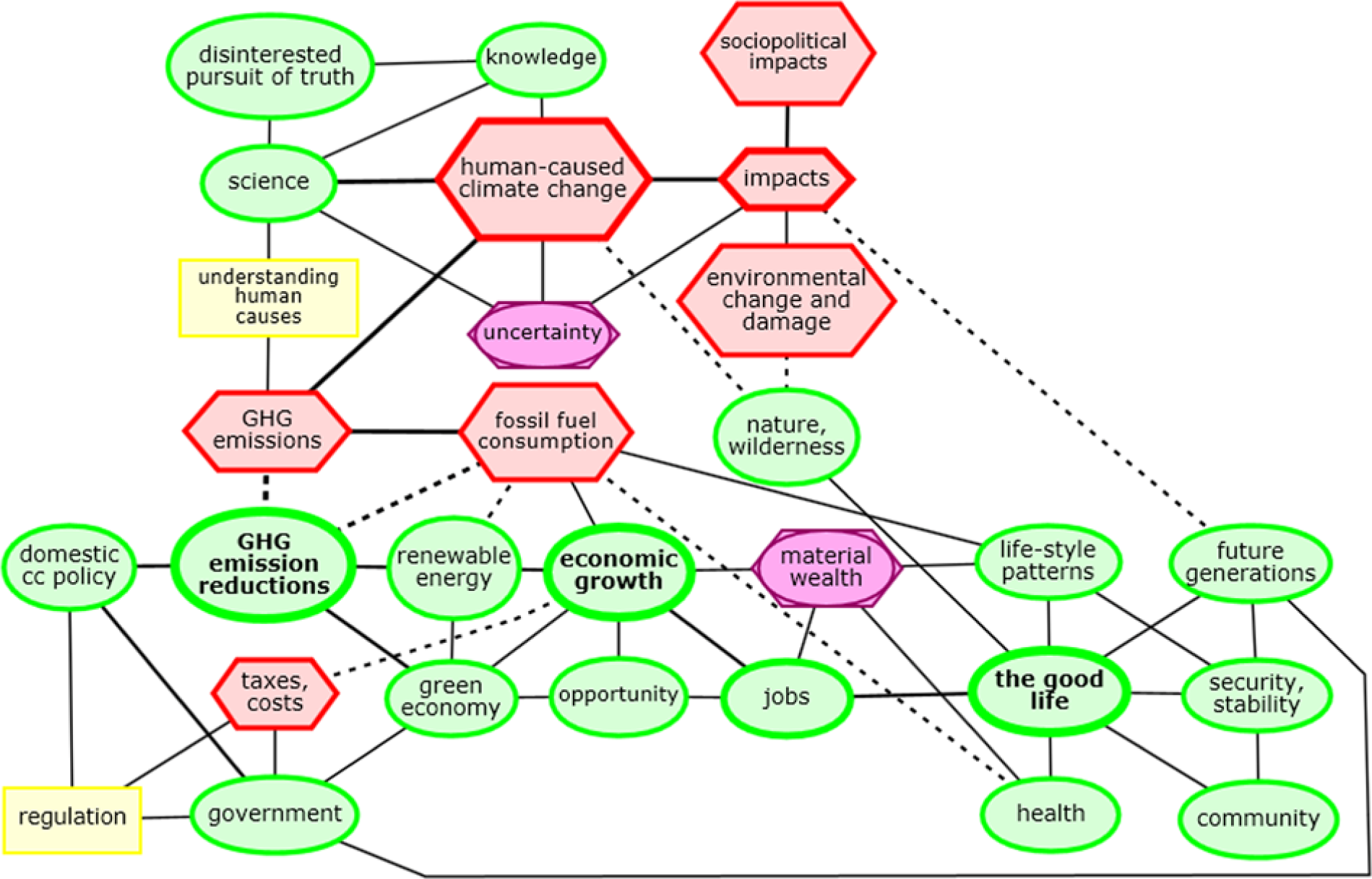
A moderately liberal climate-action advocate’s representation of CC.

A skeptic’s representation of climate change.
The two maps reveal very different answers to four basic questions. What is climate change? How do we know it is real? Why should we care? And what should be done about it?
Figure 8 shows the most important concepts of a typical well-informed and moderately liberal person who favors climate action in a Western democracy such as the United States or Germany. Relying on science as a source of reliable knowledge (concepts in the upper-left corner of the figure), a person who favors climate action accepts that climate change is a global problem with human causes and that it poses significant risks for human well-being (see the concepts related to climate-change impacts in the upper-right corner).
He or she also believes that reducing greenhouse gas (GHG) emissions will address the problem. This latter action requires a fundamental change in current energy use patterns in industrialized economies—a transition from fossil fuel-based to renewable “green” energy sources. Domestic climate policies (lower left corner) are needed to trigger and finance such a transition, even if they impose a significant cost on the economy and require difficult changes in individual lifestyle patterns. The long-term stability, health, and happiness of individuals, of society as a whole, and of future generations justify the transition costs. For this person, all concepts relating to individual well-being and happiness are clustered around the central notion of “the good life” in the CAM’s bottom right.
An advocate of climate action is concerned about the cost of climate policies and worries about these policies’ impacts on significant sources of happiness and security—for instance, on economic growth and in turn jobs. As climate change also poses a threat to other important elements of the good life—such as the natural environment and future generations’ well-being—the person favors action over complacency. He or she is willing to impose some social costs on today’s societies and to bear some of these costs to avoid the consequences of dangerous climate change. Such advocates of climate action tend to focus on the green economy’s potential for economic growth through renewable energy and other clean-technology industries.
The view of a typical climate skeptic, shown in Figure 9, is very different. For this person, anthropogenic climate change is not real, so no action is required. As shown in the figure’s upper portion, a skeptic usually believes that climate-change claims are at best based on bad science or at worst a liberal deception to increase the power of government or a stratagem by scientists to boost their research funding (McCright & Dunlap, 2000; Selin & VanDeveer, 2011). If pressed hard about possible negative consequences of climate change, skeptics might admit that natural climate variability justifies adaptation measures. As climate scientists admit that their findings contain significant uncertainties, a typical climate skeptic argues that it is premature—indeed foolish, irresponsible, and unfair—to establish costly climate policies today that might ruin profitable industries and create an international competitive disadvantage. Regulatory measures should be avoided at all cost, because they impose an unfair burden on domestic companies and bloat the government (lower left corner). Overall, climate policies would do far more harm than good.
A typical skeptic is most concerned about how climate policies might harm the domestic economy and, by putting a price on carbon, limit private property rights and natural-resource exploitation. As in the oil sands CAM (Figure 6), economic success, private property, and natural-resource exploitation are intimately linked and are the key sources of the skeptic’s notion of the good life. These things are all expressions of freedom and individualism. Climate policies such as carbon pricing are associated with the negative concepts of big government and unfair taxation or even expropriation. Cutting emissions primarily means cutting profits and maybe even killing entire industries. The associated loss of wealth and freedom seems unacceptable to skeptics and evokes negative feelings of fear and anger.
In contrast to the advocate of climate action, this typical skeptic does not have to balance values threatened by climate policies (e.g., jobs and economic growth) with those threatened by climate-change impacts (e.g., security and the well-being of future generations). He or she expects future generations to be better off due to continuing economic growth, technological development, and the strong adaptive capabilities of human societies. Combined with the absence of concerns about environmental issues, this view allows the skeptic to adopt a short-term perspective, focusing on the present and personal well-being rather than the long-term health of society and the environment.
Comparing Figures 8 and 9, we see that economic and social values, not the environment, are the main issues at stake. The concepts of warming, temperature change, conservation, and biodiversity are not central to either CAM. For both groups, climate change is a negative concept but, as in the Canadian bitumen example, for different conceptual and emotional reasons. Advocates of climate policy fear the consequences of climate change in the future; skeptics feel more threatened by the prospect of costly climate-change policies in the present.
The two camps have very different ideas about the role of government. Advocates favor a role for government in transitioning to a post-carbon society. Skeptics are leery of government intervention and trust the free market to solve social and economic problems. The rejection of government interference is connected to a strong sense of individualism and to pride in past economic achievements. One side accepts the need for social change; the other feels threatened by the prospect of policy-driven change. The line between advocates and skeptics of climate change is almost identical to that between liberals and conservatives in many countries (Jamison, 2010).
The economy plays a central role in both worldviews. So, economic issues might offer the greatest scope for identifying shared interests and moving toward resolution of the conflict. Both the typical advocate of action on climate change and the typical skeptic value economic growth as a source of the good life, and both have to reconcile the need for economic growth with the challenge of climate change. Currently, each finds a different solution based on their different value systems. A climate-action advocate generally balances the short-term economic costs of climate policies with long-term benefits such as environmental protection and happiness of future generations. A skeptic usually rejects short-term climate action, because it will constrain economic freedom. The key concept that could reconcile these contrasting views is green growth—that is, an economic model centered on renewable energy sources, clean job creation, and opportunities for technological development. 11
Germany’s approach to climate-change policy might offer some valuable insights in this regard. Despite the industrial base of the German export-oriented economy, the population—even conservative business elites—generally does not resist proactive climate and energy policies. One important reason is the framing of climate-change policies as a strategy to turn Germany into a global technology leader. This framing connects climate action with economic opportunities and benefits rather than costs.
Figures 8 and 9 show that the conflict over climate-change policy is rooted in profound ideological differences. Better climate science is unlikely to resolve this dispute. At its heart are opposing beliefs and feelings about the acceptability of imposing immediate economic costs today for the sake of social and environmental benefits later on. While one side is motivated by the prevention of future harm, the other is driven by the protection of today’s economic assets. It is more a conflict over values than over scientific facts (Thagard & Findlay, 2011).
Our analysis of this conflict using CAMs has clarified its nature. It has also identified some common ground between the two opposing viewpoints that could be used to develop a solution. But we should note that resolving a dispute between two parties by identifying common ground might ultimately make it even harder to find agreement among a larger set of actors. For example, the green-growth solution discussed above would appeal to technological optimists but is unlikely to be acceptable to many staunch environmentalists.
Discussion: The Uses of Cognitive-Affective Mapping
We have used the technique of cognitive-affective mapping to display the conceptual and emotional structure of four current disputes. In each case, the two CAMs highlight differences not only in beliefs about the situation but also in emotional values attached to relevant concepts. We have shown that this technique works equally well for disputes over national and international policies as for disputes involving religious identity.
Like any map, CAMs display only some of the information about the situation mapped. A full account of the emotional structure of conflicts would require attention to other dimensions of affective meaning such as activity-arousal and potency and perhaps a more fine-grained specification of particular emotions associated with different concepts and situations, including both positive emotions such as happiness and pride and negative emotions such as fear, anger, envy, and disgust. Nevertheless, even though the authors who produced the CAMs in this article have studied the issues they graphed for many years, each found that the exercise brought greater clarity to, and a deeper understanding of, the dispute in question.
CAMs’ simplicity makes it possible to depict in a half-page illustration much of what is most important about a given dispute and also makes it possible for disputants, mediators, and negotiators to understand and use the method quickly. However, although the method clearly provides a useful tool for conflict analysis, it remains an open question whether it is always useful for conflict resolution. Mapping the conceptual and value structure of a dispute can promote mutual understanding, compromise, and reconciliation, but it could also conceivably increase polarization and hostility. As conflict researchers have long known, better understanding between groups does not necessarily lead to concord between them.
We believe that much depends on the disputants’ underlying motives. In cases where they are eager to find a mutually satisfactory agreement, CAMs should increase disputants’ understanding of the sources of their disagreement, help them identify common ground, and point them to opportunities for crafting win–win solutions. They could also help the disputants design strategies for intervening conceptually to shift beliefs and values in one or both parties, in turn creating space for agreement. At the very least, if the disputants are well-intentioned, CAMs should dampen the natural tendency to dismiss the other side as incompetent and its viewpoint as bizarre or even stupid.
In more adversarial situations, where at least one side is adamant about being incontrovertibly right, the other side can use CAMs to understand the psychological sources of this stubbornness. Whether this aids conflict resolution or simply leads to a better strategy for winning the conflict will depend, again, on disputants’ motivations. Nevertheless, CAMs can reveal the ideological under-pinnings of disputes, providing a way of going beyond surface disagreements to help both disputants and outsiders appreciate the disputants’ more fundamental differences in beliefs and values. Used this way, CAMs can also be a powerful educational tool for conveying the deep nature of political, ethical, and social disputes.
In either type of situation, the CAM method’s emphasis on the emotional content of beliefs creates opportunities for conflict resolution that are less available to conventional approaches. CAMs, for instance, allow disputants or mediators to identify concepts that are particularly emotionally intense—emotional trigger points or pathways of emotional excitation within a belief system—and to specify the properties of the emotions involved. If the emotions are affecting the conflict’s severity and persistence, disputants or mediators could devise strategies to change the emotional valence of concepts rather than the concepts themselves. More generally, CAMs emphasis on emotion could help disputants talk about their feelings rather than their positions, enhance empathy for the other party’s circumstances, and thereby strengthen the joint motivation to produce solutions that respect both sides’ values.
Finally, the CAM methodology can be used to stimulate research, both empirical and computational. With regard to empirical research, the prediction that using CAMs will increase reconciliation would be falsified if mapping instead increases polarization (Sunstein, 2009). Thagard (in press-b) described the use of CAMs in two undergraduate courses in environmental and medical ethics. More than 80% of the students reported changing their minds at least once during three assignments in which they mapped controversial issues, which suggests that CAMs need not increase polarization. However, much more empirical work is needed to establish whether CAMs are indeed effective in bringing people together.
With regard to computational research, as we discussed earlier, CAMs can be easily translated into computer simulations of people’s decisions, because they are based directly on the HOTCO neural network model of emotional inference (Thagard, 2006). They could then be used to test the hypothesis that complex judgments and decisions are performed by holistic processes that maximize coherence among emotional as well as cognitive elements. Recent experiments on social and legal inferences support this hypothesis (Simon, Stenstrom, & Read, 2013).
Accordingly, we encourage people who have been involved in either practical interventions to resolve conflicts or empirical studies of conflict to generate CAMs of the disputants involved. This article has shown the applicability of the CAM method to disputes over a wide range of issues. It also provides both preliminary analytical and empirical support for the claim that conflicts are intrinsically emotional.
Footnotes
Declaration of Conflicting Interests
The author(s) declared no potential conflicts of interest with respect to the research, authorship, and/or publication of this article.
Funding
The author(s) disclosed receipt of the following financial support for the research, authorship, and/or publication of this article: While writing this article, Milkoreit was supported by a Balsillie Graduate Scholarship and a Vanier Canada Graduate Scholarship, and Schröder was supported by fellowship no. 1282/1-1 from the German Research Foundation (DFG) and grant no.16|1589 from the German federal ministry of education and research (BMBF). Thagard’s resarch is supported by the Natural Sciences and Engineering Research Council of Canada.