




Abstract
This study analyses the wage bargaining power of employers and internal migrant workers in the urban labor market in China using a two-tiered SFA model. The findings indicate that bargaining power decreases the observed wage relative to the benchmark wage which is associated with worker’s actual productivity. The availability of migrant labor is identified to be a key variable in the wage bargaining process. This study reveals that the migrant workers who obtain jobs via informal job search methods stand in a weak bargaining position relative to those using formal search methods which is consistent with limited choices hypothesis. Additionally, the migrant workers in the manufacturing and construction industries or producing and processing occupations extract surplus nearly identical to other groups.
Plain Language Summary
This study analyses the wage bargaining power of employers and internal migrant workers in the urban labour market in China using a two-tiered Stochastic Frontie model. The findings indicate that bargaining power decreases the observed wage relative to the benchmark wage which is associated with worker’s actual productivity. This study reveals that the migrant workers who obtain jobs via informal job search methods stand in a weak bargaining position relative to those using formal search methods. Additionally, the migrant workers in the manufacturing and construction industries or producing and processing occupations have similar standard identical to other groups. A conducive working condition, attractive wage offer, and strong employment protection should be considered to retain a consistent supply of internal migrant workers. Additionally, policymaker should review and strengthened existing discrimination law against minority group to reduce subjective and prejudice element in employment.
Introduction
The urban labor market segmentation in China has been an interest in studies of wage/income differentials between locals and non-locals since policies concerning internal migration limitations were relaxed following an era of economic reform in the late 1970s. As a result of the policy changes, internal migrants began moving to cities where industrial sectors are booming to take advantage of the higher labor demand. The scale of rural-to-urban migrants then increases from approximately 30 million in 1989 to 132 million in 2006 (Démurger et al. 2009). In fact, the number of migrant workers [including migrants with urban hukou (residential registration)] that moved into the cities has reached approximately 242 million in 2010 (National Bureau of Statistics [NBS], 2010). As an important source of labor supply in urban areas of China, the contribution of internal migrant workers to economic growth in China is quite significant. For example, Cai and Wang (1999) find that approximately 20% of GDP growth was attributable to internal migration between 1978 and 1998.
Promising job opportunities, as well as higher earning attainments relative to rural areas or small-medium-sized cities, are identified as factors that attract internal migrant workers to move out of their hometowns (Harris & Todaro, 1970; Todaro 1969). Using a China labor survey, Du and Pan (2009) show that the mean wage per month of internal migrant workers increased by 2.6% in nominal terms between 2001 and 2005. Additionally, the wage growth among internal migrant workers has accelerated since 2006. The wages of internal migrant workers, in real terms, rose by 10% in 2006 and increased by a further 17% during 2009 (Knight et al., 2011). However, the migrant salary increment is mainly due to general wage growth in the urban area. According to the National Bureau of Statistics of China (NBS) in 2015, the average nominal wages per year for individuals employed in urban areas increased from 18,200 Chinese Yuan in 2005 to 56,360 Chinese Yuan in 2014, experiencing about two-digit year-on-year growth during this decade.
The internal migrant labor shortage surprisingly emerged in 2004. A possible explanation of the scenario is that the migrant has a weak bargaining power that demotivates those in the rural to migrate. Internal migrant workers, especially new internal migrants, must accept any job offers out of necessity for survival. Additionally, the jobs and occupations filled by internal migrant workers are often low skilled and characterized by the 3-Ds (i.e., dirty, dangerous, and disreputable; Meng et al., 2013; Zhu, 2016) and are not held in high esteem by urban locals (Zhu, 2016) as a result of discrimination faced by internal migrant workers in relation to obtaining formal jobs in an urban labor market. Thus, the migrant is more associated with wage posting mechanism for the wage setting. The wage posting mechanism refers to the wage that is determined unilaterally by the employer and only two choices exist for employees: accept it or leave it. “Take-it-or-leave-it” wage offers seem reasonable to internal migrant workers. However, against the backdrop of an increasingly serious shortage of internal migrant workers, firms should compete against one another to attract internal migrant workers by offering better wages. Internal migrant workers frequently move between jobs (H. Zhang, 2010) and, after becoming familiar with working conditions, quickly realize the weakness of their bargaining power when initially accepting a wage. Meanwhile, internal migrant workers, especially rural internal migrant workers, suffer from differential treatment in many regards (Cheng & Wang, 2013; Gao et al., 2012; Lee, 2012; Messinis, 2013; Zhu, 2016). As a result, secondary wage bargaining should occur after a short period of time since internal migrant workers are more likely to seek higher wages in cities after a short period as they begin to understand the potential impact of the labor shortage on their wages; and since internal migrant workers are more sensitive to potential opportunities of obtaining higher wages.
In reality, observed wages for workers with identical characteristics will not be identical and identical firms will pay different wages for the same work. The wages paid, once the job match is made, are more likely to reveal the employer’s expected wage (productive value) of workers given their characteristics; instead of the actual productivity (Kumbhakar & Parmeter, 2009). Due to job match uncertainty or unknown match quality, employers attempt to depress the wage to avoid overpaying or overestimation of employees’ productivity. In the meantime, workers attempt to avoid being underestimated and future job loss. Thus, the agreed-upon wage may virtually reflect the level in which it may be higher or lower the real wage of the actual productivity depending upon the size of surplus extracted by each party, that is, bargaining power.
The surplus (total extra benefit) basically refers to the difference between the minimum wage that workers are willing to accept (i.e., reservation wage) and the maximum wage that employers are willing to offer (i.e., reservation offer). It is worth noting that the surplus is very likely to be exploited by both parties (Brenzel et al., 2014). Thus, the party that extracts more surplus actually stands in a stronger position in a bargaining process. In other words, the process of wage determination is dominated by the party that has more bargaining power. In the case of the internal migrant worker, the employer is more likely to have higher bargaining power and extract larger surplus.
The objectives of the present study is therefore to measure the size of the surplus (bargaining power) extracted by internal migrant workers and employers in the urban labor market using a two-tiered stochastic frontier model (two-tiered SFA) recently improved by Kumbhakar and Parmeter (2009). In particular, the present study analyses the effect of the internal migrant labor shortage in the wage bargaining process. The shortage of migrant labor takes place largely in manpower-intensive manufacturing and construction industries (Zhao & Huang, 2010). As the world’s factory, the China’s export-oriented manufacturing sector can no longer benefit from the “unlimited” cheap labor supply (X. Zhang et al., 2010; Li et al., 2012). Continuously rising wages make the important competitive advantage of manufacturing firms disappear, and still unable to sufficiently attract internal migrant workers. Construction industries in China are experiencing the similar situation as the pace of urbanization speeds up. As a consequence, internal migrant workers in these two industries are expected to, on average, possess higher bargaining power relative to those in other industries. Similarly, the increasing number of vacancies in the manufacturing/processing plants and construction sites are expected to provide more voices to migrant workers in production and processing occupations within the process of wage determination. Note that internal migrant workers in the specific industry or occupation do not necessarily get higher wages than those in other industries or occupations, but truly and relatively extract more surplus even though they are all in the weak position when bargaining with employers.
The empirical measurement of the surplus gained by internal migrant workers and employers contributes to the existing literature by proving the existence of surplus extraction; and analyzing the degree to which bargaining power affects the wage of a migrant worker. To the best of the knowledge of the authors, this study is the first to investigate the asymmetric effects of bargaining power of employers and internal migrant workers, respectively, on real wages in the urban labor market in China. Additionally, the reservation wages may be various for internal migrant workers who report different characteristics. Alike, reservation offers may be changed conditional on the set of employer characteristics. In other words, employer and internal migrant worker differently presents outcomes (employer) and productivity distribution (employee) that demonstrates different amount of extra benefit (surplus) and their specific bargaining powers. Although the weak position of internal migrant workers in the wage bargaining process seems to be realistic due to limited residency rights and asymmetric information, to investigate heterogeneity may reveal different situations or reinforce some previous findings.
The remainder of this paper is organized as follows. Section “Two-tiered SFA Model Setup” introduces the two-tiered SFA model developed for the present study. Section “Data and Variables” describes the data and the purpose of the selected variables. Section “Empirical Findings” presents the empirical findings and Section “Conclusion” concludes the present paper.
Two-tiered SFA Model Setup
The present study employs two-tiered SFA model developed by Polachek and Yoon (1987). The model is widely applied in extant studies, including examinations of the effect of match uncertainty on labor markets (Kumbhakar & Parmeter, 2009); the degree of information asymmetry (Wang, 2016) and price differences (Tomini et al., 2012). Following the approach of Kumbhakar and Parmeter (2009), the wage agreed upon by both parties is expressed as:

where wage, which is observable, consists of three elements:
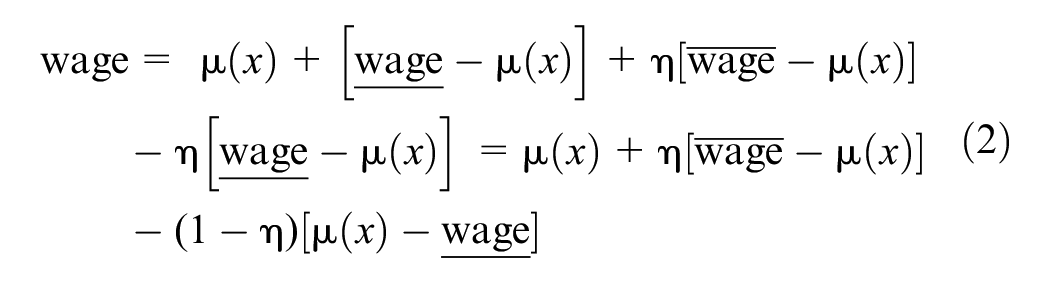
where,

where
It is also important to note that, as is often the case, monthly wages are usually transformed into natural logarithmic form in many regressions, which also means that, in our study, point estimators of
Data and Variables
The data used in this study are from rural-urban migrant-worker household survey data obtained from the CHIP 2013 dataset. The CHIP 2013 samples are effectively sourced from the NBS household survey sample of Urban-and-Rural integration. The CHIP 2013 is a nationally representative dataset that covers 15 provinces distributed across eastern, central, and western China. In total, 760 internal migrant households were surveyed. The sample used in this study is restricted to individuals aged between 16 and 60 receiving wages in 2013. Next, individuals that are full time homemakers, students or retired are eliminated from the sample because this study focuses on individuals employed for no less than 6 months in 2013. Furthermore, individuals are excluded whose employment status was characterized as employer; family worker; self-employed; and internal migrant workers that worked less than 6 months in 2013. Meanwhile, any samples with missing information concerning factors considered to affect the bargaining power of both parties are dropped. In addition, some outliers (monthly wages below the fifth and beyond the 95th percentile) are dropped. The aforementioned exclusions yield a final sample of 789 individuals.
Table 1 presents the summary statistics of demographics of internal migrant workers. The CHIP 2013 does not directly provide information concerning internal migrant workers’ monthly wage. Thus, monthly wages (lnwage) are calculated using the yearly earnings which includes bonuses and various subsidies from the respondents’ current jobs in 2013. The demographic data regarding age, marriage, education, health status, and gender are similar, if not identical, to figures cited in existing literature. Married respondents include those first-married and remarried while unmarried respondents contains cohabiting, divorced, widow, and never married situations.
Descriptive Statistics of Migrant Labor Demographics.
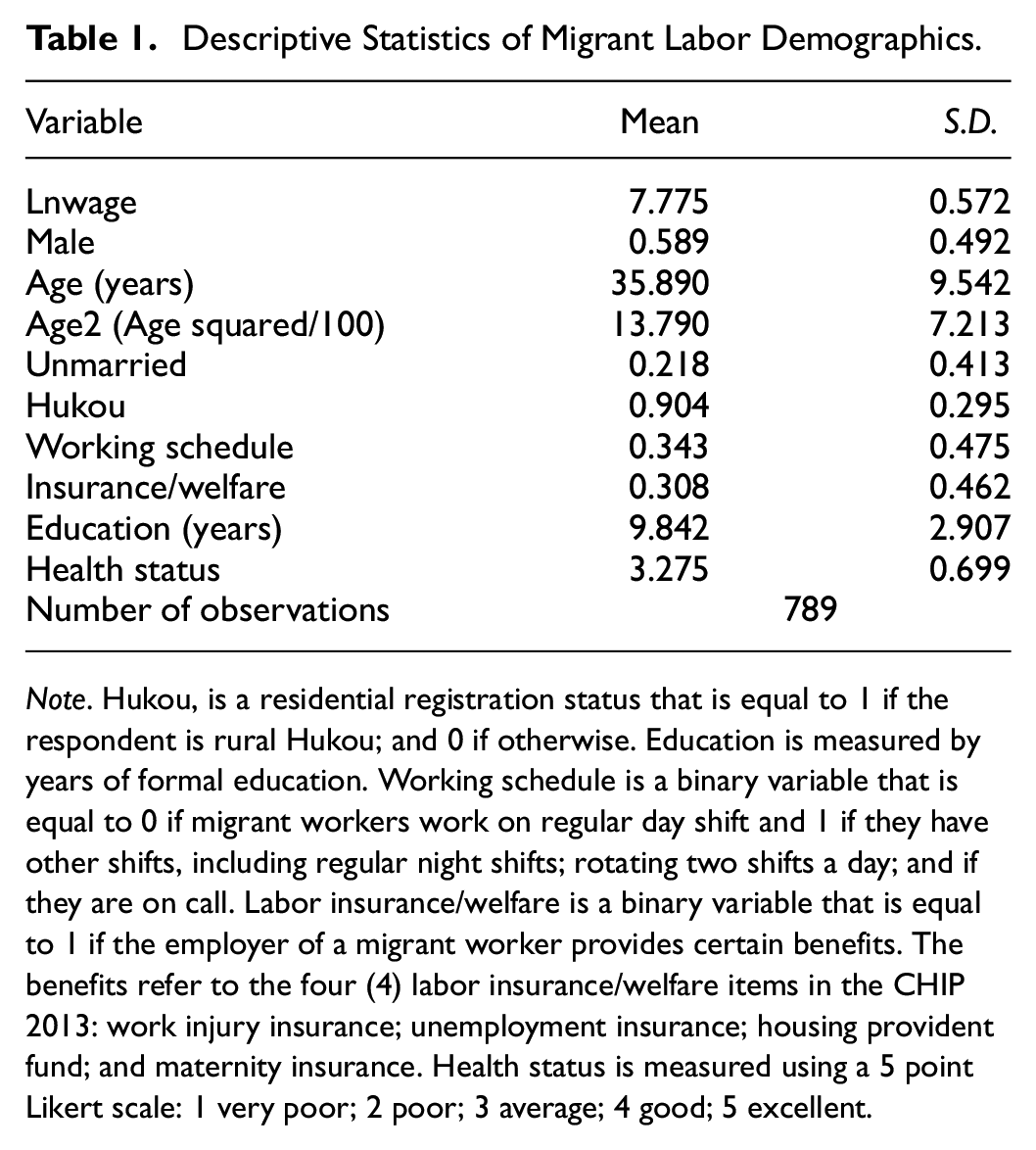
Note. Hukou, is a residential registration status that is equal to 1 if the respondent is rural Hukou; and 0 if otherwise. Education is measured by years of formal education. Working schedule is a binary variable that is equal to 0 if migrant workers work on regular day shift and 1 if they have other shifts, including regular night shifts; rotating two shifts a day; and if they are on call. Labor insurance/welfare is a binary variable that is equal to 1 if the employer of a migrant worker provides certain benefits. The benefits refer to the four (4) labor insurance/welfare items in the CHIP 2013: work injury insurance; unemployment insurance; housing provident fund; and maternity insurance. Health status is measured using a 5 point Likert scale: 1 very poor; 2 poor; 3 average; 4 good; 5 excellent.
According to Kumbhakar and Parmeter (2009), the variable which is controlled in the wage regression indicates its uncorrelatedness with the error terms of the model, which means that the surplus extracted by the workers and its distribution are uncorrelated with this variable. While some variables are per se the outcomes of bargaining process, in other words, the variable itself is an indication of bargaining power. Obviously, gender is the case because of discrimination in the labor market. Based on the same consideration, job-related variables presented in Table 5 are excluded in the wage regression as well but join the analysis of bargaining power.
Specifically, the sample is composed of internal migrant workers with a mean age of approximately 36 years and nearly 10 years of average schooling. Most of these wage earners are males (approximately 59%), and more than 78% of migrants got married. The majority of them choose the regular work shift but have no labor insurance or welfare.
Table 2 presents the sample distributions of internal migrant workers in relation to the job-related variables such as job search methods, ownership; size; industry as well as occupation. According to the number of people employed, the enterprises are classified into small enterprises (≤50 persons), medium-sized enterprises (51–250 persons) and large enterprises (>250 persons). Employers with different characteristics possess varying capabilities in relation to obtaining information concerning the local labor market and, thus, internal migrant workers also correspondingly possess varying levels of bargaining power. In the case of a small-sized private company, the bargaining powers of internal migrant workers that work in different small-sized private companies may vary considerably since small-sized private companies do not generally have strict salary systems; or standards for subsidies and bonuses, when compared to large-sized state-owned companies, irrespective of the possible existence of rigid, or stricter recruitment requirements among large-sized state-owned companies.
Descriptive Statistics of Employer Characteristic.
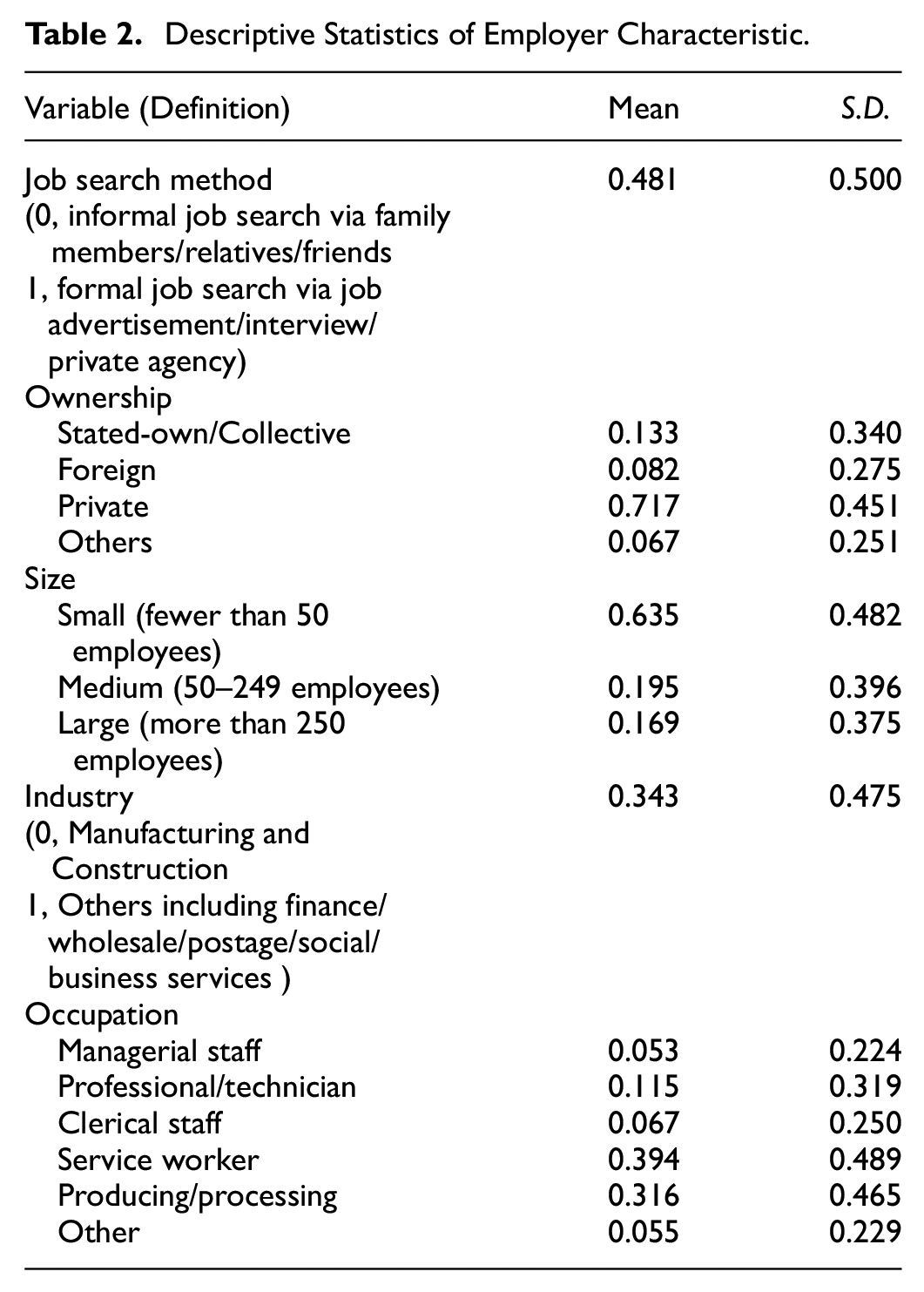
This paper categorizes the job search method into informal methods (jobs obtained via aforementioned social networks such as family members, relatives as well as friends) and formal methods (job search via job advertisement, interview, and private agency). In order to identify the influence of migrant labor shortage, the present study classifies industry into two groups—the manufacturing and construction industry and the service industries (including wholesale, postage, social, finance, and business services industries). Meanwhile, occupations are classified into six groups, namely managerial staff; professional/technician; clerical staff; service workers; production/processing; and other occupations. In our sample, about 52% of internal migrant workers obtain the job via informal methods. Unsurprisingly, the majority of them work in the private and small-size firms (72% and 64% respectively). Internal migrants are mainly concentrated in the service industries, and only 34% work in the manufacturing and construction industries.
By occupation categories, about 40% of internal migrant workers are employed as service workers, 32% as producing/processing workers and 12% as professionals/technicians.
Empirical Findings
The empirical findings of the present study are presented in two sections. The first section presents the effects of the factors examined on wages using different approaches. The second section presents the results concerning variance decomposition; the size and distribution of the surplus extracted across gender and aforementioned job-related variables; and the evidence for the limited choices hypothesis and the influence of internal migrant labor shortage.
Modelling Estimates
Table 3 presents the results of the ordinary least square (OLS) regression (Model 1). The Table also presents the maximum likelihood estimations (MLE) of the two-tiered SFA following the inclusion of two constraints (Model 2); and in the absence of constraints (Model 3 and Model 4). Following the approach of Lu et al. (2011), Model 2 is subjected to two constraints for comparison:
Lnwage Modeling Estimates.

, *** denote statistical significance at 10%, and 1% levels respectively.
In regards to the characteristics of internal migrant workers, those with rural or urban hukou exhibit no significant difference in wages after controlling for other wage determining variables. Marriage has no significant impact on wages. The significant coefficients for age and age squared in the regression manifest the conventional age-wage profile: wages rise with age but decline after a peak at a certain age. Education has a positive and significant effect on wages of internal migrant workers. Specifically, the return to an additional year of schooling is only 2.1% (
Variance Decomposition Analysis
Table 4 presents the results of variance decomposition and demonstrates the effect size in relation to the bargaining powers of employers and internal migrant workers. The total unexplained variance in lnwage is approximately 0.2776. Meanwhile, 79.65% of the total unexplained variance
Variance Decomposition Analysis.

In addition, the negative estimate,
The benchmark wage, which is estimated using
Surplus Extracted by Employers and Migrant Workers.

Figure 1 directly plots the frequency of surplus extracted by internal migrant workers and employers, as well as the net surplus. In general, the upper panel of the figure shows that the distributions of surplus extracted by internal migrant workers and employers have a long right tail, suggesting that either party has a certain proportion of those who could stand in an absolutely strong position within the wage bargaining process, the employers, however, overwhelmingly outnumber the internal migrant workers in this part. Additionally, the lower panel shows that about 70% of internal migrant workers are absolutely disadvantaged and passive position (net surplus <0) when they bargain with employers. In our results, only nearly 10% of internal migrant workers (net surplus = 0) are generally evenly matched with their employers obtaining the benchmark wages of actual productivity based on their individual characteristics.

Frequency of distribution of surplus extracted and net surplus.
However, on average, most employers are capable of using their relatively stronger bargaining power to reduce the wage accepted by internal migrant workers below the benchmark level. The shortage of internal migrant workers in the urban labor market in China has existed for many years and will likely become more serious because of rising opportunity costs and continuously strengthening support for agricultural development. Arguably, the strong position maintained by employers in the wage-bargaining process will weaken in the future.
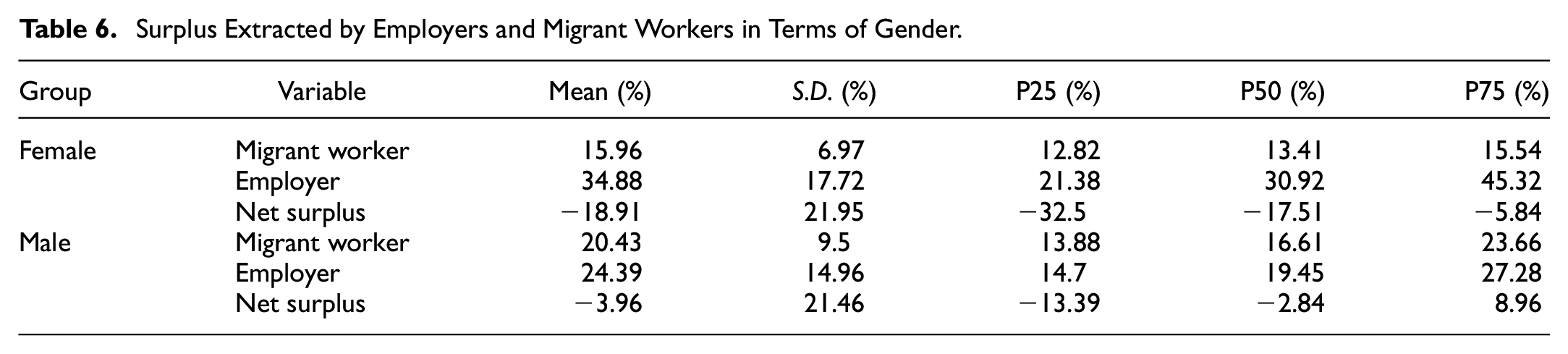
In general, a large part of migrant workers is found to suffer a wage loss, to different extents, because of employer’s superior bargaining position. The present study further investigates the existence of impact heterogeneity in bargaining power through measuring surplus extraction across the sample. Tables 6–8 present the size of surplus extracted by employers and internal migrant workers and its distribution in terms of gender, enterprise size, as well as ownership.
Surplus Extracted by Employers and Migrant Workers in Terms of Gender.
Surplus Extracted by Employers and Migrant Workers in Terms of Enterprise Size.

Surplus Extracted by Employers and Migrant Workers in Terms of Ownerships.

The net surplus of female migrant workers is, on average, considerably lower than that of the male (−18.91% vs. −3.96%). This relatively unfavorable situation for the female exists across almost the whole surplus extraction distribution; while the net surplus for men at the third quartile become positive, showing that these male migrant workers are able to receive additional wages relative to the benchmark wage relying their bargaining powers. One explanation to this result is that disadvantages faced by female migrant workers in manual jobs may exacerbate the existing discrimination in the labor market. As a result, employers who bargain with female migrants could extract surplus over 10% more than those who bargain with the male. Another reasonable explanation is that the female workers have less propensity to initiate wage bargaining with their employers (Bowles et al., 2007) and are more likely to fail in the bargaining process (Save-Soderbergh, 2007) relative to the male workers. As for enterprise size, Table 7 shows that internal migrant workers employed by the large-sized firms have relatively higher net surplus than those working in the small- and medium-sized firms. As can be seen, there is no significant difference between the surplus extracted by internal migrant workers in firms of different sizes; however, employers of the small- and medium-sized firms have relatively higher bargaining powers (29.47% and 29.17%) to put the wage squeeze on the benchmark wage that they should pay. Surplus extraction across different firm ownerships is shown in Table 8. The net surplus obtained by internal migrant workers who work in the foreign firms results in the relatively least wage reduction that are, at the mean, as much as 6.38% lower than the benchmark wage, compared with 9.65% for state-owned and collective firms; 10.15% for private firms; and 14.81% for other firms. Foreign firms are more willing to offer relatively higher wages to stabilize the labor turnover for the production and operation in local places. In addition, at the top end of net surplus distribution, the migrants in state-owned and collective as well as foreign firms have nearly identical bargaining powers to increase wage over 7% relative to the benchmark.
Evidence: The Influence of the Migrant Labor Shortage
The presence of the migrant labor shortage was reported in 2004 and since then, its various influences behind have been continuously discussed. Due to data limitation, the current study cannot conduct the analysis of comparing the results based on the specific period. As indicated above, the shortage of migrant labor mainly takes place in manpower-intensive manufacturing and construction industries. Thus, this study identifies the influence of the migrant labor shortage through an indirect way of comparing the net surplus extraction between manufacturing/construction and service industries and between production/processing and other occupations.
Although the net surplus of migrants in the manufacturing/construction industries is, at the mean, much higher than that of those in other industries (−7.56% vs. −12.25%, shown in Table 9), internal migrant workers of manufacturing/construction industries, in fact, do not contribute to their relative advantages in bargaining powers since the surplus extracted by internal migrant workers are nearly identical (18.55% vs. 18.18%), irrespective of either of industries where they work. The employers of manufacturing/construction industries are the true contributors whose surplus extracted are approximately 4% less than those of other industries, which suggests that the influence of the migrant labor shortage improves the migrants’ unfavorable situations in the bargaining process. Table 10 presents the surplus extraction in terms of occupations. The net surplus obtained by internal migrant workers in producing/processing occupations receive the relatively least wage reduction that are, on average, as much as 7.26% lower than the benchmark wage, followed by 7.32% for those in professional/technician occupation and 8.44% for managerial occupations. Even, looking at the distribution of net surplus extraction, migrant producing/processing workers at the upper quantile are able to increase their wages the highest by 5.48% compared to other occupations. The main contribution which is quite similar to the results with regard to the manufacturing/construction industries is sourced from the compromise of their employers, which further reinforces the existence of the influence of migrant labor shortage.
Surplus Extracted by Employers and Migrant Workers in Terms of Industries.

Surplus Extracted by Employers and Migrant Workers in Terms of Occupations.

Evidence: Signaling of Limited Choices Hypothesis
Taking into account the job search method, the present study further compares the difference in net surplus extraction between internal migrant workers using formal search and informal search methods to examine the signaling of limited choices hypothesis. In Table 11, at the mean, the surplus extracted by internal migrant workers obtaining jobs through informal search methods could increase wages, relative to the benchmark, by 17.99% which is slightly lower than those through formal search methods do; while the surplus extracted by the employers whose migrant workers find their jobs via informal search methods could decline wages by 29.45% which is higher than those whose migrant workers use formal search methods do. The opposite effects finally indicate that the use of informal search would cause a wage reduction to the migrants. The results provide the evidence of the signaling of limited choices hypothesis in this study. The informal search mainly based on social network would convey internal migrant workers’ limited choices of job alternatives or high likelihoods of limited productivity to the employers. Thus, employers easily hold more information of migrant workers and therefore more easily take an advantage of surplus extraction to reduce the wages relative the benchmark level.
Surplus Extracted by Employers and Migrant Workers in Terms of the Job Search Methods.

Conclusion
Using micro data from CHIP 2013, this study employs a two-tiered SFA model to measure the bargaining power of employers and internal migrant workers in the urban labor market in China. The results indicate that the surplus extracted by internal migrant workers, on average, results in an increase in wages relative to the benchmark level, while the surplus taken by employers decreases the wage. Employers, by and large, are found to possess a relatively stronger position in the wage-bargaining process. As the goal of any firm is to maximize profit, the employers take advantage as much as they could to minimize the cost particularly the cost of labor. Thus, in general, the influence of bargaining power on the wage determination of internal migrant workers is negative, suggesting that bargaining power will decrease the observed wage relative to the benchmark wage which is associated with worker’s actual productivity. Internal migrant workers have no choice but to accept any job offers out of necessity for survival. Additionally, the jobs and occupations filled by internal migrant workers are often low skilled and characterized by the 3-Ds. The implication of migrant weak bargaining power is reflected by their demotivation to migrate to the city.
However, not all internal migrant workers accept wages lower than the benchmark level. At the upper quantile, the migrants obtain a positive net surplus and increase their wages above the benchmark wage. The male migrant workers and those employed in the large-sized or foreign firms possess relatively stronger bargaining power and suffer less wage reductions than others.
The present study finds the evidence of the influence of migrant labor shortage in the wage bargaining process. Excessive demand for migrant labor, particularly producing and processing workers, in the manufacturing and construction industries is the important expression of shortage phenomena. The results show that the migrant workers in the manufacturing and construction industries or producing and processing occupations extract surplus nearly identical to other groups; what is different, however is that, their employers have to compromise in the bargaining process. Thus, migrant labor shortage improves the migrants’ unfavorable situations, to some extents. In addition, this study reveals that the migrant workers who obtain jobs via informal job search methods stand in a weak bargaining position relative to those using formal search methods, which is consistent with the Antoninis’s (2006) findings and supports signaling of limited choices hypothesis.
The empirical evidence of this study raises policy challenges with regard to labor market development in China. The non-autonomous Chinese trade unions do not fully play a protecting role for workers, especially internal migrant workers. The vast majority of them are unaware of their participations in trade unions. The deep reforms of the trade unions should be pushed forward to effectively give more voice to migrant workers and genuinely take care of their most pressing concerns. Meanwhile, the web-based platforms, such as Recruitment Advisor launched by the International Trade Union Confederation should be established to provide local labor market information and transparency to migrant workers, which not only increases their bargaining powers because of more job alternatives, but, in turn, alleviates the shortage of migrant labor to some extents. A conducive working condition, attractive wage offer, and strong employment protection should be considered to retain a consistent supply of internal migrant workers. Additionally, policymaker should review and strengthened existing discrimination law against minority group to reduce subjective and prejudice element in employment.
Further research can be conducted in light of the shortcomings and puzzling findings of present study. The current study presents the static results, but fails to describe the dynamics of bargaining power over time. The measure of the variation in the bargaining power of internal migrant workers over time will be analyzed further in a forthcoming paper. A macroscopic environment (e.g., migrant labor shortage) has a large influence on the surplus that can be extracted by internal migrant workers. One direction of the future research could include the examination of the effects of labor supply shock on the bargaining power of internal migrant workers. More specifically, such an examination should distinguish between the effects of labor supply shock on variables of interest.
Footnotes
Declaration of Conflicting Interests
The author(s) declared no potential conflicts of interest with respect to the research, authorship, and/or publication of this article.
Funding
The author(s) received no financial support for the research, authorship, and/or publication of this article.

Data Availability Statement
Data will be made available upon reasonable request.