




Abstract
This study aimed to uncover the trend of mental health in China over the years and the influence of related social factors. This study employed a cross-temporal meta-analysis (CTMA). The study analyzed 182 studies from 1993 to 2017. A total of 83,603 participants were included in 182 studies. Symptom Checklist-90 (SCL-90) Scale. From 1993 to 2001 and from 2004 to 2017, the scores for each dimension for mental health of older adults were relatively stable, and the absolute value of the effect size was between 0.02 and 0.62. From 2001 to 2003 and from 2003 to 2004, the scores of each dimension of older adults changed greatly. From 2001 to 2003, the total mean score of SCL-90 and the scores of different dimensions in older adults showed a rapidly decreasing trend, with the d ranging from −0.40 to −0.93. From 2003 to 2004, the scores of all dimensions in SCL-90 showed a trend of sharp increase, and the d of each dimension was 0.40 to 0.89. The mental health status of the older adults is declining as a whole and has a large fluctuation from 2001 to 2004 various social development indicators, including Gross Domestic Product (GDP), per capita, divorce rate, unemployment rate, and Engel’s coefficient, demonstrated a significant correlation with mental health status
Plain Language Summary
Little is known about the long-term trends in mental health of older adults. A cross-temporal meta-analysis was performed to analyze 182 studies on mental health of the older adults. The mental health status of the older adults is declining as a whole, it showed a sharp upward trend from 2001 to 2003 and a sharp downward trend from 2003 to 2004. Gross Domestic Product (GDP), per capita, divorce rate, unemployment rate, and Engel’s coefficient were significantly correlated with the mental health. Major social events such as social emergencies may explain dramatic changes in mental health among older adults.
Keywords
Introduction
Recently, the global population has been aging rapidly and the size of the older population has increased significantly, with the fastest growth rates occurring in developing countries (Mitchell & Walker, 2020). China is a developing country with the largest population of older adults in the world. According to the Chinese National Bureau of Statistics (2020), by the end of 2019 in China, the population aged 60 and above had exceeded 250 million, accounting for 18.1% of the total population. The typical features of China’s aging population include its large base, rapid growth rate, and facing heavy social burden (Chen, 2004). The increasing rate of aging has further highlighted the mental health problems of older adults, leading to widespread concern.
This stage of old age is unique in that many significant changes occur, such as retirement, facing functional decline, loss of a partner, housing, or changes in socio-economic status (World Health Organization, 2017). These significant changes can potentially contribute to mental health problems among older adults. Mental health is a stable psychological state in which the individual’s internal psychology is harmonious and consistent and adapts well to the outside (Fu et al., 2023). The World Health Organization found that up to one-fifth of the elderly population experienced various mental health problems, including anxiety, depression, decreased sensory perception, memory decline, changeable personality, cognitive disorder and even Alzheimer’s disease (G. L. Yu, 2022). There are many tools to measure the mental health level of the elderly, but most of them adopt the Symptom Checklist 90 (SCL-90) compiled by Derogatis et al. (1973).
Previous studies have shown that when the mental health of older adults declines, many adverse consequences and even social problems will follow (Janni et al., 2018). For example, a study indicates that physical health is closely related to mental health, and a poor mental state will lead to a further decline in physical function and a decrease in life quality (K. Zhao et al., 2014). Furthermore, when older people are in a state of healthy body and mind, they are more able to experience the joy of life and experience higher subjective well-being (Elliot, 2016). In contrast, poor mental health is significantly associated with lower life satisfaction and subjective well-being in later life (Luan et al., 2012). More importantly, an increase in the proportion of older adults and with the higher risks of decline in physical and mental health will create huge demands on pensions and health care, resulting in an economic burden for the nation (Harper, 2014). Therefore, the mental health of older adults has drawn the national government and society more extensive attention. Therefore, the trend of development and factors influencing mental health of older adults have increasingly become one of the most urgent topics in academic research and policy formulations (J. Yang, 2020).
Previous research has studied the changes in the psychological state of older Chinese adults. A CTMA by Yan et al. (2014) found that the loneliness levels of older adults in China increased by 1.02 SDs from 1995 to 2011, implying increased loneliness among older adults, which may be attributed to the decrease in social bonds and social relationships (Drennan et al., 2008). Furthermore, Shao et al. (2013) found that the mean score of depressive symptoms among Chinese older adults increased by 0.53 SDs between 1987 and 2010, and the level of depression has gradually increased over the years. Although these studies have explored the growth pattern of mental health in older adults, they have examined only one aspect of mental health among older adults and did not examine other aspects, such as depression, anxiety, etc. A study in 2015 showed that the five most common psychological problems in China older adults from 2000 to 2010 were somatization, depression, anxiety, obsessive-compulsive and phobic anxiety (Teng et al., 2015). This suggests that we need to have a more complete grasp and understanding of the mental health of older adults by considering different aspects of mental health.
Social development indicators are the basic gauge to measure the development level of each society, and they are also important technical tools to promote social and global development (Wang, 2018). The main social development indicators include human development index, material quality of life index, social progress index, per capita GDP, unemployment rate, divorce rate, Engel coefficient and so on (Chen & Miao, 2015; X. C. Xu et al., 2021). These indicators hold significant relevance to the well-being of individuals, particularly older adults. As older persons heavily rely on social welfare and pension systems, in addition to familial support, social development indicators have a profound impact on their mental health from a macro perspective.
A series of studies have shown that the trend for mental status is associated with family socioeconomic status, quality of life, marriage, and other factors (Butterworth et al., 2009; Luppa et al., 2012). High socioeconomic status is conducive to the physical and mental health of the older adults (Hoshi et al., 2013). Engel’s coefficient is often used internationally to measure the living standards and living conditions of a country and local people (S. F. Zhang, 2006), and it refers to the proportion of the total food expenditure in the total household consumption expenditure (X. H. Yu, 2018). With the development of the economy and the increase of residents’ income, and the proportion of food expenditure in the total household expenditure tends to decline, which can reflect the continuous improvement of people’s living standards (J. Yang, 2020). This may be a positive factor in improving mental health in older adults. In addition, family factors also play an important role in older adults (H. Yang et al., 2020). Researchers have found that being unmarried (such as divorce or widowing) has a negative impact on the health of older adults (Umberson et al., 2010; Waite & Gallagher, 2001). Since people have access to all kinds of resources through marriage, the dissolution of marriage will create a crisis (Williams et al., 2017). Furthermore, the influence of the employment rate on older adults should not be ignored. The rise of the unemployment rate is determined by population, economic development, industrial structure, and other factors. For individuals, the increase of social unemployment rate will lead to difficulties in job hunting and excessive occupational pressure, which will lead to mental health problems such as anxiety, stress and depression (Jiang, 2019). To sum up, we concur that employing social development indicators such as divorce rate, Engel’s coefficient, and unemployment rate index is imperative in examining the correlation between these factors and the mental health of older adults.
Attention also be paid to the influence of serious social events, such as large range spread virus that covered nearly all over the world. These public health emergencies brought great psychological pressure to society and trigger a more complex social psychological problem (Cai, 2016). According to a study, when severe acute respiratory syndrome coronavirus (SARS) was prevalent in some parts of China, the mental health status of older adults appeared to have an obvious drop, whose scores of anxiety, depression, and terror were significantly higher than the national norm, reflecting increased significant somatization symptoms (Y. H. Li et al., 2003). Lau et al. (2008) also found that the prevalence of post-traumatic stress disorder in older residents increased significantly after SARS. In 2009 large-scale outbreak of swine influenza (such as H1N1) caused panic and fear on a global scale, and during same period, the risk of mental health of people greatly increased (Zangeneh, 2009). In addition, World Health Organization (2020) pointed out that the older adults, especially those who were isolated or cognitive decline during the outbreak of the novel coronavirus pneumonia (COVID-19) might become more anxious and withdrawn (Sandoiu, 2020). From previous research, major serious social events invariably have an important influence on older people; they made the mental health of older adults dramatically change in a short time (Bradley et al., 2005). Furthermore, the index of economic development of counties, like the Gross Domestic Product (GDP), can also have a certain influence on the mean change in mental health in older adults, as older adults can accept the support from medical services and other care projects built by national revenue.
In summary, previous studies have not examined the effects of social development indicators (e.g., divorce rate, unemployment rate, GDP per capita) from a macro perspective and have also failed to analyze major social events on the mental health of older adults.
Therefore, this study used the CTMA technique to integrate previous studies and comprehensively explore the development trend of the mental health of the elderly in China over the years, as well as the impact of relevant social factors. We will achieve this goal by analyzing SCL-90 scale and its nine-dimensional score changes for many years. In addition, the impact of social development indicators (such as divorce rate, Engel’s coefficient) and major social events on the mental health of the elderly will also be discussed.
Methods
Material
SCL-90 scale has become one of the most widely used mental health scales in China (J. Li, 2007), which includes Somatization (S, 12 items, such as “headache”); Obsessive-Compulsive (OC, 10 items, such as “worrying about neat clothes and proper manners”); Interpersonal Sensitivity (IS, 9 items, such as “be perfect to others”) and Depression (D, 13 items, such as “decline in interest in the opposite sex”), Anxiety (A, 10 items, such as “nervousness and insecurity of mind”); Hostility (H, 6 items, such as “easy to worry and excited”), Phobic Anxiety (PA, 7 items, such as “fear of empty Spaces or streets”); Paranoid Ideation (PI, 6 items, 9 items, such as “blaming others for causing problems”); Psychoticism (P, 10 items, such as “feel like someone else has control over your thoughts”) and Others (O, 7 items, such as “having a poor appetite”). Participants were asked to choose their experience on the 5-point Likert scale, with 1 representing “no” and 5 representing “severe.” The higher the score, the worse the state of mental health. Since most of the literature in our database provided only data on the first nine dimensions, this study only analyzed the first nine dimensions.
Literature Collection and Exclusion
According to the principle of literature screening of Z. Q. Xin and Zhang (2009), the literature screening criteria in this study were as follows: (1) SCL-90 scale was used as a measurement tool in the study; (2) descriptive statistical results (N, M, SD) of the first 9 dimensions of SCL-90 were reported in the study at least; (3) participants were all older adults from mainland China, excluding those from ethnic Chinese, Hong Kong, Macao, and Taiwan. They were over 55 years old and had no significant physical or mental illnesses; and (4) for longitudinal data, if participants were in the same group, the data of the certain year would be randomly selected for input. If the samples were different from year to year, the data would be divided into different data for input according to the data collection year (only one literature fitted in this condition).
The literature exclusion criteria for the present study were: (1) studies in which participants were selected according to special criteria, such as special scores on certain tests; (2) the particularity of research methods. For example, the intervention study only used data from its control group before testing; (3) studies were unclear or had obvious errors in the basic data (N, M, SD); (4) when the same data set from the same author was repeatedly published, only the literature with the earliest published time was selected for input, and others were deleted; and (5) to avoid duplication of literature, a meta-analysis was excluded (Twenge et al., 2010).
The literature was collected from CNKI, Chongqing VIP, Wanfang Database, Excellent Master’s Thesis, Excellent Doctoral Dissertation, Elsevier, ProQuest, Wile, Web of Science, MEDLINE, and other databases, using keywords such as “SCL-90,”“older adults,”“mental health,”“older people,”“Chinese older adults,”“older adults and SCL-90,”“older adults and mental health,”“Chinese older adults and SCL-90” and so on. After the search and collection, a total of 238 literatures were obtained. Then, all literature was screened by the literature exclusion criteria, and the ones that did not meet the criteria were deleted. Finally, 182 valid literatures were obtained. According to the previous coding method of cross-sectional meta-analysis, if the data that did not indicate the sampling year, the sampling year was recorded as the year that subtracted 2 years from the time of publication (Twenge, 2001a). This study covered a period from 1993 to 2017, and 83,603 participants were included. The specific literature information is shown in Supplemental Table S1.
Social Development Indicators
To better understand the relationship between social changes and mental health in older adults, some indicators of social development were selected for analysis. The selection principles of social development indicators were as follows: (1) Social indicators were meaningful continuous variables and could be obtained; (2) Social development indicators had good social representation and were more sensitive to social changes; and (3) They were related to the older adults. Therefore, five social indicators were selected, including the divorce rate, the unemployment rate, the GDP per capita, the Engel coefficient of urban households and the Engel coefficient of rural households (Z. Q. Xin & Chi, 2008a). Relevant data were obtained on the official website of the National Bureau of Statistics (China) to establish a database of social indicators.
Literature Coding and Collation
After the selection of literature, the 182 literatures were further coded and classified. In the literature entry process, the literature was numbered according to the year of publication, then the data (N, M, SD) and various information from the literature were recorded. The number of literature and the number of participants for each category were shown in Supplemental Table S2. For the literature that only provided the data of sub-studies, the data of sub-studies were recorded in the code table, and the following formula was used to synthesize the weighted data of sub-studies to obtain the total research results.
Formula 1:
Formula 2:
X, ST, ni, xi, and si respectively represent the synthesized mean and standard deviation, sample size, mean, and standard deviation of a certain study (Z. Q. Xin et al., 2011).
Statistical Analyses
The present study employed the CTMA method to examine the extent of change in average mental health scores among older adults over time, based on its relevance to the study years. The CTMA technique is commonly employed, for example, by social psychologists (e.g., Twenge, 2000; Twenge & Campbell, 2001, 2008) to examine changes in scores across different time periods.
This method was proposed by the American scholar Twenge (2001b). This method is a meta-analysis study using a cross-sectional study “design” for large span time or the differences or variation associated to salient historical events (Twenge, 2001b). The “design” here is not pre-structured as tracking studies but “post hoc,” making existing studies a cross-sectional sampling (Z. Q. Xin & Chi, 2008b) for historical development.
Compared with traditional meta-analysis methods, this method treats the age effect as a system variable rather than merely a random variable. This change enables us to more comprehensively describe the trend of microvariables changing with age or socio-economic environment.
Results
The Overall Mean Score of SCL-90 Scale and Each Dimension of Older Adults Changed with Year
Figure 1 shows the broken line graph of the scores for each dimension for SCL-90 over the year. In Figure 1, the overall mean score of SCL-90 and the mean scores of nine dimensions of older adults presented phased changes. Specifically, it showed a relatively stable trend from 1993 to 2001; from 2001 to 2003, there was a significant decrease; there was a sharp increase between 2003 and 2004; and from 2004 to 2017, it showed a stable and slightly rising trend.

Trend of the scores of various dimensions.
Therefore, this study divided the time period into four stages: from 1993 to 2001, the period from 2001 to 2003, the period from 2003 to 2004, and the period from 2004 to 2017. Based on previous studies, this study adopted effect sizes d and r2 to measure the degree of score change (Twenge & Campbell, 2001; Twenge & Im, 2007; Z. Q. Xin & Zhang, 2009). Table 1 shows the changes in the mean score of SCL-90 and the scores for each dimension. Mx is the weighted average score of X years, My is the weighted average score of Y years (Y > X), SD is the mean standard deviation between X and Y, d represents the size of the effect size, and r2 represents the explanatory rate of year to score change. The calculation method is as follows: SD = sx2 (nx − 1) + (ny − 1) sy2)/(nx + ny − 2), d = (Mx − My)/SD, r =
Average Variation Trend of SCL-90 in Each Stage from 1993 to 2017.

Note. SD is the mean standard deviation of years in each stage, d represents the degree to which the score of a psychological indicator in each cross-sectional history study changed from the score in the starting year to the score in the end year (the score in the last year of a period minus the score in the first year, then divided by the mean standard deviation of the data over the years). R2 is the coefficient of determination. S = somatization; OC = obsessive-compulsive; IS = interpersonal sensitivity; D = depression; A = anxiety; H = hostility; PA = phobic anxiety; PI = paranoid ideation; P = psychoticism.
The calculation method is as follows:
From 1993 to 2001 and from 2004 to 2017, the scores for each dimension of mental health in older adults were relatively stable, and the absolute value of the effect size was between 0.02 and 0.62, most of which were small effects. Only the effect d of the changes in the obsessive-compulsive dimension from 1993 to 2001 reached 0.62 (Cohen, 1992).
From 2001 to 2003 and from 2003 to 2004, the scores in each dimension of older adults changed greatly. First of all, from 2001 to 2003, the total mean score of SCL-90 and the scores of different dimensions in older adults showed a rapidly decreasing trend, with the d ranging from −0.40 to −0.93, which could respectively explain the variation of 4.4% to 28.2%, and the d of interpersonal sensitivity and anxiety factors being 0.93 and 0.86, respectively. Secondly, from 2003 to 2004, the scores of all dimensions in SCL-90 showed a trend of sharp increase, and the d of each dimension ranged from 0.40 to 0.89, among which the d of Phobic Anxiety, Paranoid Ideation and Psychoticism were more than 0.6, which could explain the variation of 3.6% to 16.2% respectively. These results indicate that the mental health of older adults showed a significant improvement from 2001 to 2003 and then a sharp deterioration from 2003 to 2004 (most effect sizes are medium to large).
The Relationship Between Social Development Indicators in Different Years and the Mental Health of Older Adults
A correlation analysis was conducted between the dimension scores of the four stages and the social development indicators of the same year, 5 and 10 years ago to further investigate relationship between social development indicators and the mental health of older adults. Table 2 shows the results of the mental health and social development index from 1993 to 2001. In general, the scores of SCL-90 of older adults were significantly positively correlated with the divorce rate, GDP per capita, and unemployment rate, while they were significantly negatively correlated with the Engel family coefficient. These results suggest that GDP, divorce rate, and unemployment rate have a negative predictive effect on the mental health of older adults, while Engel’s coefficient for rural and urban households is the opposite.
Correlation Coefficients Between Mental Health and Social Development Indicators of Older Adults from 1993 to 2001.

Note. S = somatization; OC = obsessive-compulsive; IS = interpersonal sensitivity; D = depression; A = anxiety; H = hostility; PA = phobic anxiety; PI = paranoid ideation; P = psychoticism. GDP = GDP per capita; E-U = Engel coefficient of urban household; E-R = Engel coefficient of rural households; D-R = divorce rate; U-R = unemployment rate. 5 = 5 years ago; 10 = 10 years ago.
p < .05. **p < .01. ***p < .001.
Table 3 shows the correlation between mental health and social development indicators of older adults from 2001 to 2003. In general, the scores of SCL-90 for older adults show a significantly positive correlation with the unemployment rate and GDP, while a significantly negative correlation with the Engel family coefficient.
Correlation Coefficients Between Mental Health and Social Development Indicators of Older Adults from 2001 to 2003.

Note. S = somatization, OC = obsessive-compulsive, IS = interpersonal sensitivity, D = depression, A = anxiety, H = hostility, PA = phobic anxiety, PI = paranoid ideation, P = psychoticism. GDP = GDP per capita; E-U = Engel coefficient of urban household; E-R = Engel coefficient of rural households; D-R = divorce rate; U-R = unemployment rate; 5 = 5 years ago; 10 = 10 years ago.
p < .05. **p < .01. ***p < .001.
Table 4 shows the correlation between mental health and social indicators among older adults from 2004 to 2017. The scores of SCL-90 were significantly correlated with GDP, Engel family coefficient, divorce rate, and unemployment rate. The relationship between mental health and social indicators of older adults shows a reverse trend from 2004 to 2017 and from 2001 to 2003. The results show that GDP, divorce rate, and unemployment rate were significantly negatively correlated with scores of all dimensions, while Engel’s coefficient of urban and rural families was significantly positively correlated with scores of all dimensions.
Correlation Coefficients Between Mental Health and Social Development Indicators of Older Adults from 2004 to 2017.
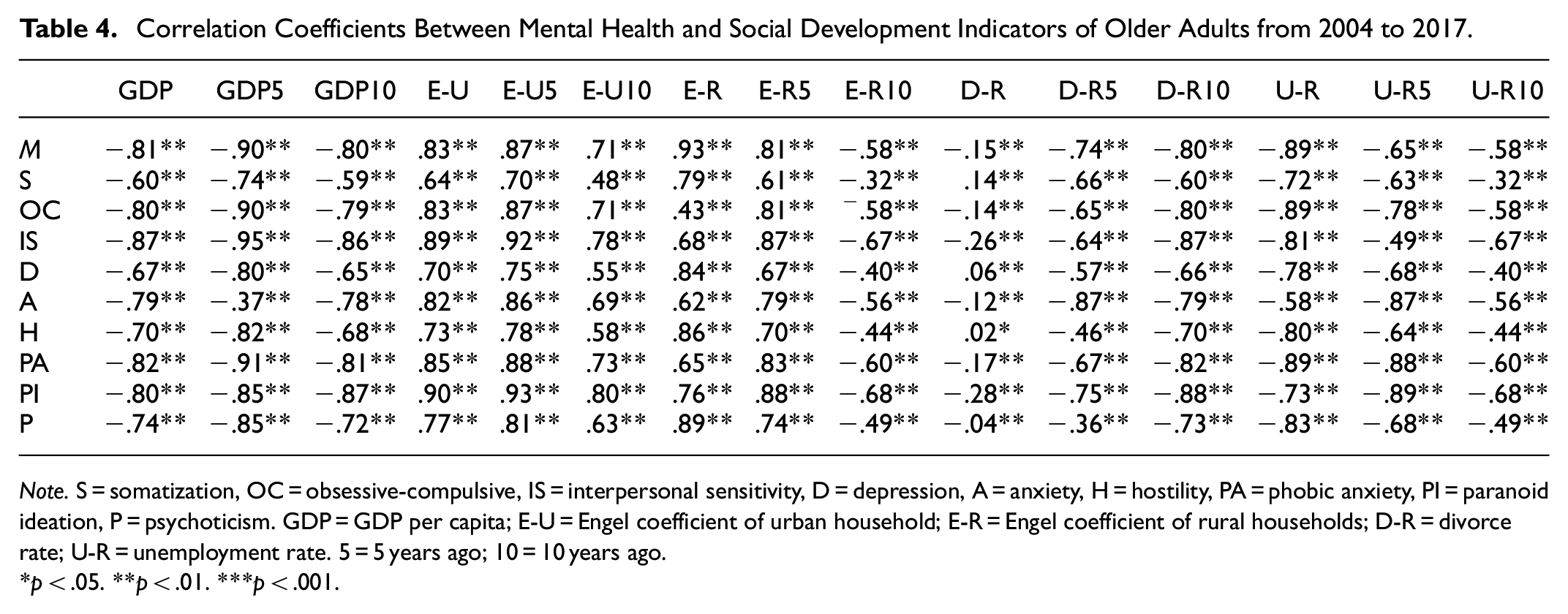
Note. S = somatization, OC = obsessive-compulsive, IS = interpersonal sensitivity, D = depression, A = anxiety, H = hostility, PA = phobic anxiety, PI = paranoid ideation, P = psychoticism. GDP = GDP per capita; E-U = Engel coefficient of urban household; E-R = Engel coefficient of rural households; D-R = divorce rate; U-R = unemployment rate. 5 = 5 years ago; 10 = 10 years ago.
p < .05. **p < .01. ***p < .001.
Discussion
Changes in the Mental Health of Older Adults and the Impact of Major Social Events at Different Stages from 1993 to 2017
Overall, there was a slight decline in the mental health of older adults in China between 1993 and 2017, which was consistent with the results of N. Zhao and Lai (2020). Interestingly, we found significant fluctuations in the mental health of older adults: an increase in 2001 to 2003 and a significant decrease in 2003 to 2004. Therefore, we divided the period into four phases according to the trend (1993–2001, 2001–2003, 2003–2004, and 2004–2017) to get a more accurate picture of the changes.
During the period 1993 to 2001, the mental health status of older adults showed a stable trend. In 1978, China entered a stage of economic reform, which led to unprecedented changes in the economic and social development, might have affected people’s mental health to some extent. However, in 1993 to 2001, China’s economic reforms had lasted 15 to 25 years, and the Chinese population had gradually adapted to this social change. This led to general social stability and development, which was conducive to stable mental health of older adults. Furthermore, China’s social security system was gradually improving between 1993 and 2001 and had undergone two major transformations: first, from supporting the reform of state-owned enterprises to supporting the reform of the socialist economic system; and second, from transformational problem solving to stereotyped development (J. Xu, 2019). Therefore, the relative stability of China’s social development between 1993 and 2001 may be the basis for the stable mental health levels exhibited by older adults.
Socio-environmental factors, such as economic, cultural, and social factors, and major national historical events typically have a slow and sustained impact on people’s mental health (Twenge et al., 2019). Pruchno et al. (2017) investigated the impact of the 2008 recession and life events on the mental health of 3,393 older adults in New Jersey and found that there was a notable rise in depressive symptoms from 2006 to 2012. A longitudinal study from Korea showed that both social factors and social activities contributed to life satisfaction and mental health in older adults (Lee & Lee, 2011). China’s reform, which lasted for more than 20 years since 1978, led to the substantial accumulation and enhancement of material wealth throughout society. In the following period, the state developed many welfare measures related to older adults, such as the reform of the health insurance and old age insurance systems and the legalization of the minimum livelihood guarantee system for urban residents (Liu, 2019). The continued cumulative effect of these social changes may have led to a rapid improvement in the mental health of older adults in China between 2001 and 2003.
Between 2003 and 2004, there was a sharp decline in the mental health of older adults, which is consistent with previous research. For example, N. Zhao and Lai (2020) found a significant decline in mental health in older adults after 2003. Pruchno et al. (2017) argued that sociohistorical events and personal experiences can alter the psychological status and aging patterns of older adults. Empirical studies have also found that major social crises can affect an individual’s mental health. The massive H1N1 influenza outbreak in 2009 caused global panic and concern, which significantly increased mental health risks (Zangeneh, 2009), particularly among older adults in developing countries, who showed higher rates of suicide and mortality than other groups. Therefore, this age group has the highest risk during outbreaks (Chan et al., 2009). Recent studies related to the 2019 coronavirus disease (COVID-19) pandemic have shown that high impact public health events can trigger a wide range of public mental health problems and increase the prevalence of mental disorders (including PTSD, anxiety disorders, depression, and somatization) (Júnior et al., 2020; Shigemura et al., 2020; W. Zheng, 2020). In 2003, China experienced an unprecedented epidemic of severe acute respiratory syndrome (SARS) (Guan et al., 2003). Due to its declining physiological functions, SARS is much more harmful toddler adults than younger ones. Thus, in addition to its physical impact, SARS had an immediate negative impact on the mental health of older adults. Therefore, between 2003 and 2004, the mental health of older adults in China showed a trend of sharp decline.
Between 2004 and 2017, the mental health status of older adults showed a slow downward trend. The relatively stable mental health status of older adults during this period could be due to the relative stability of China’s social development during that period, while the slight decline may be closely related to the overall social environment in China. What is clear is that anxiety, depression, and loneliness among older adults have increased over the past year (Shao et al., 2013), while social support has decreased, which is an important contributor to the decline in mental health among older adults (S. F. Xin et al., 2018). Modernization theory (Cowgill & Holmes, 1972) states that as societies become more modernized, the status of older adults will tend to decline (Silverstein et al., 1998), and their mental health may therefore show a slow downward trend. It is worth noting that the changes in depression between 2009 and 2017 were odd, as they first showed an increase that peaked in 2011, followed by a sharp decline. This trend is consistent with the findings of Shao et al. (2013).
Relationship Between Social Development Indicators and the Mental Health of Older Adults
Our findings indicated that the level of mental health among older adults was significantly negatively correlated with the GDP per capita, divorce rate, and unemployment rate of the current year, and those of 5 and 10 years ago. However, it was significantly positively correlated with the Engel coefficient of urban households and with that of rural households of the current year, and with those of 5 and 10 years ago. First, the mental health of older adults was significantly correlated with GDP per capita in the same year and in 5 and 10 years ago. Economic level and economic status can affect mental health and well-being (David, 2018). However, during periods of rapid social development, the increase in GDP per capita will inevitably be closely related to a faster pace of life and work (H. Zheng & Wang, 2012), resulting in higher levels of stress. In the late 20th and early 21st centuries, China paid special attention to the growth of GDP indicators, giving rise to a GDP-centric culture in some regions. Under the influence of these social environments, excessive focus on the speed rather than quality of development led to a widening gap between the rich and the poor, prominent social conflicts, serious environmental pollution, and other major social problems (Shen, 2010), decreasing their mental health status.
Second, divorce and unemployment rates were significantly negatively correlated with the mental health of older adults, which is consistent with existing research findings. A study of Chinese older adults examined changes in loneliness in this population over a 25-year period from 1995 to 2011 and found that social development indicators, such as divorce and unemployment rates, significantly predicted loneliness (Z. B. Yang et al., 2014). The study of Twenge (2000) also showed that social change plays an important role in predicting changes in anxiety. This is because the rising rates of divorce and unemployment have affected the stability of the family structure and the economic conditions of the household, creating more stress and insecurity among family members. Therefore, the higher the rates of divorce and unemployment (which are negative social development indicators) for the current year, and 5 and 10 years ago, the lower the mental health of older adults. Finally, studies have shown that social variables, such as Engel’s coefficient, are important factors that influence well-being (J. H. Zhang, 2012), while subjective well-being is inseparable from mental health (Yu et al., 2016). Therefore, the Engel coefficient of urban and rural households is a protective factor for the mental health of older adults. Recently, the disposable income of Chinses residents has increased and Engel’s coefficient of urban and rural households is constantly decreasing, while the quality of family life is improving. This has positive implications for improving the mental health of older adults.
Limitations and Future Directions
Inevitably, there are still some limitations to this study. First, the stages of the mental health status of older adults and their correlation coefficients with different social development indices are not the result of inferential statistics, and future research could adopt more advanced statistical methods to analyze the data and verify the results. Second, this study only focused on older adults without serious physical and mental disorders, and future studies could include a broader population of older adults. Third, in terms of measurement tools, this study chose the most common mental health scale-SCL-90 scale. However, studies using other tools such as the Mental Health Inventory (PHI) were excluded. In future studies, a cross-temporal meta-analysis of the literature can be performed using other measurement tools to more comprehensively analyze the changing trend of mental health in older adults.
Conclusions
The primary purpose of this investigation was to systematically review the trend of mental health among older adults in China over the years and the influence of related social factors. The analysis involved the utilization of CTMA to analyze 182 studies conducted from 1993 to 2017. These reviews show that the mental health status of older adults in China has changed over time and is closely related to the country’s social development indicators. Additionally, major social events potentially impact their mental health.
In general, the trend in the mental health of older adults in China is declining. This trend can be divided into four stages: from 1993 to 2001 and 2004 to 2017, showing a relatively stable trend; from 2001 to 2003, a sharp upward trend; and from 2003 to 2004, a sharp downward trend. Moreover, the mental health of older adults was significantly correlated with social development indicators such as GDP per capita, divorce rate, unemployment rate, and Engel’s coefficient. Major social events may also partly explain the changes. However, there is limited research on how different major social events specifically affect the changes in the mental health status of older adults in China, so future research can focus on this, as major social events are also important factors affecting mental health.
Supplemental Material
sj-docx-1-sgo-10.1177_21582440241259419 – Supplemental material for Changes in the Mental Health Status of Older Adults in China and the Impact of Social Factors: A Cross-Temporal Meta-Analysis, 1993 to 2017
Supplemental material, sj-docx-1-sgo-10.1177_21582440241259419 for Changes in the Mental Health Status of Older Adults in China and the Impact of Social Factors: A Cross-Temporal Meta-Analysis, 1993 to 2017 by Xiying Li, Xiao Liang, Hongjuan Ling, Xiaohui Ma, Xingyu Zhang and Zhongling Pi in SAGE Open
Footnotes
Authors’ Contribution
Zhongling Pi and Xiaohui Ma: Conceptualization, interpretation of data, drafting the manuscript. Xiao Liang and Hongjuan Ling: Data collection and analysis data, revising the manuscript critically for important intellectual content. Xingyu Zhang: Data collection and analysis data. Xiying Li: Funding acquisition and conceptualization.
Declaration of Conflicting Interests
The author(s) declared no potential conflicts of interest with respect to the research, authorship, and/or publication of this article.
Funding
The author(s) disclosed receipt of the following financial support for the research, authorship, and/or publication of this article: This study was supported by the Ministry of Education of Humanities and Social Science Project (23YJA880026).
Ethical Approval
This study was granted exemption by the ethics committee of Shaanxi normal university.
Informed Consent
Written informed consent did not required to obtain because our research is a cross-temporal meta-analysis.

Data Availability Statement
Our data and material are not yet available online in any institutional database. However, we will send the whole data package and material by request. The request should be sent to Professor Zhongling Pi:
Supplemental Material
Supplemental material for this article is available online.