




Abstract
The study investigated “perception of decent work (DW) and Employee Commitment: the mediating role of Job Satisfaction; to determine the extent to which employees” perception of DW influences their commitment to work. Specifically, the study sought to find out how job satisfaction mediates the relationship between the perception of DW and employee commitment. A cross-sectional survey research design of employees of tertiary institutions (Universities), as well as corporate organizations (multinational companies), in Nigeria was employed. A structured questionnaire elicited the required data from the randomly sampled respondents. Confirmatory factor analysis served to validate the instrument while Cronbach’s alpha served as the reliability test. The data were analyzed using structural equation modelling. The results indicate that social marginalization and work volition are significant predictors of DW, job satisfaction mediates the relationship between DW and employee commitment with partial mediation on the informalization of organizations and full mediation on the rest variables. Work volition and career adaptation have positive influences on employee commitment while informalization of organization and social marginalization have negative influences.
Introduction
Efficiency is an instrument of competitiveness because it can give a firm some cost advantage and position it ahead of its competitors. This explains why management focuses on it. In addition, it is complementary to organizational effectiveness. While a firm becomes efficient by doing things right, doing the right thing makes it effective. Three common techniques are often used in cost reduction, they are casualization of labour, human resource outsourcing, and automation of the business process (Egbule et al., 2016; Seth & Sethi, 2011). Ironically, these techniques are against the interest of labour because of the perceived degree of indecency inherent in each of them on the general welfare of workers. To this end, industrial and labour unions are not comfortable with these techniques, since it is glaring that they all have negative consequences on workers, especially as regards the size of the workforce, which is often the casualty. Employers of labor must meet their obligations to the employees who work for them but at the same time, they cannot afford to compromise the objective of the firm with respect to profit maximization. The trade-off between the extent to which the obligations to the employees are met and the maximum profit obtainable defines the degree of DW or otherwise (Khan, 2017).
It is now generally agreed that employee contribution is an important business issue because it helps in the production of more with less (Ugwu et al., 2013). There are so many factors that predict corporate survivability and competitiveness, some of these factors include the maximization of profits from existing capabilities, bearing in mind the dynamic nature of the business environment and hence the need to understand that what may work today may not necessarily work in the future” (Kortmann et al., 2014; Osborne & Hammoud, 2017). This, according to Kortmann et al. (2014) requires that employers and strategic managers come together and dialogue with the employees to win their confidence and make them committed to the goals of the organization since employee engagement makes a meaningful contribution to the enhancement of organizational outcomes (Dajani, 2015; Jha et al., 2019; Osborne & Hammoud, 2017).
Work life is very important and it occupies a significant proportion of the entire life of people. This makes meaningful work-life critical to an employee’s economic and social.
Employees’ work attitude influences their work behaviour. DW was included in the Sustainable Development Goals (SDGs) because of the realization that work and employment have a significant influence on the lives of people as well as its capacity to facilitate economic development (Braganza et al., 2020). SDG 8 beams its light on “DW” and economic growth. The SDG seeks to enhance inclusiveness and economic growth that is sustainable as well as support the promotion of employment and DW for all, where workers can get safe work and a working environment that is secure with significant minimization of precarious employment (U.N., 2019; Frey & MacNaughton, 2016). Based on its perceived importance, it attracts major stakeholders such as the government, employers, industrial unions, employees and other stakeholders to the quality, security or social protection which the worker in a given workplace feels (International Labour Organization [ILO], 2001). To this end, DW defines an income-earning occupation with meaningful work, good income meets and the expectations and aspirations of workers (Braganza et al., 2020; ILO, 2019; Nizami & Prasad, 2017). The U. N.’s focus on DW is aimed at drawing attention from work and employment goal with two outcomes: working or not working; employed or unemployed; to an all-inclusive goal with multi-dimensions with quantitative and quantitative rewards. Here, income is viewed as a quantitative reward while job satisfaction is viewed as a qualitative reward (Braganza et al., 2020; Nizami & Prasad, 2017).
Given how employees are increasingly becoming aware of happenings in and out of the organization, the meaning and fame of DW have started to significantly influence how employees perceive DW vis-à-vis the degree of decency of their employment. Duffy et al. (2016) have linked the performance of DW to need satisfaction, work fulfilment and well-being. Job satisfaction has also been linked to DW although, not all elements of DW predict job satisfaction (Di Fabio & Kenny, 2019; Dodd et al., 2019; Duffy et al., 2016). “Job satisfaction is germane to a psychological understanding of work in people’s lives, as is evident in more than 100 years of research” (Judge et al., 2017).
Although the need for industrial unions to operate through collective bargaining has been recognized and accepted by many organizations, there are some other organizations that forbid employees from engaging in union activities and all forms of industrial relations. Even in the organizations that allow industrial relations and union activities, it is not at all times that labour can negotiate a good deal for the employees, owing to reasons of incompetence or irresoluteness, which constrains their ability to beat management in negotiations. In such circumstances, the employees see the organization as unfair and the work is perceived as indecent in line with ILO’s conceptualization of DW (ILO, 2013).
There are very few empirical studies that have examined DW and employee job satisfaction. The problems examined by these studies include “predictors of DW” (Kim and Kim, 2022), “DW and need satisfaction” (Hansamali & Atapattu, 2021; Seubert et al., 2021), as well as “Perception of the level of Job Security and work commitment” (Jandaghi et al., 2011; Richte & Näswall, 2019; Wang et al., 2018). Others are “DW and employee performance: a conservation of resources perspective” (Huang & Yuan, 2022) DW, self-efficacy and career adaptability (Zammitti et al., 2021), “DW as determinant of work engagement on dependent self-employed.” (Cooke et al., 2019; Navajas-Romero et al., 2019) “Can DW explain employee-level outcomes? (Aybas et al., 2022) as well as DW and innovative work behaviour (Xu et al., 2022) as well as empirical research on decent work (Pereira et al., 2019). Most of the results indicate that DW has a significant influence on employee commitment and/or organizational outcomes (Aybas et al., 2022; Ferraro et al., 2018; Hansamali & Atapattu, 2021; Brown et al., 2011; Huang & Yuan, 2022; Navajas-Romero et al., 2019; Xu et al., 2022). However, none of the studies attempted to link DW to employee commitment, nor did any mediate the relationship between DW to employee commitment and job satisfaction, despite the two concepts’ importance to employee commitment. The purpose of this study was to fill these gaps. Consequently, this study sought to find out the extent to which employees’ perception of DW influences job satisfaction in an organization and the consequent implication for employee commitment.
The remaining part of this paper is organized into three subsections; literature review, methodology, results, discussion of findings, proposed model practical implications, theoretical implications, and conclusion.
Literature Review
Introduction
When the United Nations launched the SDGs, attention shifted from the quantitative to include the qualitative aspects of employment as well. Thus, emphasis was no longer on just the creation of employment but on the creation of work that is decent as well as from income-earning employment to adequate income-earning employment. Blustein et al. (2016) define DW as an “aspirational statement about the quality of work that should be available to all people who seek to work around the globe.”
Theoretical Framework
Theory of Change: Enterprise Formalization for DW
According to the theory, sustainable enterprises play an indispensable role in the creation of DW. Organizations, of all types and sizes, provide a platform for the creation and sustenance of jobs and livelihoods, thereby stimulating economic growth. But in many countries, for various reasons, it is not all organizations that are fully covered by the established, legal and regulatory framework of a country as only two out of ten economic units globally are registered as formal units (International Labour Organisation (ILO), 2021). Consequently, increased informality arising from insufficient formalization constrains economic and social progress. Informal enterprises have some shortcomings, they include reduced market opportunities, owners and employees are usually not covered by social and labour protection, as well as restricted access to formal financial support. The shortcomings of informality tend to jeopardize their survival and potential to grow. Most importantly, the high enterprise informality levels precipitate lower DW levels. For organizational members (owners and employees), the consequences of informality can be significant. They restrict the employees’ ability to fully exercise their rights as well as limit their access to social security systems, especially social insurance (International Labour Organisation (ILO), 2021). A work environment that is characterized by precarious circumstances constrains employee contribution to productivity and organizational growth.
To this end, economic informality triggers social exclusion. But greater formalization of an organization comes with organizational and societal benefits through increased productivity of the workforce, enhanced economic growth, increased rule of law, an institutional framework for fairer competition, a broader tax, and revenue base for the provision of social amenities and social protection through enhanced social cohesion. In a nutshell, formalization enhances DW and DW stimulates economic growth. Based on the above, the following null hypothesis emerged:
H 01: Formalization of organizations has no significant influence on employee perception of DW.
Psychology of Working Theory (PWT)
A very useful theory that has formed the framework of many DW researches is the PWT. Some of the studies on DW that PWT underpins are Babatunde et al. (2019), Kim & Kim (2022), Mcllveen et al. (2020), Navajas-Romero et al. (2019), Seubert et al. (2021), as well as Blustein et al. (2016). The PWT describes “how contextual and psychological variables affect an individual’s ability to secure DW and how doing so affects the fulfilment of individual needs” (Duffy et al., 2016; Mcllveen et al., 2020). The theory posits that work volition and career adaptability are the psychological predictors of DW. These psychological predictors are influenced by contextual predictors, which are social marginalization and economic factors. The theory proposes that proactivity, consciousness, social support, and economic factors moderate the manner in which economic constraints and marginalization influence work volition and career adaptability. Physiological/survival needs (food shelter and clothing, among others), social needs and self-determination are the expected outcomes of DW as proposed by the theory.
The satisfaction of these proposed outcomes of DW predicts job satisfaction and ultimately, work fulfilment. The major thrust of the PWT is that DW predicts favorable psychological outcomes for workers through the satisfaction of the needs that serve as the outcomes of the DW. Empirical evidence on the PWT indicate that some of the factors that have negative implications on DW via work volition are social class (Douglass et al., 2017; Mcllveen et al., 2020), economic constraints (Douglass et al., 2019; Duffy et al., 2019) financial strain (Smith et al., 2020). Marginalization (Douglass et al., 2019; Duffy et al., 2019) and career adaptability (Douglass et al., 2019; Duffy et al., 2019; England et al., 2020; Mcllveen et al., 2020; Tokar & Kaut, 2018) as well as employees’ propensity to own their work psychologically (Smith et al., 2020). In line with the PWT’s position on DW outcomes, empirical evidence indicate that there is positive correlation between DW outcomes and the correlates of job satisfaction such as the fulfillment of survival, social connection, and self-determination needs. In addition, some empirical results have found that DW significantly predicts social contribution, employee health condition (physical and mental), as well as the need for self-determination and survival needs through needs satisfaction (Duffy et al., 2019). PWT also states that DW predicts meaningful work. To this end, DW is critical to an employee’s needs satisfaction and job satisfaction (Parmar et al., 2019). In addition, psychological variables significantly influence an employee’s perception of DW. Based on the previous, the following null hypotheses were formulated:
H 02: Work volition has no significant influence on employee perception of DW.
H 03: Career adaptability has no significant influence on employee perception of DW.
Empirical Review
Extant studies on DW and employee job satisfaction are presented in this section to indicate the degree to which previous studies have examined the research problem.
Huang and Yuan (2022) investigated “DW and employee performance: a conservation of resources perspective.” Drawing from the conservation theory they explore the relationships between DW and in-role performance as well as organizational citizenship behavior toward the organization using career satisfaction (as a mediator and supervisor ostracism as the moderator). The study employed the cross-sectional survey design and tested hypotheses using latent moderated structural equations method in a South China industrial park. The results showed that DW is positively associated employee performance through the mediation of career satisfaction and in role performance.
Zammitti et al. (2021) examined “the concepts of work and DW in relationship with self-efficacy and career adaptability: Research with quantitative and qualitative methods in adolescence.” The results show that most respondents see work as a means to obtain economic benefits and satisfy certain values while DW is the respect for rights and duties and economic benefits. The results of the quantitative analyses indicate that those who have a more complex view of work and DW also have higher levels of self-efficacy and career adaptability. The authors discuss the findings in line with due cognizance to previous research and from the point of view of contribution to career counseling practices.
Navajas-Romero et al. (2019). Examined “DW as determinant of work engagement on dependent self-employed.” They made a distinction between the self-employed, non-dependent self-employed, and wage earners. The design was a cross-sectional survey of respondents from a population of 42,963. The results have broadly confirmed the research purposes and they established that ensuring work engagement is the key to sustainability, growth, and success for workers.
Aybas et al. (2022) examined the topic “Can DW explain employee-level outcomes? The roles of work–family and family–work conflict” to explore whether DW is associated with “employee performance” and “intention to leave.” They also sought to find out whether work–family conflict and family–work conflict can moderate the relationships in the job demands–resources model. The design was a survey 392 employees who represented their companies at a national career fair in Turkey. The results indicate that DW is a significant job resource for sustaining positive employee outcomes, including high performance and a reduced intention to leave.
Xu et al. (2022) studied “DW and innovative work behavior: Mediating roles of work engagement, intrinsic motivation, and job self-efficacy”. Based on a seven-dimension construct of DW, the study propose that DW stimulates work engagement and thus promotes innovative work behavior through the partial mediation of intrinsic motivation and job self-efficacy. They tested the hypotheses with the data elicited from 517 supervisor–employee dyads using structural equations modeling. The results support the hypothesized. Relationships.
Ferraro et al. (2018) investigated “DW and work motivation in knowledge workers: the mediating role of psychological capital.” The design was a cross-sectional survey of 3,004 knowledge workers in Portugal and Brazil using a structured. Structural Equation Modeling served to analyze the data elicited from the respondents. The results support the hypothesized model, showing that DW predicts employee work motivation and that Psychological Capital mediates the relationship between DW and employee motivation. The results also indicate that DW predicts more autonomous work motivations again with the mediation of Psychological Capital.
Predictors of DW
Kim and Kim (2022) examined “the structural model of sociocultural factors (economic constraints and social marginalization), psychological variables (work volition and career adaptability), and outcomes of DW based on the psychology of working framework” on the basis of the assumption that DW provides the employees with dignity, freedom, self-respect, experience, and security to all workers in the organization and gives them a chance to contribute in adding value to the society. They employed a survey research design and elicited the research data from 420 workers in Korea. Structural equation modeling served as data analysis technique. They found that career adaptability and work volition mediate the association that exist between social marginalization and employee job satisfaction as well as the relationship between marginalization and life satisfaction. To this end, the following null hypotheses were formulated:
DW and Need Satisfaction
Seubert et al. (2021) examined “Living wages, DW, and need satisfaction: an integrated perspective.” The design was a conceptual framework of DW with five dimensions. The proposed dimensions are reproductive, social, legal status, and recognition as well as meaningful living wages. The authors further argued that “capability development results from both living wages and DW contributing to need satisfaction. Since different needs are satisfied differently.” Consequent upon this argument, they suggested that each of the five dimensions of DW are majorly connected to a specific set of hierarchically ordered needs.
Hansamali and Atapattu (2021) examined “Interactive effects of DW practices, Individual needs satisfaction and self-recovery strategies on employee well-being” through the development of three arguments based on PWT and the model of effort recovery. Consequently, they established a statistically significant relationship between perceived DW practices and employee well-being. The design was a cross-sectional survey of 324 operational-level employees selected through convenience sampling in the Sri Lankan apparel industry. A structured questionnaire was used in eliciting the desired data. They used structural equation modeling in data analysis. The results showed that DW has a statistically significant influence on the wellbeing of employees and self-determination and survival needs fully and partially mediate the association between DW and the wellbeing of employees respectively.
Perception of Level of Job Security and Work Commitment
Wang et al. (2018) examined “the moderating role of collective trust in the management of job insecurity, employee anxiety, and commitment.” They employed a cross-sectional survey to obtain the relevant information from the respondents. Based on the multilevel analyses performed on the research data they found that job insecurity has a statistically significantly correlation with anxiety at work and lower levels of commitment by employees at work. In addition, job insecurity has a negative impact on organizational commitment but employee trust in management significantly influences this negative influence.
Jandaghi et al. (2011) studied “the impact of job security on employees’ commitment and job satisfaction in Qom municipalities.” They found a statistically significant relationship between wage and colleagues’ satisfaction and employee commitment. Ahmed et al. (2019) examine the “mediating role of job security between trust and employees’ performance” using some private hospitals in Pakistan. Their results show job security to be significantly relevant to the enhancement of employee job performance. Richte and Näswall (2019) examined “job insecurity and trust to uncover a mechanism linking job insecurity to well-being.” The design consisted of 906 chosen employees from three organizations in Sweden. Data analysis employed structural equation modeling. Based on the findings, trust has a statistically significant influence on employee job satisfaction. Braganza et al. (2020) investigated “Productive Employment and DW: The impact of Artificial Intelligence (AI) Adoption on psychological contracts, Job Engagement and employee trust.” Based on their statistical analysis psychological contracts were found to have a statistically significant influence on job engagement and trust. However, the influence of psychological contracts on trust was reduced significantly. Brown et al. (2015) also found that employee trust chances work performance while Kumar and Saha (2017) and Mcllveen et al. (2020) found that trust influences employees’ attitude. In view of the foregoing the following null hypotheses were tested:
Methodology
Introduction
Since the research problem examines DW and employee commitment, the study focused on employees of work organizations (public and private). Specifically, the study focused on tertiary institutions as well as corporate organizations in Nigeria. Consequently, all the employees in the universities and multinational companies served as the research population. Three samples were selected; the first sample was drawn from the employees of four universities, two of the four were private and the remaining two were from public Universities. The second sample was drawn from the employees of public and private organizations that are non-tertiary institutions, including the government secretariat in Lagos. The third sample was made up of participants from multinational companies who were drawn from alumni members of the University of Benin, Nigeria through random sampling. This category of participants were drawn from the University of Benin Alumni who completed their MBA within the period 2000 and 2014. These organizations were chosen mainly because the author sought to partition the respondents uniquely along public, private and multinational organizations lines in Nigeria. Nevertheless, specific organizations from each of these categories were included purely on the basis of convenience; due to the ease with which the researcher perceived that he would be able to gain access to the organizations to elicit the desired information from the respondents. The multinational companies were specifically included in the scope because of the belief that they have the capacity to provide an international outlook to the study and thus enhance its credibility. This is consistent with Inegbedion, Inegbedion, Osifo, et al. (2020) and Inegbedion, Inegbedion, Peter, et al. (2020) study that employed the same inclusion criterion for multinational companies.
The authors requested the participation of the respondents through the social media (Facebook, Instagram, and WhatsApp). Consequently, the research instrument (the questionnaires) was sent to them through this channel (Facebook, WhatsApp, and Instagram). This is exactly the manner in which Inegbedion, Inegbedion, Osifo, et al. (2020) and Inegbedion, Inegbedion, Peter, et al. (2020) elicited the data they employed in their respective studies. Three hundred two (302) respondents from the public and private universities were invited while three hundred twenty-eight (328) respondents from the non-academic public and private organizations were invited, and ninety-eight (98) respondents were drawn from the two multinational companies, thus bringing the total number to seven hundred twenty-eight (728). Out of this number of respondents that were requested, four hundred two (402) of them, representing approximately fifty-five point twenty-two percent (55.22%) participated in the study voluntarily.
Variables and Their Measurement
The procedures employed in empirical literature by the studies of Chen et al. (2020), Hansamali and Atapattu (2021), Jandaghi et al. (2011), Kim and Kim (2022), Korkmaz and Korkmaz (2017), Melhem and Al Qudah (2019), Osborne and Hammoud (2017), Richte and Näswall (2019), Wang et al. (2018) as well as Nizami and Prasad (2017) informed the measurement employed in this study. The research instrument was a structured questionnaire, which contained four questions on the respondents’ demographic variables and thirty-two (32) Likert scale questions of the 5-point Likert type. The Likert items examined DW measured by the formalization of organizations, work volition, career adaptability, social marginalization, and economic constraints), employees’ need satisfaction, employees’ job satisfaction, and job commitment. The study used three items each to measure formalization, work volition, security of work, job satisfaction, and employee commitment consistent with Inegbedion (2018); but career adaptability, economic constraints, and employee perception of DW were each measured by four items while five items were used to measure social marginalization.
Validity
The validity of a measuring instrument ensures that the instrument does not measure something different from what it purports to measure, this makes it critical to research. The author designed the study’s instrument and examined it for validity using experts’ opinions and confirmatory factor analysis. The results of the factor analysis show that infog, wvol, cad, js, and emc are heavily loaded on factor 1, smag, ecoc and jinsec (factor 2), and empdw (factor 4). The method adopted in the validation of the instrument aligns with the methods used by Braganza et al. (2020), Chen et al. (2020) Wang et al. (2018) as well as Richte and Näswall (2019). The result of the confirmatory factor analysis and expert opinion indicate that the instrument is valid (see Table 1).
Factor Loadings (Pattern Matrix) and Unique Variances.
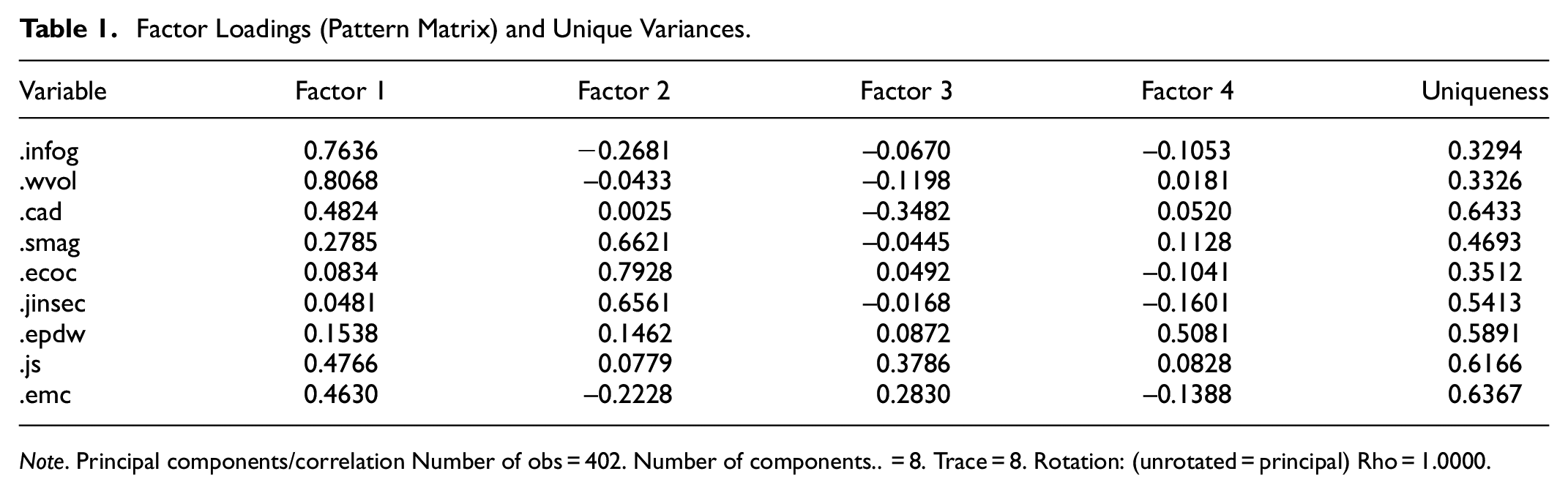
Note. Principal components/correlation Number of obs = 402. Number of components.. = 8. Trace = 8. Rotation: (unrotated = principal) Rho = 1.0000.
Reliability
In addition to validity, the reliability of the instrument was also tested. Cronbach’s alpha was used to test for the instrument’s reliability. The values of alpha for the entire instrument, informalization of organizations, work volition, career adaptability, social marginalization, job insecurity, economic constraints, and employees’ perception of DW, job satisfaction and job commitment were 0.765, 0.78, 0.776, 0.68, 0.75, 0.78, 0.74,0.69, 0.68, and 0.71 respectively (see Table 2). All the coefficients were approximately 0.7 or higher. Thus, implying that the items are internally consistent and are consistent with the threshold of acceptance in line with Hair et al. (2006).
Reliability Statistics.

Model Specification
The research models are specified as follows


The structural equation models are:



Where:
emc = Employee commitment
.epdw = Employee perception of DW
.js = Job satisfaction
.infog = informalization of organization
.wvol = Work volition
.cad = Career adaptability
.smag. = Social marginalization
.ecoc = Economic constraints
.jinsec = Job insecurity
λ0 = fraction of the changes in job satisfaction that the explanatory variables did not trigger
λ i (i = 1, 2, 3, 4, 5, and 6) are the coefficients of explanatory variables (informalization of organizations, work volition, career adaptability, social marginalization, economic constraints, and job insecurity)
θ0 = fraction of the changes in employee commitment that was not caused by the mediator (job satisfaction) and the explanatory variables (informalization of organizations, work volition, career adaptability, social marginalization, economic constraints, and job insecurity)
θi (i = 1, 2 . . . 8) = coefficients of the mediator (job satisfaction) and the explanatory variables (informalization of organizations, work volition, career adaptability, social marginalization, economic constraints, and job insecurity)
e = Stochastic error term
A priori Expectations
λ2, λ3 > 0 and λ1, λ4λ5, and λ6 < 0
ω2, ω3, > 0 and ω1, ω4ω5, and ω6 < 0
θ1, θ2, θ4, θ5 > 0 and θ3, θ6, θ7, and θ8 < 0
Results
The results of the descriptive statistics show that the means and standard deviations were 3.04 (0.73), 3.20 (0.51), 3.48 (0.46), 3.18 (0.73), 3.03 (0.59), 2.95 (0.52), 3.51 (0.41), and 3.45 (0.37) for job satisfaction, employee perception of DW, informalization of organizations, work volition, career adaptability, social marginalization, economic constraints, and job insecurity respectively. The results indicate that all the means except that of job insecurity, were above 3, the mid-point and thus indicate that majority of the respondents answered in the affirmative (See Table 3). The highest variability in perception occurred in work volition while the least was for economic constraints as indicated by the standard deviations of 0.831 and 0.369 respectively.
Descriptive Statistics.

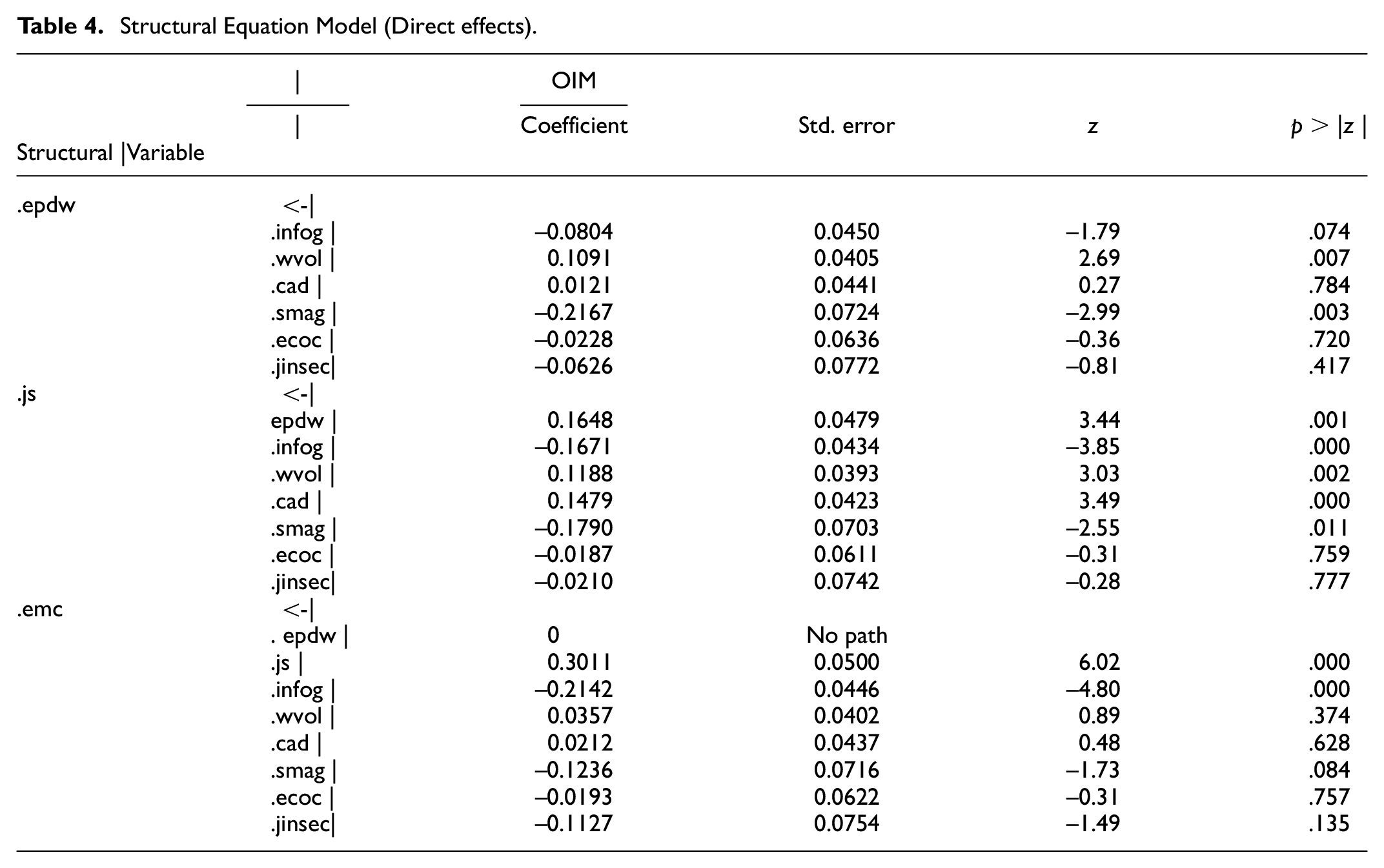
The results of the structural equations model (direct effects) of employee perception of DW shows that the coefficients of informalization of organizations (infog), work volition (wvol), career adaptability (cad), social marginalization (smag), economic constraints (ecoc), and job insecurity (jinsec) were −0.084, 0.1091, 0.0121, −0.2167, −0.0228, and −0.0626 respectively. Thus, the specific model of DW and employees’ need satisfaction is:

The calculated Z and corresponding p-values for the model were −1.79 (0.074), 2.69 (0.007), 0.27 (0.784), −2.99 (0.003), −0.36 (0.720), and −0.81 (0.417) for informalization of organizations (infog), work volition (wvol), career adaptability (cad), social marginalization (smag), economic constraints (ecoc), and job insecurity (jinsec) (see Table 4 and Figure 1). The implication is that informalization of organizations, social marginalization, economic constraints as well as job insecurity are negatively related to employee perception of DW. However, only the negative relationship between social marginalization and employee perception of DW was statistically significant. Work volition and career adaptability are positively related to employee perception of DW but only the relationship between work volition and employee perception of DW is statistically significant. Thus, work volition and social marginalization are statistically significant predictors of DW.
Structural Equation Model (Direct effects).
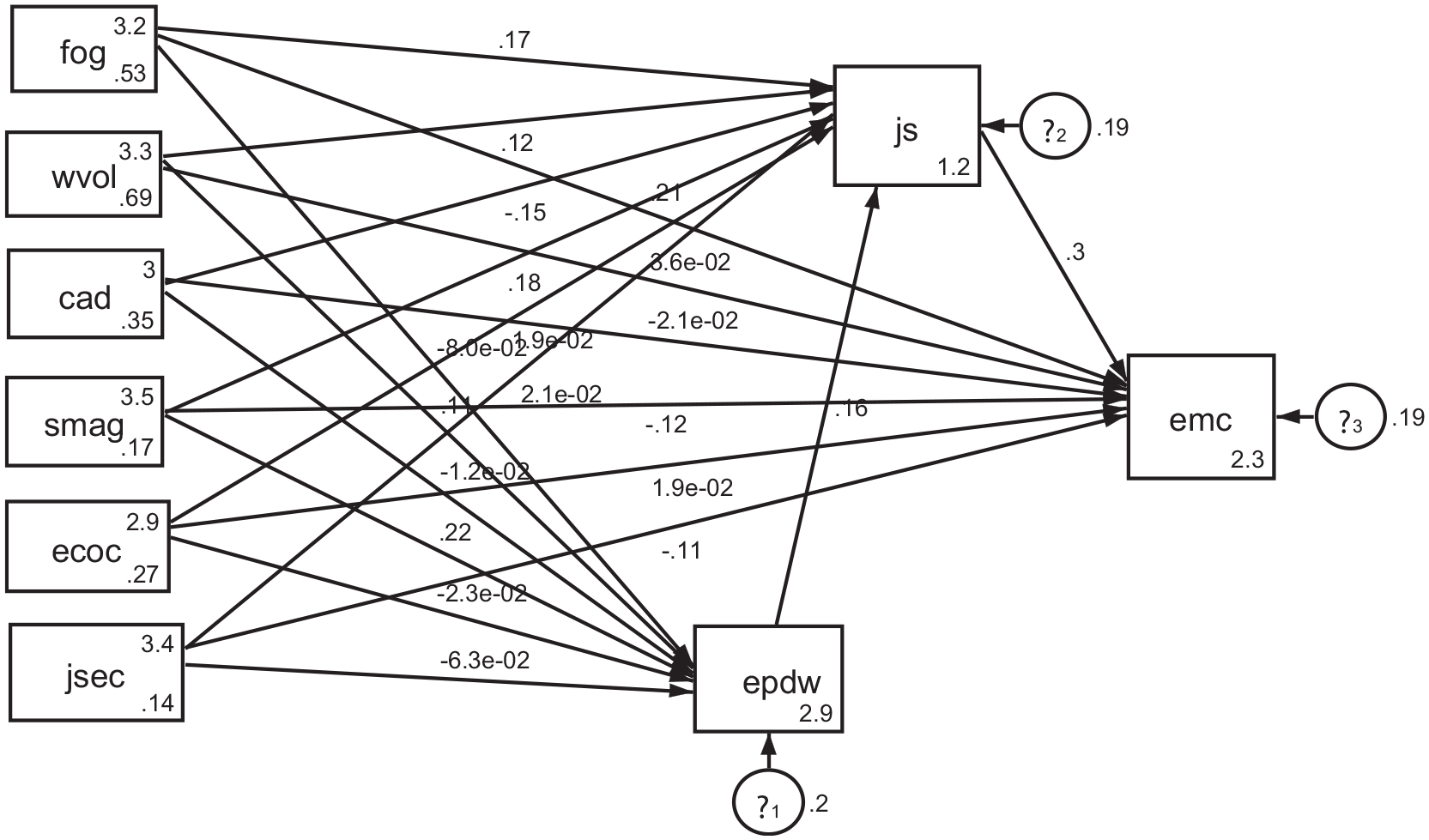
Decent work and employee commitment.
The results of the structural equations model (direct effects) of DW and job satisfaction shows that the coefficients of employee perception of DW (epdw), informalization of organizations (infog), work volition (wvol), career adaptability (cad), social marginalization (smag), economic constraints (ecoc), and job insecurity (jinsec) were 0.1648, −0.1671, 0.1188, 0.1479, −0.1790, −0.0187, and −0.0210 respectively. Thus, the specific model of DW and job satisfaction is:

The calculated Z and corresponding p-values for the model were 3.44 (0.001), −3.85 (p < .001), 3.03 (0.002), 3.49 (p < .01), −2.55 (0.011), −0.31 (0.759), and −0.28 (0.777) for epdw, infog, wvol, cad, smag, ecoc, and jinsec (see Table 4 and Figure 1). The implication is that infog, smag, ecoc as well as jinsec are negatively related to js. However, only the negative relationships between infog and js as well as smag and js were statistically significant. Also, epdw, wvol, and cad are positively related to js. All the positive relationships are statistically significant.
The results of the structural equations model (direct effects) of DW and employee commitment with job satisfaction as the mediating variable shows that the coefficients of js, infog, wvol, cad, smag, ecoc, and jinsec were 0.301, −0.214, 0.036, 0.021, −0.124, −0.019, and −0.113 respectively. Thus, the specific model of DW and job satisfaction is:
.emc = 0.3 js – 0.214 infor + 0.04 wvol + 0.021 cad – 0.124 smag – 0.019 ecoc – 0.113 jinsec . . . (ii) The calculated Z and corresponding p-values for the model were 6.02 (0.001), −4.80 (p < .01), 0.89 (0.374), 0.48 (0.628), −1.73 (0.084), – 0.31 (0.757), and −1.49 (0.135) for job satisfaction, informalization of organizations (infog), work volition (wvol), career adaptability (cad), social marginalization (smag), economic constraints (ecoc), and job insecurity (jinsec) (See Table 5 and Figure 1). The implication is that informalization of organizations, social marginalization, economic constraints as well as job insecurity are negatively related to employee commitment. However, only the negative relationship between the informalization of organizations and job satisfaction is statistically significant. Job satisfaction, work volition, and career adaptability are positively related to employee commitment but only the positive relationship between job satisfaction and employee commitment is statistically significant.
Table Indirect Effects.

The indirect effect analysis of DW and employee commitment with job satisfaction as the mediating variable shows that the coefficients of epdw, js, infog, wvol, cad, smag, ecoc, and jinsec were 0.0496, 0, −0.043, 0.0412, 0.0451, −0.065, 0.005, and −0.003 respectively. Thus, the specific model of DW and job satisfaction is:
.emc = 0.05 epdw – 0.043 infor + 0.04 wvol + 0.045 cad – 0.065 smag + 0.005 ecoc – 0.003 jinsec . . . (ii) The calculated Z and corresponding p-values for the model were 3.44 (0.001), 3.03 ( 0.002), 3.00 (0.003), 3.02 (0.003), −2.72 (0.007), −0.24 (0.819), and −0.14 (0.887) for epdw, infog, wvol, cad, smag, ecoc, and jinsec (see Table 5 and Figure 1). The implication is that infog, smag, ecoc as well as jinsec are negatively related to employee commitment. However, the negative relationships between infog and emc as well as smag and emc are statistically significant while ecoc and jinsec do not have significant influences on emc. In addition, epdw, wvol, and cad are positively related to emc but the positive relationships of wvol and cad are statistically significant. Table 6 presents the total effects and they are consistent with the direct effects.
Structural Equation Model (Total effects).

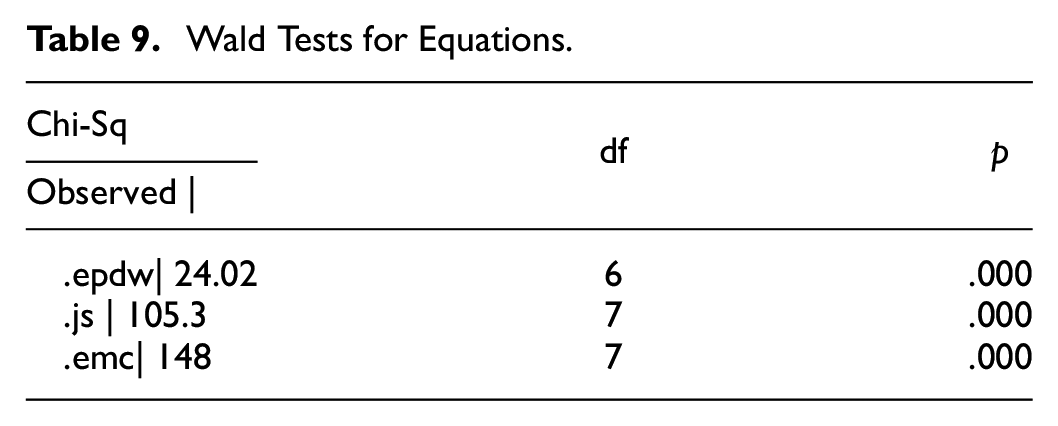
The equation-level goodness-of-fit test indicated that the fitted emc is 0.2633 with a predicted value of 0.071 and a residual value of 0.1924. In the same vein, the fitted job satisfaction is 0.2344 with a predicted value of 0.0487 and a residual value of 0.1858. Lastly, the fitted epdw is 0.2135 with predicted and residual values of 0.012 and 0.202 respectively. This resulted in comprehensive goodness of fit of 0.4333. Thus, variations in DW account for 43.33% of the variation in employee commitment (See Table 7). The results of the likelihood ratio test gave a calculated chi-square value of 0.00 thus indicating a good fit since the model and saturated are the same. The results of the baseline versus saturated shows that the calculated Chi-square and p-values were 47.36 (p < .001), thus indicating a good fit since the baseline is significantly different from the saturated (See Table 8). Lastly, the Wald test for equations indicate that the calculated Ch-square and p-values for employee perception of DW, job satisfaction and employee commitment were 24.02 (p < .01), 105.3 (p < .01), and 148 (p < .01) respectively, thus indicating that the equations are significantly different from zero (See Table 9). The value of the root mean square error of 0.23 is relatively small compared to an average data value of 3 (See Table 10). This indicates a good fit. The implication is that all the fit statistics are good and the model is a good fit to the data. Lastly, a comparison of respondents’ perception with demographic variables and organization was not significant as all the p-values associated with the F-tests were not less than .05 (See Table 11). Consequently demographic variables and the organizations had no influence on respondents’ perception of DW.
Equation-Level Goodness of Fit.

Fit Statistics.

Wald Tests for Equations.
Root Mean Squared Error.

Respondents’ Perception versus Demographic Variables.

Discussion of Findings
The first six hypotheses were tested to examine how informalization of organizations, work volition, career adaptability, social marginalization, economic constraints, and job insecurity influence employees’ perception of DW. Findings show that social marginalization has a significant negative influence on employee perception of DW but work volition has a significant positive influence on employee perception of DW. Thus, work volition and social marginalization are statistically significant predictors of DW. This shows that when employees have some level of independence at work it positively influences their perception of DW while social marginalization makes them to perceive DW negatively. The outcome of informalization and DW is inconsistent with International Labour Organization (ILO) (2021), that of work volition and dw is in line with Duffy et al. (2016) and Mcllveen et al. (2020) while the relationship of social marginalization agrees with Douglass et al. (2019) and Duffy et al. (2016). The outcome of job insecurity and dw is inconsistent with Jandaghi et al. (2011) and Wang et al. (2018).
The seventh hypothesis tested how job satisfaction mediates the relationship between DW and employee job commitment. The results of the direct effect indicate that js has a significant positive influence on employee commitment and informalization of organizations has a significant negative influence on employee commitment while wvol, cad,smag, ecoc, and jinsec did not influence employee commitment significantly. The results of the indirect effect shows that employee perception of DW, wvol, and cad have significant positive influences on employee commitment while infog and smag have significant negative influences on employee commitment. The implication is that job satisfaction has full mediation effects on the relationships between work volition and employee commitment, career adaptability, and employee commitment as well as social marginalization and employee commitment while it partially mediated the relationship between informalization of organizations and employee commitment. The results are partially consistent with Braganza et al. (2020) as well as Wang et al. (2018). This study differs from previous studies in its mediation of the relationship between DW and employee commitment with job satisfaction.
Suggested Model of Decent and Employee Commitment
The results of the study led to the suggestion of a model of perception of DW and employee commitment. The model shows that employees’ perception of their organization in terms of formalization, work volition, career adaptability, and social marginalization have significant influence on their commitment to work through the mediation of job satisfaction. Thus, the way employees perceive their work in terms of decency or otherwise has a significant impact on their commitment (see Figure 2).

Proposed model of decent work and employee commitment.
Practical Implications
The results of the study have practical implication for private and public organizations. If organizations provide a friendly work environment that employees perceive to be decent, it will stimulate the employees to be committed to duty and thus result in the enhancement of their value creation and this will eventually enhance the organizational value. In addition, perception of DW in an organization vis-à-vis what obtains elsewhere will create a stakeholder mentality in the employees and thus reduce the rate of conflict by enhancing organizational harmony.
Theoretical Implication
The study has significant theoretical implications. The negative relationship between informalization of organizations and DW is consistent with the theory of Change: Enterprise formalization for DW thus reiterating the fact that informalization of organizations precipitates inDW. In addition, the significant mediation of the relationship between DW and employee commitment is consistent with the PWT. The implication is that perception of DW has a positive influence on employees’ psychology and thus enhances their satisfaction with the job. The job satisfaction also has an influence on their commitment to work.
Conclusions
The research conclusions are as follows: informalization of organizations has significant negative influence on employee commitment, job satisfaction mediates the relationship between DW with respect to informalization of the organization, work volition, career adaptability, social marginalization, and employee commitment. Job satisfaction fully mediates the relationship between DW (wvol, cad, smag, ecoc, jinsec) and employee commitment and partially mediates the relationship between infog and employee commitment. The implication is that employees’ perception of DW in organizations is critical to their psychological job satisfaction and their satisfaction with the job influences their level of commitment and the eventual organizational output/value. Since informalization has a negative influence on employees’ perception of decency, formalization should have a significant positive influence on DW. Since Sustainability of productivity depends on employee commitment and motivation in organizations which DW stimulates. The results thus provide insights for policymakers to contribute to the achievement of the United Nation’s SDGs through the institution of mechanisms to ensure compliance of the private and public companies with basic standards for decency like formalization and compliance with labor laws as enshrined in the International Labor Organization lawsAlthough there are some studies on DW, this study’s point of departure lies in the use of job satisfaction in mediating the relationship between DW, consisting of the psychological/contextual variables, and employee commitment. The study also lends support to Sustainable Development Goal (SDG) 8 of the United Nations.
This study encountered some limitations. Firstly, although there are some studies on DW; these studies are still evolving. Thus, the paucity of literature on DW was the first limitation. Secondly, getting a complete randomization was another limitation. Randomization is often impaired by the likelihood that some employees in an organization may not be available on the day of the fieldwork or may not access the instrument online. The implication is that these people will not have equal chances of being studied. This was a likelihood in this study, being a cross-sectional survey. Lastly, since the study was quantitative, the choice of the independent variables and the constructs was at the author’s discretion. There are many other constructs that could have been used and which may have provided different results. The inclusion of constructs, which are obviously not exhaustive is a limitation.
Future studies should attempt a qualitative study and employ in-depth interviews to elicit information from respondents. This will enable them to use open ended question response format and thus elicit unconstrained responses that will provide new insights into the factors that influence employees’ perception of DW. Better still, there may be need for future studies to employ mixed method research design to provide a blend of qualitative and quantitative designs and thus provide deep insights into the problem of DW and employee commitment. Lastly, future studies should expand the scope and if possible, the methodology by combining quantitative techniques with qualitative techniques to have deeper insights that are obtainable from qualitative techniques.
Supplemental Material
sj-xlsx-1-sgo-10.1177_21582440241259283 – Supplemental material for Perception of Decent Work and Employee Commitment: The Mediating Role of Job Satisfaction
Supplemental material, sj-xlsx-1-sgo-10.1177_21582440241259283 for Perception of Decent Work and Employee Commitment: The Mediating Role of Job Satisfaction by Henry Inegbedion in SAGE Open
Footnotes
Appendix
Declaration of Conflicting Interests
The author declared no potential conflicts of interest with respect to the research, authorship, and/or publication of this article.
Funding
The author received no financial support for the research, authorship, and/or publication of this article.
Ethical Approval
The author sought and got approval from the Institutions’ Research Ethical Board to conduct the study. However, there was no approval number to that effect.
Informed Consent
The author sought the consent of the sampled respondents to participate in the study, out of 728 invited, 326 declined and the remaining 402 voluntarily participated in the study.

Supplemental Material
Supplemental material for this article is available online.
Data Availability Statement
The study used primary data and the dataset is attached as a supplementary file to this submission.