




Abstract
Although the growing literature on coronavirus disease 2019 (COVID-19) conspiracy theories has highlighted the role of digital media in fomenting beliefs, few studies have examined the influence of the fast-rising far-right media platforms. This study examines and compares the role of conservative media and far-right websites in propagating COVID-19 conspiracy theories and explores an underlying sociopsychological mechanism of political identity. The results of an online survey (N = 702) in the United States indicated that people exposed to conservative media and far-right websites were more likely to endorse COVID-19 conspiracy theories, but the impact of conservative media exposure was more prominent. Additionally, the positive relations between conservative media/far-right websites exposure and conspiracy beliefs were stronger among liberal-leaning individuals than conservative-leaning individuals. Counter-attitudinal exposure is often regarded as a crucial element of political deliberation and a solution to opinion polarization. Our findings cautioned, however, that counter-attitudinal exposure would also help propagate conspiracy theories.
Introduction
The global pandemic of Coronavirus disease 2019 (COVID-19) has triggered an “infodemic,” which was identified by the World Health Organization (2020) as “too much information including false or misleading information in digital and physical environments during a disease outbreak.” In particular, a relatively small but vocal number of conspiracy theories about COVID-19 have been disseminated virally on the Internet. The widespread dissemination of the COVID-19 conspiracy theories has elicited erroneous perceptions and fostered extreme attitudes toward the pandemic (Chen et al., 2021). For instance, one conspiracy theory posits that COVID-19 was intentionally created in a laboratory in China, sparking global debates and numerous controversies (Maxmen & Mallapaty, 2021). Scientists have strongly condemned the conspiracy theories, as they generate fear, rumors, and prejudice that undermine global cooperation in combating the virus (Cohen, 2020). To combat the “infodemic,” mainstream social media platforms, such as Facebook and Instagram, have made considerable efforts to remove over 20 million posts containing false information about COVID-19 by August 2021 since the beginning of the pandemic (Wong, 2021).
Understanding how people learn about and believe in COVID-19 conspiracy theories is essential for public health researchers and policymakers to make sense of public opinion and promote a more scientific understanding of COVID-19 among the public. Research on conspiracy beliefs is crucial for gaining a deeper understanding of the potential mechanisms influencing the communication and spread of conspiracy theories, especially across various media platforms. Because beliefs in conspiracy theories usually originate from people’s need for an explanation, they are quite difficult to be corrected (Leman & Cinnirella, 2013). Belief in conspiracy theories is usually associated with a lack of confidence in policies addressing the pandemic, which will further influence people’s risky health behaviors (Earnshaw et al., 2020; Enders et al., 2020). Previous studies have shown that people who believe in COVID-19 conspiracy theories are more likely to refuse to social distance, wear a mask, or get vaccinated (Earnshaw et al., 2020; Enders et al., 2020).
Right-wing sources have been alleged to be responsible for the dissemination of conspiracy theories, particularly amid the COVID-19 pandemic (Stecula & Pickup, 2021). However, existing investigations mostly focus on the effect of mainstream conservative news media on beliefs in COVID-19 conspiracy theories (Romer & Jamieson, 2021; Stecula & Pickup, 2021), overlooking the rising power of far-right media platforms. In recent years, far-right media platforms, represented by several anonymous imageboard websites, such as 4chan and 8kun, have become popular venues for political discussions on extreme ideologies (e.g., white supremacy and right-wing nationalism). As alternative information sources, these imageboard websites have turned into well-recognized online communities. During the COVID-19 pandemic, there has been increasing discussion on conspiracy theories on these platforms (Zeng & Schäfer, 2021). In contrast to the conservative ideology, far-right politics, or right-wing extremism, encompasses a range of political perspectives characterized by radical conservatism, ultranationalism, and authoritarianism, often accompanied by nativist tendencies. With technical protection of user privacy, the far-right websites are characterized by the absence of marked user identity and history, and ephemeral communications not stored by any archives (Nissenbaum & Shifman, 2017). These features, compared with those of other information sources, may enable far-right websites to play a distinctive role in propagating COVID-19 conspiracy theories, which is worthy of further investigation. This study aimed to examine and compare the effects of both conservative news media and far-right websites on conspiracy beliefs and how those relationships would be moderated by political identity.
Some groups in the world perceived the COVID-19 pandemic as conspiratorial and even elitist. The findings of this research in the United States further substantiate this perception, notably through the influence of social media propaganda originating from right-wing sources. In the following sections, we first reviewed the role of right-wing sources in influencing people’s beliefs in conspiracy theories. Two hypotheses concerned with the effects of exposure to conservative media and far-right websites on conspiracy beliefs were supported. Furthermore, political identity was identified as an important factor that could potentially moderate the effects of both conservative media and far-right websites. In particular, we focused on the impact of counter-attitudinal exposure (or cross-cutting exposure) on conspiracy beliefs for liberal-leaning and conservative-leaning people, respectively. A national survey with over 700 respondents was conducted to test the research hypotheses and answer the research question using ordinary linear square (OLS) regression models. Subsequently, the findings and implications are discussed further.
Exposure to Right-Wing Sources and Beliefs in Conspiracy Theories
The classical knowledge paradigm notes that individuals can gain knowledge through news media exposure and thus will be less likely to believe conspiracy theories. However, partisan bias in news media and the changing media landscape are striking this notion (Iyengar & Hahn, 2009; Stroud, 2011). Increasing partisan bias drives news media to release unverified news stories for political propaganda (Tsfati et al., 2020). Meanwhile, the digitalization of journalism has placed more emphasis on timeliness and clicks in media institutions, which has prompted news coverage without thorough investigation and verification beforehand (Giglietto, 2019). In addition, news media sometimes discuss or debunk unverified news stories based on their news values (Tsfati et al., 2020), while people’s belief in conspiracy theories can be increased due to repetitive exposure to those news reports (Corneille et al., 2020).
Moreover, according to the sociopsychological models of conspiracy beliefs, people are subjective to conspiratorial information as it later satisfies people’s epistemic and existential motives (Douglas et al., 2017). Epistemically speaking, conspiracy theories are attractive to the public because they meet people’s need for cognitive closure and help reduce the feeling of uncertainty (Douglas et al., 2017; Marchlewska et al., 2018; van Prooijen & Jostmann, 2013). Those needs tend to be stronger especially when a large-scale and significant event occurs with related official explanations being absent (Marchlewska et al., 2018), just like the case of the COVID-19 pandemic. In addition, people turn to conspiracy theories because they can satisfy people’s existential motives, such as the desire for control and security. Specifically, conspiracy theories, as alternative causal explanations, can serve people’s need to feel safe and secure, and a sense of control of their environment, by offering them chances to reject official narratives (Douglas et al., 2017; Goertzel, 1994). Therefore, conspiracy theories would become more alluring when people feel powerless and lose control of the current situation (Abalakina-Paap et al., 1999; van Prooijen & Acker, 2015), just as they actually do when they confronting the unprecedented COVID-19 pandemic. Given the prevalence of COVID-19 conspiracy theories in conservative media (Jamieson & Albarracín, 2020; Motta et al., 2020; Romer & Jamieson, 2021; Stecula & Pickup, 2021), heavier use of those media outlets is expected to enhance people’s beliefs in those conspiracy theories.
Empirical evidence also supports this theoretical expectation. For instance, Stecula and Pickup (2021) reported that conservative media consumption is positively correlated with conspiracy beliefs about COVID-19, leading to less preventive behaviors suggested by public health officials. Similarly, drawing on a two-wave panel survey of American adults, Romer and Jamieson (2021) found that the use of conservative media can predict an increase in COVID-19 conspiracy beliefs. Based on the above discussion, this study hypothesized a positive correlation between exposure to conservative news media and conspiracy beliefs about COVID-19.
H1: Exposure to conservative news media is positively related to conspiracy beliefs about COVID-19.
Exposure to platforms of user-generated content, which is sometimes considered as less legitimate media due to the varied quality of information, has a strong correlation with conspiracy beliefs. For instance, exposure to social media is found to be a significant predictor of beliefs in conspiracy theories (Enders et al., 2023; Xiao et al., 2021). Few studies, however, have investigated the increasing power of far-right websites in disseminating conspiracy theories. Far-right websites (e.g., 4chan) are relatively marginal but have salient influences and loyal supporters—far-right extremists. Far-right extremists use these websites to create and spread conspiracy theories to maintain their benefits (Allyn, 2021; Dawson, 2021). For example, imageboard 8kun has been a camp for supporters of QAnon, who are usually strong supporters of Donald Trump. While far-right websites have been infamous for producing and disseminating conspiracy theories to support Republicans, especially Trump (Dawson, 2021), empirical evidence about its implications for public perceptions is still lacking. Following the same logic of prior reasoning about conservative media, it is likely that people using the far-right media for news consumption tend to believe in the COVID-19 conspiracy theories as they later also satisfy their epistemic and existential motives. Thus, this study presumes a positive relationship between exposure to far-right websites and COVID-19 conspiracy beliefs.
H2: Exposure to far-right websites is positively related to conspiracy beliefs about COVID-19.
Political Identity and Beliefs in Conspiracy Theories
Political identity has been identified as a strong predictor of beliefs in falsehood. Individuals usually endorse misperceptions that are aligned with their in-group interests (Lewandowsky et al., 2012). One specific explanation for partisan bias in false beliefs is motivated reasoning, or people’s biased processing of information, which refers to the phenomenon that people tend to believe opinions that match their established worldviews (Kunda, 1990). Motivated reasoning leads to a preference for choosing a side instead of seeking truth (Schaffner & Roche, 2016; Vegetti & Mancosu, 2020; Weeks & Garrett, 2014). For instance, based on two surveys of American adults, Miller et al. (2016) found that both conservatives and liberals tend to believe in ideologically consistent conspiracy theories (i.e., conspiracies putting the ideological opponents in a bad light), indicating the presence of ideologically motivated conspiracy endorsement. Although the COVID-19 conspiracy theories examined in this study do not include explicit discrediting of the liberals, they mostly serve the interest of the Republican Party by implying that the pandemic is conspiratorial.
These observations also resonate with conspiracy theories literature. Scholars contend that people are attracted to conspiracy theories that can meet their social motives such as the desire to uphold a good in-group image (Douglas et al., 2017). In the context of the COVID-19 pandemic, conspiratorial narratives suggesting a Chinese origin or an intentionally covered-up origin of the pandemic (as we examined in this study) may help gloss over Trump’s incompetent response to the pandemic outbreak, thus increasing beliefs in those conspiracy theories among more conservative-leaning people.
In addition, studies found that people who are more conservative-leaning are generally more inclined to endorse false information and conspiracy theories (Bailey et al., 2021; Calvillo et al., 2021; Chadwick & Vaccari, 2019; Min, 2021). The ideology asymmetry perspective suggests that conservatives are more likely to spread falsehood due to their shared characteristics, namely higher levels of dogmatism, rigidity, intolerance of ambiguity, and need for cognitive closure, as compared with liberals; moreover, conservatives tend to prioritize values of conformity and tradition and possess a strong desire to share reality with like-minded others (Jost, 2017; Jost et al., 2018). Based on previous studies, this study hypothesizes the following:
H3: Individuals who are conservative-leaning are more likely to believe conspiracy theories about COVID-19, compared with individuals who are liberal-leaning.
The Moderating Effect of Political Identity
Apart from the main effects of right-wing sources use and political identity, these two factors may also interact with each other in affecting one’s beliefs in conspiracy theories. However, previous studies have rarely examined this moderating effect and two sets of competing propositions actually exist.
The first set of propositions suggests that the use of right-wing sources, including conservative media and far-right websites, might have a stronger effect on conspiracy beliefs among those who are more conservative-leaning. There is a school of thought that exposure to proattitudinal sources strengthens one’s preexisting attitudes and thus leads to opinion extremity and polarization (Garrett et al., 2014). Proattitudinal exposure can increase one’s own and oppositional opinion repertoires, especially among those who engage in selective exposure (H. T. Chen et al., 2020). Thus, the use of right-wing sources by conservatives (namely proattitudinal exposure) is likely to enhance their beliefs in conspiracy theories. Furthermore, researcher also demonstrated that political discussion with like-minded others can increase one’s conspiracy beliefs in conjunction with political identity (Min, 2021). Given the close link between information consumption and political discussion (Gil de Zúñiga et al., 2019), consuming right-wing sources for conservative-leaning people can generate more homogeneous discussion that interacts with political identity. Moreover, conservative-leaning people, compared with those who are liberal-leaning, are found to be less disposed to reflective and analytic thinking (Hibbing, 2014; Jost, 2017; Talhelm et al., 2015), making them more susceptible to pandemic-related misleading content from right-wing sources. Overall, the above discussion implies that for conservative-leaning people, greater use of politically concordant sources (i.e., right-wing sources) would present a larger impact on their conspiracy beliefs compared with their liberal-leaning counterparts.
However, it is also theoretically possible that the impact of right-wing sources’ use on conspiracy beliefs is larger among people who are liberal-leaning. First, exposure to counter-attitudinal sources can inform people of the rationales for opposing viewpoints and thus increase their support for the other side (Cao, 2020; Mutz, 2002). Survey results indicated that the use of counterparty sources attenuates attitude polarization, by motivating active engagement with and cognitively elaborating on the counter-attitudinal information (Garrett et al., 2014; H. T. Chen et al., 2022). The influence of counter-attitudinal exposure on opinion change, albeit deemed conducive to political deliberation, may also generate false beliefs when it involves misinformation or disinformation endorsed by the other side, which is particularly concerning given that the popularity of social media enables massive production of and engagement with misleading information. Moreover, studies based on affective intelligence theory illustrated that anxiety and fear elicited by a pressing unknown threat, like COVID-19, can prompt people to conduct wide-ranging information searches and become less reliant on preexisting political dispositions in forming their responses to the threat (Marcus, Neuman, & MacKuen, 2000; Marcus, Valentino, et al., 2019; Vasilopoulos et al., 2023). In other words, the effect of right-wing sources’ exposure on beliefs in COVID-19 conspiracy theories can be stronger among those who are liberal-leaning.
Considering the existence of competing propositions, this study raised the following research question:
RQ1: Does political identity moderate the impacts of exposure to conservative media (RQ1a) and far-right websites (RQ1b) on beliefs in conspiracy theories about COVID-19?
Method
Data Collection
A national representative survey (N = 702) was conducted in the United States from November 28 to 30, 2020. Data collection was outsourced to a survey company, Lucid, which has panels in major countries in the world. The response rate was 79%. The survey aimed at people aged between 18 and 65 years. Quota sampling in terms of gender and age was executed with Census data as a reference (U.S. Census Bureau, 2019). Respondents who did not fit our criteria were filtered out. Those aged below 18 or above 65 years and those who reported they were not currently living in the United States were filtered out.
At the end, 853 respondents completed the survey. We further exclude responses of low quality. We embedded two attention-check questions in the survey, asking respondents to choose specific options following the instructions in the question. Those who failed to pass the attention checks were filtered out from the survey. Those who finished the survey within an extremely short response time (i.e., <5 min) were excluded from the samples after the completion of the survey. The final sample has 702 valid cases. The final sample included 23.1% aged between 18 and 29 years (n = 162), 22.3% aged between 30 and 39 years (n = 157), 20.3% aged between 40 and 49 years (n = 142), and the remaining 34.3% aged between 50 and 65 years (n = 241). More than half of the respondents were female (n = 358, 51.0%), and the rest were male. The sample was representative of the U.S. population in terms of gender and age (see Table 1).
The Sample Profile.

Measures
Beliefs in COVID-19 Conspiracy Theories
This study measured beliefs in two COVID-19 conspiracy theories, namely “The spread of COVID-19 is engineered in a lab in China” and “Data displayed on the World Bank’s World Integrated Trade Solution website in September 2020 proved that dozens of nations imported or exported items labeled “COVID-19 Test Kits” in 2018—more than a year before the pandemic occurred and before COVID-19 even had a name.” Respondents were asked to rate how likely the two statements are true on a six-point Likert scale, from 1 (extremely unlikely) to 6 (extremely likely). The mean score of the two items was calculated to be the index of beliefs in COVID-19 conspiracy theories (Spearman–Brown coefficient = 0.68, M = 3.70, SD = 1.96).
Exposure to Far-Right Websites
Exposure to far-right websites was measured by how frequently the respondents use 4chan and 8kun, the two popular far-right websites, on a seven-point Likert scale, from 1 (never) to 7 (all the time). The average of these two items forms the index of exposure to far-right websites (Spearman–Brown coefficient = 0.96, M = 2.20, SD = 2.19).
Exposure to Conservative Media
Exposure to conservative media was measured by how frequently the respondents use the five popular right-leaning media, namely Fox News, Wall Street Journal, New York Post, Breitbart, and The Blaze. Respondents were asked to rate the frequency of using these media on a seven-point Likert scale, where 1 means never and 7 means all the time. The items were averaged for each respondent as an indicator of exposure to conservative media (α = .90, M = 3.09, SD = 1.75).
Political Identity
To measure political identity, respondents were asked to rate themselves from 1 (extremely liberal) to 10 (extremely conservative) (M = 5.28, SD = 3.03).
Control Variables
The analysis controls for the effects of age, gender, income, education, and marriage. For age, respondents were asked to input their age (M = 42.05, SD = 13.87). More than half of the respondents were female (n = 358, 51.0%) and the rest were males. Respondents were asked to choose the highest degree they have achieved among five options, namely 12th grade or below (coded as “1”), no high school diploma (coded as “2”), high school graduate/diploma or equivalent (coded as “3”), some college but no degree (coded as “4”), bachelor’s degree (coded as “5”), and postgraduate degree (coded as “6”). The mean score of education is 4.03 (SD = 1.59). Respondents were asked to report their yearly income among 26 ranges, namely from under $5,000 (coded as “1”) to $250,000 or more (coded as “26”). The average income lies in “12.50” (SD = 8.11), which is between the range of $55,000 to $59,999 (coded as “12”) and $60,000 to $64,999 (coded as “13”). More than half of the respondents were married (n = 365, 52.0%).
This study examined the effect of right-wing media exposure on conspiracy beliefs, and thus, media exposure to the opposite side (i.e., exposure to liberal media) should be under control. Exposure to liberal media was measured by how frequently the respondents use the five popular left-leaning media, namely NBC News, CBS, CNN, The New York Times, and Buzzfeed. Respondents were asked to rate the frequency of using these media on a seven-point Likert scale, where 1 means never and 7 means all the time. The items were averaged for each respondent as an indicator of exposure to liberal media (α = .90, M = 3.73, SD = 1.73).
Analysis
To analyze the data, a series of OLS linear regression analyses were performed. We first tested a model with control variables as a base model and then added key independent variables, namely far-right website use, conservative media use, and political identity. Then we explored the moderation effects by including interaction terms in the regression equations.
Results
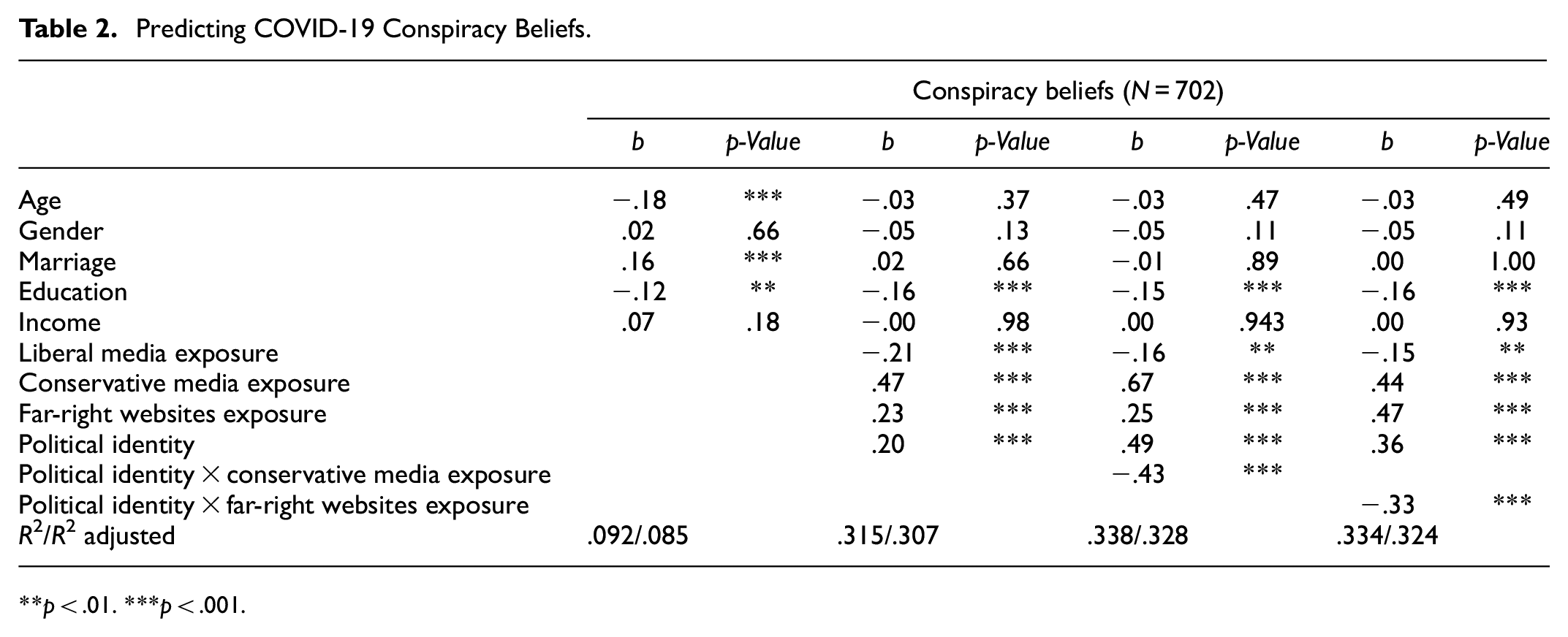
The results are shown in Table 2. We first examined the effects of control variables. People who were older were less likely to believe COVID-19 conspiracy theories (b = −.18, 95% CI [−0.37, −0.02], p <.001). Those who were married (b = .16, [0.29, 0.95], p < .001) and less educated (b = −.12, [−0.25, −0.03], p < .01) were more likely to believe COVID-19 conspiracy theories. When all the media exposure variables entered the model, exposure to liberal media had a significantly negative correlation with COVID-19 conspiracy beliefs (b = −.16, [−0.35, −0.11], p < .01).
Predicting COVID-19 Conspiracy Beliefs.
p < .01. ***p < .001.
H1 hypothesized that exposure to conservative media had a positive relationship with conspiracy beliefs, which was supported by the data (b = .47, 95% CI [0.39, 0.66], p < .001).
H2 posited that far-right websites exposure had a positive relationship with conspiracy beliefs, which was also supported by the data (b = .23, 95% CI [0.13, 0.28], p < .001). It was noticeable that the effect size of conservative media exposure was more magnificent than that of far-right websites exposure.
H3 supported that political identity was positively correlated with conspiracy beliefs (b = .20, 95% CI [0.08, 0.17], p < .001). Those who were more conservative were more likely to believe COVID-19 conspiracy theories.
RQ1a asked about the moderating effect of political identity on the relationship between conservative media exposure and conspiracy beliefs among liberals. The results (Table 1 and Figure 1) showed that the interaction term of political identity and conservative media exposure displayed a significantly negative relationship with conspiracy beliefs (b = −.43, 95% CI [−0.07, −0.03], p< .001), indicating that the relationship between exposure to conservative media and conspiracy beliefs was stronger among those more liberal-leaning. RQ1b was about the moderating effect of political identity on the relationship between far-right websites’ exposure and conspiracy beliefs. As shown in Table 1 and Figure 2, the interaction term of political identity and far-right media exposure was negatively associated with conspiracy beliefs (b = −.33, [−0.05, −0.02], p < .001), which indicated that the relationship between far-right websites exposure and conspiracy beliefs was stronger among those self-identified as more liberal-leaning.
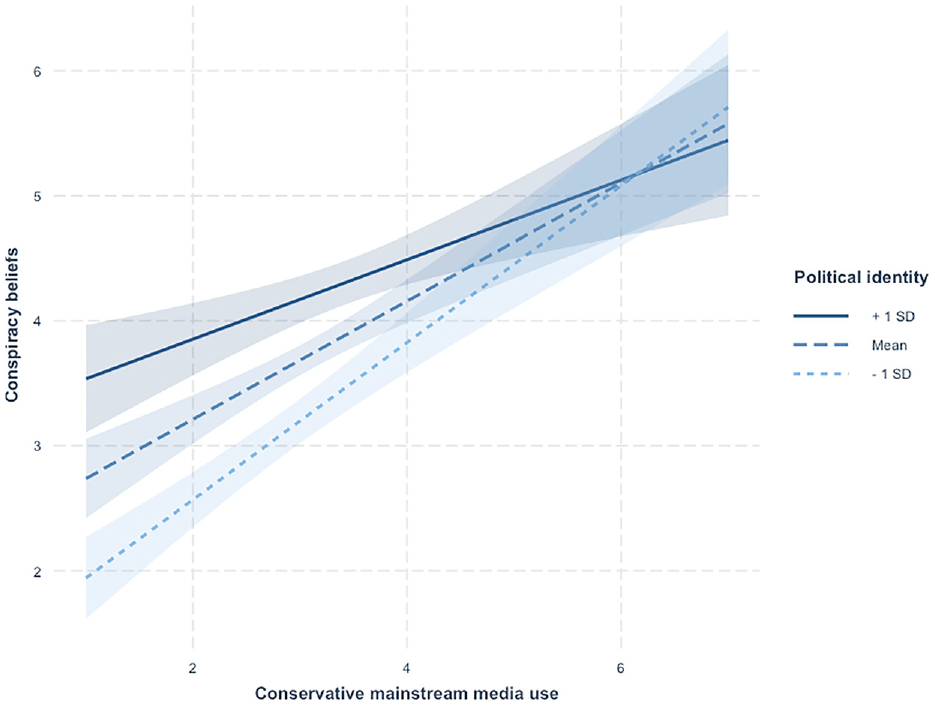
Interaction effect of conservative mainstream media use and political identity on COVID-19 conspiracy beliefs.

Interaction effect of far-right websites use and political identity on COVID-19 conspiracy beliefs.
Discussion and Conclusion
This study found that exposure to right-wing sources, either mainstream media or far-right websites, is associated with increased beliefs in COVID-19 conspiracy theories. The results particularly emphasized the importance of far-right websites in propagating conspiracy theories. Far-right websites are widely known and have been causing concern about their close connections with far-right ideology (Colley & Moore, 2022). Existing studies have shown that online discussions on 4chan, an example of a far-right website, often involve highly toxic language and hate speech (Hine et al., 2017; Mittos et al., 2020). In particular, the contents on 4chan’s political board (/pol/) have shown strong far-right personalities and openly anti-semitic rhetoric, which are often delivered through internet memes. Similar findings have been made for another board (/b/) on 4chan, as well as other imageboard platforms, such as Overboard (Ylä-Anttila et al., 2020) and Danbooru (Britt, 2019).
Right-wing extremists and those who support far-right views have exploited online platforms, such as the anonymous imageboard and Reddit, to enhance their collective identity and mobilize like-minded members to promote extreme discourses (Gaudette et al., 2021). Furthermore, existing studies showed that even if ordinary viewers are skeptical and suspicious when visiting websites, such exposure to alternative media sources may still trigger contests and confirmation of their original views (Ihlebæk & Holter, 2021). As the COVID-19 pandemic has been highly politicized in American society (Kerr et al., 2021), the rise of far-right websites and their potential influence in propagating conspiracy theories about public health should not be underestimated. Given the scarce academic attention on the impact of far-right websites on conspiracy beliefs, this study has filled the research gap by offering an empirical investigation of the relationship that advances our understanding of the social implications of far-right media.
Specifically, our findings of the positive relationships between right-wing media use (conservative/far-right media outlets) and COVID-19 conspiracy beliefs correspond with the motive-based theorization in conspiracy literature. Particularly, by fulfilling people’s epistemic and existential motives (i.e., the need for cognitive closure and the desire for control and security), COVID-19 conspiracy theories spread on the right-wing media may raise conspiracy beliefs among the heavier right-wing media users, suggesting the presence of media effect. However, those findings can also be interpreted through the perspective of selective exposure. Simply put, selective exposure refers to the behavior by which audiences selectively expose themselves to media outlets favoring their party line or ideology (Stroud, 2011). Therefore, it is possible that heavier users of right-wing media are people more supporting the Republicans and prone to those conspiracy theories in the first place (Romer & Jamieson, 2021), thus producing a positive link between right-wing media use and conspiracy beliefs. Nevertheless, scholars have cautioned that such a selection process does not occur in a vacuum and has been found to be exaggerated in certain instances (Eady et al., 2019; Kwak et al., 2022). Taken together, it is crucial to note that selective exposure and motivated reasoning are likely to influence the media effects.
In addition, our findings also illustrate that political identity still matters in conspiracy beliefs about the COVID-19 pandemic. The results show that conservative-leaning individuals are more likely to trust COVID-19 conspiracy theories than liberal-leaning individuals. The results coincide with our theorization based on motivated reasoning and the social motive explanation, that is, people are inclined to believe in conspiracy theories favoring the same ideological line and the in-group image. These findings unravel a significant role of partisan bias in an individual’s health information processing, raising concerns as the differences in COVID-19 conspiracy beliefs between different parties may eventually lead to divided opinions on public health policy and preventive behaviors.
This study further demonstrates that exposure to right-wing sources, including conservative mainstream media and far-right websites, are associated with increased COVID-19 conspiracy beliefs among liberal-leaning individuals. The relation between right-wing sources exposure and COVID-19 conspiracy beliefs is found to be greater among liberals than among conservatives. This finding supports our proposition that when confronting the impending threat of COVID-19, people tend to conduct a wide-ranging information search and become less dependent on their political ideology to formulate their responses to the crisis, thus making liberals more receptive to COVID-19 conspiracy theories transmitted by right-wing sources. Such reduced salience of preexisting political dispositions in forming people’s attitudes and information-seeking behavior occurs because impending threats such as the COVID-19 pandemic would trigger uncertainty-related emotions like fear that can mitigate an individual’s reliance on preexisting political dispositions in their decision-making (Vasilopoulos et al., 2023). Another reason for this finding is the ceiling effect illustrated in Figures 1 and 2. Particularly, the figures display that when holding exposure to right-wing sources at the lowest level, conservative-leaning individuals already express a relatively high level of conspiracy beliefs (which are much higher than the conspiracy beliefs of liberal-leaning individuals), thus leaving less room for the right-wing sources exposure to function (namely a ceiling effect).
For liberal-leaning people, even a small amount of exposure to counter-attitudinal sources has been found to correlate with a substantial increase in their beliefs in pandemic-related conspiracy theories, which potentially undermines collective efforts against the pandemic and the cause of public health. Public exposure to counter-attitudinal information sources has been deemed beneficial for a healthy democracy (Thompson, 2008) as it can promote understanding of the opposite side, foster tolerance and deliberation across party lines (Cao, 2020; Mutz, 2002), and reduce polarization and social division (Garrett et al., 2014; Stroud, 2010). Nonetheless, our findings uncover the potential dark side of counter-attitudinal exposure. In the current tumultuous media environment, consuming news information from politically uncongenial sources may also make people subject to low quality or even false content (intentionally or unintentionally) produced by the other side, cultivating problematic perceptions and beliefs that impede the formation of social consensus and the functioning of democracy.
The deleterious implications of counter-attitudinal exposure become particularly worrisome in the context of the COVID-19 pandemic. On the one hand, public discourse on the origin of the pandemic has been largely politicized before scientific conclusions could be made, which has provided sufficient leeway for politicians, such as the former U.S. President Donald Trump, to mobilize public opinion for their own ambitions (Hagström & Gustafsson, 2021). On the other hand, COVID-19 is a new disease that we do not fully understand. Therefore, the need for an explanation triggered by this pressing existential threat likely makes COVID-19 conspiracy theories possess greater power than normal political misinformation or disinformation in changing public opinion, especially among those initially holding different worldviews.
The major contributions of this study are threefold. First, this study accentuates the importance of rising far-right websites, which are largely understudied in the existing literature, in combating COVID-19 conspiracy theories. Second, the findings highlight the role of generic right-wing sources, either the conservative media or far-right websites, in propagating conspiracy theories about COVID-19. Third, this study unravels the moderating mechanism of political identity underlying the aforementioned relationships. In particular, the role of right-wing sources in fomenting individuals’ beliefs in COVID-19 conspiracy theories is found to be more magnified among liberal-leaning individuals than conservative-leaning ones. Overall, our results call for greater attention to the danger of COVID-19 conspiracy theories, particularly those transmitted from right-wing sources.
There are several limitations to this study. First, the study has a cross-sectional design that lacks the time dimension to observe the dynamics of conspiracy beliefs. Future studies may seek a longitudinal analysis to better understand the long-term effects of partisan exposure. Second, this study measured only general exposure to media outlets from conservative media and far-right websites. Future work may focus on media content for specific effects in the conspiracy persuasion process. Third, this study did not reveal the mechanisms behind the moderating effect. Future research could extend our model further. Fourth, this study only measured beliefs in two selected conspiracy theories. Future studies may replicate the study with different conspiracy theories. For further investigation, a thorough examination of the trend of conspiracy narratives would be more crucial and interesting. In addition to addressing the proven conspiracy tendencies through this research, that is, the belief that the COVID-19 pandemic is a conspiracy largely propagated by right-wing sources, future studies could try to offer a plausible explanation for the occurrence of this trend. This aspect would be more intriguing to extend the findings of this study.
Footnotes
Acknowledgements
None.
Declaration of Conflicting Interests
The author(s) declared no potential conflicts of interest with respect to the research, authorship, and/or publication of this article.
Funding
The author(s) disclosed receipt of the following financial support for the research, authorship, and/or publication of this article: This work was supported by the Fundamental Research Funds for Central Universities [23NJYH10].
Ethical Approval
The ethical approval of this study is given by the research committee at City University of Hong Kong.

Data Availability Statement
Data are available upon request.