



Abstract
Regular, inclusive, and country-driven Voluntary National Reviews (VNRs) of sustainable development goals (SDGs) are being conducted by many countries across the globe in the quest to realign development priorities toward Agenda 2030. However, there are limited studies on the progress of the implementation of SDGs. This paper used literature review and document content analysis to review the VNRs from East Africa for the first time in order to explore their reporting practices and document the progress of SDG implementation. Results substantiate that Kenya, Uganda, Tanzania, Rwanda, Burundi, and South Sudan are committed to achieving a high quality of life for their people through periodic VNR reporting. To augment, these positive efforts, countries have established a favorable multi-stakeholder legal and policy environment for SDG implementation. Moreover, remarkable impacts have been witnessed, including; reduced poverty, improved access to basic services, enhanced environmental protection, improved economic growth, improved gender equality, and improved stakeholder participation in sustainable development. Additionally, global best practices on SDG implementation are emerging from the region, especially through the tendency to formulate national strategies and policies targeting specific development sectors and resources. However, results also show that there are numerous social-political, economic, and environmental barriers to achieving the SDGs. As such, this paper recommends increasing SDGs awareness, building technical capacity, leveraging technology, fostering transparency and accountability, encouraging collaboration, addressing cultural barriers, and supporting political stability. Implementing these interventions can help to promote sustainable development in the region.
Plain language summary
[Purpose] This paper seeks to review the voluntary national reviews (VNRs) for East African states to document the progress of implementation (achievement, impacts, and barriers), identify similar features in the reviews, and make suggestions for future studies in East Africa. [Methods] The paper has applied a sound and well-designed methodology, clearly describing the methods used and how they were applied. The methodology is appropriate to the research question and is able to withstand scrutiny and replication. [Conclusions] The paper recommends increasing SDGs awareness, building technical capacity, leveraging technology, fostering transparency and accountability, encouraging collaboration, addressing cultural barriers, and supporting political stability. [Implications] There are limited studies on the progress of the implementation of SDGs, especially in East African member states. The paper summarizes the VNRs outlook and then delves into the progress of SDG implementation in the country cases. [Limitations] Despite the few study limitations, particularly the lack of data for South Sudan and the extent of reference documentation, implementing the highlighted interventions can help promote sustainable development in the East Africa region.
Keywords
Introduction
The clock is ticking for countries to reach their Sustainable Development Goals by 2030. As such, many countries are earnestly realigning their development priorities through regular and inclusive country-driven and led reviews voluntary on key development indicators (Sarwar & Nicolai, 2018). In order to promote consistent reporting on SDGs, the UN Secretary General’s Report A/70/684 of 2016 proposed a voluntary review guideline with which countries could structure their reviews. Procedurally, the guidelines require that once a voluntary national review has been conducted, it should be presented to a High-Level Political Forum on Sustainable Development (HLPF). The HLPF then enables the respective country to report their SDGs achievements around the world (UN DESA/DSD, 2017). The development and preparation of national reviews are usually conducted through a multi-stakeholder approach and are often led by the government. As of 2018, 64 countries had presented their voluntary national reviews at the respective HLPF, with literature showing that 22 voluntary national reviews were submitted in 2016 and 43 in 2017 (Sarwar & Nicolai, 2018). According to a World Vision Bulletin of 2021, up to 44 countries were to present their VNRs at the HLPF on Sustainable Development and overall implementation of Agenda 2030.
According to the UN guidelines on the preparation of VNRs, the review process of national reviews ought to be consultative enough to accommodate all affected and interested stakeholders. Reviews should be conducted in a manner that is in line with the principle of “leaving no one behind” on the basis of gender, poverty, or any other discriminative social creed. Essentially, “leaving no one behind” addresses absolute poverty in all its forms and provides marginalized groups an opportunity to participate in sustainable development (ESCAP, 2021; Smith, 2021; Stuart & Samman, 2017; Stuart et al., 2018).
Whereas the UN has produced annual analyses from voluntary national reviews, increasingly, many external critiques and analyses by independent reviewers are on the rise. It is believed that these critiques may have contributed to the recent updating of reporting guidelines by the UN Secretary General in 2017 and the publishing of a handbook for the preparation of reviews. In this connection, it is appropriate to escalate the review of the collective understanding arising from existing analyses, document the gaps, and suggest recommendations for future reviews.
Consequently, for the first time, this paper seeks to review the voluntary national reviews for East African states with the goal of documenting the progress of implementation (achievement, impacts, and barriers), identifying similar features in the reviews, and making suggestions for future reviews in East Africa. The paper will first summarize the focus areas of the current review in order to identify gaps in available information and then evaluate results on the backdrop of the UN Secretary General Guidelines for voluntary national reviews of 2016, the handbook for the preparation of voluntary national reviews, the 2022 edition and the repository of good practices in voluntary national reviews that it cuts across all 17 SDGs. In order to holistically address the study needs, one question will be asked, what do country-driven VNRs of sustainable development reveal about the progress of implementing Agenda 2030 for the East African region? The East African region has been chosen for this study because it is an economically integrated region with key complex and seemingly interconnected issues dominating development discourses (Lewis et al., 2021; SDSN, 2020).
Sustainable Development Goals (SDGs) were approved by the United Nations in 2015 as a worldwide resolution for promoting human well-being, supporting prosperity, and protecting the globe against adverse impacts. Sustainable development is implemented through the 17 SDGs that emphasize the need for development, whether at local, regional, or international levels, to balance communal, economic, and environmental aspects. Toward implementing this balance, countries across the globe have committed to prioritizing development for that furthest behind. Therefore, achieving these global goals requires creativity, know-how, technology, and financial resources in order to achieve the SDGs in every context. It is widely agreed that, in the long run, sustainable development can provide a good framework for sustainable production and consumption and ensure environmental sustainability for present and future generations. However, besides the definitional ambiguities and the difficulty to measure and develop sustainability indicators, sustainable development, and SDGs have also been criticized from multiple fronts because it is growth-driven development that is intrinsically ecologically unsustainable by fostering the illusion of combining endless economic growth on a finite planet. Secondly, the SDGs spread an anthropocentric perspective of progress and sustainability thereby negating the effective responses to the rupture of the planet system in this Anthropocene era.
Reviews of voluntary national reviews indicate that many countries have not only presented their voluntary national review, but they have also adhered to the Secretary General’s guidelines to a large extent. The motivation to submit reviews has largely been driven by the development consciousness being desired by many countries and the growing body of knowledge that suggests reporting on SDGs improves overall implementation. Together (2017a) and De Meyer et al. (2017) concur that the annual submission of VNRs supports the implementation of the SDG agenda and motivates governments to engage with the SDGs. This paper speculates that SDG reporting is likely to grow in view of the positive perception and the associated improved competitiveness and global geopolitical posturing.
According to a snapshot review of 2020 VNRs conducted by Partners for Review on behalf of the Federal Ministry of Economic Cooperation and Development and the Federal Ministry of Environment, Nature Conservation and Nuclear Safety in Germany, 47 countries conducted VNRs. Up to 26 countries conducted VNR for the first time in 2020 while one country (Benin) conducted VNR for the third time. Whereas according to the UN guidelines, a country can submit the VNR in any of the six official UN languages, in 2020, up to 30 countries submitted VNRs in English, six in French, six in Spanish, three in Russian, and two in Arabic. From the report, the volume and coverage of contents varied greatly. For most reviews, executive summaries accompanied the main report whose volume ranged between 32 and 247 pages and addressed all the 17 SDGs. Other countries such as Estonia reported an extra 18th goal on the promotion of cultural heritage and associated issues. Furthermore, the report highlights that whereas countries are highly encouraged to follow the UN guidelines for reporting, Benin, Gambia, India, Kenya, Uganda, and Panama were well aligned to the structure and content of the guidelines. Countries such as Austria, Brunei, and Peru reported using a totally different structure. Moreover, ca. 50% of reports included statistical annexes, albeit in different formats with varying proportions of qualitative and quantitative data (Partners of Review, 2020). From the foregoing discourse, it is thus evident that reporting practices, experiences, and lessons are different across countries and regions, and hence, it will be interesting to find out whether countries in East Africa are committed to the implementation of Agenda 2030 and how they too are reporting on key milestones achieved.
The need for regular reviews is further informed largely by the need for continuous improvement in reporting. Allen et al. (2018) report that consistent and systematic reviews on progress toward SDGs are important for ensuring that emerging science and knowledge are effectively informing national practice. Analysts suggest there appear to be constantly emerging themes from recent reviews. For instance, Sarwar and Nicolai (2018) using document content analysis with 22 existing voluntary national analyses from 2016 and 2017, the study identifies three common themes, namely the extent of political commitment; institutionalization of reviews, and the speed of progress on the SDGs. Whereas the study notes some positive achievements in SDG reporting, the study also decries the lack and diversity in reporting on the principle of leaving no one behind. This implies that experiences and practices on the principle have been difficult to recognize and report. There is also the challenge of the unavailability of reliable monitoring and evaluation data on SDGs (Braeye et al., 2020). With this hindsight, the UN (2018) has recommended some best practices for ensuring the “leave no one behind” principle is entrenched, especially through the formulation of macroeconomic policies that spur conducive to equitable growth. As such, the study recommends the need for more studies that delve deeper into the different approaches being used by countries to set up SDG operations, and hence it will be interesting to explore the practicality of such interventions in the case of East Africa.
Studies are increasingly showing a level of commitment to the VNR process, however, a critical review of early VNRs indicates it is little or no indication of partisan control at the national level thus affecting the coordination of voluntary national reviews across the SDGs (De Meyer et al., 2017; Griffiths, 2017).In other jurisdictions such as Estonia, South Korea, Colombia, Madagascar, Finland, Norway Georgia, Germany, Mexico, Philippines, and Sierra Leone the political leadership and evidence in voluntary national reviews are evident where the responsibility of steering goals is assigned to an executive-level office. Whereas in other countries this responsibility has been assigned to ministerial level coordination where explicit assignments are carried out by the pertinent agency. Beisheim (2016) and Brimont et al. (2016) have criticized this approach as inspiring the partitioning of SDGs which in practice should be united and integrated. In fact, Beisheim (2016) is rather explicit and calls for greater political ambition to achieve SDGs by stating that the transformative effects of Agenda 2030 may be derailed in the absence of high-level political goodwill which fosters coordination across government Ministries, Departments, and Agencies.
Moreover, expert reviews indicate that even though the secretary General’s guidance on preparing voluntary national reviews is not strictly followed, there appears to be a glaring deficiency of standardization in volume and content which makes it problematic to report and relate advancement among countries (Moller-Loswick, 2016; Together, 2030, 2017a, 2017b). In addition, countries that appear to be reporting on institutionalization vary in many ways. According to the original guidelines issued by the UN Secretary General (2016) countries submitting voluntary national reviews were to discuss how ministries were mobilized to implement the SDGs and the key institutional responsibilities for the operationalization of sustainable development. However, studies indicate that while some countries have established specific agencies and committees to undertake reviews others have reported on discussions with subnational governments. In addition, a review of the literature shows that while other countries have discussed institutions for SDGs and how they align with existing national priorities, some do not explain how the aligned agenda will be implemented (De Meyer et al., 2017; Together 2030, 2017a). Given that the SDGs should be viewed as indivisible studies recommend the “whole of government” approach in operationalizing the Agenda 2030. In this arrangement, all government Ministries, Departments, and Agencies contribute to the national SDG goals and the cross-government linkages which ensure awareness of the different SDGs (Beisheim, 2016).
Existing literature also shows that countries are not reporting on all 17 SDGs (Beisheim, 2016; Together 2030, 2017a). Other studies, for instance, emphasize the need for reporting across all the goals regardless of targets selected by the high-level political forums. In cases where reporting is not done, studies emphasize the need to justify such omissions for the sake of the integrative and transformational potential of SDGs (Beisheim, 2016; Donald & Annunziato, 2017; Fukuda-Parr, 2017; Stuart & Samman, 2017; Together 2030, 2017a). However, some studies argue that the responsibility of ensuring the unified reporting of the SDGs depends on guidelines to a greater extent. The guidelines ought to promote and guard the indivisibility and unified nature of SDG implementation processes and break the current selecting reporting appetite. Furthermore, studies have established that, in some cases, reviews appear to be talking about strategies for the execution of SDGs instead of highlighting the real achievements and challenges (De Meyer et al., 2017). Moreover, in some cases where statistical data and annexes are represented, some reviews are inclined to overflow with information without any real attempts to interpret the information with reference to the goals, targets, or indicators (De Meyer et al., 2017).
From the foregoing discussion, even though reporting on SDGs remains voluntary in the strict sense of the term, in view of the high number of countries reporting currently, pressure will begin to mount on those countries that are yet to submit their reports to comply. As such, VNRs will be instruments for understanding country profiles on SDG implementation. Hence the need for more location or region-specific studies such as this in the case of East Africa.
Materials and Methods
Study Area: East African States
East Africa is composed of six states, namely; Kenya, Uganda, Tanzania, Rwanda, Burundi, and South Sudan which together form the East African Community (EAC). The other regional economic blocs in Africa include; the EAC, Arab Maghreb Union (AMU), Economic Community of Central African States (ECCAS), Inter-Governmental Authority on Development (IGAD), Economic Community of West African States (ECOWAS), Community of the Sahel-Saharan States (CEN-SAD), Common Market of Eastern and Southern Africa (COMESA), and; the Southern African Development Community (SADC) (EAC Website, 2022).
The East African region has ca. 177 million people (EAC Statistics, 2019). The total land area is ca. 2.5 million km2. The region has a combined GDP of ca. USD 193 billion (EAC Website, 2022). The key contextual data and information for each East African state are as shown in Table 1. Tanzania has the largest land area followed by South Sudan and Kenya. Rwanda has the highest population density followed by Burundi then Uganda. Kenya has the highest GDP per capita while South Sudan has the least GDP per Capita. Kenya has the highest HDI whereas Burundi and South Sudan have the least HDI. Uganda has the highest environmental performance index whereas Burundi and Tanzania have the lowest EPI (Table 1).
Context for VNRs in East Africa.

Source. Authors compilation from multiple sources.
According to the Africa Regional Integration Index (ARII) published by the African Union Commission, the United Nations Economic Commission for Africa, and the African Development Bank, the East African region is the most economically integrated region in Africa with an ARII index score of 0.537, followed by AMU (0.488); ECCAS (0.442); IGAD (0.438); ECOWAS (0.425); the CEN-SAD (0.377); COMESA (0.367); and lastly SADC at 0.337. The ARII is a composite index that assesses how countries and regional economic communities are making progress toward their integration agendas based on 16 indicators, grouped into five dimensions (EAC Website, 2022; SDSN 2020). Kiswahili language is widely spoken and recently, the African Union approved it as the official workplace language during the 35th ordinary session of the African Union Assembly held in Addis Ababa, Ethiopia as part of the ongoing efforts towards Agenda 2063 (University of Nairobi Website, 2022). In addition, the United Nations Education, Scientific, and Cultural organization declared 7th July as the world’s Kiswahili language day (University of Nairobi Website, 2022).
Study Design and Data Collection
There is limited information on whether voluntary national reviews of sustainable development in East Africa show commitment to sustainability reporting or not. As such, this study uses a literature review and document content analysis to provide critical information needed for improving the future reporting of voluntary national reviews. The process of literature review entailed desktop internet search of information from official websites using the process shown in Figure 1. Each country’s latest national voluntary review was downloaded from Sustainable Development Knowledge Platform which is a repository for all global reviews and used as a source of data used in this study.

Document analysis.
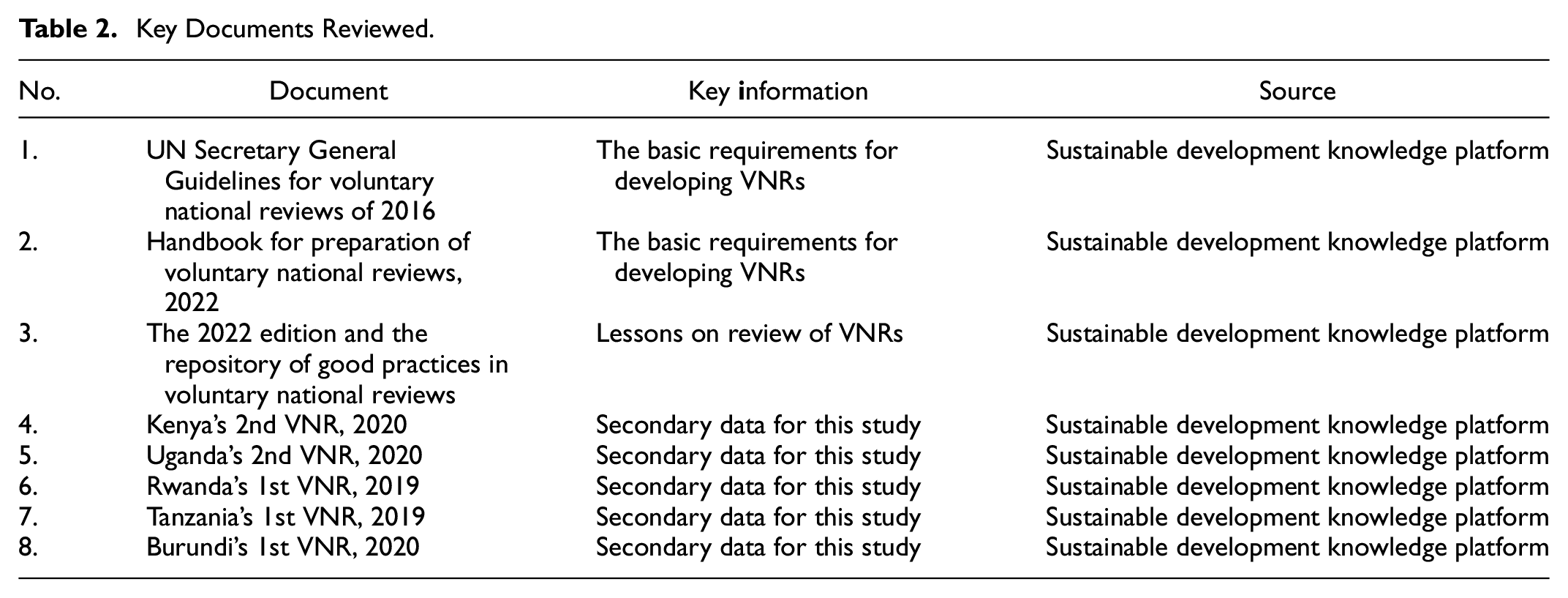
The key documents consulted and the key information sought during this study are presented in Table 2.
Key Documents Reviewed.
Data Analysis
The resultant data and information were then analyzed in two stages. First, on the backdrop of the UN Secretary General Guidelines for voluntary national reviews of 2016 for developing and analyzing each country’s voluntary national review, the handbook for preparation of voluntary national reviews, the 2022 edition, and the repository of good practices in voluntary national reviews. Secondly, a deeper analysis focused on the achieved progress of implementation of country VNRs was explored by asking the following key questions; to what extent have the sustainable development goals been integrated into national policies and programs? What impact has the implementation of sustainable development goals? What are the key barriers and drivers for the implementation of sustainable development goals? And how have been stakeholders involved in VNR reporting for East African states?
The emerging themes were then grouped into; implementation achievements and impacts, key factors promoting implementation, and key barriers to implementation were discussed in order to provide the lessons for future VNR reporting. Table 3 shows a summary of the guidelines and the key guiding analytical questions used in the first analytical stage of the review.
Summary of UN Guidance for VNRs.

Source. Adopted UN Secretary General Guidelines for voluntary national reviews of 2016.
Document content analysis was used in this study because cost-effective as the documents to be reviewed were readily available on the internet and were obtainable without requesting authority to use them from authors. Moreover, documents are stable and non-reactive sources of data and information that can be used over and over. However, researchers were also aware of the fact that this method may also have some disadvantages, especially where documents are blocked from being accessed.
Results
Results show that Kenya and Uganda reported their first VNR report in 2016 while Rwanda and Tanzania reported their first VNR in 2019. In total, Kenya has reported thrice on VNRs while Uganda has reported twice. The summary of VNR reporting in comparison to other African states for the period 2016 to 2021 is as shown in Table 3. The year 2019 had up to 16 African states submitting their VNRs (Table 4).
Reporting Rate for the African Continent.

Source. UN VNR Database 2022.
Results based on the UN guidance for VNR reporting are presented as answers to the key analytical questions as indicated below;
VNR Development Process in East Africa
Kenya has a multistakeholder process for developing VNRs which is implemented through umbrella bodies. While following the guidance provided by the UN is adhered to, Kenya involves representations from both state and non-state actors through a dedicated Directorate in the State Department for Planning. It is further noted that the data used to prepare it was sourced from the Kenya National Bureau of Statistics.
Uganda’s second VNR follows the UN guidance to a certain degree and was prepared in a consultative manner during the COVID-19 pandemic period coordinated by the National SDG Coordination Framework. The multi-stakeholder exercise conducted via online consultation provided a great diversity of stakeholders and secured the participation of many people as opposed to the traditional workshop approach where participants are formally invited. The National SDG Coordination Framework draws a national consultative roadmap or work plan targeting the government, civil society, international development partners, and local community groups among other participants.
Rwanda has a multi-stakeholder steering committee for SDGs implementation. It includes key Government Ministries and agencies, International Development Agencies, Civil Society Organizations under the umbrella of Rwanda Civil Society Platform, and the Private Sector Federation. Focal points across ministries and Agencies provide information for their sectors, which was then used to prepare the VNR. Data validation was then conducted by permanent secretaries and ministers.
The preparation of VNR in Tanzania is coordinated by the Ministry of Executing the exercise for the Zanzibar Islands. The country has a road map for SDG reporting, which highlights how stakeholders are engaged, awareness creation, resource mobilization, and SDG domestication. The process of VNR preparation in Tanzania is participatory and involves the media, local authorities, the private sector, civil society, and national government agencies. As at the time of this study, data on the preparation of VNR in South Sudan was not available in the Sustainable Development Platform.
Mechanisms for Promoting the Ownership of SDGs
In Kenya, the VNR process was also used as a forum for awareness creation among stakeholders. As such, brainstorming sessions were held during joint identification of achievements, challenges, and gaps that faced the implementation of sustainable development.
In order to foster ownership of VNRs, the Government of Uganda has established national coordination arrangements under the National SDG Coordination Framework. The arrangements define roles and responsibilities for different actors involved in SDG coordination.
In Rwanda, wide consultative approaches are used to promote SDG ownership. The Ministry of Finance and Economic Planning facilitates ownership at all national levels. As such, an SDG guide has been prepared in English but translated to the local language Kinyarwanda and is widely disseminated online and through hard copies. In addition, Rwanda SDG METADATA provides definitions for methodologies for SDGs has been developed. In addition, the country seeks to deepen consultative planning and budgeting to implement ownership of SDGs.
Tanzania has a supportive legal and policy environment that promotes the ownership of SDGs. Moreover, SDGs are mainstreamed in national frameworks and budgets. Tanzania’s long-term plans such as the Long-Term Perspective Plan (LTPP) 2011/12 to 2022/26 and Zanzibar’s Development Vision 2020 provide evidence of SDG ownership. As at the time of this study, data on the preparation of VNR in South Sudan was not available in the Sustainable Development Platform.
Integration of National Development Plans, Policies, and Programs
SDGs in Kenya are well-anchored in Key development policies and plans. At the highest national level, SDGs are anchored in Vision 2030 which is Kenya’s blueprint development aspiration and provides the overarching framework for development in Kenya. The vision’s aim of creating a globally competitive economy by 2030 is actualized through 5-year Medium-Term Plans (MTPs). It was also noted that the current legal framework supported up to 78% of SDG targets.
In Uganda, SDGs are aligned with the country’s Vision 2040 and the National Development Plans (NDPs). The current NDP II which has been in existence for over 5 years has been guiding national development and it is 70% aligned to SDGs. The government has also evaluated the quality of sector budgets for gender and equity compliance. In addition, SDGs are acknowledged as linked to regional development plans such as the East African Regional Integration and African Agenda 2063 for development which aim to ensure no one is left behind in development.
Rwanda’s Vision 2050 provides the overall framework for national development through medium-term development strategies such as the Poverty Reduction Strategy 2002 to 2006 and the Economic Development and Poverty Reduction Strategies I and II. These national strategies are in harmony with most of the SDG goals. Table 1 on page 15 provides the linkage between development priority areas and the SDGs.
Tanzania provides a deeper analysis of how sustainable development is integrated with national development policies plans, policies, and programs. The VNR elaborates on how SDGs are integrated through the medium-term planning frameworks such as FYDP II and MKUZA III. At the time of this study, data on the preparation of VNR in South Sudan was not available in the Sustainable Development Platform.
Are the Dimensions of SDGs Well Integrated with Reporting on Each Goal?
Kenya uses several approaches to enforce the integration of social, economic, and environmental aspects in the implementation of sustainable development goals. For purposes of achieving ecologically sustainable development, Strategic Environmental Assessments (SEA) and Environmental Impact Assessments are integrated with development planning and implementation. These tools help to ensure that there are interlinkages between SDGs.
In Uganda, a description of how economic, social, and environmental dimensions are integrated into reporting on each goal is lacking in the second VNR. However, there is a description of leaving no one behind strategies which include civic engagement for instance Tondeka Mabega Campaign of 2019 where citizens were enlightened on sustainable development goals. The other strategy is to enact integrated, equity-focused policies, interventions, and budgets, and the use of disaggregated people-driven data and information sourced from the Uganda Bureau of Statistics.
In Rwanda, the dimensions of sustainable development have been quite integrated into reporting on each goal. However, evidence of such integration was not visually represented in a table or in a stand-alone section of the report to highlight such an integration.
Tanzania provides a deeper analysis of how sustainable development is integrated into national development. Pages 16 to 24 are dedicated to the analysis of each of the components of sustainable development. However, the analysis is not at the goal level but highlights the existing policies and plans for each dimension. As at the time of this study, data on the preparation of VNR in South Sudan was not available in the Sustainable Development Platform.
Institutional Mechanisms for Realizing SDG
Kenya has a sound policy and legal environment and institutions geared toward SDG implementation. However, the country acknowledges that there are challenges as well, especially budgetary constraints, limited access to concessionary borrowing, illicit financial flows, tax avoidance, limited technical expertise and capacity in sustainability science. Several areas of intervention have been suggested in order to overcome these challenges and hasten the achievement of SDGs. For example, Kenya’s Vision 2030 identifies Science, Technology, and Innovation as the means of implementing SDGs through advising on challenges, innovative solutions, and providing indicators for monitoring key projects. As such, the government seeks to increase research funding. Other areas of focus include strengthening the global partnerships for sustainable development through south-south cooperation, harmonization of sector working groups, leveraging on technology for example, eProMIS, encouraging development partners to use government systems for budgeting, procurement, accounting and monitoring and evaluation, and increasing stakeholder participation in reviews.
In Uganda, the institutional mechanism for implementing SDGs is coordinated by the National SDG Coordination Framework which is a multi-stakeholder unit established in 2016 and domiciled in the Office of the Prime Minister.
Rwanda has properly functioning institutional mechanisms for the implementation of SDGs which involve stakeholders from national to local levels. Each organ has a uniquely defined role and function as shown in Table 2 of Rwanda’s VNR with the parliament being at the forefront of ensuring there are plans, adequate budgets, and accountability for SDG implementation. Performance contracting or imihigo is used to plan, monitor, and evaluate development at all levels. With regards to leaving no one behind, Article 16 of the Rwandan Constitution of 2003 is applied and specifically, the law calls for allocating 30% of all decision-making positions for women. To date, the country has 61.3% female representation in parliament; the highest in the world.
In Tanzania, it is recognized that the implementation of SDGs requires extensive multi-stakeholder collaboration and monitoring for successful implementation. As such, the country’s dedicated SDGs coordination and monitoring mechanism is being developed. Currently, the oversight for SDG implementation is done under the office of the Prime Minister. While the Ministry of Finance and Planning coordinates implementation and monitoring. There is a coordination Steering Committee domiciled in the Prime Minister’s Office and composed of Permanent Secretaries from ministries that operationalize the 5-Year Development Plan II. Zanzibar has a similar institutional mechanism for SDG implementation. As at the time of this study, data on the preparation of VNR in South Sudan was not available in the Sustainable Development Platform.
Future Direction for VNR Reporting
Kenya, Uganda, Rwanda, and Tanzania acknowledge that maximum synergies and minimum trade-offs are important for successful SDG implementation. In the next steps, the four countries strive to l focus on promoting horizontal and vertical interactions in favor of policy formulation and execution toward sustainable development.
Uganda wishes to focus on building stronger partnerships, coordination, and collaboration to ensure greater synergy for goal implementation, greater localization, and popularization of SDGs in the country, including the adoption of South Korea’s Saemaul Udong model at the local community level which helps to promote the spirit of self-help and community participation in SDG implementation, building citizen-based inclusive leadership which will promote SDGs, promoting SDG focused innovation targeting young people, strengthening technology and information systems and harnessing the financing potential for SDGs.
Rwanda and Tanzania intend to build on visionary leadership, integrated development planning, and leveraging on home-grown solutions in order to achieve multiple developments while leaving no one behind.
As at the time of this study, data on the preparation of VNR in South Sudan was not available in the Sustainable Development Platform.
Progress on the Implementation of SDGs
In both Kenya, Tanzania, and Uganda VNRs examines all 17 SDGs. Achievements are analyzed at the goal level where indicators for each goal are explored. Where possible, key qualitative and quantitative data and their sources are presented to show the progress of implementation. In Kenya, the amount of data and information presented varies from one goal to the other. Scanty information was provided under goal 15 on life on Land. Only a single sentence was used to describe indicator 15.1.1 which showed that forest area had remained steady between 2017 and 2019 at 7.28% on Page 70. Overall, the report looks visually appealing and is written in plain English and hence easy to follow by a diverse readership.
In Uganda, goal 10 on reducing inequality there are no indicators due to the absence of data.
In Rwanda, the VNR provides some useful reviews. An in-depth analysis of the seven SDGs (SDG 2, 4, 8, 10, 13, 16, and 17) is conducted. The other goals 1, 3, 5, and 9 are also explored. A goal-level analysis is thematically conducted where five themes are described.
I In all the reviewed states case studies are also cited where possible. As at the time of this study, data on the preparation of VNR in South Sudan was not available in the Sustainable Development Platform.
Measurement of SDGs Implementation Progress
Reviewed literature shows that the progress of SDGs implementation in East African states is measured using a combination of indicators and tools that provide a comprehensive overview of the progress made by each country toward achieving the SDGs. One of the key indicators used is the SDG Index and Dashboard. This index measures the progress made by each country toward achieving the SDGs, based on a set of indicators and targets that have been established for each goal. In addition, various organizations and institutions carry out assessments and evaluations to measure the progress of SDGs implementation for individual states.
The Role of Technology in Implementation of SDGs
Reviewed literature shows that technology is important for VNR reporting. Other studies such as Tjoa and Tjoa (2016) acknowledge the use of technology in SDG implementation in the East African region. The study established that technology can be used to enhance access to education, healthcare, and clean water, and improve agricultural productivity. However, there is a need to develop policies that enhance technology adoption and use in SDG implementation monitoring. Vázquez-Verdera et al. (2021) found that ICT had the potential to support economic growth, improve access to education and healthcare, and promote environmental sustainability. However, they also point out the challenges of limited infrastructure and human capacity, as well as the need for policies that promote innovation and entrepreneurship. Abid and Ikram (2022) argue that technology can be used to promote economic growth, improve access to education and healthcare, and address environmental challenges. However, the study also highlights the need for policies that support innovation and entrepreneurship. Okuwa (2020) and Ojo (2022) examined the potential of technology to catalyze sustainable development in East Africa, with a focus on the role of mobile technology. The authors argued that mobile technology can be used to improve access to education and healthcare, support agricultural productivity, and promote environmental sustainability. However, there was a need for policies that support the development and adoption of mobile technology.
Stakeholder Participation in SDG Implementation
Stakeholder participation in the implementation of Sustainable Development Goals (SDGs) is essential for achieving sustainable development and VNR reporting. Besides VNR reporting, other studies such as Fowler and Biekart (2017) examined the role of stakeholders in the implementation of SDGs in Kenya. The study found that stakeholder participation was essential in promoting the effective implementation of SDGs. However, the study identified challenges such as inadequate resources, lack of coordination among stakeholders, and limited involvement of marginalized groups. Another study by Obando et al. (2018) examined stakeholder participation in the implementation of SDGs in the water sector in Kenya. The study found that stakeholder participation was essential in promoting the effective implementation of SDGs. However, the study identified challenges such as inadequate funding and limited involvement of marginalized groups.
In Tanzania, a study by Chan et al. (2021) examined the role of stakeholders in the implementation of SDGs in the health sector. The study found that stakeholder participation was crucial in achieving SDG 3 (good health and well-being) but noted that there were challenges such as limited resources and inadequate representation of certain groups.
In Uganda, a study by Gachu (2017) examined stakeholder participation in the implementation of SDGs in the agriculture sector. The study found that stakeholder participation was crucial in achieving SDG 2 (zero hunger). However, the study noted that there were challenges such as inadequate resources and limited involvement of women and youth.
The Impact of Implementation
East African states have made significant progress in implementing sustainable development goals (SDGs) through voluntary reporting. Some of the key achievements highlighted in reviewed VNRs are shown in Table 5. These impacts are in line with the principle of leaving no one behind as espoused in the requirements for sustainable development.
Impact of SDG Implementation.

Source. Reviewed VNRs.
From the above results, East African states have become melting pots for emerging global best practices that could be emulated by other countries. For example, Kenya has developed the National Sustainable Development Goals Implementation Strategy for the implementation of SDGs in a multi-sectoral approach with a focus on priority areas such as poverty reduction, gender equality, and sustainable economic growth, and is supported by a monitoring and evaluation framework to track progress towards achieving the goals. In Uganda, the Universal Primary Education Initiative under SDGs has implemented a successful initiative to provide free primary education to all children in the country, which has contributed to achieving SDG 4 (Quality Education). The initiative has helped to increase enrollment rates and reduce the gender gap in education. In Tanzania the Renewable Energy Strategy promotes the use of renewable energy, which supports SDG 7 (Affordable and Clean Energy). The strategy includes initiatives such as expanding access to electricity in rural areas, promoting the use of solar power, and investing in wind power. Rwanda’s National Forest Policy seeks to protect its forests, which supports SDG 15 (Life on Land). The policy includes measures to reduce deforestation, increase reforestation, and promote sustainable forest management practices.
Key Barriers and Drivers of Implementation
Existing literature suggests that stakeholder participation is crucial for the effective implementation of SDGs in East Africa. However, the review of VNRs indicates there are challenges that need to be addressed. Reviewed VNR literature shows that there are numerous barriers to achieving the SDGs, including limited financial resources, weak institutional and governance frameworks, inadequate infrastructure, limited data availability and quality, climate change and environmental degradation, socio-economic inequalities, and conflicts and insecurity. Addressing these barriers will require concerted efforts from the government, civil society, the private sector, and international partners.
Discussion
Voluntary national reviews on follow-up and implementation of SDGs are important for gauging global progress towards Agenda 2030. Voluntary reviews help countries to evaluate achievements, analyze gaps, and design interventions for improving the quality of life. As such, many countries (both high income and low income) have embarked on rigorous national reviews of sustainable development and are earnestly sharing experiences, practices, and lessons with the global community. Among other key principles, reviews should observe the tenets of leaving no one behind in development. Reviews should be truly consultative and should adopt a “whole of society approach” (Stuart & Samman, 2017). In addition, reviews should follow the guidelines of the UN Secretary-General Guidelines for voluntary national reviews of 2016, the handbook for preparation of voluntary national reviews, the 2022 edition, and the repository of good practices in voluntary national reviews that cuts across all 17 SDGs. Many countries have followed the guidelines and religiously submitted annual reviews because many SDGs complement individual countries national development plans and priorities (De Meyer et al., 2017; Sarwar & Nicolai, 2018; Together, 2030, 2017a; UN, 2018).
Similarly, reviewed literature shows there are significant deviations in reporting that make it difficult to track and compare lessons between countries and regions. Moreover, there are reports that show that in certain cases the UN general guidelines and principles are disregarded to a certain extent among other emerging issues (De Meyer et al., 2017; Griffiths, 2017; Moller-Loswick, 2016; Together, 2017a, 2017b). Consistent and systematic reporting on SDGs is important for ensuring that the emerging science and knowledge is informs national practices on SDG implementation (Allen et al., 2018). The results from East Africa are hereunder presented.
Achievements and Impacts of SDG Implementation
Results from East African states (Kenya, Uganda, Tanzania, Rwanda, Burundi, and South Sudan) demonstrate the region’s commitment and desire to achieve high-quality life for the region’s 177 million people by the year 2030 and the deliberate cooperation with the global community on the implementation of SDGs. Kenya and Uganda prepared their first VNR in 2016. Rwanda and Tanzania developed their first review in 2019 (Table 3). Kenya and Uganda were among the first African countries to submit reviews (Table 3).
All the reviewed VNRs were prepared in the English language which is one of the six official UN languages in accordance with the VNR guidelines. Whereas this study agrees with the use of the six languages, in the context of the East African region, this paper calls for the inclusion of Kiswahili as one of the reporting languages. The language is spoken by over 200 million people globally. In fact, the Africa Union has already approved the language as the official workplace language for Africa. In addition, UNESCO has set aside July 7th as World Kiswahili day (EAC Website, 2022; University of Nairobi Website, 2022).
Moreover, all the reviewed VNRs highlight their development reference to the UN VNR guidelines and have reported progress on the implementation of all 17 goals by attaching additional information in the form of statistical annexes. This is a good indication that demonstrates East Africa’s commitment to implementing and following up on Agenda 2030 unlike reports from other regions which show that countries were not reporting on all the 17 goals (Beisheim, 2016; Together, 2017a). In addition to goal level reporting, results show that Kenya VNR has 2 statistical annexes comprising both qualitative and quantitative data, Tanzania has 3, Rwanda has 1, and Uganda has 1 statistical annex. These results imply some appreciable efforts are being made to provide conclusive evidence for SDG implementation as established in the UN guidelines. Reports also vary in volume and content. Kenya’s second VNR has 124 pages, Uganda’s second VNR has 104 pages, Rwanda has 109 pages, and Tanzania has 186 pages. Tanzania’s report has two opening messages whereas the report from the rest of the countries has one opening message. Uganda’s VNR has an acknowledgment part. Tanzania’s VNR lacks a list of references. The contact details of the SDG development agency are provided in Kenya and Uganda and lacking in the case of the rest of the member states. The differences, including incomplete reporting on goals and lack of standardization, are not unique to the East African region alone, other studies have acknowledged them in the case of reports from other parts of the world (Moller-Loswick, 2016; Partners of Review, 2020; Sarwar & Nicolai, 2018; Together, 2017a, 2017b). Nonetheless, in view of these reporting shortcomings, this paper agrees with De Meyer et al. (2017) and Donald and Annunziato (2017) who highlighted the need for explicit and clear UN guidance on the structure and content of VNRs.
Despite the highlighted differences in VNR content reporting of SDGs, reviewed results from SDG implementation indicate that the region is making significant strides in the quest to actualize the principle of leaving no one behind. SDGs implementation progress monitored using a combination of indicators and tools such as the SDG index and dashboard as well as voluntary assessments conducted by stakeholders shows greater strides in implementation. Table 5 exemplifies these development strides through reduced poverty levels, improved access to basic services, enhanced environmental conservation, improved economic growth, and promotion of gender equity. For example, reviewed data shows that Tanzania increased the number of children enrolled in school while Rwanda made strides in reducing infant mortality. Kenya made strides in environmental conservation by banning single-use plastics while Rwanda imposed a ban on non-biodegradable plastics. On the gender equality front, Rwanda has the highest proportion of women representation in parliament across the world, while Tanzania has been lauded for reducing gender-based violence. As a result of the commitment to SDG implementation, reviewed literature shows that the East African region is emerging as a global powerhouse for best practices in implementing sustainable development. Kenya has developed the National sustainable development strategy, Uganda has developed the universal primary education initiative targeting all children in the country, Tanzania has developed the Renewable Energy Strategy which seeks to implement SDG 7 and Rwanda has developed the National Forest Policy in order to implement SDG 15.
From the foregoing discussion, it can be deduced that the voluntary reporting of sustainable development has provided a platform for East African countries to share their experiences and learn from each other in the pursuit of sustainable development. The key achievements in the region demonstrate the commitment of governments and other stakeholders toward achieving the SDGs.
Several factors have conspired to achieve the highlighted impacts. However, the most significant factors include; stakeholder participation and SDG integration in national policies and plans. These factors are briefly discussed below.
Stakeholder Participation in SDG Implementation
The proper implementation of SDGs follow-up and reviews rely on the existing institutional structures and how these institutions promote the coherent incorporation of SDGs in a country’s development matrix. As such, from reviewed reports, Kenya, Uganda, Tanzania, Rwanda, and Burundi have established institutional structures for SDG implementation and follow up which mimic to a large extent the “whole of society” approach promoted by the UN guidance. However, these structures differ significantly in the structure and level at which coordination occurs. Generally, VNR coordination and implementation oversight appears to be anchored in the Ministry of Finance and Economic Planning across all East African states. For instance, in Burundi SDG follow-up and implementation is conducted through a two-tiered structure composed of a technical entity and a steering committee. In Tanzania, VNRs are coordinated by the finance and planning for mainland Tanzania whereas the Zanzibar Planning Commission. These institutional structures are also reported in reviewed literature as contributing to the indivisible implementation of SDGs.
Overall, the institutional mechanisms reflect a multi-stakeholder approach which is largely in line with the UN guidelines for the preparation of VNRs. In East Africa, various stakeholder groups and representations have been involved, including national government agencies, sub-national government agencies, parliament, community groups, youth, media, private sector agencies, and in some cases UN agencies. In Uganda, stakeholders have specifically explicitly expounded the active role of parliament, civil society, and young people in its VNR. In Kenya, stakeholders’ composition has prominently included a category of think tanks and the scientific community. In general, Parliament as a stakeholder appears to be playing an active role in SDG implementation across all East African states. This is important because consulting parliament on SDG implementation enhances awareness creation, oversight, and accountability in SDG implementation besides creating an environment for enacting SDG supporting legislation (Partners of Review, 2020). In preparing VNR, reviews show that Uganda prepared a program that actively consulted the parliament. In Kenya, VNR and SDG-related workshops and awareness efforts relied on parliament support for the follow-up and implementation of SDGs. However, across all cases, there is the need to investigate how overall horizontal and vertical coordination is achieved across different levels and their clear linkage to sub-national processes. This observation is in line with suggestions in a report developed by Partners for Review in the year 2020.
The process of multi-stakeholder engagement and participation varies across the East African states. In Burundi, multi-stakeholder approaches involved consultative processes and workshops. In Uganda due to the ravaging impacts of COVID-19, consultative forums for SDG were conducted online with reports indicating that a large number of people were reached. However, overall, a review of all VNRs highlights the need for increased stakeholder engagement through strong frameworks of collaboration such as Public Private Partnerships.
A review of the literature also shows that SDG implementation processes are actively creating robust institutions for monitoring and evaluation. In Uganda and Kenya, there is routine reporting on SDG implementation through the production of annual reports or periodic stock-taking. In Kenya, monitoring of SDG implementation is completely institutionalized such that biennial reports are generated in addition to voluntary national reviews of SDGs. However, weak institutional capacity for monitoring and evaluation has been highlighted in Kenya’s VNR. Partners of Review (2020) has also attested to these findings and has called for the strengthening of institutional capacity.
In general, results from East African states indicate that the institutional mechanisms for SDG are fast advancing, especially in those countries submitting their second reviews. The whole of society approach appears to be the emerging organizing concept for the coherent implementation of VNR processes. However, coordination of horizontal and vertical representations remains challenging with regards to how to fully incorporate sub-national level views in reviews. This observation is similar to the findings by Partners who explored the trends in reporting for 47 countries. In addition, there is the need to strengthen the existing monitoring and evaluation structures in all the East African states, including how to incorporate modern technology for example, enhance the integration of performance contracting with technologies such as eProMIS in the case of Kenya. There is also the need to foster more political commitment toward the implementation of SDGs by hinging coordination and implementation efforts in the highest executive office across all East African Countries in order to improve the integrated implementation of SDGs. Results have shown that across all states, SDG coordination and implementation are done at ministerial-level institutional arrangements. This may foster the sub-division of SDGs through sectoral reporting which is against the principles of integrated implementation. Equally, this study notes that even though VNRS are important, there could be other mechanisms that are equally if not more important than the VNRs that need to be explored in future studies. Also, the role of VNR shadow reports or other civil society engagement could be noted rather than only focusing on government mechanisms.
Integration of SDGs in National Development Policies
Sustainable Development Goals aim at transforming societies by implementing interlinked goals toward Agenda 2030. As such, the mainstreaming and fast-tracking of approaches and actions toward “leaving no one behind in development” through policy coherence, coordinated budgeting, increased localization efforts, and increased ownership of SDGs are urgently needed. All East African states reported progress on the implementation of the 17 SDGs in line with the UN guidance. All goals are reviewed at the indicator level. However, the format of presenting the review differs across all countries. Rwanda conducted an in-depth analysis of seven goals, however, the reviews are thematically grouped into five areas in accordance with the UN guidance. Uganda ranks goals based on external evaluation of the sustainable development Index. However, it must be noted that mainstreaming SDGs into a country’s development roadmaps is a complex and daunting process subject to many externalities. Nonetheless, attempts for mainstreaming could be achieved through priority setting expressed in national focus areas or development pillars. As such, national development plans, visions, and plans provide an overarching platform for SDG implementation. All the reviewed VNRs show all the East African states have a solid foundation for SDG integration and implementation, which exists in the form of visions and medium-term development plans. In addition, the preparation of VNRs uses Policy gap analysis which represents some best practices in efforts to set national development priorities. Policy gap analysis for SDGs that was conducted in Kenya indicated that the country’s legal framework supported up to 78% of the SDG targets. In Uganda, the current national development plan is 70% aligned with the SDGs’ follow-up and implementation. In addition, SDGs are acknowledged to be linked to other regional and global development Agenda. Burundi specifies that its national development priorities were identified through surveys.
Nevertheless, the coherent follow-up and implementation of SDGs require identification and understanding of synergies and trade-offs between goals at national and sub-national levels. As such, East African countries have devised various approaches to full fill this role. Kenya recognizes the importance of feedback on the interlinkages and trade-offs of SDGs implementation. Further, the use of sector-specific policies and plans are also used to mainstream and report on SDGs. Burundi has reported the energy sector-specific efforts targeting industrial policy. Localization of SDGs through site visits and mainstreaming SDGs in local development plans is also common in Kenya. SDGs are also integrated through legal measures. Other policies and legal mainstreaming efforts are exemplified in the case of Rwanda. Article 16 of the Rwandan Constitution of 2003 allocates 30% of all decision-making positions to women. To date, the country has 61.3% female representation in parliament; the highest in the world. Mainstreaming of SDGs is also done by implementing the provisions for leaving no one behind. In Kenya, vulnerable groups are actively identified in the VNR process and they include the youth and refugees. In Burundi, vulnerable groups include children. These case results indicate positive commitment towards SDGs implementation.
In a nutshell, from the ongoing review, the progress of implementing and mainstreaming SDGs is advancing in East Africa. Results show that mixed approaches are used. Mainstreaming of SDGs in National Development Plans appears to be the most conspicuous method of integration. However, SDG implementation should be more integrated and implemented through multi-dimensional approaches. Further, the ongoing efforts of developing SDG evaluation procedures should be upscaled.
Key Learning and Interventions for Future Reporting
From the review of progress made toward implementing SDGs in East Africa, the voluntary reporting of the implementation shows good progress in East Africa. Furthermore, it is clear that achieving the SDGs requires collaboration between various stakeholders, including governments, the private sector, civil society, and international organizations. Secondly, accurate and reliable data is crucial in monitoring progress towards the SDGs. East African countries are learning to collect and analyze data to track their progress toward achieving SDGs. Moreover, lessons show that local context matters. Even though SDGs are global goals, East African countries are learning to adapt the SDGs to their specific contexts by involving local communities in the implementation process. From reviewed literature, it is clear that countries are learning that policies across different sectors need to be coherent to achieve the SDGs. Governments need to ensure that policies related to economic, social, and environmental issues are aligned to achieve sustainable development. Finally, from reviewed literature, communication is emerging as a key ingredient for voluntary reporting on SDG implementation. With increasing communication and transparency in achieving the SDGs through VNR reporting East African countries are learning to communicate their progress toward the goals to the public and to involve them in the implementation process.
Nevertheless, based on the reviewed literature, for future VNR reporting, this paper recommends the following interventions; increasing awareness about the SDGs and their relevance to people’s lives is crucial to encourage voluntary reporting. This could be done through public education campaigns, social media, and community outreach programs; building the technical capacity of organizations and governments in East Africa is essential to improve their ability to collect and analyze data effectively. Providing training, tools, and resources can help organizations to report on their progress towards the SDGs more accurately; increasing the provision and access to technology, including the internet and smartphones, can help to improve voluntary reporting of the SDGs. This could be done through initiatives such as providing free Wi-Fi in public spaces, subsidizing smartphone purchases, and improving internet connectivity in rural areas; creating a culture of transparency and accountability is also essential to improve voluntary reporting of the SDGs. Reviewed literature acknowledges the centrality of technology deployments in SDG implementation (Abid & Ikram, 2022; Okuwa, 2020; Ojo, 2022; Tjoa & Tjoa, 2016; Vázquez-Verdera et al., 2021). Governments and organizations should be encouraged to report on their progress towards the SDGs regularly. This information should be made available to the public; encouraging collaboration between different stakeholders, including governments, civil society, and private sector organizations, can help improve voluntary reporting of the SDGs. Reviewed literature affirms the importance of stakeholder participation in SDG implementation processes (Chan et al., 2021; Fowler & Biekart, 2017; Gachu, 2017; Obando et al., 2018). Collaboration can help to share knowledge, resources, and best practices, leading to better reporting and more effective implementation of the SDGs; supporting political stability is crucial for improving voluntary reporting of the SDGs. Encouraging good governance and strengthening democratic institutions can help to improve accountability and transparency, leading to better reporting on progress toward the SDGs.
Conclusion and Recommendations
Many countries are submitting VNRs and earnestly realigning their development priorities towards sustainable development as the clock ticks on reaching the 2030 agenda. However, the SDGs’ achievements and VNRs reporting practices and approaches have been different across countries. This paper has presented the SDGs achievements and reporting practices for East African states. Results have shown that East African states are committed to achieving a high quality of life for their people. The reviewed cases have established favorable policies and legal environments for SDG implementation and have reported some good impacts with regard to the principle of leaving no one behind.
Moreover, several best practices in SDGs implementation have emerged in East Africa, especially around initiatives that involve developing national strategies, implementing initiatives to promote education, renewable energy, and forest conservation, and promoting a climate-resilient green economy. These best practices can serve as models for other countries in the region to adopt and adapt to their specific contexts.
However, reviews have also shown that East Africa still faces unique challenges in achieving sustainable development due to factors such as poverty, climate change, and weak governance structures. As such, this paper recommends increasing awareness, building technical capacity, providing access to technology, fostering transparency and accountability, encouraging collaboration, addressing cultural barriers, and supporting political stability. Despite the few study limitations, including particularly the lack of data for South Sudan and for that matter the extent of reference documentation, implementing these interventions can help to promote sustainable development in the region.
Footnotes
Declaration of Conflicting Interests
The author(s) declared no potential conflicts of interest with respect to the research, authorship, and/or publication of this article.
Funding
The author(s) disclosed receipt of the following financial support for the research, authorship, and/or publication of this article: This work was supported by the Ministry of Education of the Republic of Korea and the National Research Foundation of Korea (NRF-2020S1A5C2A01092978).
Ethics Statement
Not applicable.

Data Availability Statement
Data sharing not applicable to this article as no datasets were generated or analyzed during the current study.