




Abstract
The current study aimed to identify the most and the least important situational properties of second language willingness to communicate (L2WTC) in an EFL context. After reviewing the related literature, 24 influencing factors were identified and then they were prioritized. 180 TEFL students participated in the study to answer the research questionnaire. A quantitative research approach applying paired comparison questionnaire was employed. Data analysis was done using Excel spreadsheet for sorting data and calculating the mean and WinQSB software for solving linear programming model. The results showed that, among the selected variables, “the size of the group,”“familiarity with topics under discussion,” and “interlocutors and familiarity with them” were determined to be the first most important situational variables which highly influence L2WTC. The findings also showed that “attitudes toward the learning situation,”“course evaluation criteria,” and “alignment with the classroom norms” were the least important factors influencing L2WTC. The significance of the study lies in its theoretical contributions and pedagogical implications it has for the field of second language teaching and learning.
Plain Language Summary
This study aimed to identify the most and the least important situational properties of second language willingness to communicate (L2WTC) in an EFL context. 24 influencing factors were identified and were prioritized using EinQSB software. The results showed that “the size of the group,”“familiarity with topics under discussion,” and “interlocutors and familiarity with them” were determined the first most important situational variables while “attitudes toward the learning situation,”“course evaluation criteria” and “alignment with the classroom norms” were the least important factors influencing L2WTC.
Keywords
Introduction
The important influential properties of second language willingness to communicate (L2WTC) have long been a question of great interest in the field of modern language instruction and L2 communication. In the last few decades, for instance, there has been a surge of interest in finding the key social, situational, psychological, and other predicators of L2WTC. As stated in the literature, there are many factors which influence language learners’ L2WTC (G. Cao, 2022; Y. Cao, 2011; Kang, 2005). These properties include, but not limited to trait-like (or individual), situational, social, motivational, factors related to the influence of teachers over learners, and so forth. Furthermore, especial attention has been given to finding the most prominent individual predicators and their prioritization (Rafiee & Abbasian-Naghneh, 2019).
McCroskey and Richmond (1990), among others, expend the situational or trait-like view by asserting that it is personality oriented and therefore remains stable in different contexts, disregarding the interlocutors and/or the topic under discussion. However, data appears to limit the impact of an individual’s personality on L2WTC suggesting that it is largely dependent on a combination of situational variables namely group size (Almijbilee, 2023; Y. Cao & Philp, 2006), familiarity with interlocutors, topic, and/or linguistic proficiency (Wood, 2016). Proponents of situational WTC (Ito, 2022; MacIntyre, Clément, et al., 1998) have put forward a multi-layered Pyramid Model indicating factors influencing WTC. While they admit the influence of personality, it is asserted that a great number of factors play a role. These research findings have been confirmed by a range of empirical studies (Wood, 2016; Zarrinabadi, 2014) proposing a wider assumption that numerous elements influence communication, both trait-like and those attached to situational factors. The main reason for choosing this topic was that, evidently, factors identified to influence L2WTC in EFL contexts are complex and numerous, however, to the best of researchers’ knowledge, there has been no attempt in finding the most/the least desirable and important ones. To achieve that goal, a decision-making method can be used whose major purpose is “identifying and selecting an alternative from a set of alternatives based on the preferences of the decision-maker(s)” (Rezaei, 2016, p. 126).
As the sub-discipline of operation research, multiple-criteria decision-making (MCDM), or multiple-criteria decision analysis (MCDA), deals with evaluating multiple conflicting criteria. As stated by Mardani et al. (2015), MCDM has been considered to be an active research area since 1960 which produced many theoretical and applied research articles and books across many disciplines. Since this is a method which helps people making decisions based on their preferences, especially when there are more than one conflicting criteria (Ho, 2008), it is preferred to other operation research methods. One of the most recently developed areas in MCDM is the best-worst method (BWM), a comparison-based method whose main concern is to conduct the comparisons in a structured way. The advantages of this method are that, not only less amount of information is required, but the comparisons are also more uniform and consistent (Rezaei, 2016).
The primary aim of this paper, therefore, is finding the least and the most important situational properties of L2WTC in EFL context of Iran by applying best-worst method (BWM). This is the first study which applies one of the most developed methods of MCDM to compare the criteria related to L2WTC in a structured way. Hence, it is hoped that this research will contribute to a deeper understanding of the nature of WTC in second language communication.
Theoretical Background
Situational Properties of L2WTC
A growing body of evidence suggests that the social environment of the classroom has great influence on the behavior and thinking of language learners in the classroom (Jennings & Greenberg, 2009). As a new perspective, the proponents of this line of thinking challenge the perspective that views L2WTC as the individual or trait-like predisposition. The new perspective was well approved by different research studies and lead to the change of the definition of L2WTC which was provided earlier. Accordingly, L2WTC was defined as “a readiness to enter into discourse at a particular time with a specific person or persons, using L2” (MacIntyre, Dörnyei, et al., 1998). The immediate situational antecedents which were supposed to influence L2WTC included, but not limited to, the state of communicative self-confidence, willingness to communicate with a particular person, intergroup attitudes, interpersonal motivation, self-confidence, communicative competence, social situation, personality, and intergroup climate (Alrabai, 2022; Kang, 2005).
Following this view, the researchers tried to find the ways L2WTC can be affected by situational variable. MacIntyre et al. (2001) found that social support, especially from the friends, impacted L2WTC outside the language classrooms. In comparing the immersion and non-immersion programs, Baker and MacIntyre (2000) and MacIntyre et al. (2001) found that WTC was influenced by the educational context. As explained by Yashima (2012), immersion contexts are similar to L1 situations wherein anxiety is perceived to be the best predictor of WTC. Peng and Woodrow (2010) also examined the role of classroom environment on L2WTC and found that, in Chinese English learning context, a variety of factors such as communication confidence, learner’s beliefs, classroom setting, motivation, and the likes, affect WTC. Among these variables, confidence was found to be the most significant predictors of WTC. In another attempt, Syed and Kuzborska (2020) highlighted the influence of contextual factors, such as teacher, topic, and task type on L2WTC. The data, which was gathered from different sources (classroom observation, learners’ diaries, biographic questionnaires and stimulated recall interviews) revealed that language learners’ L2WTC was strongly influenced by the learners’ interest in topic, task type, teachers’ behavior, the interactional context, and the classroom environment.
So far, the priority of researchers in the field was to identify the influential variables of L2WTC construct. In this regard, throughout the recent two decades, many trait-like and situational properties of WTC were explored by researchers. Besides, no research has been found that surveyed the preference of one property over the other one/s from the viewpoints of students in the field. Therefore, this research seeks to address the following questions:
- What are the situational factors affecting L2WTC in the related literature?
- What is the most important L2WTC situational property?
- What is the least important L2WTC situational property?
Methodology
Sampling
Based on convenient sampling, a total number of 180 upper-intermediate to advanced TEFL university students participated in this study. Participants were both male (43% = 77) and female (57% = 103), aged from 18 to 30. Their language learning experience ranged from 5 to 15 years. They were then homogenized based on Oxford Placement Test. Before beginning the study, informed consent was obtained from the participants and they were provided with adequate information about the project, its purpose, L2WTC, and the situational factors affecting it. Furthermore, the participants were given information about the way they should fill the questionnaire. Besides that, the researchers guaranteed the participants’ anonymity and confidentiality.
Instrument
Based on the literature, influential factors affecting situational willingness to communicate were identified. A questionnaire (see Appendix A) was designed to identify 10 important factors among these 24 factors. The powerful BWM method was used to rank and check the influence of these 10 factors. It is worth mentioning that these two questionnaires were researcher-made and original.
Data collection instrument in this study was a pairwise comparison questionnaire (see Appendix B) which is often used to compare alternatives in pairs to judge which entity has greater quantitative property or is preferred over others. Applying this questionnaire gives the researcher the possibility to decide how to access the alternatives by providing a simple way to rank and rate them. To rate the importance of the options concerning the other options, measures from 1 to 9 are used in this questionnaire. Aiming to check the reliability of the comparison, the following formula was applied to measure the consistency rate of the questionnaire. Measuring the consistency rate in BWM and AHP is structurally similar.

Best-Worst Multi-Criteria Decision-Making Method
As firstly introduced by Rezaei (2015, 2016), Best-worst Method (BWM) is a type of multi-criteria decision-making method whose aim is ranking and selecting an alternative among a set of alternatives. This method, which is commonly used in various fields including health, economics, engineering, IT, and many others, is applied by one or a group of decision-makers. The distinctive feature of this method, compared with other decision-making methods such as AHP, is that it needs less comparison data and results in more consistent comparisons (Rezaei, 2015). This indicates that it produces more trustworthy results. Therefore, the number of paired comparison in AHP with n index equals
As a newcomer to the field of decision-making methods, BWM is an easy-to-apply and easy-to-understand MCDM method. This method does the comparisons in a structured way and brings in more understandable judgment. Above all, this method leads to more consistent comparisons with more reliable rankings and weigh (Ajrina et al., 2018). As mentioned by Rezaei et al. (2017), the interval weights of BWM allows the decision-makers to select a set of weights which are more consistent with their higher-level information. The other salient feature of this method is that it can be applied to different MCDM problems which have qualitative or quantitative criteria.
According to Rezaei (2015), several steps should be followed to determine the weights of criteria. In the first step, the set of decision criteria, which are necessary in decision-making, is determined. The set of criteria is defined as






Solving the above model, the optimal weights of
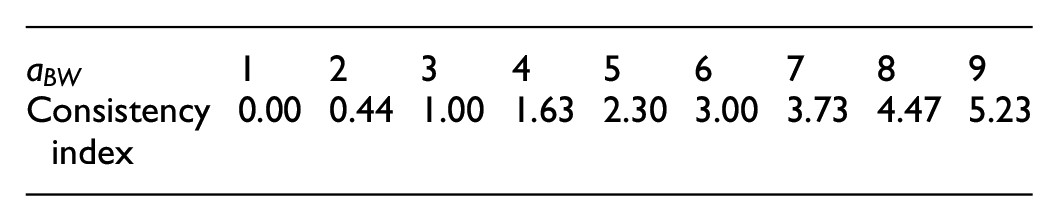
BWM has been used in a variety of areas, including evaluation of the sustainability of supply chain (Ahmad et al., 2017; Ahmadi et al., 2017), evaluating service quality of airline industry (Gupta, 2018), identifying facilitators of innovation in technology (Gupta & Barua, 2016), continuous evaluation of technologies (Ren et al., 2017), and supplier selection (Rezaei et al., 2016).
Procedure
In reviewing the related literature, 24 situational factors were identified to be influential on L2WTC. The rationale for choosing these 24 factors was that they have been repeatedly mentioned as factors affecting the WTC in the past researches. A screening questionnaire (see Appendix A) was used to assess the degree of the importance of the situational variables affecting L2WTC. From among the situational factors which were identified in the literature, 10 were selected which had more influence on L2WTC. Since the data collection involved asking information from participants through distributing questionnaires, this study was characterized to be survey-type. By receiving the informed consents from the participants, the pair-wise comparison questionnaires were distributed among them. Pairwise comparison questionnaire is a way to assess how to achieve alternatives by providing a simple way to rank them. The questionnaire requires respondents to have full knowledge of the criteria and alternatives to compare them well (Ramík, 2017). The questionnaires were distributed among the research participants at the beginning of the semester by the course instructors and they were given sufficient time and instruction to fill out the questionnaires. The researchers gave the research questionnaires to some participants through email because the access to some participants was difficult. From among the 180 participants who were selected conveniently, 175 TEFL students answered the questionnaire. The response rate was 93%. The consistency rate of the questionnaires was below 0.1, which shows that the questionnaires have high reliability and consistency and the results of the questionnaire are valid and reliable. Figure 1 illustrates the data collection procedure.

Research procedure.
Data Analysis
After collecting the questionnaires from the participants, the data was entered into the Excel spreadsheet. The geometric means were calculated and then the data was entered into the WinQSB software. This is a decision-making tool that is based on multi-criteria decision making.
Results
The first research question was formed to identify the situational variables affecting L2WTC reported in the literature. For this purpose, the related studies were reviewed and several factors were identified (see Table 1).
Situational Factors Affecting L2WTC Reported in the Literature.

Among the 10 items selected, the two variables of “the size of the group” and “alignment with classroom norms” were given the most and the least important priorities of situational variables affecting L2WTC. In one questionnaire, the preference or priority of the most important factor over other factors and in another questionnaire, the priority of the least important variable over other variables was measured through paired comparison. In Table 2, the situational variables affecting L2WTC, which were selected by the experts, are shown.
L2WTC Situational Variables Selected by the Experts.

After calculating the geometric mean of the values obtained from the questionnaires, the following linear programming problem has been achieved.











To find the optimal solution for linear programming problem, the weight of each variable was determined. The relative importance (weight) and the priority of each variable are brought in Table 3 and Figure 2.
The Relative Importance and Prioritization of Situational Factors.


Weights of research variables.
The findings in Table 3 and Figure 1 reveal that among the 10 situational variables which were investigated in the current study, “the size of the group,”“familiarity with topics under discussion,” and “interlocutors and familiarity with them” with the relative weights of 0.202, 0.167, and 0.118, were given the first to third priorities, respectively. The priorities of other factors is as follows: “explicit and implicit corrective feedback” (the relative weight = 0.072) the fourth priority, “pattern of interaction” (dyad, teacher-fronted situation, and small group; the relative weight = 0.096) the fifth priority, “purposeful decisions on the topic of the discussion” (relative weight = 0.074) the sixth priority, “lesson content” (relative weight = 0.101) the seventh priority, “attitudes toward the learning situation” (relative weight = 0.063) the eighth priority, “course evaluation criteria” (relative weight = 0.059) the ninth priority, and “alignment with classroom norms” (relative weight = 0.048) the tenth and the last priority. The next part is concerned with the discussion related to the findings obtained.
Discussion
The present study was designed to determine the most and the least important situational variables affecting L2WTC from the viewpoint of a group of TEFL students in Iran. After reviewing the related studies, 24 factors were found to be influential on L2WTC, as reported by L2 researchers in various L2 contexts. Using a screening questionnaire, the 10 most-investigated factors were chosen to be ranked by BW multi-criteria decision-making method. The most interesting finding was that “the size of the group” was ranked to be the most important predictor of L2WTC. In accordance with the present result, previous studies have demonstrated that “group size” was among the main contextual and situational factors influencing WTC (Y. Cao, 2011; Y. Cao & Philp, 2006; Kang, 2005; Wen & Clément, 2003; Zarrinabadi et al., 2014). Small classes, as reported by Cooper and Robinson (2000), are the best alternative to create occasions for EFL learners to spend more times together in meaningful and active learning and thinking situations. Engaging students to work in small groups or dyads make the EFL teachers assured about the equal share of opportunities which would be given to their language learners. The small groups of students help to lessen the effect of stressful classroom atmosphere and lack of opportunities to talk to a great extent (Syed & Kuzborska, 2018). One immediate result of talking in small groups is increasing the confidence in English communication (Fan, 2022; Yashima et al., 2004). Y. Cao and Philp (2006) and de Saint Léger and Storch (2009) have also reported that learners believed whole-class discussions and interactions were more difficult to take part than small groups or dyadic discussions/interactions.
Another finding was that the two variables of “familiarity with topics under discussion” and “interlocutors and familiarity with them” were the other main situational predictors of L2WTC. The present findings seem to be consistent with other research which showed that situational WTC in L2 contexts emerge from the influence of various environmental factors including familiarity with topic under discussion and interlocutors (Y. Cao, 2011; Y. Cao & Philp, 2006; Kang, 2005; Wen & Clément, 2003). A possible explanation for this result may be that most EFL learners who do not have the chance to communicate outside L2 classrooms show more willingness to start communication in situations which had experienced before. Therefore, interactions in unfamiliar situations, such as public talk, is challenging and demanding (Henry et al., 2024; Vongsila & Reinders, 2016). According to (Kang, 2005), two types of familiarity, context and receiver familiarity, are effective factors for initiation of L2 communication.
“Explicit corrective feedback” was found to be the other influential factor influencing L2WTC from the view point of TEFL students. The findings of the current study are consistent with those of Tavakoli and Zarrinabadi (2018) who tried to investigate the influence of implicit and explicit corrective feedback on L2WTC. The results revealed that, while explicit corrective feedback enhanced L2WTC, implicit corrective feedback did not exert influence on it. The result of their study further supported the idea that explicit corrective feedback increased L2WTC through promoting their self-confidence. This result may be explained by the fact that, overall, corrective feedback is both helpful and essential for pushing language learners toward their L2 growth (Lyster et al., 2013; Zare et al., 2022). Previous studies have revealed that giving adequate and effective feedback lead to grammatical, phonological, and morphological development in language learners (Rosa & Leow, 2004).
As regards the least important, or the worst, predictors of L2WTC, the results of this study agree with the findings of other studies, in which “attitudes toward the learning situation” either does not predict L2WTC or is considered to be an indirect predictor of it. In light of this, MacIntyre and Charos (1996) examined a model of L2WTC, which was based on the socio-educational model of language learning proposed by Gardner and MacIntyre (1993). Based on the suggested path model of L2WTC, “attitudes toward the learning situation” and “integrativeness” affect the learners’ L2WTC indirectly through motivation. Yet in another study, which examined the relationship between L2WTC and integrative motivation, Peng (2007) found that “motivation” was one of the strongest predictors of L2WTC while “attitude toward the learning situation” did not predict it.
The current study found that “course evaluation criteria” was one of the least important, or one of the worst, predictors of L2WTC. However, this result has not previously been described. Applying Bronfenbrenner (1999) nested ecosystems model as an analytical framework, Peng (2022) found that there were six types of factors underlying WTC in the microsystem including motivation, learner’s beliefs, affective factors, cognitive factors, linguistic factors, and classroom environment. At the exosystemic level, classroom setting, curriculum design, and course evaluation criteria were perceived to be strongly related to WTC. At the interview sessions, the participants of study complained that their WTC dropped when their course schedule was overwhelming. This was because they had not prepared enough and could not respond to their teachers’ prompts.
In this study, “alignment with the classroom norms” was found to be among the least important predictors of L2WTC. However, the findings of the current study do not support the previous research. Bernales (2016), for instance, applied a mixed-method study to investigate L2 use and classroom participation practices among German EFL learners. The researcher tried to find the learners’ expectations and predictions regarding their participations during the L2 classes and the reasons behind their actions. In the stimulated recall interviews, the participants were required to explain their reasons for speaking or being silent at specific moments in the classroom. The results indicated that there was a link between predicted and self-reported participation that developed as the result of a combination of factors such as teacher’s expectations, alignment with the classroom norms, students’ speaking goals, and their motivations among other. For example, learner participants stated that their speaking turns were mostly influenced by the norms which were set by their teachers.
Conclusion
The present study addressed the situational predictors of L2WTC which were reported in literature and had the attempt to prioritize the most and the least important ones. In doing so, the related literature was reviewed and one of the most recent multi-criteria decision-making methods, Best-worst method, was employed to prioritize the 10-selected variables. The findings indicated that “the size of the group,”“familiarity with topics under discussion,”“interlocutors and familiarity with them,” and “explicit corrective feedback” received the first to fourth priority from the viewpoint of TEFL students. However, these findings are limited by its scope. The finding cannot be over-generalized to other language learning contexts, EFL learners with different age levels, or even different language learning experiences.
The findings of this study have some important implications for future practice of EFL teachers and researchers in the field. To language teachers, this study suggests that limiting the number of language learners in EFL classrooms, arranging classroom and discussion groups based on the language learners’ preferences and familiarity, and giving the topics of interests to language learners are among the best ways to generate situational L2WTC. The more the interaction environment and class atmosphere are safe for language learners, the higher their opportunities and excitements in a discussion group will become. The other major finding of this study was that giving explicit feedback can enhance the learners’ interests in initiating an interaction. Consequently, it is suggested that language teachers provide as much feedback as possible to their learners to make them confident about progressing in the communication cycle. This will eventually lead to meaningful learning since learners can learn from their mistakes.
Furthermore, the findings carry critical implications for policymakers and language institutions looking for to improve the learning experience of EFL learners. Since advancing and sustaining WTC among learners is of fundamental significance, making an inclusive environment that values and empowers active and dynamic communication in English yields significant benefits in terms of their success in learning English communication. Beside language instructors, policymakers should embrace educational approaches which encourage the advancement of WTC skills, in this way cultivating learners’ language learning advancement. Moreover, it is significant to gain a comprehensive understanding of EFL students’ particular learning needs, especially with respect to their readiness to communicate. Paying attention to the variables that impact WTC and ranking them, teachers can tailor their educational methodologies and support the required mechanisms to answer the learners’ needs. This approach helps language learners to improve their capabilities in English and academic achievements overall.
The generalizability of these results is subject to certain limitations. Although the researchers had the attempt to find all the situational factors reported in the literature, some of them might be hidden from the researchers’ eyes. Further research in this field would be of great help in finding all factors and adding them to the present list. The present study had a quantitative framework using BWM to explore situational variables and their prioritization in Iranian EFL context. Using other analytic methods, such as ANP or DEMATL, which are used to explore the close relationships between criteria and build a network relation map for them, could be usefully explored in further research. The other major limitation of this study is that the findings might be of interest to Iranian teachers of English. More specifically, it’s unclear whether the same L2WTC factors are at work in classrooms with instructors from a different culture and with a different L1.
Footnotes
Appendices

| The priority of the most important factor over other factors | ||||||||||
|---|---|---|---|---|---|---|---|---|---|---|
| Important factor | Other factors | |||||||||
| The size of the group | 9 | 8 | 7 | 6 | 5 | 4 | 3 | 2 | 1 | Familiarity with topics under discussion |
| The size of the group | 9 | 8 | 7 | 6 | 5 | 4 | 3 | 2 | 1 | Interlocutors and familiarity with them |
| The size of the group | 9 | 8 | 7 | 6 | 5 | 4 | 3 | 2 | 1 | Explicit and implicit corrective feedback |
| The size of the group | 9 | 8 | 7 | 6 | 5 | 4 | 3 | 2 | 1 | Lesson content |
| The size of the group | 9 | 8 | 7 | 6 | 5 | 4 | 3 | 2 | 1 | Purposeful decisions in the topic of the discussion |
| The size of the group | 9 | 8 | 7 | 6 | 5 | 4 | 3 | 2 | 1 | Attitudes toward the learning situation |
| The size of the group | 9 | 8 | 7 | 6 | 5 | 4 | 3 | 2 | 1 | Pattern of interaction (teacher-fronted situation, dyad, and small group |
| The size of the group | 9 | 8 | 7 | 6 | 5 | 4 | 3 | 2 | 1 | Course evaluation criteria |
| The size of the group | 9 | 8 | 7 | 6 | 5 | 4 | 3 | 2 | 1 | Alignment with classroom norms |
Declaration of Conflicting Interests
The author(s) declared no potential conflicts of interest with respect to the research, authorship, and/or publication of this article.
Funding
The author(s) received no financial support for the research, authorship, and/or publication of this article.
Ethical Standards
Compliance with Ethical Standards
Informed consent
Informed consent was obtained from all individual participants included in the study.

Data Availability Statement
The data that support the findings of this study are available from the corresponding author upon reasonable request. Due to [specific reasons, such as privacy or ethical restrictions], these data are not publicly available.