




Abstract
The sudden outbreak of COVID-19 and its consequential lockdown led to the closure of tertiary institutions across the globe. The closure had severe implications by stopping academic staff from going to work and performing their jobs. However, to navigate the implication of the closure of tertiary institutions on teaching and learning, ICT and its accessories were leveraged to enable the academic staff to work remotely. Therefore, this study aimed to investigate the adoption of ICT in cushioning the effect of the pandemic on the performance of academic staff in tertiary institutions, using Enugu State as a study base. Technological determinism theory was employed in the analysis. The methodology used is a cross-sectional survey that leveraged qualitative and quantitative approaches. Data were collected using both primary and secondary sources. The population of the study is 8,034, with a sample size of 381. However, 312 questionnaires were used after retrieval from the respondents; sorting, cleaning, and scoring. We coded and analyzed the data using descriptive statistics from the IBM SPSS version 28.0, leveraging tables, percentages, and content analysis. The study adopted a Chi-Square (X2) test of hypotheses. Findings revealed that tertiary institutions leveraged ICT to cushion the effects of COVID-19 on academic staff performance, work-life balance, training and development, and safety during the pandemic. The study recommends full digitization of tertiary institutions, staff training and re-training, adequate funding, constant power supply, and development of indigenous capacity in ICT.
Plain language summary
Keywords
Introduction
Before the outbreak of the COVID-19 pandemic, human lives and activities relatively progressed with certain levels of orderliness and predictability (Onah et al., 2021; Patel & Jernigan, 2020), which created an atmosphere of relative “normalcy” in many sectors of Society. Thus, people were enjoying the freedom of gathering; socio-political-economic and religious activities were thriving as people were moving about doing their businesses and attending to their daily routines without restrictions, threats, or actual use of force to stop them from moving about and from engaging in lawful activities (Lenshie et al., 2021). In the education sector, academic staff performance in tertiary institutions such as research, teaching, conducting examinations and quizzes, hosting matriculations and convocations—graduating students, sending students to the National Youth Service Corps (NYSC) program, and other sundry employees’ performance activities in tertiary institutions progressed relatively without being simultaneously shutdown across the country or at a global scale.
However, the sudden outbreak of the COVID-19 pandemic shattered the relative organizational harmony and job performance across the globe (Evan et al., 2022; Naveen & Anders, 2020). COVID-19 sharply put an end to job performance in tertiary institutions. Thus, academic staff and other employees stayed at home in compliance with the “COVID-19 lockdown policy measures” geared toward curtailing the disease from spreading (Department for International Development, 2020; Ifijeh & Yusuf, 2020). Hence, the pursuit of quality education and employees’ job performance global agenda expressed in the United Nations (UN) 17 Sustainable Development Goals (SDGs) as contained in Goals Number 4 and 8 became threatened. Precisely, Goals Number 4 and 8 stated the desired global pursuit to achieve an all-inclusive and dynamic education and to “promote sustained, inclusive and sustainable economic growth, full and productive employment and decent work for all” to be made available for all humans and in all nations (United Nations, 2015). On this account, Al-Raeei (2023) noted that universities across the globe are leveraging digital transformation and green policy to achieve sustainable development goals.
The United Nations Educational, Scientific and Cultural Organization (UNESCO, 2020a) remarked that the education sector across the globe has never experienced the comprehensive closure of all schools at a time such as COVID-19 imposed. The closure of schools necessitated by the pandemic deprived pupils and students of the opportunity to go to school and learn and also deprived academic staff of the opportunity to go and work and perform their jobs. COVID-19, therefore, posed an existential threat to employees, students, pupils, and tertiary institutions. The UNESCO (2020a) report indicated that COVID-19 caused the closure of schools, thereby forcing 1.5 billion students out of school across the globe. They further asserted that this number represents the 87% of the world’s student population out of school and learning. The closure and its extension in phases paved the way for rethinking traditional methods of teaching, working, and learning in tertiary institutions (UNESCO, 2020b), which the solutions to were found on ICT as currently and gradually being practiced in certain universities such as the Yale, Harvard, Massachusetts Institute of Technology (MIT), Cambridge, and Oxford (Bao, 2020). Thus, COVID-19 changed the dynamics of work globally.
Against this backdrop, the advent of the Corona virus in December 2019, abbreviated as COVID-19, became a paradigm shift that shattered the employees’ performance in tertiary institutions and the relative “normalcy” the world was enjoying. However, to overcome and mitigate the effects of the COVID-19 pandemic on academic staff performance in tertiary institutions, ICT became the most relevant and sought-after tool deployed globally to counter COVID-19 at workplaces, especially in tertiary institutions (Ali, 2020; Bao, 2020; Okoye, 2021). Therefore, the how and what of ICT deployed to navigate and cushion the effects of the COVID-19 pandemic on academic staff job performance in tertiary institutions and the resultant implications is what this study investigated with the challenges and prospects. More importantly, are the implications and lessons for other future pandemics or workplace disruptions. The research questions are thus:
(1) What is the influence of the COVID-19 pandemic on academic staff performance in tertiary institutions?
(2) To what extent did the adoption of ICT during the COVID-19 pandemic promote academic staff work-life balance in tertiary institutions?
(3) How did the adoption of ICT enhance academic staff training and development in tertiary institutions during the COVID-19 pandemic?
(4) What are the challenges faced by the adoption of ICT as a tool for enhancing academic staff performance in tertiary institutions during the COVID-19 pandemic?
Conceptual Framework
The authors’ understanding of the variables being discussed above is succinctly captured through the conceptual framework depicted below (Figure 1), with their proxies thus:

Conceptual framework.
Theoretical Framework
The concept of technological determinism was used first by Thorstein Veblen, an American sociologist and an economist. Other notable technological determinism proponents include Clarence Ayres, John Dewey, William Ogburn, & Langdon Winner (Communication Theory, n.d). However, the theory of technological determinism was propounded in the 1960s by Marshall McLuhan (Azam et al., 2021; Baran & Davis, 2009; Okoro et al., 2014). The theory of technological determinism generally encapsulates the roles played by technology in society. Specifically, these roles point to the dynamics of the applications of technology in workplace. Hence, technology shapes and influences how we interact; work, and exchange information thereby playing big roles in changing the world. The tedious, complex, and drudgery of many workplace tasks in modern organizations have been changed and simplified with a mere click of a mouse (Eze, 2005). This depicts the application of technology at work, thereby determining what and how work and people operate nowadays.
By application, to navigate and cushion the effects of the COVID-19 pandemic on academic staff performance in tertiary institutions, ICT became the most relevant and sought-after tool deployed globally to counter COVID-19 both at home and in workplaces. Before COVID-19, many academics jettisoned online methods of delivering lectures. But COVID-19 lockdown forced them into using ICT tools such as computers, the Internet, and Zoom application to conduct e-Learning classes and virtual interactions with their students toward teaching and learning (Kilgour et al., 2019; McKinsey & Company, 2020). The enforcement of the COVID-19 lockdown socially excluded and alienated people from workplaces and their loved ones. Also, it led to distortions in work-life balance that created monotonous moments that generated a sense of idleness as people stayed indoors to eat, drink, sleep, and wake up in that monotonous cycle (Onah et al., 2021). Meanwhile, the use of the Internet and social media platforms in the era of COVID-19 re-positioned social media as an outstanding device for communicating and socializing among colleagues, individuals, and groups (Naveen & Anders, 2020), even though some socially alienated and excluded persons prefer social media to interactions based on physical contacts (Nowland et al., 2018).
Odoemelam et al. (2012) opined that the medium of technological determinism has demonstrated that ICT is used to navigating and socializing the world into an interactive hub, whereas Eze (2005) pointed out that the explosion in ICT has revolutionized the world in unquantifiable measures. That is to say that the medium and the message in the application of the theory of technological determinism center on globalization—a borderless world that has demystified distance barriers and physical requirements of humans to gather in a place (usually called an office) before doing any work has been long shattered by ICT, thereby providing effective and efficient employees’ performance, management of men, resources, machines, and daily operational support system (see Ezeh, 2011; Ezeh & Okonta, 2017; Onuoha, 2008). The ICT innovations and adoptions achieved seamless management of academic staff performance during the COVID-19, as demonstrated in the application of the technological determinism theoretical framework used in this study.
Literature Review
The sudden outburst of the COVID-19 pandemic in the Chinese city of Wuhan Province in December 2019 (Huang et al., 2020) has made China notorious with chronic reports of outbursts of killer diseases of pandemic proportion. Notably, many studies tracing the origin of Severe Acute Respiratory Syndrome (SARS) indicated that the global community in 2002 suffered a SARS outbreak linked to SARS CoV that erupted in the Chinese city of Guangdong (Cui et al., 2019; Muhammad et al., 2020). Two decades after the emergence of SARS CoV from China, another deadly pandemic called COVID-19 originated from the same China.
Following the rapid spread of the disease across the globe within a limited timeframe and its consequential damage, the World Health Organization (WHO) on 11th March 2020 declared the disease a pandemic (Callaway, 2020; World Health Organization (WHO), 2020a). The United Nations Department of Economic and Social Affairs (2020) stated that COVID-19 became a pandemic because it swiftly spread to 180 countries around the globe unexpectedly within a limited time, thus affected 6.5 million individuals and killed 383,000 persons all over the world, as of 3rd June 2020. Africa Centres for Disease Control and Prevention (2020a, 2020b) data revealed that Africa had recorded 701,573 infections, 14,937 fatalities, and 369,120 recovery cases of COVID-19 as of 18th July 2020. Therefore, Africa accounted for 5% of all cases reported globally (World Health Organization and African Union Member States, 2020). Lockdown policy measures were declared in order to reduce the spread of the virus. This led to the closure of socioeconomic activities and the education sector, as employees stayed at home. Meanwhile, to work from home, academic staff leveraged ICT tools to perform their duties, communicate with students and colleagues, and navigate COVID-19 risks.
Therefore, Information and Communication Technology (ICT) became the leeway in navigating COVID-19 pandemic challenges. ICT is a global concept that originates from the fields of information technology (IT), computer science (CS), management information systems (MIS), and communication technology (CT). ICT cuts across all sectors of human society as its applications are deeply entrenched in all fields of human endeavor (Onah & Ogu, 2021). ICT is a concept and a phenomenon that leverages computer, internet, data, satellite, network infrastructure, software, and hardware technology devices to deliver services across time and space, thereby breaking the barriers of distance in job performance and delivery. Thus, ICT was used to globalize the world (Eze, 2005). The saying that the world has turned into a globe village was due to the roles played by ICT in creating a borderless world, where events in one part of the world can happen; people watch and participate simultaneously in real-time from other parts of the world (Ezeh, 2011; Ezeh & Okonta, 2017; Onah et al., 2021; Onuoha, 2008).
Application of technology like the ICT facilitated the growth and development of a new public administration (NPA). The aim of the NPA according to Ezeani (2005), is to achieve “economy, efficiency, and effectiveness” in public service toward ensuring speedy delivery of quality goods and services. The application of ICT to service delivery in workplaces arguably enhances and sustains revenue generation, quality service, growth, and development of individuals, organizations, and nations at the micro and macroeconomic levels (Aduma et al., 2022). No individual, organization, or a nation becomes backward without being forced by necessity to adjust to the changing circumstances in the social milieu, thereby adopting new approaches to their daily activities and functions to be in tandem with the present era of globalization, which is deeply rooted in ICT driven innovations. Adoption of ICT has led to a general melting point in the worldview of individuals, organizations, and nations that the 21st Century created a concept known as globalization:—a critical and unavoidable worldwide phenomenon which brings everything and people together under the auspices of computers and internet (Onah et al., 2021). However, one of the dominant phenomena in the concept of globalization is rooted in Information and Communication Technology (ICT) and their accessories, which have revolutionalized the world in unprecedented dimensions (Eze, 2005), especially in service organizations such as tertiary institutions, and in managing small and large scale operations, both in private and public sector economies and bureaucracies.
There is no area of human life and the entire society that ICT innovations and adoptions have not permeated into in solving problems. ICT is the engine hub of the modern world; used in all walks of life like education, politics, religion, economy, socio-cultural, medicine, art, science, agriculture, etc. have been impacted positively, and their roles in society advanced through the application and utilization of computer and internet devices to enhance production and service delivery (Onah et al., 2021; Anis et al., 2023). Hence, we hear about ICT concepts and phenomena in all fields of human endeavor like e-Government, e-Voting, e-Marketing, e-Health, e-Worship, e-Medicine or telemedicine, e-Booking, e-Ticketing, etc. But to drive home the point in this study, we hear about computer based exam and test, e-Education, e-Learning or distance learning, e-Test, e-Receipt, i-Transcript, e-Recruitment, e-Registration, e-Payment of school fees and salaries of workers, e-Mail, e-Conference, e-Workshop (Onah et al., 2021), and lots of other e-Services are online/internet driven ICT application software services rendered in higher institutions, which make work easier, faster, cheaper, more effective and efficient, thereby contributing to the advancement of employees’ performance without breaking the COVID-19 lockdown protocols.
In light of the above, observation shows that all fields of human endeavors or careers in private organizations or public bureaucracies are re-wired toward ICT responsiveness aimed at delivering improved services, breaking barriers associated with distance, and ensuring cost-effectiveness and efficiency (Eze, 2005; Ezeani, 2005). Thus, COVID-19 disruptions and its associated new norms being part and parcel of human experience, challenge, and especially the sudden lockdown policies of the government aimed at curtailing the disease were not left untouched by the applications of ICT devices in mitigating the spread and impact of the pandemic (Anis et al., 2023) and ensuring employees’ performance in tertiary institutions. Thus, tertiary institutions adopted the globalized and computerized system of managing social/public affairs in time of COVID-19, intending to protect, provide, and promote employees’ performance, health, safety, and well-being (Adewole, 2020; Ali, 2020; Shava, 2022).
Materials and Methods
The Study Design
The research design used in this work is a qualitative and quantitative field survey method. Therefore, this is a mixed method of both primary and secondary data, leveraging descriptive content analysis. The reason for choosing this method is due to its suitability in generating data and systematically analyzing same, with precision that validates the existing literature (documented information from other scholarly research findings in the subject matter of the discourse). Thus, a survey research method was adopted, following its suitability for this study. Areh et al. (2020), noted that survey research offers a researcher the invaluable opportunity to elicit relevant data from a targeted population within a limited time. Onah et al. (2023) remarked that survey data are usually obtained from questionnaires or interview instruments and consequently subjected to statistical analysis and interpretation to aid in drawing conclusion from the study and subsequently used in making informed decisions.
Eze and Okechukwu (2022) corroborated that survey research design involves data collection, measurement, and analysis with correct tools. The overall purpose is to ensure the accuracy of the results of the findings and validity. These will help to achieve the scientific goal of replication of the study if need be. Therefore, the quantitative data sourced for this study were subjected to statistical analysis using the International Business Machine Statistical Package for the Social Sciences (IBM SPSS) 28.0 version to present the findings from the data elicited from the respondents as shown in tables, percentages, and Chi-Square test of hypotheses that provided an insightful and enhanced understanding, interpretation of the data, and drawing conclusion for the study. All these measures regarding the choice of research method, data sources, collection, procedures, tools, and analysis were religiously factored in and applied accordingly to validate the findings from the quantitative data, thereby confirming the already existing corpus of the qualitative materials—literature used in the study.
The Study Areas
The area of this study is Enugu state—one of the five (5) states in the Southeast geopolitical zone. The State was created in 1991 and is among the 36 states of the Nigerian Federation. What informed the choice of the state for the study is its outstanding educational and civil service predominance, thus accounting for the concentration of several tertiary institutions in the state, especially in the state capital, unlike other states in the Southeast zone.
Table 1 below captures the categories of tertiary education (institutions) in Enugu state, surveyed to ensure a balanced perspective and valid result from the findings that will cut across, serving as adequate representation of tertiary institutions in the state. It also necessitated why we spread the institutions since tertiary education is not limited to university education alone. Therefore, this, informed the decision and choice of the researchers for a well-spread and balanced tertiary institutions in the study that captures different categories of tertiary education such as university, polytechnic, mono-technic, and college of education as represented in Table 1 below.
Population and Sample Size Distribution.

Source. Authors’ computation and calculation from research data sourced from DAP, and Establishment units of the tertiary institutions, 2022.
Population and Sample Size of the Study
The population of the study was drawn from the ten (10) tertiary institutions selected for the research out of the 23 major tertiary institutions in the state. The criteria for selection are based on at least two tertiary institutions from each of the four categories of tertiary education as depicted in Table 1 below; both categories to be selected must include public and private tertiary institutions where both categories exist, any category of tertiary institution to be selected must be sited in Enugu state, especially in the metropolis for the reason of where ICT facilitates and other supporting infrastructure used by academic staff to navigate COVID-19 and enhance their job performance are relatively found. Rather than choosing tertiary institutions sited in rural areas where ICT facilities and other supporting infrastructure like electricity and internet access are lacking and not provided or utilized to a reasonable extent due to their non-availability in the rural areas. For example, the issues of light and internet access are better in the metropolis than in rural settings. Again, more universities were selected than other tertiary institutions because universities are more in the number, and popularity in the state as depicted in Table 1, and thus, constitute the mainstream tertiary education. Therefore, these factors carefully put in place informed the basis for selecting more universities and the State to survey for the study.
Furthermore, we selected Enugu state and its metropolis because it has the highest concentration of tertiary institutions in the Southeast, where all the four (4) categories of tertiary institutions are available in sufficient numbers for the study. Again, Enugu is the headquarters of the power Distribution Company in the Southeast known as the Enugu Electricity Distribution Company (EEDC), licensed by the Nigerian Electricity Regulatory Commission (NERC) to distribute electricity in the whole Southeastern states of Nigeria. Thus, the issue of power supply—a key infrastructure for ICT is relatively better or stable in the Enugu metropolis—the headquarters of the EEDC. In addition, Enugu is one of the prominent states in tech hubs/ICT startups in the Southeast. Thus, ICT is a widely known phenomenon among the tertiary institutions and residents in the state.
Given the above, below is the population and sample size distribution of the various tertiary institutions selected for this study based on the above criteria stated:
From Table 1 above, the questionnaires were distributed unequally (disproportionally) according to the population proportion (staff strength or capacity) of each of the tertiary institutions as demonstrated in Table 1 above. The reason is to ensure fairness and to make sure that schools with lesser numbers of academic staff do not get the same number of questionnaires or even higher number of questionnaires than schools with higher numbers of academic staff. By so doing, the result obtained from the study will not be biased, having systematically maintained fairness in the criteria for the selection of tertiary institutions, data collection, and analysis. Using Yamane’s (1967) formula for the calculation of sample size, with an 81.9% confidence level and maximum variability (p < .05), we arrived at a sample size of 381. However, 312 respondents were finally adopted for the study after the distribution of the questionnaires, retrieval, scoring, cleaning, evaluation, and analysis. The 312 respondents were carefully picked from the academic staff of the tertiary institutions, especially the senior lecturers, and the heads of departments (HoDs). Hence, a purposive sampling technique was employed in selecting and administering questionnaires to the above respondents, from the 10 tertiary institutions surveyed.
We adopted the purposive sampling technique because the HoDs constitute a special group with privileged information and knowledge on the key implementations of ICT-driven policies and devices/software solutions deployed in tertiary institutions during the pandemic. Also, the purposive sampling technique helped to focus on the senior categories of academic staff, which were heavily utilized by the HoDs in running their departments through the adoption of ICT software solutions, instead of the junior academic staff, who were not assigned with much ICT-driven roles during the pandemic. Again, the junior academics reported to the senior academics who they often take instructions from when paired together to deliver a particular job or teach a course. So the senior academics know better and have more understanding of ICT tools/devices used during COVID-19 thereby being in a better position to answer the research questions without bias. On the other hand, we chose the 10 schools in the metropolis that cover the four categories of tertiary institutions (universities, polytechnics, mono-technics, and colleges of education), where power (electricity—a key ICT infrastructure) is relatively stable instead of choosing schools outside the metropolis, where there is constant power failure and low knowledge and emphasis on ICT adoption.
Justifications of the Study Methods and Limitations
This is a cross-sectional survey research. Therefore, primary data was collected using a structured questionnaire instrument from the 10 schools selected for the study. Therefore, twenty (20) structured and standardized questions were raised and constituted the questionnaire items. That is five standard questions drawn from each of the four objectives that are meant to elicit data to address the four research questions and hypotheses, respectively. Content validity was adopted based on the confirmation secured from the ICT staff and HODs in the selected schools understudy. The reason is that the ICT units of the schools designed, deployed, and managed some of the online applications (interface) used by the academic staff during COVID-19, whereas the HODs ensured compliance in the use of the applications by the academic staff in their departments. Hence, both groups (ICT units and HODs) confirmed and validated the instrument and the questions because they are in better positions to do so. The reliability test on the other hand shows as follows:
Table 2 is the result of Cronbach’s alpha is >.7 which indicates acceptable internal reliability. Therefore, in our case its 0.738 hence we conclude that the instruments used for this study is said to be reliable.
Reliability Statistics.

The questionnaire was in two (2) formats, that is, the hardcopy and the softcopy. The hardcopy was given to the respondents physically in their offices, whereas the softcopy was designed using the Google Form application and online link generated. Therefore, the link generated after designing the form online was sent to the various respondents via their phone numbers both privately and in academic group WhatsApp platforms, and individual email addresses, which are ICT-driven technologies and platforms, to enable them to respond at their convenience time.
The choice of the use of the Google Form application to send questionnaires and elicit responses is to demonstrate the applicability of ICT in teaching and learning in tertiary institutions about research - online data collection in a survey. Also, the use of the Google Form application is cheaper, easier, more convenient, effective, and efficient in data collection, storage, retrieval, analysis, and presentation. Again, those who are not ICT-inclined preferred the hardcopy questionnaire, which were given to them. However, the major deficit in the use of this method (hardcopy questionnaire) is that it is a cumbersome process with issues in the retrieval of the questionnaires from the respondents. The reason is that some of the respondents told the researchers to drop the questionnaires for them, and thus, to go home and come back another day to collect the questionnaires, because they could not fill the questionnaires immediately in their offices due to work engagement and time factor. This automatically resulted in more expenses to the researchers in terms of time, cost, fare, and energy expended in the research process. Yet, some of the staff given hardcopy questionnaires to fill were not in their offices when the researchers went back to pick up the assumed to have been filled questionnaires, thereby resulting in some questionnaires not being returned after the distribution. But with the aid of the Google Form application enabled softcopy questionnaire hosted online and sent to many academic staff in their WhatsApp phone numbers and email addresses, the researchers were able to follow up on them persuasively until many of them clicked the link, filled the questionnaire, and submitted same online.
Also, the study being a mixed-method research approach, adopted a cross-sectional survey and documentary method for the secondary data collection. The documentary method was religiously employed to obtain in-depth data and knowledge on COVID-19, ICT, and tertiary institutions from published secondary data sources like textbooks, peer-reviewed journal articles, publications from the World Health Organization (WHO), the Nigeria Centre for Disease Control (NCDC) (2020), the United Nations Educational, Scientific and Cultural Organization (UNESCO), online materials, and government publications about COVID-19 and ICT applications in tertiary institutions were aggregated from the literature and descriptively content analyzed, thereby validating the primary data in Tables 3 to 10 below.
The Influence of COVID-19 Pandemic on Academic Staff Performance in Tertiary Institutions.

Source. Field Survey 2022, and Computed SPSS Result Output Version 28.0.
The Influence of the COVID-19 Pandemic on Academic Staff Performance in Tertiary Institutions.

Source. Field survey, 2022.
SA = strongly agreed; A = agreed; UD = undecided; DA = disagreed; SD = strongly disagreed.
The Extent to Which the Adoption of ICT During the COVID-19 Pandemic Promoted Academic Staff Work-life Balance in Tertiary Institutions.

Source. Field Survey 2022, and Computed SPSS Result Output Version 28.0.
ICT was Deployed to a Large Extent During the COVID-19 Pandemic in Promoting Academic Staff Work-life Balance in Tertiary Institutions.

Source. Field survey, 2022.
VHE = very high extent; HE = high extent; DTK = don’t know; LE = low extent; VLE = very low extent.
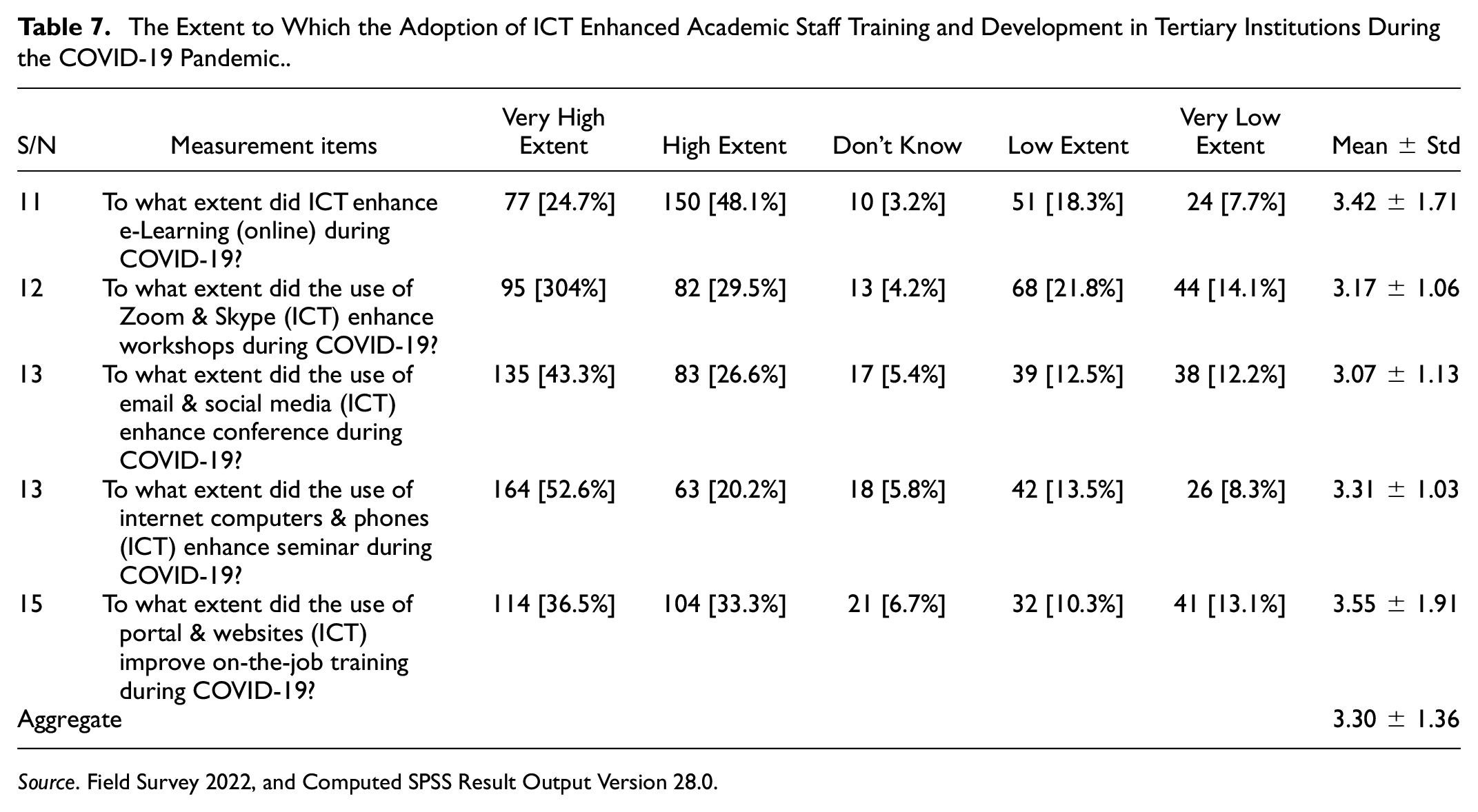
The Extent to Which the Adoption of ICT Enhanced Academic Staff Training and Development in Tertiary Institutions During the COVID-19 Pandemic..
Source. Field Survey 2022, and Computed SPSS Result Output Version 28.0.
The Extent to Which the Adoption of ICT Enhanced Academic Staff Training and Development in Tertiary Institutions During the COVID-19 Pandemic.

Source. Field survey, 2022.
VHE = very high extent; HE = high extent; DTK = don’t know; LE = low extent; VLE = very low extent.
The Challenges That Militated Against the Adoption of ICT Tools in Enhancing Academic Staff Performance in Tertiary Institutions.

Source. Field Survey 2022, and Computed SPSS Result Output Version 28.0.
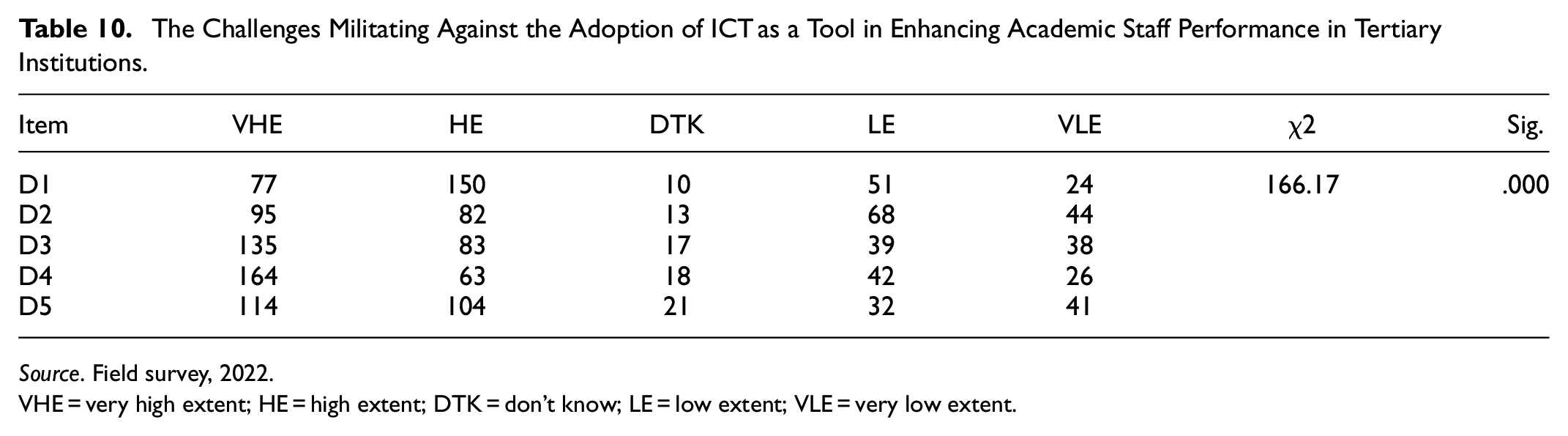
The Challenges Militating Against the Adoption of ICT as a Tool in Enhancing Academic Staff Performance in Tertiary Institutions.
Source. Field survey, 2022.
VHE = very high extent; HE = high extent; DTK = don’t know; LE = low extent; VLE = very low extent.
Data Analysis
Result of Findings
This contained Tables of mean and standard deviation of the collected data on research questions regarding ICT adoptions used in enhancing academic staff performance in tertiary institutions during the COVID-19 pandemic, work-life balance, training and development, and challenges faced by ICT during COVID-19, using both government and privately owned tertiary institutions in the study area.
Table 3 above shows the influence of the COVID-19 pandemic on academic staff performance in tertiary institutions, the finding revealed an analysis of the measures of the variable instrument on the influence of the COVID-19 pandemic on academic staff performance in tertiary institutions. The descriptions in Table 3 show the mean and standard deviation generated for all the statements on the questionnaires. Results indicate that the majority of the respondents agreed with the instruments. This is based on the aggregate mean score and standard deviation of [3.37 ± 1.35] which is above the minimum acceptance mean of 3.0 obtained from the usage of five Likert ranking scales.
In other words, the computational analysis from the data above as revealed by the respondents in Table 3 exposed the critical areas of influence where COVID-19 hampered academic staff performance in tertiary institutions such that it stopped students’ project supervision, disrupted teaching and learning, averted outputs such as students’ graduation and going to industrial training and youth service, and prevented the conduct of quizzes and exams. All these are core job roles performed by academic staff in tertiary institutions, which the COVID-19 pandemic put an end to, following the lockdown policy measures geared toward curtailing the spread of the disease by shutting down schools (see UNESCO, 2020a) and other non-essential socioeconomic human activities and gatherings.
Test of Hypothesis 1
The Chi-Square tool was deployed in testing each of the hypotheses (at .05 level) for the significant effect of the study variables. The tested hypothesis one stated as follows:
H01: The COVID-19 pandemic has no significant influence on academic staff performance in tertiary institutions.
Interpretation and Decision
The result of the Chi-Square (
Table 5 is the effect of the COVID-19 pandemic on work-life balance and academic staff performance in tertiary institutions, the finding was revealed from the analysis of the measures in the variable instrument on the effect of COVID-19 pandemic on work-life balance and academic staff performance in tertiary institutions. The descriptions in the Table show the mean and standard deviation generated for all the statements on the questionnaires. Results indicate that the majority of the respondents agreed with the instruments. This is based on the aggregate mean score and standard deviation of [3.29 ± 1.20] which is above the minimum acceptance mean of 3.0 obtained from the usage of five Likert ranking scales.
Test of Hypothesis 2
H02: Adoption of ICT during COVID-19 has no significant effect in promoting academic staff work-life balance in tertiary institutions.
Interpretation and Decision
The result of the Chi-Square (
Table 7 shows the extent to which the adoption of ICT enhanced academic staff training and development in tertiary institutions during the COVID-19 pandemic. The descriptions in the Table show the mean and standard deviation generated for all the statements on the questionnaires. Results indicate that the majority of the respondents agreed with the instruments. This is based on the aggregate mean score and standard deviation of [3.30 ± 1.36] which is above the minimum acceptance mean of 3.0 obtained from the usage of five Likert ranking scales.
Test of Hypothesis 3
H03: ICT did not significantly enhance academic staff training and development in tertiary institutions during the COVID-19 pandemic.
Interpretation and Decision
The result of the Chi-Square (
Table 9 shows the challenges militating against the adoption of ICT tools in enhancing academic staff performance in tertiary institutions. The descriptions in the Table show the mean and standard deviation generated for all the statements on the questionnaires. Results indicate that the majority of the respondents agreed with the instruments. This is based on the aggregate mean score and standard deviation of [3.28 ± 1.16] which is above the minimum acceptance mean of 3.0 obtained from the usage of five Likert ranking scales.
Test of Hypothesis 4
H04: There are serious challenges militating against the adoption of ICT as a tool for enhancing academic staff performance in tertiary institutions during the COVID-19 pandemic.
Interpretation and Decision
The result of the Chi-Square (
Discussion of Findings
The application of ICT has been instrumental in averting or mitigating the consequences of the COVID-19 pandemic on academic staff job performance in tertiary institutions. This finding is demonstrated by the qualitative data garnered from the literature and the expositions of the quantitative data sourced from the academic staff responses through the survey questionnaires administered, as indicated in the study (see Tables 5 and 7 above; Ali, 2020; Bao, 2020). The influence of the COVID-19 pandemic in tertiary institutions crippled academic staff job performance—teaching, students’ project supervision, the conduct of quizzes and exams, students’ graduation and industrial training, and access to research facilities and publications during the lockdown period. These are the negative impacts of the COVID-19 pandemic on academic staff job performance (see Table 3 above). Hence, the COVID-19 lockdown made it impossible for the academic staff to perform their jobs as implicated in extant literature (Nwachukwu et al., 2021; Olanrewaju et al., 2021; Saad & Bello, 2021; UNESCO, 2020a), and also confirmed in the survey responses from the questionnaires in Table 3 above. Therefore, with the above destructive impacts of the COVID-19 pandemic on academic staff job performance in tertiary institutions, the swift adoption of ICT devices and e-Learning platforms became the imperative leeway deployed to navigate the negative influence of the pandemic on academic staff performance (Adeyeye et al., 2022; Lorente et al., 2020). Therefore, tertiary institutions that were shutdown during the pandemic leveraged ICT to resuscitate their activities, especially teaching and learning.
While the academic staff members stayed at home in compliance with the COVID-19 lockdown protocol, they relied heavily on the use of ICT to remotely do some of their jobs at home. The application of ICT in job performance while staying at home helped the academic staff to gain work-life balance, as they interacted online with their colleagues through social media platforms, attended to their health, social, and safety needs, enjoyed flexible work arrangements, leisure, and gained job satisfaction (Schmidtke et al., 2021; Shava, 2022; Tušl et al., 2021). Through the use of ICT to promote work-life balance, employees navigated the social disconnections and boredom inherent in staying at home during the COVID-19 pandemic lockdown. Therefore, work-life balance was achieved during the era of COVID-19 with the aid of ICT that enabled academic staff to balance their work time with their private needs, family concerns, health, and other social engagements, which would not have been possible without the deployment of ICT and its accessories (see Table 5).
In terms of training and development, COVID-19 lockdown policy measures geared toward curtailing the spread of the disease shutdown all socioeconomic activities, which the WHO (2020a, 2020b) and UNESCO (2020a, 2020b) remarked that the most affected are the health and safety needs of the human race and the education sector. Therefore, the workplace safety policy redesign was hurriedly carried out to guarantee the protection of employees during the COVID-19 pandemic. The safety needs for training were in the areas of health, and remote job performance. Academic staff from tertiary institutions, therefore, engaged in several training and development programs on how to avert the COVID-19 challenges; perform their jobs, and stay safe and healthy, using ICT devices during the COVID-19 pandemic (see Table 7, Adelowotan, 2021; Adewole, 2020). The incorporation of technology in education according to Lindín et al. (2023) fosters transformative learning anchored on technopedagogical skills and designs aimed at producing vital changes in the system of education. Thus, the COVID-19 pandemic necessitated the urgent need to train academic staff toward the development and mastery of skills on how to carry out their jobs online while at home, how to protect themselves from contracting the virus, how to use ICT devices to host e-Learning, how to participate in conferences, workshops, and seminars using online applications like Zoom and Skype. According to Ajah et al. (2022), and Aduma et al. (2022), ICT deployment helps in the improvement of service delivery, transparency, revenue generation, and accountability in public institutions such as the justice delivery system and healthcare services. Due to the flexibility of ICT in improving service delivery, teaching, and virtual on-the-job training surged during COVID-19 among academic staff of tertiary institutions across the globe (Ali, 2020).
Despite the spectacular academic staff job performance using ICT devices, especially during COVID-19 (Dhawan, 2020), there were lots of challenges and factors that militated against the improvement and advancement of the use of ICT to deepen and strengthen employees’ job performance in tertiary institutions (Odewale et al., 2022; Okoye, 2021). Some of the challenges that militated against the successful adoption of ICT in the bid to enhance academic staff job performance are numerous and range from inadequate funding of tertiary institutions, epileptic power supply system in the country, incompetency in the uses of ICT devices on the part of the academic staff, and high cost of procuring ICT devices and servicing and maintaining them (see Table 9). These challenges hampered the level of adoption and success regarding the use of ICT to boost academic staff job performance during the COVID-19 pandemic and its associated lockdown. Scholars such as Maatuk et al. (2022) and Shastri and Chudasma (2022) noted that ICT adoption in tertiary institutions is facing serious threats from different areas including the political will of the ruling elites and management of tertiary institutions, lack of indigenous technology in ICT especially in the less developed countries, digital illiteracy among employees and students, corruption in the school system, cyber crimes like hacking, and unwillingness of the European and American continents to grant the less developed countries technology transfer in the critical areas of ICT (Nnamani, 2009).
To tackle the challenges of COVID-19 and prepare for future pandemics, Husaini et al. (2023) remarked that an indigenous remedial approach to the management of COVID-19 was adopted as evident in many regions across the globe resorting to homemade/local preventive and curative medicinal approach. Another perspective on the local approach in the management of COVID-19 is in the area of technology adoption in workplaces, especially by the big tech-giant countries like China that quickly resorted to the policy of continuous education of her citizens while at home through the windows of ICT devices (Zhang et al., 2020). Developing indigenous capacity in the area of technology is essential in the management of workplace disruption like the COVID-19 crisis. Therefore, to plan for future pandemics in workplaces and other similar disruptions, countries must develop indigenous capacity in technology which will likely provide a leeway to navigate such situations as witnessed from this study in which ICT was heavily deployed by academic staff to perform their jobs remotely without contravening COVID-19 lockdown policy.
The findings of this study emphasized that educational advancement lies on technological innovation and deployment both in times of peace and chaos such as witnessed during COVID-19 disruption, in which ICT became the leeway deployed to navigate and cushion the effect of the pandemic on academic staff performance. Developing technological infrastructure that supports teaching and learning in the education industry in times of crisis and bridging learning gaps and challenges posed by distance barriers through ICT innovations like e-Learning platforms and other ICT tools/devices are the way to go in the education sector. This is evident from the findings of this study on using ICT to navigate the negative implications of the COVID-19 pandemic on academic staff performance in tertiary institutions. These findings align with the UN Vision 2030 on education and Goal Number 4 of the 17 SDGs agenda of the UN.
Conclusion and Recommendations
From the findings, we conclude that ICT was heavily deployed to cushion the effects of the COVID-19 pandemic, thereby significantly moderating the role and relationship between COVID-19 and academic staff performance, work-life balance, and training and development in tertiary institutions. The significant negative influence of the COVID-19 pandemic on academic staff job performance and the leeway sought by the application of ICT tools in navigating the pandemic points to the unavoidability of technology in advancing the education sector, and research, both in times of crisis and relative peace, as demonstrated by the researchers using online Google Form survey method to collect data and arrive at the findings in this study. From the findings and the conclusion reached so far in this study, we recommend the following: (1) Adequate measures should be taken by the management of tertiary institutions to cushion the effect of workplace disruptions like COVID-19 and other similar future outbreaks of diseases on academic staff performance in tertiary institutions. (2) The management of tertiary institutions should improve on the use of ICT during workplace disruptions and other similar future outbreaks of diseases to enhance academic staff work-life balance in tertiary institutions. (3) The management of tertiary institutions should use ICT to improve academic staff training and development in tertiary institutions during workplace disruptions and in readiness to swiftly curtail other similar future outbreaks of diseases. (4) The government should provide adequate funds, power supply, constant training, and modern ICT facilities to enhance teaching and learning in tertiary institutions.
Supplemental Material
sj-doc-1-sgo-10.1177_21582440241256341 – Supplemental material for Information and Communication Technology (ICT) as a Panacea for Overcoming the Challenges of COVID-19 Pandemic: A Study of Academic Staff Performance in Tertiary Institutions in Enugu State, Nigeria
Supplemental material, sj-doc-1-sgo-10.1177_21582440241256341 for Information and Communication Technology (ICT) as a Panacea for Overcoming the Challenges of COVID-19 Pandemic: A Study of Academic Staff Performance in Tertiary Institutions in Enugu State, Nigeria by Celestine Chijioke Onah and Francis Okechukwu Chikeleze in SAGE Open
Footnotes
Authors’ Contributions
All the authors contributed significantly.
Declaration of Conflicting Interests
The author(s) declared no potential conflicts of interest with respect to the research, authorship, and/or publication of this article.
Funding
The author(s) received no financial support for the research, authorship, and/or publication of this article.
Ethical Committee Approval Number
Not applicable in this study.
Informed Consent
Informed consent was obtained from each of the participant after explaining to them what the research is all about. Thus, they willingly indicated interest and participated due to the risk free nature of the research, and its envisaged contribution to building knowledge in the education sector.

Data Availability Statement
Any other data can be sent on reasonable request.
Supplemental Material
Supplemental material for this article is available online.
References
Supplementary Material
Please find the following supplemental material available below.
For Open Access articles published under a Creative Commons License, all supplemental material carries the same license as the article it is associated with.
For non-Open Access articles published, all supplemental material carries a non-exclusive license, and permission requests for re-use of supplemental material or any part of supplemental material shall be sent directly to the copyright owner as specified in the copyright notice associated with the article.
