




Abstract
This review investigates the volunteering-work nexus, where an individual’s paid occupational work in the business, government, or voluntary sector is akin to their volunteer work: tasks and responsibilities are similar, but the structure, conditions, and relationships differ. Performing work spans their business and volunteer worlds and brings dynamic interactions between work and volunteering. Pro bono, skills-based, or corporate volunteering are terms in use; however, these conceptualizations of the underlying and interconnecting practices of work and volunteering are too limited. This transdisciplinary, qualitative systematic literature review of 62 scientific articles studies individuals using conceptualizations of work, volunteering, and occupations over their working life, from service-learning to retirement. With ambiguous boundaries and terminology in the literature, we introduce a new term—occupation-related volunteering—defined as an individual acting to benefit others without payment or coercion, developing, using, or maintaining their occupational knowledge, skills, and abilities, and drawing upon their economic, social, and cultural capital. The definition anticipates that an individual’s occupational resources change over their working life and vary depending on whether the volunteer is acting independently or with the support of their workplace. Occupation-related volunteering extends paid-unpaid and formal-informal boundaries to include volunteering in “paid” work time and in informal, community-based organizations and less public roles, such as mentoring. Finally, we encourage future research using the bibliometric data, suggestions in the reviewed articles, and our synthesis of the individual’s perspective of performing their occupational work as a volunteer.
Plain language summary
Our research is about the term for and definition of a person doing their usual work as a volunteer. They may work in business, government or a non-profit and volunteer in, for example, a private school, government hospital, or local sporting club. However, unlike other volunteering, the person does what is, will be, or was their occupation as an unpaid volunteer. The current terms, including service-learning, pro bono, corporate or skills-based volunteering, are too limited. We systematically reviewed the literature on what we call the ‘volunteering-work nexus’ from the volunteer’s perspective. We identified 62 scientific articles and, as a result, introduced the term occupation-related volunteering. Most articles took the definition of a volunteer, then added ‘what it takes’ to do occupational work: knowledge, skills and abilities, financial resources and work-related contacts, networks and personal inclinations. The definition recognizes that the willingness and ability to be an occupation-related volunteer changes over work-life stages, from student to employee to retiree, and whether the workplace is involved or not. By listing the required attributes and recognizing the importance of context, the definition is a foundation for future research. Our term occupation-related volunteering can reduce the siloing of knowledge and bridge disciplines, including education, human resources, and non-profit management, across occupations (e.g., legal, administration). It also allows a better understanding of the boundaries and crossovers between work, learning and volunteering. Limitations include that reviewed articles only studied professions in mainly Global North countries; addressing these are among several directions we suggest as future research.
Keywords
Volunteering means many things: providing charitable unpaid service, acting altruistically out of faith or conviction about a personal interest, fighting for a better world for all of us, even when this serves self-interests, or doing something akin to a hobby or leisure-time activity (see Ellis Paine et al., 2010; Rochester, 2013). This review considers volunteers who could be any of these but share an essential feature: they perform their paid or occupational work as volunteer work. The tasks and nature of their work are alike, but the social context, institutional structures, physical places, relationships, and people—from colleagues to clients—are different. These volunteers perform tasks that others cannot because they only have the specialized competencies and resources.
Occupational work is a bridge—the “long arm of the job” (Meissner, 1971; Wilson & Musick, 1997b) that spans the occupation a person will, is, or was performing and their volunteering. Research on volunteering and work occurs in business and nonprofit management, human geography, economics, sociology, law, medicine, and other disciplinary fields (Hustinx et al., 2010; Wilson, 2012; Wilson & Musick, 1997a). However, despite the breadth of interest, little research looks at the intersection of occupational and volunteering work from the individual’s perspective. This lack of research attention is surprising given the potential economic and social value generated by what appears to be a significant, globally undertaken activity: 89% of Australasian chartered accountants volunteer (Cordery et al., 2019, p. 99), and 73% of the 225 world’s largest companies facilitate employee “skills-based volunteering” (Chief Executives for Corporate Purpose [CECP], 2022, pp. 19, 46). To investigate this type of volunteering, we need a clear definition to set the boundaries of the concept, and this is currently missing in the literature.
Attention to “skills-based volunteering” mostly turns to professional occupations, chartered accountants, or, in CECP’s (2022) case, “employees performing [their] professional function” (p. 44). On a closer look, these descriptions are inconsistent with reality: surely skills-based volunteering is not only by professionals or employed professionals. Sometimes, terms may be more expansive, but the professional (pro bono, devotee work, calling, or skilled and skills-based volunteering) or organizational orientation (employee or corporate volunteering) dominate the literature. The implications for interpreting existing literature and undertaking future research are twofold.
First, non-professionals who volunteer their occupational work, such as tradespeople mentoring young people in vocational courses (Volunteer It Yourself, 2022) and building wheelchair access ramps for “neighbours in need” (MBAks, 2022), are neglected. The specialized competencies and resources they bring are not indiscernible to the everyday brought by any other volunteer. In this respect, their “fate” is not dissimilar to professionals. The tensions created by blurring boundaries between the social worlds of work and volunteering and the personal drivers, pathways, and contributions are not understood, acknowledged, or supported. If academic research is to have a real-world impact, then practitioners and policymakers could reasonably expect more.
Second, there is no cross-fertilization between fields as researchers and practitioners reflect their research or business purpose, using epistemologies and analytical concepts embedded in their institutional and organizational structures. Organizations and management scholars are interested in employee and corporate volunteering and organizational strategies (e.g., Rodell et al., 2016; Roza et al., 2017), and higher education scholars in service-learning and responding to community needs (e.g., Jacoby, 1996). Our concern is not judging which approach is correct or better but establishing how individuals conceptualize performing their occupational work as volunteer work and how researchers can use a shared set of attributes to investigate the same phenomenon of performing occupational work as volunteering work from different perspectives.
Concepts are “cognitive symbols… that specify the features, attributes, or characteristics of the phenomenon in the real or phenomenological world that they are meant to represent and that distinguish them from other related phenomena” (Podsakoff et al., 2016, p. 161). However, even though concepts are the “building blocks of theory” (Podsakoff et al., 2016, p. 166) essential to academic endeavour, clarity and specificity is not only an academic issue. Alternative terms and ambiguous concepts have implications for individuals searching for volunteering opportunities and those offering them, including membership bodies and service organizations (hosting organizations), corporate or education-based programs (home organizations), and matching or intermediary organizations (Brudney et al., 2019). The International Association for Volunteer Effort (IAVE) corporate volunteering report asks about skills-based volunteering: “Is it volunteering or is it pro bono?” (Foster et al., 2022, p. 157).
The overarching purpose of this review is to draw on the existing body of knowledge, irrespective of term, orientation, or discipline, about an individual performing their occupational work as volunteering work—the volunteering-work nexus—to answer the following questions:
What definitions and attributes exist within the scientific literature on volunteers using occupational skills?
How can we conceptualize occupational work performed as volunteer work?
What future directions can we suggest for further study?
To answer these questions, we conducted a transdisciplinary qualitative systematic literature review to investigate individuals’ perspectives on practising their occupation as volunteer work. The design includes inductive and deductive coding to analyse articles published before July 31, 2021 in six databases, including EBSCO and Web of Science. Despite extensive searching, the final 62 peer-reviewed articles (denoted with an asterisk*) only study professionals, predominantly in the medical and legal fields.
This review discerns between required and redundant attributes (Podsakoff et al., 2016) to create a conceptual border around what we come to term occupation-related volunteering. It makes three specific contributions. First, to unify “discrepant thought simultaneously existing in the literature” (Hollenbeck, 2008, p. 20), we provide a transdisciplinary umbrella term—occupation-related volunteering—as a specific type of volunteering using specialized occupational competencies and resources in diverse social structures and contexts. Second, we synthesize terms to distinguish occupation-related from non-occupation-related volunteering: volunteering using the knowledge, skills, and abilities, and the other resources that arise from studying, learning, and performing one’s occupational work. Third, we offer researchers future research directions identified from the bibliometric analysis, the suggestions provided in reviewed articles, and this review’s synthesis and discussion.
Conceptual Background
Core Definitional Features of Volunteering
Voluntary sector researchers strived to define volunteering past what it is not (Hustinx et al., 2010) not paid, forced or kinship work—concluding that a “pure definition” (Cnaan et al., 1996) of volunteering captures three elements: an individual acting predominantly unpaid, of free will, and to benefit others (e.g., Ellis Paine et al., 2010; Meijs et al., 2003; Payton & Moody, 2008; Wilson, 2000). These elements are contextual and span a continuum; the closer to the “pure definition,” the more likely a person is a volunteer (see Ellis Paine et al., 2010 for a comprehensive discussion). Therefore, the three elements intertwine, resulting in unique social constructions of who is a volunteer and what is volunteering.
A fourth attribute of volunteering is contestable: volunteering (only) occurs in formal organizational structures, often limited to charitable or nonprofit organizations. Increasingly, research indicates that “formality” perpetuates a Western history and understanding of voluntary action, neoliberal capitalist theories of labor and organizations (e.g., Cutcher & Dale, 2022; Dean, 2015; Jiang & Korczynski, 2023; Lough, 2021) and excludes community, grassroots and informal groups, which are significant in non-Western locations and ethnic and minority groups (Hustinx et al., 2010; Lough, 2021). In agreement with these views, this review omits a formal structure as a required attribute in the definition of a volunteer.
To ensure that the concept of occupation-related volunteering is consistent with the social constructions of a volunteer, we use the “pure definition” to structure this review’s discussion. However, investigating volunteering should consider “work” within family, community, institutional structures and power relationships and, subsequently, its paid or unpaid context (Overgaard, 2019; Taylor, 2004, 2005). Therefore, we use social constructions of work, occupations, and professions to understand “occupational work.”
Work, Occupations, and Professions
Work requires individual competencies to complete the tasks – knowledge, skills and abilities (e.g., Clary et al., 1998; T. Hoffmann, 1999) and, in some cases, occupational qualifications, credentials, and experience, which vary according to era and place. The use of competencies and resources in occupational and volunteer work reflects that “work is embedded in other social practices” (Bottero, 2005, p. 56) and practices transfer between domains, including occupational standards, institutional logics, professional duties, and “public service” customs (e.g., Noordegraaf, 2015). Work is organized and labelled into a social category of occupations with moving boundaries, hierarchies and relativities (consider the history of nursing and allied health within the medical field, for example) that impact “the experience, consequences, and … meaning, of being in an occupation” (Bottero, 2005, p. 56). Work also has “social, economic, and cultural circumstances surrounding its practice” (Freidson, 2011, p. 179), which allows for “work” to be practised for personal financial gain but also in unpaid and voluntary forms to benefit others.
Occupations form a social, political, and economic category representing communities of shared interests and identity (Freidson, 2011); within them are professional occupations. Conceptualizations of professions give a profession power over entering, undertaking and evaluating their professional work, thus separating it from other occupations (Freidson, 2011) and marking the profession’s boundary within a “competitive system of professions” (Abbott, 1988). Traditionally, a profession is a chartered, free, liberal, or learned occupation that provides “intimate” service to individual clients (Kultgen, 1988). However, in contemporary society, professions are a broader range of specialities centred around knowledge intensity, often structured in professional service firms (Von Nordenflycht, 2010). Naming patterns illustrate the ambiguous boundaries and competitiveness of professions: if it prevails in the public sector, for example, public prosecutions or public health, professional service firms, for law or health respectively, are “private practice” (e.g., Abbott, 1988; Cummings, 2004) whereas, for accountants and engineers, 1 it is “public practice” as they offer services to the public with private practice following the employer’s private interests (e.g., Neu, 1991). The continual redrawing of professional boundaries (Abbott, 1988; Klegon, 1978) also applies to professionals in businesses, multi-professional service firms, government, and hybrid entities (Noordegraaf, 2015; Von Nordenflycht, 2010). Professional work exists in spatial and temporal contexts with relativities and interconnections to employment, volunteer work and nonwork domains (Abbott, 2005; Glucksmann, 2005; A. Jones, 2011)
The Volunteering-Work Nexus
A “dominant” view of volunteering is unpaid work in public spaces, especially in bureaucratic, institutionalized health and welfare charities (Rochester, 2013). This view reflects and perpetuates volunteering’s contested fourth attribute of having a formal structure. Taylor’s (2004) work-mapping framework combats the structural divide, presenting spectrums of paid-unpaid work in public-private and formal-informal settings. The framework shows the same occupational work performed both for and without payment, for example, an individual employed as an accountant or acting unpaid, as an honorary treasurer in a formal, public organization, or, more privately, as a one-on-one financial advisor. This review uses the framework to conceptualize the nexus of volunteering and work across multiple personal situations, organizational structures, and social and cultural contexts.
Being willing and able to volunteer involves human and other resources, including economic, social (comprising social networks and obligations) and cultural (including personal tastes and qualifications) capital (e.g., Eimhjellen, 2022; Hustinx et al., 2010; Wilson & Musick, 1997a). Therefore, when performing occupational work as volunteer work, the individual must also bring or have access to a specific “occupational” set of competencies and other resources, and these vary over a working life: during the education-to-work transition, over a career, during post-working lives and from the impact of nonwork domains, such as migration and family responsibility (see Hirschi et al., 2016; A. Jones, 2011; Pavlova & Silbereisen, 2014). As a result, the benefits, costs, barriers and opportunities of volunteering vary across the life-course (e.g., Van Willigen, 2000).
Review Methods
This review follows The Preferred Reporting Items for Systematic reviews and Meta-Analyses (PRISMA), including the PRISMA 2020 Checklist for Reporting (Page et al., 2021). Supplementary research data, including the Review Protocol, pre-registration, and coding summaries of the 62 reviewed articles, are available in the Open Science Framework (OSF) repository (https://osf.io/rtk8g/?view_only=a33820717db64f70b3488053ec3d1364).
With alternative terms, imprecise and conflicting concepts and various theoretical lenses of the volunteering-work nexus, a systematic literature review (SLR) is an appropriate method: it gathers different approaches to the same topic, brings together theoretical perspectives, and presents different methods to address the same research questions (Burgers et al., 2019). An SLR follows “a systematic, transparent, and reproducible process for identifying academic literature about a clearly defined topic” (Fisch & Block, 2018, p. 103; see also Page et al., 2021). To this end, this section includes extracts from and summarizes the nine SLR stages in the Review Protocol held in the OSF repository.
Sources, Keywords, and Search Strings
Planning commenced in April 2021, setting the research questions and then structuring the search string keywords with the SPIDER tool (Cooke et al., 2012) for qualitative reviews (Table 1). The first author gathered keywords from EBSCO Business Source Premier and the Web of Science, two major academic online bibliographic databases, reducing the list to 252 keywords, and with truncation and wildcards, to 139 keywords, with 26 later added from other sources.
SPIDER Search Strategy Tool (Based on Cooke et al., 2012).

The search strings comprise three “volunteering” groups (common and potential names, skill and position titles, and service-learning) but excluded irrelevant word usage of “volunteer,” for example, “voluntary disclosure” (Table 2). Using the keywords, the first author wrote search strings for six databases—Web of Science Core Collection (WoSCC), EBSCO Business Source Premier, the open access platforms SSRN, SSOAR, and DOAJ, and a university library collection—chosen because they offered the comprehensiveness (perspectives, attributes, and timeframes) needed, given our research questions (Fan et al., 2022). We included the WoSCC because it is a major citation database covering the sciences, social sciences, arts and humanities, and for scientific research in established and emerging journals from 1990 onwards. EBSCO subject database offers access to academic journals and other publications that WoSCC may exclude because of lower citation rankings (e.g., due to the newness of the journal or a small academic field) or earlier publication dates. As both sources are “paywalled” to either authors or users and could exclude relevant research due to cost factors, we added the three Open Access and the university library. For non-WoSCC sources, we screened for only academic, peer-reviewed articles. Next, we used a collegial peer review of the search strings and the guidelines for reviewers (McGowan et al., 2016) to check string quality and identify errors. Finally, we searched the databases for articles published in English before July 31, 2021 in academic, peer-reviewed journals.
Search Strings Used for EBSCO Business Source Premier (July 31, 2021).

Selecting Articles for Inclusion and Exclusion
The first author exported the title, authors, meta-data, and abstracts of 13,663 identified articles and uploaded them into a shared Zotero (n.d.) literature management system, deleting duplicates using the built-in tool. We developed an Inclusion/Exclusion Guideline to aid the consistent application of the SPIDER criteria, decision-making, and transparency. An important consideration in applying the SPIDER tool was ensuring reviewed articles sample an individual and the phenomenon of volunteering occupational skills to answer RQ1. Of the 12,231 unique records retrieved (Figure 1), we excluded 10,838 due to the wrong sample (e.g., the recipient effects of employee volunteering in J. Cook & Burchell, 2018; study of nonprofit entities views of corporate volunteering by Roza et al., 2017) and 1,201 for the wrong phenomenon (e.g., managing rather than undertaking pro bono, Cummings & Rhode, 2009; using student interns for work experience to lead them into an occupation, rather than developing the skills they have already learned, Hoy, 2011; employee volunteering that is not necessarily occupation-related, D. A. Jones, 2016), 131 for wrong publication or other reasons (e.g., unindexed publication for Vian et al., 2007), leaving 62 articles remaining in the final review.

PRISMA flowchart (Page et al. 2021).
We did not use specific tools to assess the certainty of evidence or risk of bias in studies. Instead, as the review organizes and synthesizes literature to create a conceptual landscape, it was sufficient that we relied on peer-reviewed articles and journal quality metrics (Okoli, 2015, p. 11). We ensured consistent decision-making by compiling a list of publications that did not meet these requirements. Finally, reading the titles and abstracts and following our Inclusion/Exclusion Guidelines, tagging (include, exclude or undecided), and co-author discussions led to the screening of 362 records, 112 retrieved for full-text screening and 62 articles included in this review (Figure 1).
Data Extraction, Coding, and Analysis
Data extraction involved, first, exporting the bibliometric information from Zotero into an Access database, adding inductive codes (Table 3) to answer the research questions using Concepts and Relationships (What and How), Theoretical Explanations (Why), and Boundary Conditions (Who, Where, When) (Okoli, 2015). Next, the first author uploaded the bibliometric and inductive coding into a spreadsheet of the final 62 articles (see OSF repository) and then, with the associated PDF document, into MAXQDA (VERBI Software, 2021) for more detailed coding to allow the writing-up of topic summaries (see Braun & Clarke, 2021). The OSF repository holds a data coding summary of the 62 articles with coding extracts of definitions, attributes and any clarifications offered, the occupation and work-life stage, the organizational and volunteering context, and finally, the focus, theory, or concept used.
Inductive Coding and Purpose (Based on Okoli, 2015).

Reviewed Article Characteristics
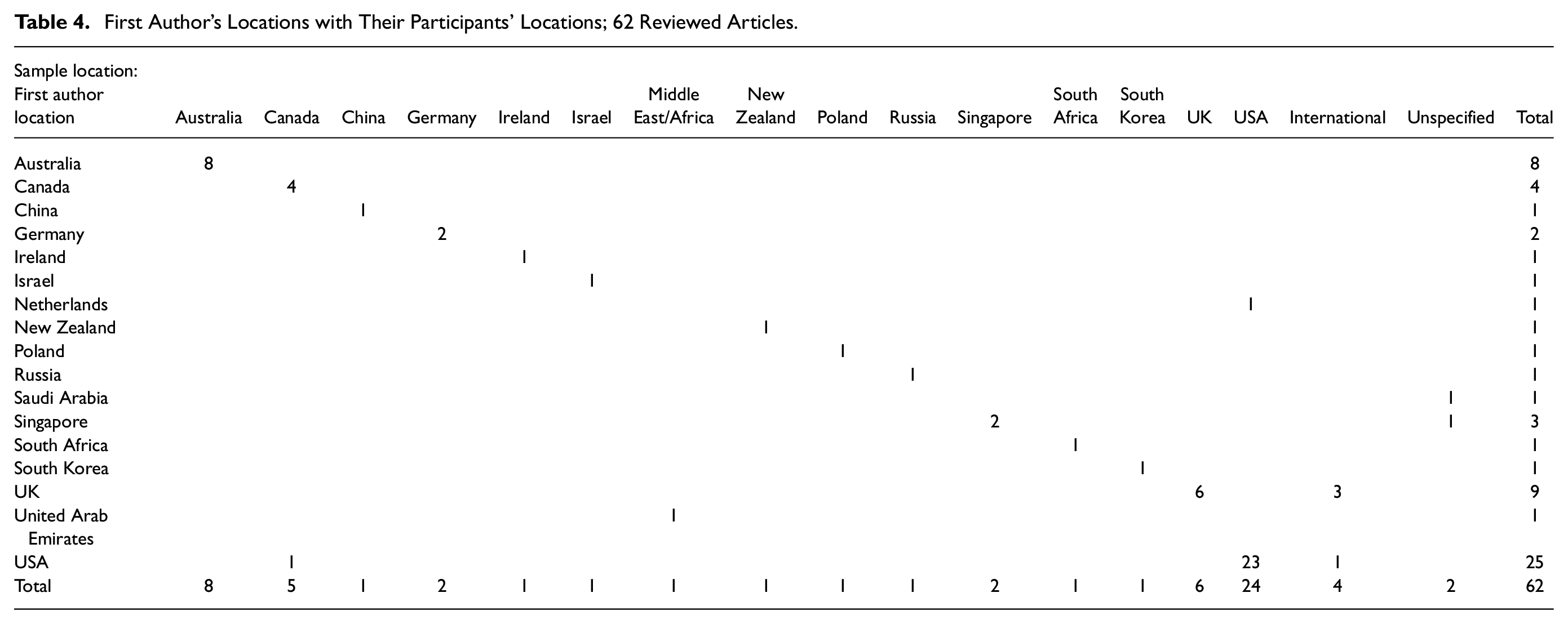
The 62 reviewed articles started with the intermittent publication of 15 articles in the first decade (1999–2008) and increased to 29 in 2009 to 2018, reaching 18 articles in less than 3 years (2019–July 2021). The research interest is primarily from the USA (25, 40%), based on the article’s first author’s university affiliation, followed by the UK (9), Australia and New Zealand (9), Canada (4), Singapore (3), other European (5), with limited representation from Russia, Africa, Asia, and the Middle East (7). Clear sample descriptions are missing from some articles; however, indicatively, research participants either worked or engaged in similar geography: the USA (24, 39%), the UK (6), Australia and New Zealand (9), Canada (5) and Singapore (2); the remainder were other locations (8), with six of unspecified or international samples (Table 4).
First Author’s Locations with Their Participants’ Locations; 62 Reviewed Articles.
The coding of research focus, theory or concept broadly creates categories of antecedents/experiences (18 articles), situated learning (8), professional practice, ethics/duty, and identity (8, 7, 7 respectively), institutional theory (6) and lifespan (2); the remaining six articles used unique approaches. With a small sample, there is no discernible trend in the methodological orientation (quantitative 32, qualitative 22, non-empirical [Luban, 1999], and mixed 7). However, coding the life stage of participants in reviewed articles revealed a bifurcation of interest: the work-life stages Transition to/Early Occupation (3 articles, 5%) and In Occupation (39, 63%), both having gained research momentum since 2015 whereas Transition to/In Retirement (3, 5%) and Not in Occupation (2, 3%) have received scant and spasmodic interest (Figure 2).

Work-life stage studied by year; 62 reviewed articles.
The reviewed articles studied university students and professionals (Figure 3); none included trade, technical or non-professional occupations, despite the search strings including non-professional specific words, such as unpaid work, skill, talent, job, role or capacity (see Table 2). Most articles investigated health professionals (31 articles), especially medical doctors (14 articles), then legal (12 articles), and diverse professions (11 articles), for example, media, engineering, and management (Arnold et al., 2011), with the remaining eight articles studying academics, accountants or other university trained (development workers, geographers, and translators).

Work-life stage studied by year; 62 reviewed articles.
During the inductive coding and creating topic summaries of the work-life transitions in MAXQDA, we divided In Occupation (39 articles) into Internal and External Practice. These titles deliberately avoid the geography- and history-dependent use of public/private practice described in the introduction. External practice (13 articles) refers to work in a professional or human service firms, such as legal, dental, or medical practices as an employee, sole or co-partner or owner; internal practice (11 articles) refers to work in other organizational types, for example, NHS staff (e.g., Brooks & Herrick, 2019). The remaining 14 articles sampled a mixture of both and one combined In and Not in Occupation. We further distinguished between volunteering undertaken with the support of the “home organization,” the employing business, agency, or firm (organizational, 15 articles) and without (extra-organizational, 47 articles, including student service-learning).
Definitions and Attributes of Volunteering Used in the Reviewed Studies
To address this review’s first question, we inductively coded the definitions and attributes provided in reviewed articles and summarized them in Table 5.The conceptualization of voluntary action as unpaid, uncoerced, and to benefit others is evident across the reviewed articles, with some explicitly citing Wilson’s (2000) definition: “Volunteering means any activity in which time is given freely to benefit another person, group, or organization” (p. 215). However, across the reviewed articles, the individual’s occupational work links or adds to the definition and description; this type of volunteering intertwines with their occupational work.
Summary of Coding and Analysis of Definitions and Attributes Based on 62 Reviewed Articles.

Pro bono’s attributes are consistent with volunteering, but reviewed articles add a “professional work” underpinning, with studies of lawyers also referencing the relevant professional body guidelines. For example, the American Bar Association (ABA) refers to voluntary pro bono service as a professional responsibility to provide legal services to those unable to pay without fee or expectation of fees (ABA, 1993). Although a “responsibility,” it is still voluntary as the lawyer may decide when, where, how, and who they serve.
A further grouping is around students in higher education undertaking service-learning, which is a blend of community service, experiential learning, and reflexivity (e.g., Jacoby, 1996). When not “for academic credit,” we find service-learning accords with volunteering’s “pure definition” with community service and students benefitting from learning and reflexivity fitting along the socially constructed continuum of volunteering.
From the contextual attributes provided in the articles, we created the definitional attributes of human, economic, social, and cultural capital or resources (Bourdieu, 1986; Wilson & Musick, 1997a). Human resources captures the competencies—the knowledge, skills, and abilities—necessary to perform an occupation (e.g., Clary et al., 1998; T. Hoffmann, 1999) and is the precondition for occupation-related volunteering. However, practicing an occupation involves other resources. Individuals require economic resources across their work-life stages, for example, using savings to recertify after relocation or immigration or paying for professional membership fees. Social resources are social networks, favours, and obligations, such as “asking” colleagues to apply for a position or tender a contract in response to the group’s social pressure or “coercion” (see Figure 4). Cultural capital includes an individual’s disposition, the physical goods and property reflecting their dispositions (such as the books they read, sports they play and organizations they belong to, work and volunteer for), and their educational qualifications that confer qualifications and “cultural competence” within that field (Bourdieu, 1986).

Occupation-related Volunteering: Definitional Attributes and Continuums (Based on Ellis Paine et al., 2010)
Conceptualizing Occupation-Related Volunteering
In this section, we answer this review’s second question by synthesizing the findings leading to this review’s definition of occupation-related volunteering. As “building blocks” of theory, a clearly defined concept establishes a common language, organizes, discerns between and removes duplication of ideas, and specifies required and excludes redundant attributes (Podsakoff et al., 2016, p. 166). The “pure definition” (Cnaan et al., 1996) is the end of the continuum most likely to meet the social constructions of a volunteer; to be occupation-related volunteering, we add a fourth definitional attribute: competencies and resources. Figure 4 illustrates the continuums and shows how, for example, an individual can gain from developing their competencies in service-learning or being exposed to peer-group pressure to volunteer but still be an occupation-related volunteer “overall” when mostly satisfying the other attributes.
The reviewed articles only studied professional occupations; therefore, the following analysis highlights professional work. The socially constructed status of professions and the individual-constructed meaning of “being” a professional exemplify occupation-related volunteering.
The professionals studied gave time but mobilized resources (e.g., Wilson & Musick, 1997b), turning the social resources of professional networks and “reputational capital” from volunteering work (e.g., Kazun, 2021) and cultural capital of professional disposition and qualification into economic benefits of client generation, career development (e.g., Bartlett & Taylor, 2016; Bitzer & Geishecker, 2010; Kazun, 2021; Liddy & Tormey, 2020). Conversely, economic capital converts to social and cultural capital by paying for out-of-pocket expenses, forgone annual leave or retirement benefits and personal or own-practice infrastructure, such as computing resources for online volunteering or operating theatres for dental procedures (e.g., Butler et al., 2011; Mui et al., 2021; Tyler et al., 2020; Zhou et al., 2019).
As a result of the synthesis, we conceptualize occupation-related volunteering as a type of volunteering based on the “pure definition” and dependent upon occupational work’s human and other resources: Occupation-related volunteering is an individual acting to benefit others without payment or coercion; it involves developing, using, or maintaining their occupational knowledge, skills, and abilities, and drawing upon their economic, social, and cultural capital.
In the following sections, we use the inductive coding (Table 3) and themes from the coding of the “pure definition” (the topic summaries) to consider volunteering as a “hybrid phenomenon” intersecting with other social roles, practices, and socio-political structures (Shachar et al., 2019), in this case, relating to occupational work and the mobilization of human resources and other forms of capital.
Unpaid: Direct Costs, Opportunity Costs, and Offsetting Strategies
Reviewed articles expressed the unpaid nature of volunteering, with only isolated consideration of the desire or relevance of remuneration (Abdelkader, 2017; Beshyah et al., 2021; Sloane et al., 2008) or financial incentives through policy-led incentives, such as tax deductibility of expenses and government-funded or subsidized service-provision (Caldron et al., 2018; Mui et al., 2021). Instead, the costs of engaging were a recurrent theme in reviewed articles, consistent with other research showing many volunteers pay direct “out-of-pocket” expenses themselves; for example, in Australia, 53% reported incurring expenses, mostly travel (42%) and phone calls (32%) (Volunteering Australia, 2021, p. 21). Similarly, professionals who act independently of their workplace (extra-organizational) or are not in practice also reported paying travel and accommodation expenses; however, two distinctions to non-occupation-related volunteering issues arise. First, the size of the impost appeared large, including international travel, investment in coordination, administration and ancillary staff and covering practice operating expenses, including medical supplies and legal out-of-pocket costs (Bartlett & Taylor, 2016; Caldron et al., 2018; Rhode, 2003; Rovers et al., 2016; Tyler et al., 2020). Therefore, occupation-related volunteering draws on their personal and potentially the practice/firm’s economic resources.
Second, reviewed articles also reported opportunity costs, that is, the cost of the professional not performing their “paid” or other roles. For extra-organizational volunteering, these included loss of income, social security contributions, annual leave entitlements and time spent away from home (Butler et al., 2011; Caldron et al., 2018; Granfield, 2007; Rhode, 2003; Smith et al., 2019; Tyler et al., 2020). Equally affected are individuals undertaking post-qualification service-learning for professional development (Rovers et al., 2016; Sin et al., 2019; Tang & Schwantes, 2021; Tyler et al., 2020). When working in professional service firms, such as legal or dental practices, the opportunity cost of spending time on unremunerated, voluntary activities is the direct loss of billings as firms sacrifice revenue otherwise generated by the employee. As with direct costs, the decision to offer pro bono services has a direct, bottom-line effect on profitability.
Accordingly, firms develop pragmatic practices and strategies to offset the impost. Firms encouraged or directed employees to undertake pro bono as part of the firm’s commitment to public benefits programs and professional (legal) body targets (e.g., Australia, Cantatore, 2020; USA, Rhode, 2003). As revenue targets still need satisfying (Ryan, 2020), pro bono hours are a disguise to meet firm-wide billable hour requirements. For example, firms charge pro bono as the “normal” workload during lean times and for incoming lawyers to build their portfolio of experiences and client base (Boon & Whyte, 1999; Steimel, 2018; Webley, 2000). Pro bono includes “free” initial fees and negotiated discounts (E. A. Hoffmann, 2007; Webley, 2000), uncollectable accounts and fulfilling personal favors (Boon & Whyte, 1999; Rhode, 2003). The firms use the professional’s efforts for relationship marketing (Boon & Whyte, 1999), to build internal cohesion (Bartlett & Taylor, 2016) and external image (Granfield, 2007), to meet client demands (Boon & Whyte, 1999), and to attract work (Granfield, 2007) and recruit staff (Bartlett & Taylor, 2016; Cummings & Rhode, 2009; McColl-Kennedy et al., 2015; Rhode, 2003). Therefore, the “billable hours” practice in professional service firms leads to foregone revenue offset by conversion into business benefits.
Employers contribute their employees’ time toward a social or public benefit in other workplaces. For example, the employed professional can be part of the entity’s administration or the organization’s income-generating apparatus; in both cases, the employer allocates and budgets their time to either revenue or cost centres in the accounting ledger. As with External Practice, Internal Practice organizations cover the opportunity costs with offsetting strategies, the “business case” widely discussed in CSR and corporate philanthropy literature, such as the “win-win-win” for employees, nonprofits, and business (Caligiuri et al., 2013; Roza et al., 2017). Therefore, this review finds that the unpaid element of the “pure definition” has different implications for non-occupation-related volunteering; it is not only unpaid, but there are “negative payments,” with distinct expenses and opportunity costs that specifically relate to the performance of (unpaid) occupational work and offsetting strategies. As the ability to volunteer requires sufficient financial or economic resources, the paid-unpaid continuum of occupation-related volunteering is highly contextual across the work-life stages and workplace settings.
Uncoerced: Discretion, Expectation, and Direction
The continuum of free will (Ellis Paine et al., 2010, pp. 12–14) shown in Figure 4 applies to occupation-related volunteers, which this section groups into discretion, expectation, and direction. Most reviewed articles investigated volunteering outside of a home organization, that is, undertaken at the discretion of the individual (47 of 62 articles). Expectation is the centre of the continuum, the area of peer and institutional pressures. Although no reviewed article reported the extremity of physical coercion, the “expectation” that professionals volunteer so that they can perform their work—to gain “local” experience (e.g., Wilson-Forsberg & Sethi, 2015), to follow employer directions, or to meet “rules” of the certifying body—teeters on the border of legal or contractual coercion.
Reviewed articles considered the “voluntariness of voluntary action” (see Payton & Moody, 2008, pp. 53–55), exercising free will and discretion in activities independent of their employer or university, for example, teachers and government sector health workers travelling to Low- and Middle-Income Countries (LMICs) (e.g.,Liddy & Tormey, 2020; Tyler et al., 2020), medical students and social workers supporting refugees (e.g.,Cullinan, 2020; Kindermann et al., 2019) or online engagement (Abdelkader, 2017; Bitzer & Geishecker, 2010; Zhou et al., 2019). Those in professional service firms, as owners or partners, chose to accept non-paying clients/patients (e.g., Frank et al., 2003; Smith et al., 2019) or initiated and organized local or LMIC trips to work in clinics (e.g., Butler et al., 2011; Caldron et al., 2018; Wassef et al., 2018). However, not all occupation-related volunteers acted out of pure enjoyment from the work (Rhode, 2003, p. 446). Social norms may be persuasive in all volunteering; however, for professionals, social expectations are such that when professionals volunteer, it should be occupation-related (e.g., Frank et al., 2003; McGinigle et al., 2008; Steimel, 2018; Tewksbury & Pedro, 2000).
Second, reviewed articles discussed the “responsibility to participate” (Frank et al., 2003, p. 7) and “peer pressure to volunteer” (Smith et al., 2019, p. 557) and mandated occupation-related volunteering in legal (e.g., Bartlett & Taylor, 2016; Granfield, 2007; Luban, 1999; Ryan, 2020; Webley, 2000) and other professions (Beshyah et al., 2021; Frank et al., 2003; Steimel, 2018). The effect of these expectations or requirements is the institutionalization of practices which position occupation-related volunteering as a commercially driven activity and management strategy. Further, pro bono facilitated by home organizations invoked “commercial friendships” that could endear or damage relationships between the organization, the professional and the recipient, for example, when “free” work was not expected or appreciated by an otherwise paying client (Arnold et al., 2011).
Third, professional body membership involves abiding by codes of professional duty and adopting professional norms and logic (Granfield, 2007; Jamal & Bowie, 1995; Kazun, 2021; Thornton & Ocasio, 2008). Professional bodies may set minimum expected volunteering hours (e.g., Frank et al., 2003; Plummer et al., 2008), but codes of conduct set a broader public service commitment (Jamal & Bowie, 1995). Membership is mandatory for the “legislated professionals” (Burns, 2019), such as legal, medical and auditing services, and is increasingly an employment prerequisite. Consequently, professional associations direct their members to undertake not just any public service or volunteering but, specifically, occupation-related volunteering.
Fourth, home organizations may also direct what activities or cases professionals undertake as occupation-related volunteering. In professional service firms, the “employer’s pro bono committee or coordinator” (Rhode, 2003, p. 452) may allocate beneficiaries/clients to staff, with both recipients and professionals selected in line with firm strategies and structures: Pro bono practice informed by layers of organization—from internal mechanisms, external meetings of firm coordinators, referral agencies and strategic community partnerships. (Bartlett & Taylor, 2016, p. 279)
In this way, the organization influences, even “coerces,” the choices made about occupation-related volunteering and the type of engagements. Criticisms included a limited range of assignments, often supporting conservative and prohibiting liberal causes (Rhode, 2003), leaning to co-ordinators “pet political causes” (Rhode, 2003, p. 458), and the “cherry-picking of high profile cases… [not] time-consuming individual casework” (Bartlett & Taylor, 2016, p. 280).
Across reviewed articles, the conceptualization of occupation-related volunteering is uncoerced and of “free choice” in the literal sense. In practice, professionals face multiple pressures from their social networks and structures—their peers, employers, professional body, and societal—not to be a volunteer but to perform their occupational work when volunteering specifically. At the same time, fulfilling the duty or norm builds and maintains the social capital from belonging to the professional group. By linking the qualifications and human resources to “giving back,” professionals build the collective stock of cultural capital by enhancing and promoting a professional identity (Plummer et al., 2008; Wilson & Musick, 1997a) and, together with economic capital noted in the previous section, individual and professions socio-economic status (e.g., Liddy & Tormey, 2020).
To Benefit Others: Access to Service and Agent of Change
A specific finding from this review conflicts with workplace-orientated definitions as beneficiaries are not only formal, nonprofit, or charitable organizations; for example, CECP (2022) states a beneficiary is “formally organized, has a charitable purpose, and never distributes profits” (p. 44). Instead, beneficiaries are needy or indigent individuals, groups and organizations that assist and service them (consistent with pro bono’s definition), professional colleagues, or other socially benefiting causes. Professionals supported them independently or with their home organization or professional body facilitation.
Professionals reported self-benefit from occupation-related volunteering across all work-life stages, including awareness and empathy (Prinsloo, 2017; Sin et al., 2019; Stickler et al., 2013), understanding oneself and others (Coatsworth et al., 2017; Kindermann et al., 2019; O’Brien & Hardman, 2014; Rovers et al., 2016; Sin et al., 2019; Yarwood, 2005), and respect, self-esteem and satisfaction (Cantatore, 2020; McGinigle et al., 2008; McNeil et al., 2015; Yarwood, 2005). In addition, professionals undertaking independent or self-initiated action enjoyed taking responsibility (Cantatore, 2020; Tewksbury & Pedro, 2000) and helping (Caldron et al., 2018; Cantatore, 2020; Fechter, 2017; Fothergill et al., 2005; Rovers et al., 2016; Tewksbury & Pedro, 2000). Other more extrinsic benefits include building technical and ethical skills and confidence in practising (Adel et al., 2021; Bartlett & Taylor, 2016; Beck et al., 2015; Bitzer & Geishecker, 2010; Brown-Liburd & Porco, 2011; Christensen & Woodland, 2018; Coatsworth et al., 2017; Rovers et al., 2016; Wassef et al., 2018), including areas not practised in the work setting, such as legal trial experience (Rhode, 2003), and side-benefits, such as free journal subscriptions for peer reviewers (Beshyah et al., 2021).
Although, with some self-interest derived from peer-to-peer exchanges with colleagues (e.g., Liddy & Tormey, 2020), keeping up-to-date by administering certification exams (Humphrey-Murto et al., 2005) or maintaining one’s professional standing (McNeil et al., 2015), the desired beneficiaries were colleagues (e.g., Liddy & Tormey, 2020; O’Brien & Hardman, 2014; Wassef et al., 2018). A second related beneficiary group are their profession, which in Figure 4 falls as “member benefits.” Benefits included promoting values from professional activism (Yoo & Jeong, 2017) and a “collective professional voice on practice” (Cullinan, 2020, p. 115), improving the public profile and legitimacy of the profession (e.g., Caldron et al., 2018; Granfield, 2007; McCauley et al., 2018; Smith et al., 2019; Webley, 2000), or establishing “newer” professions competency and autonomy boundaries (Coatsworth et al., 2017; Yoo & Jeong, 2017). Finally, a third, related group of beneficiaries are the home organization, not with the “business case” trade-offs discussed earlier but, for example, organizational learning and strengthened relationships (Arnold et al., 2011) creating a mutuality of benefits, the “We-logic” (McColl-Kennedy et al., 2015).
However, overall, the emphasis was on the well-being and interests of “more distant” others. A key finding is that professionals described two orientations or drivers for acting to benefit others: to supply their services to those who could not afford or access them or to improve the systems and service quality on offer. First, the access to services orientation suggests the perspective of volunteering as unpaid service, often in a hierarchical, bureaucratic health or social welfare organization (Rochester, 2013). The professionals provided services in hosting organizations, such as legal centres or student-run clinics, but equally in their place of practice, for example, for dental treatment (Smith et al., 2019). Unlike the organization-orientated definitions, professionals provided access to individuals and seldom organizations (McColl-Kennedy et al., 2015), with a professional-client relationship differentiated by “giving” access otherwise denied by financial constraints (McGinigle et al., 2008; Tewksbury & Pedro, 2000), for example, tax return preparation (e.g., Christensen & Woodland, 2018). Further, unlike unpaid service, occupation-related volunteering is a matter of social justice (Boon & Whyte, 1999; McGinigle et al., 2008; Mui et al., 2021; Rovers et al., 2016; Smith et al., 2019; Tewksbury & Pedro, 2000) and “equal rights and freedoms” (Kazun, 2021, p. 270) by overcoming systemic constraints. Structural barriers include the complexity and specialisation of the legal system (Boon & Whyte, 1999; Rhode, 2003), government regulations and policies (e.g., Kazun, 2021; Mui et al., 2021) and geopolitical context (Bartlett & Taylor, 2016; Caldron et al., 2018; Cantatore, 2020). Professionals countered government and market failure with reduced-fee or government-subsidized work, but nonetheless, access to services relied on pro bono (Frank et al., 2003; Kazun, 2021; Mui et al., 2021).
The second orientation is to be an agent of change, similar to the perspective of volunteering as activism (Rochester, 2013). Professionals sought to leave a “lasting legacy” (Caldron et al., 2018, p. 81) not readily achieved with “voluntourism” or the direct service delivery of, for example, medical missions. For example, they aimed to improve the skills and capacity of peers (Brooks & Herrick, 2019; Butler et al., 2011; Liddy & Tormey, 2020; McGinigle et al., 2008; O’Brien & Hardman, 2014; Wassef et al., 2018). Professionals in international occupation-related volunteering wish to create long-term benefits (Brooks & Herrick, 2019; Lough & Xiang, 2016b; McCauley et al., 2018; Rovers et al., 2016), achieve “certain social and political goals” (Kazun, 2021, p. 266) and share social values (Domaradzki & Walkowiak, 2021; Patterson et al., 2021; Tewksbury & Pedro, 2000; Wang & Ki, 2018; Yarwood, 2005; Yoo & Jeong, 2017).
Students in service-learning programs and transitioning to their profession addressed access to service, learning about community and direct beneficiary needs and their contribution to addressing them (Adel et al., 2021; Cantatore, 2020; Prinsloo, 2017; Stickler et al., 2013). Further, contact with individuals from diverse cultural, social and economic backgrounds led to changes in their worldview perspectives (Coatsworth et al., 2017; Kindermann et al., 2019; Prinsloo, 2017; Rovers et al., 2016; Sin et al., 2019; Stickler et al., 2013). As occupation-related volunteers, service-learning participants must develop or refine their already learned competencies and resources (unlike work experience, internships, or for-credit courses that focus on the learning or study pathways). Therefore, there was less emphasis on the agent for change orientation amongst students, possibly due to students (and early-career professionals) recognizing the limit of those ‘already learned’ professional competencies. Limitations noted included technical (Stickler et al., 2013; Webley, 2000), leadership and administrative (Lee et al., 2018; Loh et al., 2015), and emotional and coping skills (Kindermann et al., 2019; Loh et al., 2015; Plummer et al., 2008; Stickler et al., 2013).
The “pure definition” of volunteering requires the benefit of others but does not preclude incidental personal gains or benefits for less-distant others. Occupational-related volunteering follows the same pattern; however, the benefits are inseparable from the individual’s occupational work in both benefits given (professional work providing access or systemic change) and received (improving or advancing one’s work, organization, or profession).
Occupation-Related: Adding Competencies and Resources
The discussion has shown that the professional sphere of practice, organizational structure and work-life context affect the professional’s knowledge, skills, and ability—their human resources—and their economic, social, and cultural capital. Just as these attributes determine the willingness and ability to undertake occupational work, they affect their occupation-related volunteering. Access to organizational and structural resources affects being technically up-to-date, knowing the current “rules” of the profession, and maintaining social, work, and professional networks. Home organization involvement offsets the professional’s “sacrifice” in being unpaid. It is subtly “coercive,” but at the same time, home organization involvement provides technical and administrative resources that those acting independently or in Outside Practice do not have. Across all work-life contexts, individuals have varying obligations to continuing professional development (CPD) and other professional codes. Codes of practice include quality indicators, technical rules, and ethical standards of conduct, and abiding by the unwritten norms, and fulfilling personal, organizational, and professional level duties to society. The willingness and ability to volunteer are inseparable from their technical occupational knowledge, skills and ability, financial resources, social networks and interrelationships, and the culture and milieu of their profession.
Future Research Directions
This section answers the review’s third question by guiding future research. First, the bibliographic analysis’s most striking and unexpected finding warrants correction: the neglect across all work-life stages of many professions and all non-professional, technical, and trade occupations (see Figure 3). Researchers study their “profession” in their geographical location, locations that are, with few exceptions, in the Global North. Therefore, expanding the occupations and locations of work and volunteering, including South-South engagements, requires empirical research.
We also find a concentration of research on individuals preparing for or in “productive” employment, which links to the theoretical focus of studies leaning to situated learning, profession-related and institutional theories. Accordingly, the opportunity exists to study other work-life stages, for example, occupation-related volunteering as a post-retirement “encore” career (e.g., Simpson et al., 2012). Other directions include uncertainty not only when transitioning (e.g., Wilson-Forsberg & Sethi, 2015) but during uncertain or precarious times of work (e.g., Pavlova & Silbereisen, 2014) and new work forms and volunteering; for example, having multiple work careers (e.g., Fechter, 2017), online volunteering (e.g., Bitzer & Geishecker, 2010), technology’s impact on volunteering (e.g., Khalemsky et al., 2020) and blended volunteering-work formats (e.g., Zhou et al., 2019).
Second, we inductively coded reviewed articles for future research sections (see Table 3) and noted extensive listings that future studies could adapt to occupations beyond the professions studied (Granfield, 2007; McCauley et al., 2018; McColl-Kennedy et al., 2015; Plummer et al., 2008; Steimel, 2018). Consistent with our finding of limited geographical and work-life contexts, reviewed articles suggest a broadening of the demographic and socio-cultural contexts (Domaradzki & Walkowiak, 2021; Lough & Xiang, 2016a; McColl-Kennedy et al., 2015; Nesbit & Gazley, 2012; Patterson et al., 2021; Stickler et al., 2013) and specific work-life phases (S. L. Cook, 2015; Fothergill et al., 2005; Sin et al., 2019; Steimel, 2018; Stickler et al., 2013). Continuing with individual characteristics, authors suggested research investigating the building and maintenance of professional identity through occupation-related volunteering (Beck et al., 2015; Fothergill et al., 2005; Granfield, 2007; McColl-Kennedy et al., 2015; Patterson et al., 2021; Plummer et al., 2008; Sin et al., 2019; Steimel, 2018; Stickler et al., 2013).
Occupation-related volunteering research can expand across diverse volunteering and work organizational contexts and the opportunities and choices available (Arnold et al., 2011; Granfield, 2007; Khalemsky et al., 2020; Nesbit & Gazley, 2012) and relatedly, gender and minority group differences (Frank et al., 2003; Granfield, 2007). Other directions for consideration included intercultural and ethical decision-making competencies development (Brown-Liburd & Porco, 2011; Christensen & Woodland, 2018; Tang & Schwantes, 2021). Reviewed articles reported more detailed, large-scale or quantitative analysis (e.g., Tyler et al., 2020) and in-depth knowledge gained from targeted qualitative research (e.g., Domaradzki & Walkowiak, 2021) are needed. Another consideration is that although this review captured studies from the individuals’ perspective, authors noted a gap in research on the beneficiary and host organization’s views (Caldron et al., 2018; Lough & Xiang, 2016b; McCauley et al., 2018; Tang & Schwantes, 2021). In addition, unintended consequences for the recipients (Caldron et al., 2018) and for occupation-related volunteers (Plummer et al., 2008; Tyler et al., 2020) are also a research direction.
Table 6 consolidates the bibliometric analysis, the suggestions in reviewed articles, and this review’s discussion of the issues occupation-related volunteers face along the continuums of unpaid, uncoerced, and to benefit others, invoking competencies and resources into specific areas warranting research attention.
Future Research Directions into Occupation-Related Volunteering Categorized by Definitional Attributes.

Limitations
Notwithstanding the systematic, transparent, and reproducible review method, limitations exist; significantly, by making decisions, we have added subjectivity throughout the review process, influencing its reproducibility; for example, other researchers may make different include/exclude decisions. Regarding research design, first, the search strings are in English and source only English literature, preventing the capture of linguistically diverse terms and keywords. Second, we used selected, prominent databases which are concurrently Western-based and influenced, which may not adequately include knowledge from less publication-privileged regions. Third, we did not include “grey” literature, such as IAVE and CECP, but relied on scientific peer-review in recognized journals and our self-designed checklist for quality assurance.
Second, regarding the sample, this review can only analyze articles meeting the inclusion criteria, and these concentrated on the Global North as the “home” of researchers and their participants. In addition to geography, the articles only research professionals as occupation-related volunteers. As a qualitative review, the generalization of findings is inappropriate; nonetheless, individual findings may inform and provoke reflections on other professions and non-professionals.
Conclusion
This review’s first aim is to conceptualize individuals volunteering in ways similar to their occupational work because current definitions, including pro bono, skills-based, employee, or corporate volunteering, do not adequately capture the underlying and prerequisite link between work and volunteering. This review creates a definition of occupation-related volunteering reflecting (1) the well-known and accepted “pure definition” of a volunteer as an individual acting unpaid and uncoerced to benefit others; (2) using their occupational human resources of knowledge, skills, and abilities; and (3) their situational resources of economic, social, and cultural capital. This review’s synthesis of reviewed articles, its second task, has two significant implications.
First, the definition explicitly states the required attributes, the conceptual “building blocks,” of being an occupation-related volunteer to allow theorization of the nature, processes, and implications of occupation-related volunteering. However, it is as a continuum: not all elements always exist, in the ‘purest’ sense, but most are sufficiently present most of the time. A key finding is that an individual’s career or work-life stage is vitally important. First, when service-learning by students or seasoned professionals “satisfies” the overall condition, it is a valid form of occupation-related volunteering learning. That their motives, drivers, or pathways are varied or controversial—whether for instrumental or altruistic purposes—is not decisive, given the continuum of attributes and resources, but instead, a possibility to consider. Second, occupation-related volunteering is at the individual level, not organizational, and is not dependent on an employer or home organization because it occurs before, during, and after employment. Again, the definition allows for divergent functions, rewards and costs, barriers, and opportunities, accruing to the individual and pre-empts that these will ‘ebb and flow’ over a volunteer’s life, from studying, to performing and into retirement from their occupational work.
Second, the definition highlights the need for clear research designs. Investigating the relationship between volunteering and work means that the nexus must be clear. Too often, we rejected literature because it did not adequately explain the sample characteristics or, for example, referred to corporate programs where all types of employees were doing all types of volunteering. By missing the distinct volunteering-work nexus, such research may be ambiguous in findings and inferences and mislead policy and practice evaluations. Further, the definition sheds a different light on future research by understanding that occupation-related volunteering is inseparable from constructions of work, occupation, and professions, each changing over time and place. With this in mind, this review has addressed its third aim of directing future research to expand our knowledge of occupation-related volunteers’ social worlds and their engagement with individuals, organizations, and society.
The reviewed articles did include occupation-related volunteers’ responses to “high profile” events, including Covid-19, refugee migration to Europe, and Hurricane Katrina. At the same time, they studied less “newsworthy” but nonetheless essential roles—peer-reviewers for journals, markers for certification examinations, or dentistry to indigent patients, to list just three examples—where the benefits and consequences for the doer and receiver go largely unnoticed. At the same time, academic research only considers some professions, not all, and neglects all non-professional occupations. This review stresses that future research into occupation-related volunteering must explicate the volunteering-work nexus, investigate all occupations and work-life stages, and, with the socially constructed nature of work, occupations, and professions, widen the socio-cultural and geographical context of studies.
Footnotes
Author Contributions
Karin Y. Biermann had the idea for conducting the review, developed and ran the search strings, determined the inclusion and exclusion criteria, and drafted this article. Heiko Breitsohl contributed to the systematic review specifications, registration and conduct, including article inclusion, exclusions, and analysis. Heiko Breitsohl and Lucas C. P. M. Meijs critically revised drafts and contributed to the final version of this article.
Declaration of Conflicting Interests
The author(s) declared no potential conflicts of interest with respect to the research, authorship, and/or publication of this article.
Funding
The author(s) received no financial support for the research, authorship, and/or publication of this article.
Ethical Approval/Informed Consent
The review required no ethical approval or informed consent.

Data Availability Statement
The data and codes that produce the findings reported in this article are available in the Open Science Framework (OSF) repository.