




Abstract
Personal life and professional life are two significant grounds that may affect one another. A profession can distract personal life while personal life can hinder professional life. Both conflicts may lead to unfavorable outcomes in personal and professional life. The study focused on the experiences of the faculty from Polytechnic University of the Philippines Bataan Branch during the implementation of an alternative work scheme because of quarantine implementation and a series of lockdowns. Forty-six (46) or 70% faculty members participated in the study regardless of their status. It was conducted during the Academic Year 2020 to 2021, second Semester. The study revealed that time management was found out to have a positive correlation to availability, preparation, and work environment at a low extent but negatively correlated to the family conflict to a moderate extent. On the other hand, time management has a positive correlation to the overall home-related factors to a moderate extent. Instructional materials were found out to have a positive correlation to availability, work environment, internet connection, and overall home-related factors to a moderate extent. Class monitoring was positively correlated to availability, work environment, and to the internet connection to a low extent but negatively correlated to a low extent with family conflict. On the contrary, class monitoring has a positive correlation to a moderate extent to overall home-related factors. Overall work-related factors were found out to be positively correlated to availability, preparation, work environment, internet connection, and overall home-related factors to a moderate extent.
Introduction
The COVID-19 pandemic has totally transformed the world in all aspects. Because of the characteristics of the virus, particularly how it is transmitted, it has changed the human patterns in terms of behaviors, interactions, and way of life, and had intense impacts on the economic, political, and cultural aspects of humanities around the world. Such, different measures were implemented by different countries to control the spread of the virus, primarily by restricting the movement of people through the implementation of curfews, lockdowns, and community quarantine in different parts of the world (Simbulan, 2020).
With the implementation of community quarantine, the government instructed all residents to stay at home and the stoppage of all non-essential businesses. The same as in public transportation facilities, shopping malls, churches, parks, and all tourism spots in the country. It paralyzed the whole country.
Checkpoints were built up to control and monitor the movement of people. As such, schools and universities are not exempted in the implementation of the community quarantine. The Department of Education (DepEd) and Commission on Higher Education (CHED) announced the suspension of all face-to-face classroom interaction to prevent the spread of the virus amongst students.
As the country is facing difficult times with the peril of the Corona Virus, managing the present situation has required 360° turn around in the daily practices and working lives of many. Though this may be a significant and upsetting adjustment for some, it is imperative to have a level head as we all push onward and manage to survive with these challenges.
This is a new and tough experience for many professions, especially in the field of teaching career. The very nature of this profession entails being engaging, interactive, and lively. However, maintaining this through social distancing may be puzzling on the part of the teachers. This is an extraordinary task that comes with a lot of pressure. Everyone is experiencing anxiety about the impact of the situations on the students; however, teachers are also facing the same dilemma for the first time too.
In higher education institutions (HEIs), they were given the academic freedom (Tria, 2020) to adjust their curriculum and syllabi to implement available Learning Management Systems (LMS) such as zoom, google classroom, skype, and other e-learning applications for the synchronous and asynchronous modes of delivery to students (CHED, 2020). Thus, all academic institutions implemented the work-from-home scheme and avoid face-to-face instructions.
However, with the implementation of work from home scheme, problems arise. profession-personal life starts to occur especially when the profession causes certain complications in the personal life of the individual subject on its personalities. Profession and personal life struggles may start from long working hours, paying less time at home, and rigid working schedules.
Personal life and professional life are two significant grounds that may affect one another. The profession can distract personal life while personal life can hinder professional life. Both conflicts may lead to unfavorable outcomes in personal and professional life (Erdamar & Demirel, 2014).
Thus, this study would like to determine the impact of the work from home scheme on the faculty members of the Polytechnic University of the Philippines-Bataan Branch on their personal and professional life.
Methodology
The researchers used a quantitative descriptive research design to yield an unbiased result with regards to the empirical observation within the data gathered with the help of the Likert Scale approach. The researchers gathered the underlying causes and factors which contributed to these causes through descriptive research which was used to develop ideas and solutions to the problem. The numerical analysis and statistical treatment of the data used is the quantitative side of the research.
A self-made research questionnaire was made to determine the problems caused. It was divided into four parts namely: Part I is the profile of the respondents, Part II is the internet connection of the respondents, Part III is the work-related factors, and Part IV is the home-related factors. The research instrument was face and content validated by subject matter experts. Likewise, consistency and reliability were also checked using the Cronbach alpha formula. After approval, the questionnaires were uploaded and published using Google Docs before being sent to the respondent’s email addresses.
Forty-six or (70%) of faculty members of the PUP-Bataan Branch participated in the study. The survey questionnaire was sent to their respective corporate account and was posted in their respective group chat for their easy access to the survey questionnaire. It was conducted during the Academic Year 2020 to 2021, second Semester.
The researchers used Google Form to gather data. A self-made questionnaire was converted to google form since there were still lockdowns in some areas in the Province of Bataan during the conduct of research. The researchers explained the content of the survey form to the respondents to remove misinterpretation of the questions. The researchers collected the survey questionnaires on the same day the respondents finish answering the survey form.
Descriptive statistics such as frequency count, mean, percentage, and standard deviation were used in the study. Descriptive statistics expect to explain a big portion of data with the aid of charts and tables, but not to derive conclusions about the population from which the sample was taken (Bender, 2023). Likewise, inferential statistics such as Cohen’s d was used in the study. Inferential statistics allow the researchers to test a hypothesis and formulate conclusions about the data.
Research Framework and Hypotheses Formulation
Theory of Dramaturgy
Goffman (1959) believed that people use impression management to present themselves to others as hope to be noticed. In every situation, it is considered a new scene and individuals act in different roles depending on who is present in the environment. As such, people employ many types of actions in day-to-day activities. They have different roles to portray. The role is patterns of behavior or activities that are recognized in every individual and that are demonstrative of one’s social status. Erving Goffman calls it dramaturgy. He posed the idea that a person is like an actor on a stage. Like for example, the way people behave around their coworkers versus the way they behave around their relatives and compared to the way they behave on a blind date. Even if a person is not consciously trying to alter his personality, the people around him may probably see different sides of a person.
When a person acts in the social world, a person puts on the front in order to project a certain image which part of the social identity—people create a front by influencing the setting in which they perform such their home, their appearance like how they dress and manner such as their emotional bearing.
In the social world, people are called upon to put on different fronts’ dependent on the social stage on which they find their selves and the teams of actors with whom they are performing like the work environment or the school which requires us to on a front. On these social stages, people take on their specific roles, relative to other team members and cautiously control the impressions that a person gives off in order to fit in or connect to society and to achieve their own personal goals
The same in a classroom setting, faculty members have the personality and identity to show to the students. Wearing a uniform, carrying bags with papers, wearing an eyeglass, and others. Also, the way a faculty displays and conducts his behavior establishes how he wants to be identified in class. Likewise, when a faculty member went home, another personality will be reflected on him. As a father, or a brother, a sibling, or any family member. Being part of the family, he will do household chores, being a father in the family, he will act as the disciplinarian and the like. This draws on how Goffman deemed that when a person comes in connection with other personalities, that person will show his best to influence the impression of other people by accustoming to the situation.
H1A: The profile of the respondents has no significant effects on their work-related factors.
H1B: The profile of the respondents has no significant effects on their home-related factors.
The Role Theory
According to Kahn et al. (1964), role conflict is the stress-causing from the struggle experienced by a person to adjust to another responsibility following adjustment to a role or simply from the pressure of undertaking two or more responsibilities at the same time. Work and family argument causes by the fact that workers have such tasks as working individuals and members of a family simultaneously and sometimes these roles conflict with one another. It is reflected that as the tension caused by the discrepancy of roles adopted as part of the obligation of work and family life increases, the work-family stability of individual is disturbed and work-family or vice versa conflict happens (Greenhaus & Beutell, 1985).
Work and family disagreement occurs when the work triggers particular difficulties in the personal life of the individual varying on its attributes. The conflict may initiate from long working hours, thus, devoting lesser time at home. For example, women who want to start a profession while taking care of their children tend to experience work-family conflict (Erdamar & Demirel, 2014). The most common setbacks experienced at work due to differences between family and profession are poor work performance, feeling less competent at work, job disappointment, fatigue, and leaving the job (Allen et al., 2000). Also, in the study of Beauregard (2006) and Peeters et al. (2005), they found out that the home can impact the work environment. In the findings of Kossek and Ozeki (2001) and Allen et al. (2000), they found out that personal and professional life conflict can be connected to job discontentment, resignation, marriage, and life disappointment. Work and family conflict can be associated also with health issues such as poor psychological health (Allen et al., 2000), a problem with ill health (Grant-Vallone & Donaldsson, 2001), and issues on physical health (Frone et al., 1997).
Likewise, Greenhaus and Beutell (1985) revealed that family problems such as lack of support from family members, responsibilities at home, or the presence of children at home may affect the performance of an individual at work such as job dissatisfaction, late reporting for work, nonattendance, and bad performance (Kirchmeyer & Cohen, 1999).
H2A: Alternative work scheme has no significant effects on the teaching profession of the respondents.
H2B: Alternative work scheme has no significant effects on the private life of the respondents.
Based on the research hypotheses formulated, a model on the effects of alternative work schemes was conceptualized (see Figure 1). The proposed model assesses the effects of the profile of the respondents to the work-related factors and the profile of the respondents to the home-related factors. Aside from the investigation of the direct effects, the current study also examines the effects of work-related factors on the personal and professional life of the respondents. Likewise, the study also analyses the effects of home-related factors on the personal and professional life of the respondents.

Proposed model on the effects of alternative work from home scheme to the personal and professional life.
Statement of the Problem
The general problem of the study: “What are the effects of alternative work scheme to the profession and personal life of a faculty member” (Table 1).
The Profile of the Respondents in Terms of Gender and Work-Related Factors.

Note. Effect size—“small, d = .2,”“medium, d = .5,” and “large, d = .8.”
Results and Discussion
The results show that gender has a small effect size on instructional materials, class monitoring, and job satisfaction while a medium effect size time management. But generally, gender has a small effect size on all the work-related factors. This goes to show that there is a small the o medium effect of gender on any of the work-related. This also means that work-related factors, gender is not significant factor as a faculty.
Since it is necessary to work for their family and establish self-esteem, gender is not an issue for the faculty members. Jobs increase self-esteem and provide necessities for families. However, gender inequalities still persist in any profession. Closing these inequities may end extreme poverty for every family and increase shared prosperity (The World Bank, 2022).
Table 2 shows that the type of courses taught has a small effect size on Time Management, Instructional Materials, and Job Satisfaction while a large effect to size Class Monitoring. But generally, the type of courses taught by the faculty members has a small effect size on all the work-related factors.
The Profile of the Respondents in Terms of Course/s Taught and Work-Related Factors.

Note. Effect size—“small, d = .2,”“medium, d = .5,” and “large, d = .8.”
It only implies that faculty members may not be too familiar with the full utilization of the technology during the first implementation of online classes in terms of class monitoring. Thus, class monitoring will lead to consistent engagements of learners on their quizzes, assignments, assessments, active participation during online class, making them more focused and performing better on their academic performances (Sharma, 2021).
Table 3 shows that the type of internet use has a small to medium effect size on Instructional Materials, Class Monitoring, and Job Satisfaction while a large effect size Time Management. But generally, the type of internet used by the faculty members has a medium effect size on all the work-related factors. Due to the pandemic, it may be more convenient for the faculty that used postpaid accounts rather than those using prepaid. This may account for the safety of the faculty. In addition, those using postpaid accounts do not need to constantly check on their balances and keep track of their internet use is still valid.
The Profile of the Respondents in Terms of Internet Used and Work-Related Factors.

Note. Effect size—“small, d = .2,”“medium, d = .5,” and “large, d = .8.”
Table 4 shows the result is quite different from the other tables. Availability, knowledge in technology, and family conflict have no significant difference in terms of internet speed. Contrary to preparation, work environment, internet connection, and overall factors which have a significant effect on the internet speed. Internet connection has the biggest effect on the internet speed, followed by the work environment. The family conflict has the least effect on internet speed.
The Profile of the Respondents in Terms of Allocated Speed and Work-Related Factors.

Note. Effect size—“small, d = .2,”“medium, d = .5,” and “large, d = .8.”
Moreover, the situation wherein not only the faculty members are experiencing, but internet speed is also of much importance. The internet is basically the main important part of how they will push through with their work. With this, a very evident large Cohen’s d effect size basically gives the internet use a significant effect on all the work-related factors.
The internet was basically the heart of their work. Without or even making the internet speed slows down creates a big impact on their work. Working at home may be affected by different factors, including gaps in access to suitable equipment, such as a laptop, tablet, or personal computer (PC) and internet connectivity. Also, suitable home environment to teach and conduct classroom instructions, and the digital literacy abilities needed to engage with online learning (Silva et al., 2018; Table 5).
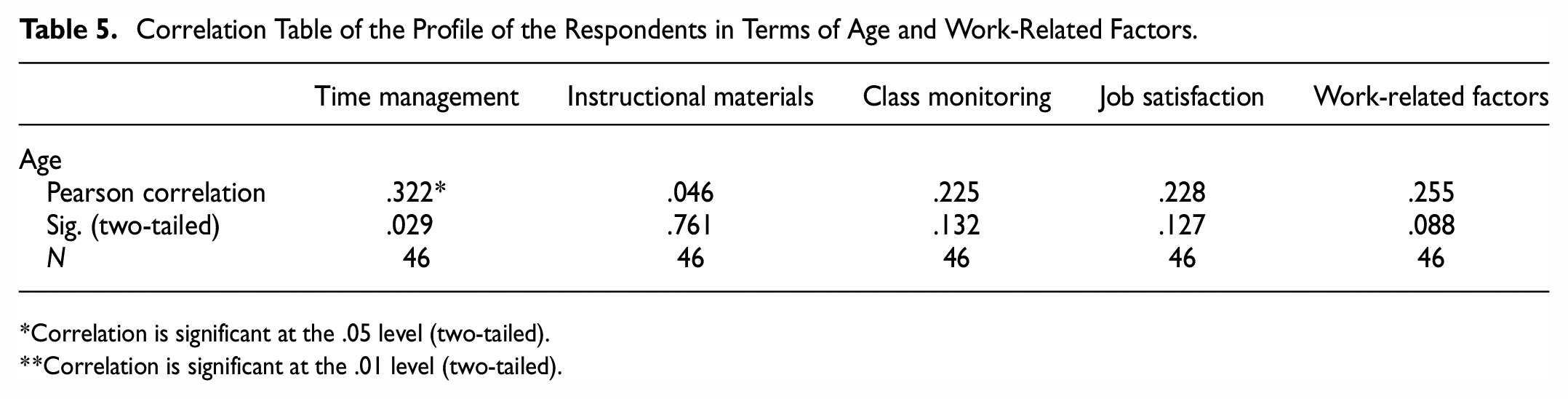
Correlation Table of the Profile of the Respondents in Terms of Age and Work-Related Factors.
Correlation is significant at the .05 level (two-tailed).
Correlation is significant at the .01 level (two-tailed).
Table 5 indicates that the correlation of age to time management is significant at .05 level with .322 correlation. The rest of the outcomes show that age has no correlation to instructional materials, class monitoring, job satisfaction, and work-related factors in general.
Since time management is a method of organizing, arranging, and planning one’s time for the use of more effective in both work and productivity, it is imperative that faculty members, regardless of age, must set plans before accomplishing tasks and sets urgencies of tasks on daily basis. Learn how to prioritize the works to be accomplished and learn how individuals make use of the time efficiently by handling the necessity of the tasks and the time to be used such that time is maximized (Sayari et al., 2017).
Table 6 reflects that when group according to gender, only preparation has a significant difference among the other home-related factors. It shows that female faculty members have a higher mean compared to male faculty members. Thus, reflects that female faculty members prepared more during online instructions. According to El-Alayli et al. (2018), that female faculty members have to transact with their students with more consideration asking for favors like tutorials, extra instructions, work demands, and grade increases so they need to prepare more compared to male faculty members. They also found out that female faculty members showed more acts of friendship from their students in such a way that such friendly actuations may be emotionally demanding which seems to increase the emotional worries for female faculty members.
The Profile of the Respondents in Terms of Gender and Home-Related Factors.

Note. Effect size—“small, d = .2,”“medium, d = .5,” and “large, d = .8.”
The study of El-Emadi et al. (2019) found out that female teachers prepared more to create more common classroom discussions by involving students in conversations and bidirectional communication and allowing their students to articulate their opinions and establish a more student-centered learning environment compared to their male counterpart.
It was also found out that female faculty members work harder and prepare well prior they go to classes, they assigned coordinator in each subject that meets with all the assigned teachers and check their scheduled plan and deliberate with them major requirements for the week and sometimes they arrange coaching with deficient students (Table 7).
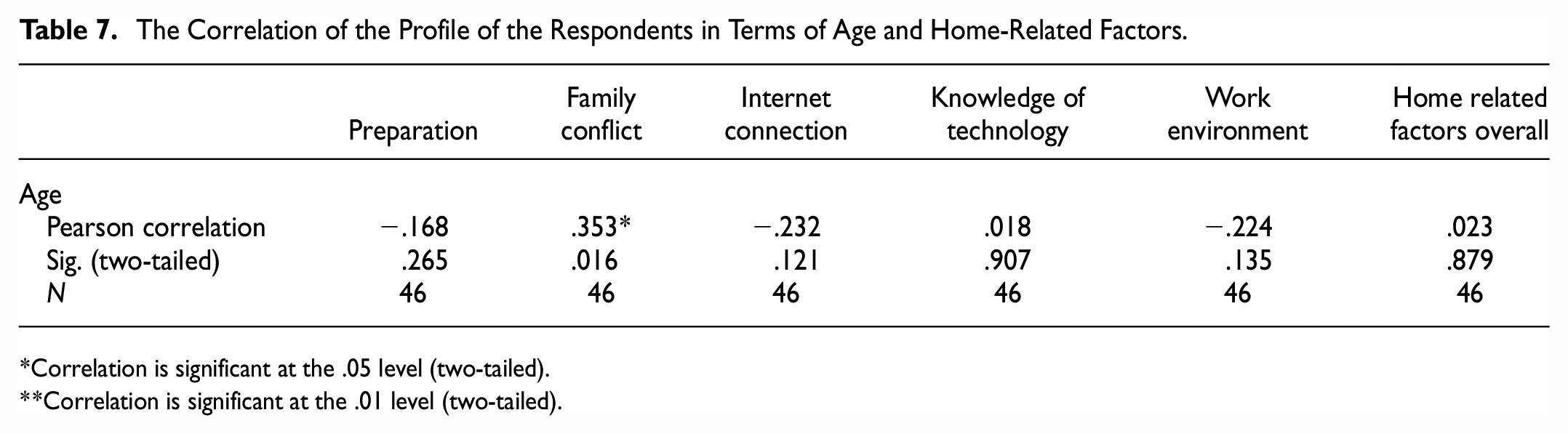
The Correlation of the Profile of the Respondents in Terms of Age and Home-Related Factors.
Correlation is significant at the .05 level (two-tailed).
Correlation is significant at the .01 level (two-tailed).
Among the home-related factors, it shows that age is significantly correlated to family conflict at .05 correlation. It shows that with aging, the ability of a person to do daily activities such as working at home declines to some degree. Also, older people, on average, tend to have more disturbs and infirmities than younger people.
The alternative work scheme for faculty members has become a remedy for this unprecedented global pandemic, notwithstanding the challenges caused to both educators and learners. However, transitioning from traditional classroom instructions to online learning can be an entirely different familiarity for the learners and the educators, which they must acclimatize to other options available. Older faculty members may find it difficult to adjust to the education system through various online platforms and are bound to embrace the new system that they are not prepared for (Pokhrel & Chhetri, 2021; Table 8).
The Profile of the Respondents in Terms of Courses Taught and Home-Related Factors.

Note. Effect size—“small, d = .2,”“medium, d = .5,” and “large, d = .8.”
Table 9 shows no significant effect on the profile of the respondents in terms of course/s taught and internet use toward their home-related factors. It only means that faculty members are not affected by their alternative work scheme whether they are handling general education courses or professional courses. Still, faculty members can manage to teach their assigned course or courses. It may also be attributed to the support of the institution, management, and their peers. Kraft and Simon (2020) found that teachers’ success on online teaching and work from home schemes during the pandemic is closely associated with their perceptions of the degree to which their school administrators, institution, and peers are supportive. Likewise, faculty members were able to attend different Professional Development Resources that will help them on how to deliver the course/s assigned to them accordingly. These are resources that may assist faculty in supporting learners, guiding them properly to contents/ objectives of the course, developing their abilities to impart the topics remotely, or more generally strengthening their capacity to support their learners’ new learning environment to be more independent and at home, rather than at school (Reimers et al., 2020). The study of Johnson et al. (2020) found out that faculty members were able to adopt online teaching methodologies and make the appropriate modifications to the ways they give assignments, exams, and grading policies, etc. It also shows that faculty members became more enthusiastic regardless of their course/s handled during the implementation of online learning with the new teaching environment and utilized more diversified resources.
The Profile of the Respondents in Terms of Internet Use and Home-Related Factors.

Note. Effect size—“small, d = .2,”“medium, d = .5,” and “large, d = .8.”
Czerniewicz et al. (2019) revealed that the majority of faculty members recognized blended and online methods as feasible decisions during the closure of university, though face-to-face teaching methodology is considered the more effective and preferred method of instruction by students and faculty members.
Table 10 shows that the profile of the respondents in terms of internet use whether the postpaid or prepaid subscription has no significant effects on home-related factors. This suggests that providing appropriate resources to the faculty members and promoting a supportive learning environment, may reduce internet anxiety, and thus it can impact the use of technology during classroom instructions that is beneficial both to faculty and learners.
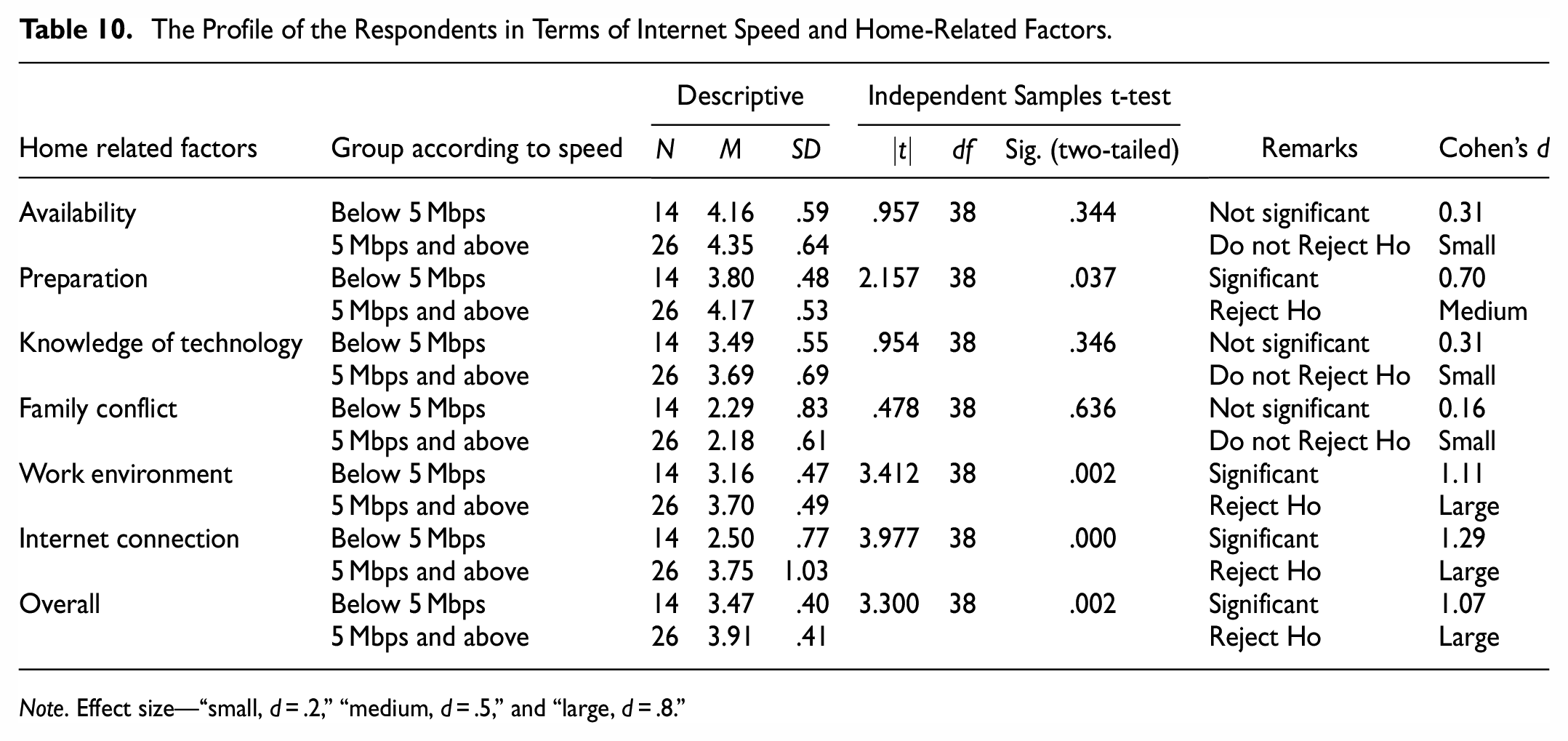
The Profile of the Respondents in Terms of Internet Speed and Home-Related Factors.
Note. Effect size—“small, d = .2,”“medium, d = .5,” and “large, d = .8.”
During synchronous classes, it is necessary to have consistent and reliable internet connections. Since it runs almost the same as traditional classes, with the participation of students, checking of attendance, lectures, and discussion. In this setup, students normally join and participate in different learning management platforms. Instructors also can virtually demonstrate specific tasks or lessons and the students can ask questions as they go.
Synchronous classrooms instructions include interactive mechanisms such as chat rooms, video presentations, and shared documents. Contrary to the findings of Cullinan et al. (2021), differences in connectivity may influence the variety of online/blended strategies that faculty members can deliver or hamper student engagement with online content.
According to them, there are issues on the significant differences in the access to digital learning management resources while they are working at home that includes high quality and continuous connection of broadband connectivity.
In terms of internet speed, Table 11 shows that preparation, work environment, internet connection has significant effects on the home-related factors of the respondents. This is not a surprise since the faculty members rely most of their preparation and their work on internet speed. Limited and slow internet access is one of the major concerns of faculty in implementing blended learning under the work from scheme (Garrote Jurado et al., 2010). In the study Asio et al. (2021) they found out that information, internet connectivity is an issue and challenge both for the students, the teachers, and the institution. Slow or unreliable internet connectivity can hamper the delivery of a lesson of a teacher, students completing online testing and can even suppress innovation in the classroom that may cause stress both for the teachers and the learners.
The Correlation Table of Home-Related Factors and the Work-Related Factors Experienced by the Respondents.

Correlation is significant at the.05 level (two-tailed).
Correlation is significant at the.01 level (two-tailed).
However, faculty members have the idea of how to deal with slow or no internet connection during classroom instructions. Such as making the tasks given as homework instead of giving it during synchronous class or uploading videos and reference materials so that students can perform necessary tasks or requirements when they have a more stable internet connection (Husniyah, 2019).
In the study of Aeni et al. (2019), it was found that the internet connection and speed have a positive impact and can provide positive benefits to the teacher competence. It means that it is characterized by the progressively professional development of the teachers, increased educational qualification, creativeness, innovativeness, good in the delivery of instructions, achieving the desired outcomes, and being able to complete all the requirements. In terms of the professionalism of teachers, internet connection and speed also have a significant impact. The study shows that teachers are able to carry out the learning process with the aid of distance learning such as a learning management system (LMS). Wherein, learning management system has come to define as any dissemination of educational knowledge over the utilization of the internet. LMS is basically the integration of different technologies.
Table 11 shows that time management was found out to have a positive correlation to availability, preparation, and work environment at a low extent but negatively correlated to the family conflict to a moderate extent. On the other hand, time management has a positive correlation to the overall home-related factors to a moderate extent.
Instructional materials were found out to have a positive correlation to availability, work environment, internet connection, and overall home-related factors to a moderate extent.
Class monitoring was positively correlated to availability, work environment, and an internet connection to a low extent but negatively correlated to a low extent with family conflict. On the contrary, class monitoring has a positive correlation to a moderate extent to overall home-related factors.
It is however surprising that job satisfaction has a positive correlation to almost all the home-related factors to a moderate extent except to knowledge of technology and family conflict.
Overall work-related factors were found out to be positively correlated to availability, preparation, work environment, internet connection, and overall home-related factors to a moderate extent.
Conclusions
Among the profiles, it was found that Courses Taught has a significant effect on class monitoring, age has a correlation to time management at .01 level, and the allocated speed has significant effects on all work-related factors. Gender was found out to have a significant effect on preparation, age is correlated to family conflict, and internet speed has a significant effect on preparation, work environment, internet connection, and overall home-related factors.
It was also found that gender has a small to medium effect size on all the work-related factors. Time management was found out to have a low correlation to age and the other work-related factors have very low correlation and almost no relationship at all to age. Class Monitoring was notably having a significantly large effect size on courses taught and the rest of the work-related factors has small effect sizes. Internet use has also a significantly large effect on time management, and the rest of the work-related factors have small to medium effect sizes. It was also seen in the results that since we are on a work-from-home scheme, the allocated speed has a significant effect on all the work-related factors. On the other hand, the number of users at home has no significant effect on all the work-related factors.
It was also found that gender except for preparation which has a significantly large effect, all the home-related factors, has small to medium effect size. Age was found out to have a low correlation to all the home-related factors. Courses taught has small to medium effect size to all the home-related factors. Likewise with Internet use has also small to medium effect sizes to all the home-related factors. It was also very obvious that preparation, work environment, and internet connection are largely affected by internet speed, while the rest of the home-related factors have small to medium effect sizes. Similarly, with the result above, the number of users at home has no significant effect on all the home-related factors.
It is also demonstrated that alternative work scheme in connection to their personal life, in general, has a positive correlation to all the work-related factors to a moderate extent. On the other hand, it is very notable that the knowledge of the technology of the faculty members has a very low correlation and almost no relationship at all to all the work-related factors. Lastly, it was found out that it has almost no relationship to all work-related factors.
Recommendations
Dialog between the faculty members and administration such as “Kumustahan Process” and “Open Forum” must be done to ensure that faculty members will be able to vent out their emotions and perceptions on the implementation of work from home scheme. Also, in doing so, the management may be able to understand the dilemma of faculty members while working at home.
Guidelines on the implementation of alternative work schemes must be properly cascaded to all members of the institution to determine the scope and limitations of the new work scheme.
The management may provide faculty members with the necessary training on the use of the Learning Management System during the conduct of the online class. Likewise, PUP management may provide internet assistance or internet connections to minimize the stress during the conduct of the online class.
Although faculty members are working from home, they should be given time and privacy especially during their off time in teaching.
Footnotes
Declaration of Conflicting Interests
The author(s) declared no potential conflicts of interest with respect to the research, authorship, and/or publication of this article.
Funding
The author(s) disclosed receipt of the following financial support for the research, authorship, and/or publication of this article: The author(s) received no financial support for the research or authorship. But the authors received publication incentive support instead.
