




Abstract
Awards and competitions are representative policy instruments of the central government to promote urban governance. Compared with command-and-control tools, awards and competitions can encourage regulators and regulated parties to actively participate in governance. Using the panel data of 286 Chinese cities during 2005 to 2017 and regarding the National Civilized City (NCC) campaign as a quasi-natural experiment, we employ the difference-in-difference (DID) method to analyze the impact of the NCC campaign on enterprise production safety and its spillover effect. Our findings indicate that the NCC campaign significantly reduces enterprise production safety accidents and deaths in cities with the title of the NCC. However, this campaign appears to engender an unintended consequence: an increase in such incidents in the neighboring cities surrounding the NCCs. Heterogeneity analysis further shows that in non-old industrial base, low corruption and low economic growth target cities, the promotion effect of the NCC campaign on enterprise production safety is more significant. The increase in production safety input and the reinforcement of corporate social responsibility are the main influencing mechanisms. This paper can contribute to decision-makers thinking about how to improve enterprise production safety through awards and competitions under the governance structure with Chinese characteristics.
Introduction
Since the reform and opening-up, China’s economic growth has achieved remarkable achievements, but with enormous costs, such as the continuing high incidence of enterprise production safety accidents. During 2001 to 2018, about 87,888 people died annually in enterprise production safety accidents in China, which is 17 times higher than that of the United States. 1 The high incidence of enterprise production safety accidents is detrimental to social stability and undermines economic growth. Therefore, the Chinese government has issued a series of policies and regulations to reduce production safety accidents and deaths as much as possible. As shown in Figure 1, the total number of enterprise production safety accidents and deaths in China has been dropping since 2002. In 2020, China witnessed 38,000 production safety accidents and 27,400 deaths. According to the Ministry of Emergency Management of China, production safety accidents and deaths have dropped to the lowest level in 70 years, indicating that the Chinese government has made remarkable progress in production safety governance.

The trends of production safety accidents and deaths in China.
Why have production safety accidents and deaths dropped so quickly in China? One idea holds that this is mainly due to increasing safety regulations (Zheng et al., 2009). Wang (2006) believed that the transformation of China into a regulatory state and the enhancement of regulatory capacity reduced production safety accidents. Similarly, other researchers found that the establishment of vertically managed regulatory bodies can effectively reduce production safety accidents (Jia & Nie, 2017; Wang, 2006). In contrast, another idea holds that increasing safety regulation cannot reduce production safety accidents. A shift in official evaluation methods is the core reason for the decline in production safety accidents (Nie et al., 2013; Shi & Xi, 2018). Chan and Gao (2012) argued that when the higher-level government set the production safety death ceiling as a veto for the promotion of local officials, the mindset of local officials that their promotion was only related to economic development would be effectively changed. And production safety could receive more attention from local officials.
Furthermore, Fisman and Wang (2015) also found that the “No Safety, No Promotion” policy can effectively reduce the negative impact of government-enterprise collusion on production safety. Shi and Xi (2018) thought that performance competition strengthened the motivation of local governments to implement production safety policies. Moreover, performance competition also had neighborhood effects on other cities within the same province, thus helping reduce coal mine accidents. From the previous literature, most scholars attach importance to the effect of accountability and regulation systems on production safety. Few papers pay attention to the vital role of incentive mechanisms on production safety. Production safety regulation is usually a long-term systematic project, and its effect depends on long-term resource investment. Therefore, motivating local governments and enterprises is key to solving this issue. By analyzing 410 gas explosion accidents during 1980 to 2000, Chen et al. (2012) found that the accidents caused by personal factors exceeded 96.59% of all the sample accidents, providing new evidence for the importance of stimulating local governments and enterprises to increase production safety governance. Compared with the serious accountability system, the incentive system is more flexible in implementation, which can form practical constraints on local officials and encourage local governments to achieve the policy goals set by higher-level governments. Furthermore, the incentive system can better handle the relationships between the central and local governments.
Among many city-level incentive policies in China, the most representative one is undoubtedly the NCC campaign. This campaign began in 2003, and the first batch of cities with the title of the NCC was announced in 2005. After that, this campaign is held every 3 years. Moreover, it has so far been carried out six times with a total of 149 prefecture-level cities to obtain this honor. Compared with other honors, the NCC is regarded as the highest honor of cities in China due to its difficulty in obtaining such an honorary title. Therefore, the NCC campaign is highly valued by local governments (Zhu, 2015). Cities trying to get this title will be disqualified if there is a major safety accident with national impacts during the campaign. In the meantime, cities with this title would also face a rigorous review every year. If a city with this title fails the review, it will be stripped of its honorary title. 2 Therefore, to obtain or retain the title of the NCC, on the one hand, local governments have strong incentives to increase production safety input and improve workers’ working environment to reduce production safety accidents, especially major production safety accidents. On the other hand, local governments will also pressure local enterprises. Specifically, local governments will strengthen regulations on local enterprises and require them to enhance safety training for employees to avoid serious production safety accidents.
In recent years, some scholars have begun to analyze the economic and social impact of the NCC campaign in China. For example, Li et al. (2022) found that performance competition based on the NCC campaign is conducive to improving the happiness of residents and the overall public service quality of cities. Other scholars denoted that getting this honor will improve corporate environmental performance and encourage enterprises to assume more social responsibilities (Chai et al., 2022; Zhang et al., 2021). However, the aforementioned literature ignores the incentive effect of the NCC as a city brand on enterprise production safety and fails to explain the influencing mechanism of the NCC campaign. Therefore, taking the NCC campaign as a quasi-natural experiment, we employ the panel data of 286 prefecture-level cities during 2005 to 2017 in China to analyze the impact of the NCC campaign on enterprise production safety by using the difference-in-difference (DID) method. Compared with the existing literature, the contributions of this paper are mainly reflected in the following three aspects: (1) Taking the NCC campaign as a quasi-experiment, we analyze the potential reasons for the rapid decline of production safety accidents in China from a politically-motivated perspective and enrich the literature on enterprise production safety. (2) Exploring the spillover effect of the NCC campaign on neighboring cities, we find that the actions of decision-makers are not independent of each other. (3) Analyzing the influence mechanisms of the NCC campaign on enterprise production safety, we confirm that higher-level governments can encourage the lower-level governments to pay attention to non-economic fields through awards and competitions. The awards and competitions could promote the transformation of local government from a promotion tournament-oriented one to a governance tournament-oriented one.
Institutional Background and Theoretical Analysis
Institutional Background
At the end of the 20th century, urbanization in China reached an unprecedented level, and many urban diseases emerged, such as road congestion, air pollution and high crime rates. To improve urban governance, the Chinese government established the Chinese Central Civilization Commission in 1997 to guide the construction of urban spiritual civilization (Cartier, 2016). In August 2003, the Chinese Central Civilization Commission launched the NCC campaign. And in October 2005, the first batch of cities to be awarded this honorary title was announced. As the leading agency of the NCC campaign, the Chinese Central Civilization Commission has extremely high political authority. With the exception of the initial director, all the directors of the Chinese Central Civilization Commission are members of the Standing Committee of the Politburo, which is China’s highest decision-making body. Therefore, local officials highly value the NCC campaign, as being awarded the title of the NCC can increase their probability of attracting the attention of the central leadership and receiving a political promotion (please refer to Appendix 1 for details). For example, Zhang et al. (2021) provided empirical evidence by employing the ordered Probit model to test the relationship between achieving the title of the NCC and officials’ probability of promotion. They suggested that officials in civilized cities have a significantly higher probability of promotion than those in non-civilized ones. Furthermore, Li et al. (2022) found that after winning the title of the NCC, the probability of local officials being promoted in the second and third years increased by 13.1% and 15.9%, respectively. The NCC campaign exerts a noteworthy impact on the promotion incentives of local government officials, potentially serving as a motivational factor for their vigorous competition to attain such a title.
The NCC campaign is held every 3 years and it has been held six times until 2020. The candidate cities of the NCC are nominated and evaluated according to the National Civilized City Evaluation System. The detailed selection process is as follows: First, the Civilization Office of the Central Communist Party Committee issues a notice on carrying out the NCC campaign to all provinces in China. Cities then submit the application materials to their provincial-level governments. If a city has a safety accident within 12 months before this application, it will be directly disqualified (please refer to Appendix 2 for details). Second, according to the National Civilized City Evaluation System, the provincial Civilization Commission will evaluate the application materials of cities and recommend the excellent ones to the Civilization Office of the Central Communist Party Committee. Finally, the Civilization Office of the Central Communist Party Committee will delegate professional third-party organizations to evaluate these candidate cities and publish the final list of the NCC. The same process applies to cities holding the title of the NCC. After completing the self-review, these cities would also submit their application materials to the provincial Civilization Committee to keep the title. Once they pass the review, the provincial Civilization Commission will report the results to the Civilization Office of the Central Communist Party Committee. And the Civilization Office of the Central Communist Party Committee decides whether to renew the title based on the review results.
Theoretical Analysis
The Influence of the NCC Campaign on Enterprise Production Safety
According to promotion tournament theory, higher-level government officials evaluate and promote lower-level government officials mainly based on the economic performance of their managed cities (Li & Zhou, 2005). However, some studies have shown that the promotion tournament exists not only in economic fields but also in non-economic fields, such as social development, urban construction and ecological conservation (Feng et al., 2018). Unlike traditional tournaments focusing only on economic indicators such as the GDP growth rate, non-economic tournaments are a top-down place-based award and competition system (Li, 2018). Through awards and competitions among cities, the central government awards some local governments honorary titles to inspire them. The number and level of titles that local governments receive determine their ranking in the promotion tournament. Since 2003, the directors of the Civilization Office of the Central Communist Party Committee have always been members of the Standing Committee of the Politburo. The leaders of cities that won the title of the NCC would have the opportunity to receive awards from the top leaders, which is another important aspect that distinguishes it from other non-economic activities. Given that, the NCC campaign further stimulates the willingness of local officials to participate in this campaign.
However, according to the National Civilized City Evaluation System, if the local government wants to get this honorary, it must construct a city with a secure and stable social environment. Furthermore, cities cannot have major safety accidents with national impact or major illegal cases violating workers’ legitimate rights and interests. In the negative list released by the Civilization Office of the Central Communist Party Committee, the production safety accident is one of the veto standards. 3 The local government will be disqualified from this campaign if a major production safety accident occurs. Cities that already have this title will also face a strict review. In a word, the NCC campaign demonstrates the willingness and policy objectives of the central government and indicates the selection process’s strictness. It stimulates local governments’ competition and safety regulation. To win the title of the NCC, local governments will focus on reducing enterprise production safety accidents and deaths. Based on the above discussions, this paper proposes the following hypothesis:
H1: The NCC campaign can significantly reduce production safety accidents and deaths.
The Influencing Mechanisms of the NCC Campaign on Enterprise Production Safety
The NCC campaign is a representative non-economic competition. The central government guides the administrative behaviors of local governments through awards and competitions. The NCC campaign may influence enterprise production safety by increasing government spending and enhancing corporate social responsibility. Firstly, the NCC campaign will increase government spending. Specifically, government spending on enterprise production safety mainly comes from three parts. The first part is the special funds set up by local governments to construct the NCC. To lead the construction of the NCC, local governments often set up the Spiritual Civilization Committees or similar organizations, usually headed by municipal party secretaries. As a result, many cities are faced with loose budget constraints when constructing the NCC. Most cities will set up special funds in their financial budgets to support the construction of the NCC. Secondly, for those cities that are more likely to win the honorary title of the NCC, higher-level governments will also give the corresponding construction funds to ensure that local governments have sufficient financial support in the NCC campaign. Finally, according to the interim Measures on the Evaluation and Commendation of the NCC campaign, the Civilization Office of the Central Communist Party Committee will give appropriate rewards to cities that win the title of the NCC. Moreover, the higher-level governments will also give financial subsidies and rewards to local governments with this honorary title. And a considerable part of these financial funds will be invested in production safety to improve the working environment of workers, reducing production safety accidents and deaths.
At the same time, local governments will put pressure on local enterprises to take on more social responsibilities. Swanson (1995) believed that enterprises usually had three main motivations for undertaking social responsibilities: economic motivation, positive and negative duties. This paper argues that the motivations for enterprises to undertake social responsibility in the NCCs mainly stem from economic motivation and negative duty. On the one hand, according to the Civilization Office of the Central Communist Party Committee, local governments can reward those who make outstanding contributions to the NCC campaign. Therefore, many cities will link the NCC campaign with the commendation activities of local enterprises. For enterprises actively engaged in the NCC campaign, local governments will award them specific honorary titles and provide appropriate convenience for their production and operation activities. 4 In addition, actively taking social responsibility is also an important channel for enterprises to establish political connections with local governments (Ma & Parish, 2006). On the other hand, local governments will strengthen the regulation on enterprise production safety. For example, they will require enterprises to strictly abide by safety laws and regulations and increase employees’ safety training and protection measures. And these measures would reduce safety accidents during production. During the NCC campaign, the Production Safety Supervision and Administration Bureau of each city will organize special working groups to increase the frequency and intensity of law enforcement activities, which will crack down on illegal production to meet the requirements of the higher-level governments. Thus, enterprises will take more social responsibilities and improve production safety management to avoid major production safety accidents. Similarly, Mavroulidis et al. (2022) found that employee safety management can be achieved through corporate social responsibility. Based on the above discussions, this paper proposes the following hypothesis:
H2: The NCC campaign reduces production safety accidents and deaths by increasing government spending and enhancing corporate social responsibility.
Research Design
Identification Strategy
Referring to Zhang et al. (2021) and Zhang and Hong (2022), we use the DID method to analyze the impact of the NCC campaign on enterprise production safety. The specific model is set as follows:

Among them,
Data
The data on enterprise production safety accidents and deaths are from the China Stock Market and Accounting Research (CSMAR) database; the list of the NCCs is from the China Civilization website 5 ; the control variables at the city-level are from the China City Statistical Yearbooks; In addition, the data on corporate social responsibility is from the Hexun website; and the control variables at the enterprise-level are also from the CSMAR database.
(1) The number of enterprise production safety accidents and deaths. This data is mainly from the CSMAR database, which is the most detailed and available data on production safety accidents. This data reveals the time, location and deaths of enterprise production safety accidents. Furthermore, according to Fisman and Wang (2017), this paper also obtains production safety accident data from the accident reports of the State Administration of Work Safety, accident investigations of the Ministry of Emergency Management of the People's Republic of China, information disclosure reports of listed companies (annual and quarterly reports, major event reports, etc.) and the news reports, which will be used to supplement and check the production safety accident data obtained from the CSMAR database. The maximum number of deaths disclosed by different sources is taken as the final death toll of enterprise production safety accidents for the same accident reported from different sources. The number of production safety accidents and deaths is added to the city-level.
Furthermore, similar to other studies examining production safety accidents in China, there may be concerns regarding data quality due to incentives for local governments to manipulate the data of accidents and deaths (Fisman & Wang, 2017). However, we contend that the swift proliferation of the Internet has rendered the concealment of production safety accidents a more arduous task. The ubiquitous possession of smartphones has enabled anyone to take photos and make comments on the accidents, thereby impeding the capacity of local governments to hide what happened. Additionally, the oversight of the higher-level government and the general public weighs upon the integrity of the NCC. Admitting the occurrence of production safety accidents is evidently more judicious than attempting to mask them. Consequently, we assert that the data on accidents and deaths employed in this study are reliable (For more discussion on data quality, please refer to Appendix 3).
(2) The list of the NCCs. This data comes from the China Civilization Website, sponsored by the Publicity Department and the Civilization Office of the Central Communist Party Committee. This website is in charge of releasing the list of the selected cities and cities that pass the review. Figure 2 illustrates the number of cities with this honorary title and the number of cities that are eliminated after the review of the NCC campaign. Figure 2 shows that about 10% of cities are eliminated in each review, indicating that the review system of the NCC campaign is not a cheap talk but a serious rule, which further promotes local governments to strengthen supervision activities and resource investment in enterprise production safety.
(3) Production safety input of local governments. The data on production safety input at the prefecture-level cannot be directly obtained. Therefore, we first calculate expenditure on public safety (Pubexp) and the expenditure on social security and employment (Socexp) at the provincial-level. Furthermore, following Xu and Lu (2009), we then use this data and take the proportion of prefectural financial expenditures to provincial ones as the weight to calculate the production safety input at the prefecture-level.
(4) Corporate social responsibility. The data on corporate social responsibility comes from the corporate social responsibility reports of listed companies published by the Hexun website. 6 This data has been widely applied to the literature on Chinese enterprises (Feng et al., 2018; Kong et al., 2021). Specifically, this paper chooses the total scores of corporate social responsibility (CSR), employee responsibility (Employee), safety checks (Check) and safety training (Train) as indicators of corporate social responsibility.
(5) Control variables. To reduce the potential influence of other factors, we also add many control variables in this paper. Specifically, these variables include urban per capita GDP, GDP growth rate, the proportion of secondary industry in GDP, population density and fiscal pressure. To reduce the impact of heteroscedasticity on the estimation results, we take the logarithm of urban per capita GDP and population density. All the aforementioned data are from the China City Statistical Yearbooks.
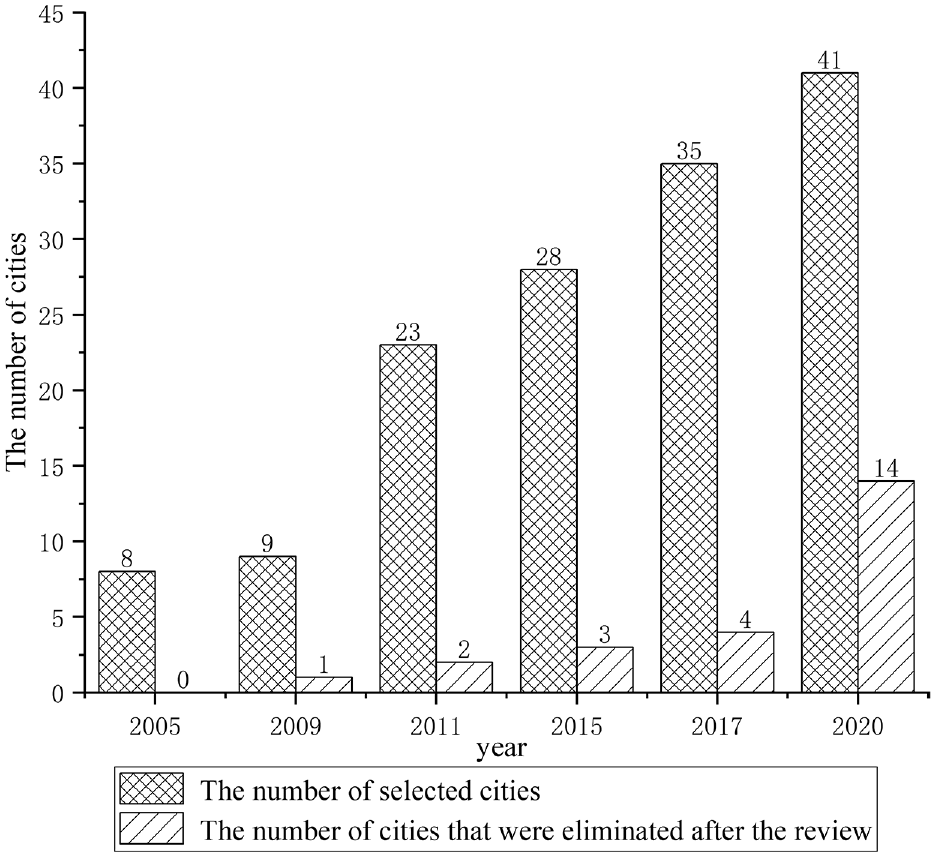
Number of selected cities and cities that were eliminated after the review.
Descriptive Statistics
The descriptive statistics for each variable are presented in Table 1. The results in Table 1 show that the number of production safety accidents and deaths in the treatment group is higher than that in the control group, possibly due to the higher economic development level in the treatment group. However, a comparison of two different periods (2005–2010 vs. 2011–2017) reveals that the number of accidents and deaths decreases more rapidly in the treatment group. And we can also find that the financial pressure of the treatment group is less than that of the control group, indicating that the treatment group has more financial funds than the control group. Through the mean difference analysis between the two groups, we find that there are significant differences in socioeconomic characteristics between the two groups, denoting that the results of the NCC campaign are not random but may have a certain degree of selectivity. Hence the robustness test of this paper examines this issue in detail and shows that this kind of selectivity does not affect the main conclusions of this paper.
Descriptive Statistics.

Note. Columns treat and control represent the mean values of the variables in the treatment and control groups, respectively. Column Diff represents the mean difference between groups.
represents significance at the 1% level.
Empirical Analysis
Baseline Regression
The results of the baseline regression are reported in Table 2. Columns (1) and (3) take the city fixed and year fixed effects into consideration. Columns (2) and (4) further consider some socioeconomic characteristics of cities. The results show that the NCC campaign dramatically reduces production safety accidents and deaths in the selected cities. In Columns (2) and (4), the coefficients of
Baseline Regression Results.

Note. Robust standard errors are in parentheses. Controls represents the control variables. City FE and Year FE represent city fixed effect and year fixed effect, respectively.
and ** represent significance at the 1% and 5% levels, respectively.
In addition, Figure 3 shows the distributions of residuals. As we can see, the residuals evince a remarkably symmetrical distribution, with a conspicuous concentration towards the center of the graph, which denotes the robustness and validity of the benchmark regression.

(a) The residual plot of accidents, and (b) The residual plot of deaths.
Heterogeneity Analysis
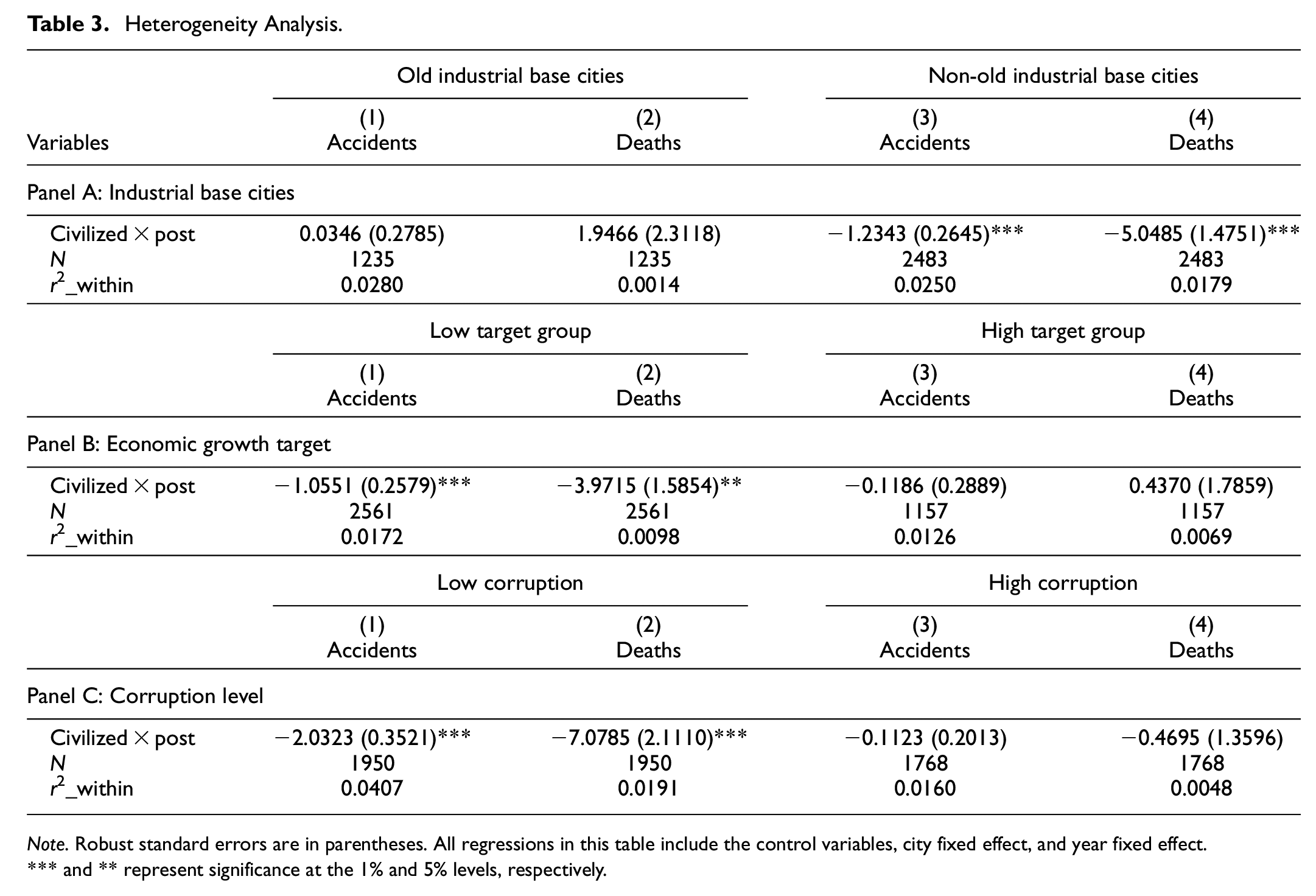
Jia and Nie (2017) found that heavy industry, such as the extractive industry, has a high incidence of production safety accidents. In China, heavy industry is mainly distributed in the old industrial base cities. Therefore, according to the list of old industrial base cities published by the State Council, 7 we divide the sample into the old and non-old industrial base cities. Panel A in Table 3 reports the results. It can be found that the NCC campaign significantly reduces production safety accidents and deaths in the non-old industrial base cities but has no significant impact on the old industrial base cities. One conceivable explanation for this observed phenomenon is the heavy reliance of old industrial base cities on heavy industries to generate employment opportunities and drive economic growth. On the one hand, to maintain economic stability and attract investment, local governments may lack the impetus to enforce stringent supervision of production safety. On the other hand, as detailed in the “Adjustment and Transformation Plan of the National Old Industrial Base (2013–2022)” issued by the National Development and Reform Commission, the reform of some enterprises in these areas is comparatively sluggish and the management practices employed are imperfect, which can also dampen the overall governance of production safety within the old industrial base cities.
Heterogeneity Analysis.
Note. Robust standard errors are in parentheses. All regressions in this table include the control variables, city fixed effect, and year fixed effect.
*** and ** represent significance at the 1% and 5% levels, respectively.
Furthermore, setting economic growth targets for the coming year is the core of local government work plans in China. Liu et al. (2020) reported that the excessively high economic growth target set by local governments would distort fiscal expenditure structure, hinder the upgrading of the industrial structure and negatively impact economic growth in the long term. Therefore, this paper takes the mean value of economic growth targets as the dividing line and divides the sample into the low target and the high target groups. The economic growth target comes from the government work reports of prefecture-level cities. Panel B in Table 3 reports the results. By comparing the coefficients of
Many existing studies have argued that corruption is the main culprit for China’s high incidence of production safety accidents (Xu et al., 2021). In an interview conducted at the end of 2006, Yizhong Li, the head of the State Administration of Work Safety, stated that some local governments acted as security umbrellas for illegal production, which could dampen production safety. He also thought that the underlying reasons for these accidents were dereliction of duty, playing favoritism and committing irregularities, power-for-money trading and collusion between officials and businessmen. 8 Therefore, based on the number of corruption cases in each province, this paper divides the sample into the low corruption and high corruption cities with the mean value of corruption cases as the dividing line. The number of corruption cases comes from the China Procuratorial Yearbook and the provincial Procuratorial Work Reports. Panel C in Table 3 reports the results, which show that the NCC campaign has a significant positive impact on production safety in low-corruption cities but not in high-corruption cities. This may be because, in high-corruption cities, enterprises are more likely to engage in rent-seeking activities to evade production supervision. Moreover, if production safety accidents do occur, enterprises may be more inclined to pay bribes to mitigate the impact of the accident rather than investing in improving production equipment and implementing new technology.
Analysis of the Influencing Mechanisms
The above analysis demonstrates that the NCC campaign dramatically reduces production safety accidents and deaths. Then, what are the influencing mechanisms of the NCC campaign on production safety accidents and deaths? According to the theoretical analysis, this paper studies the potential influencing mechanisms from two aspects: corporate social responsibility and production safety input of local governments. First, to verify the potential mechanism of corporate social responsibility, we use the total scores of CSR, Employee, Check and Train as the proxy variables of corporate social responsibility. Table 4 presents that the NCC campaign significantly improves corporate social responsibility and strengthens employee safety protection, thus effectively reducing production safety accidents and deaths.
Corporate social responsibility.

Note. Robust standard errors are in parentheses. Controls represents the control variables. Industry FE and Year FE refer to industry fixed effect and year fixed effect, respectively.
and ** represent significance at the 1% and 5% levels, respectively.
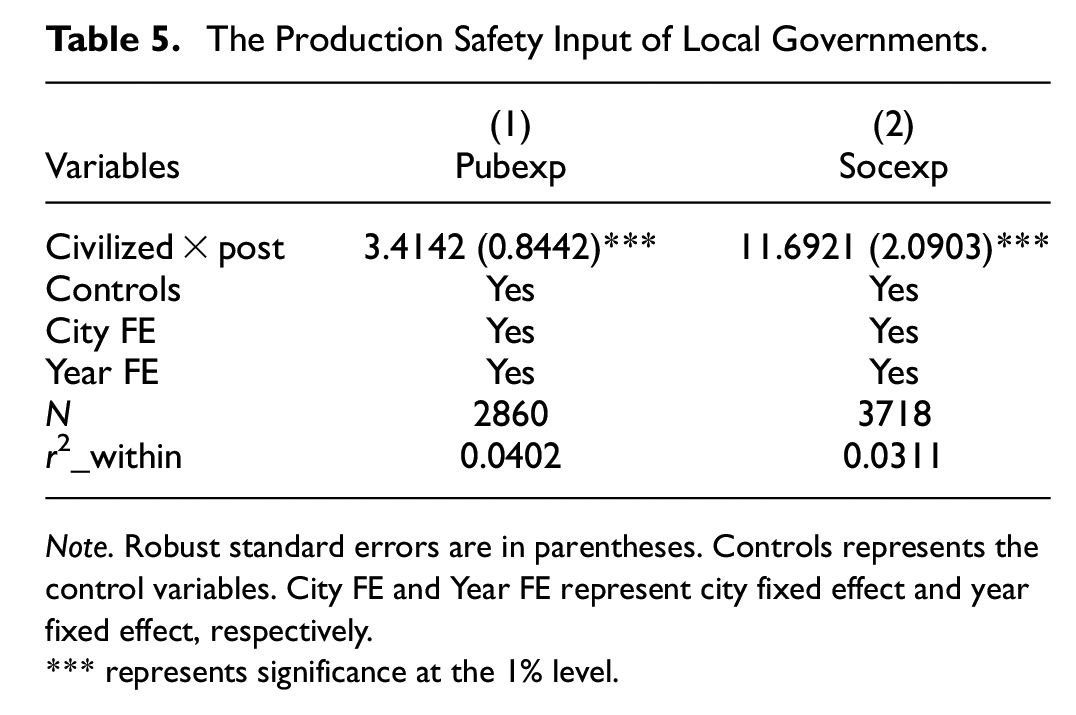
Secondly, the NCC campaign can also promote enterprise production safety by increasing the production safety input of local governments. To verify the potential influencing mechanism of production safety input, we use Pubexp and Socexp as the proxy variables of production safety input. Table 5 reports that the NCC campaign significantly improves local government expenditures on public safety, social security and employment effectively, thus improving enterprise production safety.
The Production Safety Input of Local Governments.
Note. Robust standard errors are in parentheses. Controls represents the control variables. City FE and Year FE represent city fixed effect and year fixed effect, respectively.
represents significance at the 1% level.
Robustness Test
In practice, the validity of the DID method is based on a series of assumptions. To ensure the reliability and robustness of the estimated results, we carry out a series of robustness tests in this part.
Parallel Trends
The DID method assumes that the treatment and control groups satisfy the parallel trend hypothesis. Referring to Beck et al. (2010), we use the event analysis method to perform the parallel trend test. The specific model is set as follows:

Among them,
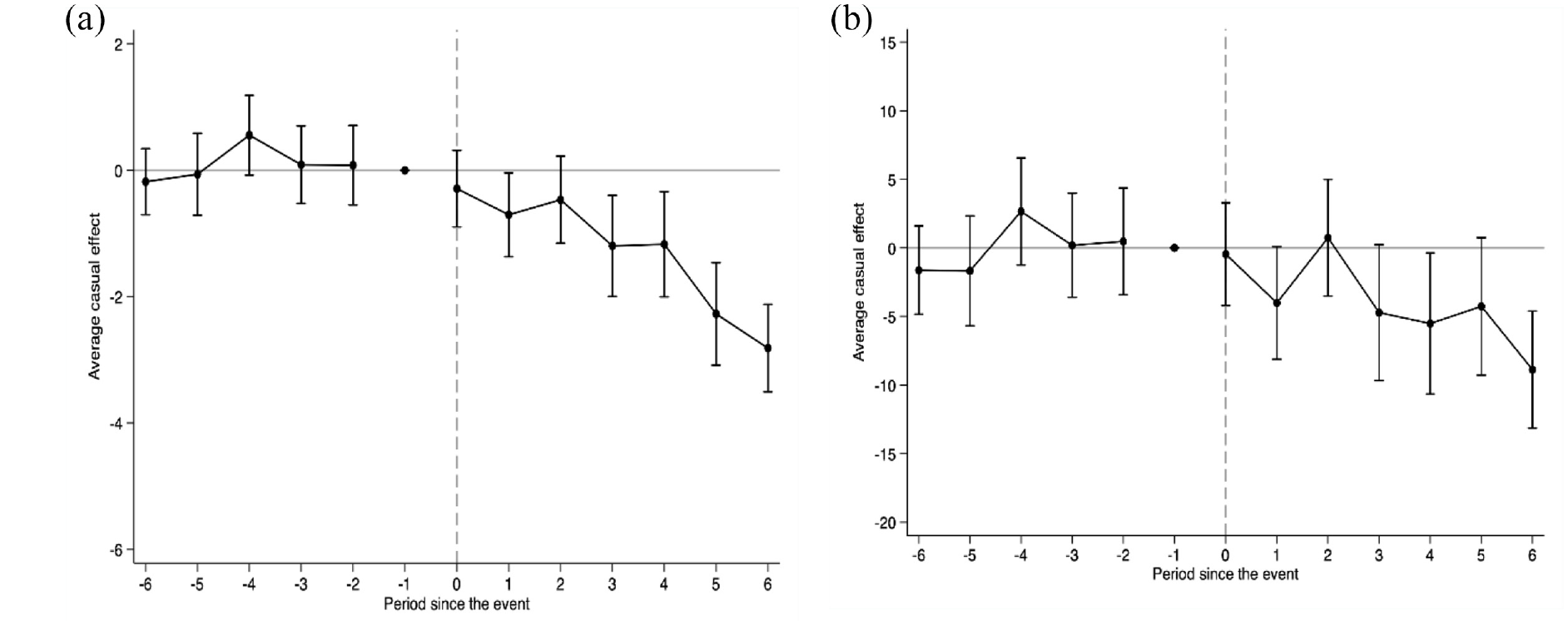
The parallel trend and dynamic effect. (a) Production safety accidents, and (b) Production safety deaths.
Placebo Test
Another concern with the DID method is the influence of unobservable factors on the estimated results. Therefore, the placebo test is carried out in this paper by referring to Li et al. (2016). Firstly, this paper randomly generates a list of the NCCs in China and uses Equation (1) as the benchmark model to analyze the effect of the NCC campaign on enterprise production safety. This process is then repeated 500 times, producing 500 false estimated coefficients. Theoretically, since the treatment groups are randomly generated, the estimated coefficients of the explanatory variables should be insignificant. Figure 5 depicts the distribution of the estimated coefficients and the dotted line represents the real estimated coefficient. We can find that the estimated coefficients are distributed near zero, with most of them located on the right side of the real estimated coefficient. This denotes that the estimated results in this paper are unlikely to be randomly obtained, and thus the NCC campaign does effectively promote enterprise production safety.

The placebo test. (a) Production safety accidents, and (b) Production safety deaths.
Social Ties of Officials
As a prerequisite for participating in the NCC campaign, any city that experiences a major safety incident prior to this campaign will be directly disqualified. However, if the leaders of a prefecture-level city possess social ties with members of the Politburo, this could potentially undermine the impact of the NCC campaign on production safety. As such, this paper considers the social ties of the leaders of prefecture-level cities to observe the net influence of the NCC campaign on production safety. Closely informed by the seminal work of Fisman et al. (2020), we construct three dummy indicators, namely NativeCityTie (indicating whether mayor i's hometown is in the same city as any member of the Politburo), BirthCityTie (signifying whether mayor i’s birthplace is in the same city as any member of the Politburo) and CollegeTie (corresponding to whether mayor i graduated from the same university as any member of the Politburo). These proxies are employed in our analysis to comprehensively account for the potential impact of social ties on production safety.
Table 6 reveals that even after factoring in the mayor's social ties, the NCC campaign continues to exhibit a significant negative association with production safety accidents and deaths. This outcome unequivocally suggests that social ties exert no discernible influence on the key conclusions of our study.
Regression Results with Social Ties.

Note. Robust standard errors are in parentheses. Controls represents the control variables. City FE and Year FE represent city fixed effect and year fixed effect, respectively.
represents significance at the 1% level.
Other Robustness Checks
As a quasi-experiment, the ideal situation of the DID method is that the choice of treatment and the control groups is random. However, Table 1 shows that the results of the NCC campaign may not be random. The results of the NCC campaign are closely related to the social and economic characteristics, resource endowments and natural conditions of cities. And these factors may affect enterprise production safety and lead to estimation bias. To address this issue, this paper uses two methods: including the time-varying variables as control variables in the model and interacting the time-invariant variables with the time trend and incorporating them into the model.
Firstly, referring to Fan et al. (2012), this paper uses the proportion of mining industry employees as a proxy variable of urban resource endowment and adds it into Equation (1). The proportion of mining industry employees comes from the Easy Professional Superior (EPS) database. Additionally, given the high incidence of production safety accidents in the construction industry, the proportion of construction practitioners collected from the EPS database is also included as a control variable. The model further incorporates several other pilot policies implemented in China during the sample period, such as the Low Carbon City, New Energy City and Smart City campaigns, which may affect the estimation results. The estimation results, reported in columns (1) and (2) of Table 6 after including these variables in Equation (1), show that the coefficients of
For the variables that do not change with time, referring to Lu et al. (2017) and Yu et al. (2023), we interact these variables with the time trend and then put them into the model. The specific model is as follows:

Among them, Z represents a series of variables that do not change with time, including the altitude and slope of the city and whether the city is a northern city or a provincial capital city or a special economic zone or a sub-provincial city;
Robustness Test.

Note. Robust standard errors are in parentheses. City FE and Year FE represent city fixed effect and year fixed effect, respectively.
, **, and * represent significance at the 1%, 5%, and 10% levels, respectively.
PSM-DID
The Propensity Score Matching-Difference-in-Differences (PSM-DID) method is also used to reduce the influence of selective bias on the estimation results. Firstly, the propensity score matching method is used to filter the samples. The specific process is as follows: (1) Using the Logit model to calculate the propensity score; (2) Using the nearest neighbor matching method to perform the one-to-one matching of samples; (3) The common support hypothesis is adopted to test the balance of matched samples and the samples that do not meet this hypothesis will be deleted. Figure 6 shows the kernel density of the propensity score of the treatment and the control groups before and after matching. After matching, the distribution of the propensity score of the treatment and the control groups tends to be consistent, indicating that the matching results are good. Then, we utilize the DID method and the sample after matching to estimate the effect of the NCC campaign on enterprise production safety. Columns (5) and (6) in Table 7 report the regression results. The regression coefficients remain significant, again demonstrating the robustness of the conclusions in this paper.
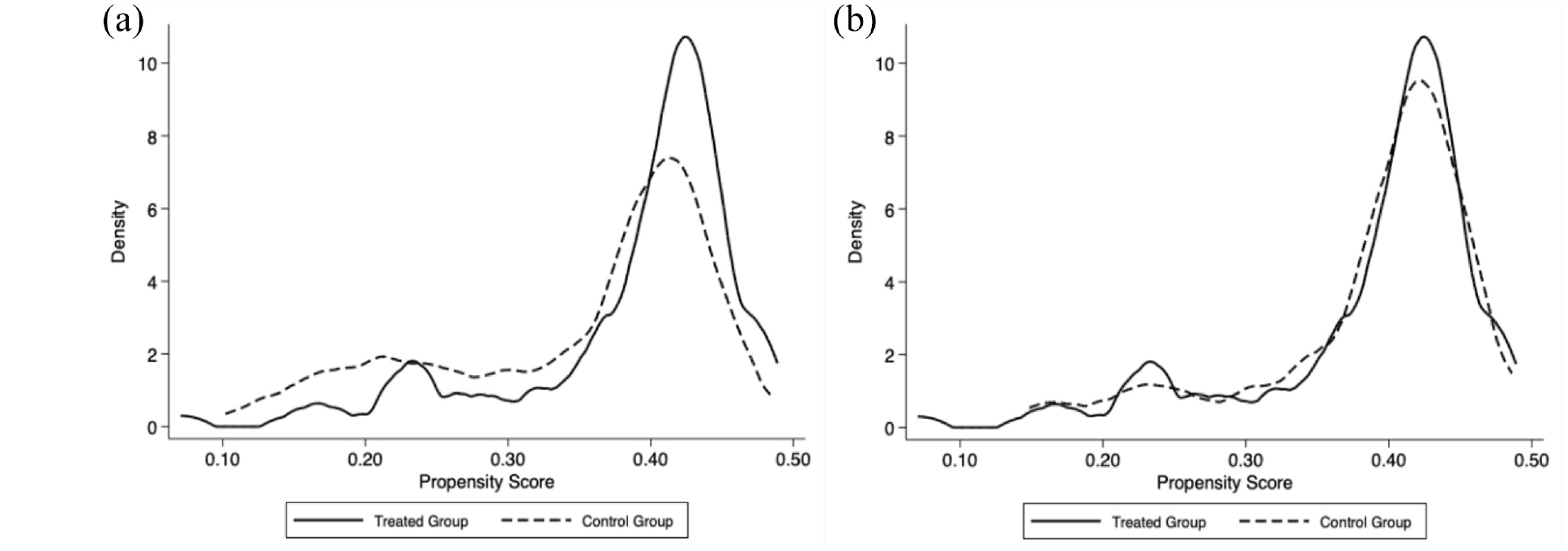
The kernel density of the treatment and control groups. (a) Before matching, and (b) After matching.
Further Analysis: Spillover Effect
The NCC campaign will not only affect enterprise production safety in selected cities but also may have a spillover effect. These selected cities have strengthened production safety regulations, which may cause some enterprises with higher rates of production safety accidents to move to neighboring cities. Hence this will increase production safety accidents and deaths in neighboring cities of the NCCs. Following Zheng and Li (2020), this paper takes the neighboring cities of the NCCs as the treatment group to explore the spillover effect of the NCC campaign. The specific model is set as follows:

Among them,
In Table 8, we present the results of the spillover effect. As evidenced in column (1), the NCC campaign exerts a positive impact on production safety accidents in neighboring cities. Simultaneously, as revealed in column (4), although the influence of the NCC campaign on production safety deaths is not statistically significant, the result remains positive. Taken together, these outcomes suggest that the NCC campaign may exert a negative spillover effect on the production safety of neighboring cities. This may be explained by the fact that some enterprises in high-risk industries choose to move to neighboring cities to avoid regulatory risks, rather than improving their production environment under supervision pressure.
Spillover Effect of the NCC Campaign.

Note. Robust standard errors are in parentheses. Controls represents the control variables. City FE and Year FE represent city fixed effect and year fixed effect, respectively.
and * represent significance at the 5% and 10% levels, respectively.
This paper also tests the spillover effect of the NCC campaign on inter- and intra-provincial neighboring cities. Columns (2), (3), (5) and (6) in Table 8 report the regression results. We can find that the spillover effect of the NCC campaign is mainly reflected in the inter-provincial neighboring cities, while the spillover effect is not significant in the intra-provincial neighboring cities. This may be related to the evaluation rules of the NCC campaign. After the central government issues a notice on carrying out the NCC campaign, cities first compete with the other cities in the same provinces to be recommended to the central government. Therefore, intra-provincial cities could compete with their neighboring cities, which may hinder the migration of enterprises with higher rates of production safety accidents (Pan et al., 2017). However, there is no competition between the inter-provincial neighboring cities. Hence some enterprises with higher rates of production safety accidents are more likely to move to neighboring provinces, thus worsening their production environments.
Conclusions and Discussions
Conclusions
How to accurately identify the governance effects of the NCC campaign is a highly debated topic in academic circles. This paper establishes a theoretical connection between the NCC campaign and enterprise production safety. And we believe that the NCC campaign will stimulate the production safety awareness of local governments and enterprises and further improve enterprise production safety. The empirical results show that the NCC campaign reduces production safety accidents and deaths and this effect is long term. However, the analysis of the spillover effect suggests that the NCC campaign worsens the production environments in neighboring areas. Heterogeneity analysis further shows that in non-old industrial base, low corruption and low economic growth target cities, the promotion effect of the NCC campaign on enterprise production safety is more significant. The increase in production safety input and the reinforcement of corporate social responsibility are the main influencing mechanisms.
Discussions
The NCC campaign is an important way for the central government to promote urban governance and improve urban quality through authoritative tools. On the one hand, the NCC campaign has strengthened government regulation on enterprises by establishing evaluative criteria, taking supervision actions and performing dynamic management of this honorary title. On the other hand, under the strong regulation of local governments, enterprises will improve their management concepts to meet the goals and requirements of constructing the NCC. Only when enterprises actively participate in urban governance can they achieve the goal of a joint gain of social and corporate interests. For a long time, local governments have dominated urban construction, and the role of other governance bodies, including enterprises, has not been effectively explored. Therefore, in the future, local governments should provide tax exemptions or other preferential policies to enterprises with good performance in production safety to enhance their social responsibilities and to better serve the goal of constructing the NCC.
In light of the tendency for local governments to confront trade-offs between competing goals, particularly those relating to economic growth targets (Chen & Jia, 2021), it is unsurprising that local governments will exhibit a propensity to channel financial resources towards infrastructure investments, which are perceived to be more conducive to immediate economic growth, as opposed to areas such as safety expenditures. Against this backdrop, we posit that the central government should adopt the NCC campaign as a potent policy instrument, while also imposing stringent selection criteria, controlling the number of the NCCs and fostering greater attention of local governments towards production safety. In cases where the old industrial base cities face financial constraints, it is imperative for the central government to reinforce its financial subsidies, to spur the construction of the NCCs. Moreover, we must not overlook the possibility of competition between neighboring cities in the same province, which may obstruct the migration of high-risk industrial enterprises and potentially exacerbate the local production environment. In contrast, neighboring cities in different provinces do not experience such competition, thereby increasing the likelihood of migration by high-risk enterprises to those locales and aggravating the local production environment. In light of these observations, we contend that the central government must account for the spatial layout of the NCCs and leverage the demonstrative and learning effects of award-winning cities, while minimizing their negative spillover effects on neighboring cities.
Supplemental Material
sj-docx-1-sgo-10.1177_21582440241255822 – Supplemental material for Competition for Safety: The National Civilized City Campaign and Enterprise Production Safety in China
Supplemental material, sj-docx-1-sgo-10.1177_21582440241255822 for Competition for Safety: The National Civilized City Campaign and Enterprise Production Safety in China by Huange Xu, Bo Chen and Guangchen Li in SAGE Open
Footnotes
Authors Contributions
Huange Xu: Conceptualization, Methodology, Software, and Writing; Bo Chen: Data curation, Original draft preparation, and Software; Guangchen Li: Reviewing and Editing.
Declaration of Conflicting Interests
The author(s) declared no potential conflicts of interest with respect to the research, authorship, and/or publication of this article.
Funding
The author(s) disclosed receipt of the following financial support for the research, authorship, and/or publication of this article: This study was supported by the Ministry of Education's Humanities and Social Sciences Youth Fund Project, China (22YJC630172).
Ethical Approval
Not applicable.
Consent to Participate
All authors agreed with the content and that all gave explicit consent to submit.
Consent to Publish
Not applicable.

Supplemental Material
Supplemental material for this article is available online.
Data Availability Statement
The data that support the findings of this study are available on request from the corresponding author.
Notes
References
Supplementary Material
Please find the following supplemental material available below.
For Open Access articles published under a Creative Commons License, all supplemental material carries the same license as the article it is associated with.
For non-Open Access articles published, all supplemental material carries a non-exclusive license, and permission requests for re-use of supplemental material or any part of supplemental material shall be sent directly to the copyright owner as specified in the copyright notice associated with the article.
