




Abstract
This study explores the impact of public safety emergencies on the preferences of women riders within Shanghai’s real-time crowdsourcing logistics platform. It employs quantitative research methods, utilizing LDA topic modeling and ERNIE categorization model for data analysis. The research identifies six key topics influencing riders’ preferences: Tip Order Information, Sharing and Volunteering, Epidemic Delivery Rules, Quality of Work and Life, Epidemic Control Measures, and Liability Exemption and Reward. The study reveals a cognitive bias among riders towards positive utilities, indicating a generally optimistic emotional state which influences their utility preferences. The findings suggest that the riders prioritize social interests and responsibilities during the pandemic, demonstrating adaptability to new work environments and appreciation for supportive measures by platforms. The study provides insights into the nuances of women riders’ preferences, emphasizing the need for targeted strategies by platforms and authorities to enhance job satisfaction and address challenges faced by women riders.
Plain Language Summary
This study explores the impact of public safety emergencies on the preferences of women riders within Shanghai’s real-time crowdsourcing logistics platform. It employs quantitative research methods, utilizing LDA topic modeling and ERNIE categorization model for data analysis.
Introduction
The gig economy introduces distinctive opportunities and challenges for women riders. Due to its low barriers to entry and high flexibility, gig work offers valuable employment opportunities for many women who need to balance family and childcare responsibilities, especially against the backdrop of persistent gender discrimination in the conventional job market (Heflin & Morrissey, 2022; Holmes, 2021). The statistical data shows that China’s instant retail market size reached 5,042.86 billion yuan in 2022, expected to triple by 2025, with the instant delivery market reaching a trillion yuan by 2026. 1 The growth in instant demand has directly propelled the rapid development of the instant crowdsourced logistics industry.
In the evolving landscape of real-time crowdsourced logistics, the role and preferences of women riders have emerged as a pivotal factor influencing operational efficiency and customer satisfaction (Johnston et al., 2023; Qin et al., 2023). Recent studies underscore the critical impact of aligning platform services with these preferences (Auad et al., 2023; Piasna & Drahokoupil, 2021). Industry experts stress that a deeper comprehension of these preferences is not only beneficial but essential for the sustained competitiveness of logistics platforms (C. Chen et al., 2022; Zhu et al., 2024). While existing studies may have delved into specific aspects of women riders’ preferences within logistics, the macro-level approach with a broader perspective is crucial as it allows for the identification of overarching patterns and trends that are not immediately visible in micro-level analyses (Brakewood et al., 2014). Furthermore, the emergence and growth of real-time crowdsourced logistics platforms have significantly transformed employment forms, introducing new paradigms of work and redefining job roles within the gig economy (Granger et al., 2022; Lin et al., 2022). This shift underscores the critical need to understand how these platforms influence the work life and preferences of those they employ, particularly women riders, whose roles and contributions are central to the operational success and adaptability of these platforms in a rapidly changing economic landscape (Chen et al., 2023).
However, the COVID-19 epidemic rebound (the public safety emergencies in this article refer specifically to the COVID-19 rebound) and subsequent lockdown measures in Shanghai, 2 a critical economic and trade center, have heightened the demand for real-time logistics, spotlighting the evolving needs of women riders on the platforms. The impact of the pandemic lockdown raises critical questions: Have the preferences of women riders in Shanghai changed in this context? What new changes have been made? How should platforms and government detect and meet the needs of Shanghai women riders promptly, so that they can continue to participate in the real-time logistics industry during harsh times and meet the production and living needs of the general residents? Addressing these questions is crucial, not only for Shanghai but also for other global cities, as it offers significant referential value in understanding and adapting to the dynamic interplay between pandemic-induced changes and the evolving demands of gig economy workers.
This research chooses for a quantitative research methodology, aiming for a more precise and objective identification of correlations and changes in women riders’ preferences at a macro level (An & Bauldry, 2023; Dolnicar et al., 2023). Based on the online comment data of Shanghai women riders, this article uses the LDA topic model to classify and automatically label the data, and through the depth of learning ERNIE model to construct a user-topic feature matrix. Using sentiment analysis based on BosonNLP and HowNet sentiment dictionary, the women riders’ sentiment preference is assigned; the sentiment score of the topic is obtained through matrix factorization, and the topic preference and sentiment preference of Shanghai women riders are ranked. The purpose of this article is to predict and compare women riders’ topic preferences, sentiment preferences and utility preferences through the overall feelings of Shanghai women riders on the platform, which will help the real-time crowdsourcing logistics platform and related departments to identify women riders’ needs quickly and accurately.
The organization of the remainder of this paper is as follows. We revisit the literature in Section “Literature Review,” and in Section “Research Frameworks and Models,” we delineate the research framework and model for women riders’ preference. A detailed specification of the research methodology in the Section “Methodology.” Section “Results Analysis” based on topic preference, sentiment preference and utility, analyzes the influential mechanism of the epidemic on the woman riders’ preference. Section “Conclusion” describes the theoretical implications, practical implications, limitations, and future prospects.
Literature Review
Real-Time Crowdsourced Logistics Platforms’ Challenges
Real-time crowdsourcing logistics platforms, a variant of the gig economy, connect time-sensitive customers with independent service providers (riders), through mobile applications and web-based platforms, offering customers on-demand delivery within 2 hr (Carbone et al., 2017). These platforms afford women riders flexible employment opportunities, enabling them to better manage their work schedules and tasks, thus harmonizing professional obligations with personal commitments (Piasna & Drahokoupil, 2021). This autonomy significantly contributes to the empowerment and independence of women delivery riders, shaping their career trajectories and enhancing their quality of life (Johnston et al., 2023). Despite these benefits, women riders encounter challenges in this predominantly male sector, including gender discrimination, unfair treatment, safety concerns, and health topics (Cook et al., 2021; Griffith et al., 2018; Hayes et al., 2021; Johnston et al., 2023; Lu et al., 2023).
The Research of Women Riders’ Preference
The preferences of women riders are pivotal for the operational efficiency and competitive edge of real-time crowdsourced logistics platforms (Wang & Xie, 2021). Research indicates that safety concerns profoundly influence women riders’ platform preferences, alongside a spectrum of socio-demographic, service-related, and contextual factors (Duman, 2023; Gerber, 2022; Johnston et al., 2023). Although studies have explored mechanisms for aligning preferences with task assignments (Kadadha et al., 2021), incorporating safety preferences into route planning (Shah & Cherry, 2021), and applying wage preferences to dynamic pricing strategies (Wang & Xie, 2021), comprehensive investigations into women riders’ preferences, especially from a quantitative empirical standpoint at the macro level, remain sparse. Current literature primarily comprises qualitative analyses focused on specific logistics segments, lacking in-depth exploration of preference rankings among women riders on these platforms.
Accordingly, there exists a pressing need for rigorous research into the nuanced preferences of women riders, aiming to fill the gap in quantitative empirical studies from a broader perspective and investigate the hierarchy of preferences within the realm of real-time crowdsourced logistics platforms.
The Impact of Epidemics on Gig Work
The COVID-19 pandemic has significantly impacted gig work, revealing complex effects on workers’ mental health, job security, and labor market outcomes. It has heightened the precarious nature of gig work, exacerbating mental stress related to autonomy, relationships, and self-acceptance, while increasing online gig work demand (Y. Li et al., 2022). The pandemic has reduced working hours across genders (Barrero et al., 2023), elevated occupational injury topics (Parteka et al., 2024), and altered working conditions (Fielbaum et al., 2023), leading to heightened emotional volatility and isolation for gig workers, especially women riders (Granger et al., 2022). It also spotlighted management challenges on gig platforms, such as women riders’ low adaptability and a lack of belonging. 3 Ultimately, COVID-19 has underscored the gig economy’s inherent insecurities and could drive substantial changes in work preferences and conditions for gig workers.
Mechanisms by Which Epidemics Affect Women Rider’s Preferences
In the context of public health emergencies, Information Processing Theory (IPT) offers a robust framework for understanding how individuals perceive, interpret, and react to information related to products and services (Valor et al., 2022). Applied to the cohort of women riders within real-time crowdsourcing logistics platforms, IPT reveals the underpinnings of their preference formation amid public health crises. IPT suggests that individuals employ both cognitive and affective systems in processing information: cognitive processing involves complex analysis and contemplation leading to rational responses, while affective processing elicits quick emotional reactions to emergencies (Lipsitz & Markowitz, 2013). Understanding how women riders navigate information processing in such critical times is pivotal for devising strategies to ensure public safety and maintain efficient platform operations. Furthermore, the application of Information Diffusion Theory has been extensively explored across fields such as social media, information science, and communication, to comprehend the dynamics of information spread within networks and its impact on emotional behaviors and user interactions (W. Li et al., 2023; Razaque et al., 2022). This theory elucidates how information diffusion influences the emotional scores of comment information within social networks (Zhao et al., 2024). Prospect Theory and its extension, Cumulative Prospect Theory (CPT), articulate how decision-making is influenced by the perception of gains and losses relative to a reference point, with loss aversion indicating a stronger sensitivity to losses over equivalent gains (Gao et al., 2023; Ghader et al., 2019; W. Zhou et al., 2021). The integration of these theories significantly contributes to the understanding of gig economy workers’ behavior, offering insights into how they process information, form collective opinions, and make decisions under topic and uncertainty (Chai et al., 2023; Geng et al., 2023).
In summary, women riders on real-time crowdsourcing logistics platforms encounter significant challenges, such as gender discrimination and unfair treatment. Their preferences are shaped by safety concerns, psychological factors and so forth. The COVID-19 pandemic has intensified these challenges by increasing online gig job demand and highlighting gig workers’ vulnerabilities. Current research predominantly addresses satisfaction and labor relations but lacks a targeted, quantitative analysis of women riders’ preferences, especially from a regional perspective. There is a critical need to explore how pandemic lockdowns influence these preferences.
Research Frameworks and Models
This study explores user preferences in sentiment analysis, topic modeling and CPT for real-time crowdsourced logistics platforms, focusing on women riders. It simplify the analysis framework by categorizing entities into features and topics, with sentiment polarity and intensity evaluated for each topic-opinion pair (Duan et al., 2022). The methodology, grounded in multi-attribute utility theory, assesses sentiment preferences and topic preferences through utility functions, incorporating Cumulative Prospect Theory (CPT) for a comprehensive utility evaluation of topic perceptions. The formal definition of the concept used is as follows:
(1). Entity: An entity
(2). Features: Entity attributes
(3). Topics: Topics describe platforms at a higher level than features. A topic contains several features which can be represented as
(4). Sentiment polarity: The sentiment polarity of a topic-opinion pair refers to the positive or negative opinion orientation implied by the pair.
(5). Sentiment intensity: The sentiment strength of a topic-opinion pair represents the quantitative strength of the opinion. The user
(6). User-topic preference:
(7). Topic preference: Given a topic

The method in this article is based on multi-attribute utility theory. According to the multi-attribute utility theory, a platform has multiple features, and the feature quality of different features is usually different. As revealed by the multi-attribute utility theory, the rider’s sentiment preference can be calculated through the utility function as

(8). Utility preferences: Emotional preference, as an emotional utility, and topic preference, as a probability weight, can be utilized in the Cumulative Prospect Theory to calculate the topic perception utility of women riders as a utility value of utility preference. This serves as a comprehensive indicator to measure the perceived utility of preferences among women riders on real-time crowdsourcing logistics platforms during the pandemic. This aspect will be further discussed in Section “Calculating the Utility Value of Utility Preferences.”
This study evaluates women riders’ sentiment preferences through a multi-attribute utility function, ranking topics by utility. Unlike L. Chen and Wang (2013), which focused on deriving user preferences from online reviews for user similarity, our approach classifies topics from reviews to understand women riders’ feature preferences (L. Chen & Wang, 2013). The research predict topic preferences using sentiment scores from the BosonNLP and HowNet dictionaries, leading to a review-based matrix factorization that addresses review sparsity. The methodology, depicted in Figure 1, progresses in three stages: topic classification via reviews, sentiment scoring and matrix factorization, and calculating topic, sentiment and utility preferences. This method provides a nuanced view of women riders’ preferences on logistics platforms.
Stage 1: Topic classification. The platform subject words and feature words are obtained from online reviews through the LDA topic model, and tags are automatically marked; then the user-topic matrix is constructed based on the deep learning ERNIE classification model. This article uses this matrix to predict topic preferences in the user-topic matrix.
Stage 2: Sentiment Scoring and Matrix factorization. With the help of BosonNLP sentiment dictionary and HowNet sentiment dictionary, the user’s overall rating vector for the platform is calculated according to the user’s opinion.
Stage 3: Matrix factorization is performed by predicting the user-topic preference matrix in the first stage and the overall rating vector in the second stage. Then calculating the utility value of utility preferences based on Cumulative Prospect Theory.

Research framework
Methodology
To clarify the impact of public safety emergencies on women riders’ preferences within the Shanghai real-time crowdsourcing logistics platform, this study separately calculates the preferences of women riders from cognitive, emotional, and a comprehensive utility perspective that integrates both cognition, emotion and topic perception.
Data Collection
ELEME and Meituan are the first group of food delivery service platforms going into the public’s horizon (Zheng et al., 2022), accounting for ninety percent of the market share. Their real time crowdsourcing logistics platforms, Hummingbird crowdsourcing and Meituan crowdsourcing have covered most cities and regions throughout China. Besides, these platforms have communication channels with preferable interactive performance. As both the viewers and users, women riders generated a bulk of text data and image content, including women riders’ preferences, delivery issues and service evaluation, etc. The data and information are authentic and abundant. Thereinto, comments and ratings are real-time and can generate new insights, making it easy to dig information about women riders’ experience and satisfaction.
Statistics of this paper are mainly from free chats, discussions and comments made by Shanghai women riders on various social platforms such as Meituan crowdsourcing app, rider community of Hummingbird App, Baidu Tieba (Chinese Twitter or Reddit) and QQ group (Chinese Skype or snapchat) from March 20, 2022 to April 30, 2022 (in the period of the COVID-19 rebound). Diversity of data sources aims to ensure the overall objectivity of data. Members of the research group joined four Shanghai rider QQ groups, involving Shanghai Jiading Communication Group, Shanghai Rider Communication Group, Shanghai Delivery Worker Work Group, and Delivery Worker Communication Group, with 200, 355, 528, and 1,423 users respectively. The above groups can be searched from QQ social media. The purpose of the group was to share their experience in executing orders. Baidu Post Bar contains relevant data of Shanghai Rider Bar, Shanghai Knight Bar, Shanghai Meituan Bar and Shanghai ELEME Bar.
There are a total of 3,290 pieces of data for rider community comments on Baidu Post Bar, Meituan crowdsourcing and Hummingbird crowdsourcing platforms. The data format includes comment time, the number of comments and the number of likes, as shown in Table 1. It can be concluded from Table 2 that 3,290 pieces of data correspond to 7,582 likes. Contents with high number of likes indicate that such user-generated contents are highly representative.
Data Format of Rider Community Comments on Baidu Post Bar, Meituan Crowdsourcing and Hummingbird Crowdsourcing Platforms.

Data Statistics of Women Riders’ Comments.

Ethical Considerations
In this study on Shanghai women riders using social platforms like Meituan and Hummingbird App, we adhered to strict ethical guidelines. We collected public comments using Python tools, ensuring anonymity by removing identifiable information and respecting privacy. Our research used public domain data to enhance public knowledge, maintaining legal and ethical standards throughout the process. Data were securely stored, accessible only to the research team, to uphold confidentiality. These measures guaranteed our research was conducted responsibly, safeguarding individual rights and contributing to academic insights.
Data Preprocessing
The preprocessing of women riders’ comments involved cleaning to enhance data analysis credibility by: (1) consolidating duplicate comments, removing non-textual elements, (2) using Jieba for Chinese text segmentation and stop word removal with the Harbin Institute of Technology’s Stop Words Table, and filtering out irrelevant or meaningless words, (3) creating a manual exclusion list for refining topic relevance, and (4) discarding comments not pertinent to women riders. This process resulted in a refined dataset of 3,520 comments.
Topic Model
To analyze the content of the comments, we applied Latent Dirichlet Allocation (LDA) topic modeling. This statistical model allowed us to discover the hidden thematic structure within the dataset (Blei et al., 2003). We trained the LDA model on our dataset, determining the optimal number of topics through iterative testing and evaluation. The model then categorized comments into these topics, which represented the key areas of interest and concern for the women riders.
Feature Word Extraction
Calculate word frequency after segmentation of women riders’ comments, filter words irrelevant to the topic, screen high-frequency words that could represent the topic of each comment (Nie et al 2020), and then provide a corpus for the topic division of LDA model. Part of high-frequency words are shown in Table 3, and a wordcloud map (Figure 2) has been made by using wordcloud package of Python.
Some High Frequency Words of the Women Riders’ Comments.


Wordcloud map of women riders’ comments data.
LDA Topic Model
LDA assumes that each document can be expressed as a probability distribution of potential topics, and that the topic distributions in all documents share a common Dirichlet prior. The establishment process of LDA model is shown in Figure 3. Each potential topic in the LDA model is also represented as the probability distribution of words, and the word distributions of topics likewise share a common Dirichlet prior (Blei et al., 2003). Based on the following assumptions: (1) There are
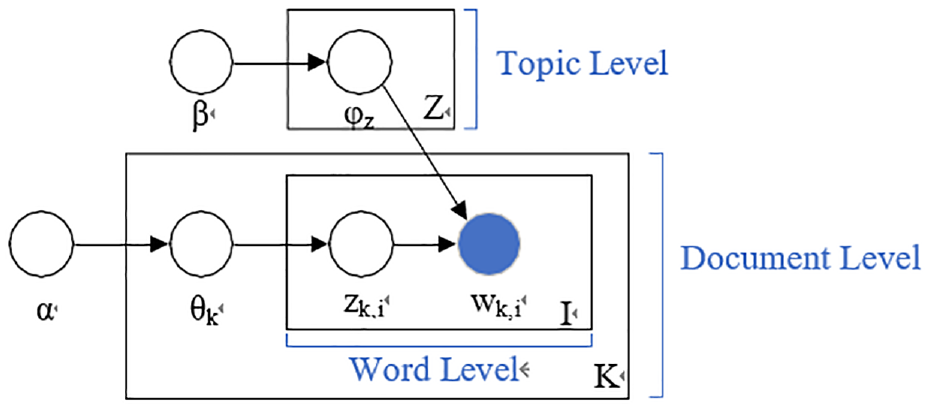
The establishment process of LDA.
Description of Model Symbol.

Selection of the Optimal Number of Topics and Autofill Transition
By using LDA model selection to determine the optimal number of topics is the most challenging task, as it will ultimately affect the annotation and results of the supervised classifier. Therefore, choosing the best LDA model and the optimum number of topics in the model can be a time-consuming task. Finding exact figure for topics suitable for better LDA models has been a major focus of previous studies (Wahid et al., 2022).
This paper uses perplexity and topic coherence as measures to determine the optimal number of topics, and these two benchmarks are widely used to evaluate the generalization performance and topic modeling competence of language models. Coherence indicators score individual topics by measuring semantic similarity among higher-scoring words in topics, which is conducive to distinguish semantically understandable topics from topics which are components of statistical inference (Greene et al., 2014). Perplexity is a level which is used to measure the model and predict samples, and topic coherence is measured as normalized logarithmic likelihood function values which is used to maintain the test set. Lower perplexity scores and higher coherence scores mean that LDA models have better generalization capacity.
(1) Perplexity analysis. Measuring sentence uncertainty to assess model complexity, indicates that lower perplexity signifies better generalization (Y. Zhang et al., 2022). Utilizing Python’s sklearn for topic modeling on women riders’ user-generated content and employing Gibbs sampling with 200 iterations, this study identifies an optimal topic count through perplexity variation. Results show a significant decrease in perplexity when topics increase from 5 to 6, and when the number of topics changes from 6 to 7, the degree of perplexity increases dramatically. Which suggests six as the most suitable number of topics for effective clustering, as evidenced by a local optimum in perplexity trends. Variation Trend of Model Perplexity is shown in Figure 4.
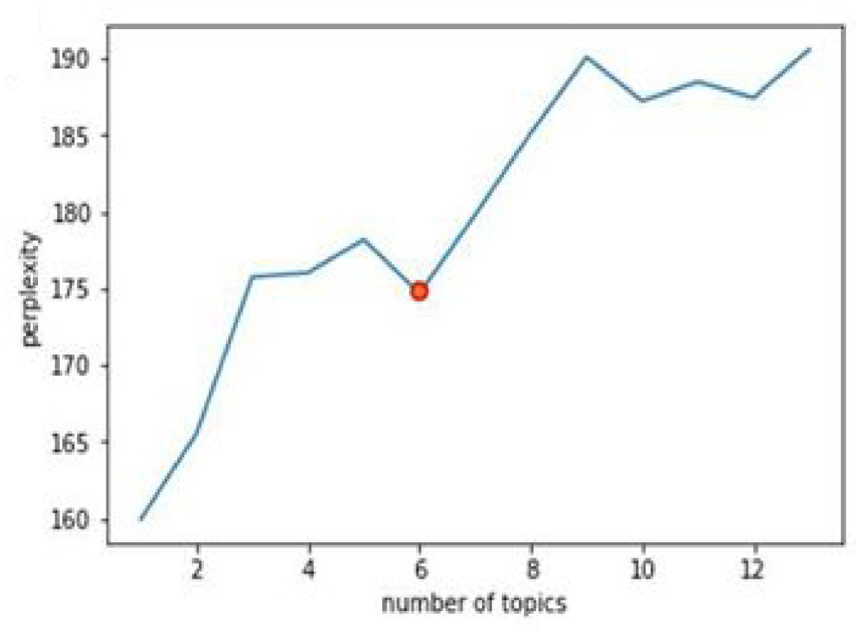
Variation trend of model perplexity.
(2) Thematic coherence analysis, using the UMass metric to measure semantic similarity between top-scoring words within a topic, Number (1) has been added in perplexity analysis. suggests that topics are more coherent when they support each other contextually (Liu et al., 2020). Given the brevity and variability of social media data, a smaller LDA model topic count often yields higher coherence. Analysis reveals a local optimum at six topics, where coherence scores peak and then decline as topic count moves from 5 to 6 and then from 6 to 7. This pattern indicates that setting the number of topics to six optimizes both perplexity and coherence for analyzing women riders’ discussions on real-time crowdsourcing logistics platforms. Variation trend of model topic coherence is shown in Figure 5.

Variation trend of model topic coherence.
To sum up, when the number of topics is 6, there is a lower degree of perplexity and a higher degree of coherence. Therefore, it is more reasonable to set 6 as the preferred topic of women riders on the real time crowdsourcing logistics platforms.
(3) After finding the optimal number of topics, this paper will extract the dominant topic from LDA model topics to tag each comment.
In addition, keyword information in topics extracted from the dataset is correlated, and keywords shown in Table 5 indicate that each topic contains specific information in various aspects.
Results of LDA Topic Model Categorization.

Topic 1: “Tip Order Information” refers to customers providing additional monetary tips to riders through platforms like WeChat. These tips are often incentives for riders to prioritize and expedite the delivery of essential items like eggs, vegetables, and other daily necessities. Sometimes, tips are also given for non-essential items like cigarettes. These tips play a crucial role in motivating riders and can significantly affect their income and job satisfaction, particularly during challenging periods like the COVID-19 pandemic. This dynamic showcases the critical role of customer-rider interaction in shaping the gig economy and the importance of understanding women riders’ preferences and motivations.
Topic 2: “Epidemic Delivery Rules” refer to the changes in delivery rules implemented by the platform during the pandemic. This encompasses modifications in delivery timings, addresses, contact methods, and operational shifts in the platform’s service model. These adjustments were made in response to the evolving situation and the need for efficient, safe delivery services amidst the public health crisis. The goal was to adapt to the new circumstances while ensuring the safety of riders and customers, and maintaining the continuity of essential services.
Topic 3: “Epidemic Control Measures” refer to the government’s pandemic prevention policies that require women riders to fill out application forms at local community committees. These measures include obtaining health certificates and travel permits, ensuring no positive infection status, maintaining a safe record, holding a green health code, and adhering to mandatory reporting and isolation protocols in case of infection. These control measures are critical for ensuring public safety and preventing the spread of the virus while allowing essential services like delivery to continue under regulated conditions.
Topic 4: “Quality of Work and Life” reflects the living conditions of riders during the city lockdown, highlighting their inability to return home and the necessity to temporarily reside outside. This includes staying in tents or under bridges, relying on instant foods like noodles due to unavailability of other options, and facing difficulties in finding accommodation in hotels. The riders also face challenges with daily necessities, eating, sleeping, and charging batteries for their electric vehicles, indicating a significant impact on their quality of life and work during the lockdown period.
Topic 5: “Liability Exemption and Reward” refers to the policies enacted by platforms during the pandemic to mitigate financial penalties for riders. Liability exemption implies that riders can appeal and potentially reclaim fines for order delays that are not their fault. Rewards include various incentives like free activities, additional meals, or extra money. These measures are designed to reduce the financial burden on riders during challenging times and motivate them to continue providing delivery services amidst the pandemic.
Topic 6: “Sharing and Volunteering” highlights the collaborative and supportive culture among riders on the platform. It encompasses riders responding to each other online, offering help and care, and contributing collectively during challenging times. This theme also reflects riders seeking advice from leaders, sharing valuable information, recommending efficient routes, and learning from each other. The emphasis is on a community spirit where riders share experiences, communicate effectively, and work together, demonstrating a strong sense of teamwork and mutual support.
The categorization was obtained by strict reasoning through LDA topic model method. Compared with the actual situation, analyses suggest that “epidemic distribution rules” and “disclaimers and rewards” are consistent with distribution rules of Meituan crowdsourcing platform. It is understandable that “epidemic control measures” are the government’s requirements for quarantine. “Quality of work and life” is in line with the research of Kara et al. (2018). “Sharing and volunteering” conforms to the study of Dedeoğlu et al. (2020).
ERNIE Categorization Model
We utilized the ERNIE model (A variant of the BERT model tailored for processing Chinese text, enhancing its applicability and effectiveness in understanding the Chinese language’s nuances) for dual purposes. Firstly, it performs topics analysis extracted by LDA on the comments. This approach enabled us to further understand the six topics embedded in the comments. ERNIE’s deep learning capabilities were particularly effective in deciphering the nuances of topics in the context of natural language usage. Secondly, the ERNIE model served as a verification tool for the LDA results.
In this study, LDA and ERNIE vectors are combined to improve topic recognition and clustering. In order to achieve the ideal categorization performance, it is necessary to label the dataset and embed context with suitable categorization models in the dataset. To this end, this paper firstly applies the automatic tagging technique through LDA topic distribution, and then develops a new sorting algorithm to sort these topics so as to extract main topics. In this section, this paper introduces the detailed implementation of ERNIE.
Data Preprocessing
(1) Data acquisition. The result data automatically marked by LDA is divided into two columns (content and label), as shown in the table.
(2) Data cleaning. This paper sets a threshold value of 32 to adjust the rider comment text whose text length in Chinese is longer than 32 without changing the original meaning.
(3) Dataset division. Randomly select 90% of the total samples as the training set and the remaining 10% as the test set. Additionally, select 10% samples in the training set randomly as the verification set. The amount of experimental data sets of various types after processing is shown in Table 6.
Experimental Data Set Volume Statistics for Each Category After Processing.

ERNIE Model
The ERNIE model implementation involves a two-step process: pre-training and fine-tuning. In pre-training, it simultaneously performs two unsupervised tasks: Masked Language Model (MLM), where 15% of input words are obscured to predict based on context, promoting deep bidirectional feature representation; and next sentence prediction, understanding sentence relationships. Utilizing an 18,000-word corpus, the model’s pre-trained versions are made public. Studies on BERT and ERNIE highlight the use of the Softmax function to derive a user-topic preference matrix from vector representations (Cong et al., 2023; Saheb et al., 2022; Tan et al., 2021). Part of the calculation results of user preference matrix are as follows:

In the formula above,
Therefore, topic preference ranking is:

It can be seen from the above that women riders are most concerned about reward order information, which agrees with the findings of Y. Zhang et al. (2022). According to statistics, each rider is assigned about 100 orders every day, but 45 orders a day is the physiological limit of normal people, so women riders tend to choose orders with high reward amount to boost their profits. Reward order information directly affects women riders’ expected earnings (Y. Zhang et al., 2022). Therefore, “tip order information” is the topic that women riders most focus on.
Performance Evaluation Measures
This paper validates its framework through a classification of women riders’ comments into six categories, employing accuracy, precision, recall, and F-measure for evaluation. A 6 × 6 Confusion Matrix, illustrating classifier outcomes with True Positives (TP), False Positives (FP), True Negatives (TN), and False Negatives (FN), visualizes actual versus predicted comment classifications, facilitating a deeper analysis of classification effectiveness (Bian et al., 2022; Xiao et al., 2022), as shown in Table 7.
The Meaning of Confusion Matrix.

This paper needs to calculate four indicators separately for analysis: Accuracy (Acc), Precision (P), Recall (R) and F1-score. The calculation process is shown in formulas (5) to (8) respectively:




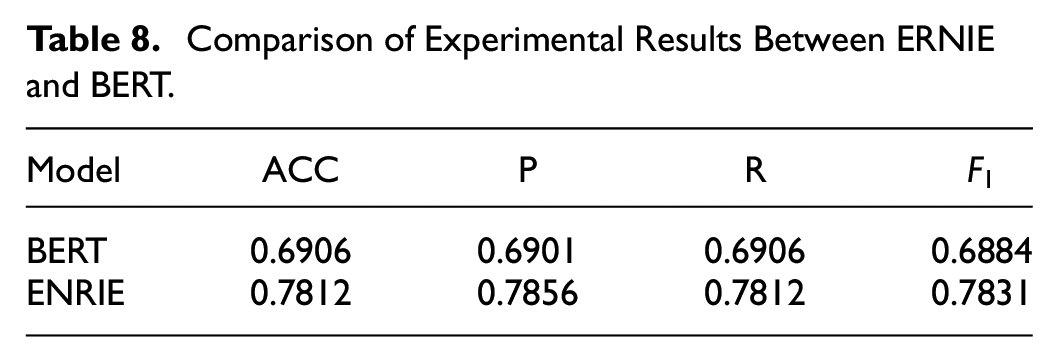
As can be seen from Table 8, ERNIE model has better performance than BERT in all four indicators and has improved to varying degrees compared with the current mainstream deep learning models. This suggests that the model proposed in this paper can deal with similarities and differences between women riders’ comments and topics in nominal metaphors more effectively and can establish the mapping relations between women riders’ comments and topics. What’s more, the little difference between P and R can prove that ERNIE model has a good, structured prediction for data and a good correlation with data. On the other hand, this paper firstly uses LDA classification to fill labels, and then adopts deep learning ERNIE to categorize, with a high precision of 78.12%. The experimental results of ERNIE verified the validity of LDA classification results indirectly and increased the credibility of the six categories of topic preferences of women riders’ comments.
Comparison of Experimental Results Between ERNIE and BERT.
Sentiment Analysis
To enrich our sentiment analysis, we integrated BosonNLP and HowNet. These tools offered deeper insights into the cultural and contextual nuances present in the comments.
The Boson NLP Sentiment Dictionary, developed from a vast array of online sources including tweets and news comments, is rich in Internet slang and informal expressions, offering extensive coverage of non-standard texts (Liu et al., 2020). This makes it well-suited for the emotion analysis in this study, which involves classifying user-generated content into negative or positive sentiment categories, with the assistance of the CNKI Emotion Dictionary for intensity adverbs. Sentiment scores are assigned to each comment, helping delineate the sentiment landscape among women riders towards the platform. Sentiments are categorized as positive (score > 0), negative (score < 0), or neutral (score = 0), with our analysis identifying 1,160 positive, 1,712 negative, and eight neutral comments. This sentiment distribution, primarily spanning [−5, 5], underscores the data’s reliability. Scatter Diagram of Riders comments sentiment Value Distribution is shown in Figure 6.

Scatter diagram of riders’ comments sentiment value distribution.
From Table 9, the proportion of positive evaluations is relatively high, approximately around 40% in all topics. This indicates that despite the presence of negative feedback, a considerable portion of responses are positive. Compared to positive evaluations, the proportion of negative evaluations is slightly higher, ranging between approximately 59% and 60%. The proportion of extreme positive evaluations (+5) is relatively low, with minimal variation across different topics. Similarly, the proportion of extreme negative evaluations (−5) is also low in all topics, with “Tip Order Information” having the highest ratio at about 2.24%. These data suggest that although the majority of topics received a greater number of negative evaluations, there is also a significant number of positive responses, reflecting the complex emotional reactions of women riders to these issues. Particularly, the “Tip Order Information” stands out in terms of extreme negative evaluations, possibly indicating that this subject has elicited a strong negative response among the women riders.
Distribution of Sentiment Scores for Six Topics.

Note. A score of 5 represents comments exceeding a rating of 4, “4” ∈ (3, 4], “3” ∈ (2, 3], “2” ∈ (1, 2], “1” ∈ (0, 1], while a score of 0 indicates a neutral rating of exactly 0. “−1” ∈ [−1,0), “−2” ∈ [−2, −1), “−3” ∈ [−3, −2), “−4” ∈ −4, −3), and a score of −5 is designated for comments rated below −4.
According to the research of Liu et al. (2020), the specific steps of emotion analysis are as follows: (1) Preparing data with an emotion dictionary from BosonNLP, a negative word list to invert sentiment direction, a degree adverb dictionary from CNKI to indicate emotion intensity, and a stop words list from the Chinese Academy of Sciences to filter non-sentimental words. (2) Preprocessing data by segmenting with Jieba and removing stop words. (3) Building an emotion analysis model to classify and position words as emotion, negative, or degree adverbs. (4) Conducting contextual analysis to assess the sentiment impact of surrounding text. (5) Handling idiomatic expressions to accurately interpret sentiments. (6) Calculating sentiment scores by identifying sentiment phrases, adjusting for degree adverbs and negations, and summing sentiment phrase scores. This process helps in understanding the nuanced sentiments of women riders towards the platform, as demonstrated in the results. The sentiment value is the sum of the scores of all the sentiment phrases, and the calculation formula (9) is

Thereinto, u is the u rider, k is the k comment, n indicating the number of negative adverbs. Affective analysis score calculation process, the display is shown in Table 10.
Calculation Results of Sentiment Analysis Scores.

The sentiment score calculation section is as follows:

Matrix Decomposition
In this study, we utilized matrix decomposition to address the issue of sparsity and to reveal the underlying characteristics of interactions between users and items. This methodological choice was inspired by the work of Duan et al. (2022), who successfully applied matrix decomposition to explore the mechanisms behind user behavior.
In our application, the fundamental concept of matrix decomposition involved breaking down the emotional evaluations of women riders towards the platform into sentiment scores for different topics. This was achieved by treating the topic score vector as the inner product of the user-topic matrix vector and the emotion vector. Herein, the user-topic factor represents the riders’ preferences for specific topics, while the emotion score indicates their perception of the platform.
The multiplication of the user-topic matrix with the emotion vector enabled us to obtain an overall assessment of the topics by the users. Specifically, this was expressed through the following formula (11):


Calculating the Utility Value of Utility Preferences
The study applied Cumulative Prospect Theory (CPT) to assess the utility preferences of women riders on real-time logistics platforms, focusing on their perceptions. Utilizing the CPT framework with piecewise power value functions for gains and losses, and incorporating parameters for curvature and loss aversion (Gao et al., 2023), we analyzed how these riders evaluate preferences related gains and losses.

This function incorporates curvature σ, consistent for both gains and losses, and a parameter λ representing loss aversion.
The research also used a widely accepted weighting function, following Tversky and Kahneman (1992), to interpret probability perceptions, particularly examining the parameter γ for understanding biases in low-probability event reactions. This approach allowed us to calculate expected values of utility preferences for different topics, thereby gaining insights into the utility preference structures and decision-making processes of women riders under uncertainty (Freudenreich & Musshoff, 2022; Tversky & Kahneman, 1992).

The study particularly focused on the parameter γ, which ranges between 0 and 1, to adjust the perception of probability in scenarios of objective probabilities. A γ value of 1 indicates an alignment with actual probability, suggesting an absence of subjective bias. Conversely, a γ value less than 1 indicates a propensity for overreacting to low-probability events, a critical aspect in understanding topic perception behaviors.
Following the functional representation of CPT by Tversky and Kahneman (1992). The expected value of a prospect

=−63.437 + 19.548 + 29.770 + 11.584 + 22.723 + 4.374
= 24.563
Results Analysis
This paper focuses on the differences in topic preference and sentiment preference among women riders of Shanghai real-time crowdsourcing logistics platform. According to the results of Section “Methodology,” the ranking of topic preferences and sentiment preferences is inconsistent, whereas the ranking of utility preferences aligns with that of emotional preferences, as detailed in Table 11.
Topic, Sentiment, and Utility Preference Rank of Women Riders.

Note. The rankings from 1 to 6 represent the order of preferences, with the values in parentheses indicating the specific numerical representations of each preference.
It can be found that the According to Information Processing Theory, when women riders browse online reviews, the cognitive and emotional systems operate independently. When more energy is devoted to the cognitive system for thinking and understanding, the processing capacity of the emotional system is lower. This implies that when riders have a ranking higher emotional preference might correlate with a lower topic preference (Kowalczuk & Czubenko, 2022), such as Epidemic Delivery Rules and Epidemic Control Measures. Meanwhile, Influenced by Information Diffusion Theory, the emotional scores of the two topics are prone to change, which have reached more than 200. It means that the Shanghai women riders affirmed the platform to relax the distribution rules in a timely manner and flexibly adapt to the management measures required by the epidemic. It also reflects the relatively objective evaluation of Shanghai women riders as front-line personnel on the epidemic prevention and control measures of Shanghai governments at all levels.
Cumulative Prospect Theory effectively integrates previously distinct topic preferences and emotional preferences, resulting in a comprehensive utility evaluation metric. Through the lens of Cumulative Prospect Theory (Ghader et al., 2019), it is observed that the ranking of utility preferences of women riders aligns with their emotional preference ranking. However, the overall utility is 24.563 > 0. The positive overall utility indicates that, generally, women riders maintain a relatively optimistic attitude towards their current working environment and the adjustments made in response to the pandemic. This may reflect that despite certain challenges, such as those related to “Tip Order Information,” they are broadly capable of adapting to this new working context. The following table is an analysis of each topic. In our subsequent analysis of women riders’ sentiment, topic and utility preferences, combined with their utility values, we aim to comprehensively understand their attitudes and challenges under pandemic control measures.
Tip Order Information
“Tip Order Information” among Shanghai’s women riders’ comments illustrates the complex interplay between customer incentives and women riders’ motivation, particularly during the COVID-19 pandemic. Customers and merchants often provide monetary tips through platforms like WeChat for both essential and non-essential items, significantly influencing rider income and job satisfaction (see Section “Selection of the Optimal Number of Topics and Autofill Transition”). However, the sentiment analysis reveals a disconnect, with a negative sentiment preference (−144.775) and a low utility value (−10.059), despite a high topic preference (0.368). This discrepancy highlights the emotional over cognitive influences in decision-making, where riders’ negative reactions stem from uncertainties, perceived unfairness, or lack of transparency in tipping practices (Kowalczuk & Czubenko, 2022).
The dynamics of tipping, including customer-provided incentives for priority delivery, not only motivate women riders but also underscore the critical role of customer-rider interactions (see Section “Selection of the Optimal Number of Topics and Autofill Transition”). Yet, challenges such as overcharging incidents 4 and delivery conflicts have exacerbated negative sentiments. This negative sentiment, potentially stemming from uncertainties, lack of transparency and perceived unfairness in tipping practices. Which underscores the need for platform and governmental interventions to ensure fairness and transparency in the tipping process. These interventions are vital for addressing women riders’ emotional concerns, enhancing job satisfaction, and fostering a more harmonious delivery ecosystem.
Moreover, understanding “Tip Order Information” aids riders in navigating the demand distribution such as customer location, with preferences for order attributes (as shown in Figure 7), allowing for strategic choices to improve efficiency and income. The pandemic has heightened the importance of these choices, with riders adapting to changing conditions, such as selecting orders based on proximity or delivery volume. This adaptability, coupled with platform adjustments to delivery rules and support measures, reflects a broader theme of resilience and community support within the gig economy.

Setting diagram of rider receiving order attribute.
Sharing and Volunteering
The sentiment preference for “sharing and volunteering” among Shanghai women riders ranks third at 158.184, with a topic preference of 0.15, placing second. “Sharing” refers to the sharing of experience and information within the rider group (Su et al., 2021), and the word frequently appears is “reply,”“Ask,”“Lead,”“Learn,”“Share,” etc. Due to different community control measures, types of goods to be delivered and delivery routes, there is a large uncertainty in each delivery, which reflects that in the era of social media, Shanghai women riders have a strong motivation to share and learn to help others reduce topics and improve delivery efficiency. This finding of willingness to share experiences that may influence others is consistent with the study of Dedeoğlu et al. (2020), illustrating a strong motivation to enhance efficiency through collective knowledge (Cheng et al., 2019).
“Volunteering” encompasses the riders’ willingness to offer unsolicited help to consumers (Deng, 2021), with keywords including “help,”“contribute,”“volunteer,” and “deserve.” During the COVID-19 outbreak, these riders have demonstrated a commitment to assisting consumers, a behavior that transcends the platform’s reward system and aligns with the concept of “employee citizenship behavior” as discussed by Bartel et al. (2012). Despite facing challenges like regional distribution restrictions, these women spontaneously organize collaborative deliveries, ensuring consumers receive necessary materials. This self-initiated behavior, not formally acknowledged by the platform’s reward mechanisms, reflects their professional pride and desire for social recognition, especially during the pandemic. With a positive utility value of 1.477 for “Sharing and Volunteering,” it is evident that such activities are perceived beneficially. This aligns with sociological and psychological perspectives, underscoring the value of social support and community participation. It illustrates how individuals derive satisfaction and positive utility from altruistic behaviors.
In summary, “Sharing and Volunteering” not only signifies the importance of communication among women riders and their interaction with consumers, but it also reflects their dedication to serving the community amidst the challenges of the pandemic (Bueno et al., 2024). This commitment, coupled with the positive utility value, highlights the intrinsic value and positive impact of sharing and volunteering behaviors in enhancing community support and individual fulfillment.
Epidemic Delivery Rules
“Epidemic Delivery Rules” reflecting the platform’s adaptive measures during the pandemic, reveal a significant positive reception from women riders, with a sentiment preference score of 270.329 and a utility value of 1.712, ranking first. This high approval indicates women riders’ strong positive response to pandemic-induced modifications, including changes in delivery timings, addresses, contact methods, and the overall service mode (see Section “Selection of the Optimal Number of Topics and Autofill Transition”). Despite being the third in topic preference (0.135), the theme underscores its critical role in riders’ operations amidst the public health crisis. Challenges highlighted by terms such as “delivery,”“isolation,” and “lockdown” point to the hurdles women riders faced, from closed stores to restricted community access, and the inability to complete cross-regional orders.
In response, platforms like Meituan implemented flexible delivery rules and enhanced safety measures, such as contactless deliveries and providing essential epidemic prevention supplies, to alleviate these challenges. 5 Meituan crowd sourcing delivery previous rules as indicated in Figure 8. This indirectly demonstrates the heightened sense of corporate social responsibility within the Meituan platform. An enhanced sense of corporate social responsibility contributes to increased organizational support behavior, allow employees to feel powerful in terms of authority and responsibility will create a sense of empowerment and consequently leads to enhanced career satisfaction among employees (Aziz et al., 2024). In summary, the high sentiment preference and positive utility demonstrated by women riders towards “Epidemic Delivery Rules” reflect their adaptability to changes in delivery regulations during the pandemic and their appreciation of the support measures provided by platforms. It also showcases their resilience in facing challenges and the societal support for their work during this period. (As is shown in Figure 8).
In summary, the high sentiment preference and positive utility demonstrated by women riders towards “Epidemic Delivery Rules” reflect their adaptability to changes in delivery regulations during the pandemic and their appreciation of the support measures provided by platforms. It also showcases their resilience in facing challenges and the societal support for their work during this period (As is shown in Figure 8).

Meituan crowdsourcing delivery rules.
Quality of Work and Life
“Quality of Work and Life” ranked fourth with an sentiment preference of 93.640, and fourth with a topic preference of 0.132. The positive utility value of 1.144. The only consistent sort. Which emphasize the importance of favorable working conditions for individual well-being, aligning with management and economic studies that highlight the crucial role of enhancing job satisfaction and life quality in boosting productivity and employee loyalty. “Quality of Work and Life” involves all aspects of food, clothing, housing and transportation. According to Maslow’s hierarchy of needs theory (Allen et al., 2019). During special periods, women riders participating in delivery work in Shanghai cannot go home due to the requirements of epidemic control in the community, and basic life demand need to be met. Frequent under the subject keywords “Bridge Cave,”“life,”“hotel” and “tent,” etc. they can only live outside such as bridges, tents etc., and facing issues like electric vehicle charging. The intervention of working and living quality may increase the perception of organizational support (Joshi et al., 2023) of employees (women riders), and thus the sentiment preference and sense of belonging of women riders. The ranking of women riders’ topic preference and sentiment preference for “quality of work and life” is lower, indicating that in the special period of the epidemic, Shanghai women riders pay more attention to the normal operation of society rather than the quality of life and work environment. It further reflects the social responsibility of Shanghai women riders, and also illustrates the inadequate platform management and government policy loopholes. Incorporating these insights, it is evident that “Quality of Work and Life” not only reflects the challenges faced by women riders in their professional and personal lives during the pandemic but also their commitment to societal well-being, suggesting a need for more comprehensive support and policy measures to address their multifaceted needs.
Epidemic Control Measures
The sentiment preference of “epidemic control measures” among women riders’ comments is 210.287, ranking second. This positive utility score of 1.485 demonstrates their favorable attitude towards pandemic control measures, likely reflecting a high regard for safety and health, as well as support for effective public health interventions. Despite ranking fifth in topic preference (0.122), this theme still occupies an important position in their professional realm. The words that appear the most are “application,”“pass check,”“epidemic prevention,”“measures,”“Shanghai QR code,”“work permit,”“neighborhood committee,”“infection” and so on. The “epidemic control measures” stem from the Shanghai government’s stringent prevention and control mandates. These policies encompass comprehensive trip control strategies and meticulous traffic control spot checks, integral to Shanghai’s approach in managing the epidemic’s spread. These regulations, while necessary for public health, have inadvertently created hurdles for women riders. The need for official documentation like “pass checks” and “work permits” has become a bottleneck, preventing some from fulfilling their delivery duties. Additionally, traffic control measures, particularly the restriction on vehicle numbers, have compounded these difficulties, restricting the ability of many women riders to operate effectively. This situation underscores the complex balance between enforcing necessary public health measures and maintaining the functionality of essential services, especially in a densely populated metropolis like Shanghai. Despite numerous challenges, women riders’ positive attitude and high sentiment preference towards epidemic control measures show their adaptability and recognition of these measures. And the positive utility value indicates that both women riders and the broader public support the government’s control and preventive measures during the pandemic, considering them vital for individual and public health. In summary, “Epidemic Control Measures” reflect not only the challenges faced by women riders under pandemic control measures but also their acknowledgment and adaptability to these measures.
Liability Exemption and Reward
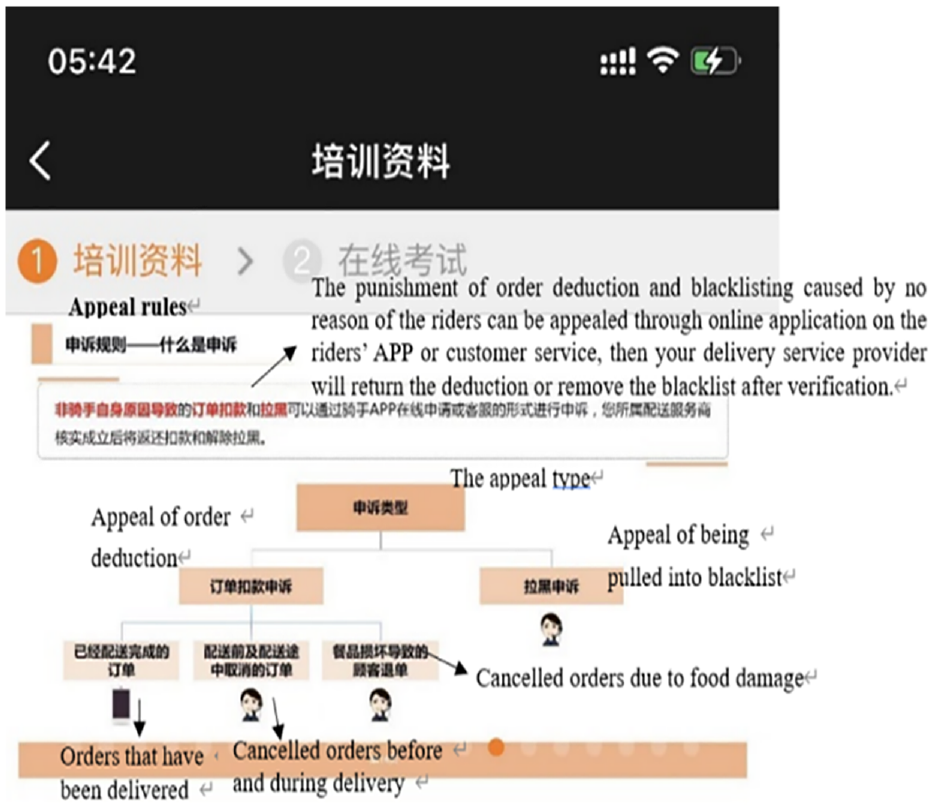
“Liability Exemption and Reward” is based on the appeal rules and reward activities of Meituan involving the process in which the platform feeds back work performance information to the rider in combination with customer evaluation and platform standards, and accordingly takes reward or punishment measures (Zhu et al., 2024). In the context of the pandemic, the dominance of the affective processing mode in the second stage significantly shapes women riders’ attitudes and reactions. Despite its relatively low importance indicated by a sentiment preference score of 37.595 (ranking fifth) and a topic preference score of 0.093 (ranking sixth), the positive utility value of 0.688 suggests that during epidemic period women riders consider it reasonable to provide incentives and protections. After verification, the deduction can be returned or the blocking can be lifted, as shown in Figure 9. During the epidemic, Meituan launched a “liability exemption” rule, which means that the system will automatically eliminate overtime and complaints under special circumstances such as bad weather and accidents. 6 “Rewards” As shown in Figure 10, there will still be rewards during the epidemic. Among them, the keywords that appear the most are “violation,”“deduction,”“cancellation,”“disclaimer,” etc. The platform can respond to the platform rules according to the epidemic situation. During the epidemic period, the platform reduces the punishment rules for women riders, retains the incentive activities, and encourages women riders to deliver while providing convenience for them. However, the ranking in topic preference indicates that these might not fully meet the most pressing practical needs of the women riders. The platform needs to balance encouraging innovation while considering fairness and transparency. This requires taking into account the emotional and practical needs of women riders in rule formulation. In conclusion, under the pandemic backdrop, platforms need to consider emotional factors more in their incentive measures and rulemaking to ensure alignment with the riders’ actual needs and emotional experiences.
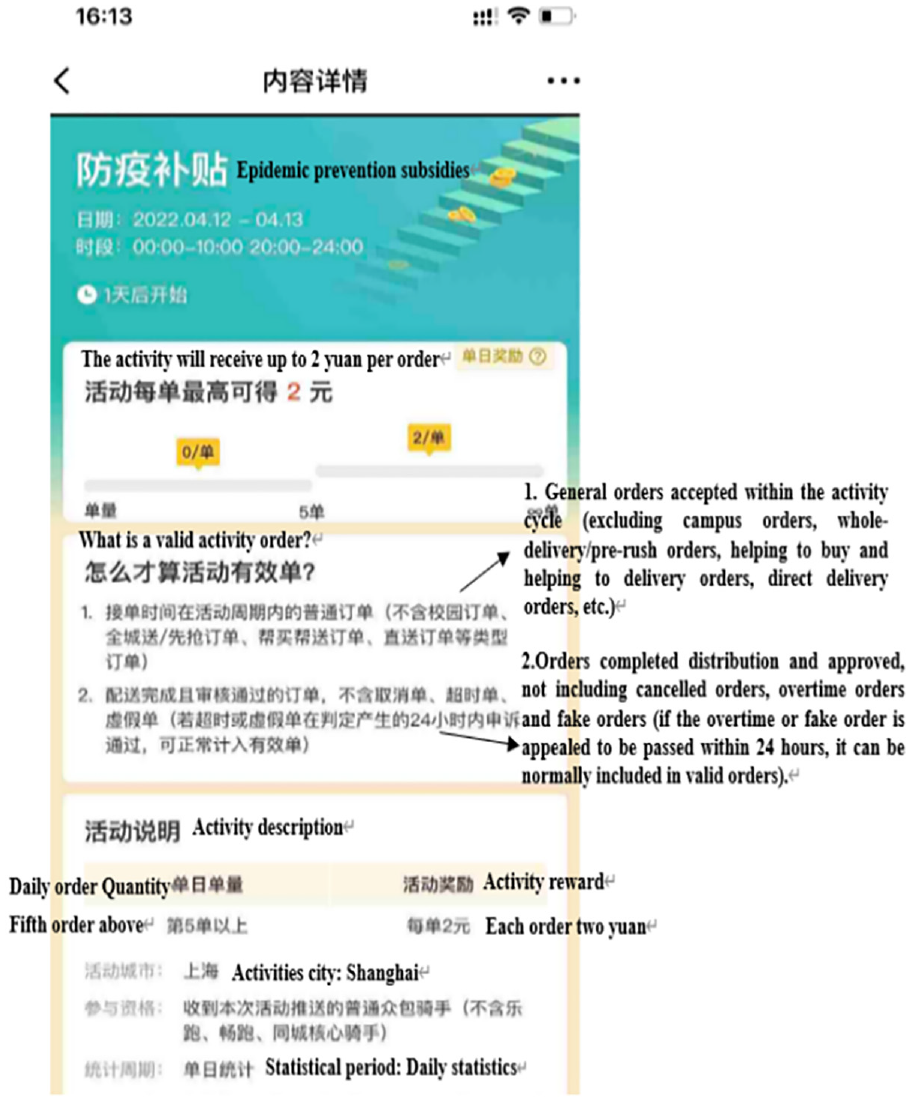
Meituan appeal rules.
Reward activities during the epidemic.
Topic-Sentiment Preference Analysis
Women riders’ topic preference is taken as the abscissa and women riders’ sentiment preference as the ordinate, and the scatter diagram is drawn as shown in Figure 11. Except for the information of reward orders in the fourth quadrant, the rest are in the first quadrant. Women riders’ topic preference degree is concentrated in about 0.1 to 0.2, and there are gradient differences in sentiment preference. According to Shin et al., the results are shown in Figure 11 (M.-C. Chen et al., 2021; Shin et al., 2022).

Coordinates of rider preference.
The first quadrant (O): This quadrant is characterized by a higher coefficient of difficulty in improving women riders’ positive sentiment preference and reducing their negative sentiment preference. Therefore, enhancing the topic in this quadrant, such as sharing and volunteering, epidemic delivery rules, quality of work and life, epidemic control measures, liability exemption and reward, can effectively improve the rider’s sentiment preference. Quadrant 1 is most effective in improving relative efficiency and therefore should be given priority.
The third quadrant (R): this quadrant reported a lower coefficient of positive sentiment preference and negative sentiment preference for women riders; In other words, improving the topic in this quadrant had relatively little effect on the rider’s sentiment preference. It can be seen from 5.1 that the reward order information is for customers and merchants. It can be learned from 5.2 that women riders volunteer to help customers. Therefore, the position of this quadrant indicates that the relationship between women riders and merchants is relatively tense. The platform and the government should take measures to intervene and adjust the relationship between women riders and businessman, so as to achieve the good development of the platform ecosystem.
The Impact of the Probability Weighting Function
Cumulative Prospect Theory involves the subjective perception bias towards probabilities, where individuals tend to overestimate or underestimate low probability events, a phenomenon driven by emotional cognitive biases (Ghader et al., 2019). Comparing original probabilities with weighted probabilities, as shown in Figure 12, serves to analyze the impact of probability weighting on decision-making.

The comparison between original probabilities and weighted probabilities.
After being processed through a probability weighting function, the respective probabilities for “Tip Order Information,”“Sharing and Volunteering,”“Epidemic Delivery Rules,”“Quality of Work and Life,”“Epidemic Control Measures,” and “Liability Exemption and Reward” are 0.368, 0.219, 0.208, 0.206, 0.198, and 0.173. The change as indicated in Figure 11, although “Tip Order Information” has the highest original probability, its weighted probability does not show a significant increase. This might imply that the topic has already established a stable cognition among women riders. For example, it is gleaned from the online comments of women riders that orders with higher tips often signify neighborhoods with “greater infection topics” or involve physically demanding tasks such as “carrying heavy items or climbing stairs.” Which requires women riders to weigh income against health topics or extra work engagement (Puram & Gurumurthy, 2023).
The significantly increased weighted probability of “Liability Exemption and Reward” suggests that women riders might be overestimating the frequency or importance of these policies. This could be because, in terms of economic and job security, exemption and reward policies are extremely crucial (Ye et al., 2012). Women riders are focused on the various policies implemented by the platform to mitigate the impact of the pandemic on their work. These policies may positively influence the riders’ work attitude, motivation, and sense of identification with the platform (Puram & Gurumurthy, 2023).
The markedly increased weighted probability of “Sharing and Volunteering” may reflect the heightened emphasis women riders place on sharing and volunteer activities. During the pandemic, mutual support and collaboration may have become more significant for them, leading to an overestimation of the value and frequency of these activities (N. Zhou et al., 2024). Similarly, the significant increase in the weighted probability of “Epidemic Delivery Rules” of platforms and “Epidemic Control Measures” government-implemented indicate a high level of attention from women riders towards pandemic-specific delivery guidelines, likely because these measures directly affect their work safety and operational efficiency (Weaver et al., 2024). The rise in the weighted probability for “Quality of Work and Life” suggests that riders are particularly sensitive to this theme, with challenging living conditions during the pandemic possibly drawing more focus to this area.
In sum, women riders exhibit a cognitive bias of overestimating their preference for positive utilities, which also reflects a generally optimistic emotional state among them. This optimism may influence their utility preferences, as optimistic individuals are often more willing to take topics (Jiang et al., 2024).
Conclusion
This research provides a nuanced understanding of the preferences of women riders in Shanghai’s real-time crowdsourcing logistics platform during the COVID-19 pandemic. The two hotly discussed reports, “Delivery Knights, Trapped in the System” and “Women Delivery Knights, Surviving in a Male-Dominated System,” show that women riders are at a disadvantage within the system, as the algorithm does not take into account their specific needs such as physical strength, safety, and family responsibilities. Instead, it operates on man dominated standards, increasing workload intensity. This conclusion is consistent with questions we finding, indicating that women riders face unique difficulties and pressures in this field.
Through a comprehensive analysis employing Cumulative Prospect Theory, Information Processing Theory, and Information Diffusion Theory, the research identifies a trend of optimism among women riders, affecting their topic-taking behaviors and utility preferences. The findings reveal the critical importance of social responsibility and adaptability during crises, offering actionable insights for platform managers, government policy-making, and enhancing women riders’ sense of belonging and operational fairness. The study advocates for tailored management strategies and supportive policies to improve operational transparency, fairness, and efficiency in response to public health emergencies.
Theoretical Implications
The theoretical significance of this study is encapsulated in the following aspects:
(1) Multidimensional perspective: Employing theories like Cumulative Prospect Theory, Information Processing Theory, and Information Diffusion Theory, the study provides a comprehensive view of women rider’ preferences.
(2) Cognitive and emotional responses: It explores the cognitive and emotional dynamics of women riders, highlighting their optimistic outlook and its impact on utility preferences.
(3) Social responsibility and adaptability: Emphasizes the importance of adaptability and social responsibility among women riders, especially during pandemics.
Overall, this research offers theoretical support for comprehending the behavioral patterns of women riders in gig logistics platforms and provides a theoretical basis for designing more effective management strategies and support measures.
Practical Implications
The research results of this paper have certain practical significance for real-time crowdsourcing logistics platforms, government departments and women riders during the COVID-19 pandemic.
Recommendations for Real-Time Crowdsourcing Logistics Platforms
At the platform level, the platform management needs to solicit the opinions and suggestions of women riders, and the research results of this paper can be used as a reference for the adjustment of the platform management rules during the outbreak.
(1) Adaptation and support: Platforms should tailor job assignments and provide special support based on women riders’ preferences, enhancing safety and fairness.
(2) Topic management: Develop strategies for topic management and support, considering women riders’ preference and emergency coping mechanisms.
Recommendations for Government Departments
From the perspective of the government, relevant government departments should pay attention to rider preferences and the scientific nature of classification.
(1) Policy development: Create supportive policies for the gig economy, focusing on women worker protection, and fair treatment.
(2) Emergency planning: Incorporate considerations for gig workers, particularly women riders, in emergency response plans.
Recommendationsfor Women Riders
From the perspective of women riders themselves, this paper can assist women riders in exploring their potential needs and improving their sense of belonging.
(1) Exploring needs: Encourage women riders to identify their needs and communicate them, improving their work conditions and emotional support.
(2) Community engagement: Promote participation in communities and support networks to foster a sense of belonging and mutual support within the industry.
These policy recommendations aim to provide a more inclusive, efficient, and fair working and policy environment for real-time crowdsourcing logistics platforms and government departments by adapting to and supporting the specific needs and preferences of women riders.
Research Limitations and Future Prospects
This study, while providing an in-depth exploration of the preferences of women riders during the pandemic, also exhibits certain limitations: Our data shows phase-like characteristics rather than cyclical ones. This may limit the understanding of the long-term trends in the behavior patterns of women riders. Future research could engage in more extensive data analysis to investigate the behavioral changes of women riders over various cycles, aiming for a deeper comprehension of their behavioral patterns.
Footnotes
Acknowledgements
The authors gratefully acknowledge the support of The National Social Science Fund of China. The support of Prof. Benoit from Georgia Institute of Technology during the initial stages of this research is also appreciated. The authors would like to express our sincere gratitude to the reviewer for their thorough review and valuable comments on this manuscript. Your suggestions and guidance have significantly contributed to the improvement of this article.
Declaration of Conflicting Interests
The author(s) declared no potential conflicts of interest with respect to the research, authorship, and/or publication of this article.
Funding
The author(s) disclosed receipt of the following financial support for the research, authorship, and/or publication of this article: This study was funded by The National Social Science Fund of China (Contact number: 22BGL124).
Ethical Approval
All procedures performed in studies involving human participants were in accordance with the ethical standards of the institutional and/or national research committee and with the 1964 Helsinki declaration and its later amendments or comparable ethical standards.
Informed Consent
Informed consent was obtained from all individual participants.

Data Availability Statement
The datasets generated during the current study are available from the corresponding author on reasonable request.