




Abstract
Studyholism (SH) is a new potential clinical condition introduced in 2017 by Loscalzo and Giannini to refer to problematic overstudying, specifying that it might be associated with either high or low Study Engagement (SE). We aimed to analyze SH and SE’s predictive role on academic resilience. We gathered 609 Indonesian youths, and we performed a path analysis model. Among the main findings, SH predicts a lack of academic resilience, while SE predicts higher academic resilience. However, SH and SE do not predict time spent studying, and GPA is negatively (although weakly) predicted by SH only. Hence, we provided support for the critical role of SH and SE in predicting students’ academic success and for implementing preventive and clinical interventions to reduce SH and foster SE, given their impact on academic resilience, which, in turn, influences students’ well-being and academic success. Finally, we recommend future research on Studyholism in non-Western countries.
Introduction
Indonesians are known worldwide for their numerosity (Charities Aid Foundation, 2019), with a population of nearly 300 million (Department of Economic and Social Affairs, 2021) and around 8.5 million active university students (Directorate General of Higher Education, 2020). Given this high number of people (and college students), there is a significant prospect for the country’s long-term development in the economy, education, and health areas, as well as in the quality of life in general. However, this potential is currently hindered by the low quality of Indonesian education, as the ability in language, math, and science is below the standards (OECD, 2019) Moreover, in 2019, around 602.208 Indonesian youths dropped out of university (Directorate General of Higher Education, 2020). Hence, considering the spread of unhappiness among Indonesians (Helliwell et al., 2021) and high early dropout university (Directorate General of Higher Education, 2020), we might assume that the Indonesian academic system led to stress and disengagement in students instead of fostering well-being and study engagement.
Education issues can be analyzed from an external or internal perspective (Reddy et al., 2018). Regarding the external level, the main problem in Indonesian education might be that the curriculum changes with the Minister of Education change, and the competence of teachers must change accordingly (Fitri, 2021; Widodo, 2016), likely resulting in stress in students, who need to adjust to these frequent variations as well. Regarding the internal level, Faradiena (2019) recently shown that Indonesian students tend to be dishonest in academic settings; for example, they have cheating behavior, ask for (forbidden) external help, plagiarize, and use (prohibited) devices during tests. Also, they have a low motivation for studying (Fitriyani et al., 2020; Puthree et al., 2021).
Another important topic to be addressed in Indonesian students at an individual level is academic stress (Stallman, 2010; Stallman & Hurst, 2016), even if it should be noted that it is spread in other countries as well. For instance, Kerr et al. (2004) showed that first-year college students in Philadelphia’s western suburbs might be under heavy study pressure. About Indonesians, Ladapase and Sona (2019) highlighted that they feel that their obligations, such as individual and group assignments—which they usually must do in their first 3 years of study—constitute a disturbing pressure on their mental well-being. Among other academic stressors, it is possible to list attending classes with a busy schedule, often having to do assignments by the end of the day, trying to balance university and personal life, and economic issues. These stressors are closely associated with a greater risk of difficulties in studies and impairment in academic achievement (Misra & McKean, 2000; Ryan et al., 2010). Academic stressors equally affect male and female students (Rohmatillah & Kholifah, 2019), even if there have been a few organizational attempts to reduce student stress (Laras et al., 2022).
At the same time, the Covid-19 outbreak added new pressure on students worldwide (e.g., Alsolais et al., 2021; Bourion-Bédès et al., 2021; von Keyserlingk et al., 2022), including Indonesia (Argaheni, 2020; Carsita et al., 2022; Ginting & Daulay, 2022; Jatira & Suhaili, 2021; Nafrin & Hudaidah, 2021; Syah, 2020). Among the main COVID-related stressors there has been having to study online (UNICEF, 2020), which has been particularly distressful for Indonesian students due to the unstable internet network (Issroviatiningrum et al., 2022) that is ranked last in a list of nine Southeast Asia countries (Giles, 2022).
In conclusion, analyzing academic stress among college students is critical because a psychologically healthy student will be a psychologically healthy worker in the future (Portoghese et al., 2019); hence, detecting students at risk of high stress, disengagement, and dropout is essential to allow them receiving as soon as possible preventive (or clinical) interventions. Therefore, the current study aims to analyze whether Studyholism (i.e., obsession toward study; Loscalzo & Giannini, 2017a) and Study Engagement predict academic resilience to understand if they are variables that preventive and clinical interventions might target to improve academic success among Indonesian college students. The concept of academic resilience represents an academic-specific type of individual resilience (Cassidy, 2016). While resilience generally refers to the individual’s capacity to adapt positively despite adversity (Riley & Masten, 2005), academic resilience specifically concerns the education context (Cassidy, 2016). As Martin and Marsh (2006) pointed out, all students sometimes face academic difficulties during their studies, including poor performance or a significant load. Hence, given the association between academic resilience and students’ well-being and academic success (Bartley et al., 2010; Liew et al., 2018; Martin & Marsh, 2006), knowing how academic resilience might be fostered in students is fundamental.
The Present Study
The term “Studyholism” was introduced in the scientific literature in 2017 to define a new potential clinical condition associated with problematic overstudying (Loscalzo & Giannini, 2017a) and indicate that it is a different construct from Study Addiction (Atroszko et al., 2015). In brief, Atroszko et al. (2015) adopted the behavioral addiction framework; hence, they suggested that Study Addiction is characterized by the seven core components of substance addictions: salience, tolerance, mood modification, relapse, withdrawal, conflict, and problems. Instead, Loscalzo and Giannini (2017a) avoided a confirmatory approach to studying a new potential clinical condition (as suggested by Kardefelt-Winther, 2015). Hence, initially, they supposed that Studyholism might have included both addiction and obsessive features (Loscalzo & Giannini, 2017a). Subsequently, referring to their first research data and critical theoretical reflections, they concluded that Studyholism does not include addictive features. Hence, they conceptualized it as an Obsessive-Compulsive Related Disorder (OCD-related disorder)—or, more generally, as an internalizing disorder (Loscalzo & Giannini, 2017a, 2018). Next, a growing body of literature supported Studyholism conceptualization as an OCD-related disorder or as a clinical condition more similar to an obsessive (or internalizing) rather than an addictive (or externalizing) disorder (Loscalzo, 2021; Loscalzo & Giannini, 2019, 2021, 2022a, 2022b, 2022c).
Another critical difference compared to Study Addiction is in the framework. Referring to the Heavy Work Investment model by Snir and Harpaz (2012), Loscalzo and Giannini (2017a) introduced the concept of Heavy Study Investment (HSI) to distinguish different types of student characterized by a high investment of time and energy in studying: engaged students, disengaged studyholics, and engaged studyholics. Engaged students have high Study Engagement and no Studyholism symptoms; studyholics, instead, might be differentiated into engaged or disengaged studyholics depending on the high or low levels of Study Engagement (both have high Studyholism levels). The distinction between the two types of studyholic is essential. Some differences arose as needed to be addressed for tailored and clinical interventions. As shown recently, disengaged studyholics are more impaired in the psychological, physical, and academic areas; though, the studyholic type most damaged in the social area is the engaged one (Loscalzo, 2021; Loscalzo & Giannini, 2019). Finally, Loscalzo and Giannini (2017a) also specify that there might be students with low levels of both Studyholism and Study Engagement (i.e., detached students).
About Study Engagement, Schaufeli et al. (2002) operationalized this positive study-related behavior as made up of three components, that is, vigor, dedication, and absorption (as derived by the work engagement definition). However, the construct included in the Studyholism model by Loscalzo and Giannini (2017a) and evaluated by their Studyholism Inventory (SI-10; Loscalzo & Giannini, 2020; Loscalzo et al., 2018) also includes (and mainly refers to) intrinsic motivation toward the study. Even if Studyholism is a new construct, growing research showed the need for its further analysis, given that it is widespread among youths (Loscalzo, 2019; Loscalzo & Giannini, 2020), and it might negatively affect the well-being and academic success of students (Loscalzo, 2021; Loscalzo & Giannini, 2019, 2022a).
In this vein, this study aims to analyze if Studyholism predicts lower academic resilience (hypothesis 1), as we expect based on previous literature showing that Studyholism is associated with adverse academic and health outcomes. More specifically, Loscalzo and Giannini (2019) showed that Studyholism in Italian youths is not associated with higher Grade Point Average (GPA), while Loscalzo and Giannini (2020) found a weak negative association with GPA. Still, Studyholism predicts higher dropout intention, negative affect, stress, sleep quality impairment, and daytime sleeping (Loscalzo & Giannini, 2019).
About Study Engagement, it has been suggested that highly engaged students should be screened for social impairment due to study (Loscalzo, 2021; Loscalzo & Giannini, 2019), social anxiety (Loscalzo & Giannini, 2022b), anxiety (Loscalzo & Giannini, 2002a), and paranoid ideation (Loscalzo & Giannini, 2022c). However, it is generally associated with positive outcomes, including a higher GPA and positive affect, and lower dropout intention, stress, and daytime sleepiness (Loscalzo & Giannini, 2019). Therefore, we expect it to be associated with higher academic resilience (hypothesis 2).
Moreover, we test if Studyholism and Study Engagement, as two types of Heavy Study Investment, are positive predictors of time spent studying daily (generally and before exams), as expected based on previous Italian studies (Loscalzo, 2021; Loscalzo & Giannini, 2019). Regarding GPA, Italian studies showed that Study Engagement predicts a higher GPA, while Studyholism does not show a statistically significant association with it (or the association is very low; Loscalzo & Giannini, 2019, 2020). Hence, we hypothesize that Studyholism is a positive predictor of time spent studying and a low negative predictor (or a nonsignificant predictor) of GPA, while Study Engagement is a positive predictor of time spent studying and GPA (hypothesis 3).
Finally, given that this is the first study concerning Studyholism in Indonesian college students, we analyzed the prevalence of Studyholism and the four types of student suggested by Loscalzo and Giannini (2017a): disengaged studyholics, engaged studyholics, engaged students, and detached students.
Methods
Participants
We recruited 609 Indonesian college students (74.4% females) aged between 18 and 39 years (M = 20.72, SD = 1.61). Most of them lived in Medan (70.6%), was full-time (78%) student, and received tuition fee from parents (91.3%), even if a minority pay the fee thanks to their own job (4.8%) or a scholarship (3.9%). There were mostly psychology (67.0%) students, and about half of the participants were in their third year of study (54.0%). Though, there are also students attending other majors: social and political sciences (8.5%), law (8.0%), public health (6.1%), engineering (4.4%), pharmacy (3.9%), agriculture (0.8%), science and technology (0.7%), and economy (0.6%). Moreover, there is also a good number of students in their second (14.5%) and fourth (21.8%) year. The year less represented are the first (5.9%) and, especially, the fifth (2.0%) and sixth (1.8%). In Indonesia, the years 1 to 4 cover the bachelor’s degree, while the years 5 to 6 covers the master’s degree.
Moreover, about half of the sample reported usually studying on the weekend (52.4%), and a minority declared to have repeated a school year before college (1.8%) or to be currently late with college studies (5.3%). Regarding GPA, considering that the Indonesian academic system foresees a five-point grading scale, with 0 corresponding to the lowest grade, 4 to the highest grade, and 2 to a sufficient grade, the participants’ GPA ranges between 2.40 and 4 (M = 3.49 ± 0.28). Regarding time spent studying, generally, they study between 1 and 12 hr per day (M = 3.46 ± 2.30) and between 1 and 7 days per week (M = 4.08 ± 1.60); when preparing for exams, the self-reported time spent studying ranges between 0 and 15 hr per day (M = 3.04 ± 2.17) and, again, 1 and 7 days per week (M = 4.04 ± 1.96).
Materials
Studyholism Inventory-10 (SI-10)
The SI-10 (Loscalzo & Giannini, 2020; Loscalzo et al., 2018) is a 10-item instrument that measures Studyholism and Study Engagement. Each scale comprises five items, one of which is a filler (hence, it is not included in the scoring). An example item for the Studyholism scale is “I cannot relax because of worries about studying.” For Study Engagement, it is “The quality of my studying is a source of pride for me.” The response format is a five-point Likert scale ranging between 1 (Strongly Disagree) and 5 (Strongly Agree). Hence, each SI-10 scale’s score might vary between 4 and 20, with higher scores indicating higher Studyholism/Study Engagement. A head sheet precedes the SI-10 items with questions about studying (e.g., GPA, time spent studying generally and before exams).
For the present study, we used the back-translation procedure to translate the SI-10 (including the head sheet) into Indonesian. Then, aiming to have at least 10 participants for each SI-10 item (i.e., at least 100 participants), we gathered 119 Indonesian students to perform factor analyses on the SI-10 before using it in our study. These participants are between 19 and 31 years old (M = 20.37, SD = 1.39). They are mostly females (80.7%) and living in Medan (66.4%). All participants attended a psychology course, and they were nearly all in their third year (87.4%), with a few representing the first (0.8%), second (2.5%), fourth (5.9%), and fifth (3.4%) year. The GPA ranges between 2 and 4 (M = 3.55 ± 0.28).
Hence, after checking that the variables were normally distributed, we tested the SI-10 two-factor and eight-item model (Maximum Likelihood estimate method) through Confirmatory Factor Analyses (CFAs), and we found a good fit in Indonesian college students: χ2/df = 2.12, p = .003; GFI = 0.92, CFI = 0.94, RMSEA = 0.097, 90% CI [0.055, 0.139]. Then, based on the modification indexes suggestions, we allowed the errors’ correlation between item 5 and item 8. This (positive) correlation is justified as the two items belong both to the Study Engagement factor. Hence, the fit of the model improved: χ2/df = 2.12, p = .073; GFI = 0.95, CFI = 0.97, RMSEA = 0.066, 90% CI [0.000, 0.114]. Moreover, the standardized factor loadings are good; more specifically, the lowest value is for item 7 (0.26), while the other items range between 0.57 (item 5) and 0.91 (item 9). The factors’ correlation is .17. Finally, regarding internal reliability, the alpha value is satisfactory for both the SI-10 scales: Studyholism, α = .68 (item-total correlations ranging between .59 [item 7] and .79 [item 4]); Study Engagement, α = .86 (item-total correlations ranging between .81 [item 5] and .86 [item 8]). In the current sample (n = 609), the α values are .74 (Studyholism) and .86 (Study Engagement).
Academic Resilience Scale (ARS)
We administered the Indonesian version (Kumalasari et al., 2020) of the ARS-30 scale (Cassidy, 2016). The original 30-item scale allows to measure academic resilience through three scales that evaluate different students’ responses in the face of academic difficulties: Perseverance (14 items), that is, the behavioral response; Reflective and Adaptive Seeking (nine items), which corresponds to the cognitive response; and Negative Affect and Emotional Response (seven items), which describes a negative emotional response. The items are preceded by a vignette concerning an academic challenge and struggle. Participants are required to imagine themselves in the situation and then rate each item using a five-point Likert scale ranging from 1 (likely) to 5 (unlikely). For scoring purposes, Cassidy (2016) reverses the positively phrased items to have a higher score indicating higher academic resilience.
The validated Indonesian version of this scale (Kumalasari et al., 2020) presents some differences from the original version. First, it consists of 24 items (instead of 30 items). Even if there are the same three scales as the original version, there are fewer items for each scale: 10 items for Perseverance (e.g., “I would use the situation to motivate myself”), eight items for Reflecting and Adaptive Help-Seeking (e.g., “I would use my past successes to help motivate myself”), and six items for Negative Affect and Emotional Response (e.g., “I would probably get depressed”). Moreover, the response format is a six-point Likert scale ranging between 1 (strongly disagree) and 6 (strongly agree). Finally, the Indonesian scoring does not have items to be reversed. Based on the Indonesian version, higher scores on the Perseverance and Reflective and Adaptive Seeking scales reflect higher academic resilience, while lower scores on the Negative Affect and Emotional Response scale reflect higher academic resilience.
Kumalasari et al. (2020) highlighted a good factor structure for the Indonesian ARS: GFI = 0.979, CFI = 0.919, RMSEA = 0.065, SRMR = 0.053; moreover, he reported the following Cronbach’s alpha for the three scales: Perseverance, .80; Reflective and Adaptive Seeking, .88; Negative Affect and Emotional Response, .77. In the current sample, Cronbach’s alphas are higher: Perseverance, .93; Reflective and Adaptive Seeking, .93; Negative Affect and Emotional Response, .92.
Procedure
Before collecting data, we got ethical approval from the Faculty of Psychology Medan University. Then, adopting a cross-sectional study design, we spread an online questionnaire containing sociodemographic data (e.g., gender, major of study, year of study), the SI-10, and the ARS-30. On the first page of the questionnaire, it has been asked for the participants’ Informed Consent by checking a box stating if they agreed (or not) to participate in the research.
Data Analysis
We conducted the analyses using SPSS.28 and AMOS.22. First—to perform the structural equation model (path analysis model; Maximum Likelihood estimation method) with academic resilience, time spent studying (i.e., hours per day of study generally and before exams), and GPA as outcomes of Studyholism and Study Engagement—we analyzed the normal distribution and the zero-order correlations of the variables included in the model. To evaluate the fit of the model, we used the cut-off values provided by the literature for χ2/df ratio, GFI, CFI, and RMSEA (Byrne, 2001; Hu & Bentler, 1999; Kline, 2016; Reeve et al., 2007).
Then, we calculated the Indonesian SI-10 cut-off scores for high and low Studyholism/Study Engagement using Loscalzo and Giannini’s (2020) approach. More specifically, we calculated the T scores for the SI-10 Studyholism and Study Engagement scales; then, we looked for the raw scores corresponding to −1 SD (or 40 T score) and +1 SD (or 60 T score). Finally, using these cut-off scores, we screened the sample for the four kinds of student suggested by Loscalzo and Giannini (2020): disengaged studyholic, engaged studyholic, engaged student, and detached student.
Results
Path Analysis Model
Preliminarily, we tested Mardia’s coefficient and calculated the descriptive statistics (including skewness and kurtosis) of the variables included in the path analysis model to assess normality assumptions. About Mardia’s coefficient, its critical ratio (i.e., 17.30) suggests that our data might not be normally distributed. However, due to the sensitivity of this test to sample size, Stevens (2009) recommends relying on other descriptive statistics, especially on kurtosis values of the individual variables, which arose as supporting normality. In fact, as shown in Table 1, skewness and kurtosis values range between −1 and +1 for almost all the variables. There are a few minor exceptions concerning time spent studying generally and before exams. However, the highest value corresponds to the kurtosis for hours per day of study before exams (i.e., 3.30), which is well below the value of 5 that Bentler and Wu (2005) indicates as the cut-off value for judging variables as being non-normally distributed. Finally, we checked for multicollinearity between the two independent variables included in the model (i.e., Studyholism and Study Engagement), and the results showed no significant multicollinearity: VIF = 1.067; tolerance = 0.937.
Descriptive Statistics of the Variables Included in the Model (n = 609).
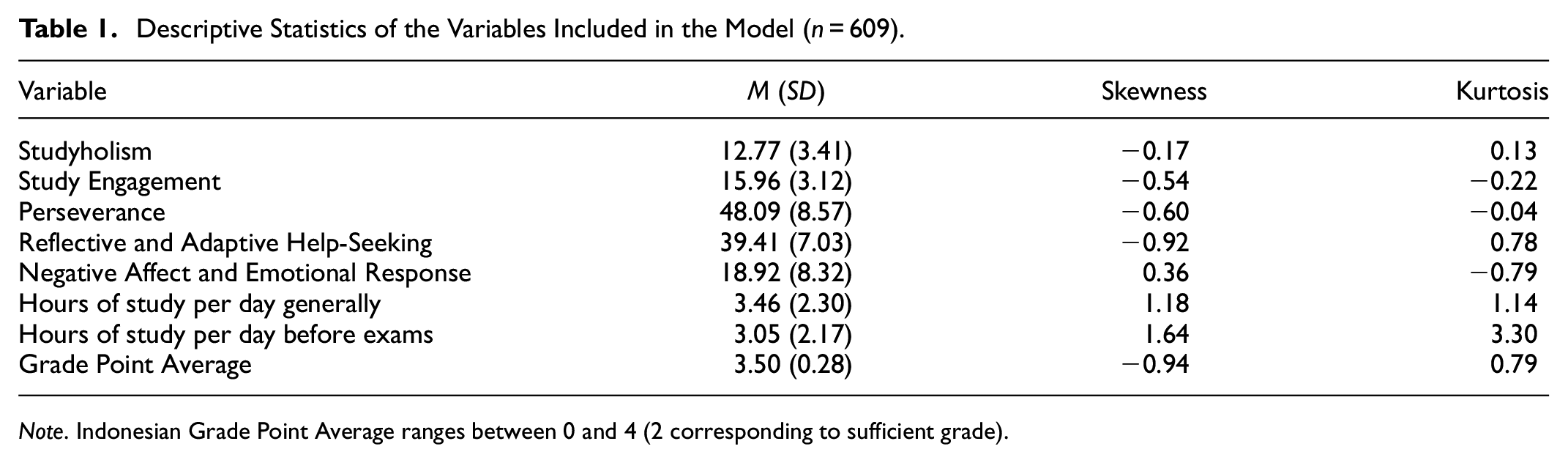
Note. Indonesian Grade Point Average ranges between 0 and 4 (2 corresponding to sufficient grade).
Then, we analyzed the zero-order correlations among all the variables included in the path analysis (see Table 2). In brief, it arises that Studyholism positively correlates with all the ARS variables, with the highest correlation values corresponding to the ARS Negative Affect and Emotional Response scale (r = 0.38). Though, it does not correlate with time spent studying, and it has a low negative correlation with GPA. About Study Engagement, there are only a few statistically significant correlations. More specifically, it positively correlates with Perseverance (r = 0.70) and Reflective and Adaptive Help-Seeking (r = 0.66) from the ARS. There is no statistically significant correlation with time spent studying and GPA.
Descriptive Statistics and Zero-Order Correlation of the Variables Included in the Path Analysis Models, n = 609.

p ≤ .05. **p ≤ .01. ***p ≤ .001.
Finally, we run the model with the ARS scales, time spent studying generally and before exams, and GPA as outcomes of Studyholism and Study Engagement. The model showed an excellent fit to the data: χ2/df = 2.63, p = .005; GFI = 0.99; CFI = 0.99; RMSEA = 0.052, 90% CI = [0.027, 0.078]. Figure 1 graphically shows the results, while Table 3 reports the unstandardized and standardized path estimates for all the variables in the model. In sum, Studyholism positively predicts the ARS Negative Affect and Emotional Response scale. Also, it (weakly) negatively predicts GPA. Study Engagement, instead, is a positive predictor of the ARS Perseverance and Reflective and Adaptive Help-Seeking scales and a (weak) negative predictor of the ARS Negative Affect and Emotional Response scale.
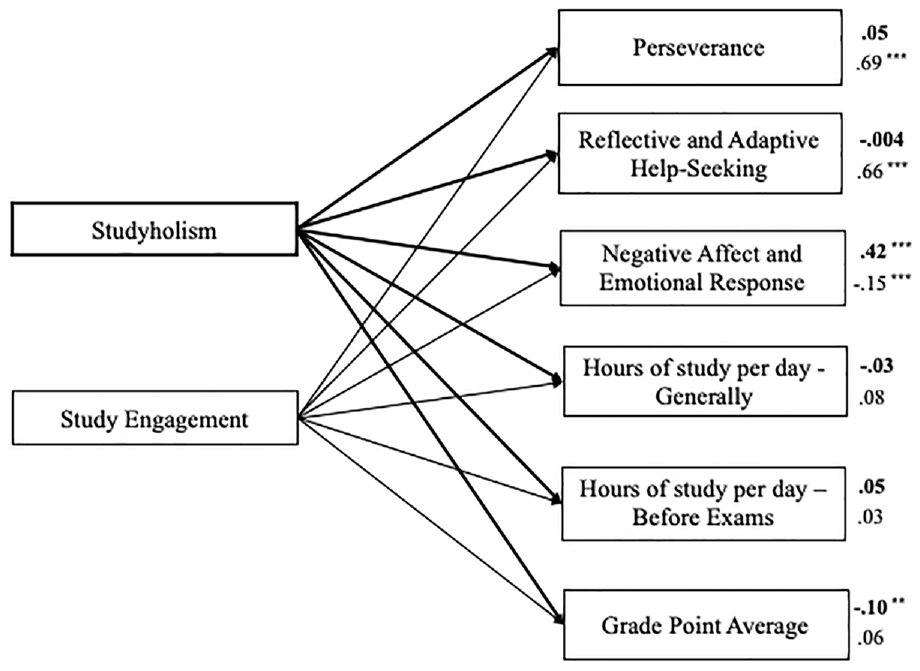
Structural model with standardized path estimates (609).
Path Analysis.

Note. Unstandardized (B) and standardized (β) path weights (n = 609).
About the percentage of variance explained by the model, Perseverance and Reflective and Adaptive Help-Seeking are the variables whose variance is explained the most (respectively, 49.4% and 42.8%), followed by Negative Affect and Emotional Response (16.6%). In line with the p and β values for time spent studying daily generally and before exams and for GPA, the variance explained for these variables is very low, respectively 0.6%, 0.3%, and 1.1%.
The Spread of Studyholism, Study Engagement, and Types of Student
Finally, even if considering that participants are predominantly psychology students in their third year of study (and, therefore, the cut-off we calculated might not be generalized yet), we used Loscalzo and Giannini’s (2020) approach to select the SI-10 cut-off scores for low and high Studyholism/Study Engagement in the current sample of Indonesian college students. More specifically, we selected the raw scores corresponding to −1 SD (i.e., 40 T score) and +1 SD (i.e., 60 T score) for low and high Studyholism/Study Engagement.
Through this calculation, we selected 9 and 16 as the raw scores for low and high Studyholism and 13 and 19 as the raw scores for low and high Study Engagement. Hence, for the SI-10 Studyholism scale, scores between 4 and 8 indicate low Studyholism, and scores between 17 and 20 indicate high Studyholism. Regarding the SI-10 Study Engagement scale, scores between 4 and 12 correspond to low Study Engagement, while 20 corresponds to high Study Engagement.
Using these cut-off scores, we screened our participants, and we found 68 students with low (11.2%) and 70 students with high (11.5%) Studyholism; moreover, there were 106 students with low (17.4%) and 104 students with high (17.1%) Study Engagement. Finally, regarding the four types of student, there are 14 detached students (2.3%), 19 engaged students (3.1%), and 35 engaged studyholics (5.7%). According to the cut-off selected, there are no disengaged studyholics in the present sample.
Discussion
Given the spread of Studyholism (or obsession toward study) among Western college students (Loscalzo, 2019; Loscalzo & Giannini, 2020; Loscalzo et al., 2023) and its downsides (Loscalzo, 2021; Loscalzo & Giannini, 2019), the present study analyzed this new potential clinical condition in a sample of (non-Western) Indonesian college students. More specifically, we examined the relationship of Heavy Study Investment (HSI) with an academic variable that has not been addressed so far by Studyholism literature, namely academic resilience (evaluated using the Academic Resilience Scale—ARS; Cassidy, 2016; Kumalasari et al., 2020). Also, since this is the first study among Indonesian students, we addressed the relationship between HSI and time spent studying and GPA.
First, based on preliminary correlation analyses, we found—as expected—that Studyholism tends to be associated with worse academic resilience. However, even if the highest correlation is with the negative strategy for dealing with academic issues (i.e., ARS Negative Affect and Emotional Response scale), there is a positive correlation also with the two positive aspects evaluated by the ARS, namely Perseverance and Reflective and Adaptative Help-Seeking. Hence, Studyholism is associated with a higher tendency to react negatively to academic issues. Nevertheless, it also correlates positively with perseverance and attempts to find a way to overcome issues. We speculate that these correlations might be explained by referring to Loscalzo and Giannini’s (2017a) assertion that there are studyholics with high levels of co-occurrent Study Engagement, which might prompt them to keep on studying despite difficulties (in line with previous findings about lower dropout intention in engaged studyholics compared to disengaged studyholics: Loscalzo, 2021; Loscalzo & Giannini, 2019).
About Study Engagement, correlation analyses showed that it is associated with better academic resilience. However, while it has a high positive correlation with the two ARS scales relating to positive ways of coping with issues, it does not correlate with the ARS Negative Affect and Emotional Response scale; hence, Study Engagement might not act as a protector against an unfavorable type of coping with academic issues. Therefore, these correlational results suggest that fostering Study Engagement might not be enough to promote academic well-being since Studyholism has a critical role in impairing students’ academic resilience.
Moreover, in contrast to our expectations and with the Italian studies (Loscalzo, 2021; Loscalzo & Giannini, 2019, 2020), Studyholism and Study Engagement do not correlate with time spent studying generally and before exams; also, Studyholism has a low negative correlation with GPA, but Study Engagement is not associated with higher GPA. We might speculate that this is due to the features of the Indonesian academic system. The Italian GPA ranges between 0 and 30 (plus the option of 30 with Laude), while the Indonesian GPA ranges between 0 and 4. Italian sufficiency corresponds to a score of 18, and students might receive grades between 19 and 30 to indicate their increasing competence. Instead, for Indonesian students, a sufficient score corresponds to 2, and they have a narrower range of grades (between 2 and 4) to indicate their increasing competence. Therefore, we might speculate that Italian students feel a higher pressure for overstudying, aiming to get the highest grades, compared to Indonesian students who might have their performance judged only as sufficient (i.e., 2), good (i.e., 3), or excellent (i.e., 4) and, consequently, might dedicate less time to study than Italian students.
Next, to test our hypotheses, we performed a path analysis model that, compared to correlation analyses, enables to analyze a predictor’s effect on an outcome variable while controlling for the influence of all the other variables included in the model. Bearing in mind the possible co-occurrence of Studyholism and Study Engagement in some students (as also highlighted by the low positive correlation found in the current sample), it is imperative to control for the effect of Study Engagement when analyzing the predictive power of Studyholism on the outcome under analysis (and vice versa). In line with this, Loscalzo and Giannini (2017b), in their workaholism comprehensive model, stressed the importance of distinguishing between engaged and disengaged workaholics when analyzing workaholism outcomes since this could help clarify why some studies found positive outcomes associated with workaholism. In the same line, they also proposed distinguishing between the two types of studyholic (Loscalzo & Giannini, 2017a).
The path analysis model supported hypotheses 1 and 2. As hypothesized, Studyholism predicts worse academic resilience, while Study Engagement predicts better academic resilience. More specifically, Studyholism does not predict ARS Perseverance and Reflective and Adaptive Help-Seeking scales (which corresponds to academic resilience). In contrast, it predicts the ARS Negative Affect and Emotional Response scale (which corresponds to the lack of academic resilience). It is interesting to note that, when controlling for Study Engagement, the positive association between Studyholism and academic resilience (highlighted by the correlation analyses) does not appear, advocating the critical role of controlling for Study Engagement and distinguishing between the two types of studyholic (Loscalzo & Giannini, 2017a).
In line with the hypothesis, Study Engagement arises as a positive predictor of academic resilience (ARS Perseverance and Reflective and Adaptive Help-Seeking scales). However, it has a low protective role on negative affect in response to academic issues. Interestingly, this is in line with a previous study that showed that Studyholism is associated with worse mental health (and Study Engagement with better mental health) but that the protective role of Study Engagement for students’ well-being is weaker than the risk posed by Studyholism (Loscalzo & Giannini, 2022a). Hence, we might affirm the importance of preventive and clinical interventions to reduce Studyholism. Fostering Study Engagement is necessary; however, targeting it alone (without also decreasing Studyholism) might not suffice to improve students’ academic success and health.
In sum, in line with our hypotheses and previous studies (Loscalzo, 2021; Loscalzo & Giannini, 2019, 2022a), we confirmed that Studyholism is associated with an impairment in students’ academic functioning, while Study Engagement is associated with better functioning. Also, we extended previous literature concerning the academic outcomes of HSI: studyholics have higher college dropout intention (Loscalzo & Giannini, 2019) but also lower academic resilience. Engaged students have lower college dropout intention (Loscalzo & Giannini, 2019), and they also have higher academic resilience. Hence, reducing Studyholism and increasing Study Engagement is imperative, given their impact on academic resilience, which, in turn, influence students’ well-being and academic success (e.g., Liew et al., 2018). Regarding time spent studying and GPA, we find support only for the expected (low or lack of) association between Studyholism and GPA. More specifically, we found that Studyholism is a low negative predictor of GPA. Instead, Study Engagement does not predict a higher GPA. Studyholism and Study Engagement do not predict time spent studying (both generally and before exams). Concerning GPA, we might suggest that, in Indonesian students, it is even more critical to address Studyholism (rather than Study Engagement) as it also predicts a lower performance. Study Engagement does not seem to be a proper target of interventions to improve Indonesian students’ academic performance, given its lack of predictivity of a higher GPA. As suggested above, HSI’s lack of predictive power on time spent studying (and of Study Engagement on GPA) might be explained by referring to the grading system foreseen by Indonesian colleges. However, we recommend that future studies on Indonesian students address the relationship between HSI, GPA, and time invested in studying to shed light on our results (and the possible explanations for this lack of association).
Finally, given that this is the first study on Indonesian college students, we screened our participants for the spread of high Studyholism/Study Engagement and the four types of student suggested by Loscalzo and Giannini (2017a). Following Loscalzo and Giannini’s (2020) approach, we selected the tentative cut-off scores for high/low Studyholism/Study Engagement. However, gathering a more heterogeneous sample of Indonesian students would be necessary before considering our cut-off scores as definitive. A vast majority of the participants are, in fact, third-year psychology students. Using our cut-off scores, we found a great spread of high Study Engagement and Studyholism, though there is a high spread of low Study Engagement and Studyholism too. Hence, based on this data, we found that Indonesian students are characterized by high levels of Study Engagement that, however, do not seem to protect them against the adverse academic effect of Studyholism. Indeed, Studyholism is also spread, predicting a worse academic resilience among Indonesian youths. Therefore, regardless of the high diffusion of Study Engagement, screening Indonesian students for Studyholism (and providing interventions to reduce it) is imperative to prevent their early dropout from college and functional impairment. In line with this, we also found that there are more engaged studyholics than engaged students in our sample, suggesting that in Indonesian students (or, at least, in the current sample), there is a high spread of co-occurrent high Studyholism and Study Engagement. Also, there are many detached students, pointing out that low Study Engagement is an issue.
In sum, the results about the spread of HSI and the four types of student emphasize the need for a deep analysis of HSI in Indonesian students because a mere analysis of Study Engagement does not allow to show that Studyholism also characterizes Indonesian students, with negative effects on their academic resilience (and, therefore, academic success). Therefore, it would be interesting to address further the analysis of HSI through the Studyholism Inventory (SI-10; Loscalzo & Giannini, 2020; Loscalzo et al., 2018) to understand if the high spread of Study Engagement (especially in the form of engaged Studyholism) is a feature of the current sample or Indonesian college students generally.
Conclusions
In conclusion, despite some limitations, this study has several strengths. Regarding weaknesses, the main is about participants. Even if we gathered many participants, most were females, third-year psychology students. Hence, future studies should deepen the analysis of HSI in a more heterogeneous Indonesian sample for greater generalizability of our findings. As another limitation, we did not gather an objective indicator of academic performance, but we asked for self-reported GPA. It would be interesting to settle longitudinal studies to analyze the effect of Studyholism (and Study Engagement) on objective academic indicators while also designing mediation analysis studies. Finally, given the lack of disengaged studyholics in the present sample of participants, we could not compare engaged and disengaged studyholics on academic resilience to highlight eventual differences between the two studyholic types.
Regarding the main strengths of this study, we introduced the analysis of Studyholism in Southeast Asia, that is, a non-Western country, and we presented in the literature the Indonesian translation of the Studyholism Inventory (SI-10; Loscalzo & Giannini, 2020; Loscalzo et al., 2018) jointly to its fundamental psychometric analyses (supporting its factorial validity on Indonesian college students) and the tentative cut-off scores for high/low Studyholism/Study Engagement. Future studies must gather a more representative sample of Indonesian students to establish the definitive Indonesian SI-10 cut-off scores. Though, our analyses showed that, regardless of a high spread of Study Engagement, the diffusion of Studyholism (especially engaged Studyholism) is an issue to be addressed in Indonesia through preventive and clinical interventions focused on reducing Studyholism (besides fostering Study Engagement). In fact, as Loscalzo and Giannini (2022a) previously found, even if both Studyholism and Study Engagement have an important role as predictors of students’ well-being and academic success, the risk factor posed by Studyholism seems to be higher than the protective role played by Study Engagement. Moreover, the present study extends the scant (even if rapidly growing) literature about Studyholism and its adverse effect on students’ functioning by highlighting its association with lower academic resilience (as opposed to Study Engagement). Finally, considering the (few) different findings when controlling for Study Engagement (i.e., correlation analyses vs. path analysis), it arises the added value of distinguishing between engaged and disengaged studyholics (Loscalzo & Giannini, 2017a) and, therefore, of using a scale that allows evaluating both Studyholism and Study Engagement. In this vein, introducing the Indonesian SI-10 in the scientific literature is a critical first step to prompt further Indonesian studies on this new potential clinical condition. Future studies could also validate the Studyholism Inventory—Extended version (SI-15; Loscalzo & Giannini, 2022d) for a deeper analysis of Studyholism components (i.e., obsessions, compulsions, and social impairment due to study).
Footnotes
Declaration of Conflicting Interests
The author(s) declared no potential conflicts of interest with respect to the research, authorship, and/or publication of this article.
Funding
The author(s) disclosed receipt of the following financial support for the research, authorship, and/or publication of this article: Medan Area University

Data Availability Statement
The dataset analyzed during the current study is available from the corresponding author on reasonable request.